

Introduction
MicroRNAs
The expression of genes at the post-transcriptional level is regulated by microRNAs (miRNAs) and they are considered as single-stranded, short endogenous non-coding RNAs (ncRNAs) with the length of 19–24 nucleotides (Refs Reference Zhang1–Reference Varghese4). Overall, there are three kinds of ncRNAs such as miRNAs, long non-coding RNAs (lncRNAs) and circular RNAs (circRNAs) that regulate vital biological processes in cells such as proliferation, migration, differentiation and angiogenesis (Refs Reference Bautista-Sánchez5–Reference Liang8). In addition to regulating biological processes, miRNAs are involved in modulating metabolic pathways such as lipid, glucose and bone metabolism (Refs Reference Greenhill9–Reference Lian11). Since aberrant expression of miRNAs occurs in different pathological conditions, particularly cancer, studies have focused on targeting these ncRNAs in disease therapy (Refs Reference Ray12, Reference Wang13). A tiny section of genome is formed by protein-coding genes, and it has been reported that miRNAs occupy 1–2% of all genome in different species such as mammals, worms and flies (Ref. Reference Bartel14). The regulation of genes by miRNAs is performed via affecting 3′-untranslated region (3′-UTR) in messenger RNA (mRNA), resulting in gene-expression inhibition (Ref. Reference Ambros15). Noteworthy, it has been shown that miRNAs can also induce gene expression (Ref. Reference O'Brien16). Each miRNA can affect expression level of more than one gene (Ref. Reference Cai17). By abnormal expression of miRNAs, a variety of downstream targets of a certain miRNA undergoes changes in expression that may be in favour of disease development (Refs Reference Lu18–Reference Zhao20). Consequently, experiments have focused on targeting miRNAs in cancer therapy and revealing their relationship with different downstream targets (Ref. Reference Yang21).
SOX family
Sex determining region Y (SRY)-related high-mobility group (HMG) box (SOX) is a family of transcription factors with more than 20 members in vertebrates that are categorised from SOXA to SOXH (Refs Reference Grimm22–Reference Abadi27). Evolutionarily, SOX family members originate from duplication and divergence and were identified a century ago (Refs Reference Bowles, Schepers and Koopman28, Reference Koopman29). SOX genes contain a well-known and specific site, called HMG. It has been reported that HMG is vital for shuttling between nucleoplasm and cytoplasm, and for this purpose, HMG has two autonomous nuclear localisation signals (NLSs) (Ref. Reference Südbeck and Scherer30) and one leucine-rich nuclear export signal (NES) (Ref. Reference Gasca31). HMG is capable of binding to DNA in a sequence-specific manner (Ref. Reference Ashrafizadeh32). A transcription factor is included in SOX family, if it has 50% or higher similarity to HMG domain of Sry (Ref. Reference Schepers, Teasdale and Koopman33). The definitive origin of SOX genes is not certain. However, based on identification of SOX-like genes in unicellular choanoflagellate Monosiga brevicollis, it can be concluded that SOX genes might be transited from unicellular organisms to multicellular ones (Refs Reference Guth and Wegner34, Reference King35). After their discovery, much attention was directed towards SOX proteins, and their function in cancer progression. It is believed that SOX proteins possess both tumour-promoting and tumour-suppressor functions in cancer, so that a certain SOX transcription factor may either induce or suppress cancer progression and viability (Refs Reference Lin36–Reference Li and Li38). This has resulted in much complexity in understanding exact function of SOX proteins in cancer (Refs Reference Mu39–Reference Wuebben and Rizzino43).
Throughout this paper, we reveal associations between miRNAs and SOX2, as a key member of SOX family in different cancers. This review is based on investigating regulatory impact of miRNAs on SOX2 in cancer, that is associated with cancer progression/inhibition. SOX2 is considered as a downstream target of miRNAs in cancer, and revealing their interaction can lead to tumour eradication.
MicroRNAs in oncology: an overview
MiRNAs are considered as master regulators of molecular pathways in cancers (Refs Reference Mirzaei44–Reference Ashrafizadeh49). MiRNA dysregulation is an obvious finding in cancer, and these short ncRNAs are reliable biomarkers for cancer detection and prognosis (Refs Reference Zhang and Ma50, Reference Wu51). For instance, in breast cancer patients, miRNA-221 and miRNA-489 demonstrate upregulation and down-regulation in expression, respectively. The 3-year survival is high in groups with low expression of miRNA-221 and in groups with overexpression of miRNA-489 (Ref. Reference Zhang52). Noteworthy, the expression level of tumour-suppressor miRNAs undergoes down-regulation in cancers. The miRNA-449a and miRNA-145-5p as biomarkers, show a decrease in expression upon endometrial cancer pathogenesis (Ref. Reference Wu53). Consequently, miRNAs are potential non-invasive prognostic factors in cancer (Ref. Reference Danarto54). The miRNAs are able to regulate growth rate of tumours (Ref. Reference Ye55). The miRNA-30a-3p remarkably down-regulates mitotic arrest deficient 2 like 1 (MAD2L1) to trigger G0/G1 arrest in gastric tumour (Ref. Reference Yang56). The miRNA-125 exerts a similar anti-tumour activity in colorectal cancer by down-regulating TAZ and disrupting cancer growth (Ref. Reference Yang56). The response of cancer cells to apoptosis is also regulated by miRNAs. It has been reported that miRNA-922 diminishes sensitivity of gastric cancer cells to apoptosis via suppressors of cytokine signalling 1 (SOCS1) inhibition (Ref. Reference Shayimu57). The metastasis of cancer cells is dually regulated by miRNAs in cancer (Ref. Reference Wang58). The miRNA-624-5p and miRNA-194-5p can induce and suppress migration of tumours, respectively, by targeting signalling networks, including PTPRB and Crk (Refs Reference Liu59, Reference Luo60). Besides, miRNAs determine sensitivity rate of tumours to therapy (Refs Reference Wan61, Reference Chavez-Dominguez62). Hence, understanding miRNA interaction with downstream targets can pave the way to cancer therapy (Refs Reference Zhao63–Reference Zhang65).
SOX2: Structure, function and role in cancer
SOX2 is one of the most well-known members of SOX transcription factors that plays a vital function in reprogramming somatic cells to induced pluripotent stem cells (IPSCs) (Ref. Reference Novak66). SOX2 gene encodes a protein containing 317 amino acids and has been located on chromosome 3 at position of q26.3-27 (Ref. Reference Stevanovic67). The HMG domain of SOX2 is essential for its binding to DNA. Besides, HMG domain of SOX2 has a nuclear localisation and a nuclear export signal. SOX2 is involved in inducing/inhibiting expression of target genes via C-terminal transactivation domain capable of binding and recognising promoter of target gene (Ref. Reference Castillo and Sanchez-Cespedes68). The SOX2 is a vital factor for development and its abnormal expression results in emergence of developmental disorders including anophthalmia−esophageal−genital (AEG) syndrome that is due to heterozygous mutation of SOX2 and subsequent anomalies in development of ectodermal and endodermal tissues (Ref. Reference Weina and Utikal69). The SOXB1 group has three members including SOX1, SOX2 and SOX3 (Ref. Reference Hüser70). The contribution of SOX2 in stem cell maintenance is more confirmed by presence of a pluripotency regulatory network that is formed among SOX2, Oct-4 and Nanog (Refs Reference Boyer71–Reference Kim73).
The SOX2 function in tumours has been confirmed in various experiments (Ref. Reference Hu74). The accumulation of genetic alterations in cells leads to cell cycle changes that are in factor of tumour development. SOX2 gene amplification is an obvious finding in cancer that is due to multiplication of 3q26.3 gene locus (Refs Reference Hussenet75, Reference Albertson76). The SOX2 amplification has been observed in different tumours such as lung cancer, glioblastoma and squamous cell carcinoma (Refs Reference Hussenet75, Reference Annovazzi77–Reference Hussenet and du Manoir79). The SOX2 can also be utilised as a prognostic factor in clinical course. In 14 studies on 2077 colorectal cancer patients, SOX2 overexpression has a positive correlation with tumour stage, distant invasion and unfavourable prognosis (Ref. Reference Zhang80). In respect to the role of SOX2 in cancer metastasis, its down-regulation is of importance in minimising migration of cancer cells. MTA3 can function as upstream regulator of SOX2, suppressing its expression and preventing cancer metastasis (Ref. Reference Du81). In contrast, transmembrane 4 L six family member 1 (TM4SF1) induces SOX2 expression via upregulating Wnt expression, leading to metastasis and epithelial-to-mesenchymal transition (EMT) stimulation in colorectal tumour (Ref. Reference Xiao82).
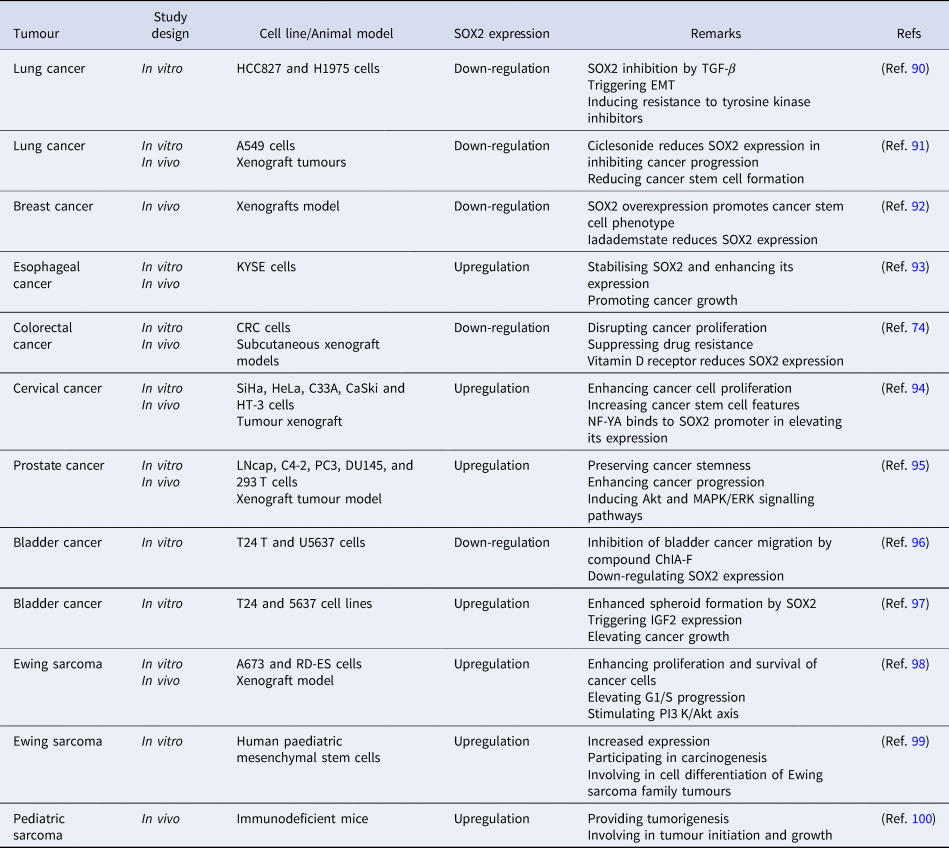
In breast cancer cells, SOX2 overexpression increases brain metastasis via elevating cell adhesion to brain microvascular endothelial cells, transendothelial migration and blood−brain barrier (BBB) invasion, whereas SOX2 down-regulation prevents brain metastasis of breast cancer cells (Ref. Reference Xiao82). In addition to metastasis, SOX2 is involved in cancer growth and viability. Down-regulating SOX2 impairs proliferation of cancer cells and reduces their survival (Refs Reference Chang83, Reference Chandimali84). Based on involvement of SOX2 in cancer growth and invasion, it can be concluded that this transcription factor participates in cancer chemoresistance (Refs Reference Wu85, Reference Terasaki86). Newly published experiments have confirmed this statement. SOX2 can provide intrinsic resistance of melanoma cells to paclitaxel (PTX) by enhancing activity and expression of ATP-binding cassette (ABC) subfamily C member 1 (ABCC1) (Ref. Reference Si87). The ubiquitin-specific protease 34 (USP34) is a deubiquitinase that can induce cisplatin (CP) resistance in laryngeal carcinoma cells by upregulating SOX2 expression and promoting cancer growth and survival (Ref. Reference Dai, Yuan and Cao88). The SOX2 down-regulation by histone deacetylase 11 (HDAC11) inhibitors impairs self-renewal capability and enhances chemosensitivity (Ref. Reference Bora-Singhal89). Table 1 provides a summary of SOX2 role in proliferation, invasion and chemoresistance of different cancers.
Potential role of SOX2 in cancer proliferation, metastasis and chemoresistance

MicroRNAs and SOX2
In previous sections, it was found that miRNAs and SOX2 are two key players in cancer, that dysregulation in their expression can lead to development of cancer. Proliferation, metastasis and therapy response are modulated by SOX2 and miRNAs (Refs Reference Novak101–Reference Xu104). The next parts will describe interaction between miRNA and SOX2, and its impact on cancer malignancy are provided to shed some light on their relationship.
Cancer metastasis
First of all, migratory capacity of tumours is under modulation by miRNAs (Refs Reference Moghbeli105, Reference Yang106). The miRNAs can dually suppress/induce migration of cancers. A number of factors such as Wnt, STAT3 and EMT are affected by miRNAs (Refs Reference Fu107–Reference Huang109). As it was mentioned earlier, SOX2 can positively affect migration of cancer cells (Ref. Reference Liu110). Therefore, tumour-suppressor miRNAs should inhibit SOX2 expression in preventing cancer invasion. The miRNA-590-5p can reduce expression of SOX2 in decreasing stem cell population and impairing breast cancer metastasis. Down-regulation of SOX2 by miRNAs is conducted via binding to 3′-UTR (Ref. Reference Zhou111). The tumours show low expression of miRNAs with anti-tumour activity. Enhancing miRNA-145-5p expression disrupts progression and distant migration of breast tumour via SOX2 down-regulation. Furthermore, miRNA-145-5p overexpression provides favourable prognosis of breast tumour (Ref. Reference Tang112). In increasing migration of cancer cells, SOX2 can affect EMT mechanism. SOX2 overexpression by transcriptional regulator transducin (β)-like 1 X-linked receptor 1 (TBL1XR1) stimulates EMT-mediated invasion in gastric cancer cells, and is associated with chemoresistance (Ref. Reference Liang108). The SOX2 down-regulation significantly diminishes cancer metastasis via EMT inhibition (Ref. Reference Bigdelou113). These studies demonstrate modulatory effect of SOX2 on EMT in cancer cells. Noteworthy, SOX2/EMT axis can be modulated by miRNAs. The miRNA-590-5p reduces SOX2 expression to inhibit EMT via enhancing E-cadherin expression and decreasing vimentin, SNAI1 and SNAI2 expressions (Ref. Reference Chang114).
Bcl-w, a tumour-promoting factor with overexpression in cancers, has a close association with metastasis (Refs Reference Lee115, Reference Lee116). In glioblastoma multiforme, Bcl-w promotes cancer invasion by inducing SOX2 expression. For this purpose, Bcl-w interacts with platelet-derived growth factor-A (PDGF-A) to provide SOX2 upregulation. However, this axis is disrupted by anti-tumour activity of miRNA-340-5p. This ncRNA can down-regulate SOX2 and Bcl-w expression levels that are in favour of inhibiting their interaction. Then, migration and mesenchymal features of glioblastoma cells undergo impairment (Ref. Reference Kim117). Consequently, when expression levels of such tumour-suppressor miRNAs diminishes, an increase occurs in tumour migration by SOX2 upregulation (Ref. Reference Wang118).
The exact function of miRNA-638 in tumour is not certain. It has been reported that miRNA-638 acts as a survival mechanism in inducing malignant behaviour of oesophageal cancer cells via autophagy stimulation (Ref. Reference Ren119). However, there are studies demonstrating tumour-suppressor role of miRNA-638. The miRNA-638 down-regulation through methylation promotes progression of endometrial carcinoma cells (Ref. Reference Ni120). Furthermore, it reduces EZH2 expression in triggering apoptotic cell death and autophagy in liver tumour (Ref. Reference Zhang121). In non-small cell lung tumour, miRNA-638 exerts an anti-tumour activity via regulating SOX2 expression. Enhancing miRNA-638 expression effectively suppresses lung cancer progression and metastasis via SOX2 down-regulation and subsequent inhibition of EMT (Ref. Reference Xia122).
It seems that angiogenesis can be affected by miRNA/SOX2 axis in cancer. The angiogenesis induction can be mediated by molecular pathways such as VEGF to increase tumour progression and metastasis (Ref. Reference Hou123). Since SOX2 upregulation stimulates angiogenesis in tumour, its targeting can provide novel therapeutics (Refs Reference Zhao124, Reference Takahashi125). In colorectal tumour cells, miRNA-450a-5p shows a decrease in expression upon cancer progression. This miRNA suppresses colorectal cancer progression by SOX2 inhibition via binding to 3/-UTR. SOX2 overexpression promotes stemness and angiogenesis of colorectal cancer cells, and also, reduces VE-cadherin expression. These impacts are in favour of cancer invasion, and SOX2 inhibition by miRNA-450a-5p significantly suppresses malignant behaviour of colorectal cancer cells (Ref. Reference Chen126).
Cancer proliferation
Table 1 obviously demonstrates contribution of SOX2 in cancer proliferation and viability. Therefore, the next critical step can be revealing interaction of miRNAs and SOX2 in cancer proliferation to target them, both pharmacologically and genetically, in future studies. In this section, a discussion of miRNA and SOX2 is provided in various cancers.
It seems that for promoting cancer growth and viability by SOX2 upregulation, upstream mediators should be regulated by miRNAs. The Wnt/β-catenin axis is an oncogene factor that can enhance tumour proliferation upon nuclear translocation of β-catenin. Glycogen synthase kinase-3β (GSK-3β) inhibits Wnt signalling by phosphorylating β-catenin, and preventing its nuclear translocation (Refs Reference Zhong and Virshup127, Reference Nguyen128). The activation of Wnt signalling pathway significantly increases viability and malignancy of cancer cells via SOX2 overexpression that is of importance for their stemness (Refs Reference Guo129, Reference Liu130). In prostate cancer, miRNA-1301-3p acts as a tumour-promoting factor and increases stem cell expansion via stimulating Wnt signalling. In this way, miRNA-1301-3p reduces SFRP1 and GSK-3β expression levels to induce nuclear translocation of β-catenin. Then, overexpression of SOX2 occurs by miRNA-1301-3p/Wnt axis to promote stem cell expansion of prostate cancer (Ref. Reference Song131). For activating SOX2 expression and increasing stem cell population, coordination among molecular pathways is necessary. It has been reported that epidermal growth factor (EGF) preserves stem cell population in cervical cancer via inducing PI3 K signalling and subsequent upregulation of SOX2. The miRNA-181a-2-3p shows a decrease in expression in cervical cancer cells. By restoring miRNA-181a-2-3p expression, SOX2 down-regulation occurs due to EGF inhibition. Hence, a coordination between miRNA-181a-2-3p and EGF/PI3 K/SOX2 is vital in which miRNA down-regulation leads to final upregulation of SOX2 in increasing cancer progression (Ref. Reference Chhabra132). In addition, miRNAs cooperate in modulating SOX2 expression and CSC features. It has been reported that simultaneous upregulation of miRNA-21 and down-regulation of miRNA-145 are essential in SOX2 overexpression and maintaining CSC features and cancer proliferation (Ref. Reference Yu133). In contrast, tumour-suppressor miRNAs such as miRNA-15a suppress stemness and growth of cancer cells via SOX2 inhibition (Ref. Reference Gopalan134). These studies clearly demonstrate that miRNA and SOX2 interaction is of interest in regulating growth and proliferation of different cancers (Ref. Reference Rahimi135).
The self-renewal capacity of cancer cells mainly depends on SOX2 expression. The miRNA-27b can suppress self-renewal capability of colorectal cancer stem cells in vitro via down-regulating SOX2 expression (Ref. Reference Chen136). One of the complexities related to miRNAs is that their exact role is not certain, and they may exert various functions, both tumour-promoting and tumour-suppressor roles in cancers. For instance, miRNA-589-5p negatively affects growth and migration of prostate tumours. The decreased expression of miRNA-589-5p occurs in prostate tumour and elevating its expression disrupts cancer growth and invasion via chemokine (C-C motif) ligand 5 (CCL-5) inhibition (Ref. Reference Ji137). However, another study emphasises on tumour-promoting activity of miRNA-589-5p that is mediated via stimulating STAT3 signalling and triggering chemoresistance (Ref. Reference Long138). In hepatocellular carcinoma, miRNA-589-5p exerts a tumour-suppressor role via affecting SOX2 expression. In this way, miRNA-589-5p decreases mitogen-activated protein kinase kinase kinase 8 (MAP3K8) expression at mRNA level to inhibit SOX2 expression. This axis prevents carcinogenesis and tumour spheroid formation capacity in hepatocellular carcinoma (Ref. Reference Zhang139). As a hint, it should be noted that SOX2 can also modulate miRNA expression in ensuring cancer development (Refs Reference Liu140, Reference Picon-Ruiz141).
It has been reported that miRNA and SOX2 interaction can be utilised for predicting progression of cancer cells. In prostate cancer, miRNA-34b demonstrates a reduction in expression that mediates progression of this life-threatening disease by enhancing stemness through SOX2 overexpression (Ref. Reference Forno142). SOX2 not only promotes stemness of cancer cells, but also provides their uncontrolled proliferation and tumour sphere formation. Consequently, when SOX2 down-regulation occurs by tumour-suppressor miRNAs such as miRNA-451, their viability and growth demonstrate a significant decrease (Ref. Reference Mamoori143). In clinical studies, relationship between miRNA and SOX2 determines prognosis. The miRNA-1181 has low expression in prostate cancer patients that mediates undesirable prognosis and low survival through promoting stem cell-like phenotypes via SOX2 overexpression (Ref. Reference Jiang144). These studies are in agreement with positive correlation of SOX2 with cancer stemness and proliferation, and its regulation by miRNAs.
Insulin-like growth factor 2 (IGF2) is a tumour-promoting molecule in tumours including hepatocellular carcinoma (Ref. Reference Adamek and Kasprzak145). It has been reported that IGF2 upregulation enhances sphere-forming activity of cancer cells and is associated with carcinogenesis in vivo (Ref. Reference Tominaga146). The IGF2 transcription can be epigenetically regulated, since IGF2 overexpression occurs due to impairment in DNA methylation of IGF2 promoter (Ref. Reference Martinez-Quetglas147). In hepatocellular carcinoma, down-regulation of miRNA-100 and miRNA-125b paves the way for IGF2 overexpression and increasing CSC properties via SOX2 upregulation (Ref. Reference Seol148). Restoring expression of miRNA-125b and miRNA-100 can reduce SOX2 expression via suppressing IGF2. One of the signalling pathways in cancer progression is Wnt/β-catenin (Ref. Reference Ashrafizadeh149). The stimulation of Wnt signalling by SOX2 leads to tumour progression (Refs Reference Tang, Wang and Gu150, Reference Tang151). In breast cancer stem cells, the interaction between SOX2 and β-catenin ensures their self-renewal capability. It has been reported that miRNA-208a can upregulate expression of SOX2 to induce β-catenin and promote self-renewal capacity (Ref. Reference Sun152). These studies demonstrate that miRNAs can target other molecular pathways such as IGF2 in affecting SOX2 expression in cancer. Furthermore, miRNAs can target SOX2 in affecting molecular pathways required for cancer progression. These kinds of interactions promote complexity of signalling networks.
One of the interesting interactions in cancer is observed between EMT and SOX2. SOX2 elevates tumour migration via EMT stimulation, and in turn, EMT enhances aggressive behaviour of tumours via SOX2 induction (Refs Reference Migita153, Reference Liu154). These dual associations are of importance for increasing cancer progression. A recent experiment has demonstrated that SOX2 and EMT interaction can be affected by miRNA-147. The miRNA-147 has low expression in colon tumour and increasing its expression can dually suppress proliferation (SOX2 inhibition) and metastasis (EMT inhibition). The miRNA-147 down-regulation enhances invasion of colon tumour via EMT stimulation. Subsequently, EMT promotes proliferation via SOX2 upregulation (Ref. Reference Ning155). The expression level of miRNAs can be affected in a methylation-dependent manner. For instance, down-regulation of miRNA-296-5p occurs in glioblastoma stem cells via DNA methylation. Then, high mobility group A1 (HMGA1) enhances SOX2 expression to enhance stemness of cancer cells (Ref. Reference Lopez-Bertoni156). The miRNAs with anti-tumour activity, significantly diminish expression level of SOX2 in impairing cancer proliferation (Ref. Reference Ozen157).
Cancer chemo- and radio-therapy
In respect to the role of SOX2 in increasing cancer proliferation and metastasis, it can be concluded that SOX2 may have a close relationship with resistance of cancer cells to therapy, since an increase in growth, viability and migration provides condition for obtaining resistance (Refs Reference Ashrafizadeh158–Reference Ashrafizadeh161). Experiments have confirmed involvement of SOX2 in stimulating chemo- and radio-resistance. In case of drug resistance, SOX2 can stimulate Wnt5a/β-catenin signalling pathway (Ref. Reference Liu162). Reducing SOX2 expression and its destabilisation, for instance via inhibiting phosphatidylinositol 3-kinase (PI3 K)/protein kinase B (Akt) axis is of importance in reversing resistance of lymphoma cells to therapy (Ref. Reference Wu85). In triggering radioresistance, SOX2 promotes expression of Hedgehog signalling by occupying HHAT promoter (Ref. Reference Huang163). Studies have examined association between miRNAs and SOX2, and its relationship with chemo- and radio-therapy response is discussed in this section. Noteworthy, SOX2 can provide resistance of tumours to immunotherapy via suppressing STAT3 signalling and inducing immune evasion (Ref. Reference Wu85). However, there is no study about relationship between miRNA/SOX axis and response to immunotherapy that can be considered in future experiments.
CP is an anti-tumour agent capable of stimulating cell death and DNA damage in cancer cells (Ref. Reference Mirzaei164). A variety of factors have been recognised to be involved in triggering CP resistance, and SOX2 is one of them. In lung cancer, a significant decrease occurs in expression of hsa-miRNA-340-5p that subsequently, mediates overexpression of SOX2, and emergence of CP resistance (Ref. Reference Cui165). By restoring expression of tumour-suppressor miRNAs such as miRNA-450b-5p, expression level of SOX2 undergoes down-regulation. Then, sphere-forming capacity and stemness of cancer cells decrease. This is in favour of 5-fluorouracil (5-FU) chemo-sensitivity, reducing cell viability, inducing DNA damage and increasing apoptosis via caspase-3 upregulation (Ref. Reference Jin166). The factors that can regulate CSC properties of cancer cells such as TMED3 are affected by miRNAs in reversing chemoresistance. For instance, miRNA-876-3p down-regulates expression of TMED3 in gastric cancer cells that mediates a decrease in SOX2 expression and enhancing CP sensitivity (Ref. Reference Peng167).
PTX is another chemotherapeutic agent with anti-tumour activity against various tumours including breast tumour, glioblastoma, lung cancer and cervical cancer (Ref. Reference Shakhwar168). Upregulation of SOX2 leads to PTX resistance via PI3 K/Akt induction (Refs Reference Li169, Reference Li170). In breast cancer cells and tissues, miRNA-145-5p demonstrates a decrease in expression, leading to tumour cell growth and metastasis, as well as PTX chemo-resistance. Enhancing miRNA-145-5p is associated with PTX sensitivity of breast tumour via SOX2 inhibition, and impairing their growth and migration (Ref. Reference Guan and Guan171). A same story occurs for miRNA-200c-3p in PTX-resistant breast tumour cells (MCF-7). The miRNA-200c-3p down-regulation increases breast tumour progression via SOX2 overexpression that is in favour of PTX resistance (Ref. Reference Chen172). Consequently, identification of miRNAs with regulatory effect on SOX2 can be of importance in increasing efficacy of cancer chemotherapy (Ref. Reference Jiang173).
The miRNA-106a function in chemotherapy has not been completely understood. Although studies demonstrate that miRNA-106a has low expression in chemo-resistant-tumour cells and elevating its expression is correlated with chemosensitivity (Refs Reference Liu174, Reference Guo175), a recent study demonstrated miRNA-106a function in providing drug resistance via JAK2/STAT3 axis induction (Ref. Reference Guo176). In colorectal cancer cells, miRNA-106a follows a unique pathway in triggering 5-FU resistance. In this way, miRNA-106a enhances expression of cyclooxygenase-2 (COX-2) via dual-specificity phosphatase 2 (DUSP2) inhibition. Then, stemness of cancer cells increases due to SOX2 overexpression, leading to emergence of 5-FU resistance (Ref. Reference Qin177).
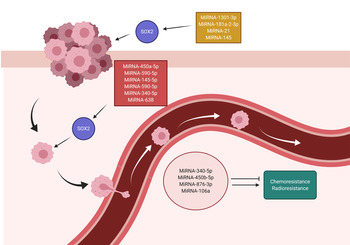
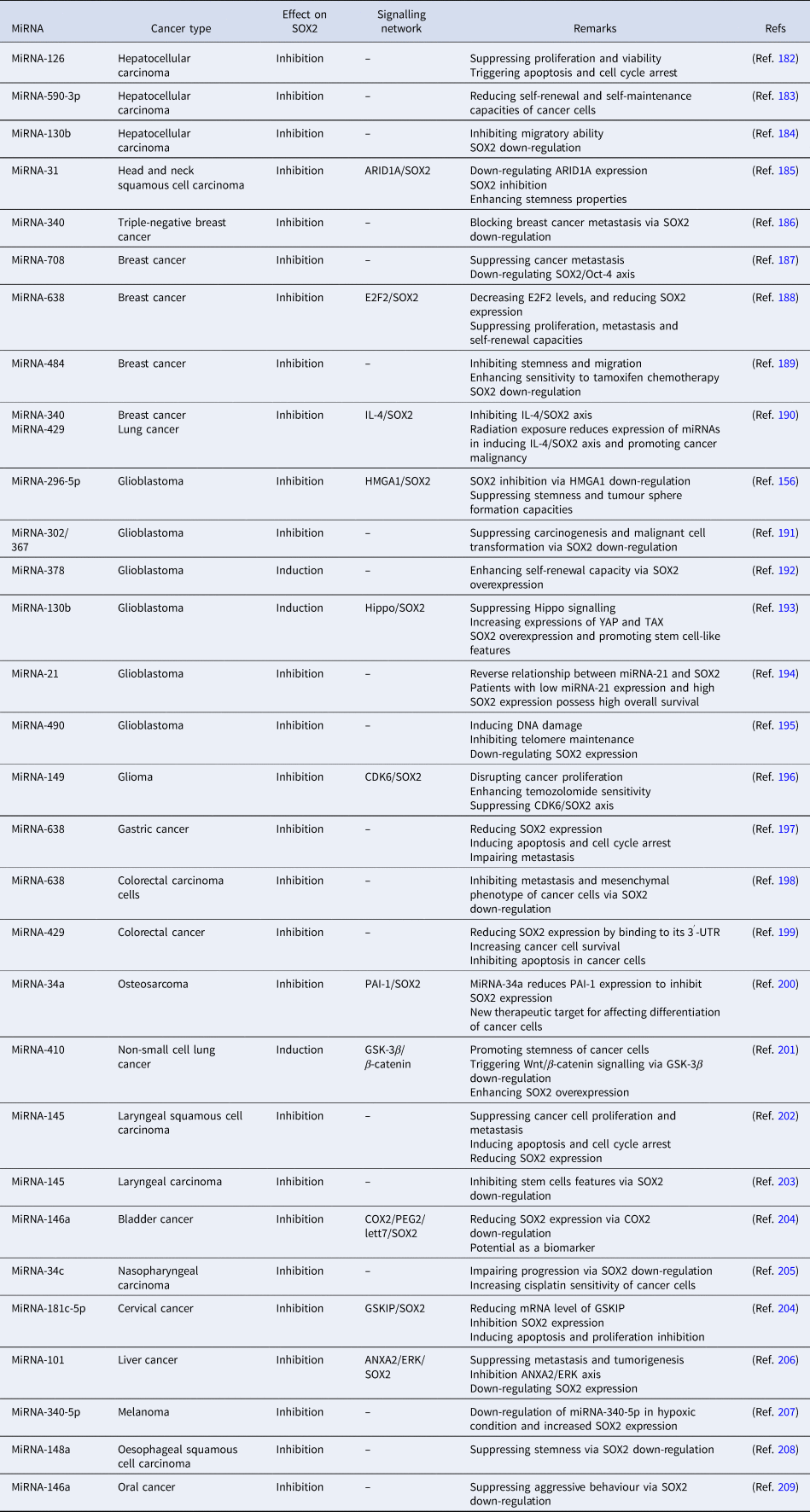
In case of radioresistance, miRNAs can target SOX2 as a stem cell factor. The miRNA-106b is a driver of different cancers, promoting both proliferation and metastasis, and can target various molecular pathways such as PTEN and FAT4 (Refs Reference Wang178–Reference Sun180). In colorectal cancer cells, miRNA-106b mediates chemoresistance via increasing colony sphere formation and upregulation of stemness factors such as SOX2 (Ref. Reference Zheng181). Although a few studies have investigated regulation of SOX2 by miRNAs in radiotherapy response, based on involvement of SOX2 in cancer progression and malignancy, this interaction should be more examined in revealing molecular pathways that are responsible for radioresistance of cancer cells (Fig. 1 and Table 2).
MiRNAs in regulating proliferation, metastasis and therapy response of cancer cells. MiRNAs can induce SOX2 in increasing stemness, proliferation and migration of cancer cells to distant sites. Identification of such pathways and their targeting are of importance in effective cancer therapy. MiRNA, microRNA.

MiRNAs as modulators of SOX2 in affecting growth, migration and therapy response of cancer cells

Upstream mediators
Long non-coding RNAs
The epigenetic regulation of human pathophysiology is performed by lncRNAs and it seems that lncRNAs contribute to carcinogenesis (Refs Reference Zuo210–Reference Wu212). These kinds of ncRNAs have more than 200 nucleotides in length and lack protein-coding capacity. For years, lncRNAs were considered as transcription noise, but further experiments revealed role of these factors in cancer progression/inhibition (Refs Reference Sheng213, Reference Shuai214). LncRNAs have both pro-survival and pro-death functions. For instance, lncRNA LINC00511 shows high expression level in breast tumour. Overexpression of this lncRNA provides unfavourable prognosis. In order to increase tumorigenesis and stemness of breast tumour cells, lncRNA LINC00511 diminishes miRNA-185-3p expression by acting as ceRNA. Then, E2F1 as a down-stream target undergoes activation that further, promotes stem cell features of breast tumour via SOX2 upregulation (Ref. Reference Lu215). Noteworthy, SOX2 not only enhances metastasis and growth of cancer cells, but also increases CSC properties (Ref. Reference Zhang216). In lung cancer cells, lncRNA ROS elevates growth and metastasis by activating p53, subsequent decrease in miRNA-145 expression, and promoting SOX2 expression. Furthermore, this axis enhances CSC properties of lung cancer cells (Ref. Reference Xia, Xiong and Li217).
LncRNA FOXD2-AS1 is a driver of cancer development increasing migration via miRNA-25-3p down-regulation (Ref. Reference Zhang218). Furthermore, FOXD2-AS1 induces hepatoma-derived growth factor (HDGF) via miRNA-760 down-regulation to increase tumour progression (Ref. Reference Dou219). The lncRNA FOXD2-AS1 affects different miRNAs in cancers. In breast cancer cells, lncRNA FOXD2-AS1 increases expression of profilin 2 (PFN2) via inhibiting miRNA-150-5p expression. Consequently, condition is provided for promoting breast cancer malignancy via SOX2 upregulation, as a stem cell factor (Ref. Reference Jiang220). It appears that there is a close association between SOX2, as stem cell factor, and metastatic factors such as EMT. These factors can positively affect expression of each other in promoting cancer progression. Hence, revealing their relationship can be of importance for targeting a novel signalling network for disrupting cancer proliferation and metastasis.
The EMT is induced by increasing vimentin and N-cadherin levels, and reducing E-cadherin (Refs Reference Lee221, Reference Hwang222). The zinc-finger E homeobox-binding 1 (ZEB1) is an inducer of EMT in enhancing cancer metastasis and invasion (Refs Reference Ji223, Reference Feng224). In pancreatic cancer cells, lncRNA linc-DYNC2H1-4 diminishes miRNA-145 expression through sponging. Then, activation of ZEB1 occurs that not only promotes cancer metastasis via EMT, but also enhances cancer progression via SOX2 upregulation (Ref. Reference Gao225). In previous sections, it was shown that SOX2 can also affect miRNAs in cancer. The SOX2/miRNA axis can also be affected by lncRNAs. In this way, lncRNA ES1 increases proliferation and cell cycle progression of breast tumour. Furthermore, ES1 participates in increasing breast cancer metastasis via EMT induction. These tumorigenesis impacts are mediated via inducing Oct-4/SOX2 axis, and increasing expression of miRNA-302, since silencing ES1 down-regulates expressions of SOX2 and its downstream target miRNA-302 (Ref. Reference Keshavarz and Asadi226).
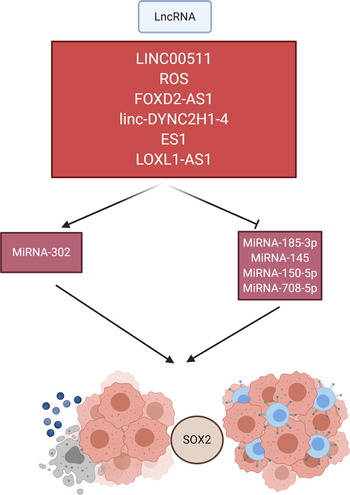
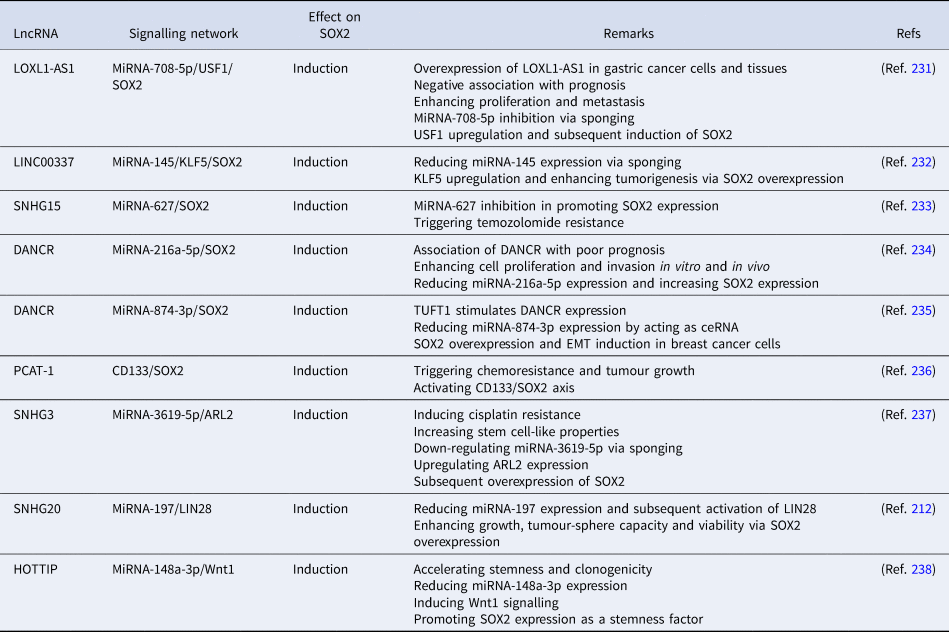
LncRNA ATB mediates miRNA-141-3p down-regulation to elevate colorectal tumour progression (Ref. Reference Li227). Furthermore, lncRNA ATB can provide ignorance of tumours towards apoptosis via miRNA-200c inhibition (Ref. Reference Gao228). These studies demonstrate modulatory effects of ATB on cancer proliferation and migration via targeting miRNAs. In endometrial cancer cells and tissues, lncRNA ATB demonstrates upregulation to increase tumour differentiation. This lncRNA reduces miRNA-126 to induce PIK3R2/SOX2 axis, resulting in proliferation, apoptosis inhibition (caspase-3 down-regulation) and cell cycle progression (Ref. Reference Zheng229). LncRNA Plasmacytoma Variant Translocation 1 (PVT1) enhances cancer stem cell-like features of nasopharyngeal cancer via miRNA-1207 down-regulation and subsequent upregulation of SOX2 in promoting viability and proliferation (Fig. 2 and Table 3) (Ref. Reference Cui230).
LncRNAs as potential regulators of miRNA/SOX2 axis in cancer. LncRNA, long non-coding RNA; miRNA, microRNA.

LncRNAs as upstream mediators of miRNA/SOX2 axis in cancer

Compounds targeting miRNA/SOX2 axis
Anti-cancer agents can affect miRNA/SOX2 axis in cancer therapy. This impact can be beneficial in limiting cancer progression. However, the results are not always in line with cancer inhibition. Vitamin C is considered as a well-known anti-cancer agent in tumour treatment with efficacy of potentiating immunotherapy (Ref. Reference Lorenzato239). Furthermore, vitamin C restricts progression of cancer cells and enhances their sensitivity to cancer chemotherapy (Refs Reference Lorenzato239, Reference Gregoraszczuk240). However, administration of vitamin C exerts carcinogenesis effect. Vitamin C stimulates reprogramming of breast cancer cells, and enhances expression of miRNA-302-367 members. This restores proliferative and metastatic capabilities of breast cancer cells via EMT induction and SOX2 overexpression (Ref. Reference Ramezankhani, Taha and Javeri241).
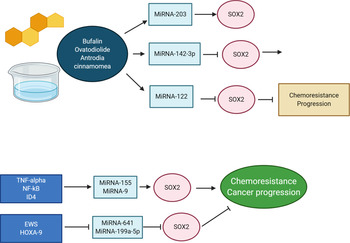
Bufalin is a cardiotonic steroid derived from ChanSu, a toad venom (Ref. Reference Slingerland242). Bufalin has demonstrated anti-tumour activity against different cancers by targeting molecular pathways. Bufalin induces apoptosis and proliferation inhibition via Axl down-regulation in lung cancer (Ref. Reference Kim243). The PI3 K/Akt and mammalian target of rapamycin (mTOR)/HIF-1α are other molecular pathways down-regulated by bufalin in cancer therapy (Refs Reference Qian244, Reference Su245). In glioma cells, bufalin significantly promotes expression of miRNA-203 as a tumour-suppressing factor. Then, the way is paved for suppressing CSC features of glioma cells via SOX2 overexpression (Ref. Reference Liu246). Therefore, anti-tumour compounds may possess epigenetic regulatory effects that are of importance in cancer therapy.
Antrodia cinnamomea (AC) is a photophobic fungus with parasitic behaviour that develops in the inner wall of Cinnamomum kanehirai (Ref. Reference Chen247). It has been reported that bioactive compounds present in AC possess anti-tumour activity against colon and oral cancers via triggering apoptosis (Refs Reference Yue248, Reference Yeh249). A recently published study has shown potential of AC in enhancing sensitivity of colon cancer cells to 5-FU chemotherapy. In this way, AC enhances expression of miRNA-142-3p that has anti-tumour activity against colon cancer cells. Then, a decrease occurs in viability, proliferation, stemness and colony formation via SOX2 down-regulation (Ref. Reference Huang250).
Ovatodiolide (Ova) is a natural diterpenoid derived from Anisomeles indica with anti-tumour activity against a wide variety of cancers. Ova administration is of importance in suppressing clonogenicity and chemoresistance via inhibiting miRNA-21/STAT3/β-catenin (Ref. Reference Chen251). It can induce apoptosis in cervical cancer cells via NF-κB down-regulation (Ref. Reference Ashrafizadeh252). Furthermore, Ova stimulates cell cycle arrest in prostate cancer cells via inhibiting Ras/Raf axis (Ref. Reference Jia253). Ova administration enhances expression of miRNA-122 to inhibit stemness, cancer cell viability and resistance to imatinib therapy. The ability of cancer cells in forming spheres decreases and apoptosis induction occurs via enhancing Bax/Bcl-2 ratio. Furthermore, Ova reduces SOX2 expression in disrupting stemness of chronic myeloid leukaemia stem cells (Ref. Reference Tu254). Although anti-tumour compounds have potentiality in suppressing cancer progression via affecting miRNA-SOX2 axis, they also have some drawbacks. Poor bioavailability and presence of biological barriers in cancer cells reduce efficacy of anti-tumour compounds. For overcoming these challenges, nanoformulations have been designed for delivery of anti-tumour agents (Refs Reference Mirzaei159, Reference Ashrafizadeh255, Reference Ashrafizadeh256). Dendrosomes significantly increase bioavailability of curcumin in glioblastoma therapy. Dendrosomal curcumin promotes miRNA-145 expression to suppress glioblastoma stemness via SOX2 down-regulation (Ref. Reference Tahmasebi Mirgani257). Therefore, application of anti-tumour compounds as modulators of miRNA/SOX2 axis is of interest in cancer therapy (Refs Reference Fu258, Reference Zhang259).
Other molecular pathways
One of the interesting points is regulation of miRNA/SOX2 axis by other kinds of SOX family members such as SOX17. The SOX17 increases sensitivity of oesophageal cancer cells to chemotherapy and radiotherapy via inducing DNA damage and preventing DNA repair (Ref. Reference Kuo260). SOX2 overexpression induces cell cycle arrest in breast cancer cells via down-regulating Cyclin A2, Cyclin B1 and Cyclin D1 (Ref. Reference Xiong261). SOX2 down-regulation increases cancer progression and is associated with poor prognosis (Ref. Reference Kuo262). In colorectal cancer cells, SOX17 enhances expression of miRNA-371-5p as a tumour-suppressing factor. Then, this miRNA reduces SOX2 expression to decrease stemness of cancer cells (Ref. Reference Li263). This study demonstrates how a SOX transcription factor affects miRNAs in targeting SOX2 in cancer.
One of the hallmarks of cancer is chronic inflammation. Increasing evidence demonstrates involvement of inflammation in promoting cancer progression. Tumour necrosis factor-α (TNF-α) is a pro-inflammatory cytokine that enhances cancer metastasis via interacting with interleukin-33 (IL-33) (Ref. Reference Zhou264). Furthermore, TNF-α enhances NF-κB expression to promote breast cancer proliferation (Ref. Reference Lin265). Interestingly, TNF-α can affect SOX2 expression via targeting miRNAs. In osteosarcoma cancer stem cells, TNF-α increases miRNA-155 as a tumour-promoting factor and generates a positive feedback loop. The TNF-α/miRNA-155 axis participates in obtaining CSC feature of osteosarcoma cells via SOX2 upregulation (Ref. Reference Yao266). NF-κB can also increase miRNA-155 expression in promoting CSC feature via SOX2 upregulation (Ref. Reference Chen267). In addition to proliferation, apoptosis is affected by miRNA/OX2 axis. For instance, in osteosarcoma, ewing sarcoma breakpoint region 1 gene (EWS) reduces expression level of tumour-suppressor factor miRNA-199a-5p to induce SOX2 expression. Then, proliferation rate of cancer cells increases and they obtain resistance to apoptosis (Ref. Reference He and Ding268). That is why SOX2 overexpression is in favour of chemoresistance, since chemotherapeutic agents are not able to induce apoptosis in cancer cells. Such association has been explored in action of inhibitor of DNA binding factor 4 (ID4). Paracrine signalling of breast cancer cells stimulates ID4 expression in tumour-associated macrophages to promote invasive behaviour of cancer cells (Ref. Reference Donzelli269). ID4 can trigger chemoresistance of breast cancer cells via enhancing activity of drug transporters (Ref. Reference Lin265). In glioma cells, miRNA-9 suppresses SOX2 expression to induce chemoresistance and cancer stemness. ID4 as an upstream mediator, provides miRNA-9 down-regulation to induce SOX2 expression, resulting in overexpression of ABCC3 and ABCC6 as drug transporters involved in chemoresistance (Ref. Reference Jeon270).
In previous sections, it was mentioned that lncRNAs can regulate miRNA/SOX2 expression in cancers. Noteworthy, it seems that circRNAs are other regulators of miRNA/SOX2 in cancer. CircRNAs play a key role in development and progression of cancer (Ref. Reference Caiment271). They possess some distinct features including high stability, presence of covalently closed continuous loop, lack of 5′ to 3′ polarity and polyadenylated tail (Ref. Reference Chen and Yang272). The hsa_circ_0103809 has demonstrated a tumour-promoting role in hepatocellular carcinoma capable of enhancing cancer proliferation and metastasis as well as inhibiting apoptosis. The hsa_circ_0103809 reduces expression of miRNA-490-5p to upregulate SOX2 expression, leading to cancer growth, viability and invasion (Ref. Reference Cai273). Response of cancer cells to CP chemotherapy is regulated by circRNAs and their effect on miRNA/SOX2 axis. As a tumour-promoting factor, circRNA CDR1as enhances expression of homeobox protein Hox-A9 (HOXA9) via miRNA-641 down-regulation, leading to CP resistance and malignancy of non-small cell lung cancer cells via SOX2 overexpression (Fig. 3) (Ref. Reference Zhao274).
Anti-tumour compounds and other upstream mediators of miRNA/SOX2 axis in cancer. MiRNA, microRNA; TNF, tumour necrosis factor; NF-kB, nuclear factor-kappaB; EWS, ewing sarcoma breakpoint region 1 gene; HOXA-9, homeobox protein Hox-A9; ID4, inhibitor of DNA binding factor 4.

MiRNAs, SOX2 and tumour microenvironment
Tumour microenvironment (TME) has two major sections including extracellular matrix (ECM) and stromal cells (Refs Reference Yang275, Reference Jiang, Wang and Zhou276). In ECM, there are chemokines, pro-inflammatory factors, matrix metalloproteinases (MMPs), and stromal cells consist of cancer cells, CSC, pericytes, endothelial cells, cancer-associated fibroblasts (CAFs) and immune cells (Ref. Reference Hanahan and Weinberg277). The metabolism in TME is completely competing among the cells (Ref. Reference Bader, Voss and Rathmell278). The vasculature condition of TME is poor that provides some challenges for providing enough energy and also, removing waste materials. Therefore, a competition occurs among cancer cells that require high amount of energy for division, and immune cells that need energy for providing anti-tumour activity (Refs Reference Pavlova and Thompson279, Reference DeBerardinis and Chandel280). TME remarkably participates in cancer progression and it is one of the important targets in cancer therapy (Refs Reference Hanahan and Weinberg277, Reference Hanahan and Coussens281, Reference Quail and Joyce282).
Recent years, much attention has been directed towards role of hypoxia in cancer. Hypoxia is capable of regulating proliferation, migration, survival and apoptosis in cancer development (Refs Reference Xiong283, Reference Ma284). Upon hypoxia, activation of HIF-1α occurs that subsequently, translocates to nucleus, affecting expression level of genes containing hypoxia-responsive elements (HREs) (Ref. Reference Bister285). In addition to HIF-1α, other molecular pathways such as NF-κB, STAT3 and mTOR activated (Refs Reference Rius286–Reference Noman288). Importantly, there are interactions between SOX2 and hypoxia in cancer. It has been reported that SOX2 expression undergoes upregulation in hypoxic condition in a time-dependent manner. Then, SOX2 activates HIF-1α signalling to increase breast cancer metastasis (Ref. Reference Wang289). Hypoxia-mediated SOX2 overexpression also enhances colony formation capacity of cancer cells. The SOX2 upregulation is vital for cellular functions of hypoxia in cancer (Ref. Reference Bae290).
It has been reported that SOX2 is vital for lung metastasis of breast cancer cells. Further investigation reveals that SOX2 affects tumour-associated macrophages (TAMs) in providing cancer metastasis. In this case, SOX2 recruits TAMs to induce STAT3 and NF-κB signalling pathways, resulting in lung metastasis of breast cancer cells. TAMs rescue compromised lung metastasis caused by SOX2 inhibition, showing that TAM activation is vital for metastasis induction by SOX2 (Ref. Reference Mou291). By providing acidic microenvironment for colorectal cancer cells, a decrease occurs in proliferation and drug sensitivity enhances due to transcriptional suppression of SOX2 (Ref. Reference Lei292). Similarly, miRNAs are key players in TME and can dually inhibit/increase cancer progression via affecting TME and its components. For instance, miRNA-149 impairs cancer migration and invasion via suppressing M2 macrophage infiltration in TME (Ref. Reference Sánchez-González293). MiRNA-216a inhibits interaction of cancer cells with CAFs to suppress breast cancer progression (Ref. Reference Roscigno294). The studies highlight the fact that SOX2 and miRNAs can affect TME components, such interaction was mentioned about SOX2 and recruiting macrophages.
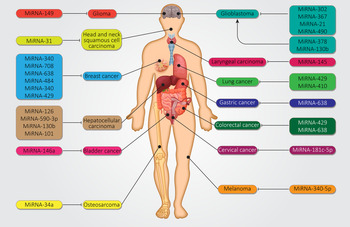
Noteworthy, a few of the experiments have shown the miRNA/SOX2 signalling pathway in TME of cancer cells. The miRNA-21-5p undergoes upregulation in glioblastoma and it is associated with chemoresistance. The miRNA-21-5p diminishes M2 polarisation of macrophages. In drug-resistant-glioblastoma cells, SOX2 shows an increase in expression and although this study has shown the role of miRNA-21-5p in TME and affecting cancer progression, there is no examination of their interaction (Ref. Reference Chuang295). Another experiment clearly investigates the role of miRNA/SOX2 axis in immunosuppression. In this way, lncRNA prostate cancer-associated transcript-1 (PCAT-1) induces CAF/myofibroblast secretion in TME by providing fibroblast differentiation via activating CD133/SOX2 axis. This is a consequence of upregulating expression levels of miRNA-182 and miRNA-217 as immunosuppressor factors (Ref. Reference Domvri236). Platelet-derived growth factor-A (PDGF-A) is a tumour-promoting factor in TME that undergoes upregulation by SOX2. The miRNA-340-5 can suppress progression of glioblastoma cells via down-regulating SOX2 and subsequent inhibition of mesenchymal features (Ref. Reference Kim117). Overall, SOX2 and miRNA interaction occurs in TME, and their expression (both SOX2 and miRNA) is regulated by TME not cancer cells (Ref. Reference Li233), and future experiments can focus on identification of more miRNAs regulating SOX2 and developing novel therapeutics for its targeting in the near future. Figure 4 represents miRNA/SOX2 axis and related molecular pathways in different cancers.
Regulation of SOX2 by miRNAs in different cancers.

Concluding remarks
In the present review, a comprehensive discussion of miRNAs and SOX2 interaction was provided to shed some light on their relationship and paves the way for developing novel therapeutic targets in cancer therapy, as a life-threatening disease. Metastasis of cancer cells is tightly regulated by miRNA-SOX2 axis. The interesting point is that SOX2 as a stemness factor, can induce EMT in enhancing metastasis of cancer cells. The miRNA-590-5p, −340-5p, −638 and −450a-5p are among miRNAs that regulate SOX2 in inducing/suppressing cancer metastasis. The most important action of SOX2 can be explored in cancer proliferation and viability. SOX2 is downstream target of tumour-promoting factors such as Wnt in enhancing stemness and growth of cancer cells. The miRNA-1301-3p, −181a-2-3p, −145, −27b and −589-5p can regulate SOX2 in affecting survival and stemness of cancer cells.
As it was mentioned previously, SOX2 plays a significant role in developing resistance of cancer cells to radiotherapy and chemotherapy. This phenomenon occurs as a result of increased cancer proliferation and invasion upon SOX2 upregulation. SOX2 overexpression stimulates resistance to CP, PTX and 5-FU chemotherapy. The miRNAs can either inhibit or induce chemoresistance via regulating SOX2 expression.
It seems that there are upstream mediators capable of regulating miRNA/SOX2 axis in cancer cells. LncRNAs are the most important regulators of miRNA/SOX2 axis that can affect SOX2 expression by reducing miRNA expression via acting as a ceRNA. Anti-tumour agents such as bufalin, AC and Ova can diminish SOX2 expression in suppressing cancer progression. Other molecular pathways such as circRNA, ID4, SOX17, NF-κB and TNF-α can regulate miRNA-SOX2 axis in cancer cells. However, more studies are needed to reveal miRNAs and SOX2 interaction in cancers.
Although a wide variety of experiments have been performed in the field of cancer therapy, cancer is still an increasing challenge to public health (Refs Reference Brockmueller296–Reference Buhrmann300). This is due to the fact that clinical translation of current findings has been ignored. This review discussed SOX2 and miRNA interaction as the key player in the progression of different cancers. The in vitro and in vivo studies have confirmed this notion. However, there is no clinical study showing the role of miRNA and SOX2 interaction in cancer patients and its association with survival and prognosis. Noteworthy, there are studies evaluating SOX2 expression in cancers. For instance, SOX2 overexpression occurs in nuclei of lung cancer cells and it can be considered as a biomarker for non-small cell lung cancer diagnosis and therapy (Ref. Reference Li301). Furthermore, its upregulation enhances migration of liver cancer cells and is associated with poor survival of liver cancer patients (Ref. Reference Sun302). The findings of present review can be used for cancer diagnosis and determining prognosis, as well as developing novel therapeutics for targeting miRNA and SOX2 interaction. Future studies will shed more light on this signalling network. Another issue is related to expression difference in cancer cells and tissues. An experiment conducted by Kanopka and colleagues demonstrates differences between mRNA expression of Fas and Rac in gastrointestinal cells and tissues (Ref. Reference Jakubauskienė303). The next experiments can demonstrate if the expression level of miRNA/SOX2 is various in cancer cells and tissues or not. Such investigation is of importance for further application of miRNA/SOX2 axis in cancer diagnosis and prognosis.
Data
Not applicable.
Acknowledgements
The graphical abstract and figures 1–3 were drawn by Biorender software (biorender.com/).
Authors’ contributions
M.A, H.K and M.N participated in the design of outline and concept. A.Z (Ali.Zarrabi) performed software works. M.A, H.S, M.E, S.M, MH.G, F.H, A.Z (Amirhossein.Zabolian), K.H, S.S and AR.A prepared the first draft.
Financial support
No funding.
Conflict of interest
The authors have declared no conflict of interest.
Ethical standards
Not applicable.
Consent for publication
Not applicable.