1. Introduction: Second language acquisition, instructed second language acquisition, and second language pedagogy
A frequent topic of position papers in applied linguistics is the research-pedagogy interface. Over the years, there have been multiple assessments of how far apart or close together research and language teaching are or should be with varying degrees of optimism for the future. This article contributes to that ongoing conversation in what we hope is a novel and constructive way. We address the issue of inter-relatedness of research and teaching by dividing research into linguistics, second language acquisition (SLA)Footnote 1, and instructed second language acquisition (ISLA). We similarly divide language teaching into the teaching activities that we find in ISLA studies and language instruction. Moreover, we approach this typically broad topic in a concrete way: We ask how cross-linguistic research on the second language acquisition of tense and aspect has influenced language instruction on tense and aspect and whether pedagogical proposals have integrated findings from SLA research.
The relationship between SLA research and language teaching has been extensively problematized (e.g., Byrnes, Reference Byrnes2019; Gass, Reference Gass, Schwieter and Benati2019). There is also growing interest in the multilateral connections between practice, research, and evidence-based pedagogy (DeKeyser & Prieto Botana, Reference DeKeyser and Prieto Botana2019; Ellis, Reference Ellis2015; Gass, Reference Gass, Schwieter and Benati2019; Loewen & Sato, Reference Loewen, Sato, Loewen and Sato2017a, Reference Loewen and Sato2017b; Sato & Loewen, Reference Sato and Loewen2019; Tomlinson & Masuhara, Reference Tomlinson and Masuhara2021). Ellis (Reference Ellis2015) and Ellis and Shintani (Reference Ellis and Shintani2014) claimed that the relationship between teaching and research can be examined at least in three ways: (a) applying research findings to language-teaching practice in the classroom, (b) identifying teaching problems and examining them from the perspective of SLA, or (c) promoting action research.
Following the recommendation of Ellis (Reference Ellis2015) and Ellis and Shintani (Reference Ellis and Shintani2014), we integrate perspectives (a) and (b) by identifying a problematic area of language teaching in a number of languages—namely, the teaching of tense-aspect forms and meanings—and we use it as a lens to focus our discussion away from general statements of principle to concrete examples that illustrate what an integration of perspectives can offer. More specifically we attempt to provide answers to the following questions by investigating instructional effect studies and pedagogical proposals:
1. Do instructional effect studies and pedagogical proposals with tense-aspect as the target of investigation provide a linguistic description of the tense-aspect target?
2. Do instructional effect studies and pedagogical proposals with tense-aspect as the target of investigation engage with the SLA literature on tense-aspect acquisition?
3. Do instructional effect studies and pedagogical proposals with tense-aspect as the target of investigation implement results from SLA literature on tense-aspect to design assessment or instruction?
4. Do instructional effect studies with tense-aspect as the target of investigation include an elaborated description of the instruction provided to learners? Do pedagogical proposals provide teaching materials informed by research?
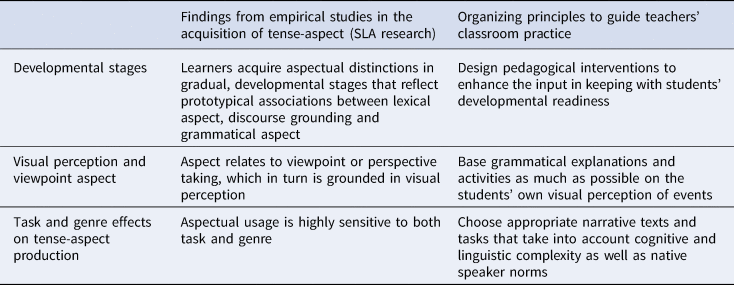
Current discussions of the connection between research and language pedagogy center around two main issues: (a) the epistemological status of the disciplines involved in language learning and teaching, and (b) the different ways in which language researchers and teachers engage with research and its applicability to language teaching. Table 1 presents a summary of linguistics, SLA, ISLA, and language teaching as they are defined in the current article and as they contribute to the acquisition and teaching of tense and aspect. The double-headed arrow at the top of the table suggests that research on tense-aspect in SLA and language teaching can be situated at different points of a continuum that goes from purely linguistic research to language teaching.
Contributions of linguistics, SLA, ISLA, and language teaching in research on the teaching of L2 tense-aspect

Of the four disciplines in Table 1, ISLA is the relative newcomer. ISLA includes—but is not limited to—studies of the effect of instruction on acquisition. Although there are a range of definitions of ISLA in the literature (Byrnes, Reference Byrnes2019; Leow, Reference Leow2019a, Reference Leow2019b; Loewen, Reference Loewen2015, Reference Loewen2020; Loewen & Sato, Reference Loewen, Sato, Loewen and Sato2017a, Reference Loewen and Sato2017b, Reference Loewen, Sato and Gao2019; Long, Reference Long2017; Sok et al., Reference Sok, Kang and Han2019), all the definitions would include instructional effect studies as ISLA. Instructional effect studies have the goal of implementing specific instruction and measuring the learning outcomes. They typically conduct a pretest to determine the level of learner knowledge before instruction and a posttest to determine if there were learning gains. They may also have a control group. Such studies may be conducted in language classrooms (Mackey, Reference Mackey, Loewen and Sato2017), as were the studies reviewed here. We refer to studies on the teaching of tense-aspect as ISLA research even though the authors of the studies themselves may not have identified their work as such. In the early 2000s, such research was still identified as SLA research prior to the use of the designation ‘ISLA’ as we know it today.
Our search methodology for the studies that investigated the acquisition and teaching of tense-aspect did not take the category ‘ISLA’ as its point of departure, but rather more general terms, such as acquisition, tense, aspect, and instruction, hoping that such an approach would allow us to find all relevant studies dealing with the acquisition of tense-aspect via instruction and the pedagogical proposals that influence such instruction.
As shown in Figure 1, research engagement was considered present when studies and proposals included linguistic descriptions of tense-aspect systems, cited SLA research, or used SLA research to design instructional materials; it was absent when studies or proposals included no reference to linguistics or SLA research. The connection between research and teaching was examined through the lens of Borg's (Reference Borg2010) language teacher engagement with research, defined as reading and using research for the classroom (cf. engagement in research; that is, doing the research).
Engagement with research and the teaching of tense-aspect

2. Why tense and aspect?
Tense and aspect is not only an area that is repeatedly identified as a challenge to second and foreign language pedagogy by professionals involved in language instruction, but it is also the site of active theoretical inquiry (e.g., Binnick, Reference Binnick2012), SLA research (e.g. Bardovi-Harlig & Comajoan-Colomé, Reference Bardovi-Harlig and Comajoan-Colomé2020), and ISLA research (e.g., the 56 studies in Review 1 of this article). Moreover, tense-aspect morphology is a standard part of the language teaching curriculum internationally, so in addition to receiving ongoing attention in the literature (e.g., the 38 pedagogical proposals in Review 2 in this article), it is also of practical importance to language teachers world-wide.
In 2020, we completed a 20th anniversary review of research on the second language acquisition of tense and aspect, focusing on the Aspect Hypothesis, the single most researched hypothesis in the area of tense and aspect (Bardovi-Harlig, Reference Bardovi-Harlig1999; Bardovi-Harlig & Comajoan-Colomé, Reference Bardovi-Harlig and Comajoan-Colomé2020). As we were coming to the end of that project, a colleague challenged us to think about whether the prolific research on second language (L2) tense-aspect acquisition was reflected in second and foreign language instruction. A previous review of early instructional effect studies concerning tense-aspect reported in Bardovi-Harlig (Reference Bardovi-Harlig2000, Chapter 6, The effect of instruction) showed close alignment between the instruction presented in those studies and SLA research on tense-aspect.
Bardovi-Harlig (Reference Bardovi-Harlig2000) reviewed five studies that had the goal of helping learners make form-meaning associations within the tense-aspect system. The studies showed a range of instructional approaches, including a functional approach that focused on discourse, in which student output focused on both language and content (Harley, Reference Harley1989), use of an input flood with focused noticing (Bardovi-Harlig, Reference Bardovi-Harlig, Eckman, Highland, Lee, Mileham and Weber1995), processing instruction (Cadierno, Reference Cadierno1995), and focus on form in a science class (Doughty & Varela, Reference Doughty, Varela, Doughty and Williams1998) and in a language class (Leeman et al., Reference Leeman, Artegoitia, Fridman, Doughty and Schmidt1995). The studies reviewed also included a range of forms with past reference, including the French passé composé and imparfait (Harley, Reference Harley1989), regular and stem changing preterites in Spanish (Cadierno, Reference Cadierno1995), preterite and imperfect in Spanish (Leeman et al., Reference Leeman, Artegoitia, Fridman, Doughty and Schmidt1995), the past tense in English (Bardovi-Harlig, Reference Bardovi-Harlig, Eckman, Highland, Lee, Mileham and Weber1995), and past and conditional past in English (Doughty & Varela, Reference Doughty, Varela, Doughty and Williams1998).
The picture that emerged is that the tense-aspect system responds favorably to a variety of instructional approaches. In three of the studies (Bardovi-Harlig, Reference Bardovi-Harlig, Eckman, Highland, Lee, Mileham and Weber1995; Doughty & Varela, Reference Doughty, Varela, Doughty and Williams1998; Leeman et al., Reference Leeman, Artegoitia, Fridman, Doughty and Schmidt1995), progress was interpreted to include not merely target-like use, which represents the endpoint of the acquisitional process, but advancement along the tense-aspect acquisitional sequence. Harley's scoring of the interviews was of particular interest because it focused on what she called the ‘"difficult" questions that required the use of the imparfait in association with action verbs’ (p. 343); in other words, the imparfait with nonstative verbs.Footnote 2 The acquisitional sequences that were reported for learners who received the experimental instruction were similar to those found in tense-aspect acquisition studies.
Based on the early review, coupled with an increase in tense-aspect research in the last 20 years, we expected to find concomitant attention to tense and aspect in research that studied the effect of instruction and in pedagogical proposals in the same time frame. We had three reasons to expect an increase in reference to SLA studies on tense and aspect in ISLA research: (a) early studies on the effect of instruction on tense-aspect showed those studies to be attuned to L2 tense-aspect research, (b) there has been a significant increase in the number of tense-aspect second language acquisition studies, and (c) tense and aspect have frequently been identified (and still are identified) as an ongoing area of interest and concern to teachers of foreign and second languages, teacher educators, and researchers.
With the goal of documenting the effect of SLA research (on tense-aspect) on ISLA and pedagogy, we undertook a systematic review of instructional effect studies and pedagogical proposals. Where we had expected, perhaps somewhat naively, to discover research on the effects of instruction and pedagogical proposals that clearly reflected the findings of two decades of research into the second language acquisition of tense and aspect, we instead found a much more nuanced state of affairs that caused us to question the relationship among SLA, ISLA, and language teaching, which we report in the two reviews in the present article.
In the introductory section that follows, we briefly describe tense-aspect systems and key findings from tense-aspect L2 acquisition research. Section 3 reports on the review of the instructional effect studies (Review 1), answering each of our guiding questions, and the review of the pedagogical proposals (Review 2), addressing the same questions. In Section 4, we discuss the current state of affairs from the perspective of the researching and teaching of tense-aspect cross-linguistically, and where we might be headed.
2.1 Tense and aspect systems: Definitions
Tense-aspect systems can be described using three main concepts: tense, grammatical aspect, and lexical aspect.Footnote 3 Teachers and researchers alike are most familiar with tense. Tense establishes the location of an event in time (Comrie, Reference Comrie1985). Time can be divided in a number of ways, and one way of thinking about tense is in relation to the time of speaking. In many Western languages, we think of the time of speaking (present), before the time of speaking (past), and after the time of speaking (future). Many, but not all, languages have corresponding ways of expressing these concepts. Verbal morphology that indicates when an event occurred is generally referred to as tense.Footnote 4
Grammatical aspect does not refer to the timeline, like tense, but rather it allows speakers to indicate how they view a situation or ‘ways of viewing the internal temporal constituency of a situation’ (Comrie, Reference Comrie1976, p. 3).Footnote 5 Because of this, grammatical aspect is also called viewpoint aspect (Smith, Reference Smith1983, Reference Smith1997). Table 2 illustrates aspectual past morphology in English, Japanese, and Romance languages (Spanish, French, and Italian).
Grammatical aspect in the past in three language groups

Note: Adapted from Bardovi-Harlig & Comajoan-Colomé, (Reference Bardovi-Harlig and Comajoan-Colomé2020, p. 1138). Copyright 2020 by Cambridge University Press.
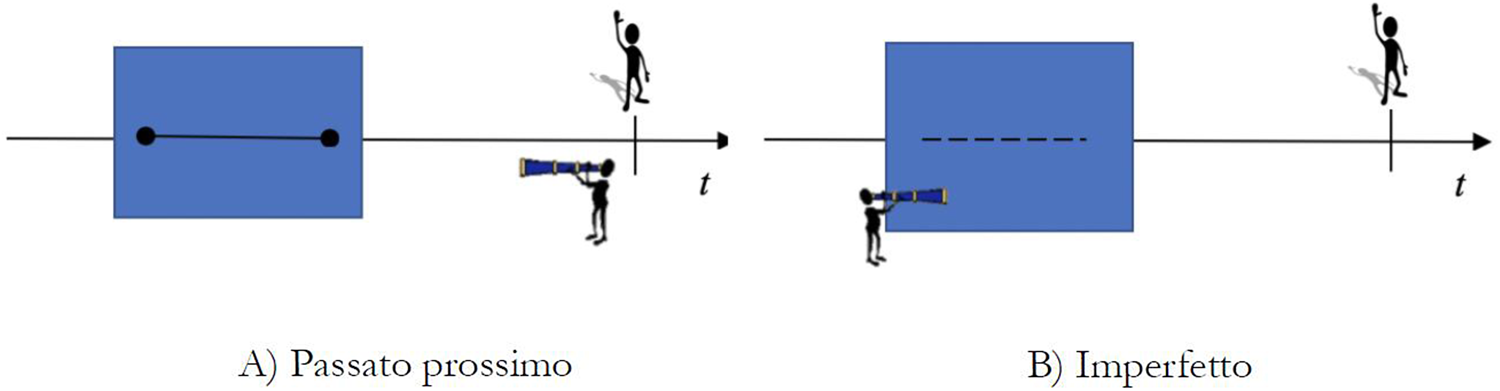
Languages may have different morphological inventories. For instance, English makes a contrast in grammatical aspect between perfective (simple past) and progressive (cf. ‘Ana sang’ and ‘Ana was singing’). Japanese shows a similar distinction. Romance languages maintain a distinction between the perfective and imperfective only in the past: the preterite (in Spanish), passé composé (in French), and passato prossimo (in Italian) are the perfective forms; and the imperfect (in Spanish), the imparfait (in French), and the imperfetto (in Italian) are general imperfective forms. Perfective morphology typically presents a situation from the outside and suggests that the situation has ended and is bounded. Imperfective morphology views the situation from the inside and has an unbounded interpretation, with different functions (habitual, progressive, or continuous), which suggest that the situation had not ended at the time of speaking. Depending on the language, progressive aspect can be expressed by the imperfective and progressive morphology (Mair, Reference Mair and Binnick2012). English has only a progressive, but no general imperfective, and French has a general imperfective, but no morphological progressive. In contrast, other languages (e.g., Spanish and Italian) have both imperfective and progressive morphology, with imperfective focusing on the unboundedness of the predicate and progressive on its ongoingness.Footnote 6
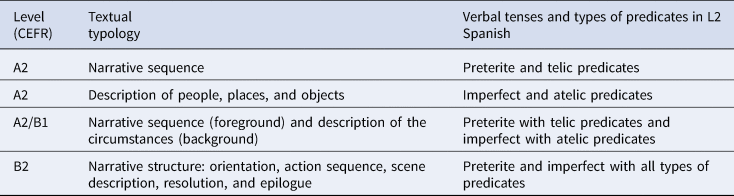
Grammatical aspect is also used in different ways in different types of texts or parts of texts. For example, a past description is likely to use the imperfective but an action-packed narrative is likely to use the simple past in English or the preterite in Spanish to convey the main story line (or foreground).
The third concept related to temporality is not realized as morphology, but instead has to do with the meaning of predicates and is therefore often called lexical aspect. The most often used classification of lexical aspect categories is that of Vendler (Reference Vendler and Vendler1967), who made a distinction between stative predicates (without the input of energy, ‘be tall’), activities (with inherent duration, ‘talk’), accomplishments (with duration and an endpoint, ‘watch a movie’), and achievements (with an endpoint but without inherent duration, ‘discover’).Footnote 7 Lexical aspect is closely connected to the structure of verbal predicates. This may be most clearly illustrated with predicates such as ‘walk’ and ‘walk a mile.’ ‘Walk’ (intransitive) is an activity, whereas ‘walk a mile’ is an accomplishment. ‘Walk’ has no inherent endpoint, whereas ‘walk a mile’ does; namely, the end of the mile. Linguists have devised different tests to distinguish lexical aspectual categories (e.g., Dowty, Reference Dowty1979). For example, activities can be distinguished from accomplishments by an adverbial test. Activities can occur with ‘for’ plus a length of time: ‘He walked for 20 minutes.’ Accomplishments cannot occur with ‘for’ + time: #‘He walked a mile for 20 minutes’). In contrast, ‘in’ + time is acceptable with accomplishments: ‘He walked a mile in 20 minutes;’ but not with activities #‘He walked in 20 minutes,’ where ‘20 minutes’ indicates how long the person walked. The interruption test also divides activities from accomplishments: ‘If someone is walking and she is interrupted after 15 minutes, did she walk?’ If the answer is ‘Yes,’ the predicate is an activity. In contrast, consider a second case in which a person runs a 5-minute mile. If she is interrupted after 3 minutes, and we ask, ‘Did she run a mile?,’ the answer is ‘No.’ These examples show that lexical aspect belongs to the predicate and not the verb alone (Binnick, Reference Binnick1991; Dowty, Reference Dowty1979; Klein, Reference Klein, Klein and Ping2009; Shirai, Reference Shirai, Salaberry and Comajoan2013).
2.2 Overview of L2 acquisition research on tense-aspect
The investigation of the development of L2 tense-aspect systems has yielded a number of findings that we believe are potentially relevant to instruction on tense-aspect. Here, we highlight five main findings: the major stages of the acquisition of temporality, the development of morphology, the polysemy of the imperfective, discourse structure, and text type (see Bardovi-Harlig, Reference Bardovi-Harlig2000; Bardovi-Harlig & Comajoan-Colomé, Reference Bardovi-Harlig and Comajoan-Colomé2020; Comajoan-Colomé, Reference Comajoan-Colomé and Geeslin2014; Rastelli, Reference Rastelli2020; and Salaberry, Reference Salaberry2008 for reviews).
There are three main stages in the acquisition of temporality; namely, the pragmatic, lexical, and morphological stages (Dietrich et al., Reference Dietrich, Klein and Noyau1995). In the pragmatic stage, learners rely on real world order, such as the knowledge that we eat breakfast before lunch, and they also rely on their interlocutor's utterances as scaffolding. In the lexical stage, lexical items, such as ‘yesterday’ and ‘at 10 p.m.’ express time. Finally, tense-aspect morphology begins to emerge in the third stage. Classroom instruction teaching is often geared to the morphological stage, although even instructed learners persist in the use of lexical reference such as adverbials until morphology is stable.
For researchers who investigate the morphological stage of the expression of temporality, one of the most significant findings is that lexical aspectual categories influence the use of tense-aspect morphology (for the languages that have been studied thus far). The tests developed to determine the aspectual category of predicates take advantage of this fact, even for native speakers (Dowty, Reference Dowty1979; Vendler, Reference Vendler and Vendler1967), and are not restricted to learner language. One hypothesis that has been widely tested is the Aspect Hypothesis (Andersen, Reference Andersen, Huebner and Ferguson1991, Reference Andersen, Salaberry and Shirai2002; Andersen & Shirai, Reference Andersen, Shirai, Ritchie and Bhatia1996), which predicts a specific sequence of acquisition for past tense-aspect morphology (see Bardovi-Harlig & Comajoan-Colomé, Reference Bardovi-Harlig and Comajoan-Colomé2020, for a review of studies from the last 20 years). One of the most important observations in this line of inquiry is that grammatical aspect and lexical aspect form prototypical associations; that is, perfective forms (e.g., simple past in English, passé composé in French, preterite in Spanish, or passato prossimo in Italian) most typically emerge and associate with predicates containing verbs with endpoints, and imperfective forms most typically emerge and develop with stative predicates. Activities are the last dynamic predicate-type to occur with the perfective past (for example, in English they occur with past progressive before the simple past, which is perfective).Footnote 8 However, activities that occur in the narrative foreground felicitously take the past, which we discuss shortly.
Some tense-aspect morphemes are polysemous, and that results in additional learnability issues. The form that has been studied most frequently for its multiple meanings is the imperfective. Its three main meanings are often considered to be unboundedness/progressivity, durativity, and iterativity. A fourth meaning is habituality. In other words, all uses of the imperfective do not have the same value. The meanings appear to be sequenced in acquisition, an area that has not yet been widely investigated (Deo, Reference Deo and Binnick2012; Domínguez et al., Reference Domínguez, Arche and Myles2017; Giacalone Ramat, Reference Giacalone Ramat, Eliasson and Jahr1997; Salaberry, Reference Salaberry2013).
Discourse structure also influences the use of tense-aspect morphology and the development of past morphology in L2 learning (the Discourse Hypothesis, Bardovi-Harlig, Reference Bardovi-Harlig2000). In narratives—those texts that convey actions in chronological order—the foreground (or main story line) that carries the action tends to occur in the perfective past. In contrast, the background—which sets the scene, provides rationale, evaluates the actions of the foreground, and looks backward or forward—is the site of a variety of tense-aspect forms. SLA research has documented that perfective morphology emerges in the foreground of narratives first, whereas imperfect morphology emerges and develops later in the background. Descriptions are often in the imperfective, but the perfective past may also occur in the background, even though it does not dominate. In contrast, in nonnarrative texts like descriptions or argumentative texts, the main structure holds time still through the use of present, imperfective, or modals, while the background of a description (the side structure) advances time.
Finally, text-type is also related to task type. The task determines the type of text the learners will construct; and, in turn, the type of text determines the distribution of tense-aspect morphology (Bardovi-Harlig, Reference Bardovi-Harlig, Salaberry and Comajoan2013).
How might we expect to see these results from SLA research reflected in studies of instruction and their potential impact in classroom teaching? We consider three points as illustration. In teaching past form-meaning associations or the perfective-imperfective contrast, one might consider the lexical aspect of predicates. If instruction considers only telic predicates as input when the perfective past is taught, the outcome may look positive because telicity and perfectivity are prototypical associations. However, if activities are included, acquisition may seem less successful because learners may not try out perfective past with activities, and nontarget-like combinations will be produced. If the predicates are balanced and analyzed separately, both the effect of instruction and the effect of lexical aspect will be clearer. Second, because the imperfective is polysemous, being clear about what meaning is taught may help teachers plan later instruction to expand and relate different meanings of the imperfect to each other. Third, the type of text influences tense-aspect distribution; for instance, narratives have very different distribution of tense-aspect forms than past descriptions do. Consequently, the introduction of different types of texts as input in classroom instruction may have variable effects. In sum, the relevance of SLA research in L2 teaching is potentially high. Section 3 explores whether such potential relevance is evidenced in current research in ISLA (Review 1), and language teaching (Review 2), respectively.
3. The reviews
The goal of the two reviews in this section is to explore the relationship of SLA, ISLA, and language pedagogy as instantiated through published studies on the effect of instruction on acquisition and proposals for the teaching of tense-aspect in the last 20 years (2000–2021). The tone of the reviews is intended to be neutral as it is not our intention to review research findings, design, or analysis, to evaluate the statistical approaches used, or to endorse one instructional approach over another, but rather to examine the connections between research and teaching of tense-aspect.
A systematic search of the literature was conducted employing both journal websites and search engines, using the keywords tense and/or aspect, instruction, teaching or pedagogy in a number of languages (e.g., tiempo, aspecto, enseñanza, didáctica; temps, aspect, enseignement, didactique, and so on). After the results of this first search were obtained, we read the abstracts of the studies and scanned their references for further bibliographic sources. The same cycle was followed until no new entries were found through the summer of 2021. The types of ISLA and pedagogical publications that were considered were articles in journals and teacher publications, book chapters, and books. Doctoral dissertations were excluded unless they were subsequently published as articles or books. The coding schemes for the two reviews in this article are described when presenting the results regarding each of the guiding research questions.
3.1 Review 1: ISLA on L2 tense-aspect
Review 1 investigates the relationship between ISLA studies, SLA research on the acquisition of tense-aspect, and pedagogy of tense-aspect through a review of instructional effect studies. The goal is to provide answers to the following guiding questions:
1. Do instructional effect studies with tense-aspect as the target of investigation provide a linguistic description of the tense-aspect target?
2. Do instructional effect studies with tense-aspect as the target of investigation engage with the SLA literature on tense-aspect acquisition?
3. Do instructional effect studies with tense-aspect as the target of investigation use results from SLA literature on tense-aspect to design instruction?
4. Do instructional effect studies with tense-aspect as the target of investigation include an elaborated description of the instruction provided to learners (i.e., can the studies be replicated based on the published account?) and do they consider pedagogical implications?
We identified 56 instructional effect studies in 44 journal articles (in 17 different journals), 11 book chapters, and one monograph (with two chapters reporting different studies), establishing a set of studies that test instruction of tense-aspect and that is at least representative of the period (2000–2021), if not exhaustive. Target languages included English, Spanish, French, Japanese, and Italian. First languages included Arabic, Brazilian Portuguese, Chinese (Mandarin and Cantonese), English, French, German, Greek, Indonesian, Korean, Persian, Polish, Spanish, Thai, and Vietnamese. The learners are primarily adults: 43 studies (77%) report on college students and another three (5%) on secondary-school students (Cho, Reference Cho2010; Bielak & Pawlak, Reference Bielak and Pawlak2013; Wijaya & Hidarto, Reference Wijaya and Hidarto2018), six (11%) in the 11–14 year range (Benati, Reference Benati2005; Benati et al., Reference Benati, Lee, Houghton, Benati and Lee2008a; Fazilatfar et al., Reference Fazilatfar, Jabbari and Harsij2017; Kermer, Reference Kermer2016; Marsden, Reference Marsden2006; Marsden & Chen, Reference Marsden and Chen2011), and four studies (7%) investigate instructed language learning by primary-school children between 7 and 10.5 years old (Benati & Angelovska, Reference Benati and Angelovska2015; Benati & Lee, Reference Benati, Lee, Benati and Lee2010; Chan, Reference Chan2019; Laval, Reference Laval, Lee and Benati2013).Footnote 9
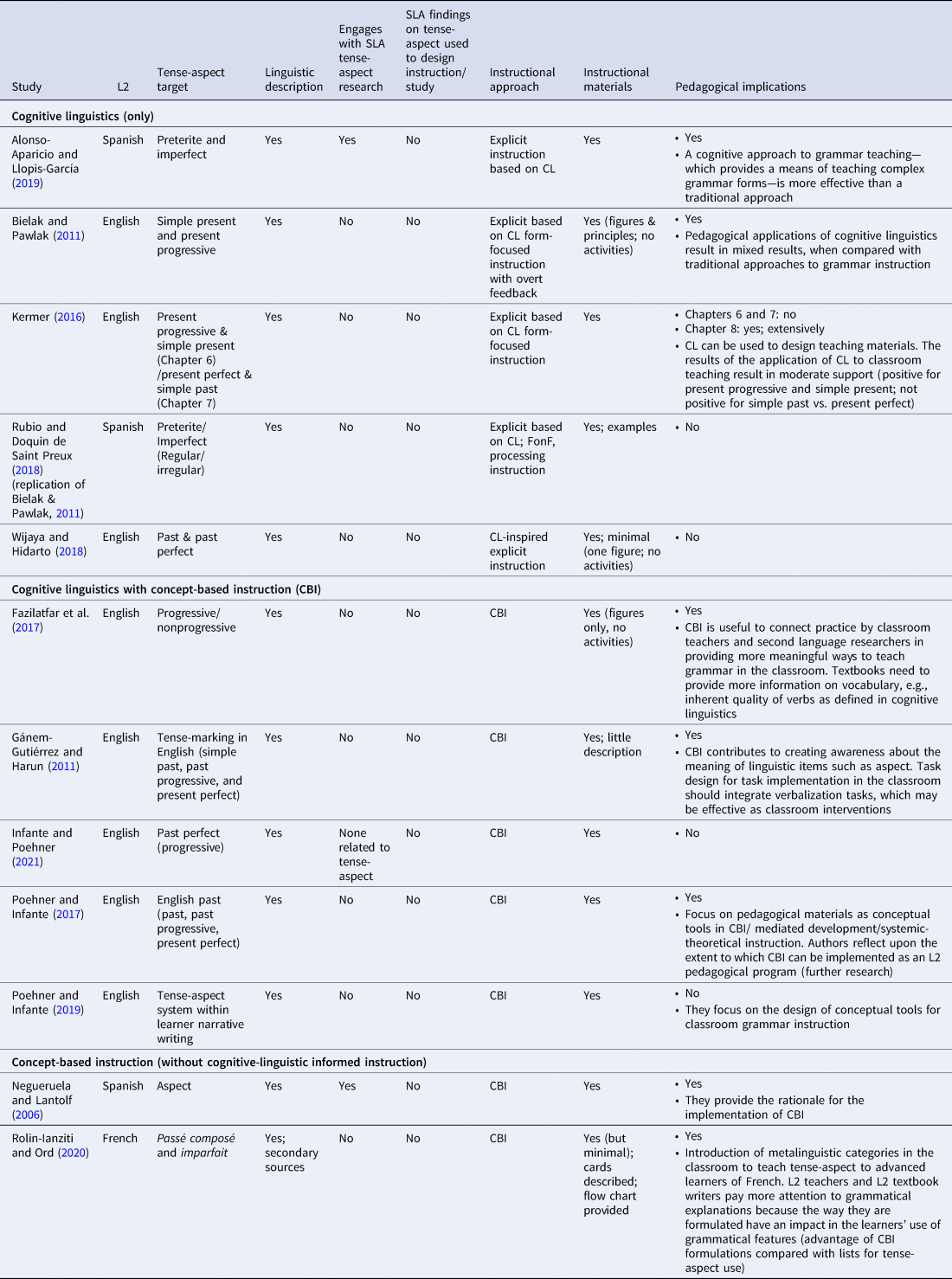
In the 56 instructional effect studies that we identified, instructional approaches fell into four main groups: input enhancement, input processing, cognitive-linguistics based studies, and corrective feedback, each of which was represented by five or more studies. A fifth group included 11 studies that use other instructional approaches. We described the studies according to how they characterized themselves in their abstracts and keywords (Tables 4–8).
Textual enhancement (originally, input enhancement, Sharwood Smith, Reference Sharwood Smith1993) increases the visual salience of the instructional target by modification to the written text by any number of means, which include bolded, underlined, italicized, or highlighted text, capital letters, enlarged text, different fonts, or text in different colors (Loewen & Inceoglu, Reference Loewen and Inceoglu2016).
Input enhancement (textual enhancement) studies with tense-aspect targets

Processing instruction studies with tense-aspect target (by collaborations)

Note: IP = Input processing.
Studies based on cognitive linguistics (CL), cognitive linguistics with concept-based instruction (CBI), and CBI alone (by collaborations)

Corrective feedback (CF) studies with tense-aspect target

Studies with ‘other’ orientations

The processing instruction studies were conducted within the framework of input processing, which seeks to determine how learners make form-meaning connections or how they parse sentences (VanPatten, Reference VanPatten, VanPatten, Keating and Wulff2020). Acquisition is seen as a by-product of comprehension. Processing instruction is derived from observations made by input processing, and it attempts to redirect learners away from less than optimal processing; that is, processing that leads to incorrect or inefficient form-meaning mapping.
Ten studies based their delivery of explicit information regarding tense-aspect systems in cognitive linguistics. These arise from eight collaborations or larger works. Cognitive-linguistics studies are divided into concept-based instruction (CBI) (and its variants) and other explicit approaches. Approaches influenced by cognitive linguistics often claim that traditional rules given to learners are incomplete or incorrect; that is, that rules of thumb that are context-free are less efficacious than situated rules or rules that take communication, the speaker's viewpoint, and text-construction into account, as cognitive-linguistics orientations do. The cognitive-linguistics studies are dominated by L2 English, with two studies targeting Spanish. The instructional targets include the contrast between perfective and imperfective past in Spanish (Alonso-Aparicio & Llopis-García, Reference Alonso-Aparicio, Llopis-García, Ibarretxe-Antuñano, Cadierno and Castañeda2019; Rubio & Doquin de Saint Preux, Reference Rubio and Doquin de Saint Preux2018), and in studies of instruction on English, contrasts between the simple and progressive forms and their meanings.
In the studies reviewed in this article, there is a partial overlap of cognitive-linguistics-based studies and CBI. Five of the ten cognitive-linguistics-based studies deliver instruction by means of CBI. In addition, there are two studies that employ CBI, but not cognitive linguistics. With the exception of Negueruela and Lantolf (Reference Negueruela, Lantolf, Salaberry and Lafford2006) and Fazilatfar et al. (Reference Fazilatfar, Jabbari and Harsij2017), which include pretests and posttests that evaluate interlanguage use, the studies that employ CBI exclusively evaluate changes in learners’ articulation of their conceptual knowledge; that is, their declarative (or explicit) knowledge. In fact, Rolin-Ianziti and Ord (Reference Rolin-Ianziti and Ord2020) explicitly rejected the need to test interlanguage development (i.e., implicit knowledge) in this framework. In contrast, Negueruela and Lantolf (Reference Negueruela, Lantolf, Salaberry and Lafford2006) and Fazilatfar et al. (Reference Fazilatfar, Jabbari and Harsij2017) examined the learners’ interlanguage progress in tense-aspect use in addition to demonstrating how the learners’ new explicit understanding of aspect helps them reason out their use of Spanish preterite and imperfect.
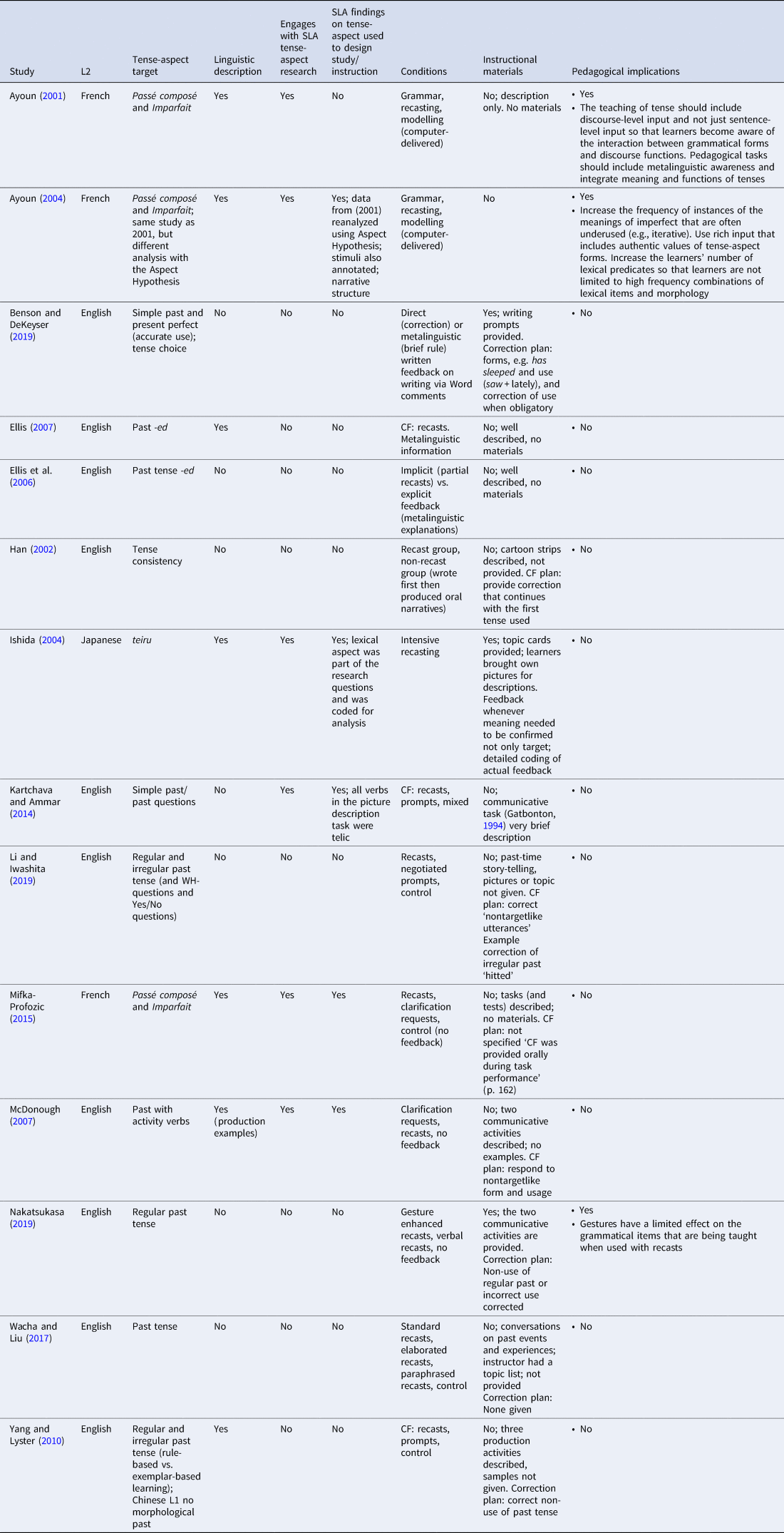
Studies were included in the corrective feedback group if they self-identified as such, or if they used a form of feedback that later became identified as corrective feedback, such as recasts (Nassaji & Kartchava, Reference Nassaji and Kartchava2021). The tense-aspect targets in corrective feedback studies seem to converge on the English past tense, with one study and a replication testing French, and one testing Japanese.
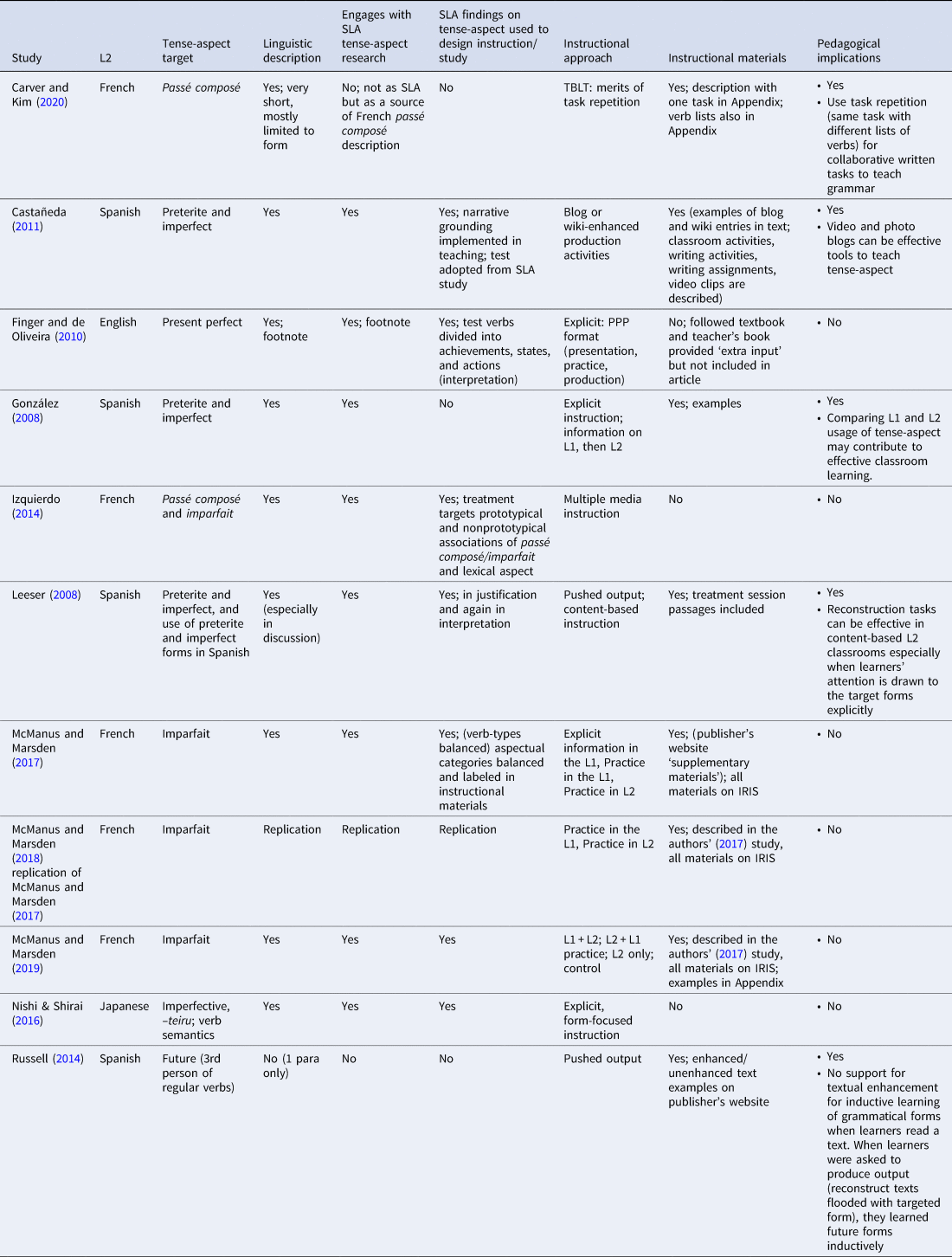
The remaining studies, grouped as ‘Other’ in Tables 3 and 8, tested the effect of explicit instruction (Finger & de Oliveira, Reference Finger and de Oliveira2010; González, Reference González2008; McManus & Marsden, Reference McManus and Marsden2017, Reference McManus and Marsden2018, Reference McManus and Marsden2019; Nishi & Shirai, Reference Nishi, Shirai, Benati and Yamashita2016), pushed output (Leeser, Reference Leeser2008; Russell, Reference Russell2014), task repetition in task-based language teaching (Carver & Kim, Reference Carver and Kim2020), production enhanced by individually authored blogs or co-authored wikis (Castañeda, Reference Castañeda2011), and multimedia instruction (Izquierdo, Reference Izquierdo2014).
Integration of SLA research into pedagogical proposals

Note: IE = input enhancement, PI = processing instruction, CL = cognitive linguistics, CF = corrective feedback.
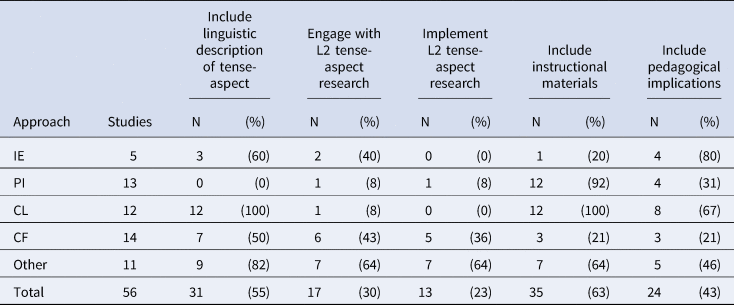
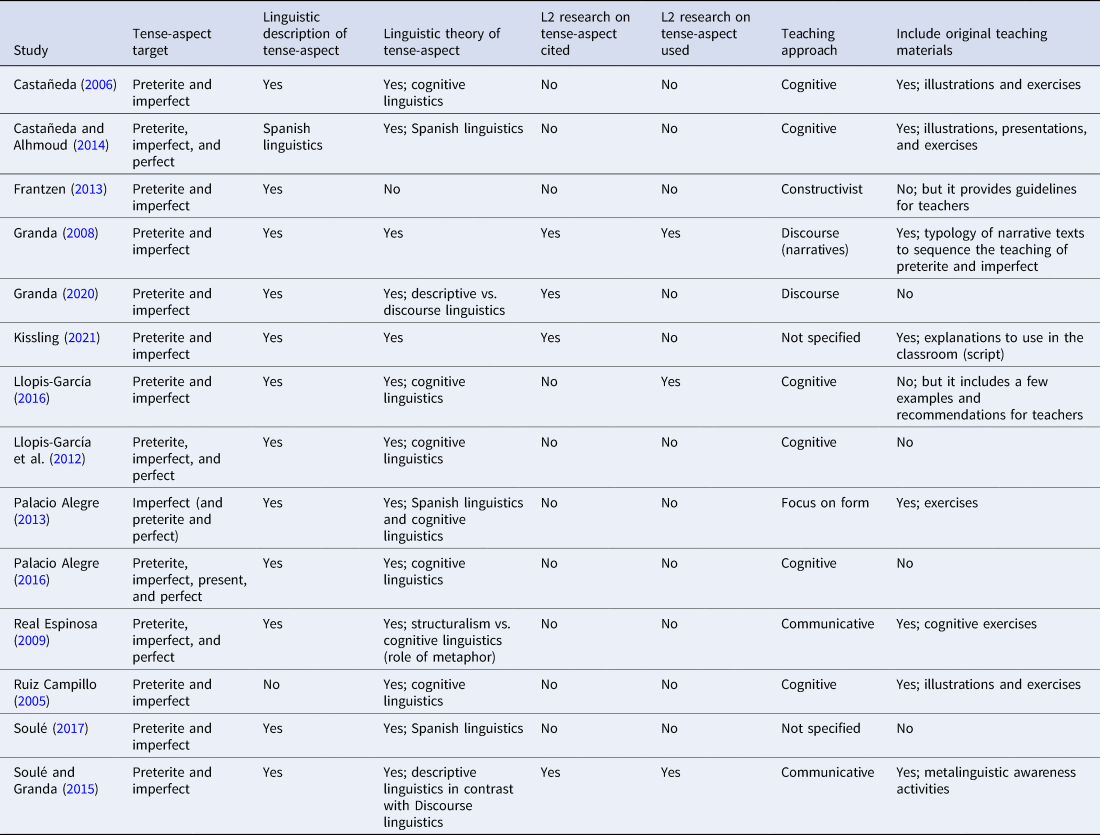
Our review showed that more studies provided linguistic descriptions of the instructional target (55%) than cited the SLA literature on the acquisition of L2 tense aspect (30%), and more articles cited the SLA literature than used it to inform the design of the study, the task, or the analysis (23%; Table 3). Sixty-three percent of the studies offered examples of the instruction provided to the learners in the study, and 43% offered pedagogical implications. The answers to the questions we posed varied widely in part according to the instructional approach and the empirical frameworks of the studies, as seen in Table 3. In the sections that follow, we address each of the four guiding questions separately with specific references to Tables 4–8. Tables 4–8 summarize the studies by approach (input enhancement, processing instruction, cognitive linguistics, corrective feedback, and other approaches, respectively) and report the individual studies and date, target language, and tense-aspect target. The tables additionally report whether the articles include a linguistic description of the target, engage with SLA research, use SLA findings to design the instruction or the task used to evaluate language, and whether the instructional materials are included in the published report. Finally, the tables include information on whether the articles include pedagogical implications. Additional information about our analysis and the tables are given in the sections that follow.
3.1.1 Linguistic descriptions of tense-aspect in ISLA studies
The first question, ‘Do instructional effect studies with tense-aspect as the target of investigation provide a linguistic description of the tense-aspect target?’ asked whether the reports in our collection describe the form-meaning association of targeted tense-aspect form. We recognize that any published research report must move along quickly, that word limits require that authors make choices, and that the purpose of the studies examined here is not a deep exploration into the semantics of tense-aspect systems. However, we also recognize that definitions and descriptions with examples enhance the clarity of reports and inform readers as to what the target of instruction is and why it is interesting. Brief definitions or descriptions suffice, but whereas some articles provide a paragraph about the target form and the target meaning, others provide extensive descriptions of the tense-aspect target.
We evaluated both brief and extended descriptions of the target as providing a linguistic description of the target. In Tables 4–8, a ‘Yes’ is entered in the column labeled ‘Linguistic description’ for a continuum of responses from a brief description in a footnote to an elaborated description. Some articles only name the target, for example ‘past,’ ‘present perfect,’ or ‘imparfait’ but provide no further information. Others give a very short gloss using terms that may not be accessible to all readers; for example, ‘Preterite is perfective and imperfect is imperfective.’ This treatment of the target is entered as ‘No’ in the tables. Articles that only give examples but have no description are indicated as ‘examples only,’ and articles that only provide a description of the form without meaning are indicated by ‘form only.’ If a study concerned itself exclusively with accuracy of form (and not use) it was not included in this review. Overall, 55% of the studies provide a linguistic description of the instructional target (Table 3).
The more concerned an instructional approach is with providing learners with explicit information about the form-meaning association of the tense-aspect target, the more likely the article reporting the study is to include a linguistic description. The cognitive-linguistics based studies cite a range of cognitive linguistics sources and describe the target of instruction in some detail, providing a description of how the targeted tense-aspect form is used, and in cases where two or more form-meaning associations are considered, how they differ from each other and what their functions are in meaning or text construction. The cognitive-linguistics based studies also report explicit approaches to instruction and five articles report drawing on cognitive-linguistics and implementing CBI (Table 6). Two additional studies that employ CBI without reference to cognitive linguistics are also listed in Table 6.
Like the cognitive-linguistics studies, two of the collaborations that describe themselves as providing explicit information to learners also provide linguistic descriptions of the target and cite linguistic sources (Table 8). These include both McManus and Marsden (Reference McManus and Marsden2017, and by extension its replication, Reference McManus and Marsden2018, and expansion, Reference McManus and Marsden2019) and Nishi and Shirai (Reference Nishi, Shirai, Benati and Yamashita2016); Castañeda (Reference Castañeda2011) also provides a linguistic description of the instructional targets; namely, preterite and imperfect in Spanish. An additional study that tests a multimedia approach to instruction (Izquierdo, Reference Izquierdo2014) also provides a linguistic description of the target (Table 8). Carver and Kim (Reference Carver and Kim2020) limit their linguistic description to form.
Studies investigating the effect of textual enhancement (input enhancement studies) are split on providing a linguistic description (Table 4). Izquierdo (Reference Izquierdo2014) incorporates textual enhancement as one component of instruction and also provides a linguistic description of the target. Likewise, studies exploring the effect of corrective feedback on tense-aspect are equally split on providing a linguistic description of the target (Table 7). Ellis (Reference Ellis and Mackey2007), McDonough (Reference McDonough and Mackey2007), and Mifka-Profozic (Reference Mifka-Profozic2015) all provide linguistic descriptions of the instructional targets. In contrast, in studies of the effect of processing instruction on tense-aspect, linguistic descriptions of the target are often not given, but examples are sometimes given (Table 5).
3.1.2 Engagement of ISLA research with tense-aspect SLA literature
Question 2, ‘Do instructional effect studies with tense-aspect as the target of instruction engage with the SLA literature on tense-aspect acquisition?’ exclusively addressed engagement with SLA research on tense-aspect, not SLA more broadly. By ‘engaged with’ we mean, for instance, that the studies went beyond citing an SLA tense-aspect study to support the claim that learning tense-aspect is ‘hard.’ If they did, the study received a ‘Yes’ in the column labeled ‘engaged with SLA tense-aspect’ in its respective table. Most of the studies in this review cited general findings from SLA research in their review of the literature and all cited previous literature within their particular empirical frameworks. However, only 17 (30%) of the 56 studies that identified tense-aspect as the target of instruction cite SLA research on tense-aspect.Footnote 10 Seven of these studies come from the articles that fall into the ‘other’ approaches group (Table 8). For example, Nishi and Shirai (Reference Nishi, Shirai, Benati and Yamashita2016, Table 8) orient to the linguistic literature, introducing both grammatical and lexical aspect, and then discuss the different readings of the target of instruction, the Japanese imperfective –teiru, which has resultative, progressive, and habitual readings. Following that, they introduce the basic findings of acquisitional studies in Japanese, and they relate them to tense-aspect acquisition. Nishi and Shirai identify a difficulty in acquisition and a corresponding absence of information in textbooks and instruction: (a) Previous research on tense-aspect acquisition concerning the acquisition of Japanese –teiru suggests that even advanced learners have difficulties in correctly rejecting aspectual combinations that are not possible in L2 as a result of L1 (first language)–L2 differences in lexical aspect (that is, achievements in Japanese break down into three categories that can be understood as states, activities, and achievements in English); and (b) verb semantics and its relation to the interpretation of tense-aspect morphology is not addressed in textbooks or in classroom instruction. They then identify the target of instruction as imperfective –teiru with a focus on verb semantics and the means of delivery as explicit instruction.
The articles in the ‘other’ category are also divided on engagement with the SLA tense-aspect literature (Table 8). Jesús Izquierdo, Kevin McManus, and Yasuhiro Shirai have worked extensively over the years on questions of acquisition of L2 tense-aspect and their studies cite SLA studies on tense-aspect (Table 8). Castañeda (Reference Castañeda2011) cites the SLA tense-aspect literature, and information on narrative structure (grounding) is additionally implemented in the instruction. Leeser (Reference Leeser2008) cites L2 tense-aspect acquisition briefly in his review, but returns to it in interpreting the results of his study.
Four of the 12 corrective feedback studies engage with research reports on the L2 acquisition of tense-aspect (Ayoun, Reference Ayoun2004; Ishida, Reference Ishida2004; McDonough, Reference McDonough and Mackey2007; Mifka-Profozic, Reference Mifka-Profozic2015). For example, McDonough (Reference McDonough and Mackey2007) uses the tense-aspect literature to identify the instructional target: activities have been repeatedly demonstrated to be the last of the dynamic verbs to occur with the preterite (or perfective past), and thus she identifies activities in the past tense in English as her instructional target. Jahan and Kormos (Reference Jahan and Kormos2015), a textual enhancement study, similarly used the acquisition literature to identify the instructional target (will and going to) and interpret the results; and the SLA literature on tense-aspect bolsters Loewen and Inceoglu's (Reference Loewen and Inceoglu2016) choice of target (preterite and imperfect in Spanish) in another textual enhancement study.
In contrast to the diligent reporting of cognitive-linguistic descriptions of tense-aspect, studies based in cognitive linguistics neglect research on the L2 acquisition of tense-aspect. Similarly, processing instruction seems to cite input processing as the sole reference for SLA research. Thus, these articles do not refer to more specific findings that describe the acquisition of tense and aspect. The one exception is the first study included in Table 4, Benati (Reference Benati2001), who cites Klein (Reference Klein1986) and Bardovi-Harlig (Reference Bardovi-Harlig1992) on the function of lexical reference—and in particular time adverbials—in the acquisition of tense-aspect systems.Footnote 11 These results are all the more surprising in light of the fact that functional approaches to SLA tense-aspect research and input processing agree on the role of adverbials in the acquisition of temporal reference (Bardovi-Harlig, Reference Bardovi-Harlig2000, Reference Bardovi-Harlig, VanPatten, Keating and Wulff2020).
Input processing research focuses on processing rather than production, which was the basis for the summary presented in Section 2.2.Footnote 12 At the time of Benati's (Reference Benati2001) article, the contribution of adverbials in the acquisition of tense-aspect from a processing perspective was captured by the Lexical Processing Strategy that states that ‘learners prefer processing lexical items to grammatical items for semantic information’ (VanPatten, Reference VanPatten1996, p. 21). The Lexical Processing Strategy has been reformulated as the Lexical Preference Principle stating that ‘learners will process lexical items for meaning before grammatical forms when both encode the same semantic (real world) information’ (VanPatten, Reference VanPatten, VanPatten, Keating and Wulff2020, p. 108). An alternative processing analysis from Ellis and Wulff (Reference Ellis, Wulff, VanPatten, Keating and Wulff2020) attributes this to the associative learning phenomenon of ‘blocking,’ whereby redundant cues are overshadowed by more salient ones and suggests that adverbs may block the learning of tense-aspect morphology. Thus, the field seems to converge in its interest in adverbials, but processing instruction studies cite no sources outside input processing, and consequently exclude tense-aspect studies.
In sum, citing tense-aspect acquisition studies may lead to using the results to plan instruction, input, corrective feedback, interpretation tasks, or output, but it does not guarantee that researchers will use the findings to design a study or pedagogy. We explore implementation of results in design in the following section.
3.1.3 Integration of SLA research
Question 3, ‘Do instructional effect studies with tense-aspect as the target of investigation use results from SLA literature on tense-aspect to design instruction?,’ asked if the findings of L2 tense-aspect acquisition studies play a role in designing the tasks, the analysis, or the instruction of a study, or in determining the target of instruction, at what level of proficiency learners might be receptive to instruction, or what type of input addresses the problem that has been identified. The number of studies that implement findings from SLA research in the study design or instructional materials or activities is a subset of those that engage with L2 tense-aspect research. Thirteen studies out of 56 (23%) use SLA tense-aspect research findings in the design of the study or instructional materials and activities, and often in the analysis of the instructional outcomes (Table 3). All the studies in this section are also included in the previous section (citing the SLA literature on tense-aspect), and they take the extra step of using the literature in the design of the study and/or instruction.
Ten main studies designed their investigations using the results of SLA tense-aspect research in a range of ways. As a researcher who works on the acquisition of tense-aspect in French, Ayoun (Reference Ayoun2004) implemented a research-based reanalysis of the data from an earlier study (Ayoun, Reference Ayoun2001). In the 2004 article, she addressed two questions from the literature: Were lexical aspectual classes (of predicates) differentially affected by corrective feedback? And were meanings of the imperfect (imperfective, durative, and iterative) differentially affected? (The durative reading made the greatest gains, and the use of imperfective was greatest with states, then activities, and then achievements.) Following evidence that lexical aspect affects L2 acquisition of verbal morphology, Finger and de Oliveira (Reference Finger and de Oliveira2010) recorded the lexical aspect class of the verbs used. Benati (Reference Benati2001) used research on the processing and use of adverbials to design studies that eliminated adverbs from input to focus learners’ attention on tense-aspect morphology. The absence of adverbs in input is a hallmark of all the processing instruction studies with tense-aspect targets that followed (Table 5).
McDonough (Reference McDonough and Mackey2007) implemented a feedback study that identified activity predicates with the simple past as the instructional target, based on documentation that past is used less frequently with activities than with accomplishments and achievements by lower level and intermediate learners. Using that information, she established a ‘readiness’ inclusion criterion: in order to be included in the study, learners had to demonstrate higher use of past with achievements and accomplishments than with activities (which follows the documented acquisition sequence). Corrective feedback was given exclusively on activities, and it addressed both form and use. In a post hoc analysis, McDonough also evaluated whether corrective feedback encouraged learners to move from the use of present to the use of past progressive with activities rather than the targeted simple past. Past progressive with activities would indicate an earlier acquisitional stage compared with the use of simple past, but a later stage compared with present (or nonpast). Thus, using the acquisitional sequence, McDonough was able to show that recasts (but not clarification requests) increase the use of past progressive, thereby helping the learners to advance one acquisitional stage, even if they did not reach the instructional target.
Nishi and Shirai (Reference Nishi, Shirai, Benati and Yamashita2016) investigated the effect of explicit linguistic instruction that focused on verb semantics on the learning of resultative –teiru. The instruction included three components hypothesized in the literature to influence acquisition: (a) different meanings of –teiru, (b) predicate types (lexical categories of predicates), and (c) how to express action-in-progress and resultative meanings.
McManus and Marsden (Reference McManus and Marsden2017, Reference McManus and Marsden2018, Reference McManus and Marsden2019) took SLA results into account in the design of their instructional component. McManus and Marsden (Reference McManus and Marsden2017) provided an appendix that shows that in their instructional material predicates were balanced by lexical aspectual categories; namely, states, activities, accomplishments, and achievements. In addition, video clips and images demonstrated the multiple meanings of the imperfect, including ongoingness and habituality (in both present and past) and then the contrast of these meanings with completion. Castañeda (Reference Castañeda2011) took his pretest and posttest recognition task from the research literature (Salaberry, Reference Salaberry1999, Reference Salaberry2000), as well as the use of different types of narrative tasks during instruction, acknowledging task-sensitivity in the use of tense-aspect morphology.
Other studies (Ishida, Reference Ishida2004; Izquierdo, Reference Izquierdo2014; Mifka-Profozic, Reference Mifka-Profozic2015) reflected the SLA research on tense-aspect in their research questions. Ishida (Reference Ishida2004) addressed three research questions, the second of which addresses the literature in tense-aspect acquisition on Japanese. Regarding the variable use of –teiru Ishida asked: (a) How does the accuracy in the use of –teiru with verbs of different lexical aspect classes change over time?, (b) How does the accuracy in the use of –teiru for different aspectual meanings change over time?, and (c) Are the changes in accuracy in the use of –teiru for different aspectual meanings related to the total number of recasts provided for each (lexical-aspectual) category? Ishida additionally balanced the instructional materials for three possible parings of aspectual classes in L2 Japanese and L1 English; namely, fall-type predicates (achievement-achievement), know-type (stative- achievement), and ride-type (activity-achievement).
Izquierdo (Reference Izquierdo2014) tested the effect of multimedia instruction on prototypical and nonprototypical combinations of grammatical aspect and lexical aspectual categories, where the prototypical combinations were operationalized as preterite with telic predicates and imperfective with atelic predicates, and nonprototypical combinations as preterite with atelic predicates and imperfective with telic predicates. Prototypical and nonprototypical contexts and uses were balanced throughout the input and the tests.
Finally, Mifka-Profozic (Reference Mifka-Profozic2015) conducted a corrective feedback study whose second research question specifically addressed whether instruction can facilitate progress through acquisitional sequences: ‘Do recasts and clarification requests have an effect on L2 acquisition of the passé composé and the imparfait in terms of use with respect to the lexical aspect of verbs in relation to the Aspect Hypothesis, where it was hypothesized that the effects of corrective feedback might be observed through accelerated progression across the predicted stages of acquisition?’ (p. 151). Although the results showed that both passé composé and the imparfait benefited from recasts, corrective feedback did not accelerate the stages; that is, passé compose was used primarily with achievements (and did not spread to accomplishments and activities) and imparfait was associated primarily with statives (with a few activities) and did not spread to activities and accomplishments in the amount of time allotted.
In sum, as McDonough (Reference McDonough and Mackey2007, p. 324), speaking of the Aspect Hypothesis, observed, ‘despite the predictive hierarchy [of the Aspect Hypothesis] few interaction researchers have adopted this framework to assess the impact of interactional feedback on the emergence of past tense forms.’ McDonough's description of the state of affairs is as true today as it was in 2007, and it applies not only to interactional approaches, but to other instructional approaches as well.
3.1.4 ISLA, description of instruction, and pedagogy
Whereas Questions 1–3 probed the relation of ISLA to SLA research (and linguistics) as instantiated through published research reports, Question 4 explores the relation of ISLA to pedagogy. By asking ‘Do instructional effect studies with tense-aspect as the target of investigation include an elaborated description of the instruction provided to learners (i.e., can the studies be replicated based on the published account?) and do they consider pedagogical implications?,’ we not only ask whether the experimental pedagogy is conveyed to the reader (i.e., is instruction given the same weight as other elements in the report?), but we also ask whether all parts of the experiment are reported (i.e., could the studies be replicated based on the published account?). The length of instruction in these studies ranged on the low end from 10 minutes in one textual enhancement study (LaBrozzi, Reference LaBrozzi2016) and 20 minutes for individual study (Nishi & Shirai, Reference Nishi, Shirai, Benati and Yamashita2016) to a high of 300 minutes or more (Benati, Reference Benati2005; Benati & Lee, Reference Benati, Lee, Benati and Lee2010; Modirkhamene et al., Reference Modirkhamene, Pouyan and Alavinia2018; Rubio & Doquin de Saint Preux, Reference Rubio and Doquin de Saint Preux2018); in the middle range, most instruction took an hour or more. Some studies delivered instruction in consecutive sessions and others distributed instruction over 2–4 weeks with as much as 9–10 weeks (and one study over 16 weeks).
Even though the length of instruction may prohibit some studies from providing a full set of instructional materials, the level of detail in reporting the instructional component varied greatly across studies. Where examples of materials were provided, a ‘Yes’ was entered into the penultimate column of Tables 4–8. Detailed information was often found in appendices and more recently as online supplemental materials at the publisher's website or a repository (IRIS). Studies that did not supply examples of instructional materials received a ‘No.’ For cases where some materials were provided but not others, this was noted. Overall, 63% of the studies provided examples of instructional materials.
Regarding the first part of Question 4, examining whether studies included a sufficiently elaborated description of the instruction provided to learners, as was the case with the answers to the first three questions, the answers seem to cluster around approaches. Nearly all the processing instruction reports provide instructional documentation (Table 5). Benati (Reference Benati2005) provided two items for each of three activities from three different instructional conditions that included processing instruction, meaning output instruction, and traditional instruction and for the English past tense. Benati et al. (Reference Benati, Lee, Houghton, Benati and Lee2008a) provided full activities for teaching English past for processing instruction (Appendix A) and traditional instruction (Appendix B). Benati et al. (Reference Benati, Lee, Laval, Benati and Lee2008b) similarly provided full activities for processing instruction for the French imparfait.
Instruction using cognitive linguistics has the expressed goal of demonstrating that detailed explanations and activities that lead learners to understand their own role as perspective-takers and text-builders in using tense-aspect morphology is superior to traditional ‘rules of thumb,’ which simplify the tense-aspect system. Consistent with that goal, the cognitive-linguistics- based studies provided elaborated instructional components that often include descriptions of the flowcharts, visuals, and slides (called tools in CBI) that were given to the learners (Table 6). For instance, using different styles of presentation, both Alonso-Aparicio and Llopis-García (Reference Alonso-Aparicio, Llopis-García, Ibarretxe-Antuñano, Cadierno and Castañeda2019) and Bielak and Pawlak (Reference Bielak and Pawlak2011) provided elaborated examples of their instructional components. Alonso-Aparicio and Llopis-García (Reference Alonso-Aparicio, Llopis-García, Ibarretxe-Antuñano, Cadierno and Castañeda2019) described the instruction of the Spanish preterite and imperfect in detail and supplied samples of their slides and the interpretation activities for both the cognitive linguistics instruction and the traditional grammar instruction. Bielak and Pawlak (Reference Bielak and Pawlak2011; see also Bielak & Pawlak, Reference Bielak and Pawlak2013) provided figures depicting the semantics of the perfective past and -ing with a step-by-step description of the cognitive linguistics presentation illustrated by figures depicting various predicates in different tenses in English.
Among the ‘other’ approaches, providing elaborated descriptions falls considerably (Table 8). McManus and Marsden (Reference McManus and Marsden2017) posted their L2 French instructional materials in online supplemental materials on the publisher's website and subsequently in a digital repository (IRIS). These materials were used in a replication by the same authors (McManus & Marsden, Reference McManus and Marsden2018) and in a follow-up study (McManus & Marsden, Reference McManus and Marsden2019). Carver and Kim (Reference Carver and Kim2020) studied the effect of task repetition, where task type or task outcome varied. They provided an example of one of the collaborative writing tasks they used in an appendix, and a list of the French verbs given to the students with the tasks. Castañeda (Reference Castañeda2011) described the classroom activities, writing activities, writing assignment topics, and video clips in the main text, and he additionally provided examples of the blogs and wikis that the learners wrote in Spanish. Examples of written feedback and sample topics were also provided.
Somewhat surprisingly, studies reporting on the effects of textual enhancement generally did not provide the texts that were used, which would be the main component of instruction (Table 4). The exception is the study reported by Loewen and Inceoglu (Reference Loewen and Inceoglu2016), who supplied the text.
Studies that explore the effects of corrective feedback are more difficult to evaluate, because the main component of instruction is the interaction rather than a specific type of presentation. Instead, we answered Question 4 with answers to two different questions better suited to the approach: (a) Did the article provide examples of the tasks or activities used to generate learner language (and thus create opportunities for corrective feedback)? and (b) Was there an articulated plan for feedback? Most studies of corrective feedback provided at least one of these, and several studies provided both (Table 7). Benson and DeKeyser (Reference Benson and DeKeyser2019) provided all four of the writing prompts that generated occasions for written feedback on English past and present perfect, as well as examples of the feedback in Appendices 3 and 1, respectively. Ishida (Reference Ishida2004) provided the topics she used to generate oral language by learners that could lead to corrective feedback on L2 Japanese use of progressive and resultative uses of –teiru.
Thus, at least some studies in each approach provided examples relevant to their approach. In addition, six studies provided information on how their instruction fit into their existing curriculum or pedagogy by giving more information than typically reported in studies of this type. Fazilatfar et al. (Reference Fazilatfar, Jabbari and Harsij2017), Loewen and Inceoglu (Reference Loewen and Inceoglu2016), Ishida (Reference Ishida2004), Mifka-Profozic (Reference Mifka-Profozic2015), Lee et al. (Reference Lee, Benati, Aguilar-Sánchez, McNulty, Benati and Lee2007), and Nishi and Shirai (Reference Nishi, Shirai, Benati and Yamashita2016) gave information on order of instruction, duration of instruction, textbooks, or instructional approaches used in the programs in which the studies took place.
The focus of the second part of Question 4 is whether the articles provide pedagogical implications. The rightmost column in Tables 3–8, labeled ‘Pedagogical implications,’ refers to whether the studies included pedagogical implications for the study results or not. References to pedagogical implications in the introduction or the literature review of the studies were not considered. The articles that include pedagogical implications mention them in the discussion section or at the end of the article either listing them together with limitations and further research or, less commonly, including a separate section dealing with pedagogy specifically. The information contained in such sections tends not to be very detailed or classroom-oriented, but rather it emphasizes possible connections of the research results to L2 language pedagogy more generally. The most common connection between the results and pedagogy is the link between the approach (input enhancement, processing instruction, cognitive linguistics, and corrective feedback) and the effectiveness of explicit language (grammar) teaching when teaching L2 tense-aspect.
In spite of the difficulty of conducting a count because the style of the articles differs, we nevertheless attempted to determine how many of the articles included references to pedagogical implications. There are clear cases of inclusion, but in other cases the references to pedagogy are so general that they could barely be considered relevant. In still other cases, such as articles on CBI and input processing, the articles include detailed classroom practices but they seem to be implemented for the sake of the experiment and not as an instance of classroom practice. The count in Tables 3–8 is liberal toward the inclusion of pedagogical implications; that is, a study was marked as a ‘Yes’ even though the connections between the results and pedagogy may have been very loose. Even so, less than half of the studies (43%) (Table 3) contained pedagogical implications, and the proportion of those that included them varied according to the orientation of the articles. Ordered from most to least frequent inclusion of pedagogical implications, we found input enhancement, cognitive linguistics and related approaches, ‘other' approaches, processing instruction, and corrective feedback.
Our inventory of detailed accounts of instruction shows that instructional effect studies do not always provide full accounts of the very variable that they investigated. Reporting the instructional component of an instructional effect study is as important to the research as reporting the tasks used to evaluate the instructional effect because not including a full account of instruction limits the interpretability of the study, which in turn affects replicability, relevance of results, and potential for application. The lack of a detailed account of the experimental pedagogy may also reflect the stance of ISLA toward language instruction, which we discuss in Section 4.
3.2 Review 2: Pedagogical proposals for the teaching of L2 tense-aspect
The second review in this article follows the same format and guiding questions as for the first review but focuses instead on pedagogical proposals and the connection between SLA research and the L2 teaching of tense-aspect. We use ‘pedagogical proposals’ to refer to scholarly works of two types:
1. Proposals that include information on how to teach tense-aspect via curriculum design and/or the design of teaching-learning activities. They were mostly articles and book chapters that discussed the connection between research and language teaching and how to implement the teaching of L2 tense-aspect in instructed environments. L2 grammar books were included only if they fulfilled two conditions: they incorporated specific sections on the teaching of L2 tense-aspect and their audience were teachers or teacher trainers. In other words, learner grammar books were excluded from the review.
2. Proposals that address how L2 tense-aspect is taught in the classroom (i.e., instructed environments) but do not measure acquisition. Studies that combined pedagogical proposals with measures of acquisition were classified as ISLA studies (Review 1). The focus of these proposals were instruction and its effect in learners; only one of the pedagogical proposals investigated teachers and how they taught tense-aspect in the classroom (Soulé, Reference Soulé2017).
In contrast to the ISLA articles, which followed standard academic formats for reporting results from research, the pedagogical proposals are heterogeneous in length, rhetorical style, and format. They are published in peer-reviewed journals, teaching journals and newsletters, or book format (chapters or whole books). Doctoral dissertations and M.A. theses were excluded unless they were subsequently published. Even though a considerable number of pedagogical proposals discuss how textbooks introduce and practice tense-aspect, language textbooks were not included in the review because their audience (learners) differs from the focus audience of the current review (researchers and teachers).
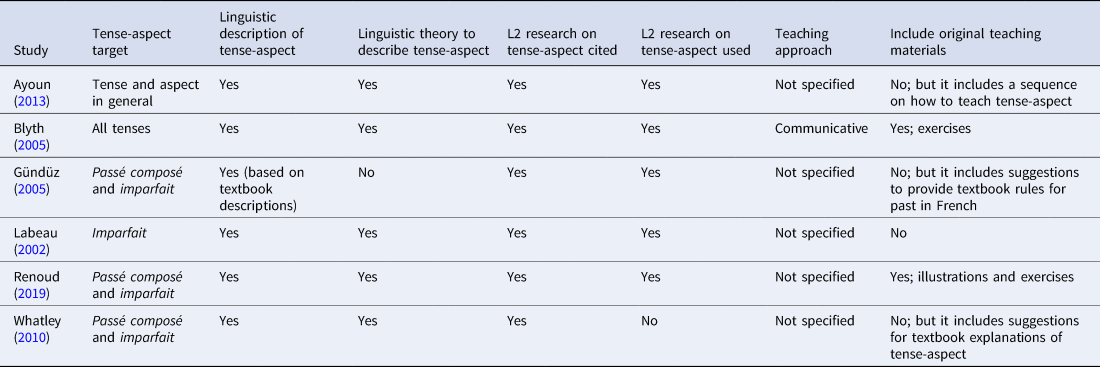
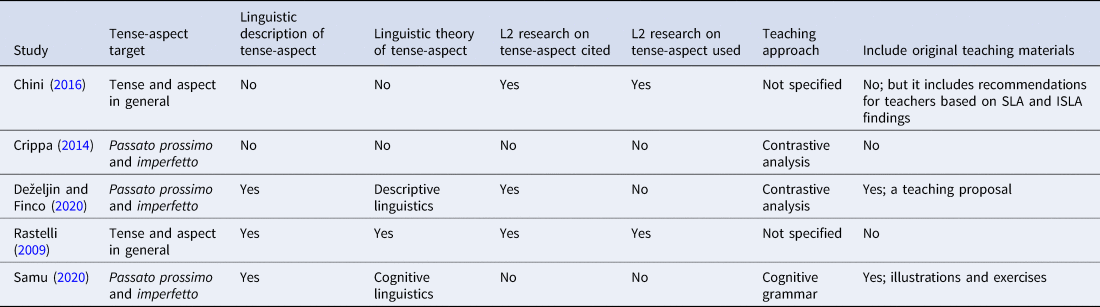
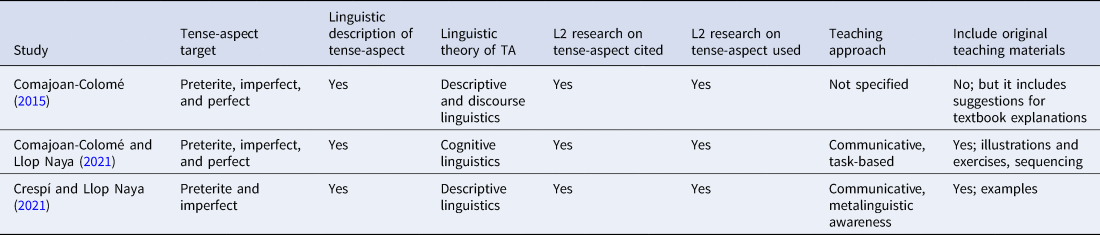
As was the case for ISLA articles, pedagogical proposals published between 2000 and 2021 were considered. The search for proposals on the teaching of tense-aspect in the classroom resulted in a corpus of 38 works: 26 articles in journals and newsletters, 11 book chapters, and one book. The target languages that were represented in the search results are Spanish, English, French, Italian, and Catalan (Tables 10–14). The proposals were more frequent for Spanish than for the other languages, probably due to the fact that Spanish is a commonly studied foreign language that has developed a number of avenues for the discussion of L2 teaching, including journals, books, and handbooks. In addition, the acquisition of L2 Spanish past morphology (perfective vs. imperfective) is often described as difficult for classroom learners (whose L1 may or may not have perfective-imperfective morphology), although it is no more difficult than other languages with the same contrast.
This section reports on the review of the pedagogical proposals, recasting the guiding questions accordingly. By answering these questions, we aim to describe the current state of the integration of research in pedagogical proposals for the teaching of L2 tense and aspect:
1. Do pedagogical proposals on the teaching of tense-aspect provide a linguistic description of the tense-aspect target?
2. Do pedagogical proposals on the teaching of tense-aspect engage with the SLA literature on tense-aspect acquisition?
3. Do pedagogical proposals on the teaching of tense-aspect use results from the SLA literature on tense-aspect to design instruction?
4. Do pedagogical proposals on the teaching of tense-aspect provide examples of teaching materials informed by research to use in the classroom?
The results of the review showed that most of the 38 pedagogical proposals (82%) included a linguistic description of the tense-aspect system (Table 9). This exceeded the number of proposals that either cited L2 tense-aspect research (58%) or employed L2 tense-aspect research to develop instruction (47%). A considerable proportion of the proposals included teaching materials (63%).
Integration of SLA research into pedagogical proposals

The number of pedagogical proposals differed across the L2s, with Spanish and English featured in a higher number of proposals than the other languages. Overall, three main trends regarding the integration of SLA research into pedagogical proposals in the different languages can be observed in Table 9. First, most proposals provided linguistic descriptions of the tense-aspect system, except for L2 Italian. Second, proposals concerning L2 Spanish tended to cite and use SLA research less than the other languages. Finally, the provision of teaching materials was different in the different languages: whereas most English proposals provided teaching materials, L2 Italian proposals did so less often.
3.2.1 Linguistic description of the tense-aspect target
The linguistic descriptions included in the pedagogical proposals typically provided background and detailed linguistic information that establish the difficulty of learning the tense-aspect target. The linguistic descriptions in the pedagogical proposals were based on three main theoretical frameworks: structuralist linguistics, discursive linguistics, and cognitive linguistics.
Most of the proposals included a review of structuralist descriptions of tense-aspect to introduce the so-called ‘traditional’ description of tense-aspect and oppose it to other linguistic approaches, mostly discursive and cognitive. The structuralist approach to the teaching of tense-aspect is closely related to what has been called the ‘aspect’ approach (e.g., Gündüz, Reference Gündüz2005); that is, one that focuses on whether events are presented as bounded or unbounded (often oversimplified in teaching materials as finished vs. unfinished) or the duration of the event and the role of adverbials. The chronological evolution from sentence-level (structuralist) accounts of tense-aspect toward discursive accounts is cited by Gündüz (Reference Gündüz2005), who observed that L2 French textbooks privileged two main linguistic approaches at different times: whereas the ‘aspectual’ approach was common in communicative methods up until the end of the 1980s, the ‘textual’ or ‘discursive’ approach became more prevalent in the 1990s and beyond.
Proposals following a structuralist approach focus on the sentence level (subject + main verb + arguments), with little reference to the role of discourse in the use of tense-aspect specific forms or the role of different types of predicates and arguments (i.e., lexical semantics). They often include contrasts of minimal-pair-style sentences with perfective and imperfective forms (e.g., Spanish vivió en el bosque vs. vivía en el bosque; ‘lived-perfective in the forest’ vs. ‘was living-imperfective in the forest’) and emphasize the role of adverbials and adverbial expressions in the choice of specific verbal forms (e.g., adverbs and adverbial expressions of frequency for imperfective forms).
In pedagogical proposals, the citations of structuralist descriptions of tense-aspect are closely connected to critiques of textbooks for providing simplified descriptions of tense-aspect, especially in the beginner and intermediate levels (Comajoan-Colomé, Reference Comajoan-Colomé2015; Crespí & Llop, Reference Crespí and Llop2021; Frantzen, Reference Frantzen2013; Real Espinosa, Reference Real Espinosa2013; Soler, Reference Soler and Ainciburu2017, Reference Soler2020). In fact, criticism of textbook rules has been a constant in applied linguistics publications, and two works—published before the beginning year for our review but often cited later— stand out in their critical accounts of traditional descriptions of tense-aspect (Dansereau, Reference Dansereau1987, for L2 French; Frantzen, Reference Frantzen1995, for L2 Spanish).
Dansereau (Reference Dansereau1987) examined how 12 beginner and intermediate French college textbooks in the United States presented the meanings of French passé composé (perfective) and imparfait (imperfective), and she argued that there were two main problems with the traditional explanations: they are ambiguous (i.e., there were too many exceptions to the provided rule), and they mislead the learner when the explanations give the idea that aspectual meanings are in reality tense meanings (e.g., they associate past forms with passé composé exclusively). Dansereau (Reference Dansereau1987) expanded on the two problems and proposed an ‘aspectual explanation’ (p. 36), which is mostly a discursive explanation: ‘The imparfait is used to relate what the conditions were / what was going (‘Quelles étaient les conditions?’), and the passé composé to relate what happened / what happened next (‘Qu'est-ce qui s'est passé’)’ (p. 37).Footnote 13
Frantzen (Reference Frantzen1995) analyzed 30 college Spanish textbooks and grammar reference books in use in the United States (11 beginning-level, nine intermediate, and ten advanced) and found that they often resorted to problematic rules of thumb. More specifically, she examined the following six rules: (a) the imperfect describes emotional or mental activity, (b) the imperfect is used to express repeated or habitual past action, (c) would + infinitive signals use of the imperfect, (d) certain words and expressions are frequently associated with the preterite, others with the imperfect, (e) some verbs take on a special meaning in the preterite tense, and (f) when two actions occur simultaneously in the past, the imperfect is used. Her results showed that most of the textbooks included one or more of such rules of thumb, and she proposed a simplified overarching explanation for teachers teaching the L2 Spanish preterite-imperfect distinction:
(1) The imperfect is used for (a) actions and states in progress at some focused point in the past, (b) habitual past actions, (c) repetitious past actions, d) anticipated/planned past actions.
(2) The preterite is used to focus on (a) the completion of past actions or states, (b) the beginning of past actions or states. (Frantzen,Reference Frantzen1995, p. 147)
In the period between 2000 and 2021, the examination of how textbooks taught tense-aspect continued and several proposals showed that textbooks continued to provide ambiguous and misleading rules (Comajoan-Colomé, Reference Comajoan-Colomé2015; Gezundhajt, Reference Gezundhajt2000; Gündüz, Reference Gündüz2005; Samu, Reference Samu2020). The long-term effect of such rules was documented by Rothman (Reference Rothman2008) in a study of instructed and uninstructed near-native speakers of Spanish. (Near-native speakers are L2 speakers whose linguistic competence allows them to be mistaken for native speakers). Rothman showed that although instructed near-native speakers showed high congruence with native performance on both a production and forced-choice selection task, they differed from native speakers in exactly the cases that are covered by ad hoc rules in traditional Spanish tense-aspect instruction. In contrast, the uninstructed learners who were not exposed to such rules did not differ from native-speaker performance.
Most of the pedagogical proposals that are critical of traditional descriptions of tense-aspect provide an alternative account, focusing on discursive linguistics, cognitive linguistics, or a combination of approaches. Those following a discursive approach focus on the use of tense-aspect in narratives (Wallace, Reference Wallace and Hopper1982; Weinrich, Reference Weinrich1964; see Gündüz, Reference Gündüz2005 for a review on L2 French). The centrality of narrative discourse in pedagogical proposals is warranted, considering that narratives are frequently the target of learner production, and that learner interaction in the classroom often includes narratives in the past (e.g., ‘What did you do last weekend?’ or ‘What did you do during the break?’). Granda (Reference Granda2008) and Soulé and Granda (Reference Soulé, Granda, Muñoz Molina and Cuadra Arance2015) provided a summary of tense and aspect in narrative discourse in Spanish reviewing the notions of foreground and background and connecting them to the development of preterite and imperfect forms in L2 Spanish and their teaching.
The linguistic descriptions of tense-aspect in the pedagogical proposals are anchored in specific linguistic traditions for each of the languages being taught. For instance, tense-aspect descriptions of French in pedagogical proposals refer to the development of specific trends in French linguistic theories in the 1970s and 1980s and the greater or lesser emphasis on the discursive nature of tense-aspect (Gündüz, Reference Gündüz2005; Renoud, Reference Renoud2019). In the case of the linguistic descriptions of Spanish tense-aspect in the pedagogical proposals, there are common references to the linguistic debate regarding the theoretical description of imperfect as a tense or an aspectual form (Castañeda, Reference Castañeda2006; Real Espinosa, Reference Real Espinosa2009).Footnote 14
Beginning in the 2000s, there was an increase in interest in cognitive linguistics and its application to the teaching of L2 grammar, and more specifically to the teaching of tense-aspect in different L2s (cf. applied cognitive linguistics, Achard, Reference Achard, Robinson and Ellis2008; Castañeda, Reference Castañeda2014; Comajoan-Colomé & Llop Naya, Reference Comajoan-Colomé and Llop Naya2021; Ibarretxe-Antuñano et al., Reference Ibarretxe-Antuñano, Cadierno and Castañeda2019; Kermer, Reference Kermer2016; Niemeier, Reference Niemeier2017; Pütz, Reference Pütz, Geeraerts and Cuyckens2007; Reif, Reference Reif2012; Samu, Reference Samu2020; Tyler, Reference Tyler2012). The cognitive pedagogical proposals included in this review adopt a cognitive framework to teach grammar that centers around motivation for grammar (i.e., emergence of grammar out of communicative needs), speaker perspective as the main factor in the choice of perfective or imperfective (as opposed to rules of thumb), and prototypical and non-prototypical meanings of perfective/imperfective morphology and meanings. Cognitive proposals emphasize the use of visual aids to convey the meaning of perfective and imperfective morphology to learners in the classroom or in textbooks and grammar books.
The interest in cognitive linguistics and its application to language pedagogy has been particularly relevant for the teaching of Spanish in Europe. In this case, the linguistic debate revolves around the opposition between the cognitive account for the teaching of L2 Spanish past perfective and imperfective morphology, based on one single operative rule, and the so-called ‘traditional’ account, which is based on lists of specific functions and adverbial expressions for each aspectual form (e.g., Llopis-García et al., Reference Llopis-García, Real Espinosa and Ruiz Campillo2012; Palacio Alegre, Reference Palacio Alegre2009; Real Espinosa, Reference Real Espinosa2009; Ruiz Campillo, Reference Ruiz Campillo2005, Reference Ruiz Campillo2017). The single operative rule for past tense aspect (perfective vs. imperfective) from cognitive accounts is based on the spatial distinction between the inside perspective (for perfective morphology) and the outside perspective (imperfective), and is argued to have a cognitive advantage for learners and to be motivated by current research in cognitive linguistics (Ruiz Campillo, Reference Ruiz Campillo2005). Finding one single operational rule that can account for the prototypical meaning of perfective and imperfective as well as for the nonprototypical meanings may prove difficult for three main reasons. First, tense-aspect meanings can be quite nuanced, and thus it may not prove fruitful to find one single principle that can account for all of them. Second, when such a principle (e.g., preterite morphology is for the inside perspective; imperfect for outside) is introduced to learners, the new terminology may not be clear enough both for learners and teachers. Third, even though the single principle is supposed to replace the long lists of meanings or functions, teaching materials implementing the single operating principle may have to ultimately resort to some lists.
The development of cognitive linguistics for L2 Spanish teaching is closely connected to the development of research in cognitive linguistics in Europe. More specifically, since the early 2000s, the research group led by Alejandro Castañeda at the University of Granada (Spain) has conducted research projects regarding tense-aspect descriptions based on cognitive linguistics and their application to the L2 classroom. The results of the studies were used to design specific teaching materials, such as the influential Gramática básica del estudiante de español (Alonso et al., Reference Alonso, Castañeda, Martínez, Miquel, Ortega and Ruiz Campillo2011, Reference Alonso, Castañeda, Martínez, Miquel, Ortega and Ruiz Campillo2021), which has had a considerable impact in how tense-aspect is described and taught in L2 Spanish classrooms in Europe.Footnote 15 Furthermore, some of the authors of the grammar are researchers and teacher trainers and have contributed to making the cognitive-based descriptions almost mainstream in Spanish L2 teaching in Europe.
3.2.2 Pedagogical proposals and engagement with tense-aspect SLA research
The second question addressed by the pedagogical review was whether the pedagogical proposals showed evidence of engagement with research by citing and using SLA literature focused on tense-aspect acquisition. We refer specifically to research and teaching of tense-aspect and not general L2 teaching and learning. This means that when a pedagogical source included references to L2 research or teaching, not focused on tense-aspect, a ‘No’ was entered in the fifth column of Tables 10–14.
Pedagogical proposals for L2 Spanish tense and aspect

Pedagogical proposals for L2 English tense and aspect

Pedagogical proposals for L2 French tense and aspect

Pedagogical proposals for L2 Italian tense and aspect

Pedagogical proposals to teach L2 Catalan tense and aspect

Out of the 38 pedagogical proposals, more than half (58%) cited SLA research in their references. The cited SLA research on tense-aspect was closely related to the theoretical and teaching framework of the pedagogical proposals and focused on lexicosemantic features of tense-aspect (i.e., references to research on the Aspect Hypothesis) and on discursive or cognitive linguistic topics. The most cited research studies on the acquisition of tense-aspect were those about interlanguage development and the role of lexical semantics by Roger Andersen, Yasuhiro Shirai, and Kathleen Bardovi-Harlig.Footnote 16 SLA research on tense-aspect was cited in the pedagogical proposals for all the L2s under study, although the Italian proposals exclusively cited the tense-aspect acquisition research of L2 Italian researchers Anna Giacalone Ramat or Maria Chini. L2 Spanish pedagogical proposals cited research on the acquisition of tense-aspect least often. This may be due to the fact that the Spanish pedagogical proposals included a large number of proposals based on cognitive linguistics, which tend to focus on description rather than on the acquisition of tense-aspect.
Surprisingly, very few pedagogical proposals cited the two book chapters that most clearly integrate SLA tense-aspect research and language pedagogy—Blyth (Reference Blyth, Ayoun and R. Salaberry2005) and Ayoun (Reference Ayoun and Ayoun2013)—discussed in the next section.
3.2.3 Integration of SLA research into pedagogical proposals for the teaching of tense-aspect
The integration of SLA research into the teaching of tense-aspect is closely related to discussions of application of research, relevance of research, and engagement with research (Marsden & Kasprowicz, Reference Marsden and Kasprowicz2017). In this respect, the pedagogical proposals that engage with research may do so for four main reasons: (a) research can inform teachers of what to expect in learners’ tense-aspect interlanguage (e.g., non-linear learning), (b) it can help teachers decide on the sequence of teaching tense-aspect forms (e.g., based on difficulty, prototypicality, and so on), (c) it can provide evidence of what works best and what does not in the classroom when teaching tense-aspect, and (d) it can contribute to the design of teaching materials that more closely reflects how tense-aspect functions in the target language.
The third question for the review of the pedagogical proposals went beyond citation practices and asked whether proposals used results from SLA literature on tense-aspect to design instruction. The percentage of pedagogical proposals in the review that used SLA research (47%) was slightly lower than the percentage that cited SLA research (58%) (Table 9). Even though there has been a large number of studies in the last 20 years that focus on instruction of tense-aspect in the classroom, the specific integration of such findings into pedagogical proposals has not been robust. Integration by 47% of the proposals also means that half of the pedagogical proposals are not informed by SLA research on tense-aspect. Some pedagogical proposals connect linguistics and language teaching without SLA research, providing instruction that is closer to a linguistic description of the tense-aspect system than finding ways to teach tense-aspect. For instance, the approaches to teaching tense-aspect identified by Llopis-García et al. (Reference Llopis-García, Real Espinosa and Ruiz Campillo2012) (taxonomic, formalist, discursive, and cognitive) are closer to linguistic foundations than to providing acquisitionally-informed input, activities, or tasks that can be used in language classrooms.
The pedagogical proposals in Review 2 integrate findings from SLA research by providing two types of content: most of them give information on designing teaching materials for the classroom, the focus of the fourth question of this review (Section 3.2.4), whereas a few provide grammar explanations for the L2 classroom that go beyond the often-criticized rules of thumb in textbooks. For instance, some proposals provided script-like grammar explanations for teachers (e.g., Frantzen, Reference Frantzen2013) or descriptions that provide more nuanced accounts of tense-aspect for classroom use (e.g., Castañeda & Alhmoud, Reference Castañeda, Alhmoud and Castañeda2014; Cowan, Reference Cowan2008).
Two references regarding the integration of research and pedagogy stand out for their in-depth discussion of the topic, both focusing on L2 French but with clear connections to the acquisition of Romance languages more generally. As early as 2005, Blyth provided a thorough account of the connection between SLA research and the teaching of tense-aspect. He reviewed the complexity of Romance aspect and derived a list of pedagogical principles from SLA research, described as ‘central organizing principles to guide teachers’ classroom practice’ (p. 218). Table 15 displays the major findings from SLA research reviewed by Blyth (Reference Blyth, Ayoun and R. Salaberry2005) and his derived pedagogical principles.Footnote 17 After discussing each of the results and principles, Blyth (Reference Blyth, Ayoun and R. Salaberry2005) provided a list of focus-on-form activities that integrate the results and principles, exemplified with the teaching of French passé composé and imparfait.
Summary of Blyth's (Reference Blyth, Ayoun and R. Salaberry2005) SLA-based instructional recommendations

Ayoun (Reference Ayoun and Ayoun2013, p. 187) also reviewed research on the acquisition of L2 French tense-aspect and approaches to teaching tense-aspect, and she provided the following list of ‘general guiding principles that should inform instructional approaches to TAM [tense, aspect, and modality]’: (a) provide clear explanations of tense-aspect concepts with appropriate terminology, (b) take into account universal concepts (e.g., time, temporality, aspect), (c) be aware of how the universal tempoaspectual concepts are expressed in the learners’ L1, and (d) use metalinguistics to establish connections with the L2. Ayoun (Reference Ayoun and Ayoun2013) further expanded the principles into a roadmap for teaching the perfective-imperfective contrast in French (p. 188; Appendix D, p. 212) (Table 16 was constructed by the present authors from Ayoun's proposal).
Ayoun's (Reference Ayoun and Ayoun2013) roadmap for the instruction of L2 French tense-aspect

Ayoun's principles and roadmap for the teaching of perfective and imperfective forms in L2 French and Blyth's review of tense-aspect research and teaching are a step toward linking research and classroom practice because they take into account important matters related to the timing of the presentation of tense-aspect forms and meanings in the classroom and address the mapping of forms to meanings. Such an integration of SLA research into language teaching can be the starting point for the design of instructional materials to be used in the classroom, which was the focus of the fourth question of the review.
3.2.4 Pedagogical proposals and the design of classroom instructional materials
When we examine whether pedagogical proposals provide examples of teaching materials for the classroom, the answer is that they partially do so, since 63% of the proposals include teaching materials (Table 9). The amount of detail in the teaching materials provided in the proposals differed both by individual proposal and by language (Tables 10–14). The review of the proposals showed that the teaching materials included therein were of three types: suggestions for the teaching of L2 tense-aspect in a specific language, updated explanations of tense-aspect use, and activities to be used in the L2 classroom.
Some of the pedagogical proposals included suggestions for teaching tense-aspect in general. This was clearly the case of the grammar books targeted to language teachers that integrate findings from SLA research. For instance, Cowan (Reference Cowan2008) included ‘suggestions for teaching tense and aspect’ (p. 397), which clearly integrate SLA research findings:
Teaching could be improved by taking into account the role that lexical aspect plays in learning. In its simplest form, this would entail giving extensive examples of the four types of verbs —stative, activity, achievement, and accomplishment— and showing how the different types can produce different meanings when they appear in a particular tense. (p. 397)
In addition to general suggestions for teaching tense-aspect, Cowan (Reference Cowan2008) referred to results from studies by Collins (Reference Collins2002) and Bardovi-Harlig and Reynolds (Reference Bardovi-Harlig and Reynolds1995) to suggest specific exercises for teachers in training programs as well as for teachers in the classroom. For instance, following Collins’ (Reference Collins2002) results regarding the inaccurate use of stative verbs used in the present progressive because they are inflected as such when used as activities (e.g., ‘look’, ‘smell,’ and ‘think’), Cowan (Reference Cowan2008) suggested a metalinguistic awareness activity in which intermediate learners are exposed to short texts and have to identify the statives that are used incorrectly in the progressive. He suggested using a text such as the following:
I think I may be sick. Everything I eat is tasting bad or having no taste at all. I ache all over my body, and every medicine I take is not seeming to help me. Maybe I'm having the flu. I don't know. Do you think I should go to the doctor? (Cowan, Reference Cowan2008, p. 386)
Most of the pedagogical proposals that implemented instruction based on findings from tense-aspect research suggest grammar explanations of tense-aspect for the classroom that are deemed more effective than those provided in textbooks. The grammar explanations often appeal to descriptive and discursive linguistics and include examples and counterexamples to textbook explanations, focusing on explanations for difficult cases of tense-aspect use. For instance, Frantzen (Reference Frantzen2013) gave 23 examples of tense-aspect uses in literary texts that could not be accounted for by simplified textbook rules, and she gave specific grammar explanations that could account for such contextually rich uses.
Pedagogical proposals based on cognitive linguistics provide numerous examples of how visual aids may contribute to grammar explanations based on a unified account of tense-aspect for learners in the classroom. For instance, Samu (Reference Samu2020, pp. 28–29) (Figure 2) provided images based on Llopis-García (Reference Llopis-García2016, p. 40) to illustrate the use of Italian passato prossimo (perfective past) when viewing bounded events (the solid line in the box) from the outside (indicated by the human figure with a telescope) and imperfetto (imperfective past) when viewing events from the inside.
Pedagogical illustration of the difference between perfective (passato prossimo) and imperfective (imperfetto) in Italian. From ‘La grammatica cognitiva e l'insegnamento del tempo e dell'aspetto in italiano L2’ by B. Samu, Reference Samu2020, Italiano LinguaDue, 12(1), p. 229. Reproduced with permission

Finally, some pedagogical proposals provide L2 activities for the classroom, which take the shape of individual classroom activities, or whole teaching units (several activities in a sequence). Explanations based on cognitive linguistics are often paired with interpretation activities found in input processing (although production activities are also common). In these teaching materials, learners are provided a communicative situation that includes a choice of preterite or imperfect forms, and learners are asked to select the appropriate interpretation for each of the forms, as in the following excerpt from Ruiz Campillo (Reference Ruiz Campillo2005, p. 13):
1) Ayer iba yo a la farmacia y, cuando cruzaba / crucé la calle, escuché una voz que me llamaba…
a) _____________ → Ya estaba al otro lado de la calle.
b) _____________ → No había terminado de cruzar.
2) Yesterday I was going to the pharmacy and, when I crossed (imperfect) / crossed (preterite) the street, I heard a voice that was calling me…
a) _____________ → I was already at the other side of the street. (expected: crucé, preterite)
b) _____________ → I had not finished crossing. (expected: cruzaba, imperfect)
Collins’ pedagogical proposals developed from her research into the acquisition of tense-aspect and the influence of first language (Collins, Reference Collins2002). Collins (Reference Collins2007) provided an activity to help learners of English to understand how context influences tense-aspect use and to show that one verb can occur with different tense-aspect forms (namely, present, past, and present perfect). In addition, although all learners of English will benefit from understanding the differences in form and meaning between simple past and present perfect, the research shows that learners from L1s that have a compound past that looks like the present perfect in form—such as French, German, and Peninsular Spanish—may need extra attention to the contrast.Footnote 18
Interpreting contexts (Collins, Reference Collins2007, pp. 301–302)
Read the following three sentences. Then read the contexts that follow, and insert each sentence into the most appropriate contexts.
• Somebody was in the apartment.
• Somebody has been in the apartment.
• Somebody is in the apartment.
Context 1: Two people living in the same apartment wake up at 3 in the morning:
-
Wake up! The dog just barked and I hear footsteps downstairs. ______________. There's a light on too. I'm going to call the police. [Target: Somebody is in the apartment]
Context 2: Two people arrive home from a 2-week vacation:
-
Look at this! My dresser drawer is open and the shoes in my closet are scattered all over the floor. I know they weren't like that when we left. _________________. I'm going to call the police. [Target: Somebody has been in the apartment]
Context 3: A person arrives home from a 2-week vacation and goes back to work. She is talking to a co-worker:
-
It's good to be home. Florence is a lovely city and we'd love to go back. The only problem with the vacation is that now we have to replace all the locks on the doors to our apartment. We didn't have anything stolen, but we know that ___________. The police think changing the locks is a good idea. [Target: Somebody was in the apartment]
Now compare your answers with a partner. For each context, explain what motivated your decision. What information in the context made you reject the other two sentences?
Soulé and Granda (Reference Soulé, Granda, Muñoz Molina and Cuadra Arance2015) reviewed the Aspect Hypothesis and the Discourse Hypothesis (Bardovi-Harlig, Reference Bardovi-Harlig2000) and designed a teaching sequence, expanding Granda's (Reference Granda2008) proposal, for introducing narrative texts in the A2-B2 CEFR levels for L2 Spanish (Table 17). The sequence takes into account both lexical aspect and discourse grounding. It presents first prototypical combinations of grounding and lexical aspect for the preterite and imperfect separately (A2 level), later in combination (A2–B1 levels), and later in nonprototypical combinations (B2 level).
Sequence of teaching of verbal tenses and types of predicates in L2 Spanish according to textual typology and CEFR levels (translation of Table 2, Soulé & Granda, Reference Soulé, Granda, Muñoz Molina and Cuadra Arance2015, p. 51)

Similar to Soulé and Granda's (Reference Soulé, Granda, Muñoz Molina and Cuadra Arance2015) progression of instruction for Spanish, Comajoan-Colomé and Llop Naya (Reference Comajoan-Colomé and Llop Naya2021), working with L2 Catalan, introduced nonprototypical combinations of lexical category, grounding, and morphology earlier (at the A2 level), partly because their learners already knew other Romance languages. Comajoan-Colomé and Llop Naya (Reference Comajoan-Colomé and Llop Naya2021) advocated for an SLA-informed approach to the teaching of L2 Catalan tense-aspect based on cognitive linguistics and included a detailed sequence of classroom activities for the A1-B1 levels that took into account lexicoaspectual categories and narrative grounding. For instance, for the introduction of grounding, they designed an activity in which learners were asked to say what they saw in Image 1 in Figure 3. Next, in Image 2, students were given unbounded predicates in the background (in gray) marked in the imperfect and bounded predicates in the foreground (in color) in the preterite. After the presentation, classroom activities were provided for practicing the use of preterite and imperfect in different combinations of lexicoaspectual predicates and grounding.
Illustrations for teaching materials to teach perfective and imperfective meanings in L2 Catalan based on narrative grounding. From ‘An SLA-informed and cognitive linguistic approach to the teaching of L2 Catalan tense-aspect’ by Comajoan-Colomé & Llop Naya, Reference Comajoan-Colomé and Llop Naya2021, Círculo de Lingüística Aplicada a la Comunicación, p. 108. Artwork by Trevor Mitchell (Reproduced with permission from Gibsons Games)

In sum, in the last 20 years, one can observe that there has been a growing interest in the integration of SLA research findings into the teaching of tense-aspect, as witnessed in the citation of SLA studies in the pedagogical proposals and the design of classroom teaching materials. However, one may still wonder whether the calls for the integration of SLA research findings on tense-aspect and language pedagogy, present at least since Blyth (Reference Blyth, Ayoun and R. Salaberry2005) and Ayoun (Reference Ayoun and Ayoun2013), have been fulfilled. The final section of this article addresses this matter and provides some thoughts for advancing the connections between SLA, ISLA, and language teaching.
4. Discussion
In this article, we report on two reviews that examined 94 studies and proposals linked by the teaching of tense and aspect. Even though their disciplinary orientations differ, they allow us to reflect on how ISLA and language teaching, represented by instructional effect studies and pedagogical proposals, respectively, relate to SLA research and to each other.
The results of the reviews show that there have been clear attempts to link SLA, ISLA, and language pedagogy in the specific area of L2 tense-aspect in the last 20 years (2000–2021). As we reflect on the nature of the relationship of research and language teaching, we find that there are more layers than often acknowledged, and we explore them in this final section. We focus on three main issues: (a) the interrelationships among the approaches involved in the teaching of tense-aspect (Section 4.2), (b) the current status of ISLA as a discipline (Section 4.3), and (c) possible outcomes for the future resulting from collaboration between research and teaching with a focus on L2 tense and aspect (Section 4.4).
4.1 Overview
We begin by exploring the relationships among different areas of research in linguistics, SLA, and language teaching. It is at times difficult to make a straightforward comparison between the ISLA studies and the pedagogical proposals in this study because there are noticeable differences in the goals, styles, and readership of the two types of publications. Overall, two main observations emerge (Tables 3 and 9). First, our reading of the literature (linguistics, SLA, ISLA, and language teaching) suggests that the pedagogical proposals tended to integrate information from linguistics and SLA more frequently than the instructional effect studies did. Second, there was high variability in the integration of research and teaching both within different theoretical approaches (Table 3) and within target languages (Table 9).
Regarding the integration of the disciplines, whereas only 55% of the ISLA studies included a linguistic description of the instructional target, 82% of the pedagogical proposals did so. The frequency with which the pedagogical proposals provided linguistic descriptions not only shows that higher rates of integration are possible than exhibited by the instructional effect studies, but also suggests that pedagogy has a greater concern with providing information about the instructional target. Perhaps this can be interpreted as a belief by authors that readers of the ISLA studies already have explicit knowledge of tense-aspect form-meaning associations through familiarity with the general tense-aspect terminology, but as educators, we find the assumption of such knowledge to be unwarranted. By only calling out the name of a tense-aspect form, researchers miss the opportunity to reflect on how their proposed instructional treatment interacts with the target tense-aspect form-meaning association as described.
In the case of the implementation of L2 tense-aspect research, 23% of the ISLA studies drew on SLA tense-aspect studies to identify the instructional target, design tasks, or create instructional materials or activities, compared with almost half (47%) of the pedagogical proposals. Given the much-discussed relation of SLA research and pedagogy, we were surprised that the lack of citations of tense-aspect SLA research was not between research and teaching, but between research and research; that is, between SLA research on tense-aspect and instructional effect studies on tense-aspect.
The final question that we asked in both parts of the review was about the integration of language teaching and whether instruction was illustrated through examples in studies and proposals. Examples of the instructional materials used in the instructional effect studies were supplied by 63% of the studies, but at a much lower rate than other elements of the research design, such as the task(s) used to evaluate interlanguage development before and after instruction. This results in incomplete reporting as well as reduced replicability of the studies. It also suggests that researchers place less value on the pedagogy of their own instructional effect studies than on other components. As a result, language-teaching specialists who may look for innovative instruction for tense-aspect would find one or more examples in less than two-thirds of the studies. As noted in the reviews, the instructional materials provided in the descriptions of the instructional components were highly variable. Some studies offered complete materials, some included several examples, and others only an example or two and did not provide sufficient description for replication. Very few articles included information about how the instruction fit into the curriculum of the program, and still fewer linked the instructional target(s) to other form-meaning associations in the tense-aspect system.
The rate at which instructional effect studies included examples from the teaching components in their research reports is further put into perspective by considering the rate at which pedagogical proposals include instructional materials with their proposals. Our review shows that 63% of the proposals included materials or activities that can be utilized in language teaching. It is noteworthy that the pedagogical proposals and the ISLA studies included instructional materials at the same rate. On one hand, this suggests that the SLA studies at least meet the standard of inclusion established by the pedagogical publications. On the other hand, one might regard this rate as relatively low for pedagogical proposals, considering that one of the goals of such proposals is to provide instances of how to use specific materials, techniques, or strategies to teach L2 tense-aspect. As was the case for the instructional effect research studies, the detail provided by the pedagogical proposals was also highly variable, ranging from the provision of a couple of examples to teaching sequences ready to be implemented in the classroom. Just as SLA to ISLA can be considered research-to-research, the inclusion of instructional materials in pedagogical proposals is pedagogy-to-pedagogy.
Finally, we also considered how many instructional effect studies offered pedagogical implications. We found that 43% of the studies offered pedagogical implications, suggesting that the authors (or reviewers or journal editors) see a potential contribution of research to pedagogy. This was independent of whether or not a paper included instructional materials, as most textual enhancement studies did not include their modified texts, but did suggest pedagogical implications, and processing instruction studies did provide instructional materials but did not draw pedagogical implications.
The fact that ISLA studies did not often provide pedagogical information can be seen as problematic for the connection between SLA and language teaching (and ISLA), but, as pointed out by a reviewer, even if they did include such information, it would not be proof that SLA is integrated into everyday pedagogy, nor that the interventions undertaken in such studies are relevant to practitioners. Taking these comments one at a time, we do not claim that the instructional treatment in instructional effect studies reflects everyday pedagogy. However, it does reflect how ISLA positions itself vis-à-vis SLA research (and how pedagogical proposals in Section 3.2 position themselves vis-à-vis (I)SLA research), which is one of the stated goals for this review. Documenting classroom instruction is another area of inquiry, which is beyond the scope of this review. (See, e.g., Comajoan-Colomé, Reference Comajoan-Colomé2022, for a survey of teachers on the teaching of tense and aspect in L2 Spanish).
Regarding the question of whether the interventions designed for ISLA studies can be relevant to classroom teaching, this would depend on the specific instruction proposed. If one were to take the ‘I’ of ISLA at face value, one might hope that the instruction that the studies report would be relevant to language teaching, but such evaluation is outside the scope of this review. We asked if ISLA studies included detailed descriptions of the instruction that they delivered, precisely so that the teaching components could be evaluated. The questions that guided our review went in both directions: Does instruction cite research and does ISLA research operationalize instruction in such a way that it is recognizable as language teaching? We believe that providing documentation is the first step, and as the reviews have showed this is often not fulfilled.
Another reviewer observed correctly that in our analysis we treated the absence of pedagogical implications as if it were a shortcoming of research. The organization of our review does indeed make that suggestion, but only about ISLA studies, not about SLA studies. We suggest that, by engaging in instructed SLA studies, researchers put themselves in a position where pedagogical interpretations could reasonably be expected of their work. If, as the reviewer suggests, the results of the design do not allow for pedagogical implications, then perhaps the author might explain why. (This review would have counted such a discussion as engaging with the topic of pedagogical implications.)
Our stand on all of these interesting, not uncontroversial points is that we have to first understand how the publications in the subdisciplines position themselves with respect to each other and whether and how they realize the following objectives: meaningfully implementing findings of other researchers through research or teaching, adopting established pedagogical practices in their instructional interventions, or addressing pedagogical concerns. Without such engagement, the disciplines connected to language learning and teaching will continue to develop their own theories, methodologies, and cultures but without the benefit of cross-disciplinary discussion and advancement in language learning and teaching for the individuals involved.
4.2 Inter-approach variation
As we conducted the reviews, we were struck by the degree of variation across approaches and languages. For example, there was high variability in the integration of research into ISLA studies and pedagogical proposals. Whereas most of the studies (82%) in the ‘other’ ISLA studies—studies that did not identify input enhancement, processing instruction, cognitive linguistics, or corrective feedback as their main orientation—included linguistic descriptions of tense-aspect, none of the processing instruction studies did. Although processing instruction and cognitive-linguistic studies did not draw on SLA studies of tense-aspect, thus lowering the overall rate for implementation of findings from SLA tense-aspect research, they do provide examples of teaching materials at very high rates (92% and 100%, respectively), thus noticeably raising the overall rates of inclusion. Similarly, whereas L2 French and L2 Catalan pedagogical proposals cited L2 research on tense-aspect, proposals on L2 Spanish tended to do so less often. These results suggest that the different disciplines as well as their research and pedagogical interests and styles of research reporting differ. Such variation is expected because the goals and theoretical orientations of the studies have developed at different times in different areas of the world, and have been influenced by different trends in research. In the same way, the teaching traditions in the different L2s are highly heterogeneous. For instance, the pedagogical proposals included learning settings in secondary schools in Europe, university classrooms in North America, and private schools for adult learners in different geographical areas. The availability and access to research in the different settings by the participants in the learning situation (teachers, administrators, and learners) is highly variable, and thus the possibilities for synergetic relationships also vary.
We also noted that at times the different approaches (especially within the instructional effect studies) appear to be rather insular, in that confirming the claims of an individual approach seems to be more important than facilitating the acquisition process. That is, some of the studies seem more interested in adding notches on belts than providing relevant results for instructional settings and for benefiting the process of language teaching (thus, benefiting both teachers and learners). This, coupled with the frequent lack of linguistic description and the relatively low rate of implementing designs suggested by SLA tense-aspect research, leads us to wonder to what degree the instructional effect studies are about the instructional target—that is, the specific tense-aspect form-meaning association(s) that they are testing—and to what degree they are exclusively tests of the instructional approach, treating the instructional target as merely incidental to the more partisan goal. At the same time, we also see a degree of integration in that studies from various approaches have imported processing-instruction-type comprehension activities. A similar expansion could be envisioned for the implementation of cognitive-linguistic-based instruction using the visual depictions in studies that tested not (only) explicit rule knowledge, but also the development of the tense-aspect system. We would count both cases as acting to the benefit of the learners.
Our reviews suggest that both ISLA studies and pedagogical proposals integrate linguistic descriptions of tense-aspect, but they do not engage yet regularly with SLA research. This may be due to the fact that the discipline of linguistics is better established as a field than SLA and thus descriptions of tense-aspect abound, including a few references that make up the standard review of the literature (e.g., works by Bernard Comrie, Robert Binnick, and Carlota Smith). In contrast, the discipline of SLA has diversified into a number of subdisciplines and theoretical orientations, which may isolate researchers and their methodological designs.
4.3 What is ISLA? Defining ISLA from the perspective of tense-aspect studies
Our reviews contribute to current discussions regarding the status of ISLA and its connection to research and language teaching. The fact that ISLA has a natural connection to SLA research and language teaching is made evident in Gass's (Reference Gass, Schwieter and Benati2019, pp. 787–788) reference to ISLA as ‘the area of second language research that is most closely tied to language pedagogy’ and her reference to Plonsky's (Reference Plonsky, Loewen and Sato2017) claim that ‘ISLA, as much or perhaps more than any other domain within applied linguistics, is expected to contribute to L2 practice’ (cited in Gass, Reference Gass, Schwieter and Benati2019, p. 789).
Our perspective on the development of ISLA is influenced by our review of the field from the vantage point of teaching tense and aspect. Focusing on the acquisition and teaching of L2 tense-aspect, the results of the current study have shown that ISLA studies have plenty to contribute to L2 teaching practice for two reasons: L2 tense-aspect is a central focus of most classroom teaching in many languages, and it is regarded by many approaches to be a challenging feature of language learning and teaching because tense-aspect morphology is linked to both temporal semantics and discourse. However, the results of Review 1 showed that not even half of the studies provided linguistic descriptions of tense-aspect, nor did they engage with L2 tense-aspect research, or consider pedagogical implications. One may wonder whether, following Plonsky's (Reference Plonsky, Loewen and Sato2017) plea for research rigor and impact, such research is trustworthy or whether it enhances our understanding of classroom practices. Our answer would be that ISLA has not yet realized its potential to contribute to language teaching, at least in the area of L2 tense-aspect.
We are not the first to consider the relationship of research and pedagogy, but in the two reviews we have used ISLA and the teaching of tense-aspect as a site from which to investigate the intersection of SLA and instruction. We did not undertake to define the status of ISLA as a field of SLA, but this review has led us to some of the very questions that other researchers have dealt with. We could not help but notice that ISLA research has not served as a catalyst for language teaching in the domain of tense and aspect. In Byrnes's words (Reference Byrnes2019, p. 517), ISLA-oriented research has lost its ‘instructional soul’ and needs to recover the ‘instructed context.’ We may be able to offer a slightly different perspective to this. The instructional effect studies might instead be building their relation to instruction incrementally (rather than losing ground), as shown by the inclusion of instructional materials at rates equal to those of the pedagogical proposals (i.e., 63%). In addition, at least four out of ten instructional effect studies (or 43%) offer pedagogical implications. Given this, ISLA may be moving toward instruction, but taking longer than previously expected to integrate it. One way to assess these competing interpretations empirically would be to track the inclusion of teaching materials and pedagogical implications in ISLA studies longitudinally to determine directionality, in an attempt to determine whether ISLA is moving toward, away from, or static in its stance toward pedagogy. As Leow and Cerezo (Reference Leow and Cerezo2016) argue, it may be necessary to ‘deconstruct’ the ‘I’ and ‘SLA’ in ISLA.
The reasons for the disconnect between SLA research and language teaching (now, more recently, via ISLA) are various and have been documented elsewhere, including differences in professional discourse, goals, power, and access to research (physically and economically). Even though the emergence of ISLA as a (sub)discipline may have engendered optimism in the language teaching and research communities, resulting in articles that discuss the research-teaching connection relatively optimistically, the results of our review have shown that, when examining a specific case, such as the teaching of tense-aspect, the integration of SLA research and language pedagogy within ISLA can be considered to still be relatively low. In this sense, the call by some researchers to link ISLA research more closely to curricular issues is welcome and necessary (Byrnes, Reference Byrnes2019; Han & Nassaji, Reference Han and Nassaji2019; Leow, Reference Leow2019a, Reference Leow2019b; Leow & Cerezo, Reference Leow and Cerezo2016; Lyster, Reference Lyster2019).
4.4 Looking forward and questions arising
Finally, we would like to offer some thoughts about what could be done in the future to strengthen the links between SLA, ISLA, and language teaching. L2 learners in classroom settings worldwide would benefit from more dialogue between those who teach or carry out research or do both. Calls for collaborative work between researchers and teachers abound in the discussions of research and practice, but they tend to be general and focus on language teaching at large. In this article, we have attempted to show that ISLA research on L2 tense-aspect is rich and diverse at the same time and that, even though there has been less dialogue than desired, both researchers and teachers have a wealth of knowledge that can be implemented for effective language teaching. In the case of L2 tense-aspect, research in the last 20 years and even earlier (cf. Bardovi-Harlig & Comajoan-Colomé, Reference Bardovi-Harlig and Comajoan-Colomé2020; Rastelli, Reference Rastelli2020) has agreed on several aspects of L2 acquisition that may impact on L2 classroom teaching, such as the findings we outlined at the beginning of this article. Furthermore, the seminal works by Blyth (Reference Blyth, Ayoun and R. Salaberry2005) and Ayoun (Reference Ayoun and Ayoun2013) have thoroughly examined the SLA of tense-aspect and its relevance for classroom teaching; however, they are not widely cited in the instructional literature. Lack of broad distribution of such integrative works may contribute to the notion that the links between SLA and language teaching in this area have yet to be specified.Footnote 19 The results from this article show that this is no longer the case, but in order to collaborate, linguists, researchers, and teachers who are involved in research and teaching need to both talk and listen to each other and demonstrate uptake through their publications. There are a number of possible ways to approach such collaborations.
1. Link the results of ISLA studies to curricular matters and focus on the learners’ language development rather than on their final acquisition of the L2 (Bardovi-Harlig, Reference Bardovi-Harlig2000; Byrnes, Reference Byrnes2019).
2. Take the results of previous SLA studies and expand on areas that are of interest to language teachers; for instance, moving beyond the study of a single morpheme, such as the imperfective, and study the different meanings conveyed by the morpheme: continuous, habitual, iterative, and progressive.
3. Design research programs that investigate how results from instructional effect studies and language teaching can fit into language teaching materials in order to move beyond the much-criticized misleading rules-of-thumb for the teaching of L2 tense-aspect (e.g., textbooks or online materials) (see, for instance, Tomlinson, Reference Tomlinson2017).
4. Emphasize the relevance of SLA research for language teaching, focusing on both solving teaching problems identified by language teachers (e.g., L2 tense-aspect) and moving the field of ISLA, with its own theories and debates, forward; in other words, fostering interest in the instructional target and keeping the focus on language acquisition rather than specific brands.
5. Replicate studies both within and across instructional approaches in order to test previous results reported by SLA research on L2 tense-aspect and focus on how such results become relevant for language instruction. One such study would be to replicate studies that provide explicit instruction substituting visual materials based on cognitive linguistics. A natural experiment for a potential replication of Rothman (Reference Rothman2008) using such materials may be underway in Spain, where cognitive linguistics for the teaching of tense and aspect has been embraced. Although that replication requires highly advanced learners, shorter-term replications could also be conducted.
6. Seek out literature on research and teaching of L2 tense-aspect in a variety of instructed contexts. The advantage of consulting the literature for both pre- and in-service teachers as well as for researchers working in teaching environments is to identify instructional targets, tasks, and materials and build collaborative instructional units on the teaching of tense-aspect developed by teachers or teacher-research partnerships. This includes promoting the idea in language teacher training courses that there is continued benefit in the relation between research, practice, and evidence-based teaching and that there already exists a body of literature that discusses the connection of SLA research and language teaching (see, for instance, Comajoan-Colomé, Reference Comajoan-Colomé2021, Reference Comajoan-Colomé2022).
7. Finally, regarding research dissemination, provide instructional materials as part of a research report or pedagogical proposal. If the materials exceed word counts or publication limits, researchers can be encouraged to post them in easily accessible archives or websites. Providing such information makes sure other researchers have enough information for replication.
We hope that the reviews in this article—dealing not with SLA, ISLA, and language teaching in general but rather on one specific topic that is of theoretical and practical interest to both L2 researchers and teachers—contribute to strengthening the connections between SLA, ISLA, and language teaching and become an inspiration for reviews on other language topics.
Kathleen Bardovi-Harlig is Provost Professor of Second Language Studies at Indiana University, USA, and founding Chair of the Department of Second Language Studies. She conducts research on second language acquisition of tense-aspect systems, pragmatics, conventional expressions, second language attrition, and instructional effect studies. She teaches courses on second language acquisition, SLA research design, and pragmatics. She is also the ESL coordinator for the Intensive English Program, Indiana University. Her research has appeared widely in SLA journals, edited volumes, and handbooks. Her groundbreaking work on temporality in L2 acquisition has influenced a generation of studies on tense and aspect (Bardovi-Harlig, Reference Bardovi-Harlig2000). In 2020, Kathleen Bardovi-Harlig and Llorenç Comajoan-Colomé published their state-of-the-science review of 20 years of research on the Aspect Hypothesis in Studies in Second Language Acquisition.
Llorenç Comajoan-Colomé is Associate Professor of Language Teaching at the Department of Language and Literature Teaching at the University of Vic –Central University of Catalonia, Spain. He teaches theory and practice of language teaching and sociolinguistics courses for pre-service elementary and secondary teachers and conducts research in second language acquisition (tense-aspect), language teaching (grammar teaching), and educational sociolinguistics. He co-directs the postgraduate program for teachers of L1 and L2 Catalan (University of Vic, University of Barcelona, and Autonomous University of Barcelona) and the Ph.D. program on Innovation and Teaching Intervention. He coordinates the research group on education, language, and literature (University of Vic). He is a member of the Research Center for Sociolinguistics and Communication at the University of Barcelona.