Recent work on the variable speech of individuals over time (e.g., Cukor-Avila, Reference Cukor-Avila2002; De Decker, Reference De Decker and Ravindranath2006; Harrington, Palethorpe, & Watson, Reference Harrington, Palethorpe and Watson2000; Wagner & Sankoff, Reference Wagner and Sankoff2011) shows that modification of socially conditioned linguistic variability can occur throughout the adult years.Footnote 1 Yet individuals continue to present an especially intractable problem, namely, their individuality. Participants in a panel study have individual histories as well as individual motivations and attitudes, and they are usually not numerous enough for analysts to make strong generalizations about typical behavior. A longitudinal panel study of a sufficiently large number of individuals is beyond the means of most researchers in sociolinguistics today. One alternative is the use of historical databases (e.g., Nevalainen, Raumolin-Bromberg, & Mannila, Reference Nevalainen, Raumolin-Bromberg and Mannila2011), but this generally restricts the analyst to morphological, syntactic, and discourse-pragmatic variables. A second approach is to collaborate with better-funded researchers in other social science fields, as did Van Hofwegen and Wolfram (Reference Van Hofwegen and Wolfram2010), who made use of recordings and standardized tests from a longitudinal dataset provided by researchers in child development.
A third approach, pursued in the present study, is to look at a small number of speakers, but to tightly focus on a well-defined—and small—portion of the life span. Individual trajectories are then at the heart of the analysis, rather than simply complicating the general picture. What is lost at the level of generalization is compensated for by a better view of the social and attitudinal factors that might affect individuals’ linguistic change in that portion of the life span. This opens the door to comparable studies of the same life span period. Cheshire (Reference Cheshire, Ammond and Mattheier2006:1558) argued that because imposed age categories or life stages in large-scale studies “cannot take account of all the important events and experiences that make up each individual's life history” what is needed are “ethnographic studies of what Eckert (Reference Eckert and Coulmas1997:167) describes as ‘the life experiences that give age meaning’” but that “to date few studies of this kind have been carried out.”
The present study looks at the life stage associated with the transition from late adolescence to early adulthood. This is precisely the life stage associated in apparent time interpretations with individual linguistic stabilization or what Chambers (Reference Chambers2008:190) called “retrenchment.” It is also a period in which young people begin to differentiate themselves from school and neighborhood peers by following a variety of different occupational and educational paths. Graduation from high school presents the first real opportunity to define oneself in terms of individual choices (Giddens, Reference Giddens1991:78–79). Sociolinguistic interviews and participant observations conducted with the students and alumnae of a high school in Philadelphia provide the resources for the study to be presented here. The sociolinguistic variable (ing)—the alternation of nonstandard apical with standard velar nasals in, for example, runnin’ [ɪn] and running [ɪŋ]—was selected for this initial investigation because its proven long-term community stability (Houston, Reference Houston1985) made it possible to focus on individual change without the need for a supporting large-scale study of community change. It also provided an opportunity to explore some of the theoretical and methodological issues associated with linguistic age grading.
AGE GRADING
Panel studies of linguistic change in adulthood can be divided (although there is some overlap) into (i) those that examine participation in a community change in progress, and (ii) those that examine modification of a diachronically stable variable. The former case (i) is now often referred to as life span change (Sankoff, Reference Sankoff and Trudgill2005:1011) to distinguish it from the latter case (ii) of age grading.
Age grading is generally defined (Cheshire, Reference Cheshire, Ammond and Mattheier2006; Sankoff, Reference Sankoff and Trudgill2005) as the fixed association of a variant of a diachronically stable variable with certain portions of the life span, such as adolescence or old age. The association is assumed, mainly from apparent time evidence, to appear in every generation. Typically, nonstandard variants are associated with younger and (to a lesser extent) older speakers, but not middle-aged speakers, yielding a curvilinear frequency distribution. This pattern was attested for several variables in early large-scale apparent time studies. It appears, for example, in the distribution of multiple negation in Detroit (Wolfram & Fasold, Reference Wolfram and Fasold1974), of glottal stops in Glasgow (Macaulay, Reference Macaulay1977), of alveolar [ɪn] in Norwich and Philadelphia (Labov, Reference Labov2001a:106–109; Trudgill, Reference Trudgill1974), and of stop or affricate variants of [ð] in Philadelphia (Labov, Reference Labov2001a:106–109).
Age grading has been discussed since the earliest days of quantitative sociolinguistics (Labov, 2006[1996]:201), but it has not been as well-supported by real-time evidence as has life span change (Wagner, Reference Wagner2012). Longitudinal trend studies of stable variables are still rare (Chambers, Reference Chambers2008:160), and so a small number of panel studies of well-attested stable variables provide the best available support for the curvilinear age-grading hypothesis. For instance, Van Hofwegen and Wolfram (Reference Van Hofwegen and Wolfram2010) studied the speech of 32 African Americans recorded at the ages of about 48 months, 6 years, 9 years, 11 years, 13 years, and 15 years old. They identified a curvilinear pattern with age for three stable vernacular features: copula absence, third singular –s absence, and use of nonstandard [ɪn]. All three showed a decline in frequency in the early school years followed by an acceleration in adolescence (ages 11 to 13 years) consonant with earlier apparent time studies of stable variables. For instance, Labov (Reference Labov2001a:110, 112) reported a peak at around age 16 years in white Philadelphian English. Overall, Van Hofwegen and Wolfram's speakers appeared to peak a little earlier than Labov observed, but in the absence of data for late adolescence it is unknown whether the African American teenagers went on to exhibit the same rapid retreat from the peak as the white youth did in Labov's study. The adolescent peak (for both stable variables and changes in progress) has been argued elsewhere on the basis of apparent time evidence to be part of a more general process of establishing linguistic and social distance from parents and authority, and aligning with peers (e.g., Bucholtz, Reference Bucholtz, Warner, Ahlers, Bilmes, Oliver, Wertheim and Chen1998; Eckert, Reference Eckert2000, Reference Eckert, Finegan and Rickford2004:373; Mendoza-Denton, Reference Mendoza-Denton2008; Moore, Reference Moore2003).
Wagner and Sankoff (Reference Wagner and Sankoff2011) studied 59 informants ages 15 to 62 years at the time of first recording and thus were able to look at the postadolescent retreat. For the stable variableFootnote 2 in question, French future tense form alternation, they found that overall use of the marked morphological (“inflected”) variant increased over speaker lifetimes. The increase was associated in Wagner and Sankoff's multivariate analysis with higher social class and use of formal address pronouns, supporting the hypothesis that age grading is a response to linguistic marketplace pressures (Bourdieu & Boltanski, Reference Bourdieu and Boltanski1975; Chambers, Reference Chambers2008:189–190; Sankoff, Cedergren, Kemp, Thibault, & Vincent, Reference Sankoff, Cedergren, Kemp, Thibault, Vincent, Fasold and Schiffrin1989). In an earlier paper, Sankoff and Wagner (Reference Sankoff, Wagner, Friesner and Ravindranath2006:12) described the inflected future as:
old fashioned, formal, literary, perhaps a little precious in speech. Gumperz (Reference Gumperz and Sills1968) long ago directed our attention to what he called ‘superposed’ variants, typically acquired with increased exposure to formal (including written) language as people age. It is not surprising that older speakers may increase their use of such features as being appropriate to their age grade and . . . social status.
Chambers remarked that older speakers might feel increased pressure at this life stage from the linguistic marketplace (Bourdieu & Boltanski, Reference Bourdieu and Boltanski1975), although this pressure is not felt equally across social classes and occupations (Chambers, Reference Chambers, Chambers, Trudgill and Schilling-Estes2004:358–360), as Sankoff and Wagner found. Indeed, age grading may only affect “a sub-set of young adults, the ones in occupations that are somehow language-dependent” (Chambers, Reference Chambers2003:206).
Neither Wagner and Sankoff (Reference Wagner and Sankoff2011) nor Van Hofwegen and Wolfram (Reference Van Hofwegen and Wolfram2010) incorporated an analysis of speaker style. Yet in their panel study of a single black speaker, Rickford and McNair-Knox (1994) raised the important question of how age grading can be distinguished from style-shifting. In four interviews between the ages of 13 and 18 years, their informant's rate of use of vernacular features decreased, increased, and then increased again. Rickford and McNair-Knox concluded, from detailed quantitative and qualitative analysis, that the decrease in one session was a response to an unfamiliar interviewer and in other sessions could have been influenced by a change of setting (the interviewer's home) and a greater or lesser amount of contact with whites by the speaker. They (1994:266) suggested “an approach based on the re-recording of speakers with different addressees” at each point in time, on the grounds that interviewers appeared to have the strongest effect on style-shifting in their study. Thus, knowing whether a speaker could have used a high rate of standard variants at Time 1 (but did not) would aid the analyst in deciding whether the speaker is demonstrating age grading or style-shifting at Time 2. Identifying age-graded variation, then, becomes contingent upon knowing that particular speaker's range of stylistic variation for a given variable at each age.
In summary, there is some real-time support for age grading in a handful of large-scale panel studies (Sankoff & Wagner, Reference Sankoff, Wagner, Friesner and Ravindranath2006; Van Hofwegen & Wolfram, Reference Van Hofwegen and Wolfram2010; Wagner & Sankoff, Reference Wagner and Sankoff2011) and to a more limited extent in studies of smaller panels (Baugh, Reference Baugh, Guy, Feagin, Schiffrin and Baugh1996; Rickford & McNair-Knox, Reference Rickford, McNair-Knox, Biber and Finegan1994). Furthermore, the potentially confounding effect of style has begun to be examined. A follow-up to the Montreal French panel study (Sankoff, Wagner, & Jensen, forthcoming) found that speaker style had no significant effect on the increase in inflected future use over panelists’ life spans. Renn (Reference Renn2009, Reference Renn, Danis, Mesh and Sung2011) and Renn and Terry (Reference Renn and Terry2009) measured style-shifting for 43 of the panelists in the Van Hofwegen and Wolfram data, finding that speakers’ range of style generally increased as they aged. Ultimately, however, neither of the large studies can explain the individual differences without more detailed ethnographic information, whereas the smaller studies are unable to untangle the effects of social and/or stylistic factors. It is hard to conceive of an ideal panel study (Chambers, Reference Chambers2008:194) in which style is thoroughly accounted for, ethnographic depth is attained, large numbers of people are recorded, and a wide life span portion is examined, yet we must hope that sociolinguists continue to carry out a range of complementary studies of age grading. The present study offers an initial contribution to the middle ground: attention to style, ethnographic analysis of individuals, and a mid-size sample (N = 13). For these ingredients to be included, the life span range examined is necessarily very compressed, but it is nonetheless potentially dynamic.
(ING)
The notation (ing)Footnote 3 represents phonetic variation in polymorphemic words in the sequence spelled “ing” in Standard English. Studies are generally restricted to the principal alternation between alveolar nasal and velar nasal variants, for example, runnin’ [ɪn] and running [ɪŋ]. (ing) is perhaps the best-known sociolinguistic variable (Hazen, Reference Hazen and Brown2006), having been described in the very earliest quantitative studies (Fischer, Reference Fischer1958; Labov, 2006[1996]). Relevant linguistic constraints are described in more detail in the outline of methodology. As for social constraints, there is a positive correlation between use of the alveolar [ɪn] variant and lower social class, male sex, and informal style.
No modern study of (ing) has established that it is undergoing a community change in progress. But curiously, (ing) has not been recruited in the longitudinal investigation of life span change. Most apparent time studies of (ing) have reported either a curvilinear age-grading pattern or, at least, that younger speakers use a higher frequency of [ɪn] than older speakers do (e.g., Houston, Reference Houston1985; Labov, Reference Labov2001a; Labov, Reference Labov2006; Woods, Reference Woods1978). The most detailed picture can be drawn from Labov's (2001a:106–109) study of the interaction between age and social class in Philadelphia. For the upper and lower working classes, and for the lower middle class, he found a peak in adolescence followed by a decline, with the decline generally much sharper for groups higher on the social scale. In an explanation that implicitly draws on the notion of linguistic marketplace, Labov suggested that target norms for [ɪn] frequency vary across social classes in their degree of difference from the adolescent peak. As a result, middle-class adolescents must make a much sharper, steeper transition to the middle-class adult norm than is necessary for working-class adolescents who are moving toward the working-class norm.
THE DATA
The data for this study come from sociolinguistic interviews conducted with 13 female teenagers in Philadelphia, Pennsylvania, in 2005 and 2006. They are supported by observations from ethnographic field notes. The 13 speakers are drawn from a larger collection of interviews with 66 teenagers and young women who were all attending, or had graduated from, the same parochial high school (Wagner, Reference Wagner2008). Informants were recruited principally on a friend-of-a-friend basis (Milroy & Milroy, Reference Milroy and Milroy1985) during the course of several months of participant observation at the school, henceforth referred to as Sacred Heart.Footnote 4 Forty informants agreed to a second interview a year later, of which the 13 in this paper represent a subsample. Informants were included based on their overall frequency of (ing) tokens. Of the original 40 twice-recorded informants, those who produced fewer than 20 (ing) tokens in either 2005 or 2006 were excluded from the analysis, as were any speakers who were not in their senior year of high school in 2005, leaving only 13 informants. A total of 717 tokens of (ing) were extracted from two points in each interviewFootnote 5 to improve the likelihood of capturing both casual and careful speech (Labov, 2006[1996]). Realization of [ɪn] and [ɪŋ] was coded impressionistically. For each of the 13 speakers, 30 tokens of (ing) were extracted from each of the 2005 and 2006 interviews where possible, up to a maximum of 60 tokens per speaker.
Although the longitudinal depth of the study is small, the life stage it represents is a critical one that has been picked out in large-scale apparent time studies of the speech community (e.g., Tagliamonte & D'Arcy, Reference Tagliamonte and D'Arcy2009). Labov (Reference Labov2001a:101), for instance, divided informants in his Philadelphia project into age groups that reflected their “acquisition and use of linguistic norms and their ability to put them into practice” (at least in mainstream American society). The first four of his seven life stages each span only 1 to 3 years: 8 to 9 years old, 10 to 12 years old, 13 to 16 years old, and 17 to 19 years old. The 17-to-19-year-old category, which he describes as representing “completion of secondary schooling and orientation to the wider world of work and/or college,” is isomorphic with the ages of the speakers in the present study. This age group represents a time of social and developmental upheaval. The strict age cohorts and highly comparable daily experiences of the high school are left behind; groups of friends who formerly did everything together must reconcile themselves to the fact that they are now attending different colleges or occupied in different workplaces. In (1), Stacey was attending a college elsewhere in the state, and her high school friends, Abby and Kaitlyn, were at college in Philadelphia.
(1) Stacey: I don't really know when I come home often.
Kaitlyn: Not enough.
Abby: Yeah, not enough.
Stacey: Aw, thanks guys. [to interviewer] I missed them. There's like pictures. I have a big— on my wall and there's all pictures of us, they're all like, “When are your friends coming?” I'm like, “Soon, hopefully.” They have to come visit. It's weird without them, cause I like— I saw them all the time. So it's kind of weird.
Abby: It is weird.
Stacey: And then like we can— we talk on the phone like often but it's hard ‘cause— And then they work . . .
Adolescents in this life stage are now often forced to establish their identity in relation to new acquaintances and become more overtly aware of sociolinguistic variation, as illustrated in (2) and (3):
(2) Amanda: So, I mean there's just like little things and— like everyone's like, “Say ‘water’Footnote 6 for me. Say it.” I'm like, “No.” I was like, “You're in Philly now. You have the fucking accent. So don't make me say things.”
(3) Veronica: I think the biggest word is “south.” [People from Northeast Philly] say the word “south” with the TH on it. Most people from South Philly don't say “south,” they say “sou’”, like SOW. “I live in Sou’ Philly.” . . . I love my public speaking class. My public speaking teacher's from South Philly, so he doesn't penalize when I say “sou’” instead of “south.”
At the same time, the traditional milestones on the path to adulthood—leaving home, finishing education, entering the workforce, getting married, and having children—are being reached at different times by different people (Benson & Furstenberg, Reference Benson and Furstenberg2006). The linguistic change and differentiation in this age group is therefore potentially much greater than the short time in which it occurs would suggest.
Social factors
As a research site for longitudinal study, Sacred Heart provided a relatively homogenous student bodyFootnote 7 that allowed for a focus on age as an independent variable. In 2005, at the time of the first round of interviews, Sacred Heart was 79% white, with African American and Asian minorities. Gender was restricted by the inclusion of only female informants, although the school was coeducational. All students in the present subsample were seniors (17 to 18 years old) at the time of first interview; in other words, they were in their final year of high school.
The following social factors were considered likely to influence (ing) production in the sample: socioeconomic status (SES), post–high school transition, ethnicity, and style.
The social class background of the students was broadly upper working class to middle class. Every speaker was assigned a value on a composite index of SES. Indices of residence value, parents’ occupation, and parents’ educationFootnote 8 were included in the calculation of a speaker's SES. The SES index was a three-point scale, with 1 indicating the lowest socioeconomic status and 3 the highest. This scale represented a relatively small range of social differences, because the school is located in a neighborhood of relatively prosperous skilled blue-collar workers and of white-collar clerical workers and small business owners. In the current sample, eight of the speakers were classified as SES 2 and five as SES 3. No speakers were in SES 1. Previous studies (Cofer, Reference Cofer1972; Labov, Reference Labov2001a, 2006[1996]; Trudgill, Reference Trudgill1974; Woods, Reference Woods1978) reported increasing use of [ɪn] with decreasing class status.
IrishFootnote 9 and Italian ethnicity emerged as an important topic in conversations with the young women in this study (Wagner, Reference Wagner2008). Although in most cases, the speakers’ immigrant ancestors arrived in the United States several generations ago, persistent trends in neighborhood residence, as well as differences in cultural practices and socioeconomic status, have preserved the sense of ethnic boundaries and ethnic rivalry both in the school and in the wider South Philadelphia community. At the community level, the linguistic evidence for ethnic differentiation has been weak, however. The 1970s survey of Philadelphia (Labov, Reference Labov2001a) identified only one clear effect of Italian ethnicity on language use: a retarding effect on the fronting of the vowels (uw) and (ow). No effect of Irish ethnicity was found on the vowel system or on the stable variables (ing), (th), and (dh). Yet in the high school, where identity construction is highly foregrounded, ethnic affiliation appeared to be exploited by students as a symbolic resource. Italian ethnicity had a significant retarding influence only on one allophone of (ow) (in checked syllables) and none at all on (uw). However, Wagner (Reference Wagner2008) reported an additional linguistic reflex of ethnicity that was not found in the 1970s communitywide study. Self-identified Irish girls were more likely to be advanced in the backing of the nucleus of (ay) before voiceless consonants (Wagner, Reference Wagner2008).
In previous studies of (ing), the effect of ethnicity has mostly been considered through a comparison of white and black speakers, with black speakers consistently being found to produce higher rates of the [in] variant than whites did (Anshen, Reference Anshen1969; Cofer, Reference Cofer1972; Labov, 2006[1996]; Shuy, Wolfram, & Riley, Reference Shuy, Wolfram and Riley1967). For white ethnic groups, Labov (Reference Labov2001a:100) found in a regression analysis that Jewish speakers in Philadelphia had a moderately disfavoring effect on [In] production. Otherwise, there have been no studies of the use of (ing) by white ethnic groups, with the exception of members of the Polish community in Britain (Drummond, Reference Drummond2010; Schleef, Meyerhoff, & Clark, Reference Schleef, Meyerhoff and Clark2011), but these were not native L1 speakers of English. In contrast, the distribution of Irish and Italian ethnicity across SES was roughly even (Table 1).
Self-identified ethnicity of the panel

The post–high school transition of each panel member was classified according to the type of college each student was attending (or in one case, had temporarily attended before dropping out) in 2006. Two-year colleges, such as community colleges and other specialized vocational colleges, were contrasted in the initial coding scheme with four-year bachelor degree–granting institutions. Furthermore, the four-year colleges were classified as either “nationally oriented” or “regionally oriented.” The nationally oriented institutions include research universities and highly selective liberal arts colleges. The regionally oriented institutions include liberal arts colleges, in this case mostly Catholic liberal arts colleges. The category could have included universities without a strong emphasis on research that attract mostly local students (such as Drexel University), but none were attended by speakers in this sample. The division between regionally oriented and nationally oriented institutions was successfully used by Prichard and Tamminga (Reference Prichard and Tamminga2011) in their apparent time study of the effect of higher education type on speakers’ phonology in Philadelphia. Speakers at nationally oriented institutions were found to have conservative realizations of Philadelphia features if those features were above the level of awareness, such as tense (aeh). Speakers at regionally oriented institutions did not show the same degree of attenuation of local features.
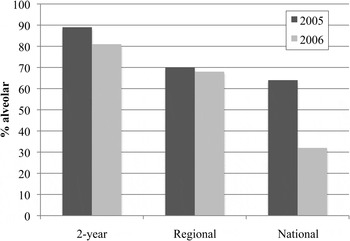
A similar effect of institution type was found in the present study for (ing), as shown in Figure 1. Speakers attending two-year colleges (n = 3) produced generally higher rates of the alveolar variant than did speakers attending regionally oriented institutions (n = 6), who in turn produced higher rates of the alveolar variant than did speakers attending nationally oriented institutions (n = 4). However, only the speakers in the nationally oriented group significantly reduced their use of alveolar [ɪn] between high school and college, χ Footnote 2 (1, N = 717) = 17.1, p < .001. In addition, the two-year group interacted with ethnicity and SES. All three were Irish girls from SES 2. As a result, speakers in the two-year group were combined with speakers in the regionally oriented group (Appendix) for the multivariate analysis.
Percentage use of alveolar [ɪn] by year of recording and post–high school transition.

As previously discussed, existing panel studies of stable sociolinguistic variables have not convincingly differentiated between age grading and style-shifting. There follows here a description of the extent to which factors likely to influence speakers’ style were examined in this study.
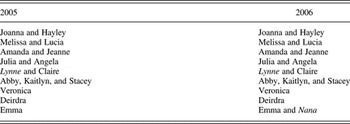
The effect of interlocutor was controlled as much as possible.Footnote 10 The author conducted all of the interviews, and in 18 interviews of 19, the same configuration of informants participated (Table 2). In the one other interview, the informant asked specifically to bring along someone they considered their best friend at that time.
Interview partners, N = 13 panelists, 2005 and 2006

Note: Nonpanelists appear in italics.
Topic, following standard best practice in sociolinguistic interviews (Labov, Reference Labov, Baugh and Sherzer1984), was only partially predefined. Some topics remained constant in both time periods. They included demographic information (updated in 2006 as subjects’ situations changed), relationships with friends and boyfriends, attitudes toward school and higher education, and orientation to or away from the local neighborhood. Other topics emerged naturally as the conversations progressed, following the Principle of Tangential Shifting (Labov, Reference Labov, Baugh and Sherzer1984).
With respect to interview setting (Coupland, Reference Coupland1980; Hymes, Reference Hymes1974:55), every 2005 interview was conducted at Sacred Heart, but in 2006, interviews were conducted in the author's apartment, which was not only unfamiliar to the panel but also in a more upscale neighborhood of the city than was Sacred Heart. However, the 2006 interviews tended to be considerably longer,Footnote 11 and the participants were by this time familiar both with the interviewer and with the interview procedure. The second interviews were also characterized by many more exchanges among the girls themselves, who treated them as opportunities to reunite with old classmates and update each other on gossip. The author provided snacks and drinks and frequently sat back and listened to the talk.
It is hard to estimate how these interacting factors might have influenced the girls’ (ing) production. Apartments are arguably a more informal setting than schools are, but the school was also the girls’ territory, not the author's. For the panel, a decline in standard [iŋ] use could be attributed to familiarity with the interviewer and procedure, whereas a decline in nonstandard [ɪn] use could be attributed to the unfamiliarity of the setting.
To provide some additional gauge of the stylistic characteristics of the 2005 and 2006 interviews, and to test for the possibility that any change over time was due to style-shifting, style was coded using Labov's Style Decision Tree (Labov, Reference Labov, Eckert and Rickford2001b). This style coding schema was developed for the 1970s study of Philadelphia speech (Labov, Reference Labov, Eckert and Rickford2001b) and was employed by Labov in a study of the stable variables (ing) and (dh) in the Philadelphia data. Stretches of speech in an interview are coded for one of eight categories. Four of them are considered speech types with the highest probability of co-occurrence with casual style: Narrative, Group, Kids, and Tangent. Narrative speech is expected to be the most highly vernacular and occurs in the telling of a first-person perspective story of a dramatic or noteworthy event. Group speech is directed to a third party, that is, someone other than the interviewer. Kids is the label for reminiscences about childhood games and activities told from first-person direct experience. Tangent speech comprises stretches in which the interviewee is clearly seen to depart from the question or topic at hand. The remaining four categories—Response (to the interviewer), Language (metalinguistic discussion), Soapbox (opinions of a general nature), and Residual—are expected to co-occur with the speaker's least vernacular style. Labov's (2001b) study of (ing) and (dh) confirmed the validity of these assumptions. Nonstandard variants occurred most frequently in the first four “casual” style categories and least often in the latter five “careful” style categories.
Although many other methods for coding style exist (Eckert & Rickford, Reference Eckert and Rickford2001; Schilling-Estes, Reference Schilling-Estes, Chambers, Trudgill and Schilling-Estes2002), the decision tree was chosen for two reasons. First, the small panel study presented here can be directly compared to the synchronic study by Labov of the same linguistic variable, in the same speech community, using the same definition of casual and careful style (Labov, Reference Labov, Eckert and Rickford2001b). Second, although the tree cannot entirely shield the analyst from subjective decision making, it differentiated the use of standard versus nonstandard variants in other studies (e.g., Mazzaro, Reference Mazzaro2005) and so can be considered reasonably reliable and replicable.
Of the nine style categories, eight were included in the current study, excluding only Kids, a category of talk that did not occur in these interviews. Tangent speech—stretches in which an interviewee clearly departs from the topic at hand—was rare and difficult to identify; it was ultimately included (with the sole token of Language style) in the Residual category. All of the remaining careful speech was coded for Soapbox generalizations, Response to interviewer, or as Residual.
Because the majority of the interviews were group interviews with two or more interviewees, and thus most speech in the interview was effectively intended for reception by a third party, the Group factor was reframed to include only utterances that were clearly directed to an interview partner, rather than to the author. These were often questions, as in (4) or sidebars (5):
(4) Claire: Senior prom! I just found a date to senior prom like last week.
Lynne: Who you taking?
(5) Amanda: Yeah. There was this one girl in particular, I won't mention her name. [to Jeanne] You know who I'm talking about. She's a little hefty.
Narrative speech was identified, following Labov (Reference Labov, Eckert and Rickford2001b:89), as “dramatized accounts of events as perceived by the speaker” and separated from more humdrum accounts of events (“chronicles”) and from accounts of events that the speaker did not personally witness. In group interviews, narratives were typically fairly short, but nonetheless carried the right hallmarks such as being a “reportable event” (Labov, Reference Labov and Hogan2011), told from first-person perspective and at a faster speech rate.
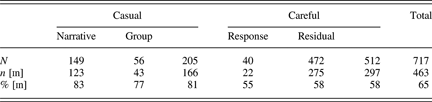
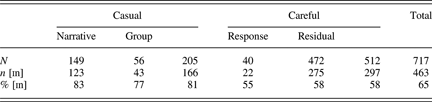
The number of tokens by style is given in Table 3. The ordering of categories generally reflects the distribution reported for (ing) in Labov (Reference Labov, Eckert and Rickford2001b), although Soapbox speech tokens (n = 12) exhibited an unexpectedly high rate of alveolar variants and was combined with Group speech. Overall, casual speech had a significantly higher rate of [ɪn] production (81%) than careful speech did (58%), χ 2 (1, N = 717) = 33.76, p < .001.
Distribution of (ing) tokens by style
Linguistic factors
Studies have consistently shown that the strongest linguistic constraint on the production of (ing) is the grammatical category of the lexical item, with nouns strongly favoring the velar variant and verbs strongly favoring the alveolar variant, and other categories falling in between. However, it is no easy task to assign categories, especially in the case of gerunds (e.g., Houston, Reference Houston1985; Labov, Reference Labov, Eckert and Rickford2001b). To partially resolve this, the present dataset was restricted to verbal tokens of (ing), defined as anything that could not unambiguously be categorized as a noun, pronoun, adjective, preposition, or discourse marker. Verbal forms were chosen because previous studies of Philadelphia speech (e.g., Abramowicz, 2007; Adamson & Regan, Reference Adamson and Regan1991; Labov, Reference Labov2001a) reported them to be much more frequent than other categories of (ing) token and to exhibit more [ɪn]~[ɪŋ] variation. In a study of 33 speakers, Labov (Reference Labov, Eckert and Rickford2001b:88) showed that in his eight-category partition, the four categories in the verbal half of the scale have an [ɪn] frequency range of 50% (from approximately 35% to approximately 85%), whereas the four categories in the nominal half of the scale have an [ɪn] frequency range of only 25% (from 5% to 30%). Verbal tokens were coded binarily as either apical [ɪn] or velar [ɪŋ].12 Tokens were also coded for two linguistic features: following segment (alveolar, other, pause) and preceding consonant (alveolar, velar, other). In her British English data, Houston (Reference Houston1985) identified a regressive assimilation effect, with velar [ɪŋ] forms favored with following velars and alveolar [ɪn] forms favored with following alveolars, as well as a progressive dissimilation effect whereby preceding velars and alveolars disfavor their (ing) counterparts. In the present study, following velars were too infrequent (n = 12) to be considered as a separate factor, and were ultimately included in the Other category. Schleef et al. (Reference Schleef, Meyerhoff and Clark2011) confirmed the effect of both preceding and following segment for the London-born teenagers in their study, but for Edinburgh-born teenagers only following segment conditioned (ing). In Philadelphia, however, Labov (Reference Labov2001a) did not find phonological environment to be a significant factor.
In summary, the following social and linguistic factors were incorporated into the analysis of (ing) variation in the panel, although not all were included in the eventual multivariate analysis:
year of recording: 2005, 2006
socioeconomic status (SES): SES 2, SES 3 (lowest to highest)
ethnicity: Irish, Italian
post–high school transition: regionally oriented college, nationally oriented college
style: casual, careful
preceding segment: alveolar, velar, other
following segment: alveolar, other, pause
RESULTS
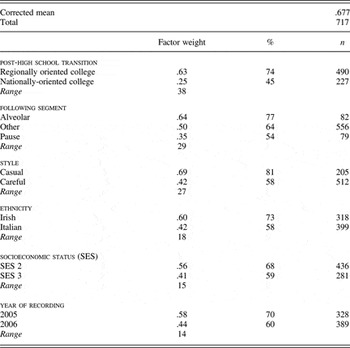
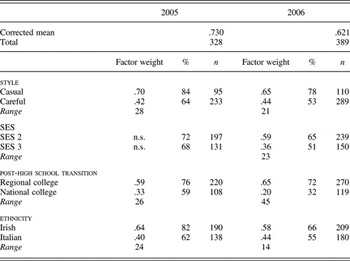
The panel registered a significant decrease in use of the alveolar variant over one year, from 70% to 60%, χ2 (1, N = 717) = 8.133, p < .05. A multivariate analysis of the factors constraining the panel's use of (ing) was performed using the logistic regression program Goldvarb X (Sankoff, Tagliamonte, & Smith, Reference Sankoff, Tagliamonte and Smith2005), and the results are reported in Table 4.
Factors constraining production of [ɪn]

Note: Not selected: preceding segment.
In contrast with other studies, in which linguistic factors contributed most to the model, the biggest constraint on (ing) variant choice in this dataset was post–high school transition. Speakers who attended regionally oriented colleges were much likelier than were speakers at nationally oriented colleges to produce high rates of alveolar [ɪn]. The primacy of a social constraint over linguistic constraints is most likely due to the absence of grammatical category variation (usually the biggest constraint) from the dataset, as well as the relative social homogeneity of the speakers. Only one of the two linguistic constraints, following segment was retained in the model. Following alveolar consonants promote the probability of a speaker producing the alveolar nasal variant [ɪn], as expected. preceding segment was not found to have a significant influence on (ing) in this dataset, but that is perhaps not surprising. The evidence from Schleef et al. (Reference Schleef, Meyerhoff and Clark2011) for two varieties of British English showed regional variation in the effect of the two phonological environment parameters on (ing), and the parameter settings here might reflect a recent Philadelphia constraint ordering that was not evident in Labov's 1970s data.
style, however, has consistently been reported in all other studies as having an influence on (ing) variation (Campbell-Kibler, Reference Campbell-Kibler2005; Fischer, Reference Fischer1958; Labov, 2006[1996]; Wald & Shopen, Reference Wald, Shopen, Shopen and Wald1981; Woods, Reference Woods1978), with casual speech (however operationalized) favoring the use of [ɪn]. The same pattern is found in the Sacred Heart panel: the casual style category is associated with a higher probability of [ɪn] use than the careful category.
The remaining three social factors—ethnicity, socioeconomic status, and year of recording—have a smaller effect on (ing) variant choice, with ranges below 20. With respect to ethnicity, speakers who self-identified as Irish were more likely to use the nonstandard [ɪn] variant than their Italian counterparts were, and this outcome will be explored in the next section. Speakers in the lower socioeconomic status group, SES 2, were more likely to produce [ɪn] than were speakers in SES 3. This finding is in line with other studies mentioned previously. As for the evidence for age grading, this can be seen in the retention of year of recording in the model. The effect is small, like the window of real time it reflects. A window in which, as we have seen, only speakers who entered nationally oriented colleges significantly reduced their use of the alveolar variant.
DISCUSSION
The effect of post–high school transition type on (ing) variant choice was considerably stronger (range = 38) than SES (range = 15). This likely reflects the difficulty of assigning socioeconomic status to older teenagers on the basis of their parents’ occupation, education, and residence value (Hughes & Perry-Jenkins, Reference Robert and Perry-Jenkins1996). It may also reflect the fact that at this life stage, where one is going has more influence on one's use of stable variation than where one has come from. As Chambers (Reference Chambers2008:190) observed, “Some young people appear to set their sociolinguistic range according to their ambitions.”
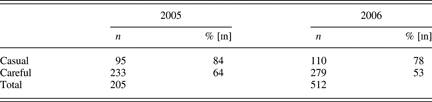
How strong is the effect of ambition over time? To test this, two separate runs of the data were performed by year of recording. The runs were carried out with only the social factors (Table 5), because the token numbers for some subcategories of the linguistic factors were too small for reliable analysis.
Social factors constraining (ing) by year of recording

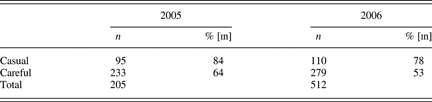
In 2005, all of the social factors except SES were selected as significant by Goldvarb. The remaining factors—style, transition type, and ethnicity—have approximately equal influence on the variation. In 2006, however, SES was selected, and the other social factors have become more strongly differentiated from one another. post–high school transition type emerges as the strongest predictor of (ing) use, with a range of 45; SES is the next strongest predictor (range = 23); and this is very closely followed by style (range = 21). ethnicity is some way behind, with a range of only 14. style is the only factor in the comparative data that does not substantially change its range or rank over time, suggesting that this is a relatively stable predictor of (ing) use over the course of the transition from high school to college, and supporting the claim that the 2005 and 2006 interviews were not very dissimilar in terms of their stylistic make-up. The independence of style and age is apparent in a cross-tabulation of these two factors (Table 6).
[ɪn] by style and year of recording
In contrast to the stability of style, the effect of collegetransition type is operational in 2005, but it is much more influential in 2006. The fact that transition type is selected for the 2005 data supports Chambers's observation that speakers anticipate the speech style that will be most appropriate for the next stage in their lives. Already in the high school, speakers in this panel calibrate their use of (ing) to their intended higher education/occupational trajectories and not to their parents’ social background. By the time they are actually in college, the effect is stronger because the panelists at nationally oriented schools exhibit a significant retreat (Figure 1) from nonstandard [ɪn]. This confirms not only the previous age-grading interpretations of (ing) made in the apparent time studies discussed earlier (Houston, Reference Houston1985; Labov, Reference Labov2001a, Reference Labov2006; Woods, Reference Woods1978), but the expectation—elucidated in Chambers (Reference Chambers2003:206), and suggested in Macaulay's (1977) apparent time results—that linguistic correlates of age grading will appear only in a subset of young people on the verge of adulthood. A panelist's (planned) enrolment in a nationally oriented college, regardless of their membership in SES 2 or SES 3, greatly decreases the likelihood that they will produce alveolar (ing) variants, particularly after high school. We can suppose that this is because attendance at a nationally oriented college brings an expectation of future social and occupational status for which high rates of [ɪn] would not be appropriate. In addition, speakers are likely being exposed to a large majority of fellow students whose own expectations for their future (and/or their socioeconomic background) have promoted low rates of [ɪn] in their speech. There are some qualitative indications in the interviews that speakers at the nationally oriented schools were conforming in other ways to the pressure to orient linguistically to a supralocal, more standard norm. Amanda, for instance, mentioned that on returning home from college she had pronounced the word laughing, in front of her mother, with a lax realization of (aeh)—a tense realization would be more typical for a South Philadelphian. Her mother pounced on this adoption of the nonlocal pronunciation with a swift: “Never fucking say [læfɪŋ] again.”
To understand why socioeconomic status was a significant predictor in 2005 but not in 2006, its relationship to ethnicity must be described in more detail. I hypothesize that SES influences (ing) use both in the high school and outside of it—in other words, that the panelists’ parental background always plays a role—but that socioeconomic status is instantiated differently in high school than in college. In the high school, speaker ethnicity is a near-proxy for social class, operating at Sacred Heart as a means of peer group identification that is akin to the Jocks and Burnouts described by Eckert (Reference Eckert1989, Reference Eckert2000) at Belten High. In college, ethnicity is no longer as foregrounded and may in any case not be interpretable by nonlocal fellow college students.
What are the social meanings of ethnicity at Sacred Heart? For the young women in the study, identification with one or other of the two dominant white ethnic groups in South Philadelphia was partly influenced by residence in a traditionally Italian or Irish neighborhood. Ethnic affiliation was usually expressed using the phrase “where I'm from,” with special reference to iconic (Gal & Irvine, Reference Gal and Irvine1995:973) streets that are locally indexical of Irish or Italian group membership. The SES index incorporated a measure of residence value, and on average, house prices in the Irish neighborhoods were lower than those in Italian neighborhoods were. Nonetheless, not all of those who lived in Irish neighborhoods had a low score on the SES index, and not all of the self-identified Irish girls lived in Irish neighborhoods.
A closer look at the individuals in the study might help to explain what sociolinguistic work “ethnicity” is really doing with respect to (ing). Among the Cohort 1 speakers, two Irish girls, Abby and Kaitlyn, were near-categorical [ɪn] producers in both 2005 and 2006 (Appendix). The remaining Irish girls, Claire, Joanna, Julia, Deirdra, and Melissa, exhibited [ɪn] rates of between 40% and 80% across time. Abby and Kaitlyn were deeply invested in their Irish identities in a way that their four other Irish peers were not. They lived, socialized, and worked part-time in the iconic Irish neighborhood of Second Street and were at the center of peer social networks there. In contrast, Claire, who also lived in this neighborhood, had a mixed Italian and Irish group of friends and was less embedded in the Second Street scene. The effect of ethnicity in the data, therefore, may be an artifact of orientation to or away from Second Street.
Exactly why Second Streeters and their associates would exhibit the highest rates of nonstandard [ɪn] is attributable to a mixture of social factors. Abby and Kaitlyn are in SES 2, but they were the only two speakers in this category who did not go on to a four-year college after graduation. Both were pursuing vocational associates’ degrees in 2006 at a local community college. In addition to the factors of age and social class, affiliation with Second Street was viewed at Sacred Heart as indexical of a straightforward personal style, or even tomboyishness. Abby and Kaitlyn, contrasting typical Second Street girls with typical über-Italian girls, described Second Street girls as sports-loving, “easy-going,” and “laid-back,” to the point of being unembarrassed about burping in public. Second Streeters occupied the most Irish end of a perceived ethnic continuum. The Italian end of the continuum, interestingly, did not have such strong associations with a particular locality and was generally understood to apply to Italian girls who were especially “gaudy”: excessively concerned with their appearance, with boyfriends, and with showy material goods (7).
(7) Melanie: The stuck-up ones who wear the too much lip liner, and put their—
Sarah: And all the gold jewelry and all the perfect bags and everything perfect.
Melanie: And their mothers go tanning and they look like they were in a toaster.
The ethnic continuum in the school can therefore be seen as overlapping with—and to some extent acting as a proxy for—continua of social class and gender. One Italian informant remarked that Irish girls “acted like men.” In light of this, it seems unsurprising that Second Street girls would orient strongly away from standard norms of female behavior in their management of linguistic resources, too. The backing (and raising) of /ay/ before voiceless consonants is a rare male-led change (Conn, Reference Conn2005; Labov, Reference Labov2001a), which is perhaps why it was appropriated at Sacred Heart as a marker of Irish ethnicity. Similarly, the association of high rates of [ɪn] use with working-class men and casual speech styles is being exploited in the expression of Irish affiliation. As to the question of why Irish ethnicity appears to be more clearly marked linguistically than Italian ethnicity is in the school, the answer perhaps lies in their relative social visibility (8):
(8) Natalie: We're all Italian but we don't show it, like “Oh, we're Italian.” Like the Irish people are so into that they're Irish.
In summary, (ing) at Sacred Heart reflects not only established supralocal meanings such as “standard,” “careful,” and “well-educated,” but also a set of local social meanings (Campbell-Kibler, Reference Campbell-Kibler2005) that include residence, ethnic self-identification, social class, and even gendered behavior. Strong affiliation to the iconic center of Irish ethnicity, Second Street, appears to promote [ɪn] use both within and beyond the high school, but particularly in school, where this affiliation has primacy over parents’ social class background. As the panelists attend colleges with other Philadelphians—and especially with non-Philadelphians—whose understanding of “Irish” and “Italian” is not shared with theirs, the importance of ethnic affiliation wanes. Without a relatively fine-grained knowledge of the local social landscape, individual differences in (ing) use over time could not be as easily interpreted, either by nonlocal peers, or by the analyst.
CONCLUSIONS
Although the stable English sociolinguistic variable (ing) has been frequently investigated by variationist sociolinguists, it has only been tracked in one other longitudinal panel study (Van Hofwegen & Wolfram, Reference Van Hofwegen and Wolfram2010). The present study represents a step forward in our understanding of (ing) use over the life span. It complements Van Hofwegen and Wolfram's (2010) study, which followed its subjects up to the age of approximately 15 years, by looking at speakers in the next stage of adolescence (17 to 19 years old). The study confirmed, using real-time panel data, that by this stage in the life course, most speakers register a retreat from the higher rates of nonstandard [ɪn] use that were characteristic of their middle adolescent years. This constitutes the first real-time confirmation that a well-known diachronically stable variable does exhibit age grading.
Furthermore, this age grading was generally in the expected direction of decreasing production of nonstandard variants with increasing age as speakers approached adulthood. Age grading was considered the best explanation for the reduction in nonstandard variants, because multivariate analysis showed a significant effect of year of recording. Importantly, the effect of year of recording was independent of the effect of style, suggesting that speakers were not simply exhibiting a temporary situational style-shift in response to a new interview setting.
But even in this relatively homogenous sample, the retreat from [ɪn] over time was not evident for all speakers. A minority exhibited little to no change in the direction of the standard norm, and this was especially the case for speakers who were affiliated with Second Street, an iconic Irish neighborhood. It was argued that the local social meanings of Second Street—informal interactional style, toughness, and such—in turn indexed the supralocal characteristics that have been associated with [ɪn]: casual style, male gender, and lower social class. As a result, the young women who maintained strong ties with the Second Street network after graduation reflected this affiliation in their high rate of use of [ɪn], in opposition to the more normative behavior expected of them at this life stage. A second minority—those speakers who enrolled in nationally oriented colleges—exhibited a significant decline in [ɪn] use after high school, when compared with peers at regionally oriented colleges. The mid-range size of the panel thus allowed for generalizations about both the majority and the minority, by making use of in-depth knowledge of individuals’ social backgrounds and life trajectories. Additionally, although the timeline for this panel study was short, the results suggest that targeted studies of critical turning points in the life course can contribute to the understanding of individual life span change.
The picture presented here is very far from complete. The panelists in the Sacred Heart study were drawn from a relatively narrow socioeconomic range. It would be useful to have more real-time information on a broader range, too. With data from the upper middle to upper class, for example, it would be possible to examine the categoriality constraint from another angle, namely: What happens to speakers who show almost 100% use of standard variants as teenagers? If given incentives to change (such as strong downward social mobility) will they change? Or could we locate a social context in which the “informal” end of their stylistic range would be tapped? A follow-up to the present study may go some way to answering Labov's question about whether speakers who exhibit high rates of [ɪn] use simply lack the sociolinguistic competence to style-shift or else lack the incentive to do so. It may turn out to be the case that the Second Streeters are simply lagging behind their peers, and that some of them at least will make the shift in the direction of the standard variant later on. But for those who continue to employ [ɪn] at near-categorical rates, we will be unable to say whether [ɪŋ] is stably marginal in their repertoire (cf. Sankoff & Blondeau, Reference Sankoff and Blondeau2007, on categorical speakers), or whether they have not yet encountered the social circumstances in which they would feel it appropriate to use [ɪŋ] at nonmarginal rates. Only a study that follows individuals from cradle to grave is likely to be able to determine this unequivocally. There is no doubt that we need large-scale, longer-term studies in which informants are recorded in a variety of settings with a variety of interviewers (Chambers, Reference Chambers2008:194). But that is not to say that we cannot design feasible studies to examine the various angles of variation. It is to be hoped that a more detailed sociolinguistic investigation of the Sacred Heart data, or of other panel data, can show whether teenagers who can make big temporary shifts are also the ones who make big changes over the rest of their adult life span.
APPENDIX
Rates of production of alveolar [ɪn] in the 2005 and 2006 interviews for all speakers (N = 13). Self-identified Irish informants are in small capitals

Note: aHayley's large increase in [ɪn] production over time is anomalous. Speaker design may be at work here. Hayley was introduced to the study as an editor of the school newspaper, and treated the first interview as a journalistic encounter, presenting herself (most of the time) as a wary, disinterested professional. In the second interview, she took greater pains than any other informant did to represent her college experience as one of drama, fun, and partying. See Wagner (Reference Wagner, Scheffler, Tauberer, Eilam and Mayol2007, Reference Wagner2008) for more on Hayley.