


8.1 Introduction
The relationship between social democratic parties and labor unions is of interest for the entire era of labor mobilization since the nineteenth century. Both labor unions and social democratic parties benefited from a close, interlocking relationship in Western Europe in several ways: Trade unions generated long-lasting and tightly knit networks of mobilization (Gingrich and Lynch Reference Gingrich and Lynch2019); trade unions and social democratic parties exchanged and cumulated organizational and financial resources; their interconnections also contributed to the programmatic alignment of voters and members on the Left and to socialization processes into a joint programmatic orientation. The question today, however, is whether we observe an increasing dealignment between trade unions and social democratic parties in terms of constituencies, as well as in terms of programmatic orientations. The middle-class shift in the employment structure of West European countries, the emergence of highly salient sociocultural issue dimensions, as well as the pluralization and fragmentation of the “left field” into social democratic, radical left and green and left-libertarian parties raise several questions in this regard. Have the constituencies of left parties and trade unions developed in parallel or have trade unions remained anchored in the working class while left parties increasingly attract support from elsewhere? Consequently, do the average preferences of trade union members and left voters align or diverge when it comes to redistribution, cultural liberalism, and immigration policies? Do unionized left voters sort increasingly into radical left, social democratic, or green and left-libertarian parties? Eventually: Do trade unions remain a connecting force in an organizationally and programmatically realigned left field?
Historically, trade unions and social democratic parties reinforced each other through a variety of channels in both directions: Bartolini’s (2007: 290–97) detailed empirical examination suggests that at the very beginning of the labor movement, European social democratic parties did not significantly benefit electorally from early unionization. Rather, it appears that party growth in the late nineteenth century induced union mobilization, which, in turn, became most beneficial for Social Democrats later in the temporal sequence. Throughout much of the twentieth century, however, interlocking cross-linkages between unions and parties, particularly in the presence of (quasi-)monopolistic union federations dominated by operatives who combined union and party offices, clearly boosted electoral partisan mobilization (Bartolini 2007: 294).
A variety of channels may have come into play in the virtuous circle between labor unionization and social democratic electoral fortunes. Working-class youths, entering apprenticeship or shop-floor unskilled labor relations at age 14 or 15, were likely to encounter unions first and join them at a much younger age than when they gained eligibility to vote at age 21. If unions were densely organized on the shopfloor as well as closely connected to social democratic parties, labor unions also provided a venue for youths to engage in party politics, first in party youth organizations and then through party membership and electoral participation. Unions created the social networks to socialize teenagers into partisan politics. Moreover, they tended to shape young workers’ political preferences to make them receptive to social democratic programmatic appeals. Both social network mechanisms and ideological formation are probably so closely intertwined that they are hard to separate analytically. This dual political accelerator further strengthened in all those instances in which unions had formal or informal claims to organizational representation inside social democratic parties all the way up from boards of party grassroot units to the organs of party leadership and legislative representation. The overlap between union and party offices was often substantial. A familiar sight were social democratic legislators who originated from working-class families, started out in blue-collar jobs, became union operatives, and then combined their elected parliamentary office with serving as secretary of a local union branch.
If that gives a flavor of the historical template of union–social democratic party relations at the electoral and organizational levels, how have relations evolved in recent decades and with what consequences for social democratic electoral fortunes? The loss of union members, particularly among the young, is likely to have weakened bonds of working-class voters to social democratic parties as well. The enfeebled parties, in turn, may then have been less successful in protecting or promoting the institutional centrality of labor unions in industrial relations systems, thereby undercutting unionization and alienating union members. At the same time, the influx of university educated voters into social democratic and other left parties may have further contributed to loosening the alignment between labor organizations and parties both organizationally and with regard to preferences.
In this chapter, we will address the subject of union–party relations and how it relates to social democratic fortunes with microlevel data on membership, political preference profiles, and electoral behavior. The chapter explores the extent to which unionized and nonunionized social democratic voters converge or diverge in their programmatic policy preferences. We also probe into differences in political views between labor unionists supporting different left-wing parties. Moreover, the chapter examines the “loyalty,” “inertia,” or “clinginess/identification” of union voters to social democratic parties through the lens of interparty switching behavior in elections. Does union membership create a distinctive incentive to maintain social democratic partisan loyalty?
The historical expectation is that the party-affiliated labor unions are the stalwarts of sustaining social democratic electoral support. But – at the micro-level of voter behavior – is this expectation still empirically borne out? After all, there are radical left and green and left-libertarian alternatives in many party systems that also embrace labor demands. Does this differentiation among political parties imply a stronger preference heterogeneity between unionized and nonunionized left voters, as well as among unionized voters of different parties in the left field? Therefore, can Social Democracy still claim to be the party of the labor movement in many advanced knowledge societies? Or, if unionists no longer have strong motivations to remain loyal to Social Democracy, are they exhibiting distinctive patterns of switching to other parties? For example, given that the bread-and-butter issue of labor unionism is the struggle for income redistribution, are labor unionists less likely to defect to the Green Left, with an emphasis on many other issues, but more likely to defect to the Radical Left, making economic distribution its most salient political cause?
Our findings concerning these questions confirm and extend empirical evidence gathered in investigations over the past decade. Several results stand out. First, trade unions have experienced a higher-education shift in the composition of their membership that is very similar to the shift within the electorates of social democratic parties. However, among social democratic voters – and among the constituencies of other parties on the Left, as well – unionists and nonunionists remain very close in programmatic terms. In particular, unionized nonworking-class members are just as left-wing when it comes to economic-distributive attitudes as working-class members. Second, if there are differences in political preferences, we find them within the subgroup of unionized social democratic voters: higher-educated unionists are programmatically more progressive than their working-class counterparts on second dimension issues such as LGBT rights or, in particular, immigration. This substantial tier of nonworking-class union members – most prevalent in (public) service sector unions, particularly in Northern Europe – now tilts toward green and left-libertarian positions.
Third, turning to labor unionists’ loyalty to Social Democracy or party switching, unionized voters are still more likely to support Social Democracy than nonunionists. But contingent upon region, unionists also provide strong support to distinctive left competitors of Social Democracy as well. In Northern and Continental Europe, where there is a strong supply of green and left-libertarian parties, these competitors to Social Democracy also disproportionally attract unionists. In Mediterranean Europe, the main electoral competitor of Social Democracy in the hunt for union voters, however, is the Radical Left. Fourth, where green and left-libertarian competitors attract substantial shares of unionists, they do so particularly among highly educated unionists. In a dynamic perspective, this pattern is confirmed by unionists’ switching to green and left-libertarian parties, although numbers of observations are too small to be statistically confident. But the writing may be on the wall: Green and left-libertarian competitors of Social Democracy appear to gain momentum among unionists particularly in the countries with the highest levels of unionization and in the socioeconomic occupations with the most promising numerical prospects in terms of future labor market demand, namely college educated professionals.
This chapter is structured as follows: In Section 8.2, we review existing evidence concerning the political outlook and partisan behavior of unionized voters compared to nonunion members. We also present descriptive data on changes in the class composition of trade union membership and voting patterns among union members. The chapter then outlines three theoretical propositions with regard to the changing relationship between trade union constituencies and party electorates on the Left and derives expectations regarding political preference patterns and vote switching. The empirical sections evaluate the plausibility of these theoretical expectations in two ways: The first empirical section examines political preferences among unionized and nonunionized voters of social democratic and other left-wing parties. The second empirical section analyses variations in unionists’ and nonunionists’ voting support for Social Democracy and other party families on the political Left. Are unionists more likely to be social democratic standpatters or are they switchers opting for alternatives on the Left and beyond?
8.2 The Context: Class Composition and Voting Patterns among Trade Union Members
Most existing contributions diagnose weakening bonds between trade unions and social democratic parties (Allern and Bale Reference Allern and Bale2012, Reference Allern and Tim2017; Gumbrell-McCormick and Hyman Reference Gumbrell-McCormick and Hyman2013). Scholars have nominated two reasons for this development: changing employment structures and programmatic shifts of social democratic parties.
First, the changing employment structures – deindustrialization and the massive expansion of occupations in middle- and higher skilled service jobs – are well documented (Oesch Reference Oesch2013; Boix Reference Boix, Beramendi, Häusermann, Kitschelt and Kriesi2015). They are at the root of both decreasing trade union density overall, as well as a massive expansion and diversification of the highly educated, which are an increasingly important constituency of the Left (Kitschelt Reference Kitschelt1994; Kriesi Reference Kriesi, Kitschelt, Lange, Marks and Stephens1999; Gingrich and Häusermann Reference Gingrich and Häusermann2015; Häusermann Reference Häusermann, Manow, Palier and Schwander2018; Oesch and Rennwald Reference Oesch and Rennwald2018). This development alone raises the question if a diverging class composition of trade union constituencies and left party electorates drives these organizations apart. Second, social democratic parties have allegedly moved away from pro-welfare and pro-redistribution policies toward more centrist positions, which may have alienated trade union members from social democratic parties. Moreover, the emergence of cultural liberalism as a core issue of left politics may increase such an alienation: Trade unions are rooted in the production working class, who tends to be more culturally conservative than other supporters of left parties. It is this sociocultural divide that has motivated speculations about a new “natural” alliance between right-wing nationalist organizations and trade unions in favor of social protectionism, anti-free trade, or welfare chauvinism.
But there are also reasons to believe that the link between unions and social democratic parties remain strong. After all, trade unions may be exposed to the same sociodemographic and programmatic transformations as social democratic parties. As higher-education occupations spread and expand, so may trade union membership within them. Thereby, unionized left voters may align with the culturally progressive orientation of the Left. At most, there may be growing internal tension within trade unions between more conservative (working-class) and more progressive (highly educated) members.
In this first section of the chapter, we provide an empirically informed overview of the development of the class composition of trade union membership over time, and of the average electoral choices of trade union members. We show that trade union constituencies have experienced a higher education shift that is similar to the one experienced by social democratic parties. We also show that while social democratic parties on average remain the most prevalent choice among unionized voters, union members increasingly also vote for other left-wing parties of either the radical left or the green and left-libertarian party families.
8.2.1 Changes in the Sociodemographic Composition of Unionists and Unionization
Even with continuing high propensity of unionists to support Social Democrats, a big driver of social democratic electoral decline might simply be the shrinkage of labor unions that can be observed in all Western countries. But there is unlikely to be a direct and linear relationship between union and party decline (Rennwald and Pontusson Reference Rennwald and Pontusson2021: 40). Moreover, the decline of unions itself is starkly heterogenous. It unfolds from different starting points and with different slopes of membership decline (for data, see Hassel Reference Hassel, Beramendi, Häusermann, Kitschelt and Kriesi2015: 236–38 and 255–56). In the Nordic countries, only a small decline occurred from very high levels of unionization (upwards of 70% of wage earners). In Continental Europe, the decline was more substantial starting from an only intermediate level of wage earner union enrollment (from 30–40% down to 20–30% union density from the 1980s to the 2000s averages). A similar pattern pertains in Mediterranean Europe, albeit in a somewhat more pronounced way, beginning at slightly lower levels than the Continental European group and dropping a bit further. Finally, the membership drop is most pronounced in Anglo-Saxon countries, starting with a relatively high average of greater than 40% union density in the 1980s and dropping to one near 25% by the first decade of the 2000s. Moreover, especially in the Mediterranean countries, but also to a lesser extent elsewhere, a large share of unionists is among the retirees and unions experience little membership replenishment among young wage earners.
Other over-time changes in unionization that may affect Social Democracy have to do with the sectoral and sociodemographic structure of unionism. Unionism has increasingly become a middle-class phenomenon in the sense that more highly paid, educated, and service-sector employed wage earners show the comparatively strongest inclination to join unions (Hechter Reference Hechter2004; Kjellberg Reference Kjellberg2008; Becher and Pontusson Reference Becher, Pontusson and Brady2011; Ebbinghaus et al. Reference Ebbinghaus, Göbel and Koos2011; Mosimann and Pontusson Reference Mosimann and Pontusson2017, Reference Mosimann and Pontusson2022; Arndt Reference Arndt2018). In occupational terms, in recent years sociocultural professionals often display higher rates of unionization than either blue-collar workers in production and services or other lower-skill clerical wage earners (Rennwald and Pontusson Reference Rennwald and Pontusson2021). These developments also show up in a finding by Mosimann and Pontusson (Reference Mosimann and Pontusson2017), who demonstrate that European unions have, on average, become less low-income inclusive between 2002 and 2016.
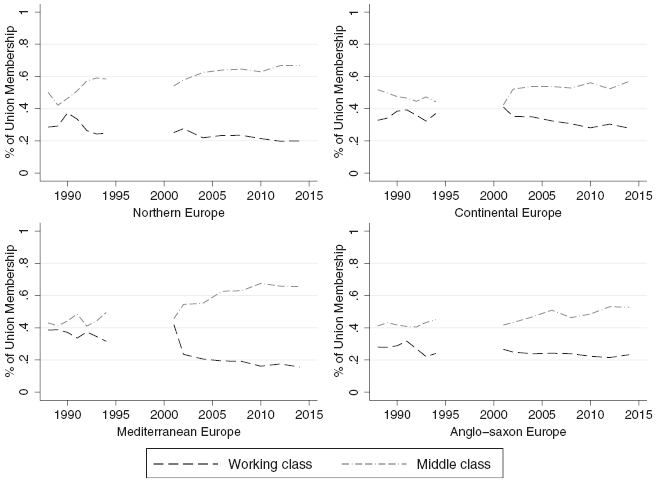
These trends are reflected in Figure 8.1. Based on a dataset combining Eurobarometer (EB) and European Social Survey (ESS) waves from the late 1980s to present, Figure 8.1 shows how the class composition of trade union membership has changed over time. Prepared by Gingrich and Häusermann (Reference Gingrich and Häusermann2015), the EB/ESS dataset combines the 1972–2002 EB trend file with seven waves of the ESS from 2002 to 2014.Footnote 1 Within this combined dataset, a question pertaining to respondents’ union membership status is available in the EB data from 1988 to 1991 and 2001 and is also available in the ESS waves from 2002 onwards.Footnote 2
Changes in the class composition of trade union membership
Note: Calculations for the employed population aged 18 and over.
Among the West European countries for which we have data on any of these waves, we select the twelve countries that have participated several times in the earlier period (1988–94) based on EB data and in the later period (2001–14) based on EB and ESS data. We sort these countries into four regions.Footnote 3 At the individual level, the sample is restricted to employed respondents aged 18 and over, that is, the pool of potential union members in most West European countries.
To observe changes by class, we group respondents based on their occupation and educational attainment. We define manual workers as working class. We label as “middle class” respondents with upper secondary education who work in sociocultural professions, technical professions, associate and higher management occupations, as well as office employees with upper secondary education.Footnote 4
Figure 8.1 shows how the relative shares of unionized working- and middle-class respondents have developed over time. By 2014, middle-class members have become by far the main constituency of trade unions in all regions. While the gap across classes has become widest in Northern and Mediterranean Europe, it has remained somewhat smaller in Continental and Anglo-Saxon Europe. The finding that unions become predominantly composed of middle-class employees over time holds for all countries in our sample.
This change in membership composition is due to declining working-class unionization on the one hand and structural occupational changes on the other hand. As a result, the picture we see for unions in Figure 8.1 closely resembles the one that has been documented for left-wing parties in general and social democratic parties in particular (Gingrich and Häusermann Reference Gingrich and Häusermann2015; Häusermann Reference Häusermann, Manow, Palier and Schwander2018).Footnote 5
8.2.2 Political Preferences of Trade Union Members over Time
The shift in the occupational and income profile of European labor unionists is likely to coincide with an evolving profile of union members’ political preferences. Existing empirical research shows that labor unionists and social democrats share a strong concern for redistributive income policies (Mosimann and Pontusson Reference Mosimann and Pontusson2017, Reference Mosimann and Pontusson2022; Macdonald Reference Macdonald2019) and support other policies with distributive implications (Hadziabdic and Baccaro Reference Hadziabdic and Baccaro2020) as well as social insurance policies (Häusermann and Kriesi Reference Häusermann, Kriesi, Beramendi, Häusermann, Kitschelt and Kriesi2015; Bledow and Busemeyer Reference Bledow and Busemeyer2021). Likewise, unionists, as well as social democrats, on average embrace progressive positions on societal issues concerning gender/sexual orientation, environmental protection, or civil liberties. Most notably, recent studies find that labor unionists also on average tend to support liberal immigration policies more than nonunionists (Kitschelt and Rehm Reference Kitschelt and Rehm2014; Donnelly Reference Donnelly2016).
It is likely, however, that there may be considerable internal heterogeneity in opinions on such issues among trade union members. This heterogeneity, in turn, is also likely to affect their vote choices in an increasingly differentiated and fragmented left field. Still, empirical studies show a general tendency for labor unionists to be disproportionally supportive of, and loyal to, social democratic parties (Arndt and Rennwald Reference Arndt and Rennwald2016; Rennwald and Pontusson Reference Rennwald and Pontusson2021).
Figure 8.2 confirms this tendency of unionists to vote social democratic. Based on the same EB/ESS dataset as Figure 8.1, Figure 8.2 shows the share of trade union members voting for social democratic, other left and non-left parties over time. The coding of parties follows the coding in this book with some minor deviations.Footnote 6 Parties are sorted into one of six party families: social democratic, green and left-libertarian, radical left, liberal and conservative, Christian democratic, and populist right. Contrary to the coding of parties in this book, we differentiate between Christian democratic and other moderate right parties, because of special ties between the former party family and the (Christian) labor movement (Arndt and Rennwald Reference Arndt and Rennwald2016; Allern and Bale 2017).
Changes in voting patterns among union members
Note: Calculations for the employed population aged 18 and over.

Figure 8.2 provides at least three important findings. First, voting social democratic has been and still is the most likely party choice among union members across Continental and Anglo-Saxon Europe. In Northern and Southern Europe, Social Democrats experience stiffer competition for unionists’ vote from moderate right parties. Second, about 60% of trade union members vote left in Northern and Continental Europe across the period under investigation, and that share even reaches 70% in Mediterranean Europe. Moreover, vote patterns for social democratic and other left parties develop in complementary ways, suggesting that electoral volatility plays out within rather than across ideological blocks. A third finding addresses speculations about a massive authoritarian shift of (unionized) working-class voters toward the Radical Right. Contrary to such speculations, the share of unionists voting for the Radical Right is extremely low and stably so across Europe.
At the microlevel, sectoral and occupational differences among unionists come into play in shaping unionists’ actual partisan vote choice as shown in Figure 8.2. Unionized blue-collar and clerical workers (industrial, service) may be more likely to stick with Social Democracy than unionized wage earners in nonworking-class occupations. Rennwald and Pontusson (Reference Rennwald and Pontusson2021: 45) find that “cross-class” appeals of social democratic parties, indicated by the parties’ ability to attract a higher proportion of nonworkers, actually keep blue-collar unionists more loyal to the party than other social democratic voters. Unionization still appears to exert a powerful affective bonding effect on workers who thereby stick with Social Democracy, even when it appears to cater to other demographic categories’ preferences. A similar loyalty is not evidenced by the electoral behavior of unionized nonworkers. They tend to be more likely to affiliate with the Green Left, and in a dynamic perspective, they are also more likely to switch from Social Democracy to the Green Left but particularly when Social Democrats focus their appeals on working-class voters rather than a cross-class message (Rennwald and Pontusson Reference Rennwald and Pontusson2021: 45).
Rennwald and Pontusson’s (Reference Rennwald and Pontusson2021) study of vote switching thus also suggests an asymmetry among the electoral choices made by working-class and nonworking-class unionized social democrats. The latter find it easier to abandon Social Democracy and particularly to switch to moderate right or green and left-libertarian parties. Working-class unionists have a slightly higher propensity to support radical right parties, when leaving Social Democracy. In Rennwald and Pontusson’s (Reference Rennwald and Pontusson2021) analysis, however, all categories of union members have a somewhat greater tendency to switch to radical left parties than nonunionists because of such parties’ advocacy of more redistribution.
Labor unionism seems a mixed blessing for Social Democracy in the twenty-first century. On the one hand, labor unionists prop up social democratic parties and provide less volatile support than nonunionists. This is because of a confluence of redistributive policy preferences as well as a habitual affective affinity created by organizational involvement and interaction. On the other hand, the size of the industrial labor force joining traditional unionism with close ties to social democratic parties has been shrinking. At the same time, new unionists with higher educational skill levels and/or income affiliated with sectors that are expanding and were not previously unionized bring in political actors that are harder to line up with social democratic parties both in their policy preferences and in their willingness to switch parties based on a strategic – or even a short-term tactical – calculus. On balance, labor unionism may no longer be a sure pillar of support for Social Democrats. Our empirical analysis aims at demonstrating the Janus face of unionism and social democratic party relations in further detail.
8.3 Theoretical Propositions
Both the theoretical abovementioned discussion and the descriptive data on the changing class profile of trade union constituencies and diversifying party choices raise the question whether these developments constitute a problem for social democratic parties or not. Such a problem could take the form of either stronger internal heterogeneity of policy preferences between their unionized voters and their nonunionized voters or an increasing tendency of unionized voters to switch away to other parties.
To assess the extent to which social democratic parties and trade unions have diverged or still ally, we sketch three alternative scenarios or hypotheses on the relationship between labor unions and social democratic parties in contemporary knowledge capitalism. Each of them has specific empirical implications regarding preference profiles and vote switching/loyalty that we subsequently explore.
A first scenario is continued social democratic / moderate left union loyalty. This hypothesis postulates that labor unionists are primed to demand economic solidarity and hence income redistribution, just like social democratic voters. In this scenario, we would expect to find hardly any differences in the programmatic preferences of unionized and nonunionized (social democratic) voters, regarding both economic-distributive and sociocultural policy issues. In addition, long-term affiliation with Social Democracy among labor unionists strengthens affective identification and makes electoral defection unlikely. Across economic branches and occupational subgroups of labor unionized wage earners, this hypothesis thus expects a continued elevated level of support for Social Democracy among those organized in labor unions.
A second scenario is radical left defection of union members. According to this hypothesis, unionized voters insist on a more radical leftist economic agenda of income redistribution than nowadays offered by social democratic parties. Therefore, we would expect radical left unionized voters to exhibit decidedly stronger pro-redistribution attitudes than the unionized voters in the social democratic and green and left-libertarian electorates. As these unionists would show a high propensity to defect to available radical left alternatives to Social Democracy, we would expect to see substantive vote switching from social democratic to radical left parties. Alternatively, short of being able to support a credible Radical Left, such workers may withdraw from voting (Evans and Tilley 2012).
A third scenario is the green and left-libertarian defection of union members. According to this hypothesis, many green and left-libertarian parties are receptive to redistributive concerns and additionally offer a number of progressive political and cultural policy prospects that may particularly attract specific categories of wage earners within the unionized labor movement, such as the numerically expanding cohorts of educated sociocultural service professionals. Consequently, over time green and left-libertarian parties may claim a growing share of unionized (middle-class) wage earners and compete with Social Democrats on what the latter considered their very own turf. In terms of empirical implications of this scenario, we would expect to see green and left-libertarian union members to hold clearly more strongly progressive preferences than unionized voters of social democratic or radical left parties. We would also expect to see substantive patterns of vote switching from social democratic to green and left-libertarian parties, especially among the middle class.
In principle, two additional, scenarios are theoretically possible. First, it could be that union membership has become entirely irrelevant for party choice (i.e., a complete decoupling of parties and unions). In an environment of eroding labor union enrollment and dealignment of voters from political parties, this hypothesis predicts a zero impact of labor union membership on partisan choice. But while labor union membership has declined everywhere, it still varies sharply across countries (Hassel Reference Hassel, Beramendi, Häusermann, Kitschelt and Kriesi2015). Moreover, Figure 8.2 has ruled out this scenario from the start. Second, it could be that unionists have become disaffected by conventional parties and now vote for radical right parties in protest and/or in alignment with second dimension authoritarian and xenophobic anti-immigrant preferences. The evidence in previous chapters (e.g., Chapter 3 by Abou-Chadi and Wagner, or Chapter 5 by Bischof and Kurer) and discussed earlier (incl. Figure 8.2) demonstrates that there is no massive defection to the Radical Right in the working class at large, or among unionized voters. Hence, these two alternative scenarios seem (so far) implausible, and we do not pursue them further empirically.
There are at least two types of modifiers that may indicate the polities and socioeconomic groups to which one or the other of these three hypotheses may apply with particular empirical force. The first concerns divisions among different categories of unionized wage earners. As already indicated when discussing hypotheses 1 and 2, the divisions may be based on sectoral and occupational conditions differentiating the wage earner population. Employment in shrinking manufacturing sectors with high, but declining shares of manual labor may well motivate their unionized lower-skilled workforce to defect from Social Democracy by either moving right, abstaining, or moving to the Radical Left. Other unionized sectors and occupations may tilt more to green and left-libertarian alternatives. As indicated, this propensity may be particularly pronounced among more highly educated wage earners concentrated in social, educational, health, and cultural services.
The second modifier resides in the different countries’ party supply and aggregate voter demand for partisan programmatic positions. Electoral laws constrain the supply side of political alternatives. In the presence of single-member district plurality, electoral laws – such as in Britain or the United States – it is difficult to establish a partisan competitor to existing moderate left parties that could attract voters based on more radical economic-redistributive or more cosmopolitan and libertarian second dimension issue positions. Barriers to the entry and effective legislative representation of new parties in these systems are sufficiently high to dissuade rational voters from abandoning social democratic party labels and supporting new alternatives. Within this institutional setup, therefore, hypothesis 1 (loyalty of labor unionists to established moderate left parties) may plausibly capture empirical voter conduct most accurately. By contrast, where multimember district electoral systems of proportional representation that is permissive to the entry of new parties are in place, unionists may more easily abandon conventional moderate left Social Democrats in favor of radical left (H2) or green and left-libertarian parties (H3).
The institutional supply-side facilitator of unionists’ defection from Social Democracy comes with a complementary political-economic demand-side accelerator. It is a robust empirical relationship that systems of proportional representation redistribute more income through more encompassing welfare states (Iversen and Soskice Reference Iversen and Soskice2006). Encompassing welfare states often involve more social service public and nonprofit sector employees (particularly in health, social assistance, and education), thereby magnifying the share of the electorate with professional profiles and occupations receptive to green and left-libertarian demands.
Northwest European welfare states and party systems thus should turn out to be most conducive to making green and left-libertarian parties strong contenders for the union vote: In these countries, labor union density is still comparatively strong,Footnote 7 welfare states and the “de-commodification” of social work have gone further than elsewhere, and all of these countries have electoral voting systems of proportional representation. In these countries, then, the union realignment pattern postulated in H3 may be borne out particularly clearly. In other systems of proportional representation, with less redistributive welfare states, and lower unionization, and further removed from the global knowledge society innovation frontier – evidenced by smaller cohorts of sociocultural professionals – political-economic conditions may not favor the defection of many unionists to green and left-libertarian parties, but more so to radical left parties (H2). Particularly in the face of precarious labor market conditions, such radical left parties – rather than green and left-libertarian competitors – benefit from the waning appeal of Social Democracy.
Putting country-level and group-level indicators together, different configurations of institutional and political economic conditions should make it more likely to validate one or the other hypothesis about vote switching among labor union members. The union social democratic standpatter H1 may be borne out particularly well in Anglo-Saxon democracies with single-member district electoral systems, reinforced by a high salience of economic redistribution in environments of limited welfare states and high-income inequality. The radical left unionist defection hypothesis (H2) may empirically apply more to democracies with proportional representation, but weak green and left-libertarian parties for reasons of socioeconomic development and political economy. The green and left-libertarian unionist defection hypothesis (H3), finally, comes into force in systems of proportional representation in Northwestern Europe with encompassing welfare states and strong green and left-libertarian party alternatives. Table 8.1 summarizes this argument.
| Election-to-election voting behavior of unionized SD voters | Conditionality: Switching pattern most likely when | ||
|---|---|---|---|
| Supply side: Electoral system | Demand side: Knowledge society | Context: Welfare state | |
| H1: more likely to remain SD standpatters | Restrictive | More or less advanced | More or less encompassing and progressive |
| H2: more likely to become out-switchers to Radical Left | Permissive | Less advanced | Less progressive |
| H3: more likely to become out-switchers to Green Left | Permissive | More advanced | More encompassing and progressive |
We note that our predictions regarding the loyalty of union members to social democratic parties in different countries overlap with predictions made by Arndt and Rennwald (Reference Arndt and Rennwald2016) and Mosimann and Pontusson (Reference Mosimann and Pontusson2017). Their proposed mechanism, however, is different: Loyalty is high where middle-class unionists will be “socialized” into working-class unionists’ preferences in favor of redistribution, particularly when combined under the same union umbrella numerically dominated by the blue-collar membership. There are two countries, however, where this “union socialization hypothesis” and our reasoning make contrasting predictions: Austria and Germany. Because of institutional and political-economic conditions, and the presence of strong green and left-libertarian parties, the demand-and-supply argument predicts a high defection rate of unionists from Social Democracy toward green and left-libertarian or moderately conservative partisan alternatives, particularly among high-skill labor unionists, and consequently a high level of unionists supporting nonsocial democratic parties. By contrast, following the union socialization account of redistributive preference formation, Austria and Germany should exhibit rather low middle-class unionist defection rates toward rival parties: After all, encompassing single union federations with majority blue-collar membership dominate the union landscape in both countries, and these federations are quite strongly intertwined with Social Democracy in terms of activists and political operatives.
8.4 Findings I: Preferences of Labor Unionists and Social Democratic Voters in the Early Twenty-First Century
To study individual-level programmatic attitudes, we rely on data from the ESS 2016 to capture preferences of unionized and nonunionized voters of left-wing parties in general and social democratic parties in particular (ESS Round 8 2016). The ESS 2016 includes a module on political preferences that allows us to evaluate preference profiles regarding different political dimensions. Informed by our theoretical discussion earlier and our observations in Figure 8.2, we compare the average preference profiles of unionized and nonunionized voters of the Social Democrats, the Green Left and the Radical Left regarding both distributive questions, that is, redistribution support, and second-dimension issues, that is, adoption rights for homosexual couples and immigration.Footnote 8 The question we want to answer is whether left electorates differ in their preferences across union membership status and across different party families or not.Footnote 9
In this analysis, we want to know how similar or different preferences of trade union members and nonmembers among the constituencies of left-wing parties are. In other words, we do not want to know if trade union membership or left voting leads to certain preferences. Since compositional effects driving differences in preferences are an integral part of what we are interested in descriptively, we simply regress preferences on an interaction between union membership and party choice without including control variables.
In line with H1, Figure 8.3 shows that all voter subgroups exhibit highly similar policy preferences across all regions and preference dimensions. It also shows that unionized and nonunionized voters of the Left alike are in general more in favor of redistribution, LGBT rights, and immigration than other voters whose average preference is indicated by the reference line. There are only two cases in which preferences differ substantially across union membership status. Union members among radical left voters in the Anglo-Saxon countries are more likely to support immigration than nonmembers (but the 95% confidence intervals overlap slightly), and union members among green and left-libertarian voters in Northern Europe are significantly more likely to support redistribution than nonmembers. In all other instances, preferences between union members and nonmembers overlap.
Predicted probabilities of policy support on three dimensions
Note: Based on models 1–12 in Table 8.A1.
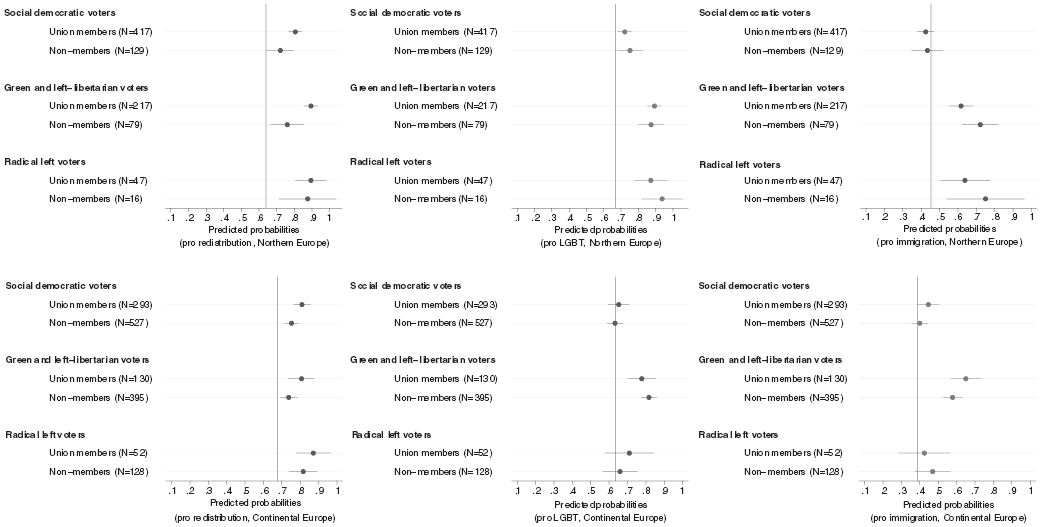

Most left-wing constituencies are, on average and irrespective of union membership status, in favor of redistribution and liberal when it comes to minority rights. Importantly, support for immigration is quite restrained – especially among social democratic voters and irrespective of union membership status. Both unionists and nonunionists within left-wing electorates are, however, in general more supportive of immigration than the electorate at large. The important exception being social democratic voters in Northern Europe whose likelihood to support immigration is below the average likelihood of immigration support in this region. This pattern may very well be explained by the fact that we can expect less ideological sorting into unions in the Nordic countries with their strong institutional incentives to join unions because of their so-called Ghent systems of unemployment insurance.
Figure 8.3 indicates that unionized voters of the Left are on average not more culturally conservative than nonunionized voters of the Left. In support of the hypothesis on a green and left-libertarian defection of union members (H3), we also find that unionized green and left-libertarian voters are generally more culturally progressive than unionized social democratic or radical left voters. Conversely, Figure 8.3 does not support the notion of a radical left defection of union members (H2) in as far as redistribution support does not vary systematically across unionists belonging to different left-wing electorates.
We are also interested in the heterogeneity of preferences among unionized voters of the Left. Figure 8.4 thus shows preferences on the same dimensions as Figure 8.3 for unionized working- and middle-class voters of the Social Democrats, the Green Left, and the Radical Left separately. The estimations for Figure 8.4 rely on the same type of regression analyses as before, and we use the class scheme by Oesch to get at the “typical” representatives of social democratic working- and middle-class voters, that is, production and service workers, sociocultural professionals, and technicians and managers (Oesch and Rennwald Reference Oesch and Rennwald2018). We show findings pooled across regions because of the small sample size on which these analyses rely on.
Predicted probabilities of policy support among unionized voters
Note: Based on models 1–3 in Table 8.A2.
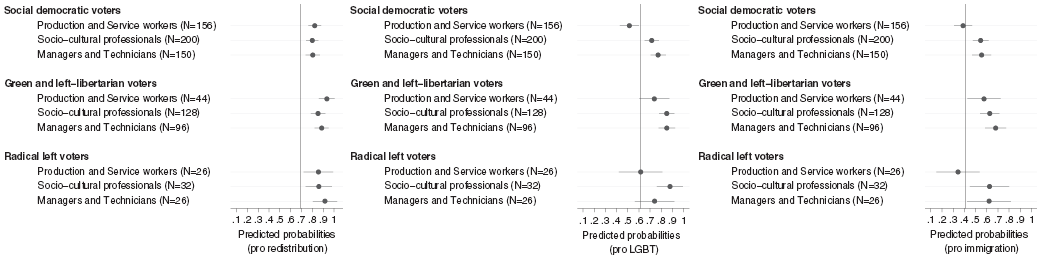
For redistribution preferences, levels of support among different working- and middle-class electorates on the left are about the same, as shown in Figure 8.4. All sub-constituencies favor generous distributive policies and their likelihood to support redistribution clearly surpasses this likelihood in the entire electorate indicated by the reference line. For redistribution, class alliances within either party family seems to hold firmly. When it comes to minority rights and immigration, preference gaps between the working class and the middle classes are more pronounced especially among unionized social democratic voters. Among unionized social democratic voters, support for LGBT rights or immigration is less likely from the working class than from either of the middle classes depicted in Figure 8.4.
The observed pattern of findings confirms that many labor unionists remain closely associated with Social Democrats’ core preferences (hypothesis 1), but that some are more closely situated near the green and left-libertarian alternatives (hypothesis 3). Unionized supporters of the Radical Left, however, do not express distinct preference profiles, contrary to hypothesis 2.
8.5 Findings II: Labor Union Members’ Electoral Choice and Party Switching Movements (1999–2014)
We next examine whether the general proximity of unionists to the preference profile of social democratic party supporters, as well as the heterogeneity in political orientations among labor unionists, leave an imprint on the dynamic of unionists’ voting behavior, compared to nonunionists, in advanced capitalist democracies. The focus of interest is the extent to which labor unionism electorally promotes or undermines Social Democracy, and the conditions under which this might occur. As in the Kitschelt/Rehm chapter on motivations of vote switchers (Chapter 7 of this volume), we explore these questions with evidence from the European Election Studies surveys 2009–19 (Egmond et al. Reference Egmond, Brug, Hobolt, Franklin and Sapir2017; Schmitt et al. Reference Schmitt, Hobolt, Popa and Teperoglou2016, 2020), because this survey contains measures of political preferences and also makes it possible to construct vote switcher and standpatter variables based on a recall question about the respondents’ previous, rather than current electoral choice.
Table 8.2 contains information on unionized and nonunionized respondents’ dynamic voting behavior, separately for three groups of countries associated with our theoretical argument (see Table 8.1): Northwestern Europe, Mediterranean Europe, and Anglo-Saxon countries. Table 8.2 shows the level of unionization, followed by three types of election-to-election voting patterns: first the standpatters of one of the left parties (Section 8.1: SD, GL, and RL), then the switchers into the various left parties (Section 8.2) and finally the defectors from left parties to the Moderate Right or Radical Right (Section 8.3).Footnote 10
| Northwestern Europe (AUT, BEL, DEU, DNK, FIN, NLD, SWE) | Mediterranean Europe (ESP, FRA, GRC, ITA, PRT) | Anglo-Saxon Europe (GBR, IRL) | ||||
|---|---|---|---|---|---|---|
| Non-TU | TU | Non-TU | TU | Non-TU | TU | |
| Level of unionization | 8,058 (53.4%) | 7,048 (46.6%) | 6,475 (86.1%) | 1,041 (13.9%) | 2,329 (74.7%) | 789 (25.3%) |
| 100% | 100% | 100% | 100% | 100% | 100% | |
| 1. Summary standpatters within the left field | 32.4 | 41.4 | 39.9 | 49.7 | 25.3 | 33.7 |
| 1.1. Social democratic standpatters (SD → SD) | 18.3 | 23.8 | 25.4 | 31.4 | 17.6 | 26.5 |
| 1.2. Green Left standpatters (GL → GL) | 10.3 | 13.7 | 1.4 (91) | 1.5 (16) | 2.2 (52) | 2.5 (20) |
| 1.3. Radical Left standpatters (RL → RL) | 3.8 | 3.9 | 13.1 | 16.8 | 5.5 | 4.7 |
| 2. Summary left switchers (toward SD, GL, RL) | 8.9 (715) | 9.6 (675) | 10.0 (646) | 11.8 (123) | 9.0 (209) | 12.7 (100) |
| 2.1. Left switchers → SD (from MR, RR, GL, RL) | 3.7 (284) | 3.9 (272) | 3.7 (237) | 3.6 (37) | 3.0 (69) | 6.1 (48) |
| 2.2. Left switchers → GL (from MR, SD, RL) | 4.1 (333) | 4.7 (332) | 2.6 (171) | 3.0 (31) | 2.9 (67) | 3.3 (26) |
| 2.3. Left switchers → RL (from MR, SD, GL) | 1.2 (98) | 1.0 (71) | 3.7 (238) | 5.3 (55) | 3.1 (72) | 3.3 (26) |
| Summary all left party supporters (RL, GL, ML) (all parties’ standpatters and in-switchers) | 41.3 | 51.0 | 49.9 | 61.5 | 34.3 | 46.4 |
| 3. Summary right switchers (toward MR, RR) | 2.8 (219) | 3.5 (249) | 4.7 (197) | 4.9 (51) | 6.4 (149) | 8.2 (65) |
| 3.1. Right switchers → MR (from GL, SD) | 2.3 (177) | 2.6 (183) | 2.5 (163) | 3.9 (42) | 4.4 (103) | 5.7 (45) |
| 3.2. Right switchers → RR (from GL, SD) | 0.5 (42) | 0.9 (66) | 0.5 (34) | 0.8 (9) | 2.0 (46) | 2.5 (20) |
| Summary all non-left party supporters (MR, RR, nonclassified) (all parties’ standpatters and in-switchers) | 58.7 | 49.0 | 50.1 | 38.5 | 65.7 | 53.6 |
The results in Table 8.2 confirm that union density is much greater in the Northwest European countries (46.5% of respondents) than in the Anglo-Saxon countries (25.3%) and especially the Mediterranean countries (13.9%). Unionization is thus likely to make a large electoral difference for Social Democracy primarily in that first group of countries.
Turning to the partisan standpatters next (section 1 of Table 8.2), one piece of evidence appears to be clearly supporting the hypothesis that unions are generally promoting social democratic electoral support (H1). Among social democratic standpatters, unionists are always and everywhere overrepresented. Although the percentage gap of support for Social Democracy between unionists and nonunionists is smallest in Northwestern Europe, that margin of extra electoral support makes a bigger difference for Social Democrats in that region than greater margins of difference do for moderate left political parties in the Mediterranean and Anglo-Saxon regions because of the much higher union density in the Northwest.
Other pieces of evidence in Table 8.2, however, also make plausible H2 and H3. There is a substantial share of unionized Green Left standpatters, and it is highest among unionists in the Northwest European subset (H3). Conversely, in the Mediterranean region, green and left-libertarian parties attract next to no unionists. But in that region a substantial share of unionists rally around radical left parties (H2). Finally, in the Anglo-Saxon countries, represented here only by the United Kingdom and the institutionally not quite fitting Ireland, neither green and left-libertarian nor radical left parties attract much electoral support so that Social Democracy remains the focal point for unionist electoral support.
Section 2 of Table 8.2 lets us inspect the dynamic process of vote switching into and out of left parties. Most important for the analysis of unionists: Their probability of switching tends to be as high or higher than that of nonunionists, a piece of evidence speaking in favor of H2 and H3 rather than H1. Unionists are not natural standpatters of Social Democracy. There is a somewhat stronger tendency of unionized vote switchers to move into green and left-libertarian parties than Social Democrats only in Northwestern Europe, in conformity with H3. Likewise, radical left parties benefit from unionized vote switchers primarily in the Mediterranean countries, where there is little supply of green and left-libertarian parties and the constituency of such parties would be more limited (H2). And unionists flock most strongly to Social Democrats only in the two Anglo-Saxon countries where electoral laws make it difficult to establish electorally viable alternatives.Footnote 11
Unionists are no more loyal to the leftist block of political parties than nonunionists, when it comes to defection to parties of the Right (section 3 of Table 8.2). Whether unionist or not, former left voters are more inclined to switch to moderate rather than radical right parties. Unionists are no more immune or susceptible to the Radical Right than nonunionists (section 3.2 of Table 8.2).
As an intermediary status report, the empirical patterns revealed in Table 8.2 suggest that unionism certainly has not lost its electoral impact on Social Democracy, in conformity with H1. Whether these patterns help Social Democracy, however, is partially conditioned by electoral systems, supply of rival left parties, and the political-economic settings of individual countries. In highly unionized Northwestern Europe, Social Democrats still appear to reap a substantial benefit from union voters. But a new rival is rising fast and challenging them in this region. Green and left-libertarian parties attract a sizeable share of unionists. Moreover, unionists’ switching conduct suggests that the Green Left may grow at the expense of Social Democrats, a question we will examine more closely later in this section, when scrutinizing the types of union voters opting for either of the two party families in the left camp. Social Democracy is most endangered in the Mediterranean region, where unionized voters are much more likely to move to the Radical Left than the Green Left. In the Anglo-Saxon countries, the union impact on Social Democracy is constrained by relatively low levels of union density but boosted by the absence of alternative party options within the left camp.
The standpatter and switcher conduct of unionists and nonunionists is also consistent with their policy preferences. Figure 8.5 reports the mean preference scores and standard deviations for all conceivable standpatter and switcher dyads between partisan blocks, pooled for all countries. The attitudinal indices for redistribution, societal governance, and immigration have been constructed in the same vein as reported in the Kitschelt/Rehm chapter on vote switchers (Chapter 7 of this volume). Because the number of observations is so much larger for the standpatter dyads, standard deviations of group preferences are small here and differences between unionists and nonunionists are often statistically significant.
Standpatters’ and switchers’ policy preference stances on three dimensions
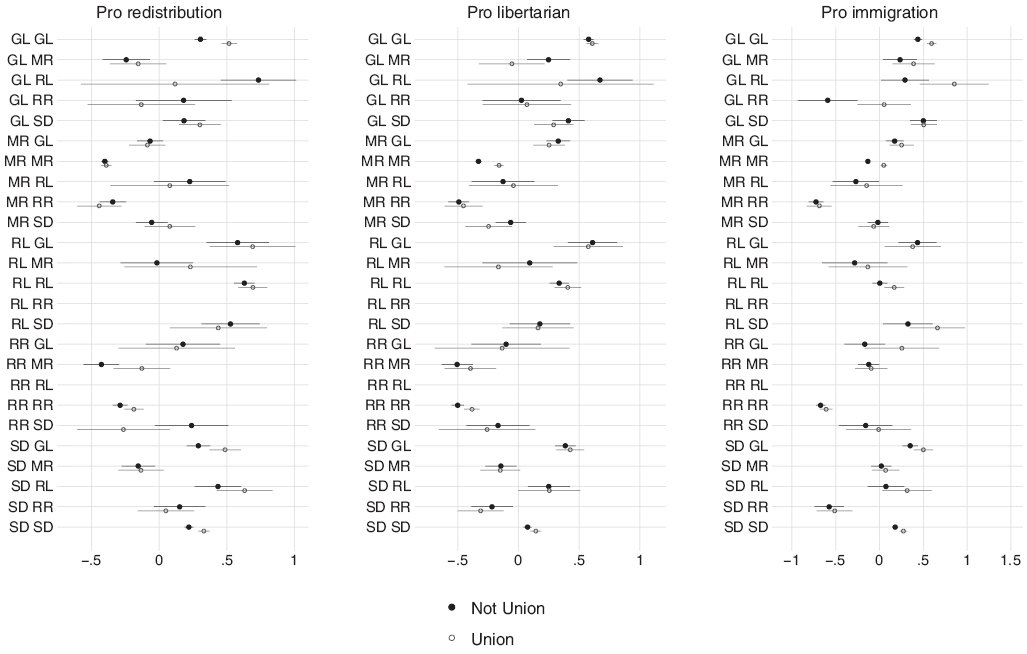
What jumps out in Figure 8.5 is the fact that identical switcher or standpatter unionist or nonunionist dyads do not diverge much in their preferences on each of the various policy dimensions. There is, however, a general tendency among almost all dyadic configurations that, compared to nonunionists, unionists tend to be more redistributive on the economic dimension, yet also more libertarian and universalist on the societal governance dimension and more inclusive on the immigration dimension. This difference between union and nonunion respondents belonging to the same vote standpatter/switcher dyads for many issue dimensions for the standpatters of parties that attract substantial shares of unionized voters (i.e., social democratic, green and left-libertarian, and moderate right parties).
Among the dyads of party switchers, typically with quite small numbers of observations each, there is a pretty close match in the preferences of nonunionists and unionists and few differences are statistically significant because of large standard deviations. But those that are significant do show unionists preferring more radically redistributive, libertarian or inclusive policies (e.g., SD-GL switchers on economic distributive preferences).
Let us finally examine the pattern of unionists shifting to green and left-libertarian parties in Northwestern Europe. Respondents are disaggregated by binary education and income groups. On education, the cut point is receipt of a lower-tier college degree. On income, the divider is between the lower two-thirds and the upper third of the income distribution, with the latter situated above the mean household income and thus presumably averse to income redistribution, if a pure myopic logic of economic self-interest prevailed. Traditional labor unionists in manufacturing and clerical occupations are primarily situated in the largest category, the low-education/low-income one, followed by the low-education/high-income category. These two groups may exhibit a high propensity to be social democratic standpatters. By contrast, higher education labor unionists, and especially those with lower incomes among them, may go for green and left-libertarian parties. These voters are concentrated in the social and cultural service sectors, often in public employment.
Table 8.3 reports the percentage of unionists and nonunionists who are standpatters of the three left party families in Northwestern Europe. Most of the switcher types by education/income categories have too few observations (<20) to be meaningful, so we depict here only the direct switching between the Green Left and the moderate social democratic Left. As expected, the Green Left scores well among highly educated unionists, and particularly with those who receive lower to middle incomes. The unionized high-education/low-income group provides the overall highest share of standpatters supporting the three left party families taken together (45%). The unionized high-education/high-income support for the entire Left is lowest (37%) while the low-education union members are somewhere in between (42% for low income, 38% for high income). The dynamic patterns of party switching among union members confirm the comparative static results about different levels of support: High-education/low-income unionized voters have the most pronounced propensity to switch from Social Democracy to the Green Left, followed by the unionized high-education/high-income group. While the numbers and percentages – here covering three surveys in the 2009–19 period – appear to be small, consider this a long-term, cumulative process yielding a big shift of union voters toward green and left-libertarian parties over several decades.
| Low-education/low-income (“working class”: manual, clerical, service) | Low-education/high-income (skilled crafts) | High-education/low-income (many sociocultural professionals) | High-education/high-income (business & finance & managerial and some sociocultural professionals) | |||||
|---|---|---|---|---|---|---|---|---|
| Non-TU | TU | Non-TU | TU | Non-TU | TU | Non-TU | TU | |
| Level of unionization | 3,187 (59.9%) | 2,134 (40.1%) | 866 (63.3%) | 503 (36.7%) | 2,045 (45.2%) | 2,480 (54.8%) | 1,960 (50.4%) | 1,931 (49.6%) |
| 100% | 100% | 100% | 100% | 100% | 100% | 100% | 100% | |
| Social democratic standpatters (SD → SD) | 20.3 | 29.6 | 18.8 | 27.0 | 17.8 | 21.2 | 15.4 | 19.8 |
| Green Left standpatters (GL → GL) | 7.3 | 7.5 | 7.0 | 6.2 | 14.3 | 19.9 | 12.1 | 14.7 |
| Radical Left standpatters (RL → RL) | 4.4 | 4.8 | 2.5 | 4.8 | 5.0 | 4.0 | 2.2 | 2.5 |
| Switchers SD → GL | 1.7 (54) | 2.1 (44) | 2.1 (18) | 1.6 (8) | 2.8 (61) | 3.2 (80) | 1.9 (37) | 2.7 (53) |
| Switchers GL → SD | 0.7 (21) | 1.0 (21) | 0.8 (7) | 0 | 1.1 (24) | 1.8 (45) | 1.4 (28) | 1.7 (33) |
Note: Northwestern Europe (AUT, BEL, DEU, DNK, FIN, NLD, and SWE).
The patterns revealed by Table 8.3 are in line with H3. In the most advanced knowledge economies with encompassing and redistributive welfare states and permissive electoral laws facilitating the partisan differentiation of the left political spectrum, union support shifts incrementally in favor of green and left-libertarian parties, and in the most pronounced fashion among the categories of highly educated union members. Already in the 2010s, these groups provided the numerically strongest contingent of unionized voters and the by far highest level of union density, as revealed by the first row of Table 8.3. At least in the very long run, this pattern does not forebode well for Social Democracy: It appears to be losing its status as the harbor of union support.
Does the middle-class union socialization hypothesis modify our interpretation? In other words, in countries with relatively low middle-class union shares and high enrollment of unionists under the umbrella of just one blue-collar dominated union federation, are “middle class” higher educated and/or higher income unionized voters more likely to stick to Social Democracy? We explored this by examining standpatters and switchers in Austria and Germany, the two crucial cases where indeed an all-but-monopoly union federation coincides with a comparatively low share of middle-class unionists. But we could find no supporting evidence here for the middle-class union socialization hypothesis. In both countries, highly educated unionists are just as likely to flock to the Green Left as in Northwestern European countries with divided union federations and/or higher levels of middle-class union enrollment.
8.6 Conclusion
In this chapter, we have appraised the extent to which there is a continuing overlap and convergence between union membership and social democratic party support, as well as its underpinnings in terms of a convergence and parallel development of labor unionists’ and social democrats’ policy preferences. We have explored these topics descriptively, based on observational and cross-sectional data.
The patterns of union and social democratic party affiliation revealed in our analysis highlight which speculations about union–left party relations are probably wrong because they are inconsistent with the correlational patterns revealed by the data. First of all, unionism has not faded away in a roundabout, global fashion but is alive and well in pockets of the labor force and in some countries more prominently than in others. Critically, these labor unionists everywhere have a disproportionate tendency to support parties of the Left, and particularly those belonging to the social democratic party family. And nowhere do labor unionists opt in significant numbers for parties of the populist Radical Right. Consistent with the theme of this volume, labor unionists are as little receptive to the appeals of radical right parties as social democrats.
Second, the bond between labor unionists and social democratic voters is anchored in a rather close similarity and convergence of policy preferences. This proximity of beliefs is not limited to questions of economic redistribution and social protection but also covers policy issues concerning societal governance and even citizenship and immigration. In many instances, unionists are – on average – more libertarian on questions pertaining to the dimension of societal governance and more inclusive and universalistic on questions of citizenship than nonunionized social democratic voters.
Third, however, unionists in general – and more specifically the labor unionists working in new, dynamic, growing sectors of the economy employing high-skilled labor and paying intermediate or even high salaries – are progressively less an uncontested electoral preserve of Social Democracy. Quite to the contrary, exactly in countries where Social Democrats most decisively contributed to shaping the current political economy and among wage earners in the most promising, growing employment sectors, these parties are most at risk of passing the union banner on to green and left-libertarian parties. The partisan differentiation of the left electorate does not stop at the doors of labor union offices anymore.


 Open access