


In early January 2004, a group of Iraqi lawyers and foreign advisors convened in Baghdad to contemplate the institutional future of a new Iraq. They were charged with setting down some basic principles that would underlie the Transitory Administrative Law, which would likely (and, in fact, did) inform the Iraqi constitution of 2005. Their principal goal was to maintain a unified state despite potentially destabilizing ethnic divisions. Guided by their own experience and strong theory, the consultants prescribed federalism and a proportional electoral system (Diamond 2005, 163, 268)—power-sharing institutions thought to ameliorate ethnic divisions and foster loyalty to the state.
The Iraqi case exemplifies a paradox regarding democracies and state allegiance. On the one hand, effective democracy depends on widespread attachment to the state. Pockets of disenchantment and disloyalty can lead to distortions in participation and representation at best and violent rejection of the state at worst. On the other hand, democratic states are likely both more susceptible to such threats and less equipped to cope with them. Although authoritarian governments can rely on fear and force to manufacture allegiance to the state, democracies must foster allegiance without infringing on civil liberties, the very liberties that allow groups to promote their identities and agendas. John Stuart Mill anticipated this problem long ago, asserting that “the boundaries of [representative] governments should coincide in the main with those of nationalities” (Mill 1861). For Mill, who was writing in the era of state formation, the idea of redrawing state boundaries was more than just a thought experiment. For leaders of multiethnic states faced with relatively entrenched borders, the challenge is to deepen democracy while mitigating disaffection for the state.
Institutions are an obvious resource for leaders because they are at least somewhat malleable. For example, as in Iraq, a window of opportunity to design institutional solutions arises during the constitutional drafting exercises—the “hour of the lawyers” (Dahrendorf 1990, 3)—that often accompany transitions to democracy. The major institutional solutions proposed both in Iraq and in the extensive literature on “plural” or “divided” societies are federalism and proportional representation. According to their proponents, these consensual institutions successfully accommodate dissidents and encourage state unity (e.g., Lijphart 1999). This view, however intuitive, is not without its critics. Skeptics argue that these same institutions are ineffectual and may even exacerbate state disintegration (e.g., Nordlinger 1972; Norris 2004). Rabushka and Shepsle (1972, 217) put it bluntly: “…, is the resolution of intense but conflicting preferences in the plural society manageable in a democratic framework? We think not.”
At root is a theoretical puzzle regarding the effects of power-sharing. Institutional solutions such as federalism and proportional electoral systems disperse power to groups by delegating authority or by facilitating their representation in government. But does distributing power to those with loyalties outside of the state strengthen or weaken their commitment to the state? Empowering groups could ameliorate their discontent but it could also reinforce group identities while providing resources that groups can then use to bring more pressure on the state. This contradictory set of effects parallels the effect of democratization more generally because democratization also empowers previously unrepresented groups.
Evidence of the effects of consensual institutions is inconclusive. We simply do not know whether minorities in states with democratic or, more specifically, consensual institutions are more or less attached to the state. This creates a conundrum for leaders in both new democracies and some established democracies, who are eager for workable prescriptions for state harmony. Our principal goals are to shed light on the magnitude of disaffection with the state and to adjudicate between competing views about how well political institutions mitigate disaffection.
THE PARADOX OF THE DEMOCRATIC STATE
Effective democracy depends on allegiance to the state, but the democratic state is not always good at commanding such loyalty. The first half of this paradox deserves emphasis, for it is not always prominent in theories of democratic consolidation. As Linz and Stepan (1996) note, much influential work on both nationalism (e.g., Gellner 1983; Anderson 1991) and on democratization (O'Donnell and Schmitter 1986) ignores the connection between democratization and national unity. However, democratization arguably depends on national unity, in that constituent groups must agree on the need for and desirability of the collective as a precondition for open participation and competition among such groups. Rustow (1970) identifies state unity as the only requirement for successful democratic transition. Dahl (1989, 207) agrees, noting that “the criteria of the democratic process presuppose the rightfulness of the unit itself.” Linz and Stepan (1996, 18) argue that there are “severe (and we believe insurmountable) limits to democracy unless the territorial entity is recognized as a sovereign state.” Indeed, compared to the act of defining the legitimate boundaries of state power, ensuring the quality and performance of democracy is less important. Though acceptance of democracy as “the only game in town” (Di Palma 1990) and the continued loyalty of electoral losers (Przeworski 1991) are crucial to democratic consolidation, even more fundamental is an acceptance of the state itself as the rightful arbiter of citizens' affairs (by whatever rules). If the state is not the “only state in town,” then questions of support for democracy or the political system are irrelevant.
Even though democracy depends on allegiance to the state, the transition to democracy likely endangers any such allegiance, at least at first. In transitioning democracies, newfound rights and liberties may empower groups that compete with the state for loyalty, allowing group leaders to center their appeals on group interests and identities. Aspiring group leaders may actually have an incentive to seek the allegiance of fellow group members by politicizing their group's identity (Rabushka and Shepsle 1972). This creates open political competition among groups (qua political parties) for the power to distribute state resources. Free and fair elections—the hallmark of democratic governance—will then accentuate ethnic group identities, especially if each of the candidates or parties represents a single group and centers its appeals on ethnic grievances. Thus, democratization can have a destabilizing impact in the short run (see Posen 1993; Snyder 2000).
If democracy does inculcate attachment to the state, it is likely to do so only in the long run. As democracies persist over time, individual political and civil liberties, as well as electoral actors and procedures, become institutionalized. Moreover, as Anderson et al. (2005) argue, a type of learning process takes place for citizens and especially for minorities, who observe that the political system protects these liberties and that there will be future opportunities to seek power. Democracy will engender more certainty regarding participatory channels, if not outcomes. This “predictable process” creates loyalty even among electoral losers (see also Przeworski 1991). Though long-standing democracies are not necessarily devoid of disaffection, a longer history of democracy should create greater attachment to the state among its constituent groups. In the empirical analysis that follows, we investigate both the short- and the long-term effects of democracy.
INSTITUTIONAL SOLUTIONS FOR DISUNITY WITHIN THE DEMOCRATIC STATE
Of course, political leaders cannot necessarily wait for the potential long-term effects of democracy to take hold. Their goal is to design specific democratic institutions to mitigate disaffection with the state during their lifetimes. The most prominent institutional remedies for disaffection with the state involve countering the majoritarian elements of democracy with more consensual modes of decision making. These remedies center on two principal arenas of reform: the way representatives are selected (the electoral system) and the relative autonomy of subnational units (federalism versus unitary government). However, there is no agreement—either theoretically or empirically—that either type of reform actually builds unity within the state. Indeed, these power-sharing “solutions” imply two equally plausible, but opposing, consequences: sharing power with ethnic minorities could either ease their discontent or allow it room to grow.
The harmonizing effect of electoral systems is perhaps most associated with Arend Lijphart's consociationalism (e.g., Lijphart 1999; see also Nordlinger 1972). In his view, majoritarian systems often deny minorities access to power, thereby reducing their affinity for the state. Lijphart advocates a proportional electoral system that maximizes minority representation while also providing elites an opportunity to form cross-ethnic coalitions. The potential problem with proportional representation is that, absent any cross-ethnic coalition, it may only solidify ethnic identities and exacerbate ethnic conflict. Horowitz (1985, 2002) argues that successful electoral systems must create incentives for cross-ethnic coalitions before the election and advocates preferential voting, in which politicians compete for “second-choice” votes and thereby must appeal to citizens outside their own ethnic group (see also Reilly 2001). We leave aside any discussion or test of such alternatives, which are not widely practiced, and focus on the merits of proportionality. Evidence that the proportionality of electoral outcomes increases minority attachment to the state is mixed. Proportional systems are associated with less ethnic protest and rebellion (Cohen 1997; Lijphart 1999; Saideman et al. 2002), but not with attitudinal measures of system support among ethnic minorities (Norris 2004).
The second institutional solution, federalism, entails devolving power to sub-state units. By providing a degree of autonomy to units wherein national minorities might be majorities, federalism conceivably shifts power to minorities and thereby makes them more content to live within the state (see Lijphart 1999; Riker 1964; Stepan 1999). However, federalism's impact on attitudes towards the state is also uncertain. Lipset (1981, 77) argues that democracies function best when citizens have “a number of crosscutting, politically relevant affiliations,” and a federal structure that divides the state along ethnic lines may hinder the development of such affiliations. Moreover, devolving power to subunits may only provide ethnic leaders with “resources that can be mobilized for nationalist ends” and may also “encourage people to think and act according to national categories” (Hechter 2000, 141). Some cross-national evidence suggests that federalism tends to decrease outright rebellion but increase protest activity among minorities (e.g., Hechter 2000; Lustick, Miodownik, and Eidelson 2004). Case studies of federal arrangements suggest that it has no consistent effect on phenomena related to state attachment (Amoretti and Bermeo 2004; Forsyth 1989).
Ultimately, there is no definitive evidence that either proportional electoral systems or federalism remedy divisions within plural societies. Kymlicka (1996: 130) provides a fitting summary: “What then are the possible sources of unity in a multination state which affirms, rather than denies, its national differences? I do not have a clear answer to this question.” These inconclusive results may arise because the effect of institutional solutions on the state attachment of ethnic groups depends on other factors, especially on the characteristics of the groups themselves. In other words, state attachment derives from the interaction between political institutions and group attributes.
We investigate two possible interactions. First, are federalism's effects intensified when a minority group is geographically concentrated? Devolving power to territorial units may assuage minorities only when they are clustered enough to take advantage of such power (see Hechter 2000; Saideman et al. 2002). But again the opposite is also possible: perhaps devolving power to geographically concentrated minorities makes them desire autonomy all the more. Alternatively, there may be no significant interaction: Horowitz (1985, 618) notes that federalism can have a palliative effect even when ethnic groups are geographically dispersed. Estimating an interaction between federalism and concentration will help adjudicate between these expectations.
Second, do the effects of electoral proportionality depend on the presence of an ethnically based party? Proportionality may not be relevant to a group if it lacks the means to gain representation in the legislature. The presence of an ethnically based party, therefore, is likely to augment any effect—either divisive or unifying—of proportional electoral systems. Proportional institutions could reduce minority disaffection when a political party is clearly identified with a group's interests and/or identity, since proportionality would enhance the chances that this party would obtain seats in the legislature. However, the combination of proportionality and an ethnic party could only encourage this party to center its campaign on ethnic appeals, which might accentuate ethnic identities at the expense of attachment to the state.
IDENTIFYING DISAFFECTION AND DISUNITY
Indicators of State Attachment
Investigating citizens' feelings towards the state necessitates measuring attachment to the state and identifying the groups whose attachment is in question. One indicator of a group's weak attachment to the state is its participation in violence and protest. Although such incidents signify disaffection in a dramatic fashion, they are not reliable indicators of state unity for three reasons. First, violence is episodic and arguably rare (Fearon and Laitin 1996); disaffection of a lesser degree, though it commands relatively little attention, is more common. Second, violence may not be a political statement if its perpetrators are interested only in what they can steal, not in protesting state sovereignty (see Collier and Hoeffler 2004). Finally, those engaging in violence may not represent the sentiment of their group. For example, despite years of violence by the Basque separatist group ETA, a large proportion of Basques profess attachment to both the Basque region and Spain (Dekker, Malová, and Hoogendorn 2003; Linz and Stepan 1992).
Instead of focusing on behavioral manifestations of state disunity, we examine attitudinal manifestations using survey data, something few comparative studies have done (Silver and Dowley 2000 and Norris 2004 are notable exceptions). This approach addresses several of the problems identified previously. First, survey data can measure discontent with the state before it is manifest in demonstrations. Survey-based measures of state attachment do not necessarily predict future protest or violence, but they may signal its potential. Barnes and Kaase (1979) note that attitudes provide important preconditions for political participation, and in particular unconventional forms of participation, though other factors, such as mobilization efforts and particular opportunity structures, are necessary to trigger episodes of behaviors such as protest. Second, surveys have the ability to reach a wide cross-section of minority group members. These “rank-and-file” group members may differ from activists who are more visible to outside observers.
In diagnosing state disunity, the operative concept is people's attachment to the state. We conceive of attachment as involving two dimensions: self-categorization as a member of that state and a positive affect for the state. The question is whether citizens define themselves, at least in part, as members of the state, and how warmly citizens feel towards the state. This conceptualization parallels other conceptions of identity (e.g., Fearon and Laitin 2000).1
Our conceptualization of state attachment elides distinctions between variants such as “patriotism” and “nationalism” (e.g., de Figueiredo and Elkins 2003). These distinctions can be important, but here we are concerned with general attachment to the state.
Although several cross-national datasets include measures of state attachment, we prefer a dataset that maximizes variation among countries in their political institutions, economic development, and the nature and history of their resident minority groups. For these purposes, the World Values Survey (WVS) has no equal. The most recent wave, conducted from 1999 to 2001, included samples in 78 countries (Inglehart et al. 2004).2
The WVS contains three regions that are not sovereign states: Puerto Rico, Northern Ireland, and (until recently) Montenegro. We deleted the Puerto Rico sample from the analysis, combined the Northern Ireland sample with the sample from Great Britain, and combined the Montenegro sample with the sample from Serbia, re-weighting the British and Serbian samples as discussed below.
Within the WVS, two items capture the dimensions of state attachment. The first captures self-categorization: it asks respondents “which of the following best describes you?” and then gives descriptions that correspond to different ethnic groups (e.g., “I am white”), to the state (“I am American”), or to both (“I am both white and American”). The specific descriptions varied, but in each country respondents were allowed to self-categorize as part of the state and/or to choose a “substate” identification.3
Three comments about this measure are in order. First, it was not included in 12 countries: Argentina, Australia, Bulgaria, the Dominican Republic, Estonia, Germany, Italy, Latvia, Romania, Switzerland, the United Kingdom, and Serbia and Montenegro. Second, in 13 countries, respondents could choose among options that corresponded to each of the three categories. In 7 countries, there was no “ethnic only” option. In 19 countries, there was no “dual” identity option (ethnic and state). Below we discuss the challenges this presents. Third, in several countries, the identification item included a category for a religious identification in addition to state identification. In Algeria, Bangladesh, Egypt, Indonesia, Iran, Jordan, Morocco, Nigeria, and Pakistan, respondents could choose “Muslim”; in Israel they could choose “Jewish.” Substantial fractions of respondents in each country did so. We excluded these cases from all analyses. Respondents who selected a religious identification are identifying neither with the state, nor, in these countries, with any kind of minority ethnic group.
Identifying Ethnic Groups
Our focus here—as in much of the literature on state-building in multiethnic societies—is on state attachment among ethnic groups. To identify relevant ethnic groups, we draw on the Minorities at Risk (MAR) project. Gurr (1993, 3) defines “minorities-at-risk” as “communal groups” whose “core members share a distinctive and enduring collective identity based on cultural traits and lifeways that matter to them and to others with whom they interact.” These groups are identified by two criteria: they have suffered from some form of discrimination vis-à-vis other groups in the state; and they have been the focus of political mobilization at some point between 1945 and 1989. Recent updates of the MAR project through 2003 have identified almost 300 minorities-at-risk in over 100 countries. (We use “communal group” and “minority-at-risk” interchangeably, and “majority” to denote all other citizens.)
Communal groups are ideal for our study for several reasons. First, these groups are, in theory, those who would plausibly challenge the state. Gurr (1993) documents rising protest and rebellion among these groups from 1945 to 1989. By examining these groups, we are thus constructing strong tests for the ameliorative effects of institutions. Second, these groups vary on important dimensions, including their history, geographical concentration, and the depth of their grievances with the state. Because the MAR dataset provides indicators of these and other dimensions, we can identify the attributes of groups that exacerbate their disaffection towards the state. Finally, we can determine whether group attributes condition the effects of institutional arrangements.4
Hug (2003) argues that the MAR data suffer from selection bias because they include only groups that have suffered discrimination or taken political action. We agree and thus do not claim to possess data on every aggrieved minority; indeed, our analysis does not even encompass every minority-at-risk. Nonetheless, minorities-at-risk are not a monolithic set of groups bent on state destruction. For example, blacks, Latinos, and Native Americans in the United States are all classified as MARs. Given the relatively inclusive definition of the MAR conceptualization and the accompanying set of group-level attributes, we feel that the benefits of the MAR data exceed their shortcomings.
To sort survey respondents into the appropriate communal group or into the “majority” group for each country, we identified the communal group(s) in each of the countries in the WVS. Then, using the appropriate individual-level WVS variables—ethnicity, religion, language, region, or some combination thereof—we attempted to code individuals as members or non-members of these groups. For many groups, this process was straightforward—for example, members of the one communal group in Northern Ireland, Catholics, could be identified using the religion variable. For others, the available WVS measures identified group members imprecisely—for example, in Egypt, we considered respondents to be Copts when they identified as Christian. In some cases, there was no way to identify members of a communal group, either because the relevant variable(s) did not exist in that country's survey or because the variable's categories did not clearly identify the group. For example, although the Roma are classified as a communal group in many European countries, only rarely did the WVS include a designation for Roma (e.g., in the ethnicity variable). In other cases, we could create a plausible means to identify group members, but none turned up in the sample.
Sample
Combining the MAR and WVS data produces a dataset of 51 countries for which we can identify one or more communal groups. Descriptive information about these countries and groups is provided in the online appendices. The countries derive from the third (1994–1997) or fourth (1999–2001) wave of the WVS, depending on the availability of data and key variables. By focusing on these 51 countries, we exclude 27 countries from the WVS because either there were no communal groups identified by the MAR Project, or we could not locate any communal group members in the WVS sample.5
Sixteen countries do not contain any minorities-at-risk: Armenia, Austria, Belgium, Denmark, Finland, Iceland, Ireland, Luxembourg, Malta, Netherlands, Norway, Poland, Portugal, Slovenia, Sweden, and Uruguay. Nine countries contain minorities-at-risk that we could not locate in the WVS: Czech Republic, El Salvador, France, Greece, Hungary, Japan, South Korea, Slovakia, and Tanzania. In most of the latter cases, there was no variable in the country's survey that would have allowed us to locate these groups. In two cases, Muslims in France and Greece, there was a religion variable, but no respondents were coded as Muslim.
Our criterion for categorizing elections in China and Vietnam as non-competitive was these states' overall level of political competition, as measured by the variable “polcomp” in the Polity IV dataset (Marshall, Jaggers, and Gurr 2004). This measure incorporates information about the regulation and competitiveness of participation. China and Vietnam had the minimum value of this variable. Below we report the results excluding countries that had higher, though still low, levels of political competition. In both countries' WVS samples, there were few minorities-at-risk (4 Hui Muslims in China; 6 Chinese and 10 Montagnards in Vietnam).
In the online appendices, we discuss the representativeness of these 90 groups vis-à-vis the groups we could not identify and the universe of MARs generally. We also discuss the correspondence between each group's proportion of the relevant WVS country sample and its proportion of the country's population. Where available, we use the WVS design weights to account for any deviations between sample and population characteristics, with two further adjustments. First, because we combine the samples from Northern Ireland and Great Britain and from Serbia and Montenegro, we weight these samples according to their true fraction of the population (e.g., Northern Ireland's fraction of the United Kingdom's population). Second, when analyzing the pooled sample of majorities and minorities, we weight each country equally despite differences in sample size (see also Silver and Dowley 2000).
State Attachment Cross-Nationally
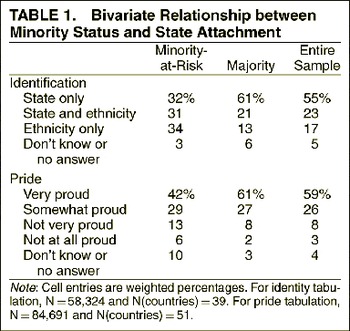
Table 1 presents a cross-tabulation of both measures of attachment with a dummy variable that indicates minority-at-risk status. Two findings emerge. First, minorities manifest high levels of state attachment. Sixty-three percent of minorities identify either with the state exclusively or with both the state and their ethnic group. About one third (34%) identify only with their ethnic group. Similarly, 71% say they are somewhat or very proud of their state. Second, although their level of state attachment is high, minorities manifest lower levels than majorities. Only 13% of majorities identify exclusively with their ethnic group, and 88% are somewhat or very proud of their state. This difference in pride may even be underestimated, as there are higher levels of non-response among minorities than majorities (10% vs. 3%), which could mean that minorities are essentially saying “this identity does not apply to me” or else are reluctant to reveal lower levels of pride in their state.

We also examined the relationship between identification and pride (data not shown). Among majorities, the proportion somewhat or very proud among those who identified as “ethnic only” (87%) is not appreciably different from the proportion among those who identified as “state only” (90%). By contrast, among minorities, pride was lower (60%) among those who said “ethnic only” than it was among those who identified with both their ethnic group and the state (81%) or with the state only (86%). Notably, minorities who possess a dual state-ethnic identity are only slightly less proud than those with exclusively a state identity. This suggests a crucial fact: minorities do not need to relinquish their ethnic identity to feel positively toward the state.
To determine whether these differences between minorities and majorities emerge consistently across countries, we computed the proportion who said “very proud” and the proportion who identified only with the state, both for all communal group members in each state and for all majorities. For the moment, we treat individual communal groups within each state as a collective, comparing them to “majority” respondents. Figure 1 plots the average state attachment of minorities against majorities, with separate panels for pride and identification as well as a 45-degree line that indicates equal levels of attachment in both groups. In both panels, the data points lie mostly above the reference line, indicating greater levels of attachment among majorities than among minorities-at-risk. However, the size of this “gap” varies considerably; some points are close to the line while others are far from it. This variation confirms the need to investigate the group- and country-level attributes that affect the state attachment of minorities.8
The average level of pride and identification among each of the 90 minority groups is only weakly correlated with the measures of “rebellion” and “protest” in the Minorities at Risk data. This suggests that attitudinal reservoirs of discontent differ from aggressive forms of resistance.

Scatterplot of State Attachment among Minority and Majority Populations
A MODEL OF STATE ATTACHMENT
What factors influence an individual's level of attachment to the state? And, which factors, especially institutions, generate state attachment particularly among minorities-at-risk? Estimating the precise effect of institutions on state unity requires that we specify as best as possible the individual-, group-, and state-level variables that predict the state attachment of majorities and minorities. We focus below on the primary hypotheses and measures (see the online appendices for details about all measures).
Individual-Level Factors
At the individual-level, our primary expectation is that, on average, minorities-at-risk will report less attachment to the state (e.g., Dowley and Silver 2000; Sidanius et al. 1997), but the observed differences between minorities and majorities will vary across countries. For example, several studies of the United States find that blacks, Latinos, and Asians do not manifest less state attachment than do whites (Citrin, Reingold, and Green 1990; de la Garza, Falcon, and Garcia 1996). This mixed evidence suggests that the effect of communal group membership is conditional on group- and state-level attributes.
Following extant literature (e.g., Bollen and Medrano 1998), we control for age, education, income, life satisfaction, cosmopolitanism, and whether the respondent is an in-party member. Income and education are measured in country-specific deciles. Our proxy for cosmopolitanism is Inglehart's (1997) familiar measure of postmaterialism. In-party membership is operationalized, following Anderson et al. (2005), as a dichotomy that captures whether the respondent shared the party affiliation of the executive, as identified in Beck et al. (2001).9
In three countries (Singapore, Jordan, and Pakistan) it was not possible to code in- and out-parties. For these countries, we coded this dichotomous variable as 0. If we exclude these countries, this variable's substantive impact increases slightly.
Group-Level Factors
We test five hypotheses about how minority group attributes affect state attachment. Our measures derive from the Minorities-at-Risk dataset. Each group-level variable is equal to its average over the five years prior to the WVS survey wave. If there was no data for a particular group for that five-year period, we used the prior ten years.
In general, we expect that group attributes that strengthen group identity will do so at the expense of their members' state attachment. First, we consider the size of a group, operationalized as the group's proportion of the state's population. The state attachment of group members should be weaker in larger groups, because those groups have the numerical mass to oppose the state with some effectiveness. Second, we examine groups' level of geographic concentration. Groups that are clustered in a particular region within the country may find it easier to build internal unity, potentially at the expense of state attachment. Past studies find that concentration is positively associated with secessionism, protest, and rebellion (Saideman and Ayres 2000; Saideman et al. 2002; but cf. Cohen 1997). Concentration may also condition the effect of federalism, as discussed earlier. Third, groups with a strong identity can provide an alternative locus of attachment for members, who are thus less likely to manifest attachment to the state. Cohen finds that a measure of strength of identity (or “group coherence”) is positively related to some kinds of protest.
Fourth, we measure residency status by coding minority groups as either “national minorities” or immigrants. National minority groups are defined as those who have resided in the state prior to state formation and immigrant groups as those who arrived in the state at a subsequent point. The former may retain residual claims to sovereignty and be less attached to the state (Kymlicka 1996, 120). We differentiate immigrant groups according to their length of residency and expect that those from recent waves should be less attached to the state than will those from earlier waves. We created two dichotomous variables—national minorities and recent immigrants (post-1945, the most recent category available in the MAR dataset)—with earlier immigrants as the excluded category. Both national minorities and recent immigrants should manifest a lower level of state attachment than will earlier immigrants.
Fifth, we examine indicators of specific minority grievances with regard to autonomy, the economy, politics, and culture. Groups with larger grievances, or a more defined set of collective interests, should be less attached to the state. Similar concepts have been shown to predict group protest and rebellion (Saideman et al. 2002). Autonomy grievances should have the largest effect, given that groups who desire autonomy are, almost by definition, less attached to the state. We do not have a priori hypotheses about the relative explanatory power of economic, cultural, and political grievances.
Finally, we measure whether a group is represented by its own political party—an attribute that should condition the effect of proportional electoral systems. The MAR dataset lists up to three organizations or parties that represent each group. We then created a dichotomous variable equal to 1 if at least one of those organizations is a political party, and 0 otherwise.
Country-Level Factors
At the country level, we control for economic development (here, GDP per capita), the (logged) age of the state itself, the (logged) state's population, status as a former Axis power, and status as a former communist country. The age of state variable addresses Deutsch's (1984) estimate that it takes between 300 and 700 years for ethnic groups to accept and be accepted by the majority (cited in Bermeo 2002). Population size captures Dahl and Tufte's (1973) hypothesis that large states manifest less pride than do smaller states. Former Axis powers (specifically, Italy, Germany, and Japan) should have lower levels of state attachment (see Smith and Jarkko 1998). The effect of being a former Axis power will be weaker for minorities than for majorities because many of the minorities in Germany and Italy (e.g., Turks in Germany or Roma in Italy) are not directly implicated in the actions of the Nazi or Fascist parties. Finally, state attachment should be lower in postcommunist countries and, moreover, this effect will be stronger for minorities than majorities. Postcommunist countries have been characterized by difficulties in creating market economies, democratic political institutions, and strong civil societies (Howard 2002). Furthermore, the transition from communist rule has often put minority populations in the former Soviet Union and Eastern Europe under particular duress—for example, Russians in Latvia and Estonia (see Chinn and Truex 1996).
Our emphasis is on the effects of political institutions on state attachment. We specify hypotheses about the overall effect of institutions and their particular effects on the attachment of minorities. The first institutional condition is the level of democracy. Our hypothesis is twofold: we expect democracy to exacerbate disaffection with the state in the short run, and to soothe it in the long run. These effects should hold for both for majority and minority citizens. We operationalize democracy with a measure from the Polity IV dataset (Marshall, Jaggers, and Gurr 2004), which captures procedural elements of democracy. To tap short-term effects, we measure the level of democracy with the Polity IV measure, averaged over the 10 years prior to the survey. To tap long-term effects, we measure a state's accumulated democracy; that is, the sum of a country's democracy scores over its life span. This measure is comparable to something like “years of democracy” (Anderson et al. 2005), except that it accounts for gradations of democracy, which are potentially meaningful (Elkins 2000).10
We obtained similar results substituting measures of accumulated democracy that weighted recent years more heavily than earlier years, using various exponential decay functions.
The second institution is the proportionality of the electoral system, which is hypothesized to increase attachment among minorities. Our measure of electoral proportionality is the median district magnitude of the country's lower (or only) legislative chamber. District magnitude is a useful measure of an electoral system's effect on proportionality (see Amorim Neto and Cox 1997; Golder 2003).11
Our sources for this measure are Golder 2003 and Beck et al. 2001. We take the log of this measure, as we expect that its effect delivers decreasing returns. Below we report on alternative models using Gallagher's (1991) index of proportionality.
To test the hypothesis that federalism increases attachment, we draw on two measures. The first is a dummy variable that classifies countries as unitary or federal, based on whether local and/or regional governments have substantial decision-making power. This measure, of course, masks variation in federal systems, and some (Rodden 2004; Stepan 1999) argue against eliding distinct modes of decentralization. Several other measures capture variation in political and fiscal decentralization more completely for at least a subset of our cases (e.g., Arzaghi and Henderson 2005; Beck et al. 2001; Lijphart 1999). Probably the most developed of these indices is Arzaghi and Henderson's decentralization index, which summarizes nine dimensions of local autonomy, such as relationships between central and local governments, constraints on local power, revenue sharing arrangements, and policy jurisdictions. This index is a fairly reliable measure of the autonomy of local governments.12
Because Henderson's measure is available for only 34 of our 51 countries, we impute missing values for countries using Lijphart's federal-unitary scale, the six items in the World Bank fiscal decentralization data, and several items from the Beck et al. (2001) data on political institutions.
MODEL ESTIMATION
To test these hypotheses we estimate a series of hierarchical or multilevel models (see Raudenbusch and Bryk 2002; Steenbergen and Jones 2002). These models are ideally suited to our data because observations (in this case, respondents) are “clustered” within higher level units (both groups and countries). We estimate models for both pride and identification. Pride is the four-category scale described previously. For identification, we collapse this indicator into a dichotomous measure where 0 indicates an exclusively ethnic identification and 1 indicates identification with either an ethnic group and the state (a dual attachment) or the state exclusively.13
We exclude the seven countries where the WVS had no “ethnic only” category (Brazil, Singapore, South Africa, Uganda, United States, Vietnam, and Zimbabwe). However, we do include the 19 countries where there was no dual attachment option. Ideally, of course, we would have equivalent measures in each country. Our strategy here thus reflects a balance between achieving reasonably comparable measures and also maximizing the number of countries included in the analysis.
We replicated the models of pride using a hierarchical ordered probit routine. The results were very similar, so we report the results of the linear models for ease of interpretation. For the HGLM models, we report the results of the unit-specific model rather than the population-averaged model (see Raudenbush and Bryk 2002, 303–304). Either model tells the same substantive story.
These dependent variables are then modeled as a function of two or more of these three levels of data. For example, the specification of state pride among minorities is as follows:


R1–R7, G1–G10, and C1–C8 refer to the individual- (or respondent-), group-, and country-level variables discussed above. We estimate the individual-level coefficients (π1–π7) as fixed, rather than random, across countries. The individual-level intercept (π0j) is then modeled as a function of both group- and country-level effects in equations (2) and (3), respectively. To estimate a cross-level interaction, a group-level coefficient is modeled as a function of country-level variables.15
Relaxing the assumption of fixed effects does not change the results. There are good reasons to presume that these individual-level effects might differ across countries, but we are not interested in accounting for that variation in this analysis, except in that we will differentiate among minorities-at-risk in subsequent models. A similar point holds for variation in the group-level effects (β01–β10). In modeling the behavior of majorities, we assume that there are no group-level factors other than those relevant to minorities-at-risk. This may not be true, if within majorities there are also important sub-groups whose attributes are relevant to state attachment. Even assuming that we could specify theoretically who those other subgroups are, we lack data on their attributes comparable to the MAR data.
The modeling strategy described thus far makes a crucial and perhaps unwarranted assumption: that federalism and electoral proportionality are exogenous to individual-level attachment. If federalism and proportional electoral systems mitigate disaffection with the state, they may be more likely to be adopted in states with significant disaffection. Indeed, the origins of these systems suggest such a selection pattern (see Christin and Hug 2006). The lack of randomly assigned institutions could produce simultaneity in the model and bias estimates of the effects of these institutions. Given that the institutions tend to be adopted under adverse conditions for state unity, such selection patterns will likely mute any ameliorative effects of the institutions.
To mitigate the potential for bias, we pursue an instrumental variable approach. We can treat institutions as exogenous if we can predict the presence of such institutions with variables that are themselves exogenous (i.e., uncorrelated with the error term). Because institutions do in fact arise for observable factors other than levels of state attachment, such an approach seems feasible. We developed first-stage equations for both measures of federalism and for proportional electoral systems. Each of the equations incorporated a comprehensive set of historical and demographic factors as well as variables to account for policy diffusion (see the online appendices for specifications, results, and diagnostic tests). The instruments explain about half of the variance in the dichotomous indicator of federalism (r2 = 0.59) and in proportional electoral systems (r2 = 0.39) and satisfy tests of exogeneity. The models we estimate below incorporate the predicted scores from these first-stage models as measures of our institutional variables.16
Because HLM does not include options for instrumental variables, our analysis is effectively two-stage least squares “by hand” and, as such, the standard errors need to be corrected manually (Achen 1986, 37–50). For the models of pride, we report the corrected standard errors, which are, once rounded, equivalent to those generated by HLM. When the outcome variable is dichotomous, as in our models of identification, corrections to both the coefficients and standard errors are necessary, but “the standard errors cannot be corrected simply” (Achen, 49). The corrected coefficients, once rounded, were the same as the originals. We have not attempted to correct the standard errors in the identification models, but given the small differences such corrections have made, we are confident that our substantive results would remain the same.
RESULTS
To establish that there is variance to be explained at each level of data, one “decomposes” the variance by estimating a model in which attachment is a function of only intercepts and error terms (see Steenbergen and Jones 2002, 227–28). For the purposes of illustration, we report such results for the measure of pride. In a model of pride for all 51 countries, including both minorities and majorities, 78% of the variance is explained at the individual level, whereas the remaining 22% is explained at the country level. Among majorities only, the results are similar (82% and 18%). Among minorities, 65% is explained at the individual level, 22% at the country level, and 13% at the group level. In each case, the group and/or country levels account for about one fifth to one third of the variance, indicating that state attachment depends on more than just individual-level characteristics.
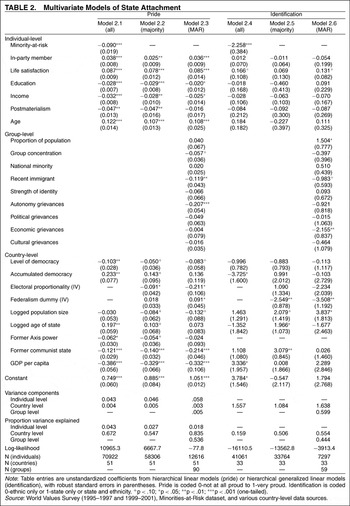
Table 2 presents six models: for each dependent variable, we estimate the model described previously for all respondents, for majorities only, and for minorities only. All variables are rescaled to range from 0 to 1. For the linear models, we present the variance components and proportion of variance explained for each level of data. The generalized model does not produce these statistics for the individual level, only for the group and country levels (see Luke 2004, 57). These models were estimated in HLM 6.02 using a restricted maximum likelihood routine.

Individual-Level Effects
In Table 2, Models 2.1 and 2.4, we analyze the entire sample with individual- and country-level predictors for the two dependent variables. In the model of pride (2.1), the individual-level control variables confirm our hypotheses: pride is positively associated with life satisfaction, in-party membership, and age, but negatively associated with education, income, and postmaterialism. In Model 2.4, in which the dependent variable is identification, only life satisfaction approaches conventional levels of statistical significance. The insignificant impact of these variables could suggest that the underpinnings of identification vary across countries and/or that these underpinnings involve factors we have not measured here. Clearly, we know less about what predicts self-categorization than what predicts pride. The individual-level control variables have similar effects across the separate models for majorities and minorities, except for postmaterialism, whose effect on pride is substantively weak and statistically insignificant for minorities.
Most importantly, both models confirm the central hypothesis: minorities manifest less attachment than do majorities. In Model 2.1, the substantive effect (b=−0.09) is comparable to that of life satisfaction; a hypothetical shift from a nonminority to a minority is associated with the same change in pride as a shift from very satisfied to very unsatisfied. In Model 2.4, the substantive effect corresponds to an odds ratio of .10, suggesting that minorities are about ten times less likely to identify with the state than are majorities. Our findings dovetail with those of Sidanius et al. (1997) and Dowley and Silver (2000) in that there are statistically significant differences between the attachment of minorities and majorities. Though the substantive magnitude of this difference rivals or exceeds the effect of other variables, it does not suggest a yawning chasm between minorities and majorities.
Group-Level Effects
Although minorities are, on average, less attached to state than are majorities, this effect varies across groups, as demonstrated in Models 2.3 and 2.6. It is not the case that factors that empower minorities necessarily lead to less attachment. Strength of group identity is not significantly related to either measure of state attachment. More geographically concentrated minorities express lower pride (b =−0.057), but are not significantly less likely to identify with the state. Instead, identification is more strongly related to the group's proportion of the country's population: larger groups are more likely to identify with the state. (We also estimated models that included a measure of absolute group size rather that its proportion of the population. It was statistically insignificant in both the models of pride and identification.)
With respect to a group's length of residency in the country, earlier, more established groups tend to express stronger state attachment. National minorities were not significantly different from early immigrant groups (the excluded category in this set of three dummy variables). This contradicts our expectation that groups with ties to the land that pre-date the state would tend to be less attached to the state. However, as hypothesized, members of more recently immigrated groups are notably less proud (b =−.119) than are those who belong to groups who immigrated earlier. The result is evident with respect to state identification as well.
The effects of grievances confirm our hypotheses and what previous research has found for similar constructs (e.g., Saideman et al. 2002). In the model of pride (Model 2.3), autonomy grievances matter more than political, cultural, or economic grievances (and more than any other group attribute, for that matter). The substantive effect of autonomy grievances (b =−0.207) is twice as large as the direct effect of minority status in Model 2.1 (b =−0.09). In the model of identification, economic grievances (though not autonomy grievances) are significant. Thus, groups that harbor particular claims against the state manifest lower levels of attachment. In sum, the effects of group-level factors suggest that the disparate findings about state attachment among minorities may arise in part because of group differences, with two factors—whether they are recent immigrants and whether they harbor grievances—most consequential.
Country-Level Effects
The country-level factors tend to have mixed, and sometimes opposite, effects on the two dimensions of attachment, suggesting again that the foundations of pride and identification may be somewhat different.17
In Models 2.1–2.6, the inclusion of these several country-level variables raises concerns about potential multicollinearity. Although the bivariate correlations among pairs of these variables are never astronomically high—the largest correlation, between GDP and accumulated democracy, is r = .64)—we estimated a variety of alternative specifications to ensure that the results are robust. These specifications confirm the significant effects documented below and, most importantly, do not change our inferences about the (non-) effects of political institutions in particular.
Second, the age and size of the state have mixed effects on state attachment. Age of state has few significant effects; if anything, it is positively associated with the pride and identification of majorities, though not minorities. The size of the state, measured by population, has contrasting effects among majorities and minorities. Models 2.2 and 2.3 show that state size is associated with lower levels of pride among both majorities and minorities. At the same time, it is associated with a greater likelihood of identifying with the state (Models 2.5 and 2.6), particularly among minorities.
Third, GDP per capita is negatively associated with pride, though it has no systematic relationship with identification in Models 2.4–2.6. Its effects on pride are statistically significant in the entire sample and in both majority and minority samples. In Model 2.1 a shift from GDP's sample minimum to maximum is associated with a −0.386 shift in pride. One explanation for this large effect is that GDP functions much like education and income do at the individual level. Just as individuals with more education and income express less pride, more economically developed societies exhibit less pride in the aggregate, perhaps because GDP per capita is a proxy for “cultural” attributes, such as the level of “cosmopolitan-ness” in a society (see also Rahn 2005). Regardless of the explanation, economic development does not automatically produce attachment to the state.
Finally, we turn to the institutional variables. Democracy has notable effects, both for the sample as a whole and for minorities in particular. In Models 2.1 and 2.4, the contemporaneous level of democracy is negatively associated with attachment, though this effect is statistically significant only for pride. Similar effects obtain in the separate models of minority and majority pride, in which the coefficient is always negative and is significantly associated with pride in particular. In Model 2.3, a shift from the sample minimum to sample maximum of the level of democracy is associated with a −0.083 shift in pride. However, the effect of long-term accumulated democracy is different. In Model 2.1, countries with more accumulated democracy exhibit higher levels of pride. This effect is evident, though statistically weaker, among both majorities and minorities. Accumulated democracy's effects on identification are opposite in sign in Model 2.4, though statistically insignificant in the models for majorities and minorities. Thus, democracy's impact on state attachment depends somewhat on its duration. Contemporaneous levels of democracy appear to decrease attachment to the state, which suggests the potential perils of democratization, although an accumulated history of democracy tends to increase attachment as measured by pride. However, there is no evidence that these effects are particularly prominent among minorities relative to majorities. Democracy itself may not close any “gap” between majorities and minorities, in either the short or the long run.
The effects of federalism and electoral proportionality demonstrate that neither institution is consistently associated with increased minority attachment to the state. Federalism has a strong negative association with identification, both among majorities and minorities (Models 2.5 and 2.6). This effect suggests that federalism may facilitate a substate identity, though it could take different forms among majorities and minorities. Despite this rival identity, however, federalism is positively associated with minorities' pride in the state (Model 2.3).18
In the models for majorities, the alternative measure of federalism—the instrumented version of the decentralization index–generates comparable results, though its effect on attachment is not statistically significant. In the models for minorities, this measure has a similar (positive and insignificant) effect on pride, though its effect on identification (a positive though insignificant coefficient) is different than the strong negative effect evident in Model 2.6. Employing noninstrumented versions of these federalism measures does not change the basic results, although the effects of the non-instrumented federalism dummy are smaller than those of the instrumented version.
The proportionality of the electoral system does not appear to build state attachment among minorities. In fact, it is negatively associated with pride among both majorities and minorities. The substantive magnitude of its effect is much larger among minorities (b =−0.211 vs. b =−.091), suggesting a larger gap between minorities and majorities in proportional systems. However, the effect of proportionality on identification is not statistically significant (Models 2.5 and 2.6).19
Substituting an instrumented version of Gallagher's index in the models of pride produces negative coefficients, though the effect is statistically significant only for minorities. This measure is also negatively associated with identification for both majorities and minorities (p < .10). A noninstrumented version of median district magnitude has a negative association with pride but no systematic association with identification. We also eliminated several marginal democracies—those whose score on the Polity IV “polcomp” variable was just above the minimum—and reestimated the models. In general, we find less evidence that proportional electoral systems weaken attachment. The upshot, however, of all of these specifications is that electoral proportionality does not increase minority state attachment and, in some specifications, appears to weaken it.
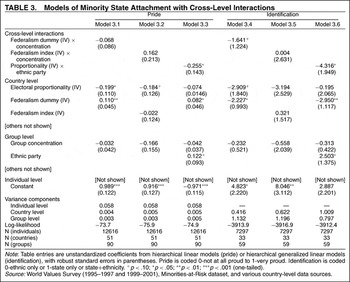
Thus far, there is little evidence that either federalism or proportional representation ameliorates disaffection with the state, but we have not yet considered whether group-level attributes condition the apparent effect of these institutions—specifically, whether federalism's effect depends on the group's geographical concentration, and whether proportionality's effect depends on the presence of a political party representing the group. Table 3 presents models identical to those in Table 2, except they include cross-level interaction terms that test these conditional hypotheses. (For the sake of presentation, Table 3 reports only the relevant coefficients.)

As we discussed earlier, the extant literature suggests no clear interaction between federalism and group concentration. This is what we find as well. In Models 3.1 and 3.4, the sign of the coefficient is negative, and statistically significant at the .10 level in the model of identification. These results suggest that when imposed under conditions of ethnic concentration, federalism is associated with decreased levels of attachment. However, when we substitute the alternative measure of federalism in Models 3.2 and 3.5, the coefficients for the two interaction terms are positive, though not statistically significant. Thus, the interaction of federal institutions and group concentration has no clear effect.
Model 3.3 includes a cross-level interaction between electoral proportionality and the presence of an ethnic party. This interaction term is negatively signed and statistically significant in both Models 3.3 and 3.6, suggesting that proportionality tends to weaken state attachment when an ethnically-based party represents a particular minority group. When no such party is present, the effect of proportionality is not statistically distinguishable from 0.20
Substituting the instrumented Gallagher's index generates very similar results for the model of pride, but no significant interaction in the model of identification. When we substitute the noninstrumented measure of median district magnitude, the cross-level interaction is not significant in either model. Though we prefer the instrumented measure because of endogeneity concerns, this divergent finding necessitates cautious inferences about the results in Models 3.3 and 3.6.
CONCLUSION
States replace their constitutions every 16 years, on average, and the most ethnically fragmented states do so about twice as frequently (Elkins, Ginsburg, and Melton 2007). It is possible that constitutional assemblies in these countries will turn to political scientists for advice about how to construct democratic institutions that encourage cooperation among competing groups. One important way to think about this question, we argue, is to consider the conditions that shape citizens' views of the state—in particular, whether and to what extent citizens are willing to express their local equivalent of “I am an Iraqi” and “I am proud to be Iraqi.” This sort of state attachment, however wary we may be of strong in-group attitudes, facilitates unity in divided societies. What emerges from our analysis is that states with institutions that facilitate a wider distribution of power are not those that command the strongest level of attachment from either their majority population or, perhaps more importantly, from their minority population.
A broader portrait of state attachment, however, helps explain why protest and state disintegration are relatively rare as symptoms of disaffection with the state. Large majorities of both majority and minority citizens express attachment to the state. This fact is often overlooked as dramatic examples of violence (rightly) command attention, and it deserves emphasis. However, there is a significant gap between the attachment of majorities and that of minorities. Moreover, the contours of attachment among minorities—defined by weaker attachment among groups that are recent immigrants and those that have active grievances related to autonomy and the economy—suggest that states must address both “immigrant ethnicity” and “territorial nationality” (Brubaker 2004). Each of these sources of discontent demands a potentially different response in terms of institutions and policies and is likely to remain salient for the foreseeable future. Migration across borders is a fact of life for most developed and many developing countries. The desire for autonomy that often characterizes territorial nationality appears equally durable, as examples such as Chechnya suggest. In short, gaps in attachment represent an ongoing challenge for multiethnic states.
This challenge makes it all the more important to assess fully the correlates of state attachment and the consequences of institutional choices. A first important result is the tenuous relationship between state attachment and economic development, whose role in the logic of democratization is itself much debated (e.g., Przeworski et al. 1999). We find that economic development may increase the likelihood of identifying with the state, but it has a robust negative impact on pride in the state. This negative effect is evident at the country level and, analogously, in pride's relationship to individual-level education and income: increasing levels of education and wealth actually weaken citizens' ties to the state, at least to a small degree. Given that enhancing educational and economic opportunities is a goal of most developed and developing countries, this result suggests that attaining this goal may have adverse unintended consequences.
The most important lesson of our investigation is that neither democracy nor consociational democratic institutions have systematic effects on state attachment among minorities. Our findings confirm a paradox involving democracy and state attachment. As much as democracy demands state loyalty, countries with long histories of democracy are not any more immune from state disaffection than more recently established democracies. Furthermore, democratizing countries may be more susceptible to state disaffection, as transitional periods provide opportunities for citizens to mobilize based on countervailing identities. This troubling paradox mirrors our findings with respect to particular power-sharing institutions. We find no evidence that either federalism or proportional representation encourages minority attachment to the state. Their effects across both indicators of attachment are mixed, and their imposition in certain circumstances, notably when groups are geographical concentrated or represented by an ethnically-based party, may actually have negative consequences for the attachment of minorities. On the whole, our results suggest the limits of federalism and proportional representation as remedies in plural societies. There may be good reasons for adopting such systems, but attachment to the state will not inevitably result.
Although we have tried to extend the scope of previous analyses—by incorporating a larger number of countries, by incorporating individual-, group-, and state-level factors, and by investigating factors that condition institutional effects on attachment—the extraordinarily rich literature on ethnic conflict and democratization requires humility. We view the results above as a reliable baseline assessment of the conditions associated with state attachment in a large set of full and partial democracies. However, it is important to point out the limitations in our particular research design, which both qualify our conclusions and suggest fruitful avenues for future research. First, our approach to the question of “divided states” is decidedly atypical. Our focus is not conflict, bloodshed, or protest, but state attachment, an attitude whose widespread acceptance we see as indispensable for democracy in multiethnic states. We recognize that attachment is not a guarantor of harmony, nor is it exclusively welfare inducing. A healthy skepticism of the state may be valuable in some contexts. Nonetheless, acceptance of and loyalty to the state are crucial to a cooperative environment. Second, although 51 states and 90 minority groups constitute a reasonable sample from which to draw inferences, this sample is far from comprehensive. To understand the effects of democracy, if not democratic institutions, on state attachment, we would prefer a sample more representative of citizens in authoritarian settings. Third, we present here average effects that derive from pooling groups and countries. These average effects undoubtedly conceal variation in minority attachment to the state and in the consequences of institutions. Understanding such variation will better illuminate the benefits and limits of institutional design. Finally, although our design encompasses a relatively well-specified set of factors at the individual-, group-, and country levels, it is in the end a single cross-section. By instrumenting for some of the institutional choices in our analysis, we have helped mitigate any inevitable endogeneity. Nevertheless, repeated cross-sectional or experimental treatments of this research question are necessary to corroborate our results.
Our analysis focuses on two institutional solutions that have become focal points in the literature. However, other approaches to incorporating ethnic minorities are available to states. For example, there are “distributive” approaches (see Horowitz 1985) that entail the granting of specific resources to minority groups. Moreover, it may be that effective institutional design involves fairly complex calculations about the timing and sequence of institutions (see Linz and Stepan 1992). Clearly, we have not investigated all of these possibilities, and further research should test the effect of such practices. The implications are critical to the performance of participatory democracy.
Previous versions of this paper were presented at the 2003 and 2004 meetings of the Midwest Political Science Association, Chicago, IL, and at the 2006 Meeting of the International Studies Association, San Diego, CA. For their many useful comments, we thank Damarys Canache, Wendy Tam Cho, Henry Elkins, Brian Gaines, Henry Hale, Jude Hays, Richard Johnston, Steven Kelts, Jim Kuklinski, James Melton, Kris Miler, Maggie Penn, Wendy Rahn, Chad Rector, Phillip Roeder, Tom Rudolph, Deborah Schildkraut, Melissa Schwarzberg, Tracy Sulkin, Emmanuel Teitelbaum, and Erik Voeten; as well as, and especially, the editor and the three anonymous reviewers. Appendices for this article are available at the second author's Web page: http://home.gwu.edu/~jsides/index.html.




Comments
No Comments have been published for this article.