Introduction
Head and neck cancer is the sixth most common cancer worldwide, and squamous cell carcinoma accounts for the vast majority of these tumours.Reference Hunter, Parkinson and Harrison1 While progress in surgical treatment, chemotherapy and radiotherapy has had a significant impact on the outcome of a number of other cancers, there has been little change in head and neck squamous cell carcinoma (SCC) prognosis over the past three decades.Reference Parkin, Pisani and Ferlay2
Few non-specialist clinicians have appreciated the potential application of tumour immunology in the management of head and neck SCC. This review discusses the current status of tumour immunology applicable to head and neck SCC and the recent development of novel treatments. The review also highlights some of the remaining obstacles that need to be overcome before any new therapies become readily available to patients.
Tumour immunology
The host immunological response to tumour is similar to an immunological response against an infective organism such as a bacteria or virus. However, because most cancer cells are essentially normal cells that will not stop replicating, it is extremely difficult for the immune system to attack and destroy them effectively, as such self-reactivity is efficiently removed during immune cell production, or actively down-regulated.Reference Sykiotis and Papavassiliou3–Reference Miller, Lavker and Sun5
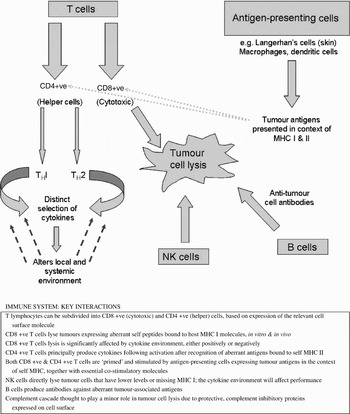
It is well known that three distinct cell types are mainly responsible for mounting a specific immune response: lymphocytes, natural killer cells and antigen-presenting cells. The roles of these and other components of the immune system have been recently reviewed by us in relation to head and neck SCC.Reference Topping, Fletcher, Agada, Alhamarneh, Stafford and Greenman6 The key interactions are summarised diagrammatically in Figure 1.
Anti-tumour activity of the immune system. CD = cluster of differentiation; +ve = positive; MHC = major histocompatability complex; TH1 = T helper-1 cell; TH2 = T helper-2 cell; NK = natural killer

Lymphocytes
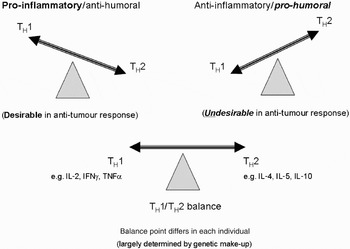
The effect of proinflammatory T helper-1 cell cytokines (such as interleukin-12 (IL-12) and interferon γ) and anti-inflammatory T helper-2 cell cytokines (i.e. IL-4 and IL-10) have been evaluated in many in vitro investigations as well as a gradually increasing number of clinical studies on human head and neck SCC.Reference Jebreel, Mistry, Loke, Dunn, Hough and Oliver7–Reference Wolf, Chen, Dong, Sunwoo, Bancroft and Capo11 It is generally accepted that relatively high levels of T helper-1 cell type cytokines have both a direct anti-cancer effect and a stimulatory effect on cytotoxic cluster of differentiation 8 (CD8) positive T cells and macrophages. Hence, a T helper-1 cell type response is considered advantageous for solid tumours such as head and neck SCC.Reference Agarwal, Rani, Saha, Valarmathi, Bahadur and Mohanti12, Reference Sparano, Lathers, Achille, Petruzzelli and Young13 The T helper-1 and T helper-2 cell cytokines act antagonistically; thus, promotion of a T helper-1 cell response causes down-regulation of the T helper-2 cell response, and vice versa (Figure 2). Generally, in patients with head and neck SCC (and in a number of other malignancies), there is a predominant T helper-2 cell response and a diminished T helper-1 cell response. Whether this is caused directly by a factor released by the cancer or as an indirect effect of the malignancy remains unclear.
T cell subsets and cytokine balance. TH1 = T helper-1 cell; TH2 = T helper-2 cell; IL = interleukin; IFN = interferon; TNF = tumour necrosis factor

In addition, it is important to note that B cells can contribute to the overall anti-tumour response, through the production of specific antibodies that bind to tumour cells. When combating a bacterial or other extracellular micro-organism infection, highly specific antibodies are produced which bind to the foreign surface and cause effective complement deposition. This subsequently results in the formation of a complex that punctures the cell membrane, as well as the recruitment of immune effector cells such as neutrophils and macrophages. Although this response is powerful and generally highly effective against bacterial infections, the process is generally poor against tumours, even though the cytokine environment is often skewed in favour of T helper-2 cell cytokines (see above). Briefly, this is due to a number of factors, including: poor generation of antibodies with a high affinity for tumour-expressed antigens; the fact that mammalian cells express a number of highly efficient anti-complement factors that largely prevent complement damage to host cells; and inefficient activation of the phagocytic effector cells by the cytokine repertoire. Although we have stated that the ‘natural’ B cell mediated immune response is relatively poor, it must be noted that the use of humanised monoclonal antibodies raised against key targets is now offering a realistic treatment options, e.g. Rituxan/MabThera® (anti-CD20 monoclonal antibody) in Non-Hodgkin's lymphoma and Herceptin® (anti-Human Epidermal Growth Factor (Her2)/neu monoclonal antibody) in breast cancer (F. Hoffmann-La Roche Ltd, Basel, Switzerland).Reference Ogura, Morishima, Kagami, Watanabe, Itoh and Igarashi14, Reference McKeage and Perry15 In head and neck SCC, much attention has focused on targeting epidermal growth factor receptor,Reference Ford and Grandis16 which is discussed below.
Tumour antigens
Although tumour cells are ‘self cells’, they express an altered repertoire of molecules, some of which are termed tumour-associated antigens. Eli et al. Reference Coico, Sunshine and Benjamini17 have broadly classified these antigens as follows: normal cellular gene products expressed at an inappropriate time (e.g. oncofetal antigens and prostate-specific antigen); mutant cellular gene products (e.g. mutant p53 or RAS proteins); and viral gene products (e.g. E6 and E7 proteins of the human papilloma viruses 16 or 18).
A growing number of tumour-associated antigens have been identified in tumours such as prostate cancer and melanoma (e.g. melanoma-associated antigens); however, these molecules are not restricted solely to these tumours.Reference Li, Ali, McArdle, Mian, Ahmad and Miles18 For instance, expression of both melanoma-associated antigens one and three has been reported in head and neck SCC; however, the clinical significance of this remains to be established.Reference Kienstra, Neel, Strome and Roche19, Reference Lee, Chang, Jo, Kim, Lee and Lee20 Over the past few years, it has become clear that the process of antigen presentation is extremely important in initiating the immune response; this role is primarily performed by the dendritic cells.
Dendritic cells
Dendritic cells are naturally occurring antigen-presenting cells which specialise in initiating a primary immune response.Reference Banchereau and Steinman21 They exist in either immature form (mainly in non-lymphoid tissue) or mature form (in the T cell areas of lymphoid organs).Reference Barratt-Boyes, Watkins and Finn22 Mature dendritic cells have the ability to activate effectively both CD8 positive and CD4 positive T cells, which either mediate direct tumour cell cytotoxicity or alter the cytokine environment to promote cytotoxic T lymphocyte activity or anti-tumour antibody production by B cells.Reference Todryk23–Reference Andre, Chaput, Schartz, Flament, Aubert and Bernard25
Defects in dendritic cell function have been reported at many different points along the pathway of cell development and antigen presentation. Firstly, Almand et al. Reference Almand, Resser, Lindman, Nadaf, Clark and Kwon26 demonstrated defective differentiation of mature dendritic cells in head and neck SCC, which correlated with poor prognosis; they later showed that this was mediated via reduced T cell stimulation.Reference Almand, Clark, Nikitina, van Beynen, English and Knight27 Interestingly, these effects were observed in patients with non-small cell lung carcinoma and breast cancer as well as in those with head and neck SCC.Reference Almand, Clark, Nikitina, van Beynen, English and Knight27 Furthermore, Tas et al. Reference Tas, Simons, Balm and Drexhage28 and Kerrebijn et al. Reference Kerrebijn, Simons, Tas, Balm and Drexhage29 both demonstrated impairment of the chemotaxis and clustering ability of dendritic cells in patients with head and neck SCC. The cause (or causes) of dendritic cell malfunction is not clear, although there is good evidence to support a role for the tumour itself, with one of the likely soluble mediators being tumour-secreted interleukin 10. This key T helper-2 cell cytokine has been shown to have multiple inhibitory effects on dendritic cells, including: blocking differentiation from monocytes;Reference Allavena, Piemonti, Longoni, Bernasconi, Stoppacciaro and Ruco30 impairing dendritic cell maturation;Reference Steinbrink, Wolfl, Jonuleit, Knop and Enk31 and inhibiting the primary allogeneic T cell response to human epidermal Langerhan's cells.Reference Peguet-Navarro, Moulon, Caux, Dalbiez-Gauthier, Banchereau and Schmitt32
Interleukin 10 is not the only cytokine involved in modulating dendritic cell function. A number of other tumour-secreted factors have been cited in this role, including vascular endothelial growth factor, granulocyte macrophage colony stimulating factor and low molecular mass factors.Reference Kacani, Wurm, Schennach, Braun, Andrle and Sprinzl33, Reference Strauss, Volland, Kunkel and Reichert34 Strauss et al. Reference Strauss, Volland, Kunkel and Reichert34 showed that dendritic cells incubated with tumour supernatant from head and neck SCC or vascular endothelial growth factor A differentiated into immature dendritic cells and did not develop full stimulatory activity. Vascular endothelial growth factor, granulocyte macrophage colony stimulating factor and low molecular mass factor are multifunctional, enhancing angiogenesis, tumour progression, immunosuppression and immune tolerance; therefore, they are likely to act at many different levels to facilitate tumour development and/or progression.
In general, when mature dendritic cell levels are increased there is an improved clinical outcome, and when levels are low there is a poorer outcome. A higher number of dendritic cells infiltrating a tumour has been shown to be highly significant as a positive prognostic marker. This was well demonstrated by Goldman et al., Reference Goldman, Baker, Weyant, Clark, Myers and Lotze35 who studied 43 patients with SCC of the tongue and showed that increased dendritic cell density in the peri-tumoural region correlated well with improved survival. Therefore, the aim of restoring or enhancing the recruitment of mature dendritic cells and of improving their function (either by direct stimulation and/or removal or inhibition of inhibitory factors) is very worthy of effort. However, to date only a few studies have been undertaken, with varying levels of success.Reference Lathers, Achille, Kolesiak, Hulett, Sparano and Petruzzelli36, Reference Dong, Bohinski, Li, Van Waes, Hendler and Gleich37
All of the studies above have used advanced tumours. However, Nix and colleaguesReference Nix, Stafford, Cawkwell and Greenman38 have studied a large cohort of early laryngeal tumours, and have shown that there is no difference in the number of dendritic cells, comparing radioresistant and radiosensitive pre-treatment biopsies. Therefore, at least in the early stages of head and neck SCC, there is the potential benefit of developing a vaccination that can enhance the specific anti-tumour immune response.
Because of the enormous potential of dendritic cells, there is a growing interest in using them as the main part of a tumour vaccine, particularly in an attempt to treat disseminated micrometastasis. Unfortunately, despite the increase in our understanding of tumour immunology, no dendritic cell based therapy (or other immunologically based treatment) has yet entered the clinic. The current status of immunotherapy modalities is reviewed below.
Current immunotherapy treatment modalities in head and neck squamous cell carcinoma
Whiteside and colleaguesReference Whiteside39 have attributed the difficulty in developing immune-based cancer therapies to two main factors: (1) active tumour escapes from the host immune system, and/or (2) failure of immune surveillance to control tumour progression.
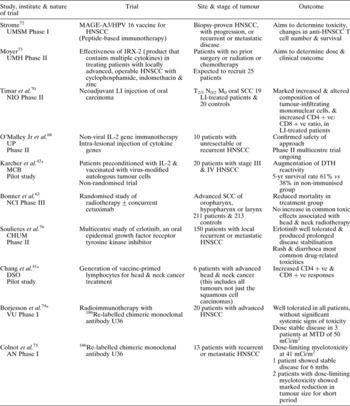
Any form of immunologically based therapy must overcome these two obstacles. Thus, many research groups are seeking to involve multiple components of the immune system, in an attempt to recreate the body's original, integrated immune response. A number of key studies are highlighted below, in order to exemplify the approaches being actively investigated (see Table I).
Examples of clinical trials with immunotherapy modalities relevant to HNSCC (2000–2006)

Data obtained by a comprehensive search of Pubmed, Ovid and Google search engines, the National Cancer Institute and the *cancerhelp.org.uk website, using the following key words: immunotherapy, clinical trials, head and neck, oral, hypopharyngeal, laryngeal, squamous cell carcinoma, and HNSCC. UMSM = University of Maryland School of Medicine, USA; MAGE = Melanoma antigen; HPV = human papilloma virus; HNSCC = head and neck squamous cell carcinoma; UMH = University of Michigan Hospitals, USA; IRX-2 = Iroquois homeobox 2 gene; NIO = National Institute of Oncology, Semmelweis University, Budapest, Hungary; LI = leukocyte interleukin; T = tumour; N = node; M = metastasis; CD = cluster of differentiation; +ve = positive; UP = University of Pennsylvania, USA; IL = interleukin; MCB = Molecular Cell Biology Group, University of Heidelberg, Germany; yr = year; DTH = Delayed-type hypersensitivity; NCI = National Cancer Institute USA & Comprehensive Cancer Centre University of Alabama, USA; CHUM = CHUM Hospital Notre Dame, Montreal, Quebec, Canada; DSO = Division of Surgical Oncology, 3302 Cancer Centre, Michigan, USA; VU = Department of Otolaryngology/Head and Neck Surgery, VU University Medical Center, 1081HV Amsterdam, The Netherlands; MTD = maximum tolerated dose; AN = University Hospital Vrije Universiteit, Amsterdam, The Netherlands; mths = months
T cell immunotherapy
Many early studies involved harvesting patients' T cells, activating and expanding these in vitro, and then infusing them back in an autologous manner. For example, To et al. Reference To, Wood, Krauss, Strome, Esclamado and Lavertu40 undertook a non-randomised, phase I clinical trial in 17 patients with advanced head and neck SCC (recurrent and metastatic disease) who had failed conventional treatment. In this study, patients were ‘vaccinated’ in the thigh with irradiated autologous tumour cells admixed with granulocyte macrophage colony stimulating factor. Eight to 10 days later, the draining inguinal lymph nodes were resected, and the resulting lymph node lymphocytes were polyclonally activated with the superantigen staphylococcal enterotoxin A and expanded in IL-2 in vitro. The resulting tumour-sensitised T lymphocytes, a mixture of CD4 positive and CD8 positive cells, were then infused back into the patients. Although the study cohort was small, the results were extremely encouraging, with one of the patients having no evidence of disease four years after surgical resection of a vertebral body metastasis and three others having their progressive disease stabilised. The toxic effects associated with immunisation were minimal and only affected four patients. This study demonstrated a safe procedure, and results from phase II trials are awaited with interest.
A more recent in vivo study by Chang et al. Reference Chang, Li, Jiang, Teknos, Chepeha and Bradford41 showed that T cell responses could be induced by autologous tumour vaccination. In this study, six patients with recurrent head and neck SCC were injected intradermally with irradiated autologous tumour cells mixed with bacillus Calmette–Guerin. Although measurable increases were seen in the CD4 positive and CD8 positive responses, all of the patients had progressive disease, with only one patient showing an initial measurable decrease in the size of their recurrent neck mass. However, one key finding of this study was that the treatment appeared safe, and it has been hypothesised that this approach would be applicable for patients with earlier stage disease, whose immune system was less compromised.
Modified autologous tumour cell vaccine
In a recent, non-randomised, clinical trial, Karcher et al. Reference Karcher, Dyckhoff, Beckhove, Reisser, Brysch and Ziouta42 used a virus-modified, autologous tumour cell vaccine in 20 patients with advanced head and neck SCC (stage III and IV tumours). The virus was added to the vaccine in an attempt to stimulate the immune system more efficiently. In patients who were preconditioned with interleukin 2 (IL-2) and then vaccinated with virus-modified, autologous tumour cells, the investigators demonstrated an increased number of T cells and near-normal mitogenic stimulation capacity of these cells. Anti-tumour reactivity was determined by a delayed-type hypersensitivity skin reaction, a manifestation of a T cell mediated response commonly used to monitor immunotherapy studies. The five-year survival rate for patients receiving the vaccine was 61 per cent,Reference Karcher, Dyckhoff, Beckhove, Reisser, Brysch and Ziouta42, Reference Herold-Mende, Karcher, Dyckhoff and Schirrmacher43 which was significantly better than the figure of 38 per cent reported by Gleich and colleagues for a cohort of 363 head and neck SCC patients of similar subgroup who received conventional treatment.Reference Gleich, Collins, Gartside, Gluckman, Barrett and Wilson44
Dendritic cell based vaccines
The outstanding ability of dendritic cells to initiate a primary immune response is the basis of current efforts to produce dendritic cell vaccines for patients with head and neck SCC. Put simply, the aim is to prime these cells with tumour-associated antigens and then subsequently to ‘vaccinate’ the patients, hoping to stimulate a strong, tumour-specific immune response that will cause regression, or at least tumour stasis.
A number of dendritic cell vaccines are currently being tested in colorectal, lung and renal cancers and in multiple myeloma, but there is little current clinical work on head and neck cancer. However, a variety of in vitro strategies have been proposed. Weise et al. Reference Weise, Maune, Gorogh, Kabelitz, Arnold and Pfisterer45 have demonstrated that a vaccine can be made by hybridising mature dendritic cells with a laryngeal carcinoma cell line (UTSCC-19A), although this needs to be tested to assess whether it will induce specific cytotoxic T lymphocytes in vivo in all patients. More recently, Kacani et al. Reference Kacani, Wurm, Schwentner, Andrle, Schennach and Sprinzl46 have reported that a vaccine comprising dendritic cells and necrotic cells from head and neck SCC cell lines is a suitable strategy for adjuvant immunotherapy in head and neck SCC. Their study demonstrated the induction and maturation of dendritic cells and subsequent production of IL-12 by this vaccine. The production of IL-12 is significant, as this pivotal T helper-1 cell cytokine will directly activate natural killer cells and promote T cell differentiation into cytotoxic T lymphocytes. We believe that dendritic cell based vaccines will play a key role in head and neck SCC treatment in the coming decade.
p53 and p53 vaccines
The p53 gene is the most commonly mutated gene in all cancers, including head and neck SCC; this mutation subsequently leads to over-expression of a mutant form of the protein (p53). Normally, p53 protein exists in the cell at very low concentrations. The protein accumulates during times of cellular stress, leading to arrest of the cell cycle, allowing time for repair of the incurred damage or, if damage is irreparable, apoptosis of the cell.Reference Cheah and Looi47 This arrest occurs at the G1 and G2 phase of the cell cycle.Reference Brown and Benchimol48 Therefore, mutation of the p53 gene results in the loss of this ‘guardian of the genome’ function.
Various studiesReference Brown and Benchimol48–Reference Hoffmann, Donnenberg, Finkelstein, Donnenberg, Friebe-Hoffmann and Myers50 have shown that the introduction of wild-type p53 gene has significant effects, and there have been some promising results in terms of tumour therapy. There is evidence that human leukocyte antigen (HLA; the nomenclature for the human MHC molecules) A2-restricted cytotoxic T lymphocytes specific for human wild-type sequence p53 epitopes lyse tumour cells expressing mutant p53.Reference Umano, Tsunoda, Tanaka, Matsuda, Yamaue and Tanimura51–Reference McArdle, Rees, Mulcahy, Saba, McIntyre and Murray53
It is on this basis that Hoffmann et al., Reference Hoffmann, Bier, Donnenberg, Whiteside and De Leo54 using cytotoxic T lymphocytes generated ex vivo from circulating precursor T cells, evaluated their cytolytic ability in a cohort of 30 HLA-A2.1 positive head and neck SCC patients, together with 31 non-tumour controls. Patients were divided into two groups based on low or no p53, as compared with subjects with normal levels. The group of patients with low or no p53 effectively generated cytotoxic T lymphocytes specific for a wild-type p53 peptide (264–272 amino acids), whereas the subjects with normal levels did not. Flow cytometric analysis using HLA-A2.1 tetramers with this specific p53 peptide confirmed that the patients in the former group had relatively high percentages of CD3 positive CD8 positive cytotoxic T lymphocytes, in contrast to those patients with normal levels of p53. Hoffman suggested that p53-specific cytotoxic T lymphocytes could be generated in vivo, which could eliminate tumour cells expressing the relevant peptide epitope; however, this may allow the expansion of ‘epitope-loss’ tumour cells. The logical deduction from these results would be that a polyclonal response needs to be generated, i.e. induction of multiple cytotoxic T lymphocyte clones reacting with an array of epitopes; this is what the immune system does naturally when responding to foreign micro-organisms. It has also been suggested that more immunogenic variant peptides of the p53 peptide could be used to induce patients' cytotoxic T lymphocytes which were otherwise non-responsive; other studies have demonstrated similar outcomes and support these findings.Reference Eura, Chikamatsu, Katsura, Obata, Sobao and Takiguchi55, Reference Asai, Storkus, Mueller-Berghaus, Knapp, DeLeo and Chikamatsu56 Because of the high prevalence of p53 mutations, immunisation strategies similar to those described above remain the subject of active research; however, transfer of results to the clinic will need time.
Deoxyribonucleic acid vaccines
Finally, it is important to highlight the attempts being made to produce deoxyribonucleic acid (DNA) vaccines, which aim to introduce genetic material into cells to induce expression of specific tumour-associated antigens, against which a patient's T and B cells can respond appropriately. The advantage of this approach is that DNA vaccines are relatively robust and simple to construct, and they harness the body's own protein production mechanisms. Therefore, as long as sufficient antigen can be produced, which is the most difficult challenge of using this approach, an active immune response should be efficiently generated.Reference Bellier, Dalba, Clerc, Desjardins, Drury and Cosset57 Deoxyribonucleic acid vaccines have been shown to be remarkably good immunogens for inducing cellular immune responses, as they are able to activate all facets of the immune system, including cell-mediated killing, cytokine release and the production of antigen-specific antibodies.Reference Trimble, Lin, Hung, Pai, Juang and He58, Reference Prud'homme59 The development of DNA vaccines for head and neck SCC is at an early stage. However, in tumours such as prostate cancer, malignant melanoma and human papilloma virus related tumours (such as cervical cancer), clinical trials of DNA vaccines are at an advanced stage.Reference Miller, Ozenci, Kiessling and Pisa60–62
Monoclonal antibodies
Since 1975, when Kohler and Milstein first described the process of making monoclonal antibodies, there has been much hope that these ‘magic bullets’ would be able to specifically target and destroy cancers. During the past 30 years, there have been many false hopes. However, with the advent of molecular biology techniques that have facilitated the relatively simple production of humanised reagents, monoclonal antibodies are now finally realising their potential for the treatment of many tumours, e.g. the use of Herceptin in breast cancer and Avastin™ (F. Hoffmann-La Roche Ltd, Basel, Switzerland) targeting vascular endothelial growth factor. In the case of head and neck SCC, one of the most obvious target molecules is epidermal growth factor receptor, as this is over-expressed in the vast majority of head and neck tumours, even at early stages of development.Reference Ford and Grandis16 As its name suggests, epidermal growth factor receptor provides a growth signal on ligation; thus, blocking epidermal growth factor receptor with monoclonal antibodies has long been considered a logical course of action. Cetuximab (or Erbitux®; ImClone Systems Incorporated, Branchburg NJ, USA.) is a humanised monoclonal antibody that binds and blocks epidermal growth factor receptor signalling; early studies have suggested that treatment with this reagent boosts the effectiveness of radiation therapy in patients with head and neck SCC.Reference Bonner, Harari, Giralt, Azarnia, Shin and Cohen63
Again following the concept that using a combination of therapeutic approaches is better than a single point of attack, clinical studies on the use of tyrosine kinase inhibitors are also ongoing. Tyrosine kinases are a group of enzymes involved in transducing signals from the cell surface receptors into the nucleus, where the appropriate response is made. Epidermal growth factor receptor, in common with many growth factor receptors, utilises tyrosine kinases which can be effectively blocked by drugs such as Iressa™ (F. Hoffmann-La Roche Ltd, Basel, Switzerland), which is currently undergoing phase III UK trials for advanced head and neck SCC.64 There are an increasing number of ‘small molecule’ drugs (such as tyrosine kinase inhibitors) being developed, with great potential for applications in cancer therapy; because these drugs target the underlying cellular mechanisms, they may become even more important than antibodies in the future. The one major limitation of this group of molecules is how to introduce them selectively into the tumour cells; this is an area of active research by many groups.Reference Arora and Scholar65–Reference Arteaga and Baselga67
Cytokines
As is clear from Figure 2, cytokines play a key role in controlling and modulating all parts of the immune system. If the ‘incorrect’ cytokine environment is predominant, key cells are not able to function effectively; that is, in the presence of a T helper-2 cell cytokine milieu (i.e. raised concentrations of IL-4 and IL-10), dendritic cells cannot mature and/or present antigen efficiently, and cytotoxic T lymphocytes respond poorly against the tumour targets. One obvious response to this is to attempt to correct the cytokine imbalance by direct administration of the relevant, desired cytokines. However, a major drawback is once again the difficulty in targeted delivery, as the anti-tumour immune response needs to be localised rather than systemic. Intra- or peri-lesional injection of various cytokines has emerged recently as a promising technique for the treatment of head and neck SCC, but further confirmatory studies are required.Reference O'Malley, Li, McQuone and Ralston68
A study by Van Herpen et al. Reference van Herpen, Looman, Zonneveld, Scharenborg, de Wilde and van de Locht69 in a phase II trial involved intra-tumoural administration of recombinant IL-12 in 10 previously untreated patients with head and neck SCC (oral cavity or oropharyngeal tumours (staged as tumour (T)1–4, node (N)0–2 and metastasis (M)0). Patients were given dose levels of 100 ng and 300 ng IL-12/kg, two or three times once weekly, before surgery. This group was compared with a control group of 20 patients (not treated with IL-12). Both groups underwent surgical resection, including a supraomohyoid or radical neck lymph node dissection. When compared with the control group, the patients receiving IL-12 showed measurable, local regional immunological responses; however, there was toxicity, particularly apparent at the higher dose levels of 300 ng/kg, which limited the duration of the study. A dose-dependent increase in plasma interferon γ and IL-10 was also detected, together with a redistribution of lymphocytes from the peripheral blood to the enlarged lymph nodes in the neck, highlighting the impact on the wider immune system.
A further approach that has been investigated is to combine intra-lesional administration of cytokines with chemotherapy. This approach is best demonstrated by Timar et al., Reference Timar, Ladanyi, Forster-Horvath, Lukits, Dome and Remenar70 in a phase II, multicentre trial using a local, neoadjuvant leukocyte IL injection regimen in oral SCC (T2–3, N0–2 and M0), together with low dose cyclophosphamide, indomethacin, zinc and multivitamins. This study concluded that ‘[local neoadjuvant leukocyte IL injection] treated oral SCC patients were characterised by a markedly altered composition of tumour-infiltrating mononuclear cells, increased CD4/CD8 ratio, and increased tumour stroma to epithelial ratio, all of which were distinct from controls’. Promising results have been reported from several other similar studies and clinical trials using intra-lesional cytokine injections, especially where these injections have been used in combination with other modalities of head and neck SCC treatment.Reference O'Malley, Li, McQuone and Ralston68, Reference Li, Shugert, Guo, Bishop and O'Malley71
Conclusion
The multi-faceted immune system, working in a coordinated manner, is both highly efficient and highly effective at dealing with foreign invaders, e.g. bacteria and viruses. As we learn more about the individual contributions of different components, our attempts at harnessing this system against the altered self cells of tumours become more effective. It has taken approximately 30 years for antibodies to begin to show their therapeutic worth; thus, one must not be surprised that the early work on dendritic cells and T cell based strategies has not yet yielded reproducible clinical therapies. One factor that must never be forgotten when considering head and neck SCC is that it is a mixture of quite different diseases (e.g. oral SCC behaves very differently to laryngeal SCC), and evidence is emerging that the immune response against these tumours is different. Hence, it is unlikely that one immunotherapy will be effective for all head and neck SCC, and researchers must be careful to reflect this in their patient cohorts under study. We fully believe that the combination of immune components or immune factors with conventional therapy (chemo- or radiotherapy) will offer the most likely avenues for success in the not so distant future.
Acknowledgements
The authors would like to thank Mrs R Green for assistance with preparing the figures and proofreading the manuscript.