Introduction
Authors have agreed on the essential composition of the subphylum Asterozoa as compiled by Ubaghs (Reference Ubaghs and Piveteau1953) and Spencer and Wright (Reference Spencer, Wright and Moore1966). Differing views on subphylum ancestry (or outgroup candidacy) have been proposed, most favoring the Edrioasteroidea (e.g., Shackleton, Reference Shackleton2005; Jell, Reference Jell2014), but also listing the Crinoidea (e.g., Fell, Reference Fell1963); in contrast, Blake (Reference Blake2013, Reference Blake2018) argued that no suitable outgroup is available.
The Asterozoa traditionally has been subdivided into the surviving classes Asteroidea and Ophiuroidea, whereas Spencer (Reference Spencer1951, p. 87) proposed an extinct early class Somasteroidea, recognizing it as representing the ‘first starfish,’ a generic term. Five genera of Somasteroidea are now recognized (Blake and Guensburg, Reference Blake and Guensburg2015). Positioning of the Somasteroidea within the Asterozoa has been debated, the stemward assignment for somasteroids relative to asteroids favored here, but not accepted by all authors (e.g., Shackleton, Reference Shackleton2005); however, early asteroid diversity raises issues of skeletal interpretation regardless of uncertainty surrounding potential ancestry.
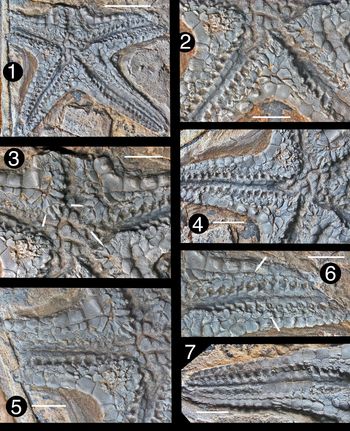
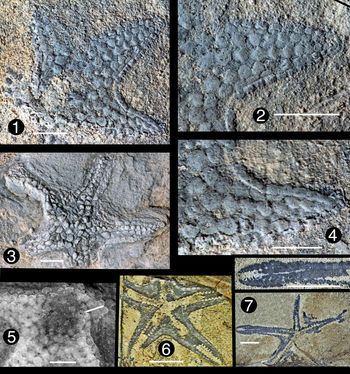
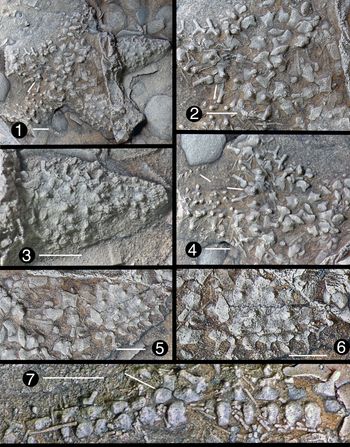
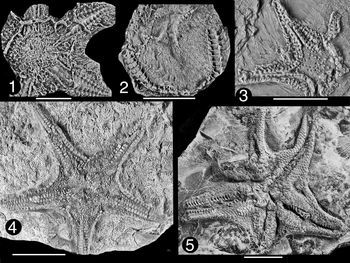
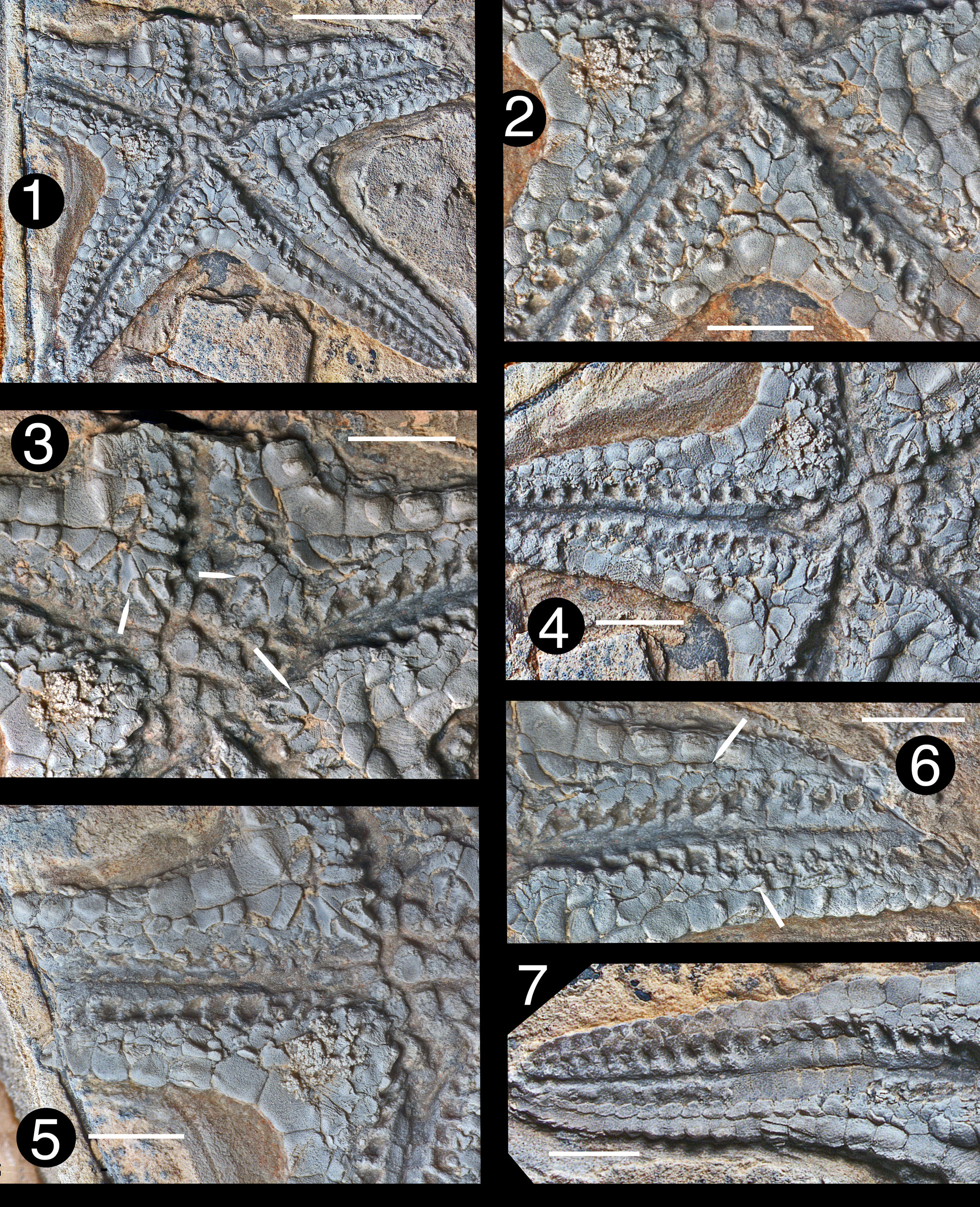
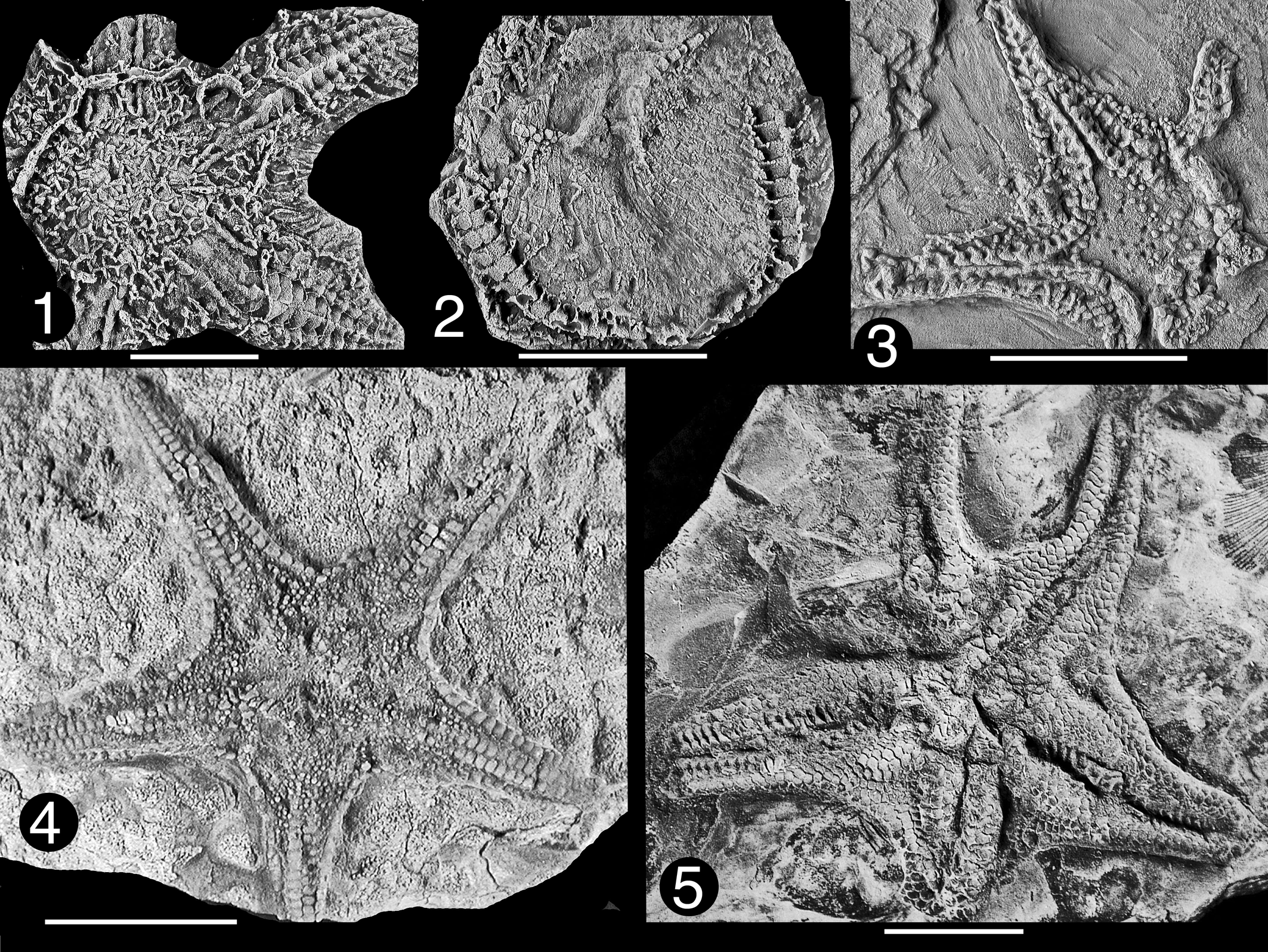
Two new genera and species, Early Ordovician Aerliceaster nexosus n. gen. n. sp. (Figs. 1, 2) and Late Ordovician Kolataster perplexus n. gen. n. sp. (Fig. 3) are described, and the early history of Paleozoic Asteroidea is reviewed beginning with the new taxa. The Early Ordovician Garden City Formation, source of Aerliceaster nexosus n. gen. n. sp., is ca. 20–25 Myr earlier than the Late Ordovician Mifflin Formation source of Kolataster perplexus n. gen. n. sp. Neither alone nor both together can be argued as strictly exemplifying the first asteroid, but rather that they provide framework for generalization on origin of ossicular categories, homologies, taxonomy, phylogeny, and function. For comparative purposes, three somasteroids (Fig. 4.1–4.3) and the early asteroid Eukrinaster Blake et al. (Fig. 4.4, 4.5) are illustrated.
(1–7) Aerliceaster nexosus n. gen. n. sp., holotype IMNH IP-276/850, Early Ordovician, Garden City Formation. (1) Complete specimen, somewhat flattened during preservation spreading arm furrows, some furrow vaulting retained; (2) inferomarginal series leading to axillary and actinal ossicles differently expressed among interbrachia; (3) arrows identify line of contact between mouth-angle ossicle (MAO) and first adaxial, MAO pair to upper left extended to expose articular tissue groove(?), first adaxial to right aligned with subsequent ossicles of series, axial detail largely lost; arrow at medial MAO pair inferred in rotated position to force food material into disk; MAO pair to lower right in inferred retracted configuration; (4) ossicular series differentiated on arm and disk, marginal textures significantly altered; (5) ossicular series clearly weathered but clearly expressed, MAO pair extended to upper right; (6) truncated arm to upper right of (1.1); actinal series extend to arm (arrows); (7) arm to lower right of (1.1), surface topography of medial axials eroded, adjacent ossicles exposed with specimen preparation; adaxial, marginal alignment retained below; actinal series reach midarm. Scale bar (1) = 5 mm; (2–7) = 2 mm.
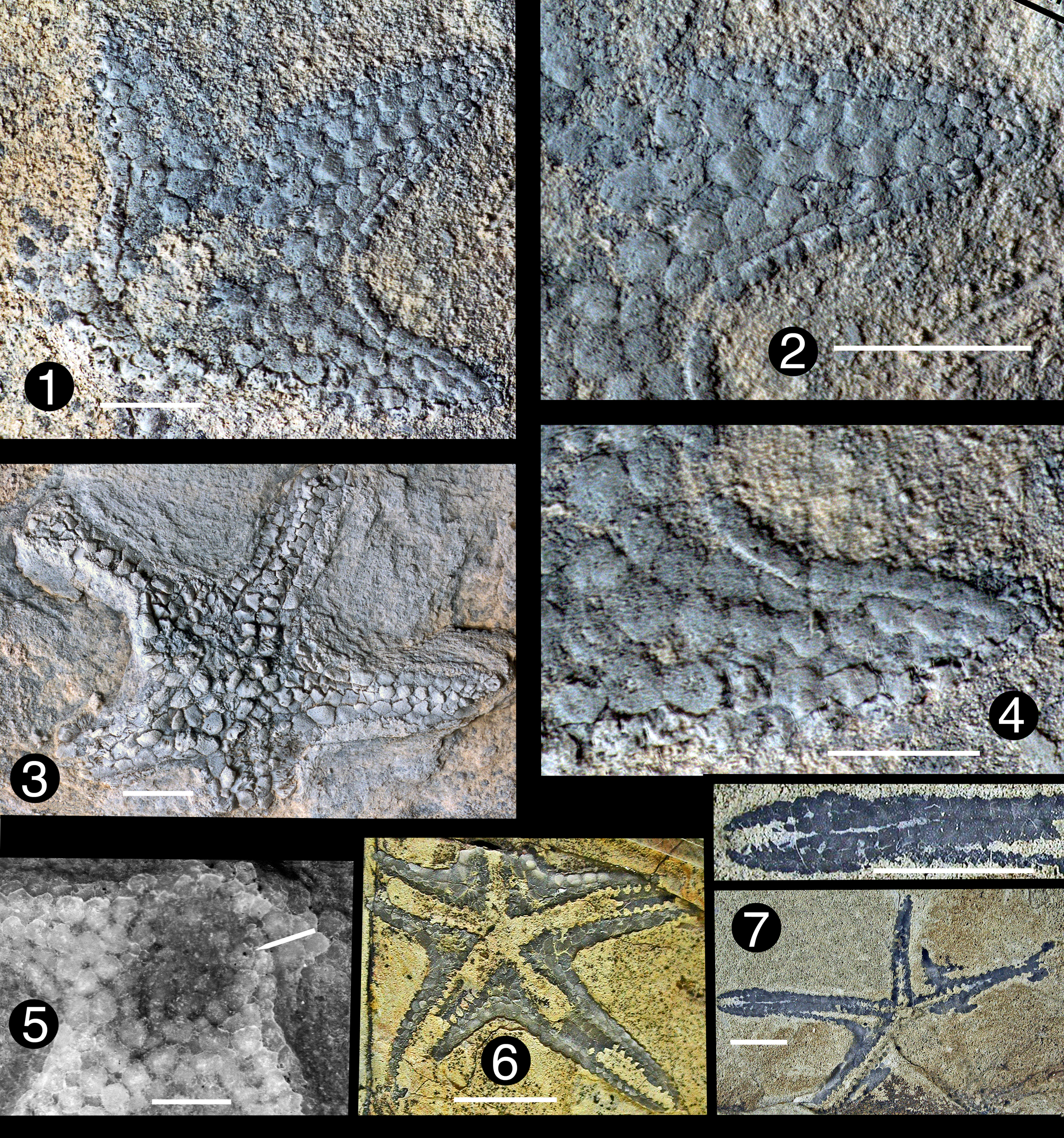
Aerliceaster nexosus n. gen. n. sp. (1, 2, 4, 5) Paratype IMNH IP-276/853; (1, 2, 4) entire specimen; arms and interbrachia bordered by marginal series extending to arm tip, with possible terminal of size similar to adjacent ossicles; three rows of enlarged midarm ossicles of uncertain identity, see text; series of smaller abactinals occur between midarm ossicles and inferomarginals; (5) disk, concentric arrangement of ossicles suggestive of arrangement of Urasterella and Hudsonaster (see text); concentration of small ossicles potentially marking anus or hydropore (arrow); (3) paratype IMNH IP-276/854, disk appears somewhat flattened but arms in upright life orientation; weathering severe; (6) holotype IMNH IP-276/850, specimen before preparation, lower right arms correspond, transverse ridges separating podial basins protected by yellow-brown sediment, compare with Figure 1.1; (7) paratype IMNH IP-276/851, arms upright as Figure 2.3, indurated matrix precludes further preparation; inset above shows arm to left of primary photograph, details partially obscured by sediment, ill-defined ossicular boundaries. Scale bars (1, 2, 4, 5) = 1 mm; (3) = 2 mm; (6, 7) = 5 mm.
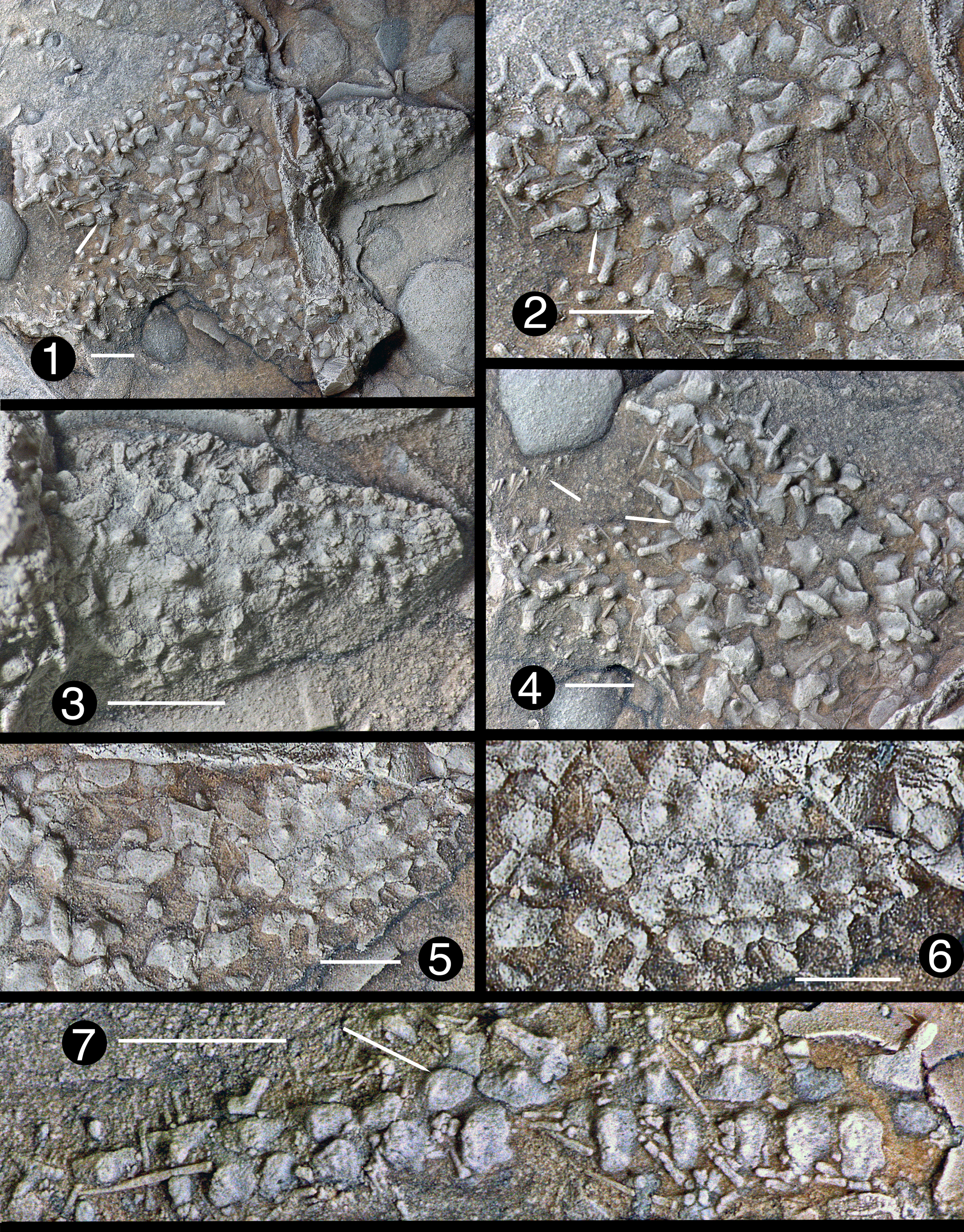
(1–7) Kolataster perplexus n. gen. n. sp., Late Ordovician, Mifflin Fm., Dixon, Illinois. (1–6) Holotype PRIP 20027; (1) entire specimen, ossicles of central disk disrupted, cyclicity uncertain, arms less disrupted; (1, 2, 4) madreporite at arrows; (2) central disk, arm base to left of (1) abactinal ossicular form, many ossicles partially overturned, some spines remain; (3) portion of disk, arm to upper right of (1); inferomarginal convergence suggests arm is complete, medial abactinals in place, more lateral ossicles partially overturned; (4) portion of disk, arm to lower left of (1), probable adaxial spines at arrow to left; (5, 6) arm to lower right of (1), ossicular configuration near midarm; (7) paratype PRIP 20028 arm remnant in lateral aspect, arrow identifies inferomarginals, these irregular, elliptical, robust paxilla-shaft of uncertain length; four ossicles with elongate paxilla-shafts are abactinals; adaxials below, bearing accessory pustules in transverse rows; pustular ridges of adjacent ossicles separated by inter-ossicular channels; scattered spines probably adaxial, perhaps inferomarginal. Scale bars = 1 mm.
Morphology of select early Asterozoa. (1) Somasterid Chinianaster levyi Thoral, Reference Thoral1935 lectotype FSL 168 691, dorsal aspect; shape petaloid; dorsal ossicles forming an open network; virgals to right; ambital framework ossicles small, obscure; (2) somasterid Villebrunaster thorali Spencer, Reference Spencer1951 paratype FSL 168962a, dorsal aspect; shape petaloid; few small scatter dorsal ossicles remain; virgals numerous, leading to well-developed marginals (upper middle); (3) somasterid Ophioxenikos langenheimi Blake and Guensburg, Reference Blake and Guensburg1993 holotype PRIP UI-X-4751, dorsal aspect; shape stellate; dorsal ossicles closely fitted, their arrangement and form irregular; virgal ossicles few in each series; marginal framework similar to that of Villebrunaster; (4, 5) stemward asteroid Eukrinaster ibexensis Blake et al., Reference Blake, Guensburg, Sprinkle and Sumrall2007 (4) paratype NPL 1982 TX1, dorsal aspect, and (5) paratype NPL 1965TX10, ventral aspect; shape stellate; dorsal ossicles subspherical, closely fitted, arrangement irregular; virgals lacking, actinal ossicles many; marginal framework well-developed. Scale bars = 10 mm.
It is generally desirable to found taxonomic subdivision around computer-based phylogenetic analyses; however, in part because of the scanty fossil record and because of the many ambiguities of morphology summarized below, data are deemed insufficient for adequate treatment. Surveys of more limited scope focused on better-understood exemplars (e.g., Blake and Guensburg, Reference Blake and Guensburg2015; Blake et al., Reference Blake, Zamora and García-Alcalde2015b; Villier et al., Reference Villier, Brayard, Bylund, Jenks, Escarguel, Olivier, Stephen, Vennin and Fara2017) document need for ongoing reinterpretation of existing specimens and viewpoints, as well as need for continuing field exploration.
Varying perspectives on class-level asterozoan diversity and relationships include Spencer (Reference Spencer1914–1940), with the supporting documentation of Owen (Reference Owen1965), as well as Spencer (Reference Spencer1951), Ubaghs (Reference Ubaghs and Piveteau1953), Fell (Reference Fell1963), Spencer and Wright (Reference Spencer, Wright and Moore1966), McKnight (Reference McKnight1975), Shackleton (Reference Shackleton2005), Gale (Reference Gale2011, Reference Gale and Lawrence2013, Reference Gale2015), and Mah and Blake (Reference Mah and Blake2012). Added commentary on genesis of ossicular categories are in Blake (Reference Blake2013, Reference Blake2014, Reference Blake2018) and Blake and Guensburg (Reference Blake and Guensburg2015).
Geologic settings
All specimens of Aerliceaster nexosus n. gen. n. sp. were recovered from the Early to Middle Ordovician Garden City Formation of the Bear River Range, Franklin County, Idaho, and collected from the upper third of an ~35 m interval dominated by intraclastic packstones; this is the same interval and locality from which Falloaster anquiroisitus Blake, Gahn, and Guensburg, Reference Blake, Gahn and Guensburg2019 was secured. At least five thrombolitic mound horizons occur in the sequence, and all of the A. nexosus n. gen. n. sp. specimens were collected on or near the upper two mounds. These two mound surfaces preserve the highest diversity and density of echinoderms so far found in the Garden City Formation, including crinoids, blastozoans, and edrioasteroids. Articulated trilobites occur in the muds draping the mounds, and they, along with the associated skeletal fragments, appear to be most consistent with the Strigigenalis plicolabeona Zone of Adrain et al. (Reference Adrain, McAdams and Westrop2009). This indicates a Floian (earliest Blackhillsian) age for the A. nexosus n. gen. n. sp. specimens.
Both known specimens of Kolataster perplexus n. gen. n. sp. were collected from the Mifflin Formation at a horizon 3–4 m above the Pecatonica Formation, Platteville Group, Upper Ordovician, at St. Mary's Cement Company Quarry, three miles north of Dixon, Lee County, Illinois; sec. 15, T22N, R9E. Further background information of the geology and echinoderm paleontology of the Mifflin Formation is available at Kolata (Reference Kolata1973, Reference Kolata, Kolata and Nimz2011) and Willman and Kolata (Reference Willman and Kolata1978).
Materials
Repositories and institutional abbreviations
The six known specimens of Aerliceaster nexosus n. gen. n. sp. are housed at the Idaho Museum of Natural History, IMNH, Pocatello, Idaho. The two known specimens of Kolataster perplexus n. gen. n. sp. are housed at the Prairie Research Institute Center for Paleontology, PRIP, Urbana, Illinois. Specimens of Chinianaster and Villebrunaster are housed at Université Claude Bernard, UCBL FSL, Lyon, France. Specimens of Eukrinaster are housed at the University of Texas Museum of Paleontology, NPL, Austin, Texas.
Systematic paleontology
Terminology
Terminology for asterozoans begins with Spencer and Wright (Reference Spencer, Wright and Moore1966), morphology labeled in Blake (Reference Blake2018, text-fig. 1). The primary skeleton forms the body wall. The accessory skeleton includes the generally abundant spines, granules, and pedicellariae seated on all primary ossicles except axials. Axial or ambulacral ossicles form a double series along the axis of the arm; axials are vaulted to form the ambulacral furrow. Internal so-called superambulacral ossicles extend from the axial to adaxial of some extant asteroids, but have not been identified among Paleozoic species. Mouth-angle ossicles are the proximal-most ossicles of the axial series. Axial ossicles articulate with the adaxial or adambulacral ossicles. The remainder of the skeleton is extraxial. The body of many asterozoans is edged by a single or double series of more or less clearly differentiated ossicles traditionally termed marginals; because the term ‘marginals’ has been broadly applied within echinoderms with unclear implications of homology, the genetically neutral term ambital framework was proposed (Blake and Guensburg, Reference Blake and Guensburg2015). A single marginal series has been judged to be homologous throughout asteroids—it recognized as inferomarginal—whereas a second marginal series, where developed, is superomarginal. The axillary typically is a more or less clearly differentiated unpaired ossicle aligned with the inferomarginal series at the interbrachial midline. Intermarginal series can occur between the two marginal series; intermarginal presence in taxa as divergent as Paleozoic Xenasteridae and Palaeasteridae and extant Echinasteridae and Asteriidae argues homoplasy. Abactinal ossicles are above the marginal series. Among many earlier asteroids, a medial disk centrale can be recognized, enclosed by about two irregular rings of similar ossicles, whereas a more clearly defined ‘primary circlet’ is common among many Paleozoic and extant asteroids. Midarm ossicles can be enlarged and/or otherwise differentiated to form a carinal series. In most asteroids, lateral abactinal series occur adjacent to the midarm carinal series (‘lateral’ here used as a positional descriptor, not necessarily arguing homology).
A hydropore or madreporite provides opening to the water-vascular system of most asteroids, although a differentiated madreporite is difficult to locate in many Paleozoic fossils. No, few, or many actinals occur between the inferomarginals and adaxials. Useful descriptive terminology for paxillae was introduced by Spencer (Reference Spencer1918, fig. 82) and adopted here (although terms were partially transposed between fig. 82 and its description). Each paxilla consists of an expanded paxilla-base that gives rise to a cone-like to columnar paxilla-shaft typically bearing a paxilla-crown of accessories. The paxilla-shaft commonly expands at the base of the crown. The word ‘category’ focuses on particular ossicular types as groups (e.g., the ambital framework including inferomarginals), whereas ‘series’ (e.g., ‘inferomarginal series’) focuses on expressions or specific occurrences of an ossicular category.
Class Asteroidea de Blainville, Reference Blainville1830
Order Euaxosida Blake, Reference Blake2018
Family Palasterinidae Gregory, Reference Gregory1899
Diagnosis
See Blake (Reference Blake2018, p. 23).
Remarks
Euaxosidan genera, including palasterinids, share fundamental similarities of axial and adaxial expression, whereas distinctive extraxial configurations within the Palasterinidae likely reflect complex branching of clades at an early stage of asteroid diversification (Blake, Reference Blake2018).
Genus Aerliceaster new genus
Type species
Aerliceaster nexosus n. gen. n. sp., only species.
Diagnosis
As for the type species, by monotypy.
Etymology
From the Anglosaxon, aerlice, near the beginning, in advance of; in reference to the time of occurrence among known asteroids, thought to be at the beginning of extensive class-level diversification; with aster, Latin, star.
Holotype
IMNH specimen IP–276/850, Figures 1, 2.6, specimen in ventral aspect, radius of single complete arm ~13.0 mm; disk radius ~4.0 mm.
Paratypes
IMNH specimen IP–276/851, Figure 2.7, specimen in ventral aspect; arm radius ~16.0 mm; disk radius ~5.0 mm. IP–276/852, unillustrated specimen in ventral aspect, largely matrix-obscured, arm radius ~11.0 mm, disk radius ~3.0 mm. IP–276/853, Figure 2.1, 2.2, 2.4, 2.5, specimen in dorsal aspect, radius of single complete arm ~4 mm; disk radius ~2 mm. IP–276/854, Figure 2.3, specimen in dorsal aspect, heavily leached, arm radius ~7 mm, disk radius ~3 mm. IP–276/855, unillustrated specimen in dorsal aspect, largely matrix-obscured, arm radius ~7.5 mm, disk radius ~2.5 mm.
Diagnosis
Palasterinid, dorsal disk ossicles include centrale enclosed by two irregular cycles of similar, equidimensional, rounded to subpolygonal, closely fitted ossicles; additional, possibly smaller ossicles might be present. Dorsal arm ossicles arranged in three abutted series of uncertain identity; ossicles of three series similar to larger disk ossicles, medial series perhaps reaching arm terminus. Circlet of small ossicles suggesting either anus or hydropore near-central on disk. Inferomarginal series ossicles enlarged, approximately equidimensional; axillary present but differently developed among interbrachia. Actinals present, few on disk, proximally on arms; actinals varied in size, shape; arrangement irregular. Axials, adaxials typical of Euaxosida; mouth-angle ossicles little enlarged, mouth frame construction suggesting forward-and-backward motion for mouth-angle ossicles; other mouth frame ossicles not available. Extraxial ossicles pustulose, bearing granules, no enlarged spine bases; adaxials bearing small spines.
Occurrence
All six available specimens of Aerliceaster nexosus n. gen. n. sp. were derived from a single locality and geologic setting (see above). All of the specimens are similar in size and overall shape, and although variably weathered due to apparent differences of immediate burial conditions and exposure, essential ossicular arrangement was preserved in all. Specimens are similar enough as to indicate assignment to a single species, although because preservation of two is poor, these not treated in detail. Proportions suggest that the two best-exposed specimens were partially flattened with burial (Figs. 1.1, 2.1). To varying degrees, axial ossicles among the six retain the asteroid furrow vaulting and axial positioning arguing near-retention of life arm proportions (Fig. 2.3, 2.7). Retention of vaulting indicates an early firming of the enclosing sediment. The calcitic echinoderm skeletal material was preserved in relatively pure limestone, and although some ossicles are exposed in weak relief, weathering has altered both original ossicular surfaces and surfaces of the surrounding substrates. Effects of weathering are striking in the differing appearances of the marginal ossicles as well as in furrow appearances of the holotype before (Fig. 2.6) and after (Fig. 1.1) preparation. Before preparation and after outcrop weathering show axial ossicles to be clearly vaulted yet with no transverse ridge separating podial basins, whereas after preparation of immediately adjacent ossicles show that the transverse ridges clearly remain. Differences exemplify difficulties commonly encountered in studies of fossil asterozoans.
Description
Disk vaulted, arms arched or rounded in life; disk moderately large, interbrachial angles rounded, arms elongate triangular, tapering to rounded tip.
Disk ossicles disrupted in available material, appearing to consist of centrale enclosed by open ring of five to seven or eight ossicles, inner ring further enclosed by many similar, closely fitted, approximately equidimensional ossicles suggestive of second ring of ~15 ossicles. Apparent cluster of small ossicles (Fig. 2.5) suggests presence of anus or hydropore, clearly differentiated madreporite not recognized, ring-like concentration a possible artifact of preservation. Dorsal of arm dominated by three medial ossicular series, these ossicles uniform, subcircular to weakly polygonal, dorsal surfaces flat medially, rounded laterally; ossicles aligned across arm; proximally, interspaces between ossicles where exposed filled with debris, some either possibly openings retaining platelets from life, or possibly representing papular gaps. On both sides of arm, series of smaller, elongate, rectangular to sub-triangular ossicles occur between midarm series and inferomarginals, these approximately corresponding with inferomarginals; series extends from the interbrachium to approximately midarm; gaps such as those between medial rows not developed.
Inferomarginals at ambital margins; inferomarginals appearing relatively small, rectangular in outline, elongate parallel to arm axis, narrow as compared to medial arm abactinals; inferomarginal number approximately corresponding to medial arm ossicular number. Inferomarginal surfaces of available specimens lost to weathering. Single axillary present in each interbrachium, expressions varied among interbrachia.
Actinal ossicles numerous on disk, actinals extend to proximal intervals of arm. Actinal sizes, outlines varied; actinal arrangement irregular, most disk actinals larger than arm actinals.
Axial ossicles approximately equidimensional, weakly offset across arm midline. Radial water-vascular channel compacted, partially flared as preserved, perhaps quite broad in life. Transverse ridges of axial ossicles well defined, podial basin appearing to be more or less equally divided between subsequent axials, bordered adradially by ridge of water-vascular channel, wall on distal side interrupted by transverse water-vascular channel. Abradial edge of axial abutting adaxial prominence; sides of prominences curved to edge and constrain podium. Adaxial ossicles not well preserved in available specimens, approximately triangular in external outline, point of triangle forming support for axial ossicle; adaxial elongate parallel to arm axis; adaxials probably more numerous than inferomarginals proximally on arms, numbers more nearly corresponding distally.
Mouth-angle ossicles small, similar in size to proximal axials. Proximal-most two or three adaxial pair enlarged, first partially enclosing mouth-angle ossicles. Circumorals, adjacent axials unknown. Mouth-angle accessories possibly among ossicular debris; granular layer well developed on dorsal disk surface.
Etymology
From the Latin, nexosus, much intertwined, involved, describing the complex morphology of the new genus.
Remarks
For purposes of comparison, the Diagnosis above includes character expressions, such as dorsal disk configuration, that are approximated in other euaxosidans. Evaluation relies largely on specimens IP-276/850 (Fig. 1) and IP-276/851 (Fig. 2.1, 2.2, 2.4) exposing both upper and lower surfaces. See Discussion section for interpretations of enlarged midarm ossicles. Extraxial development of Aerliceaster n. gen. is distinct from those of other euaxosidan genera sensu Blake (Reference Blake2018), but perhaps closest to that of the Mesopalaeasteridae, differing in that in the latter, marginals are in a clearly defined double series of robust ossicles arranged in superposition. Among euaxosidans, arrangement of the dorsal disk is similar to that of Jugiaster Blake, Reference Blake2007, but differs in that in A. nexosus n. gen. n. sp. the midarm series are more clearly defined and there are fewer abactinals beyond the medial arm ossicles.
Sediment disruption adjacent to the arms of one specimen (Fig. 2.3), especially of the ‘east’ arm, argues for remnant arm movement and sediment displacement at time of death and subsequent preservation with only minor skeletal disruption.
Genus Kolataster new genus
Type species
Kolataster perplexus, n. gen. n. sp., only species.
Diagnosis
As for the type species, by monotypy.
Etymology
For Dennis R. Kolata, who discovered and collected the specimens and donated them to The Prairie Research Institute, and for his contributions to geology and echinoderm paleontology of the North American midcontinent.
Holotype
Prairie Research Institute Center for Paleontology, PRIP 20027.
Paratype
Prairie Research Institute Center for Paleontology, PRIP 20028.
Diagnosis
Palasterinid? with extraxial abactinal skeleton of proportionately large ossicles, these possibly somewhat irregularly arranged rather than aligned and clearly differentiated. Most abactinals with paxilla-shaft that bears expanded spinose terminus; other ossicles perhaps lack paxilla-shaft. Dorsal disk ossicular arrangement uncertain, no indication of clear cycles. More lateral abactinals crescentic with papular? reentrant directed toward arm midline. Very small elliptical madreporite present. Inferomarginals small, paxilla-shaft present.
Occurrence
Both available specimens of Aerliceaster nexosus n. gen. n. sp. were derived from a single locality and geologic setting (see above). The nearly complete available specimen, PRIP 20027, is exposed in dorsal aspect, it consisting of the disk, a nearly complete arm (indicated by the convergence of ossicular series toward the arm tip), portions of two additional arms, and bases of the remaining two. The specimen was partially compressed and flattened during preservation, the disk ossicles more disrupted than those of the arms, expressions reflecting disk doming in life. Lateral arm ossicles are deflected as to expose paxilla-shaft. Ossicular preservation is good in spite of local disruption. The lateral margins of the arms are obscured by sediment that limits comparisons with the second specimen; ossicular delicacy precludes further preparation. Arm radius ~14 mm, interbrachial radius 6 mm, but somewhat exaggerated by compaction.
The second specimen, PRIP 20028, is an arm fragment ~7 mm in length and exposed in lateral aspect; ossicular definition is clear for ~4 mm. Because exposure differs between the two specimens, assignment to a single species ultimately cannot be considered unequivocal. The arm fragment shows adaxials in lateral view, with prominent spine bases, whereas rows of spinelets positioned as to be adaxial are exposed on the larger specimen. Arms of the larger specimen are bordered by paxilliform ossicles with deep papular? reentrants; fragments of such ossicles also remain on the arm fragment. On the arm fragment, a series of small, rectangular ossicles with single median shafts similar to but shorter than the shafts of the adjacent paxiliform ossicles abut and approximately correspond in number with the adaxials, these the inferomarginals. Exposure of the inferomarginal series on the more complete specimen is poor.
Description
Palasterinid? with primary abactinal ossicles large relative to overall body size. Ossicular convergence distally argues one arm is complete. Disk abactinals disrupted as preserved, ossicles appearing uniform, paxilliform; paxilla-base thickened, domal, faceted; paxilla-shaft elongate, cylindrical, terminus expanded, associated spicular debris suggests spinelet presence. Abactinals closely fitted in life, no indication of cyclic arrangement or other ossicular differentiation. Arm abactinal configuration unclear as preserved, ossicles possibly not uniform, those nearer arm midline appearing paxilliform, bases closely fitted, not faceted, perhaps aligned in series. Clear carinal series not differentiated; ossicles away from midline taphonomically deflected from upright, exhibiting papular? reentrants directed toward arm midline. Some ossicles away from best-preserved arm intervals might lack paxilla-shafts; bases irregular, polygonal. Abactinal ossicles immediately adjacent to inferomarginals might lack papular reentrants. Ossicular rows approximately aligned with inferomarginal series. Madreporite of typical asteroid ridge-and-groove configuration; ossicle elliptical, long axis <0.5 mm, height of adjacent abactinals ~0.75 mm.
Inferomarginals proportionately small, irregular elliptical in outline, domal, paxilla-shaft robust, of uncertain length; inferomarginals elongate parallel to arm axis, approximately paired with adaxials, abactinals; inferomarginals near arm tip tiny, form unclear. Axials, mouth frame unknown. On arm, adaxials similar in number to and abutting inferomarginals; no actinals on arm. Adaxials wide, with distinct fasciolar groove marking contact between subsequent adaxials; spine bases prominent.
Etymology
From the Latin, perplexus, tangled, involved, intricate, for the complex shapes and arrangement of the extraxial skeleton.
Remarks
Both specimens of Kolataster perplexus n. gen. n. sp. are incomplete, neither exposing the axial-adaxial configuration, and therefore ordinal and familial assignments ultimately cannot be unequivocally demonstrated. Extraxial preservation is excellent with ossicular form and configuration indicating assignment to the euaxosidan Palasterindae.
Kolataster n. gen. is distinguished by form and arrangement of the abactinal ossicles, with thickened bases and elongate paxilla-shafts, papular? reentrants, apparent irregularity of form, and ossicular arrangement.
Discussion
Background to skeletal evolution of the Asteroidea
Spencer and Wright (Reference Spencer, Wright and Moore1966, p. U9) subdivided the asterozoan skeleton into three categories: the axial or ambulacral; the adaxial or virgal/adambulacral/lateral; and the remainder, the extraxial. The biological and evolutionary significance of the echinoderm skeletal classification proposed by Spencer and Wright (Reference Spencer, Wright and Moore1966) was documented by Mooi et al. (Reference Mooi, David, Marchand, David, Guille, Féral and Roux1994), David and Mooi (Reference David, Mooi, Mooi and Telford1998), and Mooi and David (Reference Mooi and David1998, Reference Mooi and David2000, Reference Mooi and David2008), these authors preferring a two-fold axial and extraxial subdivision, the adaxial of Spencer and Wright (Reference Spencer, Wright and Moore1966) of uncertain assignment within axial-extraxial terminology (Mooi and David, Reference Mooi and David2000, p. 331). Early fossils have not been found to be helpful to evaluation of adaxial genesis; nevertheless, the adaxial concept of Spencer and Wright (Reference Spencer, Wright and Moore1966) has been found to be useful to understanding of the fossil record (Blake, Reference Blake2013, Reference Blake2018), and it is retained here. Extraxial ossicular expressions are ontogenetically relatively fluid as compared to those of axial and adaxial series, thereby likely contributing to complexities of certain occurrences noted here.
Diverse skeletal asterozoan remains from Early Ordovician strata are assigned to four class-level taxa (Blake, Reference Blake2013). Cambrian trace fossils suggestive of asterozoan origins have been recognized (Mikulás, Reference Mikulás1992), suggesting (but not demonstrating) that subphylum diversification might have begun prior to emergence of readily preserved skeletons (Schuchert, Reference Schuchert1915, p. 31; Sprinkle, Reference Sprinkle, Jangoux and Lawrence1983, p. 8; Blake and Guensburg, Reference Blake and Guensburg2015, p. 484).
In his comprehensive monograph of the Paleozoic Asterozoa, Spencer (Reference Spencer1914–1940) favored existence of a then-undetermined asterozoan group basal to the Asteroidea and Ophiuroidea; subsequently, Spencer (Reference Spencer1951) recognized the Somasteroidea as the first asterozoans, and since then assignment of the Somasteroidea to a stemward position has been widely but not universally accepted.
Following the thinking of both Spencer (Reference Spencer1951) and Fell (e.g., 1963), Spencer and Wright (Reference Spencer, Wright and Moore1966) favored a crinoid ancestry for the Asterozoa, whereas both Smith and Jell (Reference Smith and Jell1990) and Shackleton (Reference Shackleton2005) preferred an edrioasteroid hypothesis. Blake et al. (Reference Blake, Zamora and García-Alcalde2015b) and Blake and Guensburg (Reference Blake and Guensburg2015) accepted a stemward positioning for the Somasteroidea within the Asterozoa, but argued that no satisfactory subphylum outgroup is available.
The asterozoan skeleton consists of thousands of discrete elements partitioned among a comparatively small number of ossicular categories. Ossicular morphology varies not only among individuals and populations but also with ontogeny, such that an ossicle of given external dimension from a proximal arm interval of a small individual differs significantly from an ossicle of similar external dimensions from a distal arm interval of a conspecific large individual. Given the generally scanty fossil record of asterozoans, these complexities compromise understanding.
Ossicular arrangements of many fossil asterozoans are readily visualized as architectural floor plans; however, abutment surfaces between ossicles typically are inclined rather than perpendicular to any plane of view, with flexibility of the living and dying individual, sediment compaction, and weathering all locally altering ‘floor plan’ appearance and therefore potential reconstruction of life configuration. Specimens of Aerliceaster n. gen. (Figs. 1, 2) document concerns in that they retain near-life overall ossicular positioning, albeit with severe and misleading outcrop weathering.
The Somasteroidea and sourcing of asteroid morphology
Because no outgroup for the subphylum Asterozoa is identified (Blake and Guensburg, Reference Blake and Guensburg2015, p. 483), guidance to early asteroid history must be sought from within the Somasteroidea. For discussion purposes, the asterozoan skeleton is first separated into two basic categories, the axial-adaxial and the extraxial, the latter then with a three-fold subdivision consisting of the ambital framework, the dorsal or abactinal skeleton above the ambital framework, and within asteroids, but not somasteroids, the actinal skeleton between the marginal and adaxial series. The axial and adaxial category provided character complexes for evaluation of the Somasteroidea and the three derived asterozoan classes, the Asteroidea, Ophiuroidea, and Stenuroidea (Blake, Reference Blake2013; Blake and Guensburg, Reference Blake and Guensburg2015), as well as for three new ordinal concepts for Paleozoic Asteroidea, the Euaxosida, Hadrosida, and Kermasida (Blake, Reference Blake2018). At the current level of understanding, axial and adaxial ossicles provide little help for evolutionary sequencing within the Somasteroidea, whereas, and in contrast, the extraxial ambital framework is important, and the dorsal skeleton provides data useful for evaluation of the transition from Somasteroidea to Asteroidea.
Differentiated ossicles, termed ‘marginals,’ have been widely recognized among echinoderms. Because the term ‘marginal’ can carry implications of homology, the genetically neutral term ‘ambital framework’ was proposed (Blake, Reference Blake2013; Blake and Guensburg, Reference Blake and Guensburg2015). Marginal ossicular recognition in asteroids begins with uniformity of interpretation among authors; however, Blake (Reference Blake1978) argued that marginal series origin immediately proximal to the terminal ossicle provides an essential and objective criterion for identification of both marginals and, indirectly, of extraxial categories relative to the marginals. Beginning with the positional criterion, so-called ‘marginals’ of ophiuroids, edrioasteroids, and other echinoderms are not homologous with marginals of somasteroids and asteroids (Blake and Guensburg, Reference Blake and Guensburg2015). Shackleton (Reference Shackleton2005) rejected homology between asteroid ‘marginals’ and the commonly similarly termed series of ophiuroids while accepting ‘marginal’ homology between asteroids and edrioasteroids.
An ‘ambital framework’ was recognized for all five known somasteroid genera, but ‘marginal’ status definitively accepted for only three (Blake and Guensburg, Reference Blake and Guensburg2015). The ambital framework of Chinianaster and Thoralaster consists of many small, delicate, irregular ossicles forming an ‘ambital necklace’ (Blake and Guensburg, Reference Blake and Guensburg2015) that was judged likely, but not definitively, homologous with the ambital or marginal framework of the remaining three genera, and therefore accepted as stemward to true marginals. The ambital framework of Thoralaster is differentiated beyond that of Chinianaster, and therefore the latter is considered stemward.
Marginals of Villebrunaster are an irregular series of small ossicles that reaches the arm tip, it a logical derivative of an ambital framework such as that of Chinianaster. The more robust and clearly defined marginal framework of Ophioxenikos argues progression toward asteroid configuration, such as the marginals of Eukrinaster (Fig. 4.4, 4.5). A stemward positioning relative to Asteroidea for Archegonaster Jaekel is rejected because of morphology and stratigraphic position (Blake and Guensburg, Reference Blake and Guensburg2015, p. 483).
Ophiuroids lack marginals and therefore in this hypothesis, absence from Chinianaster and Thoralaster favors separation of the ophiuran clade prior to the Villebrunaster grade. The madreporite of Chinianaster lies within the virgal field, an expression consistent with closer linkage to the Ophiuroidea.
Because the above sequencing is based entirely on morphologic interpretations without reference to an outgroup, it is readily reframed. Villebrunaster morphology can be assigned to the stemward position, it giving rise to one branch leading toward Ophixenikos and the Asteroidea and a second branch exhibiting ambital framework reduction leading toward ophiuroids. Ambital framework ossicles occur in stenuroids sensu Blake (Reference Blake2013), suggesting that occurrence in at least this class might be paraphyletic or polyphyletic. MacBride (Reference MacBride1896, p. 398) placed asteroids stemward to ophiuroids in a diagram published early in the history of phylogenetic interpretation. At the beginning of his monograph, Spencer (Reference Spencer1914, p. 7) also favored a stemward positioning for asteroids. A stemward positioning for Villebrunaster might also be favored by hydropore-madreporite expression. Although a number of specimens of Villebrunaster are available, no madreporite has been recognized, and a madreporite is difficult to recognize among many early asteroids (perhaps in part for taphonomic reasons, see Kolataster n. gen., Fig. 3.1, 3.4); the absence of a recognized madreporite from Villebrunaster might reflect presence of only an uncalcified hydropore, the true madreporite emergent within the Asteroidea and therefore perhaps convergent, as suggested by Aerliceaster n. gen. (Fig. 2.5). Presence of a dorsal madreporite in Archegonaster favors at least possible presence of a clade close to the Asteroidea. The alternative possibilities above are consistent with complex branching within the Somasteroidea suggested by Mooi and David (Reference Mooi and David2000, fig. 6) as well as with occurrence of small, extinct early asterozoan clades (Blake, Reference Blake1995, Reference Blake2014; Blake et al., Reference Blake, Gahn and Guensburg2019). Either early diversification hypothesis is suitable for the evaluation of the Asteroidea because interpretation of this class begins with the Villebrunaster and Ophioxenikos branch.
Three dorsal skeletal expressions are recognized among somasteroids. That of Chinianaster, Thoralaster, and Villebrunaster consists of paxilliform ossicles linked by radiating connecting rods, the two ossicular types together forming a delicate open meshwork. A second dorsal expression is the closely fitted field of uniformly small and irregular ossicles of Ophioxenikos. The third, that of Archegonaster, is a field of tiny granules in which larger ossicles are lacking. Ophioxenikos is similar to Eukrinaster and many other stemward asteroids. The dorsal configuration of Archegonaster argues against a basal assignment for this genus. The fields of small, irregular ossicles typical of somasteroids also are similar to those of early ophiuroids and stenuroids.
As a part of the axial-adaxial system, the mouth frame is considered first below followed by the ambital framework, the dorsal skeleton, and accessories.
The axillary and mouth frame construction and function in Aerliceaster nexosus n. gen. n. sp
A problematic and debated ossicular occurrence among Paleozoic asteroids is that of the so-called axillary. The axillary characteristically is developed as an external, interbrachial, unpaired ossicle aligned with the inferomarginal series and abutting the mouth-angle pair (Fig. 1). The axillary is most readily recognized in taxa in which actinal ossicles are few or lacking, whereas, and in contrast, in taxa with an enlarged disk and many actinals, an axillary typically is difficult to recognize; in Eukrinaster (Fig. 4.4, 4.5), for example, marginal frame appearance only suggests presence of an axillary (Blake et al., Reference Blake, Guensburg, Sprinkle and Sumrall2007, figs. 2.6, 3.1), as does an appearance adjacent to the mouth-angle ossicle (Blake, Reference Blake2018, pl. 2.11). Difficulties of recognition cannot prove absence, at least in part because of size and shape issues but also because of expressions in other taxa, the axillary displaced from the arm margin onto the enlarged disk of Xenaster Simonovitsch (Blake and Hotchkiss, Reference Blake and Hotchkiss2004, fig. 1.4; Blake Reference Blake2018, pl. 13.2) suggesting potential ossicular loss, or at least loss of clear expression. Further, if axillaries are inferomarginal derivatives, generation in at least some lineages might have been step-wise rather than abruptly transformational, as suggested by the complex ventral disk expressions of Aerliceaster n. gen. Potential loss of clarity of expression is also suggested by occurrences within the crown group (Blake et al., Reference Blake, Bielert and Bielert2006, fig. 3; Blake et al., Reference Blake, Tintori and Kolar-Jurkovsek2017, fig. 2). Axillary ossicles have not been identified in somasteroids, although Fell (Reference Fell1963, fig. 8) did recognize a so-called ‘T-plate’ in Villebrunaster in the position of the axillary, an occurrence not subsequently confirmed. McKnight (Reference McKnight1975, p. 14), for example, argued presence of an odontophore (= axillary) as a key to asteroid recognition.
Mouth-frame construction and operation in both asteroids and ophiuroids was described and illustrated by Spencer (Reference Spencer1925, p. 263, fig. 186). In Spencer's view, in primitive forms, the mouth frame formed a trapping mechanism that, when opened, pulled mouth frame ossicles apart, and with closing, the ossicles grasped the prey and contracted toward the disk axis. Closure then created tension in the surrounding disk that gradually reopened the mouth frame as muscles relaxed.
All five interbrachia are exposed in one specimen of A. nexosus n. gen. n. sp. (Fig. 1) with axillary appearance from interbrachium to interbrachium ranging from well defined to somewhat obscure, the lack of distortion among the still closely fitted ossicles demonstrating original arrangement, without significant ossicular displacement that would hinder interpretation. Expressions of the better-preserved mouth-angle pair differ—one pair with a groove on each extended ossicle, a second pair comparatively retracted with robust edges of the mouth-angle ossicles abutting the adaxial, and in a third (situated between the other two), mouth-angle ossicles are rotated toward and into the mouth area. Although it is difficult to apply the operational interpretations of Spencer (Reference Spencer1925) to the mouth frame of Aerliceaster n. gen., disposition suggests mobility, an ability of the mouth-angle pair to extend and contract during feeding. The elliptical depression between the mouth-angle ossicular pair in this model was used for musculature to grasp and push particles into the mouth; although Spencer (Reference Spencer1925) used the term ‘prey,’ sediment feeding would be appropriate as well. The differing appearances of mouth-angle pair of the A. nexosus n. gen. n. sp. holotype are argued as having ‘frozen’ different feeding postures during the death event, the expressions likely aided by some tissue decay.
An elliptical depression between the proximal edges of ossicles of the mouth-angle pair, such as A. nexosus n. gen. n. sp. (Fig. 1.3), is common among Paleozoic asteroids, although variously obscured both by positioning at death and preservation (Spencer, Reference Spencer1922, p. 205 and associated discussions; Blake, Reference Blake2018, p. 24 for Schuchertia and Palasterina). The gap, commonly found in taxa with comparatively small accessories on the mouth-angle ossicles, seemingly would have served as effective gripping tools, in accord with the interpretations of Spencer (Reference Spencer1925).
Axillary/odontophore positioning on a small disk immediately adjacent to the mouth-angle pair arguably provided bracing; in contrast, life modes of genera with enlarged disks and small extraxial ossicular sizes might have favored flexibility and lesser need for bracing. The small actinal field of A. nexosus n. gen. n. sp. provided some flexibility rather than the rigidity of the single abutted axillary configuration. Two possible end-member hypotheses are enabled by A. nexosus n. gen. n. sp., either an enlarged actinal field reminiscent of the virgal field of somasteroids was being lost and a differentiated axillary was emergent, or the reverse, that axillary differentiation was declining with increasing actinal field size. Axillary transfer to the interior (i.e., traditional ‘odontophore’ status) would retain some bracing while restoring flexibility lost with axillary differentiation and small disk sizes.
Discussion here focuses on difficulties surrounding interpretation of presence of a single axillary ossicle, but potential presence of two or even multiple proximal inferomarginals variously incorporated into evolution of the axillary/odontophore configuration (Blake, Reference Blake2018) is a complexity consistent with above interpretations.
Ambital framework and dorsal ossicular expressions
Dorsal and body-margin ossicles of available Aerliceaster n. gen. are most clearly exposed in two arms of a single specimen (Fig. 2.1). Inferomarginals are recognized based on their occurrence as a distinctive series originating at the arm tip and positioning along the ambital margin. A lateral series of small, sub-rectangular ossicles abuts the inferomarginals and extends from the interbrachium to about the midarm position. The central portion of the arm is dominated by several rows of enlarged ossicles. The medial series of one arm is aligned, initially suggesting straightforward category determination, whereas rows of the second better-preserved arm are offset. Offset cannot be ascribed to growth abnormality because the concern here is interpretation of potential derivation of ossicular categories from the posited irregular ancestral configuration of somasteroids: ossicular ‘offset’ of Aerliceaster n. gen. could represent an emergent status of ossicular series differentiation. It also is not possible to argue taphonomic disruption because, although surfaces are heavily leached, ossicles appear in life positions both in this and the other specimens of the suite; any disruption was minor.
The medial series of the more complete arm extends from the arm tip, the apparent site of series genesis, to the disk, whereas tracking of the ossicular series reaching the arm tip of the second arm is ambiguous because of offset (Fig. 2.1, 2.2, 2.4) and irregularity of ossicular arrangement at the disk. Alignment at the disk at least suggests continuity with the lateral series of the better-preserved arm. Lateral series of neither arm appears to reach the arm tip, thereby failing the positional criterion for superomarginal series. For these reasons, in the taxonomic section above, the three series are described as midarm series, but not recognized as representing either superomarginal nor carinal series. Expression, however, is consistent with the suggestion of Shackleton (Reference Shackleton2005) of secondary superomarginal derivation, perhaps from abactinal series, here with alignment emergent.
Kolataster n. gen. (Fig. 3) is of a common overall asteroid shape. An inferomarginal series is present and dorsal ossicles are closely fitted; like Chinianaster and unlike Ophioxenikos, many ossicles are paxilliform and a second ossicular type is present. Dorsal ossicles of Kolataster n. gen. appear aligned into series as in Aerliceaster n. gen., but no differentiation of arm series (i.e., carinals and superomarginals) is recognized, and in that way Kolataster n. gen., like Aerliceaster n. gen., suggests an emergent status, but one in which series differentiation suggests separate evolutionary pathways.
Disk abactinals
Spencer (Reference Spencer1914, p. 34) endorsed the notion that “the most primitive Asterozoa have a leathery skin in which are embedded small irregular plates,” a view consistent with his later view that somasteroids, with their dorsal skeletons of comparatively uniform, small, and irregularly arranged skeletal elements, represent “ … the first stages in the differentiation of a starfish” (Spencer, Reference Spencer1951, p. 87). Dorsal disk ossicles of both the somasteroid Ophioxenikos and the asteroid Eukrinaster are uniform, small, closely fitted, irregular in arrangement, and not known to be differentiated into carinal or concentric disk series; the asteroid condition is considered plesiomorphic and derived from an ancestral somasteroid condition.
For Ordovician Hudsonaster, Schuchert (Reference Schuchert1915, p. 32) described a simple arrangement of comparatively few closely fitted dorsal disk ossicles, and Spencer (Reference Spencer1916, p. 64, Reference Spencer1918, p. 128) discussed and provided diagrammatic reconstructions of ossicular arrangements for both Urasterella and Hudsonaster. Comparatively few larger apical ossicles are present in the two, these arranged in one or two irregular but approximately pentameral cycles. Citing Stürtz (Reference Stürtz1893), Spencer (Reference Spencer1914, p. 34) suggested that although many “primitive” asteroids show the apical system of urasterellids, this arrangement is not ancestral “but is acquired secondarily and independently in many forms.” Although the term “primary circlet” was not used by Spencer (Reference Spencer1918), Spencer and Wright (Reference Spencer, Wright and Moore1966, p. U30) defined a dorsal disk primary circlet as a: “Ring of prominent ossicles on aboral surface, typically consisting of five radials and five interradials surrounding centrale.”
The configuration of Aerliceaster n. gen. is incompletely exposed, but a centrale and an enclosing ring are suggested, and surrounding ossicles are numerous, the complex seemingly similar to that described for Hudsonaster and Urasterella. Preservation of Kolataster n. gen. is incomplete, but the numerous similar ossicles, perhaps concentric in arrangement, is suggestive of Aerliceaster, Hudsonaster, and Urasterella. Collectively, dorsal disks of exemplars here are consistent with Spencer's (Reference Spencer1914) views of the ancestral condition of Asterozoa, the Somasteroidea representing the first of the Asterozoa (Spencer, Reference Spencer1951, p. 87) followed by ongoing potentially convergent ordering of the dorsal disk skeleton (Schuchert, Reference Schuchert1915; Spencer, Reference Spencer1916, Reference Spencer1918).
Many asteroids exhibit a regular five-fold apical ossicular configuration early in their ontogenetic skeletal development (see Fewkes, Reference Fewkes1888; Kano et al., Reference Kano, Komatsu and Oguro1974; Komatsu, Reference Komatsu1975), and comparable five-fold ossicular configurations about central axes are widely distributed among pentameral echinoderms (e.g., Spencer and Wright, Reference Spencer, Wright and Moore1966, fig. 26; Ubaghs, Reference Ubaghs and Moore1967, fig. 18). Such arrangement, however, is not considered to be of fundamental significance to echinoderm phylogenetic interpretation (e.g., Spencer, Reference Spencer1914, p. 34; Philip, Reference Philip1965).
Madreporite
Among the five known genera of Somasteroidea, a hydropore or madreporite has been recorded for only two. In Archegonaster, a madreporite is positioned dorsal to the single row of marginal ossicles, and in Chinianaster, the madreporite is located within the virgal field ventral to an ambital framework of tiny ossicles, these likely, but not definitively, homologous with the marginals of asteroids (Blake and Guensburg, Reference Blake and Guensburg2015). The stemward asteroid condition of water pore development is ambiguous because of differences among somasteroid occurrences.
Madreporic expressions are varied among early Paleozoic asteroids. A hydropore/madreporite has not been recognized in all early species, likely at least in part due to taphonomic disruption. Presumably, the ancestral condition is that of a simple opening surrounded by small ossicles. Small sample size limits interpretation of Aerliceaster n. gen., nevertheless preservational style likely could enable recognition of a clearly differentiated madreporite, were one present. The best-preserved dorsal disk of Aerliceaster n. gen. has an apparent circlet of small ossicles (Fig. 2.5) most like the anal pore of extant asteroids, but alternatively, it might represent a hydropore prior to madreporic differentiation. The tiny but clearly differentiated madreporite of Kolataster n. gen. (Fig. 3.1, 3.2, 3.4) demonstrates that the ossicle in fossil occurrences can be too small to be readily seen.
Actinal skeleton
The actinal skeleton of Asteroidea was posited as homologous with the virgal skeleton of the Somasteroidea by Shackleton (Reference Shackleton2005), whereas Blake and Hotchkiss (Reference Blake and Hotchkiss2004) and Blake and Guensburg (Reference Blake and Guensburg2015) argued virgal loss was followed by homoplastic derivation of actinals among asteroid clades. Actinal shapes and arrangements among interbrachia in Aerliceaster n. gen. are all but chaotic (Fig. 1), whereas actinal configurations among extant asteroids are regular, regularity having been argued as emerging independently among clades (Blake and Hotchkiss, Reference Blake and Hotchkiss2004, p. 361; Blake et al., Reference Blake, Donovan, Mah and Dixon2015a, p. 1049). Data for Kolataster n. gen. are not available.
Accessory ossicles
Accessory ossicles are the granules, spines, spinelets, and pedicellariae seated on the ossicles of the primary skeleton. Identification of granular ossicles either as ‘primaries’ or ‘accessories’ can be ambiguous. For example, in many extant Poraniidae, small granules occur in a dermal layer, but enlarged ossicles are lacking and therefore either ‘primaries’ were lost leaving only accessory granules, or, less likely, the ‘granules’ might be reduced primaries (‘less likely’ because intermediate reduced states have not been recognized in the Poraniidae, and size reduction leading to a uniform granular size suggests a more complex process than ossicular loss). The concern takes on pertinence for interpretation of early asterozoan history because only small granules have been reported from the dorsal disk of Archegonaster (Smith and Jell, Reference Smith and Jell1990, p. 764).
In Aerliceaster n. gen., some small ossicles are, or at least appear, fitted between adjacent marginal and the adaxial ossicles, and therefore argue a part of the primary skeleton, whereas others appear to rest on the adjacent ossicles and therefore suggest accessories. The complexities potentially challenge category determination and therefore also series identification among asteroids, for example, within the Mesopalaeasteridae sensu Blake (Reference Blake2018). Alternatively, differences might only document comparatively trivial local growth displacement rather than a broader challenge to recognition of ‘primary’ and ‘accessory’ ossicular recognition.
Conclusions
Early Ordovician (Floian) Aerliceaster nexosus n. gen. n. sp. is one of the earliest-known asteroids; along with the Late Ordovician (Sandian) Kolataster perplexus n. gen. n. sp., it is assigned to the stemward asteroid order Euaxosida (Blake, Reference Blake2018).
Trace fossils suggestive of asterozoans are known from Cambrian rocks, well before Early Ordovician skeletal representatives. Based on the Cambrian trace fossils and the diversity of Early Ordovician asterozoans, the possibility that diversification preceded robust skeletonization cannot be readily dismissed, and therefore the search for asterozoan class-level intermediates must encounter some uncertainty.
Nevertheless, based on skeletal similarities, three asterozoan classes, the Asteroidea, Ophiuroidea, and Stenuroidea, are considered to be derived from the Somasteroidea. Although specific generic linkages among classes are not available, for comparative purposes, Chinianaster is considered a useful stemward representative among known somasteroids and Ophioxenikos is considered the known somasteroid with the most in common with asteroids. An alternative approach, with Villebrunaster at the stemward position giving rise to both a Chinianaster-Ophiuroidea branch and an Ophioxenikos-Asteroidea branch, is consistent with considerations here.
The skeleton of Asterozoa is constructed of comparatively few ossicular categories. Axial ossicles, the ambulacrals and mouth-angle ossicles, are considered homologous throughout the Somasteroidea and Asteroidea. Asteroid adaxial or adambulacral ossicles are considered homologous as a group, a derivative of the virgal category of somasteroids, although not demonstrably the same member of that sequence among taxa. Axials, with adaxials, are critical to taxonomy and phylogenetic interpretation; the remaining skeleton is extraxial and of secondary emphasis.
Inferomarginals are emergent within Somasteroidea and are treated as plesiomorphic and homologous throughout Paleozoic Asteroidea, although given complexities of occurrences within the Somasteroidea, the postulate can be challenged.
Superomarginals are homoplastic among asteroid clades and potentially derived from abactinal ossicles. Recognition of homologous superomarginal occurrence among major Paleozoic clades is problematic.
Intermarginal ossicular series between inferomarginals and superomarginals are homoplastic.
Abactinal ossicles are plesiomorphic and homologous as an ossicular category throughout the Asteroidea, although variously modified with widespread homoplastic specificities of expression.
Occurrences of both clearly defined dorsal disk ossicular circlets and midarm carinal sequences appear homoplastic among early asteroids because neither is recognized among somasteroids, and early asteroid expressions are varied.
Presence of a typical asteroid madreporite has not been demonstrated throughout somasteroids or in many early asteroids, perhaps largely because of limitations of preservation. The differences potentially indicate that a differentiated madreporite was homoplastic, a hydropore the stemward condition.
Actinal ossicle presence and regularity of actinal ossicular arrangement are homoplastic among asteroids.
Acknowledgments
P. Jamison, J. Skabelund, J. Sprinkle, and S. Zamora provided field assistance at various times during the collection of the Aerliceaster nexosus n. gen. n. sp. specimens. D.R. Kolata collected, made available for study, and donated the two specimens of Kolataster perplexus n. gen. n. sp. to the Prairie Research Institute Center for Paleontology. F.H.C. Hotchkiss and an anonymous reviewer made many helpful comments; R.B. Mooi served as Associate Editor and also made valuable suggestions. Over the years, many have aided and supported DBB, as at least partially acknowledged in Blake (Reference Blake2013). We are grateful to all.