I. INTRODUCTION
Cancer is a class of diseases which accounts for approximately 13% of all deaths each year worldwide. Cancer is thought to be caused by the interaction between genetic susceptibility and environmental factors. Chemotherapeutic drugs (=Cytostatics) are often used as a part of the complex anticancer therapy. Their mechanism of action consists in impairing mitosis (cell division) and effectively targeting fast-dividing cancer cells. Platinum complexes represent a significant group of these compounds.
Cis-amminedibromo(2-methylpyridine)platinum complex [Pt(NH3)(2-pic)Br2] (herein referred to as PicoPtBr2) is an analogue of Picoplatin (amminedichloro(2-methylpyridine)platinum complex), which is currently used clinically. PicoPtBr2 represents an analogue that showed a similar cytostatic activity but slightly different pharmakokinetic behaviour caused by distinct water solubility and thus potentially different side effects.
We have inspected the CSD database (Allen, Reference Allen2002) for similar compounds and found the crystal data for the isostructural analogue Picoplatin Pt(C6H10N2)Cl2 (Battle et al., Reference Battle, Choi, Hibbs and Hambley2006). This compound is monoclinic [a = 9.878(1) Å, b = 9.0223(9) Å, c = 11.202(1) Å, β = 102.595(2)°, unit-cell volume V = 973.32(1) Å3, Z = 4, and space group P21/c]. The calculated powder pattern of this compound is similar to the measured powder pattern of the title compound reported in this paper.
II. SAMPLE PREPARATION
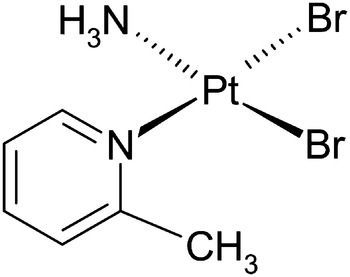
Preparation of PicoPtBr2 (Figure 1) is based on the principle of synthesis of platinum complexes with diamincyclohexane ligand, which was published by Schwartz et al. (Reference Schwartz, Meischen, Gale, Atkins, Smith and Walker1977) and Pasini et al. (Reference Pasini, Caldirola, Spinelli and Valsecchi1993).
Structural formula of Pt(C6H10N2)Br2.

Starting compounds for synthesis were Picoplatin [amminedichloro(2-methylpyridine) platinum complex] and AgNO3 to form amminedinitro(2-methylpyridine)platinum complex. This substance reacted with KBr to form an amminedibromo(2-methylpyridine)platinum complex in the second reaction step.
III. POWDER DIFFRACTION DATA
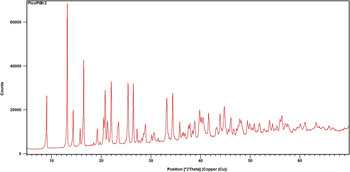
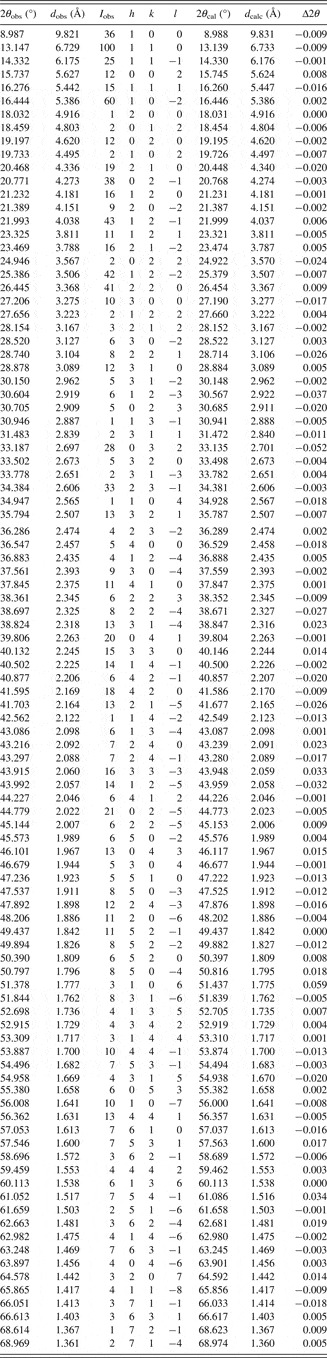
The diffraction pattern for the title compound was collected at room temperature with an X'Pert PRO θ–θ powder diffractometer with parafocusing Bragg–Brentano geometry using CuKα 1 radiation (λ = 1.5406 Å, Ni filter, generator setting: 40 kV, 30 mA). An ultrafast X'Celerator detector was employed to collect XRD data over the angular range from 4 to 70°2θ with a step size of 0.017°2θ and a counting time of 81.28 s per step. The experimental powder diffraction pattern is depicted in Figure 2. The software package HighScore Plus V3.0e(PANalytical, Almelo, The Netherlands) was used to smooth the data, to fit the background, to eliminate the Kα 2 component, and the top of smoothed peak method was used to determine the peak positions and intensities of the diffraction peaks (Table 1).
X-ray powder diffraction pattern of Pt(C6H10N2)Br2 using CuKα 1 radiation (λ = 1.5406 Å).

Indexed X-ray powder diffraction data for Pt(C6H10N2)Br2. Only the peaks with I rel of 1 or greater are presented [a = 10.049 (1) Å, b = 9.240 (2) Å, c = 11.497 (2) Å, β = 101.945 (3)°, unit-cell volume V = 1044.41 Å3, Z = 4, and space group P21/c]. All lines were indexed and are consistent with the P21/c space group. The d-values were calculated using CuK α 1 radiation (λ = 1.5406 Å).

The collected data are consistent with monoclinic unit-cell parameters [a = 10.049 (1) Å, b = 9.240 (2) Å, c = 11.497 (2) Å, β = 101.945 (3)°, unit-cell volume V = 1044.41 Å3, Z = 4, and space group P21/c]. These parameters were derived using DICVOL04 (Boultif and Louër, Reference Boultif and Louër2004) with the results all being within the errors indicated. The following figures of merit were achieved F 20 = 85.6 (0.0057 41) (Smith and Snyder, Reference Smith and Snyder1979) and M 20 = 37.8 (de Wolff, Reference de Wolff1968).
ACKNOWLEDGMENTS
This work was supported by the research programmes NPV II 2B08021, MSM6046137301 and, MSM6046137302 of the Ministry of Education, Youth and Sports of the Czech Republic and by grant no. 104/09/1497 from the Grant Agency of the Czech Republic.