Introduction
John Ward-Perkins identifies the group of Cyrenaican church floor mosaics of the Justinianic period as the work of mosaicists imported, possibly, from Syria and describes the repertory of images as ‘a curiously haphazard collection of motifs, of which surprisingly few were specifically Christian in content’. In respect of the nave mosaic at Qasr Libya, he claims that ‘more than half the panels are purely decorative’ and that ‘only a very restricted part of the mosaic had a precise symbolic significance’ and warns against ‘the not uncommon tendency to seek symbolic meanings in what must often have been purely formal generalised schemes of decoration’ (Ward-Perkins Reference Ward-Perkins1958).
However, objections can be advanced to this view. Firstly, church furnishings and decorations have always mattered both to clergy and laity. It would be surprising if those responsible for commissioning these mosaics had not given serious consideration to how appropriate the images were to the locations where they were to be installed. Secondly, these mosaics have an exuberance of content and an asymmetry which does not seem to appear in mosaics found in secular situations but which would be understandable if symbolic meaning was taking precedence over artistic design in these church floors.
The purpose of this paper is to test the validity of the opinions set out in the first paragraph above by re-examining these Cyrenaican mosaics to see if a coherent Christian message can emerge from them. To do this, two sources of imagery will be drawn on. Firstly, and most obviously, the Bible and secondly, in view of the rich and diverse fauna exhibited in these mosaics, early bestiaries such as the Physiologos. Clark makes an interesting point in the introduction to her book (Reference Clark2006, 1) saying that studies on the medieval bestiaries languished from the 1930s till the end of the twentieth century after M.R. James (an expert on Bible apocrypha) stated emphatically that Latin bestiary texts were without literary or scientific merit. Only recently have readers begun to see them properly as spiritual literature. Current reading sees the image of an animal as open to invoking a Christian message through the allegorical interpretation given to it in contemporary bestiaries.
Obvious starting points for this re-examination are the three mosaics (in the nave, round the altar and in a side room) discovered in the Eastern Church at Qasr Libya, since they are in such a remarkable state of preservation that there is no need of conjectural restoration. These will now be discussed in the above order and each examined in relation both to similar mosaics within the Cyrenaican corpus and also to roughly contemporary mosaics in two churches in present-day Jordan which lie much closer to the area which Ward-Perkins suggests as the homeland of the craftsmen responsible for the Cyrenaican mosaics.
The Nave Mosaic at Qasr Libya
Alföldi-Rosenbaum and Ward-Perkins (Reference Alföldi-Rosenbaum and Ward-Perkins1980, 9) identify three other pavements with the rectangular grid composition of the nave pavement at Qasr Libya. These are in the naves of Cyrene Cathedral and the church at Ras el-Hilal and in the south transept of the East Church of Apollonia. These three pavements are highly damaged with much loss and so less suitable for detailed analysis.
The nave mosaics at Cyrene and Ras el-Hilal lie symmetrically about the central axis of those churches; the nave mosaic at Qasr Libya is quite different. It is hard against the eastern and northern walls of the church but separated from the southern wall by a wide marble pavement and extends less than half way down the nave; the nave being plainly paved from there up to the chancel in the west. Ward-Perkins and Goodchild (Reference Ward-Perkins, Goodchild and Reynolds2003, 280) suggest that the principal entrance to the church was a door in the (now robbed out) south wall and that the nave mosaic was closely associated with the complex of rooms to the east (rooms a–c) and north (rooms d–g), one of which contains a mosaic (which will be discussed later) adjacent to the nave mosaic (cf. Fig. 1).
The East Church at Qasr Libya (Source: Ward-Perkins and Goodchild Reference Ward-Perkins, Goodchild and Reynolds2003, 274, fig. 218; rooms a–g have been labelled according to fig. 224, p. 279).

Ward-Perkins and Goodchild consider that the church was conceived in two parts, the western half having a conventional church layout while the eastern half, comprising the suite of rooms mentioned above together with half the nave and containing the two mosaics mentioned, served a separate purpose centred on room e which they thought might have served a cultic purpose. The only door from which the nave mosaic could be seen the right way up is a narrow entrance in the north-east corner of the church. One gets the feeling that this nave mosaic is defining a space in which some ritual is to be enacted. One can see support for this in the design of the band at the western end of the mosaic, the principal element of which is a scroll formed of a vine in full fruit containing birds and animals. This divides the 50 panel scheme of the main mosaic from the rest of the church and would only be seen the right way up by people standing facing the mosaic with their backs to the altar.
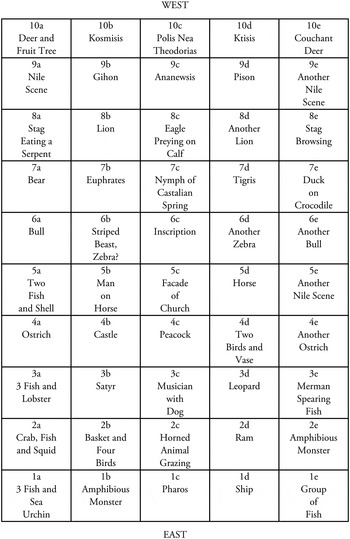
Turning to the 50 panels of the main mosaic, these were, before being lifted and installed in the on-site museum, arranged in ten rows starting hard against the eastern wall of the church and proceeding westwards. We will number these rows 1 to 10 from east to west. The five panels in each row will be designated ‘a’ to ‘e’ from south to north. In Figures 2 and 3 the layout of these panels is shown diagrammatically together with a brief title for each derived from the identifications given by Goodchild shortly after they were first discovered (Goodchild Reference Goodchild1957, 1034–35).
The mosaic panels of the nave of the church, in their original layout (Source: Alföldi-Rosenbaum and Ward-Perkins Reference Alföldi-Rosenbaum and Ward-Perkins1980, 122 fig. 10).

The layout of the mosaic floor in the nave of the church at Qasr Libya with short panel identifiers taken from the description given by Goodchild (Reference Goodchild1957).

A person entering from the small door in the north-east corner of the church and moving along the back wall to the centre line of the mosaic would have had at their feet a two panel tableau (1c and 1d) representing a small boat with its crew gesturing towards a lighthouse (generally identified as the Pharos at Alexandria). This tableau is surrounded with panels showing sea creatures and sea monsters (1a, 1b, 1e, 2a, 2e, 3a, 3e). It is interesting to note that in that early Christian work, the Shepherd of Hermas, the Third Vision is of a tower built upon the water with bright square stones, which is interpreted as being the Christian church. Strabo, in his Geography describes the Pharos as a tower built of white marble and standing on a rock surrounded by sea, which accords with Hermas's vision and with recent underwater research (Goddio et al. Reference Goddio, Bernand, Bernand, Darwish, Kiss and Yoyotte1998, 16, 94, 214). Metaphors involving the mention of light abound in the Bible, but it is, perhaps, relevant here to mention Paul's charge to the Philippians (Philippians 2, 14–16) that they should ‘shine as lights in the world’ as they held out the word of life. This tableau may therefore represent people in the darkness and danger of sin and error being drawn to the light of the gospel which the church proclaimed.
In the next row there are three panels (2b, 2c and 2d) containing, respectively, four birds, a heifer and a ram. These are the creatures appointed to be used in sacrifices in Leviticus 1 (of birds, the herd and the flock) and, if the fronds on which the birds are feeding in 2b are intended to represent some cereal, the grain offerings of Leviticus 2 are also covered. The theme here would seem to be thanksgiving, which would follow naturally from the scene in Row 1.
Row 3 exhibits a three panel tableau. The central panel (3c) shows a seated musician with a dog at his feet looking up at him. In 3d a leopard turns its head and looks back at the musician while, to the left, 3b shows a satyr gesturing towards the musician. Superficially, these are images from classical mythology – Orpheus charming the animals with his playing and the god Pan. Nevertheless images in which Christ is represented as Orpheus are known in early Christian art (Jensen Reference Jensen2000, 41–42), for instance in the catacomb of Domitilla in Rome (third century). The presence of Pan in 3b probably derives from the Praeperatio Evangelica of Eusebius of Caesarea (early fourth century). In book V of this work Eusebius develops a story told by Plutarch in his De Defectu Oraculorum that, in the reign of Tiberius, a mysterious voice came across the sea to people aboard a ship announcing that the great god Pan was dead. Eusebius associates this with the birth of Christ and claims that at that time all the old oracles ceased to function. So 3b shows Pan yielding the palm to Christ as the new converts abandon their old beliefs and embrace Christianity. Row 3, therefore, represents Christ as the recipient of the thanksgivings of Row 2.
In Row 4 are a series of images symbolic of the God that Christians worship. At either end (4a and 4e) ostriches are represented. The Physiologus, much quoted by Greek and Latin fathers of the church, claims that ostriches do not brood their eggs in the normal way but sit facing them and staring at them intensely so that they grow warm by the heat of the gaze. If their gaze was to wander, the eggs would not hatch. The ostrich, therefore, could be seen as a symbol of God's unfailing care. Panel 4b shows a castle or fortified building recalling 2 Samuel 22, 2 (‘The Lord is my rock and my fortress’) and many similar expressions in the Psalms and so signifies the protecting power of God. Panel 4c shows a peacock. In early bestiaries the peacock's flesh is said not to decay, so this could be a symbol of the everlasting nature of God. Finally 4d shows two birds, recalling the words of the Sermon on the Mount (Matthew 6, 26 – ‘Behold the fowls of the air...’) which would suggest the providence of God. This image is, perhaps, more complex than that since, between the two birds, a pomegranate tree is seen growing from a chalice-shaped urn. The pomegranate, in early Christian symbolism, was associated with eternal life and the Passion – perhaps drawing on the legend of Persephone. It may well be, therefore, that this is a symbol of eternal life being granted by God to the Christian flock through participation in the Eucharist.
In Row 5 we meet a third tableau (Panels 5b–d). Panel 5c depicts a classical, temple-like facade. Panel 5b shows a man galloping on a horse while 5d shows a horse tethered to a tree. The horses are different (one grey, one brown). Two Bible passages are called to mind in connection with this. In Isaiah 30, 15–16, God tells the people of Israel ‘in rest ye shall be saved’. Instead they take horse and flee. Then in Psalm 27, 4–5, the psalmist desires that he may ‘dwell in the house of the Lord all the days of my life’ where ‘in time of trouble he will hide me in His pavilion’. So 5b and 5c–d can be taken as the wrong and the right ways to respond to the call of God.
The fear implicit in the first and the tranquillity in the second are reflected in the adjacent panels. The main element of 5a consists of two fish with gaping mouths full of sharp teeth circling menacingly in the sea while in 5e two ducks wander calmly on a riverbank.
It is logical that acceptance of the call of God to faith should lead to baptism. It will be suggested that the concerns of the remainder of the mosaic are the saving power of Christ, baptism and renewal to eternal life (themes linked in the New Testament epistles – see Romans 6, 3–6).
The Striped Beasts
Either side of the dedicatory inscription in Row 6 stand two virtually identical quadrupeds facing each other. Goodchild (Reference Goodchild1957) describes Panel 6b as ‘a striped beast, perhaps a zebra’ and 6d as ‘another zebra’. These identifications are clearly very tentative, which is not surprising as, other than having vague brown stripes indicated on their bodies, they in no way resemble zebras – or any other identifiable creature. This suggests that they are probably legendary, symbolic creatures, a view strengthened by the fact that a similar mosaic image of comparable age occurs in a church at Mount Nebo in modern-day Jordan in a setting suggestive of symbolic meaning. It is likely that these images are intended to represent panthers. Werness comments that the panther was a largely mythical animal at the time of the bestiaries and was often shown with a striped or spotted coat (Werness Reference Werness2003, 319). It was said that after filling its belly, it went to sleep and, waking on the third day, roared out in a loud voice when a pleasant fragrance issued from his voice which drew creatures from far and near. The parallel with the death and resurrection of Christ is obvious. Werness also states that the whale was believed to have a fragrant breath with a drawing power which was the antithesis to that of the panther – symbolising damnation and death instead of redemption (2003, 315). This raises the possibility that the sea creatures and sea monsters in rows 1–3 are not merely setting the scene for the tableau in Row 1 but could also have independent symbolic significance. Is the principle image in Panel 2a with its strange lips meant to be a whale?
The church at Mount Nebo was erected as a memorial to Moses on the mountain where, by tradition, he was said to have seen the Promised Land and died. Linking the sayings:
‘As Moses lifted up the serpent in the wilderness, even so must the Son of Man be lifted up’ (John 3, 14)
with
‘I, if I be lifted up from the earth, will draw all men unto me’ (John 12, 32)
and considering the supposed drawing power of the panther, it is understandable why a representation of this creature should feature prominently in a mosaic pavement in the sixth century baptistery of the Mount Nebo church.
In the foreground of the Mount Nebo mosaic (now on display at the site) two figures hold three animals on leads and appear to be presenting them to the observer. The ‘panther’, representing Christ, is central. To its right is an ostrich, which we have seen as a symbol of unfailing care, and to its left a spotted camel-like creature (the camelopard) said to have the indefatigable patience of a camel and the courage of a leopard – all qualities exhibited by Christ in the passion story. Beyond this a second tableau stretches across the width of the floor showing a shepherd (the good shepherd who ‘giveth his life for the sheep’ (John 10, 11) with his animals browsing in contentment in no ordinary field – but in an orchard of trees laden with fruit. Beyond this again is a third tableau in which four wild animals (a boar, a bear, a lion and a lioness?) are being hunted. Metaphors in which wild animals are used to represent threats abound in the Old Testament and Paul, telling the Corinthians of the opposition he encountered to his preaching at Ephesus, describes it as ‘fighting with beasts’ (1 Corinthians 15, 32). The themes here are reminiscent of Psalm 23 with the lordship of Christ established in the foreground, the provident shepherd beyond with his animals eating at their ease in sight of their enemies. In the far right-hand corner of the mosaic is set what appears to be a crescent moon which may be the terror by night of Psalm 91, 5 or possibly intended to invoke the valley of the shadow of death of Psalm 23. Jensen (Reference Jensen2011, 256–57, 270) links Psalm 23 with Christian baptism and presents evidence that this psalm was used in baptismal ceremonies. She also quotes Cyprian's comment:
‘The church is like paradise; within her walls she encloses on the inside fruit-bearing trees’
– recalling the fruit trees on which the animals are browsing in the mosaic.
Returning to the nave floor at Qasr Libya, either side of the ‘panthers’ in Panels 6b and 6d stand images of bulls (Panels 6a and 6e). For an explanation of these symbols one must turn to Psalm 22. The sufferings of the psalmist in this poem run parallel to the gospel accounts of the sufferings of Christ on the cross:
These ‘bulls’ are clearly the psalmists enemies – and so in the Gospel parallel the enemies of Christ over whom he was to triumph by virtue of his resurrection. The panels of Row 6, therefore, signify Christ of the Passion and Resurrection whom Paul explicitly links to Christian baptism in the passage from the Epistle to the Romans cited previously.
Panels 7b, 7d, 9b and 9d display symbols of the four rivers said to flow out of the Garden of Eden in Genesis 2, 10–14. These have long been associated with baptism and are found surrounding an early baptistery at Ohrid (Alföldi-Rosenbaum and Ward-Perkins Reference Alföldi-Rosenbaum and Ward-Perkins1980, 38).
Kastalia
Panel 7c is labelled ‘Kastalia’ and depicts the nymph of the Castalian spring. There has been much speculation regarding the significance of this panel (Alföldi-Rosenbaum and Ward-Perkins Reference Alföldi-Rosenbaum and Ward-Perkins1980, 39–40). At the oracle of Apollo at Delphi both the priestess and her supplicants bathed in this spring before an oracle was delivered. Socrates Scholasticus and Eugenius Scholasticus, in their Ecclesiastical Histories, make reference to another oracle of Apollo (at Daphne, near Antioch) and Eugenius mentions the existence of another Castilian spring there. In Book 3 of his work, Socrates states that Julian the Apostate (reigned AD 361–363) visited Antioch, ordered the pagan temples to be reopened and tried, unsuccessfully, to consult the oracle at Daphne. This led to a confrontation with the local Christians and, subsequently, a persecution of them. Eugenius, in Book 1 of his History, recalls this encounter and adds that ‘the oracle of Apollo received utterance from the fountain called Castalia’.
Now Socrates Scholasticus continued Eusebius's Ecclesiastical History down to AD 440, so was presumably writing in the mid-fifth century about 80–100 years after this event. Eugenius Scholasticus took up his pen where Socrates left off and ended at AD 595, so was writing, presumably, about 250 years after the event. The Christians of those times, clearly, had no veneration for these pagan oracles. Socrates and Eugenius describe them as operated by devils – deceiving devils. However, assuming that the rites at Daphne paralleled those at Delphi, it is possible that the concept of spiritual purification through living water was regarded as a prefigurement, or ‘type’, of Christian baptism and accounts for 7c appearing in the baptismal zone of the mosaic.
Panels 7a and 7e contain respectively a bear and a crocodile with a bird sitting rather disrespectfully on its back. A bear is shown in the mosaic at Mount Nebo as a threat to the faithful and we shall see the crocodile in a similar role later. These two panels stand immediately above the ‘Bulls of Bashan’ and perhaps serve a similar purpose as spiritual dangers frustrated by the saving power of baptism.
Ananeosis, Ktisis, Kosmisis and the New Jerusalem
With Panel 8c in the nave mosaic at Qasr Libya we move from the theme of baptism to that of eschatology; from the renewal of life in baptism and its linkage with the resurrection of Christ to the ultimate resurrection at the end of time. The image in Panel 8c is of an eagle feeding on a carcase. This clearly reproduces Jesus' comment when challenged as to when the end of the world would come – ‘For wheresoever the carcase is, there will the eagles be gathered together’ (Matthew 24, 28). This image is flanked on either side by a lion (Panels 8b and 8d). In Revelations 5, 5 (the only place in the New Testament where Christ is addressed as the Lion of Judah) he is pictured mounted on a throne in heaven and initiating the cataclysmic events leading up to the founding of the New Jerusalem.
Clark makes specific reference to Panels 8a and 8e which she identifies, respectively, as a stag eating a snake and a stag eating dittany (Clark Reference Clark2006, 134–36, n. 88). The bestiary texts make two claims of interest here. Firstly, that when stags are ‘burdened with weakness’, they will seek out and eat a snake, then drink from a fountain whereupon they ‘shed all their coats and old age’; and, secondly, that stags eat a herb called dittany which enables them to expel arrows that have hit them. In both cases these legends speak of renewal of life and so of the resurrection. Roe deer are also said to eat dittany to cure wounds, reflecting Christ ejecting the devil and pardoning sin (Clark Reference Clark2006, 137). This latter is a comment to which we will return later.
The image above this in 9c (a half-length figure in an architectural frame labelled in Greek ‘Ananeosis’ or ‘Renewal’) could stand either for baptism or resurrection. The figure could be standing in a baptismal pool or rising from an elaborate tomb. However, considering the images above and below this at 10c and 8c it is almost certainly resurrection that is implied. The figure is apparently eating, presumably participating in the Messianic Feast (Isaiah 25, 6–8).
Row 10 shows the fourth and last tableau. A town, labelled in Greek as a new city, is flanked on either side with two figures, each also carrying a Greek inscription and identified as ‘Ktisis’ (foundation) (10d) and ‘Kosmisis’ (adornment) (10b). Panel 10c would seem to represent the New Jerusalem of Revelations 21, 2 coming down from heaven ‘prepared as a bride adorned for her husband’. The figure in 10d holds a scroll in one hand and a wreath in the other. The figure in 10b is swinging a censer. Additionally the figure in 10b carries a flower and in the background of 10d two trees in flower are depicted. This recalls the picture of the desert rejoicing and bursting into flower in Isaiah 35 – a chapter which lends itself to eschatological exegesis. This tableau of 10b–d is flanked by two panels showing deer in front of a tree. The deer are obviously tame and without fear (they have bells round their necks) perhaps to signify that in the new dispensation there will be no death, mourning, crying and pain (Revelations 21, 4). The trees are presumably the Trees of Life (Revelations 22, 2) which bear twelve crops of fruit a year. The fruits depicted on them may also be symbolic. The tree in 10a is a pomegranate. We have already seen this as a symbol of eternal life. That in 10e has yellow fruits and may be a citron. In Book III of the Deipnosophistae of Athanaeus of Naucratis (about AD 200) it is said that citron is an antidote to every poison (Gulick trans. Reference Gulick1969, 365).
Panels 9a and 9e presumably represent the River of the Water of Life on the banks of which the Trees of Life (in 10a and 10e) stand. This river is said to flow out from the throne of God down the streets of the New Jerusalem (Revelations 22, 1). The two rivers of Eden at 9b and 9d may be, in part, separated from their fellows at 7b and 7d for artistic reasons, but it does enable the mosaicists to link the rivers of Eden to the River of the Water of Life, with the implication that the paradise of Eden is being recreated in the New Jerusalem.
On this explanation this floor can be seen as an epitome of a Christian life from the first stirrings of faith till the end of time.
There is a problem to be faced with respect to this analysis. Panel 10c carries the inscription ‘Polis Nea Theodorias’. One might have expected the third word to be ‘Theodosios’ (Gift of God). Goodchild (Reference Goodchild1957, 1034–35) offers a different explanation for Panels 10b–d and 9c. He puts forward the hypothesis that the town in which the church is situated had been refounded and renamed Theodorias in honour of the Empress Theodora at the time when the church and its mosaic floor were constructed and that these panels celebrate that event. This, if true, would offer an explanation for the presence of the word ‘Theodorias’ but it does not integrate the whole floor into this celebratory theme and certainly does not explain the presence of Panel 8c. Nor does Goodchild present corroborating evidence that this renaming took place. In Panel 9c he comments that the figure wears jewellery which ‘tells against the obviously attractive idea’ that it has a baptismal meaning – so he associates it with Theodora and the renewal of the city. It may be questioned if this objection would have as much force if the figure was, as proposed above, an image of the risen, incorruptible body of a Christian soul. Goodchild suggests that the scroll held by the figure in Panel 10d could be the charter of the ‘City of Theodorias’. However, if viewed in an eschatological context, it could be the Book of Life in which are inscribed the names of those who will inhabit the New Jerusalem (Revelations 21, 27) and the wreath that the figure holds the ‘crown of glory which does not fade’ which will be received by the faithful at the return of Christ (1 Peter 5, 4). In like manner the figure with the censer in 10b could, on Goodchild's hypothesis, be taken as part of the rededication ceremonies. However, from an eschatological point of view, in Revelations 8, 3–4, an angel is given a great quantity of incense with which to offer the prayers of God's people to God and in Revelations 21, 3 it is stated that the New Jerusalem will be the dwelling place of God.
The two explanations are not necessarily incompatible. Both Theodosios and Theodorias carry the sense of ‘Gift of God’ and, if Goodchild's refounding and rededication did in fact take place, the floor could be both a sermon in stone and a celebration of a contemporary event.
The Qasr Libya nave mosaic is not alone in having representations of Ktisis and Kosmisis. At Ras el-Hilal, on entering the church through the eastern lobby you would see a 3 × 5 panelled mosaic before you, beyond which lay the Ktisis and Kosmisis panels, one each side of the nave, and just beyond and between them the altar (Ward-Perkins and Goodchild Reference Ward-Perkins, Goodchild and Reynolds2003, 326, 329). At Tocra not only do Ktisis, Kosmisis and Ananeosis stand directly before the altar, but the four corners of the floor contain representations, similar to those at Qasr Libya, of the four rivers of the Garden of Eden (Ward-Perkins and Goodchild Reference Ward-Perkins, Goodchild and Reynolds2003, 221). The doctrine of the real presence of Christ in the elements of the Eucharist was widely accepted at that time (McGrath Reference McGrath2001, 522–23) as was the belief, as Ignatius of Antioch expressed it, that the Eucharist was ‘the medicine of immortality and the antidote that we should not die, but live for ever in Jesus Christ’ (McGrath Reference McGrath2001, 516) – thus linking the Eucharist with the New Jerusalem of Revelations 21. The way that the Ktisis, Kosmisis (and Ananeosis) figures link with the altar at Ras el-Hilal and Tocra reinforces the belief that these figures have much more to do with eschatology and eternal life than with a Jusinianic church-building programme.
Altar Mosaics – Visions of Paradise
Now let us turn to consider the mosaic that once surrounded the altar in the Eastern Church at Qasr Libya and which is now re-laid in the centre of the nearby Western Church. This mosaic is less well preserved than the others at Qasr Libya; could that be an indication that, while this suffered routine and regular wear, the others were walked over only on special occasions? Ward-Perkins and Goodchild (Reference Ward-Perkins, Goodchild and Reynolds2003, 286) state that this mosaic ‘presents no real problems’ but fail to say why.
Bordering the free-standing altar, the central feature on three sides is a cross and on the fourth a dedicatory inscription. A large deer stands either side of the cross motif and facing it. Fruiting trees, at least two of which are pomegranates, stand in the four corners of the mosaic panel. Just above the crosses and on either side are dove-like birds and below the crosses, also on either side, are fleshier birds which Alföldi-Rosenbaum and Ward-Perkins (Reference Alföldi-Rosenbaum and Ward-Perkins1980, 134) identify as partridges – but could they be meant to be quails? If so this would suggest that the doves represent the dove that signalled to Noah the end of the flood (Genesis 8, 11) and the quails the food God provided for the tribes of Israel at a critical moments during the exodus (Exodus 16, 13; Numbers 11, 31) — both symbols of God's compassion. A rather bucolic, Garden-of-Eden-like scene fills the rest of the space, with various animals and a few birds going about their business in apparent tranquillity and without fear. The theme here can be interpreted as the compassion of God in sending his Son to earth to die in order that mankind might ultimately recover what had been lost through sin in Eden .
The Central Church at Cyrene also has a mosaic surrounding the altar which, while damaged, is even more explicit of this theme. The Garden-of-Eden-like scene again appears and forms the background to the design. A cross in a roundel (as at Qasr Libya) on the eastern side is here flanked on either side by the peacocks of immortality. On the northern side a fountain sheds water to a stream along the lower part of the panel and this stream again appears on the opposite side. This is presumably the ‘River of the Water of Life’ of Revelations 22, 1.
A vision of Paradise is an appropriate theme for a mosaic bordering the altar of a church. This was the place where the officiating priest, according to the saying of Ignatius of Antioch quoted above, created the ‘medicine of immortality’. The deer that are a prominent feature of these two mosaics, which also occur in Panels 10a and 10e of the nave mosaic at Qasr Libya and feature in mosaic in the side room at Qasr Libya which will be discussed subsequently, when linked with Werness' observation that roe deer ate dittany to cure their wounds, leads to the thought that these tame deer represent redeemed Christian souls freed from their sins and now living in Paradise. In the Qasr Libya side room some of the deer have bells round their necks like those in Panels 10a and 10e in the nave mosaic and there is an image of a stag eating a snake which we have seen in Panel 8a (above).
Crocodiles and Cows – Act before it is too late!
Now let us consider the scenes in which a crocodile attacks a cow. This image is found twice in the Eastern Church in Cyrene, in room d of the Eastern Church at Qasr Libya and Ward-Perkins and Goodchild (Reference Ward-Perkins, Goodchild and Reynolds2003, 286) indicate that it also occurs at Tocra. Alföldi-Rosenbaum and Ward-Perkins (Reference Alföldi-Rosenbaum and Ward-Perkins1980, 46) refer to other occurrences of this image and mention Pliny describing a painting of the scene. Its frequent appearance suggests that the incident (real or imagined) had become in some way proverbial. The image has the feeling of an illustration to an Aesopic fable. Among the fables of Phaedrus, who lived about the same time as Jesus, is one in which he tells that dogs run up and down the banks of the Nile taking a sip of water here and there lest they be seized by crocodiles. A crocodile invites a dog to stay and take a longer drink and the dog wisely declines to do so (Perry Reference Perry1925, 221). If a fable (always popular as a pulpit illustration) stands behind these mosaic images (and the painting to which Pliny refers) it must tell the inverse of that story – danger can strike if you don't look out for yourself.
In Matthew 24 (paralleled in Luke 17) there is a substantial passage in which Jesus stresses that the second coming will arrive without warning and urges his hearers to be ready. In Luke 9, 57–62 we find stories of people who hesitate to commit themselves to follow Jesus. The crocodile and cow image may therefore be saying ‘Don't take the risk of deferring your commitment to Christ – you could be caught out and find yourself on the wrong side of paradise!’ If that is the case one would expect these images to occur in locations speaking of acts of commitment and baptism.
With respect to the crocodile and cow images at Qasr Libya and Cyrene, Alföldi-Rosenbaum and Ward-Perkins (Reference Alföldi-Rosenbaum and Ward-Perkins1980, 50) state bluntly that no inference as to a possible meaning of this feature can be drawn from the location of these mosaics. However there are suggestive similarities in their situation in those buildings which these writers may have overlooked – similarities which bear out the tentative explanation put forward above. At Qasr Libya the mosaic occurs within a suite of rooms (a–g) adjacent to the main body of the church. Ward-Perkins and Goodchild (Reference Ward-Perkins, Goodchild and Reynolds2003, 280) suggest that room e contained an object of some cultic importance that could be freely viewed but could only be approached indirectly. They compare this with a similar situation existing in connection with the crocodile-and-cow mosaic in the north aisle of the Eastern Church at Cyrene.
The Eastern Church at Cyrene has a complicated history. According to Ward-Perkins and Goodchild (Reference Ward-Perkins, Goodchild and Reynolds2003, 127–156) there was a substantial re-build in the sixth century (their Period 2) in which the church was reversed – the altar being moved from one end to the other. They believe that there was then an item of religious significance in or against the north wall of the north aisle adjacent to one of the two crocodile and cow mosaics. When, at a subsequent period, the north wall was strengthened (their Period 3) a niche was provided in this strengthening to preserve this site. A person walking eastwards along the north aisle would see the mosaic in its correct orientation (the image had been distorted to fit a vertical, or ‘portrait’, format), pass this sacred niche on their left and proceed into the antechamber of the Period 2 baptistery. This suggests that this mosaic has some link with this site and with baptism.
The explanation for the fact that there are two crocodile and cow mosaics in this church may be that in Period 1 the ceremonies or rites that involved this image took place in the range of rooms along the eastern end of the church with the ‘relic’ (or whatever it was) in the room next to the apse that then contained the altar – quite an appropriate place for something of importance. Then, sometime later in Period 2, the ‘relic’ was moved to its new location on the north wall and a new mosaic installed in front of it and the south chapel divided to provide what Ward-Perkins and Goodchild call a porter's lodge. This may be the reason why the mosaic in the south chapel is in much better condition than that in the north aisle – it did not suffer so much wear.
Next let us consider the mosaic in room d of the Eastern Church at Qasr Libya. The central feature of this is surrounded on three sides by the tame deer, pomegranate trees and budding plants that we have already seen in Row 10 of the nave mosaic and round the altar both in this church and in the central Church in Cyrene. These have been discussed above. In the eastern margin stand the peacocks of immortality, as in the Cyrene altar mosaic. We are clearly again in the re-born paradise at the end of time. This idyllic scene surrounds the crocodile and cow mosaic on three sides. This is what is offered to those who embrace the faith before it is too late.
Of course there is no known baptistery at Qasr Libya to complete the analogy with the central church at Cyrene. However, the complex of rooms round this north-east corner of the church have not all been excavated, so this cannot be urged as a fatal objection to linking this mosaic in some way with the ceremony of baptism.
Vine Scrolls, Little Foxes and Fox Hunts
Inhabited vine scrolls occur in a number of the floor mosaics that we have been discussing. A circular whorl of a vine in full fruit encloses an image – usually of a living creature – and these circular elements are linked to form a border or set out in a rectangular array. Whatever the origin of this motif it suggests, to a Christian, Jesus' saying ‘I am the vine, you are the branches’ (John 15, 5) with the various living creatures representing the diversity of the Christian church.
The north aisle of a Byzantine church at Petra holds a particularly fine example of an inhabited vine scroll similar in date and style to the Cyrenaican mosaics discussed above. The vine grows out of an urn flanked by the peacocks of immortality (which emphasises its divine origin) to form a rectangular array of circular elements with three across the width of the aisle and twenty-eight down its length. The majority of the transverse rows of three elements hold pairs of animals in the external columns and it is possible, in some instances, to see the male of the species on one side and the female on the other. Studer carried out a detailed study of the animals featured in the floor mosaics of this church and addressed the question as to whether the pairs in the north aisle mosaic were intended to evoke the story of Noah (Studer Reference Studer, Fiema, Kanellopoulos, Walizewski, Schick and Bikai2001, 271–93). She concluded that it was not possible either to prove or disprove this theory on the basis of her study of the animals (Reference Studer, Fiema, Kanellopoulos, Walizewski, Schick and Bikai2001, 283). Waliszewski, who examined all the elements in this floor, pointed out that similar mosaics existed in the Gaza area where, as at Petra, the inhabited vine with its paired animals in the outside columns was completed in the centre column with images of amphorae, vases, boxes, baskets etc. (Waliszewski Reference Waliszewski, Fiema, Kanellopoulos, Walizewski, And Schick and Bikai2001, 242). This suggests the mosaic should be considered as a whole with respect to any meaning encoded in it. When this is done a connection with the story of Noah becomes much more likely. The images in the central column are, in the main, somewhat suggestive of stores and provisions and there are other relevant images in the floor at Petra. There is a camel struggling under the load of a vast log (of gopher wood to build the Ark?). The herdsman and his dog depicted there would be of value in embarking the animals and, in the centre of the array stands an eagle with a crescent-shaped object hanging round its neck (the bow that God ‘sets in the cloud’ [Genesis 9, 13] at the end of the story?). If, as seems likely, this mosaic is intended to evoke the Old Testament story, one would expect this to be theologically motivated. God's concern for the faithful minority is a theme in the New Testament as well as in the Old (see Romans 11, 1–5). But in 1 Peter 3, 20–21 a specific link is made between the story of Noah and the saving power of baptism. It is surely this linkage that is being evoked by the mosaic.
The inhabited vine scroll that borders the west end of the nave mosaic at Qasr Libya holds a variety of birds and two mammals. The mammals alone seem to be nibbling the grapes. Alföldi-Rosenbaum and Ward-Perkins identify these animals as hares – but could they be meant to be the ‘little foxes’ of Song of Songs 2, 15? From the time that Origen of Alexandria wrote his commentary on the Song of Songs in the third century up to comparatively recent times, this book has been interpreted as an allegory (Hayes Reference Hayes1999, 492). At least as early as the sixteenth century this verse was seen as an instruction to ‘suppress the heretics whilst they are young, that is, when they begin to show their malice and destroy the vine of the Lord’ (marginal note in the Geneva Bible [1560]), though it is to be expected that this gloss on the text is of much earlier origin.
In the south chapel of the Eastern Church at Cyrene, the crocodile-and-cow image is surrounded by an inhabited vine scroll similar to that which borders the west end of the nave mosaic at Qasr Libya. The inhabitants of this scroll are birds and animals and again it would appear that only the hare-like animal is nibbling the grapes. The question of heresy could well have been a live topic in the North African churches at the time of Justinian. Assuming that the Justinianic revival implied the re-imposition of imperial orthodoxy on communities which had for some time been cut off from imperial control, one can imagine the tensions that this would have raised.
In the crocodile-and-cow mosaic at Qasr Libya, the border, which on three sides represents paradise, is completed on the fourth by a representation of a fox hunt – which seems highly inappropriate but does not stand alone in the corpus of Cyrenaican church floor mosaics. But are we coming back to heresy again? It may be pertinent to note that in the Epistles of St Ignatius, those propagating heretical doctrines are described as rabid dogs (Epistle to the Ephesians) and wolves (Epistle to the Philadelphians). In the proem to his Ecclesiastical History, Eusebius Pamphilus also calls heretics ravening wolves.
It is intriguing that the little-fox-eating-grapes motifs and the fox hunt motifs that are mentioned in this paper all occur in boundary situations. The former occur in inhabited vine-scroll borders. The fox-hunt motif at Qasr Libya also occurs in a border but is awkwardly set into the design (it overlaps other elements). This suggests it is something important in itself, rather than being a mere decorative feature. It appears somewhat as a taboo stick – heresy must not pass!
Another fox-hunt motif is found in the south porch of the Cathedral at Cyrene. Here there is a central geometric mosaic surrounded by four panels. The fox-hunt panel is in the south at the entrance from the street. To the west stand the peacocks of immortality. The east panel is lost. To the north, at the threshold of the church, is found one of those bucolic scenes replete with deer that have, above, been associated with paradise. Is this saying ‘Here, protected from heresy, stands the true entrance that leads to paradise’?
Discussion
It has been objected that few of the motifs in the church floors that have been considered are overtly Christian in nature. But a church floor is meant to be trodden on. Were it to carry an obvious and explicit Christian image – such as a crucifixion scene – it is probable that it would be regarded as blasphemous to tread on it and soil it with one's feet. By invoking, say, the Christ of the Passion by means of a metaphorical symbol a respectful distance is created between the image on the floor and what that image encodes.
Any floor mosaic will only be seen to advantage when a church is relatively empty – e.g. as individuals carry out their private devotions or during ceremonies involving few people. It is perhaps noteworthy that several of the mosaics discussed above have strange orientations. The nave mosaic at Qasr Libya can only be seen the correct way round and in its entirety when standing against the back wall of the church. The crocodile-and-cow mosaic in room d of the same church can only be seen correctly from room e, where one would look across the mosaic to the nave mosaic in the church proper (Ward-Perkins and Goodchild Reference Ward-Perkins, Goodchild and Reynolds2003, 279–80). On the other hand the roundel set into this mosaic (inscribed with Psalm 93, 5) is oriented to be read from the nave mosaic looking towards room e (ibid. 2003, 284). In the Eastern Church at Cyrene the inscription incorporated into the crocodile-and-cow mosaic at the eastern end of the church is placed as if to be read by a person entering through a doorway in the eastern wall – yet there certainly was never a door in that position (ibid. 2003, 137). The three mosaics instanced above appear to have meanings relating to commitment to the faith. This suggests the possibility that they were not intended primarily to be viewed by the congregation but by a person – say a baptismal candidate – standing on the mosaic itself and taking part in some ceremony. The mosaic can be seen as playing its part in that ceremony. A similar scenario was proposed above for the crocodile-and-cow mosaic in the aisle of the Eastern Church at Cyrene. At Qasr Libya as one walked away from the back wall across the nave mosaic one would pass over an epitome of a Christian life while proceeding towards the main altar of the church. At Petra the obvious ceremonial route a neophyte would take from the baptismal suite in the north-west of the complex to the main altar would be along the north arcade of the atrium, through the north-west door of the church and down the north aisle with its ‘Noah's Ark’ themed mosaic speaking of the saving power of baptism.
Using biblical texts and bestiary myths it has been found possible to suggest a Christian significance in virtually all of the panels in the nave mosaic at Qasr Libya. The only exceptions are in the aquatic scenes surrounding and setting the scene for the tableau in Row 1 – and even here there is a possibility that further research may show allegorical features in these. Widening the study to a number of other mosaics of approximately the same age in the Cyrenaican corpus has yielded similar results. The interpretations given to the various motifs in the pavements considered above are speculative insofar that they are not supported here by reference to contemporary records. Additionally, it cannot be claimed that there is one unambiguous meaning assignable to any image; an image may give rise to a number of different thoughts. Nevertheless the identifications proposed here gain some legitimacy since they integrate to deliver a coherent meaning to the mosaic floor as a whole. This was true not only for the Cyrenaican mosaics but also for those at Mount Nebo and Petra that were examined above. It would seem, therefore, to be inappropriate to dismiss this corpus of mosaic pavements as decoration without purpose but rather to investigate further what can be learnt from examining them as meaningful entities in themselves.