Introduction
Family planning, or the practice of using contraceptives, is considered to play a crucial role in addressing all eight of the Millennium Development Goals (Cates et al., Reference Cates, Karim, El-Sadr, Haffner, Kalema-Zikusoka and Rogo2010). With continued commitment to the goals, Sustainable Development Goal-3 reiterates the target of reducing maternal and newborn mortality (United Nations, 2015), which requires improvement in access to contraceptive methods (UNICEF & WHO, 2015; GBD 2015 SDG Collaborators, 2016). Ethiopia aims at universal contraceptive use, and its contraceptive prevalence rate among currently married women has nearly quadrupled in a decade, from 8% in 2000 (CSA [Ethiopia] & ORC Macro, 2001), to 15% in 2005 (CSA [Ethiopia] & ORC Macro, 2006) and 29% in 2011 (CSA [Ethiopia] & ICF International, 2012). With this increased access to contraceptives, the total fertility rate (TFR) in the country declined from 5.9 to 4.8 between 2000 (CSA [Ethiopia] & ORC Macro, 2001) and 2011 (CSA [Ethiopia] & ICF International, 2012). During the same period, the TFR in the capital city Addis Ababa fell from 2.0 to 1.5, which is much lower than replacement level (2.1 lifetime births per woman) (CSA [Ethiopia] & ORC Macro, 2001; CSA [Ethiopia] & ICF International, 2012). Ethiopia’s fertility and mortality levels are still high, and the current transition of Addis Ababa cannot be generalized to the entire country because ‘demographic nationalism’, or homogeneity, can only emerge at a later stage of transition (Watkins, Reference Watkins1991). In addition, the current (2011) total wanted fertility rate in Ethiopia is 3.0 children per woman (CSA [Ethiopia] & ICF International, 2012), which suggests that the TFR is 60% higher than it would be if unwanted births were avoided through effective means, such as the use of contraceptives.
A plethora of research has attempted to explore this subject through various behavioural theories and models, yet little light has been shed on the processes and factors that lead to variations in the adoption of contraception (Bongaarts et al., Reference Bongaarts, Mauldin and Phillips1990; Mwaikambo et al., Reference Mwaikambo, Speizer, Schurmann, Morgan and Fikree2011). A review on the effect of theory-based interventions on contraceptive use assessed the social cognitive approach and concluded that programme interventions to increase the use of contraceptives must focus on information transfer rather than how people learn about, think of, and behave towards contraceptive use (Lopez et al., Reference Lopez, Tolley, Grimes and Chen-Mok2011). Primarily, contraceptive use is a function of fertility preferences – birth spacing or limiting (United Nations, 1978, 1979; Khan et al., Reference Khan, Mishra, Arnold and Abderrahim2007; Bongaarts et al., Reference Bongaarts, Cleland, Townsend, Bertrand and DasGupta2012; Darroch & Singh, Reference Darroch and Singh2013). Theoretically, if a method of contraception is available, accessible and affordable, a married couple is expected to use it; however, this depends on whether the couple wants to limit or space birth, which is contingent upon the number of living children they have, the number of children they desire, the sex composition of the children they wish to have, their family planning attitude and behaviour and reproductive issues (Rai & Unisa, Reference Rai and Unisa2013; Rai, Reference Rai2015).
Though intention to use contraceptives may not translate into actual usage, it has been considered a potential programme indicator in family planning services (Casterline & Sinding, Reference Casterline and Sinding2000). A couple’s number of living children and their future fertility desire are the prime demographic determinants of their uptake of contraceptives (Bankole, Reference Bankole1995; Oddens & Lehert, Reference Oddens and Lehert1997; Korra, Reference Korra2002; Erfani, Reference Erfani2013), and the direct factors that affect the sex composition of living children are ‘sex ratio at birth’ and ‘sex differential in child mortality’, where a skewed sex ratio at birth is attributed to sex-selective abortion and infanticide due to a strong preference for sons (Kumar & Sathyanarayana, Reference Kumar and Sathyanarayana2012). However, Ethiopia is not concerned with a skewed sex ratio at birth. A study by Upadhyay and Karasek (Reference Upadhyay and Karasek2010) showed that a woman’s response to questions about desired fertility is influenced by her actual fertility. Furthermore, women do not like to admit that they have children they did not want (Pritchett, Reference Pritchett1994). If women or couples are not satisfied with their existing (sex) composition of children, their plan to have an additional child will discourage future intention to use contraceptives, whereas an unwanted birth could be prevented with the use of effective means of contraception. Although survey data have revealed Ethiopia’s fertility transition to include a significant increase in the use of contraceptives and a substantial decline in the desire to have an additional child (Gebreselassie, Reference Gebreselassie2011), there is a dearth of studies that could empirically demonstrate if the sex composition of living children and desire for additional children is associated with future intention to use contraceptives, among women who avoid using any method of contraception. This study used three rounds of nationally representative data from Ethiopia collected in 2000, 2005 and 2011 to address this study gap. It is hoped that the findings of the study will guide Ethiopia’s family planning policy to devise targeted interventions to promote the adoption of family planning.
Methods
Data
Three consecutive rounds of the Ethiopian Demographic and Health Survey (EDHS) conducted in 2000, 2005 and 2011 were used for analysis (CSA [Ethiopia] & ORC Macro, 2001, 2006; CSA [Ethiopia] & ICF International, 2012). The surveys collected data from the mothers or caretakers of live-born infants in the five years preceding the date of interview. In order to make the data representative and comparable, the DHS followed the protocol of multistage stratified sampling designed to sample households for all three rounds of the survey (Corsi et al., Reference Corsi, Neuman, Finlay and Subramanian2012). Further details about the sampling and weighting procedure are available in the published report of each round of the survey (CSA [Ethiopia] & ORC Macro 2001, 2006; CSA [Ethiopia] & ICF International, 2012). This analysis was based on currently married women aged 15–49 years. The weighted sample included 14,456 eligible women in 2000, 12,250 in 2005 and 13,237 in 2011.
Study population and outcome event
In the EDHS, currently married women were asked if they were using any method of contraception. Women who responded that they were not using any type of contraception were considered ‘non-users’. In 2000, 2005 and 2011, nearly 92%, 85% and 70%, respectively, of currently married women were recorded as non-users. Subsequently, non-users (those who did not want a/another child soon, but were not using any method to avoid pregnancy, and women who did not want any/any more children, but were not using any method to avoid pregnancy) were asked about the reasons for not using any kind of contraceptive method. These questions were not posed to pregnant or sterilized women. In order to gauge future intention to use contraceptives, non-users were asked, ‘Do you think you will use a contraceptive method to delay or avoid pregnancy at any time in the future?’ A woman’s affirmative response was recorded as her intention to use contraceptives.
Predictor variable
Based on the available literature and the potential variables obtained from the data, variables associated with the intention to use contraceptives were chosen for analysis. The sex composition of living children and the desire for additional children were hypothesized to be the prime factors associated with future intention to use contraceptives among non-users. Information on the total number of son(s) or daughter(s) residing at the respondent’s home or ‘outside home’ (elsewhere) is available in the EDHS data. Using this information the sex composition of living children was computed as follows: ‘no children’, ‘equal number of boys and girls’, ‘more boys than girls’ and ‘more girls than boys’. The information on desire for additional children was computed using responses to the question on whether women would like to have more children. The variable ‘future desire for children’ was categorized as ‘want in future’ and ‘undecided or want no more’. The proportion of women respondents who were ‘undecided’ about their future desire for additional children was significantly negligible for all three rounds of the survey, and therefore the responses for ‘undecided’ and ‘want no more’ were combined into one. This computation did not cause any distortion in explaining the findings of the study. A separate variable using the sex composition of living children and desire for additional children was computed to estimate their compositional effect on their future intention to use contraceptives.
To distinguish the sex composition effect of fertility from its quantum effect, an approximated quantum indicator – ‘total number of children ever born’ reported by women – was considered as a predictor of the intention to use contraceptives in the analysis. This would not only offer a perspective on the effect of the sex composition of living children independent of family size (quantum effect), but also isolate their joint effect on future use of contraception. In addition, the use of ‘total number of children ever born’ as an indicator was corrected for mortality, which brought clarity when a woman’s ‘number of dead children’ was used as a predictor variable.
Other socioeconomic and demographic predictor variables included current age of women, place of residence (rural or urban), region of residence (Tigray, Affar, Amhara, Oromiya, Somali, Benishangul-Gumuz, SNNPR (Southern Nations, Nationalities, and People’s Region), Gambela, Harari, Addis Ababa and Dire Dawa), women’s years of education, religion (Orthodox Christian, Catholic, Protestant, Islam or Traditional/other), knowledge of any family planning method (yes or no), mass media exposure (yes or no) and poverty status (poor or non-poor). If the woman had heard/read any information on family planning methods on the radio/television/newspaper during the month preceding the survey, she was categorized as being exposed to mass media from where she might have learned about the use of family planning (Stephenson et al., Reference Stephenson, Baschieri, Clements, Hennink and Madise2006; Titaley et al., Reference Titaley, Dibley and Roberts2010; Westoff et al., Reference Westoff, Koffman and Moreau2011). Women who did not have electricity in their households, did not use drinking water from either a pipe in their home or from a public tap, and did not use a private or shared flush toilet were considered ‘poor’ in the analysis. This measure of poverty status follows the guidelines of a study conducted in 23 sub-Saharan African countries (Magadi et al., Reference Magadi, Zulu and Brockerhoff2003).
Statistical analysis
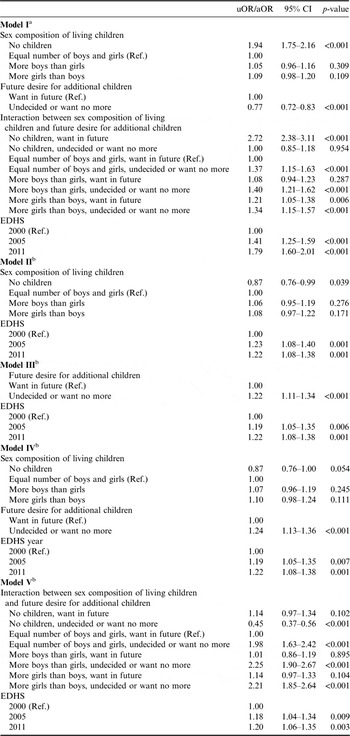
Bivariate and multivariate regression methods were utilized to carry out the overall analyses. The chi-squared test (for categorical variables) and t-test for independent samples (for continuous variables) were applied to test the association with predictor variables. To understand the odds of future use of contraceptives by sex composition of living children and desire for additional children, binary logistic regression models were estimated. Of the five models that were fitted, Model I demonstrated the association between the sex composition of living children and desire for additional children with ‘intention to use contraceptives in the future’, independent of any effect of the predictor variable. The Model II examined the variation in the intention to use contraceptives by sex composition of living children in the absence of a desire for additional children, while the Model III explained the opposite. Model IV captured intended contraceptive use by including sex composition of living children and future desire for additional children in the same regression model. Model V represented the difference in intention to use contraceptives by an interaction effect of sex composition of living children and desire for additional children.
The logistic regression model is considered appropriate for a binary outcome while performing repeated cross-sectional sampled data analysis (Hosmer & Lemeshow, Reference Hosmer and Lemeshow2000). The logistic function takes an input that might be any value from negative infinity to positive infinity, whereas the output is confined to values between 0 and 1. In this study, the binary response (y, intend to use contraceptive in future or not) for each woman was related to a set of categorical predictors, X, and a fixed effect by a logit link function:
 $${\rm logit}\left( {\pi _{i} } \right)\,\,{\equals}\,\,{\rm log}[\pi _{i} \,/\!1{\minus}\pi _{i} ]\,{\equals}\,\beta _{{0 }} {\plus}\beta \left( X \right){\plus}{\epsilon}$$
where π i is the probability that a woman intends to use contraceptives in the future. The parameter β 0 estimates the log odds of the outcome variable for the reference group, and the parameter β estimates, with maximum likelihood, the differential log odds of intention for future contraceptive use associated with the predictor X, compared with the reference group. The term ε represents the error term or residual in the model.
Because some of the selected predictor variables used in the regression models appeared to have multicollinearity issues a variance inflation factor (VIF) was estimated. All VIF values were much smaller than 5.0, suggesting that the possibility of high multicollinearity was low. In addition, the sensitivity of the predictor variables to the future intention of contraceptive use was verified by including or excluding sensitive variables, and all adjusted logistic regression models were deemed stable. To examine the effect of survey year on the intention to use contraceptives by the sex composition of living children and future desire for additional children, the data from all three rounds (2000, 2005 and 2011) were pooled, which accounted for variations due to merging the three rounds of data. The inclusion of sample size qualifies to run bivariate and multivariate analyses. Data analyses were performed using the ‘svy’ suite in Stata version 12 (StataCorp, 2011), which allows complex survey data analysis and adjusts sampling weights while estimating standard errors and confidence intervals. The variables found to be significant at p<0.05 in the binary logistic regression model are discussed.
Ethics statement
This study was based on the Demographic and Health Survey data of Ethiopia available in the public domain for researchers with all identifying information removed, therefore no ethical clearance was required.
Results
Sample characteristics
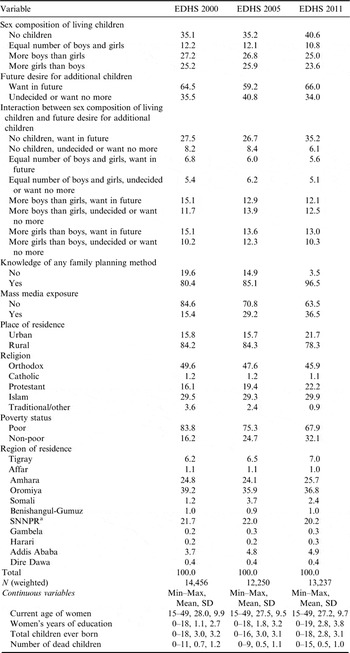
Table 1 shows the summary statistics of the selected sample. A near 6% increase in women with no children was estimated between 2000 (35%) and 2011 (41%). During the same period, there was a negligible decrease in the number of women with an equal number of boys and girls; while some women had more boys than girls, some had more girls than boys. In 2011, over 66% of the women expressed a desire to have additional children, an insignificant increase from 2000. An almost equal percentage (15%) of women with more boys than girls, and women with more girls than boys, reported a desire for additional children in 2000, and with a small decline, the difference between these two groups remaining almost negligible in 2011. Almost 97% of the non-users had knowledge of a family planning method. Over 78% of women were residing in rural areas, and 68% of non-users were estimated to be poor. The highest proportion of non-users lived in the Oromiya region of Ethiopia.
Socio-demographic characteristics of study sample, sex composition of living children and desire for additional children (percentage distribution), EDHS 2000, 2005 and 2011

a Southern Nations, Nationalities and People’s Region.
Sex composition of living children and intention to use contraceptives
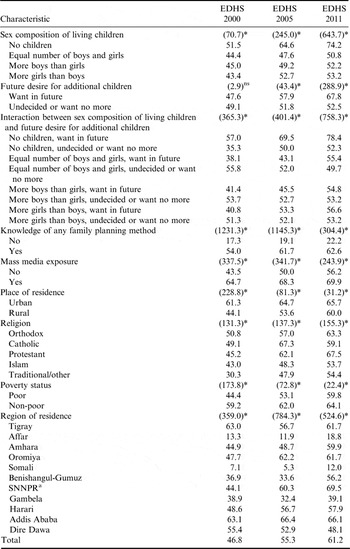
Table 2 shows the percentage of non-user women who intended to use contraceptives in the future by their background characteristics. An increase of nearly 14% of those with an intention to use contraceptives was estimated between 2000 (47%) and 2011 (61%). Between 2000 and 2011, a negligible difference (ranging from 2% to 3%) in the future intention to use contraceptives was recorded among women with more boys than girls, and women with more girls than boys. In 2000, the intention to use contraceptives was lower among non-users who wanted additional children compared with women who wanted no more children, or could not give a decisive answer, whereas the trend reversed in 2005 and 2011. Irrespective of the sex composition of living children (equal number of boys and girls, and more boys than girls), in 2000 and 2005 the percentage of women intending to use contraceptives in the future was lower among non-users who wanted additional children in the future compared with women who were unsure about their future desire for children, or were certain that they did not want to have any children. However, this trend was reversed in 2011.
Percentage of women intending to use contraceptives in the future by selected background characteristics, EDHS 2000, 2005 and 2011
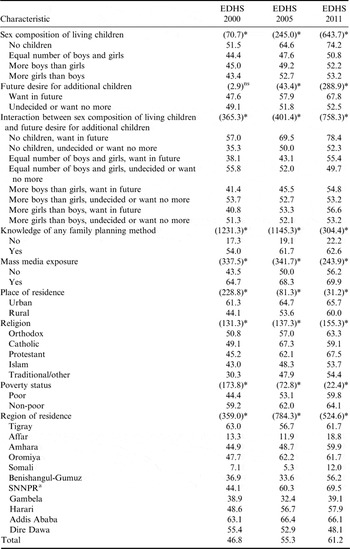
Note: The independent sample t-tests applied to the continuous variables (current age of women, women’s years of education, total children ever born and number of dead children) are not shown separately; t-test for equality of means for those variables were significantly different at p<0.01.
a Southern Nations, Nationalities, and People’s Region.
Figures in parentheses are the χ 2 values: *p<0.01; ns, not significant.
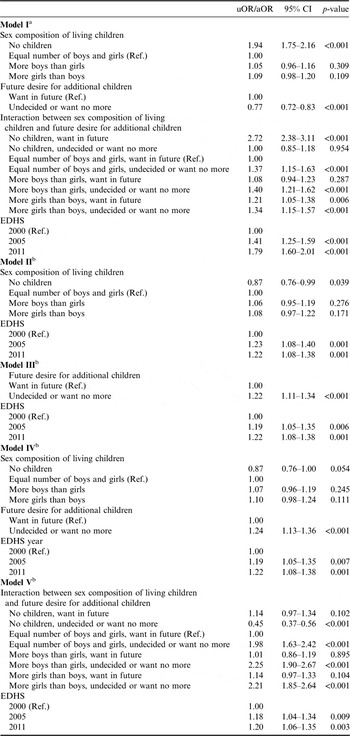
Table 3 shows the five binary logistic regression models, with unadjusted odds ratios (uOR: Model I) and adjusted odds ratios (aOR: Models II, III, IV and V) and 95% confidence intervals (CI). Irrespective of which of the five models (uOR or aOR) was fitted, during 2000–2011 there was a significant increase in future intention to use contraceptives. Model II shows that the odds of contraceptive use in the future were higher among women with an equal numbers of boys and girls, relative to women with no children (aOR: 0.87; CI: 0.76–0.99), whereas non-users who did not want children or were unsure about their future desire for children were more likely (aOR: 1.22; CI: 1.11–1.34) to consider using contraceptives in the future (Model III). In Model IV, where both the sex composition of living children and the desire for additional children were factored in, the direction of aOR remained the same as in Models I and II. Model V represents the aOR of the interaction of the sex composition of living children and future desire for additional children. Women with at least one child (equal number of boys and girls, more boys than girls, and more girls than boys) who did not want children, or who were unsure about their future desire, had a greater intention to use contraceptives in the future compared with women with an equal number of children and who wanted a child in the future. Women with no children and who did not want children, or were unclear about their future desire, had a lower intention to use contraceptives (aOR: 0.45; CI: 0.37–0.56) compared with women with an equal number of boys and girls and who wanted a child in the future.
Unadjusted (uORFootnote a ) and adjusted (aORFootnote b ) odds ratios with 95% confidence intervals (CI) estimated using logistic regression model showing future intention of contraceptive use by sex composition of living children and future desire for additional children, EDHS 2000, 2005 and 2011
a Unadjusted odds ratios.
b Adjusted odds ratios, adjusted for knowledge of family planning method, mass media exposure, place of residence, religion, poverty status, region of residence, current age of women, women’s years of education, total children ever born and number of dead children.
Ref.: reference category.
Discussion
This study used three consecutive rounds (2000, 2005 and 2011) of nationally representative DHS data from Ethiopia to assess if future intention to use contraceptives among non-users is associated with the sex composition of living children and women’s desire for additional children.
Irrespective of the sex composition of living children and desire for additional children, future intention to use contraceptives increased significantly between 2000 and 2011. Although the evidence is less convincing, the increase could be attributed to improved overall socioeconomic development and effective family planning programmes (Lapham & Mauldin, Reference Lapham and Mauldin1985; Mwaikambo et al., Reference Mwaikambo, Speizer, Schurmann, Morgan and Fikree2011; Olson & Piller, Reference Olson and Piller2013; May, Reference May2016). Despite the absence of a fundamental transformation in many socioeconomic indices, Ethiopia’s story of increased use of contraceptives could be linked to strong government commitment, strategic investment, effective public–private partnerships, well co-ordinated donor support and extensive outreach of services in rural areas through an ambitious Health Extension Programme (HEP), which was initiated in 2004 (UNFPA, 2012; Olson & Piller, Reference Olson and Piller2013; Halperin, Reference Halperin2014). The increase in acceptance of contraceptive use could be the result of improved socioeconomic measures, improvement in women’s education and the health education programme on family planning offered by Health Extension Workers (HEWs) in Ethiopia (UNICEF & Ethiopia Ministry of Health, 2010). This study indicates that almost 80% of non-users reside in rural areas, where the pace of socioeconomic development has been relatively slow; this contests the view that fertility can only fall in the context of sweeping educational and economic advancement (Kirk, Reference Kirk1996; Davis, Reference Davis1967). However, Bangladesh is an exception (Phillips et al., Reference Phillips, Simmons, Koenig and Chakraborty1988), as is Ethiopia (Halperin, Reference Halperin2014).
Fertility desire has a strong impact on the use of contraceptives, which could bring down the level of fertility of a country (Pritchett, Reference Pritchett1994). The current study’s findings indicate that non-users who wanted no more children, or who remained undecided, had a higher intention to use contraceptives in the future compared with women who wanted children in the future. An analysis (not shown) using EDHS data indicated that the mean numbers of surviving children of non-users who expressed a desire to have additional children were 1.6, 1.6 and 1.4 in 2000, 2005, and 2011, respectively, whereas the mean numbers of surviving children of non-users who did not want any children, or who remained undecided, were 3.5 (in 2000), 3.7 (in 2005) and 3.9 (in 2011). These statistics indicate that women who did not want any more children, or who remained undecided, had a relatively higher number of surviving children, and might have achieved their desired fertility, which could increase their intention to use contraceptive for limiting (Bhargava, Reference Bhargava2007). The group of women who have attained their desired fertility could include women with at least one child who did not want children or those who were unsure about their future desire. In accordance with previous studies, the reason behind the preference of non-users with high fertility to limit their children could be the increasingly high cost of raising children and the scarcity of arable land. Since there is less land available to divide between sons, women perceive that their educational and economic prospects would be curtailed by the need to care for a larger family (Kinfu, Reference Kinfu2000; Lindstrom & Woubalem, Reference Lindstrom and Woubalem2003; Sibanda et al., Reference Sibanda, Woubalem, Hogan and Lindstrom2003; Gurmu & Mace, Reference Gurmu and Mace2008; Alemayehu et al., Reference Alemayehu, Belachew and Tilahun2012). The results of this study also revealed that women with no children, those who did not want children or who remained undecided, had a lower intention to use contraceptives, compared with women with an equal numbers of boys and girls and who wanted a child in the future. The latter group of women is possibly indicating the use of spacing method in the future, and the first group of women might avoid using contraceptives (for spacing or limiting) as they might not be certain about their decision to not have children in the future.
One of the limitations of this study is that women’s reported intention to use contraceptives will not necessarily translate into contraception use. Respondents may agree to use contraceptives in the future once they are aware that it is a socially desirable practice (‘social desirability bias’). Also, when the opinion of the wife is taken into consideration but not that of the husband or partner, it distorts the assumption of compliance with future use of contraception.
In conclusion, coupled with a low rate of contraceptive use, Ethiopia has over 60% of non-users who intend to use contraceptives in the future. Therefore, creating demand is a major issue in the use of family planning methods in Ethiopia, while targeting women who do not intend to use any method in the future can be very challenging. At the national level, the federal government of Ethiopia has succeeded in increasing the uptake of contraceptives. This study proposes that interventions should focus on non-users who do not intend to use any contraceptive method in the future, as they are exposed to risk, and this affects the health and well-being of mothers, children and society at large.
One of the proven ways to increase the adoption of family planning methods in Ethiopia has been to provide counselling (Lopez et al., Reference Lopez, Tolley, Grimes and Chen-Mok2011; Ministry of Health, 2011; Dynes et al., Reference Dynes, Stephenson, Rubardt and Bartel2012). An innovative pilot study in Tigrayi Administrative Region showed that lay community volunteers can be trained successfully to provide injectable contraceptives to their neighbours, which could potentially free-up Health Extension Workers to offer more long-term methods, such as implants (Prata et al., Reference Prata, Gessessew, Cartwrigh and Fraser2011; Halperin, Reference Halperin2014). An empirical study conducted in the Jimma Zone of Ethiopia recommended better counselling for increased contraceptive use, including side-effects and switching (Tilahun et al., Reference Tilahun, Coene, Luchters, Kassahun, Leye, Temmerman and Degomme2013). The government of Ethiopia should consider adopting these interventions to improve contraceptive use in the country.
Acknowledgments
An earlier version of the paper was presented at the 2015 International Conference on Family Planning, Nusa Dua, Indonesia. The comments received from the participants are gratefully acknowledged. The author is indebted to the Demographic and Health Surveys Program (www.dhsprogram.com) for providing the data used in this study.