INTRODUCTION
Breeding patterns of dominant macrofaunal species are essential to understand their reproductive biology and community stability; which includes fecundity, breeding periods and larval dynamics (Emmerson, Reference Emmerson1994). In brachyurans, breeding patterns are a result of complex interactions between environmental factors and reproductive processes, allowing inter and intra-specific variations regarding the duration of the reproductive cycle (Sastry, Reference Sastry, Vernberg and Vernberg1983).
Fecundity is an important parameter that permits the estimation of the reproductive potential and future stock size of a given species or population (Hattori & Pinheiro, Reference Hattori and Pinheiro2001). Moreover, fecundity is directly related to life-history traits such as egg size, age at maturity, life span and reproductive effort (Llodra, Reference Llodra2002). Additionally, brood loss during egg development in crustaceans is a common feature which influences the real reproductive output, affects reproductive potential and eventually subsequent recruitment. It appears to be an inevitable consequence of brood exposure to a variable environment during incubation, which varies from a few weeks to several months depending on the ambient temperature (Wear, Reference Wear1974). Brood loss has been well documented for a wide range of crustacean taxa, ranging from terrestrial Isopoda, Amphipoda and Mysidacea, to commercially important marine decapods (reviewed by Kuris, Reference Kuris, Wenner and Kuris1991) and, in general, has been estimated by comparison of number of embryos between the earliest and latest egg stages (e.g. Morizur et al., Reference Morizur, Conan, Guénolé and Omnès1981; Kuris, Reference Kuris, Wenner and Kuris1991).
In mangrove forests, brachyuran crabs are one of the most important taxa with regard to number of species, density and total biomass (e.g. Hartnoll, Reference Hartnoll1975; Dahdouh-Guebas et al., Reference Dahdouh-Guebas, Giuggioli, Oluoch and Cannicci1999; Macia et al., Reference Macia, Quincardete and Paula2001). Crabs of the Ocypodidae family, such as fiddler crabs (Uca) are key components of Indo-Pacific mangroves (Lee, Reference Lee1998), usually occurring at very high densities (e.g. Hartnoll et al., Reference Hartnoll, Cannicci, Emmerson, Fratini, Macia, Mgaya, Porri, Ruwa, Shunnula, Skov and Vannini2002) in the intertidal zones of mud–sandy sediments. These deposit feeders construct burrows and rely on organic matter for food, (Ólafsson & Ndaro, Reference Ólafsson and Ndaro1997; Lee, Reference Lee1998) removing large amounts of sediment and changing substrate characteristics, altering both sediment topography (Warren & Underwood, Reference Warren and Underwood1986) and the composition of sediment microflora (Ólafsson & Ndaro, Reference Ólafsson and Ndaro1997). Therefore, fiddler crabs represent an important component in transferring energy to both marine and terrestrial habitats since they are consumed by a large number of fish, birds and invertebrates.
Fiddler crabs have been the subject of a wide variety of studies, including sexual selection (e.g. Christy, Reference Christy1987; Backwell et al., Reference Backwell, Jennions, Christy and Passmore1999), reproductive isolation (e.g. Salmon et al., Reference Salmon, Hyatt, McCarthy and Costlow1978; Salmon & Kettler, Reference Salmon and Kettler1987), combat (e.g. Crane, Reference Crane1967; Jennions & Backwell, Reference Jennions and Backwell1996), morphometrics (Rosenberg, Reference Rosenberg1997), circadian rhythms (e.g. Palmer, Reference Palmer1964; Barnwell, Reference Barnwell1966), osmoregulation (e.g. Vernberg & Tashian, Reference Vernberg and Tashian1959) and behaviour (e.g. Murai et al., Reference Murai, Goshima and Nakasone1983; Weis & Weis, Reference Weis and Weis2004). However, few studies have dealt with its reproductive biology namely in the east African region. Regarding its reproduction, Emmerson (Reference Emmerson1994, Reference Emmerson1999) addresses questions related with breeding season, sex ratio and fecundity and, more recently, Litulo (Reference Litulo2004, Reference Litulo2005) investigated reproduction and fecundity in some species at Costa do Sol mangrove (Maputo, Mozambique). The majority of other studies related to Uca species in this region deal with its behaviour (Jennions & Backwell, Reference Jennions and Backwell1998; Burford et al., Reference Burford, McGregor and Oliveira2001), larval dispersal (Paula et al., Reference Paula, Bartilotti, Dray, Macia and Queiroga2004), ecology and distribution (Macia et al., Reference Macia, Quincardete and Paula2001; Skov & Hartnoll, Reference Skov and Hartnoll2001; Skov et al., Reference Skov, Vannini, Shunnula, Hartnoll and Cannicii2002). Although this genus represents one of the most abundant taxonomic groups of the macrofauna of mangrove systems, little is known about fecundity, embryo production and brood loss among Uca species in that region. Furthermore, comparisons between populations may constitute an important strategy to verify differences among them, as well as to understand the environment and biological constraints that shape them (Fransozo et al., Reference Fransozo, Bertini and Correa1999; Oshiro, Reference Oshiro1999).
Six species of fiddler crabs occur in east Africa: Uca annulipes (H. Milne-Edwards, 1837), Uca chlorophthalmus (H. Milne-Edwards, 1837), Uca inversa (Hoffman, 1874), Uca vocans (Linnaeus, 1578), Uca urvillei (H. Milne-Edwards, 1852) and Uca tetragonon (Herbst, 1790). Although U. annulipes is the smallest of these species (Skov & Hartnoll, Reference Skov and Hartnoll2001), it is probably the most numerous.
In this paper we intend to study some aspects of the reproductive biology of four Uca species that inhabit east African mangroves, using the populations at Inhaca Island, Mozambique to test the hypothesis of different egg loss according to species behaviour and habitat. For that purpose, fecundity, brood loss and egg volume during the incubation period were analysed and evaluated, specifically in Uca annulipes, Uca chlorophthalmus, Uca inversa and Uca vocans.
MATERIALS AND METHODS
Study area
Inhaca (Figure 1) is a small island (42 km2) situated at 32 km off Maputo in southern Mozambique, east Africa (26°S 33°E). The east coast is exposed to the Indian Ocean, whereas the western and southern coasts face Maputo Bay. The island is positioned in a transitional region of tropical to warm subtropical conditions and constitutes a barrier between Maputo Bay and the Indian Ocean. The climate of Inhaca Island is characterized by hot, wet (September–March) and warm, dry (April–September) seasons (Bandeira, Reference Bandeira1995). Tides are predominantly semidiurnal with a range of 2 m at spring tide. A detailed description of the island's general ecology, fauna and flora is given in Kalk (Reference Kalk1995).
Inhaca Island (study area). (A) Saco mangrove; (B) Ponta Rasa mangrove.

Sampling took place on two relatively pristine mangroves, Saco and Ponta Rasa, located on the southern part of Inhaca Island. These mangroves have no freshwater supply apart from diffused groundwater flow and rainfall (Kalk, Reference Kalk1995).
Saco Bay (Figure 1A) covers an area of 15.4 km2 and is surrounded by diverse mangrove communities comprising five species. Avicennia marina (Forskål) is the most common species and fringes the bay, while Rhizophora mucronata Lamarck lines the mangrove channels and creeks. The interior areas can have extensive mangrove thickets made up of Ceriops tagal (Perr.) and Bruguiera gymnorrhiza Lamarck (De Boer, Reference De Boer2000). The fifth species—Lumnitzera racemosa Willd is the less common.
Ponta Rasa (Figure 1B) is a small mangrove occupying an area of approximately 0.2 km2 and is composed of four different areas in terms of fauna and flora, according to a zonation pattern caused by differential tidal flooding (Guerreiro et al., Reference Guerreiro, Freitas, Pereira, Paula and Macia1996). The lower area is densely covered by Rhizophora mucronata Lamarck while higher in the mangrove the vegetation is sparser, mainly composed of Ceriops tagal (Perr.) and Bruguiera gymnorrhiza Lamarck. The uppermost zone is a sandier area dominated by Avicennia marina (Forskål).
Sampling and laboratory procedure
Ovigerous female crabs were actively collected throughout February to March (wet season) of 2006, during day-time at low tide, in Saco and Ponta Rasa mangroves, by means of random surface search and following burrows with a shovel. The collecting sites were defined according to the distribution of species and mangrove characteristics. At Ponta Rasa, Uca annulipes and Uca inversa were collected in sandy areas in the upper parts of the mangrove near the Avicennia zone, while in Saco Bay were captured individuals of Uca vocans, in sandy substrate on the seaward fringe of the mangrove, and Uca chlorophthalmus in muddy areas in the centre of the mangrove in the Rhizophora zone.
After sampling, for each egg stage, 15 eggs from each of 5 randomly chosen females were selected and embryo volume (V) (mm3) was calculated using the formula for spheres V = 4/3(πR3).
Ovigerous females were preserved in buffered 4% formaldehyde diluted with seawater until examined at the laboratory. Morphometric measurements were determined with a caliper (±0.05 mm accuracy): carapace length (CL, distance from the notch between the rostral spines to the median posterior carapace margin) and carapace width (CW, distance between its widest points). The egg mass was carefully removed from the pleopods with forceps and staged according to Bauer (Reference Bauer1986): stage I, early embryos with no visible blastoderm; stage IV, embryos near to hatching, little or no yolk, large eyes, abdomen free from the cephalothorax. Although, four egg stages were identified, only the first and the last were used in this study since the goal was to evaluate the changes between two distinct and known stages, the first (fecundity—stage I) and the last (potential fertility—stage IV), avoiding the transitional and undefined stages. Bleach was used to separate the eggs that were placed in a single layer between two transparent sheets and then photographed under a digital camera (Nikon D50) at a distance of 38.1 cm using a 50 mm 2.8 Sygma lens. Egg counting was performed using Image J software, which automatically counts the egg particles on the photographs, with an estimated error inferior to 3%.
Statistical analysis
Comparison of morphometric relations (CW/CL) between females was examined using linear regression analysis (Sokal & Rohlf, Reference Sokal and Rohlf1995). A one-way ANOVA was used to compare average size (CW) between all species and to analyse data obtained for egg number and egg volume between all species in each stage. For each species, a Student's t-test was used to compare the sizes obtained from samples representing different egg development stages in order to validate any comparisons. The same statistical test was used to analyse data obtained for egg number and egg volume between the early (I) and late (IV) development stages of the incubation period, for each Uca species. When ANOVA assumptions, homogeneity of variances and normal distribution of residuals, were not met, the data were transformed (log or square root) and again tested. The equivalent non-parametric Kruskal–Wallis test was used when transformation failed to meet the ANOVA assumptions. Accordingly, Tukey or Dunn multi-comparisons tests were used if ANOVA or Krustal–Wallis, respectively, showed significant treatment effect. All results were considered statistically significant at P < 0.05 level.
For egg stage I (fecundity) and IV (potential fertility), the relationship between number of eggs and animal size (CW) was examined using linear regression analysis (Sokal & Rohlf, Reference Sokal and Rohlf1995), estimating and comparing the confidence limits of regression slopes for each species. Brood size, measured as number of embryos, approximates a volume measure (Bauer, Reference Bauer, Wenner and Kuris1991). In allometric analysis with log-transformed measures, where y is a volume and x is a linear measure, a slope of 3 indicates isometry, significantly <3 negative allometry, and significantly >3 positive allometry. All slopes were analysed and compared between stages and species for the same egg stages.
RESULTS
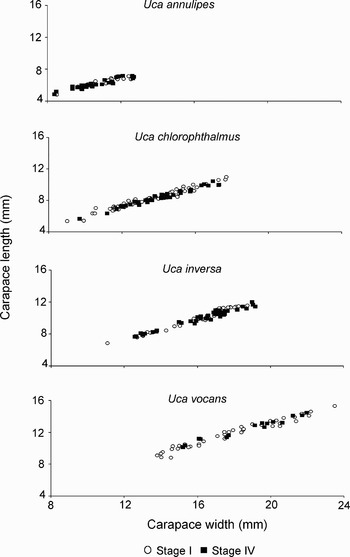
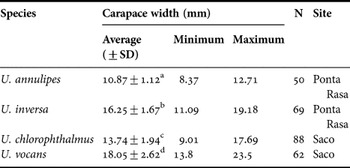
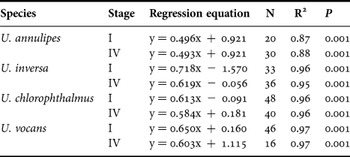
During the sampling period a total of 269 ovigerous fiddler crab females were captured (Table 1). While smaller individuals were significantly represented by U. annulipes, larger individuals were represented by U. vocans, corresponding to a significantly larger size (Table 1). Also, significant differences were not found between the population samples obtained in the different egg development stage for each species (P < 0.05), which allows reasonable comparisons between egg stages. Within each species, the slopes obtained for different egg stages did not show significant differences (Table 2; Figure 2) showing the strongly correlated morphometric relations (CW/CL).
Morphometric regressions (carapace length versus carapace width) for Uca species.

Average (±SD), maximum and minimum carapace length of total ovigerous females for each Uca species. Within columns, different superscript letters represent significant differences between species (P < 0.05).

Linear regression analysis for comparison of morphometric relations (CW/CL) between all four Uca species and stages I–IV; P, significance level of each regression for ß ≠ 0.

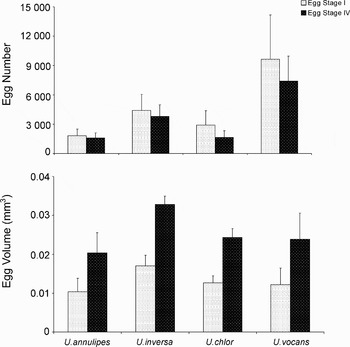
Fecundity ranged from 932 embryos (CW = 8.51 mm) in U. annulipes, to 18,057 embryos (CW = 23.5 mm) in U. vocans. The number of newly extruded embryos increased significantly with increasing female size with average fecundity ranging from 1822 eggs in U. annulipes to 9667 eggs in U. vocans (Figure 3; Table 1). The number of embryos decreased over the incubation period for each species, and significant differences were found between earlier and late embryonic stages (Figure 3) within each species. Brood loss from embryonic stage I to stage IV was approximately the same for U. annulipes and U. inversa, respectively 12.3% and 14%; U. vocans, the larger species, suffered an embryo decrease of 23.6%, while U. chlorophthalmus a significantly higher brood loss (43.2%).
Average number of embryos (±SD) and embryo volume (±SD) during embryonic development of all Uca species. Different letters over the bars represent significant differences for egg stage I, fecundity, while different numbers represent significant differences for late embryonic stage IV (P < 0.05). (U. chloro, Uca chlorophthalmus).

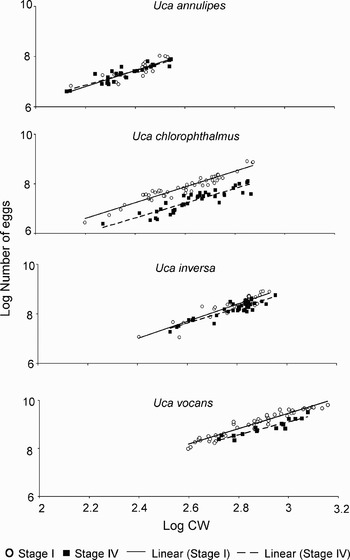
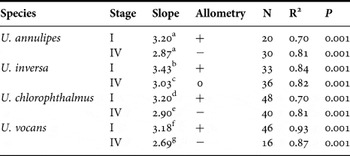
As expected, there is a linear relationship between log (embryo number) and log (CW) (Figure 4). Table 3 illustrates allometric analysis for each linear regression (P < 0.05). All species displayed a significantly positive allometric relation regarding stage I, showing that egg number increases with female size (CW). Only for U. annulipes the slope did not show significant differences between both stages. In the late development stage (IV), it was possible to observe a negative allometry in most species except for U. inversa. The average volume of embryos at the same stage differed among species (Figure 3) as well as between embryonic stages for all species. Embryo volume increased 96.1%, 93.3%, 92.9% and 96.3% in, respectively, U. annulipes, U. inversa, U. chlorophthalmus and U. vocans (P < 0.05).
Relationship between the log number of newly extruded eggs (fecundity) and number of eggs at stage IV (fertility) and log crab size (CW, carapace width) for each Uca species.

Summary of allometric regression for the four Uca species and stages I and IV. Within columns, different superscript letters represent significant differences between slopes (P < 0.05); P, significance level of each regression for ß ≠ 0.

DISCUSSION
Breeding patterns
Breeding periodicity can vary considerably, even between different hemispheres, according to factors such as latitude, temperature, larval food availability, and intertidal zonation (Sastry, Reference Sastry, Vernberg and Vernberg1983). Sastry (Reference Sastry, Vernberg and Vernberg1983) states a certain tendency toward extended reproductive seasons and continuous reproduction with decreasing latitude in benthic shallow-water crustaceans.
The majority of tropical species tend to breed continuously throughout the year or have prolonged breeding seasons compared to species at higher latitudes. However, according to Crane (Reference Crane1975), the various Uca species which occur in the Transkei (South Africa) region are also tropical in distribution and do not breed continuously. In fact, Emmerson (Reference Emmerson1994) established only two months (March–April) of a single breeding peak for U. annulipes in the same region. Thus, intertidal zonation and timing of larval release appear to be important factors that should be taken in consideration, since they determine larval access to food supplies and larval stage duration in the planktonic phase.
In this study we tried to sample the same species in the dry season (September/October), to compare with samples taken in the wet season, however it was very hard to find ovigerous females (personal observation). This suggests the existence of a seasonal breeding pattern in these subtropical crustaceans. However, Litulo (Reference Litulo2004, Reference Litulo2005) who studied this subject in some of these species in Mozambique (U. annulipes and U. inversa at Costa do Sol), determined a continuous reproduction in these fiddler crabs. Nevertheless, Litulo found that ovigerous females showed a higher frequency in the wet season and became scarce in the dry season, following temperature and rainfall patterns. This statement can explain our difficulty in capturing sufficient amount of ovigerous females to allow reasonable and confident comparisons among seasons. Furthermore, according to Mantelatto et al. (Reference Mantelatto, Faria and Garcia2003), spawning in the rainy season may provide a selective advantage to intertidal brachyuran populations, since periods of higher rainfall rate can cause changes in the salinity of water and promote an increase of nutrients concentration, favouring the development of planktonic larvae, and increase primary productivity of the seawater. It may also facilitate larval transport into deeper channels where larval predation is lower (Nobbs, Reference Nobbs2003).
Fecundity and brood loss
Fecundity in ocypodids varies greatly among species (Emmerson, Reference Emmerson1999). In the present study, fecundity for all species was similar to that described for other brachyuran species (Hines, Reference Hines1982) and fiddler crabs (e.g. Thurman, Reference Thurman1985; Rodriguez et al., Reference Rodriguez, Drake and Arias1997; Litulo Reference Litulo2004, Reference Litulo2005) with the expected increase as the female grows larger. The high determination coefficient obtained for regressions of stage I, for all species, suggests that carapace width is a good predictor of fecundity, explaining the majority of the variance (=70%). Although temperature, in terms of both level and rate of change (Pinheiro & Fransozo, Reference Pinheiro and Fransozo2002), photoperiod (Giese & Kanatani, Reference Giese, Kanatani, Giese, Pearse and Pearse1987) and food availability (quality and quantity) (Flores & Negreiros-Fransozo, Reference Flores and Negreiros-Fransozo1998) were identified as the main abiotic factors influencing the reproductive activity, variations in breeding intensity may also be associated with variations of salinity, intertidal zonation (Emmerson, Reference Emmerson1994), rainfall (Litulo, Reference Litulo2004), lunar periodicity (Emmerson, Reference Emmerson1994), chemical and biotic factors such as parasitism (Kuris, Reference Kuris, Wenner and Kuris1991).
Hines (Reference Hines1982) suggested that female body-cavity volume ultimately limits reproductive output in crabs due to constraints upon the space available for yolk accumulation in brachyuran crabs. Thus, according to Hines, 95% of the variance in brood weight, 79% of variance in the number of eggs per brood, 63% of the variance in annual brood weight and 74% of the variance in annual fecundity is explained by body weight. A comparison among all Uca species, in this study, shows that larger females produce a higher amount of eggs, as expected from the allometric relation. This is similar to that found in other brachyurans (e.g. Hines, Reference Hines1982; Mantelatto & Fransozo, Reference Mantelatto and Fransozo1997; Litulo, Reference Litulo2004, Reference Litulo2005). However, due to the higher relative brood loss in larger females, when comparing the number of embryos in the late developmental stage, a negative allometry is possible to observe in most species except U. inversa.
There are numerous reports of brood loss in crustaceans, whether dependent or not on parental size, such as egg loss at oviposition, aborted development, mechanical losses due to abrasion with the substratum, maternal cannibalism, embryo predation and parasitism (reviewed by Kuris, Reference Kuris, Wenner and Kuris1991).
Brood loss obtained for U. annulipes and U. inversa was similar and relatively low. These species inhabit burrows at depths of about 30 and 50 cm respectively, which provide good protection for the eggs. Burrow depth is one of the most prominent factors that influence breeding activity in fiddler crabs. According to Christy (Reference Christy1987), female fiddler crabs may prefer deeper burrows because they provide stable thermal environments that yield constant embryonic development rates and do not alter precise timing of larval release. Thus, they can accelerate embryonic development (Rabalais & Cameron, Reference Rabalais and Cameron1983; Christy & Salmon, Reference Christy and Salmon1984; Salmon, Reference Salmon1984; Rabalais, Reference Rabalais, Wenner and Kuris1991), reduce larvae and juvenile predation (Christy, Reference Christy1982; Reference Christy1989; O'Connor, Reference O'Connor1993; Moser & Macintosh, Reference Moser and Macintosh2001). The deeper burrow of U. inversa may explain the reduced brood loss considering its size and the isometric relation of stage IV.
The fiddler crab U. vocans is very active, feeding rapidly, walking and running, easily frightened and showing higher levels of intraspecific aggression (Weis & Weis, Reference Weis and Weis2004). This type of dynamic behaviour reported for this species might explain the higher brood loss when compared with U. annulipes and U. inversa, since they occur in a similar sandier substrate. Also, U. vocans inhabits a more unstable area, the lower intertidal zone of the mangrove, while U. annulipes and U. inversa occupy higher substrate. Furthermore, ovigerous females often abandon their burrows, as do males and non-ovigerous females, and form conspicuous droves along the water edge (Murai et al., Reference Murai, Goshima and Nakasone1983).
According to Weis & Weis (Reference Weis and Weis2004), U. chlorophthalmus frequently grooms (removes mud from appendages or carapace) itself just after emerging from its burrows since it is most commonly found on a muddier substrate, in the core of mangrove forests. While this behaviour occurs, to clean their legs the crabs flex and rub them together, which can explain the higher brood loss observed when compared to all other species. Additionally, Crane (Reference Crane1975) stated that in this species both males and females defend breeding burrows that show a great variation in construction and use, which can also support the results obtained.
Egg volume
Among decapods, variations in egg size are accompanied by changes in the stage of development at which the larvae hatch (Wear, Reference Wear1974; Pandian, Reference Pandian, Adiyodi and Adiyodi1994). The increase of volume, during the incubation period, is mainly a consequence of the increase in water content, either by water uptake to the embryo or retention of metabolic water resulting from respiration (Amsler & George, Reference Amsler and George1984). Wear (Reference Wear1974) reported volume increase during egg development, in 14 species of Brachyura, from 50–150%. In the present study, volume increases are within this range and did not show great variations between identical stages except for U. inversa. This species presented a significantly higher average volume in stage I and stage IV which can support the hypothesis already advanced of a rapid embryonic development cycle.
To better understand fiddler crab reproductive dynamics, future studies should focus on more species over a complete seasonal cycle in various different areas to establish the importance of some factors that influence breeding period. This study only addressed a comparison of brood size between species and egg stages. Future studies should also address the biochemical composition of the egg stages in different periods of the reproductive season, since similar embryo volumes recorded may be unrelated to their biochemical content, which is known to affect embryo, larvae and juvenile growth and survival, allowing a better understanding of species reproductive strategies.
ACKNOWLEDGEMENTS
The authors would like to thank Susana Ferreira and Estação Nhaca for help in the field, Ricardo Mendes and Valter Amaral for developing the automatic egg counting procedure, and Cátia Sá in laboratory analysis. We would also like to thank Fundação para a Ciência e a Tecnologia (Grant to GP-L SFRH/BD/25277/2005). This study is part of the research project TRANSMAP—Transboundary Networks of Marine Protected Areas in East Africa (INCO-CT2004-510862) funded by the European Comission, 6th Framework. The present study complies with the current laws of Mozambique, concerning experimental procedures.