Earthquakes are one of the most dangerous natural disasters that occur suddenly and uncontrollably.Reference Rostami-Moez, Rabiee-Yeganeh and Shokouhi1 Global natural disasters stated the lives of almost 95 000 people in 2023. With 133 million individuals affected overall, the number of people affected by disasters has increased 69% over the past 20 years, according to the World Disasters Report.2, 3 On February 6, 2023, 2 earthquakes of 7.8 Mw and 7.5 Mw magnitude occurred at a 9-hour interval, centred in the towns of Pazarcık and Elbistan in the province of Kahramanmaraş, Turkey. According to the Mercalli Intensity Scale, the earthquakes were measured as XII (catastrophic), the highest level of severity. The official figures in Turkey were that at least 50 783 people died and many more were injured as a result of the earthquake.4-Reference Öztürk Çopur and Karasu7
Many people were affected by these earthquakes, which were evaluated as the greatest disaster of the century.Reference Bektaş Akpınar and Aşkın Ceran8 Throughout the disaster period, nurses provide health care management and care with the aim of minimising life-threatening injuries and the threats to health that can develop in disaster situations.Reference Yönetmeliği9 The experience and education of nurses affect preparations for disasters, and increases their awareness, competence, and skills in disaster response.Reference Özcan10, Reference Özyer and Dinçer11
Nurses can also be effective in the decision-making and taking of precautions before the disaster to reduce damage such as the necessary structural reinforcements, education, and revision of city plans. In addition to all these, nurses have important duties in the “Hospital Disaster Plan,” which provides a standard framework for what must be undertaken in hospitals in the periods before, during, and after a disaster.Reference Şimşek and Gündüz12 However, nurses undertaking these roles require evidence-based knowledge on the subjects of evaluation, triage, and support methods. Moreover, to be able to perform rescue, care, education, counselling, and management requires them to be fully educated and prepared on the subject of disaster management.Reference Erkin, Aslan and Öztürk13, Reference Harmanci Seren and Dikeç6 In case the nurse is sent to the disaster area, she/he should have self-efficacy in disaster intervention in order to be capable of doing all these. Self-efficacy is thought to have a very important relationship in improving the preparedness of nurses to cope with disaster situations. Self-efficacy is the individual’s belief that he/she can do something in any situation. The nurse with high self-efficacy will adapt better to the conditions in a disaster and will have the ability to manage events better.Reference Yunanto, Setioputro and Haristiani14
Insufficient disaster preparation can lead to a series of negative consequences including an increase in psychological problems in healthcare providers, inappropriate responses to disasters, threats to the safety of healthcare providers, hospital overcrowding, and high death rates.Reference Rostami, Babajani-Vafsi and Ziapour15 In the hospitals that survived the earthquake in Turkey, nurses provided health care amongst the apocalyptic density of injured and corpses. Their families waited for them in cars and in the hospital gardens in the cold. Although they were earthquake victims themselves, the nurses felt responsible for their patients and continued to deliver service without leaving the earthquake zone until suffficient healthcare service had been provided to the region.Reference Öztürk Çopur and Karasu7, Reference Korkmaz, Erbaş and Azizoğlu16 Health care personnel who went voluntarily to the region worked to heal the injured. Nurses, doctors, and some hospital managers were organized to form volunteer healthcare teams.Reference Harmanci Seren and Dikeç6 It has been reported in literature that practice, education, and disaster experience, which are defined as research priorities in this field, are the factors contributing to preparedness for disaster management of nurses.Reference Şentürk, Büyükdavraz and Yıldırım Keskin17-Reference Tas and Cakir19 Previous experience of response to a disaster is a key factor in the perception of preparedness among nurses. However, there are very few nurses with experience of working in disaster zones and who are specialised in disaster response.Reference Korkmaz, Erbaş and Azizoğlu16 Studies of the experiences of nurses in Turkey after a diasaster are extremely limited in number.Reference Korkmaz, Erbaş and Azizoğlu16 Therefore, the aim of this study was to determine how the perceptions of disaster preparedness and levels of competence of disaster management were affected after the earthquake in nurses who experienced 2 major earthquakes.
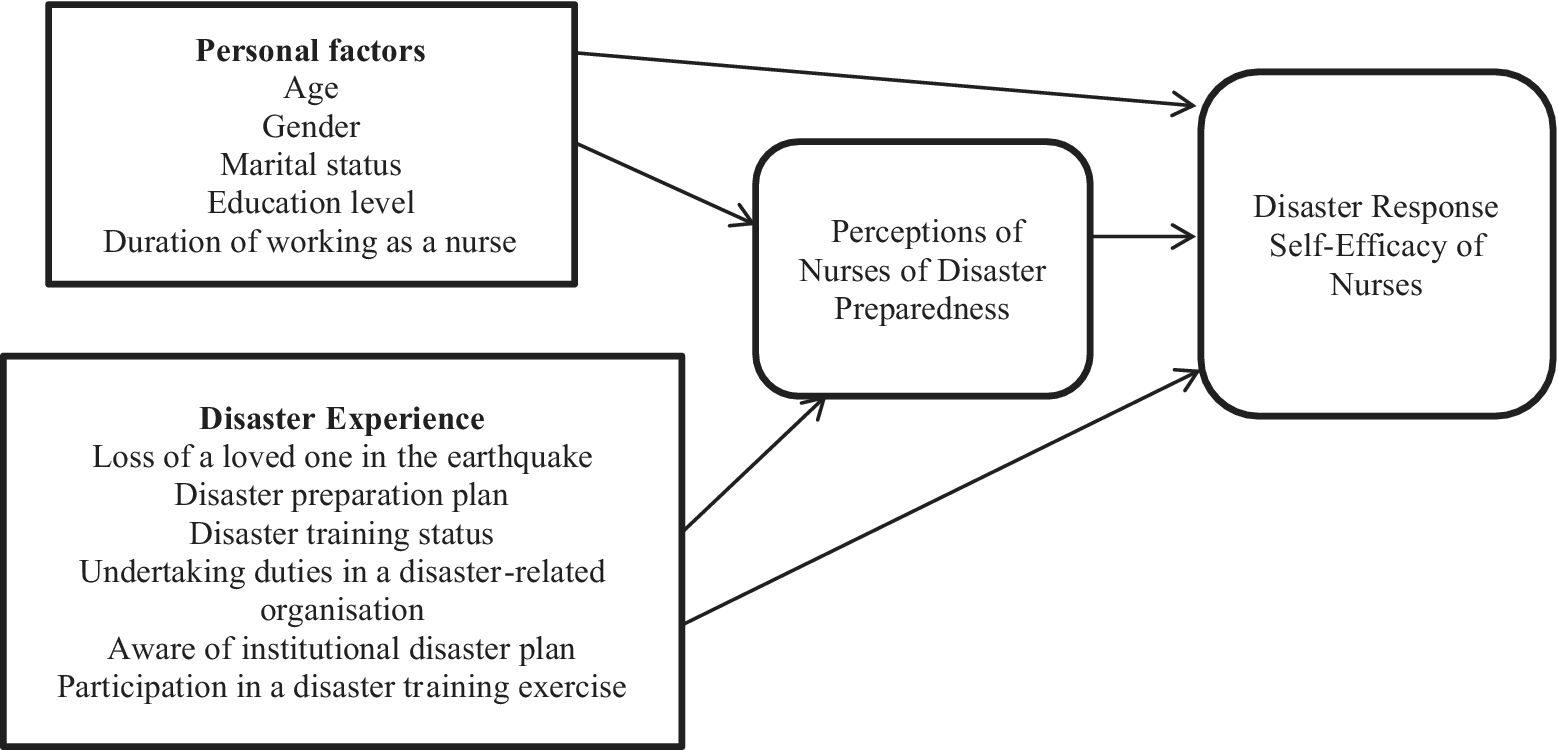
The study was planned to confirm the relationship between the perception of disaster preparedness and disaster response self-efficacy of nurses, and then through direct and indirect pathways, to investigate the affecting factors together with the results. Based on the available literature, a hypothetical model was formed (Figure 1). The hypotheses were as follows:
Hypothesis 1. Sociodemographic characteristics can directly and indirectly affect the perception of disaster preparedness of nurses.
Hypothesis 2. Disaster experience can directly and indirectly affect the perception of disaster preparedness of nurses.
Hypothesis model of the relationships between personal factors, sociodemographic characteristics, Disaster Experience, Perceptions of Nurses’ Disaster Preparedness, and Disaster Response Self-Efficacy of Nurses.

Methods
The Type of Research
This research was planned as a descriptive study to evaluate the perception of disaster preparedness and the disaster response self-efficacy of nurses.
Time and Place of the Research
The study was conducted between March 10 and May 10 2024 with nurses in a state hospital delivering health care services in the region that experienced earthquakes in February 2023. The hospital where the study was conducted was located in the province at the epicentre of the earthquakes. Many hospitals were damaged in the province where the earthquakes occurred. The hospital where the study was conducted was one of 2 hospitals that was able to provide health care services after the earthquake.
Study Universe and Sample
The population of the study consisted of 580 nurses. As a result of the power analysis performed using the status of having received disaster training and the mean and standard deviation values obtained from the preparedness grade sub-dimensions of the Perception of Nurses of Disaster Preparedness Scale (PNDPS) in the study by Özcan (2013), it was calculated that 330 study participants were required to provide effect size d = 0.3665644, α err prob = 0.05, and power (1-β err prob) = 0.90.Reference Özcan10 This study was completed with 344 nurses.
Random sampling method was used in this study. This method means that the researcher selects a part of the universe in any way according to the determined sample size.Reference Kılıç20
Data Collection Tools
The research data were collected using a Personal Information Form, the Perception of Nurses of Disaster Preparedness Scale (PNDPS), and the Disaster Response Self-Efficacy Scale (DRSES).
Personal Information Form
This form included questions to determine age, gender, education level, and status of having received disaster training of the nurses.
Perception of Nurses of Disaster Preparedness Scale (PNDPS)
The PNDPS consists of 20 items to measure the perception of disaster preparedness of nurses. The items are gathered under 3 headings of preparation stage (items 1-6), response stage (items 7-15), and post-disaster stage (items16-20). In the study by Özcan and Erol (2013), the Cronbach α values for the 3 stages were determined to be 0.87, 0.88, and 0.87, respectively.Reference Özcan10 In the current study, the Cronbach α values for the 3 stages were determined to be 0.90, 0.90, and 0.87, respectively.
Disaster Response Self-Efficacy Scale (DRSES)
The DRSES was developed by Hong-Yan Li et al. in 2017, then validity and reliability studies of the Turkish version of the scale were conducted by Koca et al. in 2018. In the validity and reliability studies of the Turkish version of the scale, the Cronbach alpha values were determined to be 0.96 for the scale overall.Reference Durmuş Sarıkahya and Yorulmaz21 In the current study, the Cronbach alpha values for the 3 subscales were calculated as 0.95, 0.92, and 0.92, respectively.
Data Collection
After receiving permission from the hospital management, the data collection tools were distributed to nurses who met the study inclusion criteria. Two or 3 wards were visited each week and the nurses were given information about the study and the data collection tools.
Study inclusion criteria
The study sample was formed of nurses aged ≥18 years who voluntarily agreed to participate in the study, had experienced the earthquakes on February 6, 2023, were providing health care services in the province during the earthquake, and completed all the items on the questionnaires used for data collection.
Study exclusion criteria
The study excluded individuals who experienced the February 6 earthquake, had psychological issues, and actively performed surgery in the field following the disaster.
Statistical Analysis
Data obtained in the study were analyzed statistically using IBM SPSS vn. 23 and IBM AMOS vn.24 software. Conformity of the data to normal distribution was assessed with the Shapiro-Wilks and Kolmogorov-Smirnov tests and the multiple normality assumption. In the comparisons of points with normal distribution in paired groups, the Independent Paired Samples t test was used, and for data not showing normal distribution, the Mann Whitney U-test was applied. The Kruskal Wallis test was used in the comparisons of data not showing normal distribution in 3 or more groups, and multiple comparisons were examined with the Dunn test. Relationships between scale points not showing normal distribution were examined with Spearman’s rho correlation coefficient. Pathway analysis was applied to test the model and the maximum probability method was preferred as the calculation method. In the evaluation of the goodness-of-fit of the measurement model, confirmatory factor analysis (CFA) was performed. A value of P < 0.05 was accepted as the level of statistical significance.
Ethical Approval
Approval for the study was granted by the Medical Research Ethics Committee of Kahramanmaraş Sütçü İmam University (decision no:06, session no:2024/04, dated: 12.02.2024). Written permission was obtained from the hospital chief physician. Verbal and written informed consent for participation in the study was provided by all the nurses. The study was conducted in accordance with the Declaration of Helsinki.
Results
The distribution of demographic data of nurses is shown in Table 1.
Distribution of demographic data of the nurses

The mean total points obtained from the scales by the nurses are shown in Table 2. The nurses obtained high points (≥3.40) in the subscales of the PNDPS, showing that the perception of disaster preparation of the nurses was high. The mean DRSES points of the nurses were determined to be high (71.22 ± 15.58) (Table 2).
Descriptive statistics of the Perception of Nurses of Disaster Preparedness Scale and Disaster Response Self-Efficacy Scale points

The results of the correlation analysis between the scales are shown in Table 3. A statistically significant positive correlation was determined between the mean points of all the subscales (P < 0.001).
Correlations between the scale points

r: Spearman’s rho correlation coefficient.
The scale points were compared according to the demographic characteristics (Table 4). The points at the response stage (P = 0.014), at the post-disaster stage (P = 0.022), and the total disaster response self-efficacy points (P = 0.046) were determined to be higher in the nurses aged ≥30 years than in the other age groups (P < 0.005).
Comparisons of the scale points according to demographic characteristics

*Mann-Whitney U test, **Kruskal Wallis test, ***Independent Paired Samples t-test. a-b: No difference between groups with the same letter, Mean± Standard deviation, Median (minimum–maximum)
Male nurses obtained higher points than female nurses at the preparation stage (P = 0.019), response stage (P < 0.001), post-disaster stage (P = 0.003), and in the self-rescue competency (P < 0.001) and the total disaster response self-efficacy points (P = 0.001).
The duration of working had an effect on disaster response, and the difference was determined to originate from nurses who had been working for 6-10 years (P = 0.017).
The mean points of nurses who had lost somebody close in the earthquake were determined to be higher than those of nurses who had not lost a loved one in respect of the post-disaster stage (P = 0.013), disaster psychological nursing competency (P = 0.032), disaster role quality and adaptation competency (P = 0.036), and disaster response self-efficacy (P = 0.017).
The points of nurses with a disaster preparation plan were determined to be higher than the points of those with no plan (P < 0.005) in respect of the response stage (P = 0.002), post-disaster stage (P = 0.003), on-site rescue competency (P < 0.001), disaster psychological nursing competency (P = 0.002), disaster role quality and adaptation competency (P = 0.004), and disaster response self-efficacy (P = 0.025).
The points of nurses who had received disaster training were determined to be higher than the points of those who had not received training (P < 0.05) in respect of disaster role quality and adaptation competency (P = 0.005), and disaster response self-efficacy (P = 0.022).
Nurses who had received both practical and theoretical disaster training were determined to obtain higher points than those of the other group (P < 0.005) in respect of disaster role quality and adaptation competency (P = 0.035).
Nurses who undertook duties in a disaster-related organization had higher points at the preparation stage (P = 0.040) and response stage (P = 0.013) compared to those without such duties (P < 0.005).
Nurses who knew of and had read the disaster plan of the instution where they worked had higher points than the other group (P < 0.005) in respect of the response stage (P = 0.037), on-site rescue competency (P = 0.001), disaster psychological nursing competency (P = 0.007), disaster role quality and adaptation competency (P = 0.006), and disaster response self-efficacy (P = 0.001). Nurses who had participated in disaster training exercises had higher points than those who had not (P < 0.005) in respect of the response stage (P = 0.028) and the post-disaster stage (P = 0.049).
The pathway analysis results are presented in Table 5. Gender was seen to have a statistically significant effect on the perception of the disaster preparation stage (P < 0.05). The perception of the disaster preparation stage was observed to be −0.116-fold lower in female nurses. The loss of a loved one in the earthquake was determined to have a statistically significant positive effect on the perception of the preparation stage (P < 0.05), with perception seen to be 0.106-fold greater compared to the other group. The level of education was seen to have a statistically significant effect on the perception of the disaster preparation stage (P < 0.05), with perception seen to be 0.152-fold greater in nurses with a postgraduate level of education. The presence of a disaster preparation plan was seen to have a statistically significant effect on the perception of the disaster preparation stage (P < 0.05). The perception of the preparation stage was seen to be 0.136-fold higher in those with a disaster preparation plan compared to those without. Age was determined to have a statistically significant negative effect on the post-disaster stage (P < 0.05), with the perception of nurses aged ≥31 years observed to be −0.236-fold lower. Gender was determined to have a statistically significant negative effect on the post-disaster stage (P < 0.05), with the perception of female nurses observed to be −0.163-fold lower.
Pathway analysis results

β1: Standardised beta coefficient. β2: Unstandardardised beta coefficient.
The presence of a disaster preparation plan was seen to have a statistically significant positive effect on the post- disaster stage (P < 0.05), with the perception of post-disaster stage observed to be 0.130-fold greater in those with a disaster preparation plan compared to those without. The loss of a loved one in the earthquake was determined to have a statistically significant positive effect on the perception of the post-disaster stage (P < 0.05), with perception seen to be 0.113-fold greater compared to the other group. Perception of the response stage was determined to have a statistically significant positive effect on disaster response self-efficacy (P < 0.05). An increase of 1 unit in perception of the response stage was seen to cause a 0.167 increase in disaster response self-efficacy. The post-disaster stage was determined to have a statistically significant positive effect on disaster response self-efficacy (P < 0.05). An increase of 1 unit in perception of the post-disaster stage was seen to cause a 0.529 increase in disaster response self-efficacy. The presence of a disaster preparation plan was determined to have a statistically significant positive effect on disaster response self-efficacy (P < 0.05). Disaster response self-efficacy was seen to be 0.083-fold greater in nurses with a disaster preparation plan compared to those without (Table 5).
The results of the examinations of indirect effects are shown in Table 6. Age and the post-disaster stage were seen to have effects on disaster response self-efficacy. In this context, the indirect effect of age on the post-disaster stage had a statistically significant effect on disaster response self-efficacy (-0.331, P = 0.002). The indirect effect of gender on the response stage had a statistically significant effect on disaster response self-efficacy (-1.134, P = 0.037). The indirect effect of gender on the post-disaster stage had a statistically significant effect on disaster response self-efficacy (-2.727, P = 0.005). The indirect effect of a disaster preparation plan on the post-disaster stage had a statistically significant effect on disaster response self-efficacy (2.203, P = 0.025). The indirect effect of a disaster preparation plan on the response stage had a statistically significant effect on disaster response self-efficacy (0.727, P = 0.045). The indirect effect of the loss of a loved one in a disaster on the post-disaster stage had a statistically significant effect on disaster response self-efficacy (1.984, P = 0.024) (Table 6).
Indirect effect results

The evaluation of the measurement model was performed by checking the goodness-of-fit values obtained as a result of CFA (16). The pathway analysis model goodness-of-fit values were calculated with CFA. The model goodness-of-fit values were determined to be CMIN/DF (322880/100) = 3.229, GFI = 0.915, IFI = 0.910, TLI = 0.823, CFI = 0.907, RMSEA = 0.081, and SRMR = 0.075.
Discussion
In a mass disaster situation, it is impossible to predict the number of patients who will initially present at hospital for treatment, and a rapid, co-ordinated operation is necessary to provide patient care at the most effective level.Reference Kulakoğlu, Uzunay and Pota22 Therefore, the aim of this study was to investigate how the perception of disaster preparedness and levels of disaster response self-efficacy were affected in nurses working in the earthquake zone.
The study results demonstrated that the PNDPS and DRSES mean subscale points were high (Table 2). In a study of nurses with no experience of earthquakes, Özcan (2013) reported that PNDPS perceptions of the nurses were at a moderate level at response and post-disaster stages, and perceptions of the preparation stage were very high.Reference Özcan10 In a study by Toraman Uysal and Konal Korkmaz, perceptions in the response and post-disaster stages were shown to increase because the nurses had experienced an earthquake.Reference Toraman Uysal and Konal Korkmaz23 Yılmaz et al. (2023) conducted a study after the Kahramanmaraş earthquake and stated that health care personnel were unprepared in the disaster in respect of knowledge and experience.Reference Yılmaz, Karakayali and Yilmaz24 In the current study, it was thought that the PNDPS and DRSES mean points increased together with the earthquake experience of the nurses.
The current study results showed that the response stage, post-disaster stage, and DRSES mean points of nurses aged ≤30 years were high (P < 0.05). Male nurses had significantly higher points than female nurses for preparation, response, and post-disaster stages, and on-site rescue competency and disaster response self-efficacy (P < 0.05). Nurses who had been working for 0-1 year and 6-10 years were determined to have higher response stage mean points than those with other durations of work (P>0.05)(Table 4).
When the indirect effect results were examined in the pathway analysis, it was determined that the effect of age on the post-disaster stage affected DRSES, and the effect of gender on the response and post-disaster stages also affected DRSES (P < 0.05) (Table 5). Aslantaş and Tabuk (2021) investigated the state of preparedness for disaster and the perception of preparedness of ambulance personnel in 112 provinces, and determined that there was no difference in the PNDPS stage mean points according to training and professional experience.Reference Aslantaş and Tabuk25 In a study by Emaliyawati et al. (2021), nurses with working experience of 6-10 years were shown to have a higher level of disaster preparedness.Reference Emaliyawati, Ibrahim and Trisyani26 Keskin and Alan (2023) evaluated nursing students and reported that gender had no effect on DRSES points.Reference Keskin and Alan27 The current study results may have been affected by the fact that men made great efforts to rescue family and friends from under the rubble and young nurses worked long hours to provide health care service until volunteers arrived in the earthquake region.
It was determined in this study that nurses who lost loved ones in this catastrophic earthquake had high post-disaster stage, disaster psychological nursing competency, and disaster response self-efficacy mean points, but the disaster role quality and adaptation competency mean points were low (P < 0.05). From a literature scan of studies conducted in Turkey, it was seen that most nurses did not see themselves as ready to respond to a disaster, and the training and skills to make interventions appropriate to the disaster were not at a sufficient level.Reference Taşkıran and Baykal28, Reference Tas, Cakir and Kadioglu18, Reference Tas and Cakir19 The study results of Adi Yunanto et al. (2023) showed a relationship between the preparedness of nurses and self-efficacy in coping with potential earthquake and tsunami disasters.Reference Yunanto, Setioputro and Haristiani14 The results of the current study are consistent with previous research which has explained that there is a significant relationship between self-efficacy and the perception of disaster preparedness of nurses. Good self-efficacy in nurses will create disaster preparedness at a high level. Moreover, it was seen that nurses who had lost a loved one in the disaster required support in respect of disaster role quality and adaptation competency. As nurses are both earthquake victims and working in the earthquake they have experienced, this causes role confusion and difficulties in disaster adaptation.
The nurses in the current study with a disaster preparation plan and who knew of the institutional disaster plan were seen to have higher response stage, on-site rescue competency, disaster psychological nursing competency, disaster role quality and adaptation competency, and disaster response self-efficacy mean points (P < 0.05). The mean points for response stage and post-disaster stage were determined to be significantly higher for nurses who had previously participated in a disaster training exercise (P < 0.05). Iytemur and Tekeli Yeşil (2020) reported that nurses in the first years of the profession were not informed about hospital disaster and emergency plans.Reference İytemur and Tekeli Yeşil29 Keskin and Alan (2023) determined that student nurses who received disaster training and knew of the school disaster plan had higher DRSES mean points.Reference Keskin and Alan27 It was reported by Aslantaş and Tabuk (2021) that health care workers who received disaster training, were active in a disaster, and participated in disaster drills had high perceptions of disaster preparedness.Reference Aslantaş and Tabuk25 In 2 systematic reviews, it was reported that nurses in countries at high risk of disaster had insufficient disaster knowledge and skills and nurses were unprepared on the subject of response in these types of situations.Reference Labrague and Hammad30, Reference Tas and Cakir19
In a study by Chegini et al. (2022), it was determined that the disaster nursing basic competency was at a higher level in nurses with experience of disaster, those at a young age, with experience of disaster response and less professional experience.Reference Chegini, Arab-Zozani and Kakemam31 Very few nurses have experience of working in a disaster zone and few are specialised on the subject of disaster response. It has been reported in the literature that nurses experience different problems in responding to an earthquake and in caring for earthquake victims. Some of these problems have been said to be difficulties in accessing medical materials, the problem of safety, and lack of training, and training on this subject has been shown to be effective in the areas of earthquake response and self-management.Reference Korkmaz, Erbaş and Azizoğlu16 The current study results suggest that the perceptions of disaster preparedness and disaster response self-efficacy of the nurses were high because of the earthquake they experienced.
When the model goodness-of-fit values were examined in literature, it was seen that a model with 81.83 Chi-square value and degree of freedom (df) of ≤5 has an accceptable goodness-of-fit value. An RMSEA value of < 0.08 is necessary for acceptable fit, and < 0.05 shows a good fit value. From the other goodness-of-fit values, >0.90 is acceptable for IFI, TLI, CFI, and GFI, while values >0.95 are accepted as an indicator of good goodness-of-fit. A value of < 0.5 for SRMR shows good fit and < 0.8 is accepted as an acceptable goodness-of-fit value.Reference Dölarslan32 In the current study, the pathway analysis model goodness-of-fit values were determined to be CMIN/DF (322.880/100) = 3.229, GFI = 0.915, IFI = 0.910, TLI = 0.823, CFI = 0.907, RMSEA = 0.081, and SRMR = 0.075. Thus, the study results showed excellent compatibility with the pathway analysis model established.
Limitations
The cross-sectional design of this study limited the full interpretation of causality. Nurses from only 1 hospital participated in this study, so the findings cannot be generalized to other earthquake regions. Moreover, as the scales used for data collection were self-reported, the responses of the nurses may have been biased.
Conclusion
The results of this study demonstrated that the disaster preparedness perceptions and levels of disaster response self-efficacy of nurses working in the earthquake zone were high. It was also seen that age, gender, and duration of work had an effect on the disaster preparedness perceptions and disaster response self-efficacy points. Nurses who lost a loved one in the earthquake were determined to have low post-disaster role quality and adaptation competency mean points. The nurses who had received disaster training, had participated in disaster drills, and who were members of a disaster-related organization were found to have a higher perception of disaster preparedness and disaster response self-efficacy. Therefore, policy-makers and hospital managers should establish training programs to develop the knowledge and basic competencies of nurses. Nursing managers should support the development of all nurses on the subject of disaster preparation. This support can be in the form of organizing training sessions of routine disaster scenarios and formal disaster preparation training. Nursing job descriptions in nursing laws and regulations should also be updated.
Data availability
The authors are unable or have chosen not to specify which data were used.
Author contribution
Dilek Soylu: Supervision, Software, Data curation, Resources, Methodology, Data curation, Conceptualization, Visualization, Writing– original draft, Writing– review & editing. Ayşe Soylu: Writing– review & editing, Supervision, Conceptualization, Data curation, Methodology, Resources, Software. Ahmet Seven: Writing– review & editing, Writing– original draft, Visualization, Supervision, Software, Resources, Methodology, Data curation, Conceptualization.
Acknowledgments
The authors would like to thank all the nurses who participated in the study.
Funding statement
No funding was received for this study from any source.
Competing interest
The authors declare no financial interests/personal relationships that could be considered potential competing interests.
Ethical standard
This research was approved by the Medical Research Ethics Committee of Kahramanmaraş Sütçü Imam University (Date: 12.02.2024 decision no: 06, registration no: 2024/04). All research personnel completed the necessary steps to ethically conduct research with human participants.