The study of electoral uncertainty is one of the mainstays of the literature on voting behaviour. Early research on this topic pointed to high levels of voter loyalty: in the United States, the path-breaking Michigan and Columbia studiesFootnote 1 uncovered considerable stability in individuals’ voting preferences, with Campbell et al.Footnote 2 arguing that ‘[O]nly an event of extraordinary intensity can arouse any significant part of the electorate to the point that its established political loyalties are shaken’. Similarly, the ‘frozen’Footnote 3 party-system scenario of Western Europe in the late 1960s was driven by the capacity of parties to structure political competition along stable societal cleavages and to thus align themselves with clearly defined segments of their electorates.
However, over the last three decades, increased levels of electoral uncertainty have been observed in multiple studies, covering established democracies around the world. Indeed, Putnam et al. note that ‘seldom does such a diverse group of nations reveal so consistent a trend’.Footnote 4 The most closely studied gauge of electoral uncertainty is the declining number of self-reported partisan identifiers in various national-level surveys.Footnote 5 Other indicators include growth in levels of aggregate electoral volatility;Footnote 6 growth in the proportion of individuals that indicates that they are highly likely to vote for more than one party when surveyed,Footnote 7 or that (given the opportunity) engages in ‘split-ticket voting’;Footnote 8 an erosion of party membership numbers;Footnote 9 increases in the number of electoral late deciders;Footnote 10 and decreases in the predictive power of socio-economic characteristics and ideological self-placement for individual-level models of vote choice.Footnote 11
The media environment has consistently featured among the possible causes of growing levels of electoral uncertainty. For instance, DaltonFootnote 12 argues that the growth in the availability of news from independent broadcast media, along with an array of societal changes, provides modern voters with both more politically diverse information and a greater cognitive capacity to process this information than their forbearers enjoyed. Similarly, Kroh et al.Footnote 13 find that TV news consumption, in concert with several other individual- and national-level factors, plays a significant part in determining individuals’ levels of political uncertainty.
However, extant research focuses exclusively on the effects of the ‘traditional’ or ‘mass’ media that are characteristic of the ‘modern’ political communications environment: newspapers, radio and television.Footnote 14 Although many commentators have speculated on the potentially transformative impact of the internet on the conduct of politics in contemporary democracies – adopting both optimisticFootnote 15 and pessimisticFootnote 16 perspectives – the effects of the internet on voter uncertainty have not been systematically studied to date.
Because the hyperlinking of news content on the internet allows readers to access multiple sources and easily jump from one website to another, use of the internet as a news source both enlarges the overall volume of available political information and increases the diversity of sources from which citizens can gather such information. These features of the online news environment have potentially profound impacts for voters’ levels of political uncertainty. The research presented here brings novel empirical evidence to bear on two specific questions: does using the internet as a source of political information influence voters’ electoral uncertainty? And if so, what is the overall direction of that influence?
We investigate these questions using data from the 2011 Irish general election, one of Europe's most volatile post-war elections. Along with a politically uncertain electorate, Ireland also has variable geographical distribution of broadband coverage – a quirk of Irish life that is vital to our research design. The difficulty of arguing that the internet (or any media for that matter) exerts an independent ‘effect’ on its users is that the choice to go online is itself driven by an array of social, economic and political factorsFootnote 17 that can also explain voter uncertainty. This fact of life creates the epistemological problem of causal endogeneity in assessing the internet's effects on its users. However, media choice is also driven by technological availability: if a media source is unavailable to an individual, then she/he cannot select it as a news source. Ireland's quasi-random variation in broadband availability allows us to tackle what MondakFootnote 18 refers to as a fundamental barrier to demonstrating media effects:
‘If media truly are a nearly all-pervasive force, then we are left with a variable that does not vary. Largely for precisely this reason, researchers have struggled to demonstrate the existence of media effects on political behaviour. Methodological leverage on a question evaporates when there exists no contrast group, no persons who are not exposed to the variable of interest’.
Variation in levels of broadband penetration in Ireland provides such a contrast or control group, comprised of citizens who are not exposed to the variable of interest (high-speed internet). We exploit this fact to develop an availability-based natural experiment employing an instrumental variables modelling approach that allows us to treat online newsgathering as an independent variable and political uncertainty as a dependent variable in our analysis. A number of recent studies have highlighted the causal effect of media environment on vote choice and turnout; several use similar methodological innovations to those developed in this article.Footnote 19
The takeaway message of our study is that browsing the internet for political news during the 2011 Irish general election campaign led to higher levels of political uncertainty among voters. Our results hold for two operationalizations of voter uncertainty and for several different model specifications, and stand up to a wide range of robustness checks.
In the next section, we provide some context on the Irish case, before outlining our theoretical expectations and empirical hypotheses regarding the relationship between online newsgathering and electoral uncertainty. A review of the extant research and debate on the effects of online newsgathering leads us to conclude that there are competing lines of argumentation and divergent expectations regarding the effects of the internet on electoral uncertainty, and we therefore adopt an agnostic approach to formulating our research hypotheses. Subsequently, we describe the data and methodology used to test these hypotheses, before presenting the results of our analysis – as well as a series of tests confirming the robustness of our core findings. We conclude with a discussion of the implications of our findings and their generalizability beyond the Irish context.
THE 2011 IRISH ELECTION
The data gathered for this study pertain to the 2011 Irish election. Our reasons for selecting the Irish case were twofold. First, we were able to use data combining information on broadband availability with responses to a national election study. This combined dataset facilitates the causal modelling of internet effects (as detailed in the Research Design section). Our second reason for focusing on the Irish case is that the topic of electoral uncertainty is substantively important in the contemporary Irish context: the 2011 Irish election was by far the most volatile in Irish history, and one of the most volatile in West European history.Footnote 20
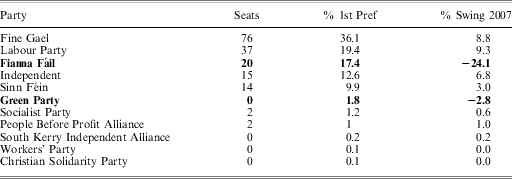
During the build-up to the election, the Irish government encountered an unprecedented conflagration of banking, fiscal and employment crises, which culminated in an Irish ‘bailout’ agreement, and the imposition of strict funding conditionality by the European Union (EU), the European Central Bank and the International Monetary Fund. The government parties (Fianna Fáil and the Green Party) were both heavily punished by the Irish electorate and, as the results in Table 1 show, all of the opposition parties, as well as several Independents, benefitted from newly available electoral support, with Fine Gael and Labour making the greatest gains.
2011 Irish General Election Results

Note: incumbent government parties in bold.
However, long before the results that led 2011 to be described as Ireland's ‘earthquake election’,Footnote 21 Marsh had made the argument that ‘a majority of (Irish) voters appear to be open to persuasion according to the balance of short-term forces’,Footnote 22 and one comparative studyFootnote 23 ranked Ireland's population among the most politically uncertain of the fifteen pre-2004 EU member states. When we apply that study's binary measure of potential vote switchingFootnote 24 to previous waves of the Irish National Election Studies (INES), we find that likely switchers in the Irish population remained stable at the comparatively high level of 50 per cent across the three election years of the INES (2002, 2007, 2011). Thus despite a series of relatively stable electoral outcomes in past decades, the Irish electorate has exhibited a substantial latent potential for electoral change for quite some time, and it appears that the circumstances of the 2011 campaign activated this potential.
The Irish party system is characterized by a number of idiosyncratic traits, most notably the ideological similarity of the two historically dominant parties (Fianna Fáil and Fine Gael)Footnote 25 and the comparative electoral weakness of the Irish Labour Party,Footnote 26 as well as the absence of a radical right party.Footnote 27 As we discuss in our conclusions, such national-level contextual factors may condition the effects of the internet on levels of political uncertainty; the lack of ideological and partisan polarization in the Irish party system and electorate may militate against the partisan filtering of news that underlies theoretical accounts that link the use of the internet to a decline in electoral uncertainty.
Finally, and importantly for the research presented here, the 2011 election campaign was marked by a substantial increase in internet use by Irish candidates, parties, media and voters, relative to the previous election in 2007,Footnote 28 meaning that the internet was a politically relevant medium.
THE INTERNET AND POLITICAL UNCERTAINTY: THEORY AND HYPOTHESES
Although, as described in our introduction, a marked increase in electoral uncertainty has been noted in recent decades in established democracies around the world, relatively little is currently known about the factors that either foster or inhibit political uncertainty at the individual level.Footnote 29 Some of the classic US voting behaviour literature does touch on this subject, concluding that uncertain voters are comparatively uninformed about politics.Footnote 30 ZallerFootnote 31 refines this position, arguing that individuals with moderate levels of political information and knowledge are in fact the most open to influence. From a European perspective, however, both DaudtFootnote 32 and van der Eijk and NiemöllerFootnote 33 find little evidence to support the hypothesis that ‘floating’ or ‘swing’ voters are any more (or less) politically informed than loyal partisans in the Dutch population. Indeed, Kroh et al.'s individual-level analysisFootnote 34 suggests that political attentiveness may in fact be negatively related to uncertainty, though this finding is not consistent across all models.
The cognitive mobilization hypothesis first proposed by DaltonFootnote 35 theorized that the availability of more abundant political information (along with an increased capacity to process such information among the electorate) would erode the importance of partisan ‘rules of thumb’ to voters. However, the direction of the relationship between increased levels of political information and electoral uncertainty remains unclear. While the cognitive mobilization hypothesis has received some confirmatory support,Footnote 36 AlbrightFootnote 37 presents evidence indicating that increased cognitive mobilization leads to higher levels of partisan attachment. More recently, DaltonFootnote 38 has developed a theoretical framework that incorporates causal flows in both positive and negative directions between cognitive mobilization and partisan attachment.
Clearly then, information is an important (if somewhat unpredictable) determinant of electoral uncertainty. However, the communication of information requires a medium, and each type of medium has its own distinctive technological advantages and limitations, which dictate the type of information that is imparted. To borrow McLuhan's evocative phraseology, the medium is the message.Footnote 39
A substantial body of empirical literature demonstrates that traditional media use and voting behaviour are related, and that exposure to television news, radio and newspapers has significant effects on key electoral behaviours and perceptions such as turnout,Footnote 40 efficacyFootnote 41 and vote choice.Footnote 42 Both DaltonFootnote 43 and Kroh et al.Footnote 44 point to a link between traditional ‘mass’ media and electoral uncertainty, while other studies have established a causal relationship between public opinion on a range of topics and exposure to traditional media.Footnote 45 However, although it is widely acknowledged that the advent of the internet (and particularly its contemporary ‘Web 2.0’ incarnation),Footnote 46 has dramatically altered the modern voter's media environment, the consequences of online newsgathering for voting behaviour remain empirically under-examined.Footnote 47
Experimental investigations and analyses of online user-generated contentFootnote 48 have attempted to disentangle how political experiences take shape online and how individuals react to dissonant opinions they encounter on the internet. However, convincing analysis of the effects of online experiences on electoral behaviour based on observational data is still very scarce. Research seeking to link online newsgathering to electoral behaviour has instead focused on the internet's effects on political participation.Footnote 49 While Gibson and McAllister's studyFootnote 50 of the Australian 2004 general election concludes that ‘online election news seekers are more independently minded than other voters’, this finding is based on cross-sectional analysis. Such analyses cannot address the issue of causal endogeneity in examining the effects of online newsgathering that we outlined in our introduction.
Therefore, the research presented here contributes to the literature by connecting online newsgathering with observational data on political uncertainty, using a research design that addresses the issue of causal endogeneity in assessing media effects.
Two schools of thought have characterized the broader debate on the internet's effect on voters, and we use the arguments and research proposed by each to develop two alternative empirical hypotheses to guide our study.
The first school of thought on the internet and its political effects comprises several scholarsFootnote 51 who have argued that the internet is a medium that facilitates selective exposure to content, leading users to reinforce their pre-existing beliefs. They contend that the pull-in nature of the internet leads individuals to explore the web by searching among information sources and loci that are in line with their prior preferences. Rather than an open market square, this view depicts the internet as a collection of private members’ clubs, in which the likelihood of bumping into outsiders is practically nil. Furthermore, PariserFootnote 52 alleges that the internet's extensive reliance on targeted advertising and automated personalization software creates ‘filter bubbles’, in which users are exposed primarily to content that reflects their prior choices and dispositions without necessarily realizing that this is the case. In terms of empirical analysis, Nie et al.Footnote 53 find that consumers of online news tend to hold more extreme political views than non-consumers, in line with their preferences for (either left- or right-of-centre) cable television news. They attribute this finding to a combination of the selective filtering described above and the representation of more extreme political opinions on the internet than are available in offline media (due to the dramatically lowered costs of production for online news).
Generally, this view would lead us to expect that internet exposure/use does not entail encountering information that may challenge voters’ prior political preferences. Empirically, we test this contention by specifying the following hypothesis:
Hypothesis 1: Internet use for newsgathering during a political campaign is associated with lower levels of political uncertainty among voters, ceteris paribus.
A number of studiesFootnote 54 indicate that internet use can challenge traditional social boundaries by exposing users to alternative opinions, views and sources. This contrasting approach focuses on an alternative defining characteristic of the internet – its hypertextuality – which may drive users to unanticipated loci, producing an unintentional or ‘by-product’ learning effect and exposing users to content they would not have encountered otherwise.Footnote 55
Tweksbury and RittenburgFootnote 56 characterize the findings of several empirical studies on news selectivity as indicating that, for internet news consumers, ‘selectivity occurs through a mixture of purposeful evaluation of sites and topics and healthy doses of habit and chance’. For instance, Garret et al.Footnote 57 found that Americans’ use of attitude-consistent online sources positively correlates with consumption of attitudinally challenging sources, and GarretFootnote 58 found that individuals spend longer read times on attitude-discrepant online items, suggesting that internet users gather awareness of dissonant positions. Gentzkow and Shapiro indicate that web users frequently browse sites that feature content that runs contrary to their ideological leanings, leading them to conclude that ‘the internet is far from segregated’.Footnote 59 Finally, Valentino et al., by means of a lab experiment, demonstrate that it is not uncommon for citizens to seek out information that challenges their attitudes and opinions while online.Footnote 60
These considerations would lead us to anticipate that voters are exposed to attitude-challenging information on the internet. This logic leads us to specify an alternative hypothesis:
Hypothesis 2: Internet use for newsgathering during a political campaign is associated with higher levels of political uncertainty among voters, ceteris paribus.
We test these two mutually exclusive hypotheses by assessing whether using the internet as a news source affects voters’ level of electoral uncertainty. Moreover, we are able to assess whether the role of the popular microblogging platform Twitter triggers similar effects on voters’ uncertainty. Due to the multifaceted nature of the internet as a medium, we are unable to map the specific sites visited and the content encountered by our respondents. However, participants were asked about whether they had used Twitter.com in the run-up to the election. The inclusion of Twitter.com in our analysis is particularly important because it sheds some light on whether social networking sites significantly differ from other websites in their effects on voters.
RESEARCH DESIGN
In this research, as in many other studies of individuals, organizations and societies, we confront a fundamental problem of causal inference: the impossibility of observing the counterfactual – that is, the outcome for the same unit in the absence of the treatment.Footnote 61 The ideal scenario from a methodological standpoint would be a random assignment of the possibility of browsing the internet for political news to individuals. Given random assignment, we could simply compare the treatment and control groups.Footnote 62 The difference between the average levels of electoral uncertainty for the treated group and the control group would constitute the causal effect of internet newsgathering, since both groups would be comparable with respect to observed and unobserved confounding factors. However, this ideal scenario is not feasible with observational data drawn from a representative sample of society at a given point in time. Simply put, browsing for political news online is not randomly assigned to individuals.
One approach to addressing this issue is to control for characteristics that are likely to affect both the probability of going online and political uncertainty. For instance, we could use multivariate regressions or matching techniques that employ a set of control variables. However, this would not help us with the problem of selection on unobserved factors that are correlated with the treatment and the outcome variable. This selection effect would induce correlation between the dependent variable and the error term, which undermines causal inference.
In this context, instrumental variables can be an effective identification strategy. We exploit the fact that broadband coverage varies according to location within the Republic of Ireland during the period under investigation. By instrumenting patterns of internet newsgathering (our treatment) on the basis of broadband coverage (our instrument), we can estimate a treatment effect by finding a control group that is similar enough to the treatment group in all the covariates, except that it does not enjoy broadband coverage. In this way, our methodological approach facilitates the identification of our treatment's effect on the dependent variable. Moreover, we include in both stages of our models a number of elements that previous studies have found to be related to voter uncertainty in order to further mitigate the issue of endogeneity.
Data
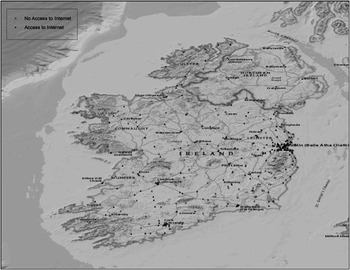
We use data from the INES 2011, the third national election study conducted in the Republic of Ireland.Footnote 63 In order to perform our analysis, we created a new individual-level variable for the INES 2011 dataset, Broadband Coverage, which accounts for the availability of broadband to each respondent. First, we encoded the location (latitude and longitude) of all respondents, and we then performed a search for broadband coverage in each respondent's geographical location.Footnote 64 The 1,854 respondents to the INES 2011 lived in 309 different geographical locations (that is, an average of six respondents per location in the survey). For those locations where all sources indicated no broadband coverage, we also performed a final check by searching for the keywords ‘location + broadband’ on google.ie.Footnote 65 Figure 1 maps the geographical distribution of the Broadband Coverage variable in the Republic of Ireland. Stars indicate locations where respondents did not have broadband coverage, whereas black triangles represent the locations of respondents who lived in areas with broadband availability.
Geographical distribution of broadband coverage

Dependent Variables
The dependent variable in this study is the level of electoral uncertainty of an individual voter. As this study takes place in a multiparty system, the operationalization of electoral uncertainty is complex, and in this section we outline the rationale behind our two measures of electoral uncertainty. We impute two metrics from our data: the first of these, Potential for Switching, is designed to capture an individual's potential for vote switching between his or her two most-preferred parties. The second metric, Openness, employs data from voters’ evaluations of all of the major parties competing in a given election. Both measures rely on a widely used survey instrument that captures voters’ orientations toward parties via a battery of items on their ‘propensity to vote’ (PTV) for each party. The PTV question from the 2011 INES reads:
How probable is it that you will ever give your first preference vote to the following parties? Please use the numbers on this scale to indicate your views, where ‘0’ means ‘NOT AT ALL PROBABLE’ and ‘10’ means ‘VERY PROBABLE’.
Our Potential for Switching measure of electoral uncertainty was originally developed by Kroh et al.Footnote 66 This measure is obtained by computing the difference between each respondent's two most-preferred parties. This figure is then multiplied by −1. The variable thus ranges from −10 to 0, where −10 indicates a high degree of certainty that respondents will vote for their most-preferred party and 0 indicates that they are equally likely to vote for at least two parties.
We complement Potential for Switching with a second dependent variable operationalization: Openness. The Openness index is an adaptation of the Herfindahl-Hirschman (hereafter HH) index. The HH index (and inverse and/or normalized versions of the index) has been used extensively in previous political science analyses. For instance, the index has been adapted to measure the extent of societal fragmentation of statesFootnote 67 and to calculate the well-known ‘effective number of parties’ measure of vote and seat fragmentation.Footnote 68 We compute Openness using a normalized version of the HH index as follows:
 $$HH\ast\, = \,{\rm{1 - }}\mathop{\sum}\limits_{i\,{\rm{ = }}\,{\rm{1}}}^{{\rm{10}}} {{{{({{x}_i})}}^{\rm{2}}} } $$
where (xi ) is the PTV of each party, divided by the total of all the probabilities filled in by respondents. In order to make our discussion of the Openness index more intuitive, we reverse the HH metric score, so that high values correspond to higher levels of electoral uncertainty. This variable ranges from 0 and 1. For instance, a respondent who gives a PTV of 10 to party X and a PTV of 0 to all the remaining parties would have an Openness score of 0. The more closely the HH value approaches 1, the greater the extent to which the respondent is divided between multiple parties. Thus for both of these measures of our dependent variable, an increase in the value of the metric indicates an increase in an individual's level of electoral uncertainty.
Treatment
We code a binary variable Internet that takes a value of 1 for respondents who browse the internet for news at least once per week and 0 for respondents who never go online for news. The set of respondents that receives online news is defined as the treatment group, whereas the set of respondents that does not go online is defined as the control group.Footnote 69 Specifically, our treatment is built on the following question from the INES survey:
On a scale of 0–7 where 0 means ‘never’, 1 means one day a week, 2 means two days a week, and so on until 7 means ‘every day’ of the week, how often do you browse online for news.
We recoded this ordinal variable as a dummy to facilitate the interpretation of our results. We could also think of browsing online news as an ordinal treatment, but that would further complicate the identification strategy.Footnote 70 Indeed, our instrument captures only whether or not respondents have access to the internet, but does not explain how frequently they go online. In our dataset, 384 respondents report that they go online to gather political news.
Control Variables
To reduce the danger of confounding factors driving our results, we include a large number of control variables in our analysis. In specifying our models, we follow Kroh et al.Footnote 71 in terms of the variables that we seek to control for, and include a number of additional independent variables that are particularly crucial to our research design. We begin with a baseline model that includes only Socio-economic Status variables. Then we enrich this parsimonious model by including two additional sets of variables: Political Involvement and Political Attitudes and Opinions, as well as a measure of the distance of the respondent's location from the nearest Irish city.
Socio-economic Status characteristics include age, gender, education and social class. In terms of Political Involvement, we include variables accounting for individuals’ party identification, consumption of radio, television, newspapers and a general measure of political attentiveness.
We also include variables accounting for the fragmentation of respondents’ newspaper consumption (a dichotomous variable that separates those who regularly read three or more newspapers from those who do not) and whether or not respondents had discussed the election with family, friends and acquaintances. These latter two variables represent an important element in our design, because they allow us to address the argument that the observed effect of online newsgathering on electoral uncertainty may be due to generally higher levels of news consumption and political discussion among those who gather news online. Traditional media play an important role during Irish election campaigns,Footnote 72 and one might argue that people who browse online news are also more likely to read several newspapers, watch multiple TV programmes and engage in many discussions about elections. McMenamin et al.Footnote 73 point out that the fragmentation of electoral frames in the Irish media was particularly pronounced during the 2011 electoral campaign. Thus it might be the case that such a variety of frames in offline media impacts voters’ uncertainty. If going online for political information is correlated with discussing elections offline and/or reading several newspapers,Footnote 74 the effect of Internet on our dependent variables may be spurious – hence it is important to account for these variables as controls in our models.
Regarding Political Attitudes and Opinions, we include left-right self-placement and extremeness, a variable capturing whether the respondent voted for Fianna Fáil in the previous elections, a variable distinguishing between those who consider voting to be a duty versus a choice, and a variable that is scored 1 if the respondent agrees with a statement claiming that voting matters (and 0 otherwise). Finally, we include a variable capturing whether a candidate visited the respondent during the campaign. Descriptive statistics of these variables are included in the online appendix.
Because geography is key to our identification strategy, we measure each respondent's distance from the centre of the closest city.Footnote 75 The inclusion of this variable is particularly important because broadband availability tends to be greater in urban areas.
Identification Strategy
Traditional techniques such as linear ordinary least squares regression have a limited capacity to establish causation because they fail to control for endogenous causal relationships between independent and dependent variables. Internet use, the purportedly independent variable in our study, is indeed endogenous to several of the individual-level characteristics that we use to predict uncertainty in vote choice. We therefore estimate our model by instrumenting patterns of internet use on the basis of the Broadband Coverage variable and a set of covariates.Footnote 76 We do so by implementing two-stage least squares estimations on the two dependent variables discussed above.Footnote 77
According to Abadie,Footnote 78 several nonparametric assumptions allow one to identify causal effects in an instrumental variable model. First, and most importantly, a crucial requirement is that the area in which a respondent lives is ‘as good as randomly assigned’, once we condition on control variables. Moreover, and relatedly, our instrument, Broadband Coverage, should explain the variation of the dependent variable only through its effect on our treatment, Internet. These two assumptions together imply that, once we control for a set of covariates, living in an area with or without broadband should only impact on a respondents’ electoral uncertainty by affecting their capacity and propensity to gather news on the internet.
A way to make sure that these two assumptions are met is to show that areas with broadband coverage are similar to areas without coverage in relation to characteristics that might affect our outcome variable. We can check an extensive number of individual-level characteristics that are available from the 2011 INES survey. Here we concentrate on a limited number of these characteristics, focusing on the variables that we employ as controls in our analytical models. An analysis of balance across a larger number of variables can be found in Appendix Figure A3.
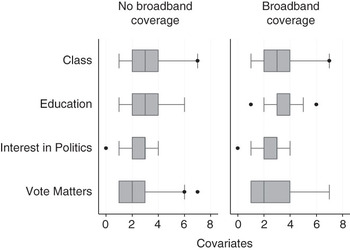
Figure 2 shows the balance between areas with broadband and areas without broadband and four ordinal control variables. The four ordinal variables are quite well balanced, though Education and Vote Matters display a slightly different distribution between the two groups. In the robustness check section, we will match these two covariates to improve their balance.
Box plots of the ordinal covariate distributions in areas with and without broadband coverage

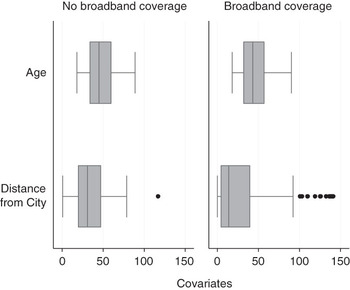
Figure 3 describes the balance across broadband and no broadband areas over two continuous control variables: Age and Distance from City. While Age is well balanced, the most significant disparity across the two groups is observable for Distance from City, which indicates higher levels of broadband access in urban areas (Figure 3).Footnote 79 This result is hardly surprising, and reinforces the validity of both Distance from City and Broadband Coverage. To account for this observed imbalance in the Distance from City variable, and to ensure that this imbalance is not driving our results, we include it as a control variable in our main model and employ data-matching techniques in a robustness check.
Box plots of the continuous covariate distributions in areas with and without broadband coverage

Regarding control variables that are dichotomous, Appendix Table A2 shows the results of tests of proportions (‘prtest’ in STATA 12) across the broadband versus no broadband areas. The dummies with statistically significantly unequal proportions are Newspaper, Duty vs. Choice, L/R (centre), L/R (extreme) and Party Identification. To improve the balance of these confounding factors, we include all of them in the matching analysis in the Robustness Checks section. Overall, although there are differences in the distribution of some covariates, areas with and without broadband coverage appear quite similar with respect to several key characteristics.
A further assumption requires that Broadband Coverage is a strong instrument for browsing online political news. In other words, Broadband Coverage must be highly correlated with Internet use, conditional on the set of control variables. There are reasons to suspect that this variable does not completely capture access to the internet: some respondents browse political news when they are at work, or they may use mobile phones, while others may have broadband access but little interest in current affairs.
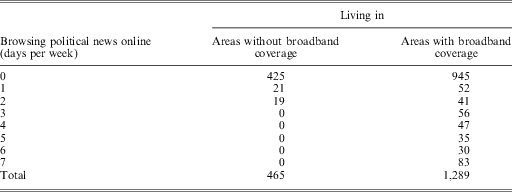
Table 2 shows that living in an area with broadband coverage (according to our Broadband Coverage variable) is strongly correlated with the probability of ‘browsing for political news online’ (our Internet variable), and that heavy use of the internet as a political news source (that is, more than two days a week) is completely absent among respondents in areas without broadband coverage. The correlation between the variables is 0.41. Moreover, when we regress Broadband Coverage on Internet, controlling for a large number of covariates, in the first stage of our estimations Broadband Coverage is statistically significant and the t-statistic is larger than 10 across all models.Footnote 80 We acknowledge that people in areas without broadband coverage may access the internet at their workplace or via mobile devices – and Table 2 indicates that just under 10 per cent of respondents in areas without broadband use the internet as a political news source.
Browsing Political News and Broadband Coverage

However, as long as accessing the internet from work and mobile internet use is not systematically related to broadband access, our effects should still be identified. Indeed, if people who lack broadband availability at home have other means of accessing the internet, our effects should be underestimated.
A final assumption underlying our analytical approach requires no inverse relationship between having access to broadband and browsing for political news. Given that broadband technology greatly facilitates internet use generally, and the strongly positive relationship between Broadband Coverage and Internet observed in our data, we argue that our instrument meets this assumption.
ANALYSIS
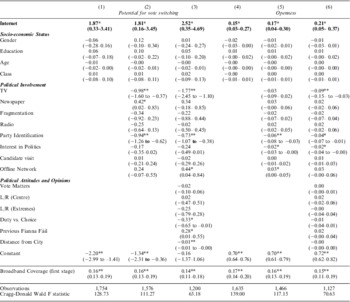
We begin by estimating baseline models (1 and 4) that include only the Socio-economic Status control variables for both of our dependent variables. Then we add Political Involvement in Models 2 and 5. In our full models (3 and 6), Political Attitudes and Opinions and Distance from City are also controlled for.Footnote 81 Table 3 reports coefficients and confidence intervals for parameter estimates of Broadband Coverage in the first stage and all covariates in the second stage of our models for our two measures of electoral uncertainty: Potential for Switching and Openness.Footnote 82
Instrumental Variables (IVREG2) Models of Electoral Uncertainty, Internet Instrumented Using Broadband Coverage

Note: the reference category for Left/Right placement (L/R) is those who did not place themselves (Don't know). Robust CI in parentheses. For the first-stage equation, only the coefficient for Broadband Coverage is reported. **p < 0.01, *p < 0.05.
The positive sign and statistical significance (with 95 per cent confidence) of the coefficient of the Internet variable is constant across all models reported in Table 3, which indicates that browsing the internet for news has a discernible impact on electoral uncertainty, ceteris paribus. The direction of this effect is positive, implying that those who used the internet to gather politically relevant information in the 2011 Irish election campaign were more electorally uncertain than those who did not – a finding that supports Hypothesis 2 and invalidates Hypothesis 1.
These outputs also show that the Internet variable coefficient has a wide confidence interval, a typical feature of instrumental variables models,Footnote 83 meaning that the amount of extra uncertainty engendered by using the internet for political news is difficult to specify precisely – and this caveat should inform our interpretation of coefficient size. The coefficient for online newsgathering (versus no use of the internet for political news) shows that it corresponds to an increase of about two units on the categorical measure of Potential for Vote Switching (which ranges from −10 to 0). The coefficient for the Openness measure indicates that using the internet makes voters approximately 20 per cent more ‘open’ to multiple parties, ceteris paribus. However, comparing these coefficients to those of other variablesFootnote 84 in the models is more meaningful. For instance, the size of the coefficients for Party Identification are between one-half and one-third the size of those that account for Internet. Specifically, if an individual identifies with a political party, his/her likelihood of being uncertain is shifted about one point down the scale for Potential for Vote Switching. Online newsgathering, our key independent variable, produces a shift in the opposite direction that is twice as large.
Alternative Independent Variable Specification – Gathering News via Twitter
Our analyses have thus far examined the effects of browsing the internet for politically relevant news, understood in a broad sense. In this section, we seek to better understand the relationship between uncertainty and online newsgathering by specifying an alternative, more specific, instrumental variable. To this end, we employ the INES question on whether respondents used Twitter.com to follow the news in the run-up to the election.
Twitter is a highly popular microblogging platform. It allows each user to post information (of no more than 140 characters) to be viewed by all users who ‘follow’ their accounts. Such information includes text, hyperlinks to other websites, video and audio files. Users can also ‘retweet’ (that is, copy and forward) other users’ posts to their followers, or address comments ‘at’ other users. Twitter's user-created content dynamic marks it as a ‘Web 2.0’ platform, while the relationships it establishes between account holders marks it as a social networking site.Footnote 85
ChadwickFootnote 86 argues that one of the defining structural features of ‘Web 2.0’ platforms like Twitter is their potential to facilitate ‘by-product learning’, a form of ‘accidental’ exposure to politically relevant information. The likelihood that users will be exposed to political information while not actively searching for political news is thus maximized in the Twitter environment. Twitter embodies the fragmentation of news sources that we discuss in explaining the rationale behind Hypothesis 2. Moreover, given the dynamic and diverse nature of messages that may pop up on one's Twitter feed, the likelihood that such information will run contrary to one's prior preferences (triggering increased electoral uncertainty) is also high.
Yet each Twitter account holder decides whom to follow, and thus may choose to build their own ‘echo chamber’ by following only users who they know are consonant with their prior preferences. If this usage pattern is highly pervasive, then using Twitter may serve to reinforce voters’ pre-existing electoral preferences.
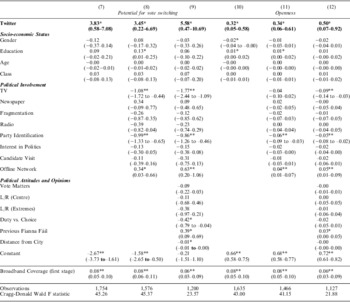
Conover et al.'sFootnote 87 analysis of Twitter points to an environment that is simultaneously preference-reinforcing (they find that ‘retweeting’ networks exhibit a highly partisan structure) and preference-challenging (they uncover far more partisan heterogeneity in the user-to-user mention network, which facilitates argumentative challenging). As such, the use of Twitter as an alternative instrumental variable allows us to have greater confidence that the online environment encountered by users has the requisite characteristics to trigger either of the mechanisms that underlie our research hypotheses. In Table 4 we present the results of an identical analysis to that reported in Table 3; the sole difference is that Twitter rather than Internet was the instrumental variable used to capture online newsgathering.
Instrumental Variables (IVREG2) Models of Electoral Uncertainty, Twitter Instrumented Using Broadband Coverage

Note: the reference category for Left/Right placement (L/R) is those who did not place themselves (Don't know). Robust CI in parentheses. For the first-stage equation, only the coefficient for Broadband Coverage is reported. **p < 0.01, *p < 0.05.
As we can see from Table 4, the results are nearly identical to those presented in Table 3. The use of Twitter as a source of political news appears to leave Irish voters more electorally uncertain – the finding is statistically significant at the 95 per cent level for both dependent variable specifications. Once again, the scale of the observed effect is considerably greater than the effect of party identification, though we repeat our caveat about the relatively large standard error associated with this coefficient. The observed direction and scale of the effects of using Twitter are thus similar to those of using the internet ‘at large’. Again, this supports the contention that the internet's capacity to impart large amounts of information, from a highly fragmented set of providers, makes it a driver of greater electoral uncertainty.
Robustness Checks for Imbalances across Groups
As we discussed above, balancing areas with and without broadband coverage is key to correctly identifying the internet's effect on voter uncertainty. As such, we implement two types of additional analysis designed to sharpen our identification strategy and provide greater confidence in the validity of our core finding.
First, although areas with and without broadband coverage proved to have similar features in terms of several possible confounding factors, some minor imbalances remain in a few variables. In order to assess whether these imbalances drive our results, we restrict our analysis to areas whose distance from the closest unit in the other group is smaller than 15 km, as this allows us to address the concern that relevant socio-economic characteristics may be geographically clustered.Footnote 88
Secondly, we implement a matching technique to further balance constituencies with and without broadband. Specifically, we match our instrument on the geographical variable (Distance from City), the two ordinal covariates that are slightly unbalanced (Education and Vote Matters) and on the five dummies that have different proportions (Newspapers, Duty vs. Choice, L/R (centre), L/R (extremes) and Party Identification.Footnote 89
This test is both important and quite conservative. If these pre-treatment variables, which are somewhat unbalanced, affect the dependent variables, our instrumental variable estimation does not address the issue of confounding factors. Put simply, the test is important because the effect of the internet on electoral uncertainty could occur via these slightly unbalanced variables, which happen to be correlated with both the treatment and the instrument. It is conservative, because by reducing our sample we increase the error around our estimates.
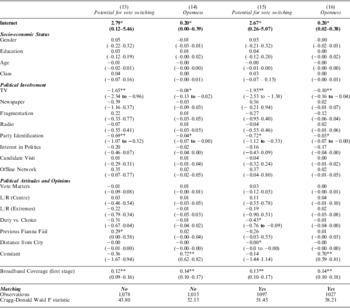
We use the STATA 12 module of the Coarsened Exact Matching Software.Footnote 90 Table 5 reports estimate results for both dependent variables controlling for distance from the closest unit in the other group (Models 13 and 14) and matching samples on the imbalanced control variables discussed above (Models 15 and 16).
Instrumental Variables (IVREG2) With Robustness Checks for Across-Group Imbalances: Distance from Closest Unit in the Other Group Smaller than 15 km (13 and 14), and Matching (15 and 16). Internet Instrumented Using Broadband Coverage

Note: the reference category for Left/Right placement (L/R) is those who did not place themselves (Don't know). Robust CI in parentheses. For the first-stage equation, only the coefficient for Broadband Coverage is reported. **p < 0.01, *p < 0.05.
The outputs of the analysis on matched observations do not change significantly; for both dependent variables we obtain estimates that are very consistent with those reported in Table 3. Even with this highly conservative specification, the observed effect of online newsgathering on political uncertainty is positive and significant with at least 95 per cent confidence across all models.Footnote 91
CONCLUSIONS
Our goal in this article has been to identify the impact of online newsgathering on voters’ electoral uncertainty. A causal understanding of the effects of the internet is generally very difficult to achieve due to selection into treatment, which represents a well-known challenge for analysts who seek to evaluate the impact of media on public opinion. We have focused on the question of whether using the internet to gather political information in the context of a general election campaign affects voters’ uncertainty with regard to their vote choice, and found evidence that browsing the internet for political news – via both regular websites and Web 2.0 platforms – leads to higher levels of electoral uncertainty. We implemented a quasi-experimental analytical approach built on geographic variation in broadband availability in the Republic of Ireland. These analyses were made possible by the design of the 2011 INES, specifically the gathering of geo-location data on respondents, which allowed us to match individual respondents to information about broadband availability where they live. Several other election studies also collect geo-location data, and broadband availability varies regionally in many states other than Ireland – the analytical approach presented in this article thus offers a replicable contribution to the study of the effects of internet use by voters during election campaigns.
This research speaks to a wider debate about the political and social impact of the emergence of the internet. Some argue that the web is a space where users can pre-define the content they receive in a manner that leads them to only receive information that is in line with their pre-existing preferences. The political implications of this argument are profound: internet use may serve to re-enforce individuals’ existing partisan and ideological predispositions and to polarize groups with differing opinions. Others counter that the diversity of online news, and the ease with which multiple websites can be accessed via hyperlinks when browsing the web, make it a media platform in which users will encounter information and political perspectives that challenge their pre-existing perspectives, and perhaps make them more open to understanding alternative political positions.
A range of robustness checks has validated our core finding: that using the internet as a news source led to greater electoral uncertainty among Irish citizens in the 2011 election campaign. By integrating Twitter into our empirical analysis, we capture the more user-driven experience of accessing social networks, and again we found that use of this platform led to an increase in voters’ uncertainty. In this respect, we can conclude that use of the internet as a source of news seems to produce an effect on uncertainty. Most research on media effects is concerned with the content carried on a given medium. Sundar notes that ‘the term media effects is somewhat of a misnomer because the vast majority of research in this tradition investigates effects of information delivered by mass media rather than effects of the media technologies themselves’.Footnote 92 However, our results suggest that the particular structure of a medium can (and does) produce effects on people's political evaluations. The availability of rich and diverse information on the campaign, party policies and political actors at the cost of only a few clicks of a mouse – via either regular websites or social networking platforms – appears to fuel uncertainty when it comes to deciding how to cast one's vote.
At this point, we cannot rule out the possibility that national and contextual factors may condition the relationship between online newsgathering and electoral uncertainty. Further research across a wider range of elections will be required to understand the conditionality of internet effects on voters’ electoral preferences. Ireland's 2011 election was exceptional in many respects – most notably due to the high aggregate volatility of its outcome, but also because of longer-term characteristics of the Irish political system, namely low levels of partisan identification in the electorate and a lack of ideological competition among the main Irish parties. It is plausible, and in line with the theoretical arguments that we used to construct Hypothesis 1, that in a more ideologically polarized political environment, use of the internet as a news source may lead to lower levels of uncertainty among voters. Nonetheless, the dynamics that we have mapped out for the Irish case may be reproduced in other political systems, especially those characterized by low levels of political polarization.
Furthermore, the mechanism(s) underlying the effects identified in this article require further research. It is extremely difficult to capture and classify the political content that is (1) available and (2) consumed online during political campaigns (or at any other time, for that matter). This problem is exacerbated by the fact that the internet itself is something of a ‘shifting target’ for analysts, a forum characterized by constant evolution in the types of use it facilitates. The next steps for research on this topic should provide more focus on differences in individual patterns of web use when newsgathering, and seek to develop methodological and analytical techniques that facilitate the identification of national-level, election-level and individual-level variables that condition the overall internet effect identified here. Experimental research designs that administer and control for the type of online content browsed by individuals may be an important tool for disentangling the aggregate phenomenon observed in our analysis.
However, in terms of overall effect, it is clear from this analysis that Ireland's wired voters are more electorally uncertain than their unwired counterparts, and this difference appears to be attributable to the influence of consuming political news online.