1. Introduction
States agree on the common responsibility to face climate change problems while they recognize that the contribution of developed countries must be higher than that of developing countries.Footnote 1 However, there is no consensus on how strong differentiation should be or on which criteria it should be based.Footnote 2 The distribution of the costs for climate protection (burden-sharing) and procedural rules of differentiation affect participation in climate agreements, the implementation, and compliance with these agreements.Footnote 3
All international climate agreements contain terms and rules of differentiation. The United Nations Framework Convention on Climate Change (UNFCCC)Footnote 4 and the Kyoto ProtocolFootnote 5 formulate the principle of common but differentiated responsibilities (CBDR)Footnote 6 and ‘equity’ as guiding principles. The Paris AgreementFootnote 7 and the Paris RulebookFootnote 8 refer to these requirements even more frequently adding ‘fairness’ and ‘climate justice’ as new terms.
Many publications mention the principle of CBDR, ‘equity’, ‘justice’, and ‘fairness’ in one breath without explaining the differences.Footnote 9 Several authors discuss differentiation concentrating on operationalization.Footnote 10 Others make their own suggestions on how terms of differentiation should be interpreted.Footnote 11 The differences between the terms of differentiation have only attained little attention in the context of international climate law.Footnote 12
The use of various terms means that each term has a discrete meaning which leads to the following research questions: What do the various terms of differentiation mean? How can they be distinguished from each other and what is the use (effet utile) of each term? How are they operationalized?Footnote 13 To what extent their clarification provides new arguments for the controversy around burden-sharing or procedural rules of differentiation?
A better understanding of the terms and their operationalization might have an impact on later climate agreements and decisions of the Conferences of Parties to the UNFCCC (COPs) and the Paris Agreement (CMA)Footnote 14 as well as on the nationally determined contributions (NDCs). This article should make it possible to use the terms in a more thoughtful and targeted way, in climate politics but also in research.
Article 2(1)(a) Paris Agreement requires holding the increase in the global average temperature below 2 °C above pre-industrial levels referring to all contracting parties as a group. This aim is binding but not sufficiently precise to evaluate the compliance of individual contracting parties.Footnote 15 To tell to what extent each party complies with the Agreement, the rules of differentiation need to be clarified. The more clearly these rules are defined, the less they can be manipulated to excuse insufficient contributions to climate protection. Additionally, the international climate policies being perceived as appropriately differentiated can increase the willingness to contribute.Footnote 16
Terms like ‘climate justice’ invite to a broader discussion on what is the objective measure for burden-sharing and differentiation. However, this article does not analyse how climate agreements should be.Footnote 17 It remains within the scope of existing agreements using the methods of legal interpretation defined in the Vienna Convention of the Law of the Treaties (VCLT). Even if the terms of differentiation always maintain a certain normative weight,Footnote 18 their discussion shall be as unbiased and close to the treaty as possible. Where the agreement refers to vague terms or allows for discretion, different interpretations might remain relevant.Footnote 19 The specification of criteria for differentiation depends on the climate agreements whether or not ethical reasons speak for their consideration.
The Paris Agreement refers to ‘the Convention’.Footnote 20 Decision 1/CP.21 mentions the Kyoto Protocol.Footnote 21 To explain the historical development and context of the terms of differentiation, these earlier agreements are included in the analysis. COP and CMA decisions are also comprised,Footnote 22 especially if these are formulated in mandatory terms.Footnote 23
After clarifying the various terms of differentiation of the climate agreements (Section 2), we discuss their broader context and the operationalization of criteria of differentiation (Section 3). The result summarizes what is the legal measure for burden-sharing and differentiation in international climate agreements (Section 4). The outlook provides future perspectives (Section 5).
2. Terms
The principle of CBDR and the terms ‘equity’, ‘fairness’, and ‘climate justice’ seem to overlap, all aiming at differentiation.Footnote 24 The question is to what extent these terms differ from one another. This section analyses these terms according to the rules of Articles 30–33 VCLT.Footnote 25
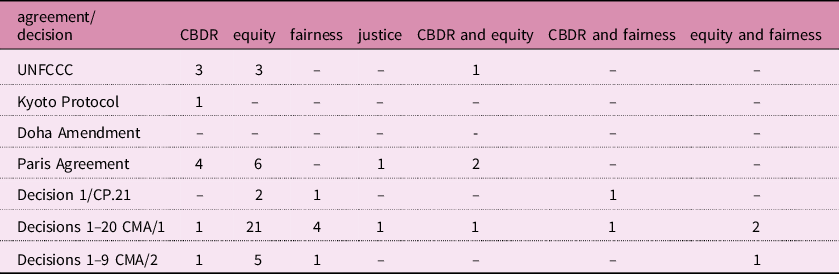
The frequency and the combination of terms of differentiation in international climate agreements and subsequent decisions (Table 1)Footnote 26 reveal to what extent a term is institutionalized whereas its legal weight depends on the bindingness, content, and context of the respective provision.
Terms of differentiation in international climate agreements and subsequent decisions

Source: own design.
The term ‘equity’ appears most frequently, followed by the principle of CBDR. The term ‘climate justice’ is used once in the preamble of the Paris Agreement.Footnote 27 The term ‘fair’ is used once in the preamble of Decision 1/CP.21 and five times in the Paris Rulebook. The principle of CBDR is used in the same context as ‘equity’ and ‘fair’. The Paris Rulebook uses the terms ‘equity’ and ‘fair’ together.
Differentiation depends on the comparison of one party’s contribution with those of other parties based on pre-defined characteristics. The more these characteristics differ, the more parties might be treated differently and vice versa. Which criteria are relevant, potential thresholds, and how all relevant criteria are interrelated, is controversial.Footnote 28
Criteria for differentiation of climate agreements can be summarized under the following headings: equality, capabilities, vulnerability, responsibility,Footnote 29 and open criteria.
– Equality can be an argument for differentiation if it depends on a neutral criterion, for example on equal chances for developmentFootnote 30 or equal emission rights per capita;Footnote 31
– Capabilities Footnote 32 include the state of development correlated with the financial, institutional, and technological capacity to face climate change problems;
– Vulnerability includes the susceptibility to climate changeFootnote 33 today and in the future. The more vulnerable a state is, the more it benefits from climate activities;Footnote 34
– The responsibility for emissionsFootnote 35 can include the share of global absolute and per capita emissions in the past, today, and in the future.Footnote 36 Responsibility indirectly refers to the availability of resources affecting climate change, e.g., fossil fuels or sinks;Footnote 37
– Open criteria for differentiation, e.g. ‘national circumstances’Footnote 38 and ‘priorities’Footnote 39 can be defined by the contracting parties.
To bring all these criteria into consistency by an all-in-one indicator is difficult. Equal emissions per capita,Footnote 40 for example, can reflect the first four criteria as far as they correlate with high absolute, cumulative and historical emissions, with a high state of development and capacity to face climate change problems and with low vulnerability to climate change. However, the example of China and India shows that immense absolute emissions can correlate with moderate per capita emissions and cumulative emissions.Footnote 41 Moreover, relative indicators are uncritical about limited resources (here a stable climate) and the limits of growth,Footnote 42 i.e., if the emissions per capita were the only criterion of differentiation, a limitation of absolute emissions would remain important.
Even if criteria of the five categories above can be specified, it is not clear which of them apply, what weight they have,Footnote 43 how they are measured, how often they need to be updated,Footnote 44 and how to deal with uncertainties or lack of data. How these criteria refer to the terms of differentiation of international climate agreements is also unclear. A deeper analysis of climate agreements and subsequent decisions might elucidate the relevance of the criteria for the terms and in the context of operationalization.
2.1 The principle of CBDR
References to the principle of CBDR can be found in the UNFCCC,Footnote 45 the Kyoto Protocol,Footnote 46 the Paris AgreementFootnote 47 and its subsequent decisions.Footnote 48 The term ‘common’ formulates a collective responsibility of all contracting parties for climate protection.Footnote 49 The term ‘differentiated’ signifies that the states’ contributions to climate protection are not the same.Footnote 50
The term ‘responsibilities’ can refer to current, historical, and future responsibilities for emissions.Footnote 51 Apart from the general term ‘responsibility’ included in the principle of CBDR, the 3rd preambular recital of the UNFCCC mentions historical and current emissions explicitly.
Current emissions can be measured by local monitoring stations but also by satellite data, which allows for overall monitoring of emissions worldwide.Footnote 52 As regards current emissions, it appears possible to isolate terrestrial and seasonal factors to measure emissions and also to assign these factors to specific states.Footnote 53 Emissions can be assigned to the producer of goods or services (current approach)Footnote 54 or (also) to the consumer.Footnote 55
Historical responsibility becomes relevant if it not only confirms other criteria for differentiation (e.g., current emissions) but if it changes the legal obligations of a contracting party. A predominance of historical emissions is neither formulated nor excluded by international climate agreements. Data on historical emissions are not always available and might not have the same quality and reliability as of current emissions,Footnote 56 as monitoring has been and still is improving. The concentration of CO2-equivalents in the atmosphere reflects historical emissions only to the extent they remain in the atmosphere for a longer period whereas the origin of those emissions is uncertain. That climate effects can be delayedFootnote 57 also means that emissions that are no longer measurable in the atmosphere can have caused climate effects.Footnote 58 In any case, emissions caused long ago are more difficult to measure and to assign to individual states than current emissions. This is further complicated if the borders of states change. Furthermore, it is unclear whether all greenhouse gas emissions or only the most relevant shall be included in the calculation. It is also unclear whether a certain extent of emissions per capita must be excluded from this calculation to cover basic needs. In that case, it might be difficult to define these minimum needs, even more if accounting for changes of the population which would require further historical data to monitor the net emissions of a state.
To overcome these uncertainties, a reference period could be defined. The industrial revolution, the global awareness about climate change problems,Footnote 59 the beginning of negotiations, the conclusion, or ratification of the first multilateral climate agreement, or a certain standard for monitoring emissions could mark the starting point. For example, the conclusion of the UNFCCC in 1992 would be a reasonable starting point.Footnote 60 However, this reference period would ignore a major part of historical emissions making them almost congruent with current emissions, which reduces the added value of historical emissions as a separate criterion.
The inclusion of developing countries into the Paris Agreement reveals that potential emissions also matter. However, the question is again whether future emissions have an added value affecting the rules of differentiation. The strong correlation with current emissions and capabilities to face climate change problems as well as the uncertainties to monitor potential emissions might reduce their relevance as a separate criterion.Footnote 61
Considering the aim and purpose of the principle of CBDR, responsibility could also be understood in the sense of taking responsibility implying various criteria of differentiation, not only the responsibility for emissions. The different qualifiers of the principle of CBDR support this perspective.
Article 3(1) UNFCCC deals with general principles of the UNFCCC aiming at the protection of the climate system for present and future generations.Footnote 62 As a qualifier, Article 3(1) adds the term ‘and respective capabilities’. The 6th preambular recital of the UNFCCC adds the respective ‘social and economic conditions’. Both capabilities and conditions can be pre-defined by a neutral criterion. ‘Social and economic conditions’ are not limited to climate-based criteria but could also include non-climate related criteria. Article 4(1) UNFCCC and Article 10(1) Kyoto Protocol use the qualifier ‘and their specific national and regional development priorities, objectives and circumstances’, which is even more open to individual criteria.
The Paris Agreement and the Rulebook always add the qualifier ‘and respective capabilities, in the light of different national circumstances’Footnote 63 The term ‘respective capabilities and circumstances’ also appears frequently without the principle of CBDR.Footnote 64 As for Article 3(1) UNFCCC, capabilities and circumstances can be defined by neutral criteria. The Paris Agreement neither refers the CBDR to ‘priorities’ nor to national or regional objectives as Article 4(1) UNFCCC and Article 10(1) Kyoto Protocol do.
The Paris Rulebook specifies the term ‘circumstances’ in the context of NDCs: geography, climate, economy, sustainable development, and poverty reduction.Footnote 65 This list is neither mandatory (‘as appropriate’) nor conclusive (‘inter alia’) but open. The criteria might be changed or complemented. To explain how a party has progressed, the following ‘circumstances’ are specified: the government structure, population profile, and sector details.Footnote 66 These criteria are rather descriptive and partly not climate-based. It is unclear whether this list applies beyond the context of NDCs, how they affect the rules of differentiation, how relevant each criterion is in comparison to others, and how often they need to be updated. Therefore, the contracting parties define whether they apply them or not and also their respective weight.
Finally, the principle of CBDR remains an open principleFootnote 67 seeking to include various criteria for differentiation but not quantifying them or going into detail as regards their specific weight. Without a clear measure for differentiation, the legal force of the principle remains limited.Footnote 68 What can be said is that differentiation depends on verifiable criteria and that climate-based criteria and capability play an important role. However, with the terms ‘circumstances’ and ‘priorities’ added as qualifiers, the principle of CBDR has become more open to individual and even to non-climate related criteria.
2.2 Equity
The terms ‘equity’ and ‘equitable’ appear in the UNFCCC,Footnote 69 the Paris Agreement,Footnote 70 and its subsequent decisions.Footnote 71 The term ‘equity’ stems from the Latin term aequitas originally meaning ‘equality’Footnote 72 and is based on Western legal traditions. It is connected with the idea of universality owing to its Latin originFootnote 73 but is also an open term that depends on political, ethical, and cultural values.Footnote 74 In the English language, equity is a ‘quality of being fair and impartial’Footnote 75 or ‘free and reasonable conformity to accepted standards of natural right, law, and justice without prejudice, favoritism, or fraud and without rigor entailing undue hardship’.Footnote 76 Hence, equity requires a comparison between two entities by specific criteria based on which equal treatment is necessary.Footnote 77 Such criteria could, for example, be the original positions, rights, opportunities, or outcomes.Footnote 78
Both the UNFCCC and the Paris Agreement use the terms ‘equity’ and ‘equitable’ in the context of general aims of the agreement, mitigation targets, financial contributions, to formulate different obligations for developed and developing countries, or within the group of developing countries.Footnote 79 Article 4(1) Paris Agreement requires that states aim to reach the maximum of greenhouse gas emissions worldwide as soon as possible, recognizing that developing countries will take longer before peaking. Equity refers to equal access to development and the eradication of poverty.Footnote 80 The term ‘equity’ is also used for appropriate geographical representation for different mechanisms of the Paris Agreement.Footnote 81 Moreover, rules on transparency include equity as a qualifying requirement.Footnote 82
The UNFCCC requires to protect the climate for present, and future generations and included them under its central principles.Footnote 83 These provisions either use the term ‘should’ or are indeterminate and, therefore, unbinding. In contrast, the Paris Agreement includes ‘intergenerational equity’ in the preamble.Footnote 84 ‘Intergenerational equity’ seeks to maintain resources for future generations.Footnote 85 In contrast to other provisions of the same recital, intergenerational equity was not referred to as a right. An explanation for not using the term ‘rights’ for future generations might be the difficulty to specify the right holder and the claimant for future generations.Footnote 86 Besides, the reach for such rights and the comparison with the rights of current generationsFootnote 87 would be controversial.Footnote 88 How could the freedoms of different generations be compared in a world of causal uncertainties, technological, and irreversible environmental effects? How can we find a measure for intergenerational equity if we do not even agree on measures for equity in the current global society?Footnote 89 These questions get more complicated if the population or state borders changeFootnote 90 or if we included the ecocentric dimension considering the preservation of nature as an own value.Footnote 91
Edith Brown Weiss’s approach to ‘intergenerational equity’Footnote 92 seeks to avoid the difficulties to represent future generations and make their rights comparable to present generations. She considers intergenerational equity to require the conservation of options (the diversity of the natural and cultural resource base), quality (maintaining the conditions of the planet between the generations), and access (maintaining the legacy of previous generations). These requirements cover the procedural and distributional dimension of equity.Footnote 93 Referring intergenerational equity to climate change, Brown Weiss includes these principles for both mitigation and adaptation.Footnote 94
The Paris Agreement directly mentions the requirement for biodiversity (options) and includes the preservation of a certain quality of a stable climate (quality), for example by formulating the 2 °C target.Footnote 95 Both requirements are also implied by the frequent mention of the term ‘sustainable development’.Footnote 96 However, the Paris Agreement does not formulate the rights of future generations (access). Brown Weiss’s criteria are only partly applicable. Furthermore, the central principles of Article 2 Paris Agreement refer only to equity without the intergenerational dimension.Footnote 97
The negotiating history confirms the focus of equity on development and procedural aspects: Article 3(1) UNFCCC specified equity referring to the responsibility for climate change and the state of development.Footnote 98 Negotiators considered equity to require the developed countries to lead,Footnote 99 which was reflected in the annex structure of the UNFCCC and the Kyoto Protocol but which is also formulated in the Paris Agreement.Footnote 100
The Paris Agreement refers to resolutions of the UN General Assembly (UNGA) that also include the term ‘equity’:Footnote 101 the Sustainable Development Goals (SDGs)Footnote 102 and the Addis Ababa Action Agenda.Footnote 103 As their relevance for climate agreements is limited,Footnote 104 they support existing interpretations rather than opening new dimensions of equity.
The SDGs use ‘equity’ or ‘equitable’ 13 times: synonymously for equality,Footnote 105 with the term ‘non-discriminatory’,Footnote 106 with the term ‘fair’,Footnote 107 and ‘just’Footnote 108 but without specifying differences between these terms. ‘Equity’ is used in the context of access to education, human and gender rights, equality of chances to development, an appropriate sharing of benefits of genetic resources, and equal access to water.Footnote 109 The Addis Ababa Action Agenda uses ‘equity’ eight times: in the context of equality of chances, non-discrimination, economic growth and sustainable development, and adequate geographical representation.Footnote 110 Both resolutions refer to future generations.Footnote 111 The two UNGA resolutions define ‘equity’ by procedures and equal rights. Only equal access to resources implies distributional aspects.Footnote 112
Finally, the term ‘equity’, as used in international climate agreements, subsequent decisions, and further applicable rules of international law, is defined by procedural and substantive rules aiming at equality of neutral criteria: participation, geographical representation, development prospects, and a proportionate share in the atmosphere. Several of these criteria might become relevant but their weight is not pre-defined.
2.3 ‘Climate justice’
The term ‘climate justice’ was included for the first time in the 13th preambular recital of the Paris Agreement.Footnote 113 The term ‘justice’ (Latin justitia) is defined as ‘impartial adjustment of conflicting claims’, ‘conformity to truth, fact, or reason’,Footnote 114 ‘quality of being fair and reasonable’,Footnote 115 and ‘morally right and fair’.Footnote 116 Compared to ‘equity’, the term ‘justice’ is more universal (whether or not a consensus on its meaning is found).Footnote 117 Justice can refer to moral foundations of conduct, political institutions, distribution, or minimum standards for individual rights.Footnote 118
The 13th preambular recital of the Paris Agreement prescribes ‘noting the importance for some of the concept of “climate justice”’.Footnote 119 Using the term ‘concept’ in singular could mean that there is only one concept of ‘climate justice’. Though the vague specification of actors makes it a relative term. ‘Some’ could either refer to persons or contracting parties including public or private actors. ‘Climate justice’ is no principle under Article 2 Paris Agreement but mentioned in the preamble and in a non-binding manner.Footnote 120 It is put in quotation marks which further weakens the normative loading the term originally has. Still, the term must be defined.
John Rawls considers justice as the ideal of an institution or rule.Footnote 121 In contrast, Amartya Sen considers justice as an improvement of an unjust situation referring to institutions and actions.Footnote 122 We will concentrate on these two theorists. Rawls’ theory has gained a lot of attention across various disciplines,Footnote 123 also in the climate context,Footnote 124 whereas Sen complements and criticizes it, offering an approach that suits the Paris Agreement. Both theories distinguish the substantive (distributional) and the procedural level of differentiation, which is decisive to understand the relationship between ‘climate justice’, ‘equity’, and ‘fairness’.
Rawls considers justice to become relevant because the collaboration of persons generates social advantages.Footnote 125 He constructs an original position where people of one community are equally represented and negotiate on their ideal institutions without knowing their role and welfare in life (‘veil of ignorance’).Footnote 126 Bargaining advantages and customs are blended out to find consensus on allocation rules.Footnote 127 Rawls assumes that an inclusive society (which is smaller than the global society) can achieve consensus on ideal institutions and allocation rules by balancing.Footnote 128 He considers the society to agree on a precise rule for allocation under uncertainty: The least advantaged members of society must have the greatest benefit (‘maximin rule’).Footnote 129 Depending on the circumstances, he considers this rule to be apt to be put into practice.Footnote 130
However, this theory does not directly apply to international relations,Footnote 131 for which Rawls formulated a more cautious approach.Footnote 132 For international justice, he suggests rules that are close to existing international law: the equality of states, respect of peoples’ independence, the exclusion of the right to war or intervention, the right of self-defence, the guarantee of basic human rights, the pacta sunt servanda rule, and minimum support in case of a famine or drought.Footnote 133 Distributional aspects are explicitly left aside by this catalogue.Footnote 134 Only where peoples suffer from ‘unfavourable conditions’ making it impossible to fulfil the requirements for the own society, shall other societies offer support,Footnote 135 but even in a crisis, mutual assistance depends on the feasibility for the supporter.Footnote 136 Beyond that, co-operation is voluntary.Footnote 137 Rawls limits distributional rules because not all societies are deemed liberal,Footnote 138 the global society is not considered a community with common values and sources of authority and, therefore, not expected to agree on and comply with a common distributional rule.Footnote 139
Rawls’s requirements for international relations could apply to the climate context. Ecologic limits challenge the minimum conditions for international peace and basic human rights (at least, in the long-run). The duty of assistance in a crisis might become relevant with climate change. However, the latter would not imply re-distribution or support of mitigation but rather support for adaptation.
Some authors seek to extend the ‘Theory of Justice’ beyond Rawls’s original intention including distributional justice for international relations.Footnote 140 Compared to Rawls’ time, global interactions have become more intense, for example through trade, capital, and labour flows,Footnote 141 communication, and culture.Footnote 142 This generates global social advantages (e.g., comparative advantages) but also external effects (e.g., climate change). Neither stops at national borders and can cause global redistribution effects.Footnote 143 Digital media make it easier to exchange common global values and more difficult to hide information. These interdependencies speak for extending distributional justice to international relations and could require pursuing distributional justice even if non-liberal societies are part of international co-operation. At least, liberal societies could improve on justice, combining it with conditional co-operation. In this way, Rawls’s ‘Theory of Justice’ could apply to international ‘climate justice’.
Amartya Sen uses a comparative approach to justice (non-ideal theory), which is based on the social choice theory.Footnote 144 It aims at the reduction of injustice in situations where the best solution for a problem is not identified or available, which he considers to be mostly the case.Footnote 145 This approach allows for incomplete solutions making justice more feasible.Footnote 146 Sen uses Adam Smith’s concept of an impartial spectator:Footnote 147 Arguments must prevail against an open and inclusive global public reasoning.Footnote 148 All arguments on the ideal solution, information on existing social problems, and living conditions, must be considered while being as independent as possible from one’s own characteristics and positions.Footnote 149
Sen seeks to improve the capabilities (chances) of a society,Footnote 150 not necessarily the achievements (results).Footnote 151 Means to capabilities are, inter alia, income,Footnote 152 healthcare, the nature of education, social organization, and social cohesion.Footnote 153 Sen argues that people with strong capabilities to reduce injustice should use them,Footnote 154 whereas vulnerable people need more support than others.Footnote 155 Still, improvements in capabilities are not pursued at all costs.Footnote 156
The comparison of possible alternative choices cannot be measured by only one criterion such as utility or happiness (non-commensurability).Footnote 157 In contrast to Rawls, Sen accepts a plurality of impartial reasons that might be compared with each other, e.g., efforts, talents, or needs.Footnote 158 To reduce injustice, ‘a broad range of not fully congruent weights’ (selective rankings) can be sufficient.Footnote 159
What do these theories tell us about ‘climate justice’? With Rawls’s theory (applied to the global case), all relevant actors fairly represented in negotiations can achieve a consensus on ‘climate justice’ as interactions of the global society are possible today. However, consensus on one balanced principle of justice remains hard to find, in the original position as in practice.Footnote 160 Rawls’s approach does not formulate ‘climate justice’ as open and cautious as the Paris Agreement does.
Sen’s approach to justice is closer to the Paris Agreement.Footnote 161 His approach upholds a plurality of impartial reasons and lowers injustice step-by-step. Even a little progress in preventing injustice contributes to ‘climate justice’ if side-effects do not outweigh it. For example, financial transfers to vulnerable or developing countries for climate purposes can improve on ‘climate justice’ even if missing core aims of the Paris Agreement. Sen’s focus on capabilities corresponds to the growing relevance of this term in international climate agreements.Footnote 162
The negotiating history confirms the procedural approach to ‘climate justice’. In the climate negotiations before Paris, the initiative ‘The People’s Demands for Climate Justice’ was launched which might have influenced the consideration of the term ‘climate justice’ for the draft of the Paris Agreement.Footnote 163 The draft used the term in the context of the distribution of the climate budget and for the idea of a climate justice tribunal.Footnote 164 Criteria of differentiation were historical responsibilities, the ecological footprint, capabilities, the state of development, and the population.Footnote 165
The SDGs use ‘just’ and ‘justice’ seven times,Footnote 166 the Addis Ababa Action Agenda once.Footnote 167 The terms are formulated as general aims for global societies, to emphasize the equality of chances, sustainable development, and the rule of law.Footnote 168 They are also used together with ‘fair’Footnote 169 and ‘equity’,Footnote 170 confirming overlaps between these terms but not clarifying their differences. The SDGs recognize the reduction of injustice as one form of justiceFootnote 171 which suits the approach suggested by Sen.
Finally, the term ‘climate justice’ of the Paris Agreement aims at inclusion of arguments but does not specify criteria for burden-sharing, or differentiation, or their weight. The approach of Sen aiming at a successive reduction of injustice and the inclusion of all actors into the discussion about justice fits the term ‘climate justice’, but even this procedural approach remains unbinding.
2.4 Fairness
The terms ‘fairness’ or ‘fair’ are also new in the context of international climate agreements. After being used in the Lima Call for Climate Action (CP.20),Footnote 172 the term ‘fair’ was included in subsequent decisions to the Paris Agreement.Footnote 173
The term ‘fair’ comes from the Old High German word fagar originally meaning ‘pleasing’ or ‘attractive’. In Middle English, the term had a meaning similar to equitable.Footnote 174 Fairness is defined as ‘acceptable and appropriate in a particular situation’,Footnote 175 ‘just and appropriate in the circumstances’,Footnote 176 and ‘conforming to an established commonly accepted code of rules of a game or competitive activity’.Footnote 177 The term is characterized by ‘honesty and justice’ and applies ‘to judgments … or acts resulting from judgments and signif[ies] freedom from improper influence’.Footnote 178 It aims at ‘treating people equally without favouritism or discrimination’Footnote 179 and finding the ‘right balance of claims or considerations that is free from undue favouritism’.Footnote 180 Compared to the terms ‘equity’ and ‘justice’, ‘fairness’ is more relative to empirical perceptions and focused on procedures.Footnote 181
This also suits the interpretations of Rawls and Sen. Rawls considers fairness as a procedural rule dependent on the consensus of an inclusive society regarding institutions and rules that enable them to communicate and interact to achieve benefits from co-operation.Footnote 182 Sen defines fairness as a synonym for impartiality, the condition to choose between alternatives the least unjust one.Footnote 183 Konow distinguishes impartiality from self-interest, self-serving biases, or spite but also from altruism, reciprocity, kinship, and friendship.Footnote 184 We consider fairness as an open term of differentiation based on impartiality within a group of people at a given time.
One study discussing the term ‘fair’ in the context of international environmental law is the study by Thomas Franck.Footnote 185 In contrast to Rawls and Sen, Franck considers ‘fairness’ to comprise both procedural and distributional rules.Footnote 186 Franck also includes under ‘fairness’ what we discussed under ‘justice’. He analyses the quality of specific sources of international environmental law. His procedural approach of all-inclusiveness of actors corresponds to the approaches of Rawls and Sen. Franck’s relativistic elements are also culture and history/time.Footnote 187 As for Rawls and Sen, common perceptions of reference groups (communities) lead to a similar legal and moral perception.Footnote 188
As we do not seek to evaluate the law by normative criteria but only want to clarify the wording of the positive law that employs normative terms, we will not follow Franck’s methodology. Using different terms for distributional and procedural differentiation (as Rawls and Sen suggest) facilitates the understanding of the different levels of the terms of differentiation of the Paris Agreement.
Inclusively specifying fairness is complicated because less developed countries, vulnerable groups, and states that have fewer resources to formulate their expectations have less capacity whereas future generations are not represented at all.Footnote 189 Making the fairness perceptions of all contracting parties transparent might be the first step to an inclusive global fairness approach.
In Paragraph 27 of Decision 1/CP.21 and in the 9th preambular recital of Decision 4/CMA.1, the contracting parties agree:
that the information to be provided by Parties communicating their nationally determined contributions … may include, as appropriate … how the Party considers that its nationally determined contribution is fair and ambitious, in the light of its national circumstances, and how it contributes towards achieving the objective of the Convention as set out in its Article 2[.]Footnote 190
The terms ‘may’ and ‘as appropriate’ make the inclusion of fairness criteria voluntary.
In contrast, Paragraph 6 Annex I to Decision 4/CMA.1 defines binding criteria for the NDCsFootnote 191 to improve on clarity, transparency, and understanding including information about:
How the Party considers that its nationally determined contribution is fair and ambitious in the light of its national circumstances:
(a) How the Party considers that its nationally determined contribution is fair and ambitious in the light of its national circumstances;
(b) Fairness considerations, including reflecting on equity;
(c) How the Party has addressed Article 4, paragraph 3, of the Paris Agreement;
(d) How the Party has addressed Article 4, paragraph 4, of the Paris Agreement;
(e) How the Party has addressed Article 4, paragraph 6, of the Paris Agreement.Footnote 192
These requirements are mandatory; in contrast to other procedural rules formulated in Annex I, Paragraph 6 does not use the term ‘as appropriate’.
In both quotations, the term ‘fair’ is combined with the term ‘ambitious’, which aims at a reflection on how each NDC contributes to the overall climate protection target (1.5–2 °C). Ambition seems to be no criterion of differentiation. However, as states are affected by climate change to a different extentFootnote 193 and as self-differentiation is decisive in the Paris Agreement, reflections on ambition imply reflections on differentiation.Footnote 194
The term ‘fair’ is combined with the term ‘national circumstances’, which corresponds to the qualifier of the principle of CBDR. The term ‘national circumstances’ aims at the definition of neutral criteria to justify the own contributions and expectations towards other states. These criteria can but do not have to be climate-based.Footnote 195
The term ‘including’ in Paragraph 6 of Annex I to Decision 4/CMA.1 leads to the conclusion that equity is a form of fairness while not all fairness criteria are also equity criteria. The term ‘fair’ seems to depend more on individual circumstances and acceptance than the term ‘equity’ which is (also) based on pre-defined criteria.
Paragraph 6(c), (d), and (e) of Annex I to Decision 4/CMA.1 also specifies the term ‘fair’ as it is listed under the headline ‘How the Party considers that its nationally determined contribution is fair and ambitious in the light of its national circumstances’. These rules refer to mitigation targets and the requirement to track progress (‘ratchet mechanism’) and emphasize capabilities as a criterion for differentiation.
Paragraph 11 Decision 3/CP.24 uses the term ‘fair’ in the context of workshops, long-term climate finance, and gender-balance. It aims at inclusiveness in international climate events.
In the negotiating history of international climate agreements and in subsequent decisions, the term ‘fair’ is used in the context of trade as a means of technology transfer,Footnote 196 access to a possible future market mechanism,Footnote 197 an adequate representation in the Climate Technology Centre and Network,Footnote 198 and an adequate distribution of financial resources.Footnote 199 This confirms the high relevance of inclusiveness in procedures and institutions.
The Lima Climate Call for Action (2014) used the term ‘fair’ in the context of national mitigation targets and together with the term ‘equitable’.Footnote 200 Australia, Bolivia, Chile, the Dominican Republic, Fiji, Indonesia, Mexico, the Philippines, South Africa, South Korea, and Switzerland agreed to the terms ‘fair’ and ‘equitable’ being mentioned together. Trinidad and Tobago as well as the USA opted against this.Footnote 201 In the end, the term ‘fair’ was not used together with ‘equitable’ but later, in the context of the NDCs, it was.Footnote 202 This speaks for parallel but non-identical meanings of the two terms (effet utile).
UNGA resolutions mentioned in the Paris Agreement also refer to the terms ‘fair’ and ‘fairness’. The SDGs use the term ‘fair’ twice, always combined with the term ‘equitable’.Footnote 203 They use the term ‘fair’ for an appropriate sharing of the benefits of genetic resources. The Addis Ababa Action Agenda uses the term eight times: in the context of the rule of law and equal chances to sustainable development, taxation, the shared responsibility for the prevention of debts, and transparency.Footnote 204 Parallels to the Paris Agreement are the closeness of fairness to equity and the focus on procedural aspects.
Finally, in the context of the decisions to the Paris Agreement, fairness is a procedural rule to establish a representative and open discourse on differentiation to discuss substantive criteria for differentiation. The contracting parties of the Paris Agreement might explain why they consider their NDC as fair, formulate expectations towards other states, or define criteria for fairness. They might include climate- and non-climate-based circumstances in these considerations, possibly comparing them with other states’ circumstances. Individual concepts of fairness become more transparent to facilitate a common understanding one day.
2.5 The terms in other authentic treaty languages
Another perspective is provided by comparing the authentic language versions of the Paris Agreement and subsequent decisions.Footnote 205 Like the English version, the Arabic version uses different terms for ‘climate justice’ ( ), ‘equity’ (
 ), and ‘fair’ (
 ). The Arabic term for ‘fair’ (
 ) used in Decision 1/CP.21 depends on individual approaches to differentiation as it is the case for the English term.Footnote 206
In contrast, the Chinese version uses a separate term for justice ( ) but a common term for ‘equity’ and ‘fair’ (
 ). The French version also does not differentiate between the terms ‘fair’ and ‘equity’ but uses the terms équité and équitable for both terms.
The Spanish version uses justicia and justa for both ‘justice’ and ‘fair’ and equidad for equity. Equidad is used for both ‘equality’ and ‘equity’ in the Spanish language, which confirms that ‘equity’ refers more to equality than the other terms of differentiation.
In the Russian version, ‘justice’, ‘equity’, and ‘fair’ are translated by the same term: справедливость. This term can be used for individual and general approaches to differentiation. Using only справедливость is not intuitive because the Russian language also has other terms for justice (правосудие) and equity (равноправие).Footnote 207
That the three English terms do not always have an equivalent in the other languages does not mean the respective concept of differentiation behind them is unknown.Footnote 208 For example, the French term équité could be understood in both specifications of the English terms (equity and fairness). The Russian term справедливость can also include both the substantive and the procedural aspect of differentiation.
Legally, ‘[t]he terms of the treaty are presumed to have the same meaning in each authentic text’.Footnote 209 The English version of the treaty has no prevalent role but can be the starting point, as the Paris Agreement and the subsequent decisions were negotiated in English. If reconciliation of the terms in all authentic languages is not possible,Footnote 210 the terms are brought into consistency by the other means of legal interpretation, in particular by looking at the aim and purpose of the agreement.Footnote 211
All but the Russian version distinguish at least two terms of differentiation. The aim of this distinction might be to distinguish the procedural and substantive level of differentiation whereas the agreements focus on procedural rules of differentiation.
2.6 Result: Procedural approach to differentiation
The terms of differentiation have strong parallels and fine differences. Differentiation is mandatory but self- rather than pre-defined. The principle of CBDR is the broadest concept implying unequal efforts of all parties that depend on climate- and non-climate related circumstances.
‘Equity’ is the term most frequently used. Procedural criteria for equity specified so far are the broad participation of all contracting parties and equal geographical representation. Substantive criteria are less specified. Capability is one common criterion, but individual criteria can be added as long as applied in a non-discriminatory way.
Compared to the other terms, ‘climate justice’ has the strongest claim to pre-defined criteria for differentiation. However, as used in the Paris Agreement, it also aims at inclusion of arguments rather than prescribing pre-defined criteria for the one and only concept of differentiation.
The term ‘fair’ depends on the moral convictions of a reference group based on impartial reasoning, whatever these convictions may be. In the climate context, this requires global public reasoning on differentiation.
Finally, all terms of differentiation used in the Paris Agreement and subsequent decisions, aim at a procedural approach to differentiation: Ideas and arguments for differentiation of all parties shall be made transparent to all parties. The communication of the NDCs facilitates the discourse on further and more concrete criteria and arguments of procedural and substantive differentiation.
3. Operationalization
International climate agreements use criteria, categories, parameters, and arguments for differentiation with or without referring explicitly to the terms of differentiation.Footnote 212 As implicit rules of differentiation are the context for all terms of differentiation, they are discussed together. This section analyses capabilities, vulnerability, and responsibility.
3.1 Capabilities: The continued relevance of the categories ‘developed countries’ and ‘developing countries’
The state of development (capability) is used within and outside the principle of CBDR.Footnote 213 A high development correlates with a high share in global emissions and the capability to face climate change problems. Therefore, developed countries are considered to be particularly responsible for climate protection whereas the need of developing countries to progress is recognized.Footnote 214 Accordingly, countries of Annex I of the UNFCCC and Annex B of the Kyoto Protocol had to reduce emissions; non-Annex I and non-Annex B countries did not have to mitigate.Footnote 215
The Paris Agreement requires developed and developing countries to contribute to climate protection. The role of the previous annexes for the Paris Agreement remains controversial.Footnote 216 The Agreement seeks to ‘enhance the implementation of the Convention, including its objective’,Footnote 217 but the bottom-up approach of NDCsFootnote 218 lowers the relevance of the annexes. Still, the Paris Agreement uses the terms ‘developed country’ and ‘developing country’ frequentlyFootnote 219 but without specifying them further.Footnote 220 It also refers to ‘other countries’,Footnote 221 which seems to include all but developed countries. The added value of the term ‘other countries’ (instead of ‘developing countries’) could be to include emerging countries with less (binding) obligations than developed countries.Footnote 222 The obligations of ‘other parties’ are formulated as soft law adding the terms ‘voluntarily’,Footnote 223 ‘should’,Footnote 224 and ‘invite’.Footnote 225
Article 4(4) Paris Agreement recommends that developed countries lead.Footnote 226 They should submit absolute emission reduction targets. Developing countries are encouraged to move towards emission reduction or limitation targets. Article 4(1) of the Agreement requires recognition that peaking will take longer for developing countries than for developed countries. Article 4(15) Paris Agreement requires considering the concerns of developing countries in the implementation process of the Agreement.
In the UNFCCC and the Kyoto Protocol, developing countries received financial and technology transfers without paying for them.Footnote 227 The Paris Agreement also recognizes the need to support developing countries; including financial transfers, technology exchange, and capacity buildingFootnote 228 with developed countries in the leadership role to offer this support.Footnote 229
Reporting is also less strict for developing countries. Article 13(9) and (10) Paris Agreement prescribes transparency for both developed and developing countries. However, the specifications of the Paris Rulebook are less restrictive for developing countries as regards the guiding principles of modalities, procedures, and guidelines.Footnote 230 These lower requirements are also reflected in the obligation for developed countries to assess uncertainties quantitatively whereas developing countries can use qualitative criteria.Footnote 231 The national circumstances can lower the transparency requirements for developing countries.Footnote 232 Consequently, only developing countries are encouraged to formulate their needs as regards the transparency requirements.Footnote 233
Developing countries shall be supported in formulating their NDCs,Footnote 234 research, collecting and identifying adaptation needs, the assessment of vulnerability, and monitoring.Footnote 235 However, in contrast to the requirements on financial transfers, the requirements of general support of Articles 4(5) and 7(13) Paris Agreement use the passive voice, i.e., they do not oblige a specific group of countries to pay.Footnote 236 Hence, this support might come from both developed and developing countries. The extent of support is also open.Footnote 237
As for the qualifiers of the principle of CBDR,Footnote 238 the terms ‘circumstances’,Footnote 239 and ‘priorities’Footnote 240 are employed if developing countries shall have lower obligations than developed countries. The term ‘circumstances’ still requires that conditions can be based on objective criteria. The term ‘priorities’ implies more discretion. Both terms also allow for the inclusion of non-climate related criteria.Footnote 241
The operationalization of differentiation also depends on the discretion of the respective groups of countries. Climate agreements and subsequent decisions maintain discretion for all contracting parties using the terms ‘sovereignty’, ‘nationally determined’, ‘nationally appropriate’, ‘country-driven’, or ‘party-driven’.Footnote 242 Partly, developing countries have more discretion than developed countries.Footnote 243 Finally, ‘developed country’ and ‘developing country’ (capability) remain decisive criteria for differentiation but with an unclear assignment of the parties to these categories.
3.2 Vulnerability
Vulnerability is used to subdivide the category of developing countries but also to address all other contracting partiesFootnote 244 and persons in vulnerable situations.Footnote 245 The vulnerability of a country can affect its mitigation targets, requirements on transparency and capacity, contributions to funding, and the right to receive funding.Footnote 246
The Paris Agreement recommends assessing a party’s vulnerability as appropriate.Footnote 247 There is no pre-defined measure for vulnerability. It distinguishes categories of countries concerning their vulnerabilities: LDCsFootnote 248 (vulnerable because of low development), SIDSFootnote 249 (vulnerable because of the geographical situation), and developing countries that are particularly vulnerable.Footnote 250 These categories are neither specified nor is a threshold defined for changing the category.Footnote 251
The UN Committee for Development Policy uses income, population, and economic vulnerability to define LDCs.Footnote 252 The list currently includes 47 states as LDCs.Footnote 253 A list of 28 SIDS was defined with the SDGsFootnote 254 and by the UN Conference on Trade and Development.Footnote 255 As the Paris Agreement neither refers to these lists nor enables the UNGA to define the terms, these lists are non-binding to the parties of the Paris Agreement.Footnote 256 Parties can define to which category they belong.Footnote 257 Nonetheless, a categorization based on objective parameters might facilitate the recognition of the development status by other states more than self-definition.
Formulating the emissions targets in their NDCs, only LDCs and SIDS may communicate strategies that reflect their ‘special circumstances’.Footnote 258 The term ‘special’ emphasizes their vulnerability and makes their NDCs more open to individual criteria.Footnote 259 LDCs and SIDS shall receive more financial support for both mitigation and adaptation than other developing countries.Footnote 260 As regards obligations on transparency, LDCs and SIDS may provide the information required in Article 13 Paris Agreement at their discretion.Footnote 261 Moreover, LDCs shall be supported in capacity building.Footnote 262 However, without specifying the extent of support or the responsible supporters, the effect of the support provisions is questionable.
3.3 Responsibility
Responsibility matters beyond the principle of CBDR.Footnote 263 In the sense of international climate agreements, responsibility can include current, historical, or future emissions.Footnote 264 Climate agreements contain procedural rules referring to the responsibility for emissions, e.g., obligations on monitoring and accounting. These formulate general obligations for all contracting parties and are not criteria of differentiation.Footnote 265 Those differentiations made in the context of accounting refer to capability, as discussed above, rather than to responsibility.Footnote 266
Flexible mechanisms as formulated in the Kyoto ProtocolFootnote 267 and planned in Article 6 Paris AgreementFootnote 268 indirectly include responsibility as a criterion for differentiation. They imply financial transfers from those who emit more than they agreed to do to others that over-achieve their emissions targets. Prohibiting double-countingFootnote 269 also emphasizes the responsibility for emissions. As the new market mechanism under Article 6 Paris Agreement has not been established so far, this reference to responsibility also remains open.
Responsibility is indirectly included in rules on adaptation.Footnote 270 Although the reasons for adaptation support could be manifold, it implies the dimension of (past) emissions. This logic also applies to the Warsaw International Mechanism for Loss and DamageFootnote 271 and the Adaptation Committee.Footnote 272 Still, although adaptation support can imply a certain recognition of responsibility, its relative weight remains unclear as adaptation support is neither binding nor quantified so far.Footnote 273
Another criterion for responsibility is per capita emissions.Footnote 274 However, as the parameter is only mentioned in the preamble of the UNFCCC but not in the Paris Agreement, it is unlikely to dominate capabilities and vulnerability which are frequently mentioned.Footnote 275
Finally, the responsibility for emissions is interrelated with the maintenance of carbon sinks in a party’s own country. The recent controversy on Brazil’s rainforest makes clear that it is not self-evident for developing and emerging countries to give priority to the preservation of the own forests instead of using this territory for other purposes (as many developed countries did).Footnote 276 Maintaining carbon sinks is related to responsibility and might speak for additional financial transfers. The Kyoto Protocol compensated for the maintenance of carbon sinks, even though the relevance of these certificates was limited.Footnote 277 The Paris Agreement only contains a recommendation to conserve forests in Article 5(1) and (2). Whether the new mechanism under Article 6 Paris Agreement will include compensation is uncertain.Footnote 278
3.4 Result: Dominance of capability
The Paris Agreement comprises elements of procedural rather than substantive equality. Of the criteria operationalizing differentiation, capability is the most relevant, followed by vulnerability, responsibility, and open categories of differentiation marked by the terms ‘national circumstances’ or ‘priorities’. However, the weight of these categories or a precise threshold above which a country switches to another category is not yet defined. A reason for this ranking of operationalizing criteria is that capability implies less redistribution and lower costs for developed countries than the other two criteria.Footnote 279
4. Result
Narrowing down the rules of differentiation is considered the key to ambitious climate commitments.Footnote 280 The vagueness of the terms and criteria of burden-sharing and differentiation in the Paris Agreement might be one reason for the emissions gap.Footnote 281
With the Paris Agreement and the Rulebook, the rules of differentiation have become even more open than they were in the UNFCCC and the Kyoto Protocol. This implies both risk and opportunity for the flexible approach of the Paris Agreement. The Paris Agreement and the Rulebook introduce ‘climate justice’ and ‘fairness’ as new terms of differentiation and continue to refer to the principle of CBDR and ‘equity’. However, all four terms broaden rather than narrow the rules of differentiation. Differentiation is mandatory but self- rather than pre-defined. All terms focus on a transparent and open discourse about the criteria of procedural and substantive differentiation that are free of discrimination.
Of the criteria operationalizing differentiation, capabilities (state of development) and vulnerability are most recognized in the Paris Agreement. Yet, their relative weight compared to other criteria is not specified or quantified. The criterion of responsibility is less mentioned. It can be referred to the open principle of CBDR and is implied by the rules on adaptation, loss and damage, and the flexible mechanism. Current (or recent) emissions appear to be decisive for responsibility, but historical and future responsibility cannot be excluded from being relevant. As responsibility has strong correlations with capabilities and negative correlations with vulnerability, the added value of responsibility is uncertain. Hence, if the contracting parties take capabilities and vulnerability into account at all, compliance with the rules operationalizing differentiation seems easy.
The Paris Agreement and the Rulebook also use the open terms ‘circumstances’ and ‘priorities’ more frequently than previous agreements. These open terms and the strong discretion of contracting parties to define their own criteria for differentiation correspond to the bottom-up structure and the co-operative spirit of the Agreement. However, they make the rules of differentiation become even less clear.
Possible specifications of qualitative criteria, categories, arguments, and quantitative parameters of differentiation and their relative weight were offered across the disciplines.Footnote 282 These normative studies provide guidance for the political debate and raise the pressure on individual parties, but they do not have much legal weight. From the perspective of the open rules for differentiation of international climate agreements, it cannot be said which contracting party did not contribute sufficiently.
The Paris Agreement and the Rulebook missed the opportunity to clarify the terms and criteria for differentiation in detail. Apart from procedural requirements, contracting parties define the criteria almost free of legal constraints. This seems to be the price for including many states into the Paris Agreement and makes it hard to consider it as a treaty that goes beyond what states politically are willing to do. It is easy to hide behind open legal terms of differentiation and vague criteria for specification rather than filling them. In case of non-compliance with the Paris Agreement, individual contracting parties cannot be blamed but only all contracting parties as a group.
5. Outlook
The controversy about differentiation goes far beyond international law. Discussions about what is just (philosophy), what maximizes welfare or utility, is efficient, and incentive-based (economics) de facto affect the legal discourse on differentiation.Footnote 283 Where economic studies provide quantifiable measures, these could be included in future agreements or decisions. However, its underlying normative assumptions must be made transparent. Other disciplines should not foreclose valid legal interpretations and should be aware of the discretion the contracting parties maintain.
The contracting parties of the Paris Agreement represent an interpretative community. They could define terms or criteria of differentiation in subsequent agreements, decisions, or in the NDCs. As a timely and detailed specification seems unlikely, contracting parties could alternatively continue to establish further procedural rules on how to narrow these criteria down step-by-step. The requirement to formulate individual approaches to fairness and ambition in the NDCsFootnote 284 is the first step in this direction. Whether this facilitates harmonization of the criteria for differentiation remains to be seen.
Besides, the contracting parties could be obliged to refer to criteria, or to react to statements or arguments about differentiation of other NDCs,Footnote 285 or to justify the refusal of criteria. This would deepen the discourse on criteria and facilitate harmonization in the long-run.