Introduction
In 2020, attempts to contain the COVID-19 virus cataclysmically changed psychiatric care (Kelly Reference Kelly2020; Lyne et al. Reference Lyne, Roche, Kamali and Feeney2020; Whaibeh et al. Reference Whaibeh, Mahmoud and Naal2020). Throughout healthcare, telemedicine use exponentially increased, bringing challenges and opportunities (Hollander and Carr Reference Hollander and Carr2020; Whaibeh et al. Reference Whaibeh, Mahmoud and Naal2020). Telemedicine utilises technologies and telecommunications to deliver healthcare where patients are geographically separated from providers (Harst et al. Reference Harst, Lantzsch and Scheibe2019)
Telemedicine has had success internationally, including in psychiatry (Haxhihamza et al. 2020; Kapoor et al. Reference Kapoor, Guha, Das, Goswami and Yadav2020; Kissi et al. Reference Kissi, Dai, Dogbe, Banahene and Ernest2020; Uscher-Pines et al. Reference Uscher-Pines, Sousa, Raja, Mehrotra, Barnett and Huskamp2020). It has been touted as key in addressing healthcare challenges, but obstacles impede widespread adoption (Kho et al. Reference Kho, Gillespie and Martin-Khan2020) including deficiencies in training and experience (Punatar et al. Reference Punatar, Khan, Carrillo and Rajnarayanan2022). The importance of training in this area is acknowledged by the European Psychiatric Association (2024), with the European Board Examination in Psychiatry, due to begin in 2025, listing digital psychiatry as a part of the syllabus.
Methods
Study design
This study involved an exploratory, cross-sectional, opt-in online survey.
Study aim
This study aimed to explore the experience and attitudes of non-consultant doctors working in Ireland to using telepsychiatry. It was conducted, following the experiences of the COVID-19 pandemic, to identify future training needs.
Study objectives
The study was conducted among non-consultant doctors working in Ireland to establish:
-
1. the level of clinical experience and interest in telepsychiatry
-
2. attitudes towards use of telepsychiatry
-
3. the training experience in relation to telepsychiatry
Study procedures
Participant selection
Participants were selected based on their being a non-consultant doctor, working in psychiatry in Ireland, whose details were registered on the College of Psychiatrists of Ireland (CPsychI) database. In Ireland, psychiatry training is divided into two parts—basic specialist training (BST) and higher specialist training (HST).
Participant recruitment
The CPsychI sent an invitation email to participate to all eligible doctors. Two reminder email links followed. The invitation contained an explanatory statement with a link to the questionnaire, which was designed using SurveyMonkey. It was made clear that participation was voluntary and that responses would be anonymous. Consent was implied by return of the completed survey. The survey was disseminated between late 2021 and early 2022.
Survey instrument
The survey used Likert-scale, yes/no and true/false answer types. It ended with a free-text response area. Telepsychiatry was stated to refer to the use of information technology platforms with both audio and visual access which facilitate remote clinical reviews. Previously used questionnaires were adapted for use in the survey. These included a survey used by Orchard et al. Reference Orchard, Cruz, Shoemaker and Hilty(2021) assessing telepsychiatry use, which was formed from five existing questionnaires (Horvath and Greenberg Reference Horvath and Greenberg1989; Robillard and Bouchard Reference Robillard and Bouchard2004; Schneider Reference Schneider1999; Stiles et al. Reference Stiles, Reynolds, Hardy, Rees, Barkham and Shapiro1994; Yip et al. Reference Yip, Chang, Chan and MacKenzie2003), and the Telemedicine Utility Questionnaire (TUQ) (Langbecker et al. Reference Langbecker, Caffery, Gillespie and Smith2017; Parmanto et al. Reference Parmanto, Lewis, Graham and Bertolet2016). However, in a systematic review of telemedicine assessment tools and their measurement properties, none of the surveys reviewed, the TUQ included, demonstrated a rigorous validation process to support their use (Barsom et al. Reference Barsom, van Hees, Bemelman and Schijven2020). Also while the survey used by Orchard et al. Reference Orchard, Cruz, Shoemaker and Hilty(2021) was iteratively developed, piloted, and revised before use, reliability and validity were not studied (Cruz et al. Reference Cruz, Orchard, Shoemaker and Hilty2021).
Analysis plan
Descriptive analysis was completed using IBM SPSS 29.
Results
The response rate was 11.6% (n = 61). Of respondents, 39.3% (n = 24) were in BST, 52.5% (n = 32) were in HST and 8.2% (n = 5) were not in a training post.
Most respondents were ‘interested’ or ‘very interested’ in using telepsychiatry in their clinical practice (62.3%, n = 38), with 16.4% (n = 10) ‘disinterested’ or ‘very disinterested’ and 21.3% (n = 13) ‘undecided’. Respondents had varying levels of experience of telepsychiatry: none (n = 13, 21.3%), one hour (n = 1, 1.6%), two to five hours (n = 10, 16.4%), six to twenty hours (n = 12, 19.7%) and more than twenty hours (n = 25, 41%). Most were unfamiliar with telepsychiatry prior to the COVID-19 pandemic (96.7%, n = 59).
Telepsychiatry training
The ‘true/false’ and ‘yes/no’ questions were answered by all 61 respondents. There was a near even split as to whether individuals felt that they had sufficient experience to provide telepsychiatry services, with 50.8% (n = 31) feeling inadequately experienced to deliver care through this medium. Forty-four respondents (72.1%) felt psychiatric training, as is, is insufficient to become competent in telepsychiatry. Only eight individuals (13.1%) had received specific training around use of a telemedicine/telepsychiatry platform. Thirty-nine respondents (63.9%) felt there were no experts in the field of telepsychiatry to provide mentorship. Most were unaware of guidelines around telemedicine/telepsychiatry use in Ireland (54.1%, n = 33). See Table 1 for more details on ‘yes/no’ questions.
Yes/no responses

Opinions on use
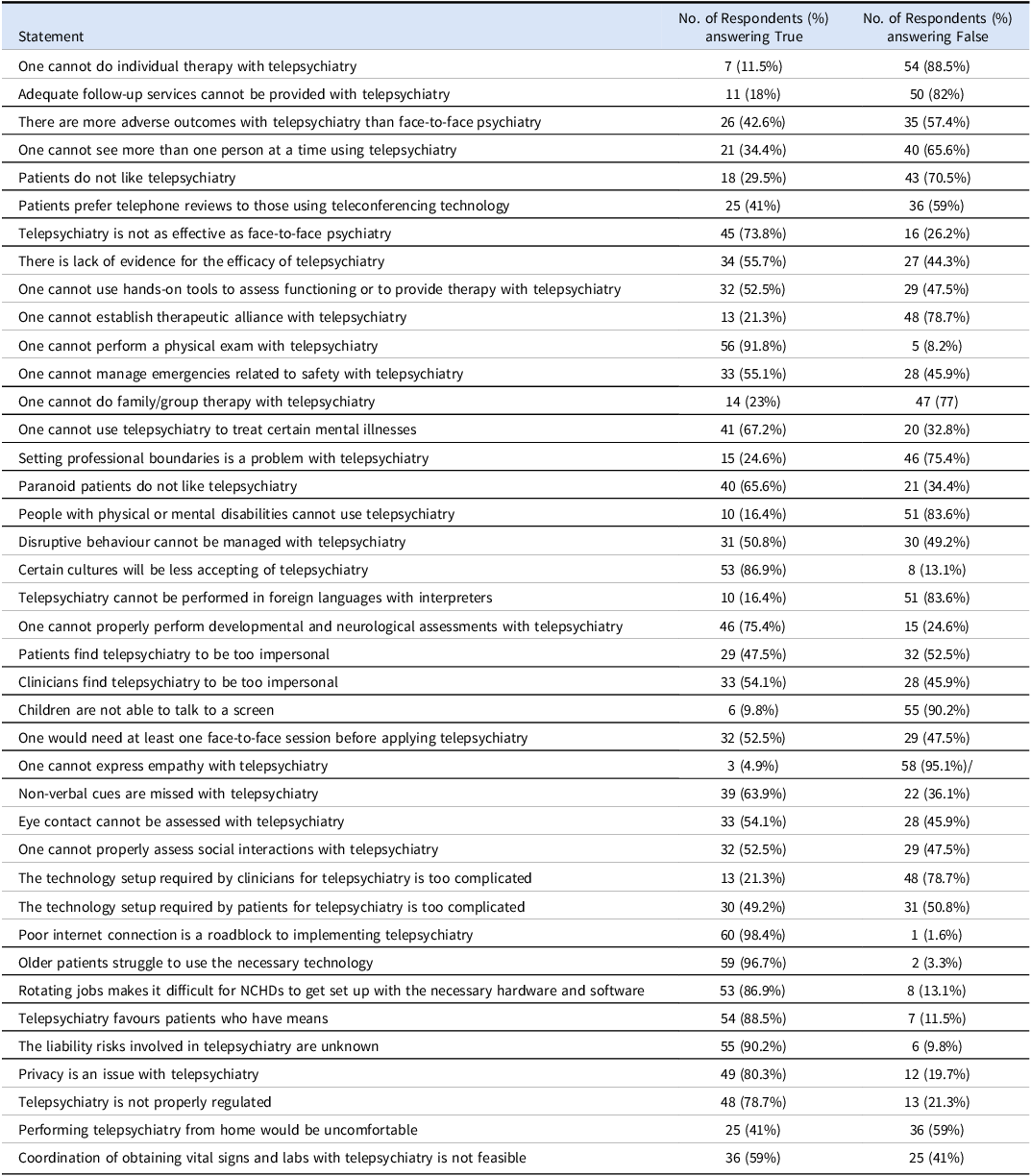
Most respondents felt that telepsychiatry could be used to provide adequate follow-up (82%, n = 50), establish therapeutic alliance (78.7%, n = 48), express empathy (95.1%, n = 58), and that adverse outcomes were not more common than for face-to-face reviews (57.4 %, n = 35). Most disagreed with the statements that patients do not like telepsychiatry (70.5%, n = 43), and that they prefer telephone reviews to using teleconferencing technology (59%, n = 36). However, the majority felt that telepsychiatry is not as effective as face-to-face psychiatry (73.8%, n = 45) and that there is a lack of evidence for its efficacy (55.7%, n = 34).
The respondents had concerns regarding some patient subgroups. The majority felt certain cultures would not accept telepsychiatry (86.9%, n = 53) and that particular mental illnesses could not be treated using it (67.2%, n = 41), including managing paranoid patients (65.6%, n = 40). Most felt that care could be provided through telepsychiatry for those with physical or mental disabilities (83.6%, n = 51) and children (90.2%, n = 55).
Thirty-one respondents (50.8%) felt that disruptive behaviour could not be managed using telepsychiatry. Most felt non-verbal cues could be missed (63.9%, n = 39) and that eye contact (54.1%, n = 33) and social interactions (52.5%, n = 32) could not be properly assessed using telepsychiatry. While the majority felt patients did not find telepsychiatry to be too impersonal (52.5%, n = 32), most felt that clinicians did (54.1%, n = 33), and that at least one face-to-face session would be needed before utilising telepsychiatry (52.5%, n = 32).
Practical concerns
Most respondents felt that the technology setup was not too complicated for clinicians (78.7%, n = 48). However this reduced to 50.8% (n = 31) when it came to patients. This was especially clear in relation to older patients where it was believed that using technology could be a struggle (96.7%, n = 59). Telepsychiatry was also felt to favour patients who have means (88.5%, n = 54). Poor internet connection was felt to be a roadblock to use (98.4%, n = 60). Rotating jobs was felt to impede doctors in getting set up with the necessary hardware and software (86.9%, n = 53). In addition, most believed that the liability risks involved in telepsychiatry are unknown (90.2%, n = 55), that telepsychiatry is not properly regulated (78.7%, n = 48) and had privacy concerns (80.3%, n = 49). See Table 2 for more details on ‘true/false’ questions.
True/false responses

Discussion
In this study 78.6% of respondents had delivered clinical care through telepsychiatry. Most respondents (59%) felt that patients preferred assessment using teleconferencing technology compared to reviews using telephone only. Videoconferencing allows visualisation, which is important in assessing a patient’s mental state (Looi and Pring Reference Looi and Pring2020). A qualitative study showed telepsychiatry was superior to telephoning in clinical consultation (Donaghy et al. Reference Donaghy, Atherton, Hammersley, McNeilly, Bikker, Robbins, Campbell and McKinstry2019).
In this study, 96.7% of respondents were unfamiliar with telemedicine prior to the pandemic. While most felt telepsychiatry added to patient care, the majority (86.9%) had received no telemedicine training, with 54.1% unaware of guidance issued by governing bodies. In a UK National Health Service survey, the majority of healthcare professionals surveyed were unfamiliar with telemedicine prior to the COVID-19 pandemic (Elawady et al. Reference Elawady, Khalil, Assaf, Toure and Cassidy2020). Like in this study, most felt that telemedicine enhanced patients’ care but had not received training and were unaware of General Medical Council guidance concerning remote consultations (Elawady et al. Reference Elawady, Khalil, Assaf, Toure and Cassidy2020).
While it is accepted that telemedicine increases access to care, this does not necessarily translate to an increase in quality of care. One way to narrow that gap is through optimising training (Punatar et al. Reference Punatar, Khan, Carrillo and Rajnarayanan2022). Telemedicine training literature has identified needs for both technical proficiency and care delivery quality assurance (Pathipati et al. Reference Pathipati, Azad and Jethwani2016; Waseh and Dicker Reference Waseh and Dicker2019). Paucity of training means that non-consultant doctors based in Ireland may not be adequately prepared to provide high-quality care via telemedicine, and may feel it is beyond their scope to do so. The American Telemedicine Association notes that most major medical associations recommend training in both the technical elements of telemedicine, and patient introduction to the virtual clinic space, which should include addressing scope and limitations of use (American Telemedicine Association, 2020). This is reflected in guidelines around telemedicine use in Ireland (College of Psychiatrists of Ireland 2020; HSE National Covid 19 Telehealth Steering Committee 2020), which most of the respondents in this study were unaware of. Indeed in this study 72% of respondents felt their training did not provide for them to become competent in telepsychiatry delivery. Lawrence et al. Reference Lawrence, Hanley, Adams, Sartori, Greene and Zabar(2020) found that while most postgraduate medical trainees were digital natives, this did not necessarily translate into competency with telemedicine use. This is inkeeping with previous literature (Pathipati et al., Reference Pathipati, Azad and Jethwani2016). Thirteen respondents (21.3%) in this study felt the technology setup for telemedicine for clinicians was too complicated, with this increasing to thirty (49.2%) in relation to patients.
While the pandemic accelerated the addressing of technical, regulatory and financial barriers to telemedicine (Scott Kruse et al. Reference Scott Kruse, Karem, Shifflett, Vegi, Ravi and Brooks2018), the success of long term implementation of telemedicine rests on the concurrent management of cultural (Shore et al. Reference Shore, Savin, Novins and Manson2006), human (Gagnon et al. Reference Gagnon, Godin, Gagne, Fortin, Lamothe, Reinharz and Cloutier2003; Demiris et al. Reference Demiris, Charness, Krupinski, Ben-Arieh, Washington, Wu and Farberow2010) and organisational change (Jennett et al. Reference Jennett, Yeo, Pauls and Graham2003; Faife Reference Faife2008; Cresswell and Sheikh Reference Cresswell and Sheikh2013). The challenges for non-consultant doctors in Ireland are well documented (Humphries et al. Reference Humphries, Crowe and Brugha2018; Humphries et al. Reference Humphries, McDermott, Creese, Matthews, Conway and Byrne2020). In this study, issues using telemedicine arising from rotating jobs, unknown liability risks, perceived lack of regulation and poor internet connection were noted. An Irish study on video-enabled healthcare found that technical issues were experienced by 34% of patients with video appointments, particularly those in rural settings (Lane and Clarke Reference Lane and Clarke2021)
In this study, most respondents felt that telepsychiatry was not as effective as face-to-face psychiatry (73.8%, n = 45) and that there is a lack of evidence for its efficacy (55.7%, n = 34). While in randomised trials, use of videoconferencing compared with traditionally-delivered clinical care, had no substantive negative impacts on disease progression or service use and resulted in reduced costs, of note, most of these studies were underpowered (Armfield et al. Reference Armfield, Bradford and Bradford2015; Abimbola et al. Reference Abimbola, Keelan, Everett, Casburn, Mitchell, Burchfield and Martiniuk2019; Ignatowicz et al. Reference Ignatowicz, Atherton, Bernstein, Bryce, Court, Sturt and Griffiths2019).
While in this study only 38.2% of clinicians agreed to liking using telepsychiatry, most (70.5%) felt patients found it acceptable. The literature demonstrates overall satisfaction with telemedicine among clinicians and patients (Hanson et al. Reference Hanson, Truesdell, Stebbins, Weathers and Goetz2019; Kissi et al. Reference Kissi, Dai, Dogbe, Banahene and Ernest2020; Haxhihamza et al. Reference Haxhihamza, Arsova, Bajraktarov, Kalpak, Stefanovski, Novotni and Milutinovic2021). However, telepsychiatry is not without its challenges for both groups (Cowan et al. Reference Cowan, McKean, Gentry and Hilty2019; Lopez et al. Reference Lopez, Schwenk, Schneck, Griffin and Mishkind2019; Uscher-Pines et al. Reference Uscher-Pines, Sousa, Raja, Mehrotra, Barnett and Huskamp2020), and despite remote assessment options, some patients still require in-person review (Kapoor et al. Reference Kapoor, Guha, Das, Goswami and Yadav2020). In this study limitations were acknowledged including in the areas of physical examination, management of emergencies and its use in certain patient subgroups and illnesses.
Conclusion
There are limitations to this study. The selection bias resulting from the low response rate suggests that the sample included are not truly representative of the population to be studied, and limits conclusions drawn. Given that the survey was disseminated electronically, it is possible that those who responded are more computer literate and more likely to be positively disposed to information technology generally. We might even infer that they represent a higher proportion of early adopters of telepsychiatry. There were also constraints due to the questionnaire used. A shorter survey distributed through different means may have improved response rates. Future research efforts could include the use of a control group, with comparisons on the duration and numbers of appointments, outcomes, and discussion of specific risks arising from remote interviewing.
That said, this study provides an important insight into the experience and attitudes of non-consultant doctors regarding telepsychiatry use and allows an opportunity to assess the impact of its rapid uptake during the COVID-19 pandemic. The integration of information technology innovations into large healthcare organisations, like the HSE, can be challenging (Sligo et al. Reference Sligo, Gauld, Roberts and Villa2017) so it is encouraging to see the ability to urgently adapt demonstrated. While telepsychiatry has not been maintained in anyway near the scale of usage during the peak of the pandemic, it is still a useful tool and lessons can be learned for the training of non-consultant doctors in psychiatry in Ireland, and beyond, into the future. More research is needed to assess telepsychiatry clinical and curricular experience, interest, and concerns. Additional curricular interventions during training could build skillset and confidence.
Financial support
This research received no specific grant from any funding agency, commercial or not-for-profit sectors.
Competing interests
The authors declare none.
Ethical standard
All procedures contributing to this work comply with the ethical standards of the relevant national and institutional committee on human experimentation and with the Helsinki Declaration of 1975, as revised in 2008. Ethical approval for publication of this research has been provided by the local Ethics Committee.