Introduction
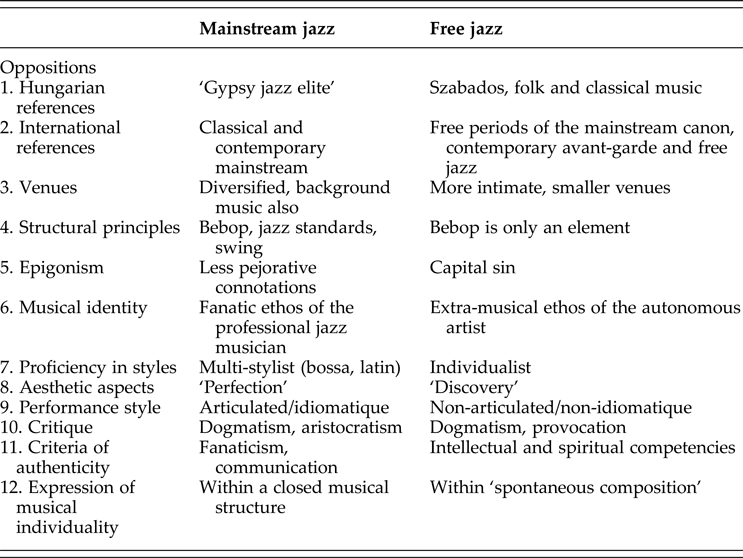
Drawing on an analysis of 27 interviews with jazz musicians of different generations, social groups and variegated musical styles within jazz and beyond, this article both applies and differentiates the Bourdieusian conceptual architecture (1993, 1996) in order to account for the construction and distribution of prestige in Hungarian jazz. In this context, it connects to recent efforts (Prior Reference Prior2008; Rimmer Reference Rimmer2012; Varriale Reference Varriale2015) to emphasise the broader social significance of intra-genre distinctions often underemphasised by quantitative analysis that seek to establish correlations between status and cultural consumption (Atkinson Reference Atkinson2011). By analysing the systematic oppositions involved in the mainstream-free jazz distinction (Table 1), the paper will argue that the institutionally unified jazz field understood as a ‘semi-consecrated’ cultural domain (Varriale Reference Varriale2015, p. 4) is structured by two oppositional poles, namely the ‘mainstream’Footnote 1 and ‘free jazz’ camps. Moreover, as a contribution to sociological approaches to jazz (Banks Reference Banks2012) and middle-brow cultural fields, especially from the viewpoint of intra-genre distinctions (Lopes Reference Lopes, Brown and Szeman2000), this analysis will show that position-takings and the distribution of prestige can be better grasped through the opposition of two anticommercial, competing orthodoxies than through the relationship between ‘heresy’, ‘orthodoxy’ and market forces, as the original theory would suggest (Savage and Silva Reference Savage and Silva2013, p. 113). It will do so by paying explicit attention to the role of contextual plurality in the structuring of classifiable aesthetic practices, which here refers to the peculiar embeddedness of Hungarian jazz within the systems of cultural hierarchies.
Structuring oppositions of the Hungarian jazz field

The article first discusses some theoretical questions raised by post-Bourdieusian (music) sociology (Prior Reference Prior2011, Reference Prior2013; Born Reference Born2010) and by recent studies that seek to specify the opposition between autonomy and heteronomy (e.g. Lopes Reference Lopes, Brown and Szeman2000; Santoro Reference Santoro2013), before briefly outlining the history of the field. The subsequent empirical sections gradually unfold the constituent elements of the mainstream/free distinction, in parallel with an interpretation of the empirical data, which comprises more than 40 hours of transcribed interviews. In particular, this paper analyses (a) the musical references of jazz musicians, (b) the discursive construction of (oppositional) jazz tradition(s), (c) the creation of entry costs, and finally, (d) how the classifiable types of aesthetic conduct and the competing legitimacy claims manifest themselves in relation to market imperatives. With its emphasis on musical discourses and Rimmer's (Reference Rimmer2012) concept of musical habitus – which to my knowledge has not been sufficiently explored as an analytic tool in cultural sociology – this analysis of the jazz field aims to contribute to the relatively under-researched terrain of jazz in cultural sociology.
Theoretical background: struggles that matter
Especially since the beginning of the new millennium, cultural sociology has witnessed profound theoretical and methodological changes (Atkinson Reference Atkinson2011; De La Fuente Reference De La Fuente2010) that also affect the sociological study of music in many classifiable ways (Prior Reference Prior2011, Reference Prior2013; de Boise Reference De Boise2016; DeNora Reference DeNora2004). If one wanted to follow the narrative of post-Marxist cultural sociology, it would be necessary to discuss how the concepts outlined in the canonical texts of Becker (Reference Becker1982) and Bourdieu (Reference Bourdieu1984, Reference Bourdieu1993) – ‘the three most cited works in the field of the sociology of art’ (De La Fuente Reference De La Fuente2007, p. 4) – were interpreted, applied and criticised in various socio-cultural contexts. Despite the mutually acknowledged differences between these ‘devoutly sociological approaches’ (Prior Reference Prior2011, p. 122), Becker's art world and Bourdieu's field theory played a central role in demystifying the artistic practices of ‘glorified great individuals’, to such an extent that the sociology of art is often accused of reductionism to social and ‘contextual factors’ (De La Fuente Reference De La Fuente2007, p. 410).
Despite Bourdieu's oft-cited relative ignorance towards music – especially popular music (Prior Reference Prior2011; Hesmondhalgh Reference Hesmondhalgh2006) – the crucial influence of his conceptual framework is signalled both by works that emanate from his spirit (Sterne Reference Sterne2003) and by critical attempts to move away from it (Born Reference Born2010). Statements such as ‘nothing more clearly affirms one's “class,” nothing more infallibly classifies, than tastes in music’ (Bourdieu Reference Bourdieu1984, p. 18) and concepts such as field, habitus and cultural capital have been central points of reference for various investigations, from Japanese pop music to Italian opera (Ferranti Reference Ferranti2002; Johnson et al. Reference Johnson2007).Footnote 2 Recent attempts to adjust Bourdieusian epistemology to contemporary national and global empirical contexts – which range from ‘defenders of the legacy’ to ‘critical repudiators’ (Atkinson Reference Atkinson2012) – and post-Bourdieusian scholars’ emphasis on the autonomy of aesthetic experiences have provided researchers with a variety of new concepts and perspectives. Rather than taking stock of the benefits and shortcomings of approaches that emphasise the variety of aesthetic experiences, or drawing the contours of a more ‘practice-based’ and ‘empirically nuanced’ music sociology (de Boise Reference De Boise2016, p. 179), this discussion will instead focus on the tensions surrounding Bourdieu's framing of field dynamics. In this sense, the approach follows works that focus on aspects where Bourdieu ‘gets it slightly wrong’ (De Boise Reference De Boise2016: 179), rather than fundamentally challenging his views to serve the growing demand for a new post-Bourdieusian research agenda.
Besides my scepticism towards the general benefits of an overarching music research paradigm,Footnote 3 I argue that differentiating the field approach from within holds considerable benefits for grasping the logic of how the symbolic hierarchy is constructed and maintained inside the Hungarian jazz field. Lopes’ genealogical case study on the evolution of the modern jazz paradigm in the USA is a good example of the empirically grounded expansion of Bourdieu's general framing of the cultural field (Lopes Reference Lopes, Brown and Szeman2000, p. 167). By calling attention to the structuring role of race, and the hybridity of cultural practices in the creation of jazz as a relatively autonomous field – notably, the incorporation of elements of both high and popular art – Lopes argues that the ‘restricted subfield of popular art’ should be incorporated into Bourdieu's original model of cultural production. Similarly, other authors stress the more rigorous study of popular art worlds overlooked by Bourdieu (Hesmondhalgh Reference Hesmondhalgh2006), arguing that the heteronomous end of cultural production can be as diversely structured by internal hierarchies as the autonomous pole (Savage and Silva Reference Savage and Silva2013, p. 120). By stressing the relational, rather than rigidly oppositional, relationship of autonomous and heteronomous structuring principles within newly emerging cultural fields (electronic music, popular music criticism, glitch, etc.), autonomy claims become apparent also at the heteronomous end of cultural production, while ‘appeals to the market are likely to be found among some contemporary avant-gardes’ (Varriale Reference Varriale2015, p. 14). This is precisely where jazz becomes an interesting domain of analysis as a modern cultural practice par excellence (Johnson Reference Johnson, Cooke and Horn2002), incorporating, including in Hungary features of both ‘high’ culture and ‘entertaining’, popular music – especially since its modernist turn after the mid-1940s (Lopes Reference Lopes2002). Moreover, since bebop is considered to be the something of a ‘lingua franca’ of jazz, the local ‘jazz diasporas’ are structured by, and at the same time influence, the transnational circulation of creative ideologies.
Lopes’ ‘hybridity’Footnote 4 is a key element for understanding field dynamics. However, Hungary presents a special kind of hybridity, in which folk music (often referred to as ‘pure source’), and 20th century Hungarian classical music (represented primarily by Bartók), serve as crucial references for free jazz musicians. Therefore, hybridity in the Hungarian case refers to the jazz field's ambiguous embeddedness within the hierarchical system of genres (classical music, folk music, mainstream/free jazz, avant-garde), wherein the folk-art hybridity characterising classical music is strategically exploited in the course of symbolic struggles between avant-garde and mainstream jazz camps.Footnote 5 Moreover, the ethos of anti-commercialism does not imply that the relational logic can be completely grasped by the struggles between consecrated and emerging avant-garde camps as suggested by Bourdieu (Reference Bourdieu1993, p. 53). The diachronic logic of struggles between ‘heretic’ newcomers who take over the positions of the consecrated avant-garde (or establish new positions in the field) differs from the logic of distinctions in the Hungarian jazz field, which is rather characterised by a relatively long-lasting opposition institutionalised in the 1970s. According to the ‘two modes of ageing’ distinguished by Bourdieu (Reference Bourdieu1996, p. 146), the opposition within the subfield of restricted production, i.e. between the newcomers (emerging avant-gardes) and the consecrated avant-gardes, corresponds to the opposition of two artistic generations which are ‘often a few years apart’ (Bourdieu Reference Bourdieu1993, p. 53). This distinction clearly presents itself in the case of the pianist György Szabados, who decades after establishing the free pole has not become the target of heretic disavowals aiming to push his legacy back to the past, but functions as a recognised reference that signifies continuity and identity for generations of young free musicians born half a century after him. Thus, Bourdieu's emerging/consecrated avant-garde typology is not entirely applicable to capture the temporal logic of hierarchisation within the Hungarian context, given that free jazz musicians are neither ‘fossils of another age’ nor heretic innovators and that their artistic practices in the present lean heavily on ‘what was done by the avant-garde of the past’ (Bourdieu Reference Bourdieu1996, p. 150). Based on the above, the case study presented here contributes to a better understanding of the intra-genre distinctions within contemporary jazz, which despite its internal differentiation remains a dominated musical subfield characterised by limited market success even at the commercialised end of the ‘mainstream’ pole (see e.g. Umney and Kretsos 2005).
Considering jazz, only a few studies have recognised the heuristic force of the aforementioned analytic tools (field, habitus, capital, consecration, etc.), especially by situating jazz within the field of cultural production (Lopes Reference Lopes, Brown and Szeman2000), by analysing the development of career trajectories (Kirschbaum Reference Kirschbaum2007), or by exploring the ‘structural ambiguity’ behind ‘objective’ selection processes in jazz education (Nylander Reference Nylander2014).Footnote 6 Regardless of their different conceptual frameworks, sociological studies of jazz – most notably Kirschbaum (Reference Kirschbaum2007) and Umney and Kretsos (Reference Umney and Kretsos2015) – tend to agree on the centrality of conflicts and rivalry in the jazz world (Banks Reference Banks2012, p. 80). Depending on the researcher's orientation and the level of cultural legitimacy expressed by jazz – from prestigious concert halls through smoky jazz clubs to background music in restaurants – different concepts are in use to describe people playing jazz. As they find Becker's (Reference Becker1951) early concept of ‘dance musician’ and ‘jazz musician’ problematic (the former overemphasising the commercial aspects, the latter the luxury of playing only jazz,), Becker and Faulkner (Reference Becker and Faulkner2009) prefer the term ‘ordinary musicians’, which adequately captures the diversity of working situations. While acknowledging the benefits of this concept, this paper prefers the term ‘jazz musician’ because the musicians strongly identify as such, even when playing popular songs at commercial gigs. The choice of terminology also points to the epistemological difference between art world and field, as the latter presupposes a sociological object-construction based on the reality-constructions of agents, rather than on observing ‘what is actually going on’. Engaging in a range of economic activities, including playing traditional forms of jazz in a big band in order to experience the ‘luxury’ of playing jazz, does not make jazz musicians ‘ordinary’, regardless of the objective structure of their earning activities, not to mention the contempt jazz musicians (both free and mainstream) – at least in Hungary – manifest towards commercial music.
Instead of focusing on the field narrative of Hungarian jazz to delimit the boundaries of jazz in the broader field of cultural production, this study supports Rimmer's (Reference Rimmer2012) approach of further exploring the intra-genre variability based on the concept of musical habitus. In doing so, the interview analysis investigates the logic of how socially conditioned dispositions and field-specific capitals operate and shape the conflict dynamics of the contemporary Hungarian jazz field. Owing to my connection with the field, I asked primarily ‘Bourdieusian’, struggle-oriented questions in the course of this quasi-ethnographic research: why is the field characterised by discontent, rivalry and uneasiness rather than by cooperation? Why do the struggles to impose (a) legitimate definition(s) of jazz coalesce around free and mainstream jazz? What are the social determinants of position-takings, that is to say, the structural basis of the field dynamics and the definition of stakes? By answering these questions in the empirical sections, I also aim to demonstrate that a ‘particular case that is well constructed, ceases to be particular’ (Bourdieu and Wacquant Reference Bourdieu and Wacquant1992, p. 77); in other words, despite the limitations of the national context, the aim is to contribute towards an expansion of field research that may be useful in other ‘semi-consecrated’ cultural spheres.
The rise of the Hungarian jazz field: an outline of field history
Johnson's observation that jazz was ‘invented in the process of being disseminated’, and ‘not invented and then exported’ (Johnson Reference Johnson, Cooke and Horn2002, p. 39), also holds true for the historical genesis of Hungarian jazz. Despite recent attempts to professionalise Hungarian popular music research (Barna and Tófalvy Reference Barna and Tófalvy2017), the narrative of jazz in Hungary is still at the beginning of its construction. Nevertheless, it is important to sketch some of the most important phases of the historical evolution of jazz in Hungary in order to shed light on the broader context in which the internal struggles are embedded.
The arrival of jazz in Hungary was not without conflicts. During the first period, the post-World War I era, Gypsy musicians playing ‘Gypsy music’Footnote 7 collectively revolted against this new ‘decadent’ genre (Zipernovszky Reference Zipernovszky2015) for taking their audience. Besides the economic competition, jazz was also perceived as a threat to Hungarian national culture in the context of cultural Americanisation. As ‘music-making for money in Hungary was almost entirely associated with Gypsies’ (Brown Reference Brown, Hesmondhalgh and Born2000, p. 124; see also Schneider Reference Schneider2006, pp. 24–9), in defending this monopoly, Gypsy musicians became prime defenders of authentic Hungarian culture, as opposed to the decadent, Western Other that jazz signified. While consecrated art music was polarised between 12-tone atonalism (Schoenberg) and neoclassicism (Stravinsky), the emerging popular music field witnessed a (racialised) struggle between two relational significant others: black Americans playing swing jazz, and Gypsies playing popular Hungarian songs (Brown Reference Brown, Hesmondhalgh and Born2000).
Leaning on Havadi's (Reference Havadi and Tófalvy2011) historical–sociological account of the emancipation of Hungarian jazz during the state socialist era (1948–1989), two phases can be distinguished after the brief golden age of postwar swing in Hungary (1945–1948). During the highly repressive Rákosi era (1948–1956), official culture politics excluded jazz – which was increasingly played by Hungarian Gypsies – from both public venues and the media, considering it to be ‘bourgeois dance music’ replete with moral decay and imperialism, rather than an autonomous genre. Nevertheless, as a consequence of the softening cultural politics, the growing scientific attention towards popular music and the autonomy claims of jazz musicians, the first jazz department of the socialist bloc was founded in Hungary in 1965. The growing number of jazz musicians winning prestigious national awards and the expanding media coverage are also reliable indicators of jazz music's increasing cultural legitimacy.
Parallel to the historical constitution of jazz as a relatively autonomous field, in the 1970s the scene began to polarise between mainstream and free jazz. The ‘heretical transformation of the field’ (Bourdieu Reference Bourdieu1993, p. 42) was marked by the emergence of institutionalised boundaries, the diversification of field-specific stakes and the prestige embodied by leading ‘prophet’ figures. Moreover, rival principles of legitimacy were further institutionalised by distinct festivals, the emergence of a jazz club network that physically separated these camps and the launch of the DIY journal Jazz Studium (1982–1990), which started to canonise the free jazz tradition in Hungary. The symbolic rupture in the field was conditioned by class and ethnic relations, given the growing number of Gypsy musicians involved in mainstream jazz and the coalescing of predominantly middle-class musicians around the prophet of Hungarian free jazz, György Szabados. Although the situation was more complex than this binary framing suggests, the growing association with upward mobility (and the shift from dance music to ‘art music’) had a considerable impact on the emerging aesthetic distinctions from the early 1970s onwards. The most notable aspect of this generational shift is the upward mobility in the hierarchy of cultural legitimacies (i.e. playing bebop), which allowed the descendants of musician dynasties to gradually become the elite group of the emerging jazz music field. Polarisation, however, is a better term than subfields to describe the structure of the field, given the institutional setting that currently unifies this historically differentiated force-field. Both free and mainstream musicians (a) study at the Franz Liszt Academy of Music's (FLAM) Jazz Department, (b) make albums with the same record companies (e.g. BMC records) and (c) receive the same professional awards and scholarships. In short, they ‘inhabit’ the same institutions and compete for the same grants.
Methodology
Since the heuristic value of field theory is not only theoretical but also essentially methodological (Savage and Silva Reference Savage and Silva2013, p. 118), the main practical challenge for avoiding scholastic bias (Bourdieu Reference Bourdieu2003) was to construct the space of possible relations based on the jazz musicians’ own classificatory judgments, rather than absolutising certain viewpoints or using pre-established concepts (Bourdieu Reference Bourdieu1984, pp. 169–70). The early phase of the research was about developing a reflexive sense of the stakes at play, i.e. for the aesthetic, symbolic and economic aspects – often expressed in subtle (bodily) gestures, manners and uses of language – of this particular cultural domain. Mirroring Thornton's (Reference Thornton1995) notion of subcultural capital, to become recognised in the scene as a researcher involved all sorts of strategic investments for keeping the balance (getting neither too familiar nor too distant) in ‘behaving comme il faut’ (Bourdieu Reference Bourdieu1984, p. 472) with the musicians. Drawing on the grounded theory method (Glaser and Strauss Reference Glaser and Strauss1967), the research questions stem both from an empirical connection to the field (semi-structured interviews, observations, informal discussions) and the continuous re-evaluation of ‘ready-made’ theoretical concepts, for instance about field dynamics.
Through purposive sampling and snowballing I conducted 27 interviews averaging an hour and a half, of which two were conducted in mini-focus groups (two to three persons), the shortest being 30 minutes, the longest lasting 3 hours, with predominantly male musicians of distinct ethnic groups, generations and different levels of prestige (understood as a relational construct). In the first stage of the research (~10 months) respondents were obtained through purposive sampling of band leaders, members of active ensembles, prestigious Hungarian Romani and non-Romani mainstream jazz musicians, big band leaders, music teachers, leaders of jazz institutions and free jazz musicians. Via snowballing, this sample of 12 musicians led to further interviews with young entrants to the artistic labour market, members of musician families of Gypsy origin and musicians playing various ‘hybrid’ (sub)genres from crossover to other contemporary forms of jazz. The youngest respondent was 21 and the oldest 60 years old, while most were between the ages of 25 and 45. All played an instrument. Although the research started in 2014, most interviews were conducted by spring 2017. The resulting ~40 hours of recording were transcribed and coded manually to identify the themes emerging in relation to the free/mainstream jazz distinction. As regards the gender make-up, the field was heavily male-dominated, and female musicians were almost without exception present as vocalists, which is in line with trends observed in the popular music industry (e.g. Leonard Reference Leonard2007, p. 28; Buscatto Reference Buscatto2007).
To operationalise the relational logic, my goal was to categorise the classificatory judgments of the issues at stake, i.e. the technical and aesthetic aspects of legitimate jazz practices. For this reason, I divided the musicians into groups in accordance with how they relate to characteristic definitions of mainstream and free jazz (a fundamental distinction that emerged in all interviews), based on the discursive construction(s) of each. A first step was to explore the relations and attitudes towards the definitions of jazz that are ‘at play’ among the musicians (and not constructed by me). These incorporate a series of elements that also function as capital within the field (the knowledge of standards, techniques, etc.). The subsequent phase included analysing how unquestioned and un-reflexive someone's position was. Asking the same questions from musicians of different musical habitus (differences in their schemes of dispositions as ‘measured’ in the categories of Table 1) allowed me to identify the dynamism of prestige by reconstructing the internal hierarchies and status distinctions among musicians categorised as free or mainstream – again, based on the musicians’ own categorisations. My strategy also involved confronting musicians with the doxa of other musicians (each group seeing itself as homogenous), given the often-unquestioned ideas about legitimate musical practices, or the definition of jazz itself. Questions about influential figures of the jazz canon (e.g. Charlie Parker) meanwhile sought to observe how specific factors had affected musicians of different positions.
After one year in the jazz world, the system of classificatory schemes outlined in Table 1 began to crystallise. In other words, the rigid mainstream/free jazz binary expressed itself in a system of recognised oppositions based on classifiable schemes of musical habitus. The construction of ‘pure poles’ based on the qualitative data seemed a reasonable approach for delineating the boundaries of particular aesthetic practices. The hierarchisation of the field outlined in the analysis was based on the recognition of what the musicians considered relevant for ‘defining the universe of problems, references, intellectual benchmarks (…), concepts in -ism, in short, all that one must have in the back of one's mind in order to be in the game’ (Bourdieu Reference Bourdieu1993, p. 176). The following interview excerpt synthesises the fundamental opposition by describing – with an almost ethnographic sensibility – the behaviour of Hungarian jazz musicians at the recent funeral of a colleague who was respected by both sides:
Looking at them it was so telling how the two groups differed from each other, by defining themselves in their physical appearance, by the way they behaved not interacting with each other. You could feel that the fundamental problem of Hungarian jazz is that both sides are enormously closed. They condemn, despise and close the doors in front of each other with the very same intensity.
This episode encapsulates the habitual, behavioural and aesthetic distinctions analysed throughout this study and summarised in Table 1. The logic of analysis consciously starts from the simple distribution of references, followed by an outline of the distinct interpretations of traditions, before finally illustrating how all of this is expressed at the level of praxis. The ‘structuring oppositions’ in Table 1 are referred to as ‘o.1–o.12.’ to facilitate a comparison between the listed aspects and the qualitative analysis.
Oppositional jazz traditions and divided references
The free–mainstream opposition is reflected in the classifiable differences as to how Hungarian and international references function as sources of legitimacy (see o.1–o.2.). Regarding Hungarian references, mainstream musicians stress the importance of the first generation of Gypsy jazz musicians who started to play mainstream American jazz from the early 1960s. Internationally, classic mainstream musicians are cited, such as Charlie Parker and Miles Davis. The references differ in accordance with the instrument played, but generally include the bands of these jazz giants. Szabados, the founding prophet of Hungarian free jazz, is rarely mentioned, and generally only in response to targeted questions.
Free musicians – both those identifying themselves and those categorised by others as such – stress without exception the importance of Szabados and his circle of followers. While they believe that mainstream musicians are merely copying the North Americans, they laud Szabados for his efforts to synthesise Hungarian high art traditions (Bartók) with folk music (including traditional Gypsy folk music) and jazz, thereby lending a ‘national character’ to improvised music. From the international jazz tradition, the free periods of the classic jazz giants are commonly mentioned, that is to say the free segments of the shared classic jazz canon (that of Charles Mingus and the late period of John Coltrane, for instance). This group explicitly uses extra-musical theoretical and aesthetic references to legitimise its positions. In their view, FLAM's Jazz Department is the old authority of consecration that has banned such innovators as Albert Ayler or Derek Bailey from its curriculum. Within its circles, the existence of a de-facto parallel department is a common topos, which highlights the opposition between orthodoxy (as institutionalised in the Jazz Department) and the heretic community of free jazz musicians: ‘to me the greatest school was the Grencsó Open Collective’.Footnote 8
Turning the doxa into dogma: the functioning of recognised differences
The hierarchisation within the field is closely related to the meanings musicians attach to the jazz tradition(s) – a construction in line with DeVeaux (Reference DeVeaux1991). Therefore, this section will outline how musicians interpret, construct and apply this constructed heritage. On the one hand, musicians referred to as ‘mainstream’ insist on the ‘blessed trinity’ of jazz that emerged in the USA in the mid-1940s: (a) improvisation within (relatively) fixed harmonies (= jazz standards); (b) swing rhythm; and (c) ‘jazzy phrasing’, which refers to the particular mode of playing rather than to what is played. The following excerpt from an interview with a mainstream Gypsy musician born into a musician family convincingly illustrates the recognised anomic state (Bourdieu Reference Bourdieu1996, p. 68) regarding the legitimate definition of jazz:
The biggest problem is about the concept! Everyone calls himself a jazz musician. Jazz is – although others despise this – bebop and the mainstream!
The differences in the technical aspects of music-making, such as the rupture with conventional harmonies (typical of free jazz) are reflected in distinct classifiable aesthetic stances, as pointed out by a free musician: ‘the difference between the aesthetics of perfection and the aesthetics of non-perfection: the latter emphasises experimentation to create something new’ (see o.7–o.9). At the level of musical practice, the (not-yet-codified) ‘aesthetics of non-perfection’ stands for the intention of overcoming the realm of fixed harmonies (jazz standards) by ‘real-time’ improvisation where the pre-given elements are dramaturgical points instead of harmonic progressions. The contrasting interpretations of Charlie Parker (an important reference for both groups) shed light on the fundamental distinction between the tradition of permanent rupture with aesthetic tradition (Bourdieu Reference Bourdieu1996, p. 244), and, on the other hand, ‘turning the doxa into dogma’ (Bourdieu Reference Bourdieu1996, p. 185) through the absolutising of the aesthetics of bebop.
Parker was avant-garde back then, this is what mainstream musicians tend to forget. The tradition is very important, but doing the same thing Parker did does not make sense. I have no problem with bebop, it can be used today as a tool.
From the free jazz viewpoint, bebop is seen as only one element, not the idiom par excellence of the only legitimate musical practice (o.4). In contrast, the mainstream viewpoint emphasises the structural, technical and performative aspects of the established ‘new language’:
Respect our history, respect Charlie Parker! He is the greatest innovator, everyone came from him. They started to play new harmonies, jazz started to move towards modern art, not only dance …
The contrast between these two representative interview excerpts lies at the heart of the mainstream/free distinction. While Parker is seen by mainstream musicians (regardless of ethnic origin) as the ‘uncreated’ creator of modern (mainstream) jazz aesthetics, the one who laid down the laws of jazz, free musicians in contrast see in him the destroyer of outdated dogmas; in short, the ‘creator of the doxa’ stands opposed to the ‘destroyer of the dogma’. Moreover, the opposition between dance music (‘not only dance’) and modern art present in the Romani musician's Parker-interpretation – the well-known low/high binary in jazz history (Johnson Reference Johnson2000) – reflects the structural homology that the shift from café house Gypsy music to jazz signified within the dominant, urban elite of this dominated ethnic group. The intense adherence to the mainstream doxa, i.e. the emphasis on jazz's high art status, can be understood as the symbolic expression of the upward status mobility of Gypsy musicians: aesthetic dogmatism provides legitimacy in the social field. In Hungary too, aesthetic differences in jazz are ‘tied to the struggles over the constitution of social status hierarchy’ (Lopes Reference Lopes, Brown and Szeman2000, p. 183), since these are closely related to Gypsy musicians’ comparative advantage owing to early musical socialisation and the supporting network of extended family ties, as the following interview excerpts illustrate:
My father could tell me things that other musicians learn at the Liszt Academy. What they learn when they are 25, I learnt when I was 13 … The most musicians are found amongst the Gypsies, this is our culture.
The most distinctive characteristic of the mainstream ‘hard core’ – often but not exclusively associated with Gypsies – is the imposition of high entry costs to their circles as a symbolic expression of their often fanatically advocated ‘professional’ (jazz) musical habitus (o.12). The attribute ‘fanaticism’, which was a term Gypsy musicians often used to distinguish themselves from other musicians, refers to a particular lifestyle attached to playing mainstream jazz. This is also how a particular style of jazz music (namely bebop) functions as a cultural practice of distinction in the Hungarian context, as illustrated by the following interview excerpt:
Fanaticism, this is the only way … You shouldn't practice music as a profession, but you must live for it. This is a form of life, you know. You must build everything around this; family, sex, love, drugs … everything, you know. The only reason for the existence of camps is because Gypsies don't do anything else but music and [therefore] there are more fanatics.
For them, the acquisition of mainstream aesthetics is indispensable for recognising others as legitimate jazz musicians. It is therefore recurrent to refer to mainstream jazz features as laws (‘I can't play with someone who can't play bebop or swing, (…) this is a must’) and to construct collective improvisation along the analogy of family ties:
A.H.: – Is it a misbelief that Gypsies like to play with each other?
– No, it is not stupid to assume so. Roma people represent a style in Hungary, which is a style of very high quality: Kálcsi, Robi, old Szakcsi, TzumoFootnote 9 …
A.H.: – Does this mean that they play very high-quality mainstream jazz, or that they play this differently?
– Differently. This is why [names] play gigs [only] with each other.. . Romanies within a certain style get on very well with each other: that is the true mainstream jazz, the bebop, but also a bit of hard bop, you know. If a non-Romani goes to play with them it is possible that they won't harmonise.
Family, this is jazz, this is where it comes from. I wish all jazzists would want to grow up into this category.
If one observes the compositions of bands, non-Gypsies are also present in predominantly Gypsy bands, which supports the idea that the entry costs are based not solely on ethnicity, but on musical dispositions that strongly favour mainstream aesthetics, whose strongest advocates tend to be Hungarian Gypsies. A foreign jazz musician, having joined a jam session with the ‘mainstream hardcore’, was acknowledged by the pianist with the words: ‘You are a good Gypsy’. Turning ethnicity into an aesthetic category (the ‘compliment’ of ‘good Gypsy’ means playing mainstream jazz at a professional level) is an important characteristic of Hungarian mainstream jazz. Most free jazz musicians, however, stand opposed to this understanding of tradition, as illustrated by the following quote where the main reference is Bartók:
To me, jazz means one thing: progression. It means a kind of music that exists in the present. As Bartók said, every music has the right to derive from earlier art, but this doesn't mean that it is obliged to do so.
It is important to emphasise that free musicians distance themselves from all ‘dogmatic’ advocates of mainstream jazz, and that non-Gypsy mainstream musicians who laud Gypsy musicians for their musical skills are at the same time critical of the perceived exclusiveness of this ‘elite’ group. The act of de-historicising is manifested in the rejection of epigones as opposed to the ethos of continuity represented by mainstream ‘conservativism’ (o.5). The typically presentist free viewpoint expresses its intention to set music free (some proponents wear shirts saying ‘free the jazz’), both from latent and institutional expectations of tradition and from fixed musical forms such as the conventional harmonies of the (mainstream) jazz standards (o.12). Its ethos of ‘pure aesthetics’ is formed in contradistinction to a ‘traditionalist’ mainstream jazz that is figured as lacking authenticity, innovation and originality (o.10–o.11): ‘If as a writer you don't have your own voice you are no one, but in music you can get by’. In the free players’ view, mainstream musicians overemphasise the technical aspects, which ‘makes them lose the spirituality of music’ to which ‘free jazz provides an alternative’. In sum, their entry costs go beyond mere musical characteristics: playing mainstream jazz well ‘makes you a jazz musician, but not an autonomous artist’. This was the clearest articulation of the free jazz habitus’ extra-musical characteristics (o.6).
In the course of an interview with an acknowledged Gypsy musician, another musician, who had listened to our conversation, suddenly cut in, saying ‘he would like to see Parker epigones’ in the Hungarian scene, illustrating that the imitation of great predecessors is not necessarily contemptible, but serves as a meaningful sign of proficiency. Accordingly, most mainstream musicians, regardless of age, gender, generation and ethnicity, believe that musical individuality and uniqueness unfold in the course of ‘improvising to serious harmonies’, and – because the free musicians are seen to lack musical mastery and the technical background – the musical practices of the latter are not considered authentic, but ‘fake’ (to use the softest term mainstream musicians use when describing free ones). In short, in contrast to Nylander's (Reference Nylander2014) analysis, the rules of entry to the ‘jazz game’ are less constituted on the selection processes of consecrating bodies (e.g. the FLAM) than on the classification of dominant positions of the field.Footnote 10 The following interview excerpt well illustrates the distinction between the mere ‘imitation’ of great predecessors and how individuality and authenticity are constructed in mainstream jazz:
If you play jazz, your imagination, creativity and improvisation must strive strongly not to play Charlie Parker, but to play yourself instead.
Musicians often use the metaphor of language in order to emphasise that different positions in the field depend on the appropriation and use of the ‘language’ described earlier. Intellectualising terms such as ‘idiomatic’ and ‘mimetic’ emerged from the interviews with free jazz musicians as a meaningful code for distinguishing their aesthetics from those of mainstream jazz, emphasising the difference between idiomatic (adherence to mainstream genre conventions, improvising to fixed harmonies, etc.) and non-idiomatic/mimetic aesthetics, where the emphasis is placed on breaking with conventional bebop harmonies (o.9).
Those musicians who do not fully represent either aesthetics often criticise both mainstream and free jazz musicians for the same orthodoxy – constructed, however, on different principles:
There is a line that says if tradition cannot be perceived directly in music, then it's not valuable. I see this as enormously self-deluding. The traditional line of the genre undermines itself, exactly because they place music not on musical, but on ideological grounds.
The opposition between musical and ideological attributes refers to those abstract, aesthetic aspects of jazz – often codified in textbooks and institutionalised in conservatories – which are not innocent technical features, but fulfil ‘ideological’ functions of legitimacy, as pointed out by DeVeaux (Reference DeVeaux1997) in the US context. Acquiring the aesthetics and style of canonised figures therefore functions as capital that conditions the schemes of mutual perception and appreciation within the field. According to a fresh graduate interviewee, during jam sessions it is not beneficial to criticise certain members of the mainstream pantheon – e.g. Miles Davis – to avoid offending mainstream musicians: ‘They wouldn't hit me or anything, but probably say something like “I'm not surprised that you've achieved so little” if you criticise Davis’. Knowing Davis’ compositions functions both as an entrance fee to mainstream circles and ‘as a type of symbolic exclusion’ (Bryson Reference Bryson1996, p. 886). Such concepts as epigonism, ‘playing yourself’, ‘creativity’ and ‘improvisation’ or even ‘innovation’ convey different meanings according to the position occupied in the field. Therefore, in the course of constructing musical habitus the modes of use differ, while the categories are identical, which can be bewildering if the categories themselves are not understood relationally.
The ambiguous embeddedness of the field within the hierarchy of legitimacies is the reason for the relatively stable field-relations: there are, so far, no ‘winners’ (avant-gardes that have become consecrated and thus mainstream) who legitimise their positions against the ‘fossils of another age’, throwing them out or back to history – as happened with Dixieland, with the emergence of bebop – or the ‘painters who supplied the galleries of the Right Bank in fin-de-siècle Paris’ with works emulating the avant-garde of a previous age (Bennett Reference Bennett2005, p. 150; see also Bourdieu Reference Bourdieu1993, pp. 105–7). Instead, the logic of distinctions in the Hungarian jazz field could be better grasped through the notion of ‘simultaneous aesthetic hierarchy’ than the opposition between autonomy (‘high art’) and heteronomy (‘commercial art’). This notion refers to the structuring force of the dogmatic interpretations (i.e. the discursive constructions of aesthetic idols) and representations (i.e. performance practices) of two competing middle brow musical legitimacies that have coexisted since the 1970s. Both ‘camps’ play in consecrated concert halls to stable (i.e. relatively small) audiences, and if on any weekday someone wishes to listen to an established musician from either the ‘free’ or the ‘mainstream’ camp, (s)he will not find major differences in audience size, although most free musicians prefer playing at small, intimate venues (o.3). Not to mention that Szabados received the most prestigious national award, the Kossuth Prize, which has only been awarded to 10 jazz musicians, seven of them ‘traditional’ Dixieland musicians. At the same time, while mainstream jazz, in line with international tendencies, enjoys a higher degree of institutionalisation in the form of specialised education, and moderate popular success following from the partial legitimacy bestowed on it by the dominant class fractions (festivals, grants, media appearance, collaborations with highbrow cultural projects, etc.), free jazz has not been able to convert the accumulation of symbolic capital into the status of legitimate culture. That this ‘inorganic’ consecration (the Kossuth Prize, for instance) has not fuelled the process of emancipation is primarily due to the persistent disavowal of the status of legitimate culture as consumed by the dominant class fractions, and the lack of producers of symbolic recognition from which free jazz could profit.Footnote 11 Therefore, in contrast to Bourdieu's account of the fight between the dominants, ‘whose strategy is tied to continuity’, and the dominated, ‘whose interest is in discontinuity’ (1996, p. 157), the mainstream/free distinction is rather a conflict of disinterested producers owing to the genre's continuous marginalisation from the 1990s in Hungary.
Without entering into historical anamnesis, the above account aimed – mainly through the analysis of the discursive construction of jazz traditions – to provide a model of the current state of the field by drawing on meaningful oppositions and classifiable differences that express themselves in the free/mainstream distinction. This remainder of this section will further explore the processes of mutual delegitimisation by shifting the focus to the construction of, and challenges to, the free jazz doxa. Besides the critiques from other positions inside the field, an analysis of the inner conflicts reveals the difficulties arising from symbolic gestures that seek to historicise the prevailing (mainstream) aesthetic conditions (Bennett Reference Bennett2005, p. 150). This also holds the promise of differentiating the free camp, which is perceived as homogeneous by other positions, thereby providing a more dynamic picture of field relations.
Critiques articulated from the mainstream position reject the perceived emptiness of what can be understood as the aesthetics of denial, arguing that free jazz has nothing more to say beyond going against the mainstream aesthetics. This critique is based on the common notion that the mere rejection of mainstream jazz is in itself not enough to challenge its prevailing cultural legitimacy: a ‘statement’ is needed. Progression and innovation are only legitimate if articulated musical content in the form of ‘melody-islands’ is present, above and beyond the non-articulated rhythms and tunes that some mainstream musicians associate with ‘pig slaughter’ and ‘noise’, but not with music. These are clear signs that free musicians are labelled as parvenus who have found refuge within the semi-consecrated realm of contemporary Hungarian free jazz, which is still on the road to becoming the consecrated avant-garde.
In more than 40 hours of interviews, there was little evidence of self-criticism: most positions are static and simplistic, which is one aspect of the camps’ self-segregation – not from the audience, as outlined by Becker (Reference Becker1951), but from each other. It is characteristic of the Hungarian scene that the conflicts between the musicians themselves are more fundamental than those between the ‘dilettante’, ‘square’ audience and the musicians, although subtly so because they play at different venues, with little meaningful interaction. Jam sessions, contrary to Becker and Faulkner's (Reference Becker and Faulkner2009) emphasis on cooperation, are avoided not only by free musicians, lest they be ‘examined’ by mainstream musicians, but also by the majority of my respondents who describe the atmosphere as ‘clannish’ and ‘hostile’. Status hierarchy is thus mutually self-reinforced by the closed groups that attend jam sessions. The dogmatically advocated anti-mainstream aesthetics is divisive in the free scene as well, especially among the few members who criticise this dogmatism:
I shouldn't dislike mainstream only because of snobbism … because I am a free jazz musician. There is no shitty music, one can play it in a shitty way, that's it!
As illustrated by the following excerpt, some free jazz musicians criticise their own camp for the same reasons as the mainstream one: that both are exclusive and follow idols of distinct aesthetics:
We take part in the creation of sects, and we have to change that. You see it absolutely correctly and we have also recognised this. It shouldn't be the case that if a ‘jazzy’ motive pops up I will refuse to play it. Not for the first time, I realise that exactly the same dogmas apply in our circles as in the mainstream ones.
Conclusion
This paper connects with the recent ‘qualitative counter-attacks’ (Atkinson Reference Atkinson2011, p. 169) against statistical surveys, which often employ totalising genre categorisations (e.g. Chan and Goldthorpe Reference Chan and Goldthorpe2007) and thus ignore the socially meaningful distinctions within pre-constructed musical genres. The constitution of the mainstream/free jazz distinction – analysed along categories applied by the musicians to justify their practices – provides further evidence for the dynamic, hierarchised and differentiated nature of musical genres (Rimmer Reference Rimmer2012), as opposed to the ‘top-down’ view offered by surveys that seek empirical correlations between genre-preferences and social status (Peterson and Simkus Reference Peterson, Simkus, Lamont and Fournier1992). Although this study aimed to typify and grasp how shared but differently interpreted references contribute to the agonic structuring of this particular field, it also showed that intra-genre hierarchies are closely related to status concerns. This proves that tangible social factors (class, gender, ethnicity) do operate as constitutive elements in the construction of recognised stakes and subsequent musical praxis. In this regard, ‘colourful distinction’ (Trienekens Reference Trienekens2002), i.e. tendentious mainstream dogmatism on the part of Gypsy musicians, is the symbolic manifestation of the dominant fraction of a dominated ethnic group. In short, in the face of social discrimination and oppression, jazz offers these dominant musicians a domain where they can become ‘aristocrats’ recognised as idols. The concept of simultaneous hierarchy was offered to mark the differences between Bourdieu's original account of field dynamics and the functioning of the Hungarian jazz field, which is characterised by a long-lasting opposition between two disinterested poles.
Bourdieu-inspired studies are often accused by ‘post-Bourdieusian’ researchers (e.g. Hennion Reference Hennion2007; DeNora Reference DeNora2000) of ignoring the musical character of music, its emotional forces and the complexity of how it ‘gets into action’ in the multifaceted contexts of everyday uses. Nevertheless, by applying a methodology that builds on what the musicians themselves define as important, this study shows that the outlined distinctions are not merely the outcome of simplification or a reduction to mysterious ‘hidden structural forces’ (Prior Reference Prior2013, p. 189); in other words, the field is not just a decontextualised environment populated by agents unaware of the underlying principles of their actions. In my view, an ethnographic analysis of in-situ interactions combined with a qualitative analysis of the field, conceptualised here as a mental construction, is an adequate mixed-method for exploring the social meaning of nuanced musical practices and interactions including ‘music's affordances’ (DeNora Reference DeNora2000). The musician shouting, ‘you are a good Gypsy’ to his foreign colleague is a prime example of how socially conditioned dispositions are unfolded and manifested ‘in action’. By reconstructing the social reality of this particular field in order to analyse the prevailing modes of classifications, we therefore gain a more truthful understanding of contemporary musical dynamics. As Bourdieu himself asserted in the Preface to the Rules of Art (Bourdieu Reference Bourdieu1996, pp. xviii–xix), this intensifies the artistic experience rather than destroying it.