Introduction
On August 24, 2016, an earthquake measuring 6.2 (SD=0.016) on the moment magnitude scale hit central Italy at 03:36:32 CEST (01:36 UTC). 1
The National Alpine and Cave Rescue (NACR) unit is part of the National Civil Defense Service (NCDS; Rome, Italy); it provides first aid after a natural disaster. The first NACR rescue team arrived in Amatrice on August 24, 2016 at 4:48am.
The aim of this report is to document the resuscitation and pain management provided to earthquake victims during the first hours immediately following the earthquake, before patient hospitalization in the Advanced Medical Presidiums (AMPs).
Sources
Study Setting
The rescue team in this report was the first to arrive in Amatrice before the AMP had been established and the NCDS had been activated. The hospital in Amatrice was completely destroyed.
Study Population
As of the writing of this report, 234 people had died; 2 this team evaluated and treated 101 patients.
Data Source
This is a field report study that was approved by the local research ethics committee of the Health Unit of L’Aquila (L’Aquila, Italy; Ref. 05/01/2017, n.12).
Observations
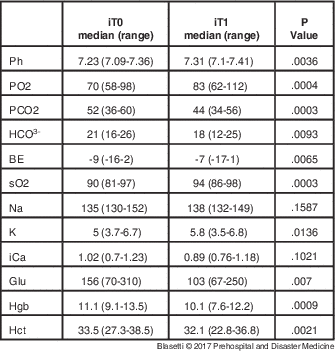
Patient data such as sex, heart rate (HR), age, oxygen arterial saturation (SaO2%), presence of a carotid pulse (yes/no), pain (evaluated using the Numeric Rating Scale [NRS]), consciousness (yes/no), and sites of injury were collected and recorded. The following blood gas tests were performed on 17 of the survivors extricated from the rubble using the iSTAT handheld blood analyzer 3 (iSTAT HANDHELD; Abbott Point of Care Inc.; Princeton, New Jersey USA): sodium (Na), potassium (K), ionized calcium (iCa), glucose (Glu), hematocrit (Hct), hemoglobin (Hgb), pH, PCO2, PO2, HCO3-, base excess (BE), and oxygen arterial saturation (sO2). Two arterial punctures – one before extrication (iT0) and the other before evacuation (iT1) – were performed on buried victims.
Outcomes
The data analyzed describe the injuries of individuals who were rescued and the drugs administered.
Analysis
Descriptive statistics were reported as the mean (standard deviation) or median and range, as appropriate, for continuous variables and frequencies for categorical variables. Statistical differences between groups were analyzed using non-parametric tests (the Mann-Whitney or chi-square test, as appropriate), and differences within the buried group were analyzed using the Wilcoxon matched pairs signed rank test. A P value less than five percent was considered significant (two-sided test).
During the first eight hours following the earthquake, this rescue team evaluated and treated 101 patients.
Eighteen subjects were already deceased upon discovery under the rubble. Thirteen patients were unconscious but presented a carotid pulse at the time of extraction. Eight patients presented head injuries, seven patients presented chest injuries, and three patients presented abdominal injuries. Ten patients died due to limb and head injuries.
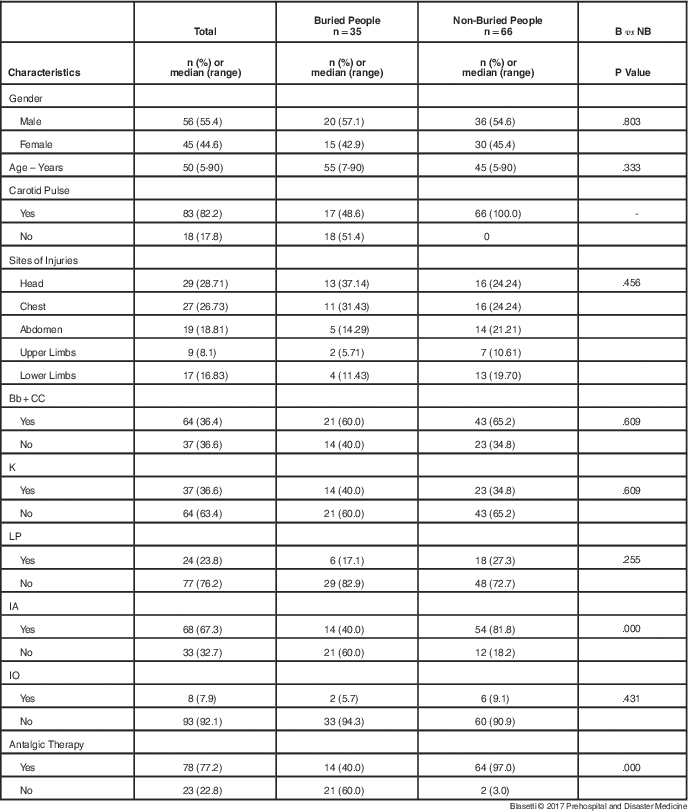
Table 1 shows the demographic and clinical data obtained at the moment of first evaluation for the overall group and each of the two sub-groups: the buried group (B group=35 subjects) and the non-buried group (NB group=66 subjects). No age or gender differences were identified between the two groups (P > .05). The mean age of the patients was 51.2 (SD=23.25) years (range 5 to 90 years). The majority of the subjects reported head injuries (29 patients; 28.7%) and/or chest injuries (27 patients; 26.7%).
Demographic and Other Baseline Characteristics

Note: Two-sample Wilcoxon rank-sum (Mann-Whitney) test was used for metric variables. Fisher exact test or Chi square test was used for categorical variables.
Abbreviations: Bb + CC, spine protection with backboards and cervical collar; K, spine protection with K.E.D. (Kendrick Extrication Device); LP, limbs protection; IA, intravenous access; IO, intraosseous access.
Statistically significant differences were identified between the B group and the NB group in the rates of intravenous access and antalgic therapy.
Table 2 summarizes the results of the blood tests performed using the iSTAT handheld blood analyzer. Because of the limited supply of iSTAT test cartridges and the decision to obtain blood samples only from patients for whom extrication was delayed for more than 30 minutes, two different arterial blood samples were obtained from 17 patients in the B group. Before extrication, a mixed acid-base disorder in which respiratory acidosis and metabolic acidosis coexisted was frequently observed in patients in the B group. Early increases in the rates of kaliemia associated with hypocalcemia, hyperglycemia, and moderate anemia were also identified.
i-STAT Tests (n=17)

Abbreviations: pH, potential of hydrogen; PCO2, arterial pressure of carbon dioxide; PO2, arterial pressure of oxygen; HCO3, bicarbonate; BE, base excess; sO2, oxygen arterial saturation; Na, sodium; K, potassium; iCa, ionized calcium; Glu, glucose; Hct, hematocrit; Hgb, hemoglobin.
After extrication, respiratory acidosis improved; a worsening of the metabolic acidosis was noted.
In eight patients, intraosseous access was established (EZ-IO; Teleflex Medical; Arlington Heights, Illinois USA), and an 18 Gauge peripheral venous access was established in 68 patients (67.33%).
The fluid therapy protocol consisted of crystalloid solutions, including lactated Ringer’s and isotonic saline, because only these fluids were available. Isotonic saline was preferred for the treatment of completely buried victims.
Patients with venous and intraosseous access received an average of 250ml crystalloid solution. For B group victims, fluid resuscitation was initiated prior to extrication, when possible. The fluid administration rate was 1,000ml/h; however, if extrication was delayed, the rate of fluid administration was tapered by at least 50% after two hours.Reference Sever and Vanholder 4 Fluid warming was not possible.
Extrication from the rubble was performed on victims with an air pocket or pulse.
Sixty-four patients were immobilized with a cervical collar and backboard. The K.E.D. (Kendrick Extrication Device) device was used in 37 subjects, as shown in Table 1.
After extrication, passive warming was initiated for each patient using blankets and adhesive body warmers. The victims were evacuated after the AMP was established in an area near Amatrice where the helicopters could land.
No arterial tourniquets were applied. No amputations were performed.
A total of 78 patients were treated for pain,Reference Jadad and Browman 5 as reported in Table 1. Of the 23 patients who were not treated for pain, 18 were deceased and five did not report pain. The pain medications were used alone or in combination. Thirty patients received morphine; in 11 cases, morphine was administered alone, while morphine was administered in combination with one of the following treatment regimens in 19 patients: ketorolac (four cases); acetaminophen (two cases); a combination of ketorolac and acetaminophen (six cases); a combination of ketamine, ketorolac, and acetaminophen (three cases); and a combination of ketamine and ketorolac (four cases). Twenty-six patients were treated with ketamine; of these patients, six received ketamine alone and 20 received ketamine in combination with one of the following treatment regimens: ketorolac (three cases); acetaminophen (five cases); a combination of ketorolac and acetaminophen (five cases); a combination of morphine, ketorolac, and acetaminophen (three cases); and a combination of morphine and ketorolac (four cases). Three patients received all available drugs.
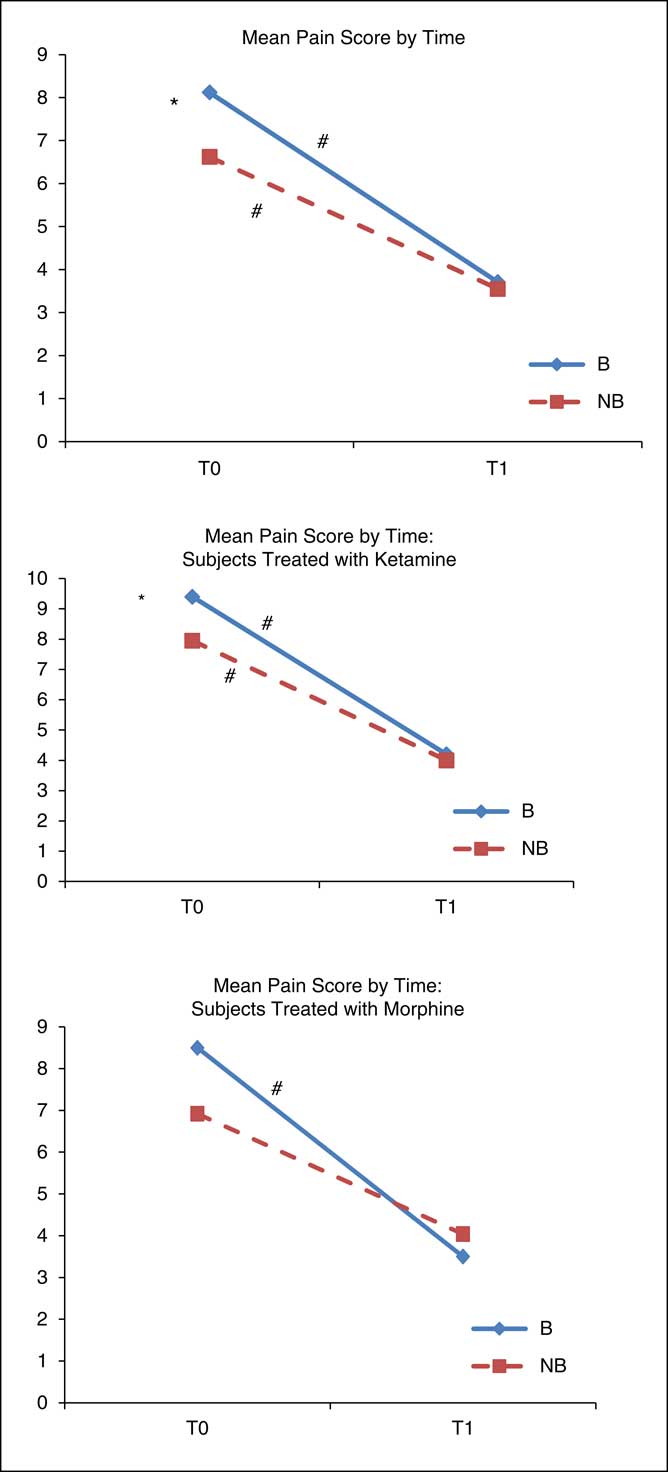
Figure 1 depicts the perceived pain intensity reported by 83 survivors.
Mean Pain Score by Time in n=83 Survived Victims. Abbreviations: B, buried people; NB, non-buried people. # Indicates values significantly lower than baseline values. * Indicates a significant difference between the B group and the NB Group (P < .000).

The NRS scores were higher among patients in the B group than among patients in the NB group at T0 (P=.003), but no differences were identified between the two groups at T1. Figure 1 shows the differences in the mean pain score over time and by treatment regimen (morphine or ketamine, alone or combined with other drugs). The present study is based on data collected directly under the rubble in a very dangerous setting because of the continuous aftershock. The results of this study suggest that providing first medical aid immediately after a natural disaster remains a challenge.
The first difficulty was determining where people were buried and trapped.
The intraosseous access established with the EZ-IO device may be an effective and timely approach for resuscitation in a natural disaster setting; however, the use of this device may be dangerous for those who are completely buried and for whom it is impossible to exclude the presence of bone fractures.
Pain management should be considered the most important objective during extrication maneuvers. The use of ketamine alone or in combination with other painkillers may be considered a suitable choice for pain relief and light sedation during extrication; ketamine does not increase intracranial pressure,Reference Wang, Ding and Tong 6 and it provides good hemodynamic stability compared with opioids.Reference Wang, Ding and Tong 6 Morphine is another potent analgesic but may be associated with worsening of respiratory acidosis, particularly when survivors have their chests compressed by the rubble.
When rescuing buried victims, the presence of an air pocket and a free airway, in combination with other vital parameters, may be useful in focusing the limited resources available on the victims who are most likely to survive.
Performing “victim-side” blood gas tests could provide concrete information to facilitate the treatment of buried victims. These data could also serve as the starting point for the appropriate and direct management of crush syndrome within the first moments of burial. After the extrication, the improved respiratory acidosis may be a result of the better ventilation; the worsening of the metabolic acidosis could be related to the reperfusion of the anatomic areas that were under the rubble.
The lack of a portable sonographic device was a major limitation for the rescuers because such a device can facilitate patient management decision making in resource-poor settings,Reference Shorter and Macias 7 and it might also be useful for performing analgesic peripheral blocks.
The results of this report reinforce the notion that ensuring the provision of immediate and appropriate fluid therapyReference Sever and Vanholder 4 for buried survivors may play an important role in the prevention of crush syndrome. Ketamine may be a good choice to provide analgo-sedation during extrication maneuvers.
Therefore, further studies are needed to understand whether these suggestions may provide a valid and useful scientific basis for the provision of first medical aid following a natural disaster.
Acknowledgements
The authors thank all of the NACR volunteers for their support, and all of the people of Amatrice for their courage and pride.