Introduction
Weed management and the associated labor inputs are consistently some of the biggest challenges to organic crop production (Riemens et al., Reference Riemens, Groeneveld, Lotz and Kropff2007; Sooby et al., Reference Sooby, Landeck and Lipson2007). Organic farmers, out of necessity, rely heavily on soil tillage and other forms of labor-intensive soil cultivation for weed management despite the disadvantages to soil health associated with intensive soil disturbance (Morse and Creamer, Reference Morse, Creamer, Kristiansen, Taji and Reganold2006; Schonbeck and Morse, Reference Schonbeck and Morse2007).
A small but growing number of organic farmers have begun adopting reduced tillage techniques, which blend the soil-conserving and labor-saving methods of conventional no-till (NT) systems with traditional soil building practices (i.e., cover cropping) (Leavitt et al., Reference Leavitt, Sheaffer, Wyse and Allan2011; Mirsky et al., Reference Mirsky, Ryan, Teasdale, Curran, Regerg-Horton, Spargo, Wells, Keene and Moyer2013). In organic reduced- or NT systems, an in situ mulch is created by mechanically terminating mature cover crops. Subsequent cash crops are direct seeded or transplanted into the mulch-covered soil. The cover crop mulch manages weeds in place of mechanical cultivation through physical impedance (Mohler and Teasdale, Reference Mohler and Teasdale1993), light interception (Teasdale and Mohler, Reference Teasdale and Mohler1993) and allelopathy (Teasdale and Mohler, Reference Teasdale and Mohler2000).
Weed suppression in NT systems is achieved with high biomass (>3000 kg ha−1) cover crops (Mohler and Teasdale, Reference Mohler and Teasdale1993). Organic NT research has focused primarily on fall-planted, winter annual cover crops that establish quickly, are competitive with weeds during the winter and spring, produce large amounts of biomass and are terminated easily using mechanical methods (Delate et al., Reference Delate, Cwach and Chase2012). Weed suppression has been documented using monocultures or combinations of cereal rye (Secale cereale L.), hairy vetch (Vicia villosa Roth) and crimson clover (Trifolium incarnatum L.) covers (Abdul-Baki et al., Reference Abdul-Baki, Stommel, Watada, Teasdale and Morse1996; Mischler et al., Reference Mischler, Curran, Duiker and Hyde2010; Delate et al., Reference Delate, Cwach and Chase2012; Duzy et al., Reference Duzy, Kornecki, Balkcom and Arriaga2014).
Adequate termination of cover crops is essential to organic NT (Creamer and Dabney, Reference Creamer and Dabney2002; Schonbeck and Morse, Reference Schonbeck and Morse2007). Optimal results have been documented with specialized roller-crimping devices that crush cover crop tissue and press the intact crop residue onto the soil surface (Creamer and Dabney, Reference Creamer and Dabney2002; Ashford and Reeves, Reference Ashford and Reeves2003; Mischler et al., Reference Mischler, Curran, Duiker and Hyde2010). Ashford and Reeves (Reference Ashford and Reeves2003) and Mischler et al. (Reference Mischler, Curran, Duiker and Hyde2010) found adequate short-term weed suppression (8–10 weeks) using roller-crimped cover crops.
Despite the demonstrated weed suppression of NT vegetable production systems, using cover crop mulches for weed suppression has produced mixed results (Delate et al., Reference Delate, Cwach and Chase2012). Yield reductions associated with NT mulches have been documented in squash (Leavitt et al., Reference Leavitt, Sheaffer, Wyse and Allan2011), bell pepper (Diaz-Perez et al., Reference Diaz-Perez, Silvoy, Phatak, Ruberson and Morse2008; Leavitt et al., Reference Leavitt, Sheaffer, Wyse and Allan2011) and tomato production (Leavitt et al., Reference Leavitt, Sheaffer, Wyse and Allan2011). On the contrary, comparable or positive yield responses in organic NT systems compared with conventionally tilled systems were reported in tomatoes (Abdul-Baki et al., Reference Abdul-Baki, Stommel, Watada, Teasdale and Morse1996; Madden et al., Reference Madden, Mitchell, Lanini, Cahn, Herrero, Park, Temple and Van Horn2004; Delate et al., Reference Delate, Cwach and Chase2012).
NT practices differ greatly from those used in conventional tillage (CT), and vegetable growers must consider several key factors for successful adoption of NT systems. For example, NT is not recommended for vegetables targeted for early spring markets because cover crops may not be sufficiently mature for mechanical killing, and cool soil conditions under the cover crop residues do not favor early season vegetable crops (Teasdale and Mohler, Reference Teasdale and Mohler1993). Growers must also consider differences in soil nutrient dynamics between conventional and NT systems. Cover crops with a high carbon to nitrogen (N) ratio (i.e., rye) may immobilize N, and those with a lower C:N ratio (i.e., legumes) may release N rapidly enough for N leaching to occur (Clark et al., Reference Clark, Decker and Meisinger1994; Salon, Reference Salon2012). Another critical factor is that failure to establish sufficient cover crop biomass before termination may result in inadequate weed suppression by the cover crop residue. (Teasdale and Mohler, Reference Teasdale and Mohler1993; Schonbeck and Morse, Reference Schonbeck and Morse2007). Therefore, additional research is needed to develop best management practices for NT vegetable production. The purpose of this research was to compare NT versus CT organic vegetable production on a Toccoa sandy loam soil in Clemson, SC, USA and to assess vegetable yield (squash and tomato), effects of soil fertility amendments and required weed management inputs in each system.
Materials and methods
Field experiment
The 2-yr experiment was initiated on 4 October 2013 at the Clemson University Student Organic Farm located in the north-western corner of South Carolina. The 2.5-hectare USDA certified organic farm is located at the Calhoun Fields Research Area on the Clemson University campus. The soil is a moderately well-drained Toccoa sandy loam (coarse-loamy, mixed, active, nonacid, thermic Typic Udifluvents) (USDA-NRCS Web Soil Survey). Soils at the Student Organic Farm have an average organic matter content of 4.6%, based on composited 0–15 cm soil samples taken in the spring in each vegetable production field at the farm beginning in 2013 through 2015. Treatments were arranged in randomized block, split plot design with tillage (NT and CT) and vegetable (summer squash and tomato) as whole plot factors, and N fertility level [0, 58 and 116 kg ha−1 N (13–0–0 organic fertilizer, Nature Safe, Irving, TX, USA)] as a split plot factor. Treatments were replicated three times. Tillage and vegetable treatment factors were evaluated in 6 m × 7.5 m plots that contained three rows of vegetables spaced 1.5 m apart. Each of the three tomato rows contained 15 plants, and each of the three squash rows contained 12 plants. Each row of vegetables received one of the three N fertilization treatments indicated above immediately after transplanting vegetables. Thus, the entire field experiment each year contained 12, 6 m × 7.5 m plots (six squash and six tomato) grown either under NT or CT practices, with three fertility treatments (one per vegetable row) in each plot. Two-meter alleys that separated the plots were flail mowed, tilled and planted to a buckwheat (Fagopyrum esculentum) cover crop in both years.
On 4 October 2013 and 13 September 2014, experimental plots were seeded with a mixture of cereal rye (VNS; Peaceful Valley Farm Supply, Grass Valley, CA, USA) and crimson clover (VNS in 2013, and ‘Dixie’ in 2014; Seven Springs Farm, Check, VA, USA) using a tractor-mounted over-seeder attachment (Kasco Manufacturing, Shelbyville, IN, USA).with 10 cm row spacing. Cover crop seed was untreated and, although not certified organic, was approved for use by our certifier given that certified seed was not available. During the previous 2 yr, the experimental land was cropped with various market vegetables grown in rotation with cover crops including Japanese millet (Echinochloa esculenta), sunn hemp (Crotalaria juncea), sudex (Sorghum bicolor × S. bicolor var. sudanese), cowpea (Vigna unguiculata), cereal rye and crimson clover. Prior to cover crop seeding for the experiment, the plots were disked to remove weeds and level the field. In 2013, a seeding rate of 112 kg ha−1 rye and 39 kg ha−1 clover was used. The high rate of clover was due to calibration problems with the seeding equipment. In 2014, the same rate of rye was used, but the clover rate was reduced to a more appropriate rate of 12 kg ha−1. Cover crops in CT plots were flail mowed on 5 May 2014, and 6 May 2015, and the plots were disked 3–4 times the following day in both years to fully incorporate cover crop residue. NT termination was accomplished on 6 May 2014, and 11 May 2015, with a rear-mounted 2.4 m roller-crimper (I & J Manufacturing, Gap, PA, USA) that had been filled with 225 kg of water for a total weight of 860 kg. In both years, crimping was done in one direction with roughly 0.3 m of roller-crimper overlap with each pass. In 2014, the initial round of crimping did not fully terminate the rye crop. The NT plots were re-crimped on 8 May with a small-plot 0.7 m roller-crimper mounted to a two-wheel walk-behind tractor. An additional 113 kg of weight was added to the small-plot crimper for a total weight of 230 kg. In 2015, two back-to-back passes with the 2.4 m roller-crimper were made over the cover crop (same direction) on 11 May to ensure adequate rye termination. At time of crimping, the rye had reached Zadoks stage 69 (anthesis complete) in 2014, and stage 75 (medium milk) in 2015. Crimson clover was in the flowering stage at the time of crimping. Previous research has demonstrated that rye can be adequately killed with a roller-crimper when the crop has reached anthesis (Mirsky et al., Reference Mirsky, Curran, Mortensen, Ryan and Shumway2009).
CT was accomplished with a 2 m wide, 10-disk harrow to a depth of approximately 15 cm. The recommended N fertilizer rate (116 kg ha−1) was based on Clemson Agricultural Service Lab soil fertility recommendations from a standard soil analysis of composited 0–15 cm soil samples taken in March 2014 from the year 1 experiment site. In March 2014, soil was amended with 448 kg P ha−1 (0–10–0 bone meal, Hi-Yield, Bonham, TX, USA) and 60 kg K ha−1 (0–0–50 potash, Great Salt Lake Minerals Co., Overland Park, KS, USA) according to soil test recommendations. Both fertilizer products were approved for organic production under the National Organic Program. No P and K amendments were needed in 2015, based on standard soil analysis of composited 0–15 cm samples taken in March 2015 from the year 2 site.
‘Celebrity’ tomato (determinant growth type) and ‘Success’ squash (straightneck-type summer squash) were started in the farm's greenhouse using on-farm generated potting soil [50% compost (2, 0.02 and 0.02 kg t−1 N, P and K, respectively): 25% perlite: 25% peat moss] with 120 ml lime and 710 ml of organic fertilizer (8–5–5; Nature Safe, Irving, TX, USA) added per 0.3 m3 of potting soil mix. Tomatoes were seeded in 128-count seed trays and then transplanted after 3 weeks into grow out pots measuring 10 cm in diameter. Squash was seeded in 72-count seed trays. Squash seedlings had reached the second true-leaf stage prior to transplanting. All vegetable transplants were organically produced and fertilized with a pelleted 8–5–5 organic fertilizer (Nature Safe, Irving, TX, USA) while in the greenhouse (20 g per transplant tray containing 72 transplants) and were hardened off prior to transplanting in the field. The 5-week-old tomato and 2-week-old squash seedlings were transplanted by hand in the corresponding CT and NT plots on 9 May 2014 (both crops) and on 14 May (tomatoes) and 18 May (squash) in 2015. Vegetable plots consisted of three rows 4.5 m in length with 0.3 m spacing between plants and 1.5 m spacing between row centers. Drip irrigation was installed on top of mulch in NT and on the soil surface in CT prior to transplanting; plants were watered immediately after transplanting. In both years, despite repeated tillage after mowing in CT plots, some cover crop residue (amount not recorded) remained on the soil surface for the early part of the season. Cover crops in CT fields at the Student Farm are typically terminated several weeks to a month prior to vegetable transplanting to allow time for residue to decompose prior to tillage. This process was accelerated in the present experiment to reduce temporal differences in soil N cycling between tillage treatments.
In the NT plots, the cover crop mulch was spread 12–15 cm apart by hand creating a narrow planting slit in the row prior to transplanting. The mulch was then pushed back against the plants after transplanting to cover the soil surface. Immediately after transplanting, plants were fertilized according to N fertilization treatment (specified above) with a side-dressed split application of a slower release, pelletized 13–0–0 feather meal fertilizer; fertilizer was not incorporated in either tillage treatment. A second split application of 13–0–0 was made at flowering stage for each crop. Tomatoes were trellised using the ‘Florida weave’ technique (Newenhouse, Reference Newenhouse2010).
Biomass and total N from cover crop
Aboveground cover crop biomass was sampled in three 0.5 m2 quadrants in 2014 and five 0.5 m2 quadrants in 2015 from the alleys between vegetable plots immediately prior to CT plot flail mowing (Leavitt et al., Reference Leavitt, Sheaffer, Wyse and Allan2011). The biomass samples were oven dried for 72 h at 55 °C and then weighed (Mischler et al., Reference Mischler, Curran, Duiker and Hyde2010). Additionally, subsamples from each biomass sample were sent to the Clemson University Agricultural Service Lab where they were dried at 70–80 °C for 12–24 h, ground to pass through a 2 mm sieve, and analyzed for total N by combustion using a LECO® FP528 Nitrogen Combustion Analyzer. Four weeks after termination, NT plots were assessed visually for percentage cover crop regrowth on a scale of 0% (no cover crop killed) to 100% (Leavitt et al., Reference Leavitt, Sheaffer, Wyse and Allan2011).
Weeding and labor inputs
Beginning 2 weeks after vegetable transplanting, CT plots were weeded approximately every 1–2 weeks in 2014 and approximately every 2–3 weeks in 2015. Weeding in CT plots consisted of rototilling (walk-behind Grillo™ tractor tiller attachment, Earth Tools, Owenton, KY, USA), flame weeding (Red Dragon™ VT21 Vapor Torch; La Crosse, KS, USA) and hand hoeing. NT plots were weeded every 2–3 weeks in both years beginning 2 weeks after vegetable transplanting. Weeding in NT plots consisted of rotary and string mowing weeds that had emerged through the cover crop residue and hand-pulling of perennial weeds. The total number of man-hours required to mechanically manage emergent weeds was recorded for each vegetable crop by tillage treatment for both years. Additionally, a visual assessment of all NT plots was made 6 weeks after crimping to estimate average percent ground coverage by weeds (Creamer et al., Reference Creamer, Bennett and Stinner1997). Labor (hours) spent preparing NT (crimping) and tilled (mowing + disking) cover crop plots prior to transplanting was also recorded both years.
Plant available N and total N
After seedbed preparation and prior to transplanting of vegetable crops and N fertilization, six 0–15 cm soil samples were taken from each of the 36 split-split plots. Soil samples were composited by split-split plot and subsamples were sent to the USDA-ARS Grassland Soil and Water Research Laboratory, Temple, TX, USA for soil health analysis using the Soil Health Tool (SHT) ver. 4.4. (Haney, Reference Haney2017). Another series of soil samples following the same collection protocols were taken at the end of the each growing season. The samples were dried at 50 °C, ground to pass through a 2 mm sieve, extracted with DI water and H3A, and analyzed on a Seal Analytical rapid flow analyzer for NO3-N and NH4-N (Haney et al., Reference Haney, Brinton and Evans2008). The water extract was analyzed on a Teledyne-Tekmar Apollo 9000 C:N analyzer for water-extractable organic C and total N and 40 g of each dried soil sample was re-wetted with DI water and incubated with a Solvita® paddle in a 237 ml glass jar for 24 h (Haney et al., Reference Haney, Brinton and Evans2008). At the end of 24-h incubation, the paddle was removed and placed in the Solvita® digital reader for CO2-C analysis. The SHT couples inorganic N (NO3-N and NH4-N), water-extractable organic C and N, and CO2-C measurements to estimate plant available N in the soil.
Vegetable yield
Yield data (weight) were recorded for all marketable tomatoes (USDA grades 1–3) and squash (USDA grades 1 and 2) in each row for every harvest (USDA 1997, 2016). Squash were harvested 3–4 times per week for 5 weeks, and tomatoes were harvested 2–3 times per week for 3 weeks in both years.
Tissue mineral analysis
In 2015, leaf tissue samples (excluding petioles) were taken from the most recently mature leaf of each plant in every experimental unit for both crops at the early flowering stage. Samples were composited by row and sent to the Clemson Agricultural Service Lab where they were dried at 70–80 °C for 12–24 h, ground to pass through a 2 mm sieve, and analyzed for total N by combustion using a LECO® FP528 Nitrogen Combustion Analyzer.
Statistical analysis
Statistical analysis was done using a three-way analysis of variance (ANOVA) to determine the effects (by vegetable crop) of tillage system and level of N fertilization on the parameters described above. Fisher's least significant difference tests (Ρ ≤ 0.05) were used to separate means when a factor was found to have a significant effect. To compare labor inputs between the two tillage treatments, data were compiled on the total labor hours required to prepare the plots for vegetable planting. This included roll-crimping in NT plots and flail mowing and tillage in CT plots. Because management activities to prepare for vegetable planting were the same in tomato and squash plots within each tillage system, total labor hours in each system were divided in half to calculate labor hours for each vegetable crop. A separate accounting of hours spent on as-needed weed control in each plot after vegetable planting was done, and those hours were tallied within each vegetable treatment to calculate total labor hours. An ANOVA was conducted to determine the effects of tillage and N fertilization on vegetable yield per unit of labor input. All statistical analyses were done using JMP® version 12.0.
Results
Cover crop biomass averaged 8400 kg ha−1 in 2014 and 8960 kg ha−1 in 2015. Based on the average total N content of the cover crop samples, 1.74% (2014) and 1.72% (2015), the estimated total cover crop N content was approximately 146 kg ha−1 in 2014 and 154 kg ha−1 in 2015. Cover crop regrowth at 4 weeks after termination was minimal (<1%) in both years suggesting that roller-crimping provided adequate termination of cover crops.
Weeding and labor inputs
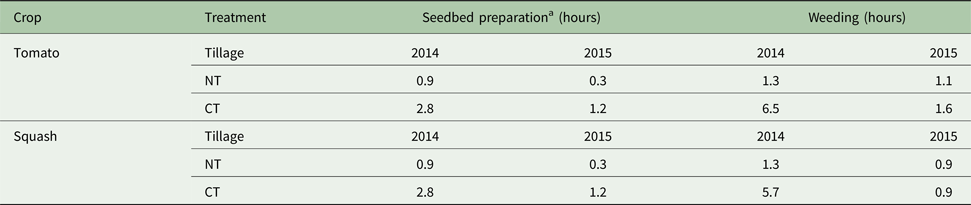
Mowing + disking (CT) required 191 and 300% more labor input in 2014 and 2015, respectively, compared with NT roller-crimping (Table 1). Managing weeds was also more labor-intensive in CT plots with weeding labor 400 and 338% greater in CT tomato and squash plots, respectively, compared with NT plots in 2014 (Table 1). In 2015, weed labor was 45% greater in CT tomato plots compared with NT; however, squash plot weed management was comparable between tillage treatments. NT plots did become weedy later in the season, particularly in 2014 when regrowth of the previous summer's cover crop (Japanese millet) required routine string mowing to reduce growth of re-seeded millet in the NT plots. Average percent ground cover by weeds at 6 weeks after termination in NT plots was 35% (tomatoes) and 25% (squash) in 2014 and 10% (tomatoes) and 10% (squash) in 2015.
Total labor hours in seedbed preparation and weeding by tillage treatment in 2014 and 2015; Clemson, SC, USA

a Total labor hours spent mowing + tilling (CT) or roller-crimping (NT) recorded by tillage treatment.
Soil and tissue analysis and yield
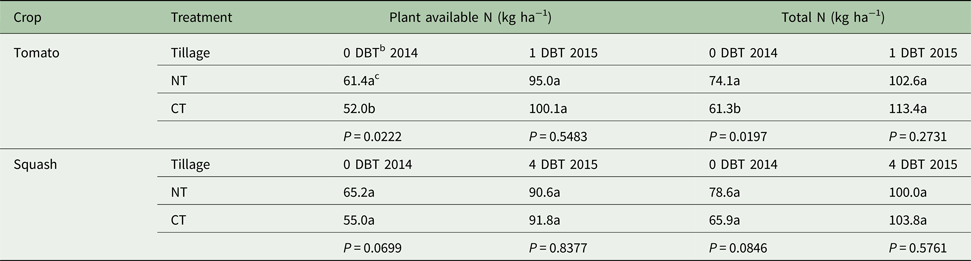
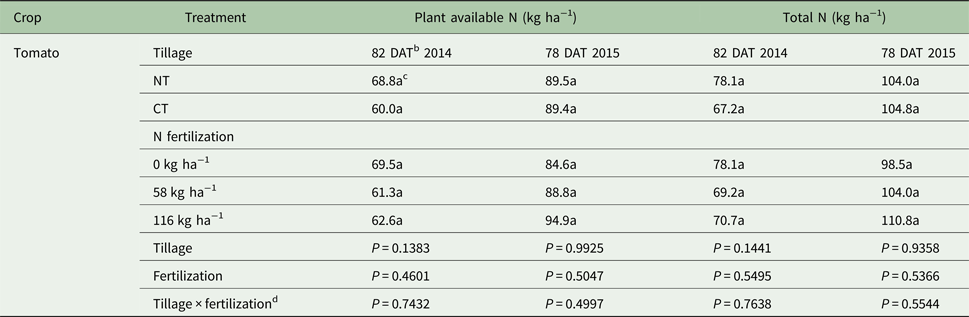
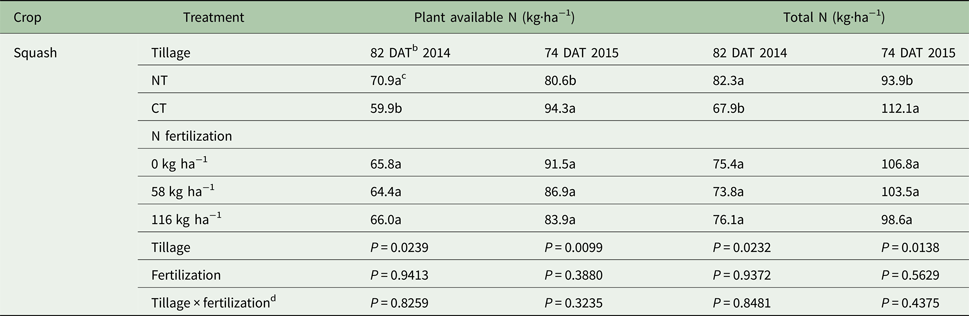
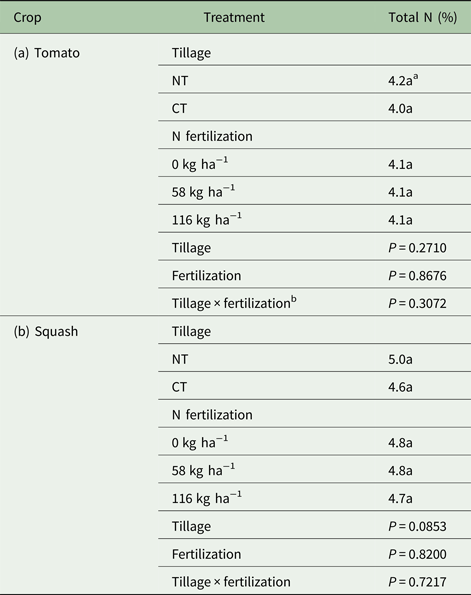
Results of pre-season soil analysis indicated that average plant available N and total N were significantly greater (P ≤ 0.05) in NT tomato plots compared with CT in 2014 (Table 2). There were no significant differences in available and total N between tillage treatments in 2015. Average plant available N and total N in squash plots were similar between tillage treatments for both years (Table 2). Analysis of soil samples taken after vegetable harvest indicated that tomato plant available soil N and total soil N levels were similar both years regardless of tillage treatment (Table 3). Average plant available N and total N were significantly greater (P ≤ 0.05) in NT squash plots in 2014 and in CT plots in 2015 (Table 4). Based on post-season soil analysis, N fertilization treatments did not significantly affect plant available N or total N in either year for either crop studied. Mid-season analysis of vegetable leaf tissue in 2015 showed no effect of tillage or fertilization on leaf tissue N (Table 5). Average percent N for both CT and NT treatments were within the sufficiency ranges for both tomato (3.5–5.0%) and squash (4.0–6.0%) crops (Campbell, Reference Campbell2000).
Effects of tillage treatment (NT, no-till; CT, conventional till) on average plant available soil N and total soil N; pre-seasona analysis conducted in 2014 and 2015, Clemson, SC, USA

a After cover crop termination but before vegetable transplanting.
b DBT = days before transplanting.
c Mean separation within tillage and year by Fisher's lease significant difference test, P ≤ 0.05.
Effects of tillage (NT, no-till; CT, conventional till) and N fertilization on average plant available soil N and total soil N: post-seasona analysis conducted in tomato in 2014 and 2015, Clemson, SC, USA

a After all harvesting completed for the season.
b AT = days after transplanting.
c Mean separation within tillage or fertilization and within year by Fisher's least significant difference test, P ≤ 0.05.
d Individual treatment means not included in the table due to a lack of significant tillage × fertilization interaction.
Effects of tillage (NT, no-till; CT, conventional till) and N fertilization on average plant available N and total N, post-seasona analysis conducted in squash in 2014 and 2015, Clemson, SC, USA

a After all harvesting completed for the season.
b DAT = days after transplanting.
c Mean separation within tillage or fertilization and within year by Fisher's least significant difference test, P ≤ 0.05.
d Individual treatment means not included in the table due to a lack of significant tillage × fertilization interaction.
Effects of tillage (NT, no-till; CT, conventional till) and N fertilization on average (a) tomato and (b) squash leaf tissue N in 2015, Clemson, SC, USA

a Mean separation within tillage or fertilization by Fisher's least significant difference test, P ≤ 0.05.
b Individual treatment means not included in the table due to a lack of significant tillage × fertilization interaction.
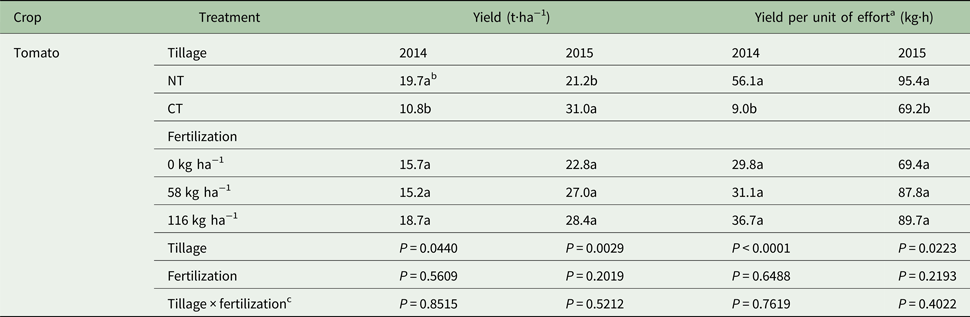
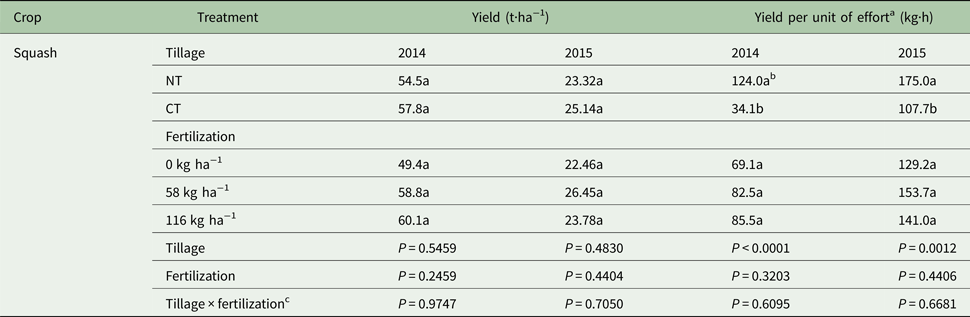
Average NT tomato yields were significantly greater than CT yields in 2014 (Table 5). However, in 2015, CT yields were significantly greater than NT (Table 6). Squash yields were similar between tillage treatments for both years studied (Table 7). N fertilization treatments did not significantly affect vegetable yield in either year for either crop. In both years of the study, NT vegetable yields per unit of labor (tomato and squash) were greater than in CT systems.
Effects of tillage (NT, no-till; CT, conventional till) and N fertilization on average marketable tomato yield and yield per unit of effort; 2014 and 2015, Clemson, SC, USA

a Rate determined by dividing labor input totals (seedbed prep + weeding) for each tillage treatment by number of 6 m long rows to estimate labor input per row. Row yields were divided by hours of labor per row to determine yield per unit of effort.
b Mean separation within tillage and year by Fisher's least significant difference test, P ≤ 0.05.
c Individual treatment means not included in the table due to a lack of significant tillage × fertilization interaction.
Effects of tillage (NT, no-till; CT, conventional till) and N fertilization on average marketable squash yield and yield per unit of effort; 2014 and 2015, Clemson, SC, USA

a Rate determined by dividing labor input totals (seedbed prep + weeding) for each tillage treatment by number of rows to estimate labor input per row. Row yields were divided by hours of labor per row to determine yield per unit of effort.
b Mean separation within tillage and year by Fisher's least significant difference test, P ≤ 0.05.
c Individual treatment means not included in the table due to a lack of significant tillage × fertilization interaction.
Discussion
The lower tomato yield in 2014 compared with 2015 was likely due to disease. CT tomatoes in 2014 were infected with a combination of Southern blight (Sclerotium rolfsii) and Pythium root rot (Pythium spp.). Plant pathogen diagnosis was confirmed by the Clemson University Plant Problem Clinic. In all, roughly 14% of the CT tomato plants in 2014 were lost to disease, which negatively impacted yields in affected rows. In contrast, NT tomatoes remained disease free in 2014 perhaps because of a lack of soil disturbance (e.g., hoeing, rototilling) in those plots. It is known that S. rolfsii mycelia and sclerotia can be spread in the field on infested soil clinging to cultivating tools (Bachi and Seebold, Reference Bachi and Seebold2008). Perhaps weed management in CT plots, particularly in-row hoeing early in the growing season, could have damaged plant roots and made the tomatoes in the plants more susceptible to the aforementioned soil-borne pathogens. A different field at the farm was used in the second year of the study and both CT and NT crops remained disease free.
N fertility treatments had no significant effect on vegetable yield. Further, in year 2, tissue mineral analysis showed sufficient leaf tissue N regardless of fertilization treatment. Thus, soil N was not a limiting factor in either year probably as a result of high soil organic matter content (4.6%) and residual N from previous cover crops and application of organic soil amendments. Considering SOM is comprised of roughly 5% N (Schulten and Leinweber, Reference Schulten and Leinweber2000) and 1.5–3.5% of SOM-N is mineralized annually (Brady and Weil, Reference Brady and Weil2008), the OM present in the soil used for this experiment would have provided an estimated 77–161 kg ha−1 of plant available N annually, representing all or in excess of the 116 kg ha−1 N fertilizer treatment.
Conclusions
Overall, the labor required to establish vegetable plots and manage weeds in CT plots was considerably greater when compared with NT. When yields were similar (e.g., squash crops in both years) or greater using CT practices (e.g., tomatoes in 2015), the labor savings associated with NT translated to significantly greater yields per unit of labor input. Further, having a 5–7 week relatively weed-free window early in the growing season where little weeding was needed in newly transplanted crops (as documented in this study with NT) would be particularly advantageous on a small, diversified farm where labor demands are high in the early summer growing season with many different vegetable crops growing in the fields at any given time.
One potential drawback recognized with NT vegetable production is the potential for weed management challenges later in the growing season, as experienced in year 1 of the study. Repeated hand weeding of NT plots can be especially labor intensive and could negate the early season weed management savings realized with NT mulches. However, weediness later in the vegetable growing season poses less of a problem because crops have matured and are better able to compete for resources. Weeds emerging later in the growing season in NT plots in this study were controlled by string trimmer and rotary mowing. Further research into cost-effective weed management strategies in organic NT systems is warranted especially in longer season summer crops where NT mulches may not provide adequate weed suppression for duration of the growing season.
Acknowledgements
Special thanks to Dr Rick Haney and the staff of the USDA-ARS Grassland, Soil and Water Research Laboratory, Temple, TX, for their assistance with the soil analyses. The authors also acknowledge the valuable assistance of the Clemson Student Organic Farm personnel who contributed to this project.