Biopreservation, the use of microorganisms and/or their metabolites to prevent spoilage and to extend the shelf life of foods, has growing interest due to the continuous request for food-grade chemical antifungal agents (Cortés-Zavaleta et al. Reference Cortés-Zavaleta, López-Malo, Hernández-Mendoza and García2014). The use of naturally occurring antimicrobials in foods retains the nutritive value of food without producing side effects (Kumar et al. Reference Kumar, Mohandas and Nambisan2013). In this context, lactic acid bacteria (LAB) produce a variety of antifungal substances such as organic acids, proteinaceous compounds and various low-molecular mass substances, including DL-3-Phenyllactic acid (PLA) (Yang & Chang, Reference Yang and Chang2010), an organic acid by-product of phenylalanine metabolism that has been produced by several microorganisms, particularly using some strains of LAB (Valerio et al. Reference Valerio, Lavermicocca, Pascale and Visconti2004; Li et al. Reference Li, Jiang and Pan2007; Prema et al. Reference Prema, Smila, Palavesam and Immanuel2008; Mu et al. Reference Mu, Chen, Li, Zhang and Jiang2009; Zheng et al. Reference Zheng, Ma, Gao, Li, Qin, Zhang, Wang and Xu2011; Rodríguez et al. Reference Rodríguez, Salgado, Cortés and Domínguez2012; Rodríguez-Pazo et al. Reference Rodríguez-Pazo, Vázquez-Araújo, Pérez-Rodríguez, Cortés-Diéguez and Domínguez2013). Due to its broad inhibitory activity against a variety of food-borne microorganisms, PLA has interesting potential for practical application as an antimicrobial agent in the food industry (Mu et al. Reference Mu, Chen, Li, Zhang and Jiang2009) providing new perspectives for the possibility of using this natural antimicrobial compound to control fungal contaminants and extend the shelf life of food and/or feedstuffs (Lavermicocca et al. Reference Lavermicocca, Valerio and Visconti2003).
In spite of their wide application in the food industry, LAB are catalogued as fastidious-growing microorganisms with numerous requirements for growth including amino acids, peptides, vitamins, and nucleic acids (Brinques et al. Reference Brinques, Do Carmo Peralba and Ayub2010). Thus, although industry and consumers for food-related applications prefer products obtained by biotechnological procedures, fermentation technologies must be cost competitive with chemical synthesis to carry out the biotechnological process at an industrial scale (Bustos et al. Reference Bustos, Moldes, Cruz and Domínguez2004). Therefore, alternative low-cost media should be developed to efficiently compete with the costly synthetic media for large-scale commercial applications (Brinques et al. Reference Brinques, Do Carmo Peralba and Ayub2010). In this sense, cheese whey and vinification lees, two by-products of the dairy and wine industries, respectively, could be assayed to formulate economic fermentative media.
Considering that cheese whey is a carbohydrate reservoir of lactose and also contains essential nutrients, it can be employed as a cheap carbohydrate source for the biotechnological production of biomass or high-added extracellular products (Brinques et al. Reference Brinques, Do Carmo Peralba and Ayub2010; Panesar et al. Reference Panesar, Kennedy, Knill and Kosseva2010; Rodríguez-Pazo et al. Reference Rodríguez-Pazo, Vázquez-Araújo, Pérez-Rodríguez, Cortés-Diéguez and Domínguez2013). On the other hand, vinasses, the main liquid wastes from the distillation process, are also alternative sources of financially competitive nutrients already efficiently employed for the economical production of food additives (Bustos et al. Reference Bustos, Moldes, Cruz and Domínguez2004; Salgado et al. Reference Salgado, Rodríguez, Cortés and Domínguez2009).
Among LAB, Lactobacillus plantarum, a heterofermentative metabolism with high acid tolerance and generally regarded as safe organism (GRAS), is one of the most widespread species used in food technologies. In this work, the production of PLA by L. plantarum was evaluated using cheese whey as an inexpensive source of carbon (lactose) and phenylalanine in batch cultures, after optimisation of the cheese whey enzymatic hydrolysis using three enzymes: iZyme, Flavourzyme and Alcalase. Vinasess were assayed as alternative economic nutrients to provide nitrogen compounds, mineral salts, and essential nutrients for microbial growth in batch or continuous fermentations. Finally, the antimicrobial activity of the cell-free supernatants was assayed against Carnobacterium piscicola.
Materials and methods
Materials
Cheese whey, kindly provided by the cheese plant Ruta Xacobea S.L. in Brea (A Coruña, Spain), and wine lees, kindly supplied by the winery Adegas San Roque (Beade, Ourense, Spain) were stored at 4 °C until use.
Cheese whey enzymatic hydrolysis
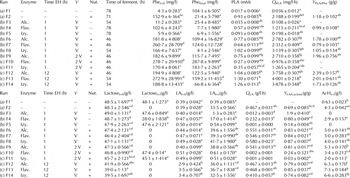
Flavourzyme (EC 3.4.11.1) with endo- and exoprotease activities, and Alcalase (EC 3.4.21.62) and iZyme BA (EC 3.4.21.1) with endoprotease activities, kindly provided by Novozymes (Copenhagen, Denmark), were used to carry out the enzymatic hydrolysis of the protein fraction of cheese whey in order to improve the substrate (phenylalanine) concentration and/or protein co-substrate that could stimulate the PLA production. The enzymatic hydrolysis was carried out for 1 or 12 h at 50 °C in a thermostatic bath, using the necessary amount (V) of enzyme to hydrolyse 10 g/l of protein. Three enzymes were assayed according to the following activities: flavourzyme with activity equivalent to 1000 Leucine aminopeptidase units (LAPU)/g; alcalase with activity equivalent to 2·4 Anson units (AU)/g, and iZyme BA with activity equivalent to 0·15 Anson units (AU)/g. Additional experiments were also conducted using 2 V. In all cases, cheese whey was initially adjusted to pH 7 with 5 N NaOH. Table 1 summarises all the experiments conducted.
Influence of nutrients addition and conditions of cheese whey enzymatic hydrolysis on fermentation parameters

(a) Influence of nutrients addition on crude cheese whey: FI and F2; (b) Influence of enzymatic hydrolysis of whey during 1 h and nutrients addition: F3 to F8; (c) Influence of the enzymatic hydrolysis conditions: F9 to F14.
Alc., Alcalase; Flav., Flavourzyme; Izy., Izyme; EH, enzymatic hydrolysis; Phe, phenylalanine; PLA, DL-3-Phenyllactic acid; LA, lactic acid; AcH, acetic acid. V: necessary amount of enzyme to hydrolyse 10 g/l of protein. Nut.: nutrients reported by Brusch Brinques et al. (Reference Brinques, Do Carmo Peralba and Ayub2010); Q PLA: global volumetric productivity of PLA; Y PLA/Phe: Phe to PLA yield, calculated as (PLAfinal−PLA t=0)/(Phe t=0−Phefinal) without considering the amount of phenylalanine released in the course of fermentation; Q LA: global volumetric productivity of LA; Y LA/Lactose: Lactose to LA yield. Different letters mean statistically significant differences among values in the same column (P < 0·05).
Strains, growth conditions and inoculum preparation
Lactobacillus plantarum CECT-221, obtained from the Spanish Collection of Type Cultures (Valencia, Spain), was employed to assess its ability to produce different antimicrobial metabolites, meanwhile Carnobacterium piscicola CECT 4020 was employed as the target organism to evaluate the bacteriocin activity of commercial acids and cell-free supernatants (CFS) obtained after fermentation processes. Seeds of L. plantarum or C. piscicola were activated in 250 ml Erlenmeyer flasks using 100 ml of the Man-Rogosa-Sharpe (MRS) medium containing 10 g/l peptone, 8 g/l beef extract, 4 g/l yeast extract, 20 g/l D(+)-glucose, 2 g/l K2HPO4, 2 g/l diammonium hydrogen citrate, 5 g/l CH3COONa, 0·2 g/l MgSO4·7H2O, 0·05 g/l MnSO4·2H2O and 1 g/l Tween-80 at 31·5 °C and 100 rpm in orbital shakers according to the conditions reported by Rodríguez-Pazo et al. (Reference Rodríguez-Pazo, Vázquez-Araújo, Pérez-Rodríguez, Cortés-Diéguez and Domínguez2013). Aliquots of culture (0·5 ml) from the late log/stationary phase were dispensed into cryovials and maintained at −80 °C using 15% (v/v) glycerol as cryoprotectant.
Inocula to carry out fermentations were prepared by transferring one stock cryovial into 250 ml Erlenmeyer flasks containing 100 ml of activation medium. Seed activation cultures were grown for 12 h at 31·5 °C and 100 rpm in orbital shakers. At least two generations of activation cultures were required before inoculation. The cells from this culture were finally recovered by centrifugation at 2755 g for 15 min at 10 °C and used to inoculate fermentations with 5% (v/v) of the final fermentation volume. pH was initially corrected to 6·2 with 5 N NaOH and sterilised at 101 °C for 60 min in autoclave.
Fermentation of cheese whey
Raw cheese whey and all the hydrolysates obtained after enzymatic hydrolysis were assayed as fermentation media for the formation of PLA by L. plantarum. Cheese whey hydrolysates (100 ml) were supplemented with the nutrients of Brinques et al. (Reference Brinques, Do Carmo Peralba and Ayub2010) containing 15 g/l peptone, 5 g/l yeast extract, 0·2 g/l MgSO4·7H2O and 0·04 g/l MnSO4·2H2O, or remained without nutrients addition, to evaluate the optimal hydrolysis conditions.
Optimised hydrolysates were supplemented with vinasses. Before use, vinasses were centrifuged and the liquid fraction neutralised with NaOH to pH 7. The liquid fraction was frozen, and subsequently freeze-dried. The solid fraction was keep at refrigerator. Different volumes of freeze-dried vinasses (25, 50, 75, 100 ml) or 50 ml plus 20 g/l of solid fraction were resuspended in 100 ml final volume of previously hydrolysed cheese whey, to assess the possibility of use vinasses as only and economic nitrogen and mineral salts source for fermentation process.
All fermentations were carried out placing 250 ml Erlenmeyer flasks (containing 100 ml of culture medium) in orbital shakers at 31 °C and 100 rpm. Samples were withdrawn at different intervals to monitor fermentation for up to 80 h. Initially, 20 g/l of calcium carbonate was added to neutralise the acids produced.
Additional experiments were performed in continuous fermentation using a 2 l Braun Biostat fermenter at 31·5 °C and 100 rpm, with pH automatically controlled to 6·2 with 5 N NaOH as described by Rodríguez et al. (Reference Rodríguez, Salgado, Cortés and Domínguez2012) and Rodríguez-Pazo et al. (Reference Rodríguez-Pazo, Vázquez-Araújo, Pérez-Rodríguez, Cortés-Diéguez and Domínguez2013). Fermentations were carried out working with 1800 ml corresponding: 1615 ml to sterilised cheese whey hydrolysates; 100 ml of nutrients elaborated after resuspending 50 ml freeze-dried and 20 g/l solid vinasses in 100 ml hydrolysed cheese whey; and 85 ml of seed culture used for inoculation.
All fermentations were performed in duplicate and standard deviation of mean values reported in the text.
Kinetic parameters and yields of fermentations
The kinetic parameters and yields of fermentations were calculated at the time where the PLA was maximal. Global volumetric productivity of PLA (Q PLA, g/(L·h)) was calculated as the ratio between the PLA concentration (mg/l) and the fermentation time (h). Phe to PLA yield (Y PLA/Phe g/g) was defined as the ratio between PLA produced (PLAfinal−PLA t=0) and Phe consumed (Phe t=0−Phefinal) without considering the amount of phenylalanine released in the course of fermentation. Global volumetric productivity of LA (Q LA, g/(L·h)) was calculated as the ratio between the LA concentration (g/l) and the fermentation time (h). Lactose to LA yield (Y LA/Lactose, g/g) was defined as the ratio between LA produced (LAfinal−LA t=0) and lactose consumed (Lactose t=0−Lactosefinal).
Antimicrobial effect of CFS
Cell-free supernatants (CFS) were obtained by continuous fermentation of cheese whey hydrolysates supplemented with vinasses using a dilution rate of 0·0207 h−1. The hydrolysates were centrifuged at 2755 g for 15 min and 10 °C and filter-sterilised using 0·22 µM pore-size membranes to obtain CFS. The bacteriocin activity was determined according to the well-diffusion method described by Rodríguez-Pazo et al. (Reference Rodríguez-Pazo, Vázquez-Araújo, Pérez-Rodríguez, Cortés-Diéguez and Domínguez2013) against C. piscicola.
Analytical methods
Total solids in cheese whey were determined by dry weight using 5 g of sample maintained in the oven at 105 °C until constant weight. Total protein concentration was determined by the Pierce Bicinchoninic Acid assay Kit (Thermo Scientific). Fat content in whey (before or after enzymatic hydrolysis with Flavourzyme at 50 °C and 100 rpm during 12 h) was quantified according to ISO 1443. Metals and amino acids were quantified as described Salgado et al. (Reference Salgado, Rodríguez, Cortés and Domínguez2009).
Samples were taken during fermentation and centrifuged at 2755 g for 15 min at 4 °C using a Centrifuge EBA 20. Supernatants were filtered by 0·22 µM pore-size membranes (Millipore) for lactose, lactic acid, acetic acid, Phe and PLA analyses by high-performance liquid chromatographic (HPLC) under the conditions described by Rodríguez-Pazo et al. (Reference Rodríguez-Pazo, Vázquez-Araújo, Pérez-Rodríguez, Cortés-Diéguez and Domínguez2013), while the cells were used for biomass concentration determination. Cells from a known volume of culture media were washed twice with distilled water and centrifuged under the same conditions reported previously. The resulting pellets were oven-dried at 105 °C to constant weight.
Statistical analysis
Mean values of fermentations were submitted to analysis of variance (ANOVA) by the Statistica Software 13.0. They were compared using the Tukey's test at significance level (P) < 0·05, and different letters were used to label values with statistically significant differences among them.
Results and discussion
Optimisation of cheese whey enzymatic hydrolysis
The production of DL-3-Phenyllactic acid (PLA) requires the availability of phenylalanine (Phe) among other compounds in the culture broth, considering that LAB have complex nutrient requirements since they have a limited capacity to synthesise vitamin B and amino acids (de Lima et al. Reference Lima, Coelho and Contiero2010). Hence, the controlled hydrolysis of cheese whey proteins with specific enzymes, could be used to provide a nitrogen source suitable for growth promotion in industrial fermentation, thus eliminating, or reducing, the need for expensive supplements (Galvão et al. Reference Galvão, Pinto, Jesus, Giordano and Giordano2009).
Using the necessary amount of enzyme to hydrolyse 10 g/l of protein during 1 h (V), flavourzyme showed the higher amounts of free Phe (107·8 mg/l), followed by alcalase (28·9 mg/l) and iZyme (13·5 mg/l), that is at least 3-fold higher than untreated cheese whey content of Phe (4·3 mg/l). An increment in time from 1 to 12 h, increased the concentration of Phe to 120·0, 42·0 and 35·9 mg/l, using respectively flavourzyme, alcalase and iZyme. However, using the double amount of enzyme (2 V) and 1 h of hydrolysis, the Phe concentrations achieved were only 125·8, 29·7 and 17·5 mg/l using respectively flavourzyme, alcalase and iZyme.
Fermentation of crude or enzymatically hydrolysed cheese whey
Crude cheese whey and hydrolysates obtained in previous enzymatic experiments were inoculated with strains of L. plantarum and tested for the production of PLA. The growth in absence of a metabolically relevant number of contaminations was double checked by examination of morphology in microscope and visual observation of uniform colonies on agar plates.
Cheese whey without enzymatic hydrolysis (crude cheese whey) was assayed as fermentation broth in absence or presence of the nutrients optimised by Brinques et al. (Reference Brinques, Do Carmo Peralba and Ayub2010) for L. plantarum. During the fermentation of crude cheese whey, in absence of nutrients (F1), Phe was continuously released from the initial 4·3 ± 0·283 mg/l up to 104·3 ± 6·505 mg/l after 78 h (see Table 1). However, PLA was scarcely produced (0·017 ± 0·006 mM) to achieve a volumetric productivity (Q PLA) of only 0·036 ± 0·012 mg/l·h, indicating that the rate of Phe formation was not enough to fulfil the microorganism requirements for the formation of product. Vermeulen et al. (Reference Vermeulen, Gánzel and Vogel2006) reported that Lactobacillus sanfranciscensis hydrolysed 76–100% of the peptides supplied as dipeptides-containing phenylalanine, thus causing an accumulation of Phe in the course of fermentation. Similarly, L. plantarum hydrolysed dipeptides as well, increasing the Phe levels from 0·44 up to 1·38 mM after 72 h. Additionally, these authors also reported that peptide hydrolysis and PLA formation continued when growth had ceased, showing that amino acid conversion is not related to exponential growth but an ongoing process in stationary cells. Using this fermentation broth, lactose was not consumed, and consequently negligible amounts of organic acids were quantified.
The fermentation broth prepared with cheese whey and nutrients (F2) revealed that a considerable proportion of Phe comes from these nutrients, increasing the initial amount of Phe up to 152·9 ± 6·364 mg/l. This supplementary amount of Phe, stimulated the formation of PLA up to 0·93 ± 0·085 mM, and consequently Q PLA to 2·188 ± 0·199 mg/l·h. Besides, from the high value of product yield calculated (Y PLA/Phe = 1·18 ± 0·102 g/g) it can also be concluded that Phe was also released during the process, as it happened in the previous fermentation. In this case, lactose was completely metabolised after 71 h, reaching a lactic acid concentration of 33·5 ± 0·566 g/l (Q LA = 0·467 ± 0·031 g/l·h) and 4·3 ± 0·042 g/l acetic acid.
Considering the complexity of the culture medium, cheese whey hydrolysed during 1 h was assayed in the absence (F3, F4 and F5) or presence (F6, F7 and F8) of nutrients. As it can be seen in Table 1 the tendency was similar to that observed using crude hydrolysates, with increased PLA concentrations after supplementation with nutrients. iZyme, followed by alcalase and flavourzyme showed the highest concentration of PLA, with values of 1·02 ± 0·099, 0·77 ± 0·085 and 0·64 ± 0·113, respectively, in experiments performed after supplementation. With the only exception of hydrolysates obtained with flavourzyme (F4), where lactose was partially consumed to produce 17·0 ± 1·414 g/l lactic acid and 2·9 ± 0·157 g/l acetic acid, the absence of nutrients was unfavourable for fermentation. Conversely, after nutrient addition (F6–F8), lactose was completely consumed, yielding high levels of lactic (39·3 ± 0·990 to 41·7 ± 1·980 g/l) and acetic (4 ± 0·141 to 5 ± 0·283 g/l) acids.
The influence of enzymatic hydrolysis can be inferred comparing F2 (crude cheese whey supplemented with nutrients) with F6, F7 and F8 (cheese whey after enzymatic hydrolysis and supplementation with nutrients). Only a slight increment in PLA concentration was observed in F8 after enzymatic hydrolysis with iZyme, from 0·93 ± 0·085 up to 1·02 ± 0·099 mM. However, in all cases, the time required to achieve the maximal amount of PLA was considerably reduced, from 71 h to only 46–54 h. Therefore, it can be concluded a beneficial effect of enzymatic hydrolysis for the metabolic pathway.
Finally, two strategies were evaluated in order to improve the production of PLA: doubling the amount of enzyme required to hydrolyse 10 g/l of protein (F9, F10 and F11) or increasing the time of hydrolysis to 12 h (F12, F13 and F14).
The first strategy was detrimental resulting in a slight reduction in the amount of PLA (see Table 1), which could be due to an excess of enzyme was harmful, or that the large number of compounds released could inhibit the fermentation. In fact, using the enzyme Flavourzyme (F10), despite the higher value of initial Phe (278·7 ± 20·930 mg/l), the value of Phe at the end of fermentation increased even further to 287·8 ± 9·899 mg/l. Regarding the generation of lactic and acetic acids, no influence was observed using Alcalase (F9), since lactose was entirely depleted, bearing reasonable amounts of lactic acid (38·8 ± 0·566 g/l). However, using Flavourzyme or iZyme, lactose was not consumed at the end of fermentation and consequently no lactic acid was produced.
Conversely, the second strategy was more positive, and therefore the highest concentration of PLA (1·30 ± 0·071 mM) and global volumetric productivity (Q PLA = 4·001 ± 0·218 mg/l·h) were attained in experiment F13 using the necessary amount of enzyme Flavourzyme to hydrolyse 10 g/l of protein, during 12 h. Similar results (PLA = 1·26 ± 0·113 mM; Q PLA = 3·878 ± 0·348 mg/l·h) were achieved using the enzyme iZyme and 12 h of hydrolysis, in spite of starting with a lower amount of Phe (188·8 ± 13·435 mg/l) compared with the 272·9 ± 28·991 mg/l of Phe when using Flavourzyme. The calculated values of product yield also suggested a continuous release of Phe in the course of the fermentation. The results of PLA achieved after enzymatic hydrolysis during 1 h (F6, F7 and F8) or 12 h (F12, F13 and F14) confirmed that the metabolic pathway not only depends on the concentration of the biosynthetic precursor (phenylalanine), since these values are similar independently of the time of hydrolysis, but also supported the hypothesis that during the enzymatic hydrolysis, some compounds that may promote or stimulate the metabolic pathway of Phe into PLA, were also released. In these fermentations, lactose was effectively converted into lactic and acetic acids, according to the data summarised in Table 1.
Characterisation of raw and hydrolysed cheese whey
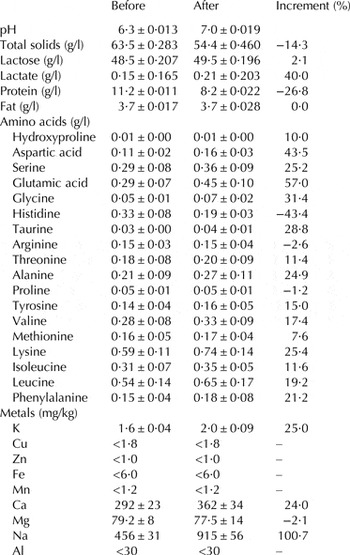
Raw cheese whey and cheese whey hydrolysed under optimised conditions (Flavourzyme at 50 °C during 12 h and 100 rpm) were characterised and the main parameters summarised in Table 2. The hydrolysis of cheese whey promotes the fractionation of proteins into smaller units. These compounds have more water biding sites, thus increasing the whey solubility (Sinha et al. Reference Sinha, Radha, Prakash and Kaul2007; Corrêa et al. Reference Corrêa, Daroit, Fontoura, Meira, Segalin and Brandelli2014). This occurrence could explain the decrease in cheese whey total solids in our study from 63·5 ± 0·283 to 54·4 ± 0·460 g/l and proteins from 11·2 ± 0·011 to 8·2 ± 0·022 g/l. The increment of nutrients can be inferred from the higher quantification of amino acids and metals determined after cheese whey hydrolysis (see Table 2). All the amino acids content increased during the hydrolytic process with the only exception of histidine, arginine and proline. Due to the objective of this study, it is particularly noticeable the increment of 21·2% observed with phenylalanine. Regarding the study of metals, after hydrolysis, it was observed a strong increment in the amount of Na, K and Ca. Mg decreased slightly; meanwhile the remaining metals were hardly quantified. Rossini et al. (Reference Rossini, Noreña, Cladera-Olivera and Brandelli2009) demonstrated in their work the efficiently of Flavourzyme to hydrolyse the casein molecule. The major concentration of Ca, present in raw cheese, is partially bonded with casein micelles. When this structure is hydrolysed, normally the Ca concentration increased (Gaucheron, Reference Gaucheron2005).
Characterisation of crude cheese whey and cheese whey after enzymatic hydrolysis (Flavourzyme at 50 °C and 100 rpm during 12 h)

Fermentation of cheese whey hydrolysates supplemented with vinasses
The solid or the freeze-dried liquid fractions of wine vinasses were evaluated as the only nitrogen source in order to increase the economical potential for larger-scale bioproduction. Salgado et al. (Reference Salgado, Rodríguez, Cortés and Domínguez2009) suggested that, in spite of being one of the most common nitrogen sources in a variety of bioprocesses, the high cost of yeast extract impairs the economics, estimating that its value accounts for 38% of the final cost of lactic acid.
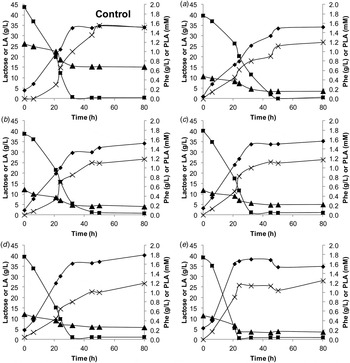
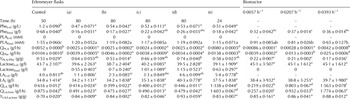
Figure 1 depicts the kinetics of Phe and lactose consumption as well as the generation of phenyllactic and lactic acids; meanwhile Table 3 summarises the parameters of fermentation. Using vinasses as a source of nitrogen, the concentration of PLA ranged between 1·15 ± 0·071 and 1·20 ± 0·052 mM, slightly lower to the value of 1·55 ± 0·060 mM achieved with commercial nutrients (used as control). Nevertheless, these values are comparable or superior to those reported by Vermeulen et al. (Reference Vermeulen, Gánzel and Vogel2006) using L. sanfranciscensis or L. plantarum (0·25–0·75 mM respectively); Li et al. (Reference Li, Jiang and Pan2007) using Lactobacillus sp. SK007 (0·55 mM); Rodríguez et al. (Reference Rodríguez, Salgado, Cortés and Domínguez2012) using L. acidophilus, Lactobacillus pentosus, L. plantarum, L. rhamnosus, and Lactococcus lactis (0·17–1·38 mM) with the highest value working with L. plantarum; Valerio et al. (Reference Valerio, Lavermicocca, Pascale and Visconti2004) during the screening of 28 strains (0·02–0·57 mM) or the 13 LAB screened by Cortés-Zavaleta et al. (Reference Cortés-Zavaleta, López-Malo, Hernández-Mendoza and García2014) in culture tubes prepared with fresh sterile MRS broth (0·021–0·275 mM), although in this case, no PLA was quantified with L. plantarum.
Kinetics of Phe and lactose consumption, and PLA and lactic acid production using cheese whey hydrolysates as carbon source and vinasses as nitrogen source in fermentations carried out in Erlenmeyer flasks. (a) 25 ml freeze-dried vinasses; (b) 50 ml freeze-dried vinasses; (c) 75 ml freeze-dried vinasses; (d) 100 ml freeze-dried vinasses; (e) 50 ml freeze-dried vinasses and 20 g/l solid vinasses. Lactose (■); lactic acid (♦); Phe (▲); PLA (×).

Summary of values obtained in the fermentation of cheese whey hydrolysates and vinasses under different fermentation conditions: using 250 ml Erlenmeyer flasks or 2 litres Bioreactor operating in continuous under three dilution rates (in h−1)

Phe: phenylalanine; PLA: DL-3-Phenyllactic acid; Q PLA: global volumetric productivity of PLA; Q Phe: volumetric rate of Phe consumption; Y PLA/Phe: Phe to PLA yield, calculated as (PLAfinal−PLA t=0)/(Phe t=0−Phefinal) without considering the amount of phenylalanine released in the course of fermentation; LA: lactic acid; Q LA: global volumetric productivity of LA; Q Lactose: volumetric rate of lactose consumption; Y LA/Lactose: Lactose to LA yield. (a) 25 ml freeze-dried vinasses; (b) 50 ml freeze-dried vinasses; (c) 75 ml freeze-dried vinasses; (d) 100 ml freeze-dried vinasses; (e) 50 ml freeze-dried vinasses and 20 g/l solid.
Different letters mean statistically significant differences among values in the same line (P < 0·05).
The product yields oscillated between 0·53 ± 0·014 and 0·68 ± 0·460 g/g in all cases. The most outstanding result could be the fact that using 50 ml freeze-dried vinasses and 20 g/l solid vinasses, the time of fermentation was reduced to only 24 h, thus increasing the Q PLA up to 0·008 ± 0·005 g/l·h and the volumetric rate of Phe consumption (Q Phe) up to 0·0138 ± 0·0003 g/l·h. In contrast, lactose was efficiently converted in lactic acid in all fermentations, with product yields ranging from 0·70 ± 0·020 to 0·93 ± 0·059 g/g, although the higher lactic acid value (40·3 ± 0·778 g/l) was achieved in fermentations carried out using 100 ml freeze-dried vinasses as nutrients (fermentation d). Consequently, vinasses could be employed to overcome one of the major technical hurdles for the development of low-cost culture media that could stimulate the production of natural products. Taking into account not only the higher global volumetric productivities achieved for both lactic acid and PLA when using freeze-dried and solid vinasses, but also considering the higher profit of using both fractions, further experiments were conducted using this combination of vinasses as nutrients in continuous processes.
Continuous fermentation of cheese whey hydrolysates supplemented with vinasses
Finally, the process was scaled up to a 2 L Braun Biostat fermenter operating on continuous. Table 3 shows the results obtained under three steady states reached at selected dilution rates. As it was expected, under the lowest dilution rate assayed (0·0057 h−1), although the maximal amount of PLA concentration was achieved (0·91 ± 0·085 mM), the process rendered a low Q PLA (0·0086 ± 0·0001 g/l·h) and Q Phe (0·0039 ± 0·0002 g/l·h) at a reasonable Y PLA/Phe (0·48 ± 0·007 g/g). The PLA concentration decreased continuously when the dilution rate was increased; with the lowest PLA concentration (0·65 ± 0·127 mM) and Y PLA/Phe (0·17 ± 0·036 g/g) achieved under the highest dilution rate assayed (0·0393 h−1). Under this dilution rate, the higher Q PLA (0·0042 ± 0·0008 g/l·h) and Q Phe (0·025 ± 0·0006 g/l·h) were achieved, meaning that it cannot be inferred an optimal value to work with.
Conversely, regarding the conversion of lactose into lactic acid, lactose was completely consumed in all cases (see Table 3); yielding similar lactic acid concentrations (38·4 ± 3·932 to 39·7 ± 1·980 g/l) corresponding to products yields of 0·85 ± 0·161 to 0·88 ± 0·012 g/g. However, an optimum value of Q LA (1·563 ± 0·078 g/l·h) and Q Lactose (0·859 ± 0·460 g/l·h) was achieved under the highest dilution rate, considering that a similar lactic acid concentration was attained in a shorter period of time.
Antimicrobial effect of CFS
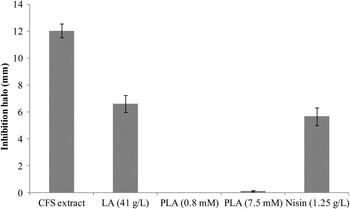
Finally, the antimicrobial activity of cell-free supernatants (CFS) was evaluated against C. piscicola as indicator microorganism. CFS extracts produced halos with mean values of 12·03 ± 0·50 mm. Commercial lactic acid, PLA and nisin (in the amounts present in CFS) were also evaluated as a control and the mean inhibitory halos depicted in Fig. 2. Using 41 g/l of commercial lactic acid, the inhibitory halo was 6·60 ± 0·63 mm, meaning that the effect of this commercial acid was equivalent to 54·9% of the value obtained with CFS. Conversely, the use of 0·81 mM of commercial PLA had no inhibitory effect. It was necessary to increase the amount of PLA up to 7·5 mM to observe a minimum effect of 0·10 ± 0·05 mm. However, commercial nisin with equivalent concentration (1·25 g/l) increased the inhibitory halo up to 5·65 ± 0·65 mm. These results pointed out the contribution of all the compounds present in the CFS.
Halos, expressed as a mean of three replications, induced by the cell-free supernatant of Lactobacillus plantarum CECT-221, commercial lactic acid (41 g/l), PLA (0·8 or 7·5 mM) or nisin (1·25 g/l), against the indicator microorganism Carnobacterium maltaromaticum.

Although Lavermicocca et al. (Reference Lavermicocca, Valerio and Visconti2003) and Prema et al. (Reference Prema, Smila, Palavesam and Immanuel2008) found that PLA produced by L. plantarum showed inhibitory action against different species of moulds, other authors reported that the high minimum inhibitory concentration for commercial PLA is in the range of 3·01–36·10 mM against some food spoilage moulds. These values suggest that PLA cannot be considered the only compound related with the antifungal potential and that synergistic effects may exist among PLA and other products obtained during the metabolism of LAB (Cortés-Zavaleta et al. Reference Cortés-Zavaleta, López-Malo, Hernández-Mendoza and García2014). In this way, Tirloni et al. (Reference Tirloni, Cattaneo, Ripamonti, Agazzi, Bersani and Stella2014) proposed that the antagonistic ability of LAB as biopreservants can be explained by the competition for nutrients and through the production of antimicrobial compounds such as bacteriocins, reuterin, organic acids (mainly acetic and lactic acids), carbon dioxide, diacetyl, ethanol, hydrogen peroxide and enzymes. In this context, Schwenninger et al. (Reference Schwenninger, Lacroix, Truttmann, Jans, Spördli, Bigler and Meile2008) in addition to PLA also identified by chromatography and mass spectrometry the presence of propionic, acetic, and lactic acids, 2-pyrrolidone 5-carboxylic acid, hydroxyphenyl-lactic acid, and succinic acid during the co-culture of Lactobacillus paracasei and Propionibacterium jensenii in supplemented whey permeate medium.
In conclusion, cheese whey can be efficiently enzymatically hydrolysed to improve the availability of phenylalanine. Hydrolysates supplemented with vinasses can be fermented by Lactobacillus plantarum CECT-221 in batch or continuous fermentations using 2 litres Bioreactors. Cell-free supernatants showed antimicrobial activity although the results suggested that PLA was not the main metabolite responsible, being more important the contribution of lactic acid and bacteriocins present in the CFS.
We are grateful for the financial support of this work to the Spanish Ministry of Economy and Competitiveness for the financial support of this work (project CTQ2015-71436-C2-1-R), which has partial financial support from the FEDER funds of the European Union, and the Brazilian research funding institutions: the Fundação de Amparo à Pesquisa do Estado de São Paulo ‘FAPESP’ (process number e 2013/19997-5) and CAPES (Coordination of High-Level Personnel Training) for their financial support (Science without Borders Program, processes 232724/2014-8 and 88881·062223/2014-01). The authors extend their appreciation to the Deanship of Scientific Research at King Saud University, Riyadh, Kingdom of Saudi Arabia for funding this work through the International Research Group Project No IRG14-24.