Introduction
Coronary-artery bypass grafting is a lifesaving intervention for severe ischemic heart disease and is frequently performed among elderly patients. It substantially improves patients’ quality of life and prognosis (Velazquez et al., Reference Velazquez2012; Vicchio et al., Reference Vicchio, Feo, Giordano, Provenzano, Cotrufo and Nappi2012). However, it is often complicated by delirium (Kazmierski et al., Reference Kazmierski2010a; Mu et al., Reference Mu2010).
Delirium is a common and serious medical problem. Systematic reviews of literature report that prevalence of this syndrome at admission among medical in-patients ranges from 10% to 31%, whereas incidence of new delirium per admission ranges from 3% to 29% (Siddiqi et al., Reference Siddiqi, House and Holmes2006). The prevalence of delirium in medical and surgical intensive care units (ICUs) is even higher and varies from 20% to 80% depending on the severity of illness observed and diagnostic methods used (Girard et al., Reference Girard, Pandharipande and Ely2008). A significant number of postoperative cardiac surgery patients develop delirium (from 11% to 50%) and its prevalence is higher at advanced age (Kazmierski et al., Reference Kazmierski2006; Reference Kazmierski2010a; Reference Kazmierski2010b; Rudolph et al., Reference Rudolph2006). This complication is associated with higher mortality and morbidity rates (sternum instability, reoperation and sepsis, self-extubation), longer stays in ICU and overall length of admission, as well as greater cost (Franco et al., Reference Franco, Litaker, Locala and Bronson2001; Bucerius et al., Reference Bucerius2004; Detroyer et al., Reference Detroyer, Dobbels, Verfaillie, Meyfroidt, Sergeant and Milisen2008; Girard et al., Reference Girard, Pandharipande and Ely2008; Kazmierski et al., Reference Kazmierski2010a). Postoperative delirium may additionally contribute to the development of cognitive decline post-discharge (Saczynski et al., Reference Saczynski2012). In the systematic review of 19 cohort studies, delirium was associated with increased mortality at discharge and at 12 months, and post-discharge institutionalization (Siddiqi et al., Reference Siddiqi, House and Holmes2006).
Many preoperative predictors of delirium have been uncovered, which may reflect multifactorial etiology of this syndrome. According to the systematic review of studies published in the last ten years, the most established predisposing risk factors for delirium following cardiac intervention include older age, cognitive impairment, depression, and such cardiovascular comorbidity as atrial fibrillation, peripheral vascular disease, and history of stroke (Koster et al., Reference Koster, Hensens, Schuurmans and van der Palen2011). However, despite its importance, the pathophysiology of delirium developing after major surgery remains poorly understood.
One hypothesis suggests that delirium may be due to hyper-responsivity of neuro-immune cells to stimulation by peripheral inflammation, leading to increased neuroinflammation (Hall et al., Reference Hall, Shenkin and Maclullich2011). The studies support the role of inflammation in the development of delirium in the population of elderly patients hospitalized in general units (Hall et al., Reference Hall, Shenkin and Maclullich2011; Simone and Tan, Reference Simone and Tan2011). Moreover, an independent relationship between pro-inflammatory interleukin levels and delirium among elderly acutely ill and critically ill inpatients has been reported (de Rooij et al., Reference de Rooij, van Munster, Korevaar and Levi2007; Girard et al., Reference Girard2012). Infectious diseases were common in these cohorts and may partially explain the higher level of cytokines and the association with delirium. However, the data regarding the association between cytokines and delirium after major surgery are limited. In studies conducted among patients presented for hip surgery, differences between individuals with and without delirium were observed in IL-6 and IL-8 (Munster et al., Reference Munster2008; Reference Munster2010). However, these cohorts included both patients who developed delirium prior and after surgery. Moreover, the above and other available studies use a case-control design or univariate analysis only. In the nested case-control study by Lemstra et al. (Reference Lemstra, Kalisvaart, Vreeswijk, van Gool and Eikelenboom2008), no relationship was found between levels of preoperative circulating pro-inflammatory markers (C-reactive protein, IL-6, insulin growth factor 1 (IGF-1)) and postoperative delirium in elderly patients. However, IL-6 levels were associated with a measure of preoperative cognitive impairment. Rudolph et al. (Reference Rudolph2008) reported a case-control study among 24 subjects undergoing different types of cardiac surgery. In this study, blood samples were analyzed on a dual-channel microsphere flow cytometer and subsequently detected inflammatory markers that were assigned to one of five classes. Twelve subjects who developed delirium had higher increases of postoperative chemokines compared to 12 matched controls. Among the five classes of cytokines, there were no other significant differences between patients with and without delirium. Moreover, the levels of preoperative inflammatory markers did not differ between the groups. The prospective cohort study by Plaschke and colleagues (Reference Plaschke2010) showed the relationship between raised postoperative IL-6 levels and delirium after cardiac surgery; however, this association was revealed only on univariate analysis. The impact of raised IL-6 concentrations on the development of delirium was not controlled for using other variables related to mental and physical comorbidities of participants or the surgical and anesthetic procedures. Thus, the significance of elevated cytokine concentration was not fully determined, however, the authors speculate that the advanced age of participants could have been responsible for IL-6 elevation and its association with delirium.
The aforementioned studies suggest that, although the levels of inflammatory markers are increased prior to surgery in cognitively impaired patients, this increase is not associated with postoperative delirium (Lemstra et al., Reference Lemstra, Kalisvaart, Vreeswijk, van Gool and Eikelenboom2008; Rudolph et al., Reference Rudolph2008). According to these studies only postoperative inflammatory markers may be associated with delirium. It should be also noted that previously studied interleukins (IL-1, IL-6, IL-8) (de Rooij et al., Reference de Rooij, van Munster, Korevaar and Levi2007; Munster et al., Reference Munster2008; Reference Munster2010) act as both pro-inflammatory and anti-inflammatory cytokines (Xing et al., Reference Xing1998; Opal and DePalo, Reference Opal and DePalo2000). For example, IL-6 is secreted by T-cells and macrophages to stimulate an immune response. However, it also has an inhibitory effect on TNF-α and IL-1, and activates interleukin-1 receptor antagonist (IL-1 inhibitor) and IL-10 (a human cytokine synthesis inhibitory factor). This dual activity of the cytokines studied might have influenced the final associations with postoperative delirium. In light of this, we decided to investigate pro-inflammatory cytokines (IL-2 and TNF-α) alone.
IL-2 has been used to treat patients with metastatic malignancies. In a prospective study of consecutive patients who received this treatment, 50% of the individuals experienced severe behavioral and/or cognitive impairment (disorientation, cognitive deterioration) (Denicoff et al., Reference Denicoff1987; Kronfol and Remick, Reference Kronfol and Remick2000). In 34% of the patients, behavioral changes necessitated acute intervention. In the recent animal models, dysregulation of IL-2 expression in the peripheral immune system and the brain was indicated as crucial for injury-induced neuroimmunological processes that drive responses towards either central nervous system (CNS) neurodegeneration or neuroregeneration (Huang et al., Reference Huang, Meola and Petitto2012). In addition, Venters et al. (Reference Venters, Tang, Liu, VanHoy, Dantzer and Kelley1999) showed that TNF-α exerted its neurotoxicity by inhibiting IGF-1 activity. Although TNF-α fails to cause the cell death in healthy brain, it contributes, similarly to IL-2, to neurodegeneration in experimental models (Loddick and Rothwell, Reference Loddick and Rothwell1999).
Finally, according to our knowledge, the impact of IL-2 on delirium development has not been investigated to date.
The studies revealed that major depressive disorder (MDD), cognitive impairment, and advanced age are the prominent factors contributing to postoperative delirium (Rudolph et al., Reference Rudolph2009; Kazmierski et al., Reference Kazmierski2010a; Kazmierski and Kloszewska, Reference Kazmierski and Kloszewska2011; Kazmierski et al., Reference Kazmierski, Banys, Latek, Bourke and Jaszewski2013). Current thinking implicates cortisol and cytokine abnormalities in both MDD and cognitive impairment (Magaki et al., Reference Magaki, Mueller, Dickson and Kirsch2007; Simone and Tan, Reference Simone and Tan2011; Maes et al., Reference Maes, Twisk and Ringel2012; Peavy et al., Reference Peavy2012; Kazmierski et al., Reference Kazmierski, Banys, Latek, Bourke and Jaszewski2013). Therefore, these conditions should be considered as possible confounders in studies on delirium and cytokines. Moreover, according to the “inflamm-aging” hypothesis diminished ability to cope with stressors, an imbalance between inflammatory and anti-inflammatory networks and a concomitant progressive increase in pro-inflammatory status are major characteristics of the aging process (Franceschi et al., Reference Franceschi2000). It is possible, yet, that the age-related inflammatory mechanisms may underlie the association between advanced age and delirium.
To date, mechanisms responsible for raised interleukin levels among surgery patients and the putative relationship between inflammation and delirium after cardiac surgery remain unknown. Therefore, our primary aim was to investigate the independent association between raised pro-inflammatory cytokine levels (IL-2 and TNF-α) and delirium diagnosed after CABG surgery. The secondary aim was to establish whether any association between raised cytokine levels and delirium is related to surgical and anesthetic procedures or mediated by pre-existing conditions associated with raised cytokine levels, such as MDD, cognitive impairment, or aging.
Methods
This is a prospective, observational cohort study conducted in a 14-bed cardiac surgical ICU of a university teaching hospital (University Hospital, Central Veterans Hospital, Poland). The inclusion criteria were as follows: (1) consecutive adult subjects; (2) patients undergoing elective CABG surgery with cardiopulmonary bypass (CPB); and (3) patients who signed an informed written consent for the participation in the study.
The exclusion criteria were: (1) concomitant surgery other than CABG; (2) history of adrenal gland disease; (3) history of systemic inflammatory disease; (4) history of glucocorticoid or cytokine/anti-cytokine therapy within the last year; (5) non-Polish speaking subjects; (6) illiteracy; and (7) patients with pronounced hearing and/or visual impairment. The study was approved by the Ethics Committee of the Medical University of Lodz, Poland and was performed in accordance with the ethical standards of the Declaration of Helsinki. The subjects included in this study have been previously reported in the manuscript regarding the role of cortisol in delirium development (Kazmierski et al., Reference Kazmierski, Banys, Latek, Bourke and Jaszewski2013).
Preoperative psychiatric assessment
The subjects were recruited and examined on the day prior to the scheduled operation. The Montreal Cognitive Assessment (MoCA) and Trail Making Test part B (TMT-B) were used preoperatively to assess global cognition and executive functions, respectively. A diagnosis of dementia was established among patients with abnormal MoCA scores using the Diagnostic and Statistical Manual of Mental Disorders, fourth edition, text revision (DSM-IV-TR) criteria. The Mini International Neuropsychiatric Interview (MINI) version 5.0.0 (Polish translation) was used to assess for a diagnosis of MDD (Sheehan et al., Reference Sheehan1998; Masiak and Przychoda-Masiak, Reference Masiak and Przychoda-Masiak2002). These assessments were conducted by an experienced psychiatrist (J.K.).
The MoCA was designed as a rapid screening instrument for mild cognitive dysfunction. It assesses different cognitive domains: attention and concentration, executive functions, memory, language, visuospatial skills, conceptual thinking, calculations, and orientation (Nasreddine et al., Reference Nasreddine2005; Magierska et al., Reference Magierska, Magierski, Fendler, Kłoszewska and Sobów2012). The TMT-B is a widely used paper-and-pencil task that evaluates the executive functions and cognitive flexibility (War Department Adjutant General's Office, 1944). In the present study, all the patients who were screened positive for cognitive impairment (MoCA score <25 according to the Polish validation study) were entered into analysis. Subjects with dementia and a milder form of cognitive impairment were not distinguished in the statistical analysis. The MINI is a structured diagnostic interview, developed jointly by psychiatrists and clinicians in the United States and Europe, for The Diagnostic and Statistical Manual of Mental Disorders, Fourth Edition (DSM-IV) and International Classification of Diseases, Tenth Revision (ICD-10), psychiatric disorders (Sheehan et al., Reference Sheehan1998).
Anesthesia and surgery
Midazolam 7.5 mg p.o. was used for premedication an hour before the surgery. A standard anesthesia technique was used for all patients. Induction of anesthesia: fentanyl 5–10 mcg/kg, midazolam 0.1–0.15 mg/kg, and rocuronium 0.6–0.8 mg/kg. Medication during maintenance was as follows: fentanyl in continuous intravenous infusion in dose of (1–2 mcg/kg), midazolam (0.1–0.2 mg/kg), interrupted doses of rocuronium. Ventilation was provided with breathing mixture of FiO2 0.5 and air to maintain end-tidal CO2 at 35 mmHg. From surgical incision to CPB connection: sevoflurane 0.5–1.5 vol%.
All patients underwent CABG surgery through a median sternotomy. During the study period, the surgical and CPB procedures remained unchanged. The patients were operated on under normothermia using antegrade cold crystalloid St. Thomas’ Hospital cardioplegic solution No. 2 (4–6°C). Postoperatively, all patients were transferred to the ICU and were placed on mechanical ventilation. As a standard, weaning from mechanical ventilation and extubation in uncomplicated cases took place after 4–6 hours after the operation. The duration of mechanical ventilation was longer than 6 hours in 19 patients. Intra- and postoperative measures were recorded on the basis of local protocols pertaining to postoperative management of patients on the cardiac ICU. Midazolam and morphine were routinely administered for sedation and analgesia. Propofol was administered as required.
Measurement of interleukin-2 and tumor necrosis factor-α
Venous blood samples for IL-2 and TNF-α were taken on the first day postoperatively, between 8:00 and 9:00 a.m. The time interval between the end of the mechanical ventilation and samples collection was from 14 to 16 hours in uncomplicated cases (n = 94). In 19 subjects the intubation was prolonged (>6 hours) which resulted in a shorter interval between the end of the intubation and samples collection (<14 hours). Blood samples were centrifuged at 7,000 rpm for 10 min and serum samples were refrigerated for a maximum of 1 month at –20 until biochemical parameters were determined. Serum IL-2 and TNF-α concentrations were measured by the chemiluminescent immunoassay (CLIA) technology on the IMMULITE® 1000 Immunoassay System (Siemens Healthcare Diagnostics GmbH, Munich, Germany). The normal range of plasma IL-2 and TNF-α concentration according to the laboratory where measurements were performed is 0–710 U/ml and 0–8.1 pg/ml, respectively (Institut für Medizinische Diagnostik, Berlin, Germany). The reliable detection limit of the IMMULITE® 1000 Immunoassay is 5–7200 U/ml for IL-2 and 0–1000 pg/ml for TNF-α. The investigators conducting these tests were blinded to all clinical data.
Delirium screening
Delirium screening was performed preoperatively and twice a day (from 8 a.m. to 10 a.m. and from 8 p.m. to 10 p.m.) for the first five days postoperatively by one of the study psychiatrists (J.K.). Delirium was evaluated using the diagnostic algorithm of the Confusion Assessment Method for the Intensive Care Unit (CAM-ICU) (Ely et al., Reference Ely2001) collecting required information (type of onset, fluctuations) over a 24-h period from all available sources. The established time of evaluation was the same for each patient in order to provide the consistency in screening procedure.
Statistical analysis
Quantitative variables are expressed as medians and interquartile ranges (IQRs). For categorical variables, the number of observations (n) and fraction (%) were calculated. Normality was tested using the Shapiro–Wilk's test for normality. Differences between two independent samples for continuous data were analyzed using Mann–Whitney U test, as variables did not demonstrate a normal distribution. For categorical variables, statistical analysis was based on χ2 test or χ2 test with Yates’ adjustment. Spearman's rank correlation coefficients were calculated to assess the correlation between two quantitative variables. The minimum study sample size was calculated using the power analysis, estimating the expected effects from the pilot data and assuming the α level of 0.10 and the power of 80% (minimum sample size for each group is 37 patients). Initially, baseline and preoperative variables were evaluated for univariate association with postoperative delirium. For quantitative variables (IL-2 and TNF-α concentration), significantly associated with the occurrence of delirium, receiver operating characteristic (ROC) curves were drawn and decision thresholds were found. Sensitivity, specificity, positive predictive value (PPV), and negative predictive value (NPV) were calculated. Odds ratios (OR) with 95% Confidence Intervals (CI) and Standard Errors (SE) were also presented. Univariate analysis was conducted to identify potential risk factors connected with the occurrence of delirium. Factors significant in univariate comparisons (p < 0.05) were included in the next step of the analysis. Since the number of potential risk factors was large, the initial variable selection was performed based on the feature ranking obtained from the Random Forest algorithm. The most important 11 variables were used to fit the stepwise logistic regression model. Internal validation with the bootstrap method (100 repetitions) was used to assess the performance of the final logistic regression model. Variance inflation factors (VIF) were calculated to describe the collinearity among the variables in the model. The results were considered significant for p < 0.05. All the calculations were performed using STATISTICA (StatSoft, Inc. 2009, version 9, Tulsa, USA), SPSS (IBM SPSS Statistics, version 19, USA), and R-project software.
Results
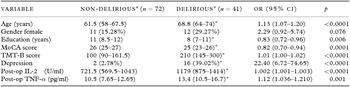
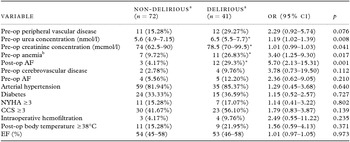
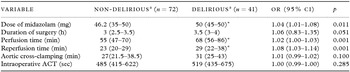
One hundred and eighty-two patients underwent CABG surgery during the study period, of these, 59 subjects did not meet the inclusion criteria: 38 patients had additional, other than CABG surgical procedures, 20 participants underwent off-pump surgery, 1 patient presented profound hearing and visual impairment. Of the 123 eligible patients, 6 refused to participate and 4 died before the observational period was completed. One hundred and thirteen subjects completed the study. Descriptive statistics for delirium and non-delirium group, as well as the results of the univariate analysis of all variables are presented in Tables 1–3.
Biomarkers and variables related to demography and mental condition of patients analyzed in univariate analysis
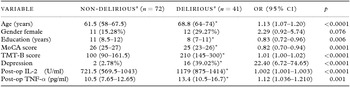
MoCA: Montreal Cognitive Assessment; TMT-B: Trail Making Test Part B; IL-2: Interleukin 2; TNF-α: Tumor Necrosis Factor-α; Pre-op: pre-operative variable; Post-op: post-operative variable.
aFor continuous variables, the medians and interquartile ranges (IQRs) are given.
*Indicates significant difference from non-delirious patients (p < 0.05).
Variables related to physical condition of patients analyzed in univariate analysis
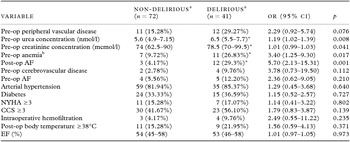
AF: Atrial Fibrillation; NYHA: New York Heart Association grade; CCS: Canadian Cardiovascular Society degree; EF: Ejection Fraction; Pre-op: pre-operative variable; Post-op: post-operative variable.
aFor continuous variables, the medians and interquartile ranges (IQRs) are given;bthe hemoglobine concentration <10 mg/dl.
*Indicates significant difference from non-delirious patients (p < 0.05).
Variables related to anesthesia and surgery analyzed in univariate analysis
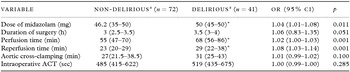
ACT: Activated Clotting Time.
aFor continuous variables, the medians and interquartile ranges (IQRs) are given.
*Indicates significant difference from non-delirious patients (p < 0.05).
The median age of the population was 64 years (IQR: 59–71); 90 (79.7%) of the participants were men. The majority of subjects had ≥8 to <12 years of education (n = 66; 58%); 31 patients (28%) had ≥1 to <8 years of education and 16 individuals (14%) had ≥12 years of education. The majority of participants (n = 87; 77%) lived in urban areas. Cognitive impairment (MoCA score <25) was diagnosed in 36 (32%) patients, whereas MDD in 18 (16%) individuals. The frequency of dementia in the whole population was 5.3% (n = 6).
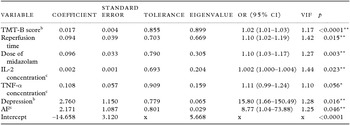
None of the participants suffered from the systemic inflammatory disease. None of the patients had preoperative delirium. Forty-one subjects (36%) developed delirium after CABG surgery. The median IL-2 and TNF-α concentration in the whole population was 844 U/ml (IQR: 595–1236) and 10.9 pg/ml (IQR: 8.3–14.1), respectively. The median time interval from the end of the surgery to the first delirium screening was 20 hours (IQR: 20–20). There were no significant differences in the median time of this interval between delirium and non-delirium group (20 hours (IQR: 20–20) vs. 20 hours (IQR: 20–21), respectively; p = 0.679). The majority of patients were assessed for the first time after 20 hours from the end of the surgery (n = 85, 75%), whereas 28 subjects (25%) were evaluated between 21 and 24 hour after operation. There were no differences between those groups in relation to the delirium incidence (37.6% in patients with shorter interval vs. 32.1% in patients with longer interval, p = 0.599). Nineteen patients had prolonged mechanical ventilation (>6 h). There were no significant differences between subjects with the standard and prolonged time of intubation in relation to delirium incidence (36.5% vs. 31.58%, respectively; p = 0.679). Similarly, there were no significant differences between subjects with the standard and prolonged time of intubation in relation to cytokine levels (845 U/ml vs. 707 U/ml for IL-2, respectively; p = 0.178; and 10.9 pg/ml vs. 11.3 pg/ml for TNF-α, respectively; p = 0.611). Moreover, the time of mechanical ventilation in the whole study sample was not associated with delirium (Table 3). Since 43 patients required administration of propofol, we analyzed the association between the use of propofol and delirium. Among 70 patients without propofol administration, 26 (37%) developed delirium comparing to 15 (35%) subjects in the propofol group (n = 43) (p = 0.808). According to univariate analysis, the individuals with raised levels of IL-2 and TNF-α were at higher risk of postoperative delirium (Table 1). Patients with increased levels of pro-inflammatory cytokines were still at higher risk of postoperative delirium after controlling for variables significant in univariate comparisons (raised IL-2 was significant and TNF-α showed trend towards significance, however, entered the final regression model) (Table 4). Other factors independently associated with delirium included: TMT-B score, reperfusion time, dose of midazolam, MDD, and atrial fibrillation in the postoperative period (Table 4).
Factors independently associated with delirium after coronary-artery bypass graft surgery revealed in multivariate stepwise logistic regression analysisa
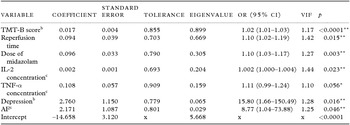
AF: Atrial Fibrillation; TMT-B: Trail Making Test Part B; IL-2: Interleukin 2; TNF-α: Tumor Necrosis Factor-α; VIF: Variance Inflation Factor.
aThe regression model is statistically significant: χ 2 = 87.79; p < 0.001; the c statistic = 0.95; Nagelkerke's R 2 = 0.67; the Brier score = 0.1065;bpreoperative variables; cpostoperative variables.
**Indicates significance; *indicates trend towards significance.
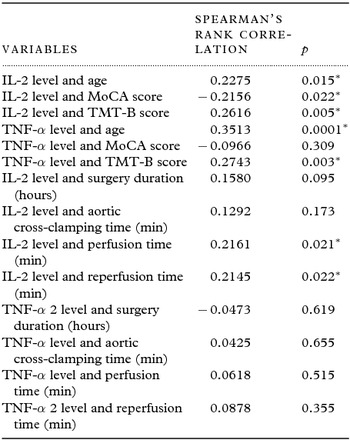
The most optimal cut-off values as determined by ROC analysis in the prediction of the development of delirium were as follows: IL-2 ≥907.5 U/ml with sensitivity of 70.73% and specificity of 69.44%, PPV = 56.86%, NPV = 80.65% (OR = 5.49) (area under the curve (AUC): 0.76 (95% CI: 0.67–0.85 (SE = 0.05))) and TNF-α ≥10.95 pg/ml with sensitivity of 70.73% and specificity of 62.50%, PPV = 51.79%, NPV = 78.95% (OR = 4.03) (AUC: 0.68 95% CI: 0.58–0.79 (SE = 0.05)). Patients with IL-2 level ≥907.5 U/ml were significantly older (p = 0.004), had poorer MoCA and TMT scores (p = 0.025, p = 0.006, respectively), whereas subjects with TNF-α level ≥10.95 pg/ml were significantly older (p = 0.002) and had poorer TMT scores (p = 0.016).
There were no significant differences in median TNF-α concentration and trend towards significance in median IL-2 concentration between subjects with and without depression: 13.4 versus 10.6 pg/ml for TNF-α (p = 0.129), and 1,171 versus 823 U/ml for IL-2 (p = 0.052), respectively. Subjects in advanced age had significantly higher peak in the median TNF-α concentration (12.65 pg/ml for patients ≥65 years vs. 10 pg/ml for younger individuals, p = 0.002), whereas patients with lower MoCA scores had significantly increased mean IL-2 level (1001 U/ml for patients with MoCA score ≤25 points vs. 740.5 for individuals who scored >25 points, p = 0.028). Correlations between more advanced age, poorer MoCA and TMT scores, and cytokines concentration were observed (Table 5). Longer duration of surgery, aortic cross-clamping, perfusion, and reperfusion time were not associated with greater TNF-α release (Table 5). Similarly, longer duration of surgery and aortic cross-clamping did not correlate with raised IL-2 level. However, a significant correlation between prolonged perfusion and reperfusion time and increased IL-2 concentration was observed (Table 5).
The correlations between cytokines levels and variables related to mental condition of patients, and surgery and anesthetic procedures
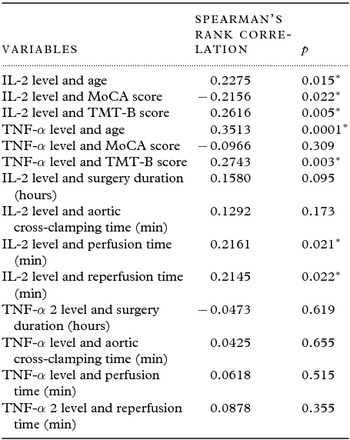
IL-2: Interleukin 2; TNF-α: Tumor Necrosis Factor-α; MoCA: Montreal Cognitive Assessment; TMT-B: Trail Making Test Part B.
*Indicates significant correlation (p < 0.05).
Discussion
In this prospective study, we investigated the incidence of delirium diagnosed among cardiac surgery patients and the association between increased levels of pro-inflammatory cytokines and postoperative delirium. The incidence of postoperative delirium in the present study was 36% compared with the incidence rate of 11–50% reported in the available literature (Kazmierski et al., Reference Kazmierski2006; Reference Kazmierski2010a; Reference Kazmierski2010b; Rudolph et al., Reference Rudolph2006; Mu et al., Reference Mu2010). However, the 50% incidence was reported for participants who were older (mean age 74.9 years; SD = 6.2) than those in the present study.
According to the multivariate regression model, patients with raised concentration of IL-2 and TNF-α measured the day after operation were more likely to develop delirium. The impact of IL-2 concentration on the risk of developing delirium was statistically significant (p = 0.023), and the impact of TNF-α showed trend towards significance (p = 0.056), however, entered the final regression model. These associations were independent of age, gender, cognitive status, psychiatric and physical comorbidity, duration of surgery, CPB time, as well as the dose of midazolam.
According to existing studies, cardiac surgery with CPB is followed by a peak in levels of inflammatory biomarkers. It has been suggested that this inflammatory response to surgery results from tissue damage, CPB, adrenal stress response, or general anesthesia (Roth-Isigkeit et al., Reference Roth-Isigkeit, Borstel, Seyfarth and Schmucker1999; Rudolph et al., Reference Rudolph2008). Recent data have also revealed that cardiac surgery with cardiopulmonary bypass causes blood brain barrier (BBB) dysfunction, cerebral inflammation, and glial cell injury (Reinsfelt et al., Reference Reinsfelt, Ricksten, Zetterberg, Blennow, Fredén-Lindqvist and Westerlind2012).
The IL-2 and TNF-α are pro-inflammatory cytokines without anti-inflammatory effect. IL-2 is produced by T cells, whereas TNF-α released by neutrophils and macrophages during the immune response. TNF-α stimulates HPA-axis activity which results in increased cortisol secretion and thus, it may mediate the intra-operative stress response and help maintain preoperative homeostasis (Nadeau and Rivest, Reference Nadeau and Rivest1999).
On the other hand, inflammatory processes may be involved in the pathophysiology of delirium and according to recent studies, cytokines may play a crucial role in the development of cognitive dysfunction observed in both dementia and delirium (Simone and Tan, Reference Simone and Tan2011).
Unfortunately, the current knowledge does not enable us to establish the molecular basis of cause-and-effect relationship between the increase in cytokines levels and the occurrence of neuropsychiatric disorders. However, consistent with this association is a recent study which revealed that the presence of intrathecal IL-6 and IL-8 leads to the synthesis of matrix metalloproteinase, which potentially culminates in an insult to the brain parenchyma, resulting in the release of neuronal and astrocytic degradation products that terminated in MRI-verifiable lesions and clinical states of brain deficiency (Trysberg et al., Reference Trysberg, Blennow, Zachrisson and Tarkowski2004).
However, in line with animal models, the multifaceted effects of cytokines on the brain function and disease should be noted. IL-2 promotes survival and neurite extension of cultured neurons, stimulates oligodendrocyte proliferation and maturation, produces behavioral and electrocorticogram spectrum changes, and has analgesic effects in the CNS (Jiang and Lu, Reference Jiang and Lu1998). It is possible that multiple actions of IL-2 are mediated by distinct domains or functional sites of cytokines interacting with different receptors or receptor subtypes. Moreover, the type of action is determined by the interaction between genetic factors (genes expression and polymorphism) and environmental factors (stress, hormones, drugs) (Kronfol and Remick, Reference Kronfol and Remick2000; Huang et al., Reference Huang, Meola and Petitto2012).
To our knowledge, this is the first study to indicate that increased concentrations of IL-2 and TNF-α are independently associated with postoperative delirium. However, the mechanisms responsible for increased cytokine release in CABG patients are not clear. These may be associated with surgical and/or anesthetic procedures (tissue damage, longer duration of surgery and CPB, stress response) or pre-existing pathologies such as MDD and cognitive impairment, since cytokine levels are reported as being increased in the course of MDD and cognitive decline (Magaki et al., Reference Magaki, Mueller, Dickson and Kirsch2007; Simone and Tan, Reference Simone and Tan2011; Maes et al., Reference Maes, Twisk and Ringel2012). Recent studies confirmed that cognitive impairment is common among elderly patients undergoing major surgery including cardiac interventions (Rudolph et al., Reference Rudolph2006; Kazmierski et al., Reference Kazmierski2010a; Robinson et al., Reference Robinson, Wu, Pointer, Dunn and Moss2012). Depending on the diagnostic measures employed, the prevalence of cognitive disturbances ranges between 17% and 44% (Rudolph et al., Reference Rudolph2006; Kazmierski et al., Reference Kazmierski2010a). These figures are consistent with current findings (32%), however, double the prevalence rates of cognitive impairment reported for community dwelling patients (10–18%) (Lee et al., Reference Lee, DeLoatch, Cho, Rosenberg, Mears and Sieber2008). Although cognitive decline and aging are reported as strong risk factors of postoperative delirium (Kazmierski et al., Reference Kazmierski2010a), the pathophysiological mechanisms underlying the association between impaired cognition, advanced age, and delirium after cardiac surgery have not been investigated to date.
The analysis presented here suggests that subjects with advanced age, lower MoCA scores, and impaired executive functions had significantly higher levels of IL-2 and TNF-α assayed in postoperative period compared to younger patients and those with better cognitive functioning, although, there were no such differences between subjects with and without MDD.
Available studies suggest that increased cytokines may induce delirium only in the presence of prior CNS vulnerability (Cunningham et al., Reference Cunningham2009). According to the experimental models, transient systemic inflammation superimposed on neurodegenerative disease acutely exacerbates cognitive and motor symptoms of disease and accelerates disease progression (Cunningham et al., Reference Cunningham2009). Therefore, it is tempting to speculate that the release of cytokines in response to cardiac surgery in the present sample was greater in individuals with pre-existing CNS vulnerability (older patients and those with poorer cognitive performance) comparing to healthy patients.
In the current study, higher levels of inflammatory markers did not correlate with longer duration of surgery and aortic cross-clamping. However, longer duration of CPB was associated with higher IL-2 level and a greater risk of delirium. This is consistent with the recent observation that the increase of TNF-α and high mobility group box 1 (HMGB1) (released by activated immune and necrotic cells) reaches the highest level right after CPB (Zhang et al., Reference Zhang, Wu, Zhao, Xiao, Liu and Zhou2013). In other reports, a longer duration of CPB was associated with increased risk of subsequent cerebral dysfunction due to embolic load (Brown et al., Reference Brown, Moody, Challa, Stump and Hammon2000). The authors of this study revealed that for each 1-hour increase in the duration of CPB the number of cerebral emboli may increase even by 90.5%. Our findings suggest that the pathogenesis of brain injury and delirium induction after cardiac surgery may be associated with CPB-related cytokines increase.
Of note, above observations must be treated with caution due to limited data available in this study. Especially the lack of baseline cytokines assays prevented us from investigating whether absolute cytokine levels or a change in cytokine levels following CABG better predicts delirium.
Study strengths
The assessments were conducted in the prospective manner by an experienced investigator. The participants were consecutively enrolled and the study group was homogenous. The association between inflammatory markers was confirmed by multivariate analysis, and was controlled for by using variables related to the mental and physical comorbidity of patients, as well as surgical and anesthetic procedures. Moreover, internal validation with the bootstrap method was conducted and variance inflation factors were calculated to confirm the reliability of the final logistic regression model.
Study weaknesses
Cytokine measurements were conducted once postoperatively and baseline samples were not collected. Thus, it is not possible to judge whether the increased preoperative cytokine concentration plays a role in the development of delirium. On the other hand, existing studies failed to reveal any association between cytokines concentration assayed prior to surgery and postoperative delirium. Furthermore, due to lack of multiple assessments, we were unable to determine if the time-course and severity of postoperative delirium was exactly correlated with that of cytokine levels. It should be noticed, yet, that the blood samples were collected as postoperative neuropsychiatric screening started and, 19 (46%) patients developed delirium after the day of samples collection, whereas 22 (54%) individuals on the day of samples collection. This may suggest a causative effect of raised cytokine levels on the development of delirium. Moreover, subjects with dementia and milder forms of cognitive impairment were not distinguished and all the patients with positive MoCA screening were included into analysis. However, in majority of previous studies, the cognitive impairment as general entity was investigated (Lee et al., Reference Lee, DeLoatch, Cho, Rosenberg, Mears and Sieber2008; Koster et al., Reference Koster, Hensens, Schuurmans and van der Palen2011). Therefore, we used the research design consistent with previous reports to make the present and previous findings more comparable. Finally, the cognitive and affective evaluation was performed the day prior to surgery and the clinical situation could have some impact on the assessment results. On the contrary, the rates of cognitive impairment and depression revealed in the present study are consistent with the rates presented in previous studies on delirium after cardiac surgery.
Conclusions
This study revealed that raised levels of IL-2 and TNF-α measured in the postoperative period are associated with the development of delirium among CABG surgery patients (independent association for IL-2 and trend towards significance for TNF-α). This higher concentration of pro-inflammatory cytokines may be associated with longer duration of CPB (IL-2 only) or related to advancing age and pre-operative cognitive decline (IL-2 and TNF-α) but importantly, not to a preoperative diagnosis of MDD. It should be noted, however, that in the current study the preoperative levels of cytokines were not investigated. Therefore, a causative effect of preoperative cytokine levels on the development of delirium is an important consideration for future studies.
Conflict of interest
None.
Description of authors’ roles
J.K. designed the study, recruited the patients, conducted the neuropsychiatric evaluation, and drafted the paper. A.B. participated in the study design and recruited the patients. J.L. collected and stored the patients’ blood samples and the patients’ data. J.B. drafted and revised the paper. R.J. participated in the study design and revised the paper.
Acknowledgments
The authors gratefully acknowledge Mrs Ewa Zielinska for her help in samples collection and Dr Malgorzata Misztal for contribution to statistical analysis. This study was funded by the Polish Ministry of Science and Higher Education, Grant No. 0174/P01/2010/70; 504-06-011.