I. INTRODUCTION
The perennial debate over whether it is appropriate for a democracy to establish judicial review has produced an extremely vast literature. However, progress has often been obstructed by differences in the way commentators approach the question. To be sure, this has to do with disagreement at the level of normative theories, but this is only part of the explanation. Differences among accounts are also due to the lack of a common methodology to address the questions involved.
A theory of judicial review of legislation cannot spring automatically from a depiction of the deficiencies of the political process—this may be at most a necessary condition for judicial review to be justified. Critics of “strong” versions of judicial review (the case in which a court is authorized to strike down or decline to apply a statute)Footnote 1 object to what they see as asymmetric or “nirvana-like” comparisons of institutions by judicial review's defenders.Footnote 2 These descriptions typically take the worst-case scenario regarding the functioning of the political branches—usually a crude description of the political process—and contrast it with a rosy picture of the judiciary. A successful theory of judicial review thus has to include inter alia some further exploration of the advantages this practice may have, including a study of judicial capacities. But this logic applies both ways. It should not be the case that a now rosy vision of the legislature is contrasted with an awful picture of the judiciary. Certainly, it may be true that in practice either the legislature or the judiciary performs poorly, and this is why scholars should clarify the method or level of analysis employed.
The study of both the promises and the dangers that judicial review may bring about partly involves a comparison between potential constitutional decision-makers. A comparison can be made, on the one hand, between the political branches and the courts in their—at least latent—ability to “get it right” about the constitution. This may be a marginal activity for decision-makers. But the question will be what the best candidate is for those cases at the margin that do entail such interpretation. We have to be clear—while making this comparison—about whether the political branches face judicial review. If they do, judicial review may affect the study of the legislature. On the other hand, instead of comparing legislatures and courts in their potential role as constitutional decision-makers, we may want to focus on the political branches themselves, thus comparing the legislature's performance with or without judicial review. This approach is not identical to the previous one. A critic of judicial review may be interested in showing that the political system performs worse in some nontrivial way when this institution is in place. But while this may be so because courts get it wrong more often than not, it may also be so because of other reasons. One of such reasons is well known: the idea that legislatures facing judicial review will have fewer incentives to respect the constitution.
A comparison among decision-makers should not be biased from the start. But at least two sets of questions need to be tackled. One of them is how to make a sensible comparison when measuring respect for the constitution. The other, one of the main issues in discussions of judicial review, is what precisely to compare, and what the implications of this comparison are. This article is devoted to these questions: to discuss the proper way to evaluate judicial review. One of its main claims is that we need to avoid the extremes of cherry-picking (generalizing conclusions from particular instances of success or failure) and complete idealization (offering a case that bears no resemblance to an often nonideal actual world). The justification of judicial review must be evaluated by seriously reflecting on the general object of this practice as well as by a systematic consideration of the performance of the political system under consideration. Neither an anecdotal nor an idealized account will do: we need the institutions that are best for us, given what we know about our society.Footnote 3 Ultimately, the answer should depend, as it were, on what our society's “worst nightmare” is.Footnote 4
The two sets of questions just identified are explored sequentially in this article. Section II begins by discussing how to engage in a discussion of judicial review. The section asks about the level of abstraction and idealization that ought to be employed when comparing the institutional capacities of potential decision-makers. The answer, as anticipated, is that a highly abstract and idealized account may not advance the discussion. The section goes on to offer a point that is as simple as it is significant: if our decision about how to structure a political system is to be made at a country's onset, we may not be in a position to disregard judicial review—even if we were confident that a “healthy” political system would not need it. If our decision regarding judicial review is made at a later stage, then the discussion around that decision may be influenced by either the presence or absence of judicial review.
Section III moves to the second set of questions: On what grounds should we structure this comparison? What is at stake in the enterprise? The section starts by introducing two models to analyze better the intersection of theories of democracy, judicial review, and constitutional interpretation. It presents a comparison between “alternative legislatures,” namely, whether or not equipped with judicial review. It argues that the familiar claim according to which judicial review may promote the legislature's lack of responsibility—defended by scholars ranging from James B. Thayer to Mark Tushnet—may be conceptually obscure. Critically, the section further claims that, ex ante, stakes will be lower when judicial review is in place. In line with the previous discussion, the section concludes that we may not be in a position to reject the idea of judicial review even if we are concerned about keeping the political system legitimate or majoritarian.
Better to discuss these issues, the article analyzes an account or model developed by Jeremy Waldron in order to criticize the political systems that allow judges to make final determinations on the constitution.Footnote 5 Now, the inquiry presented in this article extends well beyond Waldron's work. The central objection raised against judicial review is that those judicial determinations can go against the people's will with a degree of finality and therefore that judicial review is a countermajoritarian institution,Footnote 6 an objection that is at the heart of Waldron's work. In a significant way, then, Waldron's elegant account encompasses the central normative arguments against judicial review. This article, however, also deals with two important points advanced by Mark Tushnet, another prominent opponent of judicial review.Footnote 7
Different reasons explain this article's focus on Waldron. First, Waldron's contribution to the discussion is probably the best effort to date to address the methodological questions posed above. Waldron attempts to take institutions seriously in order to investigate the promise of both the political process and judicial review. Second, the framework that Waldron developed is useful for the discussion in this article for it can be employed at times as a methodological device without fully taking into consideration the substantive implications that he assigns to it. Connected to this is a third reason. We know from the U.S. context that opinions about judicial review often fluctuate depending on what courts are doing at the moment.Footnote 8 Today's defender of judicial review may well be tomorrow's main foe. As Waldron's work is meant to pay serious attention to the promise of institutions, it should allow us to focus on the second-order decision of whether to structure judicial review without being too influenced by the opinion of the day, namely, by the first-order decisions themselves.
Fourth, a model such as Waldron's is appealing because it can transcend the U.S. context. This is as unusual as it is relevant. It is unusual because the discussion of judicial review has been parochial, with most accounts being formulated for or derived from that specific context. It is also relevant because it is well known that the U.S. discussion of judicial review adopted its characteristic form for reasons that may be absent elsewhere. Prominent among these reasons is the great difficulty in amending the U.S. Constitution,Footnote 9 a choice at the founding moment that was heavily exacerbated as the union expanded (obtaining the ratification of three fourths of the original thirteen states was easier than that of three fourths of the current fifty states). Another feature is the relative lack of detail of the constitutional text, which creates ample space for interpretative disagreement. Finally, an indisputable authorization of constitutional adjudication is nowhere to be found in the text. Against the background of a heavily polarized political sphere, the combination of these features gives judicial decisions interpreting the Constitution—and gives every nomination to the Supreme Court—the dramatic force we are all familiar with.
This article claims, however, that Waldron's account fails. His account tips the balance against judicial review for reasons that are either wrong or not straightforward, and its assumptions yield perplexing results. Both Sections II and III anticipate some of these concerns, although they are analyzed at greater length in Section IV. This section focuses on a central aspect of Waldron's model: that which deals with the definition of, as it were, a political system's “health.” According to the model, a system that performs in certain ways can be by and large exempted from judicial review. Yet very few systems will provide ex ante reasons to expect they will meet the standards set by the model. Moreover, ironically as it may seem, meeting those standards will come at a high price: the political system may contradict the normative values that underlie the model. As a matter of fact, it is even possible to imagine alternative institutional arrangements in which judicial review helps to keep the political system majoritarian enough. In the end, it will be hard to avoid the conclusion that Waldron's idealized account is not adequate to reflect on our potentially nonideal world—something that Waldron himself would appear to acknowledge in his study of New Zealand.
Two remarks are important to clarify the discussion to come. For all its insistence on the need to assess the capacities of decision-makers, the article does not study the judicial branch. The article does not attempt to offer a conclusive argument in favor of judicial review, which will have to wait for a future occasion. Its aim is more modest: to neutralize central critiques that without necessarily putting judicial capacities into question, represent a challenge to the justification of judicial review, and to do so by way of focusing on the methodology employed to discuss the issue.
The second, longer remark is about the role of constitutions. The discussion of judicial review usually predicates upon the assumption that constitutions are supposed to place actual limits on the institutions in charge of interpreting it. Some people may dispute that it is necessary to have a constitution, or would say that constitutions hinder collective self-rule. Be as it may, these critiques should not be so problematic for the present discussion. If we accept the need for an authoritative constitution, we may then engage in the discussion about whether clauses are sufficiently clear or objective and about whether courts or the legislature alone should engage in the interpretive enterprise. If, in turn, we reject this idea, we may compare the legislature and courts along other, nonconstitutional standards. What we cannot do is think that, by necessity, whenever there is a constitution, courts exercising judicial review would be completely bound by it and the legislature would be completely unbound. A radically majoritarian view would hold that we can depart from a constitutional text entirely if this reflects the people's will. But on such a view, the constitutional text we assume exists is reduced to a weightless ephemeron, and that surely is implausible if the constitution is supposed to have some meaning of its own—if the interpreter cannot read anything she wants into it. The constitution will claim its authority over either decision-maker.
Granted, irrespective of the amendment process established in the constitution, the legislature's constitutional renderings may be changed by a majority vote. However, when doing so, legislators should engage in an honest attempt to respect the constitution. One thing is to say that the legislature may change a previous interpretation because it thinks its new one is the most appropriate rendering of the constitution, and another is to say that the legislature may freely change the constitution itself.
II. EVALUATING INSTITUTIONAL PERFORMANCE: HOW TO COMPARE INSTITUTIONS
Which perspective should we adopt in depicting competing or concurrent institutions? The following paragraphs highlight two different though connected levels of analysis, one related to the degree of abstraction of the inquiry, the other to its degree of idealization. Regarding the first level, we can approach the issue from two different angles. One is to attempt to devise a set of institutions that are best for a society, given some loosely defined conditions. For instance, we may come up with certain notions about separation of powers and judicial review (or lack thereof) without paying attention to the specific adjustments the resulting arrangement would need in order to fit our society's actual needs. Alternatively, we may be more concerned with the identification of those concrete institutions that are best for us now, given what we know about our society.Footnote 10
But there is a second, connected way of thinking about how to evaluate institutions, inspired by John Rawls's distinction between ideal and nonideal theory.Footnote 11 On this view, while ideal theory tries to specify the set of principles that would be appropriate to an order of perfect compliance, nonideal theory attempts to come up with principles that would be suitable in contexts where less than full compliance is expected. In our context, “full compliance” means that the agents populating the institutions we devise will abide by the constitutional principles structuring and limiting them. So we may assume that agents will be motivated enough to comply with their mission, whatever this mission entails. Alternatively, we may have in mind that noncompliance will be an issue; agents will often fail in carrying out that task, and we may want this prediction to influence institutional design. These alternative levels are much related but cannot be conflated. Our abstract depiction may incorporate some assumptions about the degree of compliance—for example, we may think the system will be to some degree nonideal. The more detailed our approach, the better able we may be to anticipate what level of compliance to expect. Conversely, if our model were ideal, we would need to offer an abstract view unless we were certain that our actual agents would carry out their task perfectly.
A. Different Levels of Analysis: Jeremy Waldron's Model
We can see how both sets of approaches work by analyzing Waldron's critique of “strong” versions of judicial review. Waldron objects to those views that show only courts in a good light. But instead of showing that courts face either similar or worse problems as some actual political processes, he offers an abstract and idealized account of the entire institutional system, including the political branches. His account is, on one hand, quite abstract, as it does not provide detailed renderings of the way political institutions may be structured and operate in practice—as shown in Section IV. At the same time, it is somewhat idealized: while his model of “healthy” institutions makes room for a degree of noncompliance, this will be a relatively marginal question. Thus it seems that for Waldron the analysis has to be carried out by comparatively assessing the work of both the political branches and the judiciary under ideal or good-enough light instead of actual light.
Let me briefly describe Waldron's model. He presents an institutional system in which four assumptions hold as a “core” case, as opposed to a “noncore” case. This conceptualization is important since in principle the panoply of arguments against judicial review applies only to cases that are within the “core.” First, in a “core” case, the political system is “healthy”: it is generally able to process people's preferences after some minimum political deliberation and to allow for political change. The electoral system works adequately; the legislature is representative, and its procedures for lawmaking are elaborate. Further, it incorporates “safeguards, such as bicameralism, robust committee scrutiny, and multiple levels of consideration, debate, and voting.”Footnote 12 This does not mean that under this assumption legislation will always be good or just or that the lawmaking process will work perfectly. For Waldron, sometimes this will not be the case. As he acknowledges, “even in the name of political equality we are not entitled to demand perfection.”Footnote 13 But even when this possibility cannot be ruled out, the political process is generally “in good working order,” which means that if the system fails, the legislature will have incentives to correct it.
Second, the judiciary is also in “good working order,” “well-established and politically independent.”Footnote 14 If it were assigned the function of judicial review, it would generally do it properly. But the issue is precisely whether this should be the case—whether the judiciary's determinations should prevail. Third, both the electorate and political elites generally respect rights. Waldron even makes this assumption “more concrete” by adding that “society cherishes rights to an extent that has led to the adoption of an official written bill or declaration of rights of the familiar kind.”Footnote 15 But this commitment does not imply that there are not deep disagreements regarding the substance of rights. Such disagreements are pervasive, even among public officials.Footnote 16 This is the fourth assumption.
Waldron argues that in cases meeting these assumptions—that is, if we can show that they reflect the way actual political systems work—judicial review will be unjustified. Judicial review may be justified in cases outside the core (in “noncore” cases).Footnote 17 This article does not analyze the full interplay of these assumptions. On Waldron's account, however, the failure of the first one seems to be a necessary though not a sufficient condition for judicial review to be justified. If it fails, judicial review may be justified depending, inter alia, on the type of failure that both the second and third assumptions face.Footnote 18 Of course, “failure” of the fourth assumption does not pose a special difficulty for judicial review—if there were no disagreement, some of the problems many people associate with judicial review would dissipate.Footnote 19
Notice that it is not completely clear whether Waldron's third assumption refers to the idea of rights as (at least partly) constraining public officials or more loosely as a set of standards to guide the legislature which the legislature may freely change by a majority vote. Waldron leaves open the question of whether the Bill of Rights is embedded in the Constitution.Footnote 20 In some passages, he argues that a legislature not facing judicial review may not need to refer to the text of the Bill of Rights and even makes the stronger claim that it is not a good idea for rights disagreements to be fought by resorting to texts.Footnote 21 Now, this article analyzes constitutional decision-making. The main attacks against “strong” judicial review are related to the fact that the political branches—at least theoretically—can hardly change judicial determinations about the Constitution. As mentioned, though, there is nothing intrinsic about the Constitution that makes it have some meaning when it is interpreted by judges and no meaning at all when in the hands of the legislature.Footnote 22 The judiciary is usually arranged in such a way as for it to resort to technical standards such as precedents. But the choice need not be between extremely technical courts and completely unbound parliaments.
Note further that a view such as Waldron's should be able to claim that “healthy” political institutions can exist without judicial review. So this article often talks of a “core case” when referring to these situations. To distinguish it from the core case that does include judicial review, such a system will be a core case*. This article also uses this formulation, core case*, to refer to well-working political institutions in contexts where we want to pay attention only to them, irrespective of the presence of judicial review.
Waldron's methodology raises serious questions, so it is the methodology itself, rather than the full arguments he offers to criticize judicial review, that this article is mostly concerned with. First, leaving those arguments aside, the model's conceptualization of “core” and “noncore” cases is anything but clear. As a consequence, we may have trouble finding actual contexts that “fit” the categories in Waldron's model. Indeed, it is unhelpful to offer an account at such levels of abstraction and idealization. In omitting too much detail, the account may fail to provide any guidance. As explained in Section IV, Waldron himself seems to find a gap between his idealized account and its application to the nonideal world, as he recoils when addressing a political system that looks as “healthy” or “nonhealthy” as many central systems in the world. Finally, and most crucially, his main case against judicial review is unstable or inconsistent, for it has built-in assumptions in tension with the argument driving the theory. This, it is argued below, extends to accounts such as Tushnet's.Footnote 23
Now, this is not necessarily an argument against ideal theory per se. Ideal theory might otherwise be justified to systematically reflect upon or achieve clarification about a complex issue or to think properly about extensive reform.Footnote 24 The point is that an idealized discussion such as Waldron's does not help to advance any of these goals. If the argument in this article is correct, the core of his case against judicial review may be empty in real life, and if it is not, it will likely be because of reasons that the account itself cannot easily accommodate. Such a methodology could still be defended by arguing that it highlights normative issues that would be important even if the conditions set by it were never or rarely satisfied in the actual world. Yet this argument would not take us far. First, it is anything but obvious that Waldron himself would want to offer such a view. There is no reason to believe that he is not concerned with the aim of impacting actual institutional arrangements. He would probably reject the idea that his theory could be valid even when not generally applicable to actual contexts, and rightly so. More generally, offering such a view would be an odd way to proceed in the discussion. If, as this article shows, Waldron's account does not fit most of the actual world that we know, it is unclear how or in what way it should help us think of (actual) institutional design. Judicial review is nothing other than an institution meant to operate in the actual world. Therefore an account of judicial review is unhelpful if it does not fit that world.
B. Situating the Discussion
If we were able to classify any given political system into one of these core/noncore categories, and we further embraced Waldron's insights underlying it, the model would prove a relevant tool. Whenever we found a core case, we would know that judicial review must not be implemented. It is unclear, however, that the suggested classification would be realizable or useful. Indeed, it may be difficult even to reflect on the question of judicial review without providing additional information on the context being considered. Judicial review will or will not be justified according to local and historical circumstances, and without taking them into account, it will not be possible to assess, first, whether the political system is a core case and, second, whether it will become or remain one.Footnote 25 This is an utterly simple yet crucial point, and one that Waldron overlooks, interested as he is in developing an abstract argument.
Judicial review (or the idea of it) does not emerge out of the blue. As we know, constitutions are first written at a nation's outset. A first possibility is to study whether to implement judicial review at that founding time (t1). Alternatively, we can explore the issue at a subsequent stage (t2) in a nation's life. Here there are two possible situations. One is the option to include judicial review if it was not included at t1 (t2a). The other is to remove it if it was originally implemented (t2b).Footnote 26 Our response to the three cases will be based on empirical predictions (on the likelihood of noncompliance, on possible losses or gains of civic virtue that judicial review may lead to, etc.) but also on the level of “failure” that we are willing to tolerate.
Let us start with t1. At this stage, it may be hard to predict whether the procedures set out in the constitutional text will bear fruit without judicial review—whether the expectations of a core case* will bring in an actual core case*.Footnote 27 We may think that political institutions will need an external umpire as a court in charge of signaling and correcting deviations, at least up to the moment when the promise of the core case is fulfilled. This is not to say that a country may not do well without judicial review. In fact, someone may articulate the view that in the absence of previous experience, we should not be risk-averse. After all, many well-working political systems did not experiment with judicial review, at least not for a long time. The point suggests only that without relevant local information, we might be unable to predict whether our country will develop into an actual core case*. If we were confident enough, we might certainly be willing to make a bet, but a bet this will be. Given that we do not know much about how institutions will work, we should not assume that judicial review will perform well either. But unless we want to press the stronger claim that a core case* cannot develop with judicial review—a claim that would be at odds with Waldron's modelFootnote 28 —this issue is relatively unproblematic for the discussion. Our uncertainty about how institutions will develop in practice would be a serious problem if judicial review could be thought to obstruct the road to the core*. This may happen, for instance, if courts hopelessly meddled with political institutions. It would be bad if courts were ineffectual, but this would hardly prevent a system from becoming a core case*.
The decision in t2 very likely depends on past performance. In t2a, those in favor of judicial review may argue that because of increasing violations of the system's democratic procedures or certain unjust outcomes, the nation might risk deviating from the core in the near future. Even if political institutions were not “pathologically or incorrigibly dysfunctional,”Footnote 29 efforts by these institutions to correct deficiencies may have yielded inconclusive results in the past. The situation in t2b is different. Here the well-working political institutions may want to assert their exclusive power to interpret the constitution, probably by arguing that deviations have been so negligible in the past that judicial meddling unduly interferes with democracy. The political system might be mature enough to experiment by getting rid of judicial review while remaining a core case*. Although its implications are explored below, this argument may make perfect sense. One point to notice, though, is that the nation might now be a core case partly as a function of its political system having judicial review. As with any counterfactual claim, this is extremely difficult to prove, but this difficulty applies all the way down—to defenders and critics of judicial review alike.Footnote 30 So unless it could be proved that judicial review was never needed in that country, the election at t2b may be a function of the past, a past that included judicial review. On the other hand, if judicial review was not frequently exercised, it might be true that the system got to be a core case regardless of it.Footnote 31 But if we assume judicial review did not play any role, the discussion would be rather artificial: there would not be much to get rid of. The system was already more a core case* than a core case.
An alternative way of seeing t2b is to consider that the system of judicial review worked badly. Courts might have erred too frequently or they might have been too invasive of the political branches. It suffices to say now that this is a possible scenario, and it is precisely what we want an analysis to find out. (Remember, though, that in Waldron's account the core case does not include this situation.)
The paragraphs above, based on a very basic intuition, by no means amount to a justification of judicial review. But a tentative conclusion that follows from them is that the idea of judicial review may not be so swiftly rejected even if we were confident that a healthy political system would not need it. The next section goes on to explore what is at stake in our comparison.
III. WHAT TO COMPARE: COMPLIANCE, MISTAKES, AND DISAGREEMENT
It would be a panacea if we all agreed on some common standards for the evaluation of our institutions in terms of their respect for the constitution. We know that such a common standard eludes us—people tend to disagree regarding many constitutional questions—so we need to map the main evaluative approaches in order to see how an argument for or against judicial review might stand. We would be better able to reflect on this if we devised some simple yet useful conceptual framework. The following paragraphs are an attempt to offer such a framework in the form of two models. For the most part, the normative discussion of judicial review has taken place within the context of political systems that do not look pervasively deficient, such as the United States. This assertion, however, is problematic, as the debate itself can influence our concept of “deficiency.” So the exploration of the two models that follows does not consider the political systems' level of “failure” or “deficiency,” a central point in Waldron's model that is addressed in Section IV.
Two Models: Decision-Makers' Constitutional Views.

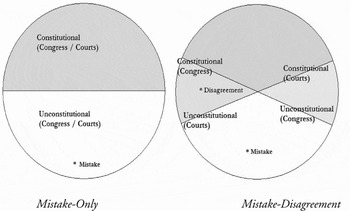
Let us explore these models. In the first, decision-makers share the same understanding on constitutional issues—call it the mistake-only model. A second model will be reserved for cases in which decision-makers may have different answers. This will be the mistake-disagreement model.
A. The Mistake-Only Model: Constitutional Responsibility and Judicial Overhang
Even though many people might find it quite naïve, this model offers a simple framework to analyze some of the main issues involved in the discussion. The model assumes there is something approaching constitutional objectivity, so that reasonable people should be able to agree upon answers to particular constitutional questions.Footnote 32 Since there should be agreement among the branches on whether the constitution was violated, someone might think it would not be problematic if courts had the power to solve “mistakes” by striking down legislation. But this cannot be the whole answer; courts can err too, thus violating rights or other constitutional clauses on their own.Footnote 33 In order to show that judicial review would be beneficial, we would have to prove that: (1) in the aggregate, judges tend to err less frequently than the political branches; or (2) even when judges are at least as likely to err, stakes are lower when they intervene, particularly when it comes to certain types of constitutional matters, such as when rights are involved. Richard Fallon takes this latter road, which I further develop toward the end of this subsection.Footnote 34
There is a different way to analyze judicial review in this model: by focusing on the comparison between alternative “legislatures,” whether or not facing judicial review. Some scholars—including Waldron—argue that we should not assume that a well-working legislature will be unable to self-correct. Even when mistakes will be made eventually, a responsible legislature may be able to solve them in the future without any need to resort to judicial review. This possibility is worth considering but it needs clarification. The idea seems more intuitive if we are thinking of structural deficiencies in the political process that may open the door to constitutional violations. Self-correction here would mean the likelihood that the legislature (or the political branches more generally) solve these problems in the medium to long term. But the discussion would be different if we were thinking of discrete violations. Self-correction here would imply a solution for the short to medium term. Although the legislature may by and large be unable to provide a particular remedy to someone injured by an unconstitutional statute, we would still want it at least to repeal or change the statute. Even assuming that the legislature is somehow committed to self-correcting, certain potential features of the legislative process (inter alia, the legislature's inertia, the scarcity of time and other resources) may hinder this possibility.
Even if successful, the position insisting on the legislature's self-remedying does not inflict a mortal blow to judicial review. At most, it would show that judicial review may not be necessary. But uselessness should not be equated with harmfulness. If judicial review were completely useless, it would lose its positive justification, but this is not the same as saying it would have negative implications. If the legislature were always able to self-correct, either judicial review would never result in interferences with legislative action (in which case it would only be nominal) or it would result in some instances of interference before such self-correction. Judicial review would be problematic under such a scenario if judges made mistakes. But the fact that judges would be telling the legislature to do exactly what it would have done anyway does not seem to be particularly troublesome. In any event, judicial review's usefulness would marginally increase with the corresponding decrease in the legislature's level of self-correction.
Yet we may be willing to go one step further and claim that it would be not unnecessary but bad for judicial review to exist: it may forestall the chances of legislative self-remedying or arguably increase the chances that the legislature “gets it wrong.” According to a familiar argument, judicial review would minimize legislators' responsibility to respect the constitution. Knowing that courts would solve any mistake they could make, legislators would be less attentive to the values at stake. This is James B. Thayer's concern.Footnote 35 But at best this argument rests on empirical evidence—only that systematic evidence here is difficult to obtain and assess.Footnote 36 At worst it is obscure.Footnote 37 We may make the opposite point, a familiar one as well: judicial review may be needed as a red flag.
Mark Tushnet is one of the contemporary scholars who think that legislators would be more instead of less inclined to respect the constitution if judicial review did not exist, which he attempts to illustrate with a number of examples.Footnote 38 Now, it is not entirely clear to me exactly what Tushnet's claim is. In his view, legislators have reflective views on the constitution that are independent of what courts say. But judicial review produces a “judicial overhang”; it “sometimes promotes legislative disregard of the constitution.”Footnote 39 Arguably to support his position, he cites the conclusions of Bruce Peabody's study of the level of respect that U.S. legislators show toward the Constitution “independent of the Supreme Court's interpretation,” allegedly showing that this level is quite high.Footnote 40 The survey, quoted by Tushnet, concludes that “more than 60% of the respondents refused to cede constitutional questions to the courts, believing instead that congress should “form its own considered judgment” on these issues.”Footnote 41
But if the “judicial overhang” that Tushnet criticizes is already present, as it should be in the United States because of its long-standing tradition of judicial review, then it is not clear how to read these findings. To begin with, the survey asked legislators whether they should defer to the courts in issues of constitutional interpretation.Footnote 42 To a large extent, the findings are an assertion of legislators' authority to read the Constitution vis-à-vis courts. The quoted phrases refer to how legislators perceived their work to be, not to how they really worked or how good that reading was.Footnote 43 The most crucial point, however, is that if the answers said something about how good those interpretations are, it would be the very negation of the “judicial overhang” effect.Footnote 44
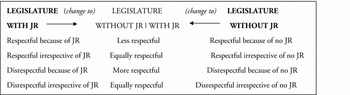
Although the discussion of the legislature's constitutional responsibility ultimately rests on empirical grounds, perhaps we can reflect about it. The addition of judicial review to a system that did not have it would worsen the legislature's responsibility only if the legislature respected the constitution because there was not judicial review—the legislature would not change if its level of respect was independent of the issue of judicial review. In turn, the removal of judicial review would increase that level of responsibility if legislators were disrespectful because of it. Conversely, if the legislature in a system with judicial review does respect the constitution, it may be so either because of judicial review or irrespective of it. In the former case, the removal of judicial review would lower the legislature's level of respect. In the latter, it would make no change. So we could hardly say at the same time, as Tushnet seemed to do, that legislators today are respectful independently of judicial review but would be even more so without it.
The Legislature and the Constitution, with or without Judicial Review.

Maybe we can go back to Thayer's claim (which is otherwise Tushnet's as well) and insist along the following lines: legislators are inclined to respect the constitution and they will strive to do so; but if judicial review were in place, they would have fewer incentives than if it were not. In deciding a complex question, a legislative committee might analyze one independent report instead of four, even knowing that having four would minimize mistakes. This might be a risk worth taking in order to save the committee's scarce resources, and if a mistake were made, judicial review would solve it.Footnote 45 If judicial review were not in place, legislators would request and analyze all four reports. This initially intuitive argument may be validated by empirical evidence. But once again this would run counter to Tushnet's reference to Peabody's findings. If the argument were correct, it would not be true that legislators' responsibility toward the constitution was independent of judicial review, at least not totally. For good or for bad, legislators kept an eye on courts, so courts exerted influence on their degree of responsibility—after all, this was the idea behind the concept of “judicial overhang.” Without judicial review, legislators would have no incentive to keep an eye on courts, but it is far from obvious that their responsibility would be enhanced.Footnote 46
We can see this through an example. Suppose we will be leaving our house. We need to hire someone to water the plants, an activity we deem vital. Hiring one person would cost us more than half of what we would pay hiring two, in which case the money would be equally split. Our neighbor Leo says he is very responsible. He says that if he alone were in charge, he is positive he would not forget. But he adds that if someone else were also in charge, he might become too self-confident. When we tell Leo that his words suggest he is not so responsible after all, he gets furious. He says he is responsible, but that the presence of somebody else might produce a slightly narcotizing effect over him. Another neighbor, Cecilia, is inclined to do the work, but she cannot do it alone. We may end up hiring both. If Leo were really responsible, why should he change because of the presence of Cecilia? Perhaps Leo would not forget either way—he is interested in earning more money, which he would get by being hired alone. But should we not at least suspect that without Cecilia he might forget anyway?
Even if we think that removing judicial review would not alter the legislature's responsibility, we may welcome the change on democratic grounds. Remember that the main argument leveled against judicial review is that it involves a cost in the democratic “legitimacy” of the political system. Elusive as it is, the concept of legitimacy as employed in this article refers to the core of the normative claim about collective self-government, epitomized by the principle of majority decision.Footnote 47 Nevertheless, that view is not straightforward either. As explained below, legitimacy might best be preserved or promoted with instead of without judicial review. Moreover, the cost would not be too serious under the mistake-only model, particularly if we agree that the value of legitimacy does not entail the unabridged “right” to make constitutional mistakes in cases where there should be no doubts that such mistakes are being made.Footnote 48
The Canadian “notwithstanding” clauseFootnote 49 allows the legislature to insist on the validity of legislation even when courts concluded that it violates the constitution. This insistence may be seen in two ways. First, we can interpret it as a tool for the legislature to reaffirm its previous decision, even though it acknowledges it made a serious mistake. Second, we can see it as a case in which the legislature disagrees with courts as to the meaning of the clause at stake.Footnote 50 Even when some people would be willing to defend the first view (and we may in some cases),Footnote 51 it is generally inadequate if we also accept that we have a constitution setting limits on what state institutions can do. The second interpretation is more plausible,Footnote 52 but in the mistake-only model we do not need to consider it.
After noting that both the legislature and the courts can violate the constitution, the claim is made that an argument for judicial review needs to show either that judges tend to err less frequently than the legislature or that we have ex ante reasons to think that stakes will be lower under judicial review.Footnote 53 Phrased differently, the answer to whether judicial review is justified will depend not only on judicial capabilities but also on what is at stake. Both the political branches and the judiciary may violate the constitution. We may, however, be willing to run the risk that some constitutional breaches originate within the courts if the alternative is that the political branches are free from external oversight.Footnote 54 This is not (or not only) a probabilistic argument. As Fallon has argued, the central question is not whether one institution is more likely to err than the other. The question, instead, is what kinds of errors it is more important to avoid—those leading to rights being overprotected or to rights being infringed.Footnote 55 The answer, with Fallon, is that judicial review may minimize such infringements:
The affirmative case for judicial review need not depend on the assumption that courts can identify rights more accurately than legislatures. Rather, the most persuasive case maintains that both institutions should be enlisted in the cause of rights protection because it is morally more troublesome for fundamental rights to be underenforced than overenforced.Footnote 56
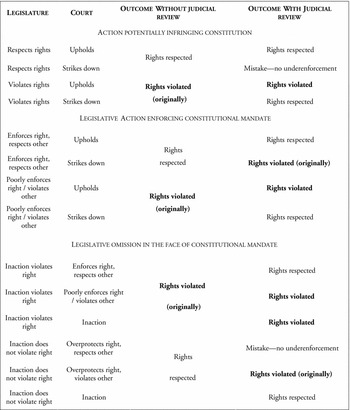
Fallon acknowledges the possibility that courts improperly strike down a statute. But, the author argues, this mistake would not be one of the kind we should be most worried about: those leading to rights violations.Footnote 57 Now, this argument assumes that state action is more likely to violate rights than state inaction, an assumption that, as Fallon himself claims, “is certainly open to challenge.”Footnote 58 Although this is probably not the case of the U.S. Constitution—a mostly restraining one—some constitutions force the state to action, as when they mandate the provision of positive socioeconomic rights.Footnote 59 In such situations, state omission would amount to a rights violation.Footnote 60 Therefore the argument needs to be further fleshed out. In order to show that the argument still holds, we need to map all imaginable scenarios of legislative and judicial intervention (or lack thereof) and then consider the respective outcomes in terms of rights protection. This approach has an obvious empirical dimension that is missing in this article: a study may well show that a significant portion of cases comes from only one or a few of such scenarios. We lack this information, so the discussion assumes each scenario to have an equal chance of occurring. Although this article does not fully explore the issue of judicial capabilities, justifications of judicial review typically argue that judges are especially competent at identifying rights violations. Even if an empirical study may show otherwise, suggesting that judges are as competent as legislators seems a fairly weak assumption for a position defending judicial review. Figure 3 summarizes these scenarios and the corresponding outcomes.
Legislature and Courts: Rights Enforcement and Underenforcement.

Let us start with the case in which a court reviews a statute not directly mandated by the constitution. With its action producing the statute, the legislature may have either violated or respected rights. When reviewing the statute, a court can either uphold it or strike it down and can do so rightly or wrongly. This yields two possible scenarios for when judicial review is not in place and four for when it is. In the former case, the outcome is a rights violation in one of the two cases. When judicial review is in place, the outcome is a rights violation in one of the four—when a court fails to stop an unconstitutional statute. In this situation, though, the violation is not independently introduced by a court. Of the remaining three scenarios, there is one in which a court makes a constitutional mistake: when it wrongly finds a bill in contradiction with the constitution. As this mistake does not lead to a rights violation, it should not be our main concern.Footnote 61
In cases in which the constitution forces to action, a statute enacted by the legislature could be solving a rights violation. But the statute could also be unduly infringing rights other than the one(s) enforced through legislative action.Footnote 62 As before, in half of the scenarios without judicial review (one of two), the legislature ends up violating rights. The same is true of courts (two of four); but only in one of the four cases would a rights violation be independently introduced by them. This is when judges wrongly strike down a statute duly enforcing the mandated right.
If we focus only on cases of legislative intervention—this article explores judicial review of legislation—we should stop here. However, since we analyze cases of mandated action, we need to allow for the possibility that the legislature does not intervene or that its intervention does not yield a legislative outcome. In some political systems with judicial review, courts often take up the task of enforcing rights in the face of legislative silence. Again, in one of these two scenarios without judicial review, the legislature would violate rights with its omission. The other scenario assumes that there will be cases of justified omission, in the sense that the status quo does not violate the mandated right. A system with judicial review may in turn yield six scenarios, leading to an outcome of rights violation in three: when a court refuses to intervene in the face of an unconstitutional omission; when in the same situation it enforces the new right, improperly infringing other rights; and when it overly enforces the mandated right in cases where the status quo was not unconstitutional, violating other rights. However, in only one of these three hypothetical situations—the last one—would a violation be originally introduced by the court.
To sum up, without considering cases of legislative omission, we would have, in the absence of judicial review, two types of scenarios of rights violations out of the four. With judicial review, we would have three such scenarios out of the total eight, but only one would arise from the courts alone. If we included cases of legislative omission, in three of the total six scenarios the outcome without judicial review would be a rights violation. With judicial review, the courts' intervention would possibly lead to such a violation in six of the fourteen scenarios. But in only two of these six would this violation be the courts' exclusive responsibility. In sum, this hypothetical analysis—devoid of empirical support—suggests that stakes may indeed be lower when judicial review is in place.
B. The Mistake-Disagreement Model: Legitimacy and Constraints
Some of the arguments explored above will not do in this model. Here we are not in a position to agree on what the constitution exactly means. To simplify, we find three main positions. According to the first two, we agree that in many cases more than one view may exist that is a reasonable reading of the constitution, and we know which those views are—we can call this “objective disagreement.” But we have two options: to argue that at least two answers are equally correct; or to argue that at the margin one will be better. A third position is to think that while people believe only one view is correct, in many cases they disagree about which view this is—let us call this “subjective disagreement.” All three positions in turn allow for the existence (either marginal or not) of mistakes. The positions should influence our quest for decision-makers that increase the probability that we “get it right” or lower the stakes involved in constitutional discussions.
Taking these positions into consideration, this section briefly introduces two very broad accounts of the political process to see how a potential argument in favor of judicial review may proceed. These will be the procedural and the epistemic accounts. For the reasons mentioned in Section I, the Introduction, this section does not consider the position arguing that there are no grounds at all to claim that any decision is correct and so the people themselves should freely decide what the constitution demands. As said above, the main question is what the constitution means rather than whether it means something. If we believe there is no constitutional objectivity whatsoever and embrace this purely majoritarian argument, judicial review would have a very limited role, but so would the constitution. We would insist that the legislature further either the electorate's preferences or its own members', and we would then label these views “the constitution.” There may be some space for courts' intervention in this view when the legislature faces serious problems aggregating collective preferences, but only if courts do not face similar ones.
In purely procedural accounts, “rightness” is a process-based concept, depending by definition on the satisfaction of quite stringent ex ante requirements. Some deliberative democracy accounts seem to claim this.Footnote 63 But this view surely cannot reject judicial review. The more expectations are placed on both the political process and the virtues of deliberation (as one critic sharply suggests, the more deliberative and the less democratic this view becomes),Footnote 64 the more political institutions will need an external organ to signal or correct deficiencies. However rights are interpreted, either substantively or procedurally, many of them will be needed—from freedom of expression to some notion of equality to the right of association—to secure that the process functions effectively.Footnote 65
Epistemic accounts, in turn, insist that the political process is instrumentally in a good position to get at the truth. We can find different versions of the argument according to the strength we assign to the epistemic side in the trade-off between legitimacy and epistemic virtues. For some people, simple majority decision by itself offers good chances of getting right answers if everyone shares some basic information—if other conditions obtain, Condorcet's theorem would predict this effect.Footnote 66 For others leaning toward the epistemic side, certain features of the political process will strongly promote the chances of “getting it right.” Most theories of deliberative democracy seem to belong to this camp.
What about judicial review here? In cases of “objective disagreement,” why should courts be allowed to make a final decision between—already reasonable—readings x and y? This issue, of course, is at the center of the discussion of judicial review. One line of argument, to which I return below, insists on the risks involved in a system without judicial review. But there is an alternative point. If constitutional discussions usually concern two or more equally valid options, the virtue of the political process with regard to constitutional decision-making would lie more in its legitimacy than in its epistemic potential. A majority vote would solve the disagreement, but the political process would not be adding much epistemic-wise. For instance, Condorcet's theorem is not applicable if more than one option is reasonable or correct. Granted, the theorem can help us a lot should this not be the case. But if it is true that many constitutional discussions turn around a set of reasonable alternatives, we should instead rely on the legitimacy side.
The legislative process might be able to find among the minimally correct alternatives the one that is best at the margin. For this to work, though, the process might need to be structured in such a way that its levels of self-introspection and internal deliberation get enhanced.Footnote 67 But this move—probably deviating from pure majoritarian decision-making—should not be obvious for legitimacy-based critiques of judicial review. A more difficult scenario for judicial review would arise if we think that people are usually able to agree that there are single correct answers but disagree when it comes to identifying them, namely, in cases of “subjective disagreement.” We see below the implications of this option.
In the aggregate, constitutional discussions in the mistake-disagreement model will likely encompass a combination of cases of “subjective disagreement,” “objective disagreement,” and “mistake.” While some constitutional issues will be highly visible and contested, others will be less so. Now, let us assume that properly epistemically equipped or constrained political process will be able to minimize mistakes while maximizing the chances of finding best solutions among “minimally correct” alternatives. Bicameralism and further internal checks are among the natural candidates to help achieve that effect, as Waldron seemed to suggest. These checks, however, would not be costless for legitimacy-based accounts. If majority decision is championed because it best respects fairness and equality—the argument against judicial review resting heavily on this notion—any departure from it has to be justified.
We may even argue that if the underlying concern is to keep the system legitimate, it would be better to have a more majoritarian system (say, a unicameral legislature) coupled with judicial review rather than a less majoritarian one (symmetrical bicameralism, a robust committee system, filibuster) without judicial review. In the former case, legislation would be enacted more easily. If we are optimistic about collective rationality, we will be fairly confident about the system. On occasion it will “objectively” err, and at least for that we may have judicial review. If we accepted only this kind of judicial oversight, the challenge would then be how to restrict courts to deal with only these cases.Footnote 68 However, even in cases of “objective disagreement”—if we think there would be a marginally “best” answer—we may believe that judicial review will be helpful as a way to enhance the epistemic potential of the political system while keeping its overall legitimacy. This may be so because, as seen above, the threat of judicial review may raise a red flag to legislators, but also because the judicial process itself might be a good candidate to help find that marginally “best” answer.
A question would remain as to what to do with cases of “subjective disagreement.” It may be that among the most controversial discussions within a society—typically those ethically charged issues where texts do not provide a minimum threshold of interpretation—are cases like these. While deeply controversial, however, these discussions need not be all too frequent (this is ultimately an empirical issue) and may thus not undermine the general practice of judicial review. The whole practice cannot be judged by only a few instantiations of it.
This becomes a crucial issue when we think of the alternative, more constrained way to arrange the political process without judicial review. To be sure, in such a case a critic would not worry about discrete policies being struck down. But she should worry a good deal about all majoritarian attempts being hindered by the political process itself, instead of only those that would otherwise be analyzed under judicial review. The costs commonly associated with judicial oversight of discrete pieces of legislation (or portions of them) as to their compatibility with the constitution would be transferred to every ordinary political decision. Ordinary decisions would be paying the price of being, as it were, in the “same boat” with constitutional ones. It is true that while judicial determinations will be in principle final, legislative constraints will rarely be. However, we know from experience that judicial determinations are rarely final as well.Footnote 69 Even the strongest model of judicial review will not be able to tie the legislature's hands forever.
It is certainly reasonable to argue that some (constitutional) decisions are so central that it is worthwhile to compromise the political system's overall legitimacy, either by implementing judicial review or by way of constraints internal to the political process. In principle, though, the critic of judicial review should reject both these alternatives. It would be paradoxical to start from the assumption that majority rule should be the baseline for every collective decision, only to conclude by embracing a system obstructing such majoritarian impulse for every such decision, even the most ordinary one. Now let us more carefully analyze the position favoring a strengthening of the political process as the “price” of avoiding judicial review. The analysis is abstract—it ignores, for instance, that in the United States a set of legislative constraints coexists with judicial review. There are two alternatives. One is to argue that the political process should be arranged in such a way that legislation generally faces internal constrains. The second is to say that, in principle, only the most important constitutional decisions should undergo a more robust procedure. But since it is difficult to tell these decisions apart from the rest, the entire system has to end up somehow restricted.
Both alternatives will have the effect that any bill will be more limited than in a system with no such constraints, from abortion laws to decisions whether to authorize the building of bridges in state-owned land. But the second would be more problematic. Remember that the opposition to judicial review was based on the fact that majority decision-making was not available for these (constitutional) cases. The critic could hardly say that constraints should apply to only those very decisions for which she made a claim to majority decision in the first place.
This article predicates upon the assumption that constitutions ought to mean something other than just the preferences of the agents interpreting them. What if this assumption was actually false? For many years now, political scientists have been trying to come out with an empirically informed explanation of the way judges decide. Although this is a complex issue—one that is still being explored—a number of studies have shown that judges are not only (or not mainly) influenced by legal rules. This is especially so when it comes to a field such as constitutional law, where both rules and principles are usually more open to interpretation than in other fields of law. According to some of these studies, judges worry about their ideological attitudes or preferences and will seek to advance them in the cases they decide.Footnote 70 In this sense, judges would not be so different from legislators.
The fact that judges are often able to read their preferences into their decisions does not necessarily mean that they do so all the time. Moreover, even if it was true that legal constraints do not eliminate the influence of preferences, they may still restrict judges' space to advance them. But let us assume for a moment that as a matter of fact, judges' main motivation is to advance their preferences. This concern is anything but new to legal scholars. U.S. realists at the dawn of the twentieth century defended different versions of a view putting into question the role of law as a guide for judges. At one extreme is a radical position (a conceptually skeptical one) arguing that the legal order does not exist as an independent entity; law is merely what judges and other agents do.Footnote 71 On a weaker version, the skepticism is empirical rather than conceptual: even when it is possible to predicate the existence of the legal order, this order is often indeterminate and hence it does not sufficiently guide judges. A still weaker version would pose that the legal order is determinate enough—but that judges do not in fact follow it, as they are motivated by extralegal factors.Footnote 72
There are important differences in the way we can treat these positions. The first and more extreme—arguably defended by Felix CohenFootnote 73 —is already rejected by this article: not everything in the constitution is up for grabs. This position is not empirical but conceptual and is not about judicial review in particular but the constitutional enterprise in general. The second and third positions are as empirical as they may be dependent on the institutions in place. Several factors may influence judges in a sense that we still do not understand very well from the available literature. Among these are the way in which constitutions are written—with more or less detailed provisions—and the way in which the organs in charge of judicial review are arranged. Be as it may, once we reject the extreme position, we remain “in the game”: the second and third positions will revolve around either the mistake-only model or some version of the mistake-disagreement model that does not deny constitutional objectivity. We can see this point through the discussion of a related argument.
In his work, Waldron notes that judges in collegial courts often disagree,Footnote 74 so a problem would exist if the same kind of disagreement we find in society (or the political branches) were replicated within collegial courts. If this were the case, a solution might be to demand that such disagreement be channeled through politics. However, at least two reasons warn against jumping so hastily to this conclusion. The first is the more tentative. We may be wrongly calling disagreement cases belonging to the mistake-only category. In such cases, when one or more justices are correct, the others would be wrong to disagree with them. Certainly, the fact that disagreement among judges in the actual world includes objective mistakes would not add much to the justification of judicial review if such disagreement were pervasive and inescapable. Nonetheless, if we consider judicial review to be otherwise valuable, we could strive to devise a procedure or mechanism that minimizes mistakes. Whether we will find one is a central question but one about which we do not have ex ante answers. This section discusses one institutional feature mentioned by Waldron—the level of consensus required among judges.
Second, as discussed, our answer will depend on what is at stake. The analysis of this point in the mistake-only model assumes that constitutional mistakes—as rights violations—can be identified, and further, that hopeless disagreement is not a major concern. Although this may be deemed a strong assumption for the present analysis of the mistake-disagreement model, in the actual world rights can be violated. The reader would not find this argument persuasive if she thought that rights cannot ever be said, from an objective standpoint, to have been violated. At the very least, though, the analysis in this subsection shows that judicial review could not be discounted even under a scenario including subjective disagreement.
The first argument in the immediately preceding discussion relates to an important point that Waldron makes about majority decision: while we have strong reasons to resort to majority decision when it comes to the political process, these reasons do not apply to the judiciary.Footnote 75 Judges do not represent anyone, so it is anything but evident as to why they should resort to majority decision in order to aggregate their opinions and not to more stringent methods. This point is as correct as it is contingent. Courts may work differently, and in fact they do in some places. If one of the German Constitutional Court's panels is tied with a four-to-four vote in a case where a statute is being reviewed, the statute survives.Footnote 76 Certainly, having five votes out of eight is the expression of the majority, but only because panels are arranged in order to strengthen the requirements to strike down a statute.Footnote 77 If this were all that mattered, majority decision could be abandoned, in some places even through an ordinary statute or regulation.
But there may be a reason of another sort to resort to majority decision. A system demanding that courts reach higher levels of consensus before invalidating a norm will have a “conservative” pull—other things being equal, it will produce a lower level of invalidation. This may or may not be good. In systems that—borrowing Waldron's language—are further from the core, this may be detrimental if we want to promote (at least certain types of) judicial review. Before 1989, when the country's constitution was amended, Costa Rica's Supreme Court needed a two-thirds vote to strike down legislation. Together with other features, this rule made the court an irrelevant institution.Footnote 78 Since 1989, a majority decision vote is enough,Footnote 79 and this has invigorated judicial review.Footnote 80
So far this article is assuming the rather idealized viewpoint according to which a constrained political process would be able to minimize rights violations. This link may be strong. In any case, we do not need to think in terms of horrendous political outcomes in order to argue for judicial review. True, grotesquely unjust results through action will not be so widespread within relatively “healthy” political institutions.Footnote 81 Ironically, however, the discussion gets more instead of less interesting if we rule out these cases. We need not share a view on collective rationality that is too pessimistic to conclude that at times, it is naïve to assume the legislature will be committed to a quest for right or acceptable answers. Granted, the judiciary may also fall prey to this problem, but this is precisely what a serious enterprise should be able to analyze. Even constrained and aptly deliberative legislatures can—and often will—violate rights. Once again, our normative intuitions should be capable of being tested in a world that is most often nonideal.
IV. JUDICIAL REVIEW AND POLITICAL SYSTEMS
The analysis in the previous section is quite abstract. I am still assuming, following Waldron, that the justification of judicial review depends partly on the political system being healthy or deficient—a core case or a noncore case. We still do not know enough, however, about how to define these categories. As explained in Section II, Waldron argues that if certain assumptions about social and institutional features in a polity hold, judicial review is unjustified.Footnote 82 He gives only a few clues as to the precise definition of these conditions. Since Waldron explicitly sets about to offer an abstract case against judicial review, this is to some degree natural. Yet this section completes the argument of this article by showing that this strategy is very problematic.Footnote 83
Although the interplay of the assumptions in Waldron's model is complex, this section focuses on the first one—a well-working political system is in place. The reason is quite straightforward: while failing to meet this assumption does not automatically justify judicial review,Footnote 84 it strongly weakens the main argument raised against it. Upon analyzing the concerns underlying Waldron's first assumption, this section argues that if they are taken to their natural consequences, few systems would be ex ante labeled as core cases*. Waldron's argument against judicial review seems to assume that neither the executive nor the legislature will be “too strong.” Applying Waldron's own notions on the issue, developed for the case of New Zealand, the section claims that this assumption will have no grounds for most actual political systems. Nevertheless, if we were to think that the assumption is realistic for a particular political system, and therefore that the system may do without judicial review—its actual performance may suggest we need it all the same—this would be precisely because the system is not majoritarian enough. And this would contradict the argument driving the critique of judicial review. This line of reasoning extends to Mark Tushnet's account.
A. Legislatures and Executives
How should we measure the success or failure of a political system? Which systems are good candidates to count as core cases*? Since we are focusing exclusively on the first assumption, we should try to avoid taking into account the outputs of the systems, as they would force us to analyze the level to which they respect rights. Waldron believes New Zealand is not a core case*,Footnote 85 and his conclusion is entirely based on the country's alleged failure to satisfy the first assumption. In a relatively recent article, he asks:
Does the New Zealand Parliament operate in a way that makes any further process of review unnecessary? It certainly does not operate in the way that I have in mind when I argue against judicial review in the U.S. I am used to opposing judicial review in a context where representative bicameral legislatures, independent of state and federal executives, debate legislation in a reasonably adequate way.Footnote 86
This does not seem to be the case in New Zealand. According to Waldron, for legislation to have democratic credentials, there needs to be interplay of four elements: “(1) general and multi-faceted deliberation among the people; (2) voting among the people (for representatives); (3) multi-layered deliberation among the representatives; and (4) successive rounds of voting among representatives.”Footnote 87 New Zealand's political system does not meet these standards:
Now what happens in Parliament is only part of this process—elements (3) and (4)—but if that part of the process is screwed up, it undermines the linkages with the rest. . . . [In New Zealand] [t]hese parts of the process have been screwed up not by accident but by the gradual accretion of power in the executive.Footnote 88
He goes on to say, “these days when I return to Parliament in Wellington, and watch it legislating, I come away ashamed—a mostly empty chamber, legislation rushed through under urgency, constant use of closure motions.”Footnote 89 This forces Waldron to conclude that “[i]f our parliamentary procedures were better, if there were a serious second chamber or a better set of standing orders, then the case for judicial activism would be much less.”Footnote 90 There are two features of New Zealand's political system that, in Waldron's view, would seem to make a difference with the United States:Footnote 91 the strong preeminence of the executive and the lack of checks or veto points within the legislature. Bills, most often the executive's, rush through the legislature and swiftly get enacted into statutes. Presumably this is so because of the lack of both bicameralism and further internal legislative constraints. Although not an obvious point, it might be that a more constrained political process would on average yield better outcomes than a less constrained one.
Yet Waldron's conclusion seems strongly counterintuitive. Remember that in depicting his model, he claims that strict compliance with the first assumption is not always necessary for a system to be a core case*. However, confronted with the actual case of New Zealand, which does not seem to be an unusual representation of the way many legislatures really work, he firmly believes that his first assumption does not hold, as his strong language evokes. Section II warns that Waldron's model would face a serious challenge if we were unable to identify many actual systems that “fitted,” or complied with, its assumptions. This might happen even in the case of central political systems that we would otherwise deem as well-working. While Waldron's model is ideal, reality is most often not.
1. Executive Too Strong
Since it is not entirely clear what standards we should use to determine whether a political system is “healthy,” the next paragraphs comment on the two options available following Waldron's account.Footnote 92 The objections against judicial review are usually based on the assumption that legislative outcomes are the product of a (at least) minimally inclusive and deliberative process, which likely is not the case if the executive exerts a very strong control over the legislative process. The executive's legitimacy is weaker than the legislature's, and while the virtue of bureaucratic expertise may be important, there is no reason parliament is incapable of matching or even offsetting it.
Waldron's discussion of New Zealand seems to acknowledge this. He thinks New Zealand's system exacerbates the influence of the executive. But what exactly does it mean for the executive to predominate? It may mean at least two different things. This may refer, first, to a situation where the executive actually occupies the place of the legislature by issuing pieces of legislation—such as executive orders—in areas that are supposed to be left to the legislature. A second possibility, arguably a softer one, is for the executive to have a very strong control of the legislative agenda; while the legislature is still in charge of enacting legislation, it is overly influenced by the executive. This seems to be the notion underlying Waldron's concern about New Zealand.
Presidential systems are supposed to give more weight to the executive against the legislature than do parliamentary systems. In such regimes, inter alia, the people directly elect their presidents, so there is a dual popular legitimacy.Footnote 93 At least on formal grounds, the executive in parliamentary systems depends entirely on the legislature to survive.Footnote 94 The predominance of the executive is clear when it comes to many actual presidential systems. In practice, however, some parliamentary systems are much more executive-oriented than the U.S. presidential system. We may contrast the United States with the Westminster parliamentary model. Compared to the latter, in the United States, the president's power to set the national legislature's agenda is limited. The president is unable to initiate legislation and, presumably, can only veto a piece of legislation in full.Footnote 95 Further, bicameralism makes it more likely that the incumbent president faces a hostile Congress, and, even when the president's party controls both houses, both the committee system and the Senate's filibuster act as strong veto points.Footnote 96 On the other hand, in the United Kingdom a bill is hardly enacted if the executive does not propose it (successful private members' bills are relatively uncommon), and a bill proposed by the executive is hardly ever rejected.Footnote 97
This is not to suggest that U.S. presidents are “weak.” As Daryl Levinson and Richard Pildes compellingly claim, the legislative-executive separation of powers designed at the dawn of the U.S. Republic soon proved anachronistic. Political parties rapidly emerged as powerful actors, and so divided government became at times only a fantasy—political competition started to be ideologically channeled through parties, not branches.Footnote 98 The argument in this section is that most presidential systems outside the United States feature even stronger executives. Moreover, many parliamentary systems—certainly those closer to the Westminster system—simply have nothing in the way of a clear arrangement delimitating power. Other parliamentary systems are, employing A. Lijphart's definition, more “consensual” than “majoritarian,”Footnote 99 a conceptualization that transcends the presidential-parliamentary division to incorporate other features, from the type of party system to electoral rules to social cleavages.
One such feature seems to be the level of centralization of the legislative decision-making process—the number of veto points and the institutional powers of agenda setters.Footnote 100 While many presidential systems are “vertical” in the sense that the executive predominates over the legislature, Westminster-like parliamentary systems may be deemed so in a roughly similar way. The U.S. system, in turn, is much more “horizontal,” and other parliamentary systems are so as well—although the latter face much fewer obstacles than the former in forming a collective will.
If our exclusive concern were that the executive does not have a strong influence over the legislative process, then the United States (a quite singular experience) might not need judicial review of legislation, at least not generally. It would be sufficient for this country to have judicial oversight of norms issued by the executive or some restricted judicial supervision to make sure the legislature does not excessively delegate its powers to the president. But holding constant other features, many if not most other nations may still need it. To be sure, both the United Kingdom and other Westminster-like countries would be far from exceptional cases in which judicial review may be afforded some role. They would be central; potentially, their political systems would carry the very dangers that Waldron wants to avert through judicial review in New Zealand. The United Kingdom might not be a core case*, and this conclusion would drag less well-working systems into the noncore camp as well.Footnote 101 A reply may be that some of these political systems could do without judicial review because no serious constitutional violations would justify it. This situation is entirely possible, although, as explained in Section II, it would be difficult to anticipate in the abstract. On the other hand, so far our analysis holds constant other variables, and we see that when referring to the case of New Zealand, Waldron does not touch upon the issue of rights.
2. Legislature Too Strong
There may be an additional concern: the fear of an all-too-powerful legislature. Although mostly worried about legislative “tyranny” at the local level, the U.S. Founding Fathers generally held the Humean assumption that in politics, “every man must be supposed a knave.”Footnote 102 Given their take on collective rationality, they sought to structure a system in which the legislature, where the electorate is more directly represented, did not reign supreme.Footnote 103 Thus they tried to introduce some structural safeguards in order for the legislature not to fall prey too easily to majoritarian whim. The executive veto, a second chamber such as the Senate (with both equal number of members for each state and indirect election), and more debatably, judicial review itself seem to be consequence of this. Other possible constraints are more internal to the legislature. They include the need for several readings of bills or that bills are analyzed and voted in committees, supermajorities for some cases, restrictions to closure motions, and so on. The United States adopted many of these constraints. This does not mean that the legislature never violates the Constitution—it often does. But compared to other systems, the U.S. Congress is arranged in such a way that bills cannot be swiftly enacted even when the same party controls both political branches.Footnote 104
Few systems, however, share these features. In parliamentary regimes, legislatures are generally structured in order more directly to find and process a majority. Even though many such systems have bicameral legislatures, chambers are usually asymmetric, and the one that more directly represents the people can ultimately overcome the other.Footnote 105 If this were our main concern, the potential scope of judicial review should be wide, again covering a large number of political systems. As a matter of fact, the boundaries with the case analyzed above—“executive too strong”—will often be blurry. A legislature without these constraints may not be “strong” but strongly dominated by the executive. Actually, this case seems to epitomize Waldron's concerns.
We have reached a central point in the analysis, anticipated in Section III. For if the American case seems to survive this test, it is precisely because it has built-in nonmajoritarian devices other than the judiciary. In terms of the consistency of Waldron's model, there seems to be something really puzzling. If majority decision—arguably the fairest way to settle discussions in the face of disagreement—is the key to legislation's dignity,Footnote 106 the reason we would not need judicial review in order to “check” the U.S. political system would be the same reason we would have for criticizing it. It simply is not majoritarian enough.Footnote 107 Some may think this kind of departure from the core of the principle of legitimacy is a less serious problem than implementing judicial review. We see in Section III that this is not always the case.Footnote 108
This feature that is so central to the United States, a prominent country in the discussion of judicial review (and featured in the model as a core case*), has not received any consideration in Waldron's account. A set of legislative constraints of the sort discussed before—bicameralism, an unrepresentative Senate, filibuster, executive veto, a strong committee system, and so on—may significantly slow down a majority's ability to enact legislation.Footnote 109 Such a system may excessively privilege the status quo, and this will be costly for legitimacy-based accounts. As a matter of fact, in cases in which the constitution creates positive obligations as well as poses negative constraints—probably not the case of the mostly restraining U.S. Constitution—the resulting inaction by itself may violate the constitution. Interestingly, some version of judicial review may help put an end to a deadlock by calling the legislature to pass a bill in order to comply with the constitution.
Similar concerns extend to another prominent critic of “strong” judicial review—Mark Tushnet. In his most recent contribution to the debate,Footnote 110 Tushnet argues that a central feature of democratic politics is that the people are able to displace the policy choices they disfavor. He adds:
Importantly, these mechanisms of displacement must be relatively easy, a term that cannot be defined precisely but that must mean something like this: Displacement of policy choices made by representatives is roughly no more difficult than getting representatives to adopt a new policy.Footnote 111
The problem of judicial determinations on the constitution, Tushnet argues, is that they can be disputed only by a constitutional amendment or by replacing the judges who made that determination. He adds that things would be different if the amendment process were “relatively easy.” Here, the objections to judicial review would disappear. The key to analyzing Tushnet's claim lies in the actual meaning of the pair of phrases “relatively easy” and “no more difficult than getting representatives to adopt a new policy.” In a footnote, Tushnet warns that “[t]his formulation allows for some degree of inertia associated with the status quo.”Footnote 112 However, in the United States, the political process goes a long way beyond “some degree of inertia.” A policy preferred by the majority of the electorate may face significant opposition before finding its way into legislation—assuming this ever happens. Therefore, as with Waldron, Tushnet should criticize in the first place the way elected offices in the United States are arranged. It is the ordinary political process itself that does not offer “relatively easy” ways to repeal or enact policies. In fact, the “inertia” brought about by judicial review seems really minor in comparison with the constraints within the political process. Let us just take one of such constraints—the executive veto. As Sanford Levinson claims, while the Supreme Court in the entire history of the country until 2002 struck down about 160 national laws, presidents vetoed 2,550 bills, “very few of which ma[d]e reference to the duty to preserve constitutional norms.”Footnote 113
Tushnet could well reply that this critique adds nothing to the justification of judicial review. After all, judicial review introduces yet another constraint, which makes for an even less majoritarian system. True, this is how the U.S. political system works. With all its insistence on majority rule, however, a legitimacy-based critique such as Tushnet's should accept that a system retaining judicial review while getting rid of other constraints can provide a superior alternative to the current configuration of the U.S. political system. As explained, the extant system has the cost of slowing down every policy proposal, not only the most sensitive ones allegedly dealing with constitutional values.
Perhaps more important, as I warn at the beginning of this article, the historical contingencies resulting in the U.S. Constitution's rigidity should not blind us in our evaluation of judicial review. The comparison in the U.S. case seems to be between a completely antimajoritarian amendment process and a quite antimajoritarian political process. But as shown, the U.S. experience is rather singular. More pointedly, if it is true that legislators in the United States take the Constitution seriously, they would often have a hard time even without judicial review. A majority that dislikes a constitutional clause would not be able to repeal it unless it were able to meet the stringent requirement set by Article V. Naturally, the majority would be able to render an interpretation of the clause—or to change a previous one—but this strategy has limits, since some interpretations are out of bounds. Whether this is a good thing is a different question, but it should help us realize that it is not judicial review as such (or it is not only judicial review) that is creating the problem that Tushnet raises.
In many political systems in the world where “strong” judicial review is in place, judicial determinations are still hard to override, in the sense that more—even much more—than a temporary majority is needed. However, the legislative process is more majoritarian than in the United States, and constitutions are not impossible to amend. Judicial determinations are final until they are not final any longer. Such situations offer a more helpful analytic framework for thinking about the promise and dangers of judicial review; by contemplating them, we can focus on judicial review itself without being distracted by the more general discussion of the role of constitutions.Footnote 114 The question, in those contexts, is whether we need judicial review. The answer, following Waldron's insights, is that we may.
The recent debate over the health care bill in the United States, where legislative constraints nearly killed a measure widely publicized by President Barack Obama when running for office only months before, illuminates this point very well. The bill may be eventually halted by courts, and there are some first indications to this effect.Footnote 115 But its passing demanded extremely big efforts, even with Congress controlled by the party of the president. Although this article starts by warning against cherry-picking instances of institutional performance, the case points to a general concern that contemporary commentators on U.S. politics are voicing as of late: the political system seems on the verge of paralysis.Footnote 116 Partly a result of institutional design, this feature is exacerbated by a context of political polarization and the excessive influence of special interest. Judicial review as such does not seem to be at the root of these problems. True, courts are populated by judges (or justices) who are often unwilling to make things better.Footnote 117 At least in part, though, this is yet another consequence of extreme political polarization and not only a function of judicial review in itself.
Thus, if we were worried about only the two main dangers underlying Waldron's first assumption and overlooked the fact that rights violations have by no means been exceptional, the United States might not need judicial review. Other elements in the system are doing the job. In any case, this should hardly be something that judicial review foes would want to celebrate.
V. CONCLUSION
As warned about in the Introduction, the main purpose of this article is to address a number of key arguments leveled against judicial review by way of reflecting on the methodology employed in the discussion rather than offering a complete justification of it. This is why this article does not provide a complete account of why courts would be particularly good candidates to oversee the constitution. Many of those arguments, presented in a very elegant way by Waldron, revolve around the idea that a mature, well-working political system (a core case*) would not need judicial review. This, the article argues, is possible, although for reasons that potentially run counter to the intuition driving Waldron's (and, for that matter, Tushnet's) insights themselves. In the end, however, we may only know that something resembles a core case (or a core case*) when we come across one—that is, if we do come across one. One of the main lessons of this article is that, when discussing judicial review, our intuitions should be able to address the circumstances of our actual political systems, and Waldron's work does not seem to be successful in this regard.