Hypertension, commonly known as high blood pressure, poses a significant public concern worldwide due to its association with increased risk of CVD and other health complications. While traditionally considered an issue primarily affecting adults, hypertension in children and adolescents has garnered increasing attention in recent years(Reference Flynn, Kaelber and Baker-Smith1). The prevalence of hypertension among youth has shown a troubling rise, paralleling trends in childhood obesity and other lifestyle factors(Reference de Simone, Mancusi and Hanssen2). Approximately 4 % of children worldwide suffer from hypertension, with higher rates observed in certain populations and regions(Reference Song, Zhang and Yu3). This condition not only predisposes young individuals to the early onset of CVD but also raises the likelihood of developing CVD in adulthood(Reference Theodore, Broadbent and Nagin4,Reference Hardy and Urbina5) . Similar to adults, hypertension in youths could lead to irreversible damage to organs and blood vessels(Reference Psara, Pentieva and Ward6). Identifying modifiable factors influencing hypertension in children and adolescents is crucial for devising effective preventive strategies and interventions.
Passive smoking, or exposure to second-hand smoke, defined as the involuntary inhalation of tobacco smoke from others, is recognised as a significant environmental risk factor for hypertension in children and adolescents(Reference Liu, Liu and Sanders7,Reference Levy, Brathwaite and Sarathy8) . Youths are particularly vulnerable to the adverse effects of passive smoking due to their developing cardiovascular systems and higher respiratory rates(Reference Raghuveer, White and Hayman9). The harmful components of tobacco smoke, such as nicotine and carbon monoxide, can disrupt cardiovascular function and contribute to the development of hypertension over time(Reference Liu, Liu and Sanders7). Despite efforts to reduce smoking rates, exposure to second-hand smoke remains prevalent in homes, public spaces and even vehicles, posing an enduring threat to youth health globally.
Dietary intervention is an important measure to prevent and manage hypertension. Riboflavin, also known as vitamin B2, a water-soluble vitamin essential for cellular function and growth, plays a crucial role in cellular metabolism and antioxidant defense mechanisms(Reference Ashoori and Saedisomeolia10). Riboflavin lowers circulating homocysteine levels through its involvement in one-carbon metabolism, and elevated homocysteine levels are closely associated with increased hypertension and CVD risks(Reference Psara, Pentieva and Ward6,Reference Herrmann and Herrmann11,Reference Lyon, Strippoli and Fang12) . A previous cohort study has shown an inverse relationship between riboflavin intake and hypertension among Chinese adults(Reference Liu, Zhou and Zhang13). High dietary nutrient (vitamin E and n-3 PUFA) levels may mitigate metabolic syndrome risks in children exposed to tobacco(Reference Moore, Clark and Bachand14). We hypothesise that higher riboflavin intake may reduce the hypertension risks associated with passive smoking exposure in young individuals. This study will explore the moderating effect of riboflavin intake on the relationship between riboflavin intake and the prevalence of hypertension in children and adolescents.
Methods
Study design and participants
The National Health and Nutrition Examination Survey (NHANES), integrating interviews and physical examinations, is a programme designed to assess the health and nutritional status of adults and children in the USA. The NHANES interview includes demographic, socio-economic, dietary and health-related questions. The examination component consists of medical, dental and physiological measurements, as well as laboratory tests administered by highly trained medical personnel.
The data of children and adolescents aged 6–19 years were extracted from the NHANES database 2007–2018. Individuals with complete data on hypertension, dietary intake and serum cotinine would be included for further analysis. The exclusion was participants who were missing data for any covariates. All participants completed informed consent before the study. The NHANES protocols were approved by the ethics review board of the National Center for Health Statistics.
Riboflavin intake
Dietary riboflavin intake data were collected through 24-h dietary recall interviews, designed to estimate the types and amounts of foods and beverages, as well as intakes of energy and nutrients consumed in the preceding 24 h (midnight to midnight). Each NHANES participant underwent these interviews to determine daily riboflavin intake. The initial dietary recall interview was conducted face to face at the Mobile Examination Center, while the second interview took place via telephone within 3–10 d(Reference Li, Guo and Xia15).
Information regarding riboflavin supplement usage was obtained from the NHANES dietary supplements section of the home interview, which captures data on the use of vitamins, minerals, herbs and other dietary supplements(Reference Li, Krall and Frankenfeld16). Total riboflavin intake was calculated by combining dietary and supplemental intake. Participants were grouped based on the median of riboflavin intake.
Passive smoking exposure
Children and adolescents would be considered smoking exposed if they had at least one smoker in the household or if they had serum cotinine concentration ≥ 0·05 ng/ml. Passive smoking exposure was defined as if a participant had a serum cotinine level of ≥ 0·05 ng/ml(Reference Homa, Neff and King17,Reference Tsai, Homa and Gentzke18) . Serum cotinine levels were measured using isotope dilution high-performance liquid chromatography and atmospheric pressure chemical ionisation tandem MS. The assay demonstrates excellent accuracy, with mean values within 9 % of theoretical values across all levels except the lower limit of quantification, where the deviation was within 14 %. Furthermore, it has good precision, with a within-day CV less than 5 % at all concentrations except the lower limit of quantification, which was less than 16 %(Reference Levy, Brathwaite and Sarathy8).
Hypertension assessment
Hypertension was defined as either self-reported diagnosis by medical professionals, meeting the 2017 AAP Guideline criteria of systolic blood pressure and/or diastolic blood pressure ≥ specified thresholds, or the use of antihypertensive medications(Reference Yao, Lu and Xu19). Self-reported hypertension was determined with the question ‘Have you ever been told by a doctor or other health professional that you had hypertension, also called high blood pressure’. Blood pressure measurements were conducted by trained personnel and/or physicians at the mobile testing centre. Classification of blood pressure followed the 2017 AAP Guideline(Reference Flynn, Kaelber and Baker-Smith1). More detailed information on hypertension was illustrated in online Supplementary Table S1.
Covariates
To assess the influence of potential confounding factors, we selected several important covariates, including age, gender, race, poverty income ratio, BMI, waist circumference, birth weight, physical activity, sedentary time, HDL-cholesterol, LDL-cholesterol, fasting glucose, TAG, homeostasis model assessment of insulin resistance (HOMA-IR), carbohydrate and Na. BMI was converted to a BMI z-score, accounting for age and sex using the recommended Centers for Disease Control and Prevention percentiles. A BMI z-score of ≥ 85th percentile and < 95th percentile indicates overweight status, and a BMI z-score of ≥ 95th percentile indicates obesity(20). A birth weight < 5·5 lbs was defined as low birth weight, and individuals with missing data were expressed as unknown. Physical activity was estimated by multiplying the weekly duration of each activity reported by the participant with the corresponding metabolic equivalent of task (MET) value and then summing the results to obtain a MET-h index. One MET corresponds to 1 kcal/kg body weight per hour. The guideline advises 60 min of moderate-to-vigorous physical activity daily for children and adolescents(Reference Ryu, Loprinzi and Kim21). Ideal activity levels were defined as ≥ 180 MET-min/d (age > 11) or ≥ 60 min/d (age 6–11)(Reference Jia, Wu and Su22). Sedentary behaviour was assessed via self-reported physical activity questionnaires, specifically asking, ‘How much time do you typically spend sitting on an average day?’ It was characterised by the time spent sitting at school, home or during travel (e.g. in a car or bus), including activities such as desk work, reading, card games, TV watching or computer use, excluding sleep(Reference Zhang and Liu23). Insulin resistance status was indicated by HOMA-IR. HOMA-IR = fasting glucose (mmol/l) × fasting insulin (μU/ml)/22·5. According to National Cholesterol Education Program guidelines, abnormal serum HDL-cholesterol, serum LDL-cholesterol, fasting plasma glucose concentrations and abnormal HOMA-IR score were identified as follows: HDL-cholesterol ≤ 35 mg/dl, LDL-cholesterol ≥ 130 mg/dl, hyperglycaemia with fasting glucose ≥ 100 mg/dl and HOMA-IR ≥ 4·39(Reference Tang, Zhan and Wei24).
Statistical analysis
According to the NHANES analytic guidelines, complex sampling design and sampling weights were considered in our analyses(Reference Ruan, Lu and Chen25). Continuous variables were presented as means and standard errors, and comparisons between two groups were weighted t tests. Categorical variables were expressed as the proportion (n (%)), and χ 2 tests were performed for the differences between the two groups. The covariates were selected by utilising weighted logistic regression models. Weighted multiple logistic regression models were conducted to explore the associations of riboflavin intake and passive smoking exposure with hypertension in children and adolescents aged 6–19 years. The analysis further investigated the moderating effect of riboflavin intake on the relationship between passive smoking exposure and hypertension. The results are presented as OR with 95 % CI. Associations of three variables were also investigated in different age, gender and race subgroups. All analyses were performed by using SAS 9.4, and P < 0·05 was considered statistically significant.
Results
Characteristics of children and adolescents aged 6–19 years
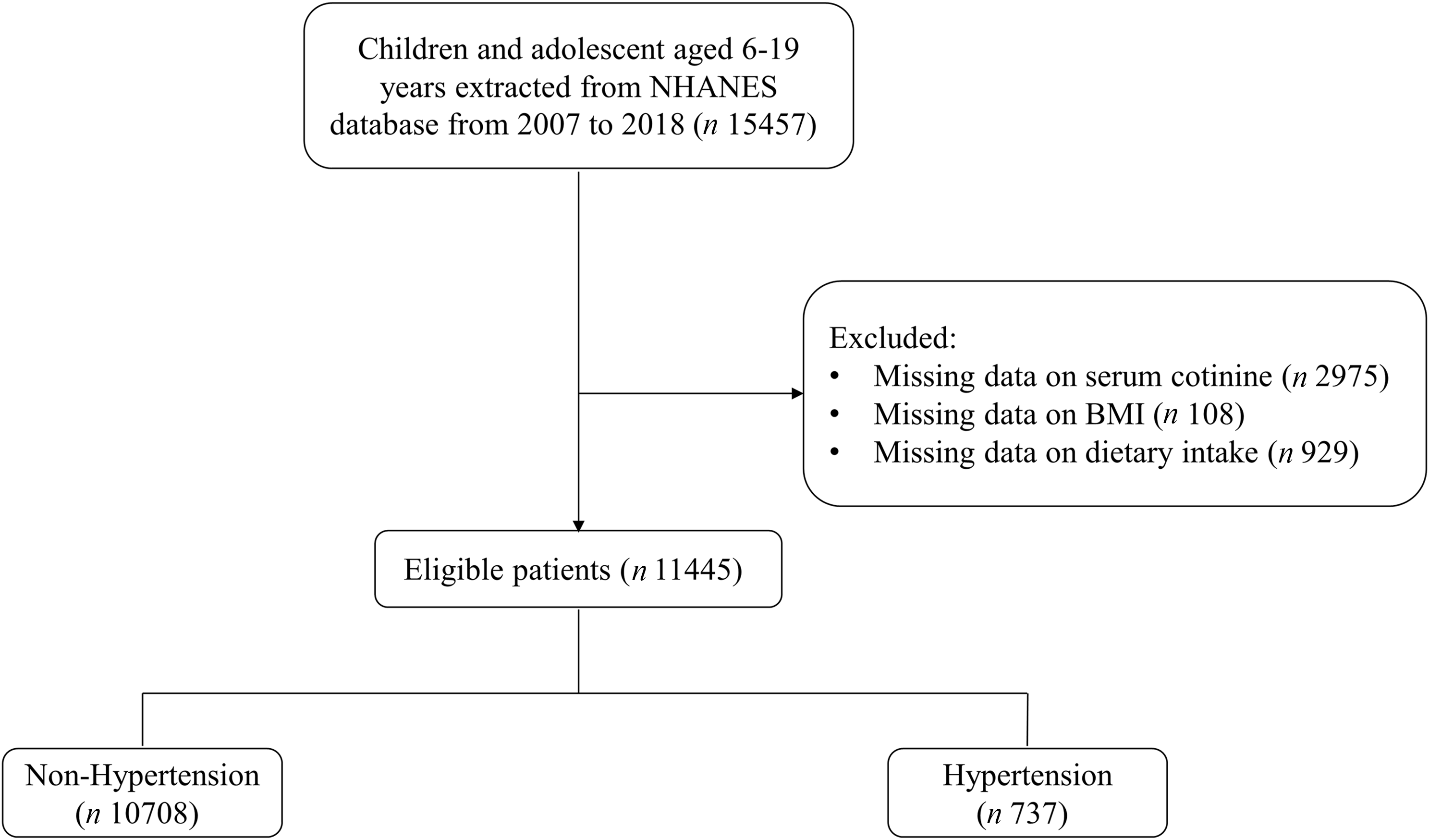
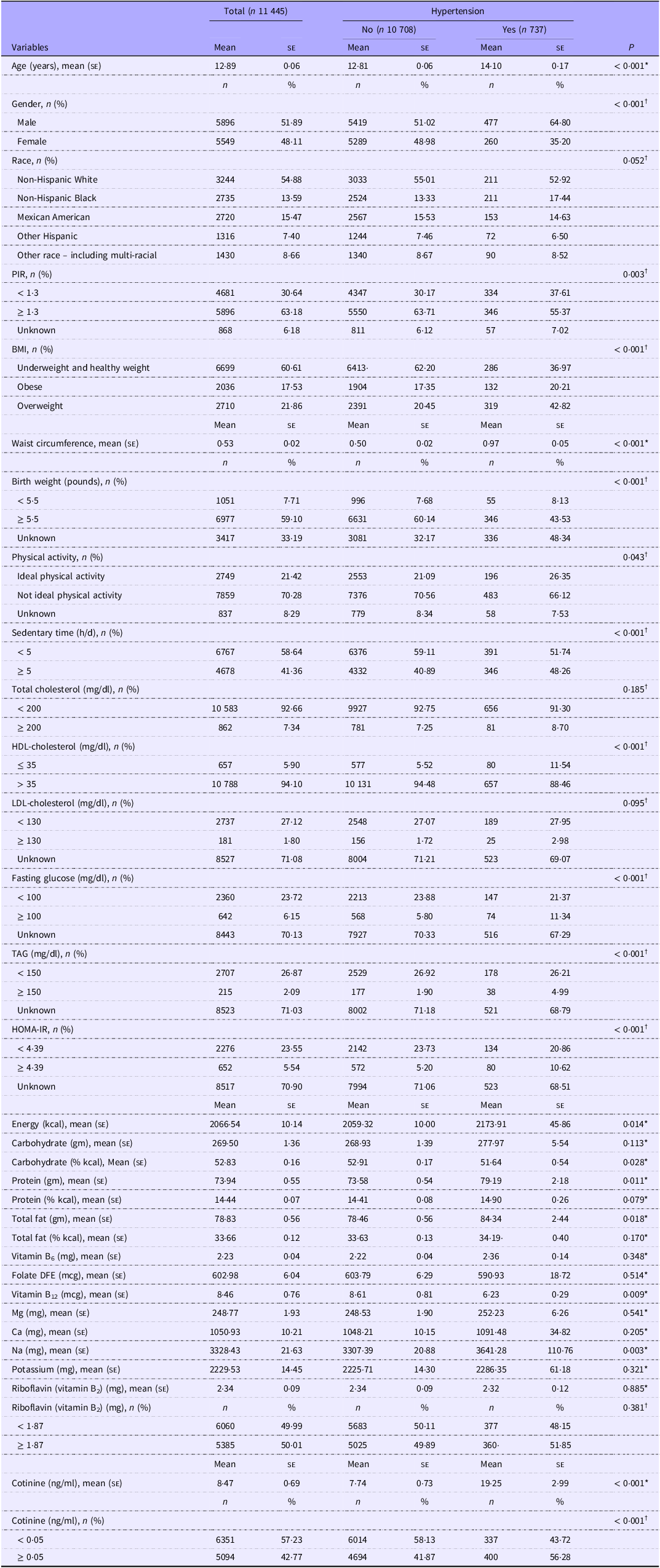
The participant selection process was illustrated in Fig. 1. In total, 4012 participants were excluded with missing data on serum cotinine (n 2975), BMI (n 108) and dietary intake (n 929). Finally, 11 445 children and adolescents were included. The mean age was 12·89 (0·06) years old, among them 51·89 % were males. Of the 11 445 children and adolescents aged 6–19 years in the 2007 to 2018 NHANES, 737 (6·44 %) participants were diagnosed with hypertension. Statistical significances were observed between hypertension and non-hypertension groups in age, gender, poverty income ratio, BMI, waist circumference, birth weight, physical activity, sedentary time, HDL-cholesterol, fasting glucose, TAG, HOMA-IR, total energy intake, carbohydrate, protein, total fat, vitamin B12, Na and cotinine (all P < 0·05). Table 1 shows more characteristics of children and adolescents aged 6–19 years.
Selection process of included children and adolescents.

Characteristics of children and adolescents aged 6–19 years based on the NHANES 2007–2018

NHANES, National Health and Nutrition Examination Survey; PIR, poverty income ratio; HOMA-IR, homeostasis model assessment of insulin resistance; DFE, dietary folate equivalent; physical activity, physical activity was estimated by multiplying the weekly duration of each activity reported by the participant with the corresponding metabolic equivalent of task (MET) value and then summing the results to obtain a MET-h index. Ideal activity levels were defined as ≥ 180 MET-min/d (age > 11) or ≥ 60 min/d (age 6–11). All the nutrient intakes were daily intake.
*Weighted t test; †weighted χ 2 test.
Associations between riboflavin intake, smoking status and hypertension in children and adolescents aged 6–19 years
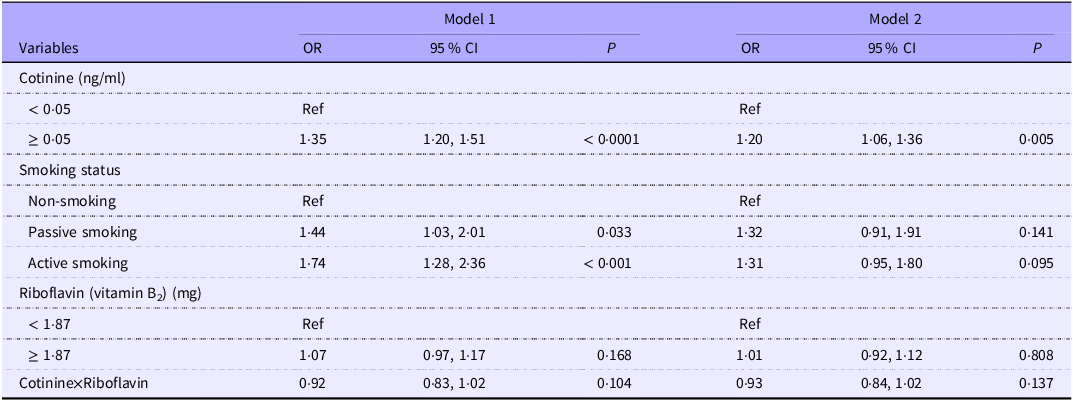
The associations of riboflavin intake and smoking status with hypertension are shown in Table 2. In adjusted model 2, covariates were adjusted including age, gender, race, poverty income ratio, BMI, waist circumference, birth weight, physical activity, sedentary time, HDL-cholesterol, HOMA-IR, carbohydrate, Na and energy. Compared with children and adolescents with serum cotinine < 0·05 ng/ml, serum cotinine ≥ 0·05 ng/ml was associated with increased odds of hypertension (OR = 1·20, 95 % CI: 1·06, 1·36). No statistically significant relationship was observed between riboflavin intake and prevalence of hypertension in children and adolescents (OR = 1·01, 95 % CI: 0·92, 1·12). Additionally, no multiplicative interaction effect was observed between smoking status and riboflavin intake (OR = 0·93, 95 % CI: 0·84, 1·02) on hypertension.
Associations between riboflavin intake, smoking status and hypertension in children and adolescents aged 6–19 years based on the NHANES 2007–2018

Ref, reference; NHANES, National Health and Nutrition Examination Surveys.
A weighted logistic regression model was used to account for the complex survey design.
Model 1: Crude model, with no covariates included.
Model 2: Adjusted model, which included the following covariates-age, gender (male, female), race (non-Hispanic White, non-Hispanic Black, Mexican American, other Hispanic and other race – including multi-racial), PIR (< 1·3, ≥ 1·3 and unknown), BMI (underweight and healthy weight, obese, overweight), waist circumference, birth weight (< 5·5, ≥ 5·5 and unknown), physical activity (ideal physical activity, not ideal physical activity, unknown), sedentary time (< 5, ≥ 5), HDL-cholesterol (≤ 35, > 35), HOMA-IR (< 4·39, ≥ 4·39 and unknown), carbohydrate, Na and total energy intake.
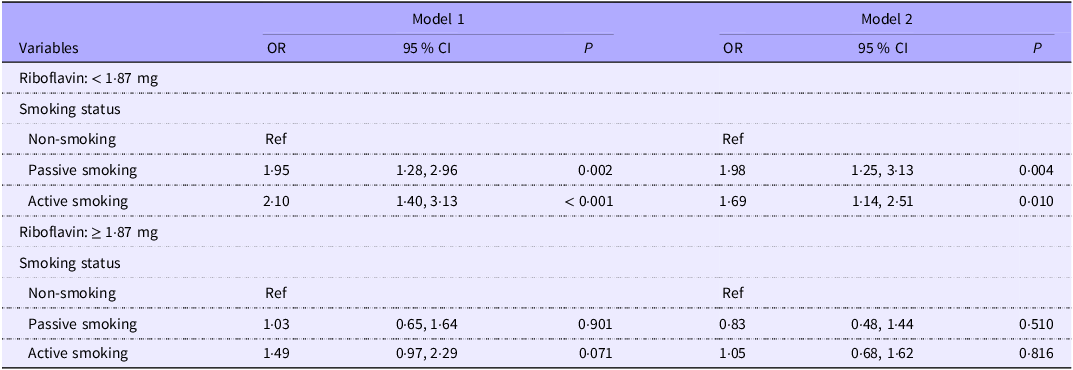
The moderating effect of riboflavin intake on the associations between smoking status and hypertension is illustrated in Table 3. When individuals have riboflavin intake < 1·87 mg, passive smoking (OR = 1·98, 95 % CI: 1·25, 3·13) and active smoking (OR = 1·69, 95 % CI: 1·14, 2·51) were both related to higher odds of hypertension. When individuals have riboflavin intake ≥ 1·87 mg, no association was observed between passive smoking (OR = 0·83, 95 % CI: 0·48, 1·44) and active smoking (OR = 1·05, 95 % CI: 0·68, 1·62) and hypertension. Therefore, riboflavin intake has a moderating effect on the association between smoking status and hypertension in children and adolescents aged 6–19 years.
Riboflavin intake modulating the associations between smoking status and hypertension based on the NHANES 2007–2018

Ref, reference; NHANES, National Health and Nutrition Examination Surveys.
A weighted logistic regression model was used to account for the complex survey design.
Model 1: Crude model, with no covariates included.
Model 2: Adjusted model, which included the following covariates-age, gender (male, female), race (non-Hispanic White, non-Hispanic Black, Mexican American, other Hispanic and other race – including multi-racial), PIR (< 1·3, ≥ 1·3 and unknown), BMI (underweight and healthy weight, obese, overweight), waist circumference, birth weight (< 5·5, ≥ 5·5 and unknown), physical activity (ideal physical activity, not ideal physical activity, unknown), sedentary time (< 5, ≥ 5), HDL-cholesterol (≤ 35, > 35), HOMA-IR (< 4·39, ≥ 4·39 and unknown), carbohydrate, Na and total energy intake.
Associations of riboflavin intake, passive smoking exposures and hypertension in different subgroups among children and adolescents aged 6–19 years
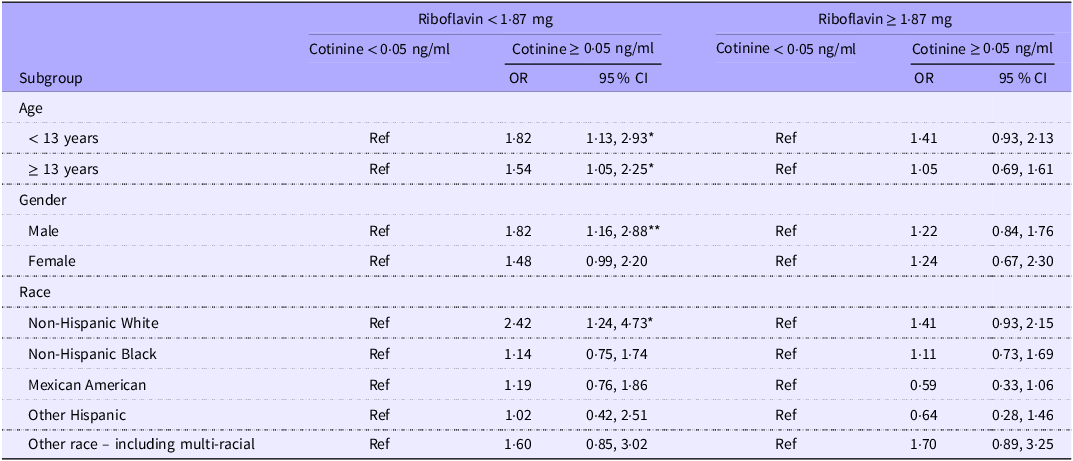
The moderating effect of riboflavin intake was also explored in different age, gender and race (Table 4). When riboflavin intake was < 1·87 mg, individuals with serum cotinine ≥ 0·05 ng/ml were related to elevated odds of hypertension in those age < 13 years old (OR = 1·82, 95 % CI: 1·13, 2·93), ≥ 13 years old (OR = 1·54, 95 % CI: 1·05, 2·25), males (OR = 1·82, 95 % CI: 1·16, 2·88) and non-Hispanic Whites (OR = 2·42, 95 % CI: 1·24, 4·73). When they have riboflavin intake ≥ 1·87 mg, no statistically significant relationships were observed between passive smoking exposure and the prevalence of hypertension. The results suggest that the moderating role of riboflavin intake was also found in age < 13 years old, ≥ 13 years old, males and non-Hispanic Whites. Results on the association of riboflavin, smoking status and hypertension in different age, gender and race groups with three–way interaction models were presented in online Supplementary Table S2.
Associations between riboflavin intake, passive smoking and hypertension in diverse subgroups among children and adolescents aged 6–19 years based on the NHANES 2007–2018

Ref, reference; NHANES, National Health and Nutrition Examination Surveys.
*P < 0·05; **P < 0·01 (trend-level significance).
All analyses were conducted using weighted logistic regression models to account for the complex survey design of the NHANES.
Age subgroup: Adjusted for gender (male, female), race (non-Hispanic White, non-Hispanic Black, Mexican American, other Hispanic and other race –including multi-racial), PIR (< 1·3, ≥ 1·3 and unknown), BMI (underweight and healthy weight, obese, overweight), waist circumference, birth weight (< 5·5, ≥ 5·5 and unknown), physical activity (ideal physical activity, not ideal physical activity, unknown), sedentary time (< 5, ≥ 5), HDL-cholesterol (≤ 35, > 35), HOMA-IR (< 4·39, ≥ 4·39 and unknown), carbohydrate intake, Na intake and total energy intake.
Gender subgroup: Adjusted for age, race (non-Hispanic White, non-Hispanic Black, Mexican American, other Hispanic and other race – including multi-racial), PIR (< 1·3, ≥ 1·3 and unknown), BMI (underweight and healthy weight, obese, overweight), waist circumference, birth weight (< 5·5, ≥ 5·5 and unknown), physical activity (ideal physical activity, not ideal physical activity, unknown), sedentary time (< 5, ≥ 5), HDL-cholesterol (≤ 35, > 35), HOMA-IR (< 4·39, ≥ 4·39 and unknown), carbohydrate intake, Na intake and total energy intake.
Race subgroup: Adjusted for age, gender (male, female), PIR (< 1·3, ≥ 1·3 and unknown), BMI (underweight and healthy weight, obese, overweight), waist circumference, birth weight (< 5·5, ≥ 5·5 and unknown), physical activity (ideal physical activity, not ideal physical activity, unknown), sedentary time (< 5, ≥ 5), HDL-cholesterol (≤ 35, > 35), HOMA-IR (< 4·39, ≥ 4·39 and unknown), carbohydrate intake, Na intake and total energy intake.
Discussion
Our study explored the associations between riboflavin intake, passive smoking exposure and hypertension in children and adolescents aged 6–19 years. Higher passive smoking exposure was associated with increased odds of hypertension in children and adolescents aged 6–19 years. Interestingly, riboflavin intake has a moderating effect on the relationship between passive smoking exposure and hypertension.
Passive smoking exposure was associated with elevated blood pressure in children and adolescents, which is similar to our finding(Reference Levy, Brathwaite and Sarathy8). Liu et al.(Reference Liu, Liu and Sanders7) also reported the relationship between higher diastolic blood pressure and passive smoking exposure during childhood. The moderating effect of riboflavin intake on this relationship is novel and provides insight into potential dietary interventions for mitigating the adverse effects of passive smoking. Previous research has suggested that riboflavin may have preventive and therapeutic impacts against high blood pressure with its angiotensin-converting enzyme inhibitor effect(Reference Ciftci, Turkoglu and Bas26). Low and deficient riboflavin status could lead to hypertension(Reference McNulty, Pentieva and Ward27). The methylenetetrahydrofolate reductase 677TT genotype is associated with an increased risk of hypertension, while better riboflavin status is associated with a reduced genetic risk(Reference Ward, Hughes and Strain28). Supplemental riboflavin was shown in randomised trials to lower systolic blood pressure by up to 13 mmHg, particularly in adults genetically at risk of developing hypertension(Reference Psara, Pentieva and Ward6).
The moderating effect of riboflavin intake was found in children and adolescents aged older or younger than 13 years; the findings underscore the pervasive impact of passive smoking on cardiovascular health, and riboflavin supplements may improve cardiovascular health. The moderating effect of riboflavin intake on the relationship between passive smoking exposure and hypertension was evident in our study, which identified its protective role, particularly among males and individuals of white race. Riboflavin, a key component of antioxidant enzymes, may mitigate oxidative stress induced by smoke exposure, thereby preserving vascular health(Reference Olfat, Ashoori and Saedisomeolia29). This protective effect could be more pronounced in males due to potential gender differences in antioxidant capacity or metabolism(Reference Ahn, Lee and Park30). Furthermore, individuals of the non-Hispanic White race might benefit from cultural or dietary factors that enhance riboflavin absorption or utilisation, compared with other racial groups.
The moderating effect of riboflavin intake on the relationship between passive smoking exposure and hypertension suggests potential mechanisms through which riboflavin may influence cardiovascular health in children and adolescents. Passive smoking exposes individuals to reactive oxygen species and other free radicals, which can damage vascular endothelial cells and lead to hypertension(Reference Zalghout, Kaplan and Abidi31,Reference Wong, AbuArish and Matthes32) . Riboflavin, as a precursor for flavin adenine dinucleotide and FMN, enhances the activity of antioxidant enzymes such as glutathione reductase, superoxide dismutase and catalase(Reference Murgia, Dehlia and Guthridge33). These enzymes play critical roles in neutralising reactive oxygen species and maintaining endothelial function, thereby mitigating the vascular damage caused by passive smoking. Furthermore, riboflavin may influence nitric oxide (NO) bioavailability. NO acts as a vasodilator, regulating blood pressure by relaxing vascular smooth muscle cells(Reference Lundberg and Weitzberg34). Oxidative stress induced by passive smoking can reduce NO availability by increasing its degradation and impairing endothelial NO synthase activity(Reference Ardiana, Santoso and Hermawan35). Riboflavin’s antioxidant effects may help preserve NO bioavailability by scavenging reactive oxygen species and protecting NO from degradation, thereby maintaining vascular tone and reducing hypertension risk.
Our findings underscore the importance of dietary interventions aimed at enhancing riboflavin intake in children and adolescents exposed to passive smoking. Promoting riboflavin-rich foods or considering dietary supplements may be beneficial, particularly in populations where passive smoking exposure is prevalent. This approach could complement existing public health efforts to reduce the cardiovascular burden associated with environmental tobacco smoke. Healthcare providers should consider assessing riboflavin status and advising on dietary modifications as part of hypertension prevention strategies in at-risk children and adolescents.
Several limitations should be considered in our study. As NHANES is a cross-sectional study, we are unable to establish causality and temporal relationships between riboflavin intake, passive smoking exposure and hypertension. Longitudinal studies are needed to confirm our findings and assess long-term cardiovascular outcomes. Additionally, riboflavin intake was obtained by 24-h dietary recall and supplements, introducing potential recall bias. Objective biomarkers of riboflavin status and more precise measures of passive smoking exposure could enhance validity. Another limitation is that the study’s generalisability may be limited by regional variations in dietary habits and smoking prevalence among youth populations. Finally, a limitation is the high missingness (70 %) in HOMA-IR data, which may have limited our ability to fully adjust for insulin resistance in the models, potentially impacting the accuracy of the observed associations.
Conclusion
Higher passive smoking exposure was related to elevated odds of hypertension in children and adolescents aged 6–19 years. Adequate riboflavin intake may minimise the adverse cardiovascular outcomes of passive smoking exposure. The study could offer a novel nutrition management strategy for preventing hypertension in children and adolescents aged 6–19 years. Future prospective and interventional investigations are required to validate our findings.
Supplementary material
For supplementary material/s referred to in this article, please visit https://doi.org/10.1017/S0007114525104078.
Acknowledgements
Xiaoqing Xiong analysed the data and wrote the paper. Jiao Li designed this study and revised the manuscript. The authors have read and approved the final manuscript.
The study was supported by the Chongqing Natural Science Foundation Project (approval number: CSTB2022NSCQ-MSX0904).
There are no conflicts of interest.