1. Introduction
The present paper aims to contribute to the current debate of feature re-activation, feature reorganization or reassembling around a given functional category in adult second language (L2) acquisition, by investigating the acquisition of interpretable features associated with the Spanish personal preposition a. Footnote 1 What makes the present study of significance is the fact that the target structure is widespread in Spanish, and yet has not received much attention in research on adult L2 learners of Spanish. In contrast, personal a has attracted much theoretical research over the years, and recently a whole Special Issue of Probus was dedicated to its study. Personal a involves a cluster of semantic properties, constituting an interesting construction to examine in light of theoretical proposals of L2 acquisition of interpretable features, which underpin much of the morpho-syntax in generative accounts, allowing us to move away from the language-particular parameter-resetting acquisition process. Particularly, Spanish personal a is an intriguing phenomenon to explore in terms of lexical feature assembly and reassembly, as stated by the Feature Reassembly Hypothesis (FRH; Lardiere, Reference Lardiere, Liceras, Zobl and Goodluck2008, Reference Lardiere2009). The conditions that govern whether personal a is selected are determined by semantic properties that appear to be highly under-determined by input, and therefore it is interesting to see the extent to which English speakers of L2 Spanish are able to understand such semantic conditions. Moreover, our findings carve into new territory on the acquisition of features, thus advancing our knowledge of acquisition of features, and more decisively, the development/redeployment of interpretable features. Reassessing and expanding Lardiere's initial insights on the FRH with regard to the acquisition of uninterpretable features, we applied it to the acquisition of interpretable features as part of a phenomenon (personal a) that represents an amalgamation of different interpretable features. From this, we will begin to uncover whether some, but not all, interpretable features are subject to reassembly in the grammar of L2 adults. More significantly, the present study goes a step further than the FRH since we also tested features that apply at the predicate level (e.g., aspect). According to Lardiere's hypothesis, we would expect all interconnected personal a features to be acquired independently from their interpretability, but the more reassembly of features is linked to a certain structure, the harder the acquisition task could become. The findings showing piecemeal acquisition of interpretable features are one of our key results and therefore a clear indication that not all interpretable features in all configurations are actually acquirable by adult L2 learners.Footnote 2
The paper is organized as follows: Firstly, we review the major current accounts in second language acquisition of features. We then present our research questions and the syntactic assumptions underlying them, followed by our study design and results. Finally, we discuss our results in relation to previous findings and claims.
2. Features in second language acquisition
Applying a minimalist approach (Chomsky, Reference Chomsky1995, Reference Chomsky2007) to L2 acquisition, the learning task for L2 adult learners is not necessarily different from that of the child acquiring his or her first language (L1), apart from the fact that the L2 acquisitional process is less straightforward because of other intervening internal and external factors (Hawkins & Hattori, Reference Hawkins and Hattori2006; Tsimpli & Dimitrakopoulou, Reference Tsimpli and Dimitrakopoulou2007, amongst others).
Different accounts have been put forward to explain the acquisition (or lack thereof) of uninterpretable features in second language acquisition. One such account is the Failed Functional Features Hypothesis (FFH; Franceschina, Reference Franceschina2005; Hawkins & Franceschina, Reference Hawkins, Franceschina, Prévost and Paradis2004), which claims that while universal principles of grammar remain available, a full inventory of features of universal grammar (UG) is no longer available to the learner past the critical period. Under the FFH, the underlying syntax of L2 grammars is destined to remain like the L1 grammar with only localized alterations. L1 and L2 grammatical representations are assumed to be inevitably divergent on a continuum determined by the extent to which the L1/L2 particular grammars have unique feature compositions. Nevertheless, it is assumed that adult L2 learners can and do redeploy L1 features to be mapped onto newly acquired L2 morpho-phonological forms while acquiring surface rules via domain-general learning. Franceschina (Reference Franceschina2005) and Hawkins and Franceschina (Reference Hawkins, Franceschina, Prévost and Paradis2004) suggested that the representation of grammatical gender for English adult learners of Spanish and French is different from that of native speakers; they concluded that such differences indicate L2 inaccessibility to particular representation resources after the critical period.
Since then, the FFH proposal has been refined suggesting that only interpretable and uninterpretable features instantiated within the L1 and perhaps interpretable features not selected by the L1 remain available together with the computational procedures and principles of the language faculty; in contrast, uninterpretable features that have not been selected during L1 acquisition are argued to no longer be available to adults despite access to L2 input/lexicon that exemplifies these L2 features (i.e., the Interpretability Hypothesis; Hawkins & Hattori, Reference Hawkins and Hattori2006; Tsimpli & Dimitrakopoulou, Reference Tsimpli and Dimitrakopoulou2007).
Several explanations have been offered as to why uninterpretable features are more problematic than interpretable ones; one such explanation is based on the usefulness or functionality of the interpretable features in that they provide semantic import as opposed to abstract syntactic information; the other explanation rests on the apparent loss of capacity to acquire truly abstract features due to the effect of the critical period. Tsimpli and Dimitrakopoulou (Reference Tsimpli and Dimitrakopoulou2007) proposed that only uninterpretable features are subject to a critical period and possibly to permanent fossilization, whereas interpretable features and aspects of UG such as operating principles, as well as interpretable and uninterpretable features already instantiated during L1 acquisition remain available.Footnote 3 Tsimpli and Dimitrakopoulou investigated the use of the resumptive strategy in wh-subject and wh-object extraction by Greek learners of L2 English with different proficiency levels. The overall results indicated significant differences between the native and non-native speakers, and among the non-native speakers, advanced learners outperformed intermediate learners. The authors claim that the interpretable features of animacy and d(iscourse)-linking are activated in the analysis of English pronouns by Greek L2 learners, whereas the L1 specification of resumptive pronouns as clusters of uninterpretable case and agreement features are not. Therefore, these uninterpretable features were not acquired by the L2 learners.
Following the same line of enquiry (that is, availability of individual uninterpretable and interpretable features), Lardiere (Reference Lardiere, Liceras, Zobl and Goodluck2008, Reference Lardiere2009) proposes the FRH. Lardiere argues that acquiring an L2 grammar is not a question of whether features are still available for selection from a universal inventory. The relevant question is how features are assembled and mapped to lexical items taking into consideration particular language-specific conditions under which they are phonologically realized. Thus, two languages can select the same formal features such that a native speaker of language A acquiring language B would not need to ‘reset’ parameters in the target grammar. However, how a particular feature is assembled and the conditions of its expression in each of the two languages may be quite different. The learning task would then consist of appropriately reconfiguring or reassembling formal and semantic bundles in the L2 lexicon, and determining the specific conditions under which their properties may or may not be morphophonologically expressed. That is, in addition to acquiring new features, the adult learner must redeploy the morphological expression of individual features from the way they are employed in the native language. Lardiere focuses on the examination of plurality, and more specifically plural marking in English, Chinese Mandarin and Korean following claims by Chierchia's (Reference Chierchia1998) Nominal Mapping Parameter. That is, Lardiere proposes the existence of a “plural feature” which is selected by languages differently.Footnote 4 She also argues that such a feature can be both interpretable and uninterpretable depending on the environment.
In light of these hypotheses, it is important to investigate distinct linguistic features in different L1–L2 configurations. To that end, we investigated the acquisition of the Spanish personal a by English adult learners of Spanish at three distinct proficiency levels. The Spanish personal a is an ideal structure to address all the aforementioned hypotheses, but in particular the FRH because the conditions determining whether or not personal a is selected relate to interpretable features which are under-determined in the input.
3. Linguistic background: Personal a in Spanish
The Spanish language, like many other languages (e.g., Hindi, Yiddish), marks direct objects with a preposition, i.e., personal a, under some conditions. [+animate] and [+specific] direct objects are marked with the personal a, as shown in (1):
(1)


The marking of these direct objects is a case of the so-called Differential Object Marking (DOM) (Aissen, Reference Aissen2003; Leonetti, Reference Leonetti2008; Torrego, Reference Torrego1998, Reference Torrego, Satterfield, Tortora and Cresti2002). All remaining direct objects (namely, [+animate, –specific]; [– animate, +specific] and [– animate, –specific]) are not marked with a, as shown in (2)–(4):
(2)
(3)
(4)



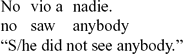
Nevertheless, other cases show that marking of the direct objects is not always systematic. Firstly, non-specific negative quantifiers (such as nadie “nobody”; Leonetti, Reference Leonetti2008) always require personal a, as shown in (5):
(5)
Secondly, in order to disambiguate the meaning of a sentence (Rodríguez-Mondoñedo, Reference Rodriguez-Mondoñedo2008), inanimate direct objects are marked with the personal a if the subject is also inanimate, as shown in (6):
(6)
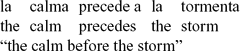
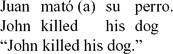
Thirdly, with some direct objects with animal referents, the use of personal a is required as long as it is [+specific] and human features are assigned to an animal:
(7)
According to Torrego (Reference Torrego1998, Reference Torrego, Satterfield, Tortora and Cresti2002), agentivity and semantics of the predicate also determine when the direct objects are marked in Spanish.Footnote 6 Personal a is compulsory with stative and activity verbs that take an agent as subject, as in (8a), but not in (8b).
(8)
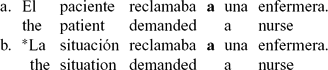
In (8a) the object of the transitive verb is overtly marked by a because the subject of reclamar “demand” is agentive. The sentence in (8b) is ungrammatical because here the subject of reclamar is not agentive.
Torrego further claims that one of the factors that determines the use of a is the semantics of the predicate. Considering the entire vP event, accomplishments and achievements indicate an end in time (telic), whereas states and activities do not (atelic).Footnote 7 Objects of predicates classified as accomplishments and achievements are therefore telic (e.g., emborrachar “make.drunk”) and require the object of the transitive predicate to be marked with a regardless of whether or not the subject of the predicate is [+human], as in (9), but not regardless of the animacy of the object.
(9)
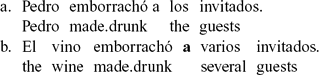
In contrast, in the case of stative and activity predicates, personal a is required only when the subject is [+human], as shown in (10) ((10b) is adapted from Torrego, Reference Torrego1998, p. 31).
(10)
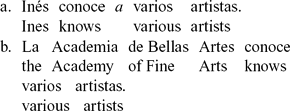
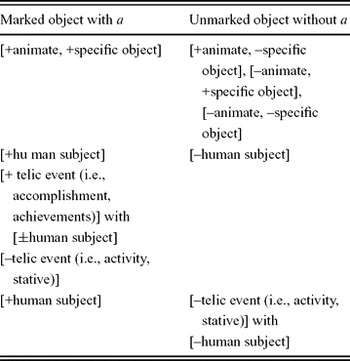
To sum up, there are at least four conditions that determine the DOM in Spanish: (i) animacy, (ii) specificity, (iii) agentivity, and (iv) aspectual class (Aktionsart) of the predicate. Putting aside some of the special cases mentioned above, in Table 1, we propose the scenario of distribution for personal a, along the lines of Torrego (Reference Torrego1998, Reference Torrego, Satterfield, Tortora and Cresti2002).
Distribution of DOM in Spanish.

Adopting Torrego's (Reference Torrego1998, Reference Torrego, Satterfield, Tortora and Cresti2002) analysis, personal a is an instance of marked accusative case, or inherent case, encoded in a functional category specific to Spanish. Let us consider the sentence structure illustrated in (11) for transitive verbs, which encodes the majority of the Spanish direct objects:
(11)
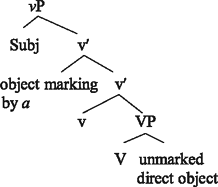
One can assume that marked direct objects with a move outside the V(erb)P(prase) in the overt syntax, whereas the unmarked direct objects can check accusative case inside the VP in the direct object position. Following Torrego's analysis, it is further assumed that ν may have a D-feature, since Torrego argues that it is this feature which can attract the marked direct object to be raised overtly (i.e., this feature needs to be checked, or valued and deleted, and this forces the raising).Footnote 9 Namely, a D/EPP feature on v triggers raising of the D(eterminer)P(hrase); once the DP is raised its case is licenced in an outer specifier position of vP.Footnote 10 Torrego (Reference Torrego1998, p. 25) also assumes that personal a adds its own D-feature and can be treated as an additional functional category. She further claims that objects marked with a actually have structural in addition to inherent case, while unmarked accusative objects only have structural case. What is relevant for the purposes of the present paper is that marked objects end up in a structural position higher in the syntactic structure than the thematic position of unmarked objects, by means of object raising (see (11) above).
Thus, the overt marking of accusative objects in Spanish is not “free”; following Torrego's analysis, animacy and the agentive nature of the D-feature on ν are responsible for object raising and the creation of a second specifier to vP.Footnote 11 Ultimately, it is also tied to the specific semantics of the predicate. Structural accusative case for direct objects is an uninterpretable feature checked by the functional category v (formerly AgrO), arguably also involving uninterpretable (agreement) features on v. In contrast, marked (inherent) accusative case is a lexical case regulated by interpretable features (i.e., animacy, specificity and semantics of the predicate). Comparing English and Spanish, both languages possess structural accusative case; however, direct objects in English are not marked with a preposition, given that they lack inherent case.
Against this linguistic analysis, the present study addresses the following research questions:
(i) Are there group and individual differences between native and non-native speakers in the use and acceptability of the personal preposition a?
(ii) Are there group and individual differences among the L2 learners with three different proficiency levels (i.e., advanced vs. high intermediate vs. low intermediate) in the distribution of the personal preposition a?
(iii) Is there any evidence of L2 learners having acquired the object raising movement of the a DP which involves, firstly, assigning/checking inherent case to the object and secondly, associating a certain set of interpretable features to that movement? That is, is there any evidence of L2 learners having reassembled the new target features, moving from their L1 structural case to a target/L2 inherent case (namely, realizing the DP with personal a or in higher syntactic position)? If so, are there differences between proficiency levels regarding the conditions that require the use of the personal preposition a? Does knowledge of a particular interpretable feature in our participants' first language (English) hinder/facilitate the reconfiguring and then the redeploying of the features in the target language (Spanish)?
The Interpretability Hypothesis predicts that older L2 learners of Spanish will converge on the target grammars, similarly to native speakers, since both English and Spanish select the same uninterpretable feature (i.e., structural case) which has been activated in the L1 acquisition. Crucially, this hypothesis would predict that L2 learners of Spanish must be able to acquire interpretable features in the L2. Namely, English learners of Spanish would eventually acquire the interpretable features of Spanish that determine the use of personal a, moving from the structural case marking corresponding to English to the inherent case marking in Spanish.
According to the FRH, acquisition of personal a should also be possible because English also possesses the relevant (semantic) interpretable features. As illustrated above, in the grammar of Spanish, different values for the features for specificity, telicity and animacy have different morphological realizations. Personal a is a spell-out of the positive values, [+specific], [+telic] and [+animate], in the functional projections of direct object DPs. The negative values of these features are phonetically null (e.g., Vimos a Juan “We saw Juan” vs. Vimos ø un libro “We saw a book”). In English too, features that express different values for specificity, telicity and animacy exist in the grammar. They are required to distinguish, for instance, between pronouns such as he and she (animate) versus it (inanimate), between telic and atelic interpretations (that is, inherent in some verbs, but also marked via the use of the particle up, e.g., drink vs. drink up), and between specific and non-specific determiners. Nevertheless, English has no syntactic category associated only with the direct object that has different phonological realizations according to the positive or negative values of these three features, i.e., a category analogous to Spanish personal a. This illustrates the fact that grammars do not vary from one another just in the range of features that are grammaticalized, but may also differ in the distribution of features and in their phonological realization. Animacy, specificity and telicity in Spanish are intrinsically the same semantic features as in English, albeit they may be represented/distributed differently in both language grammars.
Our assumption, though, is that semantic features exist in all languages and are motivated cross-linguistically (Smith, Reference Smith1991). Thus, since all the interpretable features involved in personal a are available in English, although spread out in the grammar in a different way, personal a should be acquirable by the learners. However, the learning task for English speakers of Spanish would involve teasing apart the relevant features from the way they are employed in their L1, and re-employing them as required by the L2. This would involve processing the L2 input, identifying relevant features and reassembling these features from the way they are conditioned and realized in L1 English to that of L2 Spanish. As mentioned earlier, the realization of the preposition a in Spanish involves the features [+animate], [+specific] related to the object, [+telic] related to the predicate, and [+human] related to the subject. The semantic conditions constraining a DP object when the accusative direct objects are marked with a are quite complex. From a learnability perspective, L2 learners should process the input, identify the features in the object, predicate, and the subject, and, despite the fact that these features are present in their L1, reassemble them in the way they are conditioned and realized in Spanish. Nevertheless, we predict that it will be more difficult to acquire conditions where learners need to conjoin features of the predicate and the subject because the learner will have to identify them first and then decide which features are relevant to mark the object. Alternatively, one can assume that learners may entertain the possibility that only animacy is relevant for Spanish marked direct objects (Leonetti, Reference Leonetti2008) due to the effects of instruction and its frequency in the input. The teaching instruction is often insufficient and leads the learners to assume that mainly/only animacy is important, but we remain cautious with regard to any argument attached to such claims, as we show in the results/discussion section.
4. Previous studies on the acquisition of personal a in Spanish
To date, only a few studies have investigated the acquisition of the personal preposition a in L1 and L2 Spanish (Montrul, Reference Montrul2004; Rodriguez-Mondoñedo, Reference Rodriguez-Mondoñedo2008). Rodriguez-Mondoñedo (Reference Rodriguez-Mondoñedo2008) investigated Differential Object Marking (DOM) in L1 Spanish using longitudinal spontaneous data from six Spanish-speaking children between the age of 0;9 and 2;11 from the CHILDES database. Children made a very small number of errors, with a total of only 16 errors (6 instances of a in contexts that did not require it, and 10 instances of a omission in obligatory contexts with animate and specific objects). This amounts to a 98.38% accuracy rate with DOM before the age of three years, demonstrating that there are no significant errors in the children's performance. Rodriguez-Mondoñedo also analysed the recordings from two additional children from two databases (Romero and Serra/Sole databases, respectively). No errors were found in these two additional databases, although this may be due to the fact that they are considerably smaller and consequently the number of objects is also smaller than in the other four databases. This indicates that the features related to personal a acquired by L1 Spanish children below the age of three years are acquired almost error-free. Nevertheless, a word of caution is needed here. The data reported from CHILDES only contain a subset of the environments in which personal a is possible. Some of the subtle instances – among them contexts used to judge the L2 acquisition of personal a in the present study – occur very infrequently if at all in child language.
Montrul (Reference Montrul2004) investigated the acquisition of subject and object arguments by Mexican-American heritage speakers of English/Spanish. Bowles and Montrul (Reference Bowles, Montrul, Bruhn de Garavito and Valenzuela2008), on the other hand, examined the role of explicit instruction on the acquisition of one of the features [+animate, +specific] of DOM in L2 Spanish.Footnote 12 The overall results obtained in Montrul (Reference Montrul2004) from an oral story-telling task administered to intermediate and advanced heritage Spanish learners and Spanish monolingual controls indicated that there were almost no differences between heritage speakers and monolinguals in the accurate production of direct objects, except for animate direct objects (Montrul, Reference Montrul2004, p. 135). Heritage and monolingual speakers showed a different rate of omission of the personal a: monolinguals 0%, advanced heritage 21.3%, and intermediate heritage 6%. However, no clear semantic patterns emerged from the omissions by heritage speakers: the omission of the personal a tended to occur with both stative and activity verbs and with accomplishments and achievements, regardless of the theta role of the subject. However, one possible limitation of the study is that the elicitation instrument used by the author may not have effectively assessed the effect of subject animacy (see Montrul, Reference Montrul2004, p. 136). To overcome this problem, we used two different tasks in which a wider range of contexts of use of personal a was manipulated.
5. Method
5.1 Participants
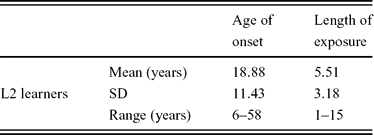
Forty-nine English learners of Spanish and 16 Spanish native speaker controls participated in this study. All English-speaking participants had learned Spanish in a classroom setting, and the controls were monolingual speakers of European Spanish from one region in Spain, namely Andalusia. As their performance on the tasks demonstrates, the native speakers are a very homogenous group. All L2 learners were taught with textbooks and received classroom instruction. The native Spanish teachers’ own production of key contexts corresponded to the same variety of Spanish as the control group. Hence, we could assume that all learners had in fact been exposed to most if not all instances in which personal a might occur. However, it is very likely, that our L2 participants would have received more exposure in a classroom setting to examples like (1)–(4) than to examples like (5)–(10) above. The English learners of Spanish had a mean age of 24.5 years (SD = 3.4) and the Spanish controls a mean age of 26.5 years (SD = 10.3). There was no significant difference in age between the two groups (t(63) = –.763, p > .1). Table 2 shows the age of first exposure and length of exposure in years. None of them had an immersion or study abroad experience at the time of conducting the study. As for how much classroom instruction our L2 learners had received, the advanced group had been instructed for six years at school plus two years at university, and the high intermediate for four years at school plus one year at university with the low intermediate at one year of university only.
Participant details.
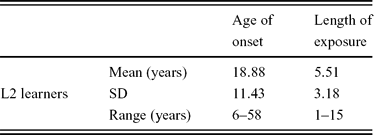
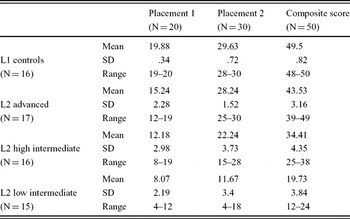
In addition to signing a consent form for voluntary participation, all participants completed a questionnaire about their linguistic background/experiences together with two placement tests, which consisted of the vocabulary and cloze sections of a standardized Spanish proficiency test (Diploma Español de Lengua Extranjera – DELE). Based on the results from the placement tests, the learners of Spanish were divided into three proficiency levels: advanced (score 39–50), high intermediate (score 25–38), and low intermediate (score 0–24). The results from the placement tests correspond to the years of classroom instruction which are detailed above. The groups were divided according to their composite score (see Table 3).
Results from the placement tests.

5.2 Materials and procedure
To test the participants' knowledge of the usage of personal a we used a sentence-level Completion Task and an Acceptability Judgement Task. All tokens included were accurate representations of all the features which motivate the DOM in Spanish presented in Section 3 above. In some instances, the tokens were the same as the examples used in Section 3, and additional ones followed the same patterns. The vocabulary and proper names used in the test items were selected from the textbooks used in class so that all L2 participants were familiar with them. All L2 participants received a vocabulary list to ensure that they were familiar with all the words used in the examples, so that any lexical comprehension problems were avoided. In addition, all L2 participants were told that they were allowed to ask about any vocabulary problems during the subsequent tasks.
Completion Task
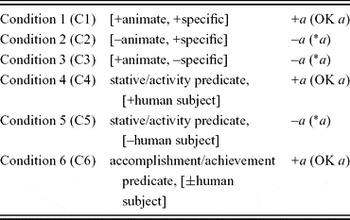
The Completion Task consisted of 48 sentences ranging over seven conditions (all aforementioned properties from Section 3 and a control condition (Condition 7)). The properties of the experimental Conditions 1–6 (C1–C6) are shown in Table 4.

There were six items for the experimental Conditions 1–5 and 12 for the experimental Condition 6 (six with [+human subject] and six with [–human subject]). In addition, we included six items for the control condition that did not involve the preposition a. For Conditions 4, 5 and 6 the inherent aspectual class of the verb was determined taking into consideration the distinctions [± telic], [± stative] and [±durative]. In each of the sentences there was a gap, and participants were asked to either fill the gaps in with one word or leave them empty (that is, the prompt did not directly instruct them to consider using the personal a). Examples (12) and (13) are sample items for this task.
(12)
(13)


Although there was no time limit for the task, all participants completed it within 30 minutes. Instructions were presented in English for the L2 participants and in Spanish for the control group. Instructions clearly indicated how to fill in the gaps by giving three examples. Participants were instructed to indicate their “first intuition” and not to go back and change their answers.
Acceptability Judgement Task
In the Acceptability Judgement Task, participants were asked to read test sentences such as those in (14) and (15) below, preceded by a short background story.
(14) Pedro no tiene tiempo para hacer las tareas de la casa, pues trabaja más de 40 horas a la semana. Un día, Pedro le pregunta a su madre sobre su mujer de la limpieza:
“Pedro does not have time to do the housework because he works more than 40 hours per week. One day, Pedro asks his mother about her cleaner:”
Test sentence: Busco tu mujer de la limpieza, ¿sabes dónde vive Luisa ahora? (unacceptable)
“I'm looking for your cleaner. Do you know where Luisa lives?”
(15) Theo está de vacaciones en el Canadá. Me escribe un mensaje diciéndome lo que hizo apenas llegó. Dice:
“Theo is on vacation in Canada. He wrote a text message telling me what he did when he arrived. He said:”
Test sentence: Ayer visité el Museo de Arte Contemporáneo. (acceptable)
“Yesterday I visited the Museum of Contemporary Art.”
The background story provided an appropriate context that contributed to whether the experimental sentences would be judged as grammatical or ungrammatical. The rationale for using contexts before test items rests on the fact that while some of the features related to the use of personal a are part of core semantics (e.g., animacy) and are provided in the experimental sentences, others are context-governed (e.g., specificity and telicity). Additionally, the validity of our results is strengthened by having two distinct tasks whose format is totally different, which also allowed us to control task effects. Six conditions – the same experimental conditions as in the Completion Task – were used in the Acceptability Judgement Task. We created 42 experimental items, six each for Conditions 1–5 and 12 for Condition 6 ([+human subject] and six with [–human subject]). These items formed pairs including an acceptable and an unacceptable test item. We created two different lists, each list including only one of the two versions, randomly selected. Participants completed only one list so that each participant encountered only one version of each experimental item.
Each participant received a booklet containing two examples and 42 experimental sentences, and had to judge the acceptability of the sentences on a scale from 1 to 4 (1 = sounds very bad, 2 = sounds relatively bad, 3 = sounds relatively good, 4 = sounds very good). We included a possible answer “I don't know” ( = 100), which participants could use if they were not sure about the acceptability of the sentence. As in the Completion Task, written instructions were given, in English for the L2 group and Spanish for the control group. Participants were asked to judge the acceptability of the sentences based on their first intuition, and not to go back and change their answers later. There was no time limit for the task, but all participants completed it within 45 minutes. See the Appendix for a list of conditions and sample test items (space limitations prevent us from including samples from both tasks).
6. ResultsFootnote 13
6.1 Completion Task
The data were first screened for outliers. Three items showed an accuracy of 2 standard deviations below the mean in the group of native speakers of Spanish, and were excluded from further analyses. In addition, we excluded the data of one English learner of Spanish from the high intermediate level because he scored 0% in the control items. The results from the remaining data are given in Table 5 below.
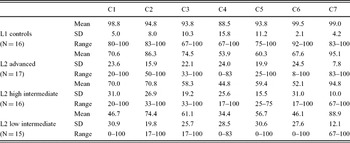
Results from the Completion Task.

A repeated measures ANOVA with the factors Group (L1, L2 advanced, L2 high intermediate, L2 low intermediate) as between-subjects variable, and Sentence Type (seven conditions) as within-subjects variable showed a main effect of Group (F(3,60) = 30.988, p < .001), a main effect of Sentence Type (F(6,360) = 28.270, p < .001), and a significant interaction between Group and Sentence Type (F(18,360) = 3.288, p < .01) reflecting differences in the performance of the groups in the experimental conditions. To determine the source of the differences, we first conducted post-hoc Bonferroni tests to determine differences between the conditions in each group. These showed no significant difference between the conditions in the group of native speakers (p > .1). Advanced learners performed significantly better in the control Condition 7 than in all other conditions (p < .05) apart from Condition 2 (i.e., [–animate, + specific]) (p = .1). In addition, they performed better in the [+animate, +specific] condition (C1) compared to the stative/activity predicate, [+human subject] condition (C4) (p < .05). They were also better in the condition C2 compared to the two conditions with stative/activity predicates (C4, C5) (p < .01), and in the condition involving accomplishment/achievement predicates (C6) compared to the condition involving stative/activity predicates, [+human subject] (C4) (p < .05). High intermediate learners performed significantly better in the control condition (C7) compared to the [+animate, –specific] condition (C3) (p < .001), and the conditions involving stative/activity and accomplishment/achievement predicates (C4, C5, C6) (p < .01), but there was no significant difference between the control condition (C7), the [+animate, +specific] condition (C1) (p > .1), and the condition C2 (p = .09). Low intermediate learners performed significantly better in the control condition (C7) compared to all conditions (p < .05) apart from the condition C2 (p = .09). In addition, they performed better in the condition involving animacy (C2) compared to the condition involving stative/activity predicates, [+human subject] (C4) (p < .05).
To determine differences between the groups in the seven conditions, we performed independent sample t-tests in each condition separately. These showed that native speakers performed significantly better than advanced learners in all conditions (p < .01) apart from the control condition (p = .09) and the one involving animacy (C2) (p = .06). They also performed significantly better than high intermediate learners in all except the control condition (C1, C4, C5, C6: p < .001; C2, C3: p < .01; C7: p > .1). Finally, they performed significantly better than the low intermediate learners in all conditions (C1, C2, C3, C4, C5, C6: p < .001; C7: p < .01). Advanced learners performed better than high intermediate learners in the [+animate, –specific] condition (C3) (p < .05), and better than low intermediate learners in the [+animate, +specific] (C1), the stative/activity predicate, [+human subject] (C4), and the accomplishment/achievement predicate condition (C6) (p < .05). High intermediate learners performed better than low intermediate learners only in the [+animate, +specific] condition (C1) (p < .05).
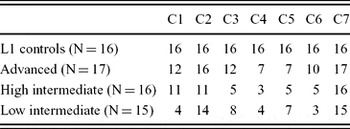
To investigate individual variation, we calculated the number of participants and the conditions in which they performed above chance level in each group (see Table 6).
Number of participants performing above chance in the Completion Task.

All native speakers of Spanish performed above chance in all conditions, and all L2 learners performed above chance in the control condition (C7). Finally, in the condition involving animacy (C2), 41 out of the 48 L2 learners performed above chance. However, this is not the case in the other conditions. Twenty-seven out of 48 L2 learners performed above chance in the [+animate, +specific] condition (C1) followed by the [+animate, –specific] condition (C3), in which 25 out of 48 L2 learners performed above chance, and the stative/accomplishment predicate, [–human subject] condition (C5), in which 19 out of 48 L2 learners performed above chance. For the other two remaining conditions, the number of participants who performed above chance levels was relatively smaller: 14 out of 48 participants in the stative/activity predicate, [+human subject] and 18 out of 48 participants in the accomplishment/achievement predicate condition. It is noteworthy that the number of advanced learners performing above chance is higher than the number of high and low intermediate learners in all conditions, but the difference between high and low intermediate learners is less robust. In fact, in the condition C2, the [+animate, –specific] (C3) and the stative/activity [+human subject] condition (C5) the number of low intermediate L2 who performed above chance level is slightly higher than the number of high intermediate learners. The individual results do confirm the group results: only native speakers have a solid knowledge of all conditions regulating the use of personal a, and L2 learners regardless of their proficiency level have robust knowledge only of the condition C2. We will return to this in the discussion.
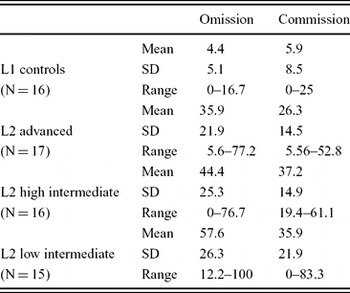
To investigate whether the groups of participants showed more target-deviant omissions or commissions (i.e., target-deviant cases of commission are those instances of overuse of a), we averaged the conditions requiring the preposition a (C1, C4, C6) and the conditions requiring a gap (see Table 7), and conducted a repeated measures ANOVA with the factors Group (L1, L2 advanced, L2 high intermediate, L2 low intermediate) as between-subjects variable, and Target-deviant Type (omission, commission) as within-subjects variable.
Number of target-deviant cases of omission vs. commission.

This showed a main effect for Group (F(3,60) = 31.926, p < .001) reflecting differences between the groups, and a main effect of Target-deviant Type (F(1,60) = 7.514, p < .01) reflecting a higher instance of target-deviant omissions than target-deviant commissions, but there was no significant interaction between Group and Target-deviant Type. This pattern of results could be explained as being due to L1 transfer effects. Recall that English does not possess any preposition to mark DPs as direct objects. We will return to this issue in the discussion.
6.2 Acceptability Judgement Task
As in the Completion Task, we first screened the data for outliers. Four items showed an accuracy of 2 standard deviations below the mean in the group of native speakers and were therefore excluded from further analyses. The tokens from this task that the participants marked as “I don't know” were not included in the statistical analysis. Also excluded were items with a very low score in the group of native speakers. The remaining data were transformed into percentage of correct responses (see Table 8).
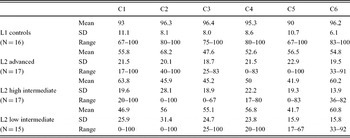
Results from the Acceptability Judgement Task.

A repeated measures ANOVA with the factors Group (L1, L2 advanced, L2 high intermediate, L2 low intermediate) as between-subjects variable, and Sentence Type (6 conditions) as within-subjects variable, showed a main effect of Group (F(3,61) = 66.849, p < .001), a main effect of Sentence Type (F(5,305) = 2.732, p < .05), and a significant interaction between Group and Sentence Type (F(15,305) = 2.059, p < .05) reflecting differences in the performance of the groups in the six conditions. Pairwise comparisons using Bonferroni correction showed no significant difference between the conditions in the group of native speakers, advanced, and low intermediate learners. High intermediate learners performed significantly better in the condition with accomplishment/achievement predicates (C6) compared to the condition with stative/activity predicates and [–human subject] (C5) (p = .01). Low intermediate also had extremely similar scores on C5 (41.7) and C6 (60.8) respectively.
To determine differences between the groups in the six conditions, we performed independent sample t-tests in each condition. These showed that native speakers performed significantly better than all learner groups in all conditions (p < .001). Advanced learners performed better than high intermediate learners in the condition involving the animacy feature (C2) (p < .05), and the difference was approaching significance in stative/activity predicates with [–human subject] (C5) (p = .05); they also performed better than low intermediate learners in stative/activity predicates with [–human subject] (C5) (p < .05). High intermediate learners performed better than low intermediate learners only in the [+animate, +specific] condition (C1) (p < .05).
We also calculated the number of participants that performed above chance level in each group in order to find out individual variation (see Table 9).
Number of participants performing above chance in the Acceptability Judgement Task.
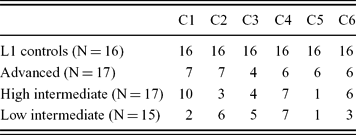
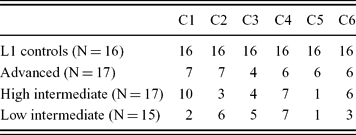
As in the Completion Task, all native speakers of Spanish performed above chance in all conditions. However, in contrast with the Completion Task, in all groups of L2 learners, less than half of the participants performed above chance: only seven advanced learners for C1 and C2 and six for C4, C5 and C6 and only four in C3; ten out of the seventeen high intermediate learners for C1, only three and one for C2 and C5 respectively; four, seven and six participants for C3, C4 and C6. With regard to the low intermediate group, only one scored above chance for C5; two for C1 and three for C6; for the other conditions the number of participants above chance fluctuated too. Finally, as in the Completion Task, in the conditions [–animate, +specific] (C2), [+animate, –specific] (C3), and stative/activity predicate [+human subject] (C4), the low intermediate learners outperformed the high intermediate learners; in the other conditions, a large number of high intermediate learners scored above chance compared to the low intermediate learners. Furthermore, overall there were more advanced learners that scored above chance level in all the conditions, compared to the other two groups, as one would expect. In order to explain these findings and link them to previous studies (e.g., Montrul, Reference Montrul2004), perhaps the learners in both studies did worse because of some kind of U-shaped developmental curve that they had started to descend but had not yet come up the other side, when one considers the overall group and individual scores. Although improvement was not shown to be significant across conditions, this issue may have more to do with the fact that there were not enough participants above chance. A future study would no doubt benefit from the inclusion of more participants at each proficiency level.
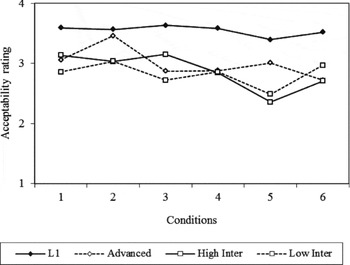
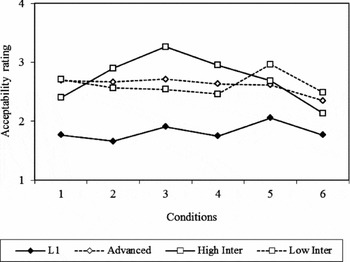
To investigate differences between acceptable and unacceptable sentences, we calculated means for each condition for acceptable and unacceptable sentences separately (see Figures 1 and 2, respectively).
Mean acceptability rating (1–4) for grammatical sentences.

Mean acceptability rating (1–4) for ungrammatical sentences.

A repeated measures ANOVA with the factors Group (L1, L2 advanced, L2 high intermediate, L2 low intermediate) as between-subjects factor, and Acceptability (acceptable, unacceptable) and Sentence Type (six conditions) as within subjects variables showed a main effect of Acceptability (F(1,60) = 130.639, p < .001), indicating that participants gave different ratings to acceptable and unacceptable sentences, and a main effect of Sentence Type (F(5,300) = 4.836, p = .001) reflecting differences between the 6 sentence types. There was a significant interaction between Group and Acceptability (F(3,60) = 45.961, p < .001) reflecting differences in the acceptability rating between the groups, and a significant interaction between Group and Sentence Type (F(15,300) = 2.877, p = .001) reflecting differences in the sentence types between the groups. There was also a significant interaction between Acceptability and Sentence Type (F(5,300) = 4.499, p < .01).
To investigate differences between groups in their acceptability judgement, we compared the rating for acceptable and unacceptable sentences using paired-sample t-tests for each group separately. These showed that native speakers gave different scores to acceptable vs. unacceptable sentences (t(15) = 22.224, p < .001). The same was true for advanced learners (t(16) = 3.090, p < .01), but not for high and low intermediate learners (p > .1). This shows that learners at the high and low intermediate levels were not sensitive to the distributional properties of the preposition a.
6.3 Relation between the two tasks
We conducted Pearson correlations for the two tasks in each one of the six experimental conditions separately. These showed a moderate correlation between the two tasks in all conditions except the [+animate, –specific] condition (C3), in which it was approaching significance (C1:(r(62) = .449, p < .001); C2: (r(62) = .535, p < .001); C3 (r(62) = .219, p = .081); C4: (r(62) = .467, p < .001); C5 (r(62) = .448, p < .001); C6 (r(62) = .491, p < .001)].
Finally, we compared the performance of the individuals in the two tasks in order to find out whether the participants who performed above chance in the acceptability judgement also performed above chance in the Completion Task (see Table 10). In comparing individual performance across the two tasks, the same participants – native and non-native – who performed above chance in each of the tasks were the same.
Number of participants who performed above chance in the Acceptability Judgement Task and also in the Completion Task.

All native speakers were above chance in both tasks. For the L2 learners, there seems to be a split between advanced vs. high and low intermediate learners. Half or more than half of the advanced learners who were above chance in the Acceptability Judgement Task were also above chance in the Completion Task. This was not the case for high and low intermediate learners, and confirms that these learners had limited knowledge of the interpretable features determining personal a with the exception of the condition involving the feature animacy (C2). In this condition, all learners apart from one who performed above chance in the Acceptability Judgement Task were also above chance in the Completion Task. This demonstrates that learners acquire the distribution of the preposition a in a piecemeal way starting from the condition involving one interpretable feature, [±animacy]. With the data from the cross-sectional study it is impossible to determine which features are acquired in which sequence; hence, a longitudinal study or a follow-up study with some of the participants would be desirable. One can argue, however, that learners’ performance might be influenced by explicit knowledge of grammar rules. That is, even at the very low proficiency level, learners may explicitly know some basic rules (i.e., a is used when the direct object is a person) that govern personal a.Footnote 14 On the basis of these findings, one could predict then that the best results in term of performance for the low proficiency level participants are on the conditions that require [+a] in a [+animate] context (C1) and the worst results in terms of their performance in those that have [–a] in [+animate] contexts (C3). We will return to this issue in the next section. In this respect, we would like to claim that one plausible explanation for this may be that L2 learners of Spanish learn personal a in a manner that supports the piecemeal acquisition route. However, this explanation does not preclude us from going further and discussing the acquisition of personal a in relation to the aforementioned hypotheses, i.e., Interpretability Hypothesis (IH) and Feature Reassembly Hypothesis (FRH).
7. Discussion
This study was set up to explore the acquisition of the features related to personal a, which are all interpretable and are also found in other grammatical domains in English (see Section 3).
In answering our three main research questions, in both tasks English learners of L2 Spanish behaved differently from native speakers, who were at ceiling, and made more target-deviant omissions than commissions. Proficiency also seemed to affect the learners’ accuracy. Even though there was not, strictly speaking, a clear significant developmental pattern across the conditions; there were, nevertheless, significant differences in the performance between the L2 learners and the native speakers. The advanced group only performed significantly better in two of the conditions: C2 with the high intermed iate and C5 with both intermediate groups (this in turn may indicate some kind of developmental patterns within the testing conditions). Although, on C1 the high intermediate group performed significantly better than the low intermediate, there are three other conditions (i.e., C3, C4 and C6) where there are not any significant differences between any of the experimental L2 groups. Additionally, advanced learners of Spanish, like the Spanish controls, gave significantly different ratings to acceptable vs. unacceptable sentences. This was not the case with the learners at the high and low intermediate levels, who gave similar ratings to acceptable vs. unacceptable sentences in all conditions tested. In some experimental conditions, advanced learners outperformed high and low intermediate learners, and high intermediate outperformed low intermediate learners. More specifically, in the Acceptability Judgement Task, advanced learners were better than the high intermediate learners in the condition involving the animacy feature (C2) and the difference was approaching significance in stative/activity predicates with [–human subject] (C5); advanced learners were better than low intermediate learners in C5; high intermediate were better than low intermediate learners in the [+animate, +specific] condition (C1). Looking closely at Figure 1, it seems that Condition 5 was the hardest for the learners, with Conditions 3 and 6 also proving difficult. Also note that for ungrammatical items (Figure 2), learners often appear not to have the confidence to reject outright an ungrammatical sentence. If learners can understand the sentence, but do not really know whether it is right or wrong, they may not indicate “I don't know” and may assume that anything they are not sure of is a result of their own lack of proficiency rather than a problem with the sentence they are being asked to judge. Thus, we can hypothesize that low performance in ungrammatical items may have more to do with learners’ lack of confidence in deciding that something they are reading in the L2 could possibly be wrong.Footnote 15
With regard to the Completion Task, advanced learners were better than high intermediate learners in the [+animate, –specific] condition (C3); advanced were better than low intermediate learners in the [+animate, +specific] (C1), the condition with stative/activity predicates [+human subject] (C4), and the condition with accomplishment/achievement predicates (C6); and high intermediate learners were better than low intermediate learners in the [+animate, +specific] condition (C1).
Before discussing the acquisition of the semantic features related to personal a in more detail, let us first outline very briefly how and where these various semantic features (e.g., animacy, specificity, telicity) are represented and bundled on lexical items. In tackling such a task, we take the stance that animacy and specificity can cluster in a DP. The difference is that animacy is an obligatory, inherent semantic feature of the lexical item, e.g., “boy”. Whether specificity is assigned involves an additional stage of conceptualization since specificity could also be context-based. We can choose to assign or not the feature specific to different lexical items. This seems to us to be analogous to the count–mass distinction existing in English. We can choose to view items such as bird or bread as either count or mass, respectively, but these features may not be inherent to the lexical item.Thus, what exactly is the role of personal a in licensing these features in Spanish? The more human and the more specific the object is, the more likely the occurrence of personal a seems to be. In support of this claim, proper names and personal pronouns are marked with personal a more frequently than any general nouns, whether definite, specific-indefinite or non-specific-indefinite. From our main results, the acquisition of features for the personal a was also reflected in the L2 learners’ accuracy. All groups of L2 learners showed higher levels of accuracy in the condition that involved one feature [±animate], and in this condition none of the groups differed significantly from the control condition (C7) in the Completion Task. In addition, the majority of the L2 learners at all proficiency levels performed above chance in this condition in the Completion Task, and all but one of the L2 learners who performed above chance in this condition in the Acceptability Judgement Task also performed above chance in the Completion Task. This shows a robust knowledge of the condition involving the animacy feature at all proficiency levels, but a great deal of variability in the conditions which also required access to more than one feature (Conditions 1, 3), and involved features related to the predicate and the subject (Conditions 4, 5, 6). Additionally, in the Completion Task, advanced learners scored higher in the condition that involved two features (+animate, +specific) of the object and none of the predicate (C1), and in the condition involving one feature of the predicate (accomplishment/achievement) (C6) compared to the condition that involved features of both the predicate and its subject (C4).
These results demonstrate that L2 learners may acquire the distribution of the preposition a in a gradual fashion, as stated above. More importantly, this is a domain where not all interpretable features are attained at the same time and rate. Nevertheless, our results suggest that the number of features involved affects the acquisition of a; the more the features are clustered in the mapping of form to meaning in relation to DOM, the harder the acquisition task seems to be. In other words, the featural configuration of the L1 (see Section 3 above) seems to hamper, rather than facilitate the acquisition process in the L2, due to the complexity, number and type of features that are dealt with in the realization of DOM in Spanish, as further discussed below and elsewhere in this paper.
An additional observation about our findings is that our advanced learner group did not perform at the same level as the native controls, in spite of the fact that they were the highest scoring in our placement test. However, unlike L2 learners returning from an extended period of time in a Spanish speaking country, these advanced learners had never spent any time abroad, and had had very limited contact with native speakers outside the classroom. Therefore, a future study with more highly proficient and more advanced learners with significant naturalistic exposure is very desirable.
7.1 The acquisition of features in L2 acquisition: Features and proficiency
The results presented in this paper indicate that second language acquisition is constrained and selective. Our results are only partially consistent with the Interpretability Hypothesis (e.g., Hawkins & Hattori, Reference Hawkins and Hattori2006; Tsimpli & Dimitrakopoulou, Reference Tsimpli and Dimitrakopoulou2007). Recall that all interpretable features involved in personal a are available in English and according to the IH only uninterpretable features are problematic, not the interpretable ones. Therefore, if the IH was on the right track, our findings would have been rather unexpected, since L2 learners showed difficulties in acquiring interpretable features in general, casting doubt on some of the IH premises; conversely, we can advance that not all features are equal regarding L2 acquisition (Guijarro-Fuentes & Larrañaga, Reference Guijarro-Fuentes and Larrañaga2011). However, how can we then explain the finding that L2 learners showed difficulties with all other conditions?
Recall that the IH claims that uninterpretable features not accessed during first language acquisition will be inaccessible during adult L2 learning. All other aspects of UG are assumed to be available. L2 learners will at some point encounter positive evidence that may conflict with their interlanguage grammar. This will force the grammar to restructure. Therefore, pressure to restructure within the constraints of UG (and not through general problem solving) means that learners may exploit only interpretable features to model properties of the L2. Crucially, there is no implication that L2 learners will use interpretable features, or must acquire interpretable features in the L2, that are different from the L1. However, restructuring of the interlanguage grammar is just as much subject to learners encountering unambiguous positive evidence as it is to some degree in the IH account.Footnote 16 When evidence is ambiguous, learners may never converge on the grammar of a native speaker, and may end up with different, but nevertheless UG-constrained grammars. Given that the conditions for use of personal a are quite subtle (see Section 3), it is possible that English speakers of L2 Spanish will never fully establish them. This does not imply, however, that they do not have access to interpretable features like animacy, specificity and telicity, only that the evidence for how they are deployed is not sufficiently clear from the input received in the case of L2 acquisition, in stark contrast to L1 learners who quickly and easily acquire this construction from the input (Rodriguez-Mondoñedo, Reference Rodriguez-Mondoñedo2008). Thus, unlike L1 acquisition, maybe in L2 it is a matter of “murky” input which selectively affects L2 learners’ knowledge of personal a uses (more on this below). Remember that the six conditions differ in terms of their complexity (e.g., C1 is [+animate, +specific], whereas C6 [+accomplishment/achievement predicate, ±human subject]), and given the fact that all of our participants were classroom-instructed learners, with no naturalistic input at the time of testing (although they have been exposed to native language via their teachers’ production), one can claim that a lack of (sufficient) exposure (at least for the more complex conditions) may have affected our results. Additionally, the differences observed between Spanish L1 monolingual acquisition and L2 acquisition may be related to the fact that input received (i.e., exposure) is a variable, at least in quantity and quality in L2. Although it was not controlled in the present study, the exposure of our L2 learners to Spanish outside of classroom had been limited, as they all were learning Spanish in the UK. The DOM in Spanish undoubtedly presents a Poverty of Stimulus problem in L2 acquisition, even though it is a mapping onto an overt morpho-phonological form whose distribution needs to be acquired on the basis of its distributional pattern in the input. Note, however, that some DOM features (e.g., examples (9b) and (10b)) may be quite rare in the input. It is clear from our experimental conditions that DOM is sometimes obligatory and other times optional, marking a specific semantic interpretation and not others. The latter cases might be more confusing and troublesome for L2 learners, if the semantic nuances that DOM involves for native speakers are not perceived in cases in which it is optional.
To offer an explanation of this finding, we adhere to, but at the same time expand, Lardiere's (Reference Lardiere, Liceras, Zobl and Goodluck2008, Reference Lardiere2009) Feature Reassembly Hypothesis. In the present paper, all of the interpretable features (including specificity and animacy) already exist in the L1 of our speakers (see Section 3), but they need to be redeployed to capture the distribution of all available readings that are mediated by the distribution of the personal a. We argue that since English lacks the mapping of the interpretable features corresponding to Spanish personal a in the DP in the object position, this redeployment may be problematic to our L2 speakers, and consequently this grammatical restructuring may take longer. Thus, the learnability problem is not completely overcome regarding L2 interpretable features, even though there is no “completely new” featural content to be acquired, but instead a reorganization of features mediated distinctly in particular grammars. Our English L2 learners indeed know from their L1 about telicity and distinct marking of different types of objects, other than a morphological equivalent to personal a in terms of feature content. Consequently, what they have to learn is how to associate these properties with Spanish DOM; for them it is then a matter of (re)assembling features. As shown earlier, L2 learners of Spanish have acquired the least complex constraint regarding the distribution of the preposition a, which involves one feature, [±animacy], but have not yet acquired the other constraints. This asymmetry could be caused by complexity constraints in terms of the number of features, the complexity of the configuration and/or intrinsic difficulty of the interpretable feature in question. Increased complexity may require a longer period of exposure until the L2 learners are capable of processing the input and identifying the features that are relevant for the personal a, and to reassemble them in the way they are conditioned and realized in their Spanish. The task of reassembling the relevant interpretable features in combinations such as the DOM in the L2 is an arduous task, although not insurmountable, which may require more intensive exposure to the language over a longer period of years. A group of near-native speakers of Spanish would be needed to corroborate this claim.
Nevertheless, one can call into question the different L2 hypotheses outlined throughout this paper. They all predict no acquisitional struggle, since all interpretable features which are needed for personal a marking in Spanish are also present in the native language of our participants. Although we recognize this as a potential hindrance, we opt to follow the FRH, albeit with caution, given the fact that the reorganization of features could be problematic: namely, all but one feature (i.e., animacy), are acquired in a straightforward way. An alternative account to the feature redeployment approach is the possibility that some of the factors listed as part of personal a may not correspond to features of individual lexical items. Animacy seems easy to be motivated as a lexical feature, but telicity does not (this may also be the case with specificity). Telicity is one of those facets of interpretation that seems to operate at a higher order of complexity, or rather at the phrasal level, than the feature level, in that it involves interpretive relations among different constituents in the clause, i.e., properties of the event, of its participants and their mapping to times. Specificity may also involve both event and argument properties. Likewise, agency is the result of compositional factors (including animacy and non-stativity of the event). If this account is true, then there may be two (or more) distinct sources of personal a: the one that can be listed in the “lexicon”, associated with a feature [+animate], and another that is something else altogether.
To that end, it may be erroneous to encapsulate all features related to personal a at the macro-level (i.e., at the level of whole language structure); by contrast, the number of features needs to be narrowed down at the micro-level (i.e., individual lexical items such as nouns, verbs and so on) in order to account for the acquisition patterns detected here.
Extending the parametric variation theory (Kayne, Reference Kayne, Cinque and Kayne2005; Manzini & Savoia, Reference Manzini and Savoia2007, among others) to second language acquisition, we postulate micro-parameters that would add predictive power. That is, the general model of language development has at least partially shifted from the notion of macro-parameters, which operate at the level of the whole language, to micro-parameters, which operate over word classes, or even individual lexical items, leading to an approach to language variation which is essentially lexicalist. Principles are narrowed down further and further in scope in order to give an explanation for the richness of natural language data, given that predictions built on supposed parametric clusters of phenomena are not borne out in L1 and L2 acquisition research (Guasti, Reference Guasti2002; Guijarro-Fuentes, to appear). Thus, a new notion of micro-parameters is of great utility to the language learner confronted with the challenge of the task of acquiring all intertwined features in personal a, for instance. There may be more fine-grained differences in terms of the semantic interpretation on certain features in the two languages and, consequently, our L2 data demonstrate that language-wide parameter settings cannot capture the full spectrum and linguistic inter-group and within-group variation observed in this domain. What the L2 learners of Spanish need to come to know when faced with the “personal a parameter” is not the simple setting of a parameter switch for the whole “personal a parameter”, but the particular lexical semantics of all individual structural domains where a may or may not appear, depending on different syntactic-semantic constraints. Thus, taking together our findings and comparing features and individual features across conditions, one could consider a lexical learning hypothesis by which the learner starts with the [–animate] = “no personal a” and expands from there to other contexts. That is, given the strikingly uniform success of all our participants across the board and across the two experimental tasks with only one feature, the bundle of features related to personal a must be narrowed down. With this in mind, we may be able to account for the diverse behaviour of our learners who seem to be unable to generalize and amalgamate all features when facing the vastness of the task of acquiring personal a. Micro independent interpretable features with possible ramifications on different language sub-domains seem to be at work here, making the learning task even more challenging as learners need to reorganize, but at the same time need to assemble information from different sub-domains. Hence, the poor rate of performance on some of the conditions may have come from the learners’ inability to reassemble all semantic properties of personal a at the same time. Thus, individual semantic features must be reassembled before learners understand how personal a may legitimately appear in different contexts.
The learnability task for interpretable features is such that, even under optimal conditions of input (e.g., Bowles & Montrul, Reference Bowles, Montrul, Bruhn de Garavito and Valenzuela2008), internal factors such as transfer from L1, non activation of all features at the same time and/or incorrect redeployment hypotheses adopted by the learners may extend the appearance of non-target-like grammars as shown here; these deviant patterns may persist until an advanced level of proficiency is achieved.
In explaining the challenging and belaboured task that learners of L2 Spanish may face in dealing with personal a, we cannot overlook the intrinsic impenetrability that some particular features may present. That is, some interpretable features may be more difficult to be redeployed than others due to their own intrinsic/internal interpretability configuration. From our findings it is difficult to weigh up such a claim, but let us for example take the telicity feature. The acquisition of telicity has been proven to be notoriously difficult by L2 learners at different proficiency levels (e.g., Montrul & Slabakova, Reference Montrul and Slabakova2003). In the same vein, some complex combinations of interpretable features such as the one responsible for personal a (in somewhat idiosyncratic, language-specific structure) might indeed not be attainable after the critical period. The effect of age, of course, can really be an issue here as has been argued for the deficit of representation around the uninterpretable syntactic features; however, we remain cautious as to any claims made in relation to the critical period effect since the good performance by our learners shows that, at least some interpretable features can indeed be acquired after the critical period.
From our data it is difficult to assess, however, whether L2 learners have indeed redeployed the L2 features, or are simply making performance-related errors in supplying the correct use of personal a. In that respect, we contend that in the reassembly process, some features will be more transparent form–function associations than others (that is, features such as animacy represent one single cognitive construct, whereas other features such as telicity represent more than one cognitive construct), and due to the fact that L2 learners are operating with L1 and L2 features simultaneously, the features that are less transparent/obscure form–function association (Anderson, Reference Andersen, Hyltenstam and Viberg1993; Bardovi-Harlig, Reference Bardovi-Harlig, VanPatten and Williams2007) would lose momentum over the more transparent ones. Thus, if the interpretable features involved in personal a were some monolithic light-switching cluster of features that were “all or nothing”, this variation would be anomalous unless it was interpreted under the micro-parameter framework as argued above. However, we can assume that learners after extended exposure to the L2 would be able to fine-tune the meaning of the L2 lexical items and successfully converge on the grammar in the new language. In this regard, it is worth mentioning Yang's (Reference Yang2002) Variational Learning Hypothesis, which claims that the degree of acquisition of parameter values depends on the proportion of sentences in the overall input to the learners that show signs of evidence for the value. That is, high frequency equals high rate of acquisition. In that respect, some of the DOM structures may be more frequent than others and hence the different rate in acquisition reported herein. It may be argued then that the acquisition of some facets of Spanish personal a is simply correlated with overall frequency of the respective environments. This would form a null hypothesis in which the entire superstructure of syntactic structures (interpretable vs. uninterpretable features), and all the theories implicating the existence and accessibility of UG during L2 acquisition would be superfluous to a certain degree. However, in order to reject this null hypothesis, a future study is needed in order to document the relative frequency of the various more subtle instances requiring personal a. Such a null hypothesis would not play down the importance of the fact that in any case learners still need to associate meaning to form and this implies syntactic structures, particularly with respect to telicity and thematic role of the subjects. Moreover, what we can tentatively claim in light of our findings is that the interpretable features dealt with in this paper may not have very clear-cut syntactic consequences and, hence, they may pose the same learnability problem that has been attributed to uninterpretable features. If this claim is on the right track, then the IH and FRH need to be redefined and a more nuanced account needs to be found. We call upon a new account, namely, the Feature (In)accessibility Hypothesis, which claims that all linguistic features regardless of their nature may posit the same learnability problems. In addition, this new hypothesis can also make predictions depending on the level of complexity of the feature itself; that is, a feature is more easily accessible when it is concentrated on a single item (i.e., animacy), whereas accessibility is reduced when the whole functional category or an entire phase is involved (i.e., vP). In that regard, the learnability problem may be related to the location of the feature rather than the nature of the feature itself.
Turning now to the proficiency levels of our participants, the results of the present study show that the interpretable features that determine the personal a affect the accuracy of the L2 learners within the different conditions we investigated; there is a clearly significant developmental change and significantly different performance of the learners from the native speakers. Nevertheless, we observe that the level of proficiency of the L2 learners did not fully affect their accuracy in the experimental conditions that required access to more than one interpretable feature. Some interpretable features cause real learnability problems even at advanced stages of acquisition and there are clear indications of selective attainment in some conditions. Even though the personal a may be very frequent in the input (either institutional or naturalistic setting), its usage could be unclear (or not robust enough to trigger its acquisition) for L2 learners because it is determined by a non-transparent set of features. The one-to-one principle (Anderson, Reference Andersen, Hyltenstam and Viberg1993, and previous work) seems to be in evidence here where the initial mapping is one morpheme one function (namely, a marks animate objects).
Albeit the present study was not set up to address the L1 transfer per se, an alternative explanation is offered. English does not allow object raising and does not mark accusative case overtly with a preposition, so this could explain the high number of target-deviant omissions (see Table 7). Recall that movement of the a DP seems to involve two separate operations (namely, assigning/checking inherent case to the object and then associating a certain set of interpretable features in that position). That is, do L2 speakers show any evidence of the position (i.e., having a marking)? Do they also show any evidence of mapping the relevant semantic features to that position? One might think that the results of our study help to provide an answer to both questions in that light. The data in Table 7 seem to show steady progress towards fewer omissions, which could in turn be interpreted as acquiring the vP object-raising operation (perhaps with a clear breakdown point among L2 high intermediate and L2 advanced learners, where learners stop “overshooting” by putting a all over the place). Meanwhile, acquisition of feature-mapping would follow a separate but parallel route. Furthermore, in the condition where L2 learners had a robust knowledge of Spanish a, the preposition was absent, whereas in the conditions where a is required, English L2 learners (particularly at the low level of proficiency) seemed to fail to supply it. If these effects were due to a “transfer strategy”, we would have expected to find good performance in all conditions in which a is not permitted (Condition 2, 3 and 5). Our findings do not support this and therefore we reject the idea that learners tend to resort to the least costly option (their L1); we are more inclined to think that these patterns of results are due to the different level of complexity in terms of the number of features and the configuration in the conditions constraining the realization of a, as mentioned above. Future research can address this issue by comparing the performance of learners of L2 Spanish whose L1 does not mark DPs as direct objects overtly with a preposition (English learners of Spanish) with L2 learners whose L1 marks the object of transitive verbs with a preposition similarly to Spanish (e.g., Romanian speakers of L2 Spanish).
Although tentatively, one can argue that even though all interpretable features are features relevant to the semantic component, some can be more relevant to a “pragmatic component”. Definiteness, for example, relates more to semantics, but specificity crucially relates to the discourse context. One only knows that an indefinite DP such as una secretaria “a secretary” is specific or not from the linguistic context. By contrast, animacy clearly involves semantics, and lexical aspect largely relates to the semantics of the predicate; however, whether the inherent telicity of a given predicate is actually realized or not in a particular case will also depend on the discourse context. Thus, the question would be whether the interpretable features related purely to the “core” semantic component of the grammar prove to be easier or harder to acquire than other types of interpretable features, which may be more peripheral to the semantic component and closer to a “pragmatic component”. Nevertheless, as pointed out by one of the reviewers, our results could also be interpreted in line with some interpretation of the Interface Hypothesis account (Tsimpli & Sorace, Reference Tsimpli, Sorace, Bamman, Magnitskaia and Zaller2006). Throughout this paper, we have discussed ideas regarding different levels of application of different features (specifically, the difficulty of acquiring features associated with the pragmatic component). Therefore, in line with such an account our results might also be interpreted as showing complete acquisition of the core semantic features, but difficulty with those associated with pragmatics. We remain cautious to any strong attachment to such claims and leave this issue for future research.
Finally, a comparison of our results with results from L1 acquisition (Rodriguez-Mondoñedo, Reference Rodriguez-Mondoñedo2008) shows an asymmetry between child L1 and adult L2 acquisition. L1 acquisition of DOM entails the assembly of semantic features drawn from a universal inventory and it appears to be part of the child's linguistic knowledge from the earliest stages of production. Unlike L1 Spanish-speaking children who seem to acquire the preposition a easily and quickly, our L2 English speakers show incomplete acquisition of the preposition a even at the advanced proficiency level.
In sum, this paper has looked at the controversy regarding the acquisition of interpretable features in L2 acquisition by investigating the acquisition of the Spanish personal a by English L2 learners. Our main findings partly support the claim that interpretable features are acquirable, and suggest that some interpretable features are intrinsically more difficult than others causing developmental delays, and may be vulnerable to fossilization. More importantly, our results do not seem to be fully congruent with any of the current feature acquisition accounts, and we propose an alternative account based on the saliency and configuration complexity of some features. Future research on the acquisition of the same or different features (i.e., interpretable and uninterpretable) with different populations will help shed light on some of our initial conclusions.
Appendix. Sample items included in the Acceptability Judgement Task
Condition 1: +animate, +specific
1. Hoy es San Valentín, el día de los enamorados. Llamé a la radio para sorprender a mi novia, y decir para que todo el mundo lo sepa:
‘Quiero mi novia más que nadie en este mundo’. 1 2 3 4 100
Condition 2: –animate, +specific
2. Nunca he estado en New York. Un amigo mío estudió allí y le escribo para preguntarle dónde podría vivir sin peligro:
¿Tú conoces a New York muy bien? ¿Dónde podría vivir? 1 2 3 4 100
Condition 3: +animate, –specific
3. En Inglaterra el pasado mes se produjo uno de los robos más importantes de su historia de aproximadamente 50 millones de libras. Los ladrones no dejaron huellas algunas.
La policía no conoce a los atracadores del robo, aunque ya tienen algunas pistas. 1 2 3 4 100
Condition 4: stative/activity verb, +human subject
4. La falta de médicos es grave, y el gobierno no sabe lo que hacer. Incluso, en las noticias de ayer estuvieron repitiendo varias veces que, debido a las recientes guerras,
Los heridos de guerra reclamaban un médico de forma inmediata. 1 2 3 4 100
Condition 5: stative/activity verb, –human subject
5. Esta mañana he escuchado en la radio que anoche se produjo un gran incendio donde murieron varias personas en una discoteca de la ciudad. La llegada de los bomberos fue demasiado tarde, y uno de los dueños dijo:
La situación reclamaba a los bomberos de forma inmediata. 1 2 3 4 100
Condition 6: accomplishment/achievement verb, ±human subject
6. Juan vive con su madre desde hace algunos años, precisamente desde que su madre tuvo un accidente de coche y tiene que estar en una silla de ruedas porque no puede andar. ¡Pobrecita!
Al llegar a casa después del trabajo Juan encontró su madre en el suelo. 1 2 3 4 100
7. Todos los españoles aseguran que el atentado terrorista cometido en Madrid es una de las catástrofes más importantes de la historia reciente en España. Sin embargo, tanto la policía como los hospitales cercanos reaccionaron de forma inmediata para ayudar a los más afectados.
El hospital Ramón y Cajal operó casi todos los heridos del atentado. 1 2 3 4 100