Introduction
The transition from living independently to living in an institutional setting is a very taxing one, probably as a result of the accumulation of different stressors such as a new daily structure, loss of social contacts, and dependency due to physical limitations. Depression rates in nursing homes are known to be high (Rozzini et al., Reference Rozzini, Boffelli, Franzoni, Frisoni and Trarucchi1996; Jongenelis et al., Reference Jongenelis, Pot, Eisses, Beekman, Kluiter and Ribbe2004; Achterberg et al., Reference Achterberg, Pot, Kerkstra and Ribbe2006; Smalbrugge et al., Reference Smalbrugge2006), even three to four times higher than in the community-dwelling elderly (Jongenelis et al., Reference Jongenelis, Pot, Eisses, Beekman, Kluiter and Ribbe2004). It remains unclear how depressive symptoms change over time in the nursing home population, due to the incongruent results of previous longitudinal studies. Two studies investigated depression in newly admitted residents and found depression to stay constant over a six-month (McSweeney and O’Connor, Reference McSweeney and O’Connor2008) and a nine-month period (Sutcliffe et al., Reference Sutcliffe2007). Another study found depression to increase over 12 months (Rozzini et al., Reference Rozzini, Boffelli, Franzoni, Frisoni and Trarucchi1996). O’Rourke et al. (Reference O’Rourke2009) compared residents with and without cognitive impairment over a two-year period and found depressive symptoms to increase for residents without cognitive impairment and to stay constant for residents with cognitive impairment. A large study in the Netherlands found depressive symptoms to decrease over six months in a population with relatively intact cognition (Smalbrugge et al., Reference Smalbrugge2006). Even more important than the course of depressive symptoms are the psychological mechanisms and individual differences that play a role in changes over time. Due to the fact that most studies concern residents with dementia, there is a lack of research on the population of residents with relatively intact cognition and less is known about the incidence of depressive symptoms in this group. What we do know is that the chances for depressive symptoms of this population are three to four times higher than for older people living in the community (Jongenelis et al., Reference Jongenelis, Pot, Eisses, Beekman, Kluiter and Ribbe2004) and that the trajectory of depressive symptoms in this group differs from the trajectory of residents with cognitive impairment as described before (O’Rourke et al., Reference O’Rourke2009). Therefore, in the current study individual variations in depressive symptoms over time were investigated in newly admitted nursing home residents with relatively intact cognition. This was done using self-determination theory (Ryan and Deci, Reference Ryan, Deci, Deci and Ryan2002) and adaptation theory (Brandtstädter and Rothermund, Reference Brandtstädter and Rothermund2002).
Self-determination theory (Ryan and Deci, Reference Ryan, Deci, Deci and Ryan2002; Deci, Reference Deci2008) proposes that the fulfillment of three basic psychological needs is important for psychological well-being. Autonomy refers to making one's own decisions, choosing activities, and regulating behavior in accordance with one's goals. Relatedness refers to feeling connected to others, having a sense of belongingness. Competence refers to the feeling that one's behavior results in intended outcomes. In nursing homes, need fulfillment is difficult to achieve. Residents have been confronted with often sudden limitations and a consequent dependency on others, which may influence their feeling of competence. The need for autonomy is under pressure due to limited choice in all kinds of aspects of the nursing home (e.g. bed/meal times, privacy). The need for relatedness is also under strain due to the changed social situation. Previous studies in nursing homes have shown that the fulfillment of the three needs is related to more life satisfaction and less depressive symptoms (Kasser and Ryan, Reference Kasser and Ryan1999; Philippe and Vallerand, Reference Philippe and Vallerand2008; Custers et al., Reference Custers, Westerhof, Kuin and Riksen-Walraven2010).
Self-determination theory assumes that the three needs are universal, and has little attention for the individually experienced importance of the three needs. However, studies have shown that older people regulate their needs in order to maintain high levels of well-being despite losses in their lives (Westerhof et al., Reference Westerhof, Dittmann-Kohli, Bode, Biggs, Lowenstein and Hendricks2003). An explanation of this phenomenon can be found in the adaptation theory, in which two processes called assimilation and accommodation are described. When the realization of a goal is blocked, individuals can either persist to achieve the goal (assimilation) or flexibly lower their aspiration levels (accommodation). In a previous study (O’Connor and Vallerand, Reference O’Connor and Vallerand1994), individuals with a low motivation for self-determination reported better adjustment in nursing homes which gave little room for self-determination, whereas individuals with a high motivation for self-determination were better adjusted in nursing homes stimulating self-determination. Other research in this area seems to assume that adjustment is always desirable (Marcoen et al., Reference Marcoen, Coleman, O’Hanlon, Bond, Peace, Dittmann-Kohli and Westerhof2007). Besides the need fulfillment that residents experience, the importance they attach to the three needs (autonomy, relatedness, and competence) was central in the current study. Our first research question was how depressive symptoms change over time. Based on the study of Smalbrugge and colleagues (Reference Smalbrugge2006), that was quite similar to our study, and our own observations in clinical practice, we expect depressive symptoms to decrease over time. Second, we have investigated how depressive symptoms are related to residents’ need fulfillment and need importance during the first eight months of living in a nursing home. Based on the theoretical models described before, we expect need importance and need fulfillment to interact in their relation with depressive symptoms. This will be the first study that assesses this relationship longitudinally.
Methods
Participants
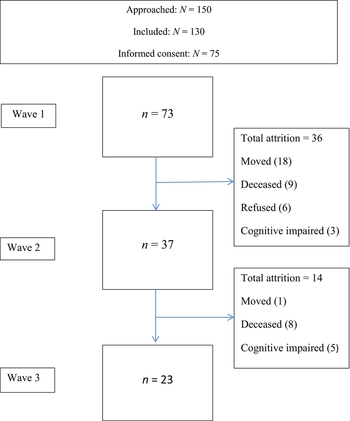
This paper is based on a broader research project including a longitudinal study on need fulfillment and well-being during the first months of residing in a nursing home (Custers et al. Reference Custers, Westerhof, Kuin and Riksen-Walraven2010; Reference Custers, Kuin, Westerhof and Riksen-Walraven2011; Reference Custers, Westerhof, Kuin, Gerritsen and Riksen-Walraven2012). The participants in this study were newly admitted to one of the seven participating nursing homes and lived in long-term care units for physically frail residents. Inclusion criteria were based on the procedures of the Amsterdam Groningen Elderly Depression Study (Smalbrugge et al., Reference Smalbrugge2006): participants had to be aged 55 years and over, without communication problems and without severe cognitive impairment (Mini-Mental State Examination Score >15, Folstein et al., Reference Folstein, Folstein and McHugh1975). Out of the 150 residents that were approached, 130 residents fitted the inclusion criteria and 75 residents participated in the first measurement wave. Two residents were excluded due to incomplete questionnaires. The attrition over the three measurement waves is illustrated in Figure 1.
Initial sample and attrition over three waves of data collection.

Procedure and design
The study consisted of three measurement waves: approximately six weeks, five months, and eight months after residents’ admission to the participating nursing home. The eight-month follow-up period was chosen because at the start of the study (in 2009) the mean stay on long-term care units for physically frail residents in the Netherlands was about eight months. Newly admitted residents received written information about the research project and were after approximately one week visited by the first author or a research assistant (master student in psychology). When residents fitted the inclusion criteria they were asked for written informed consent. During structured interviews socio-demographic variables (at measurement wave 1), control variables about health and cognition, need importance, need fulfillment, and depressive symptoms (at measurement waves 1, 2, and 3) were measured.
Measures
Depressive symptoms were measured with the eight-item version of the Geriatric Depression Scale (GDS; Jongenelis et al., Reference Jongenelis2007). Items were answered with “yes” or “no” and a sum score between 0 and 8 was computed, with higher values indicating more depressive symptoms. Previous research showed this scale to have good psychometric properties (Jongenelis et al., Reference Jongenelis2007). In the present study, the alpha reliability coefficients for this scale were 0.76, 0.78, and 0.76 at measurements 1, 2, and 3 respectively. Need fulfillment (of autonomy, relatedness, and competence) was measured with the 21-item Basic Need Satisfaction in Life Scale (Gagné, Reference Gagné2003). This scale is based on self-determination theory and has been used and validated in previous research with this theory (e.g. Gagné, Reference Gagné2003; Custers et al., Reference Custers, Westerhof, Kuin and Riksen-Walraven2010). Questions were answered on a 5-point scale from “never” to “always.” Examples of items are: “I feel like I am free to decide for myself how to live my life” (autonomy), “I really like the people I interact with” (relatedness), and “People I know tell me I am good at what I do” (competence). The alpha coefficients for the total scale were 0.90, 0.88, and 0.86 at measurements 1, 2, and 3 respectively. A mean score was computed across the items, with a higher score indicating more need fulfillment. The importance of needs was measured using nine items, based on self-determination theory and developed for the purpose of this research project (see also Custers et al., Reference Custers, Westerhof, Kuin, Gerritsen and Riksen-Walraven2012), and were answered on a 5-point scale from “not important” to “most important.” Examples of items are: “Do you consider it important that you can make your own choices concerning food, drinks, clothes, etc?” (autonomy), “Do you consider it important that the caregivers give you personal attention?” (relatedness), and “Do you consider it important that you can do the things you can still do yourself (like washing, shaving, comb your hair) for as long as possible?” (competence). The inter-item correlations for this scale were between 0.10 and 0.69, with the lowest correlations being between items measuring autonomy and relatedness (between 0.10 and 0.15), and the highest correlations between the items measuring autonomy (between 0.58 and 0.69). The inter-item correlations between competence and autonomy were between 0.24 and 0.43, and the correlations between relatedness and competence were between 0.11 and 0.30. Factor analyses (conducted with the sample from wave 1) showed a one-factor solution for this scale, explaining 36.9% of the variance, with all items loading higher than 0.30. The alpha coefficients for the total scale were 0.77, 0.79, and 0.84 at measurements 1, 2, and 3 respectively. The mean was computed across all nine items: higher scores indicate a higher attached importance of the three needs. Subjective health was measured by asking the residents to rate their overall health on a 5-point scale from “very poor” to “very good.” Educational level was measured on a 7-point scale with higher scores indicating a higher level of education. Cognitive functioning was measured using the 30-point Mini-Mental State Examination (Folstein et al., Reference Folstein, Folstein and McHugh1975), with higher scores indicating higher cognitive functioning. Functional Impairment was measured using the 11-item Groningen Activity Restriction Scale (Kempen et al., Reference Kempen, Doeglas and Suurmeijer1993). Residents rated items on eating/drinking, dressing, washing, and mobility on a 4-point scale from “yes, I can do it fully independently without any difficulty” to “no, I cannot do it fully independently, I can only do it with someone's help.”
Data analysis
Before testing the research questions, we first identified possible confounders, that is, variables that correlated significantly with depressive symptoms as well as need fulfillment or need importance. The investigated variables included sex, age, education, cognitive functioning, ADL (activities daily living) restrictions, and subjective health. Only subjective health was a possible confounder. A number of statistical analyses can be used to investigate longitudinal data in research on aging (Newsom et al., Reference Newsom, Jones and Hofer2012). We tested our research questions using individual growth curve modeling following Singer and Willet (Reference Singer and Willett2003). An important advantage of this method is the flexibility it has with variations in the degree to which individuals were able to participate in the study: the data from individuals who did not participate in all data collection waves still contribute to the estimation of the growth parameters. Not every person needs to have participated in every data wave, and every data point can be used, even those with just one wave. Concerning the missing data in our sample, this method is suitable in that it takes into account all data from our 75 participants. However, we also conducted the analysis with the 37 residents that participated in two or three waves. In order to fit the model, the dataset was converted from a person-level dataset, which contains one record for each resident in the study, to a person-period dataset, which contains one record for each time point a resident was in the study. This re-structuring resulted in a file with 134 observations (data lines). The analyses were conducted using SPSS mixed models, with restricted maximum likelihood estimation. Within this multi-level model for change the research questions were analyzed simultaneously. The Level 1 (within-person) question focused on individual change over time in depressive symptoms, and the Level 2 (between-person) questions focused on how these changes vary depending on participants’ degree of need fulfillment and need importance.
Results
Description of the sample
The mean age of the 73 residents at baseline (59% female) was 79.9 years (range 55–93). The mean score for cognitive functioning was 22 (range 15–30), the mean score for subjective health 2.9 (range 1–5), and the mean score for functional impairment was 31.6 (range 11–42). Main self-reported reasons for admission to the nursing home were stroke (29%), (hip) fraction (21%), and serious physical impairment due to old age (15%). Further physical syndromes were cancer, rheumatoid arthritis, and lung diseases.
In order to investigate possible selective attrition over time, the 23 residents that participated in all of the measurement waves were compared to the 36 dropouts that participated in the first measurement wave only. Longitudinal participants (N = 23) appeared similar at baseline to those participating at the first measurement wave only (N = 36). Baseline-only participants and longitudinal participants did not significantly differ in age (M = 80.24, SD = 8.29 and M = 79.04, SD = 7.47, respectively, t(71) = 0.59, p = 0.56), education (M = 2.78, SD = 2.23 and M = 2.43, SD = 2.06, respectively, t(71) = 0.63, p = 0.53), cognitive status (M = 21.53, SD = 5.14 and M = 23.45, SD = 5.22, respectively, t(68) = −1.47, p = 0.15), and subjective health (M = 3.2, SD = 0.92 and M = 3.0, SD = 1.22, respectively, t(71) = –0.53, p = 0.60). Furthermore, there was no difference in the number of men or women (sex: χ 2 (1, 71) = 0.079, p = 0.78); 59% and 57% of the participants were women at T1 and T3, respectively. Concerning the main study variables, baseline only participants seemed to have somewhat more depressive symptoms and less need fulfillment at T1 compared to longitudinal participants. However, the means did not differ significantly: depressive symptoms (M = 2.7, SD = 2.27 and M = 1.78, SD = 2.17, t(71) = 1.62, p = 0.11); need fulfillment (M = 3.44, SD = 0.62 and M = 3.64, SD = 0.76, t(71) = −1.18, p = 0.24). There was also no significant difference between baseline-only and longitudinal participants in the attached importance to the needs (M = 3.55, SD = 0.69 and M = 3.66, SD = 0.65, t(69) = –0.63, p = 0.30).
Preliminary analyses
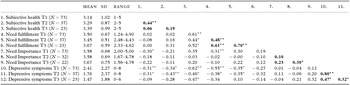
Table 1 presents the descriptive statistics for depressive symptoms, need fulfillment, need importance, and subjective health at the three time points. The mean for depressive symptoms was somewhat higher at T1 than at T2 and T3. The three means for need fulfillment and need importance were relatively constant: they indicated that residents were on average rather satisfied and considered need fulfillment to be rather important at each time point.
Descriptive statistics and correlations between the main study variables

Notes. *p < 0.05; **p < 0.01.
Over time correlations are in bold.
Table 1 includes the correlations between the four study variables. The moderately high and significant correlations of the three need fulfillment scores over time as well as of the three depressive symptom scores show that these constructs were rather stable over the seven-month period. The over-time correlations of subjective health and need importance were low to moderate, indicating that these constructs were somewhat less stable. Subjective health at T1 was significantly correlated to subjective health at T2, and need importance at T2 was significantly correlated to need importance at T3. Table 1 also shows that higher need fulfillment and higher subjective health were related to less depressive symptoms, in particular at and between T1 and T2.
A model of change in depressive symptoms
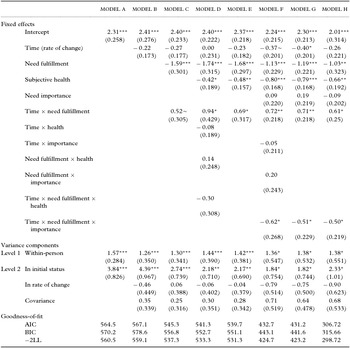
Table 2 presents the results of the model building. Model A, the unconditional means model, has no predictors and serves as a baseline for model comparison. It shows that there was significant within-person and between-person variance in the dependent variable, depressive symptoms. Model B presents the results of the unconditional growth model with time as a predictor. There was significant between-person variation in depressive symptoms, however the rate of change was not statistically significant. According to this model there was no change in depressive symptoms over time. Yet, because the effect of time could be moderated by one of the predictors, and because the statistical non-significance of time might have been influenced by our relatively small sample size, we considered it worthwhile to explore the effect of the two substantive predictors.
Results for the growth curve models predicting depressive symptoms from need fulfillment, need importance, and subjective health

Notes. ~p < 0.10; *p < 0.05; **p < 0.01; ***p < 0.001.
Standard errors are within parentheses.
In Model C the first predictor, need fulfillment, was added and showed a significant effect on depressive symptoms. The interaction between need fulfillment and time on depressive symptoms was marginally significant. In model D the predictor subjective health was added which showed a main effect on depressive symptoms. The interactions with health were non-significant. Therefore, in model E those interactions were removed. Next, in model F the variable need importance and the interactions with time and need fulfillment were added. A significant three-way interaction effect between time, need fulfillment, and need importance on depressive symptoms was found. Finally, the non-significant interactions in Model F were removed, which led to the final model G with main effects of time, need fulfillment, and subjective health on depressive symptoms, and an interaction between time, need fulfillment, and need importance (i.e. an interaction between need fulfillment and need importance on the slope of depressive symptoms). Comparison of the goodness-of-fit statistics between the different models revealed a lowering of AIC (Akaike Information Criterion), BIC (Bayesian Information Criterion), and −2LL (Log Likelihood) statistics, indicating an increasingly better fit. More specifically, when comparing the −2LL statistics for nested models a statistically significant improvement was found between models B and C, C and E, and between models E and F.
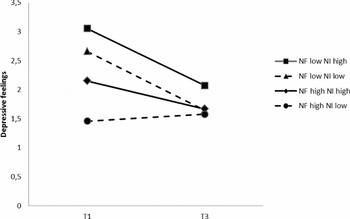
In the final model, the initial level of depressive symptoms was 2.3, and depressive symptoms were reduced by the effects of time (–0.40), need fulfillment (–1.19), and subjective health (–0.79). To examine the interaction between need importance and need fulfillment on the change in depressive symptoms (–0.51), a prototypal plot was created. It shows the change in depressive symptoms for prototypical participants, crossing high and low need fulfillment with high and low need importance. Their means plus or minus one standard deviation were used to indicate high and low scores. The trajectories of depressive symptoms for the four resulting groups are shown in Figure 2. As can be seen, residents with low need fulfillment (upper lines) had higher initial levels of depressive symptoms that decreased modestly, regardless of their need importance. Residents with high need fulfillment (lower lines) had lower initial levels of depressive symptoms, but their trajectories differed for participants with low and high need importance. Residents with low need importance (striped line) started with lower levels of depressive symptoms but remained stable over time, whereas residents with high need importance (solid line) had more depressive symptoms at T1, but decreased slightly over time. In the additional model H, the results of the analysis with only the 37 residents that participated in two or three waves are presented. It shows that the effects remain significant, with the exception of the effect of time.
Prototypical plot of trajectories of depressive symptoms over time for four groups of participants.

Discussion
The aim of this study was to investigate change in depressive symptoms and the relation with residents’ need fulfillment (i.e. fulfillment of relatedness, autonomy, and competence) and need importance during the first eight months of living in a nursing home. We expected depressive symptoms to decrease, yet it was shown that depressive symptoms did not change over time in general. However, at an individual level, the course of depressive symptoms over time is related to individually experienced need fulfillment and the interaction between need fulfillment and the importance attached to this need fulfillment, which confirmed our second expectation. At this individual level it was shown that in most residents there is a small or moderate decrease in depressive symptoms, with the exception of the residents that experience high need fulfillment and attach low importance to the needs. Their depressive symptoms seem to increase. In particular the residents that consider need fulfillment to be highly important but experience low need fulfillment deserve attention. The level of depressive symptoms of this group was higher and remained higher as compared to the other three groups.
In the current study, depressive symptoms seem to be rather stable over time on average. This finding is in accordance with the studies of Sutcliffe and colleagues (Reference Sutcliffe2007) and McSweeney and O’Connor (Reference McSweeney and O’Connor2008), although, as described before, other studies did show different results. Our study offers an explanation for the differences in trajectories of depressive symptoms. Residents with high need fulfillment had less depressive symptoms at baseline and showed no change (in the case of low need importance) or a minor decrease (high need importance) in depressive symptoms, whereas residents with low need fulfillment (high and low importance) started higher but decreased substantially in self-reported depressive symptoms.
Residents that consider the three needs to be important but experience low fulfillment of these needs seem to have relatively high levels of depressive symptoms shortly after admission as well as after eight months, compared to the other three groups. Possibly, when residents do not adapt (lower) their needs for relatedness, autonomy, and competence, their depression levels remain higher. This is comparable to the conclusion of Sterns (Reference Sterns2007) that being proactive, by for instance complaining to a staff member about a specific unfulfilled need, resulted in unsuccessful adaptation and a lower morale. The current study contributes to the understanding of factors that may contribute to the well-being, in terms of depressive symptoms, of nursing home residents with relatively intact cognition. It is of importance to take into account nursing home residents’ needs, wishes, and expectations concerning relatedness, autonomy, and competence in the nursing home. When there is insight in residents needs soon after they move into the nursing home, the fulfillment of these needs could be facilitated, which probably makes the first months of living in the home somewhat easier. As staff forms a major source of contact for nursing home residents, the relationship with professional caregivers is crucial in promoting need fulfillment and well-being. Staff should be trained in asking for psychological needs and anticipate on these needs during daily care routines. This fits with the growing trend to individualize care and should be highly possible, given that this group of residents is generally able to make their wishes known.
A limitation of the current study is the relatively small sample size and the large attrition over time. The sample size could partially be explained by residents’ reluctance to participate in video-recordings, which were made for another research purpose (see Custers et al., Reference Custers, Kuin, Westerhof and Riksen-Walraven2011). Due to the high attrition rate and selection bias, the residents participating in the study might differ from nursing home residents in general, which could negatively affect the generalizability of the results. Although our sample is, with regard to sociodemographic variables, comparable to a large Dutch survey sample in somatic nursing homes (den Draak, Reference Den Draak2010), it remains unclear whether other factors such as residents’ personality might have influenced residents’ participation in the study. Although the study was conducted at nursing home units for long-term care, a considerable group of residents moved out of the nursing home (they either went home or to a less intensive care facility) before the second measurement wave. This indicates that residents were initially “falsely” admitted to long-term care units and probably should have been on a rehabilitation unit. Comparison of this group of residents to the other residents shows that residents who moved out had less depressive symptoms at baseline than the rest of the sample, which could have distorted the results of this study. However, we also conducted the analysis with the longitudinal participants only and found the interactions between need fulfillment and need importance over time with depressive symptoms to remain.
Future research should focus on the three needs separately in a larger sample to gain more insight into the contribution of relatedness, autonomy, and competence to depressive symptoms over time. In investigating adaptation to the nursing home it would be appropriate to measure the needs and need fulfillment of older people before rather than after moving to a nursing home. Although there are many practical difficulties it is worth the effort to gain more insight in this difficult process of adapting to an institutional setting. Another option for future research would be to cross-sectionally compare the importance and fulfillment of relatedness, autonomy, and competence between independently living older adults and older adults living in a nursing home. It is to be expected that in particular the nursing home as an institutional setting with all the belonging consequences is associated with adaptation and fulfillment of psychological needs.
Conflict of interest
None.
Description of author's roles
A. Custers collected the data, conducted the analysis, and wrote the article. A. Cillessen was responsible for the statistical design and supervised the statistical analysis. G. Westerhof designed the study and assisted with writing the article. Y. Kuin assisted with designing the study, supervised the data collection, and assisted the writing. M. Riksen-Walraven assisted with designing the study and writing the article.