Histeromerus Wesmael, 1838 (Hymenoptera: Braconidae) is a highly distinctive, small genus of cyclostome braconid parasitoid wasps with an unusual-shaped head, highly spinose protibia, and a very elongate and tapering basal metatarsomere (van Achterberg Reference van Achterberg1976). The taxonomic history of this genus is complex, having variously been classified in the Doryctinae (e.g., Shenefelt and Marsh Reference Shenefelt and Marsh1976), Braconinae (van Achterberg Reference van Achterberg1976), and Histeromerinae (van Achterberg Reference van Achterberg1984; Shaw and Huddleston Reference Shaw and Huddleston1991). Histeromerus is now regarded as a monotypic tribe in the subfamily Rhyssalinae (Zaldívar-Riverón et al. Reference Zaldívar-Riverón, Mori and Quicke2006; Sharanowski et al. Reference Sharanowski, Dowling and Sharkey2011).
Only four species have been described (Yu et al. Reference Yu, van Achterberg and Horstmann2012): Histeromerus mystacinus (Wesmael, 1838) from western Europe as far east as western Russia; H. canadensis Ashmead, 1891 originally described from Canada and occurring down the eastern side of the United States of America as far south as North Carolina, but subsequently discovered in western Europe (but so far only in the Netherlands) (van Achterberg Reference van Achterberg1992); H. orientalis Chou and Chou, 1991 from China, Taiwan, and Japan; and most recently, H. clavatus Austin and Wharton, 1992 from Australia. They are encountered more frequently by coleopterists than hymenopterists because females spend much of their lives with their host beetle (Coleoptera) larvae rather deep inside dead wood through which they can bore using their modified head and prothoracic legs (Shaw Reference Shaw1995).
Using DNA barcoding sequence data we show here that two species of Histeromerus occur in Canada, one of them being H. canadensis as expected, while the second possesses sequences that cluster with H. mystacinus to which we assign them.
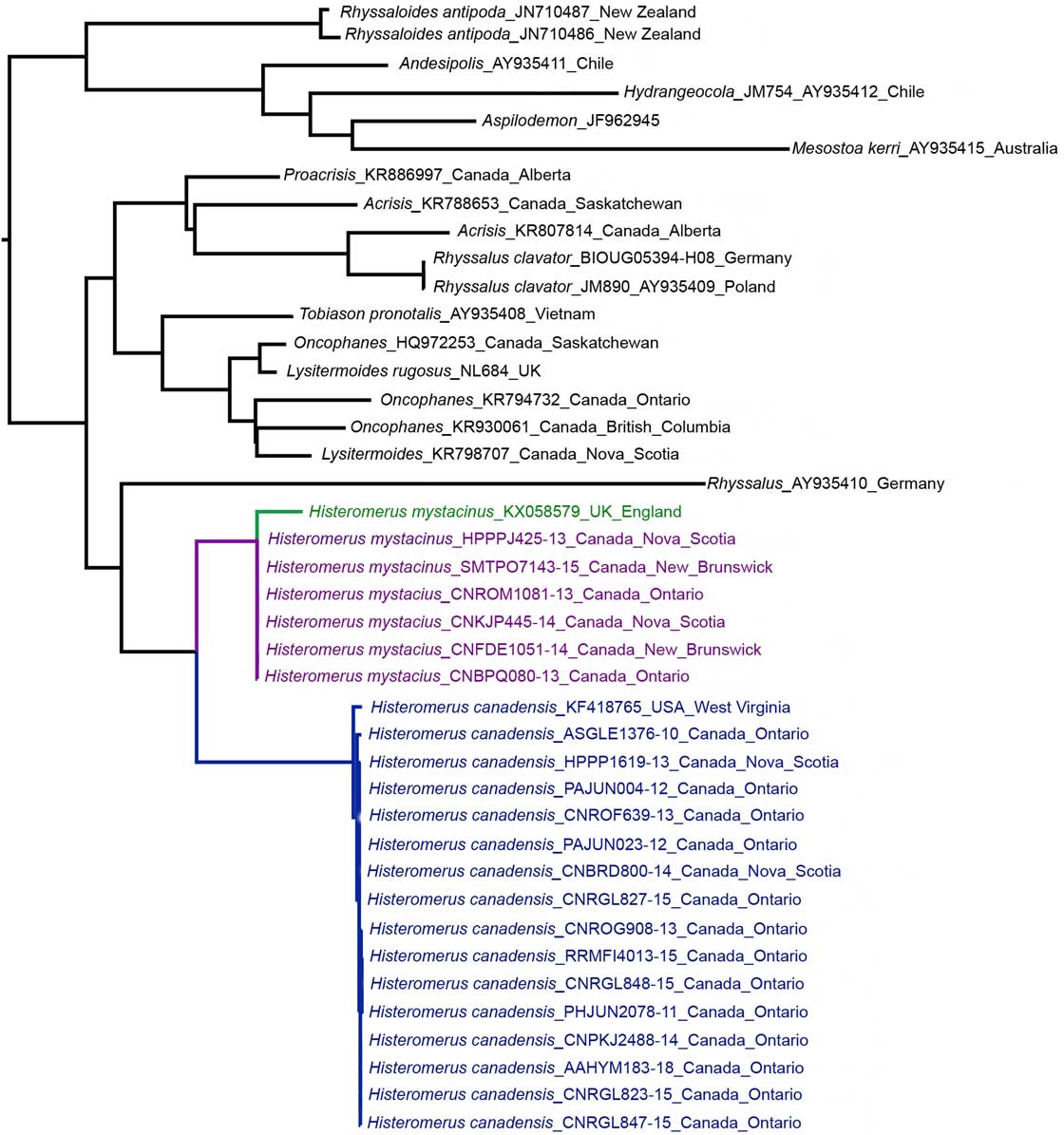
Specimens were predominantly collected in Malaise traps as part of the International Barcode of Life Project (http://ibol.org/phase1). They were sequenced for the 648 base pair barcode fragment of the mitochondrial cytochrome c oxidase subunit 1 gene using standard protocols (Ivanova et al. Reference Ivanova, deWaard and Hebert2006; deWaard et al. Reference deWaard, Ivanova, Hajibabaei and Hebert2008; Hebert et al. Reference Hebert, deWaard, Zakharov, Prosser, Sones and McKeown2013). Additional sequences were included from the first author’s publications that are deposited on Genbank (www.ncbi.nlm.nih.gov/genbank). Barcode of Life Data System (BOLD; www.boldsystems.org) or GenBank accessions numbers are given on the tree (Fig. 1). Specimens are deposited in the collection of the Centre for Biodiversity Genomics, Guelph, Ontario, Canada. Sequences were analysed using RAxML v8.2.X (Stamatakis Reference Stamatakis2014), using a GTR+G rate model with the three codons as separate data partitions.
Maximum likelihood tree based on a 658 base pair segment of near the 5', terminus of the CO1 gene. This tree includes all available Histeromerus sequences as well as several other Rhyssalinae species. It is rooted with representatives of the more basal subfamily Mesostoinae.
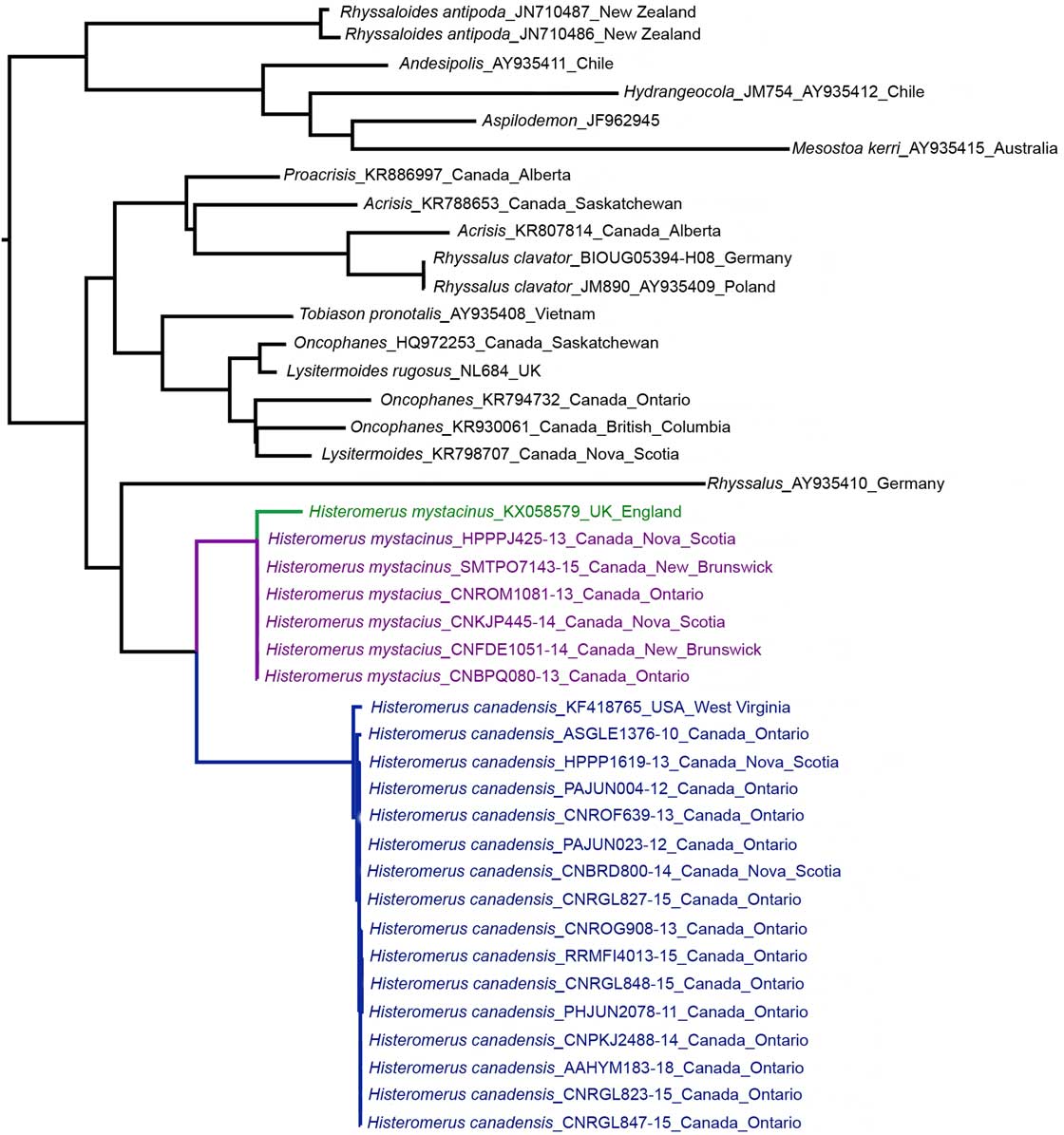
Sequences from specimens of Histeromerus from North America form two discrete clusters, which differ consistently at 48 of the 658 base pairs (7.3%) suggesting a long period of separation (Fig. 1). The larger cluster corresponds to H. canadensis and includes specimens from Ontario (Canada), Nova Scotia (Canada), and West Virginia (United States of America). The specimens in the small cluster derive from Ontario, New Brunswick (Canada), and Nova Scotia (Canada) and associate with a H. mystacinus sequence from the United Kingdom. The Canadian H. mystacinus specimens run to this species in van Achterberg’s (Reference van Achterberg1992) key, and examination revealed no noticeable morphological differences when compared with European material.
The broad distribution of H. mystacinus in Canada, ranging between 43°N and 46°N and 60°W to 80°W, suggests that it has been there for a considerable period and is not a recent introduction. This conclusion is reinforced by fact that they differ from the United Kingdom H. mystacinus sequence at 14 of 652 base pairs that overlap (2.15%), a divergence value compatible with their isolation from the western Palaearctic population for at least several hundred thousand years (see e.g., Brower Reference Brower1994; Farrell Reference Farrell2001; Quek et al. Reference Quek, Davies, Itino and Pierce2004; Papadopoulou et al. Reference Papadopoulou, Anastasiou and Vogler2010). The known Old World distribution of H. mystacinus is more extensive in both latitude and longitude (Belokobylskij et al. Reference Belokobylskij, Loni, Lucchi and Bernardo2013). Longitudinally its distribution extends from Ireland in the west through to western Russia, Georgia and northern Iran in the east; and latitudinally between Campania, Italy (40.8°N) to southern Sweden and Latvia in the north (~56°N). It remains to be determined whether its North American distribution is markedly larger than what is already known.
The extensive barcoding of Canadian insects has also revealed the occurrence of several taxa that had previously only been known from the Palaearctic Region in the Canadian far north (e.g., Blagoev et al. Reference Blagoev, Nikolova, Sobel, Hebert and Adamowicz2013; Landry et al. Reference Landry, Nazari, Dewaard, Mutanen, Lopez-Vaamonde, Huemer and Hebert2013; Fernandez-Triana et al. Reference Fernandez-Triana, Shaw, Cardinal, Dosdall and Mason2014). In the case of spiders (Araneae), half the species found at Churchill, Manitoba, Canada have Holarctic distributions. As more, especially taxonomically poorly known, groups such as parasitic hymenopterans are investigated, the number of known circumpolar species will almost certainly increase yet further.
Acknowledgements
The authors thank Senior Postdoctoral Fellowship under Rachadapisek Sompote Fund, Graduate School, Chulalongkorn University to D.L.J.Q. DNA sequencing analysis was supported by funding from the Government of Canada to Genome Canada through the Ontario Genomics Institute.