Introduction
The pumpkinseed Lepomis gibbosus L. (Perciformes, Centrarchidae) is one of the most successful introduced freshwater fish species in Europe (Copp & Fox, Reference Copp, Fox and Gherardi2007). The fish was first imported into Europe from North America around 1880 as an aquarium and garden pond fish (Welcome, Reference Welcome1981). During the 19th and 20th centuries, L. gibbosus spread, with or without human assistance, and established populations in at least 28 European countries (Copp & Fox, Reference Copp, Fox and Gherardi2007). Outside its native range, L. gibbosus has colonized a variety of habitats, from small ponds to large rivers such as the River Danube (Copp et al., Reference Copp, Fox and Kováč2002). The first records from the River Danube were published from the beginning of the 20th century (Pintér, Reference Pintér1977) and several established populations are presently known from backwaters and oxbows of the River Danube floodplain (Copp et al., Reference Copp, Guti, Rovný and Černý1994). Despite its relatively wide distribution throughout Europe, there have been relatively few studies on parasites of this species compared to the extensive studies undertaken in its native range of North America (summarized in Hoffman, Reference Hoffman1998).
The Centrarchid fishes of North America are parasitized by a variety of ancyrocephalid Monogenea (Beverley-Burton & Klassen, Reference Beverley-Burton and Klassen1990; Hoffman, Reference Hoffman1998). The ancyrocephalid diversity of native European fishes (predominantly Percidae and Siluridae), however, is relatively low (Gusev, Reference Gusev and Bauer1985). The monogenean fauna of L. gibbosus in Europe was first studied in the Romanian section of the Danube delta by Roman (Reference Roman1953), who found two Onchocleidus species. To date, the introduction of four ancyrocephalid monogeneans into European waters with their fish host (L. gibbosus) has been reported: Actinocleidus recurvatus, A. oculatus, Onchocleidus (synonyms Urocleidus, Cleidodiscus) similis and O. (synonyms Urocleidus, Haplocleidus, Cleidodiscus) dispar (Gusev, Reference Gusev and Bauer1985; classification based on Beverley-Burton & Klassen, Reference Beverley-Burton and Klassen1990). While all four ancyrocephalid species are known from southern Europe (Galli et al., Reference Galli, Stefani, Benzoni and Zullini2005), only Onchocleidus spp. have been reported from Central Europe, i.e. the Danube River Basin (Roman, Reference Roman1953; Kiškaroly, Reference Kiškaroly1977; Kakacheva-Avramova et al., Reference Kakacheva-Avramova, Margaritov, Grupcheva, Russev and Naidenov1978; Moravec, Reference Moravec2001).
In this study, as a contribution to the faunistic knowledge of introduced fish parasites in Europe, we examine (1) the distribution of monogeneans within the Danube River Basin, (2) the morphometric variability of haptor hard parts between native and introduced fish populations, and (3) the microhabitat distribution of the two dominant parasite species in the area of the host introduction.
Materials and methods
During April 2004, 15 specimens of L. gibbosus were collected by electrofishing from side-channels of the River Danube near the village of Bodíky, Slovak Republic (standard length (SL) ranged from 64 to 119 mm, mean ± SD: 93.6 ± 19.4; water temperature 12°C). In April 2006, six fish were collected in the main channel of the Danube near the village of Koshava, Bulgaria (SL 43–84 mm, 63.6 ± 16.5; 10°C). In addition, one specimen (SL 78 mm; 19°C) was collected in a backwater of the River Dyje, located near the confluence of the Rivers Dyje and Morava (Czech Republic) in May 2005 and another (SL 99 mm; 10°C) at Batina (Croatia) on the main channel of the Danube in November 2005. All fish were transported alive, in aerated water, directly to the laboratory and immediately examined for the presence of gill parasites. Monogenean parasites were removed from the host tissue, fixed with a mixture of ammonium picrate and glycerine (Malmberg, Reference Malmberg1970), and later mounted in Canada balsam for further analysis (Lim & Gibson, Reference Lim and Gibson2008). Parasites were identified according to the shape of the sclerotized parts of the haptor (anchors, connective bars and marginal hooks) and reproductive organs (copulatory organ and vaginal armament) (see Gusev, Reference Gusev and Bauer1985) using a light microscope equipped with phase-contrast and differential interference contrast. Measurements were taken using the Digital Image Analysis package (MicroImage 4.0 for Windows, Olympus Optical Co., Hamburg, Germany). All measurements, unless specified otherwise, are in micrometres. These measurements were compared with those for parasites from the native distribution area, obtained from studies undertaken by Hanek & Fernando (Reference Hanek and Fernando1972), Beverley-Burton & Suriano (Reference Beverley-Burton and Suriano1981) and Beverley-Burton (Reference Beverley-Burton, Margolis and Kabata1984). Spearman rank correlation was used to test for a relationship between metric trait and SL. In order to avoid any effect of differing habitat or temperature, this test was only undertaken on specimens originating from the Slovak section of the Danube.
For the monogenean microhabitat distribution study, the gill apparatus was divided into four gill arches. Each gill arch was divided into three segments (dorsal – D, medial – M, ventral – V), three gill areas (distal – d, central – c, proximal – p), two gill hemibranches (anterior – A, and posterior – P) and two gill surfaces (outer – out, and inner – in), according to Gelnar et al. (Reference Gelnar, Svobodova and Vykusova1990). All four gill arches were examined from both the left and right sides. The positions of 620 specimens of O. similis and 199 specimens of A. recurvatus were recorded in fish originating from the side-channel system of the Danube, Slovak Republic. Gyrodactylus sp. (n = 1) and O. dispar (n = 7) were not included in the analysis because of the low number of individuals. Significant differences in microhabitat distribution were assessed using a chi-square-based median test (Kruskal–Wallis ANOVA) followed by multiple comparison tests using the Statistica 9.0 software package (StatSoft Inc., Tulsa, Oklahoma, USA).
Results
Parasite community composition
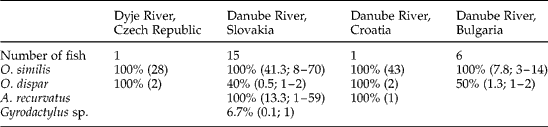
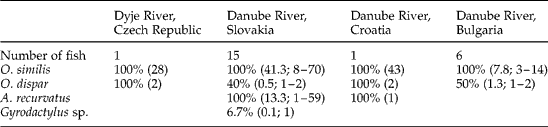
Monogenean parasites infected all the fish examined. No parasites were found on fins. On gills, three ancyrocephalid species (O. similis, O. dispar and A. recurvatus), and one specimen of Gyrodactylus sp. were recorded. Both O. similis and O. dispar occurred at all sampling sites along the Danube. However, while O. similis was recorded on all fish examined, only 48% of fish were infected with O. dispar. Indeed, the intensity of infection with O. dispar was lower than with O. similis at all sampling sites. Actinocleidus recurvatus was recorded on L. gibbosus from Slovakia, attaining 100% prevalence and showing a relatively high intensity of infection, and a single specimen was found also in fish from Croatia (table 1).
Prevalence, mean abundance and intensity of infection (in parentheses) of monogenean parasites found on gills of L. gibbosus in the Danube River basin.
Morphometric variability
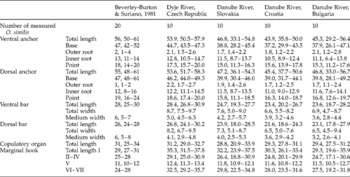
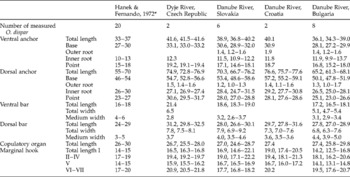
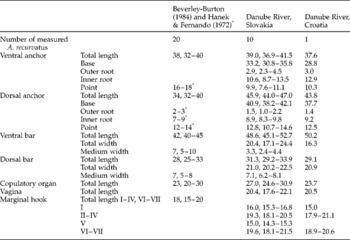
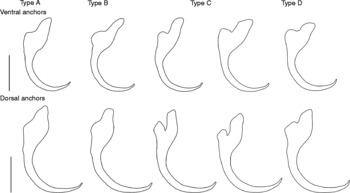
Whereas measurements for O. similis from the three sections of the River Danube were comparable, haptor hard parts of parasites from the River Dyje were larger. Nevertheless, most of the traits measured in parasites from the Danube Basin were smaller than those collected from native fish in Canada (table 2). Fourteen of the 18 traits measured for haptor hard parts were positively correlated with SL (P < 0.05). Note that only two specimens of O. dispar were available for measurement from the River Dyje and the Croatian stretch of the Danube. With the exception of the copulatory organs, measurements for O. dispar from the Danube River Basin tended to be higher than those recorded for native fish from Canada (table 3). Likewise, the central hooks of A. recurvatus from the Danube were also larger than those recorded for Canadian fish (table 4). None of the traits measured for either O. dispar or A. recurvatus were associated with SL. The anchors of A. recurvatus from the Slovak section of the River Danube showed high morphological variability (fig. 1).
Measurements (mean, range; in μm) of O. similis parasitizing L. gibbosus collected in sites located in the Danube River basin.

Measurements (mean, range; in μm) of O. dispar parasitizing L. gibbosus collected in sites located in the Danube River basin.

* Measurements based on O. dispar collected from L. macrochirus.
Measurements (mean, range; in μm) of A. recurvatus parasitizing L. gibbosus collected in sites located in the Danube River basin.

Morphological variability of ventral (upper line) and dorsal (lower line) anchors of Actinocleidus recurvatus from Lepomis gibbosus sampled from the backwater system of the Slovak section of the River Danube (scale bars 20 μm).

Microhabitat distribution
Due to the low intensity of O. dispar and Gyrodactylus infection, only O. similis and A. recurvatus were included in the microhabitat distribution analysis. Onchocleidus similis showed a statistically significant preference for the second gill arch (χ 2 = 17.9, P < 0.001), and A. recurvatus a marginal preference (χ 2 = 7.7; P = 0.053). No microhabitat preference for gill arch segment was displayed by O. similis, although A. recurvatus was seen to parasitize the dorsal segment more often than the medial (χ 2 = 7.6; P = 0.022). While a preference for the central gill arch area was observed for O. similis (χ 2 = 22.6; P < 0.001), an avoidance of the proximal area was noted for A. recurvatus (χ 2 = 19.3; P < 0.001). The abundance of both parasite species did not differ between the anterior and posterior hemibranch. The inner surface of the hemibranch tended to be preferred by A. recurvatus (χ 2 = 3.4; P = 0.047) and the outer surface by O. similis (χ 2 = 30.0; P < 0.001).
Discussion
To date, four ancyrocephalid monogenean species have been documented as parasitizing introduced L. gibbosus in Europe (Gusev, Reference Gusev and Bauer1985; Galli et al., Reference Galli, Stefani, Benzoni and Zullini2005). Three of these species, O. similis, O. dispar and A. recurvatus, were confirmed as parasitizing fish hosts from the Danube River Basin in the present study. Moreover, an unspecified Gyrodactylus species (belonging to the laevis/prostae group) was observed in one of the populations under study. The native monogenean fauna of L. gibbosus is very rich, comprising 16 species of Ancyrocephalidae and two species of Gyrodactylidae (Hoffman, Reference Hoffman1998). Reduced parasite diversity in introduced populations, as compared to native host populations, is a well-documented phenomenon. Frequently, only a fraction of the parasite species richness from their native range is found in populations of the same species in their introduced range (Torchin & Mitchell, Reference Torchin and Mitchell2004). Based on the literature and the present study, the occurrence of only five monogenean species is known from introduced L. gibbosus populations throughout Europe (e.g. Roman, Reference Roman1953; Kiškaroly, Reference Kiškaroly1977; Kakacheva-Avramova et al., Reference Kakacheva-Avramova, Margaritov, Grupcheva, Russev and Naidenov1978; Lambert, Reference Lambert1979; Moravec, Reference Moravec2001; Galli et al., Reference Galli, Stefani, Benzoni and Zullini2005; Sterud & Jorgensen, Reference Sterud and Jorgensen2006). These data indicate that less than half of the monogenean species infecting L. gibbosus in their native range have been introduced into Europe with their fish host. This corresponds well with the findings of Torchin et al. (Reference Torchin, Lafferty, Dobson, McKenzie and Kuris2003), who showed that the number of parasite species found in introduced populations of various animal taxa is approximately half that found in their native populations.
Onchocleidus similis seems to be the most frequent and prevalent monogenean parasite among the introduced ancyrocephalid species found in Danubean L. gibbosus populations (table 1), and also from southern European lakes (Kakacheva-Avramova et al., Reference Kakacheva-Avramova, Margaritov, Grupcheva, Russev and Naidenov1978; Galli et al., Reference Galli, Stefani, Benzoni and Zullini2005). In its native range, this parasite species appears to be a specific parasite of L. gibbosus (Hoffman, Reference Hoffman1998). However, the frequency of its occurrence among native L. gibbosus populations is lower than that of other species, such as the less specific O. dispar or O. ferox (e.g. Allison & McGraw, Reference Allison and McGraw1967; Hanek & Fernando, Reference Hanek and Fernando1972; Wheeler & Beverley-Burton, Reference Wheeler and Beverley-Burton1989). Contrary to O. similis, the low infection rate of introduced O. dispar remains comparable among both present and historical findings in the Danubean (Vojtek, Reference Vojtek1958; references in Moravec, Reference Moravec2001) and southern European L. gibbosus populations (Kakacheva-Avramova et al., Reference Kakacheva-Avramova, Margaritov, Grupcheva, Russev and Naidenov1978; Galli et al., Reference Galli, Stefani, Benzoni and Zullini2005), suggesting a limited capacity for population growth in new European areas. Interestingly, parasites with higher host specificity (e.g. O. similis) seem to be more adaptable in new environments than parasites with lower host specificity (e.g. O. dispar), especially in areas with a relatively high density of specific hosts and an absence of other conspecific host species.
Both valid Actinocleidus species (A. oculatus and A. recurvatus) parasitizing L. gibbosus in North America were introduced into Europe during the 20th century (Gusev, Reference Gusev and Bauer1985). As Actinocleidus species have previously only been documented from southern European countries such as France (Lambert, Reference Lambert1979) and Italy (Galli et al., Reference Galli, Stefani, Benzoni and Zullini2005), our findings of A. recurvatus in Slovakia and northern Croatia represent a new parasite species record for Central Europe. The recent occurrence of A. recurvatus in Central Europe, a species previously found only in southern Europe, may therefore indicate either a process of fish migration or additional introductions within the European continent over past decades. Furthermore, the high morphological variability in haptor hard parts which was found in A. recurvatus from the Slovak section of the Danube, with between one and three types (see fig. 1) occurring simultaneously on one fish host, is also worthy of note. Morphological variability of parasites among different host species, or within geographically distant populations, has previously been reported for dactylogyrids (Šimková et al., Reference Šimková, Pečínková, Řehulková, Vyskočilová and Ondračková2007); however, it is not common within parasite infracommunities. In various regions of North America, A. recurvatus has been recorded only on L. gibbosus (Wheeler & Beverley-Burton, Reference Wheeler and Beverley-Burton1989), though a certain degree of morphological variability could be detected when comparing parasites from different locations (Beverley-Burton, Reference Beverley-Burton, Margolis and Kabata1984, Reference Beverley-Burton1986). This variability corresponds to types A and B from our European samples (fig. 1). In the case of types C and D (fig. 1), morphological abnormality, rather than the effect of fixation procedure used (e.g. cover-slip pressure), is the most likely reason for such high morphological variability.
A strong relationship between size of parasite haptor hard parts and host size was only observed for O. similis. The tendency towards larger measurements for the hard parts of the haptor in North American as compared with European O. similis specimens has been noted previously (Vojtek, Reference Vojtek1958; Beverley-Burton & Suriano, Reference Beverley-Burton and Suriano1981). Lepomis gibbosus introduced into Europe display much slower growth and a smaller adult size than native North American fish (Copp & Fox, Reference Copp, Fox and Gherardi2007). The difference in host size, therefore, is likely to be a good explanation for the smaller measurements of the hard parts of European O. similis specimens.
Microhabitat preference for certain habitats within the host (i.e. fish gills) has been widely observed for monogenean parasites, which often have overlapping niches, and a great proportion of the available niche space on the gill apparatus remains empty (Rohde, Reference Rohde1981). In our study, both O. similis and A. recurvatus showed a preference for the second gill arch. This corresponds with the results of Hanek & Fernando (Reference Hanek and Fernando1978), who also observed a preference of monogenean parasites (A. recurvaus, Cleidodiscus robustus, O. acer, O. attenuatus, O. dispar and O. ferox) for the second gill arch in American L. gibbosus populations. Gill site segregation was observed for both O. similis, which showed a preference for the central gill area and outer hemibranch surface, and A. recurvatus, which preferred the dorsal segment and inner hemibranch surface and avoided the proximal area. Morphological adaptation to the host is believed to be the reason for such site segregation in intergeneric monogeneans co-occurring on the same host (Rohde, Reference Rohde1979).
In the introduced European populations, the monogenean parasite fauna of L. gibbosus displays high host specificity. With the exception of a single Gyrodactylus specimen, representing the only documented case of the acquisition of local parasite species, all monogenean species found in the area of L. gibbosus introduction are native to their host's original range and were introduced together with the host. Besides that, there has been no previous record of a natural L. gibbosus monogenean parasite infecting native European fish species. These ancyrocephalid parasites are usually limited to their host species only (i.e. L. gibbosus), or to a related species potentially introduced into the same area. Therefore, the absence of closely related species native to Europe may contribute to the low level of host-switching in the L. gibbosus–monogenean host–parasite system.
Acknowledgements
This work was supported by Ichthyoparasitology Centre of Excellence, No. LC 522 and Research Project No. MSM 0021622416 of Masaryk University. We would like to thank Pavel Jurajda of the Institute of Vertebrate Biology ASCR, Brno; Jaroslav Černý of the Institute of Zoology SAV, Bratislava; Teodora Trichkova and Millen Vassilev of the Institute of Zoology BAS, Sofia; and Ivan Bogut of the University of Osijek, Croatia, for help with fish collection.