Introduction
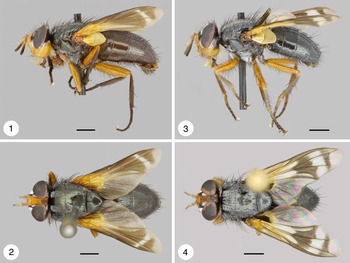
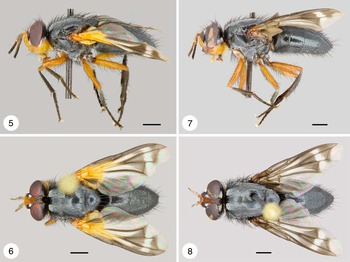
Species of Euthera Loew (Diptera: Tachinidae) are attractive medium-sized tachinids (Figs. 1–8) easily recognized by their superficial resemblance to deer flies (Chrysops Meigen [Diptera: Tabanidae]). There are only 12 described species in the world but collectively they occur in all six zoogeographic regions, with the most species (five) in the Australasian Region (Cantrell Reference Cantrell1983; Cantrell and Crosskey Reference Cantrell and Crosskey1989). In North America, there are three described species (Brooks Reference Brooks1945; O'Hara and Wood Reference O'Hara and Wood2004) and a new species is described herein.
Habitus images of Euthera species, males. 1.Euthera bicolor, left lateral view (Huntsville, Texas, CNC; TachImage 00127); 2.E. bicolor, dorsal view (same specimen; TachImage 00128); 3.Euthera setifacies, left lateral view (Gomez Peak near Silver City, New Mexico, CNC; TachImage 00121); 4.E. setifacies, dorsal view (same specimen; TachImage 00122). Scale bars = 1.0 mm.

Habitus images of Euthera species, males. 5.Euthera tentatrix, left lateral view (Gomez Peak near Silver City, New Mexico, CNC; TachImage 00123); 6.E. tentatrix, dorsal view (same specimen; TachImage 00124); 7.Euthera woodi, left lateral view (paratype, North Peak, Torrance Co., 34°16.4′N 105°43.5′W, New Mexico, CNC; TachImage 00125); 8.E. woodi, dorsal view (same specimen; TachImage 00126). Scale bars = 1.0 mm.

Euthera is classified in the tribe Eutherini, either on its own (Crosskey Reference Crosskey1973, Reference Crosskey1976) or with the monotypic Palaearctic genus Redtenbacheria Schiner (Herting Reference Herting1984; Herting and Dely-Draskovits Reference Herting and Dely-Draskovits1993; Ziegler Reference Ziegler1998; Richter Reference Richter2004; O'Hara et al. Reference O'Hara, Shima and Zhang2009). The subfamilial placement of Euthera is a perplexing problem that has yet to be unequivocally resolved. Egg structure, metapneustic larvae, and parasitism of pentatomid bugs suggest placement of Euthera in Phasiinae and this classification has been followed by many authors (e.g., Crosskey Reference Crosskey1976; Cantrell Reference Cantrell1983; Cantrell and Crosskey Reference Cantrell and Crosskey1989; Herting and Dely-Draskovits Reference Herting and Dely-Draskovits1993; Ziegler Reference Ziegler1998; Richter Reference Richter2004), but there is contradictory evidence suggestive of an affinity with Dexiinae.
Tschorsnig (Reference Tschorsnig1985) examined the male postabdomen of a large cross-section of mostly Palaearctic Tachinidae and drew attention to similarities between Euthera and Dexiinae in the pregonite, postgonite, sternite 5, and distiphallus. As further evidence of a non-Phasiinae relationship, Euthera females lay eggs containing fully developed first instars (ovolarviparity), as do females of Dexiinae, Tachininae, and most Exoristinae, but unlike females of Phasiinae that lay undeveloped eggs (oviparity). However, the most definitive synapomorphy of Dexiinae is generally accepted as a hinged connection between the basiphallus and distiphallus and this is lacking in Euthera (e.g., Verbeke Reference Verbeke1962: pl. XI, fig. 4).
Shima (Reference Shima1989) considered these character traits of Euthera and concluded that the genus is a primitive member of Dexiinae. He placed Euthera on a cladogram of tachinid relationships as the only extant taxon on the Dexiinae lineage prior to the development of a hinged phallus. This interpretation is followed by some authors (O'Hara and Wood Reference O'Hara and Wood2004; Shima Reference Shima2006; O'Hara et al. Reference O'Hara, Shima and Zhang2009; Cerretti Reference Cerretti2010; Wood and Zumbado Reference Wood and Zumbado2010), but is best treated as a hypothesis in light of the general uncertainty surrounding Euthera affinities.
The first North American species, Euthera tentatrix, was described from New York by Loew (Reference Loew1866). Coquillett (Reference Coquillett1902) added a second species, Euthera bicolor, from Texas. Brooks (Reference Brooks1945) described a third species, Euthera setifacies, from British Columbia and provided a key to the three known species. The key was based on the study of very few specimens and likely did not include all three species and, as a result, is unreliable. A new species of Euthera is described here and is accompanied by images and a key to facilitate the identification of the four known species of Euthera in North America.
It is my pleasure to include this paper in a Festschrift honouring the coordinators of the Manual of Nearctic Diptera. This series influenced me more than it did most other present-day dipterists, for I saw it taking shape as an undergraduate student in biology before I had decided to pursue a higher degree of any kind. Quite by chance, I was hired in 1977 as a summer student in the Diptera Unit of the CNC when work on the first volume of the Manual was in full swing. My principal task for 4 months was to attach labels to the Diptera illustration plates being prepared by artist Ralph Idema for volumes I and II of the Manual. That summer was followed by 8 months of part-time work in the Diptera Unit for Monty Wood while I finished my undergraduate degree. It was while working for Monty that my interest in Tachinidae was kindled, and in the fall of 1978 I went to Alberta to pursue tachinid systematics under the supervision of coleopterist George Ball. In 1989, I was hired back into the same Diptera Unit I had left 12 years earlier, this time as a research scientist with a mandate to study tachinid flies. I dedicate this paper to the coordinators of the Manual and name a new species after Monty Wood, the coordinator who most influenced my career path in science and dipterology.
Materials and methods
Images in Figures 1–15 were taken with a Canon EOS 40D Digital SLR camera body mounted on a Kaiser RS1 copy stand. Canon EF 100 mm f/2.8 and MP-E 65 mm 1–5× macro lenses were used for Figures 1–12, and Figures 14–15, respectively. A ring light comprising 80 LEDs and covered with a white reflective dome provided lighting for the non-wing images. This lighting system produced bright and even illumination but as a side-effect rendered the black bodies of the specimens rather shiny grey. Oblique lighting from a fibre optic source provided lighting for the wing images. An 18% grey card was used to set white balance before each set of images was taken. Except for the wing images (where single images were used), stacks of images were taken and montaged using Auto-Montage by Syncroscopy. Final preparation of images and plates was done in Adobe Photoshop CS4. Wings were not removed from specimens for imaging.
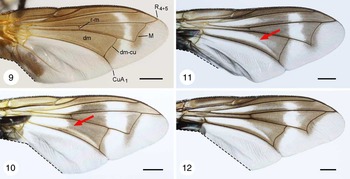
Wings of Euthera species. 9.Euthera bicolor, left wing (image reversed), with cell dm and several veins indicated (Irapuato, Guanajuato, USNM); 10.Euthera setifacies, right wing, with arrow indicating smoky black area in cell dm that is clear in Euthera tentatrix and Euthera woodi (Gomez Peak near Silver City, New Mexico, CNC); 11.E. tentatrix, right wing, with arrow indicating clear area (Gomez Peak near Silver City, New Mexico, CNC); 12.E. woodi, right wing (holotype, North Peak, Torrance Co., 34°16.4′N 105°43.5′W, New Mexico, CNC). Lower basal portion of wings have been digitally removed where they overlapped with body, as indicated by dashed lines. Scale bars = 0.5 mm.

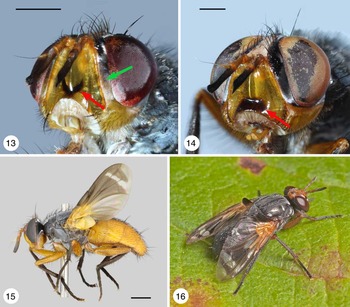
13.Euthera setifacies, head of male in oblique view, red arrow indicating dark facial marking and green arrow indicating fine parafacial hairs (Gomez Peak near Silver City, New Mexico, CNC), scale bar = 0.5 mm; 14.Euthera woodi, head of male in oblique view, red arrow indicating dark facial marking (holotype, North Peak, Torrance Co., 34°16.4′N 105°43.5′W, New Mexico, CNC), scale bar = 0.5 mm; 15.Euthera bicolor, left lateral view of female (Miller Canyon, Huachuca Mtns., Arizona, USNM; TachImage 00129), scale bar = 1.0 mm; 16.E. setifacies, live female on vegetation (near Tobermory, Ontario; image by S.A. Marshall).

Terms for structures of the male terminalia follow Sinclair (Reference Sinclair2000) and those for other structures follow McAlpine (Reference McAlpine1981). “North America” is used in its broadest sense, as a continent extending southward to the border between Panama and Colombia. Label data are cited in full for the holotype and allotype of the new species, with data from each label enclosed in parentheses and data from each line separated by a diagonal slash (/). Additional information not appearing on a label is enclosed within square brackets.
The acronyms of collections cited in this work are as follows:

Euthera Loew
Euthera Loew, Reference Loew1866: 46, 47. Type species: Euthera tentatrix Loew, Reference Loew1866, by monotypy.
Eutheropsis Townsend, Reference Townsend1916: 178. Type species: Euthera mannii Mik, 1889 (= Ocyptera fascipennis Loew, 1854), by original designation.
Macreuthera Bezzi, Reference Bezzi1925: 281 (as subgenus of Euthera). Type species: Euthera skusei Bezzi, Reference Bezzi1925, by original designation.
Preuthera Townsend, Reference Townsend1933: 452. Type species: Euthera peringueyi Bezzi, Reference Bezzi1925, by original designation.
Diagnosis.Euthera is a distinctive genus, the species of which are not closely similar in appearance to those of any other tachinid genus. Members of the genus are easily recognized by: presence of a prominent facial carina; carina and lower margin of face well visible in profile; smoky black alula and cross bands on outer half of wing; and wing vein M with a sharp bend of nearly 90° and ending in vein R4 + 5 well before the wing margin. The North American species as well as most of the other known species throughout the world can be further characterized by the following features: eye bare; face yellow, lower portion with or without a dark marking medially (face entirely black in some Old World species); male without outer orbital setae, female with one or more; proboscis short; prosternum bare; three postsutural supra-alar setae, first not longer than first postsutural dorsocentral seta and second strong; anepimeral seta undifferentiated from adjacent setae; katepisternum with two setae; body setae finer than in most Tachinidae.

Euthera bicolor Coquillett
Euthera bicolor Coquillett, Reference Coquillett1902: 114. Type data: holotype female (USNM, examined). Type locality: United States of America, Texas.
Diagnosis. Length: 5.0–7.3 mm. Face completely yellow in both sexes. Pedicel less than half the length of first flagellomere. Parafacial with hairs almost entirely confined to shiny black (male) or yellow (female) nonpruinose area lateral to scape and basal portion of pedicel. Tibiae dark testaceous to black (Fig. 1). Upper and lower calypteres yellow (Fig. 1). Wing yellow basally except for black alula (Fig. 2), wing portion anterior to vein CuA1 and between yellow base and clear cross band smoky black (hence wing without the typical two dark cross bands) (Fig. 9). Abdomen black in male (Fig. 1), in female completely yellow except for a testaceous area medially on syntergite 1 + 2 and tergite 3 in a few specimens (Fig. 15).
Host. Adult Oebalus mexicana (Sailer) (Heteroptera: Pentatomidae) (four males in USNM from Irapuato, Guanajuato, Mexico), new record.
Distribution. O'Hara and Wood (Reference O'Hara and Wood2004: 43) summarized the known distribution as “Texas, Arkansas, Mexico (S&A, 1965)”. I have examined specimens from the following states (CNC, USNM). Mexico: Chihuahua, Coahuila, Guanajuato, Guerrero, Morelos. United States of America: Arizona, Arkansas, Kansas, Oklahoma, Texas.
Remarks. Wood and Zumbado (Reference Wood and Zumbado2010: 1404) commented that there is “at least one [Euthera species] in Central America that may be conspecific with one of the three Nearctic species”. I have not seen any North American Euthera specimens from south of Mexico and none are known from Costa Rica (D.M. Wood, personal communication). Euthera bicolor is at present the only North American species known from Mexico but E. setifacies and E. tentatrix have been collected close to the Mexican border in Arizona and (or) New Mexico and are likely to be present there as well.
Euthera setifacies Brooks
Euthera setifacies Brooks, Reference Brooks1945: 79. Type data: holotype male (CNC, examined). Type locality: Canada, British Columbia, Trinity Valley.
Diagnosis. Length: 5.0–7.7 mm. Face in most males and females with a testaceous to black U-shaped marking that curves around lower portion of facial carina (Fig. 13, red arrow), in some members of both sexes completely yellow or with a small testaceous marking as described for some E. tentatrix males. Pedicel about half the length of first flagellomere. Parafacial in most specimens with hairs descending to middle portion well below shiny nonpruinose area (Fig. 13, green arrow). Tibiae yellow except very rarely partly testaceous (Fig. 3). Upper and lower calypteres yellow in most specimens and slightly smoky in a few (Fig. 3). Wing yellow basally except for black alula (Fig. 4), with two smoky black cross bands, cell dm distal to crossvein r-m smoky black except for a narrow clear strip along wing fold anterior to vein CuA1 (Fig. 10, arrow). Abdomen black in both sexes (Fig. 3).
Host. Unknown.
Distribution. O'Hara and Wood (Reference O'Hara and Wood2004: 43) summarized the known distribution as “British Columbia, Washington, Maine (S&A, 1965), Arizona, Utah (CNC)”. I have examined specimens from the following states and provinces (CNC, USNM). Canada: British Columbia, Ontario, Québec. United States of America: Arizona, California, Florida, Maine, Maryland, Nevada, New Mexico, Utah, Virginia, Washington.
Remarks. Males of this species have been reported hilltopping in Québec (Wood Reference Wood1996, as E. tentatrix) and New Mexico (O'Hara Reference O'Hara1996, as Euthera sp.). On two occasions at the latter site (Gomez Peak near Silver City), I collected males of E. tentatrix together with males of E. setifacies (see Remarks under E. tentatrix).
Euthera tentatrix Loew
Euthera tentatrix Loew, Reference Loew1866: 46. Type data: lectotype male (not female as published) (MCZ, examined), by fixation of Townsend (Reference Townsend1938: 208). Type locality: United States of America, New York.
Note about lectotype fixation. Euthera tentatrix was described from an unknown number of specimens, with sex given as “♀”. There was presumably more than one specimen in the original type series because body and wing lengths were given as ranges. Townsend (Reference Townsend1938: 208) cited the “Ht” from New York in “Cambridge” (= MCZ), and by this action the single specimen in that collection (a male, presumably mistaken for a female by Loew) is accepted as the lectotype of E. tentatrix.
Diagnosis. Length: 5.5–7.7 mm. Face usually completely yellow in both sexes, a few males with a small and almost rectangular testaceous marking medially occupying the narrow space between lower margin of facial carina and lower facial margin. Pedicel more than half the length of first flagellomere. Parafacial with hairs almost entirely confined to shiny black nonpruinose area lateral to scape and basal portion of pedicel. Tibiae dark testaceous to black (Fig. 5). Upper and lower calypteres yellow (Fig. 5). Wing yellow basally except for black alula (Fig. 6), with two smoky black cross bands, cell dm distal to crossvein r-m smoky black except for wedge-shaped clear area extending almost to posterior end of crossvein dm-cu (Fig. 11, arrow). Abdomen black in both sexes (Fig. 5).
Hosts. Sabrosky (Reference Sabrosky1965) and Arnaud (Reference Arnaud1978) (and references therein) listed the adult stage of the following pentatomid bugs (Heteroptera: Pentatomidae) as hosts: Euschistus ictericus (L.), Euschistus servus (Say), Euschistus tristigmus (Say), Euschistus variolarius (Palisot de Beauvois), and Oebalus pugnax (F.). In studies other than those cited by Arnaud (Reference Arnaud1978), E. tentatrix has been recorded from adults of the following pentatomid bugs: Edessa bifida (Say), Euschistus obscurus (Palisot de Beauvois), Euschistus quadrator Rolston, E. servus, E. tristigmus, Hymenarcys crassa Uhler, Hymenarcys nervosa (Say), O. pugnax, Piezodorus guildinii (Westwood), Podisus maculiventris (Say), Proxys punctulatus (Palisot de Beauvois), Thyanta calceata (Say), Thyanta custator accerra McAtee, and Thyanta custator custator (F.) (Oetting and Yonke Reference Oetting and Yonke1972; Deitz et al.Reference Deitz, Van Duyn, Bradley, Rabb, Brooks and Stinner1976; Buschman and Whitcomb Reference Buschman and Whitcomb1980; Eger and Ables Reference Eger and Ables1981; McPherson et al. Reference McPherson, Pitts, Newsom, Chapin and Herzog1982; Jones et al. Reference Jones, Shepard and Sullivan1996). Additionally, there is one specimen in USNM reared from Nezara viridula (L.) (from Krotz Springs, Louisiana), new record.
Distribution. O'Hara and Wood (Reference O'Hara and Wood2004: 43) summarized the known distribution as “Illinois to Massachusetts, south to Texas and Florida, also California, New Mexico (S&A, 1965), Iowa, Ontario, Québec (CNC)”. I have examined specimens from the following states and provinces (CNC, USNM). Canada: Ontario. United States of America: Alabama, Arkansas, Florida, Georgia, Illinois, Iowa, Louisiana, Maryland, Massachusetts, Michigan, New Hampshire, New Mexico, New York, North Carolina, Ohio, Pennsylvania, Tennessee, Texas, Virginia. Additionally, I have seen a single female from Grand Bahama Island in the West Indies (USNM). Euthera tentatrix has been reported visiting flowers of Symphyotrichum pilosum (Willd.) G.L. Nesom (Asteraceae) in central Illinois (Tooker et al. Reference Tooker, Hauser and Hanks2006).
Remarks. I have collected this species only at Gomez Peak near Silver City, New Mexico (9 and 24 August 2007). Males were captured as they flew around, and landed on, the topmost branch of a bush in the centre of the hilltop. They were mixed with males of E. setifacies, a species I had collected at the same spot on several occasions in earlier years. Wood's (Reference Wood1996) report of E. tentatrix from a hilltop in Québec was based on misidentified specimens of E. setifacies.
Aldrich et al. (Reference Aldrich, Khrimian, Zhang and Shearer2006, Reference Aldrich, Khrimian and Camp2007, Reference Aldrich, Khrimian, Chen and Camp2009) reported the attraction of E. tentatrix to lures baited with methyl 2,4,6-decatrienoates, male-produced pheromones of certain pentatomid bugs.
Euthera woodi sp. nov.
Holotype. Male, labeled: “USA NM Torrance Co./ca. 9 mi. s. Cedarvale/North Peak, hilltop 34°16.4′N 105°43.5′W/7400′ 7.viii.2007/J.E. O'Hara”, “HOLOTYPE/Euthera/woodi/O'Hara [red label]” (CNC).
Allotype. Female, labeled: “U.S.A.: CALIFORNIA/Tuolumne County, Lost/Claim Camp Ground/vicinity Groveland/Ranger Station/6-VII-1967 975 m/Paul H. Arnaud, Jr.”, “ALLOTYPE/Euthera/woodi/O'Hara [red label]” (USNM).
Paratypes. Three males, one female. United States of America. California: same data as allotype, one male, one female (USNM). New Mexico: same data as holotype, one male (CNC); same locality and collector but date 13.viii.1993, one male (CNC).
Etymology. This species is named after my mentor, colleague, and friend, D. Monty Wood, who first introduced me to the wondrous diversity of tachinid flies in 1977.
Diagnosis. Length: 8.1–9.1 mm. Face in male yellow except for a broad semi-circular testaceous to black area between lower margin of facial carina and lower facial margin (Fig. 14, arrow), in female yellow except for a very faint marking in the same position as in male. Pedicel about half the length of first flagellomere. Parafacial with hairs almost entirely confined to shiny black nonpruinose area lateral to scape and basal portion of pedicel (Fig. 14). Tibiae dark testaceous to black (Fig. 7). Upper and lower calypteres smoky black (Fig. 7). Wing smoky black basally (including alula) (Fig. 8), with two smoky black cross bands, cell dm distal to crossvein r-m smoky black except for wedge-shaped clear area extending almost to posterior end of crossvein dm-cu (Fig. 12). Abdomen black in both sexes (Fig. 7).
Description. Male habitus, Figures 7 and 8. Largest of the North American species, 8.1–9.1 mm in length.
Head. Face in male yellow except for a broad semi-circular testaceous to black area between lower margin of facial carina and lower facial margin (Fig. 14, arrow), in female yellow except for a very faint marking in the same position as in male. Head below eye and on postcranium below level of occipital foramen yellow. Parafacial, fronto-orbital plate and postcranium above level of lower margin of occipital foramen black in ground colour, covered with silver pruinosity except for shiny black nonpruinose area lateral to scape and basal portion of pedicel and a faintly pruinose band across postcranium just above occipital foramen. Three areas of silver pruinosity visible when head viewed from above: parafacial, upper portion of fronto-orbital plate, and postcranium beside median occipital sclerite (Fig. 8). Antenna with scape, pedicel and arista yellow to testaceous, first flagellomere dark. Maxillary palpus yellow. Eye 0.73–0.76 head height in male (n = 4), 0.72–0.74 head height in female (n = 2). Antenna long and thin (Fig. 7), combined length of pedicel and first flagellomere slightly more than eye height. Pedicel about half as long as first flagellomere. First flagellomere extended well below lower margin of face, 0.49–0.55 head height in male (n = 4), 0.54–0.55 head height in female (n = 2). Aristomere 3 bare, nearly as long as first flagellomere, evenly tapered to tip. Fronto-orbital plate with row of fine frontal setae interspersed with longer hairs, 7–10 frontal setae in male, 5–6 frontals in female; a few hairs lateral to frontals and a group of hairs on shiny black area on lower fronto-orbital plate and upper parafacial. Parafacial with hairs almost entirely confined to shiny black nonpruinose area lateral to scape and basal portion of pedicel (Fig. 14). Male without orbital setae, female with one proclinate outer orbital and one or two lateroclinate or reclinate inner orbitals. Vertex at narrowest point 0.13–0.16 head width in male (n = 4), 0.27–0.30 head width in female (n = 2). Aristomeres 1 and 2 short. Ocellar seta weakly developed. Inner vertical setae slightly divergent. Outer vertical seta not differentiated or barely differentiated (one female). Facial ridge bare except for a small number of hairs on lower fourth. Vibrissa weakly developed, not always distinguishable from subvibrissal setae. Maxillary palpus clavate, slightly longer than pedicel. Proboscis not longer than maxillary palpus.
Thorax. Nota and pleura black in ground colour with a thin dusting of silver pruinosity, two silver vittae visible dorsally when scutum viewed from behind. Legs with fore coxa mostly yellow and other coxae varied from yellow to black, femora yellow, tibiae and tarsi very dark testaceous to black (Fig. 7). Prosternum bare. Postpronotum usually with three setae, setae arranged in a row or middle seta displaced forwards. Four or five postsutural acrostichal setae. Four to six postsutural dorsocentral setae. Intrapostalar seta well developed, generally longer than hindmost acrostichal and dorsocentral setae. Scutellum with three pairs of marginal setae, basal and subapical pairs subequal in length, apical pair crossed and almost as long as basal and subapical pairs. Mid tibia with one well-developed anterodorsal seta near midlength and one weaker seta proximal to it. Upper and lower calypteres smoky black (Fig. 7). Wing with base of vein R4 + 5 bare dorsally. Wing base smoky black (including alula) (Fig. 8), with two smoky black cross bands, cell dm distal to crossvein r-m smoky black except for wedge-shaped clear area extending almost to posterior end of crossvein dm-cu (Fig. 12).
Abdomen. Black in ground colour with a barely discernible, uniform, dusting of white pruinosity (Fig. 7). Setation reduced. Syntergite 1 + 2 without marginal setae. Tergites 3 and 4 without marginal setae or with weak pair of median marginals and one to two pairs of weak lateral marginals. Tergite 4 with one pair of median marginal setae and several pairs of lateral marginal setae. Tergite 5 with row of marginal setae.
Male and female terminalia. Not noticeably different from those of other North American Euthera species (see Remarks).
Host. Unknown.
Distribution. Presently known from two localities in the United States of America, one each in California and New Mexico.
Remarks. The male and female terminalia of North American Euthera do not differ significantly between species. Cantrell (Reference Cantrell1983) observed a similar uniformity among the terminalia of Australian Euthera species. The male terminalia of North American Euthera resemble the terminalia of Euthera illungnarra Cantrell figured by Cantrell (Reference Cantrell1983).
Acknowledgements
My thanks to Shannon Henderson (CNC) for preparing the images in Figures 1–15 and reviewing the text. Steve Marshall (University of Guelph, Guelph, Ontario) kindly provided the image of a live E. setifacies (Fig. 16). I am grateful to Norman Woodley (Systematic Entomology Laboratory, United States Department of Agriculture, Washington) for the loan of USNM Euthera specimens, which allowed for better characterization of the described North American species and contributed three specimens of the new species. I am also pleased to thank reviewers Pierfilippo Cerretti (Sapienza Università di Roma, Rome) and Norman Woodley for their helpful suggestions on the submitted manuscript. I thank Philip Perkins (MCZ) for the loan of the type of E. tentatrix.