INTRODUCTION
Desire-to-die statements (DDSs) are not uncommon among terminally ill cancer patients (Hendry et al., Reference Hendry, Pasterfield and Lewis2013). DDSs cover a wide range of patients' wishes, such as a desire for death to occur, a wish to hasten death, and requests for euthanasia or physician-assisted suicide. Determining the epidemiology of this construct is not an easy task due to the very nature of the phenomenon, its variability and dependency on external factors, and the problem of its conceptualization (Monforte-Royo et al., Reference Monforte-Royo, Villavicencio-Chávez and Tomás-Sábado2011). Research studies regarding this type of statement mainly address questionnaires among patients or health personnel in hypothetical situations (Johansen et al., Reference Johansen, Holen and Kaasa2005; Hudson et al., Reference Hudson, Kristjanson and Ashby2006; Karlsson et al., Reference Karlsson, Milber and Strang2012). In a recent systematic review (Hudson et al., Reference Hudson, Kristjanson and Ashby2006) of 35 studies regarding DDSs, only 8 included patients had a current DDS and only 3 of the studies focused on advanced cancer patients (Kelly et al., Reference Kelly, Burnett and Pelusi2003a; Reference Kelly, Burnett and Badger2003b; Coyle & Sculco, Reference Coyle and Sculco2004; Mak & Elwyn, Reference Mak and Elwyn2005).
The philosophy of palliative care is holistic. It considers physical, emotional, and spiritual concerns, focusing on quality of life, relief of suffering, and humanism in the patient–doctor relationship, thus dignifying the process of death (Sanz Ortiz & Bild, Reference Sanz Ortiz and Bild1985; Foley, Reference Foley1997). Nevertheless, a considerable percentage (8.5 to 17%) of advanced cancer patients receiving palliative care still make a DDS (Chochinov et al., Reference Chochinov, Wilson and Enns1995; Rosenfeld et al., Reference Rosenfeld, Breitbart and Stein1999; Breitbart et al., Reference Breitbart, Rosenfeld and Pessin2000; Kelly et al., Reference Kelly, Burnett and Pelusi2003a).
Many factors have been associated with a DDS—predominantly depression, hopelessness (with or without depression), anxiety, poor social support (especially being widowed), low functional capacity, elevated pain intensity, and other physical symptoms (Rosenfeld et al., Reference Rosenfeld, Breitbart and Stein1999; Breitbart et al., Reference Breitbart, Rosenfeld and Pessin2000; Coyle & Sculco Reference Coyle and Sculco2004; Shim & Hahm, Reference Shim and Hahm2011; Julião et al., Reference Julião, Barbosa and Oliveira2013). Factors such as poor spiritual well-being (Brady et al., Reference Brady, Peterman and Fitchett1999), decreased quality of life (Cohen et al., Reference Cohen, Mount and Strobel1995), and perception of being a burden to others are also referred to often. On some occasions, however, patients with a DDS exhibit none of the above (Chochinov et al., Reference Chochinov, Wilson and Enns1995). In several qualitative studies and systematic reviews (Bascom & Tolle, Reference Bascom and Tolle2002; Pearlman et al., Reference Pearlman, Hsu and Starks2005; Mak & Elwyn, Reference Mak and Elwyn2005; Wilson et al., Reference Wilson, Chochinov and McPherson2007), there are five main reasons for having a DDS: (1) loss of meaning, sense, or dignity in continuing to live when there is the certainty of a progressive functional limitation and health deterioration with a subsequent fatal ending; (2) loss of identity secondary to physical, personality, emotional, and capacity changes; (3) perception of current or future self-suffering (pain or other symptoms, hopelessness or loss of enjoyment of life) or others' suffering: (4) consideration that it is a compassionate act that facilitates a smooth death, avoiding worsening and greater suffering than death itself; and (5) preparedness and willingness to die, retaining the autonomy to choose how and when they will die.
Spirituality in terminally ill patients (Brady et al., Reference Brady, Peterman and Fitchett1999; Breitbart, Reference Breitbart2002; Benito et al., Reference Benito, Barbero and Payás2008) includes faith in a superior power, the meaning of one's own life (Karasu, Reference Karasu1999), and the concepts of love, reconciliation, and forgiveness (Kuhn, Reference Kuhn1988). Patients who consider themselves spiritual show greater tolerance to severe physical symptoms, less hopelessness, and less depression than patients who do not (Breitbart et al., Reference Breitbart, Rosenfeld and Pessin2000).
In one semistructured interview about attitudes toward legalization of euthanasia or assisted suicide conducted in patients at a palliative care unit, 5.8% stated they would ask for it if it were legal (Wilson et al., Reference Wilson, Chochinov and McPherson2007). These patients had less intense religious beliefs, lower performance status, a higher symptom burden, and higher prevalence of depressive mood.
In our exploratory study, focused on the Mediterranean nation of Spain, rather than using specific screening tests available in the English literature, we only included patients who made a spontaneous desire to die statement to any member of the palliative care unit. A secondary aim was to describe the demographic, symptomatic, emotional, and spiritual issues in this population and to determine possible differences regarding patients who made desire-to-die comments (DDCs) and those who made desire-for-euthanasia comments (EUCs).
METHODS
From October of 2007 to October of 2008, a total of 701 patients were cared for in the palliative care unit at Hospital Sant Pau, a tertiary university hospital in Barcelona, Spain. They were treated by a highly specialized team of physicians, nurses, and psychologists. The palliative care unit admits ambulatory patients and referrals from all the Hospital Sant Pau departments. In accordance with the findings of Higginson and Costantini (Reference Higginson and Costantini2002), communication between professionals in our palliative care unit could be classified as “correct messages between key professionals with minor inaccuracies and delays between others.”
We conducted a one-year cross-sectional prospective study that included all patients in the palliative care unit who made any spontaneous comment to any member of the team representing a generic DDS. Daily, at each morning session, any new DDS was classified by consensus as a DDC or EUC. In the EUC group, we included only those patients who made an unmistakable, clear statement of desire for euthanasia or assisted suicide. All other DDSs were classified as a DDC. Latency (time between entering the palliative care program until the statement) and survival (time from statement to death) were calculated. We prospectively followed each patient with a DDS, recording whether or not the DDS persisted, the place of death, and the need for sedation.
At inclusion we recorded demographic and clinical data; functional capacity employing the Eastern Cooperative Oncology Group (ECOG) Performance Status Scale (Oken et al., Reference Oken, Creech and Tormey1982) and the Barthel Index (Mahoney & Barthel, Reference Mahoney and Barthel1965; Baztán et al., Reference Baztán, Pérez and Alarcón1993); and cognitive function with the Mini-Mental State Examination (MEC, Spanish version) (Folstein et al., Reference Folstein, Folstein and McHugh1975; Lobo et al., Reference Lobo, Sanz and Marcos1999). We also employed the Support Team Assessment Schedule (STAS) (Higginson, Reference Higginson and Higginson1993; Higginson & McCarthy, Reference Higginson and McCarthy1993) and measured the team's consensus about patient knowledge concerning level of illness (Ellershaw et al., Reference Ellershaw, Peat and Boys1995) and acceptance (Kübler-Ross, Reference Kübler-Ross1973). Patients with adequate physical and cognitive status and who had no communication barriers were asked to evaluate the intensity of symptoms using the Edmonton Symptoms Assessment Scale (ESAS) (Bruera et al., Reference Bruera, Kuehn and Miller1991), depression and anxiety with the Hospital Anxiety and Depression Scale (HADS) as a screening test (Zigmond & Snaith, Reference Zigmond and Snaith1983; Tejero et al., Reference Tejero, Guimerá and Farré1986; Herrero et al., Reference Herrero, Blanch and Peri2003), and the value of their life using the Palliative Outcome Scale (POS) (Hearn & Higginson, Reference Hearn and Higginson1999; Serra-Prat et al., Reference Serra-Prat, Nabal and Santacruz2004). Each of these measures has been widely used and validated in terminally ill populations. A semistructured interview was conducted to explore the patients' reasons for making a DDS, their previous and current views toward euthanasia, their religious beliefs, and to elicit a spiritual self-assessment (Brady et al., Reference Brady, Peterman and Fitchett1999; Breitbart, Reference Breitbart2002; Payás et al., Reference Payás, Barbero and Bayés2008).
Ours was an exploratory study to describe the prevalence of DDSs in a palliative care unit. We also analyzed data looking for differences between the DDC and EUC groups. For descriptive analysis we utilized the number of cases and their percentage for categorical variables, and the median and interquartile range (IQR) for quantitative and ordinal variables. A Fisher's exact test (or likelihood ratio when the contingency table was larger than two by two) was employed to compare categorical variables, and a Mann–Whitney U test was applied to compare quantitative and ordinal variables. Unless specified otherwise, inferences refer to the comparison between the DDC and EUC groups with a significance according to a Cronbach's alpha α equal to 0.05. We employed an IBM–SPSS statistical package (version 21.0) to analyze the data.
The study was approved by the ethics committee at our center, and a written informed consent was obtained from all participants.
RESULTS
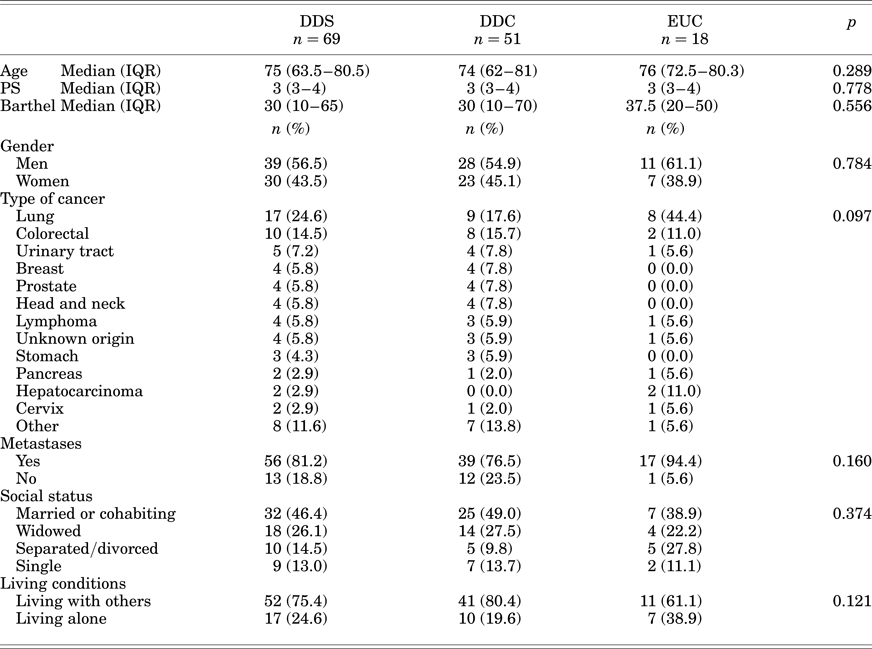
Of the 701 patients cared for at our palliative care unit over the study period, 69 (9.8%; IC 95% 7.7–12.3) verbalized a DDS: 51 made a DDC (7.3%), and 18 made an EUC (2.5%). DDCs and EUCs continued until death in 88% (45/51) and 94% (17/18), respectively. A small percentage (4%; 2/51) of patients with an initial DDC later made an EUC.
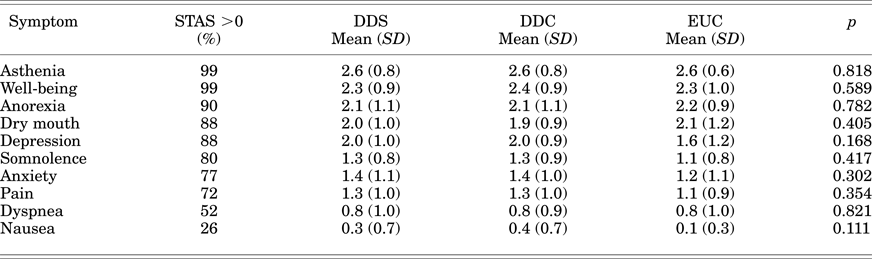
Table 1 shows patients' main characteristics. The median age was 75 (IQR 63.5–80.5) years. Median survival and latency were 10 (IQR 4–10) and 6 (IQR 1–56) days, respectively; in 16 of 69 cases (23%), the statement was made at the first meeting in the palliative care unit. The team evaluation (STAS) showed that the most intense symptoms were, in order of frequency, asthenia, anorexia, dry mouth, depression, and decreased well-being (Table 2).
Characteristics of patients with a DDS (DDC and EUC)

IQR = interquartile range; PS = performance status; DDS = patients with a desire-to-die statement; DDC = patients with desire-to-die comment; EUC = patients with euthanasia comment.
Symptom prevalence and mean intensity (STAS)
STAS = Support Team Assessment Schedule; DDS = patients with a desire-to-die statement; DDC = patients with desire-to-die comment; EUC = patients with euthanasia comment.
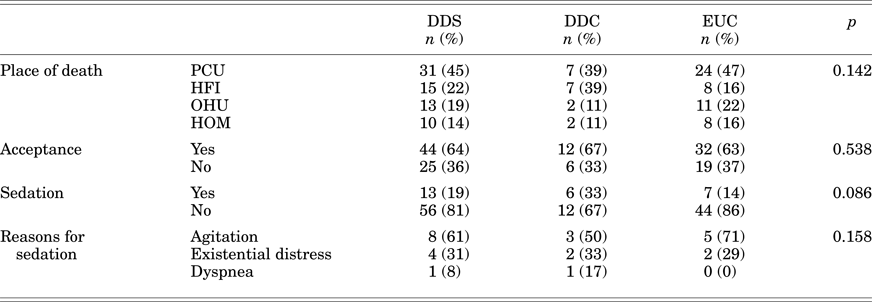
According to the palliative care assessment tool (Ellershaw et al., Reference Ellershaw, Peat and Boys1995), 36 of the 69 (52%) patients were fully aware (4 on a 0–4 scale) of their diagnosis and prognosis, and 27 (39%) had limited insight about the prognosis (3 on a 0–4 scale). The remaining six patients scored lower than 3. The EUC group showed greater insight into their illness than the DDC group (median 4 vs. 3, p = 0.039). About half the patients in both groups died in the palliative care unit, most in a state of acceptance according to the Kübler-Ross model. Table 3 shows this and other conditions at death. Some 13 of the 69 (19%) patients required palliative sedation. The percentage of sedation tended to be higher in the EUC group (33 vs. 14%, p = 0.086). The drug used for sedation was midazolam in all cases (median dose 75, IQR 60–120 mg/day).
Final conditions at death
DDS = patients with a desire-to-die statement; DDC = patients with desire-to-die comment; EUC = patients with euthanasia comment; PCU = palliative care unit; HFI = health facility; OHU = other hospital units; HOM = home.
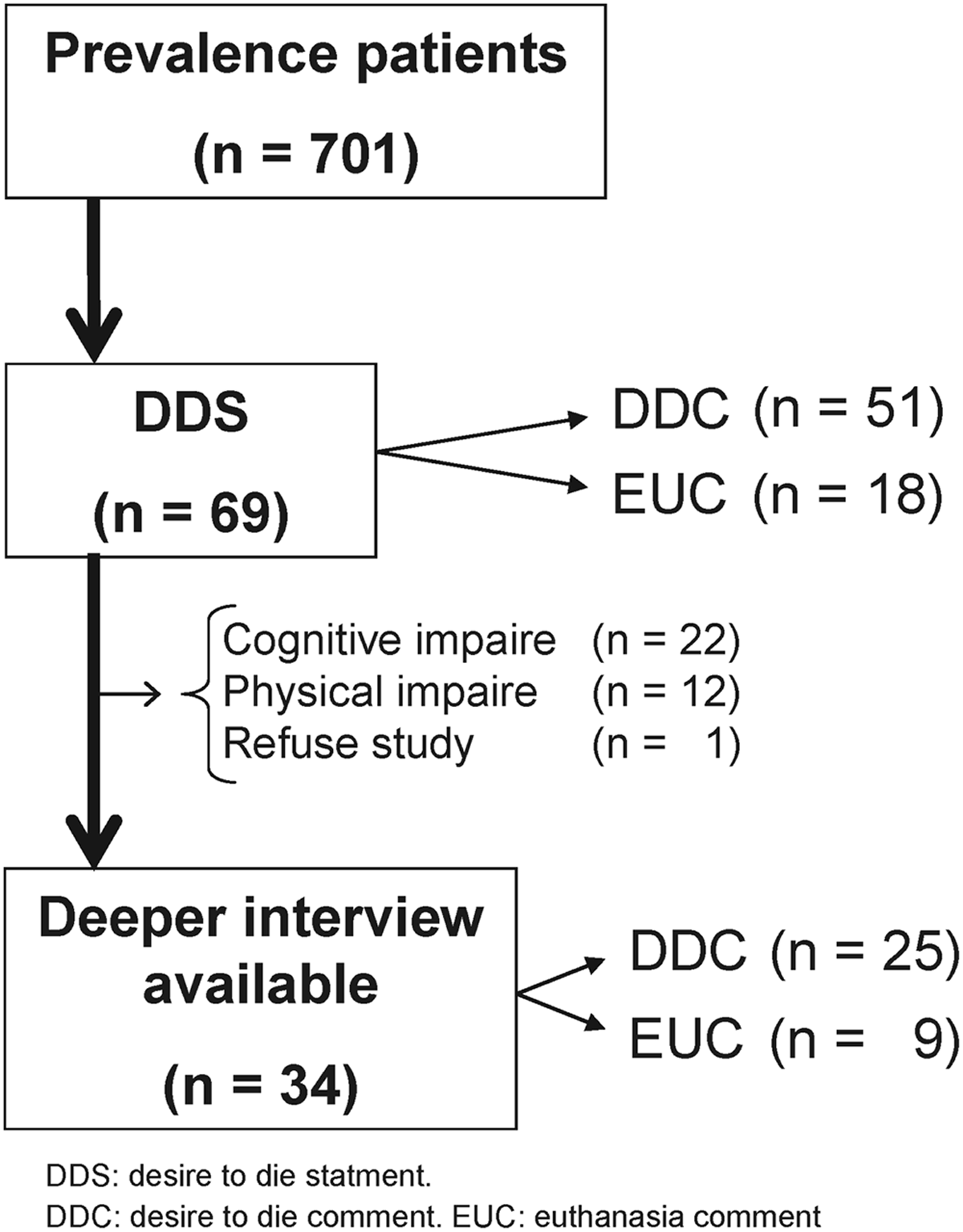
Of the 69 patients, 34 were able to partake in an interview that included reasons for their DDS, religious beliefs, self-spiritual assessment, and the ESAS and HADS scales. Survival in these patients was higher than those who do not were able to partake in the interview (13 vs. 8 days; p = 0.023). Of the 35 patients excluded, 34 presented at least one exclusion criterion (extremely deteriorated physical state –25–, altered MEC –22–, or communication barriers –13–). The remaining patient refused to participate in the interview. Figure 1 presents a schematic for how patients were recruited.
Patient recruitment flowchart.
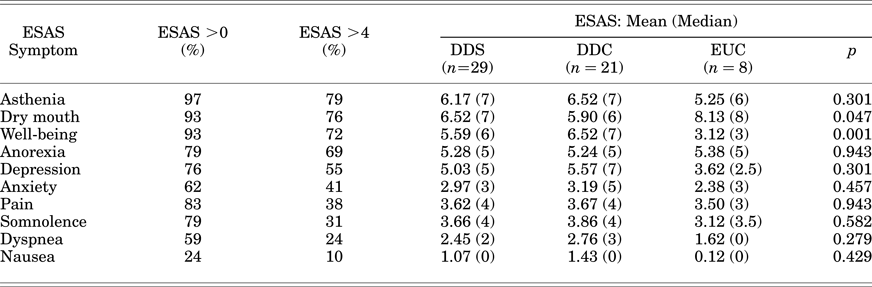
Symptom intensity using the ESAS was conducted in 29 (21 DDC, 8 EUC) of the 34 patients. It was not performed in the other five due to misunderstanding of the tool. Of the 10 symptoms explored using the ESAS, we found that seven had some degree of intensity (ESAS >0) in more than 75% of patients (see Table 4). The median baseline ESAS well-being was worse in the DDC group than in the EUC group (7 vs. 3, p = 0.001). In both groups, symptom intensity was moderate or severe (ESAS >4, as shown by Selby et al., Reference Selby, Cascella and Gardiner2010) in asthenia, dry mouth, decreased well-being, anorexia, and depression in more than half the patients. A baseline ESAS score above 4 was worse in the DDC group than in the EUC group for well-being (91 vs. 25%; p = 0.001) and tended to be worse for depression (67 vs. 25%; p = 0.055) and anxiety (52 vs. 13%; p = 0.060).
Symptom prevalence (ESAS > 0 and ESAS > 4); ESAS mean and median scores according to DDC or EUC
ESAS = Edmonton Symptom Assessment Scale; DDS = patients with a desire-to-die statement; DDC = patients with desire-to-die comment; EUC = patients with euthanasia comment.
Some 18 of the 34 patients (53%) scored higher than 11 on the HADS depression subscale, and 5 (15%) had borderline depression scores (8–10). Three patients (9%) scored above 11 on the HADS anxiety subscale, and 9 (27%) had borderline anxiety scores (8–10). The median scores were 11 (range 1–21) and 6 (range 0–14) for both subscales, respectively. No differences between the DDC or EUC groups were found on any HADS subscale.
Using one question from the palliative outcome scale (which ranges from 0, meaning “all the time”, to 4, meaning “no, not at all”), we asked patients if they felt life was worth living. The EUC group scored 3 and 4 more frequently than the DDC group (78 vs. 32%: p = 0.023).
Twenty of the 34 patients (59%) considered themselves religious (95% Catholic, 20% other regular practitioners); the EUC group tended to be less religious than the DDC group (33 vs. 68%; p = 0.079). We also found that 25 patients (74%) considered themselves spiritual, this percentage being significantly lower in the EUC group (44 vs. 84%; p = 0.034).
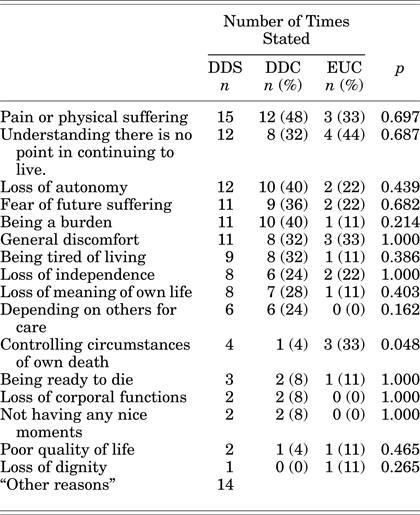
The most frequently cited reason for a DDS was “pain or physical suffering,” but, taken together, nonphysical reasons predominated (Table 5). Patients gave a median of three reasons (range 1–9) to justify the DDS. The item “retaining autonomy to choose how and when to die/I will die” was the only statistically significant item, showing a higher percentage in the EUC group (33 vs. 4%, p = 0.048).
Reasons for DDS (DDC or EUC) (n = 34)
DDS = patients with a desire-to-die statement; DDC = patients with desire-to-die comment; EUC = patients with euthanasia comment.
Patients generally considered that their illness did not change their former view on euthanasia (27/34; 79%); five of the seven who did alter their opinion moved toward a favorable one. Within the euthanasia debate, 21 of 34 patients (62%) were in favor, 14 of whom (67%) stated they would initiate formalities if it were legal, representing 2% of the cared-for population.
DISCUSSION
Patients were included in the present study on the basis of any spontaneous comment made to any member of the palliative care unit concerning a desire to die or desire for euthanasia. We found that the prevalence of desire-to-die statements using this single inclusion criterion was similar to that in previous studies using screening scales (Chochinov et al., Reference Chochinov, Wilson and Enns1995; Foley, Reference Foley1997; Emanuel et al., Reference Emanuel, Fairclough and Emanuel2000; Wilson et al., Reference Wilson, Scott and Graham2000; Ganzini et al., Reference Ganzini, Nelson and Schmidt2000; Coyle & Sculco, Reference Coyle and Sculco2004), indicating that verbally expressing a wish to die is a highly sensitive matter. Indeed, several considerations suggest that the prevalence in our study could even have been underestimated: (1) we did not use a screening process, so DDSs in some patients were likely missed; (2) DDSs are often stated exclusively to family members (Morita et al., Reference Morita, Sakaguchi and Hirai2004); (3) DDSs are not necessarily verbalized in our setting as a patient may consider this futile given the illegal status of euthanasia in Spain; and (4) DDSs in patients transferred to other healthcare centers are unknown.
The percentage of moderate to severe symptoms (ESAS >4) was similar to that in previous DDS studies (Chochinov et al., Reference Chochinov, Wilson and Enns1995; Rosenfeld et al., Reference Rosenfeld, Breitbart and Stein1999; Kelly et al., Reference Kelly, Burnett and Pelusi2003a; Reference Kelly, Burnett and Badger2003b). Surprisingly, we found that physical, emotional, and spiritual concerns differed between desire-to-die comments (DDCs) and desire-for-euthanasia comments (EUCs) patients. Decreased well-being was higher in the DDC group than in the EUC group. Depression and anxiety tended to be higher in the DDC group, but this was not statistically significant, probably due to the sample size (29 evaluable patients). This tendency suggests that reasons other than physical or emotional ones may have triggered the EUC (Levene & Parker, Reference Levene and Parker2011). These differences, however, were not detected using the HADS–D or HADS–A. This poor concordance between depression and anxiety measured by the ESAS and HADS subscales has been reported previously in advanced cancer patients (Teunissen et al., Reference Teunissen, de Graeff and Voest2007). The HADS scores found in our survey are similar to those in other studies in advanced cancer patients with no specific DDS (Holtom & Barraclough, Reference Holtom and Barraclough2000).
Our findings support those of other authors who have shown that a high percentage of patients with a DDS consider themselves spiritual. Some authors consider that spiritual assistance guidelines should be implemented as part of standard palliative practice as it has been found that they increase the likelihood of a serene death (Rousseau, Reference Rousseau2000). Along these lines, logotherapy (Zuehlke & Watkins, Reference Zuehlke and Watkins1975) may be considered one of the first reported approaches to spirituality in advanced cancer patients. The predominance of existential aspects explains the recent proposal to tailor the model of care to individual patients (Mak & Elwyn, Reference Mak and Elwyn2005). Such a talking-death model could be useful rather than stressful (Emanuel et al., Reference Emanuel, Fairclough and Wolfe2004), and should consider expectations and fears, palliative care options, personal objectives, aspects regarding family and carers, physical and emotional relief, meaning of life, quality of life, and depressive symptoms (Bascom & Tolle, Reference Bascom and Tolle2002).
A novel intervention called “meaning-centered psychotherapy” (Breitbart et al., Reference Breitbart, Rosenfeld and Gibson2010; Reference Breitbart, Poppito and Rosenfeld2012) was recently implemented in a pilot randomized controlled trial with advanced cancer patients. The findings showed that spiritual well-being and sense of meaning and anxiety improved while the desire for death decreased. However, patients included in Breitbart's study differed from ours: recruitment was ambulatory, Karnofsky performance scores were higher, and survival was longer than eight weeks. Another intervention, the dignity model and dignity therapy (Chochinov et al., Reference Chochinov, Hack and Hassard2005), employs holistic and individualized approaches that foster improvement in the will to live in terminally ill patients. Unfortunately, some patients in our study were not fully aware of their diagnosis and prognosis, a necessary item for dignity therapy. Furthermore, to our knowledge, there is no extensive specific training in dignity therapy in Spain.
We believe that qualitative studies are needed to better understand the great diversity of reasons behind a DDS (Kelly et al., Reference Kelly, Burnett and Pelusi2003a; Mak & Elwyn, Reference Mak and Elwyn2003; Reference Mak and Elwyn2005; Bharucha et al., Reference Bharucha, Pearlman and Back2003; Coyle & Sculco, Reference Coyle and Sculco2004; Pearlman et al., Reference Pearlman, Hsu and Starks2005). It is of particular interest that, as in two previous studies (Portenoy et al., Reference Portenoy, Thaler and Kornblith1994; Chochinov et al., Reference Chochinov, Tataryn and Clinch1999), we found that most reasons given were not related to symptoms. And, interestingly, the only reason that was statistically different between our EUC and DDC patients was that the former wished to retain their autonomy concerning how and when they would die.
Regarding the euthanasia debate, most of our DDS patients (62%) were in favor of its legalization, and they stated that they had not changed their opinion since the onset of their illness. This figure is similar to that found in a study within the general population in Spain (OCU, 2000) in which 75% of participants were in favor of legalizing euthanasia. We believe it is also noteworthy that 28% of the DDC patients in our study stated that they would apply for euthanasia if it were legal. This suggests that this subgroup understood that there was no point to requesting euthanasia while it remained illegal.
Our study has several limitations. First, patients who had a desire for hastened death or euthanasia and did not or could not (due to physical factors) verbally express these desires were missed. Furthermore, some expressions of these desires may not have been witnessed by staff. Second, as there was no control group, we cannot compare symptoms with patients who did not make a DDS. Third, the sample size was not large enough to detect all statistical differences between the DDC and EUC groups, but multiple correlations were employed, the reason being that it was originally designed to investigate the prevalence of DDSs. Fourth, as our sample was recruited from a palliative care unit that attends to patients referred from all hospital departments, it may not be generalizable to less extensive models of palliative care.
Promoting palliative care and advocating legalization of voluntary euthanasia are seen by many as opposing forces when in fact they share some common values (Hurst & Mauron, Reference Hurst and Mauron2006). Our findings further confirm the need for an emotional and spiritual approach in patients who make a DDC or EUC, emphasizing their singular lived experiences and individual concepts of autonomy and beneficence.
ACKNOWLEDGMENTS
This study received a research grant from the Victor Grífols Foundation.
CONFLICTS OF INTEREST
The authors state that they have no conflicts of interest to declare.