INTRODUCTION
J’ai idée que la station de La Tène est destinée à acquérir une certaine célébrité.
Henri Beauval, in Louis Favre’s Reference Favre1875 novel, Le Robinson de La Tène.
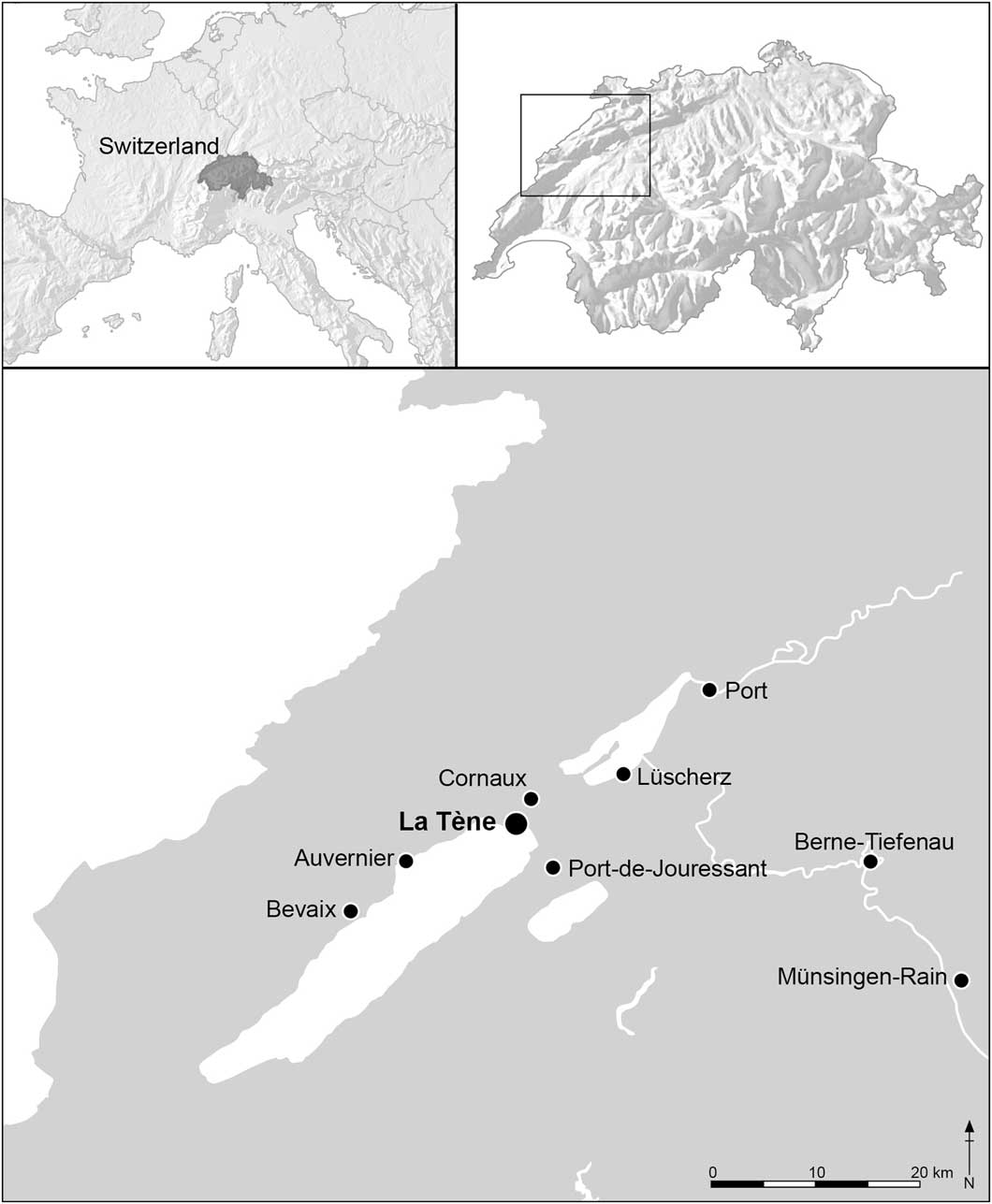
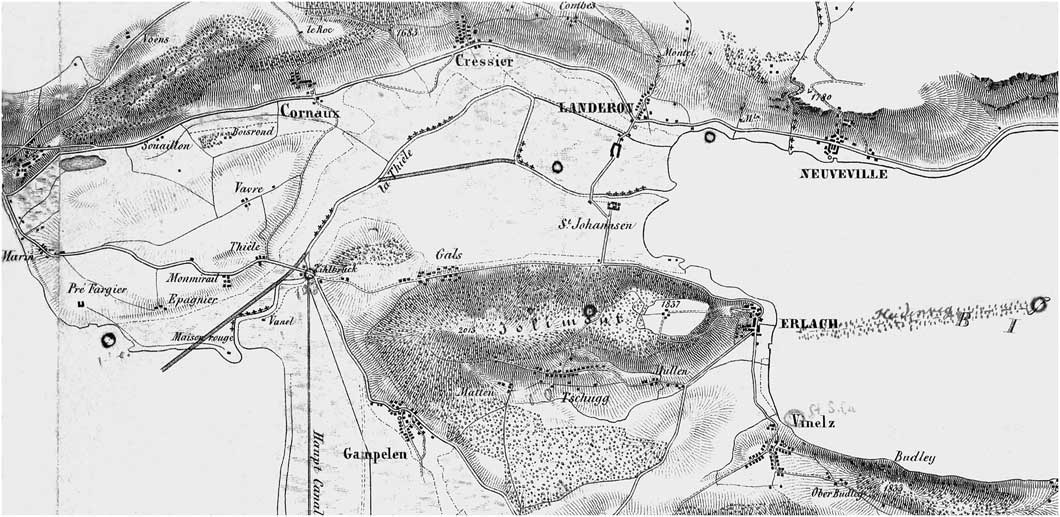
Louis Favre was correct. For over 150 years, La Tène, which lies on Lake Neuchâtel in western Switzerland, has been at the heart of the study of the European Iron Age. Discovered in 1857, it gave its name to the later part of the Iron Age. The site is best known for the numerous weapons found there, mainly iron swords in their decorated scabbards and spears. Many were found close to an Iron Age bridge that crossed the mouth of an old arm of the River Thielle, the northern outflow of the lake (fig 1).
Location of La Tène and sites mentioned in the text. Base mapping by courtesy of the Swiss Federal Office of Topography. Drawing: Craig Williams.

La Tène has been interpreted variously as a settlement, an armoury, a customs post, a battlefield, a votive site and a flood scene,Footnote 1 but since 1952 there has been a consensus that the site was votive and that the weapons were gifts to the gods that had been placed directly in the Thielle or displayed on Pont Vouga.Footnote 2 Today the finds are, like those from many prehistoric sites found in the lakes of west Switzerland in the nineteenth century, widely dispersed between ‘museums, which extend from Vienna to Wisconsin’,Footnote 3 including the British Museum.
The year 2007 saw the 150th anniversary of the discovery of La Tène,Footnote 4 and the sad recognition that only a few hundred of the thousands of finds from it had ever been published.Footnote 5 This was the stimulus for a project to re-assess the earlier work at the site, and to locate and publish the surviving finds with each collection to be published linked by the subtitle ‘La Tène, un site, un mythe’.Footnote 6
THE FISHING DAYS
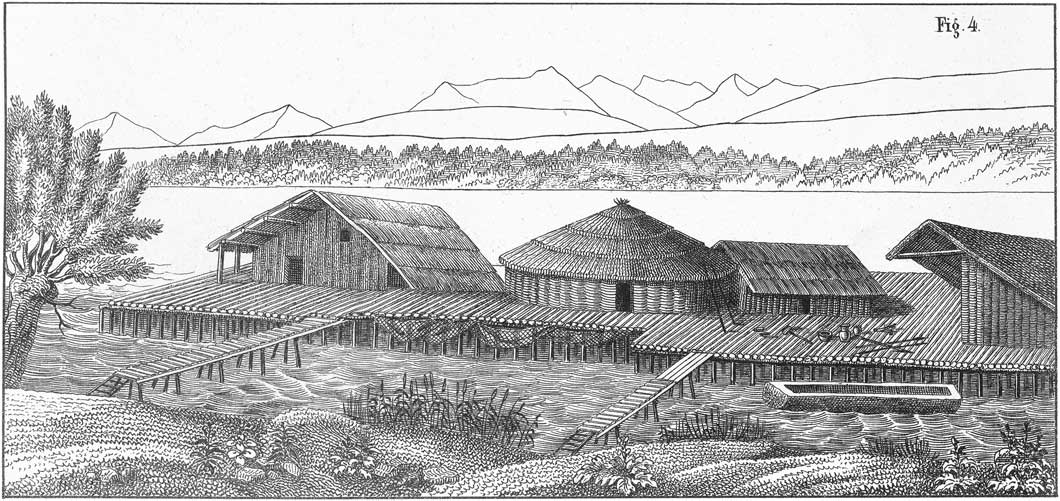
In 1854–5 an extraordinarily cold and dry winter caused Lake Zurich to fall to an unusually low level, and led to the discovery of the Neolithic lakeside settlement at Meilen. Interpreted by Ferdinand Keller (1800–81) as a pile dwelling by analogy with contemporary examples in New Guinea, the discovery sparked the start of what has been called ‘Lake Dwelling Fever’ (fig 2).Footnote 7
Keller’s reconstruction of the Meilen Lake Village based on a contemporary settlement in New Guinea. Source: Keller Reference Keller1854, Taf 1, 4.

These Pfahlbauten or Palafittes yielded well-preserved and well-dated evidence for daily life at a time when the foundations of modern archaeology were being laid. They provided the materials to create interpretations of the past that, while romantic and nationalist, were accessible, immensely popular and well-portrayed in the paintings of the Pfahlbauromantik. They also provided the stimulus for some of the first scholarly syntheses of what became the later prehistory of western and central Europe.Footnote 8 Although some Swiss lake dwellings were already known,Footnote 9 it was Keller who brought them to public attention, and he was described as ‘the new Christopher Columbus’ who discovered a whole new world beyond history.Footnote 10 Lake dwellings were soon found in southern Germany, eastern France and northern Italy.Footnote 11
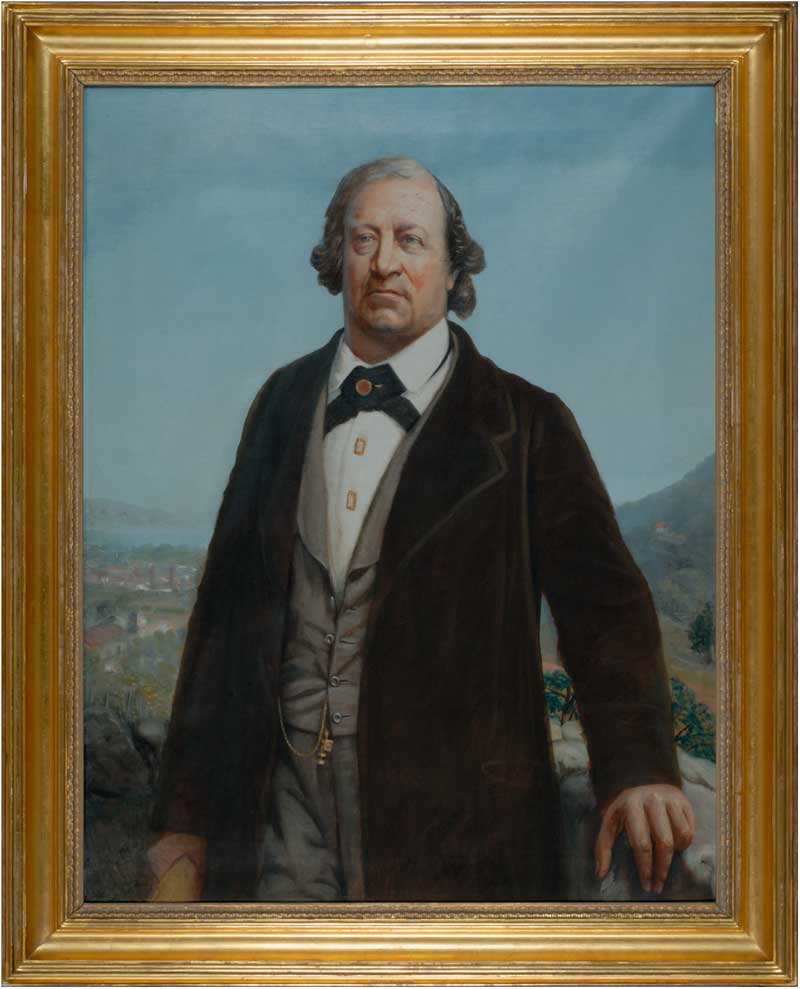
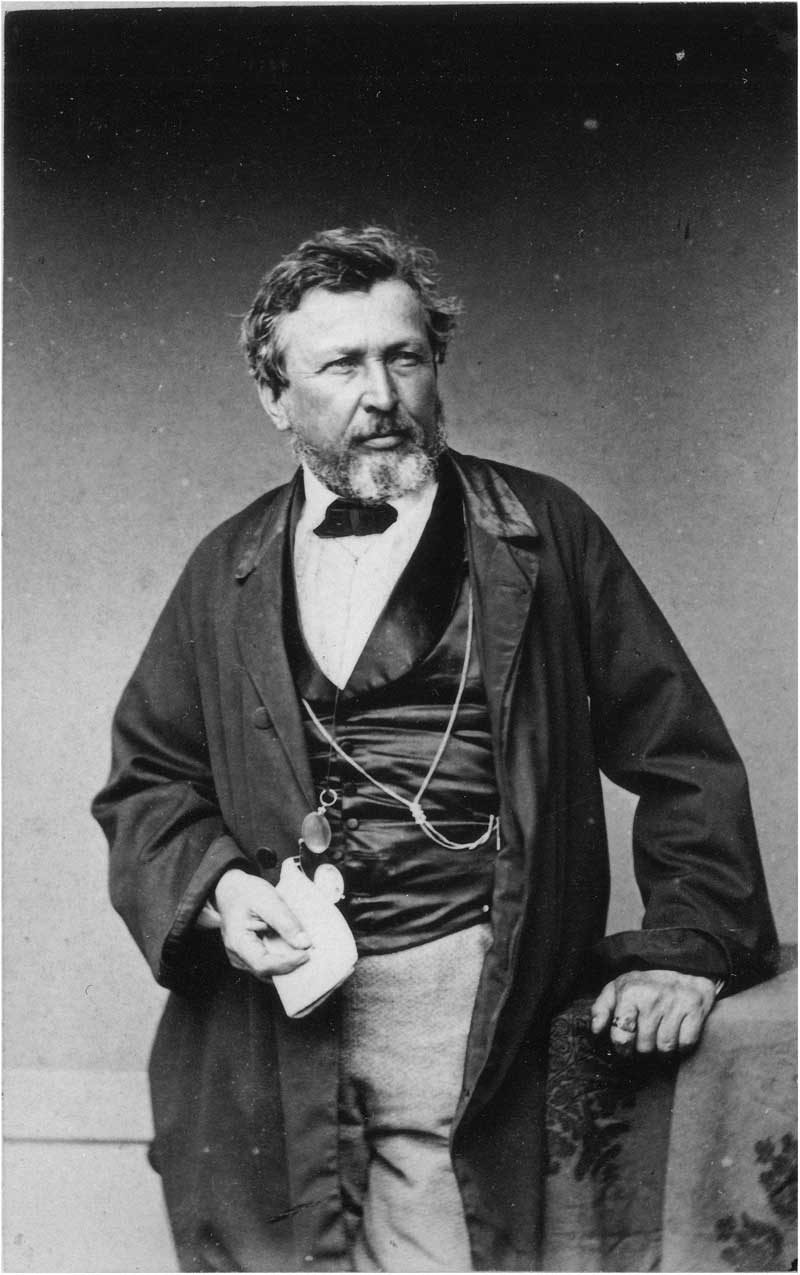
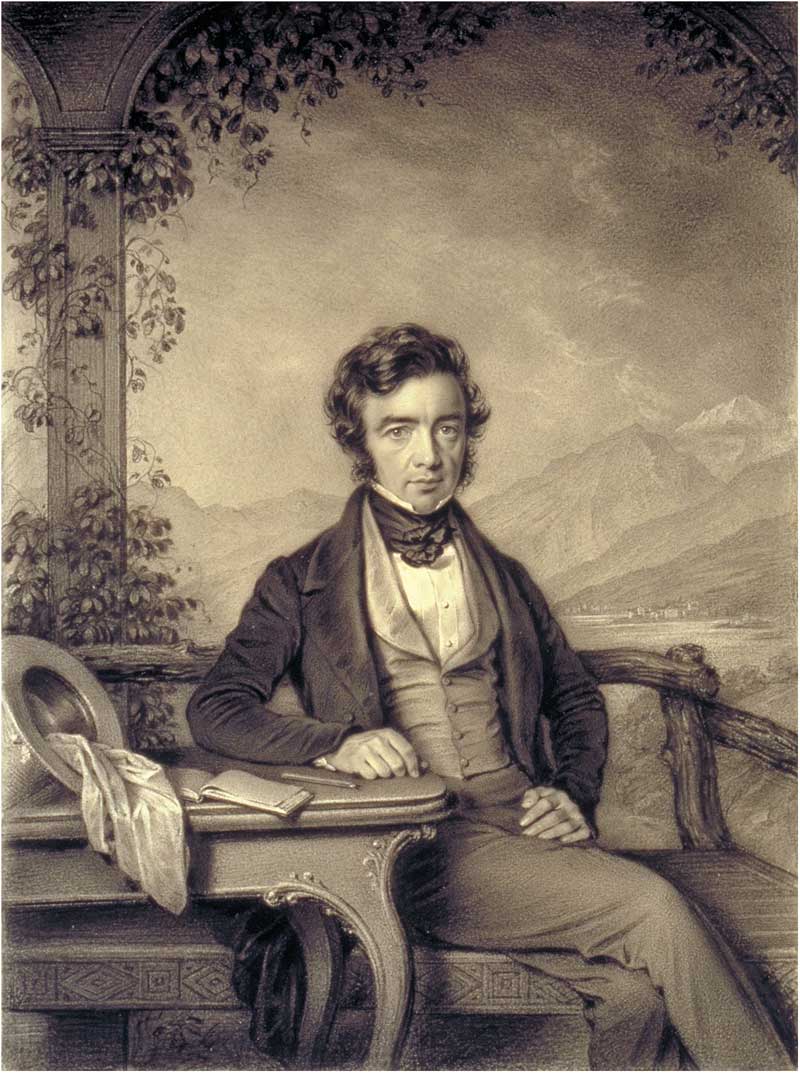
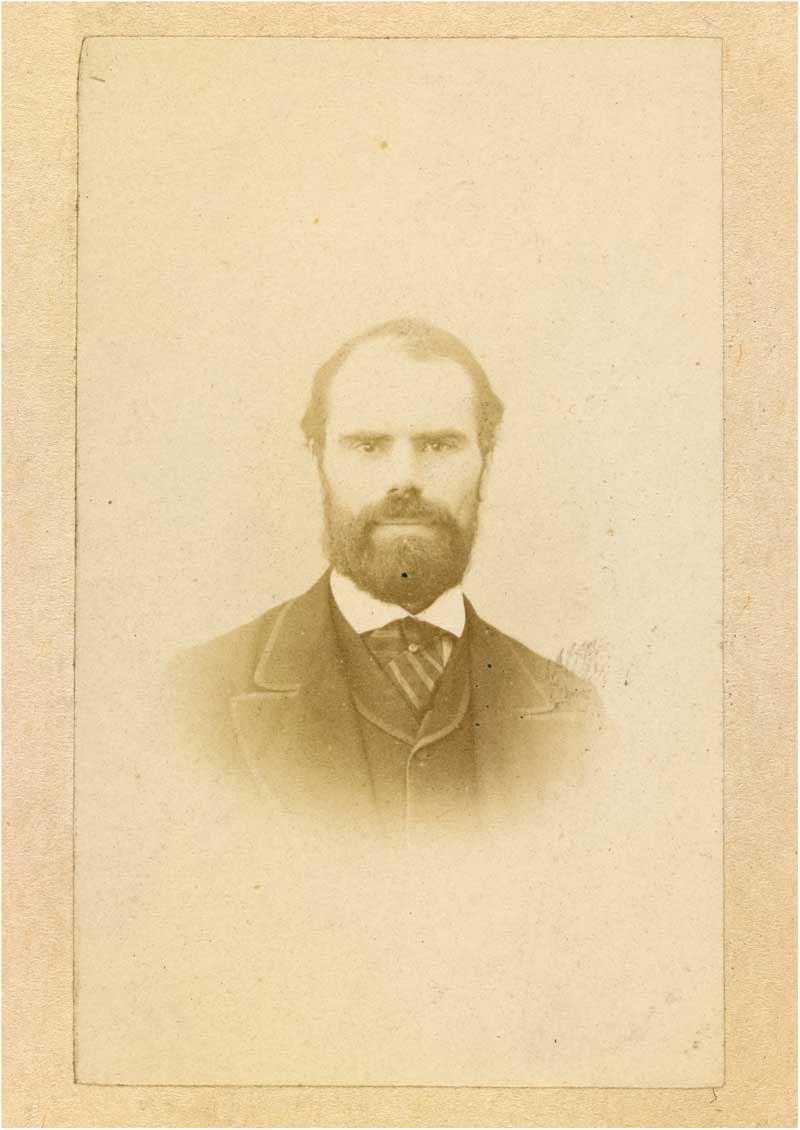
Most of these early finds entered the collections of archaeologists.Footnote 12 Two of the archaeologists who collected finds from Lake Neuchâtel were Colonel Friedrich Schwab and Edouard Desor (figs 3–4). Schwab (1803–69) was a prominent businessman and local politician whose collection from west Switzerland was widely acknowledged as pre-eminent.Footnote 13 Desor (1811–82) was a German political exile, geologist and palaeontologist who became a professor of geology at the Neuchâtel Academy. He knew some of the leading proponents of the three-age system and played an important role in the development of European prehistory.Footnote 14 The two shared a common interest and enjoyed a certain local rivalry in acquiring finds from the lakes.Footnote 15 At the time it was common to employ men to procure objects, and those from palafittes were often acquired by – quite literally – fishing for them.
Friedrich Schwab. Portrait by Aurèle Robert c 1860. Reproduced by courtesy of the Kunstsammlung der Stadt Biel.

Édouard Desor in 1873. Reproduced by courtesy of Laténium.

The discovery of La Tène fell, indirectly, to Schwab. In November 1857, his collector, Hans Kopp, fished some forty iron objects from what was presumed to be a settlement covered by just ‘four feet’ of water. According to Desor, the name Tène was a local term meaning ‘shallow water’.Footnote 16
The scene was captured in Louis Favre’s popular novel of the time, Le Robinson de La Tène:
‘The morning, was it good?’, said Beauval, while resting his oar on one of the boats. ‘We have only found iron, always iron’, said Hans Kopp in Bernese dialect. ‘I think that we have fallen upon one of the most remarkable sites … bronze is completely absent.’Footnote 17
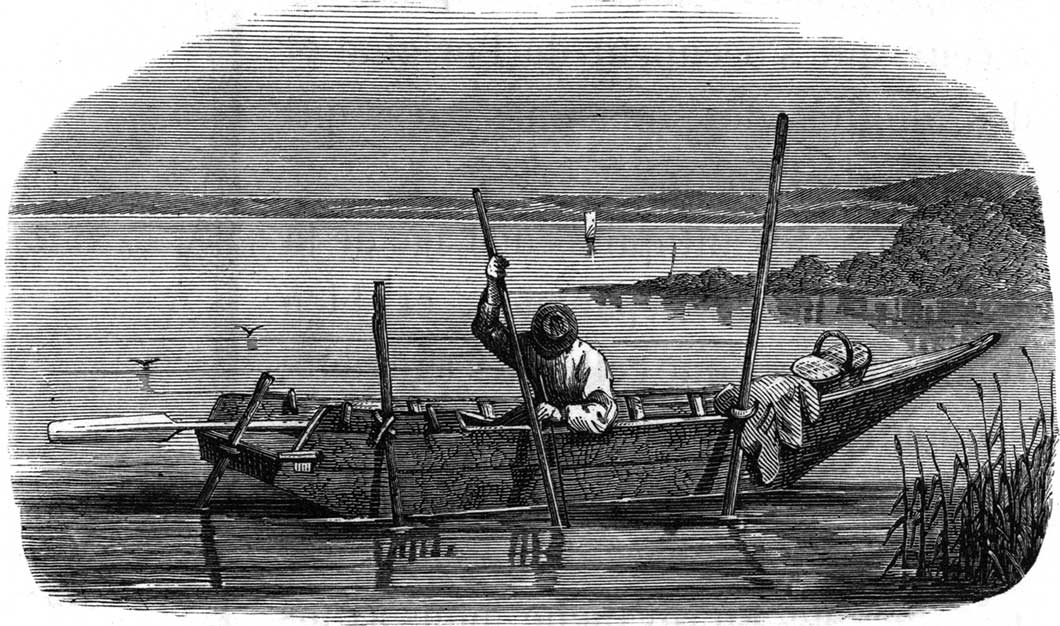
A drawing by Oscar Huguenin of these pêcheurs, as they were known, adorned the cover of the book, echoing the engraving by Favre himself of Kopp fishing at La Tène in Desor’s Reference Desor1865 book, Les palafittes (fig 5).
‘Notre pêcheur pêchant à la pince dans une palafitte’. Woodcut by Louis Favre in Desor Reference Desor1865, frontispiece and fig C.

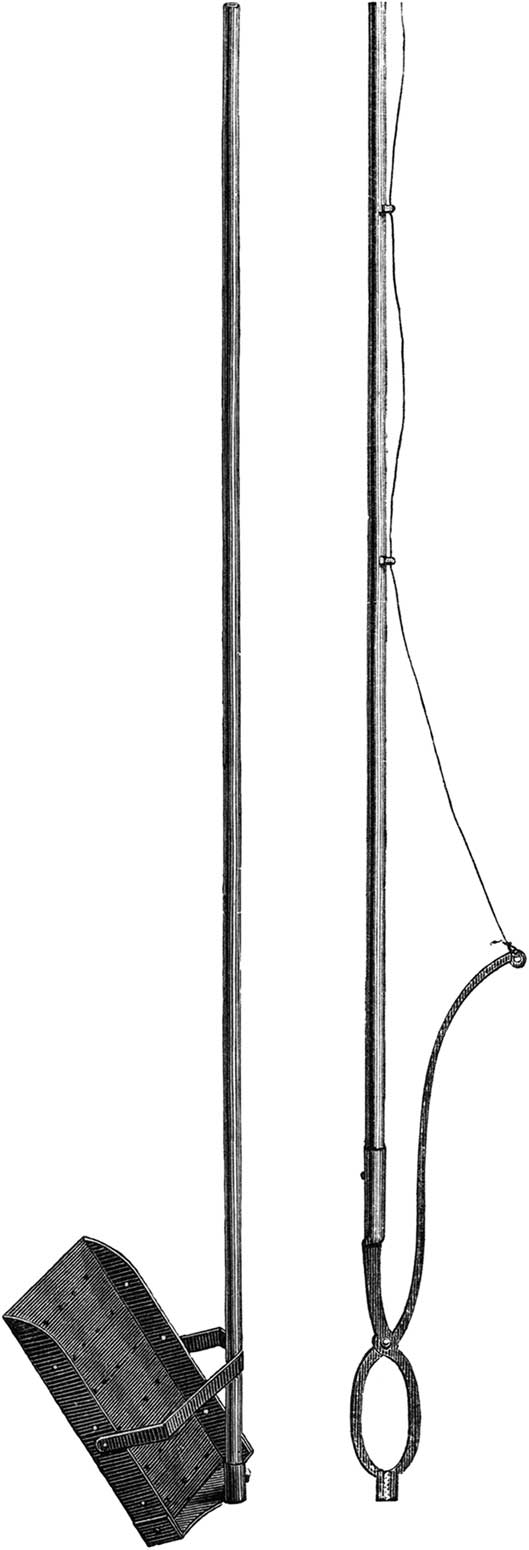
With his small boat held in place by stakes, Kopp used a hand dredge and a pair of metal tongs to retrieve the objects (fig 6). On 17 November 1857, Schwab wrote to Keller with an illustrated list:
Two swords, twelve sheath fragments, eight spear heads, two knives, three axes, one big sickle, three javelins, three rings, one ring with two rings, two pieces of flat iron with rivet holes, one perforated stone, one big handle of a pot and half a small arm-ring of dark blue glass.
Tongs and scoop used in fishing for antiquities. Source: Desor Reference Desor1865, fig A & B.

La Tène was different from other palafittes: all the metal objects were iron. But the date and significance of this was uncertain; Schwab thought the finds were Roman.
Desor heard about the finds by chance. His cook, Marie Kopp, was Hans’ sister and Desor promptly engaged Hans to prospect for him, too. Unlike most archaeologists of the period, Desor was not overly interested in attributing finds to ethnic groups. Instead, he saw the significance of the finds in the context of the three-age system: La Tène was Iron Age, and he soon published an account.Footnote 18
Keller was also quick to publish his views (fig 7).Footnote 19 Keller was the long-time president of the Zurich Antiquarian Society, which he helped found in 1832 on his return from England, where he had worked as a tutor. Keller had visited Colt Hoare’s collection at Stourhead and it has been said that the Zurich Society was modelled on English antiquarian societies. As more lake dwellings were found, Keller wrote regular reports on them and these Pfahlbauten Berichte were published by the Society. In 1866, the first six were translated by John Lee, FSA.Footnote 20
Ferdinand Keller. Reproduced by courtesy of Laténium.

Keller and Schwab corresponded regularly, and Schwab was happy for Keller to publish his latest acquisitions. For Keller, La Tène was a puzzle. The few comparable finds had been attributed variously to Celto-Helvetic, Roman and Alemannic peoples.Footnote 21 Keller saw that the decoration on the scabbards from La Tène was neither Bronze Age (which he described as keltisch) nor Roman in style, and he noted similarities with the decoration on some jewellery and neck rings published by Bonstetten.Footnote 22 The most similar finds were from Berne-Tiefenau, c 35km away. Found in 1849, this Massenfund was said to have contained over one hundred swords. Although correctly identified as keltisch-helvetisch by Albert Jahn in 1850, Gustave de Bonstetten later attributed it to the third-century ad Alemanni.Footnote 23 Keller’s caution prevailed and he left the matter open, hoping that further discoveries would clarify matters.
Meanwhile, Desor developed his view of the significance of La Tène. Between 1860 and 1864, he argued in lectures and local publications that the site was pre-Roman and, in 1865, he set this out in his book, Les palafittes ou constructions lacustres du lac de Neuchâtel.Footnote 24
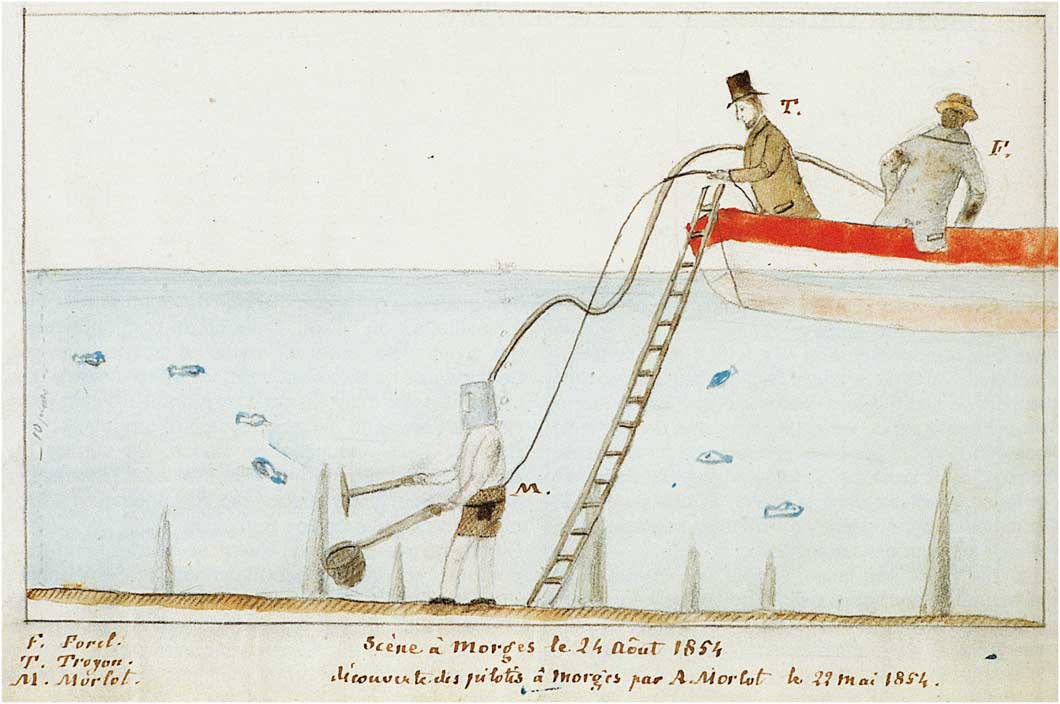
The wider significance of La Tène was also quickly noted by Frédéric Troyon (1815–66), the curator of Lausanne Museum. In 1847 Troyon had seen the similarities between iron swords found in west Switzerland and those described by Roman writers,Footnote 25 and in 1854 he assisted in the first underwater exploration of a lake dwelling, at Morges in Lake Geneva (fig 8). Troyon correlated the swords from La Tène and Berne-Tiefenau with Livy’s description of those used by Gauls when sacking Rome in 387–6 bc. Troyon was inclined to see the decoration on the scabbards as Scandinavian in origin (albeit influenced by the Helvetii, the tribe that occupied west Switzerland in the Iron Age) rather than as the work of the indigenous ‘Celtic’ people.Footnote 26
‘Scene at Morges, 24th August 1854’. Watercolour by Adolphe Morlot (Reference Morlot1859) from his unpublished Cours d’Archéologie à Moudon en Février 1859. Reproduced by courtesy of the Bernisches Historisches Museum and Laténium.

From 1857 to c 1864–6, La Tène continued to be fished for its iron finds, mostly for Schwab, but after a flurry of work in 1864 interest waned. In 1866, Schwab wrote to Keller saying that there was nothing more to be found at La Tène.Footnote 27
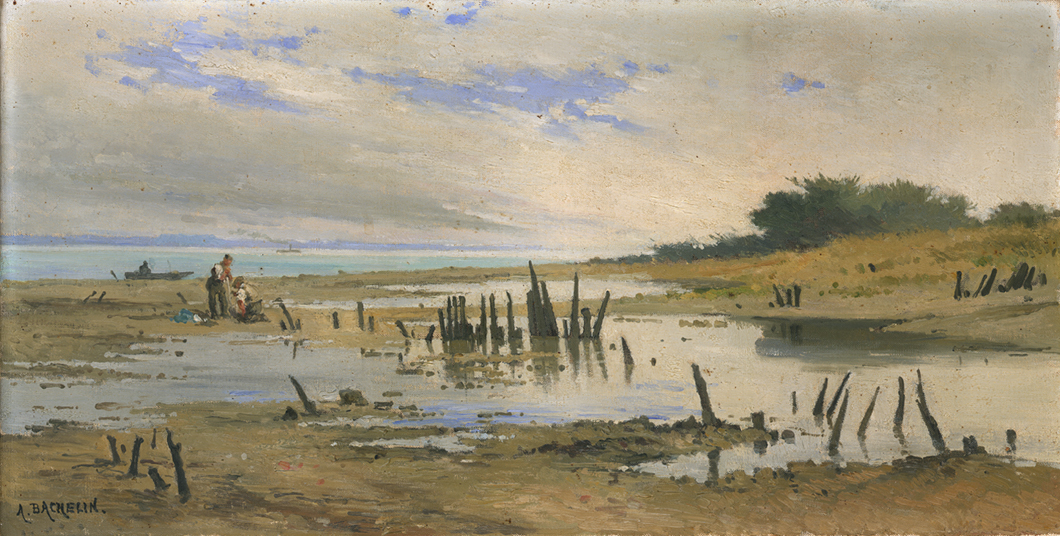
Schwab was soon shown to be wrong. During 1868 to 1881, the water levels of the lakes of the Jura were systematically lowered (or ‘corrected’) by building locks and canals in order to reduce flooding. In 1879 Lake Neuchâtel was lowered by more than 2m, resulting in La Tène being exposed regularly. Uncontrolled and unrecorded investigations soon followed (fig 9),Footnote 28 and Munro gave a contemporary account of these in his work, The Lake-dwellings of Europe.Footnote 29 François Borel, the concierge of Neuchâtel Museum, sold many of the finds from his explorations to other Swiss museums, while in 1884 the Swiss Confederation bought the large collection of Victor Gross.Footnote 30 The many finds that are probably from La Tène, but which have lost their provenances have been described by de Navarro as ‘apocrypha’.Footnote 31
La Tène and the exposed timbers of Pont Vouga in 1879 by Rodolphe Auguste Bachelin. Reproduced by courtesy of Laténium.

The damage to La Tène was such that it was thought to have been destroyed; its finds plundered and sold. Only Émile Vouga made detailed records of his investigations. Between 1880 and 1885 he identified two bridges across an old channel of the Thielle and traces of wooden buildings on its banks. The channel itself contained many objects, mostly weapons. Vouga published the first systematic account of La Tène, which was soon followed by a synthetic review by Gross.Footnote 32
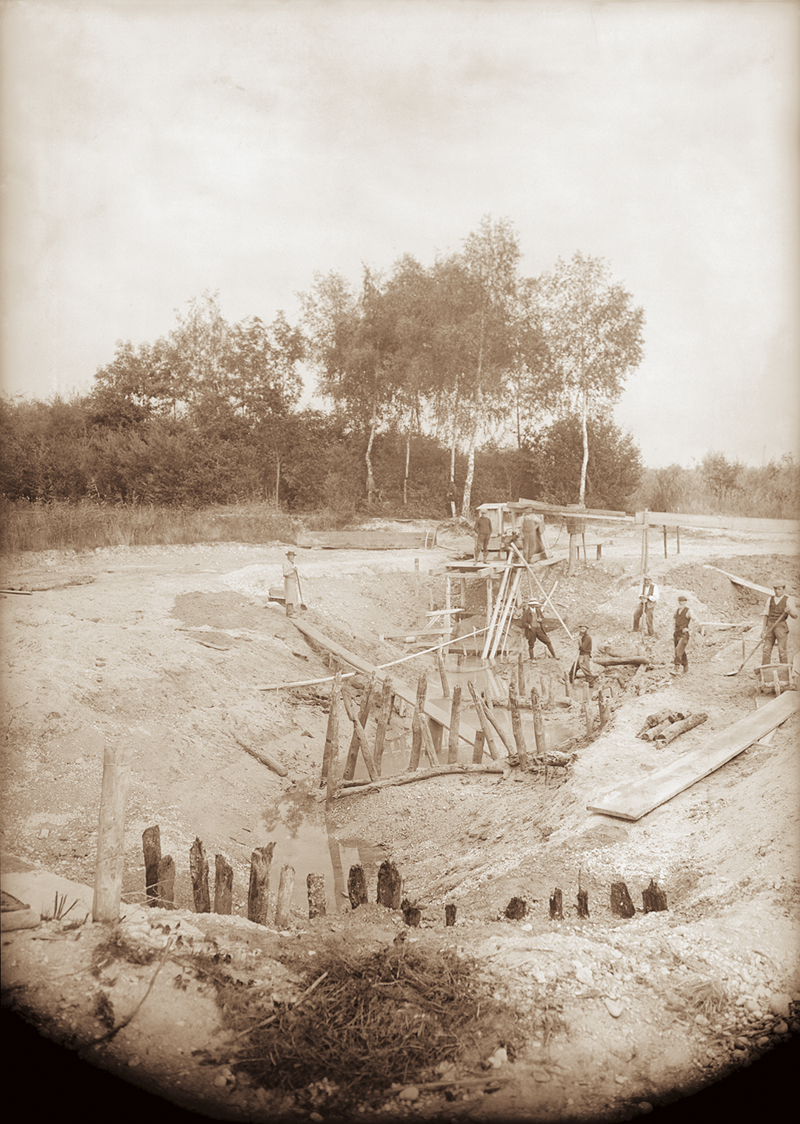
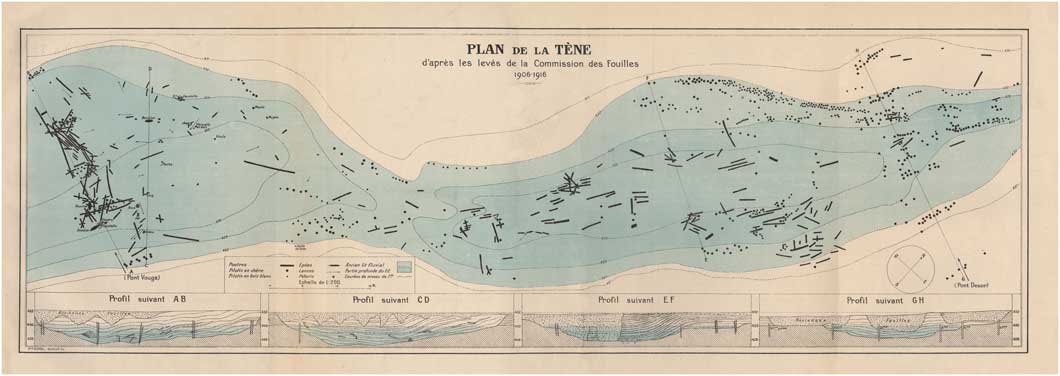
The impact of these monographs, the increasing international fame of La Tène and a developing sense of patrimoine (in 1886, it became a legal requirement to protect antiquities from leaving the country with foreign buyersFootnote 33) eventually saw the formation of the Commission des fouilles de La Tène. Its excavations of 1907–17 were directed firstly by William Wavre and then by Vouga’s son, Paul. Much of the old channel of the Thielle was excavated and in 1923 Vouga published this work as La Tène : Monographie de la station. It summarised the early investigations and for many years it was the definitive statement on La Tène. The bridge closest to Lake Neuchâtel was named Pont Vouga. The other bridge, approximately 100m downstream, was named Pont Desor and thought to be Roman (figs 10 and 11).Footnote 34
Pont Vouga under excavation in 1916. Source: Vouga Reference Vouga1923, fig 5.

Plan of excavations at La Tène. Source: Vouga Reference Vouga1923, Plan.

Lamenting the motives and quality of earlier investigations, Vouga documented the widespread dispersal of the finds.Footnote 35 However, Schwab’s and Desor’s collections remained largely intact. Schwab donated his to the town of Biel, with an endowment for a new museum, which opened in 1873. Desor bequeathed his collection to Neuchâtel Museum and in 2001 it was transferred to the new Laténium centre.Footnote 36
AUGUSTUS FRANKS: NETWORKS, TRAVELS AND ACQUISITIONS
Among the finds from La Tène in foreign museums noted by Vouga was a group in the British Museum.Footnote 37 Like many objects acquired by the British Museum in the nineteenth century, they were acquired by Augustus Franks (1826–97) (fig 12).Footnote 38 In his History of the British Museum, David Wilson eulogised Franks as a hero in the development of the antiquities departments of the British Museum, ‘as innovative in his scholarship as he was aggressive in his collecting and generous in his giving’.Footnote 39
Augustus Franks. c 1865. Reproduced by courtesy of the Trustees of the British Museum.

Coincidentally, Franks was born in Geneva in 1826 and, after being brought up in Rome, he was educated at Eton and Cambridge, where he developed his interests in medieval history and archaeology. Appointed to the staff of the British Museum in 1851 as assistant in the Department of Antiquities, Franks was given special charge of the British and medieval collections. Until then the museum had resolutely opposed collecting archaeological finds from Britain.Footnote 40
As Franks‘ personal papers do not survive, much less is known about him than his contemporaries, most notably John Evans and John Lubbock,Footnote 41 but Franks was a member of the small group who championed deep human antiquity and the study of prehistory in the 1850s and 1860s. Evans, Franks and Lubbock were all rich, well connected and, eventually, knighted. All were Fellows of the Royal Society and Presidents of the Society of Antiquaries of London.Footnote 42 On occasion, they travelled abroad; in 1866 they visited Paris before going on to Munich, Salzburg and Hallstatt.
Such travels were commonFootnote 43 and, alongside correspondence, they played an important role in exchanging knowledge. For example, Frédéric Troyon corresponded regularly with the Society of Antiquaries and his letters were often read out at meetings. In May 1854 he was the first to give the Society news of the discoveries at Meilen. He also corresponded with William Wilde in Dublin and published papers on Swiss lake dwellings in the Ulster Journal of Archaeology.Footnote 44
These networks saw scholars elected to overseas academies. Franks was elected to several,Footnote 45 and honours were reciprocated. For example, Ludwig Lindenschmit the Elder of Mainz was elected an Honorary Member of the Society of Antiquaries in 1864,Footnote 46 while Desor was elected an Honorary Fellow alongside the classicist Theodor Mommsen in 1868.Footnote 47
In common with curators across Europe, Franks also collected personally, a pursuit afforded by his considerable inheritance, and he was famous for his voracious acquisition of antiquities of all ages from across Europe. To assist this, he acquired British and Irish material to use in exchanges. Many exchanges and purchases were made in a personal capacity and then gifted to the British Museum. The museum could not make exchanges from its collection because it held material in trust rather than owning it,Footnote 48 as it does today.
The buying and selling of objects between archaeologists and museums to develop comparative collections was routine and international. For example, Jens Worsaae, Christian Thomsen’s assistant in Copenhagen, compiled a collection of Irish antiquities during an extended visit there in 1846–7, part of which was given to him by the Royal Irish Academy, and there were also exchanges with the Society of Antiquaries of Scotland.Footnote 49 The nonchalant way in which Thomsen and Lindenschmit discussed purchases and prices shows that the practice was commonplace.Footnote 50 Alongside it was a trade in plaster casts, initially for classical statues, but Lindenschmit later developed a trade in casts of portable archaeological objects.
By 1860, the Neolithic and Bronze Age lake dwellings of Switzerland were so well known that their finds were widely collected by foreign archaeologists and given as gifts,Footnote 51 and a thriving domestic market also catered for tourists.Footnote 52 Visits to lake dwellings were promoted as tourist attractions, and John Morell’s Scientific Guide to Switzerland stated that:
As this guide is specially intended to aid the traveller in quickly and readily picking out the most scientific interest in Switzerland, we refer him first to Zurich Museum, with its numerous specimens, arranged under the care of Dr. Keller, and other antiquarians. Secondly, let him visit the pile work on the Lake of Moosseedorf, near Berne (two hours’ walk), because it affords the most perfect example of a regular lake dwelling of the Stone period, no implement of metal having been found in it. | Thirdly, let him go to the settlement of Robenhausen, on lake Pfäffikon, near that of Zurich, and forming a tarn in a peat district on the borders of St. Gall. We learn more from this settlement than all the others. We can here walk on the flooring of dwellings abandoned thousands of years ago, and see before us the hearths, utensils and food of their people.Footnote 53
A visitor book was kept at Robenhausen between 1858 and 1890, and in the mid-1860s it was signed by more foreigners than Swiss, with the Germans and British (including Charles Lyell) being most common.Footnote 54 Albert Way, secretary of the Archaeological Institute, could write to Keller ‘with the greatest sincerity that we do not things in Old England with such spirit and success’.Footnote 55
Things were not always so harmonious. In a letter, Keller wrote about the difficulties of deciding which artefacts to keep or sell and, while saying he had nothing but respect for the English, he complained that they did not hesitate to use their money to rob public museums, as it were, and then to boast that they had made people on the continent their slaves with their gold coins.Footnote 56
ACQUISITION
Franks first saw the finds from La Tène when he visited Switzerland in 1860. He met several archaeologists, including Schwab, who wrote to Keller saying that Franks was ‘a quite wonderful, kind and educated man‘, describing him as the director of the Society of Antiquaries. Franks was reported to have been particularly interested in the finds from La Tène, making drawings of the swords ‘together with a few other things’ and some ‘impressions’ of them.Footnote 57 Schwab stated that Franks intended to give the drawings and impressions of the scabbards to the Society of Antiquaries. Franks’ notebooks for these years do not survive, but it seems certain that he visited TroyonFootnote 58 and so it is likely that he visited Desor en route. Franks also went to Zurich, where he must have met Keller.
One reason for Franks‘ interest in La Tène was his work on Celtic art. In 1860, he was either finishing or had recently completed his contribution to Horae Ferales, the posthumous publication of John Kemble’s archaeological work.Footnote 59 In it, Franks brought together his observations on what is now called the Celtic art of the pre-Roman Iron Age. Franks was arguably the first person to correctly identify and date this art and to see its European scope.Footnote 60 As a result, he was the first person to correctly date La Tène to the Iron Age, and his conclusions in Horae Ferales, which did not appear until 1863, were quickly accepted by Swiss archaeologists.Footnote 61 Troyon and Desor, both of whom had met Franks, also reached the same conclusion shortly afterwards.Footnote 62
In 1863 Franks visited Schwab again, and also Keller.Footnote 63 Schwab records that afterwards he and Keller both presented Franks with objects from the Swiss lakes, with Schwab later sending two separate parcels of finds. The second was sent after Franks had inadvertently offended Schwab by describing him as the excavator of La Tène, something Schwab considered to be of lowly status. By sending another parcel, Schwab had the opportunity to correct this misapprehension.Footnote 64 The Neolithic and Bronze Age objects sent by Schwab were accessioned into the museum’s collections in 1863, but the first from La Tène were not registered until 1867: four from Desor and two from Schwab. In 1880, a further nine objects from La Tène were accessioned as a gift from Franks. The museum also has plaster casts of seven decorated scabbards from La Tène and it seems likely that these were also acquired c 1867.Footnote 65
The first objects and casts may all have been acquired in 1867 at the Exposition Universelle in Paris. One of the most important exhibitions of prehistory was displayed at the Exposition as part of the musée de l’histoire du travail, having been organised by the Congrès international de préhistoire, the forerunner of the modern Union Internationale des Sciences Préhistoriques et Protohistoriques (UISPP). This was established by Desor and Gabriel de Mortillet in 1865 as the Congrès international d’anthropologie et d’archéologie préhistorique, with the aim of facilitating a large archaeological display at the Exposition and inaugurating a major international meeting of prehistorians. Gabriel de Mortillet was the secretary general of the organising committee and set out this wider significance in his Promenades préhistoriques.Footnote 66 Many nations contributed displays and the exhibition has been held to symbolise the ‘coming of age of archaeology’, reflecting the idea of prehistory, its great antiquity and also the importance of ethnology.Footnote 67
The prominence afforded to archaeology in the Exposition benefited directly from the patronage of Emperor Napoléon iii. During his research into Julius Caesar’s Battle for Gaul, Napoléon iii cultivated links with archaeologists across Europe, and the discovery (in 1861) of Caesar’s siege works of 52 bc at Alésia led, three years later, to the unambiguous dating of the finds from La Tène and the Berne-Tiefenau Massenfund to the pre-Roman Iron Age. With his dating of the La Tène vindicated, Desor was able to develop his idea of a first and second Iron Ages that Hans Hildebrand soon named ‘Hallstatt’ and ‘La Tène’.Footnote 68
Napoléon iii and his officers took an especial interest in La Tène, attempting to buy Desor’s collection and also to instigate new excavations. Those attempts were unsuccessful, but plaster casts were made of weapons in the collections of Desor and Schwab, and also of other weapons from central and western Europe. Some of the casts were made by Lindenschmit, who also trained the imperial mould-makers – those who had previously specialised in the manufacture of casts of statues – to make casts of archaeological objects. This was paid for from Napoléon’s personal treasury, and his imperial largesse also included bestowing the Légion d’honneur on Desor and Lindenschmit.Footnote 69
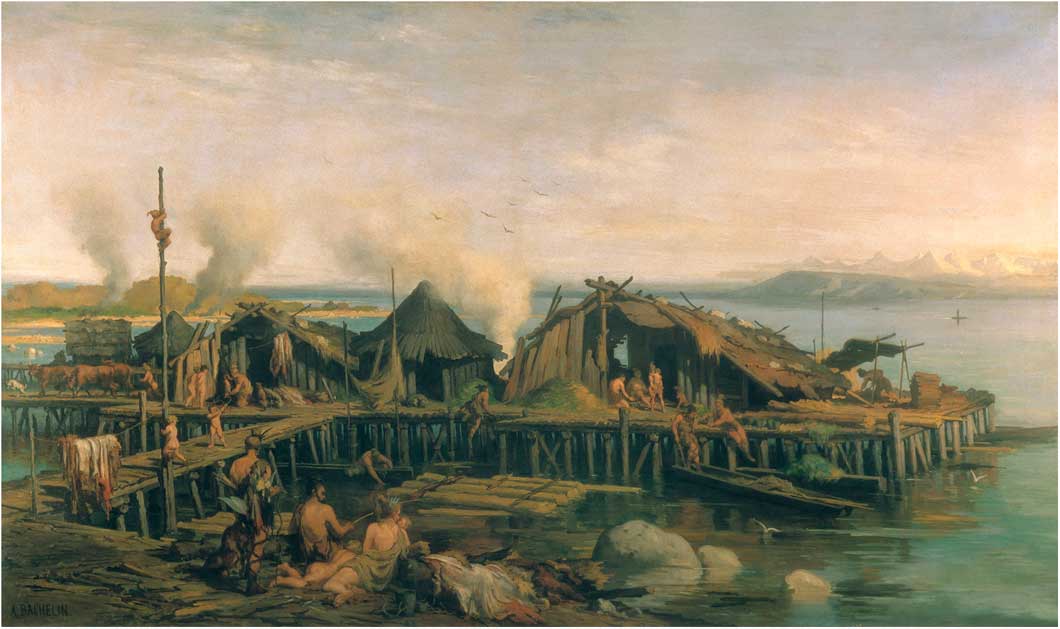
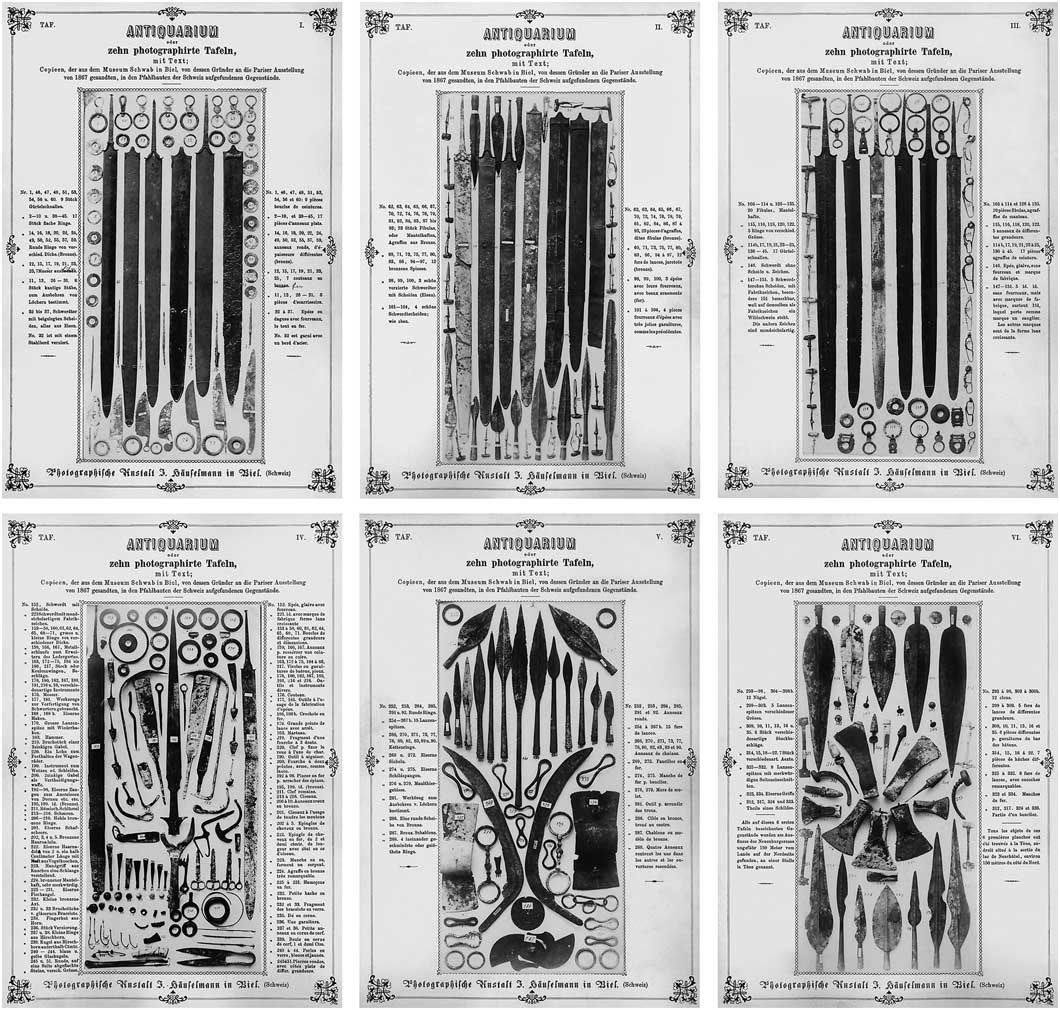
The Swiss lake dwellings were afforded a particular prominence in the Exposition. The Swiss government paid for six collectors to send displays, including Desor, Schwab and Gustave Clément. Coordinated by Clément and Desor, the displays were organised according to the three-age system and accompanied by a painting by Auguste Bachelin (fig 13).Footnote 70 The Iron Age was represented almost exclusively by finds from La Tène that were mounted on display boards. The six boards sent by Schwab were insured for 200,000 Swiss Francs and photographed before their departure (fig 14).Footnote 71
Neolithic Lake Village by Auguste Bachelin (1867) for the Exposition universelle. Reproduced by courtesy of the Schweizerisches Landesmuseum and Laténium.

Finds from La Tène from Schwab’s collection mounted for display at the Exposition universelle. Source: Häuselmann Reference Häuselmann1867, Taf. i–vi.

The finds from La Tène acquired by the British Museum in 1867 were, in Franks‘ words, ‘presented by Desor and Schwab’. Their receipt is recorded in Franks’ report to the Society of Antiquaries on ‘Additions made to the collections of British antiquities in the British Museum during the year 1867’. Franks initially gave these accounts to the Archaeological Institute, which published these in the Archaeological Journal and subsequently to the Society of Antiquaries of London, which included these in its Proceedings.
Franks reported that:
A few valuable objects of the iron period have been added from the Swiss Lakes. Professor E. Desor, Hon. FSA, very liberally presented a sword and sheath, both of iron from the lakes of Neufchatel [sic]. These are fine and well preserved specimens; he has added a large spearhead and a fibula of the same material.[Footnote 72] Colonel Schwab of Bienne, well known for his valuable collection, has presented a fine iron spear-head [sic]; two other objects and pottery from the lake dwellings at Morges were given by M. Henri Carrard.Footnote 73
Although the phrase ‘presented by‘; seems to imply that the objects were gifted to the museum, a list in Neuchâtel of the finds in the British Museum written by Franks between 1880 and 1896 describes the 1867 acquisitions as purchases (see Supplementary Material fig SM1).Footnote 74 As both Desor and Franks were at the Exposition (Franks was one of the seven vice-presidents of the Congrès) and Schwab probably visited it, it seems likely that the ‘presentations’ were arranged at it.
In 1867 the Department of British Antiquities also acquired material from Austria (from excavations by Evans and Lubbock at Hallstatt), Denmark, France, Germany, Hungary, Ireland, Italy, Sweden and Switzerland and casts of objects from Russia, as well as finds from America, China, Ecuador, Siberia and Syria. This list correlates closely with the nations that exhibited antiquities in Paris and many of the finds must have been acquired there.
It is not known how Franks acquired the objects from La Tène that he donated in 1880. De Navarro suggested that he obtained them, and also the casts of the swords, when he visited Schwab in 1860 and 1863, but Schwab’s letters to Keller do not mention any gifts or sales.Footnote 75 While the acquisition of large collections could be complicated,Footnote 76 it is hard to explain why Franks would have waited for almost twenty years before donating this small group, particularly as Schwab’s 1863 gifts of Neolithic and Bronze Age objects were accessioned the same year.
It seems more likely that the 1880 acquisitions were bought on the open market, perhaps through a Swiss intermediary such as Desor, who is known to have been involved in the overseas sales of Swiss finds. Antiquities from La Tène began to appear regularly on the market after 1879 when the site was exposed regularly after the lowering of Lake Neuchâtel. In 1890 Robert Munro could observe that ‘Like the fate of most lacustrine remains, those from La Tène have been widely scattered’.Footnote 77
COMPOSITION AND DATE OF THE ASSEMBLAGE
Despite this, the overall composition of the assemblage from La Tène is now relatively well understood. At least 166 swords, 269 spears and thirty shields are represented and many of the 200 or so belt hooks and belts rings are probably from sword belts.Footnote 78 Approximately 70 per cent of the finds from the Schwab collection are from weaponsFootnote 79 and, while weaponry has attracted the most attention,Footnote 80 there is also a wide range of other finds. These include almost 400 brooches and an array of tools that includes knives, razors, scythes and sickles, some forty axes (which are not regarded as weapons) and a set of wood-working tools. Fragments of ten bronze cauldrons, ten wooden vessels and twenty pots are recorded, and horse riding and the driving of carts and/or chariots is represented by thirty-two bridle bits and fifty-eight phalerae, four wheels and two yokes. Rarer finds include coins,Footnote 81 half a gold torc and part of a carnyx.Footnote 82 Bones from between fifty and one hundred people are thought to have been found. Animal bone is also present.
The great majority of these finds date to late in the La Tène C1 phase or early in C2, and while there are some finds of La Tène A and B date, they may be old objects still in use or available at this time. In his authoritative work, Thierry Lejars’ preferred date for the assemblage is 220–200 bc.Footnote 83
The independent dating is largely consistent with this. Some objects dated by dendrochronology in the 1970s have been re-sampled and some additional dates obtained.Footnote 84 A shield first dated to 229/228 bc has been re-dated to 225/>220 bc and new dates have been obtained on a plank (386/240/>220 bc) and a rod (>242 bc). However, a plank supposedly from Pont Vouga that was dated originally to 251 ± 8 has been re-dated to 6/>26 ad. Pont Desor has been shown to date to the Early Iron Age – to 660/655 bc rather than the Roman period.Footnote 85 Eight radiocarbon determinations on human bone apparently span the fifth to first centuries bc, though only two have been published in full. These determinations fall in the fourth to the second century bc calibration plateau, but are consistent with a late third-century date; 400–200 cal bc at 95.4 per cent (2245±45 bp: ETH-32943) and 390–150 cal bc at 95.4 per cent (2190±45 bp: ETH-32944).Footnote 86
THE FINDS IN THE BRITISH MUSEUM
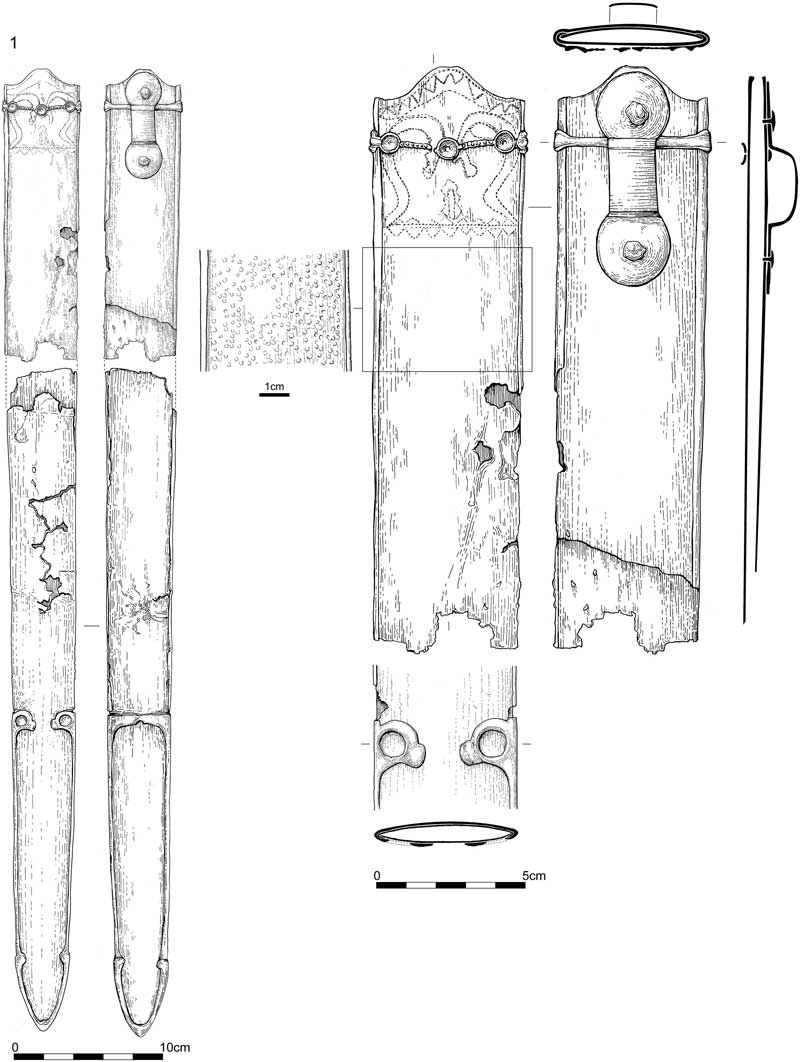
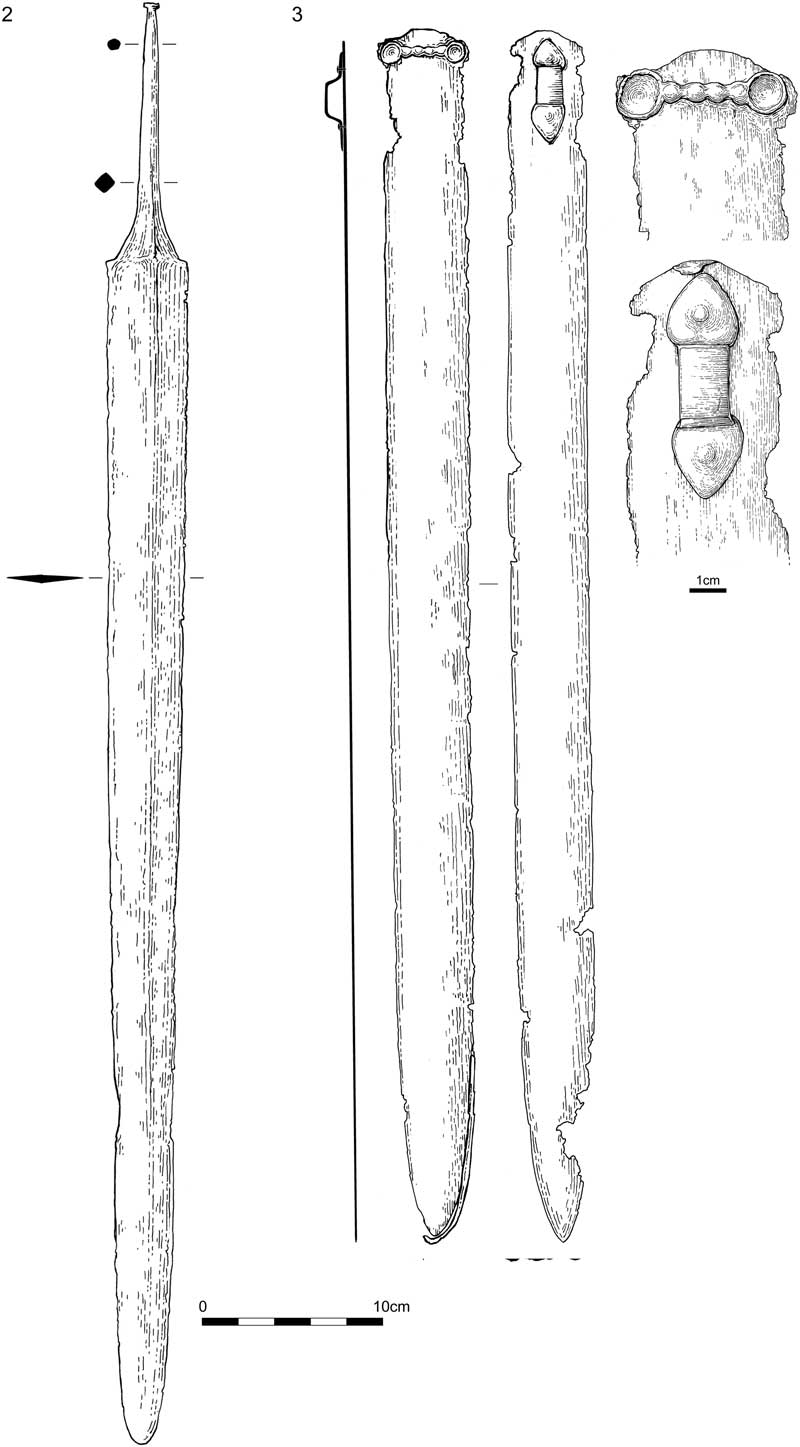
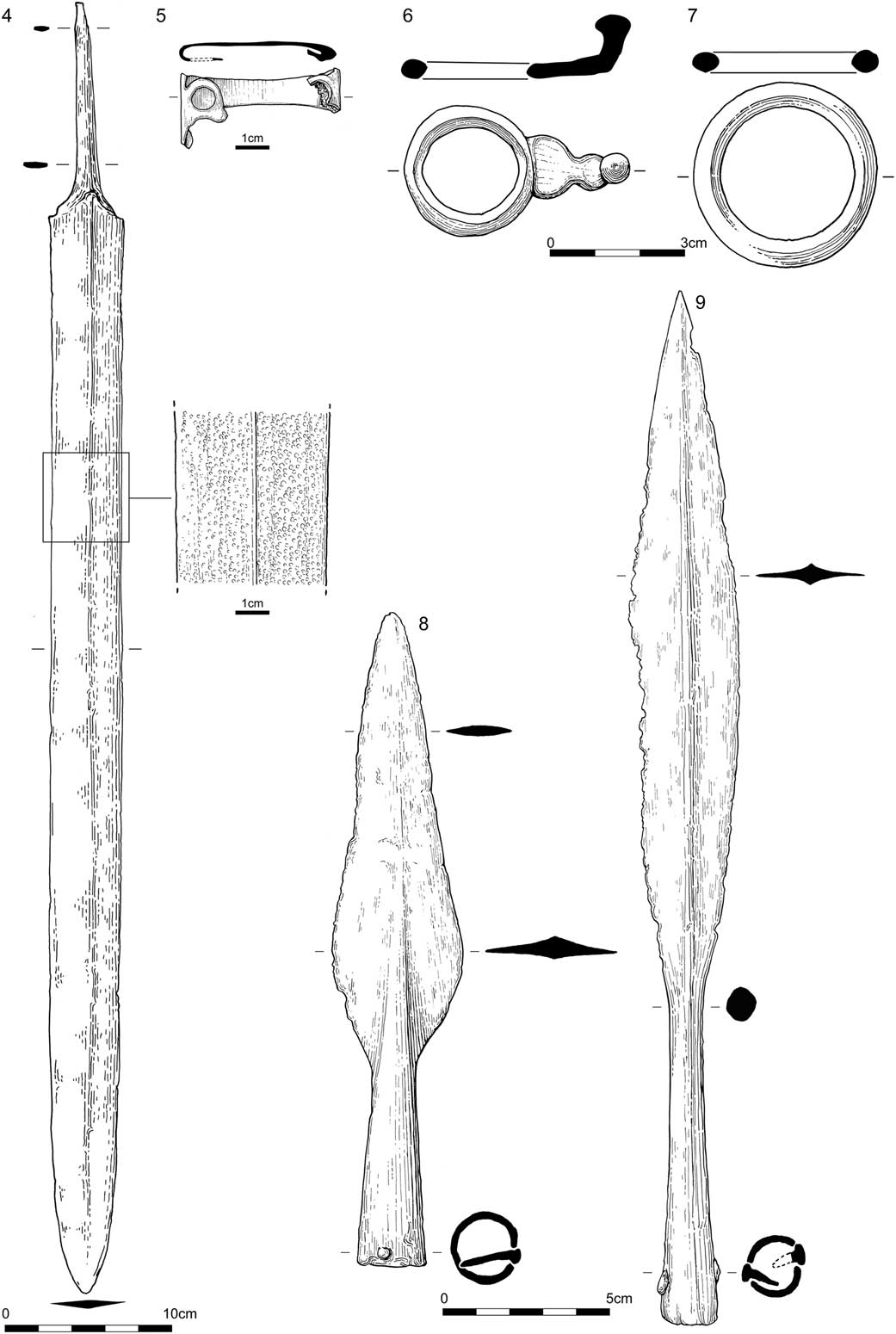
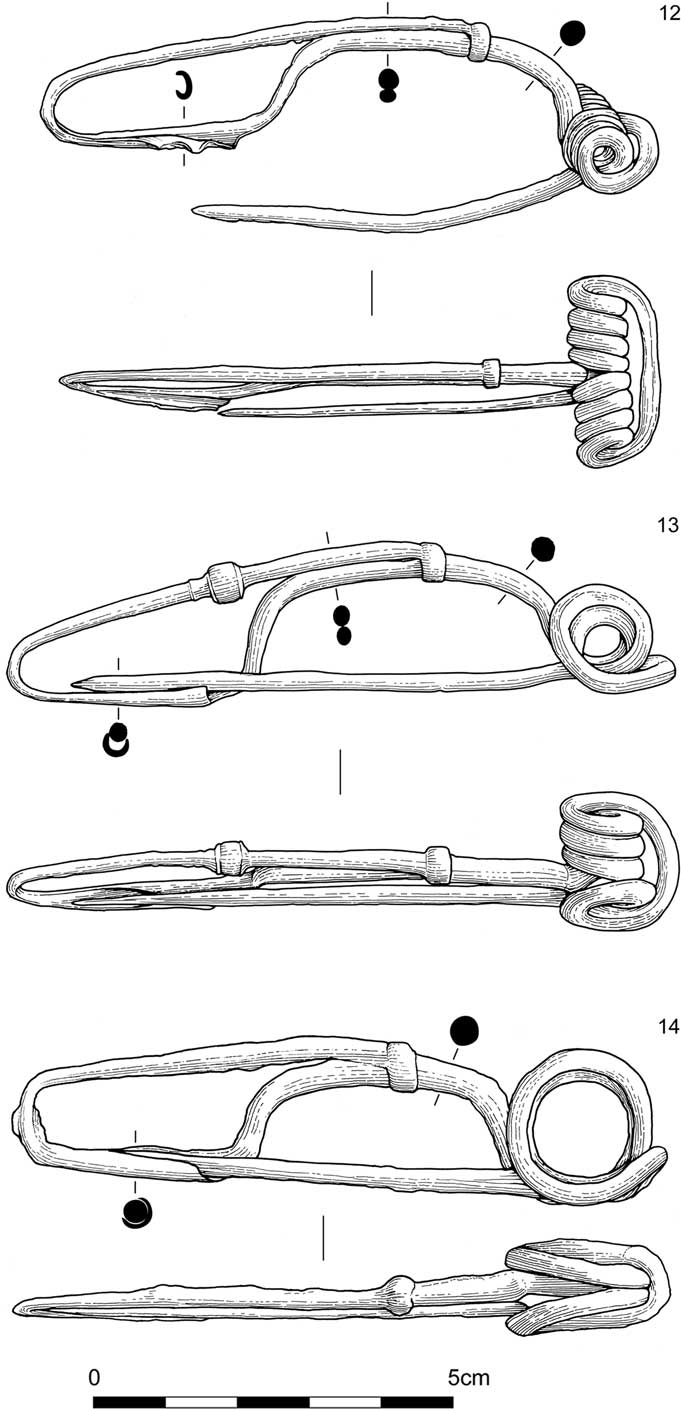
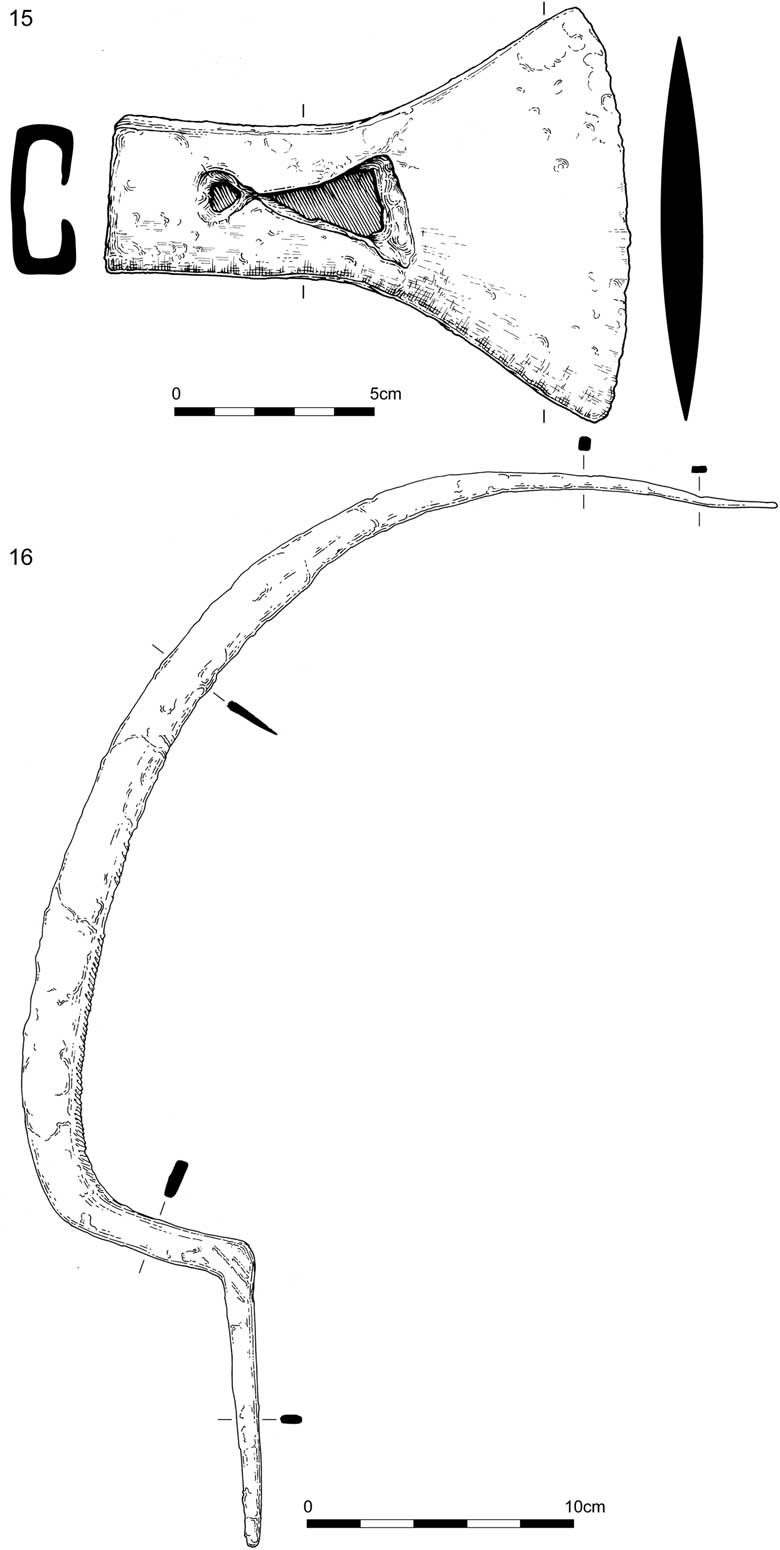
The sixteen finds from La Tène in London comprise two swords and scabbards, a belt hook and a ring (probably from a sword belt), four spearheads, three brooches, an axe and a sickle. All are of iron (see Supplementary Material Appendix 1; figs 15–20). There are also seven casts of decorated scabbards, whose originals are still in Switzerland.Footnote 87
Finds from La Tène in the British Museum; scabbard no. 1. Drawing: Craig Williams.

Finds from La Tène in the British Museum; sword no. 2 and scabbard no. 3. Drawing: Craig Williams.

Finds from La Tène in the British Museum; sword no. 4, chape no. 5, belt hook no. 6, ring no. 7 and spears no. 8–9. Drawing: Craig Williams.

Finds from La Tène in the British Museum; spears no. 10–11. Drawing: Craig Williams.

Finds from La Tène in the British Museum; brooches no. 12–14. Drawing: Craig Williams.

Finds from La Tène in the British Museum; axe no. 15 and sickle no. 16. Drawing: Craig Williams.

Metallurgical and chemical analyses of the two swords (nos 2 and 4) have shown that both swords were effective weapons. The mouth of one scabbard (no. 3) is decorated with two opposed beasts, either dragons or birds; although dragon pairs are common at La Tène, these beasts may be birds.Footnote 88 The front of scabbard 1 and the blade of sword 4 are decorated with punch marks (chagrinage). Part of a scabbard chape (no. 5) was once fixed to scabbard no. 3, but this may have been added after its discovery. The belt ring (no. 6) and the ring (no. 7) are probably from sword belts, though these objects do occur in the graves of females in west Switzerland. The four spearheads in London (nos 8–11) are of different types and include one (no. 11) of the asymmetrical types that are relatively common at La Tène.
Émile Vouga stated that over half of the swords that could be removed from their scabbards were unused, but that the blades of many swords found on their own had edge damage and were bent, as were some spears. Many of these weapons were straightened after their discovery. However, Lejars found only a few swords with deliberate edge damage in the Schwab collection. The incomplete but otherwise undamaged condition of many of those scabbards and swords, whose organic handles are missing, may be due simply to them having disintegrated slowly. Many of the shields are also fragmentary.Footnote 89 One of the scabbards in London (no. 1) is broken and the other sword and scabbard (nos 3–4) are slightly bent, but in the light of this evidence it is uncertain if the damage was deliberate.
Although weaponry comprises the largest category of finds, there are slightly more examples of other types overall. The largest group comprises the c 200 brooches. Most of these are La Tène C types, many of which were apparently damaged deliberately.Footnote 90 The three examples in London (nos 12–14) are all typical La Tène C types that are common in the Schwab collection.Footnote 91 The axe (no. 16) and the sickle (no. 17) are representative examples of the large tools from the site, although sickles are not particularly common.Footnote 92
The martial, and male, component of the La Tène assemblage has attracted much comment, as has the fact that there is no certain female counterpart. Although the brooches and some of the belt hooks and belt rings could be seen as symbolising a female element, and many of the tools could have been used by females, almost no objects associated exclusively with females are known. In particular, the belt chains and glass bangles that are found commonly in the graves of females in cemeteries in western Switzerland, such as Münsingen-Rain, are absent.Footnote 93
However, female remains are present in the human bone. Remains from between fifty and one hundred people are estimated to have been found, but as bone was rarely retained, remains from only twenty-six individuals can now be identified. The sex of twelve of them has been determined: four are female; eight are male. Two bodies were identified as female at the time of discovery because they wore iron arm rings and one had two brooches by their chest. However, while arm rings are found frequently in contemporary graves of females in west Switzerland, they are sometimes found with males, where they are commonly of iron. Brooches are found in graves of both sexes.
The human remains have been interpreted as sacrifices,Footnote 94 but it has been argued recently that they represent a ‘special‘ way of disposing of the dead, some of whom were subjected to ritual post-mortem decapitation. Seven of the sixteen surviving skulls have traces of cuts and lesions. One individual had been decapitated and another had wounds that were the cause of death.Footnote 95
Very little animal bone survives (c thirty pieces), but it contains an unusually high proportion of horse. While this might be due to sample size, two of the horse skulls are perforated, suggesting that they had been displayed.Footnote 96
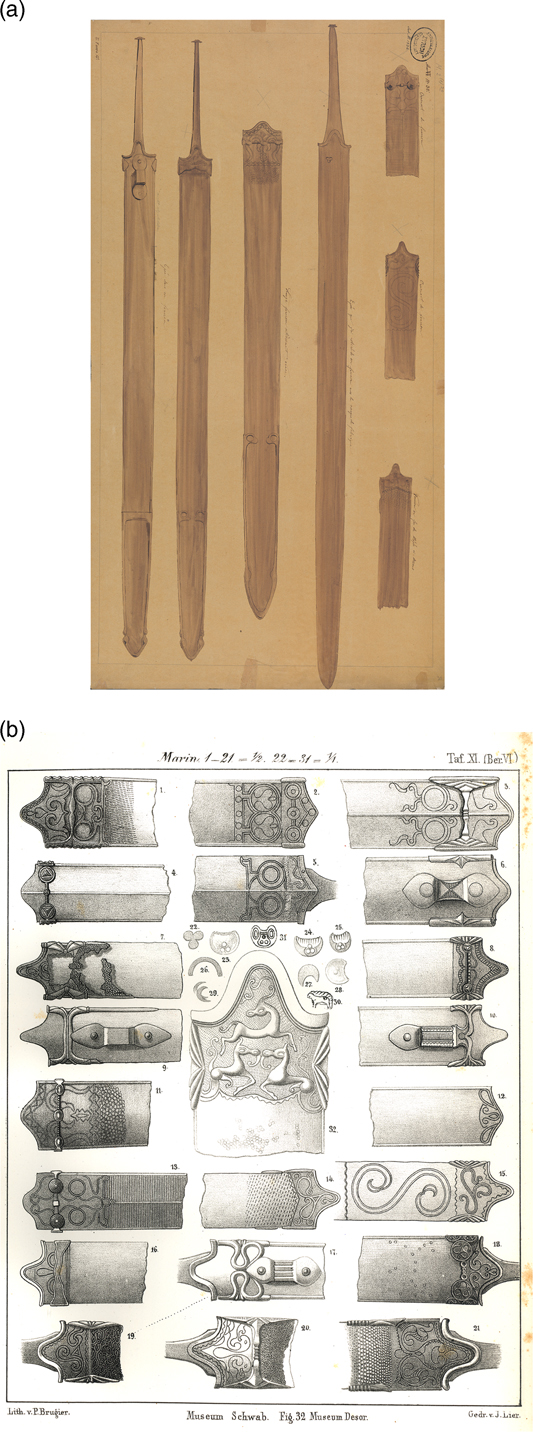
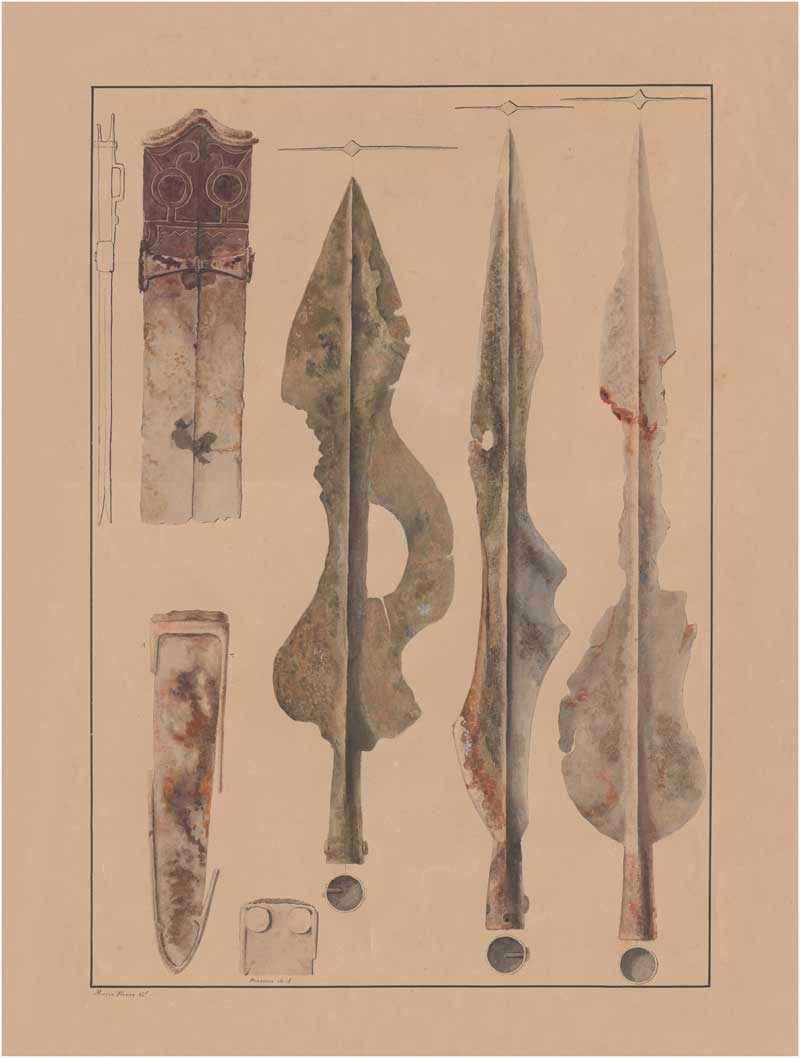
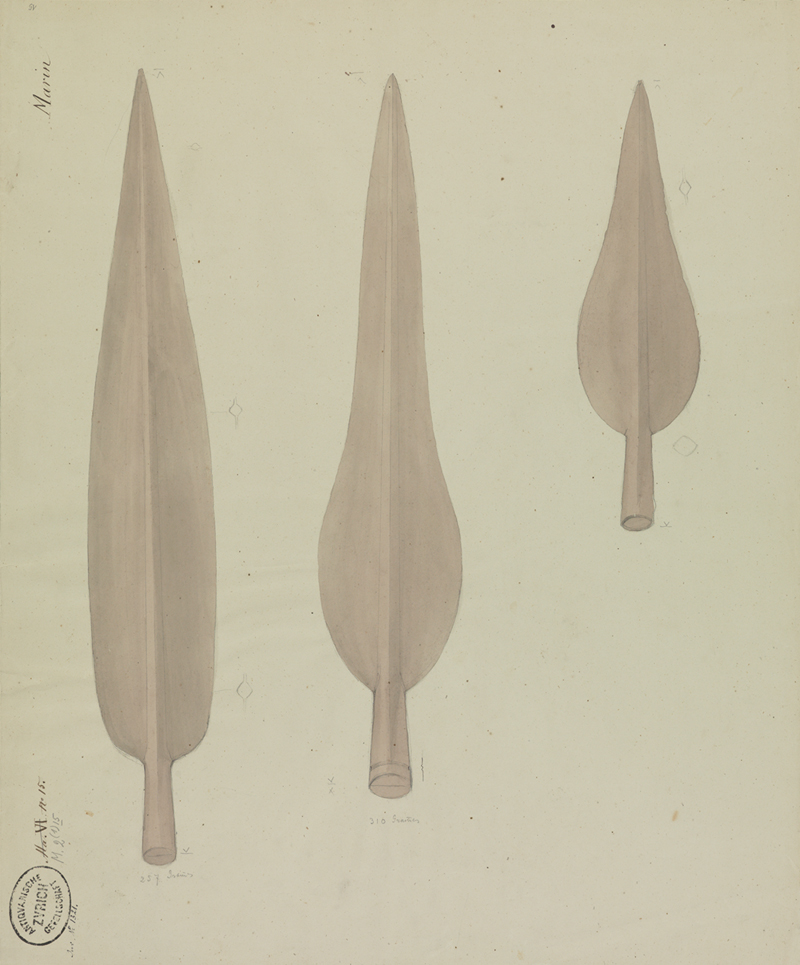
While most of the objects in London are typical examples and might be regarded as ‘doubles’ from a collection, they include some fine examples. The decorated scabbard (no. 1) was illustrated in Keller’s 1866 Pfahlbauten Bericht (fig 21b) and one, perhaps two, spears were illustrated shortly after their discovery. The wavy spearhead (no. 11) was illustrated by Marie Favre-Guillarmod (fig 22) and another spear (no. 10) may be one shown in a water colour (fig 23).Footnote 97
Sword and scabbard no.1, as illustrated in: a) a watercolour by Louis Favre in the 1850s (reproduced by courtesy of the Staatsarchiv des Kantons Zürich); and b) in Ferdinand Keller’s Pfaulbauten Bericht of 1866, Taf. xi, 32 (after Keller Reference Keller1866b).

Spear no. 11 illustrated (far right) by Marie Favre-Guillarmod c 1860. Reproduced by courtesy of Laténium.

Spears from La Tène as illustrated in the 1850s. The spear in the middle of the watercolour may be spear no. 10 in the British Museum. Reproduced by courtesy of the Staatsarchiv des Kantons Zürich.

THE INTERPRETATION OF LA TÈNE
The re-examination of Schwab’s and Desor’s accounts has provided important insights into the context of the objects found in 1857–8 and 1863–5. Although the topographic changes caused by the Jura Water Correction of 1879 mean that it is now impossible to locate their exact find-spots, it is clear that most of them were retrieved from deposits of peat and silt, though the ones found in 1857–8 were found on the top of a small mound of broken stones called ténevière that was covered by only 0.6m of water (Zone 1). That mound may be later, perhaps medieval, and waves breaking against it may have caused the erosion of the find-bearing sediments.Footnote 98
The 1863–5 finds came from a nearby but discrete area (Zone 2) that was covered by 1–1.5m of water. Most of the objects from this zone were found within a few square metres in which lower water occasionally exposed structural timbers.Footnote 99 In 1865 the pêcheur Friedrich Gerber recorded a depression in the lake bed and observed stakes, wattling and wooden beams that he thought were on the bank of an old course of the Thielle (fig 24).Footnote 100 In contrast, the objects found in the 1907–17 excavations were from the old river channel.
Location of finds made at La Tène in the 1850s and 1860 and Pont Desor. From a map started by Emanuel Müller and completed by F Schwab (c 1860). The circle on the left below Pré Fargier indicates the location of the earliest finds. Reproduced by courtesy of the Neues Museum Biel and Laténium.

In 1885 Émile Vouga thought that the 1857–8 and 1863–5 finds had been found close to Pont Desor. This was because he found that most of the old channel of the Thielle was covered by a thick layer of gravel. As this gravel was absent close to Pont Desor, he deduced that it was the location of the soft alluvial sediments.Footnote 101
Lejars has questioned Vouga’s conclusion. When viewed as assemblages, the objects found by fishing in 1857–8 and 1863–5 and by excavation in 1884 and 1907–17 are almost identical. There are, however, some small differences that Lejars considers significant.
Half of the objects collected by the pêcheurs in 1857–8 and 1863–5 are less than 50mm long, but objects of this size were rarely found in the channel of the Thielle. The preservation of organic materials on the weapons also differs. Wood survived only in the spear ferrules found by pêcheurs and Lejars suggests this was because the ferrules had been rammed into the ground, whereas their shafts were exposed to the air and so decayed. The remains of wooden sword handles were also found occasionally in 1857–8 and 1863–5, but none was found in the 1907–17 excavations. Lejars deduces from these observations that, while the objects found by the pêcheurs had originally been in the open air, they were found close to their original location. In contrast, the larger and sometimes damaged objects without any organic remains found in the old river channel had been redeposited.Footnote 102
This conclusion challenges the popular view that the objects had been thrown into the river or were originally displayed on Pont Desor. This has been the interpretation presented in Britain when La Tène is used as a comparison for Iron Age finds from watery contexts.Footnote 103 Both Felix Müller and Thierry Lejars have proposed a more gruesome interpretation that is based on the results of recent excavations at Iron Age sanctuaries in northern France.Footnote 104
At Gournay-sur-Aronde, Oise, a temple stood in the centre of a rectilinear enclosure defined by a ditch, bank and palisade. Different species of animals were placed in discrete locations in the ditch alongside hundreds of broken weapons, many of which had been systematically mutilated. These weapons are suggested to have been initially displayed on freestanding posts in the enclosure before being placed in the ditch. The sanctuary was used between the fourth and second centuries bc, with the principal activity dating to c 280–150 bc (La Tène C1a–C2).Footnote 105
There was also a ditched and palisaded enclosure at Ribemont-sur-Ancre, Somme, and although many of the finds are similar to those at Gournay-sur-Aronde, the interpretation of their deposition is quite different. At Ribemont the decapitated remains of hundreds of males, mostly young men, were found along with thousands of weapons. Many of the bodies have evidence of wounds, some of which were the cause of death, but others were inflicted post-mortem. Unlike Gournay, few of the weapons at Ribemont had been damaged deliberately. The human remains were found in two principal types of deposit: scatters of articulated but decapitated remains; and piles of long bones arranged around posts. There were at least four of such ossuaries. The site is interpreted as a trophy on which the slaughtered and decapitated remains of an army and their weapons were displayed on galleries inside the palisade. Their decomposing bodies eventually slumped to the ground to form the deposits of articulated bones from which long bones were later removed to create the ossuaries. The associated objects are a homogenous typological group that dates to 250–200 bc (La Tène C1b).Footnote 106
These discoveries led Müller to reinterpret the Berne-Tiefenau Massenfund, which largely comprises martial equipment including many deliberately destroyed swords, as the remains of a trophy,Footnote 107 and a comparable interpretation has been developed for La Tène.Footnote 108
Lejars has argued in detail that the similarities between the assemblages from La Tène and Ribemont-sur-Ancre, notably the presence of human remains and the rarity of the deliberate mutilation of arms seen at Gournay-sur-Aronde, are because La Tène was also a trophy. He suggests that the timbers seen in the lake in 1864–6 and those found on the banks of the channel by Émile Vouga in the 1880–5 and interpreted by him as buildings, may all be part of the structure. The exact form of the trophy and how Pont Vouga related to it are unknown, but the objects, human remains and horses’ heads are argued to have been displayed on it; objects such as the bronze cauldrons and the wooden vessels may have been used in ceremonies. The gold torque is suggested to have been displayed on a life-size wooden figure.
The finds recovered by the pêcheurs are suggested to have fallen from the trophy onto the river banks before slipping into the water and being covered by alluvial sediments. In contrast, the finds found in the old river channel were in derived contexts, having been washed downstream, and may originally have been on different parts of the structure. Eventually, the trophy collapsed into the Thielle, which slowly silted up, perhaps after Pont Desor went out of use.Footnote 109
Although this interpretation draws on recent excavations in France, La Tène is one of a group of sites in west Switzerland where weapons have been found in watery contexts. These include Port, c 20km to the north on the River Zihl, the outflow of Lake Biel. This assemblage is dominated by weaponry, including at least sixty swords and sixty spearheads, most of which are contemporary with La Tène. Many of these were found in during the First Jura Water Correction when the Zihl was dredged in 1868–75, but large groups were also retrieved in 1936–8.Footnote 110 Another assemblage that was also found during the First Jura Water Correction comes from Port-de-Joressant, 5km south east of La Tène on the River Broye, which flows between Lakes Morat and Neuchâtel. It included several swords, spears and sickles, but the finds were dispersed and the site remains poorly understood.Footnote 111 Other sites have yielded small numbers of finds from watery contexts, often weapons (for example, Lüscherz on Lake Bienne).Footnote 112 However, not all finds from watery contexts need necessarily be votive offerings. The bridge at Cornaux/les Sauges, just 3km downstream of La Tène on the Thielle, was originally suggested by Hanni Schwab to have been destroyed by a flood that also destroyed La Tène, but it is now known that Cornaux is later, dating to after 135 bc.Footnote 113 Although sometimes interpreted as a votive site,Footnote 114 the case for Cornaux being a bridge that was destroyed by a flood has been carefully restated by Ramseyer. He observes that several of the bodies appear to have been crushed beneath collapsing bridge timbers and the finds appear to represent a domestic assemblage strewn around by flood water rather than a series of votive offerings.Footnote 115
CONCLUSION
Discovered in 1857 in the early years of ‘Lake Dwelling Fever’, La Tène has played a key role in the development of European prehistory. Its discovery helped the pre-Roman Iron Age to be identified, correctly dated and divided into earlier and later phases, within a decade. Augustus Franks, who bought the finds in the British Museum, was part of the European network of scholars who took those steps, and his travels and personal connections helped him be arguably the first person to correctly identify Celtic art. If, as seems likely, Franks bought objects from La Tène in Paris at the Exposition Universelle of 1867, it was at an event intended to use these personal networks to create a body that could establish the scientific basis of the three-age system on an international basis and define prehistory as a separate field of study. The latest interpretation of La Tène is not as a votive site, but a trophaeum on which the bodies and weapons of a defeated army were displayed in c 220–200 bc. This shows that the last word on the site has not been said, but the finds from La Tène in the British Museum carry memories of some of the defining years in the development of European prehistory. They are entitled to have, as Louis Favre said, ‘a certain celebrity’.
ACKNOWLEDGMENTS
The author is grateful to Drs Julia Farley and Neil Wilkin, British Museum, and Jody Joy, University of Cambridge Museum of Archaeology and Anthropology, for their help and for arranging for the provision of the drawings, which are by Craig Williams (figs 1 and 15–20). Annoshka Rawden and Derrick Chivers kindly searched the Society of Antiquaries’ collection of brass rubbings by Augustus Franks. Eveline Isler and Martin Leonhard, Staatsarchiv des Kantons Zürich, provided copies of Friedrich Schwab’s letters to Ferdinand Keller and images. Dr Thierry Lejars (UMR8546 CNRS-ENS) shared his unrivalled knowledge of Iron Age weaponry and Dr Laurent Olivier (Musée d’Archéologie national), provided information of the finds in Paris, as did Dr Martin Schönfelder on those in the Römisch-Germanisches Zentralmuseum, Mainz.
The author is particularly grateful to the project director, Professor Gilbert Kaenel (University of Lausanne), and Dr Gianna Reginelli Servais (Laténium) for their help in answering queries, providing images and commenting on the draft text, as did Dr Marc-Antoine Kaeser (Laténium), Dr Jill Cook (British Museum) and Professor Peter Rowley-Conwy (University of Durham).
Some years ago, the Schweizerischen Eidgenössischen Stipendienkommission für ausländische Studierende awarded the author a Europaräts-Stipendium to study in Basel for a year as part of his doctoral research, so I am pleased to contribute to this collaboration on La Tène; Fonds National Suisse de la recherche scientifique, projects 100012–113845 and 100012–134964.
Supplementary Material
The supplementary material for this paper can be found at https://doi.org/10.1017/S0003581518000550
ABBREVIATIONS AND BIBLIOGRAPHY
Abbreviations
- Laténium
Laténium, parc et musée d’archéologie de Neuchâtel, Hauterive
- StAZH
Staatsarchiv des Kantons Zürich, Zurich