INTRODUCTION
In spite of the current increase in the number of young learners of foreign languages (FLs) in many parts of the world, research on the linguistic and nonlinguistic outcomes of this population is scarce. Comparative studies have consistently shown that the learning rate of younger learners (i.e., in primary school) is slower than that of older learners (i.e., in secondary school) (Muñoz, Reference Muñoz2008), but an early start has been encouraged on the basis that the main gains in this period lie in the development of positive attitudes and motivation (e.g., Edelenbos & Kubanek, Reference Edelenbos, Kubanek and Nikolov2009). This view seems to rest on the assumption that an early start will have long-lasting positive effects on learners’ attitudes and motivation that will remain unchanged over their language learning trajectories, which is at odds with the currently prevailing notion that motivation is a complex and evolutionary process that fluctuates over time (Ryan & Dörnyei, Reference Ryan, Dörnyei and Berndt2013). However, we still know very little about young learners’ motivational development. A recent review of studies on second language (L2) motivation that were published between 2005 and 2014 (Boo, Dörnyei, & Ryan, Reference Boo, Dörnyei and Ryan2015) found that, while secondary school students are underrepresented, primary school pupils are virtually absent from systematic research. However, motivation is a crucial factor for young school learners because they may be expected to study the FL over many years. Because research has shown the strong impact of motives associated with the L2 course, the teacher, and the learner group (e.g., Oxford & Shearin, Reference Oxford and Shearin1994), one may predict fluctuations of these motives for each L2 course, teacher, and group over the FL learning period. In fact, one may predict even more fluctuations in this group than in other age groups, given the many and rapid changes happening in this life stage and the dynamic and contextualized nature of motivation (Kim, Reference Kim2005; Ushioda, Reference Ushioda, Dornyei and Ushioda2009).
In this study we looked at the trajectories of a group of young learners of English as a foreign language (EFL) from age 6 (Grade 1 of primary school) to age 16 (Grade 10 of secondary school) using a mixed-model design. We examined their outcomes in relation to their language-learning aptitude and motivation, and we observed the fluctuations in their motivation and attitudes toward English learning over a 10-year period. The triangulation of data from different sources, and principally from yearly individual interviews, provided us with valuable insights to better understand the role played by internal and external factors in those trajectories.
BACKGROUND
This literature review focuses on studies that have addressed changes in motivation, attitudes, and perceptions in young learners in primary and compulsory secondary school. A frequent finding of these studies is that, similar to when FLs were introduced at the start of secondary school, the positive attitudes shown in the first years of primary school wane after a while. The decline has been observed in the transition to secondary school as well as during primary schooling (Bolster, Ballandier-Brown, & Rea-Dickens, Reference Bolster, Ballandier-Brown and Rea-Dickens2004; Cable et al., Reference Cable, Driscoll, Mitchell, Sing, Cremin, Earl and Heins2010; Mihaljević Djigunovic & Lopriore, Reference Mihaljević Djigunovic, Lopriore and Enever2011). In the transition from primary to secondary school, two demotivating factors have been noted. One is lack of continuity in teaching methodology (e.g., Edelenbos & Kubanek, Reference Edelenbos, Kubanek and Nikolov2009), specifically a stronger focus on literacy. A second problem is the lack of reliance on what children already know, which may also have a negative effect on their sense of competence (e.g., Courtney, Reference Courtney2014; Nikolov & Curtain, Reference Nikolov, Curtain, Nikolov and Curtain2000). A general decline in motivation has also been observed with respect to different subjects at around the age of 10, which has been related to learners’ becoming more accurate or realistic, and hence potentially more negative, in their self-assessments (Wigfield et al., Reference Wigfield, Eccles, Yoon, Harold, Arbreton, Freedman-Doan and Blumenfeld1997). However, there is also evidence that perceptions of progress as they grow older may enhance motivation (Spinath & Steinmayr, Reference Spinath and Steinmayr2008).
In FL studies, several classroom-related factors have been identified as responsible for school learners’ decline in motivation. For example, Nikolov (Reference Nikolov1999) investigated EFL motivation of three cohorts of Hungarian students (aged 6 to 14). Out of a total of 84 students, 45 were followed longitudinally for 8 years. The same questionnaire, with an open-ended question format, was used over the 8-year period to assess attitudes to the language learning situation and motivation. The study found that the most important motivating factors were classroom related: intrinsically motivating (i.e., enjoyable and satisfying) activities, tasks and materials, and the teacher. Instrumental motives (those that are related to long-term benefits concerning work, education, and economic advantage) emerged around the age of 11 or 12, and the 11- to 14-year-olds stated more utilitarian reasons (e.g., “it will be useful”) than the younger children. However, integrative motives (those that are related to a positive relationship with speakers of the target language) were not identified in the answers to open questions. More generally, Nikolov (Reference Nikolov and Nikolov2009) concluded, from the analysis of data collected in large-scale studies in Hungary, that teachers’ eclectic methods may “be responsible for very slow development over the years and learners’ loss of motivation over time.” (p. 106).
In typical FL classrooms, contact with the target language may be very limited. In Japan, Carreira (Reference Carreira2006) compared intrinsic and extrinsic motivation (motivation to get sufficient rewards from the activity itself and motivation to obtain an external reward, respectively) in a group of 174 third graders and a group of 171 sixth graders learning English. A factor analysis of the results of a motivation questionnaire clustered the items into five factors: intrinsic motivation to learn English, interest in foreign countries, caregivers’ encouragement, instrumental motivation, and anxiety. The results showed that, as expected, the third graders scored significantly higher in intrinsic motivation than the sixth graders. But contrary to the researcher's initial hypothesis, the third graders also scored significantly higher in extrinsic motivation (interest in foreign countries and instrumental motivation). Carreira suggested that when learners are in lower grades, they can be satisfied with exciting and fun tasks, but as they grow, their motivation can decrease due to lack of contact with the target language in real terms.
Other reasons that have been suggested to explain the drop-off in motivation are related to learners’ perceptions of themselves as learners and their learning process. The notion of “linguistic self-confidence” (related to the psychological notion of “self-efficacy”; Bandura, Reference Bandura1997) refers to a person's belief that they are able to perform in the L2 and achieve their goals. This notion has been seen to correlate with L2 proficiency in adolescents and adults (Clément, Dörnyei & Noels, Reference Clément, Dörnyei and Noels1994; Graham, Reference Graham2004) and also to have a determinant role in young learners’ attainment. For example, Courtney, Graham, Tonkyn, and Marinis (Reference Courtney, Graham, Tonkyn and Marinis2015) followed a group of English learners of French from Year 5 (n = 254, ages 9–10) to Year 7, the first year of secondary school (n = 165, ages 11–12). Longitudinal data on learner attitudes and motivation were collected via questionnaires and language outcomes through oral tasks. First language literacy scores at the end of primary school were also collected from teacher assessments. A general finding of the study was that the widely held view that all young learners enjoy learning languages is unsupported. More specifically, results showed that self-efficacy was more strongly related to outcomes than general attitudes to language learning and that a number of young learners were already displaying low levels of self-efficacy and lack of progress at the end of primary school. Erler and Macaro (Reference Erler and Macaro2011) investigated self-efficacy in relation to decoding ability (the ability to relate graphemes to phonemes) in French of a large cross-sectional sample of young English adolescents (ages 11–14) over 3 years. This age group in England characteristically shows low motivation for L2 learning. They found that disaffection with continuing French was linked with poor decoding skills, low self-efficacy, and the students’ perception of having no control over their learning. Lack of a sense of progress has also been found to have a negative impact on learners’ motivation in a number of studies (e.g., Lamb, Reference Lamb2007; Macaro, Reference Macaro2008; Nikolov, Reference Nikolov and Nikolov2009). For example, in a study of primary languages in England, Cable et al. (Reference Cable, Driscoll, Mitchell, Sing, Cremin, Earl and Heins2010) found that Grade 3 learners had a more positive attitude toward learning French than Grade 6 learners. Among the third graders, 98.5% stated that they enjoyed the lessons, whereas only 74.6% sixth graders enjoyed French lessons. Some Grade 6 learners found lessons boring and became frustrated with repeating the same content and making very little progress. In a longitudinal study, Graham, Courtney, Tonkyn, and Marinis (Reference Graham, Courtney, Tonkyn and Marinis2016) followed the development of learners’ motivation for learning French in England, during the transition from primary to secondary schooling. A questionnaire to measure their motivation was administered three times: in Grade 6 (n = 233), in the middle of the first term of Grade 7 (n = 161), and at the end of Grade 7 (n = 99). Learners showed higher levels of motivation in Grade 7 than in Grade 6, although by the end of Grade 7, they expressed less positive attitudes toward learning French than at the beginning of the year, low levels of self-efficacy for communication with native speakers, and less optimism about future progress. The researchers concluded that learners’ motivation seemed to be negatively affected by their classroom experiences, in particular by activities that they felt did not help them to learn effectively and to make continuing progress. According to these researchers, to halt this decline in motivation, greater alignment was needed between what learners valued about learning French (to use it for travel and communication) and what French lessons equipped them to do (see also Courtney, Reference Courtney2014).
As the review of previous research shows, there is evidence of significant changes in young learners’ motivational trajectories. The present study was motivated by the lack of longitudinal studies involving young learners and the need to explain the variability in their outcomes. A quantitative analysis looks at the association of learners’ linguistic outcomes at two time points (after 6 years and 10 years of English learning) with internal factors such as aptitude and motivation. A qualitative analysis looks at their language-learning experiences in depth. The general aim of the study was to examine young learners’ trajectories in English language learning to shed light on the internal and external factors that determine linguistic and affective outcomes and drive changes in those trajectories. The specific research questions of the study were:
1. To what extent is learners’ language achievement at the end of compulsory secondary school related to their achievement at the end of primary school and to their aptitude and motivation?
2. In what ways have learners’ individual motivational trajectories changed throughout their 10 years of English learning?
3. In what ways were their trajectories affected by internal (motivation) and external (classroom, family, and out-of-class exposure) factors?
THE STUDY
Participants
Participants in this study were 14 EFL learners from three state schools in the city of Barcelona. They were all Catalan-Spanish bilinguals, most of them balanced bilinguals. They were followed from the first grade of primary education (age 6) to the last grade of compulsory secondary education (age 16). They were a subsample of the participants in a larger research project that was initiated as part of the ELLiE (Early Language Learning in Europe) project (Enever, Reference Enever2011). When the ELLiE project finished after 4 years, at the end of fourth grade, the Spanish sample was followed for 6 more years until the end of compulsory secondary education. The participants in the current study were drawn from the focal learners in the Spanish sample of ELLiE. They had been selected by their teachers as representative of different types of school performance. Parental permission was obtained for each participant through the school.
The three participating schools (A, B, C) were similar to each other in that students in each school came from a wide range of socioeconomic backgrounds: School B had the highest proportion of parents with tertiary education, and School C the lowest. From a methodological point of view, School C was distinctive because it followed a project-based methodology, School A implemented content and language integrated learning (CLIL) in the science class in Grades 5 and 6, and School B was the most form-focused in the last 2 years of primary school. English teachers in each school varied in teaching and classroom management skills. Learners in each primary school moved together to the same high school, and although classes could not be observed then, teachers’ interviews also showed a wide variety of teaching styles but a common focus on grammar.
Method
Data Collection Instruments and Procedures
This longitudinal study follows a mixed-method approach to examine the language learning histories of 14 learners of EFL over a period of 10 years. It uses two indicators of English language achievement: the scores obtained in an official external examination in Grade 6 (including listening and reading comprehension and written production), considered a reliable indicator of students’ English language achievement at the end of primary school; and the final course grades at the end of secondary school (Grade 10), with the exception of one student who was repeating Grade 9.
Learners’ language-learning aptitude was measured by means of the MLAT-E (elementary version of the Modern Language Aptitude Test) in its Catalan adaptation (Suárez, Reference Suárez2010). The test was administered to intact classes in Grade 6. It consists of four parts: Hidden Words, Matching Words, Finding Rhymes, and Number Learning. To examine learners’ motivation and attitudes toward English, this study used their answers to a questionnaire with smiley face questions, which was administered every year (e.g., Do you like English this year?) and adapted to children's increasing age. After performing item internal consistency tests, after Grade 3, the number of items increased from three to seven, and the answer choice (the smileys representing a range of sentiments from positive to neutral to negative) was expanded from the initial 3-point Likert scale to a 5-point one.
The learners in the current study were interviewed individually once a year in Grades 1 through 4; twice a year in Grades 5, 6, and 7; and a final time in Grade 10 (or 9 in one case). The interviews were conducted in Catalan (the school language), and in almost all occasions, the author was the interviewer, who over the years had built a strong rapport with them. The interviews were semistructured, where the learners could freely express their perceptions of their own learning process and their attitudes toward the classroom and the teacher. The interviews were coded inductively using NVivo and deductively for the topics that had emerged as relevant over the whole period (e.g., parents’ influence). These learners had also been observed by the author in their English lessons twice a year during primary education to triangulate their reports about their attitudes in class and those of their teachers, who were also interviewed twice a year.
Two take-home questionnaires for parents were also used, for Grades 1 and 4. The questionnaires asked parents about their child's attitude toward English and their extracurricular exposure to the language, about parents’ own attitudes toward English language learning, about their educational level and knowledge of English, and about English exposure and languages spoken in the home. For this and the above instruments, see the ELLiE Research Instruments website, at www.ubgral.com/ellie-research-instruments.html.
Results
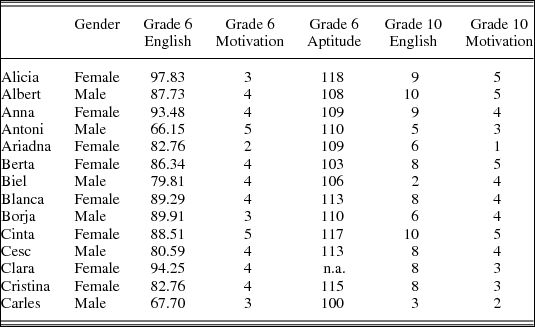
To answer the first research question, English language achievement, aptitude, and motivation (as measured by the smiley questionnaire) were examined. Table 1 provides information about these learners’ English language outcomes: scores on the English test at the end of primary school (maximum score = 100), the final course grades in Grade 10 at the end of obligatory secondary school (maximum score = 10), the scores on the aptitude test (maximum score = 123) that they took in Grade 6, and the average scores from the motivation questionnaire in Grade 6 and in Grade 10. The first letter in the learners’ pseudonyms represents their respective school (A, B, C).
Descriptive Data on Language Outcomes and Aptitude

The data in Table 1 show several trends. Students with high scores in English in Grade 10 had high scores in Grade 6. Students with high scores in Grade 10 tend to be more motivated and have higher aptitude scores than those with lower English scores. However, English scores, aptitude, and motivation in Grade 6 do not seem to be strongly related. Neither is motivation in Grade 6 strongly related to motivation or scores in Grade 10.
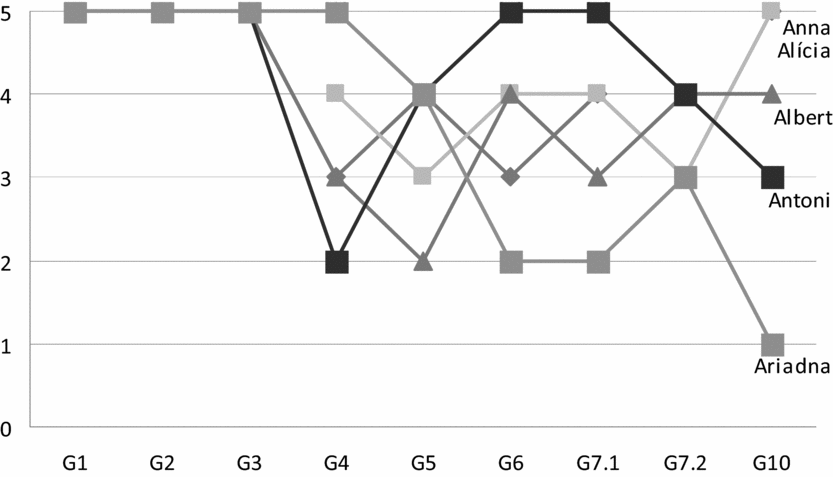
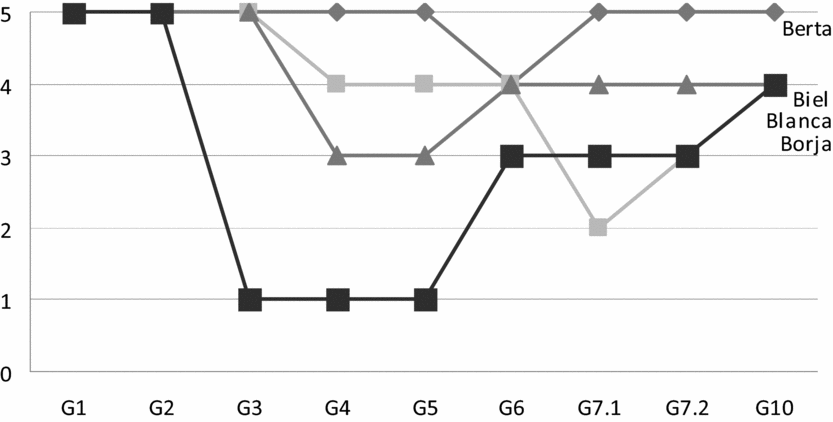
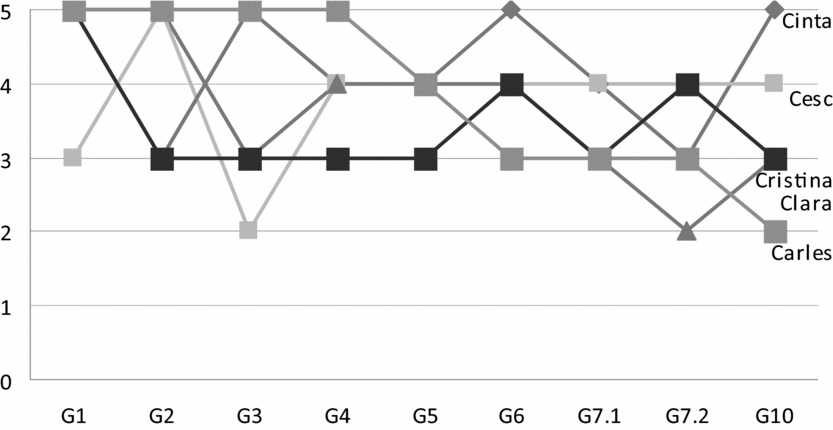
To address the second research question, the participants’ answers to the attitude questionnaire that was administered nine times over 10 years are presented in Figures 1, 2, and 3, one for each school: A, B, and C. (Two students were absent from class at one of the points in School A). The scale used in Grades 1 through 3 had only 3 points, and an equivalence has been worked out so that 3 was converted into 5, 2 into 3, and 2 into 1.
Learners in School A

Learners in School B

Learners in School C

The graphs show attitudinal trajectories that begin with a very positive start in Grade 1 but are not horizontal. Changes occur at the different time points, and in many cases, a decline appears as early as Grade 2 or 3. Differences between the three schools are also visible, but the type of instruction in each does not seem to have a distinctive effect on learners’ motivation. School A shows a greater uniformity from Grades 1 to 3, with the five learners choosing the happiest face at all three data points. Variability starts in Grade 4 and continues until the end. In School B, we see one student (Borja) who was unhappy with English after Grade 2, but was recovering in the last grade of primary school and in Grade 10. Also interesting is the case of Berta, who seemed to be perfectly happy with English all along, with only a slight decrease in Grade 6. In School C, variability starts in Grade 1. Only one student (Carles) showed a linear decline with no upward changes, while the others experienced upward and downward changes.
The third research question looks into the factors that appear to have significantly contributed to these learners’ trajectories over their 10 years of learning English at school. Data triangulation identified five issues, among those elicited by the interviews, that appear to play a significant role in the students’ learning experiences. They are illustrated with the cases of the most successful and the least successful learners, in order to better show how the different factors interact and push trajectories in different directions. The former group includes Alicia, Anna, Albert, and Cinta, those with the highest final mark and a positive or very positive attitude toward English in Grade 10. In the latter group, there are two learners whose final course grade was very low: Biel and Carles. Biel expressed a positive attitude toward English at the end, though it was more negative at the beginning of secondary school, and Carles was repeating Grade 9 at the last data collection point and his attitude suffered a linear decline beginning in Grade 5.
Motivation
These learners’ motivation toward English is largely influenced by its role as a world language. An international orientation was already evident in Grade 1 by Cinta, when she alluded to the fact that most people know English, so it would allow her to communicate with other people even if they didn't know Spanish. It was also visible in Albert's constant concern in primary school over the need to go abroad to find a job when he was grown up, and in his choice of speaking as the most helpful classroom activity for his future travels. Although Carles had not internalized the international value of English in all these years, just before the last interview, he participated in a sport competition abroad and discovered that he could communicate with other boys from around the world who practiced his street sport (his WhatsApp chats contained expressions not learned in class: “bro” and “hey man”).
All these learners were aware of the potential importance of English for their lives, although some could better imagine themselves as actual users of the language, while for others, this was still something pushed on them by their parents and society. For Alicia, English was seen as the key to getting a good job, as her mother did. Albert said: “English has opened new doors to me like international marketing.” Some have always loved the language, like Cinta and Anna. For example, in Grade 5 Anna said that “knowing English makes me feel good,” while at the same time she had internalized her parents’ interest in her knowing the language (she had attended private lessons ever since Grade 1). She said that learning English is “essential” and that “everybody should have the right to know English.” Some had come to love it more when they had been able to use it in a meaningful way. This is the case of Albert in Grade 10 after spending a whole week with a Dutch exchange student at home: “If I could, I would talk in English all the time.” The four successful learners had also studied other FLs as optional subjects in secondary school (Albert, Cinta, Alicia) or in a private language school (Anna). Alicia and Albert took French in secondary school for 3 years. Albert did not intend to continue it in the next, more demanding, educational phase. Cinta took French in Grade 10 (which she found easy because of its similarity with Spanish), and Anna took German (which she found easier to learn thanks to knowing English).
Parents’ Encouragement and Model
All 14 participants started off saying that their parents were happy with the English they learned, and this was confirmed by the positive answers in the parents’ questionnaires. Only one of the participants (Carles) said that he does not talk with his parents about English, and they do not encourage him to learn languages. On the questionnaires, his parents reported that they both had a low educational level and did not know English, while they expressed positive attitudes toward the language.
For all of the most successful participants, parents seemed to play a fundamental role, encouraging their motivation toward English and other languages. For example, Anna in Grade 7 echoed what she reported her parents saying in Grade 2, that with many languages, one could go to more places. Cinta's parents rated English as one of the most important school subjects in the questionnaire. Anna's parents took her to a private language school in Grade 1, which she attended for the duration of this study. She reported that her mother, who knew English, tried to get her and her sibling to watch their television shows in English, but they found this difficult. In the interviews, Albert reported that his parents were very encouraging and interested in his school performance. His father was a teacher and knew some English. His parents tried to convince him to attend extracurricular English lessons in primary school. He finally did so in Grade 7. For Alicia, her mother was her role model. She firmly believed that if she spoke good English, she would have more opportunities to get a job, as her mother did when the family moved to Barcelona when she was 5 years old. In the final years of primary school, when her attitude toward English was more negative, she also reported that her parents were critical of her pronunciation and of the English lessons. In the final years of secondary school, her mother allowed her to watch English-speaking television shows every day for one and a half hour after she had completed her homework.
Classroom-Related Factors
Both individual teaching styles and the teaching approaches used in the different educational phases appear as strong determinants of these learners’ attitudes. Participants often commented on their teachers’ classroom management styles: Both what was considered too strict and too lenient were criticized, and both influenced individual participants’ attitudes toward English. The effect of shifting teaching approaches can be seen in the attitudinal changes that occurred with each new phase in primary education (Grades 1–2, 3–4, 5–6), which implies an increase in literacy orientation and a change of teacher. Figures 1 through 3 show a decline in positive attitudes across phases in primary school, with most learners having complained that they played less and were then asked to write. For example, in Grade 4, Biel complained that the exercises were difficult and said that “you need to think hard.” He started finding English difficult in Grade 4, and ever since then, the only activity he liked to do in English was reading his textbook. Cinta, a hard-working student, resented the change of teacher and focus in Grade 3: “Before, we talked more and learned more things”.
The transition to secondary school was perceived differently and depended a great deal on each individual's experience in primary school. Some resented the change from fun tasks to literacy-related tasks, while some welcomed the change to more explicit teaching and learning. At the interview in Grade 10, Albert compared learning English in primary and in secondary school as follows: “In primary school it was through repetition. You may not have understood it, but you retained it through repetition. Now in secondary school you are required some understanding . . . you cannot memorize a whole language, you need to see how it works, and this they have to some extent taught to us these years.” However, many resented the exclusive focus on grammar in their classes. For example, Cinta again was very critical and found it hard to get used to a grammar-oriented methodology after thoroughly enjoying a project-based communicative methodology in primary school. But even then, she was attentive and participated in class; in Grade 7 she confessed that she volunteered a lot in class “to fight boredom.” Biel and Carles found grammar difficult. Carles said that he would have dropped English if he could have done so. He admitted that he was not very attentive in class and found it difficult to make sentences, to put words together. When English became a more formal school subject, he did not have a solid base on which to build the grammar that was taught, and he seemingly gave up on making any effort to catch up.
After their first few years in secondary school, some participants complained that classes were repetitive and not challenging enough. This is especially the case with those participants who enjoyed opportunities to learn the language outside the school, like Alicia, Anna, and Albert. For Cinta, a high-achieving student, learning opportunities in the classroom seemed to have reached a ceiling.
Extracurricular English Lessons
For those participants who attended extracurricular lessons, their learning experience outside the school had a great influence on how they interpreted their school experience.
The case of Albert is illustrative. Throughout primary school, he did not have a very favorable attitude toward the English subject (although his teachers always found him attentive and eager to learn). He yearned for real contact with the language and was frustrated by the slow pace in school and his lack of progress. For example, in Year 5 he complained that his English was not improving because nobody in his family spoke English (he compared himself implicitly with a bilingual classmate whose father was a native speaker of English). After years of parental insistence, he joined a language school at the beginning of secondary school. This enhanced his feeling of learning, self-efficacy, and motivation: “English is a positive thing for me.” However, this high motivation did not extend to English as a subject: “I like the language school English, not the English here.” He complained that the pace was slow and repetitive: “We are studying now here what I studied at the language school two years ago.” This time lag between content taught in private schools (with more focused lessons and small groups) and in regular schools (with very diverse and larger groups) was already felt by Anna in Grade 4, when she complained that school English was sometimes boring because she had learned it before in the language school. She also noted that her pronunciation was better than that of her classmates. This perception seems to be reflected in her attitude in the classroom: In Grade 6, her teacher portrayed her as a bit conceited and sometimes inattentive in class.
Learning From Out-of-School Exposure
Out-of-school learning appears to be a determining factor in the learning histories of some participants. The case of Alicia is the most striking. She was a hard-working but shy student, and classroom observations and teacher reports confirmed that, as she admitted, she did not participate in class. Her attitude toward English started declining in Grade 4, but by the end of Grade 10, she had a very positive attitude toward the English language that she acquired through watching shows on the internet. She started watching the shows in Grade 8, first with subtitles in Spanish or English and now without subtitles because, she said, after 3 years, she became familiar with the vocabulary of the cop series genre. Because of her shyness, individual learning through shows seemed to be an ideal, anxious-free situation, where she could learn much better and enjoy the experience. Another example of effective out-of-school learning and practice is provided by exchange experiences with students from abroad with whom participants spoke English. For Albert, finally being able to speak nonstop for a week with a Dutch exchange pal was a source of indescribable pleasure and rekindled his motivation.
Real contact with the language outside school had a strong effect on the two least successful learners as well. Biel met the American exchange pal of a classmate, and in an interview a year later, he said the best way to learn a language would be through communicating with somebody like that. Carles used the little English he knew for the first time just before the last interview. Previously, he had never had any contact with English or any reason to learn it and had not met any English speakers. However, 2 weeks before the interview, he participated in a street sport competition abroad that radically changed his views about English. Since then, he started communicating intensively with other international participants, sharing videos and writing in English (with very simple and often ungrammatical phrases) in WhatsApp chats. Then he wanted to learn English to the level where “he can speak it everywhere,” but he was not interested in any certificate or in learning school English. He said that when he finishes secondary school, he intends to study within a vocational module related to sports and in the future, and he sees himself traveling, working, and speaking English abroad. For the first time, learning English has meant something to him: to be able to communicate with people who share his sports interests. English has become a necessary tool for his imagined successful international sports career.
DISCUSSION AND CONCLUSION
The first research question of this study inquired about the relationship between learners’ language achievement and their aptitude and motivation. Strong associations were observed between the English scores in Grades 6 and 10 (Grade 9 in the case of Carles) and between English scores in Grade 10 and motivation in Grade 10 but not in Grade 6, which points to the changing nature of this factor over these 4 years. Scores in Grade 10 were also highly associated with aptitude (measured in Grade 6). This is in line with previous longitudinal studies that show aptitude to be a strong predictor of L2 achievement in secondary school students (e.g., Sparks, Patton, Ganschow, & Humbach, Reference Sparks, Patton, Ganschow and Humbach2009) and in primary school learners (Muñoz, Reference Muñoz, Pawlak and Aronin2014). This result also contradicts the position that traditional aptitude tests are not relevant for young learners because they target the product of explicit learning and young learners largely use implicit learning mechanisms. As has been discussed in previous studies (e.g., DeKeyser, Reference DeKeyser2000; Muñoz, Reference Muñoz2008), input-limited classrooms do not provide the massive exposure needed for implicit learning mechanisms to be activated. The strong association found between MLAT-E and language achievement scores provides supportive evidence against the belief that young learners in such school settings are primarily learning implicitly.
The analysis addressing the second research question showed trajectories with very positive attitudes at the beginning of primary school, with some early declines, and increases in later grades. Two observations emerge from those profiles. One is the confirmation of previous findings that not all young learners enjoy FL learning (Copland, Garton, & Burns, Reference Copland, Garton and Burns2014; Courtney et al., Reference Courtney, Graham, Tonkyn and Marinis2015), or not always. The other is that different patterns seem to emerge from the experiences in the different schools, which highlights the importance of the school environment and the contextualized nature of those trajectories (Ushioda, Reference Ushioda, Dornyei and Ushioda2009). These changing trajectories open interesting questions as to the source of change, while the more horizontal trajectories over such a long time are also intriguing and may point to a strong motivation that is resilient in the face of change.
Such issues are illuminated by the analysis related to the third research question, which explores some of these trajectories in more depth by triangulating the data from multiple sources, and principally from the learner interviews. In relation to some of the changes seen above, in many cases, it becomes clear that they are related to teacher and teaching method changes across the different educational phases. Crucially, motivation appears complex and multifaceted. These learners liked the English lessons at the beginning of school because of the fun activities in class, and they enjoyed them less when lessons became more literacy-oriented. It is arguable that their early “liking” can be always interpreted as evidence of intrinsic motivation (enjoyment of learning the language). Later on, for those who express their love of languages and English, an instrumental motive can also be identified in their acknowledgment of the value of English, which is not present in their attitudes toward other FLs. English learning is seen as an obligation for employment reasons and as a necessity for these learners’ aspirations to integrate in the international community (to acquire a “World English Identity”; see Dörnyei, Reference Dörnyei2005), even if virtually through the internet. The international motive or “international posture” (Yashima, Reference Yashima2002) is present in all learners at the end. The importance of English as a global language in their present and future lives makes it easier to see a growing disjuncture between their attitude toward the English language, which tends to be very positive and their attitude toward English as a school subject matter, which is not so positive, and distanced from their initial enjoyment of games and songs.
Parents play a fundamental role in these learners’ attitudes toward English, in line with previous studies conducted in different settings (Butler, Reference Butler2015; Carreira, Reference Carreira2006; Csizér & Kormos, Reference Csizér and Kormos2009; Lamb, Reference Lamb2013; Masgoret, Bernaus, & Gardner, Reference Masgoret, Bernaus, Gardner, Dörnyei and Schmidt2001; Noels, Reference Noels, Dörnyei and Schmidt2001). In the questionnaire, all parents expressed a positive attitude toward English, independent of their educational level or their knowledge of English. However, the parents of the only student who resented their lack of involvement (Carles) had the lowest educational level, which echoes the relation found between parental education and students’ outcomes (achievement and motivation) (Butler, Reference Butler2014, Reference Butler2015). The interviews reveal that, in general, parents encourage their children verbally (through praise and constructive criticism) and may also do so financially (paying for after-school tuition). Parents promote opportunities for language learning (encouraging or letting their children watch English-speaking programs or shows). Parents positively impact the students’ L2 motivation, by showing how English has helped family members in their lives and providing models of English speakers that make it easier for learners to imagine themselves as future users of the language (Dörnyei, Reference Dörnyei2005; Tragant & Muñoz, Reference Tragant and Muñoz2014).
The analysis of learners’ perceptions about their school lessons indicates that, for many of them, lessons are not adequately challenging and involve tiresome repetition, as found in studies in different countries (Cable et al., Reference Cable, Driscoll, Mitchell, Sing, Cremin, Earl and Heins2010; Nikolov, Reference Nikolov and Nikolov2009). Learners associate this with their perception of lack of progress, which also seems to be a common characteristic of school FL learners (Courtney et al., Reference Courtney, Graham, Tonkyn and Marinis2015; Lamb, Reference Lamb2007; Macaro, Reference Macaro2008; Nikolov, Reference Nikolov and Nikolov2009). In contrast, lessons in private language schools, with smaller class sizes, appear to be better able to cater for individual proficiency levels. A consequence, however, is that this results in a negative attitude toward the school lessons, increases the disparity in levels among students in the regular school classrooms, and makes teaching for all even more difficult. Furthermore, for some less successful learners, like the two in this study (with low aptitude scores and self-competence), lessons and learning activities become harder with the increasing focus on literacy.
Another related finding from the exploration of these learners’ stories is the importance of contact with the target language. Input limitations in “drip-feed” classrooms (Stern, Reference Stern1985) are seen as a demotivating factor here, as in studies in other settings (Carreira, Reference Carreira2006; Macaro, Reference Macaro2008), while the extra input offered by private language schools appears to be a source of motivation or remotivation in these learners’ accounts. However, experiences that provide real contact with the language (e.g., exchanges, internet series) push learning and increase motivation, and they appear to be better aligned with learners’ goals than the classroom lessons, as in previous studies (Graham et al., Reference Graham, Courtney, Tonkyn and Marinis2016).
In sum, this study has offered valuable insights from a longitudinal exploration of the first 10 years of compulsory English language instruction. An asset of this study is its longitudinal nature that allows us to see the attitudes displayed by learners at the beginning of learning and the ways in which language experience has led to significant changes in motivation and self-perception. The study has observed macro- and micro-contextual influences on individual learners’ motivation to learn English and the important role of aptitude, all of this resulting in different trajectories of English learning.
Several implications for teachers, schools, and educational authorities can be drawn from this study. One is the need to ensure continuity, in particular across transition from primary to secondary school, through appropriate liaison between teachers and schools. Continuity should ensure that teachers build on the learners’ previous knowledge, avoid unnecessary repetition in the classroom, and avoid learners’ frustration from lack of progress. Looking forward, another implication is the need to recognize the increasing importance of out-of-school learning, to foster such learning opportunities, and to integrate this learning and learners’ real interests toward the language in the classroom.
This study is not without limitations. One is its small sample size, common to research with a qualitative perspective. In future studies the sample can be enlarged with more focal learners and their data enriched with quantitative data on language attainment and attitudes from all the learners in those classes. Other variables that have not been examined here, such as individual teaching practices, will also shed more light on these learners’ processes and outcomes. To conclude, this study has highlighted important challenges for FL teaching, some specific to English and some more general. Understanding those challenges through learners’ voices can contribute toward improving FL teaching and learning in schools.
Acknowledgments
This research was supported by grants from the Lifelong Learning Programme (European Union), RecerCaixa, and ICREA Acadèmia. My most sincere thanks to the students, their schools, and their families, as well as to my co-researcher Elsa Tragant.