Introduction
Lowbush blueberry (Vaccinium angustifolium Aiton (Ericaceae)), an important crop in eastern Canada and the state of Maine in the United States of America, relies heavily on bees (Hymenoptera: Apoidea) for cross-pollination and fruit set (Aras et al. Reference Aras, De Oliveira and Savoie1996; Eaton and Nams Reference Eaton and Nams2012). The crop is typically managed on a two-year cycle of an initial year of vegetative growth (“sprout year”) followed by a second year of fruit development and harvest (“crop year”) (Yarborough Reference Yarborough2012). Managed honey bees (Apis mellifera Linnaeus (Hymenoptera: Apidae)) are often used for blueberry pollination (Yarborough Reference Yarborough1997; Eaton and Nams Reference Eaton and Nams2012), but blueberry growers are interested in using and promoting non-Apis Linnaeus bees to pollinate their crop. Numerous species of wild bees are effective pollinators of blueberry (Javorek et al. Reference Javorek, MacKenzie and Vander Kloet2002; Cutler et al. Reference Cutler, Nams, Craig, Sproule and Sheffield2015) but their abundance can vary, and blueberry growers are usually unable to rely entirely on wild populations for adequate pollination (Eaton and Murray Reference Eaton and Murray1997). Various tactics to boost wild bee populations have been shown to improve pollination of several crops (Vaughan and Black Reference Vaughan and Black2008; Wratten et al. Reference Wratten, Gillespie, Decourtye, Mader and Desneux2012; Blaauw and Isaacs Reference Blaauw and Isaacs2014), and such techniques could be adapted to lowbush blueberry.
Osmia Panzer and Megachile Latreille (Hymenoptera: Megachilidae) collect lowbush blueberry pollen (Drummond and Stubbs Reference Drummond and Stubbs1997; Sheffield et al. Reference Sheffield, Kevan and Smith2003; Hicks Reference Hicks2009) but may not be as abundant in lowbush blueberry agroecosystems as other wild bees (Bushmann and Drummond Reference Bushmann and Drummond2015; Cutler et al. Reference Cutler, Nams, Craig, Sproule and Sheffield2015). Osmia and Megachile species nest in a variety of natural habitats including plant stems and abandoned tunnels in wood from previous insect inhabitants, as well as under rocks, but will also nest in artificial structures made of wood or other materials that mimic their natural nesting substrates (Torchio Reference Torchio1987; Cane et al. Reference Cane, Griswold and Parker2007; Packer et al. Reference Packer, Genaro and Sheffield2007; Hicks Reference Hicks2009; Guisse and Miller Reference Guisse and Miller2011; Sheffield et al. Reference Sheffield, Kevan, Pindar and Packer2013, Reference Sheffield, Wilkes, Cutler and Hermanutz2014). In Nova Scotia, Canada, wax-cardboard milk cartons containing paper tubes were used as artificial nests for solitary bees in apple (Malus Miller (Rosaceae)) pollination, and provided suitable and effective nesting habitat for Osmia tersula Cockerell and other species (Sheffield et al. Reference Sheffield, Kevan, Westby and Smith2008). Certain Osmia species prefer to nest under rocks, and although these populations can be difficult to manage (Cane et al. Reference Cane, Griswold and Parker2007), 10% of overturned clay lids placed in lowbush blueberry fields in Newfoundland, Canada, were used by Osmia inermis Zetterstedt as an artificial nesting substrate (Sheffield et al. Reference Sheffield, Wilkes, Cutler and Hermanutz2014). Despite the potential of artificial nests to support Osmia and Megachile populations in lowbush blueberry (Stubbs et al. Reference Stubbs, Drummond and Algard1997), little research has been published testing nest design and dispersal in lowbush blueberry fields.
Artificial nests were placed in lowbush blueberry fields in Nova Scotia to examine if Megachilidae would nest in these substrates. Nesting occupancy in three different nest designs (milk carton, wooden, and clay lid) was tested. Nesting occupancy was compared between fruit-bearing and vegetative fields for milk cartons and clay lids, and was also compared between field edge and within field for clay lids. Although Osmia and Megachile bees may not be abundant in lowbush blueberry fields (Bushmann and Drummond Reference Bushmann and Drummond2015; Cutler et al. Reference Cutler, Nams, Craig, Sproule and Sheffield2015), we predicted there would be moderate occupancy of nests in this experiment. Nest occupancy (number of capped nesting tubes) and emergence (bees or parasitoids) were evaluated. Nesting occupancy was expected to be higher along the field edge near natural habitat compared to within field, and we predicted that nesting occupancy would be higher in fruit-bearing fields than vegetative fields due to the pollen provided by blueberry flowers. Parasitism was also expected based on previous studies (Drummond and Stubbs Reference Drummond and Stubbs1997; Stubbs et al. Reference Stubbs, Drummond and Algard1997; Sheffield et al. Reference Sheffield, Kevan, Westby and Smith2008; MacIvor and Packer Reference MacIvor and Packer2015), and we quantified occurrence of parasites.
Materials and methods
Artificial nest designs
This study was conducted over two years in Nova Scotia, Canada, with n=4 fields in 2014, and n=12 fields in 2015. In 2014, one milk carton nest design was tested along with eight different wooden nest designs (Supplementary Table S1), while in 2015, only milk carton nests were tested. Nests were placed in lowbush blueberry agro-ecosystems before bloom began, and were monitored throughout the summer. Lowbush blueberry bloom typically begins in mid to late May, until mid to late June. Habitats surrounding all blueberry field sites were generally mixed forests of softwood and hardwood trees, including maple (Acer Linnaeus (Sapindaceae)), fir (Abies Miller (Pinaceae)), and spruce (Picea Dietrich (Pinaceae)), with no other agricultural or developed (urban/industrial) areas within 1000 m of our test plots.
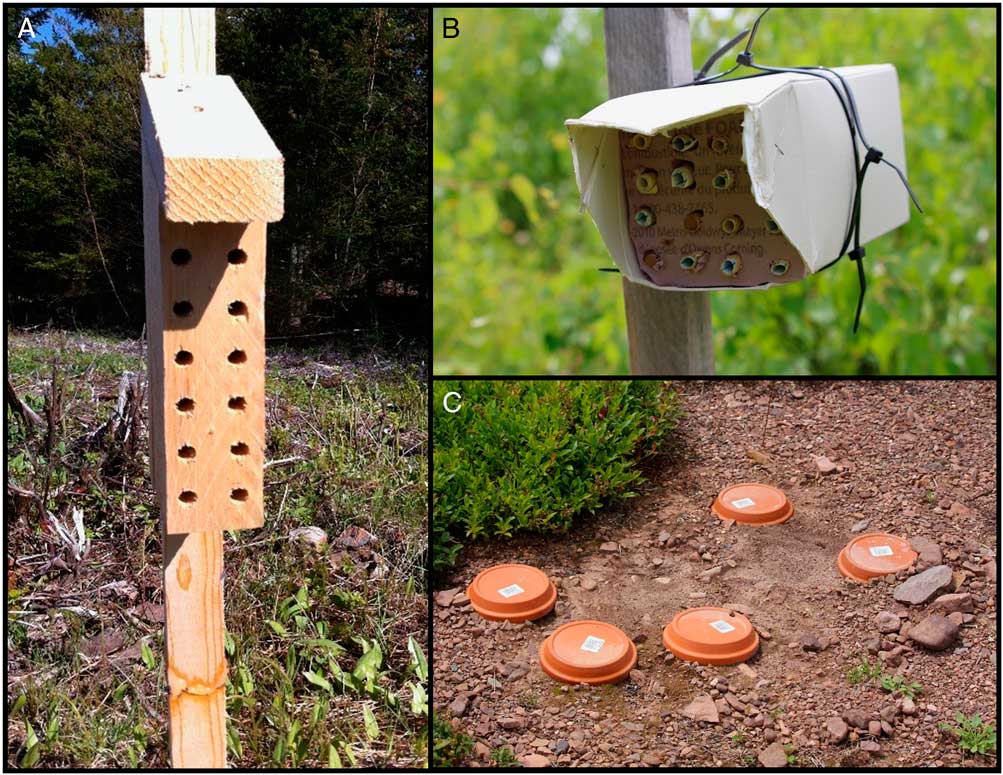
The wooden nests tested in 2014 (9.5 cm deep×5 cm wide×18.5 cm tall) were constructed from spruce wood (Picea) and each contained twelve 8-cm-long drilled holes, either all 0.7 or 0.9 cm in diameter, and approximately 1.5 cm apart (Fig. 1). Two different nesting tube diameters were used as this can be an important factor in nesting occupancy (Westerfelt et al. Reference Westerfelt, Windefalk, Lindelow, Gustafsson and Weslien2015) and preference varies among bees (Fye Reference Fye1965; MacIvor Reference MacIvor2016). The two diameters selected were previously used in trap-nest studies in lowbush blueberry (Drummond and Stubbs Reference Drummond and Stubbs1997; Stubbs et al. Reference Stubbs, Drummond and Algard1997). Some wooden nests had exteriors and roofs that were charred by lightly burning the wood with a propane torch until the wood exterior turned black. Roofs consisted of a 14.5 cm long×5 cm wide×2.5 cm thick piece of wood nailed to the top of the nest, providing an overhang at the front of the nest. These two features were tested as roofs may provide protection from rain and sun (Taki et al. Reference Taki, Boone, Viana, Silva, Kevan and Sheffield2004), and because some blueberry growers have suggested that darker or charred surfaced are attractive to trap-nesting bees.
Artificial nests for Megachilidae bees in Nova Scotia lowbush blueberry fields: A, a wooden nest with a roof; B, milk carton nest (notice-capped nesting tubes); C, terra cotta lids in a blueberry field (photographs by N.L. McLean and R.S. McCallum).
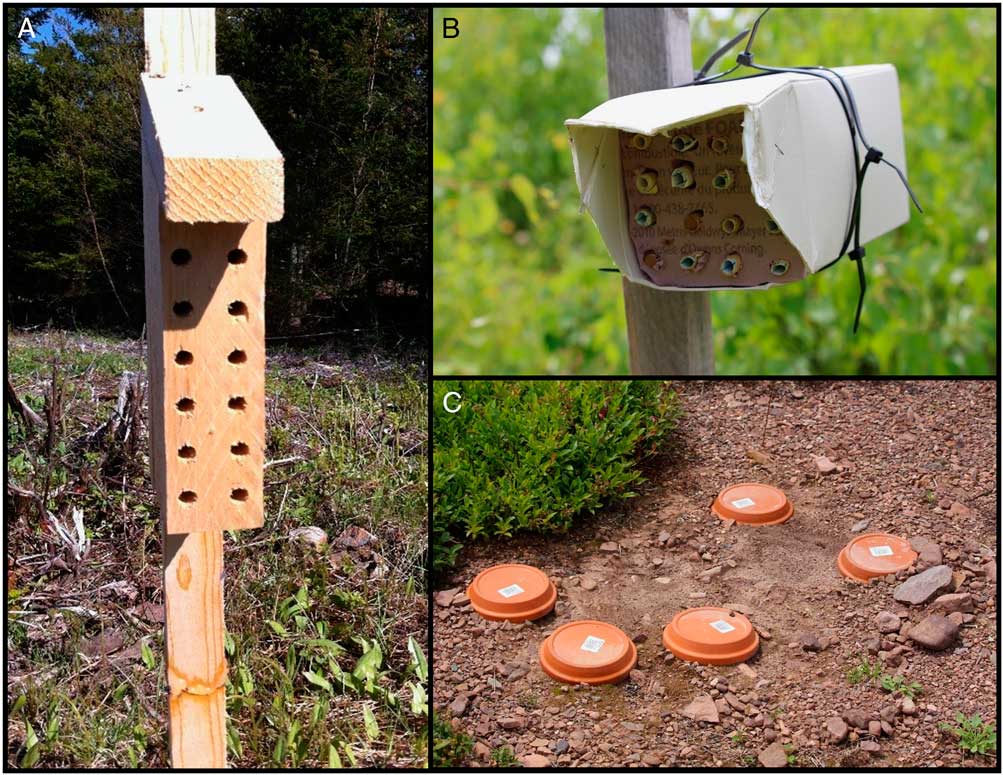
Milk carton nests in 2014 were made by inserting paper nesting tubes into washed 2-L milk cartons that were painted white (Beauti-Tone interior/exterior latex paint, Home Hardware, St. Jacobs, Ontario, Canada) (Fig. 1). Nesting tubes were made by rolling together a sheet of newsprint over a sheet of white multiuse paper (21×10 cm) (Staples, Richmond Hill, Ontario, Canada). A wooden dowel (0.7 or 0.9 cm diameter) was used to roll the paper into tubes, with the newsprint on the outer surface of the nesting tube. There were six 0.7 cm and six 0.9 cm diameter nesting tubes per milk carton. All nesting tubes were trimmed to 15 cm long and placed through a square (9.5×9.5 cm) piece of pink polystyrene. Spray foam insulation (Great Stuff, Home Hardware, St. Jacobs, Ontario, Canada) was applied around the nesting tubes and the polystyrene, and the nesting tube structure was then inserted into the milk carton such that it was held in place when the spray foam dried, with the polystyrene block containing the nesting tube openings fitted snuggly into the front opening of the milk carton (Taki et al. Reference Taki, Boone, Viana, Silva, Kevan and Sheffield2004; Sheffield et al. Reference Sheffield, Kevan, Westby and Smith2008). The milk carton design was modified slightly in 2015 to include 16 nesting tubes instead of 12, all of which were 0.7 cm in diameter. Wooden nests were nailed to wooden stakes while milk carton nests were secured to wooden stakes using nylon cable ties, both at a height of 1 m. Tanglefoot (Home Hardware, St. Jacobs, Ontario, Canada) was applied around each stake at the base to deter ants and other arthropods (Sheffield et al. Reference Sheffield, Kevan, Westby and Smith2008). Clay lids (also known as “nesting saucers” or “terra cotta lids”) (14 cm diameter) (Canadian Tire Corporation, Toronto, Ontario, Canada) were tested as potential nesting substrates for O. inermis (Sheffield et al. Reference Sheffield, Wilkes, Cutler and Hermanutz2014) in 2015. Overturned clay lids were placed directly on the soil surface of blueberry fields with a small opening made in the soil underneath to facilitate bee access (Sheffield et al. Reference Sheffield, Wilkes, Cutler and Hermanutz2014) (Fig. 1).
2014 nest study
Wooden and milk carton nests were installed at four fruit-bearing lowbush blueberry fields in Nova Scotia in 2014 (Supplementary Tables S1–S2). A randomised complete block design was used with each site (field) serving as a block. Sites were separated by at least 2 km and were considered to be independent, given the limited foraging distances of solitary bees (Gathmann and Tscharntke Reference Gathmann and Tscharntke2002; Zurbuchen et al. Reference Zurbuchen, Landert, Klaiber, Muller, Hein and Dorn2010). Four milk carton nests and two wooden nests of each of the eight unique designs were installed at each field (Supplementary Table S1). Nests were installed on 22 April 2014, before Osmia nesting occurred. Nests were randomly placed 5 m apart along the south-facing edge of each field, and were retrieved on 9 October 2014. The nests were monitored bi-weekly for the presence of capped nesting tubes. An Osmia or Megachile female caps the end of a nesting tube when she has completed provisioning her offspring in that nest (Bosch and Kemp Reference Bosch and Kemp2000; Guisse and Miller Reference Guisse and Miller2011) and nesting tubes were therefore classified as occupied if a cap was observed (Fig. 1). Retrieved nests were placed in an unheated outdoor shed at the Dalhousie University Agricultural Campus in Truro, Nova Scotia, Canada, and capped nesting tubes were brought to the laboratory for dissection the following spring (2015). Bees in tubes were counted and identified. The effect of nest design on nesting occupancy was measured by the total number of capped nesting tubes per field per nest design. Model assumptions of normal distribution and constant variance of the residuals could not be met for the raw data or through transformation, and a non-parametric Kruskal–Wallis test using Proc npar1way was therefore conducted in SAS v. 9.4 (SAS Institute 2014) for this analysis.
2015 milk carton study
Based on limited nest occupancy in wooden nests in 2014, only milk carton nests were studied in 2015. Nesting occupancy was compared between fruit-bearing and vegetative blueberry fields. The progression of capped nests was monitored throughout the season to determine when nesting occurred and if nesting overlapped with blueberry bloom. Bee emergence after overwintering was examined, as well as emergence of parasitoids. A completely randomised design was used with one factor (field type: fruit-bearing or vegetative) and six replicates (fields) per factor level, for a total of 12 fields (Supplementary Table S2). There were three milk carton nests per field, placed 5 m apart along the south-facing field edge, for a total of 36 nests in the experiment. Nests were placed in fields on 5 and 6 May 2015, and monitored bi-weekly as in 2014. All nests were collected from fields on 20 October 2015 and placed in an unheated shed (as in 2014) until 4 March 2016. The nests were then placed in an environmental chamber to observe emergence of bees and parasitoids. Each capped nesting tube was removed, labelled, and placed in its own inflated plastic bag in the environmental chamber according to a method used by J.H. Cane (J.H. Cane, United States Department of Agriculture, personal communication). The temperature was initially set at 8 °C and then warmed with daily increments of 4 °C up to 25 °C. After 10 days at 25 °C, the environmental chamber temperature was increased to 30 °C for an additional three days. Relative humidity was maintained at 60% throughout the experiment (MacIvor and Packer Reference MacIvor and Packer2015). Bee and parasitoid emergence were recorded daily. Nesting occupancy, measured as number of capped nests from all possible nesting tubes per nest (16), was compared between fruit-bearing and vegetative fields using one-way analysis of variance using the Mixed Procedure (SAS Institute 2014). A Kruskal–Wallis test using Proc npar1way (SAS Institute 2014) was used to test the effect of field type on bee and parasitoid emergence, as the assumptions of normal distribution and constant variance of the residuals could not be met.
2015 clay lid study
Overturned clay lids were evaluated as potential nesting substrates for O. inermis (Sheffield et al. Reference Sheffield, Wilkes, Cutler and Hermanutz2014) at field edge (0 m) and 25 m from the field edge, and between fruit-bearing and vegetative fields. Parasitism of bees was also recorded. A completely randomised design was used for a 2×2 factorial experiment with field type (fruit-bearing or vegetative) and distance from the field edge (0 or 25 m) as the two factors of interest. There were three replicate fields per factor level for a total of 12 fields. These 12 fields were also used for the 2015 milk carton nest experiment (Supplementary Table S2). Within each field, 10 lids were placed either along the field edge (0 m) or 25 m from the field edge, into the blueberry field. The lids were placed in the fields on 5 and 6 May 2015 and collected on 20 October 2015. Each lid was placed overturned onto bare ground and pushed firmly into the soil, with a ~2-cm-wide entrance formed in the soil under the lid for bees to gain access (Sheffield et al. Reference Sheffield, Wilkes, Cutler and Hermanutz2014). The lids were stored in a freezer upon retrieval until they could be dissected.
Insect identification
Bees were identified using characters described in Mitchell (Reference Mitchell1962) and Packer et al. (Reference Packer, Genaro and Sheffield2007), and parasitoids were identified using descriptions from Bohart and Kimsey (Reference Bohart and Kimsey1980) and McAlpine et al. (Reference McAlpine, Peterson, Shewell, Teskey, Vockeroth and Wood1987). Voucher specimens were sent to the Canadian National Collection of Insects, Arachnids, and Nematodes (Ottawa, Ontario, Canada) for identification based on morphology to the lowest possible taxonomic level (family, genus, or species). Voucher specimens were pinned and deposited at the A.D. Pickett Entomology Museum, Dalhousie University Agricultural Campus (Truro, Nova Scotia, Canada).
Results
2014 nest study
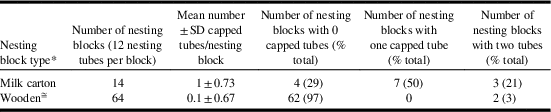
Nest design affected bee nesting, with significantly more capped nesting tubes in milk carton nests than wooden nests (χ2=39.9; df=8; P<0.0001) (Table 1). Only 3% of wooden nests – two nesting blocks in total – contained at least one capped nest compared to 71% of milk carton nests that had at least one capped nesting tube (Table 1). The two wooden nests that had capped nesting tubes were of different designs: one was burned with 0.7 cm diameter holes and a roof, and the other was not burned with 0.9 cm diameter holes and no roof. These two wooden nests had two and five capped nesting tubes, respectively, out of 12 possible nesting tubes per nesting block. Although more than 70% of milk carton nests had at least one capped nesting tube, none had more than two capped tubes, and 50% of successful nests contained only one capped nesting tube (Table 1). Two milk carton nests, one each from Masstown and Portapique field sites, were discarded due to damage by animals. After overwintering in an unheated shed, 13 nesting tubes were dissected. Sixty-one O. tersula Cockerell were identified, as well as 34 Megachile bees, 10 fully developed sapygid wasps (Sapyga martinii Smith) (Hymenoptera: Sapygidae), and one tachinid fly (Diptera: Tachinidae).
Mean number and percentage of nesting blocks and nesting tubes containing bees when placed in commercial fruit-bearing lowbush blueberry fields in Nova Scotia, Canada, 2014.

Notes: A Kruskal–Wallis test was used to compare the number of capped nesting tubes in milk carton versus wooden trap nests.
*Each of four fields had four milk carton trap nests and 16 wooden trap nests. Due to damage, a total of 14 milk cartons and 64 wooden nests were tested. Each nest had 12 possible nesting tubes.
≅Multiple wooden trap nest designs were used but because occupancy by bees was low, data from all wooden nests were combined. The two trap nests containing capped nesting tubes were from two designs: roof, burned, small holes and no roof, not burned, and large holes.
2015 milk carton study
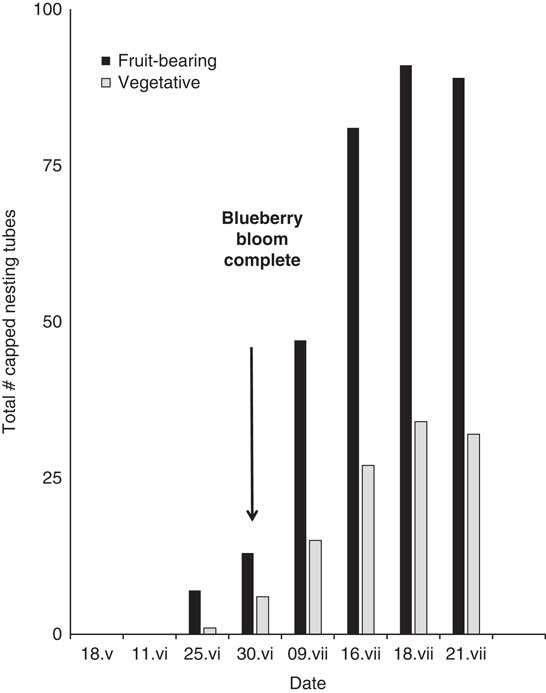
Of the 36 milk carton nests placed in 12 different blueberry fields, three nests were damaged at one site and removed from the study. Of the remaining 33 nests, 24 (73%) contained at least one capped nesting tube. A total of 176 out of 512 nesting tubes (34%) were capped and considered occupied. The first capped nesting tube was observed in a field on 25 June 2015, during late blueberry bloom, and the last capped nesting tube was observed on 30 July 2015, after blueberry bloom had finished. The majority of nest capping was completed by mid-July (Fig. 2).
Occurrence of capped nesting tubes in milk carton nests by bees (Hymenoptera: Megachilidae) in lowbush blueberry fields (fruit bearing and vegetative) in Nova Scotia, Canada, 2015. x-axis is not linear in scale.
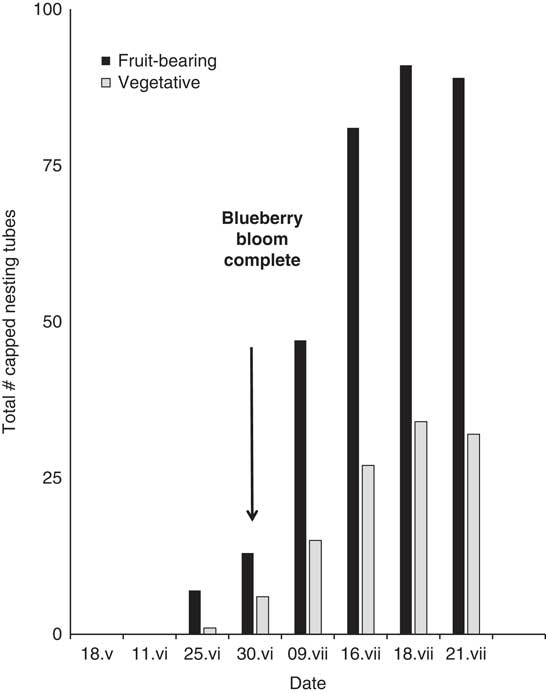
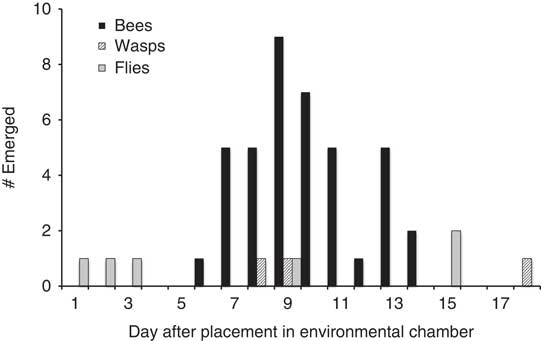
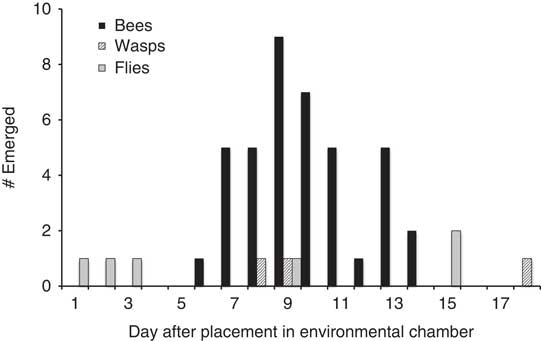
Although nesting occupancy was not significantly different between the two field types, there were almost twice as many capped nesting tubes in fruit-bearing fields than vegetative fields (Table 2). In the environmental chamber, 40 O. tersula, two sapygid wasps, one chrysidid wasp (Hymenoptera: Chrysididae), and six tachinid flies emerged from 17 of 176 capped nesting tubes. Significantly more bees emerged from capped nesting tubes from fruit-bearing fields than from vegetative fields (Table 2). Most bees emerged over a period of approximately one week, starting five days after placement in the environmental chamber and peaking at day 9 (Fig. 3).
Bee and parasitoid emergence from milk carton nests within an environmental chamber after removal from a lowbush blueberry field in Nova Scotia, Canada, 2015. The temperature was initially set at 8 °C and then warmed with daily increments of 4 °C up to 25 °C. After 10 days at 25 °C, the temperature was increased to 30 °C for an additional three days.
Osmia nesting, emergence, and parasitism in milk carton trap nests in Nova Scotia lowbush blueberry fields in 2015.

Notes: Means are presented with ranges of capped nesting tubes per field in parentheses. A mixed model was used to compare the mean number of capped nesting tubes per carton in different field types, and a Kruskal–Wallis test was used to compare bee, wasp, and fly emergence in different field types. Only milk cartons with at least one capped nesting tube were compared.
Field type did not have a significant effect on emergence of wasps or flies (Table 2), although bees only emerged from one capped nesting tube from a vegetative field. After removal of nesting tubes from the environmental chamber and placement in the laboratory at room temperature, 16 leafcutter bees (Megachile species) emerged. No Osmia emerged from tubes that contained Megachile. Dissection of the 176 nesting tubes after emergence found 266 failed or incomplete cells that could be recognised as well as fully developed dead bees that were mouldy. It is possible more cells were present but many of the tubes were damp and mouldy, and nesting evidence was not recognisable. The number of failed cells per tube ranged from one to 16 and included Osmia and Megachile bees, and chrysid and sapygid wasps. Additionally, six Phoridae (Diptera) pupae, two satellite fly adults and 10 pupae (Diptera: Sarcophagidae: Miltogramminae), and seven Tachinidae (Diptera) in various stages of development were dissected from the nesting tubes.
2015 clay lid study
Only 3.3% (4/120) of overturned clay lids had O. inermis nesting evidence. All successful lids were found in fruit-bearing fields and three of four lids were found at the field edge. The successful lids had nesting aggregations of five to 17 O. inermis, as determined by separating and identifying each bee the following spring. The bees ranged from pupae to adults and were mouldy, but identification was still possible. Only one of the lids showed evidence of parasitism upon dissection, with three Chrysura Dahlbom (Hymenoptera: Chrysididae) detected next to fully developed O. inermis.
Discussion
Female cavity-nesting bees and wasps carefully search their habitat and seem to prefer conspicuous, high-quality holes (Westerfelt et al. Reference Westerfelt, Windefalk, Lindelow, Gustafsson and Weslien2015). In our study, nest occupancy was significantly affected by nest design in 2014, with more bees nesting in tubes of milk cartons than wooden nests. The rate of occupancy in the wooden nesting blocks – a total of only two and five capped nesting tubes in two wooden nests – was lower than in other studies. For example, in Maine (United States of America) lowbush blueberry fields, 20% of wooden nesting blocks and 6% of available holes (120 nests made in 2086 holes) were occupied by Osmia, and the rate of uptake was similar in two subsequent years (Stubbs et al. Reference Stubbs, Drummond and Algard1997). In a Swedish boreal forest, more than 30% of artificial wooden nests, consisting of pine poles with predrilled holes, were occupied by bees or wasps, with Megachile using mostly holes that were 7 or 10 mm in diameter (Westerfelt et al. Reference Westerfelt, Windefalk, Lindelow, Gustafsson and Weslien2015). In our study, it is possible that the deeper nesting tubes of milk carton nests (15 cm) were more attractive to Megachilidae than shallower tubes of wooden nests (8 cm) (Stubbs et al. Reference Stubbs, Drummond and Algard1997; Bosch and Kemp Reference Bosch and Kemp2002; MacIvor Reference MacIvor2016), although Megachile may also readily occupy artificial holes in wood that are 8 cm or less (Westerfelt et al. Reference Westerfelt, Windefalk, Lindelow, Gustafsson and Weslien2015). The smoothness of the hole may be important for cavity-nesting bees. Whereas the drilled holes of our wooden nests were not modified and had a relatively coarse inner surface, the milk carton tubes had smooth paper inner surfaces and had higher occupancy. Stubbs et al. (Reference Stubbs, Drummond and Algard1997) inserted cellophane-coated straws into drilled holes and had greater occupancy than we did in wooden trap nests.
It is also possible that the white milk carton nests were visually more attractive than the wooden nests; in California (United States of America) almond (Prunus dulcis (Miller) Webb (Rosaceae)) orchards, light blue nest boxes were more attractive to cavity-nesting bees than yellow or orange nest boxes, potentially due to visual signalling, detectability, and discrimination abilities from spectral reflectance of the different colored nest boxes (Artz et al. Reference Artz, Allan, Wardell and Pitts-Singer2014). In a ground-nesting solitary bee experiment, Inouye (Reference Inouye1990) demonstrated female Epicharis metatarsalis Friese (Hymenoptera: Apidae) bees use visual cues to recognise nest entrances, signalling the importance of visual cues for nesting uptake and recognition for bees. In the same study, no olfactory cues were associated with female bees locating their nest entrance (Inouye Reference Inouye1990), suggesting olfactory factors may not be as important as visual cues for locating nest entrances.
Temperature and humidity can also influence nest uptake and emergence success by cavity-nesters (Bosch and Kemp Reference Bosch and Kemp2002; Westerfelt et al. Reference Westerfelt, Windefalk, Lindelow, Gustafsson and Weslien2015), although these factors were not measured in our study. Relatively poor nesting occupancy overall in the 2014 experiment may have partially been due to lack of established Osmia populations in the fields sampled. In a study examining the wild bee community in lowbush blueberry fields in Nova Scotia, only five Osmia were collected from ten commercial fields over nine collection events throughout the summer (Cutler et al. Reference Cutler, Nams, Craig, Sproule and Sheffield2015). Similarly, low captures of Osmia were reported from lowbush blueberry fields in Maine (Bushmann and Drummond Reference Bushmann and Drummond2015). It is possible that field history affected Osmia population size or fecundity; it may take multiple years of stable food supply to support increases in bee populations. In contrast, Sheffield et al. (Reference Sheffield, Kevan, Westby and Smith2008) found an increase in the number of bees reared in trap nests each year for three years in Nova Scotia apple orchards and other habitats, even with bees removed each year.
The experiment was modified in 2015 to focus on nesting in milk carton nests and potential differences in nesting between fruit-bearing and vegetative fields, as well as parasitism. We predicted nesting occupancy would be higher in fruit-bearing fields due to the food source offered by blueberry flowers for the provisioning females, and that early season emergence of Osmia would overlap with blueberry bloom (Drummond and Stubbs Reference Drummond and Stubbs1997; Sheffield et al. Reference Sheffield, Kevan and Smith2003). Although we found no significant difference in nest occupancy between fruit-bearing and vegetative fields, significantly more bees emerged from occupied nesting tubes collected from fruit-bearing fields. The study sites were in close proximity (within 500 m) to other blueberry fields. The industry practice of maintaining both fruit-bearing and vegetative fields in close proximity in any given year ensures that there are harvestable berries every year (Yarborough Reference Yarborough1997). If vegetative and fruit-bearing fields are in close proximity to one another, bees that emerge near vegetative fields may be able to fly to nearby fruit-bearing fields to forage during blueberry bloom. On the other hand, we found that provisioning and capping of most nesting tubes occurred after blueberry bloom ended, suggesting that megachilid bees also collected pollen and nectar from non-crop flowering plants. Whereas the foraging period of Osmia is from mid-April to late June, Megachile have been recorded in lowbush blueberry in Nova Scotia from early June to late September (Sheffield et al. Reference Sheffield, Kevan and Smith2003), suggesting nesting tube capping observed in July was from Megachile bees rather than Osmia. Thus, activity of Osmia and Megachile bees may coincide with blueberry bloom (Drummond and Stubbs Reference Drummond and Stubbs1997; Sheffield et al. Reference Sheffield, Kevan and Smith2003), but the availability of alternative floral resources in and around fields after blueberry bloom is also important for nesting success of Megachilidae. We recovered both Megachile species and O. tersula bees from milk carton trap nests, which contained 7 and 9 mm tubes. In contrast, in Nova Scotia apple orchards, 97% of collected O. tersula were recovered from nesting tubes that were 3 and 5 mm diameter, while most Megachile occupied tube diameters ranging from 5–9 mm, depending on the species (Sheffield et al. Reference Sheffield, Kevan, Westby and Smith2008). If milk carton nests containing nesting tubes of variable diameters can simultaneously attract multiple Osmia and Megachile species, a more diverse pollinating force could be supported.
We detected parasitism by cleptoparasites and parasitoids (e.g., Sapygidae wasps, tachinid flies), as in previous studies (Drummond and Stubbs Reference Drummond and Stubbs1997; Stubbs et al. Reference Stubbs, Drummond and Algard1997; Sheffield et al. Reference Sheffield, Kevan, Westby and Smith2008; MacIvor and Packer Reference MacIvor and Packer2015). Of the 65 insects that emerged from tubes, nine were parasitoids. Upon dissection of the nesting tubes, more than 200 failed cells were observed, as well as additional wasps and flies that may have caused parasitism and prevented development of bees.
Notably, this is the first record of Sapyga martinii east of Québec (identification confirmed by J. Huber, Canadian National Collection of Insects, Arachnids, and Nematodes). Six Sapyga Latreille species are known to occur in southern Canada (Goulet and Huber Reference Goulet and Huber1993) and this species has been recorded in Ontario and Québec (https://bugguide.net/node/view/704862), but to the best of our knowledge, no records exist for east of Québec. This species has been recorded in trap nesting studies throughout much of the United States of America and is a known parasitoid of O. tersula (Medler Reference Medler1967; Gardner and Spivak Reference Gardner and Spivak2014).
Field conditions may have further reduced nest occupancy and development of bees and parasitoids. Many cells with undeveloped bees were in damp nesting tubes. Nesting success of Megachilidae can be reduced by cool, damp weather conditions (Pitts-Singer and James Reference Pitts-Singer and James2008), and associated bacterial or fungal activity (Frankie et al. Reference Frankie, Thorp, Newstrom-LLoyd, Rizzardi, Barthell and Griswold1998). In 2015, 404.6 mm of precipitation were recorded for the study region from May to August, but this was only slightly higher than the 30-year average (1981–2010) of 397.1 mm (Government of Canada 2016). The paper nesting tubes may have also contributed to the humid conditions, and further troubleshooting of this nesting design is warranted.
Nesting by O. inermis in clay lids was lower than previously reported; in our study only 3.3% of lids were occupied, as compared to 10% lid occupancy reported by Sheffield et al. (Reference Sheffield, Wilkes, Cutler and Hermanutz2014), despite more extensive sampling effort. We detected parasitism by chrysid wasps in one clay lid, whereas Hicks (Reference Hicks2009) and Sheffield et al. (Reference Sheffield, Wilkes, Cutler and Hermanutz2014) did not report any parasitism of O. inermis in Newfoundland. We predicted nest occupancy would be greater in fruit-bearing fields and along the field edge due to proximity of food sources (Cutler et al. Reference Cutler, Nams, Craig, Sproule and Sheffield2015). Although more nesting in clay lids along field edge and in fruit-bearing fields was observed, the overall low number of lids occupied (four) prohibits any conclusion on the importance of these factors in O. inermis nesting. Blueberry bloom would provide a mass-provision of flowers for bees and could make nesting in fruit-bearing fields more efficient for female O. inermis. As offspring would then emerge the following year in vegetative fields, ensuring fields are split into nearby fruit-bearing and vegetative rotations could be important to optimise pollination from wild bees. The low nesting occupancy in clay lids could have been due to poor ventilation or high humidity under lids (some mold was observed), or simply low incidence of O. inermis in the blueberry fields sampled. In Maine and Nova Scotia blueberry fields, relatively few O. inermis were collected (Bushmann and Drummond Reference Bushmann and Drummond2015; Cutler et al. Reference Cutler, Nams, Craig, Sproule and Sheffield2015), and this was also the case for other agricultural habitats sampled in Nova Scotia (Sheffield et al. Reference Sheffield, Kevan, Pindar and Packer2013). Our clay lid experiment suggests prospects for managing O. inermis in Nova Scotia blueberry fields may be limited, but further investigation into nesting already occurring in fields, for instance, in rock piles, may be of value. Alternatively, it is possible O. inermis could be relocated from high-abundance areas to blueberry fields for pollination.
Given the efficacy of wild bees for lowbush blueberry pollination (Javorek et al. Reference Javorek, MacKenzie and Vander Kloet2002), efforts to promote wild bees will continue to be an important complement to pollination by managed bees. Nesting occupancy in certain nest block designs was promising and could be implemented to enhance cavity-nesting bees in and around lowbush blueberry fields. The wooden and clay lid nests were not well used in our experiments, but success in previous studies (Stubbs and Drummond Reference Stubbs, Drummond and Algard1997; Sheffield et al. Reference Sheffield, Wilkes, Cutler and Hermanutz2014; Westerfelt et al. Reference Westerfelt, Windefalk, Lindelow, Gustafsson and Weslien2015) suggests that further examination is warranted into the role of nest design in determining nest occupancy and emergence success of Megachilidae. The higher uptake in milk carton nests, as well as the observed failed cells, suggests Megachilidae are attracted to this nest design, but tactics to optimise emergence and reduce parasitism are needed.
Acknowledgements
The authors thank the blueberry growers who allowed us to use their fields and J. Sproule, C.J. Chapman, K.D. Glasgow, and C.N. Chapman for technical support. The authors thank J. O’Hara, B. Sinclair, and J. Huber of the Canadian National Collection of Insects, Arachnids, and Nematodes in Ottawa (Ontario, Canada) for their assistance with specimen identification. Funding for this research was provided by a Natural Sciences and Engineering Research Council of Canada Industrial Postgraduate Scholarship (partner Syngenta Crop Protection) award to R.S.M., a Nova Scotia Department of Agriculture Research Acceleration grant to N.L.M. in partnership with Syngenta Canada (project number RA15-0006), and a Nova Scotia Department of Agriculture Research Acceleration grant to G.C.C. in partnership with Syngenta Canada (project number RA14-033).
Supplementary material
To view supplementary material for this article, please visit https://doi.org/10.4039/tce.2018.45