Introduction
The Rapid RhinoTM pneumatic nasal tampon (Applied Therapeutics Ltd, Glenfield, United Kingdom) consists of an inflatable nasal cuff (balloon) with a haemostatic coating (Gel Knit™ fabric; Acordis Speciality Fibres, Coventry, United Kingdom), a valve and a pilot cuff. With the exception of one case of an ingested Rapid Rhino nasal pack,Reference Hashmi, Gopaul, Prinsley and Sansom1 these devices have been demonstrated to be safe, comfortable and effective in achieving haemostasis in the nasal cavity.Reference Arya, Butt and Nigam2–Reference Singer, Blanda, Cronin, LoGiudice-Khwaja, Gulla and Bradshaw4 The balloon is inflated with air, as this provides more gentle compression of the nasal mucosa than the larger pressures that can be generated using liquids. Epistat and Brighton balloons spontaneously deflate after air insufflation,Reference McFerran and Edmonds5 as do Teflon™- and silicone-coated Foley catheters when used for nasal packing.Reference Hartley and Axon6 The balloon in the Rapid Rhino nasal pack is manufactured by Applied Therapeutics Ltd from medical grade polyvinylchloride, and the valve is assembled using an ‘O’ ring and a stainless steel spring so that the product is leak-proof even at very low pressures.
However, the authors noticed that, when used in vivo, the pressure in the pilot cuff could diminish with time (as assessed by tactile feeling); ward patients had also suggested that depressurisation may be occurring. On occasion, we observed that further inflation was necessary to control epistaxis after the pack has been in situ for a while.
We wished to study the in vivo behaviour of Rapid Rhino packs and to characterise the rate of depressurisation and/or leakage, so that we could anticipate when further monitoring and possibly inflation of the Rapid Rhino pack may be necessary. Unfortunately, assessment of the pressures and volumes of Rapid Rhino packs is challenging because the pack holds only a small volume of air. Any air lost when connecting the measuring apparatus would therefore be significant. Investigating the in vivo behaviour of Rapid Rhino packs therefore required assessment of any potential air loss due to the measurement apparatus, in addition to studying air pressures and volumes within the packs themselves.
Materials and methods
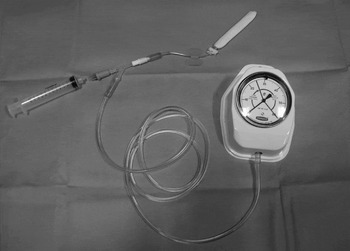
Air pressure in 7.5 cm Rapid Rhino nasal packs was measured using a low reading Portex pressure gauge (Applied Therapeutics Ltd, Glenfield, United Kingdom) and a Y piece connector with a removable one-way valve on the side port (Figure 1). This pressure gauge was chosen because of its small size and simple operation, making it easy to use in the clinical setting. Although this device was airtight, it comprised a hollow chamber and connection tubing which would allow some pressurised air to be transferred from the packs to the pressure gauge. The process of opening and closing the valve on the Rapid Rhino pack during attachment and detachment of the gauge, and the couplings along the connection tube, would also potentially allow some air to escape.
Portex pressure gauge, connection tubing and Rapid RhinoTM nasal pack.

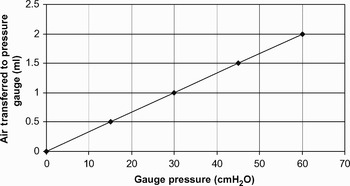
In order to calculate the volume of air transferred under pressure from the pack to the gauge, a 2.5 ml syringe containing 0.5 ml of air was connected to the tubing of the pressure gauge. The plunger of the syringe was fully depressed and the pressure reading noted. The procedure was repeated with volumes of 1, 1.5 and 2 ml of air. A graph was then plotted of gauge pressure against air volume.
The effect of air leakage from the various connection tubing couplings on the pressure readings was determined by attaching a Rapid Rhino nasal pack and then clamping the tubing on the pack just below the pilot cuff. A 10 ml syringe containing 8 ml of air was connected to the side port and depressed until a reading of 30 cmH2O was obtained. The syringe barrel was then taped in this position. Its purpose was to provide a reservoir of pressurised air (of similar quantity to that contained within the Rapid Rhino pack). Without this reservoir, even a minute leak from the small volume contained within the connection tubing and pressure gauge would have had a profound effect on the readings. Pressure changes were recorded over a 12 hour period for five packs.
In order to determine the volume of air which was escaping from the pack during connection and disconnection of the pressure gauge, two pressure readings were performed in vitro on five Rapid Rhino packs, in quick succession. Each pack was immersed in water for 30 seconds and then inflated with 8 ml of air inside a 10 ml plastic syringe casing. After allowing 30 minutes for the pack to fully expand, a pressure reading was taken. The Y piece connector was inserted quickly and firmly into the valve of the Rapid Rhino nasal pack, in order to minimise the potential for air leakage, and then quickly removed during disconnection. The gauge was then reconnected for a second reading. While still connected, air was withdrawn through the side port on the Y piece connector with a syringe. The plunger was fully retracted to remove all the air from the pack and the hollow measuring equipment. The plunger was then depressed until the reading on the pressure gauge rested just at zero. The volume of air in the syringe was recorded. (Since the pressure gauge now read zero, any air transferred to the gauge when it was connected to the pack was now in the syringe.) This volume was added to that which would have been transferred to the pressure gauge during the first pressure reading and subsequently lost when the gauge was disconnected (calculated from the graph shown in Figure 2). Deducting this total volume from the initial 8 ml gave an indication of the amount of air leakage during connection and disconnection of the pressure gauge.
Gauge pressure following transfer of varying volumes of air.

In vivo testing
After determining the effect of measuring air pressure on Rapid Rhino nasal packs, the pressure and leakage characteristics of inflated packs could be assessed. Ethical committee approval was obtained to perform pressure measurements in consecutive adult volunteer patients undergoing septoplasty with or without turbinate surgery (05/Q2704/I5).
Rapid Rhino packs were immersed in sterile water at the end of the operation for 30 seconds and then placed in the nasal cavities. They were inflated with 8 to 10 mls of air. Initial pressure readings were taken. Prior to removal of the packs on the following day, a second pressure reading was performed. The remaining volume of air was measured, using the same procedure as that for assessing air loss when connecting and disconnecting the pressure gauge. High but unsteady initial pressure readings were found in the first patient. In the following five patients, the pressure in one pack was continually monitored until stable, and the time taken for this to occur was noted. In subsequent cases, initial pressure readings were obtained from both packs after this period of stabilisation had elapsed.
In vitro testing
In vitro Rapid Rhino nasal packs were used as controls, on the assumption that they did not leak in vitro. This was based on the strength of the manufacturer's claims and the direct observation that inflated Rapid Rhino packs left undisturbed remained inflated for several months.
Five packs were immersed in water and then inflated with 8 ml of air inside a 10 ml plastic syringe casing. The pressure gauge was attached and pressure readings performed every two minutes until steady readings were obtained. In a further 20 packs, initial pressure readings were performed after the stabilisation period had elapsed. Second pressure readings and remaining volume measurements were obtained 24 hours later. These in vitro tests were then repeated in a few Rapid Rhino packs denuded of their Gel Knit fabric covering.
All volume recordings were taken at atmospheric pressure and recorded in millilitres. All pressure readings were recorded in centimetres of water.
Results and analysis
Effects of pressure measurement
Figure 2 shows the pressure generated within the pressure gauge and tubing when set volumes of air were transferred to the pressure testing apparatus from a 2 ml syringe. It demonstrates a linear relationship between the volume of air transferred to the pressure apparatus and the pressure of the system under measurement.
When the gauge connections were tested for leakage, the drop in pressure over a 12 hour period averaged 1 cmH2O per hour.
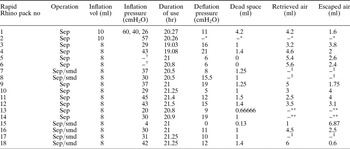
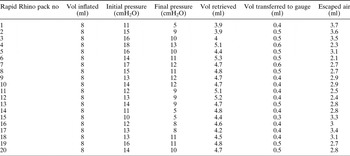
Table I shows the difference between two consecutive pressure recordings taken before and after detachment of the pressure gauge. Pressurised air transferred to the hollow pressure gauge and tubing was lost when the Rapid Rhino pack was disconnected. This volume could be calculated from Figure 2. The remaining volume of lost air was due to escape from the Rapid Rhino valve during connection and disconnection; this averaged 3.1 ml.
Air leakage during connection and disconnection of pressure gauge

No = number; vol = volume
In vivo testing
Fourteen volunteer patients were recruited to the study, three of whom underwent additional submucosal diathermy of the inferior turbinates. Five Rapid Rhino nasal packs were monitored after inflation and pressures at 2 minute intervals recorded to determine the time required for pressure stabilisation. The initial pressures recorded were 49, 34, 48, 50 and 42 cmH2O (mean average, 44.6 cmH2O). The time taken to obtain three consecutive steady readings was between 16 and 22 minutes (being 16, 18, 18, 22 and 18 minutes for each of the five packs). Of the 18 packs investigated for deflation, one fell out but was not returned for examination. Measuring the volume of retrieved air was omitted in one patient, and disconnection occurred in three instances during this procedure. Complete volume results were available for 12 packs. Inflation pressure was recorded for 16 packs (average 32.5 cmH2O) and pressure prior to deflation for 17 packs (average 11.5 cmH2O). Table II shows these results in detail.
Data from in vivo study

* Pack fell out; †ommitted; ‡disconnection during air retrieval; **retrieved air not measured. No = number; vol = volume; hr = hour; Sep = septoplasty; smd = submucosal diathermy
In vitro testing
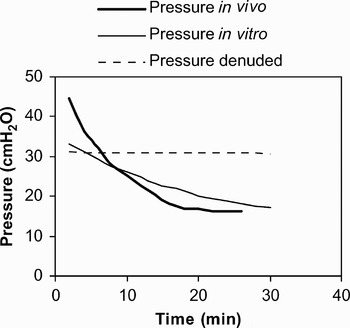
Five new Rapid Rhino nasal packs were subjected to serial pressure readings after inflation in a 10 ml syringe casing. Initial pressure readings were lower than in the in vivo packs (being 28, 37, 35, 35 and 30 cmH2O; mean, 33 cmH2O) and stabilised over a longer time period of 28 to 32 minutes (stabilisation times were 28, 30, 30, 30 and 32 minutes for each pack). Twenty packs were subjected to intermittent testing over 24 hours; their pressure and volume measurements are shown in Table III. The air volume lost ranged from 2.1 to 3.7 ml. Continuous pressure measurements were performed in five Rapid Rhino packs denuded of their Gel Knit coatings. Readings after 0, 2, 4, 6 and 30 minutes are shown in Table IV. Average pressures in the in vivo Rapid Rhino packs, in vitro packs and in vitro packs without their Gel Knit covering are plotted for comparison in Figure 3. Testing demonstrated fairly rapid initial depressurisation of the intact packs but almost no depressurisation of the denuded packs, suggesting that the Gel Knit coating of the Rapid Rhino pack is responsible for its depressurisation characteristics.
Initial depressurisation of Rapid RhinoTM nasal packs over time. Denuded = Gel KnitTM fabric removed

Data from in vitro testing of 20 Rapid RhinoTM nasal packs

No = number; vol = volume
Pressure stabilisation in Rapid RhinoTM packs denuded of Gel KnitTM covering

No = number; vol = volume; min = minutes
Statistical analysis
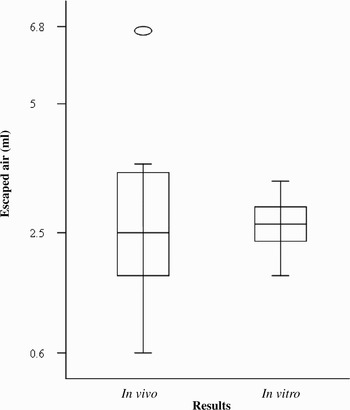
Exploratory data analysis of the results of intermittent in vivo testing (Table II) and in vitro testing (Table III) was performed using box plots of the volume of escaped air. This allowed outlying variables to be identified and the distribution of the results to be graphically displayed, so that an appropriate statistical model could be used for further analysis. It can be seen from Figure 4 that the in vitro results for escaped air were normally distributed with no outlying variables. The in vivo results, however, showed a left-sided skew, and the highest volume of escaped air (6.87 ml) was an outlying result. This was omitted when performing further analysis to prevent distortion of results.
Box plot of results for escaped air in vivo and in vitro.

The aim of the experiment was to detect escape of air from the Rapid Rhino nasal pack in an in vivo environment. The null hypothesis was that there was no difference between the mean volumes of escaped air, comparing the in vitro and in vivo Rapid Rhino packs. Since the in vivo results were skewed, a Wilcoxon rank-sum test for two independent samples was used to test the null hypothesis. This non-parametric statistical analysis gave a z score of 1.05. Using a p value of 0.05, the null hypothesis was not rejected.
Exploratory data analysis identified the escape of 6.87 ml of air from an in vivo Rapid Rhino pack as an outlying variable. Comparison with the in vitro results demonstrated that this was much greater than the air loss volume expected during pressure measurement. The initial pressure reading in this pack after 30 minutes was also very low. Taken together, this information suggested that this Rapid Rhino pack was faulty.
Discussion
There is always the potential for the process of measurement to affect the system under investigation. In this study, considerable effort was dedicated to defining the impact of pressure measurements on Rapid Rhino nasal packs. It was not possible to make volume measurements alone, because when retrieving air from the pack a pressure monitor is required to ensure that excessive suction does not artificially expand the volume retrieved. Neither was it possible to permanently attach the pressure gauge in order to prevent the air loss that occurred during attachment and detachment of the gauge. With such an arrangement, the Rapid Rhino pack would not be fully assessed as the valve would no longer be under investigation. The effort of defining air loss during pressure measurements created a tedious methodology, but the interpretation of the results from the in vivo study would have been meaningless without this context.
This study did not demonstrate a significantly different amount of air loss from the in vivo Rapid Rhino packs subjected to pressure and volume measurements, compared with the in vitro packs subjected to the same measurements. However, initial depressurisation of the Rapid Rhino packs was confirmed. This occurred faster in the in vivo packs and was associated with earlier pressure stabilisation, compared with the in vitro packs. The in vitro packs maintained an almost constant pressure after inflation when the Gel Knit fabric was removed (Figure 3). The behaviour of the Gel Knit fabric would therefore explain the depressurisation characteristics of the in vitro packs. With the in vivo packs, there may be contributory factors such as the behaviour of the nasal cavity in response to pressure from the pack.
This early period of depressurisation suggests that it is necessary to check the pilot cuff 20 to 30 minutes after insertion of a Rapid Rhino pack. In our experience, this is especially true when packs are inserted into conscious patients to treat epistaxis, as initial inflation volumes tend to be lower. We have observed that discomfort is often experienced when the initial volume of inflated air begins to exceed 4 ml. Given the depressurisation observed in this study, we would anticipate that smaller inflation volumes would lead to lower pressures after 20 to 30 minutes, reducing the tamponade effect and possibly allowing recurrence of epistaxis.
• Rapid RhinoTM pneumatic nasal tampons do not characteristically leak air
• Although they do not deflate, they do depressurise. Most of this depressurisation occurs during the first 20–30 minutes
• These depressurisation characteristics are mostly caused by expansion of the Gel KnitTM haemostatic coating on the Rapid Rhino nasal pack
One pack in this study appeared to have been faulty. From the number of packs studied, it is not possible to predict how commonly such malfunction should be expected. However, Rapid Rhino nasal packs are manufactured products with defined tolerance limits, and small samples are adequate to characterise this relatively homogeneous population.