Introduction
The control of and impacts resulting from perennial, invasive plants are challenging in both annual cropping systems and perennial plant communities. For example, a recent review of invasive plant control publications found that 16 of the 20 most-studied species were perennials (Kettenring and Adams Reference Kettenring and Adams2011), and 83% of the most commonly listed noxious weeds in the United States and Canada were perennials (Skinner et al. Reference Skinner, Smith and Rice2000). Many perennial species spread both by seed and vegetatively, enabling effective dispersal (Hakansson Reference Hakansson2003a). Such perennial plants also have the ability to store carbohydrate reserves in their extensive root systems. Due to these biological characteristics, perennial weeds can be persistent, difficult to manage, and tolerant of certain management techniques, such as mechanical disturbance (Hakansson Reference Hakansson2003b).
Canada thistle [Cirsium arvense (L.) Scop.] is a perennial plant that is particularly difficult to control once established in both annual cropping and perennial systems (Tiley Reference Tiley2010). Cirsium arvense was first introduced to North America in the 1600s from Europe via contaminated grain seed, hay, and ship’s ballast (Morishita Reference Morishita1999). It commonly invades croplands, natural areas, pastures, rangelands, and roadsides (Tiley Reference Tiley2010). Cirsium arvense was listed as a noxious weed in all but four U.S. states by 1957 (Tiley Reference Tiley2010), and as of 2000 it was the most frequently listed noxious weed in the United States and Canada (Skinner et al. Reference Skinner, Smith and Rice2000). Producers on certified organic land in the Pacific Northwest and Great Plains regions recently listed C. arvense among the most problematic weeds (Organic Advisory and Education Council 2013; Tautges et al. Reference Tautges, Goldberger and Burke2016).
This invasive plant is an effective competitor, with a tall growth form and efficient vegetative spread aiding its rapid colonization ability and suppression of other plants (Tiley Reference Tiley2010). Yield losses in a variety of annual crops, including barley (Hordeum vulgare L.) (O’Sullivan et al. Reference O’Sullivan, Kossatz, Weiss and Dew1982), rapeseed (Brassica napus L.) (O’Sullivan et al. Reference O’Sullivan, Weiss and Kossatz1985), and spring wheat (Triticum aestivum L.) (Donald and Khan Reference Donald and Khan1996) are associated with increased C. arvense density. In addition, C. arvense infestations can cause further economic losses due to contamination of seed, grain, or straw, which results in changes in product handling, processing, and quality (Tiley Reference Tiley2010). Although C. arvense is regarded as a major weed in perennial systems, there is less information published on yield losses in perennial pastures compared with annual crops (Tiley Reference Tiley2010). Grekul and Bork (Reference Grekul and Bork2004) demonstrated significant grass and forb yield losses associated with increasing C. arvense density in perennial pastures in western Canada. Furthermore, C. arvense’s prickly mature foliage can reduce pasture productivity by deterring livestock from grazing in infested areas (Tiley Reference Tiley2010).
Although stand-alone and integrated management techniques have been cited as viable approaches to managing C. arvense (Donald Reference Donald1990), it continues to invade and persist in temperate regions of the world. Carefully reviewing and systematically summarizing results from previous studies may help refine management strategies for C. arvense. A statistical tool useful for achieving this goal is meta-analysis, that is, the systematic and quantitative review and synthesis of previous studies (Koricheva and Gurevitch Reference Koricheva and Gurevitch2014). For example, through a meta-analysis of 52 studies, Lutman et al. (Reference Lutman, Moss, Cook, Welham and Kim2013) determined that mechanical cultivation and time of seeding were the most efficient nonchemical approaches to manage blackgrass (Alopecurus myosuroides Huds.). Additionally, a meta-analysis on downy brome (Bromus tectorum L.) management indicated that a variety of control methods reduced short-term abundance of B. tectorum, but only those that included herbicide or revegetation led to long-term control (Monaco et al. Reference Monaco, Mangold, Mealor, Mealor and Brown2017). Finally, a recently completed meta-analysis of management of C. arvense and field bindweed (Convolvulus arvensis L.) in organic cropping systems showed that integrating two or more management strategies generally caused greater reductions in weed abundance than any method used alone (Orloff Reference Orloff, Mangold, Miller and Menalled2018). Meta-analyses can also identify knowledge gaps and potential ways to improve experimental approaches. For example, a recent review found that most experimental approaches assessing weed control of invasive plants evaluated efficacy of management techniques on short time frames (<1 yr) and rarely included impacts on desirable vegetation or evaluations of control costs (Kettenring and Adams Reference Kettenring and Adams2011).
We conducted a meta-analysis to review and summarize results from previously published studies involving C. arvense management in annual cropping and perennial systems. Our objectives were to (1) assess short- and long-term effectiveness of management techniques for controlling C. arvense, (2) compare short- and long-term effectiveness of different herbicide mechanism of action (MOA) groups for controlling C. arvense, (3) determine whether and how management techniques for C. arvense control impact crop yield (annual cropping systems) or abundance of desired plants (perennial systems), and (4) identify knowledge gaps. These objectives were conducted separately for annual cropping systems (row crop and fallow fields) and perennial systems (pasture, rangeland, natural areas, etc.).
Materials and Methods
Literature Search and Study Inclusion
In December 2015, we conducted a literature search for C. arvense using the Web of Science® (1864–2015) and Agricola® (1927–2015) databases. We used the key words “Cirsium arvense,” “Carduus arvensis,” “Canada thistle,” “creeping thistle,” “Californian thistle,” and “field thistle.” We limited our search to articles written in English.
Following guidelines by Koricheva et al. (Reference Koricheva, Gurevitch and Mengersen2013), all references underwent the following filtering process for their inclusion into the meta-analysis: (1) duplicate references from the two databases were removed; (2) abstracts and titles of retrieved articles were examined, and clearly irrelevant literature (e.g., patents, studies about ecology or biology with no control treatments, medical topics, genetics studies, pollination studies) was removed; and (3) full text of selected articles was examined, and studies were included that met our preestablished inclusion criteria. Specifically, we included replicated field studies that assessed the relative efficacy of stand-alone or integrated weed management techniques taking place in annual cropping or perennial systems. We limited annual cropping system studies to cooler, temperate climatic regions specified as those that grew crops listed by the USDA state agriculture overview for the Northern Great Plains states (defined as Montana, Nebraska, North Dakota, South Dakota, and Wyoming): wheat, intersown alfalfa (Medicago sativa L.), barley, peas (Pisum sativum L.), potatoes (Solanum tuberosum L.), lentils (Lens culinaris Medik.), corn (Zea mays L.), beans (Phaseolus vulgaris), canola (Brassica napus L.), safflower (Carthamus tinctorius L.), oats (Avena spp.), sugar beets (Beta vulgaris L.), sunflower (Helianthus annuus L.), sorghum [Sorghum bicolor (L.) Moench ssp. bicolor], millet (Panicum miliaceum L.), legumes (Fabaceae), black mustard [Brassica nigra (L.) W.D.J. Koch]; mustard (Sinapis alba L.), and flaxseed (Linum usitatissimum L.) (USDA 2017). Perennial systems included rangelands, pastures, lawns, alfalfa, hayfields, and natural areas worldwide.
Studies using herbicides were included only if the applied herbicide was approved for use according to Shaner (Reference Shaner2014) and if it was applied within recommended rates (Greenbook 2017; Shaner Reference Shaner2014). We followed terminology from Shaner (Reference Shaner2014) and did not consider herbicides that had an unclassified MOA (e.g., sodium chlorate). We included studies with control/treatment comparisons that published quantitative response measurements for aboveground density, cover, biomass, frequency, survival, or percent control (measured from 0% to 100%) of C. arvense. Responses needed to be from established C. arvense populations as opposed to populations established artificially for testing purposes. The filtering process was conducted by a single author (SD).
Data Extraction and Synthesis
Following Gurevitch and Hedges (Reference Gurevitch and Hedges2001), we recorded means, measures of variation, and sample sizes for both control and treatment plots from published tables, within the text, or derived from published figures using WebPlotDigitizer (Rohatgi Reference Rohatgi2017). Means included quantitative response measurements for aboveground density, cover, biomass, frequency, survival, or percent control of C. arvense. We extracted additional information on type of system (annual vs. perennial), study duration, and details of the treatment applied (e.g., herbicide type and rate, herbicide MOA group). Herbicide MOA groups followed the classification used in Shaner (Reference Shaner2014) and were as follows: 2 (acetolactate synthase or acetohydroxy acid synthase inhibitors), 4 (synthetic auxins), 5 (inhibitors of photosynthesis at photosystem II site A), 6 (inhibitors of photosynthesis at photosystem II site B), 9 (inhibitor of 5-enolpyruvyl-shikimate-3-phosphate synthase [EPSPS]), 11 (inhibitors of carotenoid biosynthesis [unknown target]), and 27 (inhibitors of 4-hydroxyhenyl-pyruvatedioxygenase). We included a “mix” herbicide MOA group, which we defined as an herbicide application using two or more herbicides from different groups. We also extracted data, when available, on crop yield or abundance of desired plants to examine how C. arvense management techniques impacted them.
Following Gurevitch and Hedges (Reference Gurevitch and Hedges2001), we developed a series of criteria to systematically extract data from the literature. If there were multiple types of response measurements within a study (e.g., density and cover), we selected one response type using a ranking process to avoid issues of nonindependence. We ranked response measurements based on a predetermined order of importance: (1) biomass, (2) cover, (3) density, (4) frequency, (5) survival, and (6) percent control. Oftentimes, percent control response measurements did not include means for nontreated plots; therefore, we assumed 0% control in nontreated plots. Additionally, percent control was transformed to the same scale as weed abundance measurements (i.e., biomass, cover, density, frequency, or survival) by subtracting percent control from 100. In this metric, lower numbers indicated more successful management.
For each published article, if more than one site or treatment was assessed, data were extracted from each situation being tested. For multifactorial studies, we considered the response to each treatment as an independent data point (Gurevitch and Hedges Reference Gurevitch and Hedges2001). For example, if an article compared five different types of herbicide active ingredients applied at two different rates, we extracted data for each herbicide active ingredient and rate combination, for a total of 10 data points. Although this meant the same control group mean was included for more than one data point, it allowed us to maximize use of existing valuable data on effectiveness of management techniques (Gurevitch and Hedges Reference Gurevitch and Hedges2001).
When multiple articles reported results on the same study across varying years, we used the data only once, extracting data from the latest set of observations. Many land managers apply management techniques every year for multiple years in a row, but to accurately compare short- and long-term control of C. arvense, we only used response measurements that considered a single year of treatment. If responses to a single year of treatment were measured over multiple dates, we extracted data from two defined time periods (<1 yr after treatment and 1 yr or more after treatment) when possible and conducted separate analyses to compare short- versus long-term control. If there were repeated measures within our defined time periods, we only used the response from the longest time period since treatment (Gurevitch and Hedges Reference Gurevitch and Hedges2001).
Data Analysis
For each data point, the effect size of a treatment was calculated as the log response ratio (lnR), where
 $${\rm lnR}\, {\equals}\, {\rm ln}\left( {X^{{\rm E}} /X^{{\rm C}} } \right)\, {\equals}\, {\rm ln}X^{{\rm E}} -{\rm ln}X^{{\rm C}} $$
and X E and X C are means of experimental (treated) and control (nontreated) groups, respectively (Hedges et al. Reference Hedges, Gurevitch and Curtis1999). This variable quantifies the proportionate change that results from an experimental treatment and represents a meaningful approach to summarize and combine results of different studies (Hedges et al. Reference Hedges, Gurevitch and Curtis1999). We selected the response ratio for our analysis because it can be estimated without knowledge of sample sizes or variances (Adams et al. Reference Adams, Gurevitch and Rosenberg1997). An example of an effect size measurement that uses measures of variance is the standardized difference in means (e.g., Hedge’s D) (Koricheva et al. Reference Koricheva, Gurevitch and Mengersen2013). However, because many of our studies did not report measures of variation, we used the response ratio as our effect size measurement. Only 22% of data points from annual cropping systems and 2% of data points from perennial systems reported measures of variation.
The response ratio cannot be calculated when data points have response measurements equal to zero, because one cannot take a logarithm of a zero value (Koricheva et al. Reference Koricheva, Gurevitch and Mengersen2013). Therefore, 10 data points from annual cropping systems and 11 data points from perennial systems were excluded from the analysis (<3% of data for each system type). Although we could not include these data points, using the response ratio as our effect size allowed us to include a large amount of data that did not report measures of variation.
We paired our response ratio with a nonparametric bootstrapping approach using a simplified weighting scheme. Meta-analyses using Hedge’s D as the effect size metric weight each effect size based on its relative sensitivity to measures of variance (Koricheva et al. Reference Koricheva, Gurevitch and Mengersen2013). However, because most of our studies lacked information about variance, we weighted each response ratio using sample sizes with the function FN, where
 $${\rm F}_{{\rm N}} \, {\equals}\, \left( {n_{{\rm E}} {\times}n_{{\rm C}} } \right)/\left( {n_{{\rm E}} {\plus}n_{{\rm C}} } \right)$$
and n E and n C represent the number of replicates for the experimental (treated) and control (nontreated) groups, respectively (Adams et al. Reference Adams, Gurevitch and Rosenberg1997). We used bootstrapping methods to calculate 95% confidence intervals around the pooled effect size mean, with 1,000 iterations for individual management techniques or herbicide MOA groups (Adams et al. Reference Adams, Gurevitch and Rosenberg1997). Individual management techniques or herbicide MOA groups were considered effective at managing C. arvense if the mean response ratio was negative and the 95% confidence interval did not overlap zero (Adams et al. Reference Adams, Gurevitch and Rosenberg1997; Gurevitch et al. Reference Gurevitch, Morrow, Wallace and Walsh1992). For example, a 50% reduction in C. arvense relative to a control group is equivalent to an effect size of −0.7. Mean response ratios from different management techniques or herbicide MOA groups were considered to be different from one another if their 95% confidence intervals did not overlap (de Graaff et al. Reference de Graaff, Van Groenigen, Six, Hungate and Van Kessel2006; Ferreira et al. Reference Ferreira, Castagneyrol, Koricheva, Gulis, Chauvet and Graca2015). Management techniques or herbicide MOA groups that had only one data point were included in figures to note knowledge gaps and should not be compared statistically with other management techniques or herbicide MOA groups, because confidence intervals could not be calculated. All summaries and analyses were conducted in R statistical software (v. 3.3.2), including the ‘plyr,’ ‘ggplot2,’ and ‘cowplot’ packages (R Core Team 2016).
We conducted separate meta-analyses corresponding to each objective. First, we examined management techniques used for C. arvense control in annual cropping and perennial systems. Management techniques included biocontrol, burn, competition, crop diversification, fertilizer, herbicide, herbicide integrated, mowing, mulch, non–herbicide integrated, soil disturbance, and water manipulation (Table 1). We included the categories of herbicide integrated and non–herbicide integrated to examine the effectiveness of integrated multitactic techniques, with or without herbicides. For our analyses in annual cropping and perennial systems, we examined management at different time periods by conducting two meta-analyses for each system, one for responses measured <1 yr after treatment and another for responses measured ≥1 yr after treatment. Next, we examined efficacy of different herbicide MOA groups (<1 yr after treatment and ≥1 yr after treatment). We did not compare additional specifics of individual management techniques (e.g., timing, types of biocontrol agents, herbicide rates), because this level of detail was outside the scope of our questions of interest and there was insufficient replication of specific practices within management techniques to adequately compare them. Finally, we compared the effect of management techniques on crop yield (annual) or abundance of desired plants (perennial). A positive response ratio indicated an increase in yield or abundance with treatment, while 95% confidence intervals overlapping zero indicated the management technique had no effect (Gurevitch et al. Reference Gurevitch, Morrow, Wallace and Walsh1992).
Descriptions of management techniques used in articles included in the meta-analysis of Cirsium arvense with the number of data points associated with each type of system indicated.

Complete bibliographies of the articles used in our annual cropping and perennial system analyses are given in Supplementary Appendices 1 and 2. Information from each article used in our meta-analysis, including study location, system description, management techniques, herbicide MOA groups (if applicable), and study duration grouping, is shown in Supplementary Tables 1 and 2.
Results and Discussion
Cirsium arvense Management in Annual Cropping Systems
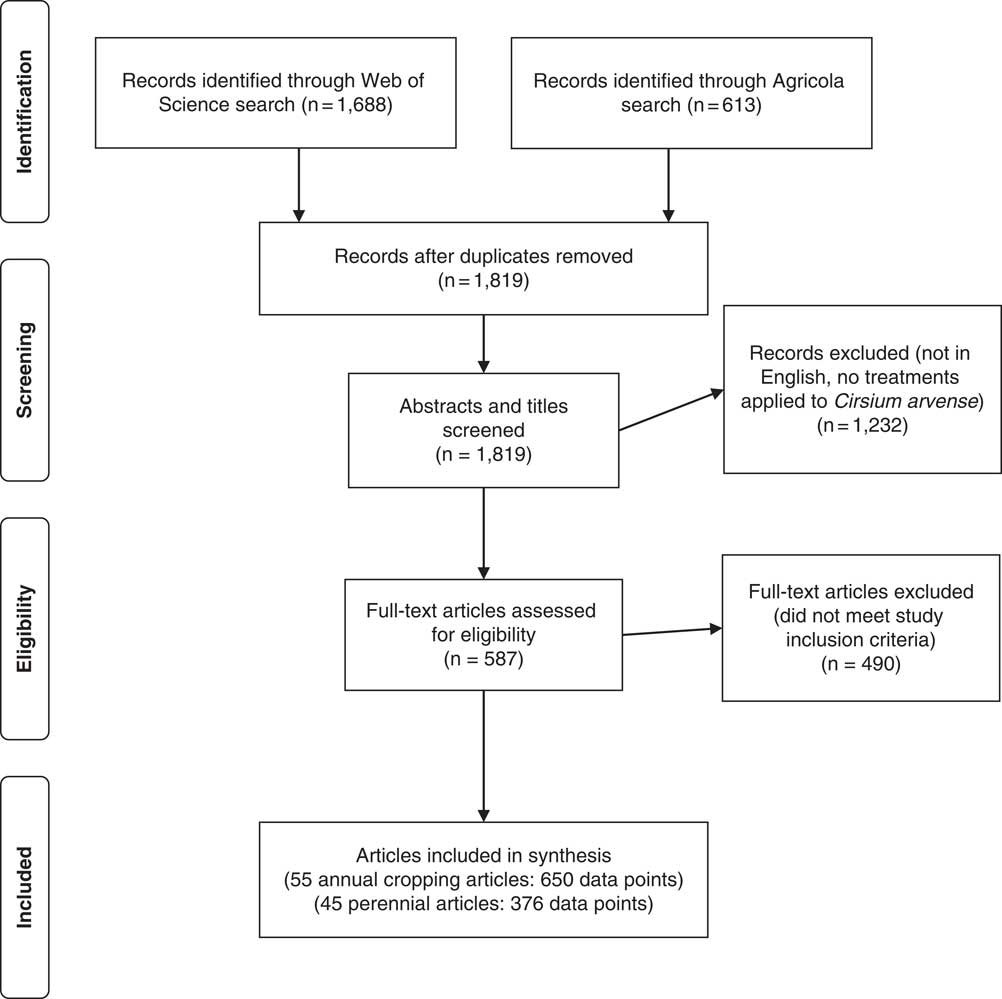
We extracted data from 55 articles published between 1957 and 2015, resulting in 650 total data points (Figure 1). The majority of studies took place in the United States (33 articles) and Canada (9 articles), while the remaining took place in Denmark, England, Germany, Hungary, India, Iran, New Zealand, Norway, Poland, Serbia, and Sweden. Nearly three-quarters (74%) of data points evaluated short-term efficacy of C. arvense management (<1 yr).
Flow diagram depicting criteria applied during literature screening portion of the meta-analysis of Cirsium arvense management. In each box, “n” is the number of articles described in that step.

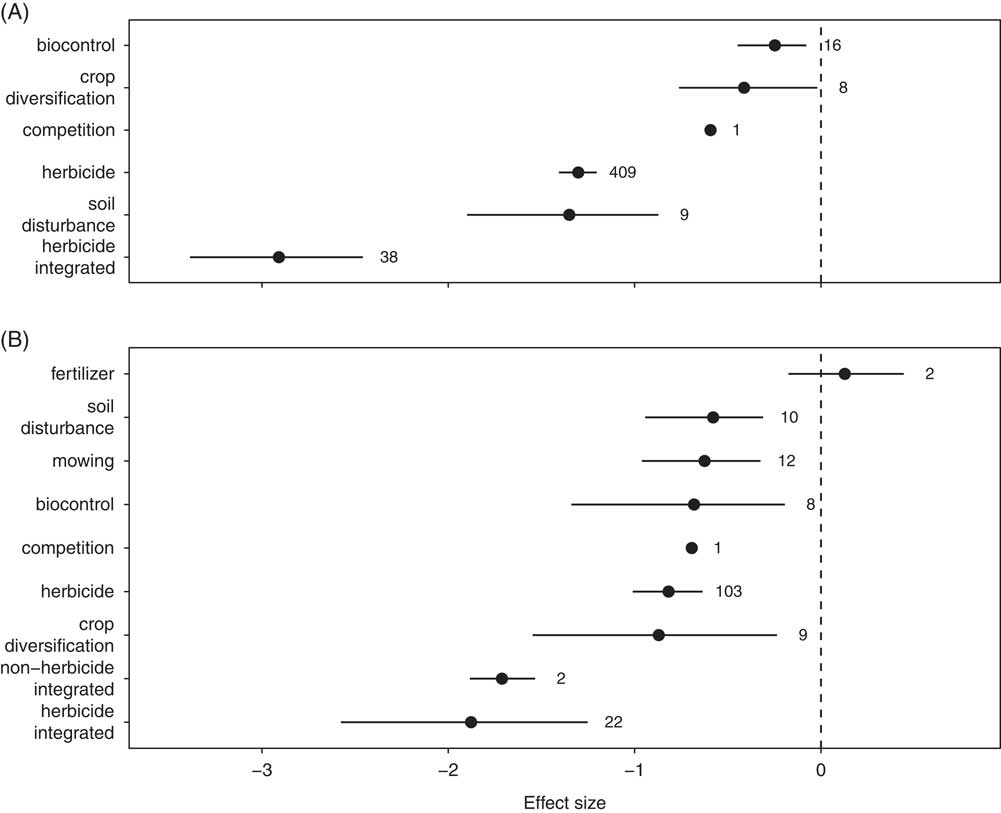
All management techniques studied were effective at reducing C. arvense in annual cropping systems when measured <1 yr after treatment (Figure 2A). However, herbicide integrated management techniques were most effective for short-term control (Figure 2A). Herbicide, herbicide integrated, and soil disturbance were more effective than biocontrol and crop diversification (Figure 2A). Many management techniques were also effective ≥1 yr after treatment. Biocontrol, crop diversification, herbicide, herbicide integrated, mowing, non–herbicide integrated, and soil disturbance all reduced C. arvense ≥1 yr after treatment (Figure 2B). Similar to effects <1 yr after treatment, herbicide integrated management techniques were more effective than herbicide alone ≥1 yr after treatment (Figure 2B). Additionally, herbicide integrated management techniques were similar to non–herbicide integrated management techniques ≥1 yr after treatment (Figure 2B). Fertilizer had no effect on C. arvense ≥1 yr after treatment (Figure 2B). The availability of data for competition as a management technique in annual cropping systems was insufficient, with only one data point reporting treatment effects both <1 yr and ≥1 yr after treatment.
Mean effect size (lnR) and 95% confidence intervals for Cirsium arvense abundance measured (A) <1 yr or (B) ≥1 yr after treatment in annual cropping systems as a function of management techniques. For each management technique, the number next to the confidence interval represents the number of data points that was used to calculate the mean.

Although herbicide was the most studied management technique (79% of data points), other less-studied management techniques were equally or more effective at controlling C. arvense in annual cropping systems. For example, soil disturbance was as effective as herbicide <1 yr after treatment but has not been studied to the extent that control via herbicide has. Furthermore, biocontrol, crop diversification, mowing, and soil disturbance all had the same level of effectiveness as herbicide ≥1 yr after treatment. Only two data points in our meta-analysis evaluated the long-term effectiveness of non–herbicide integrated management techniques, but these techniques resulted in improved control of C. arvense versus herbicide alone (Figure 2B), highlighting the potential benefits of nonchemical multitactic strategies for C. arvense control.
Our meta-analysis also indicated that herbicide integrated management techniques resulted in greater reductions in C. arvense than herbicide applied alone both <1 yr and ≥1 yr after treatment (Figure 2A and B). Herbicide integrated management techniques examined across both time periods included herbicide +fertilizer (3 data points), herbicide+mowing (14 data points), herbicide+soil disturbance (40 data points), and herbicide+soil disturbance+fertilizer (3 data points). Compared with herbicide used as a stand-alone technique, integrating herbicides with additional management techniques can help reduce crop injury and decrease the selective pressure toward the selection of herbicide resistance, while providing control of invasive perennial weed species (Miller Reference Miller2016).
All herbicide MOA groups reduced C. arvense when measured <1 yr after treatment (Figure 3A), while only half of the MOA groups tested ≥1 yr after treatment were effective (Figure 3B). Less than 1 yr after treatment, herbicide MOA Groups 4, 6, 9, 11, 27, or mixes of MOA groups reduced C. arvense more than herbicide MOA Group 2 (Figure 3A). At ≥1 yr after treatment, herbicide MOA Groups 4, 5, and 9 were effective at reducing C. arvense (Figure 3B). However, herbicide MOA Group 9 was slightly more effective than MOA Group 4 (Figure 3B). Herbicide MOA Group 4 (i.e., synthetic auxins) was most frequently tested ≥1 yr after treatment (n=37) and included 2,4-D (32%), picloram (26%), and clopyralid (16%). Other MOA Group 4 herbicides included dicamba, quinclorac, and MCPA (26%). Herbicide MOA Group 5 (i.e., inhibitors of photosynthesis at photosystem II site A) assessed ≥1 yr after treatment all consisted of atrazine in cornfields (n=6) (Parochetti Reference Parochetti1974). Herbicide MOA Group 9 (i.e., inhibitors of EPSPS, glyphosate) was used in 24 data points evaluated ≥1 yr after treatment. Herbicide MOA Groups 2, 11, or mixes of MOA groups did not provide C. arvense control ≥1 yr after treatment. Two of 10 data points for the mix treatment had a positive effect size (i.e., increased C. arvense). These treatments were bromoxynil + MCPA and glyphosate+bromoxynil+MCPA used in spring wheat (Carlson and Donald Reference Carlson and Donald1988). Overall, results from short-term studies suggest that all herbicide MOA groups studied have similar effectiveness. However, if the goal of the land manager is to reduce the frequency of herbicide applications, herbicide MOA Groups 4, 5, and 9 are promising options for longer-term control of C. arvense in annual cropping systems.
Mean effect size (lnR) and 95% confidence intervals for Cirsium arvense abundance measured (A) <1 yr or (B) ≥1 yr after treatment in annual cropping systems as a function of herbicide mechanism of action groups. For each group, the number next to the confidence interval represents the number of data points that was used to calculate the mean. Groups are as follows: 2, acetolactate synthase or acetohydroxy acid synthase inhibitors; 4, synthetic auxins; 5, inhibitors of photosynthesis at photosystem II site A; 6, inhibitors of photosynthesis at photosystem II site B; 9, inhibitor of 5-enolpyruvyl-shikimate-3-phosphate synthase; 11, inhibitors of carotenoid biosynthesis; 27, inhibitors of 4-hydroxyhenyl-pyruvatedioxygenase; and mix, includes two or more herbicides from different groups.

Cirsium arvense causes significant yield losses in the northern part of North America (Tiley Reference Tiley2010), but our results suggest that management options can help reduce its impacts. In our meta-analysis, 90 data points reported on how various management techniques for C. arvense control were associated with improved crop yield of barley, canola, corn, rapeseed, spring wheat, sugar beets, and winter wheat (Figure 4). These techniques included biocontrol, crop diversification, herbicide, herbicide integrated, non–herbicide integrated, and soil disturbance. Biocontrol, herbicide, and herbicide integrated management techniques were similarly associated with increased crop yield (Figure 4). Crop diversification and non–herbicide integrated management techniques were associated with increased crop yield more than biocontrol and herbicide (Figure 4). However, herbicide was the only management technique that had more than three data points recording crop yield, emphasizing the need to include measurements of crop yield in study design. The availability of data for fertilizer as a management technique was insufficient to make comparisons with other techniques, with only one data point reporting treatment effects.
Mean effect size (lnR) and 95% confidence intervals for crop yield in annual cropping systems as a function of Cirsium arvense management techniques. For each management technique, the number next to the confidence interval represents the number of data points that was used to calculate the mean.

Cirsium arvense Management in Perennial Systems
We extracted data from 45 articles published between 1958 and 2015, resulting in 376 total data points (Figure 1). The majority of these studies took place in the United States (28 articles) and New Zealand (11 articles), while the remainder took place in Australia (1 article), Canada (2 articles), the Czech Republic (1 article), Turkey (1 article), and England (1 article). Perennial systems studied included alfalfa fields, grass for seed, natural areas, pastures, rangelands, and roadsides. More than half of data points (58%) evaluated short-term efficacy of C. arvense management (<1 yr).
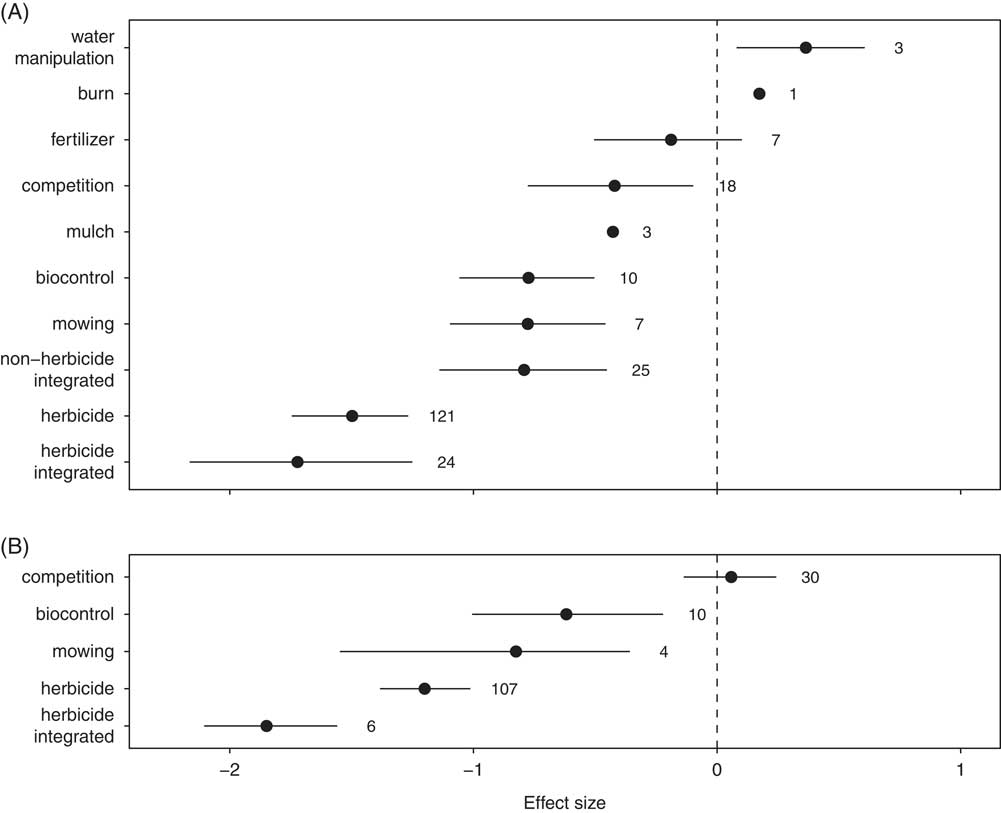
Our meta-analysis revealed that biocontrol, competition, herbicide, herbicide integrated, mowing, mulch, and non–herbicide integrated management techniques reduced C. arvense <1 yr after treatment (Figure 5A). Herbicide and herbicide integrated management techniques were most effective at reducing C. arvense, compared with all other techniques (Figure 5A). Fertilizer had no effect on C. arvense control, whereas water manipulation increased the density of C. arvense <1 yr after treatment (Figure 5A). The three water manipulation data points were from low, medium, and high levels of irrigation on plots with forage species; all levels of irrigation resulted in an increase in density of C. arvense (Thrasher et al. Reference Thrasher, Cooper and Hodgson1963). Only one data point existed for the impact of burning on C. arvense, so comparisons with other management techniques should not be made.
Mean effect size (lnR) and 95% confidence intervals for Cirsium arvense abundance measured (A) <1 yr or (B) ≥1 yr after treatment in perennial systems as a function of management techniques. For each management technique, the number next to the confidence interval represents the number of data points that was used to calculate the mean.

Many management techniques that were effective at reducing C. arvense <1 yr after treatment were also effective ≥1 yr after treatment. These included biocontrol, herbicide, herbicide integrated, and mowing (Figure 5B). Although herbicide was equally effective as herbicide integrated <1 yr after treatment, herbicide integrated was more effective than herbicide alone ≥1 yr after treatment (Figure 5B). Mowing was as effective as herbicide in controlling C. arvense ≥1 yr after treatment (Figure 5B). Mowing techniques included removing all vegetation to 5 cm using a sickle bar when C. arvense was at early bud stage in a pasture (Grekul and Bork Reference Grekul and Bork2007), mowing alfalfa fields twice a year for hay (Hodgson Reference Hodgson1958), and using a rotary mower set at 5 cm when C. arvense was at bud stage in a pasture (Amor and Harris Reference Amor and Harris1977). Even though competition decreased C. arvense <1 yr after treatment (Figure 5A), it had no effect on C. arvense ≥1 yr after treatment (Figure 5B).
Similar to our annual cropping system results and the findings of other meta-analyses (Kettenring and Adams Reference Kettenring and Adams2011), herbicide was the most-studied management technique in perennial systems (61%). However, other management techniques were equally or more effective than herbicide for long-term control. Specifically, mowing was as effective as herbicide, while herbicide integrated management techniques were more effective than herbicide applied alone ≥1 yr after treatment. Herbicide integrated management techniques that resulted in long-term control included herbicide+burn (1 data point), herbicide+competition (2 data points), herbicide+soil disturbance (1 data point), herbicide+competition+mowing (1 data point), and herbicide+competition+soil disturbance (1 data point). While herbicides are the primary method of weed control in most rangelands, this study emphasizes the need to develop integrated weed management programs to achieve long-term control of weeds and healthy plant communities (DiTomaso Reference DiTomaso2000).
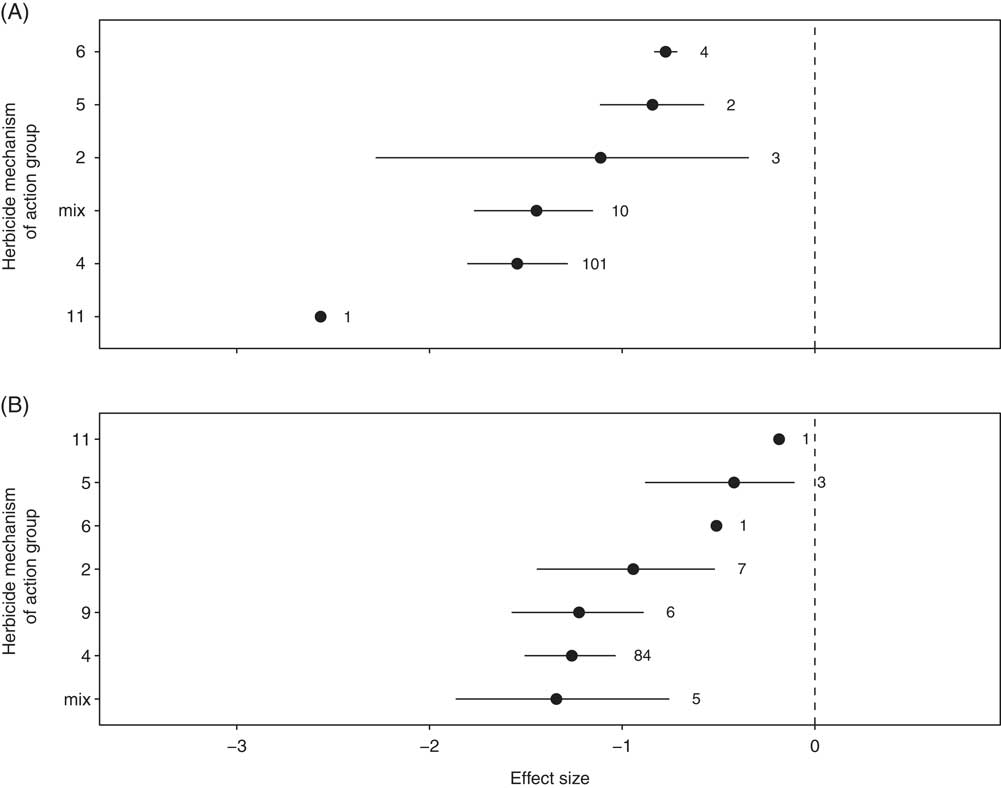
All herbicide MOA groups reduced C. arvense <1 yr and ≥1 yr after treatment (Figure 6A and B). Several herbicide MOA groups showed similar effectiveness in controlling C. arvense. In particular, herbicide MOA Groups 2, 4, and mixes of MOA groups were similar in effectiveness <1 yr after treatment (Figure 6A). Herbicide MOA Group 4 and mixes of MOA groups showed higher effectiveness than herbicide MOA Groups 5 and 6 <1 yr after treatment (Figure 6A). Herbicide mixes included imazamox+bentazon, imazethapyr+bentazon, MCPB+bentazon, clopyralid+chlorsulfuron, and 2,4-D+chlorsulfuron. At ≥1 yr after treatment, herbicide MOA Groups 2, 4, 9, and mixes of MOA groups were similar in effectiveness (Figure 6B). Herbicide mixes included dicamba+diflufenzopyr, 2,4-D+chlorsulfuron, and 2,4-D+metsulfuron. Herbicide MOA Group 9 was represented in our meta-analysis by only six data points that measured control ≥1 yr after treatment. This group is likely seldom used in pastures and rangelands, because it includes nonselective products that could injure desired perennial vegetation. Data for herbicide MOA Group 6 at ≥1 yr after treatment and MOA Group 11 in both time periods were insufficient to make comparisons with other groups, with only one data point for each MOA group reporting treatment effects.
Mean effect size (lnR) and 95% confidence intervals for Cirsium arvense abundance measured (A) <1 yr or (B) ≥1 yr after treatment in perennial systems as a function of herbicide mechanism of action groups. For each group, the number next to the confidence interval represents the number of data points that was used to calculate the mean. Groups are as follows: 2, acetolactate synthase or acetohydroxy acid synthase inhibitors; 4, synthetic auxins; 5, inhibitors of photosynthesis at photosystem II site A; 6, inhibitors of photosynthesis at photosystem II site B; 9, inhibitor of 5-enolpyruvyl-shikimate-3-phosphate synthase; 11, inhibitors of carotenoid biosynthesis; and mix, includes two or more herbicides from different groups.

Similar to our results in annual cropping systems, herbicide MOA Group 4 was the most studied in perennial systems, with 81% of data points using this group across both time periods. Additionally, the majority of studies using mixes of MOA groups had Group 4 as one of the ingredients (73% of data points). Herbicide MOA Group 4 contains herbicides such as 2,4-D, dicamba, clopyralid, MCPA, and picloram, which are considered important tools for managing perennial invasive species in rangelands and pastures (DiTomaso Reference DiTomaso2000; Morishita Reference Morishita1999). Common MOA Group 4 herbicides used in studies in our meta-analysis included clopyralid (19%), 2,4-D (18%), dicamba (17%), a mix of two or more MOA Group 4 herbicides (17%), and picloram (15%). Other MOA Group 4 herbicides making up 15% of use in studies included aminopyralid, MCPB, and MCPA. In spite of the emphasis on MOA Group 4 in past research, other MOA groups were just as effective at reducing C. arvense ≥1 yr after treatment (e.g., Groups 2 and 9).
Both competition and herbicide were similarly associated with increased abundance of desired plants in perennial systems (competition mean lnR= 0.45, 95% confidence interval: 0.21 to 0.67, n=5; herbicide mean lnR= 0.20, 95% confidence interval: 0.08 to 0.32, n=27), as demonstrated by 32 data points measuring alfalfa yield, seed yield, and grass biomass. For example, decreasing row spacing of alfalfa was associated with an increase in alfalfa yield and a reduction in C. arvense density (Celebi et al. Reference Celebi, Kaya, Korhan Sahar and Yergin2010). A total of three articles discussing studies that used herbicides also recorded abundance of desired plants with contrasting results. Mesbah and Miller (Reference Mesbah and Miller2005) found an increase in alfalfa seed yield after applying a variety of herbicides (18 data points), and Gallagher and Vandenborn (Reference Gallagher and Vandenborn1976) observed both increases and decreases in creeping red fescue (Festuca rubra L.) seed yield after applying herbicides (7 data points). In contrast, Krueger-Mangold et al. (Reference Krueger-Mangold, Sheley and Roos2002) observed a decrease in desired grass biomass after treating natural areas in the fall with glyphosate, a nonselective herbicide (2 data points). It is important to note that other plant-community components and ecosystem services may also change as a result of management efforts. For example, abundance of desired forbs may decrease as a result of broadleaf herbicide use (Ortega and Pearson Reference Ortega and Pearson2010). Although no data points in our meta-analysis examined the response of native forbs to C. arvense management techniques, the potential non-target effects on native forbs with broadleaf herbicides is an important concern. Incorporating herbicide use with other weed management strategies may help minimize such non-target impacts in perennial systems (Crone et al. Reference Crone, Marler and Pearson2009).
General Management Recommendations
Our meta-analysis provides several general management recommendations for C. arvense. First, in both annual cropping and perennial systems, land managers should consider integrating management techniques for enhanced long-term control of C. arvense, as this approach proved to be more effective than solely applying herbicides. Second, despite herbicide being the most-studied management technique, a variety of other management techniques resulted in similar control of C. arvense in the short and long term in annual cropping and perennial systems. This emphasizes the need to refocus weed science research priorities by investigating alternative and integrated control methods more often. Third, herbicide MOA Groups 4, 5, or 9 can be used for long-term control of C. arvense in annual cropping systems. Finally, a variety of herbicide MOA groups can be used for long-term control of C. arvense in perennial systems, including Groups 2, 4, 5, 9, and mixes of MOA groups.
Future Research
First, our meta-analysis had limited data on certain nonchemical management techniques, such as burning, mulch, and water manipulation. However, some of these management techniques had negative effect sizes, suggesting they could be promising techniques for C. arvense control. Additional management techniques, such as grazing, were not examined due to lack of papers addressing these. Therefore, increasing the amount of research devoted to nonchemical and integrated management techniques in annual cropping and perennial systems may help provide a broader range of management recommendations for C. arvense control. Second, because short-term studies could misrepresent the impact of a management technique on a perennial species, we encourage researchers to conduct long-term evaluations on approaches to control C. arvense. Finally, our meta-analysis, along with others (Koricheva and Gurevitch Reference Koricheva and Gurevitch2014; Philibert et al. Reference Philibert, Loyce and Makowski2012), highlights the need to include such basic information on means, measures of variation, and sample sizes in published articles related to invasive species management (Gurevitch and Hedges Reference Gurevitch and Hedges2001; Gurevitch et al. Reference Gurevitch, Morrow, Wallace and Walsh1992). Additionally, researchers should consider the importance of measuring not only weed control but also crop yield and abundance of desired plants, as well as other ecosystem services.
Supplementary material
To view supplementary material for this article, please visit https://doi.org/10.1017/wsc.2018.6
Acknowledgments
The authors would like to thank the Montana Noxious Weed Trust Fund and the Montana Wheat and Barley Committee for funding this research. We would like to thank Sean MacKenzie for statistical analysis help. No conflicts of interest have been declared.