Introduction
On 31 December 1985, Singapore left the United Nations Educational, Scientific and Cultural Organization (UNESCO), together with the UK and the United States, turning against the ‘New International Information Order’ demanded by UNESCO in the early 1980s. The order aimed to fight pro-Western bias in global news agencies by licensing journalists, creating an international code of press ethics and increasing government control over the media.Footnote 1 Inspired by the works of Theodor W. Adorno and Max Horkheimer and others, it reflected a conceptualisation of knowledge and culture that aimed at preserving and fostering localised, cultural diversity, autonomous forms of cultural production and free cultural expression.Footnote 2 It turned explicitly against any forms of market-driven or -oriented cultural production. Contrasting autonomous arts and ‘cultural industry’ (as termed by Adorno), the former was regarded as the only possible breeding ground for social change and the latter as standardised market products and bonds of the individual's conscience.Footnote 3 Consequently, ‘culture’ and ‘market’ were regarded as entirely separate entities by UNESCO.
Singapore, nevertheless, a small island state that only had become independent in 1965, pursued a clearly economic-oriented development path in which the fostering of freely expressed culture hardly played a role.Footnote 4 Instead, the Singaporean government joined a global developmentFootnote 5 and focused on creating a technologically defined knowledge society, generally referred to in Singapore as the ‘knowledge-based economy’. The National IT Plan of 1985, the year of Singapore leaving UNESCO, identified information and communication technology (ICT) as a ‘new bloodline for Singapore Economy’.Footnote 6 Only from the late 1990s onwards, again following a global development,Footnote 7 the potential of creativity, the arts and culture for fostering knowledge production and transmission as well as the creation of a separate economic sector moved into the centre of the Singaporean government's attention. Since then, the commercially oriented concept of ‘creative industries’Footnote 8 has become a path commonly taken by governments in order to foster creativity and culture in a tightly defined manner along its market potential. Contrary to Adorno and Horkheimer's critique of ‘cultural industry’, ‘creative industries’ are regarded here as a positive contribution to economic growth rather than the democratic replacement of totalitarian propaganda, leading to a conforming collective conscience.Footnote 9
UNESCO, nevertheless, continues to foster the practising and preservation of local cultures, cultural diversity, equality and free expression — independent of their market-orientation or potential contributions to economic development. The basic ideas of the MacBride Report, which formed the basis for the ‘New International Information Order’ and therefore Singapore's departure from the organisation, are still relevant and supported by UNESCO today.Footnote 10 Nonetheless, the explicit separation of ‘culture’ and ‘market’, portraying economic, profit-making interests with regard to culture as exclusively negative for social development, has been replaced by an increased openness, additional to the traditional foci of content, to allow for market-driven and organised forms of cultural production in the conceptualisation of culture by UNESCO. When Singapore rejoined UNESCO on 8 October 2007 after a 22-year absence, the Singaporean minister of state for education and manpower, Gan Kim Yong, explicitly identified Singapore's aim of ‘cultural and scientific exchanges with other UNESCO members in its push to build a knowledge-based economy’ as the prime reason for the nation's re-emergence.Footnote 11
This paper comprises four parts. Taking the terminological use and attached definitions of the notions of ‘creative industries’ in Singapore and ‘cultural industries’ by UNESCO as starting points, the first part of this paper introduces the reader to theoretical works on boundary objects, tools, settings and concepts that theoretically underpin the study. Based on these factors, I propose to reconceptualise ‘creative industries’ as a boundary concept which facilitates communication and co-operation between players with widely differing conceptualisations of knowledge and culture. Second, the paper reviews the about-turn in UNESCO's position towards the conflicting or corresponding relationship of culture and markets, by redrawing the organisation's development from a rather critical stand on the commercial tapping of artistic production to the incorporation of the notion of ‘creative industries’ into its profile. UNESCO-organised conferences, symposia and commissions with reference to ‘creative industries’ are assessed regarding the use of the term ‘cultural industries’ (used mainly by UNESCO) and Singapore's presence or absence from the mid-1970s onwards. This is followed by the third part of this paper, which assesses the effects of the global aim to develop into a knowledge society on Singapore's cultural politics. Singapore's first long-term cultural policy, The Ong Teng Cheong Report, was published in 1989. The development of a high-class cultural scene along the bay of the Singapore River, called ‘The Esplanade’, and a ‘Creative Industries Development Strategy’ followed in 2002. Here, the Singaporean government defines ‘creative industries’ as ‘those industries which have their origin in individual creativity, skill and talent and which have a potential for wealth and job creation through the generation and exploitation of intellectual property’.Footnote 12 In 2007, Singapore's government took its attempt to foster local culture one step further by rejoining UNESCO. The ‘creative industries’ concept was adopted by both sides to act as a bridge for intensified mutual co-operation. Consequently, the concluding part of this paper discusses the concept of ‘creative industries’ as a boundary concept offering a common meeting ground for renewed co-operation.
Methodologically, this paper is based on (a) a quantitative and qualitative analysis of the documentations of UNESCO-organised conferences, symposia and commissions on the notion of ‘cultural industries’, conducted in 2009/10, (b) a quantitative and qualitative analysis of Singaporean state programmes and initiatives in the fields of culture, creativity development and the arts, conducted in 2007/09 and (c) qualitative expert interviews conducted with representatives of government administrative bodies and state-financed research institutes, conducted in Singapore in 2005.
‘Creative industries’ as a boundary concept
Since the mid-1990s, a continuously growing number of national governments, their policy-producing bodies, multilateral organisations and civil society representations around the world have released policies, programmes and initiatives to promote ‘creative industries’. Connecting ‘creative industries’ with the notion of a ‘knowledge society’, UNESCO, together with the Global Alliance for Cultural Diversity, states that ‘creative industries are becoming increasingly important components of modern post-industrial knowledge-based economies’.Footnote 13 As such, this relatively fuzzy concept encourages recognisable action worldwide, although it should be noted that the precise definitions implied and the interests or rationale behind using the concept vary widely. John H. Hartley mentions that ‘the creative industries idea varies geographically, depending on local heritage and circumstance. Most notably, in the United States, creativity is consumer- and market-driven, whereas in Europe it is caught up in traditions of national culture and cultural citizenship.’Footnote 14 John Howkins points out that:
Most countries would agree that creativity and its industries embrace the creative imagination in all its forms. But a few, including Britain and Australia, restrict the term “creative industries” to the arts and cultural industries and exclude science and the patent industries.Footnote 15
This is also the case with regard to the use of the concept by the Singaporean government and UNESCO. While Singapore in government programmes, publications and speeches works with the notion of ‘creative industries’, UNESCO predominantly uses the term ‘cultural industries’. In defining ‘creative industries’, Singapore refers to the original definition developed by the UK Creative Industries Taskforce in 1997/98, stating that this applies to ‘those industries which have their origin in individual creativity, skill and talent and which have a potential for wealth and job creation through the generation and exploitation of intellectual property’.Footnote 16 This definition can be regarded as the first definition of the concept.Footnote 17 It excludes science and the patent industries, but instead focuses on the arts and cultural industries.
UNESCO, in 2000, defined ‘cultural industries’ as follows:Footnote 18
It is generally agreed that this term applies to those industries that combine the creation, production and commercialisation of creative contents which are intangible and cultural in nature. The contents are typically protected by copyright and they can take the form of a good or a service. […] Cultural industries generally include printing, publishing and multimedia, audiovisual, phonographic and cinematographic productions as well as crafts and design.
In 2005, in the Convention on the Promotion and Protection of the Diversity of Cultural Expressions, UNESCO defined ‘cultural industries’ as ‘industries producing and distributing cultural goods or services’, which are defined as:
[…] those activities, goods and services, which at the time they are considered as a specific attribute, use or purpose, embody or convey cultural expressions, irrespective of the commercial value they may have. Cultural activities may be an end in themselves, or they may contribute to the production of cultural goods and services.Footnote 19
In 2006, UNESCO, together with The Global Alliance for Cultural Diversity, attempted to explicitly distinguish ‘cultural industries’ from ‘creative industries’ by adding those industries ‘in which the product of service contains a substantial element of artistic or creative endeavour’ but do not derive from the traditional artistic domain, such as, for example, architecture and advertising.Footnote 20 The 2009 UNESCO Framework for Cultural Statistics adopted this distinction between ‘cultural’ and ‘creative industries’Footnote 21 and argued for the use of the term ‘cultural industries’ due to the lack of clarity when defining and measuring the level of creativity applied throughout the separate industries in this sector.Footnote 22 Within the framework itself, UNESCO works with the notion of ‘cultural industries’, but includes selected ‘creative industries’ (design and advertising) as a separate domain.
This blurred use of terminology, which lacks clear-cut and commonly accepted definitions, is significant for boundary concepts. Ilana Löwy stresses in her paper, ‘The strength of loose concepts’, the important role that imprecise terms play for scientific change.Footnote 23 Empirically based on the development of immunology as science, she argues that, while ‘some terms may indeed evolve towards well-defined ones, […] at times “fuzzy” terms may remain imprecise for their whole life span and, as such, continue to play an important heuristic role in the construction of new scientific knowledge’.Footnote 24 Hence, loosely defined terms and concepts leave space for creative exploration, while tight definitions close off this space.
Löwy's assessment of the involvement of different actors and actor groups is important for this paper: ‘On the social level such “permanently imprecise” concepts may moreover favour the development of “federative” experimental approaches and may facilitate the long-term maintenance of loose coalitions and of institutional alliances between pre-existing professional groups.’Footnote 25
The use of the ‘creative industries’ notion on UNESCO's website exemplifies this ‘fuzzyness’, this imprecise and loose definition. The notion here clearly facilitates the crossing of boundaries conceptually (creative versus cultural industries) and in terms of practical co-operation (Singapore and UNESCO).
Singapore's government subscribes to the concept ‘creative industries’ as defined by the UK Creative Industries Taskforce, and applies it in its subsequent policies. UNESCO, in its everyday work, prefers the term ‘cultural industries’, emphasising the importance of local and global cultures rather than the aspect of added economic value through creativity. This is also supported when searching for the terms in UNESCO's online document database. While the term ‘cultural industries’ meets 653 targets, the term ‘creative industries’ only results in 279 hits. The interchangeable use of these terms, as well as the lack of a commonly accepted, clear-cut definition for ‘creative’ and ‘cultural industries’ on UNESCO's website, points to a loose conceptualisation of the phenomenon. This then offers a common meeting ground on which the crossing of boundaries is eased — boundaries between national politics and multilateral co-operation, as well as between cultural and economic policy.
This suggests that it is useful to frame ‘creative industries’ as a boundary concept. Originally developed by Löwy, this concept was taken up and developed further by Peter Mollinga.Footnote 26 In his boundary-crossing framework, developed with regard to interdisciplinary research and work, Mollinga relates Löwy's thoughts on ‘boundary concepts’ to the notion of ‘boundary objects’, as grasped by Susan Leigh Star and James R. Griesemer,Footnote 27 and complements these two by adding the notion of ‘boundary settings’. These three notions – ‘boundary concepts’, ‘boundary objects’ and ‘boundary settings’ – are identified by Mollinga as the three pillars of his boundary-crossing framework, the main value of which he sees in its ability to ‘rationalise dissent’.Footnote 28 As Mollinga states,
[…] boundary concepts are words that operate as concepts in different disciplines or perspectives, refer to the same object, phenomenon, process or quality of these, but carry (sometimes very) different meanings in those different disciplines or perspectives. In other words, they are different abstractions of the same “thing”.Footnote 29
This notion of ‘boundary concepts’ stands in close proximity to ‘boundary objects’, defined by Star and Griesemer as:
[…] both plastic enough to adapt to local needs and the constraints of the several parties employing them, yet robust enough to maintain a common identity across sites. They are weakly structured in common use, and become strongly structured in individual site use.Footnote 30
Löwy nevertheless stresses an important commonality between ‘boundary objects’ and ‘boundary concepts’:
Both ‘boundary concepts’ and ‘boundary objects’ are multifunctional: on the cognitive level they make possible the interaction of distinct scientific cultures and thus permit the construction of a given segment of knowledge, while on the social level they facilitate the development of inter-group alliances and therefore advance specific social interests.Footnote 31
Additionally, according to Mollinga, ‘boundary settings’ are the spaces, conducive, enabling environments or settings where these ‘concepts, devices and methods can be fruitfully developed and effectively put to work’.Footnote 32 Mollinga refers to interdisciplinary research projects and distinguishes between the internal organisation and dynamics that foster inter-disciplinarity and the external environment in which the activities are embedded.Footnote 33
The notion of ‘creative industries’ operates as a concept in different settings and is employed by a wide range of highly differing actors and actor groups. All these actors refer roughly to the same meaning when using the term ‘creative industries’, but refrain from giving tight, precise definitions. Instead, enough space is given to attach slightly varying meanings to the term. Referring to Star and Griesemer's definition of boundary objects, as stated above, the notion of ‘creative industries’ is plastic enough to adapt to the needs and constraints of the actors employing them. However, although it offers enough similarity to be used by actors across all kinds of sites, it fails to offer a common identity. Definitions given by different actors still vary to a degree, so that an explicit common identity cannot be assessed. The notion of ‘creative industries’ is structured weakly in common and seemingly individual use. The common structure crossing different social worlds – in which varying definitions of ‘creative industries’ exist – is still in the process of being built. Hence, so far, ‘creative industries’ seem to act as a boundary concept, defined by the different actors who use it in varying ways. A common identity and common structure uniting these different definitions are still in the process of being constructed.
UNESCO and the notion of ‘cultural industries’
UNESCO's use of the term and concept of ‘cultural industries’, as its preferred name, goes back to the early 1970s. The then following UNESCO activities regarding ‘cultural industries’ can be divided into two phases. During the primary phase (1976–1998), UNESCO and its member states adopted the concept of ‘cultural industries’, originally developed by academics such as Theodor W. Adorno, Max Horkheimer,Footnote 34 Armand Mattelart, Augustine Girard and others,Footnote 35 conceptually developed it further and moved from a critical stand on the integration of culture, creativity and the arts on the one hand, and the market on the other, to an incorporation of market-oriented and market-driven cultural production in UNESCO's profile, while at the same time maintaining the aim to foster and preserve traditional and experimental arts and culture. This incorporation of ‘cultural industries’ into the UNESCO portfolio and the growing recognition of ‘cultural industries’ on the national and regional levels of policymaking can be seen as a paradigm shift in the perception of ‘cultural industries’ as a link between culture and the market. During the secondary phase (1998–ongoing), the practical incorporation of ‘cultural industries’ into national and regional policy measures for socio-economic development (including statistical assessments of ‘cultural industries’) has moved into the centre of respective UNESCO discussions. The following two sections outline the primary and secondary phases by following the notion of ‘cultural industries’ through UNESCO-organised conferences and commissions.
The history of ‘cultural industries’ within UNESCO
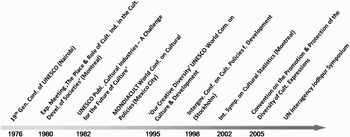
Going back to Adorno and Horkheimer's critical assessment of ‘cultural industry’ (the authors used the singular) introduced in the 1940s,Footnote 36 questions regarding the commercial tapping of artistic creation, summarised under the notion of ‘cultural industries’, first entered UNESCO's discussions in the early 1970s. Figure 1 lists all major conferences, symposia and commissions organised by UNESCO,Footnote 37 which contributed to the conceptual development of UNESCO's gradually changing position on the notion of ‘cultural industries’.Footnote 38
UNESCO conferences, symposia and commissions on ‘cultural industries’ (compiled by the author, 2010)

At the nineteenth General Conference of UNESCO (Nairobi) in 1976, the term ‘cultural industries’ entered the resolutions of a General Conference of UNESCO for the first time. Taking an explicitly critical stand on the topic, the General Conference recommended: ‘Member States or the appropriate authorities should make sure that the criterion of profit making does not exert a decisive influence on cultural activities, and, in drawing up cultural policies, provide for machinery for negotiating with private cultural industries […].’Footnote 39
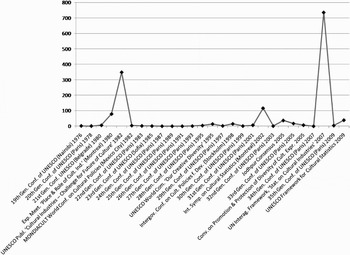
At the twentieth session, held in Paris in 1978, the General Conference of UNESCO approved ‘comparative research […] on the place and role of cultural industries in the cultural development of societies’.Footnote 40 This led to the organisation of a meeting of experts on ‘The place and role of cultural industries in the cultural development of societies’ in 1980 in Montreal. In preparation for the World Conference on Cultural Policies, to be held in Mexico City in 1982, this expert meeting was expected to ‘update [UNESCO's] thinking on culture’, to outline problems regarding the term ‘cultural industries’, their scope, mode of operation, branches, effects on social groups, ‘creative workers’, the phenomenon of internationalisation and potential forms of public and private intervention.Footnote 41 At the twenty-first General Conference of UNESCO in Belgrade (1980), the programme and budget for an internationally disseminated publication as a result of this expert meeting were approved,Footnote 42 and in 1982, the book ‘Cultural industries – A challenge for the future of culture’ was published.Footnote 43 With contributions from scholars such as Augustine Girard, Albert Breton and Armand Mattelart, it scientifically prepared the ground for the World Conference on Cultural Policies (MONDIACULT) in Mexico City.Footnote 44 However, as stated by UNESCO Bangkok, ‘those conferences had only limited impact on programming and policy development in the countries of the Asia-Pacific region’.Footnote 45 Only in 1995, 10 years after Singapore left UNESCO, was the issue of culture in development and therein also the interlinkage of culture and the market, embodied by the ‘cultural industries’ and with the publication of ‘Our creative diversity’, the report of the World Commission on Culture and Development,Footnote 46 ‘raised to the programming level in all UN Member States’.Footnote 47 As illustrated in Figure 2, Singapore, as a non-member of UNESCO at that time, was not involved in the commission.Footnote 48
Terminological use of ‘cultural industries’ in UNESCO conferences – in total numbers (compiled by the author, 2010) (based on: UNESCO, General conference resolutions 1976–2009; UNESCO, Committee of experts on the place and role of cultural industries in the cultural development of societies (Montreal: UNESCO, 1980); UNESCO, Cultural industries – A challenge for the future of culture; UNESCO, Mexico City declaration on cultural policies, adopted by the World Conference on Cultural Policies Mexico (Mexico City: UNESCO, 1982); World Commission on Culture and Development,Our creative diversity (Paris: World Commission on Culture and Development, 1995); Intergovernmental Conference on Cultural Policies for Development, Final report (???Intergov. Conf. on Cult. Policies for Development, Stockholm, 1998); UNESCO Institute of Statistics (UIS), Proceedings of the International Symposium on Culture Statistics (Montreal: UIS, 2002); UNESCO Bangkok, Jodhpur consensus (Bangkok: UNESCO Bangkok, 2005); UNESCO, Convention on promotion and protection of the diversity of cultural expressions (Paris: UNESCO, 2005); UNESCO Bangkok, Statistics on cultural industries: Framework for the elaboration of national data capacity building projects (Bangkok: UNESCO Bangkok, 2007); UNESCO, 2009 UNESCO framework for cultural statistics (Paris: UNESCO, 2009)). The search was conducted for ‘cultural industries’ and ‘cultural industry’

In 1998, the newly inspired interest in ‘cultural industries’ led to the Intergovernmental Conference on Cultural Policies for Development in Stockholm, bringing together not only United Nations and member states, but also a wide range of non-governmental organisations and private enterprises. Again, the Singaporean government did not participate.Footnote 49
In the same year, and closely following the Intergovernmental Conference, UNESCO published its first World Culture Report, Culture, creativity and markets, thereby finally abolishing the traditional separation of ‘culture’ and ‘markets’.Footnote 50 The publication of this report can be regarded as the final point of paradigm shift within UNESCO, in which it turned against the former division and believed contradiction of ‘culture’ and ‘markets’ and instead – under the notion of ‘cultural industries’ – incorporated profit-making-oriented aspects of culture, creativity and the arts into its portfolio.
Towards ‘cultural industries’ as a socio-economic development strategy
From 1998 onwards, UNESCO's activities and discussions with regard to ‘cultural industries’ increasingly focused on their practical incorporation into national and regional policy measures for socio-economic development. The integration of market-oriented cultural production into UNESCO's profile is less questioned. Figure 2 illustrates the terminological use of ‘cultural industries’ in the documentations and reports of the major conferences, symposia and commissions (including the resolutions of the General Conferences) organised by UNESCO on the topic from 1976 onwards. The data indicate the continuous discussion of the topic of ‘cultural industries’ within UNESCO since the mid-1970s, with more intense discussions throughout the early 1980s and the mid-2000s. The peaks of terminological use fall together with the discussions on the ‘New international information order’ in the early 1980s (with UNESCO taking a sceptical stand on ‘cultural industries’) and Singapore's subsequent leaving of UNESCO, as well as with increased discussions in the mid-2000s (with UNESCO taking a positive stand on ‘cultural industries’) and Singapore's subsequent rejoining of UNESCO. This second phase of the position of ‘cultural industries’ within UNESCO's portfolio is outlined below and related to Singapore's renewed interest in interactions with the organisation, as communicated by its presence/absence during the respective events.
In October 2002, the UNESCO Institute for Statistics (UIS), together with the Institut de la Statistique du Québec, organised an International Symposium on Cultural Statistics with the theme ‘Statistics in the Wake of Challenges posed by Cultural Diversity in a Globalisation Context’. By inviting the researchers and representatives of statistical agencies from 25 countries, as well as users of international and national cultural statistics, the symposium acted as a think-tank for the strategic and continual orientation of the newly established UIS. As the topic of ‘cultural industries’ and their statistical assessment was discussed at great length during the symposium (the term ‘cultural industries’ is mentioned 116 times in the symposium documentation),Footnote 51 ‘cultural industries’ as a statistically under-assessed sector was recognised and integrated into the newly formulated agenda of the institute. Singapore's government, nevertheless, was not represented.Footnote 52
In February 2005, UNESCO's Bangkok office organised a Senior Expert Symposium in Jodphur, India, bringing together the UIS, the United Nations Industrial Development Organization (UNIDO), the World Intellectual Property Organization (WIPO), the World Bank and the Asian Development Bank in order to define a common approach ‘to support the creative sector as a key driver for socio-economic development in the Asia-Pacific region by identifying and establishing a policy framework and an accompanying action strategy for the promotion of cultural industries’.Footnote 53 In so doing, the Symposium formulated ‘The Jodhpur consensus’, a declaration of political will leading to a policy framework, a regional technical assistance mechanism, a 10-year plan of action for establishing a framework for the promotion of cultural industries in the Asia-Pacific region and a data model. The plan consisted of proposals for five key technical assistance activities as next steps and a suggested coordination framework, bringing together national stakeholders with international technical assistance agencies and non-governmental organisations.Footnote 54 According to the Symposium, ‘this roadmap for development driven by creative, cultural industries [aims for] an integrated regional approach which is adaptable to national and local circumstances’.Footnote 55
Singapore, despite not being a member of UNESCO at that time, was represented at this Symposium by Mr Baey Yam Keng, the then Director Creative Industries Singapore, Ministry of Information, Communications and the Arts, and Mr Wong Sheng Kwai, the then assistant director-general of the Intellectual Property Office of Singapore, who were both panellists. The Director Creative Industries Singapore, in the closing statement of his speech, emphasised the importance of integrating all relevant stakeholders – government agencies, industry players and individuals both in economic and social segments – into the effort of fostering creative industries.Footnote 56 The director of UNESCO Office Bangkok took this further and underlined the role of profound (often localised) cultural richness and diversity as the basis for cultural industries, as well as the need for regional and global co-operation in tapping these cultural resources for social and economic development. He assessed a paradigm shift in perceiving culture increasingly as a direct contributor to sustainable development, and emphasised UNESCO's role in fostering supportive policy environments across national and sectoral borders.Footnote 57
The Symposium in Jodhpur was followed by the ‘Expert Meeting for Policy Leaders and Decision-makers in the Broadcasting and Audio-visual Industry in Asia’ (February 2006, Singapore), the ‘Bay of Bengal Initiative for Multi-Sectoral Technical and Economic Cooperation (BMISTEC) First Ministerial Meeting on Culture’ (May 2006, Paro/Bhutan) and the ‘Open Forum on Measuring Creativity, Happiness and Well-being’ (November 2006, Hong Kong). Additionally, the ‘UN Interagency Technical Working Group on Cultural Industries Statistics’Footnote 58 was formed, as recommended by the Jodhpur Symposium, in order to design and implement a strategy for the collection and analysis of the statistics of cultural industries.Footnote 59
Despite Singapore not being a UNESCO member at the time, the Expert Meeting for the Audio-visual Industry was organised in collaboration with the government of Singapore and held in Singapore. As one of three sub-regional seminarsFootnote 60 under the project title, ‘Harnessing ICTs for the audiovisual industry and public service broadcasting in developing countries’, it focused on identifying policy mechanisms and strategies in Asia to support research and emerging creators in the broadcasting and audiovisual industries. During the event, 10 representatives from Singapore participated, including the assistant director-general, then Mr Sheng Kwai Wong, and the senior assistant director, then Ms Elaine Leong of the Intellectual Property Office of Singapore. In the second meeting, held in Paro/Bhutan, Singapore did not participate as she is not located geographically along the Bay of Bengal. The third meeting, held in Hong Kong, aimed at offering a meeting ground for a wide range of creative industries’ experts in order to exchange ‘methodologies, models and findings of the variety of indices developed in the attempt to measure the impact of culture and creativity on our economies and societies’.Footnote 61 As a result, Singapore was represented by the assistant director-general of the Intellectual Property Office of Singapore, then Mr Sheng Kwai Wong, as well as Ms Kit Boey Chow, senior fellow at the Intellectual Property Academy, Singapore.Footnote 62
In addition to these meetings, which aimed at establishing increased and strategic co-operation amongst Asian and Pacific countries on ‘creative industries’ issues, the United Nations Interagency Technical Working Group on Cultural Industries Statistics met several times. In 2007, it published a document entitled, Statistics on cultural industries – Framework for the elaboration of national data capacity building projects, describing ‘the framework for National Technical Assistance Projects, […] a long-term interagency programme for the promotion of cultural industries in the Asia-Pacific region, as a strategy for poverty reduction and community regeneration’.Footnote 63 As such, the framework was intended primarily for policy makers and officials concerned with the elaboration and implementation of national development plans, statisticians and cultural researchers. The framework hoped to contribute to the design of national projects and action plans to a degree that consistently applied international statistical standards in the area of ‘cultural industries’ development.Footnote 64
On 20 October 2005, the thirty-third UNESCO General Conference in Paris adopted the ‘Convention on the Protection and Promotion of the Diversity of Cultural Expressions’. The notion of ‘cultural industries’ is mentioned seven times in the text of the convention — once in the ‘Principle of international solidarity and co-operation’ and one of altogether eight guiding principles of the convention. Here the convention stresses the importance of international co-operation for the fostering of national ‘cultural industries’ by stating: ‘International co-operation and solidarity should be aimed at enabling countries, especially developing countries, to create and strengthen their means of cultural expression, including their cultural industries, whether nascent or established, at the local, national and international levels.’Footnote 65
Singapore, nonetheless, did not at that point ratify the ‘Convention on the Protection and Promotion of the Diversity of Cultural Expressions’. Instead, it ratified the ‘International Convention against Doping in Sport’, which was adopted by the thirty-third General Conference of UNESCO on 19 October 2005, one day earlier.Footnote 66 Using the fact that Singapore had not yet rejoined UNESCO in 2005 as a reason for not ratifying the Convention on the Protection and Promotion of the Diversity of Cultural Expressions therefore does not hold. Instead, it suggests that reasons of content might prevail: the convention focused on the protection and promotion of cultural diversity and the free interaction of these largely diverse cultures, both aspects not supported fully by Singapore's legal system.Footnote 67 The harnessing and economic utilising of ‘cultural industries’ – Singapore's openly communicated interest – only played a minor part in the convention.
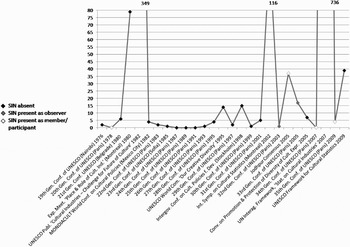
Based on Figure 2, Figure 3 indicates, besides the use of the term ‘cultural industries’ in an enlarged form, the participation of Singapore's government in, or absence from, the General Conferences of UNESCO and main events with regard to ‘cultural industries’ from 1976 onwards. In the case of participation, the figure distinguishes between participation as a passive observer or active participant.
Singapore's participation and terminological use of ‘cultural industries’ enlarged in UNESCO conferences – in total numbers (compiled by the author, 2010) (based on: UNESCO, General conference proceedings 1976–2009; UNESCO, Committee of experts on the place and role of cultural industries in the cultural development of societies; UNESCO, Cultural industries – A challenge for the future of culture; UNESCO, Mexico City declaration on cultural policies; World Commission on Culture and Development, Our creative diversity; Intergovernmental Conference on Cultural Policies for Development, Final Report; UIS, Proceedings of the International Symposium on Culture Statistics; UNESCO Bangkok, Senior Expert Symposium on Cultural Industries – List of Participants, http://www.unescobkk.org/culture/our-projects/cultural-industries-and-creative-enterprises/cultural-industries-in-asia-and-the-pacific/senior-expert-symposium-on-cultural-industries/list-of-participants (last accessed 20 April 2010); UNESCO, Singapore – Ratified conventions, http://portal.unesco.org/la/conventions_by_country.asp?contr=SG&language=E&typeconv=1 (last accessed 23 March 2010); UNESCO Bangkok, Statistics on cultural industries: Framework for the elaboration of national data capacity building projects (Bangkok: UNESCO Bangkok, 2007); UNESCO, 2009 UNESCO framework for cultural statistics (Paris: UNESCO, 2009))

In 1976, the year in which the term ‘cultural industries’ entered the resolutions of a UNESCO General Conference for the first time, the preservation and practising of culture and the pursuit of economic interest were regarded as incompatible, as outlined above. Profit-making, and thereby markets in general, was perceived as a threat to culture. In 1978, Singapore's government participated in the twentieth General Conference of UNESCOFootnote 68 — the last time before leaving UNESCO in 1985. In 1998, after 22 years and several Expert Meetings, World and Intergovernmental Conferences and Commissions after the first mentioning of ‘cultural industries’ in a UNESCO General Conference resolution, UNESCO published its first World Culture Report, entitled, Culture, creativity and markets, and subscribed to the notion of ‘cultural industries’. Adorno and Horkheimer's critical assessment of cultural industry, contributing to the dissolution of the autonomous, emancipated position of arts and culture as critical engines for change and formed a central part of UNESCO's discussions on ‘cultural industries’ in the late 1970s and early 1980s,Footnote 69 was therefore replaced by an increasing openness to the economic potential of culture and creativity.Footnote 70 The critical potential of autonomous, experimental arts for the further development of society, as stressed by Adorno and Horkheimer, left the stage of discussion. Instead, fostering and harvesting the economic potential of arts and culture, while at the same time preserving traditional cultures and supporting the development of experimental arts, was no longer regarded as a contradiction but as a solution and path towards a culturally diverse – and at the same time economically prosperous – future.
With regard to Singapore, 18 years passed until its government again participated in a General Conference of UNESCO. In the role of an observer, Singapore attended the thirty-second General Conference in September 2003.Footnote 71 This was then followed by the country's active participation in the Senior Expert Symposium in Jodphur, India in February 2005 and again as an observer in the thirty-third General Conference of UNESCO in October 2005.Footnote 72 In October 2007, Singapore finally rejoined UNESCO. In May 2008, Singapore launched the Singapore National Commission for UNESCO and called it ‘a significant milestone for Singapore's membership in UNESCO, after rejoining UNESCO last October’ in a press release.Footnote 73 The chairman of the Singapore National Commission became Dr Ng Eng Hen, minister for education and second minister for defence.
Cultural politics and the creative economy of Singapore
After gaining independence in 1965, Singapore, a small island state with limited land and available labour, embarked on an export-oriented economic development path by focusing on manufacturing – then the steel and cotton industries – followed by the chemical, microchip and semi-conductor industries. The preservation and fostering of local culture, as underlined by UNESCO, played a minimal role. From the 1980s onwards, Singapore, similar to the United States, the European Union and Japan, adopted the image of a knowledge society for long-term economic growth, since when it has taken enormous steps towards realisation. In the early years, Singaporean government programmes on the creation of a knowledge society focused clearly on the building of an ICT infrastructure in conjunction with an appropriate legal infrastructure.Footnote 74 This primary focus was then increasingly complemented by the application of ICTs in all spheres of private and professional life.Footnote 75
In 1991, these ICT-focused definitions of a knowledge society were challenged by the founding of the Agency of Science, Technology and Research (A*STAR),Footnote 76 as well as, in 2001,Footnote 77 the construction of a biomedical research hub, similar to an industrial park, called Biopolis,Footnote 78 which derived from an increased awareness of the importance of local scientific knowledge production. In the mid-1990s, and with the building of a vast library scene, the Singaporean government aimed to include all parts of society in the usage of ICTs, knowledge creation and transmission.Footnote 79
In the 2000s, these four foci were extended further by the emphasis on fostering creativity and the explicit development of ‘creative industries’ (to stick with Singapore's terminological choice), which in the application of ICTs would contribute to Singapore's economic development. The identification of ‘creative industries’ as a future economic sector by Singapore's government, therefore clearly formed one step on Singapore's path to a knowledge society. The move towards the fostering of creativity and the arts resulted in an increased push for Singapore's first cultural policy, to which I now turn.
The history of cultural politics in Singapore
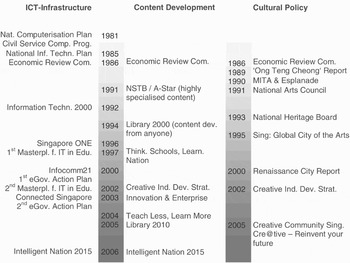
Up to the mid-1980s, Singapore's government did not make any distinct attempts to develop an overall long-term cultural policy.Footnote 80 Instead, as outlined above, the years after independence in 1965 were known for an immense policy push towards industrial and economic development by focusing on the technological and infrastructural aspects of ICTs. According to Lee, the term ‘cultural policy’ found its first official mention in Singapore's political sphere on 26 December 1978, when the then minister of culture, Ong Teng Cheong, used the term in a press release to refer to the protection of cultural heritage in order to provide younger generations with cultural depth, traditional norms and values.Footnote 81 This is also in line with Singapore leaving UNESCO in 1985. The preservation and fostering of culture, creativity and knowledge production were of no immediate concern to the government. As illustrated in Figure 4, enormous policy action was taken towards the building of the ICT infrastructure. Fostering knowledge production moved into the centre of government attention only in the 1990s and 2000s. Fine arts (i.e. theatres, operas, concerts and exhibitions) hardly existed, which resulted in the periodically voiced concern by scientists and Singaporean civil society groups that the nation was becoming a ‘cultural desert’. As Lily Kong and Brenda S.A. Yeoh note:
[F]rom independence until the late 1970s (some would argue into the mid-1980s), landscapes of the arts were conspicuous by their absence because the arts were accorded low priority, given the view that scarce national resources should be diverted to develop Singapore's fledgling economy, reflecting the ideology of pragmatism and survival.Footnote 82
Timeline of government initiatives towards knowledge and creativity development (compiled by the author in 2007, updated in 2010)

This situation changed from the late 1980s after the Economic Review Committee (ERC), installed by the government in 1986 to assess potential development paths for Singapore's economy, identified the arts and all forms of cultural expression as future growth areas. Figure 4 illustrates the development of cultural policy in relation to the building of an ICT infrastructure and activities looking at content knowledge production.
In February 1988, the government of Singapore appointed the Advisory Council on Culture and the Arts (ACCA), chaired by Ong Teng Cheong, in order to formulate recommendations on how to boost arts and culture as a future growth sector in Singapore. In the Ong Teng Cheong Report, as it became known, published in April 1989, ACCA assessed the state of arts and culture in Singapore, as well as formulated measures for creating a culturally vibrant nation.Footnote 83 The report included multiple recommendations aiming at the shaping of the cultural landscape of Singapore. As such, it recognised the necessity to establish a new agency which would spearhead the development of the arts, the creation of a museum complex in the central civic district and the construction of a performing arts centre at Marina Bay.Footnote 84 Furthermore, it recommended the establishment of a Literature Board, a National Heritage Trust and improvements to arts education in schools. Following these recommendations, the Ministry of Information and the Arts (MITA), today the Ministry of Information, Communications and the Arts (MICA), was founded in 1990. As stated on its website, the Ministry sees its mission as ‘[developing] Singapore as a Global City for Information, Communications and the Arts, so as to build a Creative Economy, Gracious Community and Connected Society with a Singaporean Identity rooted in our Multicultural Heritage’.Footnote 85
In 1990, ‘The Esplanade’, a waterfront location just north of the mouth of the Singapore River in downtown Singapore, was turned into a major performance arts venue. The National Arts Council (NAC) and the National Heritage Board (NHB) were established as further coordinating and planning bodies in 1991 and 1993, respectively. The task of the NAC was to raise the interest of the general public in arts and cultural activities, while that of the NHB was to oversee the development of a museum scene and the preservation of cultural heritage, including archival record keeping. The report can be regarded as the first blueprint of a Singaporean cultural policy.Footnote 86 Nonetheless, the efforts that followed, aiming at the creation of a culturally vibrant Singapore, were designed mainly as ‘money-spinning blockbuster performances’.Footnote 87 Most performances were conducted by foreign, not local theatre groups, most plays written by foreign authors and there were only rarely narrated Singaporean stories.
In 1995, the MITA and the Singapore Tourist Promotion Board published a document entitled, Singapore: Global city of the arts. This policy document was to be regarded as an economic policy initiative that – as expressed by the then minister for information and the arts, George Yeo – ‘hopes to do for the arts what it has done for banking, finance, manufacturing and commerce, and help create new ideas, opportunities and wealth’.Footnote 88 It therefore reaffirmed the already existing focus on arts and culture as a potential economic sector.Footnote 89 In March 2000, the MITA published the cultural policy document, Renaissance city report: Culture and the arts in renaissance Singapore.Footnote 90 The report aimed at the development of Singapore into a cultural capital that could compare itself with other cultural capitals worldwide such as London, New York or Paris. The Renaissance city report assessed that Singapore had successfully developed the institutional infrastructure for a vibrant culture and arts scene, including the above-mentioned MITA, NAC and NHB. However, the report saw a future task in emphasising ‘software’ aspects, meaning the support of the local cultural, theatre and arts scenes. Nevertheless, this interest in developing the culture and arts scenes of Singapore did not go back to an interest in arts from an artistic standpoint; rather, it was more ‘attuned to the economic activity and political longevity of Singapore in an increasingly competitive global era’.Footnote 91 Kong summarises this by speaking of the ‘hegemony of the economic’ in Singapore's cultural policy.Footnote 92
The creative economy of Singapore
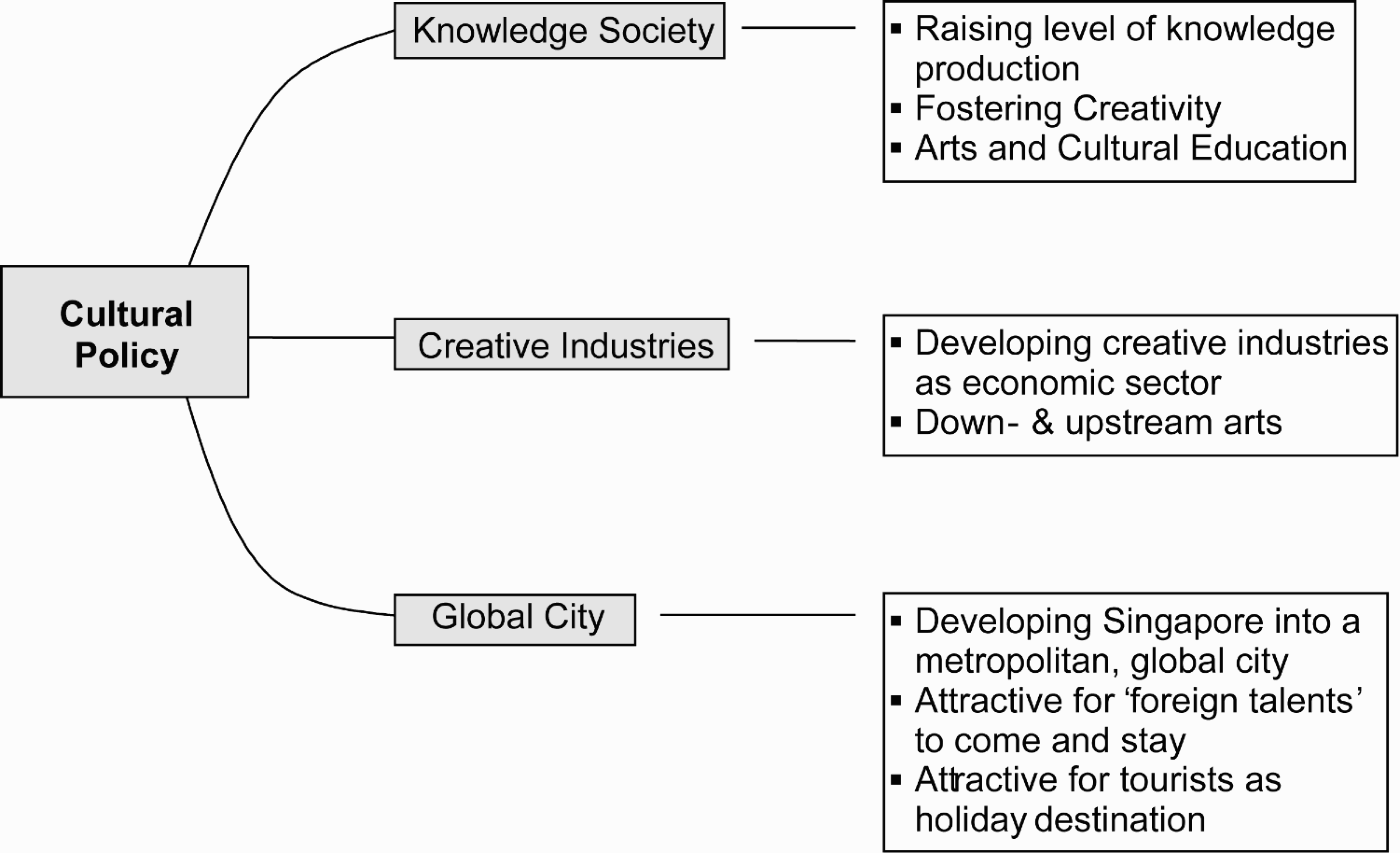
The above examination calls for a categorisation of Singapore's government initiatives according to the rationales and reasons behind their creation and particular design. I will suggest that culture was not fostered for the sake of culture alone, but rather with economic reasoning in mind. Looking at the content of the initiatives, three groups can be identified, namely ‘knowledge society’, ‘creative industries’ and ‘global city’, as illustrated in Figure 5.Footnote 93
Typology of Singapore's cultural policy (compiled by the author, 2007)
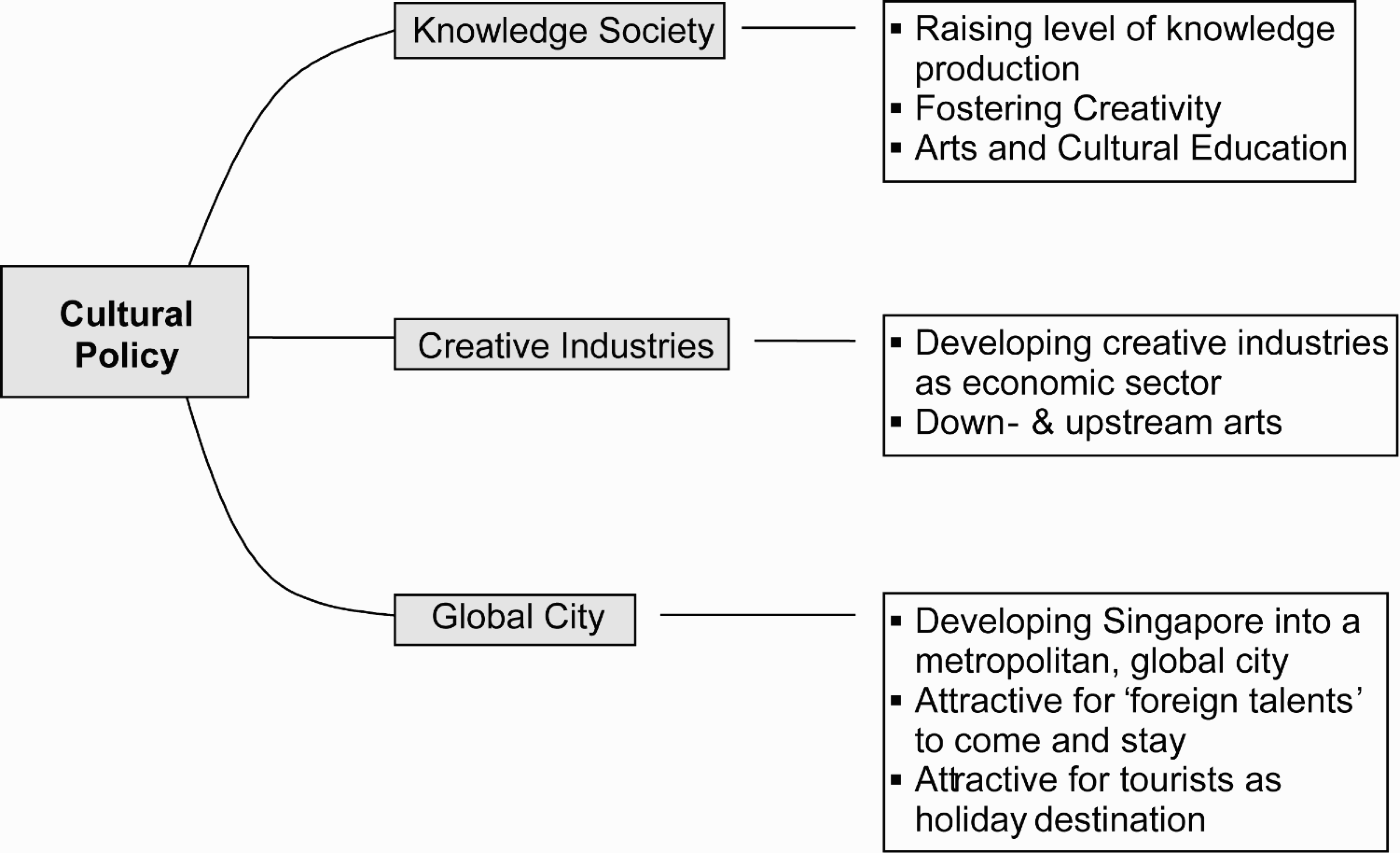
The first group, named ‘knowledge society’, includes cultural activities and initiatives with a clear educational purpose for (mainly) Singapore's society. They serve the purpose of raising the cultural awareness and expertise of Singapore's citizens by encouraging them to be creative, to ‘think out of the box’ and hence to contribute to the building of a knowledge society. The second group, named ‘creative industries’, with reference to the terminological choice of the Singaporean government, forms initiatives that clearly push the development of arts and culture as an economic sector. ‘Global city’ refers to many of these cultural initiatives and set-ups, which serve the purpose of developing Singapore into a metropolitan, global city, a city that is not only attractive to tourists, but also to foreign experts (often called ‘foreign talents’ by Singapore's government) who come to Singapore to work and stay for a longer period of time. This categorisation of Singapore's activities towards the development of a cultural sphere will be explained further by looking at the nation's activities in the field of creative industries development.
The beginning of the twenty-first century was influenced by a regional economic recession (2000/01), which the Singaporean government once more responded to by establishing an ERC in 2003, which analysed the current situation and future potential growth areas of Singapore's economy. Within the ERC subcommittee ‘Service Industry’, the Workgroup on Creative Industries outlined the ‘Creative Industries Development Strategy’.Footnote 94 As mentioned above, the strategy adopted the definition of ‘creative industries’ given by the UK Creative Industries Taskforce as ‘those industries which have their origin in individual creativity, skill and talent and which have a potential for wealth and job creation through the generation and exploitation of intellectual property’.Footnote 95 The strategy aimed to develop creative industries as a ‘creative cluster’ defined along the lines of Richard Florida,Footnote 96 who reasoned that creative people had become the decisive source of competitive advantage in a contemporary economy and society; hence, businesses locate in places where clusters of creative people exist. Florida states:
A class is a cluster of people who have common interests and tend to think, feel and behave similarly, but these similarities are fundamentally determined by economic function – by the kind of work they do for a living. All other distinctions follow from that.Footnote 97
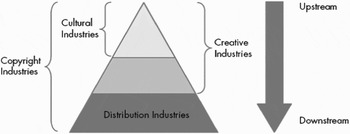
The ‘Creative Industries Development Strategy’ identified three approaches to defining the scope of the creative cluster in Singapore: (a) cultural industries; (b) creative industries; and (c) copyright industries. Together they formed the creative cluster and built mutually on each other, as shown in Figure 6.
Composition of the creative cluster (from Toh Mun-Heng, Adrian Choo and Terence Ho, Economic contributions of Singapore's creative industries (Singapore: Ministry of Information, Communication and the Arts, 2003), p. 52)

The ‘creative industries’ are regarded as the main driver of the cluster. Here, Singapore's government distinguishes between basic ‘upstream’ and applied ‘downstream’ arts. Upstream arts refer to traditional arts such as performing, literary and visual arts. In opposition to this, downstream arts refer to advertising, design, publishing and media-related activities. Upstream arts bear a commercial value in themselves, while downstream arts merely gain economic value when applied in other economic sectors.Footnote 98
Based on this analysis, the strategy aims to foster the development of the creative industries, which will then further the whole creative cluster. In order to foster up- and downstream arts, the Workgroup on Creative Industries of the ERC formulated three blueprints — namely ‘Renaissance City 2.0’, ‘Design Singapore Initiative’ and ‘Media 21’.Footnote 99 ‘Renaissance City 2.0’ was merely a continuation of the Renaissance city report published in 2000,Footnote 100 basically adding innovation as a key policy outcome within the arts and cultural sector. ‘Renaissance City 2.0’ called for a shift in all MITA agencies ‘away from the “art for art's sake” mindset, to look at the development of arts from a holistic perspective, to contribute towards the development of the creative industries as well as our nation's social development’.Footnote 101 This is surprising when we consider the history of Singapore's cultural policy inasmuch that the original reason for fostering the arts and cultural sector in Singapore from the 1980s onwards clearly was the idea of arts for economic growth; there was no evidence of an ‘art for art's sake’ mindset.
The ‘Design Singapore Initiative’ claimed to be the first national collaborative strategy to spearhead the promotion of design in Singapore.Footnote 102 In order to do so in an economically successful manner, it sought convergence amongst different actors, namely enterprises (industry users and designers) and education. The aim of this initiative was ‘to inspire a fundamental change in the promotion and development of a pervasive design culture’,Footnote 103 which would be achieved by focusing on four strategies: (1) integrating design in enterprise; (2) developing a vibrant and professional design community; (3) positioning Singapore as a global design hub; and (4) fostering a design culture and awareness. ‘Media 21’Footnote 104 envisioned Singapore as a ‘global media city, a thriving media ecosystem with roots in Singapore, and with strong extensions internationally’.Footnote 105 The blueprint aimed to reach this vision by implementing five strategies: (1) to develop a state-of-the-art media city; (2) to position Singapore as a media exchange; (3) to export made-by-Singapore content; (4) to augment the media talent pool; and (5) to foster a conducive regulatory environment and culture.
‘Media 21’ and, to a lesser extent, ‘Design Singapore’ were economic policy agendas, although their physical manifestation lay in the framework of fostering the development of a creative cluster. A rather interesting aspect of the ‘Media 21’ policy framework is that the media in Singapore are, by some, regarded as the mouthpiece of the Singaporean government and have therefore mixed only little with other economic and especially cultural sectors. The same Singapore as the one in which the press has been regulated by a Newspaper and Printing Presses Act aims to position itself as a global media capital. The seeming contradiction is solved by attracting foreign media companies to produce their documentaries and programmes on the region, not by encouraging local media players to conduct critical journalism on Singapore and its government.
Overall, the ‘Creative Industries Development Strategy’ was a clear attempt to develop new economic clusters for Singapore's economy to rest on in the future. This was repeatedly stressed by the government when turning towards the arts, design and media in 2002. The director of the Educational Technology Division in the Ministry of Education explains:
The one who has made the most compelling and convincing argument in terms of supporting the “creative industries” is Dr. Tan Chin Nam. As Permanent Secretary in the Ministry of Information, Communication and the Arts (MICA), he cleverly positioned the whole thing not as “art for art's sake” but art as the foundation for a new industry, the creative industries.Footnote 106
This rather recent development expresses the government's belief in what management guru Peter F. Drucker describes: ‘the central wealth-creating activities will be neither the allocation of capital to productive uses, not “labour” […] Value is now created by “productivity” and “innovation”, both applications of knowledge to work.’Footnote 107
Singapore's government wants to make Singapore innovative and ‘creative’,Footnote 108 which poses an immense change in the definition of what knowledge can be regarded as valuable. The head of the Media & Digital Entertainment, Infocomms & Media Cluster in the Economic Development Board describes this need and aim to become more creative:
There is a definite emphasis on building a greater awareness and appreciation of the arts, predicated on the belief that in building the appreciation, one also fosters a sense of creativity. Our Ministry of Education realises that this is the challenge of tomorrow, meaning that the people of today need to be a lot more versatile and creative thinkers.Footnote 109
This official government perspective is mirrored in the changing of school curricula, from primary to tertiary education, in building a vast arts and cultural scene and a well-equipped island-wide library system. The former stringent focus on natural sciences and engineering has been loosened. Humanities, arts and culture are now moving into the centre of government attention, explicitly due to their believed contribution to economic growth. Nevertheless, the traditional focus on applied knowledge – knowledge that can directly lead to economic growth – prevails. Not basic knowledge production (‘art for art's sake’) but clearly applied knowledge is fostered.Footnote 110 Not all kinds of arts and culture, such as experimental arts, are supported, but ‘money-making’ arts such as movie production, design and media receive assistance. Experimental arts are respected with regard to their potential contribution to commercial arts only. The director of Creative Industries Singapore in the Ministry of Information, Communications and the Arts explains:
We will not promote experimental arts, but we also don't draw a distinctive line between commercial and experimental arts. We should improve the commercial, marketing infrastructure of the non-commercial sector to help it become more financially successful. […] The arts infrastructure has to allow for the initial spark of creativity to happen. Then some company could market this intellectual property for the artist and exploit it commercially.Footnote 111
Increasingly, government politics in Singapore widen the range of knowledge areas supported and fostered. Besides natural sciences and engineering, arts and culture are gaining momentum. This change is nevertheless very much market-oriented and market-driven. Applied rather than basic knowledge production, commercial rather than experimental arts and, consequently, knowledge for economic growth stand at the centre of government interest. This clear economic orientation of arts, creativity and knowledge production in Singapore culminates in ‘creative industries’ as a term and a concept.
Conclusion: ‘Creative industries’ as a boundary concept
This paper has discussed the role of the notion of ‘creative industries’, a concept lacking a clear-cut, commonly accepted definition, in the reviving co-operation of UNESCO and Singapore. Taking the UNESCO–Singapore relationship as an empirical example, the paper argues for a re-conceptualisation of ‘creative industries’ as a boundary concept, bridging discrepancies and long-torn cracks. In 1985/86, an ongoing debate within UNESCO on the strict separation of ‘culture’ and the ‘market’, the fostering of local culture and the free expression thereof by fighting pro-Western bias in global news agencies (often summarised under UNESCO's push for a ‘New International Information Order’) culminated in Singapore, following the United States and the UK, leaving UNESCO. In 2007, Singapore rejoined UNESCO, despite the organisation's continuous support for the basic ideas of the MacBride Report,Footnote 112 the basis for the ‘New International Information Order’ and Singapore's legal system continuing to not guarantee free opinion and speech,Footnote 113 two rights that UNESCO was fighting for. In the public media the decision to rejoin was positioned as part of Singapore's drive towards a knowledge-based economy.Footnote 114
This paper has assessed UNESCO and Singapore's gradual repositioning towards the relationship between ‘culture’ and ‘market’, finally identifying the notions of ‘creative’ and ‘cultural industries’ as a common meeting ground. While UNESCO in the 1970s and 1980s took an explicitly critical stand on the commercial tapping of culture, and instead focused on autonomous arts, localised cultural diversity and the free expression thereof – Singapore, a newly independent nation – was focusing on export-oriented economic growth. Culture and the arts hardly played a role in government politics of the 1970s and early 1980s. Yet, with the adoption of the aim to develop Singapore into a knowledge society (another ‘fuzzy’ concept)Footnote 115 from the late 1980s onwards, culture and creativity were identified in the 1990s as important bases for knowledge production and an additional economic sector. Not ‘art for art's sake’, but instead market-oriented and -driven cultural production was summarised under the notion of ‘creative industries’.
UNESCO, on the other hand, moved from an explicitly negative stand on the linking of culture and the market to an incorporation of ‘cultural industries’ in its portfolio. Neither Adorno and Horkheimer's critical assessment arguing for a conflicting relationship of culture and market, nor an exclusively market-oriented approach disregarding autonomous cultural production, as could be found in Singapore in the late 1970s, was maintained. Instead, UNESCO and its member states pursued the integration of the two, by maintaining the organisation's traditional activities of fostering culture and the arts, while simultaneously establishing ‘cultural industries’ as an additional focus. The above outlined activities towards the incorporation of ‘cultural industries’, not merely into UNESCO's portfolio but furthermore by UNESCO member states, succeeded in establishing ‘cultural/creative industries’ as a topic of national and regional policymaking and implementation. With regard to Singapore, interested in the potential contribution of culture, arts and creativity to the development of innovations, knowledge and content for a knowledge society, UNESCO's activities in fostering regional co-operation for national and regional policymaking in the sphere of ‘creative industries’ opened up the path to reviving dialogue and interaction, as indicated by the data above. The sheer use of the term ‘cultural industries’ in the documentations and resulting publications of UNESCO conferences and events on the topic, as highlighted above, illustrated the rise and fall of the discussion surrounding the term. In correlation with Singapore's presence or absence during these events, insight into the relationship between the development of the discussion on ‘creative industries’ within UNESCO and Singapore's gradual repositioning towards it, finally leading to Singapore's rejoining, was given.
The data suggest that the notion of ‘creative industries’ as part of the urge towards the construction of a knowledge society in the relationship of UNESCO and Singapore created a new meeting ground and facilitated the revival of co-operation. Its loosely defined structure leaves space for creative exploration, for dialogue and interaction of – in other areas – opposing actors and their viewpoints. It offers a bridge for the United Nations organisation known for supporting free and traditional cultural expression and development and Singapore, where the legal infrastructure has allowed the government to detain citizens without trial and the right to free speech is not legally guaranteed. It thereby clearly acts as a boundary concept, as defined by Löwy and developed further by Mollinga. It allows actors to cross boundaries of viewpoints, knowledge and politics, as well as the institutional boundaries of different actor groups such as Singapore and UNESCO.