


Introduction
The nationalization of U.S. elections represents one of the most fundamental changes to U.S. electoral politics in the post-World War II era. United States House, U.S. Senate, gubernatorial, and other state and local election outcomes have grown increasingly tied to presidential election outcomes (Abramowitz and Webster Reference Abramowitz and Webster2016; Hopkins Reference Hopkins2018; Jacobson Reference Jacobson2015). For instance, in Senate elections in 2016, the Democratic candidate won every state that Hillary Clinton won, and the Republican candidate won every state that Donald Trump won. This trend in the nationalization of elections has serious implications for the functioning of representative democracy in the United States. First, electoral nationalization likely exacerbates elite polarization. Highly nationalized elections reduce the likelihood that Republican legislators represent relatively liberal districts and that Democratic legislators represent relatively conservative districts. Importantly, legislators representing ideologically mismatched districts tend to exhibit more moderate roll-call-voting behavior (McCarty, Poole, and Rosenthal Reference McCarty, Poole and Rosenthal2009). Second, electoral nationalization presents a troubling situation for democratic accountability. With nationalized elections, national forces, such as the popularity of the president and the state of the national economy, increasingly determine the electoral fate of congressional, state, and local candidates rather than local circumstances, such as the candidates’ policy positions and the performance of officeholders. In a federal system in which the actions and responsibilities of state and local elected officials are distinct from those of federal officials, binding their electoral fate likely impedes state and local accountability.
Coinciding with this period of electoral nationalization is a period of dramatic change in the media environment in the United States. Newspapers have experienced substantial declines in circulation and advertising revenues and, in turn, have reduced their staff by nearly 40% from 1994 to 2014 (Pew Research Center 2016). Similarly, audiences for local late night television newscasts, typically the most watched time slot, have dropped by 31% over the past decade (Pew Research Center 2017). The often suspected culprit for the decline of traditional local news sources is the entrance of national cable news channels, increased access to broadband internet, the proliferation of digital news sources, and the rise of social media (Pew Research Center 2016). Does this nationalization of news help explain the nationalization of U.S. elections?
Greater exposure to local news coverage may provide voters with relevant information about candidates and officeholders, such as their performance in office and policy priorities, which allows voters to make assessments of down-ballot races separately from their judgment in the national race at the top of the ticket. Conversely, voters with less exposure to local news coverage may be more likely to apply their partisan, national judgment to down-ballot races. In other words, exposure to local news coverage may reduce a voter’s propensity to cast a straight-ticket ballot—that is, selecting candidates from the same party for president and down-ballot offices.Footnote 1 Thus, I seek to investigate the degree to which local news coverage mitigates the nationalization of elections, and, further, whether local news coverage matters in the present hyperpolarized political context.
In this paper, I examine local television news coverage to help answer the broader question of whether the nationalization of the news explains the nationalization of electoral politics. In particular, I analyze how, and to what extent, local news coverage allows voters to make judgments for down-ballot races separately from their national, partisan judgment in the presidential race. The factors that drive individuals to consume, or not consume, particular media sources are often related to outcomes of interest. This selection problem makes studying the effect of media exposure problematic in the absence of (quasi-)random variation. I exploit the geography of television media markets as a source of quasi-random variation in exposure to local television news coverage (e.g., Stewart and Reynolds Reference Stewart and Reynolds1990). Due to exclusivity contracts between networks and television stations as well as Federal Communications Commission rules, media market boundaries generally determine the television stations that viewers can access. Importantly, the boundaries of media markets often span multiple states, placing some voters in media markets that are predominantly composed of residents from their own state (in-state markets) and other voters in media markets that are predominantly composed of residents from another state (out-of-state markets).
Television stations focus their coverage on topics relevant to their audience, so stations tend to provide more local news coverage of a state’s elected officials if a larger proportion of the media market (i.e., the station’s potential audience) resides in that state. I leverage publicly available closed-captioning transcript data from the Internet Archive’s TV News Archive, and I provide strong evidence of this first-stage relationship between a state’s population share of a media market and the amount of news coverage that stations in the market devote to that state’s governor and senators. In other words, the level of coverage governors and senators receive increases as their state’s population share of a media market increases. This pattern in news coverage across media markets is the key source of variation: voters living in the same state but in separate media markets are exposed to different local news broadcasts with more or less coverage of their governor and senators, depending on the state’s population share of the market.
Exposure to relevant local news coverage has important consequences both in terms of voter knowledge and voter behavior. Using survey data from the 2012 and 2016 elections, I compare residents within the same state and election year—holding constant all of the features of the statewide electoral context for both senators and governors—and find that residents of in-state media markets, who consequently receive greater exposure to local news coverage of statewide elected officials, demonstrate greater knowledge of their governor and senators than residents of out-of-state markets, who receive less exposure to relevant local news coverage. Importantly, however, residents of in-state markets do not demonstrate greater general or national political knowledge, which is strongly suggestive that local news coverage is the source of the state-specific knowledge advantages rather than unobserved differences between residents of in-state and out-of-state markets. Additionally, this higher exposure to local news coverage increases the probability of casting a split president–governor ticket by about 4–5 percentage points and a split president–senator ticket by about 2–3 percentage points. Given that the overall rate of split-ticket voting during the period under study is about 8–9% for both senators and governors, the estimated effects are substantively large. This relationship between exposure to local television news coverage and split-ticket voting is robust to the inclusion (or exclusion) of different sets of control variables, alternative measurement strategies, and restricting the sample to subsets of geographically proximate residents. Finally, I consider a plausible alternative explanation—television campaign advertisements—and provide strong evidence that exposure to local news coverage, not ads, primarily accounts for the observed knowledge gaps between residents of in-state markets and out-of-state markets.
Overall, the results point to the important role of local television news in providing information to voters about governors and senators, which then allows voters to make judgments in these races that are separate from their national, partisan judgment. Given the recent period under examination, it is difficult to assess the extent to which the decline in local news audiences explains the longer trend of electoral nationalization. Nevertheless, the results are strongly suggestive of the important role that local news coverage plays in influencing the degree to which elections are nationalized, even in the present polarized context.
Literature and Theory
The Shifting Media Environment
The major shifts in the media environment—in particular, the rise of cable news and broadband internet—over the past 20–30 years have unsurprisingly attracted the attention of social scientists. One line of research investigates whether the increased diversity of news sources results in voters opting to consume sources of news that primarily reinforce preexisting beliefs—that is, echo chambers or the selective exposure hypothesis (e.g., Flaxman, Goel, and Rao Reference Flaxman, Goel and Rao2016; Gentzkow and Shapiro Reference Gentzkow and Shapiro2011; Iyengar and Hahn Reference Iyengar and Hahn2009; Stroud Reference Stroud2011). These studies examine the consumption patterns of media sources, and the results vary by news medium (internet vs. television) and research design (experimental vs. observational). While the results are somewhat mixed, fears of extreme echo chambers seem largely overblown.
Another line of research investigates whether exposure to partisan or slanted media sources, in particular Fox News, has an effect on vote choice and aggregate election outcomes (e.g., DellaVigna and Kaplan Reference DellaVigna and Kaplan2007; Hopkins and Ladd Reference Hopkins and Ladd2014; Martin and Yurukoglu Reference Martin and Yurukoglu2017). These studies consistently find that greater exposure to Fox News increases Republican vote share.Footnote 2 A related strand of research considers whether partisan media (Arceneaux and Johnson Reference Arceneaux and Johnson2013; Levendusky Reference Levendusky2013a, Reference Levendusky2013b, Reference Levendusky2013c), the internet (Boxell, Gentzkow, and Shapiro Reference Boxell, Gentzkow and Shapiro2017; Lelkes, Sood, and Iyengar Reference Lelkes, Sood and Iyengar2017), and, more broadly, media fragmentation (Davis and Dunaway Reference Davis and Dunaway2016) increase polarization. Overall the results are mixed. Arceneaux and Johnson (Reference Arceneaux and Johnson2013) and Levendusky (Reference Levendusky2013a, Reference Levendusky2013b, Reference Levendusky2013c) utilize experimental research designs but arrive at largely opposite conclusions as to whether partisan news is a major contributor to polarization. Similarly, while Lelkes, Sood, and Iyengar (Reference Lelkes, Sood and Iyengar2017) find that access to broadband internet increases affective polarization, Boxell, Gentzkow, and Shapiro (Reference Boxell, Gentzkow and Shapiro2017) conclude that the internet only has played a limited role in rising polarization. And, Davis and Dunaway (Reference Davis and Dunaway2016) find that media fragmentation is associated with greater partisan-ideological sorting, but their results are conditional on interest in news and politics.Footnote 3 , Footnote 4
The natural resultant to the rise of these new forms of more nationalized media is the decline of traditional local sources of media. An abundance of research points to the importance of local news in informing voters, increasing voter engagement, and holding elected officials accountable (e.g., Arnold Reference Arnold2004; Hayes and Lawless Reference Hayes and Lawless2015; Reference Hayes and Lawless2018; Oberholzer-Gee and Waldfogel Reference Oberholzer-Gee and Waldfogel2009; Snyder and Strömberg Reference Jr, James and Strömberg2010; Song Reference Song2016). For example, Snyder and Strömberg (Reference Jr, James and Strömberg2010) demonstrate that members of Congress representing districts with boundaries that are more congruent with newspaper markets receive more news coverage. This coverage results in better informed citizens who are more likely to vote in House races and officeholders who work harder for their constituents. Similarly, Hayes and Lawless (Reference Hayes and Lawless2015; Reference Hayes and Lawless2018) find a link between newspaper coverage of House races and voter engagement, and Darr, Hitt, and Dunaway (Reference Darr, Hitt and Dunaway2018) link local newspaper closures with polarized voting (as measured by a county-level proxy for split-ticket voting). On the other hand, other research suggests that local news coverage may be of limited benefit to voters given its emphasis on horserace and game-frame coverage rather than substantive policy coverage (e.g., Dunaway Reference Dunaway2008; Dunaway and Lawrence Reference Dunaway and Lawrence2015).
In a broader study of the nationalization of politics, Hopkins (Reference Hopkins2018) finds only minimal changes over time in the degree to which newspapers and local newscasts focus their coverage on local/state politics vs. national politics. Instead, audiences have shifted away from local news sources to more nationalized sources. Hopkins also leverages the structure of TV media markets and finds that more exposure to local TV news coverage of state politics boosts turnout in gubernatorial elections; the size of the effect varies over time consistently with trends in the nationalization of politics.
Local Television News and Split-Ticket Voting
Local television news has three especially important features for the purposes of this study. First, the audience of a television station is “spatially bounded,” which results in more local coverage relative to non-geographically constrained news sources (Hopkins Reference Hopkins2018). As discussed in greater detail below, stations focus their coverage on topics most relevant to their audience. In this context, news coverage of a state’s elected officials increases with the state’s population share of the media market. Second, the habits of television viewers result in incidental exposure to and learning from local newscasts (Boemer Reference Boemer1987; Krugman and Hartley Reference Krugman and Hartley1970).Footnote 5 In particular, rates of audience retention are high from one program to the next (McDowell and Dick Reference McDowell and Dick2003; Webster Reference Webster2006). These inheritance effects between programs on the same channel can result in incidental exposure to local news content. Despite declines in audiences over recent years, local television news continues to have broad reach: “in an average week in the first quarter of 2017, local news reached 40% of persons 25–54,” and these viewers watched on average nearly two and a half hours of local news in that week (Nielsen Company 2017, 2).Footnote 6 Third, despite low trust in the media in general, when evaluating specific sources of news, voters express the most trust in and hold the most positive views about local television news. Importantly, unlike most sources of news, there are only modest differences in trust and sentiment toward local television news across partisan and ideological identities (Guess, Nyhan, and Reifler Reference Guess, Nyhan and Reifler2018; Media Insight Project 2018; Reuters Institute 2018).
To recapitulate: (1) local television stations provide news coverage relevant to their geographically constrained audiences, (2) viewers experience incidental exposure to local TV news coverage, and (3) viewers have relatively high trust in local television news. All of these unique features suggest that local television news may play an especially important role in helping voters evaluate candidates and officeholders. With greater exposure to local television news coverage, voters have more information about the candidates in races for offices such as governor and senator. This information allows voters to assess the individual candidates and the local circumstances in these races separately from their national, partisan judgment for president. Voters with less exposure to relevant local news coverage are more likely to apply their national, partisan judgment for president to down-ballot races. In fact, past research suggests that partisan cues are less powerful in high-information environments (Bullock Reference Bullock2011; Peterson Reference Peterson2017). In the context of this study, greater exposure to relevant local news coverage should increase rates of split-ticket voting. Voters with less information, due to lower exposure to relevant local news coverage, should be more likely to engage in straight-party voting.
In this paper, I examine whether greater exposure to local television news allows voters to make judgments about governor and senator races separately from their national, partisan judgment for president. This paper is unique in its examination of the relationship between exposure to local television news coverage and ticket splitting. Given the broader focus on the nationalization of elections, split-ticket voting is the most appropriate outcome. Elections are nationalized when voters apply their national, partisan assessment for president to all other offices (i.e., straight-ticket voting). In fact, the degree to which voters engage in ticket splitting determines (mechanically) the degree to which electoral politics are nationalized. Said differently, in the complete absence of split-ticket voting (and differential roll off), election outcomes across offices are identical and perfectly nationalized.Footnote 7
The Geography of Television Media Markets
A major impediment to making inferences about the media’s effects on electoral politics and voting behavior is that different types of voters choose to consume different sources of media. As a result, any observed differences in voting behavior could be the result of underlying differences in voter characteristics rather than the media sources that voters opt to consume.Footnote 8 To remedy this selection problem, scholars have a long history of utilizing clever natural experiments that exploit quasi-random variation in exposure or access to the medium of interest.Footnote 9 For instance, Simon and Stern (Reference Simon and Stern1955) exploit a Federal Communications Commission (FCC) freeze on the issuance of television licenses to examine the effect of television on turnout and vote share in the 1952 presidential election in Iowa, where television was expanding at the time. Since this seminal work, scholars have continued to use natural experiments to study media effects, including an eight-month driver strike that disrupted newspaper delivery in Pittsburgh prior to the 1992 election (Mondak Reference Mondak1995); the roll-out of cable news channels and local Spanish-language news (DellaVigna and Kaplan Reference DellaVigna and Kaplan2007; Hopkins and Ladd Reference Hopkins and Ladd2014; Oberholzer-Gee and Waldfogel Reference Oberholzer-Gee and Waldfogel2009); the ordering of channels within a channel lineup (Martin and Yurukoglu Reference Martin and Yurukoglu2017); and the geographic structure of media markets for radio, newspapers, and television (Althaus and Trautman Reference Althaus and Trautman2008; Ansolabehere, Snowberg, and Snyder Reference Ansolabehere, Snowberg and Snyder2006; Hopkins Reference Hopkins2018; Levy and Squire Reference Levy and Squire2000; Schaffner Reference Schaffner2006; Snyder and Strömberg Reference Jr, James and Strömberg2010; Stewart and Reynolds Reference Stewart and Reynolds1990).
The geography of television media markets conveniently allows for the comparison of voters participating in the same state-level electoral context with access to entirely different television stations and, thus, different local news content. The present-day media market boundaries defined by the Nielsen Company (known as designated market areas—DMAs) approximate the geographic reach of television stations’ signals in the 1950s and 1960s (Gentzkow Reference Gentzkow2006). Consequently, these boundaries are largely idiosyncratic, not subject to contemporary political considerations, and often span multiple states. Indeed, as discussed in greater detail below, the idiosyncratic nature of these boundaries results in remarkable covariate balance across the in-state share of DMA measure within states. In other words, counties located in in-state media markets are very similar to counties located in out-of-state media markets along a host of observable characteristics.
Media market boundaries generally determine the television stations to which a viewer has access. With very few exceptions, multichannel video programming distributors (MVPDs), such as cable and satellite providers, are restricted from including out-of-market television stations in their channel lineups.Footnote 10 , Footnote 11 While residents in certain areas may be able to receive over-the-air signals from out-of-market stations, the vast majority of television households subscribe to a cable or satellite provider.Footnote 12 Prior to the rise of MVPD subscription rates (see Appendix Figure A1), media market boundaries were likely far more porous due to over-the-air signals penetrating across media market boundaries. In sum, in the present context, viewers residing within a given media market generally only have access to the television stations within that market.
Because media markets can span multiple states, a person may reside in a market that is predominantly comprised of residents from another state. The degree to which a person’s media market is comprised of residents from that person’s state is the key geographic feature of media markets that induces variation in exposure to local news content. A person lives in an out-of-state market if most of the residents of that media market are from another state, while a person lives in an in-state market if most of the residents of that market are from the same state. For example, Van Wert and Mercer Counties in Ohio are adjacent to one another (see Figure 1). Van Wert County is located in the Ft. Wayne DMA (7% of this market resides in Ohio and 93% in Indiana), while Mercer County is located in the Dayton DMA (100% of this market resides in Ohio). The in-state share of DMA measure that I employ in analyses below is coded as 0.07 for Van Wert County and 1 for Mercer County. As I demonstrate empirically below, a station’s news coverage of a given state’s governor (senators) increases with the proportion of residents in the media market from the governor’s (senators’) state. Thus, residents of Mercer County (in the Dayton, OH media market with an in-state share of DMA of 1) are expected to receive substantially more coverage of Ohio officeholders than residents of Van Wert County (in the Fort Wayne, IN market with an in-state share of DMA of 0.07). For more information on media markets and how the in-state share of DMA measure is constructed, see Appendix Section A.2.
Media Market Boundaries and In-State Share of DMA: An Example
Note: Mercer County, which is shaded in dark green on the map, is located in the Dayton DMA. The boundaries of the Dayton DMA include the counties shaded in green: 100% of the Dayton DMA’s residents live in Ohio, as the market does not span across the state boundary. On the other hand, Van Wert County, which is shaded in dark blue on the map, is located in the Fort Wayne DMA. The boundaries of the Fort Wayne DMA include the counties shaded in blue: 7% of the Fort Wayne DMA’s residents live in Ohio and 93% live in Indiana.

There is broad variation across the country in the degree to which counties are located in in-state vs. out-of-state markets. Overall, about 19% of counties are located in out-of-state markets in which less than 50% of the market’s residents are in-state, and 43 states have at least one county that is located in an out-of-state market based on this threshold.Footnote 13 See Figure 2 for a map of the lower 48 states and variation within each state in terms of counties in relatively in-state (lighter shades of blue) vs. relatively out-of-state markets (darker shades of blue).
Geographic Distribution of Counties in Out-of-State Media Markets
Note: Darker shades indicate that counties are located in predominantly out-of-state media markets, while lighter shades indicate in-state media markets. Counties in out-of-state markets have lower values for the in-state share of DMA measure and are located in media markets in which most of the market’s population resides in a different state.
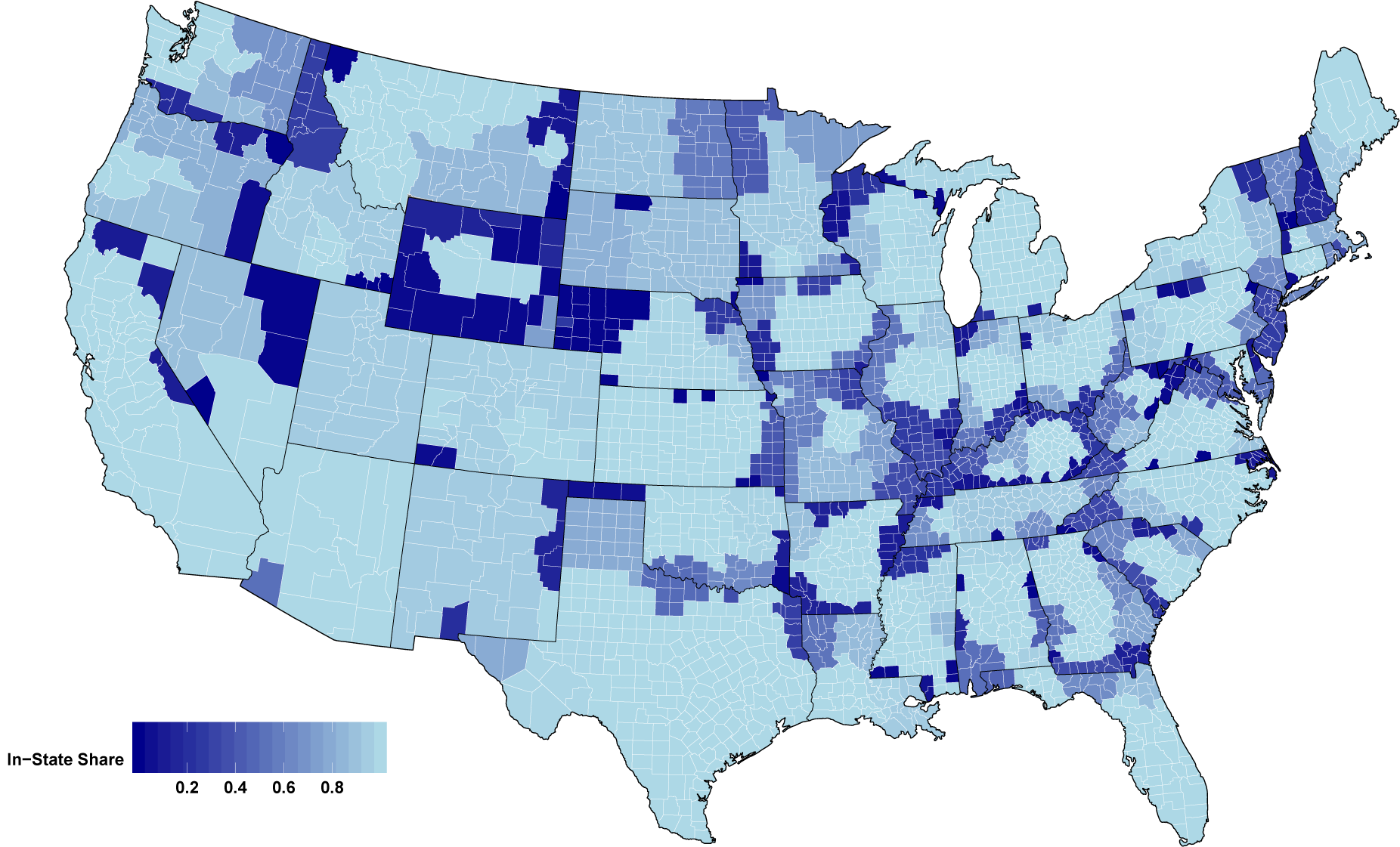
The validity of this empirical strategy rests on the assumption that these media market boundaries are haphazard such that residents of in-state media markets are comparable to individuals from the same state who reside in out-of-state media markets.Footnote 14 , Footnote 15 I assess the plausibility of this assumption in Appendix Section A.3; Appendix Figure A3 indicates remarkable covariate balance with respect to race/ethnicity, educational attainment, age, residential mobility, median income, poverty, party vote share and turnout rate in the 2016 presidential election, and several other characteristics. The impressive covariate balance weighs against the possibility that people’s political preferences, attitudes, or propensity for certain behaviors are correlated with their in-state media exposure such that differences in voter knowledge or voting patterns would be attributable to an unobserved/unknown confounder. If I had observed serious differences in the populations residing in counties located in-state vs. out-of-state media markets, that imbalance would have called into question the validity of the research design.
Of note, counties located in relatively out-of-state media markets do tend to be more rural, less populated, have a daily newspaper, and, unsurprisingly, these counties tend to be geographically located relatively near to state boundaries (based on a visual inspection of Figure 2). To alleviate concerns that these differences may jeopardize the comparability of individuals residing in in-state vs. out-of-state markets, I present additional specifications in which I subset the sample to different subsamples of geographically proximate residents (e.g., residents of counties that border a neighboring state). In the subsamples of geographically proximate residents, the covariate balance improves markedly in terms of these characteristics.Footnote 16 These specifications are described in greater detail subsequently.
How Media Markets Structure Local News Coverage
The biggest difficulty in studying patterns in local television news coverage is data availability. It is rare for stations to make transcripts of their newscasts publicly available, and few research repositories exist that collect local television newscast transcripts.Footnote 17 To overcome this obstacle, I rely on publicly available closed-captioning data from the Internet Archive’s TV News Archive.Footnote 18 In total, the TV News Archive contains about two million hours of coverage, equating to 5.7 billion words, from over 150 stations (Leetaru Reference Leetaru2016). Many of the stations in the archive are national or international networks such as CNN, MSNBC, Fox News, and BBC News London.
I include in the sample all local stations affiliated with one of the four major networks (ABC, CBS, NBC, or Fox) and analyze coverage during 2016.Footnote 19 The sample includes 99 stations from 25 media markets and, in total, about 24,000 hours of nonentertainment coverage. I retrieve data through an API to count the number of 15-second clips that mention a specific governor or senator from all states that overlap with the station’s media market (see Appendix Section A.4 for more technical details). For example, the Boston DMA overlaps with three states—Massachusetts, New Hampshire, and Vermont—so I count clips that mention senators and governors from those three states for all stations in the Boston DMA.
Figure 3 demonstrates this first-stage relationship between a state’s population share of a DMA and the level of news coverage that the governor and senators from that state receive from stations in that DMA. As is clear from the figure, television stations provide greater coverage of an officeholder as the officeholder’s state makes up a larger share of the population in the DMA.
Local TV News Coverage of Senators and Governors by State’s Share of DMA
Note: A station devotes more coverage to senators (left) and governors (right) from states within their media market as the share of residents from that state comprise a larger proportion of the market. The plot is residualized to account for senator/governor fixed effects. Each point corresponds to a local mean, and the regression line is estimated using OLS. Officeholders who were presidential or vice presidential candidates in 2016 are excluded from the analysis.
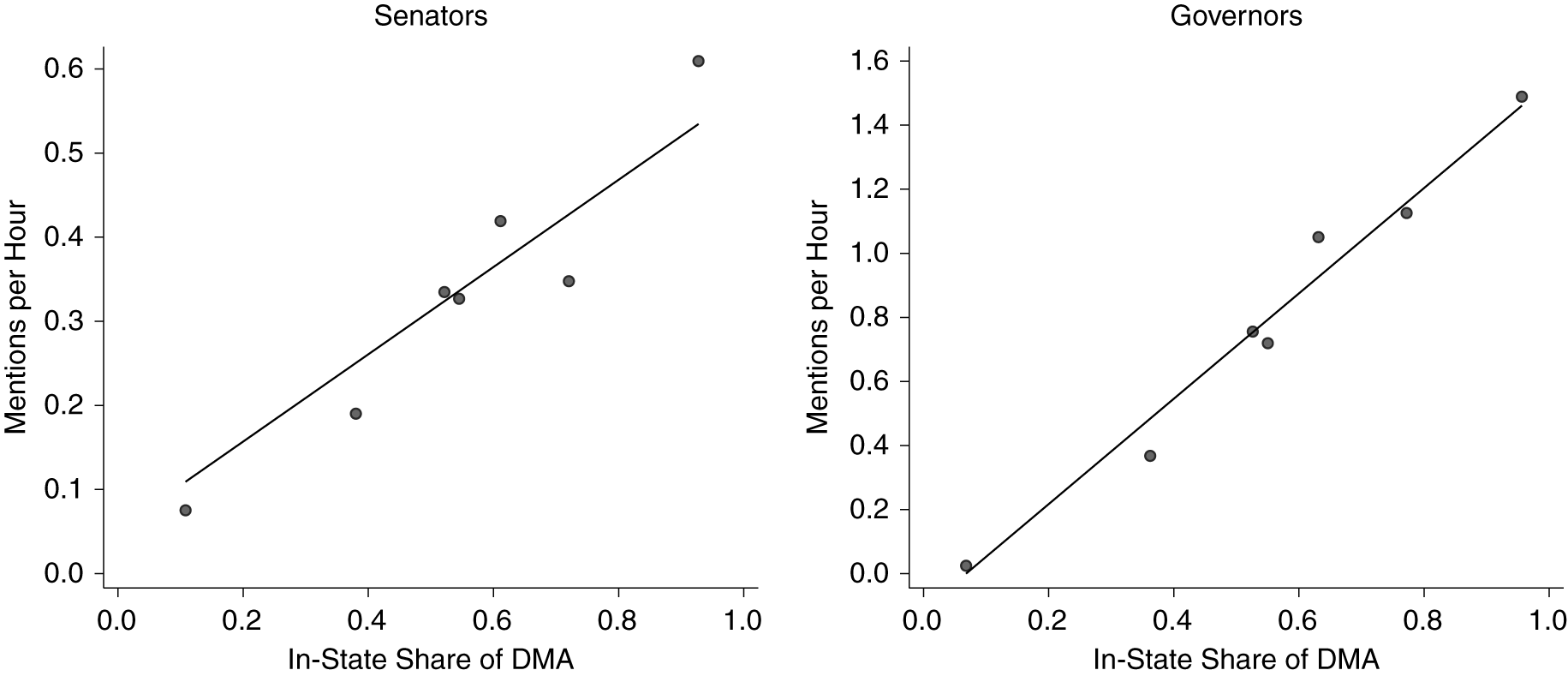
Consequently, a resident of an entirely in-state market (i.e., a media market that is entirely contained within the resident’s state) is expected to receive about 1.5 additional mentions of her governor per hour of coverage relative to a resident of an out-of-state market in which only a minuscule share of the media market’s population lives in the same state as the resident.Footnote 20 The same estimated quantity for a senator is about 0.5 additional mentions per hour hour of coverage.Footnote 21 While the magnitude is substantially larger for governors, both quantities represent substantively meaningful increases in coverage.Footnote 22 In sum, the relationship between a state’s population share of the media market and local news coverage for that state’s governor and senators is positive and strong. The full results from the local news coverage analysis along with additional technical information are available in Appendix Section A.4.
These patterns provide strong evidence that residents of in-state media markets have access to far more news coverage of their senators and governor than residents of out-of-state markets. The relationship is approximately linear, which provides an empirical basis of support for using a continuous measure of the in-state share of DMA.
Local News Coverage Informs Voters
As elaborated earlier, the theoretical logic linking the nationalization of news to nationalized voting can be summarized as follows. Higher exposure to relevant local news provides voters with more information about down-ballot officeholders and candidates, which better enables voters to evaluate candidates for down-ballot offices separately from their national assessment at the top of the ticket for president. A voter with less exposure to relevant news coverage is more likely to apply her assessment from the top of ticket to down-ballot offices and engage in nationalized voting (i.e., straight-ticket voting). This logic yields two testable implications. First, voters with greater exposure to relevant local news coverage should have more knowledge of their down-ballot officeholders (e.g., senators, governor). And, second, voters with greater exposure to relevant local news coverage should have a higher probability of casting a split-ticket ballot. In this section, I present evidence on the intermediate outcome: voter knowledge of down-ballot officeholders and candidates. In the subsequent section, I examine the effect of exposure to relevant local news coverage on split-ticket voting.
Remarkably, Representative Andrew Maguire of New Jersey’s 7th district pointed to the idea that residents who lack access to in-state television stations are unable to stay informed: “The citizens in the northern part of the State are better able to recognize Mayor Koch of New York City and the political issues facing local legislators in Albany then [sic] they are able to identify their own local political leaders and State officials. They are deprived, for the most part, of local advertising and public affairs programming that is targeted to their own needs. The citizens in southern New Jersey suffer the same fate at the hands of the Philadelphia television programmers.”Footnote 23 Does exposure to relevant local news coverage about governors and senators inform voters?
For this analysis, I use data from the 2012 and 2016 Cooperative Congressional Election Study (CCES). The large sample size of the CCES provides substantial geographic coverage of respondents in counties located in both in-state and out-of-state markets. Conveniently, the CCES asks respondents several questions that gauge knowledge of their elected officials. The empirical setup is as follows:
 $$ \unicode{x1D53C}\left[{knowledge}_{ist}\right]={\lambda}_{st}+\phi \cdot {p}_{ist}+{X}_{ist}\cdot \beta, $$
where knowledgeist
is the knowledge of respondent i in state s in year t (measures of knowledge are discussed below),
 $ {\lambda}_{st} $
is a state-year fixed effect, pist
is the in-state population share of the DMA in which respondent i lives, and Xist
is a vector of individual-level control variables. The inclusion of state-year fixed effects ensures that comparisons are of individuals within the same statewide electoral context. Given that this is a study of statewide offices (i.e., governor, senator), the state-year fixed effects hold constant the officeholders and candidates and all other features of the statewide setting in an election year. The coefficient of interest is
 $ \phi $
. All models are estimated using ordinary least squares.
Table 1 displays the relationship between the in-state share of DMA (i.e., the proportion of the DMA’s population from the respondent’s state) and three measures of knowledge. The party recall measure indicates whether the respondent can correctly recall their senators’ or governor’s party (see specifications 1 and 4, labeled: “Recall”), the ability to evaluate measure indicates whether the respondent is able to evaluate (i.e., approve or disapprove) their senators or governor (see specifications 2 and 5, labeled: “Eval.”), and the ability to place on an ideological scale measure indicates whether the respondent is able to place their senators or governor on an ideological scale (see specifications 3 and 6, labeled: “Ideo.”).Footnote 24 All specifications reported in Table 1 include demographic control variables: family income, gender, race, education, age, and marital status.Footnote 25 Alternative specifications are reported in Appendix Tables A3–A5. Estimates are stable across all specifications.
Voter Knowledge of Senators and Governors

Note: Robust standard errors clustered by state-DMA in parentheses. *p
 $ < $
0.05.
The dependent variable is whether the individual can recall the party of the senator/governor in specifications (1) and (4), whether the individual is able to evaluate the senator/governor in specifications (2) and (5), and whether the individual is able to place the senator/governor on an ideological scale in specifications (3) and (6). Basic control variables include family income, gender, race, education, age, and marital status.
Across the three knowledge measures for both senators and governors, the estimated coefficient for in-state share of DMA is substantively large. Importantly, the in-state share of DMA variable ranges from < 0.01 to
 $ 1 $
, so it is approximately correct to interpret the estimated coefficient as the expected increase in voter knowledge moving from an almost entirely out-of-state market to an entirely in-state market.Footnote
26
Thus, a person living in an entirely in-state market is about 9 percentage points more likely to recall their senator’s party correctly and 11 percentage points more likely to recall their governor’s party correctly than a person living in the same statewide electoral setting in an entirely out-of-state market. Similarly, relative to residents of entirely out-of-state markets, residents of entirely in-state markets are about 9 percentage points more likely to be able to evaluate their senator, 4 percentage points more likely to be able to evaluate their governor, 8 percentage points more likely to be able to place their senator on an ideological scale, and 7 percentage points more likely to be able to place their governor on an ideological scale.Footnote
27
Exposure to local television news not only increases voter knowledge about officeholders but also knowledge about nonincumbent candidates. The CCES asks respondents to place Senate candidates, including those candidates challenging an incumbent and those running in an open-seat race (unfortunately, CCES respondents are not asked about nonincumbent gubernatorial candidates). The results are displayed in Table 2. For all three types of candidates—challenger, Democratic open-seat, and Republican open-seat—the relationship between in-state share of DMA and ability to place the candidate on an ideological scale is substantively large. Residents of entirely in-state markets are 10–13 percentage points more likely to be able to place a candidate on an ideological scale relative to residents of entirely out-of-state markets.
Voter Knowledge of Nonincumbent Senate Candidates
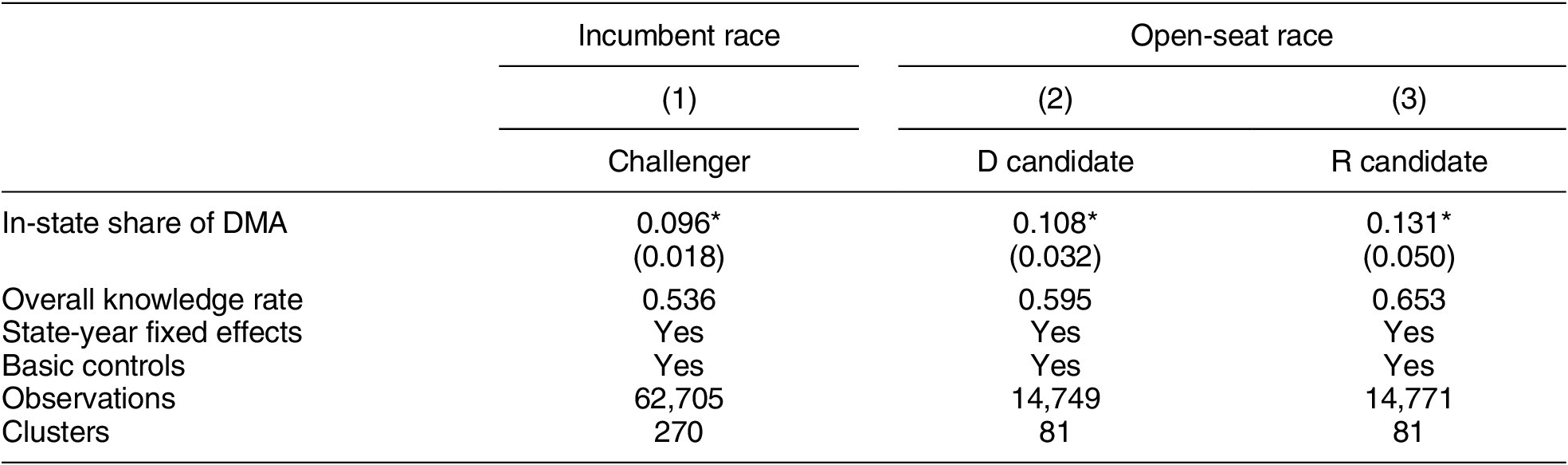
Note: Robust standard errors clustered by state-DMA in parentheses. *p
 $ < $
0.05.
The dependent variable is coded = 1 if the individual is able to place the candidate on an ideological scale and = 0 if the individual is unable to make an ideological placement. Basic control variables include family income, gender, race, education, age, and marital status.
One especially important concern—and serious threat to inference—is that the residents of in-state markets are more politically knowledgeable than residents of out-of-state markets due to differences between the two groups of residents. While the strong covariate balance described above allays this concern, the possibility remains that an unobserved difference accounts for these gaps in political knowledge. If this were the case, then residents of in-state markets should demonstrate greater general political knowledge as well. Table 3 displays results from six placebo tests that all capture general knowledge of national politics: knowledge of which party controls the House (1) and Senate (2), ability to place the Democratic Party (3) and Republican Party (4) on an ideological scale, correctly placing the Democratic Party to the left of the Republican Party on an ideological scale (5), and ability to place the Supreme Court on an ideological scale. Across all six placebo tests, the coefficient on the in-state share of the market is estimated precisely and near to zero. These results provide strong evidence that residents of in-state markets are more knowledgeable about their governor and senators due to exposure to in-state television rather than bias from confounding variables.
Voter Knowledge Placebo Tests
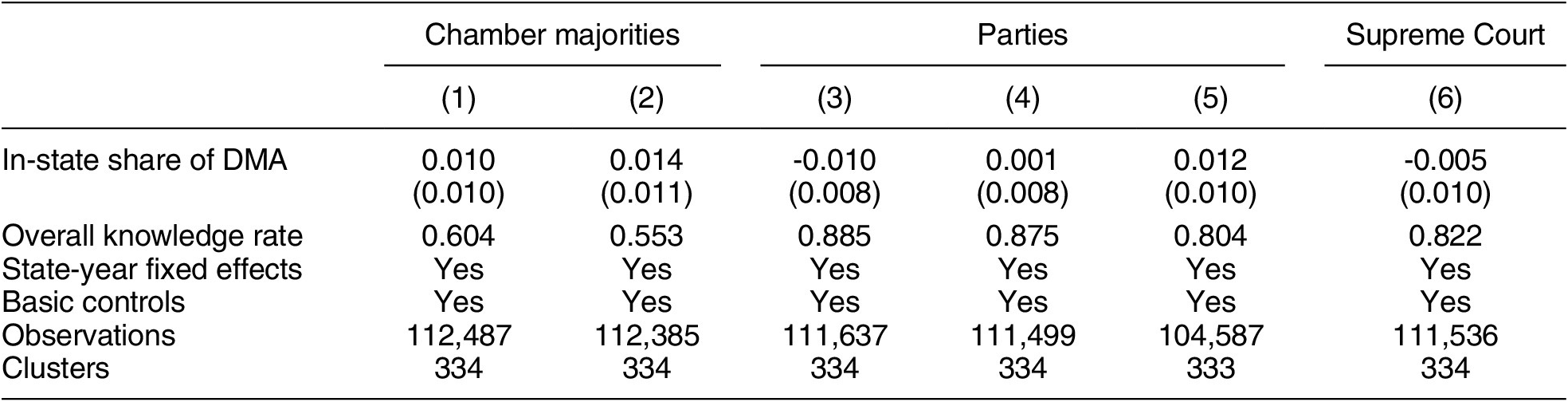
Note: Robust standard errors clustered by state-DMA in parentheses. *p
 $ < $
0.05.
The dependent variable for models (1) and (2) is whether the individual knows which party has a majority of seats in the House (1) and Senate (2); the dependent variable for models (3), (4), and (5) is whether the individual can place the Democratic Party (3) and Republican Party (4) on an ideological scale and whether the individual correctly places the Democratic Party to the left of the Republican Party (5); and the dependent variable for model (6) is whether the individual is able to place the Supreme Court on an ideological scale. Basic control variables include family income, gender, race, education, age, and marital status.
Local News Coverage and Split-Ticket Voting
As discussed above, greater exposure to local news coverage may allow voters to assess down-ballot candidates separately from their national, partisan judgment for president. Voters with less exposure to local news coverage may be more likely to apply their national, partisan judgment to down-ballot races, resulting in a straight-party vote. Again, using a state’s population share of the media market as the key source of variation in the level of local news coverage, I examine the degree to which exposure to local news coverage increases the probability of a voter engaging in split-ticket voting for governor and senators. The empirical strategy remains the same as in the previous section:
 $$ \unicode{x1D53C}\left[{split}_{ist}\right]={\lambda}_{st}+\phi \cdot {p}_{ist}+{X}_{ist}\cdot \beta, $$
where splitist
is coded = 1 if respondent i in state s in year t casts a split-ticket ballot (i.e., votes for candidates from different major parties for president and senator/governor) and is coded = 0 if respondent i casts a straight-ticket ballot (i.e., votes for candidates from the same major party for president and senator/governor),
 $ {\lambda}_{st} $
is a state-year fixed effect, pist
is the in-state population share of the DMA in which respondent i lives, and Xist
is a vector of individual-level control variables.Footnote
28
Again, the state-year fixed effects allow for the comparison of voters within the same statewide electoral context across different media markets. This strategy exploits quasi-random variation in the level of relevant local news coverage but ensures that these voters experience identical statewide electoral conditions (e.g., candidates, incumbency, closeness of the race). And, the coefficient of interest is
 $ \phi $
.
Table 4 displays the main results. For Senate elections, voters in an entirely in-state market are about 2–3 percentage points more likely to cast a split ticket than voters in an entirely out-of-state market within the same statewide electoral context. For gubernatorial elections, the estimated coefficient implies a 4–5 percentage point increase in ticket splitting for voters residing in entirely in-state markets relative to voters living in entirely out-of-state markets.Footnote 29 Of note, the larger magnitude of the estimated effect of local news coverage for the governor specifications is consistent with the higher level of local TV news coverage that governors garner. The estimated effects for both senators and governors are substantively large: based on estimates from the CCES, in total, about 8% of voters in 2012 and 2016 cast a split president-senator ticket and 9% of voters cast a split president-governor ticket in 2012 and 2016. Thus, media markets and local news coverage seem to play a meaningful role in ticket-splitting behavior in contemporary U.S. elections.
Split-Ticket Voting: President-Senator and President-Governor
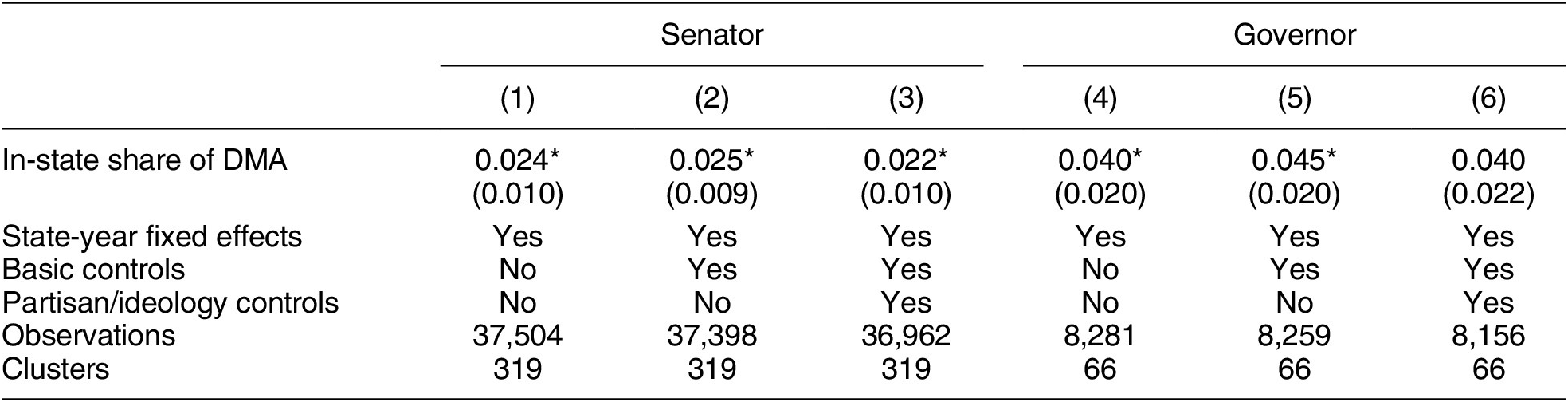
Note: Robust standard errors clustered by state-DMA in parentheses. *p
 $ < $
0.05.
Dependent variable is coded = 1 if an individual votes for the Democrat (Republican) for president and Republican (Democrat) for senator/governor. Basic control variables include family income, gender, race, education, age, and marital status. Partisan/ideological controls include opposite-party incumbent, strength of partisanship, and strength of ideology.
Robustness Checks and Alternative Explanations
Robustness Checks
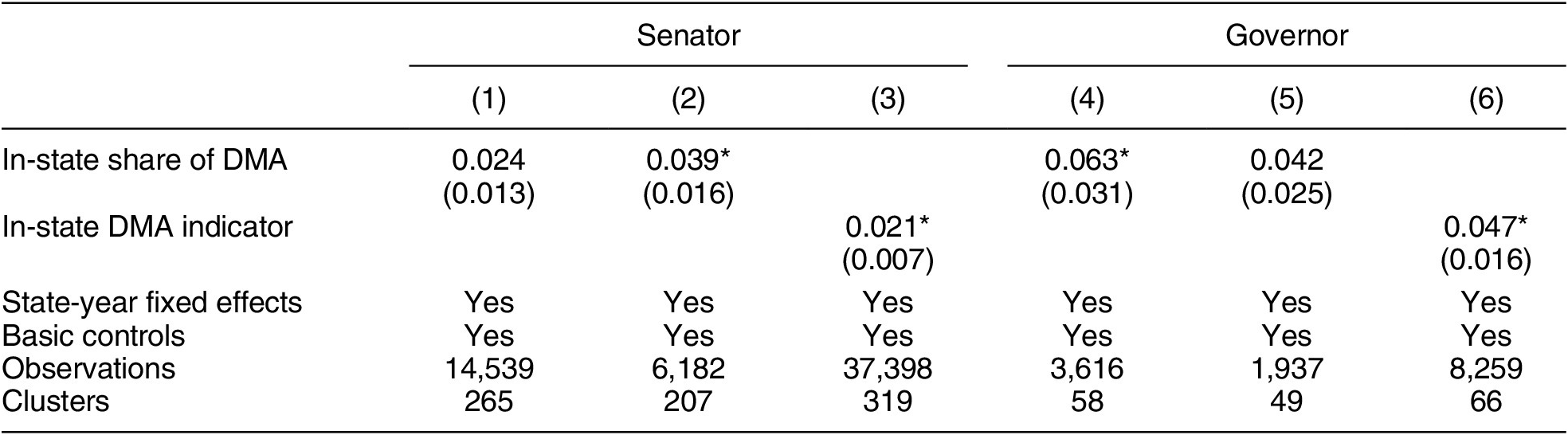
The strong covariate balance and placebo tests related to general political knowledge strongly suggest that voters living in out-of-state markets are a valid comparison group for voters living in in-state markets. Nevertheless, to provide further evidence that the observed relationship between in-state share of DMA and split-ticket voting is indeed causal, I subset the sample to geographically proximate residents. In the first subsample, I restrict the sample to residents of counties that are adjacent to counties in another state (i.e., residents of border counties). And, in the second subsample, I restrict the sample to residents of counties for which the in-state share of DMA is less than 0.5 as well as residents of counties adjacent to such counties (i.e., residents of counties in out-of-state markets and adjacent counties). The two restricted samples have strong covariate balance across a host of characteristics, including how rural and how populated the counties are (see Appendix Figures A4–A5). The results based on the geographically proximate subsamples are displayed in Table 5; see specifications (1) and (4) for results from the border counties subsample and specifications (2) and (5) for results from the adjacent counties subsample.Footnote 30 While the precision of these estimates is unsurprisingly diminished due to the substantial reduction in sample size and the number of clusters, the estimates—for both geographically proximate subsamples for senators and governors—are of a reasonably similar size to the estimates reported in Table 4. These results from narrower samples of voters who are geographically closer to one another and reside in similar locales provide additional evidence that the relationship is causal.
Alternative Specifications: President-Senator and President-Governor Split-Ticket Voting
Robust standard errors clustered by state-DMA in parentheses. *p
 $ < $
0.05.
Dependent variable is coded = 1 if an individual votes for the Democrat (Republican) for president and Republican (Democrat) for senator/governor. Basic control variables include family income, gender, race, education, age, and marital status. Models (1) and (4) restrict the sample to residents of counties adjacent to another state, models (2) and (5) restrict the sample to residents of counties in which in-state share is less than 0.5 or residents of counties adjacent to such a county, and models (3) and (6) use a dichotomized version of in-state share of DMA (coded = 0 if in-state share of DMA < 0.5 and coded = 1 if in-state share of DMA ≥ 0.5).
Table 5 also contains results based on a dichotomous measure of an in-state market (see specifications 3 and 6).Footnote 31 A voter is considered to live in an in-state DMA if at least half the market’s population resides in the same state (i.e., the in-state share of DMA ≥ 0.5). Again, the magnitude of the estimates based on the dichotomous in-state DMA measure are very similar to those based on the continuous measure. These results are important for a few reasons. First, the main findings in the paper are robust to a nonlinear characterization of the explanatory variable of interest. Second, these results imply that variation in a narrow part of the distribution of the in-state share of DMA measure is not driving the observed relationship. That is, it is not simply the case that the analysis is leveraging variation from residents of markets with an in-state share between, say, 0.9 and 1. Finally, the similarity in the magnitude of the estimated coefficients for the specifications with dichotomous and continuous measures bolsters the claim that exposure to in-state television news increases the probability of casting a split president–senator ballot by about 2–3 percentage points and a split president–governor ballot by about 4–5 percentage points.
To provide further evidence of the effect of local news coverage on ticket splitting, I also examine the relationship between the in-state population share of media markets and aggregate election returns at the precinct level. The full technical details of the analysis and results are displayed in Appendix Section A.6. The aggregate approach guards against potential survey nonresponse bias and measurement error in recalling vote choice across offices. This approach has a disadvantage in that it requires an aggregate proxy measure of split-ticket voting, which is an individual-level phenomenon. Thus, I first demonstrate the validity of the precinct-level proxy using unique ballot-level data from the South Carolina Election Audit. Then, using precinct-level data from the 2012 Harvard Election Data Archive, I examine the relationship between the in-state share of DMA and the precinct-level measure of split-ticket voting. The positive, significant estimates from the precinct-level analysis provide strong corroborative evidence that local news coverage increases split-ticket voting (see Appendix Table A16). And, as in the individual-level specifications, the relative magnitude of the estimated coefficient is higher in the gubernatorial specifications than the senatorial specifications, consistent with the higher level of local television news coverage that governors receive relative to senators. This analysis serves to demonstrate that the observed relationship between the in-state population share of the media market and split-ticket voting is not merely an artifact of survey measurement.
Is It Local News Coverage or Campaign Advertisements?
Thus far, I have demonstrated that voters residing in in-state markets have greater exposure to news coverage about their governor and senators, have more knowledge about these officeholders, and are more likely to engage in split-ticket voting. While my theoretical claim is that exposure to local news coverage accounts for the knowledge advantages and the increased ticket splitting, a plausible alternative mechanism, however, is exposure to campaign advertising on television. In this scenario, voters are better able to assess down-ballot candidates independently of their national partisan assessment due to higher levels of television advertising in in-state markets. Campaigns are strategic and tend to air more ads in in-state markets than out-of-state markets (see Appendix Section A.7 for an analysis demonstrating this relationship). This pattern is unsurprising: it is a far more efficient use of limited campaign resources to air advertisements in in-state markets in which most viewers are eligible to participate in the relevant electoral contest.
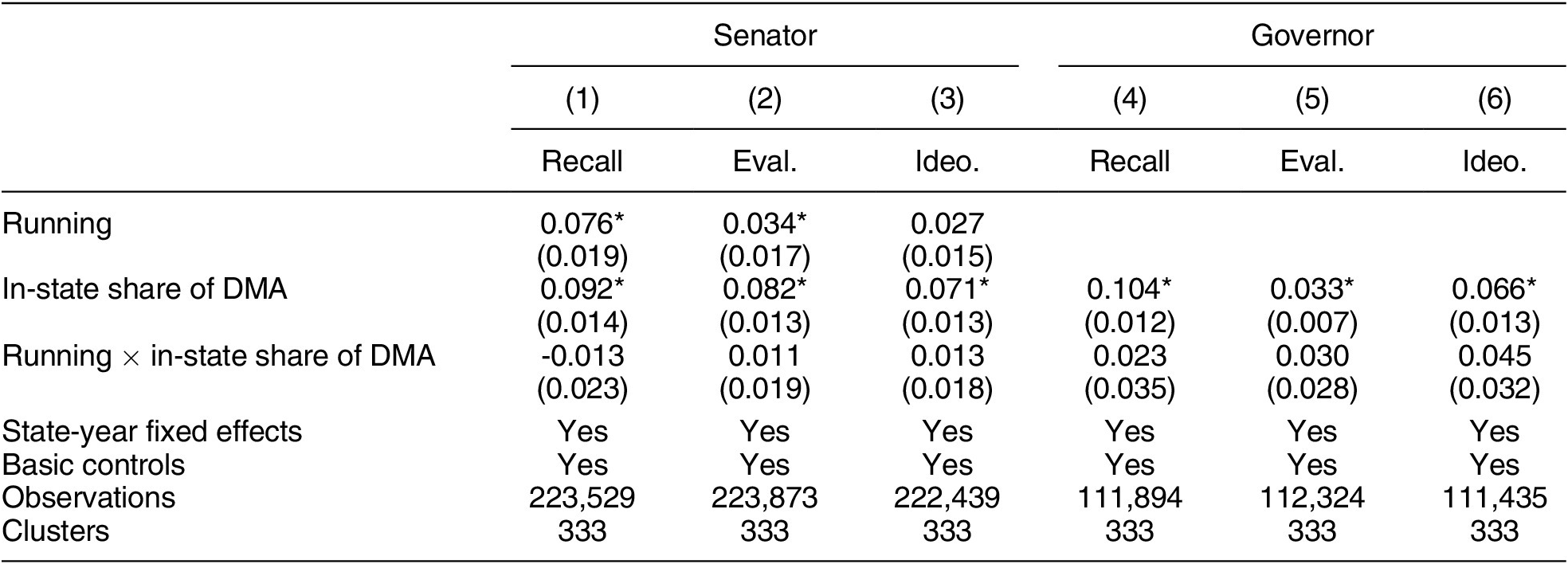
Voters are typically exposed to advertisements only during the period in which an officeholder is seeking reelection. Thus, if voters are primarily acquiring information from advertisements (rather than local news coverage), the relationship between in-state share of the DMA and voter knowledge should be driven by the officeholders running for reelection contemporaneously to the administration of the survey. In Table 6, I present specifications that test whether the magnitude of the in-state effect is contingent on whether the officeholder is running for reelection. The coefficient of interest from this table is the interaction between running (for reelection) and the in-state share of DMA. This coefficient indicates the extent to which the effect of in-state television is larger for officeholders running for reelection.
Voter Knowledge: Running for Reelection vs. Not Running
Note: Robust standard errors clustered by state-DMA in parentheses. *p
 $ < $
0.05.
The dependent variable is whether the individual can recall the party of the senator/governor in specifications (1) and (4), whether the individual is able to evaluate the senator/governor in specifications (2) and (5), and whether the individual is able to place the senator/governor on an ideological scale in specifications (3) and (6). Basic control variables include family income, gender, race, education, age, and marital status.
The estimated coefficient for the interaction term for all three measures of knowledge across both offices is of modest size and not significant. While not statistically significant, the interaction term is positive in 5 of the 6 specifications, which is at least suggestive that voters absorb some informational content from ads.Footnote 32 Nevertheless, the coefficient for the main effect of in-state share of DMA demonstrates that voters residing in in-state markets have substantially greater knowledge of officeholders not running for reelection compared with residents of out-of-state markets.
In addition to campaign ads, I consider two other alternative informational mechanisms that could explain the observed relationship: exposure to national cable news and exposure to local newspapers. In Appendix Section A.8, I demonstrate that residents of in-state markets and residents of out-of-state markets report almost identical levels of cable news viewership. Furthermore, in Appendix Section A.5.5, I control for the presence of a local newspaper in the voter’s county, and estimates are insensitive to the inclusion of this control. Overall, these results provide strong evidence that exposure to local TV news primarily accounts for the increased voter knowledge and ticket splitting rather than exposure to campaign ads, cable news, or local newspapers.
Discussion and Conclusion
This paper demonstrates the important effects that exposure to local television news coverage has on voter knowledge and split-ticket voting. The geography of television media markets structures the level of relevant local news coverage to which voters are exposed. Voters who live in in-state media markets, which are comprised mostly of residents from their own state, are exposed to higher levels of relevant local news coverage about their governor and senators than voters who live in out-of-state media markets, which are primarily comprised of residents from a neighboring state. Exposure to relevant local news coverage has considerable effects on voter knowledge of both officeholders and nonincumbent candidates. For instance, residents of in-state markets with access to relevant local television news coverage are 9 percentage points more likely to recall the party of their senators and 11 percentage points more likely to recall the party of their governor than residents of out-of-state markets with little access to relevant local TV news. Moreover, voters residing in in-state markets are about 2–3 percentage points more likely to cast a split president–senator ticket and 4–5 percentage points more likely to cast a split president–governor ticket. Given that the overall rate of split-ticket voting is about 8–9% for these offices in these election years, the estimated effects of exposure to local television news on ticket splitting are considerable. Importantly, these findings are robust to the inclusion (or exclusion) of various control variables, alternative characterizations of the explanatory variable of interest, restricting the sample to subsets of geographically proximate residents, and different sources of data (individual-level survey data and precinct-level election data). Auxiliary analyses, including placebo tests, all point to local television news coverage as a causal factor rather than campaign television ads or unobserved confounders.
The results accord with the theoretical expectation that greater exposure to local news coverage provides voters with relevant information about officeholders and candidates, which allows voters to make assessments for down-ballot elections separately from their national, partisan judgment in the presidential race. In the absence of exposure to relevant local news coverage, voters are more likely to apply their national, partisan judgment to down-ballot races. The results suggest that the decline of local news likely contributes—to an important degree—to the nationalization of U.S. elections. Unfortunately, given the limited period under examination, it is difficult to assess the degree to which declining local television news audiences account for the decrease in split-ticket voting observed over the past couple of decades. It is possible that local television news had even larger effects on ticket splitting in the recent past, prior to the downturn in local newscast audiences. Moreover, to the extent that these results are indicative of the effect of local news coverage beyond television, the broader decline in traditional sources of local news likely contributed substantially to the nationalization of elections. Local newspapers have experienced steep declines in their circulation and revenues, resulting in considerable cuts to staffing and other resources required to provide extensive local coverage. Less speculatively, the findings suggest that local television news has mitigated nationalizing electoral forces in Senate and gubernatorial elections even in the contemporary polarized context.
The nationalization of elections has serious implications for the functioning of representative democracy. On the one hand, to the extent that party labels are more clearly defined across offices and levels of government (i.e., if a party label means the same thing or at least similar things), electoral nationalization could simplify the task of voters and improve ideological or policy-based representation. On the other hand, nationally meaningful party labels could crowd out important state and local issues in the calculus of voters. Moreover, with highly nationalized elections, the electoral prospects of candidates and officeholders are based less on their (prospective) performance in office (e.g., competence, service delivery, economic performance, etc.) and more on national forces such as the popularity of the president. Unless the performance of officeholders is correlated within party and across levels of government, and these correlations in performance correspond correctly with national electoral forces (e.g., the president’s popularity), it is difficult to hold elected officials accountable based on their performance. In the context of U.S. federalism, the actions and responsibilities of state and local elected officials are mostly distinct from those of federal officeholders. If voters are unable to assess down-ballot officeholders separately from their national judgment at the top of the ticket, these officeholders will have little incentive to defect from their parties. These forces are likely to exacerbate elite polarization. After all, if voters have limited ability to discern differences among officials within the same party, these officials have little reason to separate themselves from their party in service to their local constituents if there is no electoral reward for doing so.
With that said, scholars in the past have bemoaned indistinct parties and incumbency advantage as problematic for accountability and representative democracy. The parties are now more distinct and the incumbency advantage has declined, which have yielded the present accountability concerns due to increasingly nationalized elections. Thus, it is easy to point to present ills and far more difficult to diagnose potential future ills.Footnote 33 More optimistically, U.S. primary elections help to filter out less qualified candidates as well as officeholders involved in scandals even in safe districts in which general elections fail to act as an effective filter (Hirano and Snyder Reference Hirano and Snyder2019). Of course, the first-order concern with the decline of local news should be its direct impact on being able to hold politicians accountable (e.g., Arnold Reference Arnold2004; Snyder and Strömberg Reference Jr, James and Strömberg2010). As local news sources disappear and their resources decrease, scandals, corruption, and other bad behavior may be more likely to go unnoticed. Politicians may also be less deterred with fewer watchdogs, increasing the incidence of such behavior. If the wrong-doing goes undetected, it is impossible for voters to hold the officeholder accountable in a primary or general election. Moreover, as citizens’ reliance on national news presumably increases with the decline of local sources of news, the character of the news coverage of political elites is likely to differ in ways that could have important consequences for mass polarization. For instance, research indicates that national sources of news, such as the New York Times, broadcast television news, and cable television news, provide greater coverage of more ideologically extreme elected officials relative to more moderate officials (Padgett, Dunaway, and Darr Reference Padgett, Dunaway and Darr2019; Wagner and Gruszczynski Reference Wagner and Gruszczynski2018).
A series of FCC rule changes appears to erode important protections for localism in broadcast news. First, the FCC eliminated the main studio rule, which required stations to have a physical studio in or near the community of license (Federal Communications Commission 2017c). FCC Commissioner Mignon L. Clyburn, who voted against the rule, issued a strong warning when the rule was proposed: “By tentatively proposing to eliminate the Commission’s main studio rule however, it seems to me that we are embracing a world in which automated national programming is the new normal” (Federal Communications Commission 2017e, 1). The Commission also has loosened restrictions on media consolidation within the same market area (Federal Communications Commission 2017d), and it has taken steps that effectively raise the cap on the national audience reach of a single owner (Federal Communications Commission 2017a).Footnote 34 The possible consequence of these rule changes is that a single entity can own television stations with a vast reach throughout the country and pipe into those stations nationally oriented news programming with little local content. Sinclair Media Group is one such company that has acquired several stations recently and thereby expanded its reach.Footnote 35 Alarmingly, Martin and McCrain (Reference Martin and McCrain2019) find that stations acquired by Sinclair increased their coverage of national politics and reduced their coverage of local politics. The direction of these new FCC rules is likely only to accelerate the nationalization of elections in the near future.
Supplementary Materials
To view supplementary material for this article, please visit http://dx.doi.org/10.1017/S0003055420000829.
Replication materials can be found on Dataverse at: https://doi.org/10.7910/DVN/HDDPTB.




Comments
No Comments have been published for this article.