The biogeographical area of Wallacea consists of a group of islands in the middle of the Indonesian archipelago, the largest of which is Sulawesi. Wallacea is recognised as a global biodiversity hotspot with high levels of endemism (Myers et al. Reference Myers, Mittermeier, Mittermeier, da Fonseca and Kent2000). It is separated by deep water from the Asian Sunda continental shelf to the West, and from the Australian Sahul continental shelf to the East and South. Sulawesi is geologically complex, consisting of diverse rock types including ultramafics, and soils which have relatively high pHs (Smith & Silver Reference Smith and Silver1991).
Termites are the most important invertebrate decomposers in tropical rainforests. They are ecosystem engineers and deliver important ecosystem services (Bignell & Eggleton Reference Bignell, Eggleton, Abe, Bignell and Higashi2000). These services include decomposition, soil carbon and nitrogen mineralisation, soil bioturbation, and water availability (Ashton et al. Reference Ashton, Griffiths, Parr, Evans, Didham, Hasan, Teh, Tin, Vairappan and Eggleton2019, Evans et al. Reference Evans, Dawes, Ward and Lo2011). Soil formation and conditioning processes, which are also services provided by termites, can be affected by atypical soil conditions (Holt & Lepage Reference Holt and Lepage2000). Furthermore, termite communities are strongly affected by biogeography (Davies et al. Reference Davies, Eggleton, Jones, Gathorne-Hardy and Hernández2003) and soil type (Jones et al. Reference Jones, Rahman, Bignell and Prasetyo2010). It is therefore important to study the interaction of geographical position and geological influence on the ecology and diversity of termites.
The biogeographical region of Sundaland, on the Sunda Shelf, is Peninsular Malaysia, Borneo, Sumatra, Java and their associated islands. During the Quaternary, at the Lower Glacial Maxima, land bridges connected these islands allowing species to move freely within Sundaland (Voris Reference Voris2000). However, Sundaland and Wallacea have never been connected because of an ocean trench which has an average depth of 2 km (Situmorang Reference Situmorang1982). The Wallace Line runs between the islands of Borneo and the Sulawesi in the north, and Bali and Lombok in the south (Wallace Reference Wallace1863). It defines the eastern boundary of the Asiatic biota, leaving Sulawesi with a predominantly Australian biotic composition (Wilson & Moss Reference Wilson and Moss1999). The Makassar Strait separates Borneo from Sulawesi and is 100 km wide at its narrowest point. The Makassar Strait is a physical barrier to the colonisation of termites from Sundaland to Wallacea (i.e. west to east). It is not thought that many termites have colonised east to west (Arab et al., Reference Arab, Namyatova, Evans, Cameron, Yeates, Ho and Lo2017; Bourguignon et al., Reference Bourguignon, Lo, Sobotnik, Ho, Iqbal, Coissac, Lee, Jendryka, Sillam-Dusses, Krizkova, Roisin and Evans2017; Bourguignon et al., Reference Bourguignon, Lo, Sobotnik, Sillam-Dusses, Roisin and Evans2016)
Here we present data on termite assemblages from Buton, an island in the archipelago of South East Sulawesi. The whole archipelago has never before been sampled quantitatively for termites, using a standardised method, although faunal inventories suggest that the assemblage is depauperate (Collins, Reference Collins1984, Gathorne-Hardy et al., Reference Gathorne-Hardy, Collins, Buxton and Eggleton2000a). We compare the regional termite assemblages found across Sundaland with those found in Buton (Sulawesi) using transect data, taken with the same, comparable, termite sampling method (Jones & Eggleton Reference Jones and Eggleton2000).
Data were collected between June–July 2012 and June–August 2013 on Buton Island (longitude 123°12’E–122°33’E, latitude 005°44’S–004°21’S). Termites were sampled in four sites in Tropical Monsoon Forest (Whitten et al. Reference Whitten, Henderson and Mustafa1987), using a standardised belt transect (100 m × 2 m) sampling protocol (Jones & Eggleton Reference Jones and Eggleton2000). The protocol gives a measure of species density and relative abundance (number of encounters) per transect. One transect was run in each site, and six soil samples were collected along each transect to measure the pH of surface soil (top 10 cm). Termites were identified at the Natural History Museum, London. The feeding group classification follows Donovan et al. (Reference Donovan, Eggleton and Bignell2001).
Transect 1 (T1) was in Kakanauwe Nature Reserve (122°53’18’’E, 05°10’12’’S; c. 230 m a.s.l.). The site has a history of selective logging, and few big trees remain. The underlying geology is Wapulaka reef limestone, and there is little to no soil present due to the Quaternary coral protrusions. Mean soil pH was 7.9.
Transect 2 (T2) was near Bala Camp in Lambusango Forest Reserve (122°56’55’’E, 05°17’44’’S; c. 400 m a.s.l.). Although the area is within a Limited Production Forest, there was no evidence of recent selective logging or rattan harvesting. Soil was present in the form of lime-rich mud and clay due to the underlying Sampolakosa formations with chalks and marls. The soils were shallow with a mean pH of 6.9.
Transect 3 (T3) was near North Buton camp (123°09’24’’E, 04°41’10’’S; c. 250 m a.s.l.). This site was undisturbed old growth forest, with a full canopy and trees up to 40 m in height. The soils were derived from the Tondo geological formation of clastic sediments made up of mafic and ultramafic rocks. The soils were shallow with a mean pH of 6.7.
Transect 4 (T4) was near Lapago camp, also in Lambusango Forest Reserve (122°50’49’’E, 05°13’54’’S; c. 225 m a.s.l.). The site had a history of selective logging. Some tall trees remain and there were gaps in the canopy. The soils were deeper than the other three sites, with a deep litter layer, and mean soil pH of 6.8. The soils were again predominantly limestone.
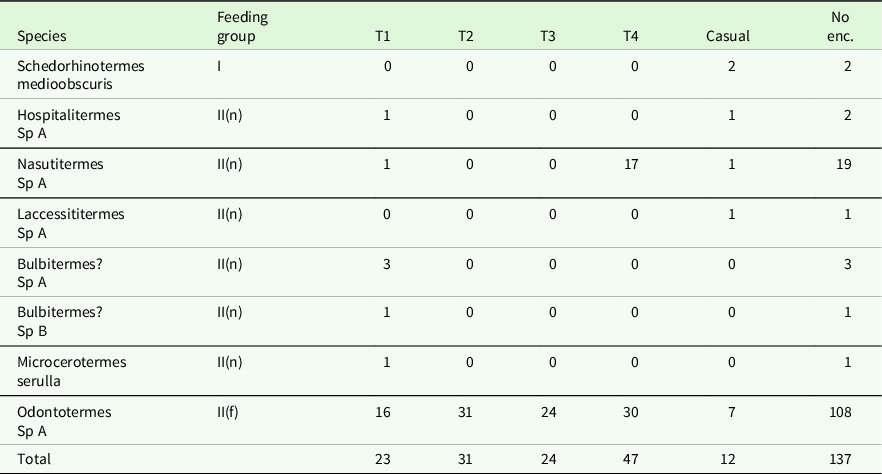
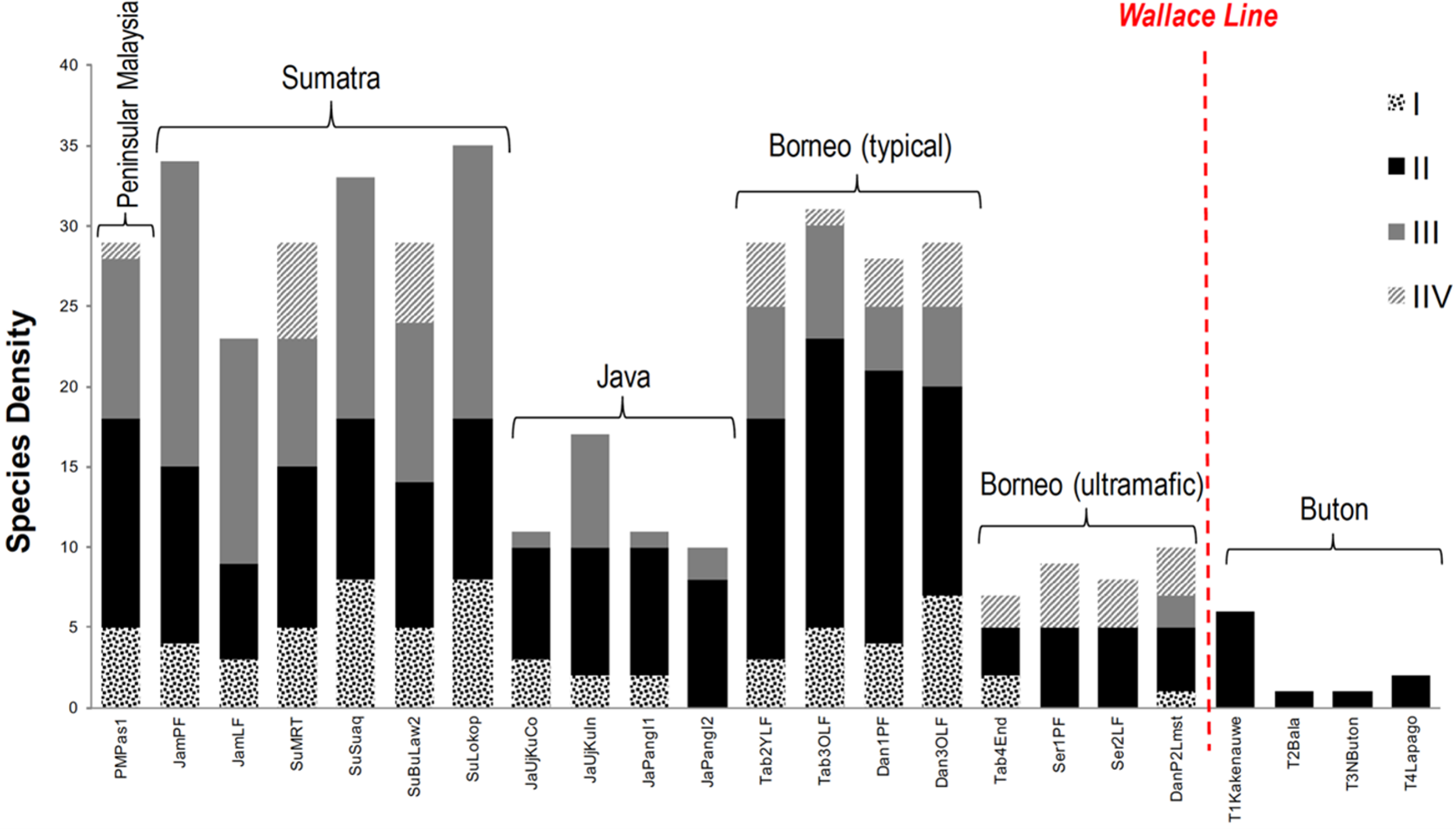
The results (Table 1; Figure 1) show that the termite assemblages have a distinctly lower species density (mean = 2.5 species, range = 1 to 6) compared with assemblages in Sundaland forest on non-ultramafic soils (species density mean = 29.9 species, range: 23 to 35). Relative abundance is also lower on Buton (mean = 31.3 encounters, range = 23 to 47) compared with the same Sundaland transects (mean = 93.3 encounters, range = 68 to 110) (Figure 1). The exceptions are the four Java transects, which have intermediate levels of species richness (Figure 1), probably because they are coastal forests (Gathorne-Hardy et al. Reference Gathorne-Hardy, Jones and Mawdsley2000b). The Buton transects are most similar to the four ultramafic transects on Borneo (Figure 1), with mean species density = 8.5 species (range: 7 to 10) and mean relative abundance = 20 encounters (range: 18 to 23).
Species encounters in the four transects from Buton, as well as termites collected casually. No enc. = number of termite encounters. II(f) = fungus-growers, II(n) = non-fungus-growers

Termite species density from transect in lowland forest across Sundaland and Sulawesi. Species density from each site is categorised into four feeding groups (Donovan et al. Reference Donovan, Eggleton and Bignell2001). Tab4End, Ser1PF, SER2LF and DanP2Lmst are atypical assemblages present on ultramafic-derived soils in Borneo (Jones et al. Reference Jones, Rahman, Bignell and Prasetyo2010). Other sites codes are from Gathorne-Hardy et al. Reference Gathorne-Hardy, Davies, Eggleton and Jones2002.

Functional diversity of the Buton assemblages was also greatly reduced, with 75% of the relative abundance being represented by one species of Odontotermes sp. (group-II fungus-growing wood-feeder), 24% being represented by non-fungus-growing group-II wood-feeders (Microcerotermes serrula, Nasutitermes sp. and two species of Bulbitermes) and a single encounter with Hospitalitermes sp. (group-II micro-epiphyte-feeder). This is in sharp contrast to the Sundaland transects (excluding ultramafic transects and the Java transects), which have a mean of 43% (range: 25% to 61%) group III and group IV soil-feeding species (Figure 1).
Some of the shortfall may be due to the transect method not sampling arboreal termites. This would be especially true of the Kalotermitidae, which feed and nest on dead branches still attached to trees in the canopy. However, we have no data on kalotermitid distribution in any of the sites (Sundaland or Sulawesi) and so we cannot say anything about these inaccessible groups. There have been two previous published accounts of termites from Sulawesi (Kemner Reference Kemner1934; Gathorne-Hardy et al. Reference Gathorne-Hardy, Collins, Buxton and Eggleton2000a), and these data, albeit limited and collected casually, also suggests that the island has a relatively low termite diversity. In total, only 41 species from 18 genera are known from Sulawesi, and only one species is a soil-feeder (Gathorne-Hardy et al. Reference Gathorne-Hardy, Collins, Buxton and Eggleton2000a). In contrast, at least 226 described species from 48 genera are known from Sundaland, of which 27% are group III or group IV soil-feeders. (Gathorne-Hardy, Reference Gathorne-Hardy2004). Mark Collins, a very experienced termite collector, carried out intensive sampling in lowland rainforest in Dumoga-Bone National Park, North Sulawesi, and found only 22 species (see Gathorne-Hardy et al. Reference Gathorne-Hardy, Collins, Buxton and Eggleton2000a). However, in a similar sampling programme in Mulu National Park in Borneo, Collins (Reference Collins1984) found 59 species in the lowland forest. In other intensive sampling programmes in lowland forest in Sundaland, 95 species were found in Danum Valley in Sabah, Malaysian Borneo, and 80 species were found in Pasoh Forest Reserve in Peninsular Malaysia (Jones & Eggleton Reference Jones and Eggleton2000). The transect method and these other intensive sampling programmes are designed to collect all feeding groups from all terrestrial microhabitats.
What factors are responsible for the low termite species density and the absence of soil-feeding termites seen on Sulawesi? These data are all from an island off the coast of Sulawesi, so island size and isolation may contribute to the low diversity found here, although this effect may be attenuated by Buton being a continental rather than a volcanic island and having most of the biotic elements found in mainland Sulawesi. (Michaux, Reference Michaux2010)
Generally, in order to colonise the Sulawesi region from Borneo, termites must disperse either by rafting in wood or they must fly over the 100-km-wide Makassar Strait. The chance of rafting to Sulawesi is reduced by the strong southbound oceanic current that passes through the Makassar Strait, called the Indonesian Throughflow, which is known to carry dead trees that are washed out of rivers on the East coast of Borneo southwards passed Sulawesi (Susanto et al. Reference Susanto, Field, Gordon and Adi2012). However, of the 18 termite genera listed from Sulawesi (Gathorne-Hardy et al. Reference Gathorne-Hardy, Collins, Buxton and Eggleton2000a), 16 nest in wood, and most of those are widely distributed globally and are known to raft in floating wood (Abe Reference Abe1984, Gathorne-Hardy et al. Reference Gathorne-Hardy, Jones and Mawdsley2000b). The soil-nesting genus Pericapritermes has been recorded in Sulawesi, but it has been observed nesting in dead wood (Gathorne-Hardy et al. Reference Gathorne-Hardy, Collins, Buxton and Eggleton2000a), so it may also have the ability to raft.
Dispersal from Borneo to Sulawesi by flying is difficult because the alates (winged reproductives) of most termite species are poor fliers and usually land within a few hundreds of metres of their natal nest (Abe Reference Abe1984, Gathorne-Hardy et al. Reference Gathorne-Hardy, Jones and Mawdsley2000b). Longer distances tend to be achieved only when alates are carried by strong air currents. However, the wind patterns associated with the Indonesian Throughflow are more likely to carry any alates south rather than east towards Sulawesi. This may account for the near-absence of soil-nesting termites recorded from Sulawesi, as rafting is not a possibility for these species. The one exception is the obligate soil-nesting species Odontotermes sp. which dominates all the Buton transects. This species may have flown from Borneo, as African Microtermes are known to have flown 300 km across the Mozambique Channel to colonise Madagascar (Aanen & Eggleton Reference Aanen and Eggleton2005; Nobre et al., Reference Nobre, Eggleton and Aanen2009).
Termites in Sundaland have been well studied (e.g. Gathorne-Hardy, Reference Gathorne-Hardy2004). In Sundaland, termites are most abundant and diverse in lowland forests (< 400 m elevation; Gathorne-Hardy et al. Reference Gathorne-Hardy, Syaukani and Eggleton2001) on soils with relatively low pH (range: 3.7 to 4.7; Jones et al. Reference Jones, Rahman, Bignell and Prasetyo2010). However, forests on ultramafic-derived soils in Borneo, which have higher soil pH (range: 5.4 to 6.4) and higher concentrations of Ca, Mg, N, Cr, Co, Cu and Zn, have termite assemblages with low species density (< 35%), low relative abundance (< 30%) and a near-absence of soil-feeding species compared with assemblages in forests in Borneo on non-ultramafic soils (Jones et al. Reference Jones, Rahman, Bignell and Prasetyo2010). They had an extremely low diversity of Rhinotermitidae and the non-fungus-growing taxa, which are mostly wood-feeders (Jones et al. Reference Jones, Rahman, Bignell and Prasetyo2010). Their low diversity in these sites is not due to any restrictions on dispersal by flight but may be associated with the soil conditions. These sites also have high concentrations of metals, and therefore three possible mechanisms may explain the depauperate assemblages on these ultramafic soils: 1) high soil pH (as shown in other studies, (Lavelle et al. Reference Lavelle, Chauvel, Fragoso, Date, Grundon, Rayment and Probert1995). disrupting termite gut physiology; 2) metal toxicity; and 3) microbial interactions with metals (Jones et al. Reference Jones, Rahman, Bignell and Prasetyo2010). The soil pH at the four Buton sites (range: pH 6.7 to 7.9) is considerably higher than the soil pH at the four ultramafic transects (range: 5.4 to 6.4) (Jones et al. Reference Jones, Rahman, Bignell and Prasetyo2010), suggesting that the negative impact of higher soil pH on termites may be even greater in Sulawesi. Therefore, those termite groups that are vulnerable to high soil pH and that do disperse from Borneo across the Makassar Strait by rafting or flight may be less likely to survive due to the effect of the higher soil pH.
Overall, we conclude that the low species diversity and functional diversity of the termite fauna of Buton is caused by a combination of a number of factors: particularly biogeographical position and soil chemistry. First, dispersal across the Wallace Line is difficult for non-rafting termites due to the unlikely chance of alates flying 100 km across the Makassar Strait. Second, termites that do arrive in Sulawesi may have reduced chances of colony establishment and survival due to the high pH of the soils in many parts of Sulawesi. To quantify the impact of these factors on termite diversity, sampling at other sites in Sulawesi is recommended, especially in forests with lower soil pH.
Acknowledgements
We thank colleagues from Syiah University, Banda Aceh, Indonesia, who provided insight and expertise to the project. This research is part of a programme organised by Operation Wallacea Ltd., which provided funding and logistics. We thank BKSDA Southeast Sulawesi for permission to work in Lambusango Wildlife Sanctuary and Kakenauwe Nature Reserve. The work was done under a research permit issued by the Indonesian Institute of Sciences (LIPI). The following people helped with this work: Dr Philip Wheeler, Charlotte Palmer, Clancy Zhiang, Murray Fife, Sam Wright.