Introduction
Several recent studies have sought to understand the impact of elections and campaign activity on state courts. Indeed, a debate has arisen about whether or not judicial elections degrade judicial independence and legitimacy. In general terms, at issue here is the relationship between state judges and the democratic process. As Bonneau and Hall (2009, 1) ask: “Should judges be independent of democratic processes in obtaining and retaining their seats, or should they be subject to the approval of the electorate and the processes that accompany that control?” Many scholars who have addressed this question proceed from the assumption that elections diminish judicial legitimacy.
Institutional legitimacy flows partially from public perceptions of a governmental institution's capacity to be fair and impartial. Though members of the legislative and executive branches of government undoubtedly are concerned with public perceptions of their institutions, it has long been speculated that legitimacy is most important for the judicial branch of government. Why? The (often unspoken) answer generally goes as follows: because courts lack both the purse and the sword, and because many judges achieve their positions through nondemocratic processes and also rely on other political actors to enforce their decisions, the support of the public is crucial for the exercise of judicial authority. In short, courts require legitimacy if their decisions are to have weight. As Bartels and Johnston (Reference Bartels and Johnston2013, 184) note, courts need to “maintain a sufficient reservoir of institutional legitimacy, or diffuse support, with the American public” to ensure that their rulings carry with them authoritative force.
What factors affect public perceptions of judicial legitimacy? Several recent studies have addressed this question, focusing primarily on specific campaign activities (see, e.g., Gibson Reference Gibson2008a, Reference Gibson2008b, Reference Gibson2009, Reference Gibson2012; Gibson et al. Reference Gibson, Gottfried, Delli Carpini and Hall Jamieson2011; Gibson and Caldeira Reference Gibson and Caldeira2012). Other recent studies have addressed related topics, including how levels of spending in judicial elections affect voter turnout (Hall and Bonneau Reference Hall and Bonneau2008), how controversial decisions affect public perceptions of judicial legitimacy (Gibson, Caldeira, and Spence Reference Gibson, Caldeira and Kenyatta Spence2003; Wedeking, Peffley, and Wininger Reference Wedeking, Peffley and Wininger2013), and what precisely the concept of judicial impartiality actually means (Geyh Reference Geyh2012).
In this article, we attempt to push the study of judicial legitimacy a bit further by presenting new experimental data on the effects of judicial selection method on diffuse support for state supreme courts. On the whole, our results suggest that contrary to critics of judicial elections, it is appointments rather than elections that degrade public perceptions of judicial legitimacy. Although we uncover no evidence that elections directly increase levels of diffuse support for the judiciary, our findings indicate that elections indirectly do so because they are the lone alternatives to appointment selection methods, which citizens do not like. Our results also show that citizens do not view the state supreme court as sui generis among governmental institutions. We examine the effects of selection method on perceptions of school board legitimacy to test the notion that the judiciary is somehow different from other government institutions. Our results show that citizens have a profound distaste for appointments to the school board, just as they do for appointments to the state high court.
Background: Legitimacy and state high courts
Courts have always enjoyed a more favorable standing among the public than the other branches of government. In short, state courts are the beneficiaries of high levels of public trust and confidence relative to the other branches of state government (Kelleher and Wolak Reference Kelleher and Wolak2007). While there may be reason to believe that state courts are perceived differently than are federal courts—particularly the US Supreme Court—there is evidence that levels of diffuse support for the two institutions are positively correlated (Jamieson and Hardy Reference Jamieson and Hardy2008).
Perceptions of judicial legitimacy, however, are not uniformly high, and several factors tend to affect these perceptions. One of these factors appears to be the method by which judges are chosen. In an initial formulation, Benesh (Reference Benesh2006) found a link between state judicial selection method and public confidence in the courts. She writes: “[I]n partisan election states, respondents have less confidence in the courts; they are more likely to have only a little confidence and less likely to have a great deal of confidence” (Benesh Reference Benesh2006, 704). This intriguing finding spawned a great deal of research. Charles Geyh (Reference Geyh2003) had earlier weighed in on this issue, and he is widely credited with creating the Axiom of 80. In his 2003 article, Geyh surveys the literature on judicial selection and concludes the following: 80 percent of Americans favor elections over other judicial selection methods; 80 percent of Americans do not vote in judicial elections; 80 percent of Americans cannot identify the candidates in a given judicial election; and 80 percent of Americans express apprehension that elected judges may be beholden to their campaign donors. The Axiom of 80, which highlights public confusion, ignorance, and ambivalence about judicial elections, leads Geyh to conclude that judicial elections should be phased out over time (though more recently he seems to have cooled on this sentiment; see Geyh Reference Geyh2012), as they may lead to declines in judicial legitimacy.
Perceptions of Judicial Legitimacy
Benesh, Geyh, and others began a scholarly conversation about judicial selection methods that has recently heated up considerably. Perhaps most prominent in this conversation is political scientist James Gibson, who has sought directly and empirically to discover the determinants of public perceptions of judicial legitimacy. In a 2009 study, Gibson examines survey data from a national sample to assess the impact of specific campaign activities on citizen perceptions of the state judiciary. Building on similar findings from an earlier study (Gibson Reference Gibson2008b), Gibson concludes that neither policy promises made by judicial candidates nor attack advertisements placed by judicial candidates diminish public perceptions of judicial legitimacy. Gibson does find, however, that campaign contributions to judicial candidates negatively affect perceptions of judicial legitimacy. However, this finding is mitigated somewhat by his finding that campaign contributions diminish levels of support for other institutions of state government as well. Gibson essentially doubles down on these findings in his 2012 book, Electing Judges. The bulk of his empirical evidence—some from experiments and some from surveys—leads Gibson to conclude that judicial elections do not threaten perceptions of judicial legitimacy, despite the (minimal) legitimacy‐degrading effects of some campaign activities. In all, Gibson's research on the effects of attack advertisements, policy pronouncements, and financial contributions to judicial candidates (Gibson Reference Gibson2008b, Reference Gibson2009, Reference Gibson2013; Gibson et al. Reference Gibson, Gottfried, Delli Carpini and Hall Jamieson2011; Gibson and Caldeira Reference Gibson and Caldeira2011, Reference Gibson and Caldeira2012) represents a powerful rebuke to scholars who believe that elections threaten judicial legitimacy.
Gibson is not the only scholar to conclude that judicial elections do not have the legitimacy‐degrading effects that some critics argue they do (or might). In their 2009 book, In Defense of Judicial Elections, political scientists Chris Bonneau and Melinda Gann Hall test and then reject the notion that judicial elections are bad for judicial legitimacy. They do not address public perceptions of judicial legitimacy per se, but rather ask: Do voters in judicial elections know what they are doing? Critics of judicial elections, they maintain, answer this question with an unqualified “No,” and extrapolate from here that judicial elections cannot be good for legitimacy in the long term. After analyzing election data, Bonneau and Hall conclude that voters do know what they are doing in judicial elections—they tend to show up for competitive elections, they are able to distinguish high‐quality candidates (e.g., those with substantial previous judicial experience) from low‐quality candidates (e.g., those with no previous judicial experience), and they correctly realize that judges are not impartial arbiters, but are, instead, political actors. In the end, much like Gibson and his colleagues, Bonneau and Hall conclude that judicial elections are much like other US elections—imperfect, but appropriate and reasonable and not legitimacy degrading.
The empirical studies of Gibson and Bonneau and Hall notwithstanding, judicial elections continue to attract criticism. One criticism of judicial elections (to which we allude above) is that they directly and negatively affect public perceptions of legitimacy. This degradation of public support for the judiciary, the argument goes, may cause the institution itself to lose legitimacy. Benesh (Reference Benesh2006) comes closest to showing a link between elections and poor perceptions of judicial legitimacy empirically, but her methodology (she distinguishes between “partisan” and “nonpartisan” selection methods rather than between “elective” and “appointive” methods) does not allow her to demonstrate directly that elections degrade public perceptions of court legitimacy. The most common criticism of judicial elections is that they may cause judges to behave differently than they otherwise would (Epstein Reference Epstein2013; Hume Reference Hume2013; Streb Reference Streb2013). Specifically, critics argue that elected judges may reject their proper role as countermajoritarians, and instead respond to public pressures just like other politicians do. In electing judges, this criticism goes, we sacrifice the sacrosanct value of judicial independence for the less important value of judicial accountability. This trade‐off is particularly troublesome, many critics maintain, for minority rights. Empirical studies confirm that elected judges do indeed behave differently on the bench, and that this redounds to the detriment of vulnerable citizens. Brace and Boyea (Reference Brace and Boyea2008) and Canes‐Wrone, Clark, and Kelly (Reference Canes‐Wrone, Tom and Jason2014), for example, demonstrate that state high court justices who are elected are much more responsive to public opinion in death penalty cases than are state high court justices who are appointed. Similarly, Gordon and Huber (Reference Gordon and Huber2007) find that, ceteris paribus, elected judges are much harder on criminal defendants than are appointed judges (see also Berdejó and Yuchtman Reference Berdejó and Yuchtman2013; but see Choi, Gulati, and Posner Reference Choi, Gulati and Posner2008).
Unfortunately, critics of judicial elections tend to talk past defenders of judicial elections. While Gibson and others who defend judicial elections focus on how elections affect public perceptions, critics of judicial elections tend to focus on how elections affect judicial outcomes. The latter issue is indeed an important one, but it is qualitatively different from the former.
An Unanswered Question
While previous studies have unquestionably improved our understanding of elections and their effects on judicial legitimacy, we believe that one general question remains underaddressed. That question is this: Does the method by which judges acquire their positions affect public perceptions of judicial legitimacy? Footnote 1 Though it may seem at first glance that some do, none of the studies we cite above address this precise question directly. Gibson and his colleagues examine the effects of specific campaign activities on public perceptions of court legitimacy, not the effects of the very existence of an election as a method for choosing state judges. Bonneau and Hall reassuredly conclude that voters in judicial elections are no fools, but they do not address perceptions of judicial legitimacy head on. It is our contention that the mere existence of an election, quite separate from the particular activities in which candidates engage during a specific election, affects public perceptions of judicial legitimacy. As for the critics of judicial elections (as we note above), they tend not even to address the question of how the existence of elections affects public perceptions of legitimacy, instead focusing on how elections lead judges to behave like “politicians in robes” who ignore the law and make decisions based on public opinion (see, e.g., Benesh Reference Benesh2006; Robinson Reference Robinson2013). This behavior may over time degrade perceptions of judicial legitimacy, but contending that this is the case is qualitatively different from saying that elections themselves degrade perceptions of legitimacy.
In addressing the general question of how the method by which judges acquire their positions affects public perceptions of judicial legitimacy, we break with previous studies by explicitly addressing the question of how appointment as a judicial selection method affects perceptions of judicial legitimacy. Appointment as a method of judicial selection is the real‐world alternative to election, and thus to understand the effects of choosing elections over appointments fully, we must examine how appointment as a selection method affects public perceptions of judicial legitimacy. Given the institutional reality that legitimacy is extremely important to US courts, it is important to understand the determinants of public perceptions of court judicial legitimacy.
Data, Methods, and Approach
How does the mere existence of an election as a selection method affect levels of diffuse support for the judiciary?Footnote 2 To address this question (and the more general question of how selection method affects public perceptions of institutional legitimacy), we conducted a randomized, post‐test only, control group, survey experiment. Our subject pool consisted of 802 US adults.Footnote 3 Our experiments were administered by the Internet‐based data‐collection firm SurveyMonkey, via its SurveyMonkey Audience service.Footnote 4 All surveys were administered during a one‐week period in May 2013, and 802 of 2,942 possible respondents took the survey (for a response rate of 27.2 percent). Web‐based survey tools in political science are relatively new, but a wealth of recent research suggests that data gathered via such tools tend to be as reliable and valid as those collected through other means (see, e.g., Alvarez, Sherman, and VanBeselaere Reference Alvarez, Sherman and VanBeselaere2003; Stephenson and Crête Reference Stephenson and Crête2011; Cassese et al. Reference Cassese, Huddy, Hartman, Mason and Weber2013).
We relied, like several previous studies (Gibson Reference Gibson2008b; Gibson and Caldeira Reference Gibson and Caldeira2012), on experimental vignettes to investigate citizen attitudes about the judiciary. The advantages of experimental vignettes are, as Gibson (Reference Gibson2008b, 63–64) points out, manifold. Most important, experimental vignettes are contextualized; in this case, the context is defined by different selection methods. Contextualization “can reveal processes of reasoning perhaps not even directly accessible to the respondents themselves” (Gibson Reference Gibson2008b, 63). Our experiment is structured around a brief story about a government official. We varied the stories to which we exposed respondents to estimate the effects of our two independent variables of interest (which we describe momentarily). After each respondent was exposed to a vignette, he/she was asked three questions designed to measure perceptions of institutional legitimacy. Our survey experiment retains all the advantages of experiments in general. Specifically, it has high internal validity (and thus allows for causal inferences), it allows us to control precisely for independent variables of interest, and it lends itself to easy replication.Footnote 5
The Experimental Manipulations
As Gibson (Reference Gibson2008b) notes, judicial institutions are generally studied in isolation—that is, they are seldom compared to other institutions of government. This is a mistake, Gibson writes, because many “criticisms directed against judicial elections in fact are generic to all low‐salience elections” (Gibson Reference Gibson2008b, 64). Some of Gibson's experiments (2008b, 2009) attempt to remedy the lack of cross‐institutional analyses by analyzing the effects of independent variables of interest on public attitudes toward the state legislature as well as the state judiciary. Varying institution across experimental vignettes allows Gibson to test the general hypothesis that people judge and evaluate judicial institutions differently than they judge and evaluate other institutions of government. Here, we follow Gibson's lead and vary institution across experimental vignettes. Doing this allows us to test the notion that citizens view courts differently than they view other institutions of government. Although the evidence that judicial elections are a lot like other types of elections is growing (see, e.g., Hall Reference Hall2001, Reference Hall2007), there remains a lack of cross‐institutional analyses of the issue. While Gibson uses the state legislature as his comparison institution, we use the local school board.
We use the school board as our comparison institution for three primary reasons. First, the school board selection process is in many ways similar to the judicial selection process. Most important, despite the widespread perception that school board members are virtually all elected, school board selection processes vary across states and jurisdictions, and not all school boards are elective institutions. In nineteen states, at least some school board members are appointed rather than elected, and many very large jurisdictions, including Los Angeles County, Baltimore, Chicago, Cleveland, and Philadelphia, have appointed rather than elected school boards (National School Board Association 2009). Thus, school boards, like state judicial institutions, vary in the ways their members are selected. Second, school boards, like state high courts, are low‐salience political institutions. Third, turning to elections specifically, school board elections share many characteristics with judicial elections. Like judicial elections, school board elections tend to be low‐information, low‐salience, low‐turnout affairs (Bartusek Reference Bartusek2007; Copeland and Garn Reference Copeland and Garn2007). In sum, we believe that the local school board is an ideal comparison institution for our purposes; it allows us carefully to test the notion that people see courts as somehow different than other types of government institutions.
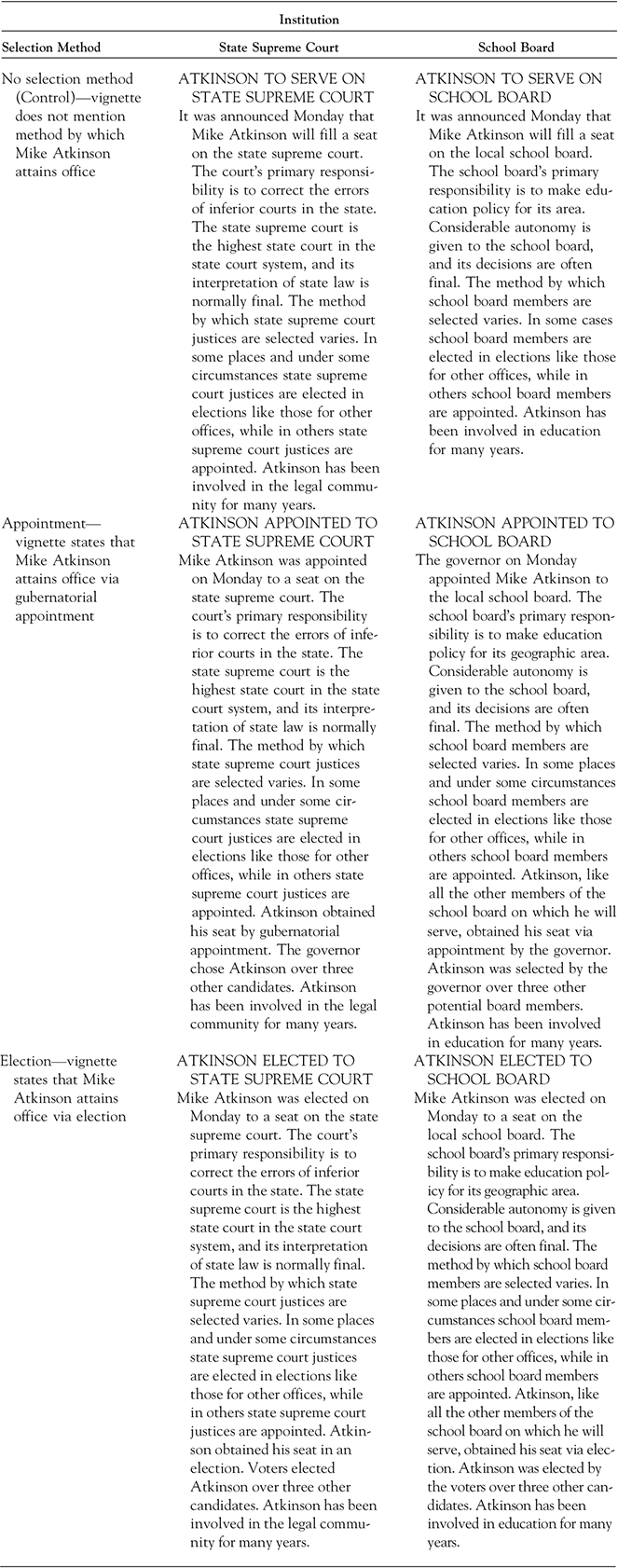
Our experiment utilizes a between‐subjects, 2×3 factorial design. Each respondent was assigned to only one group, and thus viewed only one experimental vignette (out of a total of six). Respondents were assigned to one of two general experimental groups: (1) the state supreme court group or (2) the school board group. Respondents assigned to the first group were exposed to a story about the state supreme court, while respondents assigned to the second group were exposed to a story about the local school board. The most important substantive manipulation in our experiment concerns selection method. Specifically, we varied what our vignettes said about how the fictional Mike Atkinson attained his office. Here, respondents were assigned to one of three groups—(1) the no selection method information group, (2) the appointment group, or (3) the election group. Respondents in the first group were exposed to a vignette noting that Mr. Mike Atkinson would soon take a position on the school board or the state supreme court; but not indicating how Mr. Atkinson attained his office. The no selection method information group essentially is a control group. Respondents in the second group received a vignette stating that Mike Atkinson would soon take a position on the school board or the state supreme court, and that Mr. Atkinson attained his position via appointment.Footnote 6 Finally, respondents in the third group received a vignette stating that Mike Atkinson would soon take a position on the school board or the state supreme court, and that he attained his position via an election. Table 1 contains the full text of each of our vignettes.
The Experimental Vignettes and Six Experimental Groups

| Institution | ||
|---|---|---|
| Selection Method | State Supreme Court | School Board |
| No selection method (Control)—vignette does not mention method by which Mike Atkinson attains office | ATKINSON TO SERVE ON STATE SUPREME COURT It was announced Monday that Mike Atkinson will fill a seat on the state supreme court. The court's primary responsibility is to correct the errors of inferior courts in the state. The state supreme court is the highest state court in the state court system, and its interpretation of state law is normally final. The method by which state supreme court justices are selected varies. In some places and under some circumstances state supreme court justices are elected in elections like those for other offices, while in others state supreme court justices are appointed. Atkinson has been involved in the legal community for many years. | ATKINSON TO SERVE ON SCHOOL BOARD It was announced Monday that Mike Atkinson will fill a seat on the local school board. The school board's primary responsibility is to make education policy for its area. Considerable autonomy is given to the school board, and its decisions are often final. The method by which school board members are selected varies. In some cases school board members are elected in elections like those for other offices, while in others school board members are appointed. Atkinson has been involved in education for many years. |
| Appointment—vignette states that Mike Atkinson attains office via gubernatorial appointment | ATKINSON APPOINTED TO STATE SUPREME COURT Mike Atkinson was appointed on Monday to a seat on the state supreme court. The court's primary responsibility is to correct the errors of inferior courts in the state. The state supreme court is the highest state court in the state court system, and its interpretation of state law is normally final. The method by which state supreme court justices are selected varies. In some places and under some circumstances state supreme court justices are elected in elections like those for other offices, while in others state supreme court justices are appointed. Atkinson obtained his seat by gubernatorial appointment. The governor chose Atkinson over three other candidates. Atkinson has been involved in the legal community for many years. | ATKINSON APPOINTED TO SCHOOL BOARD The governor on Monday appointed Mike Atkinson to the local school board. The school board's primary responsibility is to make education policy for its geographic area. Considerable autonomy is given to the school board, and its decisions are often final. The method by which school board members are selected varies. In some places and under some circumstances school board members are elected in elections like those for other offices, while in others school board members are appointed. Atkinson, like all the other members of the school board on which he will serve, obtained his seat via appointment by the governor. Atkinson was selected by the governor over three other potential board members. Atkinson has been involved in education for many years. |
| Election—vignette states that Mike Atkinson attains office via election | ATKINSON ELECTED TO STATE SUPREME COURT Mike Atkinson was elected on Monday to a seat on the state supreme court. The court's primary responsibility is to correct the errors of inferior courts in the state. The state supreme court is the highest state court in the state court system, and its interpretation of state law is normally final. The method by which state supreme court justices are selected varies. In some places and under some circumstances state supreme court justices are elected in elections like those for other offices, while in others state supreme court justices are appointed. Atkinson obtained his seat in an election. Voters elected Atkinson over three other candidates. Atkinson has been involved in the legal community for many years. | ATKINSON ELECTED TO SCHOOL BOARD Mike Atkinson was elected on Monday to a seat on the local school board. The school board's primary responsibility is to make education policy for its geographic area. Considerable autonomy is given to the school board, and its decisions are often final. The method by which school board members are selected varies. In some places and under some circumstances school board members are elected in elections like those for other offices, while in others school board members are appointed. Atkinson, like all the other members of the school board on which he will serve, obtained his seat via election. Atkinson was elected by the voters over three other candidates. Atkinson has been involved in education for many years. |
The Dependent Variables
We utilize two main dependent variables in the analyses that follow. First, there is Diffuse support for the state supreme court. This variable is constructed using responses to the following three survey items:
-
1. Question: Do you strongly believe that members of the state supreme court can serve as fair and impartial judges, somewhat believe they can be fair and impartial, somewhat believe they cannot be fair and impartial, or strongly believe they cannot be fair and impartial? Answer: 0. I strongly believe they cannot be fair and impartial, 1. I somewhat believe they cannot be fair and impartial, 2. I somewhat believe they can be fair and impartial, 3. I strongly believe they can be fair and impartial.
-
2. Question: How likely would you be to accept decisions made by the state supreme court as impartial, fair, and legitimate? Would you be very likely, somewhat likely, not too likely, or not at all likely? Answer: 0. Not at all likely, 1. Not too likely, 2. Somewhat likely, 3. Very likely.
-
3. Question: Would you consider the state supreme court a very legitimate institution, a somewhat legitimate institution, a not too legitimate institution, or not legitimate at all? Answer: 0. Not legitimate at all, 1. Not too legitimate, 2. Somewhat legitimate, 3. Very legitimate.
For each respondent, we calculated a total score based on his/her responses to these three survey items. Thus, our first dependent variable, Diffuse support for the state supreme court, can take any value from 0–9, where 0 indicates complete lack of support for the state supreme court, and 9 indicates the highest level of support. In our sample, the mean on this dependent variable is 5.79. The set of three items used to create Diffuse support for the state supreme court is highly reliable (Cronbach's alpha=.804).
Our second dependent variable is Diffuse support for the school board. This variable was also constructed using responses to three survey items. The three survey items were identical to those used to create our first dependent variable except that the words “the local school board” appeared instead of the words “the state supreme court.” This dependent variable has a range of 0–9, and a mean of 5.54. The set of three items used to create Diffuse support for the school board is extremely reliable (Cronbach's alpha=.813).
Each of these dependent variables, we believe, captures the key conceptual variable, which is individual diffuse support for the state supreme court, and individual diffuse support for school board, respectively.Footnote 7
Validity Concerns
We would be remiss if we did not acknowledge that our research strategy raises validity concerns. Two concerns are of particular interest. First, there are obvious external validity concerns. It is entirely possible that any differences we uncover in levels of diffuse support for either the state supreme court or the school board are due to exogenous factors rather than to our experimental manipulations (i.e., the information we provide). For example, a respondent living in a state in which a judicial election campaign was raging at the time of our study (though there do not appear to us to be any such respondents) may be responding to the events of that campaign rather than to our experimental stimulus. In a similar vein, our respondents may be making judgments about the institutions we ask about based entirely upon what they already know about these institutions (e.g., whether or not they are elective institutions) rather than on the basis of the information we provide. Unfortunately, we cannot completely discount these external validity concerns. Nor can we be certain that our results are due solely or primarily to our experimental stimuli.
But there is one very good reason to believe that our findings are externally valid. That reason is this: the typical American knows little and cares little about either the state judiciary (Geyh Reference Geyh2003; Caldeira and McGuire Reference Caldeira, McGuire, Kermit and Kevin2005) or local politics (Verba, Burns, and Schlozman Reference Verba, Burns and Lehman Schlozman1997; Maciag Reference Maciag2014). Even in places with judicial and/or school board elections—that is, in places where people are most likely to be exposed to information about the institutions we ask about (mainly via campaign advertisements)—people are woefully ignorant about these institutions. Thus, it is likely that most of our respondents are nearly blank slates when it comes to information concerning the institutions about which we ask. In short, we believe that for each respondent, the information we provide is one of the few pieces of information he/she has about the institution (i.e., either the state supreme court or the school board) about which we ask. Thus, we believe it is safe to conclude that any differences in levels of support that we uncover are attributable at least partially to our experimental stimuli. We must acknowledge, however, that though we have tried our best to maximize external validity, concerns remain, and our results should be viewed as suggestive rather than determinative.
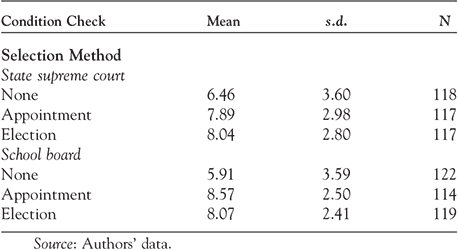
We also acknowledge that our research design raises construct validity concerns. We say this because it is possible that our respondents did not understand the vignettes we presented to them. To minimize construct validity concerns and to ensure that our results are defensible, we conducted manipulation checks. Specifically, we included in each survey a question designed to determine the extent to which each respondent read and correctly interpreted the significant feature of the story to which he/she was exposed (the Appendix includes the survey items we used in our manipulation checks). The significant feature in each vignette was the method by which the fictional Mike Atkinson attained his office. The results of our manipulation checks appear in Table 2. For each group, a mean score of 10 would indicate that all respondents in that group perfectly comprehended the vignette they read, while a score of 1 would indicate that all respondents in that group completely miscomprehended the vignette they read. For example, a mean score of 10 for the state supreme court appointment selection method experimental group would indicate that all respondents in that group answered that they were “very certain” that the vignette they read stated that Mike Atkinson was appointed to the state supreme court (rather than elected). Another way to put this is to say that a score of 10 indicates that the members of this group were all correct and very confident that they were correct that the vignette they read stated that Mike Atkinson was appointed to the state supreme court (rather than elected). A mean score of 1 for this group would indicate that all respondents in that group responded that they were “not certain at all” that the vignette they read stated that Mike Atkinson was appointed to the state supreme court (rather than elected).
Manipulation Check

| Condition Check | Mean | s.d. | N |
|---|---|---|---|
| Selection Method | |||
| State supreme court | |||
| None | 6.46 | 3.60 | 118 |
| Appointment | 7.89 | 2.98 | 117 |
| Election | 8.04 | 2.80 | 117 |
| School board | |||
| None | 5.91 | 3.59 | 122 |
| Appointment | 8.57 | 2.50 | 114 |
| Election | 8.07 | 2.41 | 119 |
Source: Authors’ data.
Table 2 shows that respondents did indeed understand the vignettes. All of the means are above 5, and three of six are above 8. Moreover, a quick check of frequency tables (not shown here) shows that a majority of respondents in all six groups understood the selection method (if there was one) mentioned in their vignette. In short, the data show that vignettes were perceived correctly by our respondents.
Results
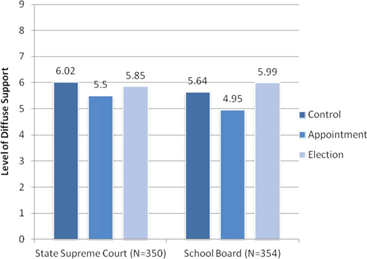
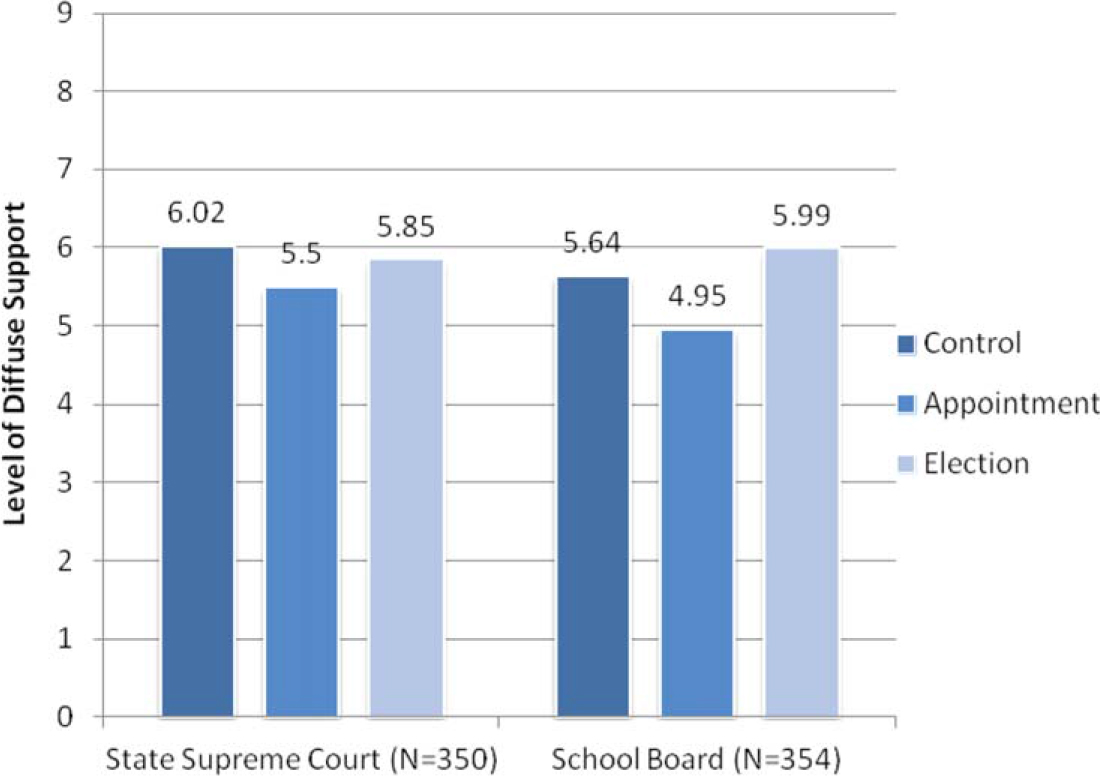
We begin with some summary results. Figure 1 displays the mean diffuse support scores for all six conditions. Though it is a rough gauge to be sure, Figure 1 suggests that selection via election rather than appointment does not decrease diffuse support for either the state supreme court or the school board. We say this because the mean on both Diffuse support for the state supreme court and Diffuse support for the school board is lower for the appointment condition than it is for the election condition.Footnote 8 The most important and obvious preliminary takeaway from Figure 1 is that selection via appointment may decrease diffuse support for both the state supreme court and the school board. For respondents in both the state supreme court group and the school board group, the mean diffuse support score is lowest in the appointment subgroup.
The Impact of Selection Method on Perceptions of School Board and State Supreme Court Legitimacy: Mean Diffuse Support Scores by Experimental Group and Institution
Notes: The range for each diffuse support variable is 0–9. Higher values mean more diffuse support. For the state supreme court group, a difference of means test (specifically, a Bonferroni multiple comparison test) indicates the following: (1) the difference of means between the appointment group and control group is statistically significant (p=.05, one‐tailed test) and (2) the difference of means between the appointment group and the election group is statistically significant (p=.001, two‐tailed test). There are no statistically significant differences of means in the school board group.
Source: Authors’ data.
OLS Models of Perceptions of Legitimacy
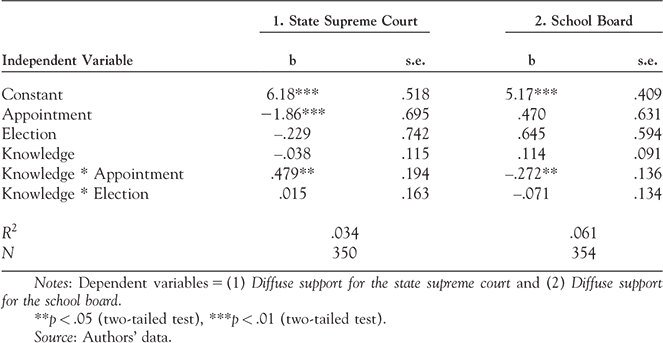
While these preliminary findings are intriguing, they tell us little in isolation. The best way to explore the relationship between selection method and diffuse support for the two institutions we study is to cast two multivariate, OLS regression models. The results of this exercise appear in Table 3. In Model 1, the dependent variable is Diffuse support for the state supreme court. To determine the effect of selection method, we included two independent variables in the model—Appointment and Election. Each of these is a dummy variable for which a respondent who read a vignette referring to that method of selection was assigned a value of 1, and a respondent who did not was assigned a value of 0. The excluded category for our selection method manipulation is the “no selection method information” category. In Model 2, the dependent variable is Diffuse support for the school board. Model 2 also contains Appointment and Election as independent variables.
OLS Regression Results of the Effect of Selection Method on Institutional Legitimacy

| 1. State Supreme Court | 2. School Board | |||
|---|---|---|---|---|
| Independent Variable | b | s.e. | b | s.e. |
| Constant | 6.18*** | .518 | 5.17*** | .409 |
| Appointment | −1.86*** | .695 | .470 | .631 |
| Election | –.229 | .742 | .645 | .594 |
| Knowledge | –.038 | .115 | .114 | .091 |
| Knowledge * Appointment | .479*** | .194 | –.272*** | .136 |
| Knowledge * Election | .015 | .163 | –.071 | .134 |
| R 2 | .034 | .061 | ||
| N | 350 | 354 | ||
Notes: Dependent variables=(1) Diffuse support for the state supreme court and (2) Diffuse support for the school board.
** p<.05 (two‐tailed test),
*** p<.01 (two‐tailed test).
Source: Authors’ data.
Following research on the effects of new information and awareness on political attitudes and opinion (especially Zaller Reference Zaller1992), we seek to control for the effects of political knowledge. Specifically, we include three additional variables in each OLS model. First, there is Knowledge. Knowledge is a count variable whose values range from 0–6. Each respondent is scored based on the number of political knowledge questions out of six total questions that he/she answers correctly. The six questions used to create this variable are found in the Appendix. In addition, we include two interaction variables: (1) Knowledge * Appointment and (2) Knowledge * Election. These variables allow us to determine how political knowledge conditions the effects of the selection method information we provide respondents. Specific to this study, we must consider that citizens potentially have some knowledge of how judges are elected prior to reading the experimental vignette. To account for this potential reality, we include the interactive variables to control for political knowledge.
How might political knowledge affect perceptions of legitimacy? Wenzel, Bowler, and Lanoue (Reference Wenzel, Bowler and Lanoue2003) found that, overall, method of judicial selection was not related to public confidence in state courts. There was one exception, however: the most educated of citizens report less support for appointment systems. We account for this possibility. Gartner (Reference Gartner2008) also suggests that political knowledge affects levels of support for government institutions, and thus we expect respondents with relatively low levels of political knowledge to be affected more profoundly by the new information we provide than will respondents with high levels of political knowledge (see also Gibson, Caldera, and Spence 2003).
The results of our multivariate analyses are found in Table 3. We first look at the estimates on Election. In Model 1, the unstandardized coefficient on Election is negative, which hints that reading the election vignette decreases diffuse support for the state supreme court. In Model 2, the unstandardized coefficient on Election is positive, which suggests that reading the election vignette increases diffuse support for the school board. In neither case, however, is the coefficient on Election statistically significant, so we cannot safely conclude that reading the election vignette had any impact on diffuse support for either institution.
To arrive at a complete and accurate picture of how the election treatment affects levels of support for each institution, however, we cannot just look at the coefficient on Election; we must take a closer look at the interaction variable Knowledge * Election. We do not present the full results of these analyses here, but they indicate that the election treatment never affects levels of diffuse support for either the state supreme court or the school board. In other words, at all knowledge levels, exposure to the election treatment has no impact whatsoever on diffuse support for either the state supreme court or the local school board.Footnote 9
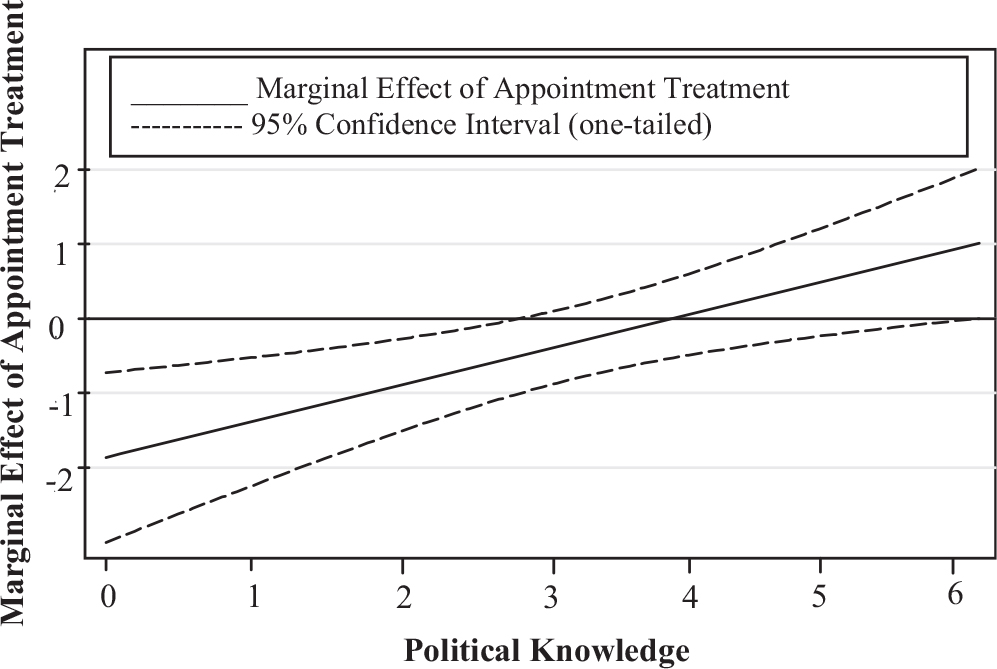
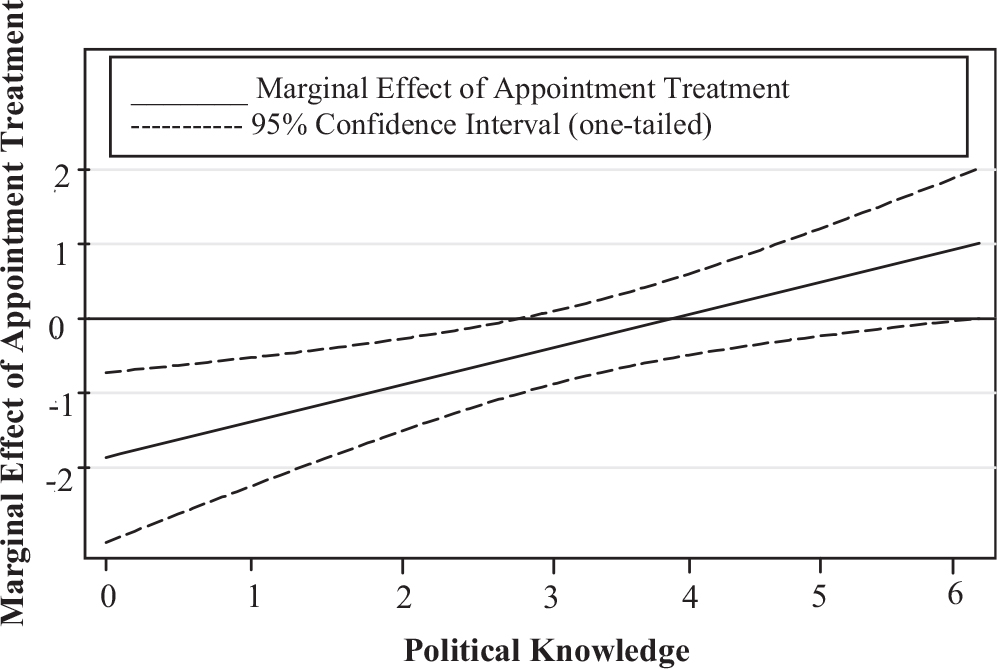
We turn next to our appointment variable. In Model 1, the coefficient on Appointment is large, negative, and statistically significant (p=.008, two‐tailed test). This indicates that information about Mike Atkinson being appointed to the state supreme court had a profound impact on exposed respondents’ diffuse support for the state high court. It is impossible, however, to determine the exact nature of this impact without taking a closer look at the interaction term Knowledge * Appointment. The coefficient on Appointment in Model 1 (−1.86) represents the appointment treatment effect for respondents who scored 0 on our knowledge variable. In other words, our results show that for the least informed respondents in our state supreme court group, information about Mike Atkinson being appointed to his position was associated with substantially lower diffuse support scores for the state high court. To demonstrate the impact of the appointment treatment fully, we produced Figure 2. The solid sloping line in Figure 2 shows how the appointment treatment affected values on Diffuse support for the state supreme court at different levels of political knowledge. The 95 percent (one‐tailed test) confidence intervals around the line show that for respondents with levels of knowledge of 0, 1, and 2, exposure to the appointment treatment had a negative impact on diffuse support for the state supreme court. This effect, however, diminishes as levels of political knowledge increase, and disappears once level of political knowledge hits 3. Interestingly, Figure 2 also shows that exposure to the appointment treatment also affects respondents with the highest level of political knowledge. Specifically, the 95 percent confidence intervals show that for respondents with a level of knowledge of 6, exposure to the appointment treatment had a positive impact on diffuse support for the state supreme court. We have more to say about this later.
Marginal Effect of Appointment Treatment on Diffuse Support for the State Supreme Court as Level of Political Knowledge Changes
Source: Authors’ data.
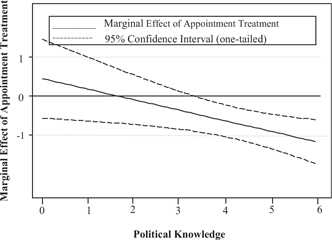
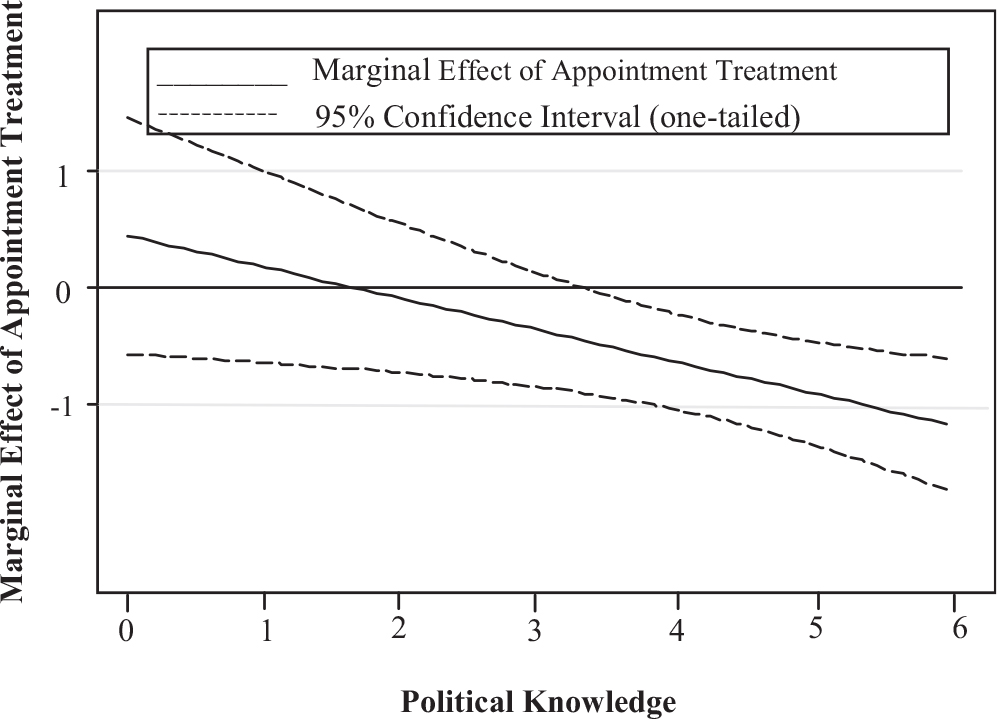
The school board model yields a coefficient on Appointment that is not significant. However, the coefficient on Knowledge * Appointment is statistically significant, so we must further investigate the relationship between the appointment treatment and level of diffuse support for the school board. To demonstrate the impact of the appointment treatment on respondents in the school board group more fully, we produced Figure 3. The solid sloping line shows how the appointment treatment affected values on Diffuse support for the school board at different levels of political knowledge. The 95 percent (one‐tailed test) confidence intervals around the line show that for respondents who score 4, 5, and 6 on our political knowledge variable, exposure to the appointment treatment had a strong negative impact on diffuse support for the school board. The effect of the treatment increases with level of political knowledge, and is at its maximum at the highest level of knowledge.
Marginal Effect of Appointment Treatment on Diffuse Support for School Board as Level of Political Knowledge Changes
Source: Authors’ data.
Logit Models of Perceptions of Legitimacy
One additional way to address the question at hand is to determine which selection method leads to the lowest levels of diffuse support for the two institutions we study. If judicial legitimacy is threatened by low levels of diffuse support for the judiciary, it seems to us that it is especially threatened if people express rock‐bottom levels of diffuse support. In other words, we believe that it is when the public at large has truly abysmal views of the judiciary that its legitimacy most realistically might be threatened. Thus, we believe it is appropriate and important to determine what pushes people to virtually lose faith entirely in an institution. To do this, we created two new dichotomous variables: Lowest level of support for the state supreme court and Lowest level of support for the school board. For the first variable, we assigned respondents who scored a 0, 1, or 2 on Diffuse support for the state supreme court a value of 1, and respondents who scored 3–9 a value of 0. For the second variable, we assigned respondents who scored 0, 1, or 2 on Diffuse support for the school board a value of 1, and respondents who scored 3–9 a value of 0. From here, we cast two logistic regression models—a state supreme court model and a school board model—in which the dichotomous variables we describe above were the dependent variables. Each model contains the same set of variables included in Models 1 and 2 in Table 3.
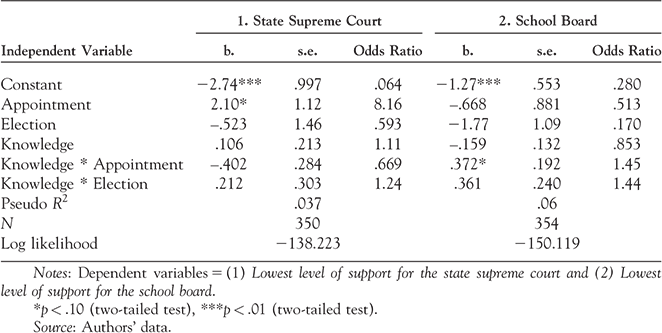
Table 4 shows the results of two models, one for each institution. The results of Model 1 show very clearly that exposure to information about Mike Atkinson being appointed to the state supreme court significantly increases a respondent's odds of expressing the lowest levels of support for the state supreme court. We reach this conclusion on the basis of the large, positive, and significant coefficient on Appointment (p=.06, two‐tailed test), as well as the large accompanying odds ratio. Further analyses show that exposure to the appointment treatment increases the odds of being in the lowest diffuse support group for respondents who score 0, 1, 2, or 3 (p<.05, two‐tailed test) on our political knowledge variable. To learn a little bit more about the effects of the appointment treatment, we used Clarify to elucidate the relationship between exposure to the appointment treatment and the probability that a respondent will express a very low level of support for the state supreme court (Tomz, Wittenberg, and King Reference Tomz, Wittenberg and King2003). We found that the probability of someone scoring a 1 on Lowest level of support for the state supreme court is .097 for a respondent in the election treatment group with a knowledge level of 3. This probability for a respondent in the appointment treatment group is .181. For a respondent with no political knowledge in the election group, the probability of scoring a 1 on Lowest level of support for the state supreme court is .059. That probability rises to .354 for a respondent in the appointment group. In short, for many people, being exposed to information about judges being appointed substantially increases the odds of expressing severely negative views of the state supreme court.
Logistic Regression Results of the Effect of Selection Method on Lowest Level of Support for Institution

| 1. State Supreme Court | 2. School Board | |||||
|---|---|---|---|---|---|---|
| Independent Variable | b. | s.e. | Odds Ratio | b. | s.e. | Odds Ratio |
| Constant | −2.74*** | .997 | .064 | −1.27*** | .553 | .280 |
| Appointment | 2.10* | 1.12 | 8.16 | –.668 | .881 | .513 |
| Election | –.523 | 1.46 | .593 | −1.77 | 1.09 | .170 |
| Knowledge | .106 | .213 | 1.11 | –.159 | .132 | .853 |
| Knowledge * Appointment | –.402 | .284 | .669 | .372* | .192 | 1.45 |
| Knowledge * Election | .212 | .303 | 1.24 | .361 | .240 | 1.44 |
| Pseudo R 2 | .037 | .06 | ||||
| N | 350 | 354 | ||||
| Log likelihood | −138.223 | −150.119 | ||||
Notes: Dependent variables=(1) Lowest level of support for the state supreme court and (2) Lowest level of support for the school board.
* p<.10 (two‐tailed test),
*** p<.01 (two‐tailed test).
Source: Authors’ data.
The coefficient on Election in Model 1 is negative, which hints that being exposed to election information decreases a respondent's probability of expressing very low levels of support for the state supreme court. However, the coefficient is not statistically significant, and further analyses indicate that exposure to the election vignette has no impact on a respondent's probability of scoring a 1 on Lowest level of diffuse support for the state supreme court.
Turning to Model 2—the school board model—the results hint at the possibility that exposure to information about Mike Atkinson being appointed significantly increases some respondents’ odds of expressing the lowest levels of support for the school board. We reach this conclusion on the basis of the positive and statistically significant coefficient on Knowledge * Appointment (p=.052, two‐tailed test). Further analyses show that exposure to the appointment treatment increases the odds of being in the lowest diffuse support for the school board group for respondents who score 4, 5, and 6 (p<.05, two‐tailed test) on our political knowledge variable. Again, to learn a little bit more about the effects of the appointment treatment, we used Clarify to elucidate the relationship between exposure to the appointment treatment and the probability that a respondent will express a very low level of support for the school board (Tomz, Wittenberg, and King Reference Tomz, Wittenberg and King2003). We found that the probability of someone scoring a 1 on Lowest level of support for the school board is .099 for a respondent in the election treatment group with a knowledge level of 4. This probability for a respondent in the appointment treatment group is .255. For a respondent with the highest level of political knowledge in the election group, the probability of scoring a 1 on Lowest level of support for the school board is .147. That probability rises to .340 for a respondent in the appointment group. In sum, for many people, being exposed to information about school board members being appointed substantially increases the odds of expressing severely negative views of the institution.
The coefficient on Election in Model 2 is not statistically significant, and further analyses indicate that exposure to the election vignette has no impact on a respondent's probability of scoring a 1 on Lowest level of diffuse support for the school board.
Discussion
Our empirical results lead us to a number of conclusions. Two of the most important are these: (1) elections appear to have no direct impact on respondents’ perceptions of state supreme court legitimacy, and (2) elections appear to have very little direct impact on respondents’ perceptions of school board legitimacy. Thus, our findings lead us to conclude that the existence of an election as a selection method does not directly affect levels of diffuse support for the judiciary one way or another. Similarly, the existence of an election as a selection method for school board members has no direct impact on perceptions of school board legitimacy.
Our findings on the impact of appointment as a selection method on perceptions of legitimacy for the two institutions we study are more obvious and substantial. They are also more abstruse. In general, our data show that for many (but not all) people, the appointment of public officials to positions of authority decreases perceptions of institutional legitimacy. Specifically, for people with very low levels of political knowledge, learning that members of the state supreme court are appointed negatively affects perceptions of state supreme court legitimacy. For these low‐information voters, being exposed to news that state supreme court justices are appointed also substantially increases the probability of bottoming out on support for the judiciary. Our findings on the effects of appointment as a selection method for school board members also uncover what we call negative appointment effects. Knowledge, however, conditions these effects differently. Specifically, our results show that for people with high levels of political knowledge, learning that members of the local school board are appointed negatively affects perceptions of school board legitimacy.
These findings beg several questions. The first is this: Why, for low‐knowledge individuals, might information about state supreme court justices being appointed rather than elected lead to lowered perceptions of legitimacy? The answer probably lies in the positivity bias identified in previous studies (Gibson, Caldeira, and Spence 2003, Reference Gibson, Caldeira and Kenyatta Spence2005). People with higher levels of political knowledge, the argument goes, probably see courts as unique among government institutions for their objectivity, legitimacy, and lack of politicization. Thus, high‐information voters are not troubled to learn that judges are appointed rather than elected. People with lower levels of political knowledge, in contrast, probably see courts as similar to other political institutions, and thus are troubled to learn that judges are not chosen by voters (as are most public officials with whom they are familiar). This explanation for our findings is bolstered by our unexpected finding of a positive appointment effect on state supreme court legitimacy among our highest‐knowledge respondents. There may be something else at work here. It is possible that people with high levels of political knowledge know that all federal judges are appointed and that state judges in many states also are appointed, and thus see appointment as the normal order of things, and thus are untroubled by it (and, in fact, may be pleased about it). We say more about this later.
Our finding of a negative appointment effect begs an additional question: Why, for high‐knowledge individuals, might information about school board members being appointed rather than elected lead to decreased perceptions of legitimacy? While low‐knowledge individuals respond badly to information about state supreme court appointments, high‐knowledge individuals respond badly to information about school board appointments. Why is this the case? This finding is probably not the result of any positivity bias. Rather, it is probably related to the second explanation we pose above—a normal order of things explanation. Specifically, high‐knowledge citizens believe (and are correct) that in most places school board members are elected rather than appointed; in other words, elections constitute the normal order of things when it comes to school board member selection. Learning that this normal order of things has been violated in the case of Mike Atkinson may offend some people.
Conclusion
Does electing state supreme court justices negatively affect levels of diffuse support for the state supreme court? Our findings suggest that the answer to this question is “No.” In fact, our experimental results suggest that for most people, appointing state high court justices negatively affects levels of diffuse support for the state supreme court. Our results also suggest that appointing school board members negatively affects levels of diffuse support for the school board. In all, our results suggest that, ceteris paribus, most citizens prefer that their government officials—be they state supreme court justices or members of the school board—are chosen in elections rather than via appointment. Are courts different from other institutions when it comes to the effects of selection method? Again, our results indicate that the answer is “No.” Our experimental results suggest that elections have no impact whatsoever on perceptions of institutional legitimacy. But this is only half of the story. In real life, states choose between elections and appointment (though methods of appointment, of course, vary). Our results show that choosing elections does not directly enhance perceptions of institutional legitimacy. Indirectly, however, choosing elections helps because it means not choosing appointment, which does directly degrade perceptions of institutional legitimacy.
Overall, our results supplement and support a great deal of previous work on judicial legitimacy (including Bonneau and Hall 2009; Gibson Reference Gibson2012). We show that elections as selection mechanisms for judges do not diminish perceptions of judicial legitimacy, and indirectly even enhance them. Moreover, our findings suggest that previous research about the negative effects of campaign contributions on state court legitimacy are less troublesome than they might appear because state courts receive an election legitimacy boost by choosing their high court judges in elections rather than via appointment. Thus, the decrease in legitimacy due to campaign contributions may be balanced (if not offset) by the mere existence of elections. Finally, our comparative analyses suggest that most citizens view elections as the best way to choose public officials, no matter the office. Like Gibson, we find that citizens do not view the judiciary as somehow different than the other branches of government. In short, citizen perceptions of institutional legitimacy are enhanced by elections no matter which institution we are talking about. Of course, our results in no way undercut the conclusions of critics of judicial elections that elections lead to undesirable judicial behavior. In fact, they do not address such conclusions at all. Addressing this issue requires an entirely different research design.
In closing, we wish to consider briefly where our findings fit into the larger research on judicial legitimacy. Our results provide support for the notion (offered by Gibson and his colleagues, and by Bonneau and Hall) that judicial elections are not bad for perceptions of judicial legitimacy. This is in and of itself is useful. Our results are especially valuable, however, because they flow from a novel research design. We are aware of no previous studies that consider the effects on perceptions of judicial legitimacy of the mere existence of elections (rather than appointment) as a method of judicial selection (rather than either the effects of specific aspects of elections or the ability of voters to make reasonable choices in judicial elections). We submit that our results enhance our understanding of institutional legitimacy by showing that elections in and of themselves, quite separate from the specific aspects of any particular type of election, actively enhance judicial legitimacy by preempting the use of appointment as a selection method.
Why is the insight that elections as selection mechanisms indirectly enhance perceptions of judicial legitimacy important? We have several answers to this question. First, our results are important because many judicial elections are low‐information, low‐salience, low‐attention affairs. This means that in many (if not most) judicial elections, citizens are not even aware of the specific aspects of ongoing judicial election campaigns. Many citizens are not, for example, exposed to campaign commercials or candidates’ public statements. If there is one thing that citizens are likely to know about an in‐progress judicial election, it is that an election is occurring. And this is good for perceptions of judicial legitimacy. Second, our findings complement those of previous studies by putting their findings in context. Previous studies clearly show that some aspects of elections damage perceptions of judicial legitimacy, but because elections themselves do not have the legitimacy‐decreasing effects of appointments, this finding is less troubling than it might otherwise be. Finally, our findings complement those of previous studies by explicitly showing a negative appointment effect. All of the findings on the effects of elections on public perceptions of legitimacy tell only half the story. In the real world, states do not choose between elections and nothing; they choose between elections and appointment. And in choosing appointment over elections, states actively decrease perceptions of judicial legitimacy.
Appendix
In this appendix, we will say more about our manipulation checks, and how we created our political knowledge variable.
A. Manipulation Checks
Here are the three items included in the state supreme court surveys:
-
1. Before you began this survey, you were shown a short news story about Mike Atkinson joining the state supreme court. Using the scale below, where 1 indicates you are not certain at all, and 10 means you are very certain, how certain are you that the story did not indicate how Mike Atkinson obtained his position on the state supreme court (that is, whether he was appointed or elected)?
-
2. Before you began this survey, you were shown a short news story about Mike Atkinson joining the state supreme court. Using the scale below, where 1 indicates you are not certain at all, and 10 means you are very certain, how certain are you that the story indicated that Mike Atkinson was appointed to the state supreme court (rather than elected)?
-
3. Before you began this survey, you were shown a short news story about Mike Atkinson joining the state supreme court. Using the scale below, where 1 indicates you are not certain at all, and 10 means you are very certain, how certain are you that the story indicated that Mike Atkinson was elected to the state supreme court (rather than appointed)?
Here are the three items included in the school board surveys:
-
1. Before you began this survey, you were shown a short news story about Mike Atkinson joining the school board. Using the scale below, where 1 indicates you are not certain at all, and 10 means you are very certain, how certain are you that the story did not indicate how Mike Atkinson obtained his position on the school board (that is, whether he was appointed or elected)?
-
2. Before you began this survey, you were shown a short news story about Mike Atkinson joining the school board. Using the scale below, where 1 indicates you are not certain at all, and 10 means you are very certain, how certain are you that the story indicated that Mike Atkinson was appointed to the school board (rather than elected)?
-
3. Before you began this survey, you were shown a short news story about Mike Atkinson joining the local school board. Using the scale below, where 1 indicates you are not certain at all, and 10 means you are very certain, how certain are you that the story indicated that Mike Atkinson was elected to the school board (rather than appointed)?
Each of these six survey items was followed by the following response set:

| 1 | 2 | 3 | 4 | 5 | 6 | 7 | 8 | 9 | 10 |
| Not certain at all | Very certain | ||||||||
B. Political Knowledge
Here are the six political knowledge questions we used to create Knowledge:
-
1. Do you happen to know what political office is now held by Joe Biden?
-
2. Whose responsibility is it to determine if a law is constitutional or not?
-
3. How much of a majority is required for the US Senate and House to override a presidential veto?
-
4. Do you happen to know what party has the most members in the US House of Representatives?
-
5. Which of the parties would you say is more conservative than the other at the national level?
-
6. How many justices (judges) are there on the US Supreme Court?