In Western societies, there has been a dramatic increase in the prevalence of eating disorders (EDs) (Smink, van Hoeken, & Hoek, Reference Smink, van Hoeken and Hoek2012). A classical study in Spain showed that 4.7% of the girls and 0.9% of the boys from a representative sample of 1314 adolescents with a mean age of 15.05 years had EDs (Morandé, Celada, & Casas, Reference Morandé, Celada and Casas1999). A subsequent study indicated a significant increase in the prevalence of EDs (Ruiz-Lázaro, Alonso, Comet, Lobo, & Velilla, Reference Ruiz-Lázaro, Alonso, Comet, Lobo, Velilla and Swain2005): from a representative sample of adolescents between the ages of 12 and 18 years, 16.32% of the girls and 3.3% of the boys were at high risk of developing an ED. A couple of years later, a new epidemiological study conducted with 1545 Spanish students (12 to 21 years old) showed lower rates, specifically the prevalence of EDs was 3.43% overall, 5.34% for females and 2.72% for males (Peláez-Fernández, Labrador, & Raich, Reference Peláez-Fernández, Labrador and Raich2007). More recently, the prevalence rates of EDs in Spain were found to lie between 4.1 and 6.41% (Ministerio de Sanidad y Consumo, 2009).
EDs are a health problem that has very negative consequences not only for patients but also for their family caregivers (Hillege, Beale, & McMaster, Reference Hillege, Beale and McMaster2006). Notably, caring for a person with an ED entails dealing with a range of challenges associated with the care context every day. This situation, considered a chronic stress, leads to diverse negative consequences for caregivers’ health and quality of life (Schulz & Sherwood, Reference Schulz and Sherwood2008). Similar to informal caregivers of other disorders, caregivers of people with EDs have been reported to have higher levels of burden and negative health outcomes (Zabala, Macdonald, & Treasure, Reference Zabala, Macdonald and Treasure2009). In particular, they suffer from serious mental problems, and lower general quality of life (Kyriacou, Treasure, & Schmidt, Reference Kyriacou, Treasure and Schmidt2008; Martin et al., Reference Martín, Padierna, Aguirre, Quintana, Hayas and Muños2011; Whitney, Haigh, Weinman, & Treasure, Reference Whitney, Haigh, Weinman and Treasure2007). Specifically, in most studies, caregivers have shown higher rates of anxiety and depression, reaching clinical cut-offs in some cases (Anastasiadou, Medina-Pradas, Sepulveda, & Treasure, Reference Anastasiadou, Medina-Pradas, Sepulveda and Treasure2014; Orive et al., Reference Orive, Padierna, Martin, Aguirre, González, Muñoz and Quintana2013). In line with this, in research evaluating the quality of life of caregivers, the most affected domains are those related to mental disturbances (Anastasiadou et al., Reference Anastasiadou, Medina-Pradas, Sepulveda and Treasure2014).
As noted, caregivers are chronically exposed to a high level of stress daily, and such stress has been associated with alterations in body homeostasis, increasing health disturbances (McEwen, Reference McEwen1998). In this regard, the autonomic nervous system (ANS) is one of the main systems involved in maintaining body homeostasis when dealing with stress through the processes of allostasis (McEwen & Wingfield, Reference McEwen and Wingfield2003). As has been previously described, both over- and under- activation of such processes could be detrimental to the body (McEwen, Reference McEwen1998; McEwen & Wingfield, Reference McEwen and Wingfield2003). Hence, the analysis of ANS functioning may be especially relevant in people under chronic stress, such as caregivers. In particular, improving our understanding of the functioning of the ANS in this population could help elucidate the pathophysiological basis of health problems exhibited by some family caregivers of people with EDs (de la Rie, van Furth, De Koning, Noordenbos, & Donker, Reference de la Rie, van furth, De Koning, Noordenbos and Donker2005; Sepúlveda et al., Reference Sepúlveda, Graell, Berbel, Anastasiadou, Botella, Carrobles and Morandé2012; Zabala et al., Reference Zabala, Macdonald and Treasure2009). One of the most widely studied markers of the functioning of sympathetic branch of ANS is electrodermal activity (EDA), which can be analyzed in terms of two components: tonic EDA, skin conductance level (SCL), and phasic EDA, non-specific skin conductance responses (NSCRs) (Boucsein, Reference Boucsein2012).
Few studies have evaluated EDA during acute stress in family caregivers, and in those which have, results have been mixed (Gonçalves & Graça, Reference Gonçalves and Graça2011; Ruiz-Robledillo & Moya-Albiol, Reference Ruiz-Robledillo and Moya-Albiol2015; Soares, Reference Soares2009). While caregivers of people with cancer have shown higher SCLs in response to emotional stimuli (Gonçalves & Graça, Reference Gonçalves and Graça2011), no significant differences were found considering caregivers of people with drug addiction (Soares, Reference Soares2009), both studies comparing with a control group of non-caregivers. On the other hand, caregivers of people with autism spectrum disorder (ASD) showed lower SCLs during acute stress than a control group (Ruiz-Robledillo & Moya-Albiol, Reference Ruiz-Robledillo and Moya-Albiol2015). Furthermore, in this last study, caregivers also had weaker psychological responses to stress. These discrepancies could be due to the different stimuli applied, emotional pictures being used as a stimulus in the studies of caregivers of people with cancer and drug addiction (Gonçalves & Graça, Reference Gonçalves and Graça2011; Soares, Reference Soares2009) and cognitive stressors in the study of caregivers of people with ASD (Ruiz-Robledillo & Moya-Albiol, Reference Ruiz-Robledillo and Moya-Albiol2015). Moreover, although chronic stress from caregiving has generally been associated with similar physiological alterations and health disturbances, the specific diagnosis of the care recipient could have a significant influence on these negative consequences. In particular, in the case of caregivers of people with EDs, it has previously been found that they present high levels of worrying, burden and poorer health status than caregivers of people with schizophrenia (Martín et al., Reference Martín, Padierna, van Wijngaarden, Aguirre, Anton, Muñoz and Quintana2015; Treasure et al., Reference Treasure, Murphy, Szmukler, Todd, Gavan and Joyce2001). Moreover, differences have been found when caregivers of people with different disorders in the ED spectrum have been compared (Graap et al., Reference Graap, Bleich, Herbst, Tristmann, Wancata and de Zwaan2008; Santonastaso, Saccon, & Favaro, Reference Santonastaso, Saccon and Favaro1997). Caregivers of people with anorexia nervosa (AN) suffer from higher levels of burden, strain, and problems related to relapses and crises, as well as showing a greater need for intervention than caregivers of people with bulimia nervosa (Graap et al., Reference Graap, Bleich, Herbst, Tristmann, Wancata and de Zwaan2008; Santonastaso et al., Reference Santonastaso, Saccon and Favaro1997).
To the best of our knowledge, no previous studies have evaluated electrodermal reactivity to acute laboratory-induced stress in family caregivers of people with EDs. The main aim of this study was to evaluate both components of EDA (SCLs and NSCRs) and psychological responses (changes in mood state from pre- to post-stress) in relation to an acute stressor in parents of people with EDs (caregivers) and in a control group of parents of healthy individuals (non-caregivers). Based on previous research, we expected to find lower SCLs, NSCRs and psychological responses to stress in caregivers than non-caregivers (Ruiz-Robledillo & Moya-Albiol, Reference Ruiz-Robledillo and Moya-Albiol2015).
Methods
Participants
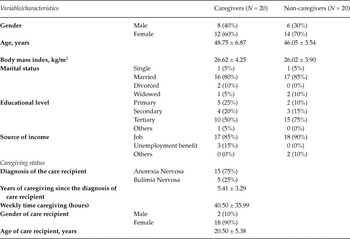
The sample was composed of 40 participants: 20 caregivers (48.75 ± 6.87 years) (parents of individuals with EDs, 12 women and 8 men) and 20 non-caregivers (46.05 ± 3.54 years) (parents of healthy offspring, 14 women and 6 men). Caregivers were recruited from a centre in Valencia (Spain) specialized in the treatment of people with EDs. Care recipients were clinically diagnosed with an ED (15 with anorexia nervosa and 5 with bulimia nervosa) by clinical staff following the DSM-IV-TR criteria. The mean age of care recipients was 20 ± 5.38 years and the majority were female (n = 18).
Firstly, meetings were held to explain the aim of the research and the inclusion criteria. To be eligible for the caregiver group, individuals had to be parent of an individual with a diagnosed ED, be their primary caregiver, and have lived in the same home as them for at least two years before the study. An interview was programmed for the parents selected who wished to participate in the study. The non-caregiver group was composed of parents of healthy offspring who had not provided special care for any ill relative for at least two years before the start of the experiment. This group was recruited using advertisements, as well as by word of mouth. Participation was voluntary, all parents in both groups signing an informed consent that followed ethical norms for research involving humans (Helsinki Declaration), and approval was obtained from the local ethics committee.
Procedure
Participants were instructed to abstain from eating, drinking stimulants, or smoking during the 2-hour period before arriving at the laboratory. The experimental procedure was performed between 4:00 and 7:00 p.m., and each session lasted approximately 2.5 hours. When participants arrived, the anthropometric variables (age, weight, and height) were measured and compliance with the instructions was confirmed. They were then conducted to another room, the stress laboratory, which had a constant level of light and was sound-attenuated and temperature-regulated (21 ± 2 °C) during all sessions. Electrodes were attached and participants were encouraged to make themselves comfortable and relax. After a few minutes of habituation, participants completed a psychological questionnaire for the evaluation of mood state (pre-stress mood) and, immediately afterwards, Baseline signals were recorded for 10 minutes. Then, general information regarding the stress stimuli and the evaluation of their performance during the Stressor was provided to the participants. After this Instruction period (2 minutes), the Anticipatory period began (5 minutes), during which participants remained silent. When the Anticipatory period finished, participants were exposed to a psychosocial Stressor consisting of a session lasting 20 minutes in front of a committee of two men and three women performing a set of cognitive tasks (Stroop test, mirror-drawing test and arithmetic tasks). Physiological measurements continued to be recorded during a 10-minute Recovery period (immediately following completion of the Stressor). When participants had completed questionnaires for the evaluation of post-stress mood, they returned to the first room. Finally, the participants were interviewed to collect data on socio-demographic characteristics. In the case of caregivers, the researchers also conducted an interview at this stage regarding the characteristics of the care recipient and the status of the caregiver.
Psychosocial stressor
The stressor was an adapted version of the Trier Social Stress Task, a standardized protocol for the induction of moderate psychosocial stress in laboratory settings (Kirschbaum, Pirke, & Hellhammer, Reference Kirschbaum, Pirke and Hellhammer1993). During the stress period, a video camera was switched on to heighten the evaluative threat by simulating a recording, as suggested in previous studies (Dickerson & Kemeny, Reference Dickerson and Kemeny2004). To avoid generating expectations in the participants regarding the results obtained during the tasks, there was no outcome related to the stressor, and any information regarding performance was given to the participants after the stress period had finished.
Psychological Responses
Psychological responses (changes in mood state from pre- to-post stress) were evaluated using the abbreviated version of Profile of Mood States (POMS), developed by Fuentes, Balaguer, Meliá, and García-Merita (Reference Fuentes, Balaguer, Meliá, García-Merita and Cantón1995). This version is composed of 29 items which correspond to adjectives that can be used to describe feelings and these are rated on a 5-point scale in response to the question ‘How are you feeling right now?’ Items are grouped into five subscales: tension (e.g., tense, nervous), depression (e.g., sad, unhappy), anger (e.g., angry, bad-tempered), vigor (e.g., lively, energetic), and fatigue (e.g., fatigued, exhausted). A total score was also calculated by summing scores on all subscales, subtracting the vigor scale score and adding a constant of 100. The higher the total score, the worse the mood. Cronbach’s alpha of this instrument in the present study was .92.
Electrophysiological recording
Following the guidelines of the Society of Psychophysiological Research (Society for Psychophysiological Research Ad Hoc Committee on Electrodermal Measures, 2012), two Ag/AgCl electrodes (TSD203) with a 6-mm diameter contact area were used to measure the SCL. Adhesive collars were used to hold the electrodes on the middle phalanges of the fore and ring fingers on the non-dominant hand. Hypoallergenic gel was used as a contact medium between the skin and electrode. A skin conductance module (GSR100C) amplified the electrical signal with a constant voltage of less than 0.5 volts. The SCL module was a part of a physiological recording system composed of 16 modules (BIOPAC Systems, Inc, Santa Barbara, CA. 93117). This system was connected to a signal pre-amplifier using a UIM100C (Universal Interface Module) and, in turn, to a computer equipped with data acquisition hardware (MP150) and data acquisition and analysis software (AcqKnowledge 4.2 for Windows).
Data reduction and analysis
The physiological recording system recorded data for each variable at sample rate of 1000 Hz. As the duration of each period was different and could vary somewhat from one individual to another, Acqknowledge software was used to obtain means for the Baseline, Instruction, Anticipatory, Stressor, and Recovery periods. SCL was expressed in microSiemens (μS). Any artefact-free changes in SCL greater than or equal to than 0.05 μS and within a 1.0– to 3.0-s latency window were considered NSCRs.
Repeated measures ANOVAs were performed with ‘period’ (Baseline, Instruction, Anticipatory, Stressor, and Recovery) as the within-subject factor and ‘group’ (caregivers and non-caregivers) as the between-subject factor for EDA (SCL and NSCRs). Greenhouse-Geisser corrections for degrees of freedom were applied. For psychological responses, ANOVAs for repeated measurements (pre-stressor and post-stressor) were used with ‘period’ as the within-subject factor and ‘group’ as the between-subject factor. Bonferroni corrections for multiple comparisons were applied when a significant interaction effect was found in ANOVAs. Change scores in psychological responses were obtained as the difference between post-stressor and pre-stressor scores. In order to analyze the magnitude of the SCL wave over the whole stress protocol, the area under the curve (AUC) was calculated following the trapezoidal rule (Kudielka, Buske-Kirschbaum, Hellhammer, & Kirschbaum, Reference Kudielka, Buske-Kirschbaum, Hellhammer and Kirschbaum2004; Ruiz-Robledillo & Moya-Albiol, Reference Ruiz-Robledillo and Moya-Albiol2015). The total AUC of the SCL was calculated for all periods evaluated (Baseline, Instruction, Anticipatory, Stressor and Recovery). The partial AUC of the stressor was calculated to analyze the magnitude of the SCL increases from Baseline to the Stressor period. Similarly, the partial anticipatory AUC of the SCL was calculated as the increase in SCL from Baseline to the Anticipatory period. All statistical analyses were performed with SPSS 21.0 for Windows. The alpha level was set at .05. Data is expressed as mean + SD.
Results
Sample characterization
Groups did not differ in age, body mass index, marital status, educational level or source of income. Anthropometric and socio-demographic variables (mean ± SD) for caregivers and non-caregivers are summarized in Table 1.
Anthropometric and socio-demographic variables in caregivers and non-caregivers (M ± SD)

Was the stressor effective for eliciting changes in EDA and psychological responses in caregivers and non-caregivers?
To analyze the effectiveness of the stressor in eliciting changes in EDA and psychological responses in each group, components of both variables were analysed separately for caregivers and non-caregivers.
In the case of EDA, the effect of ‘period’ was significant for both SCL and NSCRs in caregivers, F(2.427, 46.118) = 19.954, p < .0001, η2partial = .512 and, F(2.958, 56.208) = 17.987, p < .0001, η2partial = .486, respectively. There was an increase from Baseline to the other periods, with the SCL being significantly higher during the Stressor period than all the other periods (for all p < .01). Regarding NSCRs, caregivers had a lower frequency of responses at Baseline than any of the other periods (p < .05).
In the case of non-caregivers, period was also found to be significant for SCL and NSCRs, F(1.462, 27.777) = 17.837, p < .0001, η2partial = .484 and, F(2.548, 48.409) = 24.887, p < .0001, η2partial = .567, respectively. For SCL, the same pattern of differences between periods was found as that described in the caregivers (p < .01). For NSCRs, non-caregivers presented a lower frequency of responses at Baseline than in all of the other periods (p < .001) and higher frequency during the Instruction than the Anticipatory period (p < .05).
Regarding psychological responses, caregivers obtained higher scores after the stressor for tension, F(1, 19) = 8.705, p < .01, η2partial = .314, and total negative mood, F(1, 19) = 4.700, p < .05, η2partial = .198. Non-caregivers had higher scores on these scales: tension, F(1, 19) = 14.265, p < .001, η2partial = .429; and total negative mood, F(1, 19) = 12.122, p < .01, η2partial = .390; and also for anger, F(1, 19) = 7.734, p < .05, η2partial = .289; and fatigue, F(1, 19) = 12.579, p < .01, η2partial = .398.
Are there differences between caregivers and non-caregivers in EDA and psychological responses to the stressor?
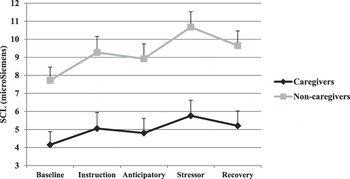
For SCL, a main effect of group was found, F(1, 38) = 14.008, p < .001, η2partial = .269, caregivers having a lower SCL than non-caregivers (See Figure 1). No significant “period*group” interactions were found (p > .10). Analyzing the AUC to compare the magnitude of the SCL response, differences were found in total AUC, t(38) = –2.521, p < .01, d = .81; AUC for the stressor, t(38) = –2.777, p < .01, d = .90; and AUC for the anticipatory period, t(38) = –2.657, p < .01, d = .86, caregivers having smaller AUCs than non-caregivers.
Skin conductance level (SCL) during Baseline, Instruction, Anticipatory, Stressor and Recovery periods by group (caregivers and non-caregivers) (p < .001 refers to a main group effect).

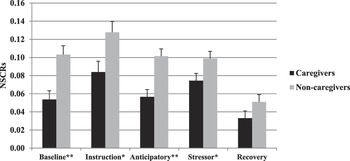
In the case of NSCRs, a main effect of group was also found, F(1, 38) = 10.374, p < .01, η2partial = .214, caregivers having a lower frequency of NSCRs than non-caregivers. Furthermore, the ‘group*period’ interaction proved to be significant, F(2.868, 108.982) = 3.713, p < .05, η2partial = .089. Specifically, caregivers had fewer NSCRs during Baseline, Instruction, Anticipatory and Stressor periods (p < .05) See Figure 2.
Non-specific skin conductance responses (NSCRs) during Baseline, Instruction, Anticipatory, Stressor and Recovery periods for groups (caregivers and non-caregivers) (**p < .01; *p < .05).

For psychological responses, a main effect of group was found for depression, F(1, 38) = 6.812, p < .05, η2partial = .152 and total negative mood, F(1, 38) = 5.410, p < .05, η2partial = .125, caregivers obtaining higher scores than non-caregivers. However, no differences were found between groups in change scores calculated for psychological responses.
Though the group composed of parents of people with bulimia was small (n = 5 vs. n = 15 for anorexia), the same analyses were conducted separately in caregivers of people with anorexia and of people with bulimia. No significant differences were detected between the caregivers for EDA components or for psychological responses to stress (p > .10).
Discussion
As previously found in caregivers of people with ASD (Ruiz-Robledillo & Moya-Albiol, Reference Ruiz-Robledillo and Moya-Albiol2015), caregivers of people with EDs, specifically anorexia and bulimia nervosa, exhibit lower electrodermal reactivity to acute cognitive stress than non-caregivers. In particular, they presented lower SCLs throughout the whole stress procedure and a lower frequency of NSCRs during all periods apart from recovery.
These results reinforce those of previous research conducted in caregivers of people with ASD (Ruiz-Robledillo & Moya-Albiol, Reference Ruiz-Robledillo and Moya-Albiol2015). In that study, authors proposed a possible adaptation to stress as an explanation for the electrodermal hyporeactivity. According to inoculation theory, being under high levels of chronic stress, as occurs in the care context, could produce an adaptation effect in the ANS, and this would manifest as a blunted sympathetic response to acute stress in laboratory settings (Carroll, Phillips, Ring, Der, & Hunt, Reference Carroll, Phillips, Ring, Der and Hunt2005; Eysenck, Reference Eysenck and Cooper1983).
This hypothesis has also been tested in other chronically stressed populations and using other measures of the ANS. For instance, a blunted cardiovascular response to acute stress has been observed in people under chronic stress, including people living in conditions of severe poverty and mistreated children (Evans & Kim, Reference Evans and Kim2007; Gump & Matthews, Reference Gump and Matthews1999; Murali & Chen, Reference Murali and Chen2005). When the acute stress response has been studied in other samples of family caregivers employing other biological markers, the results were similar (De Andrés-García, Moya-Albiol, & González-Bono, Reference De Andrés-García, Moya-Albiol and González-Bono2012). Caregivers also exhibited lower cortisol response to acute stress than non-caregivers when the same stress protocol was applied, demonstrating that there may also be an adaptation to stress in the case of the hypothalamic-pituitary-adrenal axis (De Andrés-García et al., Reference De Andrés-García, Moya-Albiol and González-Bono2012).
Based on the inoculation or adaptation effect, repeated stress exposure may help caregivers to develop adaptive effective coping strategies to cope with stressors (Ruiz-Robledillo, Bellosta-Batalla, & Moya-Albiol, Reference Ruiz-Robledillo, Bellosta-Batalla and Moya-Albiol2015). This phenomenon could be directly related to the observed increase in resilience coping in this population (Ruiz-Robledillo & Moya-Albiol, Reference Ruiz-Robledillo and Moya-Albiol2015). It is plausible that caregivers develop stronger adaptive coping strategies, and this could, in turn, reduce their need for greater physiological resources to cope with stress. This could be an adaptive mechanism, to protect their health from the negative consequences of the chronic physiological over-activation that is characteristic of the care context (Ruiz-Robledillo & Moya-Albiol, Reference Ruiz-Robledillo and Moya-Albiol2015; Ruiz-Robledillo et al., Reference Ruiz-Robledillo, Bellosta-Batalla and Moya-Albiol2015; Ruiz-Robledillo, De Andrés-García, Pérez-Blasco, González-Bono, & Moya-Albiol, Reference Ruiz-Robledillo, De Andrés-García, Pérez-Blasco, González-Bono and Moya-Albiol2014).
The lower sympathetic reactivity showed by caregivers could be a manifestation of such an adaptive mechanism. In this regard, several studies have found high levels of resilience coping in samples of informal caregivers, including caregivers of people with dementia (Dias et al., Reference Dias, Santos, Barroso de Sousa, Lima Nogueira, Torres, Belfort and Nascimento Dourado2015), ASD (Bayat, Reference Bayat2007) and acquired brain injury (Las Hayas, López, & Calvete, Reference Las Hayas, López de Arroyabe and Calvete2015), among others. It is likely that personality traits also influence in the way in which caregivers cope with the stress. In line with this idea, neuroticism was associated with lower levels of resilience and maladaptive coping, while optimism was related to high resilience and adaptive coping in caregivers of people with dementia (Dias et al., Reference Dias, Santos, Barroso de Sousa, Lima Nogueira, Torres, Belfort and Nascimento Dourado2015; Fernández-Lansac, Crespo, Cáceres, & Rodríguez-Poyo, Reference Fernández-Lansac, Crespo López, Cáceres and Rodríguez-Poyo2012). However, these variables have not been analyzed in informal caregivers of people with EDs.
In addition to lower sympathetic reactivity to acute stress, caregivers also presented lower psychological responses (with no significant changes in mood state from pre- to post-stress) than non-caregivers, reinforcing the hypothesis of a possible adaptation to stress in the former. However, caregivers showed higher levels of depression and general negative mood than the control group. This could also influence the physiological reactivity to stress exhibited by caregivers. As has been found previously, caregivers suffer from high chronic stress, and in turn, high levels of negative affect (Anastasiadou et al., Reference Anastasiadou, Medina-Pradas, Sepulveda and Treasure2014). Classically, this type of emotionality has been associated with blunted EDA in laboratory settings (Miquel, Fuentes, Garcıa-Merita, & Rojo, Reference Miquel, Fuentes, Garcıa-Merita and Rojo1999; Thorell, Kjellman, & D’Elia, Reference Thorell, Kjellman and D’Elia1987). This effect has been attributed to inhibitory mechanisms in the information processing of the central nervous system (Boucsein, Reference Boucsein2012). In this regard, it is plausible that the high negative affect showed by caregivers could also be an explanation of the blunted physiological reactivity in this group. Considering that adaptive ANS reactivity to stress mobilizes resources to deal effectively with the stress, the lack of the normal response could have severe negative consequences for caregivers.
Even though several studies have found higher levels of burden in caregivers of people with anorexia nervosa than those of people with bulimia nervosa (Graap et al., Reference Graap, Bleich, Herbst, Tristmann, Wancata and de Zwaan2008; Santonastaso et al., Reference Santonastaso, Saccon and Favaro1997), in our sample, no differences were found between the groups in EDA or psychological responses. This may be due to the relatively small sample size employed in the present study. Furthermore, other variables that have not been analyzed in the study, such as the severity of the symptomatology of the care recipients, could significantly influence the impact of ED diagnosis on caregivers. No previous studies have analyzed electrophysiological response to acute stress in caregivers of people with different EDs. In this regard, although higher subjective burden was found in caregivers of people with AN than bulimia nervosa, it is possible that the biological disturbance is similar and shared by most people under high chronic stress levels, as similar results have been obtained in other samples of informal caregivers (De Andrés-García et al., Reference De Andrés-García, Moya-Albiol and González-Bono2012; Ruiz-Robledillo & Moya-Albiol, Reference Ruiz-Robledillo and Moya-Albiol2015) and chronically stressed individuals (Gump & Matthews, Reference Gump and Matthews1999).
Although the study advances our understanding of stress response in caregivers of people with EDs, several limitations should be recognized. Firstly, the relatively small sample size and the cross-sectional character of the research limit the generalization of the results obtained. Due to the different characteristics of each type of ED, further research with large samples is necessary to evaluate the possible differences in electrodermal reactivity to stress in caregivers of individuals with different types of ED. Moreover, due to the small sample size, it has not been possible to analyze gender differences in EDA and psychological response. According to previous research, there are differences between genders in coping styles (Jáuregui, Garrido, Santiago, & Alvarez, Reference Jáuregui Lobera, Garrido, Santiago Fernández and Alvarez Bautista2010) and in sympathetic reactivity to stress, women showing lower electrodermal reactivity to acute stress than men in most cases (Ruiz-Robledillo & Moya-Albiol, Reference Ruiz-Robledillo and Moya-Albiol2015). Given this limitation of the study, future research should explore possible gender differences in stress response and coping in caregivers of people with EDs. Further, longitudinal studies are necessary to evaluate changes in stress response since the diagnosis of the care recipient. Finally, future studies should attempt to replicate these results with other types of caregivers. As noted, similar results have already been obtained in samples of caregivers of people with ASD.
The results obtained point to alteration of one of the physiological system most closely involved in the stress response, namely, the ANS. The evaluation of EDA could provide researchers and clinicians with relevant information about the physiological and health status of caregivers. Including this marker as a part of an evaluation protocol of health status of caregivers could be useful for identifying caregivers with high levels of burden and at high risk of health deterioration, making it possible to refer them for preventive psychotherapeutic intervention programs. Furthermore, as has been pointed out in this study, EDA may be a reliable physiological marker of the burden and status of caregivers of people with EDs. As such, it could be useful for evaluating the clinical effectiveness of psychotherapeutic interventions oriented to reducing stress levels and burden, and restoring the normal functioning of the ANS in this population.