Introduction
The diversity of lice infesting woodpeckers (Piciformes: Picidae) in North America is reasonably well known, having been subjected to recent taxonomic revisions (Dalgleish Reference Dalgleish1969, Reference Dalgleish1972; Price and Emerson Reference Price and Emerson1975) and thoroughly catalogued (Price et al. Reference Price, Hellenthal and Palma2003). However, the population dynamics of lice has received little attention. Seasonal patterns of infestation for chewing lice on birds in general are poorly known and few long term, quantitative studies have been conducted (e.g., Ash Reference Ash1960; Baum Reference Baum1968; Foster Reference Foster1969; Eveleigh and Threlfall Reference Eveleigh and Threlfall1976; Kettle Reference Kettle1983; Chandra et al. Reference Chandra, Agarwal, Singh and Saxena1990; Galloway and Lamb Reference Galloway and Lamb2014, Reference Galloway and Lamb2015a, Reference Galloway and Lamb2015b). Even among these studies, direct comparisons may be tenuous, because different methods have been used to extract lice from birds (Clayton and Drown Reference Clayton and Drown2001). For woodpeckers, nothing has been published beyond basic infestation parameters. For example, infestation parameters of seven species of chewing lice (Phthiraptera: Amblycera and Ischnocera) from four genera infesting five species of woodpeckers and sapsuckers (Piciformes: Picidae) were investigated in Manitoba, Canada (Galloway and Lamb Reference Galloway and Lamb2016). However, the temporal relationships between parasites and their hosts also are critical in understanding their interactions.
Our objective was to describe the seasonal life histories and population dynamics for the species of lice that occur on three species of woodpeckers in Manitoba: the resident downy woodpecker (Picoides pubescens (Linnaeus)), and two migrant hosts, northern flicker (Colaptes auratus (Linnaeus)) and yellow-bellied sapsucker (Sphyrapicus varius (Linnaeus)). Six species of lice (Phthiraptera) occur on these hosts: Menacanthus pici (Denny) (Amblycera: Menoponidae) from all three hosts, and five species of Ischnocera (Philopteridae): Penenirmus auritus (Scopoli) from downy woodpecker and yellow-bellied sapsucker, Picicola snodgrassi (Kellogg) and Brueelia straminea (Denny) from downy woodpecker, and Penenirmus jungens (Kellogg) and Picicola porisma Dalgleish from northern flicker (Galloway and Lamb Reference Galloway and Lamb2016).
Materials and methods
Woodpeckers and sapsuckers were mostly salvaged from rehabilitation hospitals at the Wildlife Haven (Manitoba Wildlife Rehabilitation Organization, Île des Chênes, Manitoba, Canada) and Prairie Wildlife Rehabilitation Centre (Winnipeg and St. Adolphe, Manitoba, Canada), and processed as described in detail by Galloway and Lamb (Reference Galloway and Lamb2014, Reference Galloway and Lamb2016). We also examined birds that had died from traumatic injury and were submitted to the Oak Hammock Marsh Interpretive Centre or directly to us by the public. Lice were collected by washing birds twice in warm soapy water and once in clean water (Mironov and Galloway Reference Mironov and Galloway2002). The washing method removes nearly the entire population of lice infesting the host, except the majority of eggs (Clayton and Drown Reference Clayton and Drown2001; T.D.G., personal observation). Voucher specimens of lice were slide-mounted (Richards Reference Richards1964) and preserved in 70% ethanol, and deposited in the J.B. Wallis/R.E. Roughley Museum of Entomology, Department of Entomology, University of Manitoba (Winnipeg, Manitoba, Canada). Galloway and Lamb (Reference Galloway and Lamb2016) suggested that M. pici is probably a species complex requiring revision, with the taxa being host specific. Here, we consider M. pici on each host separately and so interpretation of data for members of such a complex could still be assigned to a species name, once the taxonomy of this species group has been clarified.
The following data were recorded for each individual bird for each host species: collection date, numbers of adult females and males, and number of nymphs for each louse species. These data were used to estimate: prevalence – the proportion of birds infested; mean intensity – the mean number of lice on infested birds; sex ratio – the ratio of males to females; and the ratio of nymphs to females (Rózsa et al. Reference Rózsa, Reiczigel and Majoros2000). Avian host specimens were sometimes identified as adults or juveniles, but birds that had fledged recently often could not be reliably distinguished from adults. When sufficient juveniles were identified for a given host species, the differences in infestation between juveniles and adults were used to help interpret the causes of seasonal patterns of infestation.
Lice were collected from hosts acquired over 22 years, from 1994, ending in the summer of 2015. The data for each host and louse species were sorted by month of collection pooled over years, to provide the total number of louse species in each category, the total number of lice per species, and the proportion of hosts infested, for each month. To increase the sample sizes of hosts and lice, data for months were sometimes pooled to coincide with seasons corresponding to changes in the life history of the hosts: winter, November–March; spring, April–May; summer, June–August; and fall, September–October. Monthly or seasonal changes in louse prevalence, mean intensity, sex ratio, and ratio of nymphs to females were used to describe the annual population dynamics of the lice. Where sample size permitted, χ2-tests of independence (SYSTAT Software 2009) were used to assess differences in prevalence, sex ratio, and ratio of nymphs to females among seasons, louse species, or hosts. Mann–Whitney rank sum tests (SYSTAT Software 2009) were used to compare mean intensities, because these data deviated from normal and variances were not homogeneous.
Results
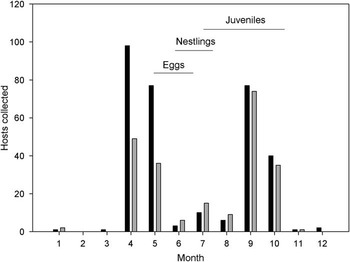
The 55 specimens of downy woodpeckers were acquired from all months of the year, but most often in May (n=9), July (n=13), and September (n=8), with five or fewer in each of the other months. Too few downy woodpeckers were identified as juveniles or adults to independently determine when this host fledges, but eggs are known to be present in nests in Manitoba from mid-May to early June and the young to fledge in late June or early July (Taylor Reference Taylor2003). The other two host species also were collected (sapsuckers – 316 specimens; flickers – 225 specimens) in most months of the year, but primarily in April and May (spring) and then again in September and October (fall), sapsuckers most frequently in spring, and flickers in fall (Fig. 1). Few sapsuckers and flickers were collected between egg hatching and young fledging (June–August), in contrast with the numbers of downy woodpeckers. For sapsuckers and flickers, juvenile birds were acquired from mid-July until birds migrated south. For these birds, specimens acquired during April–June were all adults that had returned from the south, whereas the small numbers of birds collected in July and August and the larger fall collections were an unknown mix of adults and their juvenile offspring. Some of the hosts were identifiable as adults or juveniles when they were collected, with sufficient sapsucker juveniles identified (n=33) to confirm that juveniles were present in the Manitoba population from 17 July to 21 October (Fig. 1). Fewer juvenile flickers were identified (n=5), and these were present between 6 July and 8 October. The seasonal distribution of specimens acquired for each avian host species determined the sample sizes available to assess seasonal patterns of louse abundance.
Seasonal pattern of acquisitions of louse hosts and the typical timing of host life history processes (Taylor Reference Taylor2003) for yellow-bellied sapsuckers (black bars) and northern flickers (grey bars) in southern Manitoba, Canada.

For the winter-resident downy woodpecker, adults and nymphs of all four louse species that occur on this host were present on the 10 birds collected in winter, although the numbers of M. pici and P. snodgrassi were low in all seasons. For the migratory sapsuckers and flickers, only a few birds were collected in winter months. Males, females, and nymphs of M. pici were present on one flicker collected in January, and all three stages of both M. pici and P. auritus were on four sapsuckers collected in December–March. For the species of lice that infested sapsuckers and flickers, adults and nymphs were present on birds from April through October, as soon as the birds returned in spring and until they left for the south in the fall (Figs. 2–4). The seasonal patterns of louse abundance are described for the common louse species in the following paragraphs.
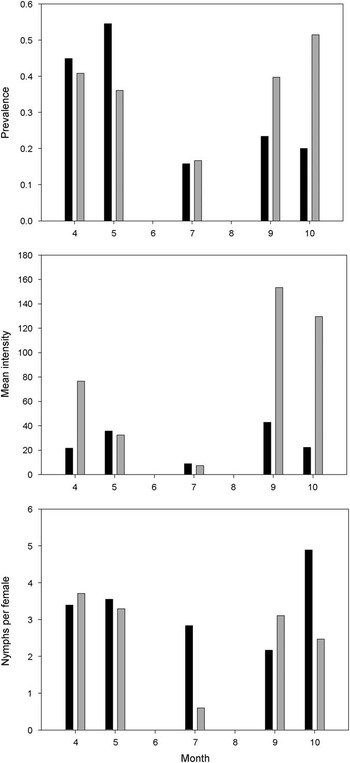
Seasonal patterns of population parameters for the louse Menacanthus pici on yellow-bellied sapsuckers (YBSA, black bars) and northern flickers (NOFL, grey bars) in southern Manitoba, Canada. Probability of seasonal differences (P) from χ2 test of independence for prevalence and nymphs per female, and Kruskal–Wallis test for mean intensity are as follows: Prevalence – YBSA, P<0.001; NOFL, P=0.07. Mean intensity – YBSA, P=0.46; NOFL, P=0.02. Nymphs per female – YBSA, P<0.001; NOFL, P<0.001.

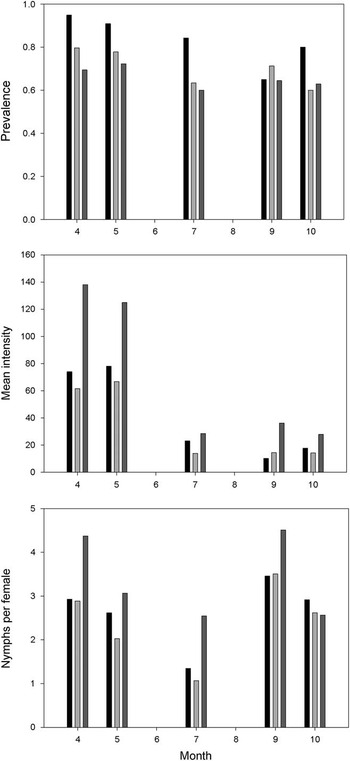
Seasonal patterns of population parameters for the lice Penenirmus auritus on yellow-bellied sapsuckers (Pa, black bars) and Penenirmus jungens (Pj, light grey bars) and Picicola porisma on northern flickers (Pp, dark grey bars) in southern Manitoba, Canada. Probability of seasonal differences (P) from χ2 test of independence for prevalence and nymphs per female and Kruskal–Wallis test for mean intensity are as follows: Prevalence – Pa, P<0.001; Pj, P=0.24; Pp, P=0.81. Mean intensity – Pa, P<0.001; Pj, P<0.001; Pp, P<0.001. Nymphs per female – Pa, P<0.001; Pj, P<0.001; Pp, P<0.001.

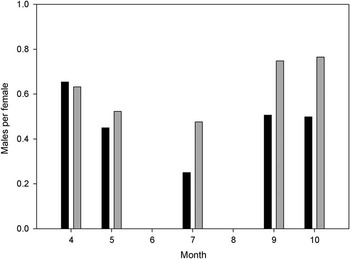
Seasonal patterns of sex ratio (males per female) variation for Menacanthus pici (Mp, black bars) and Penenirmus jungens (Pj, grey bars) on northern flickers in southern Manitoba, Canada. Probability of seasonal differences (P) from χ2 test of independence: Mp, P=0.05; Pj, P=0.03.

Menacanthus pici
Only five of 55 downy woodpeckers were infested with a total of 28 M. pici, too few to assess seasonal patterns for this louse. On both sapsuckers and flickers, however, M. pici had its lowest prevalence and mean intensity through the nesting period, June–August (Fig. 2). Notably, the most dramatic seasonal change was in prevalence, which dropped from 0.4 to 0.5 in April–May to <0.2 in June–August. The pattern of M. pici on the two hosts differed in that it reached a higher prevalence in fall on flickers than on sapsuckers (χ2=26.4, P<0.001, df=1).
By considering only sapsuckers that were identified as adults (n=91) or juveniles (n=33), the pattern in prevalence on this host was attributed to changes in prevalence on the adults versus on their fledged offspring. Recall that all birds in April–May were adults, but from July, the identity of juveniles and adults was unknown for most host specimens. Sapsuckers identified as adults at capture had a prevalence of M. pici=0.61 in April–May and 0.18 in June–October, similar to the pattern for the whole sample (Fig. 2). The 10 identified juvenile sapsuckers collected in July–August had no lice, but prevalence of M. pici on juveniles rose to 0.43 (n=23) in September–October. On flickers identified as adults, the prevalence of M. pici in spring was 0.48 (n=31), similar to that observed for the full spring sample, and it dropped to 0.25 (n=8) in summer before rising to 0.43 (n=21) in fall. Only five juvenile flickers were identified, two with no M. pici from July and August and three from October, two of which had M. pici. Therefore, the seasonal patterns on sapsuckers and flickers were consistent with each other, with a decline in prevalence from spring to the nesting period on adults, and an absence of M. pici on recently fledged juveniles through July–August. This was followed by a rise in prevalence on both juveniles and adults in September–October, with a greater increase in the infestation rate on flickers than on sapsuckers.
The mean intensity of M. pici on sapsuckers and flickers showed a similar seasonal pattern to that of prevalence, with the lowest mean intensity during the nesting period (Fig. 2). As was the case for prevalence, mean intensity increased more dramatically on flickers in the fall than on sapsuckers (Fig. 2). A similar seasonal pattern was evident for the ratio of nymphs to females (Fig. 2). On sapsuckers, the ratio dropped slightly during the nesting period but was lowest in September before reaching an October peak (Fig. 2). On flickers, this ratio was low during the nesting period, but returned to spring levels by September.
Penenirmus auritus and Brueelia straminea on downy woodpecker
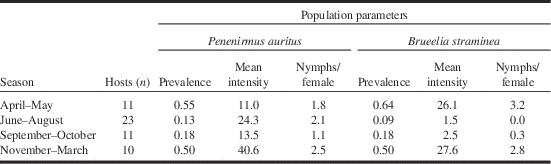
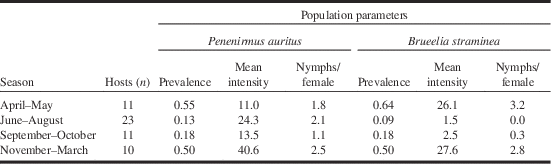
Because the sample of hosts was low for downy woodpeckers, the louse collections from April–May, June–August, and September–October were pooled (Table 1) for comparison with similar collections of flickers and sapsuckers that occurred at those times of year. Too few P. snodgrassi (n=15) were available for meaningful seasonal analyses, leaving P. auritus (n=380) and B. straminea (n=335) available to identify seasonal patterns on downy woodpeckers (Table 1). Both P. auritus and B. straminea had low prevalence from June–October when nesting occurred and juveniles fledged, compared to the winter and spring periods (November–May) (Fisher’s exact test (SYSTAT Software 2009), P=0.045 and 0.012, respectively). For B. straminea, mean intensity and the ratio of nymphs to females were also lower during June–October than during November–May, although the sample sizes were too small to confirm these apparent differences. Winter and spring were the seasons when population parameters were highest for the two abundant lice on downy woodpeckers.
Seasonal patterns of population parameters for two species of lice from downy woodpeckers collected over 22 years in southern Manitoba, Canada.
Penenirmus auritus on yellow-bellied sapsucker and Penenirmus jungens and Picicola porisma on northern flicker
These three species of lice had similar seasonal patterns of abundance (Fig. 3). Penenirmus auritus showed a slight decline in prevalence through the spring and summer reaching a low point in September, whereas P. jungens and P. porisma showed no significant seasonal pattern of prevalence, although for both, prevalence was higher in spring than in summer and fall. The three species also showed similar seasonal patterns of mean intensity, with the highest intensities occurring in spring, dropping to low levels in summer, and hardly rising again before hosts flew south. The ratios of nymphs to females for these louse species also showed marked seasonal patterns, dropping to low ratios in summer before returning to spring levels in fall.
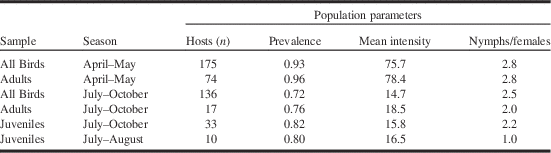
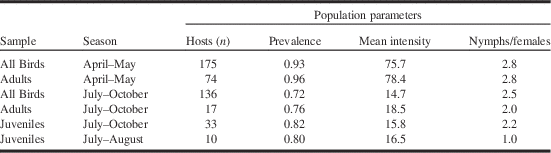
For P. auritus on sapsuckers, seasonal patterns for prevalence and intensity were similar for juvenile and adult hosts, and similar to the larger sample of all birds (Table 2). The ratios of nymphs to females were also similar between juvenile and adult birds from July to October. The ratio of nymphs to females was lowest on the 10 juveniles collected in the nesting period (Table 2), but too few adults (n=3) were collected in this period to assess the significance of this ratio. For P. jungens and P. porisma on flickers, too few juveniles were collected to assess louse densities on these birds.
Seasonal patterns in the population parameters of Penenirmus auritus on adult and juvenile yellow-bellied sapsuckers and mixtures of adult and juvenile sapsuckers collected over 22 years in southern Manitoba, Canada.
Sex ratios
No seasonal patterns of sex ratio variation, measured here as the ratio of males to females, were evident for lice on downy woodpeckers, but small sample size (five or fewer hosts in most months) reduced our potential ability to detect any differences. For M. pici and P. auritus on sapsuckers and for P. porisma on flickers, sex ratios did not vary significantly from month to month when birds were in Manitoba (Pearson’s χ2 test (SYSTAT Software 2009): χ2=4.9–7.4, P>0.12, df=4). Seasonal patterns in sex ratios were similar for M. pici and P. jungens on northern flicker, with the lowest male to female ratios occurring during the nesting period (Fig. 4).
Discussion
Adults and nymphs for all six species of lice were present throughout the year on their respective three host species. The migratory sapsuckers and flickers return to Manitoba with high populations of louse nymphs and adults. These observations are consistent with the conclusion that avian louse reproduction is continuous year round, regardless of whether the host spends the winter in Manitoba or the host migrates to warmer wintering habitats, as was previously observed for rock pigeons (Columba livia Gmelin, Columbiformes: Columbidae) and common nighthawks (Chordeiles minor (Forster), Caprimulgiformes: Caprimulgidae) in Manitoba (Galloway and Lamb Reference Galloway and Lamb2015a, Reference Galloway and Lamb2015b). On the winter-resident downy woodpeckers, the two most common species of lice were equally abundant in winter and spring.
All the abundant louse species on the three hosts tended to have low prevalences, mean intensities, sex ratios (male:female), and nymph to female ratios during the nesting period (June–August). Many of the population parameters began to increase in September and reached elevated spring levels again in October, but some did not recover to spring levels before winter. Unexpectedly, recently fledged juveniles for both sapsuckers and flickers had no lice, even though they had left the nest. Only 12 such specimens were available, but these birds were collected in different years and from various locations. Given the usual prevalence of lice on these hosts at other times in their lives, it is unlikely that all these specimens would have been louse free by chance, suggesting that lice frequently infest sapsuckers and flickers after they fledge. If so, this late infestation would explain some of the drop in population parameters during the summer. A summer drop in population parameters also occurs on adult birds, which contributes to the summer decline in louse populations.
It is one thing to describe seasonal changes in infestation parameters using destructive sampling methods, as we have used here, where we had access to considerable numbers of salvaged hosts from rehabilitation centres. It is quite another to explain the reasons for these seasonal changes. Clearly, some phenomenon consistently drives a population decline in some louse species during the breeding season. Perhaps lice transfer from adult birds to their chicks during nesting, resulting in a dilution effect on louse mean intensity until numbers increase through reproductive recruitment on infested birds (Moyer et al. Reference Moyer, Gardiner and Clayton2002). In the cases of sapsuckers and flickers, however, recently fledged juveniles had no lice ruling out any dilution effect until after nesting.
Seasonal moulting may negatively affect coincident louse populations on both birds and mammals (e.g., Murray Reference Murray1957 for mammals; Baum Reference Baum1968 for birds). Woodpeckers moult once a year, commencing shortly after chicks have fledged (Pyle and Howell Reference Pyle and Howell1995). This coincides with the depression in infestation parameters observed in most species of lice infesting woodpeckers in this study. However, Moyer et al. (Reference Moyer, Gardiner and Clayton2002) conducted experimental studies on two species of lice on captive pigeons and they concluded that the moult, which in this case was environmentally stimulated by manipulating photoperiod, had no significant impact on louse populations. They suggested previous authors had underestimated post-moult louse populations because lice were more difficult to detect in the new plumage when intensity of infestation was determined by visual inspection. In our study, birds were washed using a method similar to that used by Moyer et al. (Reference Moyer, Gardiner and Clayton2002), and we are confident the numbers of lice collected from these woodpeckers are an accurate reflection of louse populations at the time of examination. In woodpeckers in our study, observed summer decreases in louse populations were real and not artifacts of collecting techniques.
Grooming behaviour in birds may have a significant impact on louse populations. When a host’s ability to groom is experimentally impaired, louse populations soar (Clayton Reference Clayton1991; Clayton et al. Reference Clayton, Lee, Tompkins and Brodie1999), and bill structure and integrity affect efficiency of grooming and hence louse populations (Clayton et al. Reference Clayton, Koop, Harbison, Moyer and Bush2010). Perhaps it is also true that if a host spends more time grooming, louse populations can be affected. This may be especially the case for lice that are found in regions of the body with greater access to grooming behaviours. In some species of lice, adults and nymphs may infest different body regions (Grossi et al. Reference Grossi, Sharanowski and Galloway2014), so impact on different developmental stages of the lice may be differentially affected by grooming activity. Birds spend a great proportion of their maintenance activities grooming (Cotgreave and Clayton Reference Cotgreave and Clayton1994). If during the moult birds are stimulated to spend more time grooming with the loss of old feathers and growth of new ones, perhaps louse populations are depressed.
Ambient environmental conditions are also known to affect chewing louse populations. In particular, low humidity can increase mortality in some species of lice. Malenke et al. (Reference Malenke, Newbold and Clayton2011) described differences in infestation parameters in louse populations on mourning doves, Zenaida macroura (Linnaeus) (Columbiformes: Columbidae), across geographic boundaries and throughout the season. Infestation parameters were lowest in drier regions of North America and in Utah, United States of America in the hottest and driest month of the year. It is possible that lice on woodpeckers in Manitoba suffer higher mortality or reduced reproductive output during summer months. Experimental studies are necessary to determine the underlying causes of the depression of louse populations during the nesting season.
Sex ratios in chewing lice on birds most often favour females or are balanced (Marshall Reference Marshall1981; Clayton et al. Reference Clayton, Gregory and Price1992). We found this to be the case for all studied species of lice infesting woodpeckers in Manitoba, for which numbers of lice were sufficient for analysis. We also found that the ratios of males to females were lowest during summer for M. pici and P. jungens on northern flickers, at the time of year infestation parameters also were lowest. Marshall (Reference Marshall1981) cited examples where sex ratios of lice varied across the seasons, but found no examples for chewing lice on birds. Perhaps the same factors affecting prevalence and mean intensity of infestation for lice on flickers also affected male survival more dramatically than for females.
Adults and nymphs were present on downy woodpeckers all year, and on migrant sapsuckers and flickers from when they arrived until they left, suggesting lice reproduce continuously on their hosts. Prevalences and mean intensities of louse infestations generally decreased from their respective springtime levels to their lowest values during or at the end of the breeding season of their hosts, and then increased in various degrees during the fall. No seasonal pattern in louse sex ratios was observed except on northern flickers, where male to female ratios for two of three species were lowest during the breeding season. Resident and migrant hosts had similar seasonal patterns of infestation by lice.
Acknowledgements
The authors especially thank the staff at the rehabilitation hospitals of the Wildlife Haven and the Prairie Wildlife Rehabilitation Centre for the care with which they handled the birds for this study; Paula Grieef kindly allowed us access to woodpeckers submitted at the Oak Hammock Marsh Interpretive Centre; thanks to the Canadian Wildlife Service for issuing scientific permits over the duration of this study. We thank Dave Holder, Lisa Babey, and the many students who helped by washing birds. This research was funded in part by Discovery Grants to T.D.G. from the National Sciences and Engineering Council of Canada and by Manitoba Conservation (Sustainable Development Initiatives Fund). The authors are grateful for the continued support of the Department of Entomology and the Faculty of Agricultural and Food Sciences at the University of Manitoba.