Introduction
A hospital’s ability to provide the best patient care during an emergency is dependent upon its ability to coordinate effectively with other agencies and service providers.Reference Adelaine, Shoaf and Harvey 1 - Reference Barnett, Dennis-Rouse and Martinez 3 In the past, hospital emergency management programs focused on building resilience to disasters by ensuring that their facilities were self-sufficient and well-prepared. 4 - Reference Kaji and Lewis 6 However, experiences in recent disasters have shown that an ability to work effectively with other agencies and service providers is equally important to the ability of hospitals to provide safe patient care during emergencies. Prior to Superstorm Sandy in 2012 (Northeastern USA), many hospitals on the east coast had basic preparedness plans that were developed based on their experiences during Hurricane Irene (East Coast USA) in 2011, but these plans focused on taking a small surge of patients and sheltering in place with their employees. During Superstorm Sandy, the Healthcare Facility Evacuation Center in New York (USA) was used to coordinate the dispersal of patients from the storm and coordinate with the hospitals. Total patient transports were near 7,000. Through interviews with hospitals, Toner et al. identified significant challenges with the emergency care process.Reference Adelaine, Shoaf and Harvey 1 The overriding problems fell into three categories: command, control, and communication. The hospitals were unable to communicate due to technology failures, and used cell phones, text messages, radios, and news broadcasts. The inability to communicate caused a subsequent shift in command of the evacuation process from the centralized Healthcare Evacuation Center to the hospitals themselves. The lack of command prevented the evacuation process from being controlled and instead caused inefficiencies in the process; large amounts of patients were evacuated to a small number of hospitals, while other hospitals received very few patients. This experience highlighted the need for hospitals to coordinate with a wide range of agencies (including Emergency Medical Services (EMS), Public Health, and Governmental Emergency Managers) to plan appropriately before disasters, respond appropriately during disasters, and make corrections and adjustments after disasters. Currently, there is not clear guidance on how hospitals should work with other response agencies.
The US Department of Health & Human Services (HHS; Washington, DC USA) through the Office of the Assistant Secretary for Preparedness and Response (ASPR; Washington, DC USA) developed 15 emergency support functions which organize governmental and private sector resources to most effectively support critical infrastructure, including medical services.Reference Sternberg 7 The ASPR developed the Hospital Preparedness Program (HPP) and requires Health Care Coalitions as an attempt to facilitate collaborations between hospitals and other response agencies.Reference Schultz, Koenig and Lewis 8 , 9 These coalitions include other hospitals, local EMS agencies, long-term care facilities, specialty care clinics, and urgent care centers. However, the US federal guidance developed for Health Care Coalitions does not outline specific strategies that should be implemented for better outcomes during a disaster. A study conducted by Walsh et al. found that this lack of detailed guidance is a significant challenge to the effectiveness of Health Care Coalitions. 10
This study evaluated specific factors that needed to be addressed in order to facilitate successful collaboration with hospitals during disasters. This report included a survey of hospitals nationwide and was conducted to elucidate the best practices for coordinating and collaborating with other agencies during disasters. These agencies include public health, emergency management, and EMS. This study also included assembled gaps and some of the challenges hospitals faced when attempting to collaborate with other agencies. Recommendations are made based on these findings pertaining to the ways that individual hospitals, Health Care Coalitions, and US federal agencies can support focused efforts to help hospitals coordinate with other response agencies.
Methods
The survey was designed using the emergency management sections of The Joint Commission (Oakbrook Terrace, Illinois USA) and previous studies regarding hospital preparedness. The survey contained 132 multiple choice, scaled, and open-ended questions. The questions evaluated the current state of preparedness at hospitals, their perspective on the preparedness of the other agencies, and the hospital experiences collaborating with those agencies. West Los Angeles Hospital (California USA) emergency planners piloted the survey in order to ascertain internal validity of the questionnaire.
A random sample of 1,982 US acute care facilities was obtained from the 2013 American Hospital Association (AHA; Chicago, Illinois USA) database which contains approximately 6,500 hospitals. Only the 4,831 acute care facilities within this database were used in the population. The sample was stratified by HHS region; 200 hospitals were selected from each region, with the exception of Region 1, which contained a universe. Five hundred seventy-seven hospitals responded, yielding a response rate of 29.7% after accounting for 13 unreachable hospitals. The overall margin of error for the sample proportion with 95% confidence (α=.05) was approximately ±5% after incorporating the appropriate sample weights.
In order to reach each facility, the standard Dillman method of survey research was utilized; this used a mailed invitation, addressed to the hospital executive listed in the AHA database, with instructions that the letter be forwarded to the facility emergency manager or most appropriate staff member. In order to complete the survey, the participant was to login to a web-based questionnaire hosted by Snap Survey (Bristol, United Kingdom) with a unique identifier included in the initial letter. Two weeks after the letter was sent, a postcard was sent to all hospitals that had not yet completed the survey. Two weeks later, a second letter was sent to all remaining non-participants. SPSS version 21.0 (IBM Corp.; Armonk, New York USA) was used to analyze data; preliminary analyses included simple univariate descriptive statistics. Qualitative, open-ended questions were coded based on functional categories of personnel, financial, and technology.
The study was reviewed and approved by the Institutional Review Board at both affiliated Universities: University of California, Los Angeles (Los Angeles, California USA) and University of Utah (Salt Lake City, Utah USA).
Results
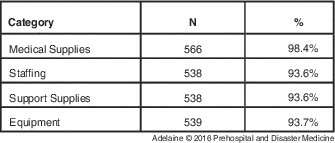
Hospitals have a basic level of preparedness and no longer need guidance on how to prepare internally for disasters. When asked questions related to The Joint Commission standards for the basic components of an Emergency Operations Plan, most hospitals (>90%) responded that they had all the fundamentals, including communications, surge planning, and utility failure plans (Table 1). Hospitals actively are participating in coalitions, at a high rate. An overwhelming 85% of hospitals belong to Health Care Coalitions. These two areas were primary foci for previous efforts to build hospital resilience and are the building blocks for preparedness. However, the individual emergency preparation of a hospital and participation in a Health Care Coalition alone are not sufficient to ensure a successful partnership and appropriate patient care during a disaster. Hospitals identified barriers to successful collaboration in the following areas: physical distance between collaborating entities; emergency management staffing; funding; communication; and personal working relationships between hospital staff.
Hospital Incorporation of Planning Categories in Emergency Operations Plan

Physical Distance between Collaborating Entities
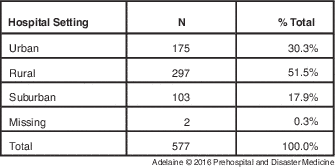
The distance between neighboring hospitals and hospitals and their collaborators creates one of the most basic described barriers to collaboration. As stated by one of the hospitals, “We are beyond rural. Considered frontier. The next closest hospital to us is another critical access, 25-bed facility. Larger facilities are two to three hours away.” A majority of the hospitals that responded identified themselves as being in a rural area, and approximately one-third were categorized as Urban (Table 2). Less than one-third of the hospitals belonged to a larger system. One hospital identified this as a major barrier: “Distance. We are located above the Arctic Circle in Kotzebue, Alaska. No road systems to other hospitals that are about 500 miles or greater distances away.” The mean number of licensed beds was 193 and the median was 120 beds. The number of staffed beds was lower with a mean of 156 and median of 85 beds.
Hospital Demographics

Emergency Management Staffing
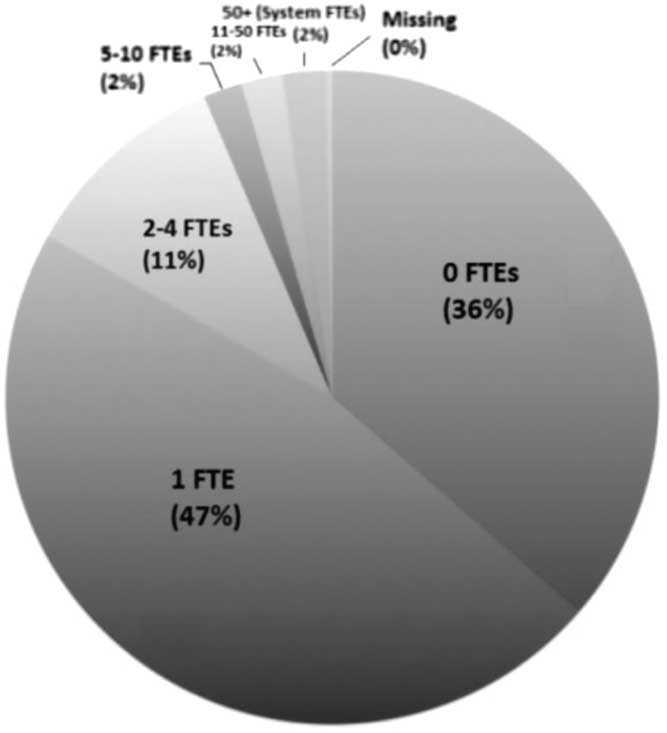
Having staff with multiple responsibilities creates a larger barrier to being able to dedicate the time needed to participate in collaborative meetings. Approximately one-third of the hospitals had less than one full-time employee (FTE) working in emergency management (Figure 1). This created a significant barrier as stated by this hospital:
In critical access hospitals, the person assigned to work on disaster planning has many other roles in the hospital. There is not enough money to hire someone full time to do this work. This is not a full-time position. It is hard for hospitals to send someone to all the planning meetings. Therefore, the hospitals are not fully represented on the coalition board.
Number of Full-time Employees Dedicated to Emergency Management. Abbreviation: FTE, full-time employee.

Slightly less than one-half of the hospitals had only one person working full time in emergency management. Approximately 60% of respondent hospitals with fewer than 50 licensed patient beds did not have a full-time person working in emergency management. This prevented the employee from having the amount of time they need, as stated by this hospital: “Lack of time, all of our coalition members are performing as Emergency Preparedness Coordinators part time while trying to fulfill their main roles within the hospital system.” Very few hospitals had more than one person working in emergency management. The survey asked the total number of FTEs working as an emergency manager for each hospital, and this study speculates that the hospitals that identified more than five FTEs as emergency managers were part of a larger health system. The emergency manager completing the survey responded for the whole system rather than for an individual hospital.
Funding
Funding was mentioned as both a barrier to preparedness and collaboration, as well as a necessary factor for ensuring success. Seventy-one percent of hospitals stated their local jurisdiction received HPP funding from the ASPR, and 69% stated that the hospital itself received such funding. Of note: 13% of the hospitals stated that they did not know if they received any HPP funding whatsoever. Some hospitals noted a decrease in funding over the years, stating: “ASPR funding has decreased significantly to hospitals. Many hospitals are considering dropping out of the ASPR program as the deliverables are more time consuming than the funding provided.” Another stated: “Grant funding. That is it. If we didn’t get money, we wouldn’t meet (with other hospitals or agencies).”
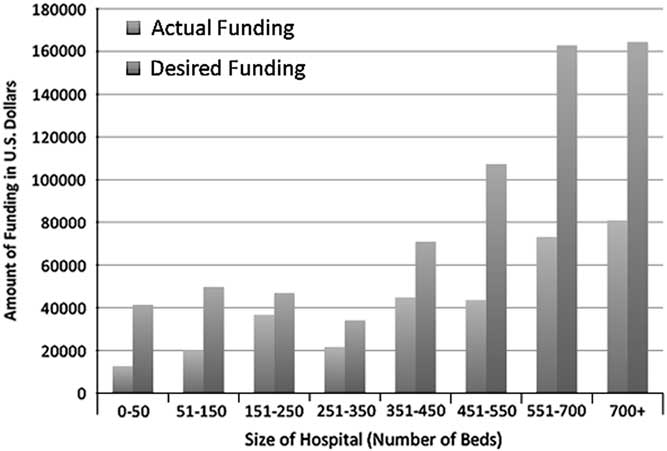
The funding from HPP was distributed widely with hospitals citing amounts of less than US $10,000; US $10,000-$24,000; and US $25,000-$49,000. Fewer than five percent of hospitals received more than US $49,000 annually, and nearly 32% of respondents left these questions blank, likely skewing results. The median amount was US $19,000 and the mean was US $32,999. Hospitals with more beds received more funding, but the average amount per bed was approximately US $155, with hospitals that were smaller than 50 beds reporting a slightly higher average of US $188. In the open-ended section, 55% of the respondents stated that they felt more funding would be useful for their emergency management program. Most hospitals stated that a funding level roughly one-third to twice as much as they currently had would be ideal for preparedness. One hospital indicated:
Our Mutual Aid Coalition is reliant on individual hospital support and does NOT receive HPP funding. We continue to ask New York State for funding and are denied yearly; this severely hinders our ability to provide training, exercise support, and actual response efforts.
Hospitals with 50 beds or less stated that the funding they would require was approximately US $200 per licensed bed. The larger hospitals stated US $235 per bed (Figure 2).
A Comparison of the Amount of Funding Hospitals Receive and Desired Funding.

Communications
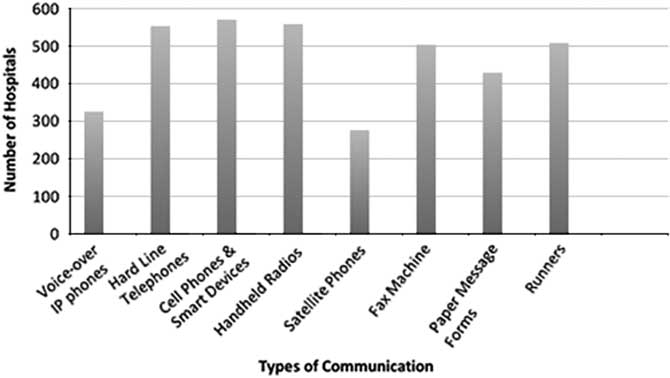
Communication barriers included problems with technology, accessing correct and updated information, and having the correct contact for each collaborator. Hospitals used a variety of communication strategies. One hospital noted: “In a perfect world, receiving real-time, accurate, concise information from an incident scene would be ideal. However, the reality is that we usually get information through EMS, emergency management, or law enforcement that is incomplete.”
Approximate effectiveness within inter-agency collaboration was strongest with interoperability with EMS at 89% and the lowest with skilled nursing facilities at 11.4% (Figure 3). Respondents noted that barriers existed both from being able to get the information they needed from communications, and having the right technology. A respondent hospital highlighted a technical problem with communication stating that: “[Their] county is working to implement a new radio system, but at present the ‘old’ and ‘new’ systems don’t communicate well, so we have fragmentation.”
Distribution of Communication Technology that Hospitals are Using.

Collaboration
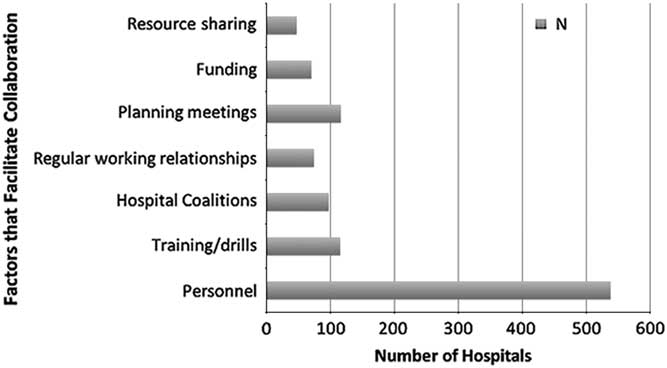
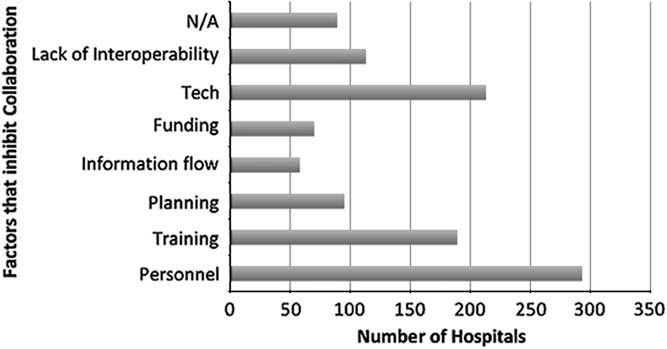
Overall, the factor that contributed most to a successful collaboration with other hospitals was related to the broad category of personnel; similarly, problems with personnel were highlighted as the greatest barriers to successful collaboration (Figure 4 and Figure 5). Although “personnel” covers a wide area, the specific collaboration process referenced frequently by hospitals began with simply knowing the correct contact person at each collaborating agency. The benefits of frequent working relationships were emphasized with the following statement: “The ability to communicate with someone within another organization that has the ability and understanding of their organization’s readiness and resources and has the authority to either make decisions or work with leadership.... ” Another hospital indicated that: “Through the coalition we build relationships and contacts over time. One is able to respond quickly and more efficiently knowing these processes and contacts ahead of time. There is a level of trust and support when calls or request made.” Once a contact person is established, having a relationship of shared expectations and goals during a disaster was stated by many hospitals as a requirement for success. Lastly, having organizational and logistical support to form and establish that personnel connection during a disaster was noted as essential by many respondents; any break in those organizational and logistical components prevents successful collaboration between agencies during disasters
Distribution of Factors that Contribute to the Collaboration of Hospitals with Other Agencies.

Distribution of Factors that Prevent to the Collaboration of Hospitals with Other Agencies.

Discussion
These results indicate that hospitals are struggling to form inter-agency connections needed for collaboration. The major factor contributing to both the facilitation of collaboration, as well as barriers to collaboration, was highlighted as personnel, specifically point of contact. Traditionally, emergency managers have relied extensively on pre-existing relationships. The value of personal relationships is reiterated as essential to collaboration with the demonstration of it being both barrier and successful strategy. However, when that relationship strategy for collaboration breaks down through physical distance, staffing, funding, and communication, or other various means, it can prevent any further course of action and hamper collaboration.
The data indicate that US federal and regional agencies need to refocus funding and guidance on the establishment of partnerships across hospitals and other agencies. A two-part approach may be necessary for addressing the concerns about personal connections. The first approach may be to provide opportunities to increase the development of relationships by tying them to funding. US federal funding may need to include annual requirements to attend meetings, participating in exercises, and collecting and distributing contact information.
A second approach to address the need for personal relationships is to work towards removing the need to have specific relationships to be effective collaborating. Establishing processes that require you not to know an individual, but an assigned position, for standard forms and requests may be beneficial.
Limitations
Due to the small amount of respondents to the hospital survey needs, the results may not be applicable to all hospitals. There may have been a participation biased by hospitals that are in need of additional funding. Participants were allowed to answer open-ended questions, the analysis of which included the identification of themes which is biased by the interpretation of the answers.
Conclusion
Collaboration with hospitals and other agencies is crucial to being able to manage patients effectively in a disaster. Alignment of funding, identification of barriers, and addressing gaps in the ability of hospitals to collaborate are required. This study begins to address funding needs, to identify gaps, and to propose strategies for better collaboration. It will be necessary for US federal funding agencies to ensure that hospitals are using funds to address gaps and increase the ability of hospitals to collaborate effectively.
Relying on relationships during a time of crisis is not practical. It can be incredibly effective, but also unreliable. Individuals who are collaborative may be affected by the disaster and be unable to respond at the time of the event. Conversely, if a hospital is unable to establish a strong relationship with other agencies, the public suffers.