




No CrossRef data available.
Article contents
Heavy alcohol consumption in individuals with HIV infection: Effects on neuropsychological performance
Published online by Cambridge University Press: 28 January 2005
Abstract
Higher rates of alcohol use have been reported in HIV+ individuals compared to the general population. Both heavy alcohol use and HIV infection are associated with increased risk of neuropsychological (NP) impairment. We examined effects of heavy active alcohol use and HIV on NP functioning in a large sample of community-residing HIV+ individuals and HIV− controls. The four main study groups included 72 HIV− light/non-drinkers, 70 HIV− heavy drinkers (>100 drinks per month), 70 HIV+ light/non-drinkers, and 56 HIV+ heavy drinkers. The heavy drinking group was further subdivided to assess effects of the heaviest levels of active alcohol use (>6 drinks per day) on NP functioning. A comprehensive NP battery was administered. Multivariate analysis of covariance was employed to examine the effect of HIV and alcohol on NP functioning after adjusting for group differences in age and estimated premorbid verbal intellectual functioning. The analyses identified main effects of heavy drinking and HIV on NP function, with greatest effects involving the contrast of HIV+ heavy drinkers and the HIV− light drinkers. Synergistic effects of heaviest current drinking and HIV infection were identified in analyses of motor and visuomotor speed. Supplementary analyses also revealed better NP function in the HIV+ group with antiretroviral treatment (ART) and lower level of viral burden, a finding that was consistent across levels of alcohol consumption. Finally, heavy alcohol use and executive functioning difficulties were associated with lower levels of self-reported medication adherence in the HIV+ group. The findings suggest that active heavy alcohol use and HIV infection have additive adverse effects on NP function, that they may show synergistic effects in circumstances of very heavy active alcohol use, and that heavy drinking and executive functioning may mediate health-related behaviors in HIV disease. (JINS, 2005, 11, 70–83.)
Information
- Type
- Research Article
- Information
- Journal of the International Neuropsychological Society , Volume 11 , Issue 1 , January 2005 , pp. 70 - 83
- Copyright
- © 2005 The International Neuropsychological Society
INTRODUCTION
HIV+ populations have substantially higher rates of alcohol use than the general population (Petry, 1999), yet more than 20 years after the onset of the AIDS epidemic there are few systematic studies on the relationship between NP function and alcohol use in HIV+ individuals. HIV infection is associated with neuropsychological (NP) impairments, particularly in later stages of disease and in persons not receiving treatment, in those with higher viral loads and lower CD4 counts (Heaton et al., 1995; Reger et al., 2002; Sacktor et al., 1999). Studies of asymptomatic HIV+ individuals have yielded mixed evidence of NP dysfunction (Clifford et al., 1990; Gibbs et al., 1990; Heaton et al., 1995; Janssen et al., 1989; Lunn et al., 1991; Poutiainen et al., 1993). Some studies have suggested that since the introduction of highly active antiretroviral treatment the incidence and severity of NP deficits have decreased dramatically in persons with HIV (e.g., Deutsch et al., 2001; Hammer et al., 1997; Maschke et al., 2000), whereas others have found evidence of continued NP morbidity in the era of antiretroviral therapy (ART; Sacktor et al., 2002). The adverse effects of heavy alcohol consumption on NP functioning have also been demonstrated in numerous studies, primarily involving clinically treated individuals with past alcohol dependence and current abstinence (Adams et al., 1980; Brandt et al., 1983; Goldman et al., 1983; Grant, 1987; Grant et al., 1984; Martin et al., 1986; Sullivan et al., 2002; Wilkinson & Carlen, 1981). The detrimental effects of alcohol are especially robust in those drinking currently and in the more recent past (Horner et al., 1999; Mann et al., 1999), those drinking higher quantities, for a greater number of years, and at an older age (Eckardt et al., 1995; Parsons & Nixon, 1998; Tarbox et al., 1986; Zuccala et al., 2001), as well as in those with co-morbid substance use disorders. Recent reviews of the literature (Parsons, 1998; Parsons & Nixon, 1998) on neuropsychological deficits in social drinkers suggests that studies examining higher consumption levels are most likely to yield evidence of adverse effects on cognitive functioning. Specifically, studies were more likely to find mild nonspecific cognitive impairment or reduced cognitive efficiency when upward of 21 standard drinks per week are consumed (Parsons, 1998). Studies assessing the effects of regular daily consumption of upwards of six or seven standard alcoholic drinks are still more likely to yield evidence of at least mild neurocognitive deficits (Parsons, 1998; Parsons & Nixon, 1998). Neuropsychological domains implicated in the research involving chronic alcohol abusers include working memory, executive functioning, visuospatial processing, memory, and gait and balance (Grant, 1987; Hartman, 1995; Sullivan et al., 2000, 2002).
Several authors (Fein et al., 1995; Meyerhoff et al., 1995; Meyerhoff, 2001; Pfefferbaum et al., 2002) have raised the possibility of increased vulnerability to NP impairment and a longitudinal progression of CNS morbidity in HIV disease due to an interaction between alcohol dependence and HIV. However, evidence is limited. Bornstein et al. (1993) found higher alcohol consumption was associated with lower NP performance in HIV+ subjects, but did not report synergistic (i.e., greater-than-additive) effects. In a study of cocaine users, level of current weekly alcohol use exacerbated adverse HIV effects on sequential reaction time (Durvasula et al., 2001). A more recent study by Green et al. (2004) suggested mainly additive effects of previous history of alcohol abuse and HIV infection. Several measures showed significant effect of HIV infection in the group with, but not in those without a history of alcoholism, leading the authors to speculate that a history of alcohol abuse creates a vulnerability to the adverse effects of HIV infection on CNS functioning (Green et al., 2004).
Mechanisms underlying a potentially synergistic relationship between alcohol and HIV remain unclear. Heavy alcohol consumption and HIV may each adversely affect cortical and subcortical structures, including cerebral gray and white matter, the corpus collosum, basal ganglia, thalamus, and cerebellum (Pfefferbaum et al., 2002). Cumulative adverse effects of the alcohol and HIV infection may result in neuropsychological dysfunction that would otherwise be difficult to detect. Synergistic effects may arise indirectly secondary to lower medication adherence associated with problem drinking (Cook et al., 2001; Golin et al., 2002; Gordillo et al., 1999; Howard et al., 2002; Paterson et al., 2000; Safren et al., 2001; Schuman et al., 2001; Singh et al., 1996; Spire et al., 2002; Starace et al., 2002). Specifically, compromises in CNS function may occur via the increases in viral burden (Nieuwkerk et al., 2001), which may occur after failures of adherence to prescribed ART.
The primary goal of the present investigation was to test the hypothesis that chronic, heavy alcohol use and HIV infection interact to lower NP functioning beyond the effects of HIV and alcohol observed independently. We predicted that heavy drinking would show significant interactions with serostatus in adversely affecting NP functioning. A secondary hypothesis was that heavy drinking and NP deficits are associated with failures of ART adherence among HIV+ participants. In light of recent studies which noted that memory appeared to be associated with lower medication adherence (Hinkin et al., 2002), and another study that noted an association between lower Trail Making Test B performance and failures of adherence (Avants et al., 2001), we hypothesized that measures of learning and executive functioning would be specifically associated with lower medication adherence in the present cohort of HIV+ individuals on ART.
METHOD
Research Participants
Participants were recruited by advertisements in San Francisco Bay Area bars, newspapers, HIV/AIDS and gay/bisexual community agencies, and the San Francisco VA Medical Center from December 1998 to November 2002. All were paid volunteers. The sample was derived from a larger longitudinal study of the CNS effects of HIV and alcohol. The present study included cross-sectional data for 268 adults (231 male): 72 HIV− light/non-drinkers, 70 HIV− chronic heavy drinkers, 70 HIV+ light/non-drinkers, and 56 HIV+ chronic heavy drinker subjects. Light/non-drinkers (LDs) were operationally defined as participants with lifetime average consumption of less than or equal to 45 (35 for women) standard alcoholic drinks per month without past or current alcohol dependence or significant periods of drinking more than 45 drinks per month. Classification as a heavy drinker (HD) was based on self-report of an average consumption of at least 100 (80 for women) standard alcoholic drinks per month for the prior three years and active drinking at time of study.
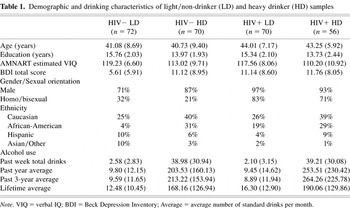
Alcohol consumption was measured with the Lifetime Drinking History (LDH; Skinner & Sheu, 1982; Sobell et al., 1988), a structured clinician-administered interview. The LDH defines a standard drink as 12 oz beer, 5 oz wine, 1.5 oz liquor, or 3 oz fortified wine, all of which contain approximately 13.6 g absolute alcohol (Skinner & Sheu, 1982). Demographic characteristics and drinking indices of the groups are presented in Table 1. At the time of the NP assessment, additional questions were administered pertaining to number of days on which alcohol was consumed during the week prior to the assessment as well as number of drinks per occasion during the past week, in order to obtain additional information on more recent drinking.
Demographic and drinking characteristics of light/non-drinker (LD) and heavy drinker (HD) samples

Psychiatric exclusions included history of delirium or dementia disorders (not including HIV− Associated Dementia); non-alcohol substance dependence within the past 12 months; schizophrenia or other psychotic disorders; bipolar disorders; current (past month) manic, mixed, or hypomanic episodes; current severe primary depression or current depression with psychotic features. All psychiatric diagnoses were assessed using the Structured Clinical Interview for DSM–IV (SCID; American Psychiatric Association, 1994; First et al., 1996). Additional detailed information on past substance dependence was gathered in a subgroup of 208 participants (78% of the sample). Subjects not fluent in English were excluded. Exclusion criteria included subject report of past significant head trauma. A history of head trauma resulting in loss of consciousness (LOC) equal to or greater than 24 hours was judged a priori as basis for exclusion. Furthermore, any reported history of head trauma with less than a 24-hour period of LOC but resulting in other more persistent neurologic sequelae was also a basis for exclusion. Other medical/surgical exclusion criteria included CNS neurosurgical procedures; insulin-dependent diabetes; history of cerebro-vascular accident (CVA) or intracerebral hemorrhage, brain tumor, or encephalitis; uncontrolled hypertension (SBP > 170 or DBP > 120) or history of hospital admission for hypertension; Wernicke-Korsakoff syndrome; evidence of end-stage liver disease; opportunistic CNS infection or malignancy; change in ART less than three months prior to screening; or participation in an HIV vaccination study less than one month prior to screening.
The HIV+ sample was significantly older than the HIV− sample [F(1, 267) = 8.02, p < .005), with slightly lower verbal intelligence quotient (IQ) (VIQ), as estimated from the AMNART score and level of educational attainment [F(1, 248) = 4.2, p < .05]. The HD group was significantly less educated than the LD group [F(1, 267) = 42.77, p < .001], and their estimated Verbal IQ was significantly lower [F(1, 248) = 33. 4, p < .001]. Compared to the HIV+ sample, the HIV− group contained a significantly higher proportion of female participants [χ2(1, 268) = 12.8, p < .001; see Table 1]. In contrast, the proportion of gay/bisexual participants was significantly higher in the HIV+ sample overall [χ2(1, 235) = 78.4, p < .001].
Ethnicity
African-Americans made up the largest group of minority ethnic participants in the study (20%), followed by Hispanics (7%). Representation of other minority ethnic groups was less than 3% in the overall sample (Asian-American, Native American, and Polynesian-Pacific Islander). The HD group contained a significantly higher proportion of African-American participants than the LD group [χ2(1, 233) = 11.7, p < .001]. The difference was primarily accounted for by a higher proportion of African-Americans in the HIV− HD sample (see Table 2). Seropositive and seronegative groups were balanced with regard to the proportion of African-Americans and the combined African-American and Hispanic participants, although there was a significantly higher proportion of African-Americans in the LD+ sample compared to the LD−.
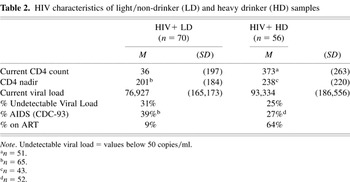
HIV characteristics of light/non-drinker (LD) and heavy drinker (HD) samples

Alcohol
Quantity of drinking during the week preceeding the evaluation was slightly lower than during comparable time periods in the preceeding 3-year period. There were no HIV × Alcohol group interactions with reference to alcohol use parameters (see Table 1).
Psychoactive substances and marijuana use
The HIV+ sample had higher rates of current treatment with prescribed psychoactive medication ([χ2 = 33.7, p < .001). Current marijuana use was also slightly higher in HIV+ sample overall (13% vs. 6%, χ2 = 4.1, p < .05). Rates of past substance dependence did not differ significantly in HIV+ and HIV− groups. LD and HD groups did not differ significantly in marijuana use or other psychoactive medication use. However, the HD group had higher rates of prior dependence on one or more of the following substances: cocaine, crack, heroin, methadone, methamphetamine, marijuana, or other drug. Other than marijuana, most commonly used past drugs of dependence were cocaine and methamphetamine. Rates of past clinical dependence on one or more of these drugs were 36% in HD versus. 13% in LD overall (χ2 = 15.84, p < .001).
HIV illness and treatment parameters
HIV/AIDS-related measures of peripheral viral load, CD4, and treatment are shown in Table 2. CDC Classification: Of the HIV+ LDs, 30% were CDC-93 class A, 24% class B, and 39% class C, compared to 41%, 25%, and 27% among the HIV+ HDs. CDC data was missing for five HIV+ LDs and four HIV+ HDs. ART: Ninety-one HIV+ participants (72%) were undergoing ART at the time of their involvement in this study (On-ART group). ART was defined as either mono- or dual-drug therapy with nucleoside reverse transcriptase inhibitors or combination therapy with at least one protease inhibitor. Thirty-one participants (25%) were not receiving treatment at the time of study (Untreated group), and treatment information was not available for four HIV+ subjects. Light and heavy drinking samples were balanced with respect to the proportions receiving treatment. The On-ART group had a history of lower CD4 count than the Untreated HIV+ group [CD4 nadir M = 177, SD = 174 vs. M = 334, SD = 218; F(1, 98) = 13.50, p < .001]. However, current CD4 was similar across ART and untreated samples (M = 367, SD = 216 vs. M = 409, SD = 245; p = ns). Viral Burden: Among the HIV+ participants with treatment information (n = 122), data concerning current plasma viral burden was available in 111 cases (88%). A significantly higher proportion of the On-ART group exhibited viral suppression (defined as viral load below 400 copies/ml) at the time of study participation: 44 of 83 participants (53%), contrasted with 4 of 28 participants (14%) among the Untreated group (χ2(1, 119) = 12.8, p < .001). This relationship of plasma viral suppression to ART was comparable across light and heavy drinking cohorts.
Self-reported mood
Beck Depression Inventory (BDI) total scores were significantly higher in HDs than LDs [F(1, 247) = 9.10, p < .01] and in the HIV+ compared to the HIV− sample [F(1, 247) = 9.20, p < .01]. Scores fell in the subclinical-to-mild range across all groups, a reflection of the exclusion criteria for the study, which restricted enrollment to individuals without current Major Depressive Disorder. There was a significant HIV x Alcohol interaction for BDI [F(1, 247) = 5.81, p < .05]. Post-hoc contrasts among the four study groups revealed that the HIV− LD group reported significantly lower BDI symptoms than each of the other groups, none of which differed significantly from each other.
Procedure
Potential participants underwent an initial telephone interview. Those who appeared to fit the LD or HD requirements and met no exclusionary criteria were scheduled for an intake interview, consisting of written informed consent, LDH, and SCID. The LDH obtains frequency and quantity of alcohol consumption from the first age of regular drinking (defined as at least once per month) to the present. LDH information was used to confirm inclusion as LD or HD, to characterize the drinking behavior of the samples, and to provide continuous measures of drinking severity for correlation with major outcome measures. The purpose of the SCID was to diagnose exclusionary psychiatric disorders not revealed at the time of the phone screen, as well as to record non-exclusionary mental disorders (e.g., alcohol abuse or dependence, panic disorder). The intake interview was conducted by clinicians holding graduate degrees in psychology under supervision of a licensed psychologist, and lasted one to three hours, depending on complexity of subject's drinking and psychological histories.
Neuropsychological measures
The NP test battery included standardized measures of multiple domains of cognitive and motor function, selected for their sensitivity to alcohol and HIV−associated NP impairment. General verbal intellectual functioning was assessed by the American version of the Nelson Adult Reading Task (AMNART; Grober & Sliwinski, 1991) and the Information subtest of the Wechsler Adult Intelligence Scale—Third Edition (WAIS–III; Wechsler, 1997). NP tests were grouped into the following domains on the basis of their theorized relation to more general NP constructs considered to be at risk in heavy drinkers and/or individuals with HIV−related cognitive deficits:
- Processing speed—Symbol Digit Modalities Test (Smith, 1973), Trail Making Test–Parts A and B (Reitan & Wolfson, 1985), Stroop Color and Word Test (Golden, 1978), Grooved Pegboard Test—dominant and non-dominant hands (Klove, 1963).
- Working memory—Brown-Peterson Auditory Consonant Trigrams number correct (Stuss et al., 1987), MicroCog Computerized Assessment of Cognitive Functioning Numbers Reversed total score (MC; Powell et al., 1993); Controlled Oral Word Association Test (COWAT; Benton & Hamsher, 1983).
- Visuospatial processing—Rey-Osterrieth Complex Figure Drawing Test Copy trial (Osterrieth & Rey, 1944) scored according to criteria set forth by Denman (1984) and the mental spatial rotation item (item 99) from the Luria-Nebraska Neuropsychological Battery (LNNB; Golden et al., 1985).
- Executive function—Short Category Test, Booklet Format errors (Wetzel & Boll, 1987); Computerized Wisconsin Card Sorting Test total errors (WCST; Heaton et al., 1993); MicroCog Timers 1 and 2 cued average reaction time (MC; Powell et al., 1993).
- Verbal learning and memory—California Verbal Learning Test Trials 1–5 total recall and long-delay free recall (CVLT; Delis et al., 1987), MicroCog Story immediate and delayed recall total scores.
- Visuospatial learning and memory—Brief Visuospatial Memory Test–Revised Trials 1–3 total recall and Delayed Recall (BVMT = R; Benedict, 1997); Rey-Osterrieth Complex Figure Drawing Delayed Recall trial.
- Motor balance—Fregly Graybiel Ataxia battery (Fregly & Graybiel, 1968; Sullivan et al., 2000). In the task used in the present study, the subject stands on one leg with eyes closed and has five trials to achieve 30 seconds of balance.
NP testing was completed within two weeks of intake. The NP battery was administered in one 3–4 hour session with a 5–10 minute break at midpoint and other breaks as needed. Subjects were asked to refrain from drinking for approximately 12 hours prior to testing, and zero-breath alcohol was confirmed via Breathalyzer. Information about alcohol and drug use in the 24 hours and week prior to testing was obtained at the time of NP assessment. Trained psychometrists administered the tests in a fixed order and according to standardized procedures.
On the day of testing, subjects also completed a medical exam and blood draw. Blood analysis included tests for HIV−1 antibody, liver functioning, CBC differential, CD4 count, HIV viral load, and, for HIV+ subjects with a viral load greater than 1000 copies/ml, viral genotyping for antiretroviral resistance. An infectious disease specialist physically examined all participants and obtained medical histories, including antiretroviral medications and CD4 nadir.
Subjects also completed the University of California San Francisco Center for AIDS Prevention Studies psychosocial questionnaire (unpublished) on the same day. The questionnaire contains a series of measures including the Beck Depression Inventory and other quality of life measures. Every seropositive participant who had taken antiretroviral medications was also surveyed regarding their medication adherence using a 12-item questionnaire surveying common reasons for HIV medication non-compliance (e.g., Wanted to avoid side effects, Simply forgot, Had a change in your daily routine). The 12 items were based on previous research examining reasons for HIV treatment non-adherence (Chesney, 2000). Subjects that had ever been prescribed HIV medications indicated how frequently each reason caused them to miss taking their medications. Possible responses were 0 (Never), 1 (Rarely), 2 (Sometimes), and 3 (Often). A medication adherence fraction, was calculated as: 1− (sum of 12 responses/36), with 0 as maximum non-adherence and 1 as maximum compliance.
Statistical Considerations
The main study hypotheses concerning HIV and alcohol main effects and interactions were examined with multivariate analyses of covariance (MANCOVA), with groups of related NP test scores as dependent variables, and adjusting linearly for age and estimated baseline verbal intellectual ability as derived from the AMNART and level of educational achievement (Grober & Sliwinski, 1991). Subsequently, the individual univariate analyses of covariance (ANCOVA) were examined for results pertaining to specific NP measures. To reduce the risk of Type I error, univariate analyses were considered only for groups of variables that showed significant effects in multivariate analyses. Finally, paired-comparison analyses were completed for variables showing significant group differences in univariate ANCOVA, in order to further evaluate specific group contrasts, with Bonferroni correction made to give an overall significance level of alpha = .05. The statistical package employed was SPSS-10.0 for Windows (SPSS; Chicago, IL).
RESULTS
Multivariate Analysis of Alcohol and HIV effects on NP function
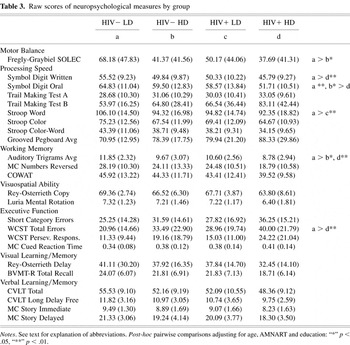
Mean raw scores and standard deviations are presented for each of the main study groups on individual NP tests in Table 3. Contrary to our hypothesis, multivariate analysis of covariance revealed no significant Alcohol (HD vs. LD) × HIV (seropositive vs. seronegative) interactions.
Raw scores of neuropsychological measures by group

Alcohol:
Significant effects of Alcohol were noted in the domain of Working Memory [Hotelling's T(3, 235) = 3.09, p < .05], Motor Balance, as assessed by the Fregly Graybiel Ataxia Battery [Hotelling's T(2, 224) = 3.76, p < .05], and Executive Functioning [Hotelling's T(2, 232) = 5.35, p < 01]. The effects of Alcohol failed to reach statistical significance for Verbal Learning and Memory [Hotelling's T(4, 237) = .96, p = .43], Visuospatial Memory [Hotelling's T(3, 193) = .49, p = .69], and Processing Speed [Hotelling's, T(9, 229) = .990, p = .490].
HIV:
Significant effects of HIV were noted for measures in the Working Memory domain [Hotelling's T(3, 235) = 3.31, p < .05], and in Processing Speed [Hotelling's T(9, 229) = 2.32, p < .05]. Effects of HIV did not reach significance for Executive Functioning measures [Hotelling's T(3, 232) = 2.52, p = .082], or Motor -Balance [Hotelling's T(2, 224) = .532, p = .588], Verbal Learning and Memory [Hotelling's T(4, 237) = 1.65, p = .163], or Visuospatial Memory [Hotelling's T(3, 193) = .964, p = .411].
Univariate Analyses of Alcohol and HIV
Alcohol
ANCOVA revealed significant effects of alcohol on the Brown-Peterson Auditory Trigrams [F(1, 246) = 8.26, p < .005], and the WCST Total Errors [F(1, 241) = 8.34, p < .005], in addition to the effect on the Fregly-Graybiel Ataxia measure noted above. In each case lower performance was associated with heavy drinking.
HIV
Seropositive participants obtained lower scores on numerous measures of processing speed, including the Symbol Digit Written subtest [F(1, 247) = 7.03, p < .01], the Symbol Digit Oral subtest [F(1, 248) = 14.13, p < .001], Trail Making Test B [F(1, 248) = 6.79, p < .05], Stroop Word [F(1, 243) = 5.87, p < .05], and Stroop Color-Word trials [F(1, 243) = 6.18, p < .05], as well as on numerous measures of auditory working memory efficiency, including MicroCog Numbers Reversed Total Score [F(1, 245) = 4.97, p < .05], the COWAT [F(1, 247) = 4.24, p < .05], and a trend in the direction of lower scores on the Brown-Peterson Auditory Trigrams [F(1, 246) = 3.24, p < .10].
Individual Group Comparisons
In post-hoc pairwise comparisons applying Bonferroni correction and adjusting for age and AMNART-estimated IQ, the HIV− LD controls demonstrated significantly better performance than (1) the HIV− HD on the Fregly-Graybiel Ataxia measure (p < .05), (2) both HIV− HD and HIV+ HD on the Brown-Peterson Auditory Trigrams (p < .05 and p < .01 respectively), and (3) the HIV+ HD on Symbol Digit Substitution Test (Oral and Written trials, p < .01) and WCST Total errors (p < .01; see Table 3). The HIV− HD group also showed better performance than HIV+ HD on the Symbol Digit Substitution Oral trial (p < .05). Finally, the HIV− LD group obtained significantly better Stroop Word Reading scores than the HIV+ LD group (p < .01).
Effects of Very Heavy Current Drinking
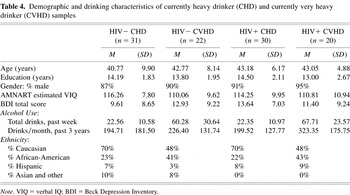
In order to further examine the possible adverse effects of heavier quantities of current drinking in interaction with the effect of HIV disease, we conducted the major analyses a second time after further stratifying the HD group into a Currently Heavy Drinking group (CHD, reporting an average of <6 drinks per occasion of drinking during the past week, n = 61), and a Currently Very Heavy Drinking group (CVHD, those reporting an average >6 drinks per occasion during the past week, n = 42).
Detailed demographic description of the CHD and CVHD groups are presented in Table 4. CHD and CVHD groups did not differ significantly in level of education, and both were significantly less educated than the LD. The two groups were comparable with regard to frequency (number of days) of drinking during the past week, with each reporting an average of five days of drinking during the seven-day period preceding NP assessment. The two groups were also similar in terms of approximate number of hours since last drink (Mean = 13.8, SD = 3.4). However, the CVHD group consumed an average of 9.8 (SD = 7.5) drinks during the 24 hours preceding testing, significantly greater quantities than the average of 4.8 (SD = 3.0) drinks for the CHD group during the same period. Rates of alcohol consumption over the past week were also significantly higher in the CVHD group (see Table 4). The CVHD also exhibited significantly higher rates of past dependence on other drugs of abuse, and higher rates of minority ethnic group representation. Table 5 shows group differences in HIV illness and treatment parameters as a function of this stratification by level of current alcohol consumption. The CVHD+ group also had slightly lower rate of treatment [χ2(1, 44) = 3.27, p = .07] and significantly higher rates of viremia [χ2(1, 40) = 5.01, p = .025].
Demographic and drinking characteristics of currently heavy drinker (CHD) and currently very heavy drinker (CVHD) samples

HIV characteristics of light/non-drinker (LD) and heavy drinker (CHD, CVHD, HD)

A 3 × 2 (3 Alcohol classifications × HIV) MANCOVA adjusting for age and AMNART revealed a significant HIV × Alcohol interaction in the domain of Processing Speed [Hotelling's T(16, 432) = 2.57, p = .001] but not other NP domains. Univariate ANCOVA adjusting for age and AMNART revealed significant HIV × Alcohol interaction on Trail Making Test Part A [F(2, 224) = 3.41, p < .05], Stroop Word Reading [F(2, 224) = 3.28, p < .05], and Grooved Pegboard [F(2, 237) = 10.01, p < .001; see Figure 1). Post-hoc pairwise comparisons analysis revealed that the 21 HIV+ CVHD participants showed significant NP impairment compared to every other group on Trail Making and Grooved Pegboard tests. After Bonferroni adjustment for multiple comparisons, the only significant difference was between HIV− LD and HIV+ CVHD (p < .05).

Effects of drinking and viral suppression on neuropsychological function. Note: Average z scores for individual NP tests (referenced to the mean and SD of the LD group) have been converted to T-scores for ease of presentation. Error bars represent standard deviations of the T-scores.
Supplementary Analyses
Effects of ART and viremia on processing speed
A 2 × 2 (Alcohol × ART) Univariate analysis of covariance revealed that the On-ART group displayed somewhat better performance than Untreated HIV+ on the Symbol Digit Oral Test [F(1, 111) = 5.03, p < .05] and Symbol Digit Written Test [F(1, 111) = 5.03, p < .05]. There was no evidence of ART × Alcohol (LD vs. HD) interaction in the seropositive group. Similarly, ANCOVA revealed significant effects of viral suppression on several measures of processing speed including performance with non-dominant hand on the Grooved Pegboard examination [F(1, 101) = 4.87, p < .05], Symbol Digit Oral [F(1, 101) = 4.74, p < .05], Stroop Color-Word Reading Trial [F(1, 101) = 5.05, p < .05], and the Brown Peterson Auditory Trigrams task [F(1, 101) = 4.58, p < .05]. There were no significant viremia × alcohol (LD vs. HD) interactions. Similar alcohol effects on NP function were observed in both suppressed and viremic subjects (see Figure 2).

Effects of HIV and very heavy current drinking on attention and motor control measures. Note: Error bars represent standard deviations.
Levels of drinking analysis in HIV seronegative participants
In post-hoc pairwise comparisons among the three levels of drinking within the HIV− sample, with adjustment for AMNART VIQ and Bonferroni correction, significantly lower scores were observed in the CVHD group compared with the LD group on the Fregly-Graybiel ataxia measure, on the WCST (Total Errors), and the Brown-Peterson Auditory Trigrams. Significantly lower performance was also observed in the CVHD compared to LD groups on the delayed story recall from the MicroCog Test, and on Trail Making Test B. After adjusting for AMNART VIQ, CHD differed from the LD group only on the Word [F(1, 129) = 4.90, p < .05], and Color [F(1, 129) = 4.88, p < .05] reading trials of the Stroop Test.
Additional analyses involving potential NP confounds
Univariate ANOVA repeated for each NP measure revealed that female participants in the HIV− sample performed significantly more poorly than males on measures of reaction time and Rey-Osterrieth Complex Figure Drawing delayed recall, and better on measures of verbal list learning. Exclusion of female participants from the analyses did not substantially affect the main study findings.
Given the substantial minority ethnic group representation within the HD sample and the potential for confounding of the main study findings by ethnicity, we also carried out a comparison of NP performance by ethnicity within the HD group to assess for potential confounding effects of our unbalanced recruitment of ethnic minorities, contrasting the Caucasian sample with the combined sample of African-American and Hispanic participants. African-American and Hispanic participants in the HD group were less well educated (p < .05) and scored lower on the AMNART (p < .01), a measure of reading vocabulary sometimes used to calculate estimated baseline or premorbid verbal intellectual ability. The African-American and Hispanic participants drank also more heavily (at >6 drinks per day) in the past week in our study (60% vs. 39%, χ2 = 4.13, p < .05). Previous research has suggested that in a mixed sample of African-Americans and Caucasians elderly study participants, adjustment for reading proficiency attenuates or eliminates differences in NP performance related to ethnicity (Manly et al., 2002). Because ethnicity was confounded with drinking severity and AMNART VIQ in our sample, we calculated a MANCOVA to assess effects of ethnicity on NP scores after adjustment for AMNART VIQ and current alcohol consumption (quantity consumed per occasion during the past week) within the HD sample (n = 100). We found that ethnicity did not account for significant additional variance on any NP measure.
Similarly, among members of the HD group, a history of past dependence on a substance other than alcohol was not associated with NP performance after adjusting for age and AMNART VIQ. Together these findings support the strategy of controlling for AMNART score and education in addition to age in all analyses related to our major study hypotheses.
Predictors of self-reported medication adherence in HIV
Self-reported adherence to ART was associated with higher current CD4 (rs = .40, p < .05) and lower viral load (rs = −.36, p < .05). Self-reported ART adherence was significantly lower in the HDs than the LDs [Mean = .68, SD = .22 vs. Mean = .78, SD = .14; F(1, 72) = 6.30, p < .05]. Lower BDI score (rs = −.45, p < .001) was also associated with more consistent medication adherence. Among the NP measures, only one significant association with self-reported medication adherence was observed. Participants who demonstrated an abnormal number of failures to maintain set on the Wisconsin Card Sorting Test (with abnormal defined as two or more, n = 24) also showed lower self-reported adherence than those with fewer than two failures to maintain set (n = 49) [Mean = .64, SD = .20 vs. Mean = .77, SD = .17; F(1, 72) = 13.01, p < .001]. Correlations between the remaining indices of executive function and memory and adherence failed to reach statistical significance.
DISCUSSION
The major findings of the present study were that (1) heavy drinking and HIV infection each demonstrate significant adverse effects on NP function, (2) very heavy current drinking and HIV infection showed synergistic adverse effects on aspects of motor and visuomotor functioning, and (3) heavy drinking, higher scores on a depression inventory, and lower performance on one measure of executive function were associated with reduced self-reported adherence to antiretroviral medication.
Effects of Alcohol, HIV, and Comorbidity on Neuropsychological Functioning
The first set of major findings concerned the individual and combined effects of HIV and alcohol. Generally, HIV and chronic heavy drinking failed to show clear synergistic effects across all NP domains. Nevertheless, the most robust group differences were noted in the contrast of the comorbid HIV+ HD group and the seronegative LD control group.
Heavy drinking showed robust effects on measures of working memory, balance, and executive function, and current very heavy (past week) drinking appeared especially detrimental to NP test performance. These observations are generally consistent with results of previous studies of heavy social drinkers, which suggest that NP decrements are more reliably noted when studies involve individuals drinking higher quantities (see Parsons & Nixon, 1998 and Parsons, 1998 for review).
HIV was associated with deficits in processing speed and auditory working memory. In supplementary analysis, ART was associated with better processing speed, and level of plasma viral burden appeared to be a significant predictor of HIV− associated NP decrements. Indeed HIV+ participants with viral suppression showed no statistically significant decrements relative to HIV− controls in the present study, although the scores of this group were generally lower than those of the controls. These findings are consistent with most previous studies since the advent of ART, which show benefit of viral suppression on cognition and low rates of severe cognitive impairment in clinically asymptomatic patients (Childs et al., 1999; Ellis et al., 2002; Margolin et al., 2002).
The results suggest that some areas of cognitive function (e.g., working memory) may be adversely affected by both heavy alcohol and HIV, but that there may be a greater effect of alcohol on measures of working memory, executive function, and motor balance, and a greater effect of HIV on processing speed. Greater-than additive effects were seen in the heaviest currently drinking HIV+ group on several measures of visual attention, motor dexterity, and speed (Trail Making Test A, Grooved Pegboard).
Together the findings suggests that co-occurring heavy alcohol consumption and HIV disease are associated with lower NP functioning than either factor alone, that the effects of HIV are greatest in those with viremia, and that acute very-heavy alcohol consumption (>6 drinks per day last week) and HIV may result in synergistic adverse effects on motor and visuomotor functioning. The results appear to corroborate previous research involving NP assessment (Durvasula et al., 2001), event-related potential (ERP) (Fein et al., 1995), and magnetic resonance spectroscopy (Meyerhoff et al., 1995) that all suggested additive or synergistic CNS effects of alcohol and HIV. Our results differ from an earlier neuropsychological study (Durvasula et al., 2001) in that we noted significant interaction between alcohol parameters and serostatus only at very heaviest current levels of alcohol consumption.
Correlates of Medication Adherence
Drinking severity, WCST failures-to-maintain-set, and higher Beck Depression Inventory scores were associated with self-reports of more frequent lapses in ART adherence. The WCST failure-to-maintain-set score assesses vulnerability to distraction during complex problem solving. The association of this WCST index with failures of adherence supports the view that cognitive dysfunction may contribute to lower medication adherence in everyday life (Hinkin et al., 2002; Selnes, 2002). The present findings contrast with Hinkin et al. (2002), who noted that global function and memory were associated with lower medication adherence, and with Avants et al. (2001), who found an association between lower Trail Making Test B performance and failures of adherence. Overall these findings suggest that subtle attentional vulnerability may be associated with self-report of adherence failures in a relatively high functioning HIV+ cohort.
General Discussion
The mechanisms whereby HIV+ heavy drinkers, especially those with higher plasma viral load, develop difficulties in NP functioning remain unclear. It has been suggested by previous investigators that cerebellar degeneration may contribute to difficulties in balance experienced by abstinent heavy drinkers (Sullivan et al., 2000). Results of previous NP investigations suggest that cerebellar dysfunction also contributes in important ways to timing and coordination of a variety of higher cognitive operations (Arroyo-Anllo & Botez-Marquard, 1998; Harris et al., 1999). Alcohol effects in motor balance and other domains observed in the current study may in part reflect cerebellar dysfunction, possibly in conjunction with more widely distributed mild cerebral dysfunction. In contrast, our HIV+ group showed greater difficulty in measures of processing speed, and viral burden in particular was associated with lower working memory. Earlier studies suggest that such decrements have a basis in lowered frontal or subcortical functioning in HIV (e.g., Hall et al., 1996). Based on the present findings, we speculate that HIV−associated subcortical dysfunction and alcohol-associated cerebellar and other cerebral dysfunction may combine to produce deficits affecting complex attention, working memory, and other tasks dependent on sequencing, timing, and motor control. Alternatively, or in addition, both alcohol and HIV infection have the potential to induce sensory and motor neuropathies, which could also affect performance on some of the same motor and visuomotor tasks. Furthermore, the cumulative and/or synergistic adverse effects of HD and HIV observed in seropositive individuals may be mediated in part by CNS morbidity associated with lower treatment adherence in heavy drinkers.
There are several limitations of the present study. First, sampling criteria excluded moderately drinking persons from participation in the study, which may limit generalizability of the present conclusions across the spectrum of community-residing active social drinkers not in treatment. However, the current findings suggest that synergistic effects of alcohol and HIV on NP function are unlikely in social drinkers with more moderate rates of alcohol consumption.
Second, although we utilized age and education as covariates in the current analysis, it is possible that the observed group differences were related to factors that were not fully controlled for. Covariance analysis has the potential to reduce variance that is also associated with such other factors, limiting interpretability (Adams et al., 1985). Unbalanced distribution in the rates of other substance use might also factor into the apparent additive effects of HIV and alcohol (Rippeth et al., 2004). Similarly, unbalanced distribution in rates of viremia and ART between HD+ and CVHD+ may have contributed to some of the significant interactions observed in this study. Furthermore, although liver function tests ruled out the presence of more severe liver disease, the rates of comorbid hepatitis C, which we did not formally assess, may not have been comparable across the main study groups, potentially accounting for some of the observed effects. Finally, recent reports suggested that gay men perform better than heterosexual men on some measures of verbal associative fluency (Rahman et al., 2003a) and lower on measures of visuospatial processing (Rahman et al., 2003b). Such an association of sexual orientation with cognitive functioning may mask certain HIV effects and interactions in our study and exaggerate others.
More generally, the mechanisms contributing to the observed group differences cannot be clearly established through a cross-sectional study. A further possible basis for the lower NP functioning in HIV+ HDs is lingering effects from previous CNS injury due to past alcoholic crises or HIV−related illness. Likewise it remains possible that the adverse effects seen in the CVHDs were mediated by subclinical withdrawal symptoms or hangover effects (Yesavage & Leirer, 1986; Wiese et al., 2000). Alcohol withdrawal may include mild to moderate clouding of sensorium, tremor and restlessness, nausea, anxiety, headache, and sensitivity to noise and light. Although these symptoms were not explicitly reported by participants at testing nor generally noted by the tester, they could potentially contribute to lower cognitive functioning in some active heavy drinkers.
Future Directions
Studies examining NP correlation with neuroimaging and utilizing quantitative measures of subclinical withdrawal are needed to refine theories of potential mechanisms of neurocognitive decrement in actively drinking HIV− infected persons. Longitudinal studies are also needed to more firmly establish additive effects and synergy involving HIV infection and heavy drinking, and to determine if NP morbidity is cumulative and progressive in the context of continued heavy drinking in HIV disease. Finally, objective assessment of day-to-day variation in ART adherence and level of regimen complexity are needed in conjunction with longitudinal assessment of NP functioning, drinking, and other health-related parameters, in order to examine the relationships among these variables and such outcomes as drug resistance and increasing viral burden in HIV infection.
ACKNOWLEDGMENTS
This manuscript is dedicated to the memory of Linda Rogers, Ph.D. (1946–2003). This research was supported by NIAAA PO1 11493. We would like to acknowledge John Kornak for his helpful suggestions concerning the statistical methods, and Dr. George Fein, the initial PI on this program project. We would also like to acknowledge three anonymous reviewers for their helpful suggestions.
References
REFERENCES
Adams, K.M.,
Brown, G.G., &
Grant, I.
(1985).
Analysis of covariance as a remedy for demographic mismatch of
research subject groups: Some sobering simulations.
Journal of Clinical and Experimental Neuropsychology,
7,
445–462.Google Scholar
Adams, K.M.,
Grant, I., &
Reed, R.
(1980).
Neuropsychology in alcoholic men in their late thirties: One-year
follow-up.
American Journal of Psychiatry,
137,
928–931.Google Scholar
American Psychiatric Association
(1994).
Diagnostic and Statistical Manual of Mental Disorders
(4th ed.).
Washington, DC:
American Psychiatric Association Press.
Arroyo-Anllo, E.M. &
Botez-Marquard, T.
(1998).
Neurobehavioral dimensions of olivopontocerebellar atrophy.
Journal of Clinical and Experimental Neuropsychology,
20,
52–59.Google Scholar
Avants, S.K.,
Margolin, A.,
Warburton, L.A.,
Hawkins, K.A., &
Shi, J.
(2001).
Predictors of non-adherence to HIV−related medication
regimens during methadone stabilization.
The American Journal on Addictions,
10,
69–78.Google Scholar
Benedict, R.H.B.
(1997).
Brief Visuospatial Memory Test–Revised: Professional Manual.
Odessa, FL:
Psychological Assessment Resources.
Benton, A.L. &
Hamsher, K.
(1983).
Multilingual Aphasia Examination.
Iowa City, IA:
AJA Associates.
Bornstein, R.A.,
Fama, R.,
Rosenberger, P.,
Whitacre, C.C.,
Para, M.F., &
Nasrallah, H.A.
(1993).
Drug and alcohol use and neuropsychological performance in
asymptomatic HIV infection.
Journal of Neuropsychiatry and Clinical Neuroscience,
5,
254–259.Google Scholar
Brandt, J.,
Butters, N.,
Ryan, C., &
Bayog, R.
(1983).
Cognitive loss and recovery in long-term alcohol abusers.
Archives of General Psychiatry,
40,
435–442.Google Scholar
Chesney, M.A.
(2000).
Factors affecting adherence to antiretroviral therapy.
Clinical Infectious Diseases,
30 (Suppl. 2),
S171–176.Google Scholar
Childs, E.A.,
Lyles, R.H.,
Selnes, O.A.,
Chen, B.,
Miller, E.N.,
Cohen, B.A.,
Becker, J.T.,
Mellors, J., &
McArthur, J.C.
(1999).
Plasma viral load and CD4 lymphocytes predict HIV−associated
dementia and sensory neuropathy.
Neurology,
52,
607–613.Google Scholar
Clifford, D.B.,
Jacoby, R.G.,
Miller, J.P.,
Seyfried, W.R., &
Glicksman, M.
(1990).
Neuropsychometric performance of asymptomatic HIV− infected
subjects.
AIDS,
4,
767–774.Google Scholar
Cook, R.L.,
Sereika, S.M.,
Hunt, S.C.,
Woodward, W.C.,
Erlen, J.A., &
Conigliaro, J.
(2001).
Problem drinking and medication adherence among persons with HIV
infection.
Journal of General Internal Medicine,
16,
83–88.Google Scholar
Delis, D.C.,
Kramer, J.H.,
Kaplan, E., &
Ober, B.A.
(1987).
The California Verbal Learning Test.
NY:
The Psychological Corporation.
Denman, S.
(1984).
Denman Neuropsychology Memory Scale.
Charleston, SC
(privately published).
Deutsch, R.,
Ellis, R.J.,
McCutchan, A.,
Marcotte, T.D.,
Letendre, S.,
Grant, I., &
the HNRC Group
(2001).
AIDS—associated mild neurocognitive impairment is delayed in
the era of highly active antiretroviral therapy (HAART).
AIDS,
15,
1898–1899.Google Scholar
Durvasula, R.S.,
Miller, E.N.,
Myers, H.F., &
Wyatt, G.E.
(2001).
Predictors of neuropsychological performance in HIV positive women.
Journal of Clinical and Experimental Neuropsychology,
23,
149–163.Google Scholar
Eckardt, M.J.,
Stapleton, J.M.,
Rawlings, R.R.,
Davis, E.Z., &
Grodin, D.M.
(1995).
Neuropsychological function in detoxified alcoholics between 18 and
35 years of age,
American Journal of Psychiatry,
152,
53–59.Google Scholar
Ellis, R.J.,
Moore, D.J.,
Childers, M.E.,
Letendre, S.,
McCutchan, J.A.,
Wolfson, T.,
Spector, S.A.,
Hsia, K.,
Heaton, R.K., &
Grant, I.
(2002).
Progression to neuropsychological impairment in human
immunodeficiency virus infection predicted by elecated cerebrospinal
fluid levels of human immunodeficiency virus RNA.
Archives of Neurology,
59,
923–928.Google Scholar
Fein, G.,
Biggins, C.A., &
MacKay, S.
(1995).
Alcohol abuse and HIV infection have additive effects on frontal
cortex function as measured by auditory evoked potential P3A
latency.
Biological Psychiatry,
38,
343–344.Google Scholar
First, M.B.,
Spitzer, R L.,
Williams, J.B.W., &
Gibbon, M.
(1996).
Structured Clinical Interview for DSM–IV (SCID-I).
New York:
New York State Psychiatric Institute, Biometrics Research.
Fregly, A.R. &
Graybiel, A.
(1968).
An ataxia test battery not requiring rails.
Aerospace Medicine,
39,
277–282.Google Scholar
Gibbs, A.,
Andrewes, D.G.,
Szmukler, G.,
Mulhall, B., &
Bowden, S.C.
(1990).
Early HIV-related neuropsychological impairment: Relationship to
stage of viral infection.
Journal of Clinical and Experimental Neuropsychology,
12,
766–780.Google Scholar
Golden, C.J.
(1978).
Stroop Color and Word Test.
Chicago, IL:
Stoelting Company.
Golden, C.J.,
Purish, A.D., &
Hammeke, T.A.
(1985).
Luria-Nebraska Neuropsychological Battery: Forms I and II: Manual.
Los Angeles, CA:
Western Psychological Services.
Goldman, M.S.,
Williams, D.L., &
Klisz, D.K.
(1983).
Recoverability of psychological functioning following alcohol
abuse: Prolonged visual-spatial dysfunction in older alcoholics.
Journal of Consulting and Clinical Psychology,
51,
370–378.Google Scholar
Golin, C.E.,
Liu, H.,
Hays, R.D.,
Miller, L.G.,
Beck, C.K.,
Ickovics, J.,
Kaplan, A.H., &
Wenger, N.S.
(2002).
A prospective study of predictors of adherence to combination
antiretroviral medication.
Journal of General Internal Medicine,
17,
812–813.Google Scholar
Gordillo, V.,
del Amo, J.,
Soriano, V., &
Gonzalez-Lahoz, J.
(1999).
Sociodemographic and psychological variables influencing adherence
to antiretroviral therapy.
AIDS,
13,
1763–1769.Google Scholar
Grant, I.
(1987).
Alcohol and the brain: Neuropsychological correlates.
Journal of Consulting and Clinical Psychology,
55,
310–324.Google Scholar
Grant, I.,
Adams, K.M., &
Reed, R.
(1984).
Aging, abstinence, and medical risk factors in the prediction of
neuropsychologic deficit among long-term alcoholics.
Archives of General Psychiatry,
41,
710–718.Google Scholar
Green, J.E.,
Saveanu, R.V., &
Bornstein, R.A.
(2004).
The effect of previous alcohol abuse on cognitive functioning in
HIV infection.
American Journal of Psychiatry,
161,
249–254.Google Scholar
Grober, E. &
Sliwinski, M.
(1991).
Development and validation of a model for estimating premorbid
verbal intellegence in the elderly.
Journal of Clinical and Experimental Neuropsychology,
13,
933–949.Google Scholar
Hall, M.,
Whaley, R.,
Robertson, K., &
Hamby, S.
(1996).
The correlation between neuropsychological and neuroanatomic
changes over time in asymptomatic and symptomatic HIV-1-infected
individuals.
Neurology,
46,
1697–1702.Google Scholar
Hammer, S.M.,
Squires, K.E.,
Hughes, M.D.,
Grimes, J.M.,
Demeter, L.M.,
Currier, J.S.,
Eron, J.J., Jr.,
Feinberg, J.E.,
Balfour, H.H., Jr.,
Deyton, L.R.,
Chodakewitz, J.A., &
Fischl, M.A.
(1997).
A controlled trial of two nucleoside analogues plus indinavir in
persons with human immunodeficiency virus infection and CD4 cell counts
of 200 per cubic millimeter or less. AIDS Clinical Trials Group 320
Study Team.
New England Journal of Medicine,
337,
725–733.Google Scholar
Harris, N.S.,
Courchesne, E.,
Townsend, J.,
Carper, R.A., &
Lord, C.
(1999).
Neuroanatomic contributions to slowed orienting of attention in
children with autism.
Cognitive Brain Research,
8,
61–71.Google Scholar
Hartman, D.E.
(1995),
Neuropsychological toxicology: Identification and assessment of
human neurotoxic syndromes
(2nd ed.).
New York:
Plenum Press.
Heaton, R.K.,
Chelune, G.J.,
Talley, J.L.,
Kay, G.G., &
Curtiss, G.
(1993).
Wisconsin Card Sorting Test Manual.
Lutz, FL:
Psychological Assessment Resources, Inc.
Heaton, R.K.,
Grant, I.,
Butters, N.,
White, D.A.,
Kirson, D.,
Atkinson, J.H.,
McCutchan, J.A.,
Taylor, M.J.,
Kelly, M.D.,
Ellis, R.J.,
Wolfson, T.,
Velvin, R.,
Marcotte, T.D.,
Hesselink, J.R.,
Jernigan, T.L.,
Chandler, J.,
Wallace, M.,
Abramson, I., &
Group, H.
(1995).
The HNRC 500—neuropsychology of HIV infection at different
disease stages. HIV Neurobehavioral Research Center.
Journal of the International Neuropsychological Society,
1,
231–251.Google Scholar
Hinkin, C.H.,
Castellon, S.A.,
Durvasula R.S., Hardy D.J.,
Lam, M.N.,
Mason, K.I.,
Thrasher, D.,
Goetz, M.B., &
Stefaniak, M.
(2002).
Medication adherence among HIV+ adults.
Neurology,
59,
1944–1950.Google Scholar
Horner, M.D.,
Waid, L.R.,
Johnson, D.E.,
Latham, P.K., &
Anton, R.F.
(1999).
The relationship of cognitive functioning to amount of recent and
lifetime alcohol consumption in outpatient alcoholics.
Addictive Behaviors,
24,
449–453.Google Scholar
Howard, A.A.,
Arnsten, J.H.,
Lo, Y.,
Vlahov D., Rich J.D.,
Schuman P., Stone V.E.,
Smith, D.K.,
Schoenbaum, >E.E., &
the HER Study Group.
(2002).
A prospective study of adherence and viral load in a large
multi-center cohort of HIV−infected women.
AIDS,
16,
2175–2182.Google Scholar
Janssen, R.S.,
Saykin, A.J.,
Cannon, L.,
Campbell, J.,
Pinsky, P.F.,
Hessol, N.A.,
O'Malley, P.M.,
Lifson, A.R.,
Doll, L.S.,
Rutherford, G.W., &
Kaplan, J.E.
(1989).
Neurological and neuropsychological manifestations of HIV−1
infection: Association with AIDS-related complex but not asymptomatic
HIV−1 infection.
Annals of Neurology,
26,
592–600.Google Scholar
Klove, H.
(1963).
Clinical neuropsychology.
Medical Clinics of North America,
47,
1647–1658Google Scholar
Lunn, S.,
Skydsbjerg, M.,
Schulsinger, H.,
Parnas, J.,
Pedersen, C., &
Mathiesen, L.
(1991).
A preliminary report on the neuropsychologic sequelae of human
immunodeficiency virus.
Archives of General Psychiatry,
48,
139–142.Google Scholar
Manly, J.J.,
Jacobs, D.M.,
Touradji, P.,
Small, S.A., &
Stern, Y.
(2002).
Reading level attenuates differences in neuropsychological test
performance between African American and White elders.
Journal of the International Neuropsychological Society,
8,
341–348.Google Scholar
Mann, K.,
Gunther, A.,
Stetter, F., &
Ackerman K.
(1999).
Rapid recovery from cognitive deficits in abstinent alcoholics: A
controlled test–retest study.
Alcohol and Alcoholism,
34,
567–574.Google Scholar
Margolin, A.,
Avants, S.K.,
Warburton, L.A., &
Hawkins, K.A.
(2002).
Factors affecting cognitive functioning in a sample of human
immunodeficiency virus-positive injection drug users.
AIDS Patient Care and STDs,
16,
255–267.Google Scholar
Martin, P.R.,
Adinoff, B.,
Weingarther, H.,
Mukherjee, A.B., &
Eckart, M.J.
(1986).
Alcoholic organic brain disease: Nosology and pathophysiologic
mechanisms.
Progress in Neuro-Psychopharmacology and Biological Psychiatry,
10,
147–164.Google Scholar
Maschke, M.,
Kastrup, O.,
Esser, S.,
Ross, B.,
Hengge, U., &
Hufnagel, A.
(2000).
Incidence and prevalence of neurological disorders associated with
HIV since the introduction of highly active antiretroviral therapy
(HAART).
Journal of Neurology, Neurosurgery and Psychiatry,
69,
376–380.Google Scholar
Meyerhoff, D.J.
(2001).
Examining the link between alcohol and HIV/AIDS: Studies of
CNS effects.
Alcohol Research & Health,
25(4),
288–298.Google Scholar
Meyerhoff, D.J.,
MacKay, S.,
Sappey-Marinier, D.,
Deicken, R.,
Calabrese, G.,
Dillon, W.P.,
Weiner, M.W., &
Fein, G.
(1995).
Effects of chronic alcohol abuse and HIV infection on brain
phosphorus metabolites.
Alcoholism, Clinical and Experimental Research,
19,
685–692.Google Scholar
Nieuwkerk, P.T.,
Sprangers, M.A.,
Burger, D.M.,
Hoetelmans, R.M.,
Hugen, P.W.,
Danner, S.A.,
van Der Ende, M.E.,
Schneider, M.M.,
Schrey, G.,
Meenhorst, P.L.,
Sprenger, H.G.,
Kauffmann, R.H.,
Jambroes, M.,
Chesney, M.A.,
de Wolf, F., &
Lange, J.M.
(2001).
Limited patient adherence to highly active antiretroviral therapy
for HIV−1 infection in an observational cohort study.
Archives of Internal Medicine,
161,
1962–1968.Google Scholar
Osterrieth, P. &
Rey, A.
(1944).
Le test de copie d'une figure complex.
Archives de Psychologie,
30,
205–221.Google Scholar
Parsons, O.A.
(1998).
Neurocognitive deficits in alcoholics and social drinkers: A
continuum?
Alcoholism: Clinical and Experimental Research,
22,
954–961.Google Scholar
Parsons, O.A. &
Nixon, S.J.
(1998).
Cognitive functioning in sober social drinkers: A review of the
research since 1986.
Journal of Studies on Alcohol,
59,
180–190.Google Scholar
Paterson, D.L.,
Swindells, S.,
Mohr, J.,
Brester, M.,
Vergis, E.N.,
Squier, C.,
Wagener, M.M., &
Singh, N.
(2000).
Adherence to protease inhibitor therapy and outcomes in patients
with HIV infection.
Annals of Internal Medicine,
133,
21–30.Google Scholar
Petry, N.M.
(1999).
Alcohol use in HIV patients: What we don't know may hurt us.
International Journal of STDs and AIDS,
10,
561–570.Google Scholar
Pfefferbaum, A.,
Rosenbloom, M., &
Sullivan, E.V.
(2002).
Alcoholism and AIDS: Magnetic resonance imaging approaches for
detecting interactive neuropathology.
Alcoholism, Clinical and Experimental Research,
26,
1031–1046.Google Scholar
Poutiainen, E.,
Elovaara, I.,
Raininko, R.,
Hokkanen, L.,
Valle, S.L.,
Lahdevirta, J., &
Iivanainen, M.
(1993).
Cognitive performance in HIV−1 infection: Relationship to
severity of disease and brain atrophy.
Acta Neurologica Scandinavica,
87 (2),
88–94.Google Scholar
Powell, D.H.,
Kaplan, E.F.,
Whitla, D.,
Weinstraub, S.,
Catlin, R., &
Funkenstein, H.H.
(1993).
MicroCog: Assessment of Cognitive Functioning.
San Antonio, TX:
The Psychological Corporation.
Rahman, Q.,
Abrahams, S., &
Wilson, G.D.
(2003a).
Sexual orientation-related differences in verbal fluency.
Neuropsychology,
17,
240–246.Google Scholar
Rahman, Q.,
Wilson, G.D., &
Abrahams, S.
(2003b).
Sexual orientation related differences in spatial memory.
Journal of the International Neuropsychological Society,
9,
376–383.Google Scholar
Reger, M.,
Welsh, R.,
Razani, J.,
Martin, D.J., &
Boone, K.B.
(2002).
A meta-analysis of the neuropsychological sequelae of HIV
infection.
Journal of the International Neuropsychological Society,
8,
410–424.Google Scholar
Reitan, R.M. &
Wolfson, D.
(1985).
The Halstead-Reitan Neuropsychological Test Battery: Theory and
Interpretation.
Tucson, AZ:
Neuropsychological Press.
Rippeth, J.D.,
Heaton, R.K.,
Carey, C.L.,
Marcotte, T.D.,
Moore, D.J.,
Gonzalez, R.,
Wolfson, T.,
Grant, I., &
The HNRC Group.
(2004).
Methamphetamine dependence increases risk of neuropsychological
impairment in HIV infected persons.
Journal of the International Neuropsychological Society,
10,
1–14.Google Scholar
Sacktor, N.C.,
Lyles, R.H.,
Skolasky, R.L.,
Anderson, D.E.,
McArthur, J.C.,
McFarlane, G.,
Selnes, O.A.,
Becker, J.T.,
Cohen, B.,
Wesch, J., &
Miller, E.N.
(1999).
Combination antiretroviral therapy improves psychomotor speed
performance in HIV-seropositive homosexual men.
Neurology,
52,
1640–1647.Google Scholar
Sacktor, N.C.,
McDermott, M.P.,
Marder, K.,
Schifitto, G.,
Selnes, O.A.,
McArthur, J.C.,
Stern, Y.,
Palumbo, A.S.,
Kieburtz, K.,
DeMarcaida, J.A.,
Cohen, B.,
Epstein, L.
(2002).
HIV-associated cognitive impairment before and after the advent of
combinaton therapy.
Journal of Neurovirology,
8,
136–142.Google Scholar
Safren, S.A.,
Otto, M.W.,
Worth, J.L.,
Salomon, E.,
Johnson, W.,
Mayer, K., &
Boswell, S.
(2001).
Two strategies to increase adherence to HIV antiretroviral
medication: Life-Steps and medical monitoring.
Behaviour Research and Therapy,
39,
1151–1162.Google Scholar
Schuman, P.,
Ohmit, S.E.,
Cohen, M.,
Sacks, H.S.,
Richardson, J.,
Young, M.,
Schoenbaum, E.,
Rompalo, A.,
Gardner, L.
(2001).
Prescription of and adherence to antriretroviral therapy among
women with AIDS.
AIDS and Behavior,
5,
371–378.Google Scholar
Selnes, O.A.
(2002).
Neurocognitive aspects of medication adherence in HIV infection.
Journal of Acquired Immune Deficiency Syndromes,
31
(Suppl. 3),
S132–135.Google Scholar
Singh, N.,
Squier, C.,
Sivek, C.,
Wagener, M.,
Nguyen, M.H., &
Yu, V.L.
(1996).
Determinants of compliance with antiretroviral therapy in patients
with human immunodeficiency virus: Prospective assessment with
implications for enhancing compliance.
AIDS Care,
8,
261–269.Google Scholar
Skinner, H.A. &
Sheu, W.J.
(1982).
Reliability of alcohol use indices. The lifetime drinking history
and the MAST.
Journal of Studies on Alcohol,
43,
1157–1170.Google Scholar
Smith, A.
(1973).
Symbol Digit Modalities Test.
Los Angeles, CA:
Western Psychological Services.
Sobell, L.C.,
Sobell, M.B.,
Riley, D.M.,
Schuller, R.,
Pavan, D.S.,
Cancilla, A.,
Klajner, F., &
Leo, G.I.
(1988).
The reliability of alcohol abusers' self-reports of drinking
and life events that occurred in the distant past.
Journal of Studies on Alcohol,
49(3),
225–232.Google Scholar
Spire, B.,
Duran, S.,
Suoville, M.,
Leport, C.,
Raffi, F.,
Moatti, J.P., &
APROCO cohort study group.
(2002).
Adherence to highly active antiretroviral therapies (HAART) in
HIV-infected patients: From a predictive to a dynamic approach.
Social Science and Medicine,
54,
1481–1496.Google Scholar
Starace, F.,
Ammassari, A.,
Trotta, M.P.,
DeLongis, P.,
Izzo, C.,
Scalzini, A.,
d'Arminio Monforte, A.,
Wu, A.W., &
Antinori, A.
(2002).
Depression is a risk factor for suboptimal adherence to highly
active antiretroviral therapy.
Journal of Acquired Immune Deficiency Syndromes,
31
(Suppl. 3),
S136–139.Google Scholar
Stuss, D.T.,
Stethem, L.L., &
Poirier, C.A.
(1987).
Comparison of three tests of attention and rapid information
processing across six age groups.
The Clinical Neuropsychologist
1,
139–152.Google Scholar
Sullivan, E.V.,
Deshmukh, A.,
Desmond, J.E.,
Lim, K.O., &
Pfefferbaum, A.
(2000).
Cerebellar volume decline in normal aging, alcoholism, and
Korsakoff's syndrome: Relation to ataxia.
Neuropsychology,
14,
341–352.Google Scholar
Sullivan, E.V.,
Desmond, J.E.,
Lim, K.O., &
Pfefferbaum, A.
(2002).
Speed and efficiency but not accuracy or timing deficits of limb
movements in alcoholic men and women.
Alcoholism, Clinical and Experimental Research,
26,
705–713.Google Scholar
Tarbox, A.R.,
Connors, G.J., &
McLaughlin, E.J.
(1986).
Effects of drinking pattern on neuropsychological performance among
alcohol misusers.
Journal of Studies on Alcohol,
47,
176–179.Google Scholar
Wechsler, D.
(1997).
Wechsler Adult Intelligence Scale— Third Edition.
San Antonio, TX:
The Psychological Corporation.
Wetzel, L. &
Boll, T.
(1987).
Short Category Test, Booklet Format.
Los Angeles, CA:
Western Psychological Services.
Wiese, J.G.,
Shlipak, M.G., &
Browner, W.S.
(2000).
The alcohol hangover.
Annals of Internal Medicine,
132,
897–902.Google Scholar
Wilkinson, D.A. &
Carlen, P.L.
(1981).
Chronic organic brain syndromes associated with alcoholism:
Neuropsychological and other aspects. In
Y. Israel,
F. Glaser,
H. Kalant,
R. E. Popham,
W. Schmidt, &
G. Smart (Eds.),
Research advances in alcohol and drug problems, Vol. 6 (pp.
107–145).
New York:
Plenum.
Yesavage, J.A. &
Leirer, V.O.
(1986).
Hangover effects on aircraft pilots 14 hours after alcohol
ingestion: A preliminary report.
American Journal of Psychiatry,
143,
1546–1550.Google Scholar
Zuccala, G.,
Onder, G.,
Pedone, C.,
Cesari, M.,
Landi, F.,
Bernabei, R., &
Cocchi, A.
(2001).
Dose-related impact of alcohol consumption on cognitive function in
advanced age: Results of a multicenter survey.
Alcoholism, Clinical and Experimental Research,
25,
1743–1748.Google Scholar
Demographic and drinking characteristics of light/non-drinker (LD) and heavy drinker (HD) samples
HIV characteristics of light/non-drinker (LD) and heavy drinker (HD) samples
Raw scores of neuropsychological measures by group
Demographic and drinking characteristics of currently heavy drinker (CHD) and currently very heavy drinker (CVHD) samples
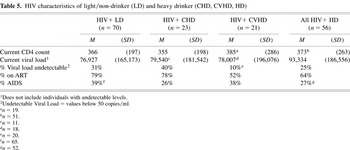
HIV characteristics of light/non-drinker (LD) and heavy drinker (CHD, CVHD, HD)
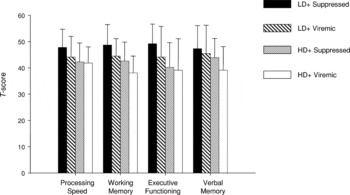
Effects of drinking and viral suppression on neuropsychological function. Note: Average z scores for individual NP tests (referenced to the mean and SD of the LD group) have been converted to T-scores for ease of presentation. Error bars represent standard deviations of the T-scores.
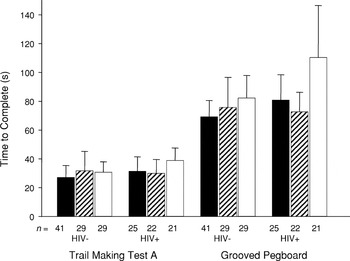
Effects of HIV and very heavy current drinking on attention and motor control measures. Note: Error bars represent standard deviations.
 You have
Access
- 78
- Cited by