Introduction
Specialization is considered a critical criterion for classifying predator or parasitoid species as candidates for biological control, given that risk to non-target species, apparent competition, and competitive exclusion are expected to be minimal in specialized organisms (Dixon, Reference Dixon2000; Van Lenteren et al., Reference Van Lenteren, Bale, Bigler, Hokkanen and Loomans2006). Furthermore, specialized predators are expected to display higher efficacy than generalist predators as the former usually have higher prey searching ability and voracity (Dixon, Reference Dixon2000). Still, dietary specialization of predators is often conditioned to the availability of prey in time and space (Hodek & Honěk, Reference Hodek and Honěk1996; Abrams & Ginzburg, Reference Abrams and Ginzburg2000). Specialized predators are usually restricted to the prey's habitat, and their life cycles are often synchronized (Dixon, Reference Dixon2000; Sloggett & Majerus, Reference Sloggett and Majerus2000).
Processes of ecological specialization in insects have been well studied in herbivorous species, with special attention paid to herbivore–plant interactions and associated co-evolutionary processes (Thompson, Reference Thompson1995; Funk et al., Reference Funk, Filchak and Feder2002; Scriber, Reference Scriber2010). Specialization in parasites, parasitoids, and predators has also been regularly studied from an evolutionary perspective and for practical biological control purposes (Bristow, Reference Bristow1988; Strand & Obrycki, Reference Strand and Obrycki1996; Wiegmann et al., Reference Wiegmann, Mitter and Farrell1996; Dixon, Reference Dixon2000; Diehl et al., Reference Diehl, Sereda, Wolters and Birkhofer2013). Studies on the specialization of arthropod predators cover a large range of orders such as Coleoptera, Diptera, Hemiptera, and Araneae (e.g., Pekár, Reference Pekár2004; Short & Bergh, Reference Short and Bergh2004; Jackson et al., Reference Jackson, Salm and Nelson2010; Jałoszyński & Olszanowski, Reference Jałoszyński and Olszanowski2013; Vieira et al., Reference Vieira, Salom, Montgomery and Kok2013).
Within Coleoptera, the species studied most often are Coccinellidae (Obrycki & Kring, Reference Obrycki and Kring1998). Predaceous ladybirds show variable degrees of specialization, and have been widely used in biological control programs (Dixon, Reference Dixon2000). An example of the importance played by specialization in the suitability of a biological control is the contrast between the two species Harmonia axyridis Pallas and Rodolia cardinalis Mulsant. The first of the two is a generalist predator, which has been released to control aphids in Europe and North America, with negative impacts on native fauna, whereas the second species, which is coccidophagous, has provided highly targeted control of Icerya purchasi Maskell (Hemiptera: Monophlebidae) in California and Europe (Caltagirone & Doutt, Reference Caltagirone and Doutt1989; Koch & Galvan, Reference Koch, Galvan, Roy and Wajnberg2008; Katsanis et al., Reference Katsanis, Babendreier, Nentwig and Kenis2013).
In this study, we considered the predaceous ladybird Iberorhyzobius rondensis Eizaguirre (subfamily Coccidulinae) as a potential biological control agent of the pine bast scale Matsucoccus feytaudi Ducasse (Hemiptera: Matsucoccidae). Matsucoccus feytaudi is an extremely specialized scale insect which only feeds on maritime pine, Pinus pinaster Aiton. The native range of this insect species is restricted to the Southwestern part of the Mediterranean basin. This corresponds to the refuge areas of P. pinaster during the last glaciation (Burban & Petit, Reference Burban and Petit2003), where the bast scale is thought to have evolved in close association with its host (Burban et al., Reference Burban, Petit, Carcreff and Jactel1999). The only other Matsucoccus species naturally occurring in Europe is Matsucoccus pini Green feeding on Pinus nigra JF Arnold and Pinus sylvestris L. (Foldi, Reference Foldi2004). The distribution of P. pinaster has changed in the last two centuries, with afforestation of large areas especially in Southwest France, Corsica, and Italy. During the 20th century, M. feytaudi expanded its range to the Southeast of France and later also to the North of Italy, and to Corsica, becoming a major pest of maritime pine in those areas (Covassi et al., Reference Covassi, Binazzi and Toccafondi1991; Jactel et al., Reference Jactel, Ménassieu and Burban1996). In this context, the predaceous ladybird I. rondensis, if confirmed as a specialized predator, could be proposed as a good candidate for the classical biological control of M. feytaudi in invaded areas.
Iberorhyzobius rondensis is a recently discovered coccidophagous ladybird species (Raimundo et al., Reference Raimundo, Canepari, Mendel, Branco and Franco2006) and very little is known about its biology. To date this species has been collected only on maritime pines in Portugal and Spain (Eizaguirre, Reference Eizaguirre2004; Raimundo et al., Reference Raimundo, Canepari, Mendel, Branco and Franco2006), despite focused search for natural enemies of M. feytaudi in Italy (Covassi et al., Reference Covassi, Binazzi and Toccafondi1991), the South of France and Corsica (Branco et al., Reference Branco, van Halder, Franco, Constantin and Jactel2011). The new genus Iberorhyzobius is assumed to be closely related to Rhyzobius, based on morphological similarities (Raimundo et al., Reference Raimundo, Canepari, Mendel, Branco and Franco2006). The larvae of I. rondensis have been observed feeding on egg masses of M. feytaudi and found to respond to the sex pheromone of the scale insect (Branco et al., Reference Branco, Franco, Dunkelblum, Assael, Protasov, Ofer and Mendel2006). Considering these characteristics, we hypothesized that I. rondensis is a specialized predator of M. feytaudi.
Two main mechanisms have been proposed to explain ecological specialization in ladybirds: diet specialization and habitat specialization. The two are often linked and ladybirds, as with other predators, are usually restricted to the habitat of their main prey (Sloggett & Majerus, Reference Sloggett and Majerus2000). Therefore, given that specialized predators are expected to have a narrow range of hosts and habitats (stenotopic), the main objectives of this study were to determine: (i) the habitat specialization of I. rondensis, (ii) its diet breadth by analysing its development and survival on different prey species, and (iii) its host preference with choice tests. In addition, we tested the possibility of rearing the predator with an artificial diet (sterilized eggs of Ephestia kuehniella Zeller).
Material and methods
Habitat preference of I. rondensis
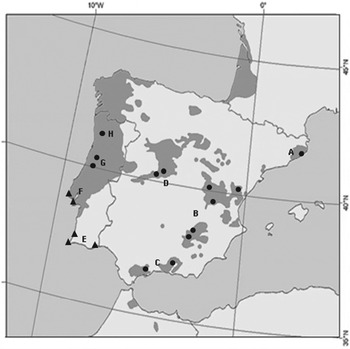
We tested whether I. rondensis occurs only on P. pinaster trees or whether it is also present on other native pine species that are hosts of M. pini (Foldi, Reference Foldi2004). Plots of three native pine species were surveyed (P. pinaster, P. sylvestris, and P. nigra) within six regions of the Iberian Peninsula, where they naturally co-occur (fig. 1). Two other Iberian regions, where only P. pinaster occurs, were also sampled. In each region at least three plots of each pine species were sampled. Distance between sampled plots was, whenever possible, less than 10 km and never more than 50 km. Lures were made of rubber dispensers impregnated with 200 μg of female M. feytaudi sex pheromone, pinned to the tree trunk (N=50 trees per sample area), 1 m above ground level, after smoothing the bark surface to create an arena (Branco et al., Reference Branco, Franco, Dunkelblum, Assael, Protasov, Ofer and Mendel2006). Baited arenas were monitored for 1 h, in March, April, and May 2006–2012, which corresponds to I. rondensis larval activity and male M. feytaudi flight, both of which are attracted to the lures. Plots of P. sylvestris and P. nigra were only sampled from the end of April through the beginning of May, when the flight periods of male M. pini and M. feytaudi overlap (Foldi, Reference Foldi2004).
Distribution map of maritime pine (Pinus pinaster) [EUFORGEN 2009, www.euforgen.org] with the sampled sites in the Iberian Peninsula. A – Catalonia, B – Valencia region C – Andalusia, D – Madrid region, E – South Portugal, F – Setúbal/Sintra, G – Central Portugal, and H – North Portugal. Triangles represent sampled sites with only P. pinaster and circles sampled sites with all three pine species (P. pinaster, Pinus nigra, and Pinus sylvestris).

Because the data did not satisfy the assumptions of normality and homoscedasticity, differences in the abundance of I. rondensis between regions were analyzed with the non-parametric Kruskal–Wallis test followed by the Mann–Whitney test to compare each pair of regions. Pearson's correlation coefficient was then calculated to assess the relationship between M. feytaudi and I. rondensis abundances.
Diet preference of I. rondensis
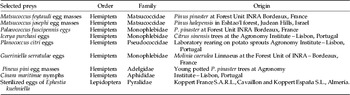
Potential prey species of I. rondensis were selected using the centrifugal phylogenetic method (Van Lenteren et al., Reference Van Lenteren, Bale, Bigler, Hokkanen and Loomans2006), starting with close relatives of the target prey and continuing with species from more distant taxa: e.g., subfamilies and families within the same order. We tested the target prey (M. feytaudi) and its congener, Matsucoccus josephi Bodenheimer & Harpaz, which is native to the East Mediterranean region and only inhabits Pinus halepensis Mill and Pinus brutia Ten. Some species from the family Monophlebidae, which is phylogenetically very close to the Matsucoccidae, were tested as well: Palaeococcus fuscipennis Burmeister, a scale insect which also feeds on P. pinaster trees; and I. purchasi and Gueriniella serratulae Fabricius, which feed on several hosts (Ben-Dov et al., Reference Ben-Dov, Miller and Gibson2001). Different families sharing the same pine habitat as the target prey were tested: an Aphididae, Cinara maritimae Dufour and an Adelgidae, Pineus pini Koch. From the family Pseudococcidae, we tested Planococcus citri Risso, which feeds on Citrus trees. Finally, sterilized eggs of E. kuehniella (Lepidoptera: Pyralidae) were used in order to check whether ladybirds could be reared on artificial food (table 1).
List of selected prey according to the centrifugal phylogenetic method (Van Lenteren et al., Reference Van Lenteren, Bale, Bigler, Hokkanen and Loomans2006) to test host range of Iberorhyzobius rondensis Eizaguirre larvae.

These diets were tested with second, third, and fourth instar larvae of I. rondensis collected from P. pinaster plots in 2006, 2009, and 2010, using sex pheromone lures of M. feytaudi, as described above. In the laboratory, larvae were weighed and their body length measured in order to determine their instar. Each larva was put into an individual plastic vial for feeding tests. In 2011 and 2012, neonate larvae were reared under room conditions, from eggs laid by adults in the laboratory.
Prey preference in choice tests
Paired choice tests were performed allowing I. rondensis larvae to choose between M. feytaudi eggs, M. josephi eggs (n=20), C. maritimae nymphs (n=48), P. citri eggs (n=118), P. pini eggs (n=63), and E. kuehniella sterilized eggs (n=34). Tests were performed in Petri dishes of 10 cm in diameter, with a layer of filter paper, under natural conditions of light and a temperature of 22±2 °C. Food items were placed at maximum distance opposite each other, and their position was switched for each replicate. Larvae were starved 48 h before trials. Assays were monitored for up to 2 h and the test was considered finished when the larva selected one of the food items and began to eat it. Choice tests were performed with the 3rd and 4th instar larvae collected in the field in Portugal, in March and April 2009 and 2010, with the exception of the test between M. feytaudi and M. josephi which was performed with 1st instar larvae in 2011. This was because these trials with M. josephi were completed in Israel (as M. josephi is not present in Europe), where the number of I. rondensis larvae was limited; none were available in the 3rd and 4th instar to be used for the choice test. A χ2 analysis was performed to test for differences in prey choice.
Survival of I. rondensis
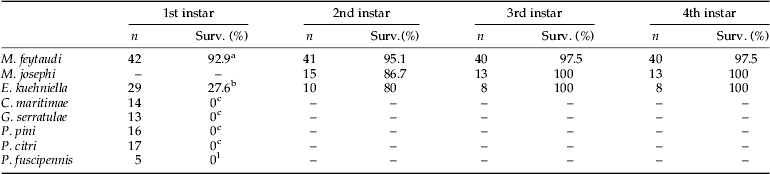
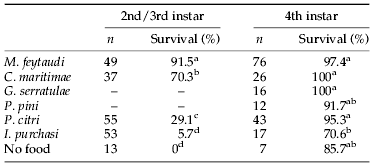
Iberorhyzobius rondensis larval survival was analyzed for different feeding regimes. Larvae were reared in small tubes, with cotton as a lid. Feeding trials were performed for the entire life cycle, from the 1st instar larvae to the adult stage, starting from neonate larvae obtained in the laboratory (table 2) and also separately for each of the 2nd, 3rd, and 4th instar for larvae collected in the forest (table 3). Matsucoccus feytaudi eggs are difficult to obtain and not enough were found to feed all larvae from the 1st instar onwards; therefore larvae of later instars were obtained from the field. The number of larvae and food items available dictated the number of replicates for each regime. Also, 2nd and 3rd instar larvae were further pooled together because the number of 2nd instars captured in the field was very low. For 1st instars, experiments started when neonate larvae hatched. All larvae were reared in separate plastic test vials at 22 °C, 14:10 L:D (ratio of light to dark), and 60% relative humidity. A small piece of cardboard was provided to allow them to hide, and the prey was exposed on a piece of paper. Individuals were checked and fresh food was added every 2 days, so that larvae were never limited by their food supply. Survival until adulthood was monitored for each individual and then analyzed with the Kaplan–Meier estimator, followed by a Log-Rank test based on I. rondensis larval stage. Pairwise comparisons of diet effects were also computed using the Log-Rank test. No statistical analysis was performed for the P. fuscipennis diet given the low number of replicates.
Number (n) and survival (%) of Iberorhyzobius rondensis larvae reared in the laboratory from neonate to adult on different prey treatments: egg masses of Matsucoccus feytaudi, Matsucoccus josephi, Gueriniella serratulae, Pineus pini, Planococcus citri and Palaeococcus fuscipennis, eggs of Ephestia kuehniella, and nymphs of Cinara maritimae. Within the 1st instar, results with the same letters were not significantly different (P<0.05). With subsequent instars differences were not significant due to high survival rates.

1 Since n=5, this diet was not statistically analyzed; all individuals were dead in 7 days.
Number (n) and survival (%) of larvae collected in the forest and reared in the laboratory from 2nd, 3rd or 4th instar to adult with different prey treatments: egg masses of Matsucoccus feytaudi, Gueriniella serratulae, Pineus pini and Planococcus citri; Icerya purchase, and Matsucoccus feytaudi; nymphs of Cinara maritimae and control (No food). Within each instar, results with the same letters are not significantly different (P<0.05).

Growth rate
Performance under each regime was further evaluated by the relative growth rate (RGR), calculated for each individual as used by Matsuki & Jr.MacLean (Reference Matsuki and MacLean1994):
 $$RGR = \displaystyle{{(\ln (Wf) - \ln (Wi))} \over {(Df - Di)}}$$
where Wf is the fresh weight at the final day of the test, Wi is the fresh weight at the first day, Df is the final day of the test, and Di is the first day of the test.
Larvae were checked every day and food was added every 2 days. Larvae were weighed every week, on the same day, and their instar stage was recorded by observing exuviae. Final weight (Wf) was measured after adult emergence, or otherwise we used the weight of the last day before the larva died. RGR was calculated for each instar and diet, i.e., C. maritimae nymphs, eggs of I. purchasi, M. feytaudi, P. citri, E. kuehniella, plus a control with ‘no food’. For the 1st instar, RGR was calculated only for the diets with M. feytaudi and E. kuehniella eggs due to the high mortality of neonate larvae on other prey regimes. In the 3rd instar, the ‘no food’ RGR was not calculated due to a lack of replicates. One-way analysis of variance (ANOVA) was used to test for differences in mean RGR between diets for each larval stage. It was followed by a multiple comparisons Tukey's test to identify significant differences between diets. Normality and homogeneity of variances were assessed, prior to all analyses, using the Kolmogorov–Smirnov one sample and Levene's tests, respectively. For t-tests, the number of degrees of freedom was corrected whenever equal variance was not assumed.
Pre-imaginal development
Development time from neonate until adulthood was recorded with two diets: E. kuehniella eggs and M. feytaudi eggs. The duration of each instar was recorded at each molt by observing exuviae. Independent sample t-tests were performed to compare the effect of the two feeding regimes on development time for each larval stage separately. Levene's test was used to test for equality of variances. All statistics were performed with SPSS version 20.
Results
Habitat preference of I. rondensis
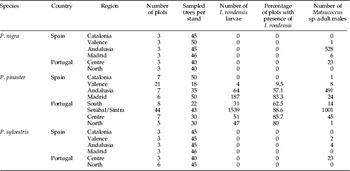
Larvae of I. rondensis were only found on P. pinaster (table 4); none were observed on P. nigra or P. sylvestris, although males of Matsucoccus sp. were observed in several of these plots. These were presumably M. pini, which typically reproduces on these two pine species (Foldi, Reference Foldi2004). Matsucoccus feytaudi and I. rondensis were found in P. pinaster from all examined regions except Catalonia.
Total number of Iberorhyzobius rondensis and Matsucoccus sp. males sampled in selected regions of Spain and Portugal, on different pine species (Pinus pinaster, Pinus nigra, and Pinus sylvestris).

Pooling of data at the regional level showed that most regions presented a low density of I. rondensis larvae per maritime pine tree, but with significant differences (Kruskal–Wallis test χ7 2 =549.19; P<0.001) in density between regions. Pairwise comparison of regions where the ladybird was found showed that larval density (mean larvae per tree±standard error) was lowest in Valencia (0.01±0.006) followed by Southern Portugal (Algarve) (0.16±0.036). In the other extreme, Madrid and Setúbal/Sintra had the highest densities (0.62±0.071 and 1.59±0.111, respectively). A density-dependent relationship was found between the total number of larvae of I. rondensis and the total number of M. feytaudi males observed in each region (r=0.889; n=8; P=0.003).
Prey preference in choice-tests
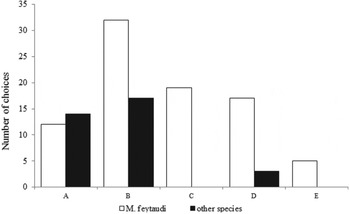
In paired choice tests (df=1), M. feytaudi eggs were preferred by I. rondensis larvae to E. kuehniella eggs, M. josephi eggs, C. maritimae nymphs, and P. citri eggs, but not to P. pini eggs (fig. 2). Larvae did not make a choice in 60% of the trials.
Results of choice-tests between different prey regimes with larvae of Iberorhyzobius rondensis. All tested pairs presented significant differences P<0.05 except pair A. Paired choices: (A) Matsucoccus feytaudi eggs vs. Pineus pini eggs (n=63, χ2=0.19, P=0.660), (B) M. feytaudi eggs vs. Planococcus citri eggs (n=118, χ2=4.61, P=0.032), (C) M. feytaudi eggs vs. Cinara maritimae nymphs (n=48, χ2=19.05, P<0.001), (D) M. feytaudi eggs vs. Matsucoccus josephi eggs (n=20, χ2=9.85, P=0.002) and (E) M. feytaudi eggs vs. Ephestia kuehniella eggs (n=34, χ2 =4.33, P=0.037). All tested larvae were 3rd or 4th instar larvae, except for M. feytaudi vs. M. josephi for which we tested 1st instar larvae.

Survival of I. rondensis
Neonate larvae reached adulthood only when fed M. feytaudi or E. kuehniella eggs, but M. josephi eggs were not tested with 1st instars (table 2). The survival rate of first instars significantly differed between prey species (χ6 2 =102.18; P<0.001). It was highest (92.9%) with M. feytaudi eggs, significantly lower (27.6%) with E. kuehniella eggs (P<0.001) and null with all other food regimes (table 2). Survival of 2nd instars was also higher on M. feytaudi (95.1%) than on E. kuehniella (80%) and M. josephi (86.7%) but the differences were not significant (χ2 2 =2.4551; P=0.293). For 3rd and 4th instars, survival was around 100% with the three prey items with no significant differences between them (χ2 2 =0.52; P=0.769).
For 2nd and 3rd instar larvae collected in the forest, the survival rate also differed between prey items (χ4 2 =102.417, P<0.001). It was highest when larvae were reared on the M. feytaudi eggs (91.5%), followed by the C. maritimae nymphs (70.3%). Only a small percentage of individuals survived until adulthood on other treatments and none of the 2nd and 3rd instar larvae survived with the control ‘no food’ treatment (table 3). For the 4th instar larvae collected in the forest, survival was relatively high for all treatments (>70%, table 3), although significant differences between treatments were still found (χ6 2 =23.151, P<0.001). Larvae fed with eggs of M. feytaudi again exhibited a high survival rate (97.4%). It is worth noting that these larvae were probably close to pupation, which may explain the high survival rate (85.7%) of the ‘no food’ regime.
Growth rate
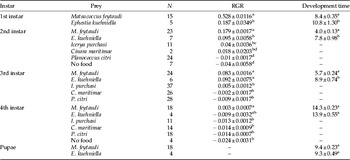
The mean RGR varied significantly between prey for the 1st, 2nd, 3rd, and 4th instars respectively: (F (1.19)=14.33; P=0.001), (F (5.73)=60.98; P<0.001), (F (4.128)=22.72; P<0.001), and (F (5.68)=4.55; P<0.001). For all instars, larvae fed with M. feytaudi showed higher RGR than larvae fed on other diets, with the only exception being the 3rd instar fed with E. kuehniella (table 5). This diet provided the second best food, although displaying high variability. The RGR coefficient of variance (CV%) was 8.5 and 41.8 for first instar larvae fed with M. feytaudi and E. kuehniella, respectively. In all other diets, with the exception of C. maritimae in the 2nd instar and I. purchasi in the 2nd and 3rd instar, larvae showed decrease in their weight which was highest with the ‘no food’ diet (table 5).
Relative Growth Rate (RGR) and development time (DT) in days (mean±standard error) of Iberorhyzobius rondensis instars fed with different prey regimes. Within each instar, values followed by the same letters are not significantly different (P<0.05).

Pre-imaginal development
Development time averaged 10 days longer for I. rondensis larvae fed E. kuehniella eggs than on M. feytaudi eggs (table 5). The difference was significant for the 1st (t 9.19=2.32, P=0.045), 2nd (t 7.32=4.23, P=0.004), and 3rd instars (t 45=5.43, P<0.001). No significant differences were found between the two diets for the 4th instar (t 45=−0.90, P=0.371) and the pupal stage (t 45=−0.21, P=0.837).
Discussion
So far, no detailed information on the biology and host range for the recently described ladybird species I. rondensis was available (Raimundo et al., Reference Raimundo, Canepari, Mendel, Branco and Franco2006). The present findings support the hypothesis that I. rondensis is specialized on M. feytaudi as indicated by its habitat, prey choice, survival, and development rate on different prey species. On the Iberian Peninsula, I. rondensis was found only on P. pinaster trees, even when other pine species co-occurred. We thus reject the hypothesis that it is likely to naturally prey on M. pini which can only reproduce on P. sylvestris and P. nigra. As for the majority of coccinellids, if neonate larvae can only feed on a specific prey, adult females are most likely to lay eggs in the vicinity of that prey (Ferran & Dixon, Reference Ferran and Dixon1993; Dixon, Reference Dixon2000).
Full development of I. rondensis was only achieved with two prey items, M. feytaudi's eggs and sterilized eggs of E. kuehniella. However, survival was much lower for 1st instar larvae fed with eggs of the moth E. kuehniella compared to those fed with M. feytaudi egg masses. Survival on this artificial food is not unusual since other ladybirds such as Cryptolaemus montrouzieri Mulsant (Hodek & Honěk, Reference Hodek and Honěk2009) have been successfully reared on E. kuehniella eggs, which they would never normally find in their natural habitat (Hodek & Honěk, Reference Hodek and Honěk1996). After the 2nd instar, larval survival increased considerably on alternative prey items. For the 4th instar, survival was almost 100% with all tested prey. This trend suggests a broadening of diet breadth as larvae grow, which may imply the use of alternative food sources towards the end of the developmental season, when M. feytaudi egg masses become scarce. Even when left without food, 85.7% of the 4th instar larvae were able to pupate. As observed by Hodek & Honěk (Reference Hodek and Honěk1996) larvae of ladybirds can complete their development when a certain weight is achieved, although this may be delayed by nutritional deficiency and adults may emerge smaller. Thus it can be hypothesized that, in the absence of M. feytaudi, late instars of I. rondensis can survive and complete their development on alternative prey occurring in the same habitat, such as C. maritimae or P. pini.
In two-choice tests, a consistent preference of M. feytaudi over the other tested prey was observed, except for P. pini egg masses. Like M. feytaudi, females of P. pini lay egg masses in cottony ovisacs in tree trunks and twigs. It is possible that P. pini is an alternative food prey for 3rd and 4th instar larvae when there is a lack of M. feytaudi. By contrast, C. maritimae, also occurring on P. pinaster trees, is highly mobile, able to defend itself or escape and is a myrmecophilous species, which makes it an improbable prey for I. rondensis. Matsucoccus feytaudi was preferred to M. josephi, the only other tested species of the Matsucoccus genus. However, this prey was only tested with 1st instar larvae in the two-choice test, and thus we cannot conclude about its use by older instars.
RGR was highest when I. rondensis larvae were reared on M. feytaudi eggs for all instars except for the 3rd, for which RGR was approximately the same as with E. kuehniella eggs. When larvae were reared on other prey, RGR was in most cases null or even negative, demonstrating a detrimental effect. The lower suitability of other prey is also indicated by the higher variability of RGR with other prey regimes, particularly E. kuehniella, compared to M. feytaudi. Interestingly, when fed with I. purchasi egg masses, 2nd and 3rd instar larvae had a positive RGR but survival was extremely low (5.7%). Apparently, the larvae were able to convert assimilated food into biomass but died, possibly due to some toxic effect. Also, neonate larvae were observed to feed voraciously when P. citri eggs were offered, but would die a few days later, without gaining weight and unable to complete molting. These results suggest physiological adaptations of I. rondensis to M. feytaudi. According to the trade-off specialization theory it is expected that a specialist will perform poorly (development and survival) on other kinds of prey, even if the different prey are taxonomically similar (Ferran & Dixon, Reference Ferran and Dixon1993). This has been observed in a large number of studies. Coccinella septempunctata L. is known to feed on Aphis sambuci L. although this is a highly unsuitable prey (Hodek & Honěk, Reference Hodek and Honěk1996). Nine aphid species were tested as prey for the aphidophagous Calvia quatuordecimguttata L. but only six were ‘essential’ food, and three were unsuitable, causing 100% mortality in fed larvae (Kalushkov & Hodek, Reference Kalushkov and Hodek2001). The specialist R. cardinalis was tested on 16 prey species before its introduction in Galapagos and it was only able to complete its life cycle with one, Margarodes similis Morrison which, like the target prey I. purchasi, belongs to the family Monophlebidae (Causton et al., Reference Causton, Lincango and Poulsom2004). According to Hodek & Honěk (Reference Hodek and Honěk1996) most cases of unsuitable prey concern herbivores that derive chemical protection from their toxic plants (e.g., Mendel et al., Reference Mendel, Blumberg, Zehavi and Weissenberg1992).
Iberorhyzobius rondensis distribution overlaps with that of its prey in the Iberian Peninsula where the latter found refuge during the last ice age (Burban et al., Reference Burban, Petit, Carcreff and Jactel1999). Apparently, the ladybird did not follow its prey when the latter expanded its range to new pine forest areas in Southern France and Northern Italy. Densities of I. rondensis were generally low, as are densities of M. feytaudi, in its native geographical distribution (Riom & Gerbinot, Reference Riom and Gerbinot1977). However, differences could be observed from one region to another. Iberorhyzobius rondensis showed the highest abundance in one particular region (Setúbal/Sintra) where M. feytaudi was also reported to be particularly abundant (M. Branco, personnel observation). In agreement with a density-dependent relationship, a significant and positive correlation was found between the number of ladybird larvae and the number of M. feytaudi males caught per region. This result suggests a numerical response of the predator to the density of its prey populations (Abrams & Ginzburg, Reference Abrams and Ginzburg2000).
Additional evidence of I. rondensis specialization is seen in its foraging behavior. Other coccinellids are known to be attracted to the odor of their prey, e.g., H. axyridis to Aphis citricola van der Goot (Obata, Reference Obata1986), Cryptolaemus montrouzieri to mealybugs (Heidari & Copland, Reference Heidari and Copland1992), Chilocorus nigritus F. to Abgrallaspis cyanophylli Signoret in conjunction with the host plant (Ponsonby & Copland, Reference Ponsonby and Copland1995) and Hippodamia convergens Guérin-Méneville which responds positively to (E)-b-farnesene, the alarm pheromone released by aphids (Acar et al., Reference Acar, Medina, Lee and Booth2001). In the case of I. rondensis, it is the species-specific sex pheromone of M. feytaudi which acts as kairomone for I. rondensis larvae. Using these olfactory cues, ladybirds are able to find the prey on a pine tree within a short period of time which greatly reduces their foraging time (Branco et al., Reference Branco, van Halder, Franco, Constantin and Jactel2011).
The results of this study suggest that M. feytaudi is the optimal prey for I. rondensis: the highest survival of larvae was achieved when fed with egg masses of M. feytaudi and in choice tests M. feytaudi was consistently preferred over other prey items. These results, together with its restriction to P. pinaster forest habitat, lead us to suggest that I. rondensis is specialized on M. feytaudi. Due to logistic constraints, we were unable to test the full development of I. rondensis on M. josephi egg masses. However, this scale species does not occur in the natural range of I. rondensis. In contrast, it would be interesting to test the possibility of development on M. pini since this prey species can be found in the natural habitat of the ladybird.
Rhyzobius, which is considered the ladybird genus closest to Iberorhyzobius, appears to be more generalist in terms of prey and habitat. Two Rhyzobius species are native to Europe, Rhyzobius chrysomeloides Herbst and Rhyzobius litura Fabricius; both are polyphagous species feeding on Aphididae and Coccidae, present in several Mediterranean forest ecosystems and arable lands (Ricci, Reference Ricci and Hodek1986; Toccafondi et al., Reference Toccafondi, Covassi and Pennacchio1991). Three species are of Australasian origin: Rhyzobius lophanthae Blaisdell, Rhyzobius forestieri Mulsant, and Rhyzobius ventralis Erichson. The third species is monophagous and stenotopic, feeding only on the genus Eriococcus (Hemiptera: Coccoidea) and present mostly on Eucalyptus species (Pope, Reference Pope1981). Rhyzobius forestieri is oligophagous, feeding on several species in the Coccidae and present on different tree species such as Casuarina spp., Citrus spp., and Acacia spp. (Richards, Reference Richards1981). Rhyzobius lophanthae is polyphagous, feeding on Diaspididae and Pseudococcidae and is present in many different ecosystems, having been introduced in many areas around the world for biological control (Stathas, Reference Stathas2000). Furthermore, in general specificity does not appear to be characteristic of the taxonomic group Coccidulinae, but rather more of the coccidophagous guild: e.g., Coelophora quadrivittata Fauvel, Hyperaspis egregia Fürsch, Hyperaspis pantherina Fürsch, Rodatus major Blackburn, Scymnus mediterraneus Iablokoff-Khnzorian, and R. cardinalis (Chazeau, Reference Chazeau1981; Richards, Reference Richards1985; Ragab, Reference Ragab1995; Ackonor & Mordjifa, Reference Ackonor and Mordjifa1999; Fowler, Reference Fowler2004). Some exceptions are Diomus thoracicus Fabricius which is myrmecophagous with a parasitic mode of living (Vantaux et al., Reference Vantaux, Roux, Magro, Ghomsi, Gordon, Dejean and Orivel2010), and Anisolemnia dilatata Fabricius which feeds on the woolly aphid Ceratovacuna silvestrii Takahashi on bamboo plants (Majumder & Agarwala, Reference Majumder and Agarwala2013).
The fact that late instars of I. rondensis can feed on other prey is also common to other specialized predators. Even the successful biological control agent R. cardinalis can at least partially develop on the eggs of P. fuscipennis in its natural environment (Mendel et al., Reference Mendel, Assael, Zeidan and Zehavi1998). The ability of I. rondensis to feed and develop on E. kuehniella eggs is of interest since it might allow mass rearing under laboratory conditions. Nevertheless, we need to consider that at least for the first instar of I. rondensis, M. feytaudi egg masses will be needed, as the survival rate was very low in our experiments with E. kuehniella eggs.
From an applied perspective, our findings suggest that I. rondensis may be an effective and safe biological control agent of M. feytaudi due to its high level of specialization at both the dietary and habitat level. In particular, acclimation of I. rondensis could be envisaged in recently colonized areas of Corsica and Northern Italy where the invasive scale is still spreading and causing important forest damage. However, further studies are needed to estimate the predation effectiveness of I. rondensis before deciding on its introduction.
Acknowledgements
We would like to thank Susana Rocha and Liliana Vilas Boas for field and laboratory assistance. This study was partially funded by the French Ministry of Agriculture and the Regional Council of Corsica with the project ‘Lutte Biologique contre la cochenille du Pin maritime en Corse’ and by the Portuguese Government with a PhD Grant for C. Tavares.