In the studied context, school failure is not associated to students with learning barriers or under situations of extreme need, or to dysfunctional family or school systems. Despite having the basic conditions for success, students do not reach their academic goals, entering a cycle of grade repetition that precedes an early and definitive school drop-out. This problem, which affects all societies, manifests itself most strongly in the most vulnerable regions of the world, such as in Sub-Saharan Africa, where 42.1% of children drop out of school before completing their primary education. However, it also occurs in countries with better economic conditions. Spain, for example, has rates of 20%, almost doubling the EU average (11%); Malta, 19.8%; Romania, 19.1% and Italy, 10% (EUROSTAT, 2016). According to UNESCO (2012), Colombia is the third country with the highest grade repetition rate in Latin America, with 15.5%.
Due to its characteristics, school failure is an extremely complex social phenomenon (Gonzales-Pineda, 2003). The greatest difficulty in understanding this phenomenon arises when trying to establish causality relationships (Álvaro, et al., Reference Álvaro, Bueno, Calleja, Cerdán, Echeverría, García and Trillo1990). Only by changing the angle of observation, the variables that were initially considered as the origin of a process, become its consequence, generating effects of circular causality and large areas of uncertainty that prevent general theories or models from being proposed. Hence, a relatively high number of researchers prefer to use descriptive and correlational approaches, ignoring explanatory studies. Conceptually, three dominant trends can be identified in the specialized literature that focuses their analyses on individual, social and school variables. Related to the first case, studies on self-concept (Adebule, Reference Adebule2014; Troncone, Drammis, & Labella, Reference Troncone, Drammis and Labella2014), general intelligence (Alloway & Passolunghi, Reference Alloway and Passolunghi2011), emotional intelligence (Goleman, Reference Goleman1995; Jiménez & López-Zafra, Reference Jiménez and López-Zafra2009), achievement motivation (Walkey, McClure, Meyer, & Weir, Reference Walkey, McClure, Meyer and Weir2013; Wang & Eccles, Reference Wang and Eccles2013), management of study techniques (Alcalá, Reference Alcalá2011; Mendezabal, Reference Mendezabal2013), and the type of attributions that students make on the results obtained (Boudrenghien, Eccles, Frenay, Bourgeois, & Karabenick , Reference Boudrenghien, Eccles, Frenay, Bourgeois and Karabenick2014; Weiner, Reference Weiner1985), among others, can be found. Regarding the second case, there are studies that attempt to explain school failure in relation to non-academic variables, such as sociological and psychosocial studies, which have favored variables like social inequalities (Hernández & Tort, Reference Hernández and Tort2009; Perrenoud, Reference Perrenoud1970), demographic and cultural characteristics (Wright, Standen, & Patel, Reference Wright, Standen and Patel2014), the type of family (Oliva & Pertegal, Reference Oliva and Pertegal2012; Robledo & García, Reference Robledo and García2009), parental styles (Baumrind, Reference Baumrind1980; Chan & Koo, Reference Chan and Koo2011; Domínguez & Guash, Reference Domínguez and Guash2014), the parents’ expectations (Huston & Rosenkrantz, Reference Huston and Rosenkrantz2005) and the quality of family support (Kit, Reference Kit2004). Finally, there are authors interested in attributing school failure to the dynamics of the educational system (Barrera-Osorio, Maldonado, & Rodríguez, Reference Barrera-Osorio, Maldonado and Rodríguez2012), favoring the analysis of school climate (Madrigal, Díaz, Cuevas, Nova, & Bravo, Reference Madrigal, Díaz, Cuevas, Nova and Bravo2011); Prado, Ramirez, & Ortiz, Reference Prado, Ramirez and Ortiz2010), as well as teachers’ perceptions and attributions on student performance (van den Bergh et al., Reference van den Bergh, Denessen, Hornstra, Voeten and Holland2010).
In the present study, the construction of the theoretical model has been based on three aspects: identification of variables with the greatest predictive ability for the studied phenomenon, knowledge of its context and common sense. In the first stage, Gonzalez’s (2003) and Alvaro’s (1990) studies have been taken into account in order to define the theoretical and methodological perspective, respectively. Additionally, the main explanatory models have been reviewed, highlighting the following: Scheerens’ (Reference Scheerens1990) integrated model of school effectiveness; Stringfield and Slavin’s (1992) hierarchical model on school effects, known as the QUAIT/MACRO; Creemers’ (Reference Creemers1994) teaching effectiveness model; Sammons, Thomas, and Mortimore’s (Reference Sammons, Thomas and Mortimore1997) high school effectiveness model and the empirical and global model of effectiveness in primary schools in Spain (Murillo, Reference Murillo2008). These models can be considered as having the greatest influence within the research on educational effectiveness. The most complete are Scheerens’ and Creemers’ models, due to the type of variables and levels they include. The most questioned is the QUAIT/MACRO, as the specificity of its design makes it inapplicable in contexts other than those within the United States. Strictly speaking, the model suggested in the present study does not attempt to replicate any of the aforementioned models, as it focuses exclusively on school failure. However, it integrates many of the variables that have been considered as being the most influential on academic performance. Hence, the need to propose a new model using structural equations (SEM) methodology is justified in order to understand the causal relationships associated with school failure. SEM is a sophisticated methodology used to test hypotheses between latent variables and observable variables, by modeling complicated functional or causal relationships (Nayernia, Reference Nayernia2013). According to Batista and Coenders (Reference Batista and Coenders2000), it is one of the most powerful tools for the study of random relationships on non-experimental data when the relationships are linear. This allows verifying whether the causal inferences that a researcher formulates are consistent with the available empirical data. It is noteworthy that the consistency between data and the model does not necessarily imply a consistency between the model and reality. The only thing that can be confirmed is that the researcher’s assumptions are not contradictory and, therefore, may be valid. Furthermore, “being valid” does not mean that they are the only explanation for the phenomenon under study, as it is possible that other models also adapt to the same data (Pearl, Reference Pearl2014).
Objective
The central objective of the present study was to validate a theoretical model regarding the causes that determine low academic performance in secondary school students who are in a situation of school failure. To achieve this purpose, a hypothetical causal model for low academic achievement was designed. The most significant variables in each of the modules, blocks or factors of the initial model were identified. Afterwards, an analysis between the factors of the model was performed in order to establish those variables that best discriminated students with the lowest levels of academic performance. Finally, the theoretical model was contrasted with the empirical model.
Method
Participants
At the data collection stage, 319 high school students suffering from school failure, 265 of their parents and 200 high school teachers took part. The students belonged to five public educational institutions and represent 64.5% of the total population of grade repeaters. From a socioeconomic point of view, they have very similar characteristics, belonging to strata 1, 2 and 3. According to gender, there were 25% more men than women. Their ages ranged between 12 and 20 years, with a median of 14 years. The majority were enrolled in the sixth grade (48.6%), followed by students enrolled in the tenth grade (18.2%) and those in the seventh grade (11%). With regard to grade repetition, 37% of students had repeated one year, 33.5%, had repeated three years, 23.2% had repeated two years and 5.9%, had repeated more than four years. All the teachers who participated worked in the five selected institutions and took part in the students’ educational processes. They were homogeneously distributed according to sex and institution, 59% had an undergraduate degree, 36.5% had a specialization and 4.5%, had a master’s degree. Of the parents taking part in the study, 81% of the participants were women, representing 78.9% of male students. Parents had a low level of education and there was a predominance of nuclear families (46.0%), followed by single-parent families (24.9%), large families (21.5%) and reconstituted families (7%), who were identified as having authoritarian and permissive parental styles.
Instruments
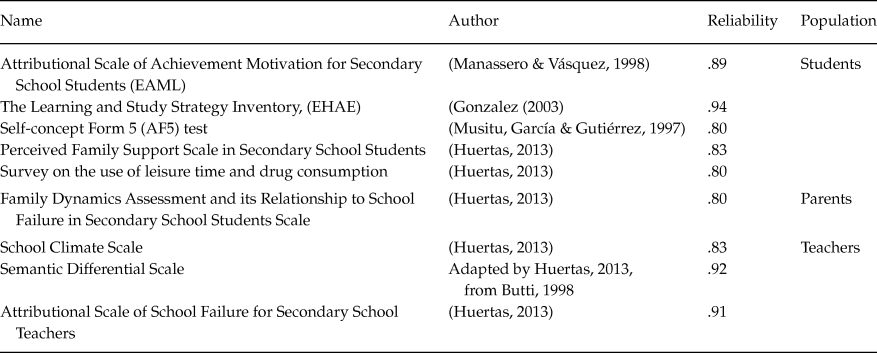
Nine instruments were used for the collection of data, which were applied to students, parents and teachers. All participants underwent a pilot test with 50 subjects and expert judgment. The instruments answered by the students were: Attributional Scale of Achievement Motivation for Secondary School Students, (Manassero & Vásquez, Reference Manassero and Vázquez1998). Conceptually, it relies on Weiner’s attribution theory (1985). It was designed for the educational context and it is based on causal attributions (attribution-emotion-action). It consists of 22 items distributed across five dimensions: Locus of Causality, Stability, Controllability, Globality and Intentionality.
The Learning and Study Strategy Inventory, adapted by Gonzalez (2003). It consists of ten subscales, with 64 items. The first nine correspond to Weinstein, Zimmerman and Palmer’s (Reference Weinstein, Zimmerman, Palmer, Goetz and Alexander1988) Learning and Study Strategy Inventory, (LASSI), and the last one, which measures learning styles, has been taken from Schmeck, Geisler-Brenstein, and Cercy’s (Reference Schmeck, Geisler-Brenstein and Cercy1991) Inventory of Learning Processes (ILP). The two reference instruments have been widely used in different educational research contexts with high levels of reliability.
The Self-concept Form 5 (AF5) test (Musitu, García, & Gutiérrez, 1997). It measures self-concept in general, based on a five-dimensional model that evaluates, with 30 questions, the family, emotional, social, academic and physical self-concept. It can be applied to adolescents and adults, demonstrating great robustness in all the studies in which it has been employed.
The Perceived Family Support in Secondary School Students Scale (Huertas, Reference Huertas2013). It is based on the theoretical background that shows significant correlations between the quality of family support and school achievements, as well as on the direct knowledge of the context. It seeks to measure students’ perceptions of the quality of school support they receive from their family. It evaluates six dimensions: academic and school support, parental control, motivation, degree of parental manipulation on behalf of the students and study time management.
The Survey on the use of leisure time and drug consumption (Huertas, Reference Huertas2013). Its objective is to identify the activities carried out by students outside the educational institution and some aspects related to drug consumption. It consists of 19 questions and 64 variables. They assess the use of free time and the frequency with which activities are performed; it also identifies the type of drugs consumed by students, their perception about this consumption and its effects on school life. When the scale was submitted to a reliability test, a Crombach alpha of .80 was obtained.
Parents were assessed through the Family Dynamics Assessment and its Relationship to School Failure in Secondary School Students Scale (Huertas, Reference Huertas2013). It is structured in two parts. In the first part, information regarding the social origin, family structure, parental styles and academic background of parents and siblings are collected. In the second part, the scale itself is presented. It contains 53 items, distributed across seven dimensions: family relationships, perception of their children’s use of free time, attributions of school failure, expectations about their children’s academic success, application of rules, academic support and relationship with teachers.
Teachers were administered: the School Climate Scale (Huertas, Reference Huertas2013). It seeks to identify the contextual elements that affect performance. Its 44 items are grouped into 6 dimensions: relationships with management, students and parents; perceived school violence, drug consumption, school discipline, resources and infrastructure and the school.
The Semantic Differential Scale (Butti, Reference Butti1998), its objective is to evaluate teachers’ attitudes towards students in situations of school failure and towards those students considered to be successful, using a scale of 16 bipolar adjectives.
The Attributional Scale of School Failure for Secondary School Teachers (Huertas, Reference Huertas2013). Teachers’ judgment is analyzed through two categories, distributed across six dimensions. The first one corresponds to internal attributions and has to do with the quality of the pedagogical and didactic processes, the assessment mechanisms and the direct influence of the teacher on the student’s performance. The second category refers to causes external to the teacher that, according to the literature, may affect students’ school failure, such as their behavior, the educational system and the family system.
Procedure
Methodologically, the theoretical model was contrasted with the Structural Equation Modeling technique using SPSS/AMOS 23, complemented with a mediation analysis, using the Baron and Kenny method. The starting point for the data analysis was more than 300 observable variables that were slowly reduced to 24 variables. The DV of the model was the number of years lost by the students. For functional reasons, the variable, which was initially continuous, was considered as discrete and was divided into three categories: low level (one or two years of repetition), medium level (between three and four years) and high level (more than four years). Consistently with the study’s hypotheses and theoretical approaches, it proved more convenient to establish three different groups according to intervals. Socially, it is more relevant to distinguish between “more or less adequate” students than to place all participants on a continuous scale. Statistically, it is advisable that variables that can yield infinite values are grouped into intervals. In a similar procedure, Baron and Kenny (Reference Baron and Kenny1986) suggested dichotomizing continuous moderating variables. As a whole, the hypotheses formulated try to establish how the factors selected affect the academic performance of students in situations of school failure and how these can be deduced from the trajectories between the latent variables of the model.
Data analyses
The analyses were performed in five stages. In the first stage, the internal coherence of each instrument was evaluated to establish their psychometric properties. In the second stage, the number of variables was reduced through the Exploratory Factor Analysis (EFA); to expand the assessment of the different types of relationships between the variables, this technique was complemented with the analysis of the total item correlations and, in cases where it was advisable to estimate the relationships of each scale with the DV, linear regressions and decision trees were used. Afterwards, the relationships between the components of the theoretical model were analyzed; in addition to the mentioned techniques, a Factorial Confirmatory Analysis (CFA) was used. The resulting variables gave rise to the initial version of the empirical model, in whose adjustment the relationships proposed in the theoretical model and the technical criteria of the SEM methodology -specification, identification, parameter estimation, adjustment evaluation and re-specification of the model- were taken into account.
Results
Before performing the data reduction and modeling procedures, a preliminary analysis was carried out to establish whether the minimum conditions for a multivariate analysis were met. Firstly, the univariate and multivariate normalities were evaluated, in order to avoid type 1 and type 2 errors, followed by the assessment of homoscedasticity, linearity and independence of the variables. Afterwards, it was verified that all the instruments used in this study yielded high levels of reliability (Table 1). The constructs presented high internal coherence and the subscales loaded into the corresponding factors with saturation levels above 0.80.
Reliability of the Instruments Used

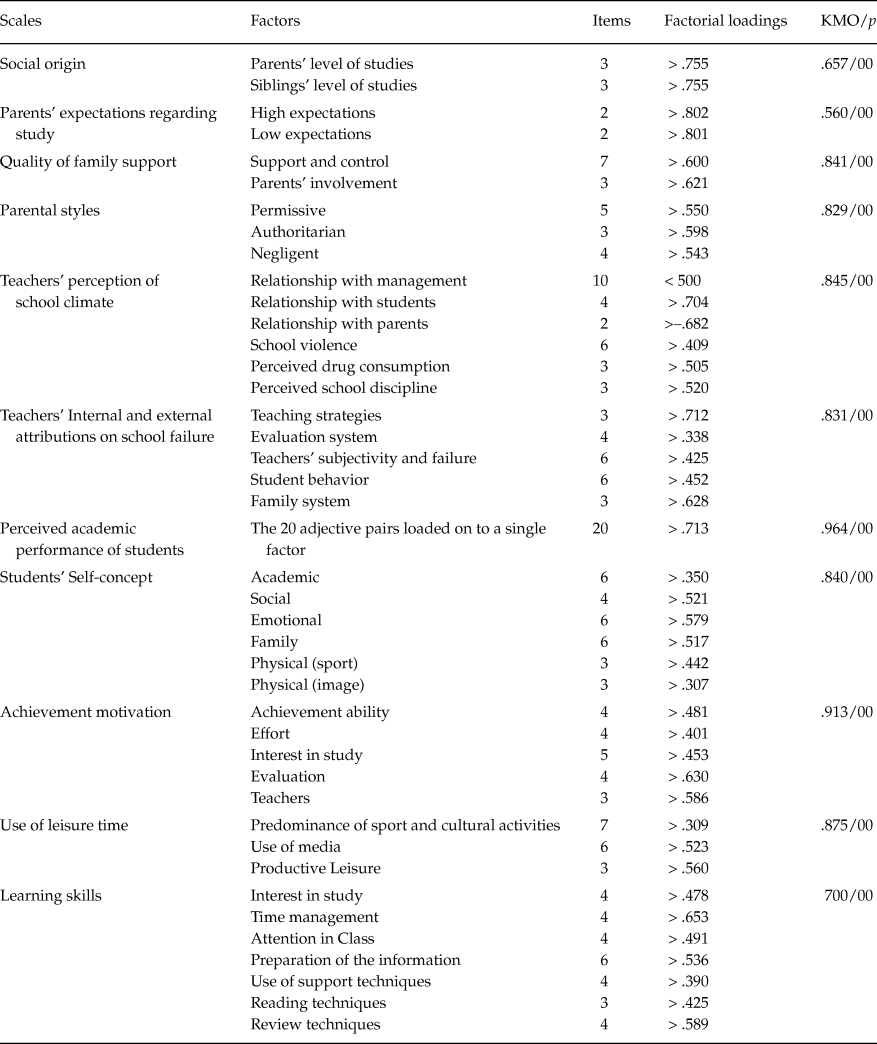
With the data reduction applied to each of the instruments, the most efficient factors were identified. For example (Table 2), the positive and negative expectations of the parents regarding study presented the highest factor loadings and were grouped in their respective factors. In relation to the quality of family support, the support, the parental control and the low involvement of parents in their children’s academic activities were emphasized. Permissive, authoritarian and negligent parenting styles predominated. Regarding school climate, the most significant factor was the relationship between management and teachers. Teachers attributed school failure to external causes, with emphasis on factors related to pedagogical strategies, the evaluation system, and student behavior. The mental representation of the teacher regarding the successful or failed student was totally polarized and generated stereotypes. With regard to achievement motivation, the factor loadings were acceptable, the lowest being for interest in study. The latter, together with the effort to perform tasks are the ones that best predict performance, according to the decision tree, generating an inversely proportional relationship. In relation to the use of free time, three factors stood out: leisure activities outside home, use of media and productive leisure activities at home. Regarding learning abilities, there were reactive learning skills that denoted negative attitudes towards study, difficulties in study time management and attentional problems.
Factorial Loadings and Assessment of the Factorial Model for the Instruments Used

The analysis of the veracity of the theoretical relationships between the factors of the hypothetical model and the tests carried out with the CFA confirmed that there was a coincidence between the theoretical model and the relationship between the factors of each component. The social origin influenced the parental styles and the quality of the support; the relationships between school variables were satisfactory, giving rise to a four-factor submodel that achieved an excellent fit. The CFA and the Path Model confirmed that self-concept fulfilled the function of DV, with respect to the student-teacher relationships, the parental styles and the causal attributions of teachers, obtaining an excellent fit. The same is true for achievement motivation. The results of the CFA indicated the existence of significant relationships with the other variables of the block; the good fit of the Path Model demonstrated that the achievement motivation is the DV relative to students’ causal attributions, self-concept, and quality of parental support. After analyzing the relationship between academic performance and the variables that appear as the direct causes, both a CFA and a Path model with an excellent fit were obtained.
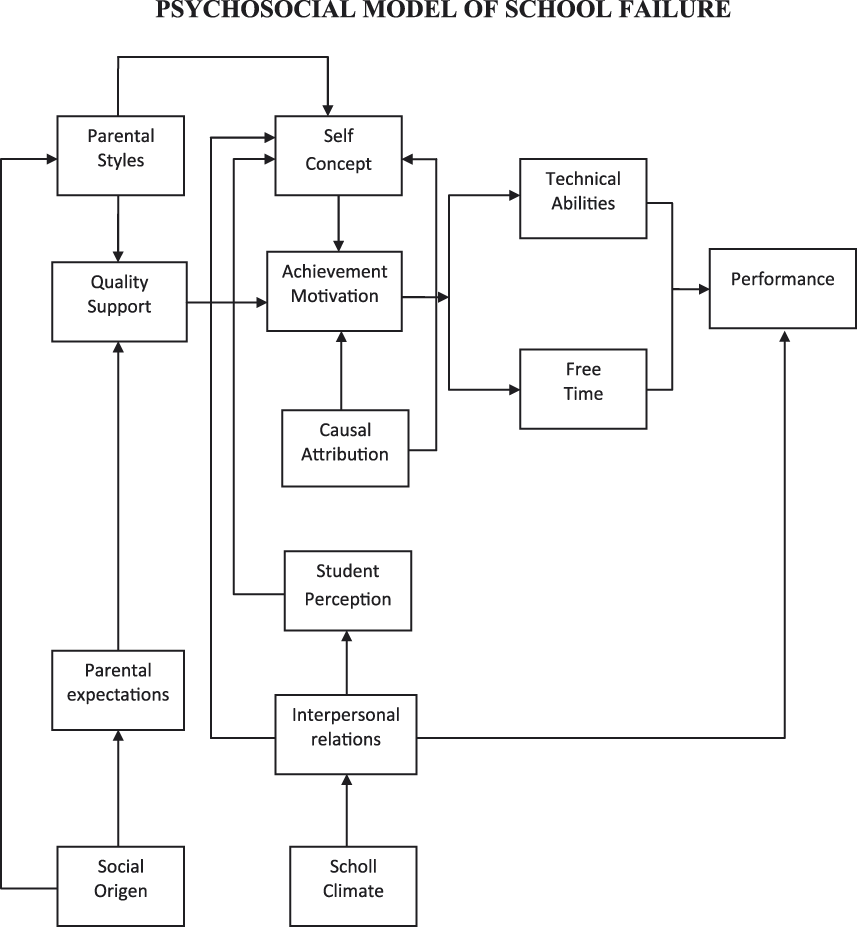
In order to validate the model, using the Structural Equation Model methodology, the process began with its specification (Casas, Reference Casas2002), determining its components and relationships to reduce them to a system of equations. This stage was carried out taking into account the characteristics of the context and the main trends in research on school failure (see Figure 1).
Theoretical Version of the Psychosocial Model of School Failure.

Technically, the theoretical model responded to the scheme: context-input-process-output. The variables that investigate the social origin of the family, the parenting styles, the expectations and the quality of family support in the educational process of children were part of the context. As input data, the individual characteristics of the students, the attributions with which they explained their academic performance, their relationship with study, and the use of their free time were considered, including drug use and its influence on academic outcomes. The perception of school climate, of the students in situations of school failure, and their interactions with relational and educational dynamics were included among the elements of the process. The output was considered to be the variations in the low performance of students. The next step was to operationalize the latent variables based on two criteria: according to their consideration in the model and according to the function they perform in such model. All these relationships were, of course, of a theoretical nature and, as has been discussed, the ultimate goal was to validate them empirically.
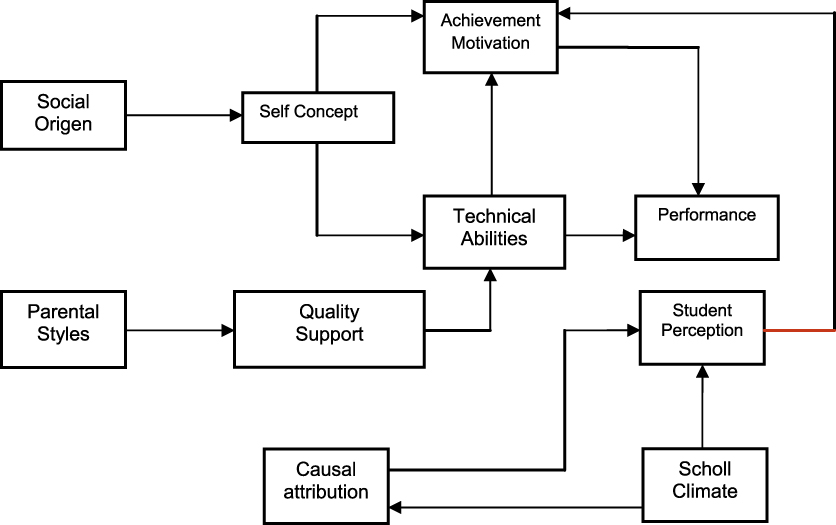
In Figure 2, the diagram of the definitive empirical model can be observed. After comparing it with the theoretical model (Figure 1), it can be concluded that the study’s hypotheses were partially fulfilled.
Empirical Version of the Psychosocial Model of School Failure.

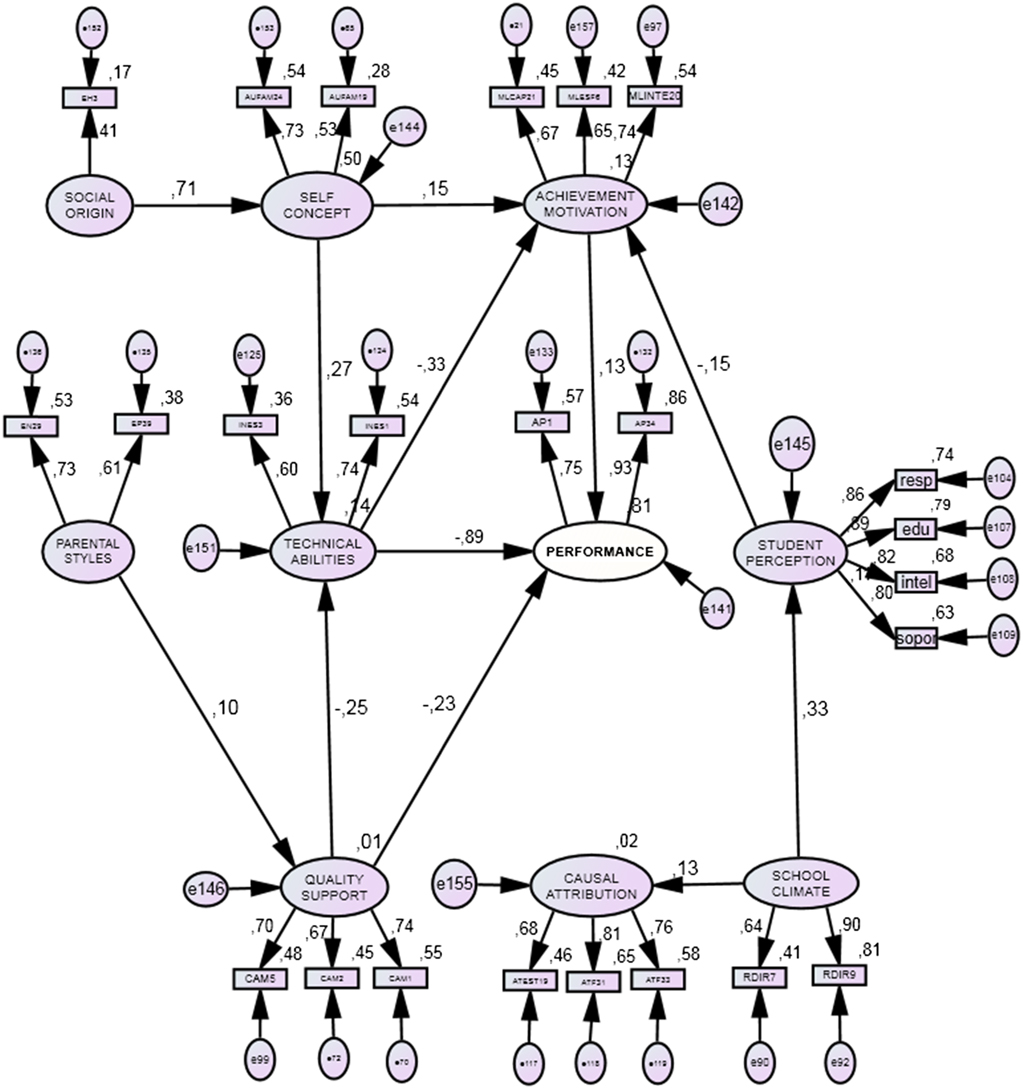
The variables regarding the parents’ expectations of their childrens’ academic performance, the students’ use of their free time, and the students’ atributions regarding their own academic performance were eliminated from the original model. The main reason for eliminating them was methodological, as they were statistically insignificant and their presence in the model negatively affected the indices of goodness of fit and the covariance relationships between the latent variables. These changes, inherent to the process, did not theoretically affect the model; on the contrary, they provided criteria to identify the variables that best predict the phenomenon. In this process, it was necessary to make methodological decisions that led to the modification of the original trajectories, to eliminate some of the latent variables included in the theoretical model or to modify their functions, for the reasons previously expressed. In fact, in the final solution, five of the theoretical causal relationships were preserved: the direct influence of self-concept on achievement motivation, the dependence of the quality of school support, with respect to parental styles and the direct influence of study skills and techniques on school performance. The perception of the school climate continued to occupy its position of VI and directly influenced interpersonal relationships between teachers and students, but also directly influenced the causal attributions that teachers construct regarding the academic success or failure of their students and its influence on the DV was no longer direct, but was mediated by attributions and relationships with students. On the one hand, despite the fact that social origin continued to be an independent variable, it no longer had a direct effect on parents’ expectations, as these were eliminated, or on parental styles. On the other hand, its direct effect fell on self-concept. The position of the parental style variable was modified, which became an independent variable, with a direct effect on the quality of family support. With the modifications made to the theoretical model, a very efficient empirical model was obtained, presented in Figure 3, consisting of 34 variables, 10 latent and 24 observable, excluding the error terms. Of these, 2 variables were exogenous and 8 were endogenous.
Final Solution for the Psychosocial Model of School Failure.

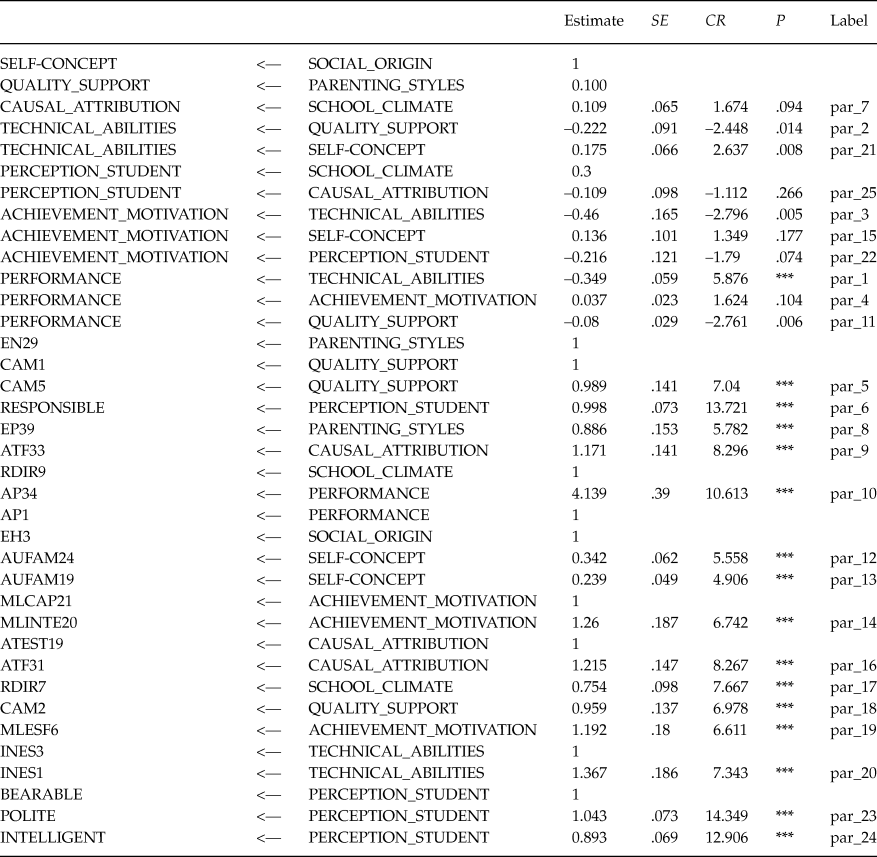
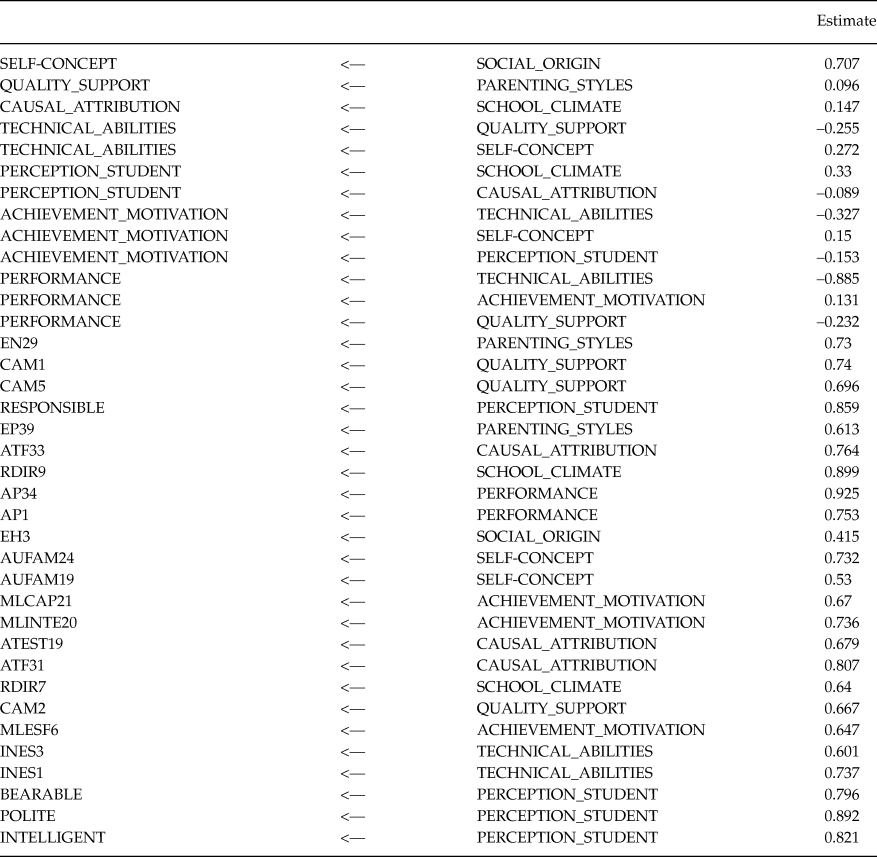
Analyzing the estimates of maximum likelihood of the model (Table 3), it was found that in all observable variables, the critical ratio (CR) was greater than 1.96 in absolute value, which indicated that the parameters were significantly different from zero to n.c. of 95%. In the case of the influence between latent variables, the critical reason was not significant for 5 parameters. The other parameters were > 1.96. According to the standardized regression weights (Table 4), the “factor loadings” of the indicators were high. Only two observable variables were less than 0.50; the rest were greater than 0.60.
Maximum Likelihood Estimation of the Final Solution

Standard Regression Loadings for the Final Solution

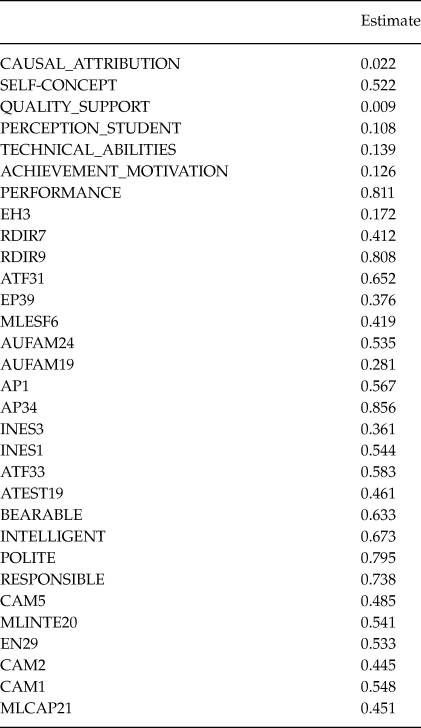
The highest loading was that of the dependent variable of the model (0.925), for students who repeated more than three years. The regression weights were less important among the latent variables; however, they were different from zero. The highest corresponded to the influence of study skills and techniques on low academic achievement (–0.885) and between social origin, reduced to the level of studies of brother three, and self-concept (0.707). Most of the standardized residues of the covariates tended towards zero, suggesting a good predictive ability with respect to the observed matrix. Only seven values exceeded the criterion of > +/–2.58, without reaching 4.0. The reliability of the measure, evaluated by R 2 , was adequate for the observable variables (Table 5). Of the 24 variables analyzed, 20 were above .412, reaching the maximum value of 0.856. Regarding the latent variables, the most reliable variable was academic performance (0.883) and the lowest, the teacher’s perception of students’ performance (0.013).
Squared Multiple Correlations for the Final Solution

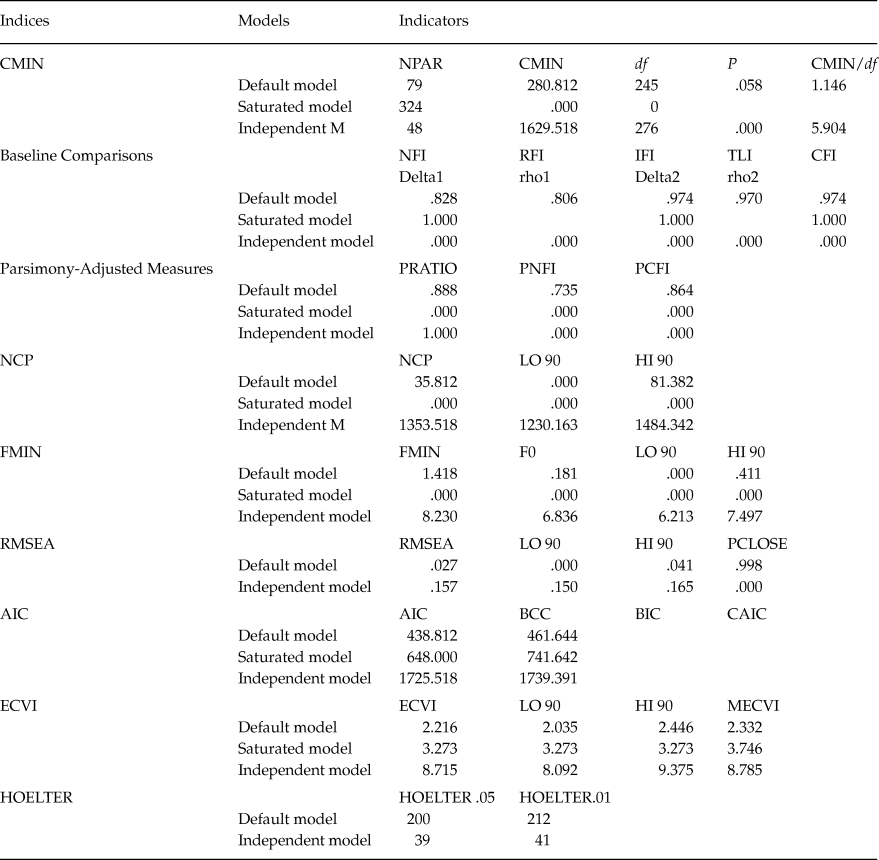
According to the results of the analysis, the final solution presented an excellent fit. Although a significant p value is not sufficient argument to reject the model, its coefficient was > .50, which reinforces the validity of the results. The CMIN/DF=1.146 remained within the acceptability range, the IFI = 0.974, the TLI = .970 and the CFI = .974 largely exceeded the .950 required to consider them as a good fit. The PCFI = 0.864 remained within a good acceptability range. The RMSEA = .27 < .50 approached zero and the PCLOSE = 0.998 remained close to 1. In the remaining indices, AIC, BCC, ECVI and MECVI, the default model values were smaller than in the saturated and independent models, indicating a good fit (Table 6). Finally, the Hoelter index yielded a maximum value of 212. Therefore, it can be concluded that the final solution proves to be a good model, due to its excellent fit.
Summary of Goodness of Fit Indices for SEM4

Discussion
Most research in Latin America on school failure is characterized by a descriptive or correlational scope, with a limited ability for generalization (Murillo, Reference Murillo2008). Very few studies have addressed the problem from an explanatory perspective, which highlights the significant contribution of the present model. Compared with existing models, the main difference is that the other models generally focus on the problem of performance or school efficiency. In contrast, the proposed model is a tool exclusively designed to understand the psychosocial dynamics that explain the phenomenon of school failure. It is not a question of comparing those who have good academic performance with those who do not achieve their goals. The point at stake is to know why those who fail. Another methodological difference is that in almost all models, academic efficiency is measured by performance in math or language proficiency tests. In the present case, it is based on the premise that the results obtained at the end of the academic year are representative of the level of competences that the student has; for that reason, the level of variability of the DV was considered in terms of the number of years repeated by the student. On the other hand, the validated model has some structural similarities with the referenced models. This model shares the structure with Scheerens’ (1990) model: input-process-context-output and the inclusion of students, parents, teachers and school climate. With the QUAIT/MACRO (Stringfield & Slavin, Reference Stringfield, Slavin, Creemers and Reezigt1992), the present model does not have many elements in common as the QUAIT/MACRO was designed for the United States education system, with the exception of their similar levels of analysis, as is the case with Creemers’ (Reference Creemers1994) model. With respect to Sammons, Thomas & Mortimore’s (Reference Sammons, Thomas and Mortimore1997) and Murillo’s (2008) models, they share the context, input, process, output process but instead of studying school efficiency, it focuses on the causes of inefficiency, partially represented by the students’ academic failure. The resulting model can explain the phenomenon studied in similar socioeconomic and cultural contexts, as the characteristics of the participants are homogeneous. Our Psychosocial Model of School Failure becomes a useful tool for the improvement of educational quality, insofar as it facilitates decision-making based on scientific arguments. Thanks to the model, it is possible to understand the interactions of the main agents involved in the educational process and to, not only identify the factors and variables that have the greatest impact on school failure. This can be very useful within the educational practice. Based on the evidence provided by the model, both management and teachers can guide and prioritize their interactions with students and parents. In relation to the student, the fundamental role of self-concept and achievement motivation should make teachers aware of the importance of avoiding comments, attitudes, and procedures that damage the students’ abilities, as well as reinforcing their competencies in study skills and techniques, which can be optimized with training sessions in executive functions. Another important element that derives from the model is that in the social context studied, school failure is part of a family tradition, which must be intervened with parents to modify beliefs, parenting styles and inefficient types of support that end up exerting a negative influence on academic performance. Finally, it is necessary for teachers to change the way students in a situation of school failure are perceived to be by recognizing that, in part, the phenomenon is due to the limitations inherent in their methodological, pedagogical and assessment strategies. One of the most important limitations of the model is, as previously mentioned, having been designed with a homogeneous sample in most of its characteristics, which hinders the generalization of the conclusions. In order to increase its predictive ability, a second stage is being prepared with students from private institutions which are representative of the different social strata, creating a group of students in situations of school failure and another group of students that can be regarded as successful, due to their academic results.