INTRODUCTION
Cognitive deficits commonly persist in individuals with a history of moderate, severe, and penetrating traumatic brain injury (TBI) and are generally considered the result of neurological damage. In contrast, most mild TBI (mTBI) patients will recover within weeks or months; however, in a small minority of cases, cognitive deficits linger. Poor outcome following mTBI has most strongly been linked to psychosocial factors (Belanger, Tate, & Vanderploeg, Reference Belanger, Tate, Vanderploeg, Morgan and Ricker2018); however, neurological changes may contribute to poor cognitive performance in a subset of patients with history of mTBI. In addition to elucidating the mechanisms driving cognitive impairment following TBI of all severities, blood-based biomarkers could potentially serve as prognostic indicators of long-term impairment and/or decline.
Blood biomarkers of axonal injury [e.g., tau, neurofilament light (NFL)], neuronal cell body injury [e.g., ubiquitin carboxyl-terminal hydrolase L1 (UCH-L1)], and astrogliosis [e.g., glial fibrillary acidic protein (GFAP)]) have been linked to worse outcomes following TBI of all severities (Gan et al., Reference Gan, Stein, Swanson, Guan, Garcia, Mehta and Smith2019). Investigation of these biomarkers in the chronic phase of recovery and their relationship to cognition is particularly important in understanding how TBI may impact future neurodegeneration, developing clinically relevant interventions, and improving monitoring those patients who are at higher risk.
We previously investigated serum total tau (t-tau) in relation to cognition in a much smaller, but overlapping, sample of participants assessed five or more years after injury (Lippa et al., Reference Lippa, Yeh, Gill, French, Brickell and Lange2019). We found no differences in t-tau levels between participants with a history of uncomplicated mTBI (n = 58), complicated mTBI (n = 23), and moderate, severe, or penetrating TBI (sTBI; n = 33). Additionally, t-tau was unrelated to any of five neuropsychological composite scores. The present study expands prior work by investigating whether t-tau, NFL, GFAP, and UCH-L1 are related to cognitive performance years after TBI in a larger sample of service members and veterans, including injured and non-injured controls.
MATERIALS AND METHODS
Participants
Participants were 488 US military service members prospectively enrolled in the larger Defense and Veterans Brain Injury Center 15-Year Longitudinal TBI Study. Participants were recruited and consented to the larger study via (a) community events, (b) inpatient wards, (c) outpatient clinics, or (d) intensive treatment programs at four Medical Treatment Facilities and had any lifetime history of TBI, orthopedic/soft-tissue injury without any lifetime history of TBI [i.e., injured control (IC) group) or no injury and no lifetime history of TBI [i.e., non-injured control (NIC) group]. This research was approved by the Institutional Review Board of Walter Reed National Military Medical Center and conducted in accordance with the guidelines of the Declaration of Helsinki.
Participants were enrolled in the larger study if they were an active-duty service member or a veteran eligible to receive military benefits and provided informed consent to participate. General exclusion criteria included: a lack of proficiency in conversational English, a history of significant neurological conditions (e.g., meningioma, pre-injury epilepsy, stroke, artery dissection, and multiple sclerosis), a history of formal psychiatric diagnosis prior to the military that did not represent a pervasive response to isolated events (e.g., major depressive disorder, obsessive compulsive disorder, generalized anxiety disorder were generally exclusionary, but dysthymia following someone’s death that resolved was not itself exclusionary), any diagnosis of psychotic disorder, personality disorder, or bipolar disorder. Participants diagnosed with attention deficit hyperactivity disorder or learning disability were only excluded in the event of pervasive impact on academic functioning (e.g., requiring extensive special education, tutoring).
For the purposes of this study, participants were selected from a larger sample of 689 participants who had completed a blood draw. Patients were selected for inclusion in the final sample if they had at least one useable biomarker sample (described below), at least one neuropsychological index score, and passed performance validity tests. Participants were excluded from the analysis if the presence/absence of TBI was unable to be determined, the assessment occurred less than 11 months post-injury, or the assessment occurred more than 20 years post-injury. This resulted in a final sample of 488 with participants separated into four groups: NIC (n = 74), ICs (n = 116), uncomplicated mTBI (n = 172), and sTBI (n = 126). Of note, individuals in the TBI group may have sustained a TBI prior to military service. The NIC and IC groups had no history of TBI in their lifetime.
TBI Evaluation and Classification
Diagnosis and classification of TBI have been described in detail previously (e.g., Lippa et al., Reference Lippa, Yeh, Gill, French, Brickell and Lange2019). Briefly, a comprehensive interview assessing all potential TBI events throughout one’s lifetime was conducted and combined with medical records for classification of TBI severity by consensus. For this study, TBI severity was classified as follows: uncomplicated mTBI (n = 188), complicated mTBI (n = 43), moderate TBI (n = 24), severe TBI (n = 22), and penetrating TBI (n = 37).
Measures and Procedure
Laboratory analyses
Non-fasting blood samples were collected with plastic lithium heparin tubes, processed within an hour of the sampling, and stored at −80 °C. Batch assays were conducted after all samples had been collected. Simoa™ (Quanterix, Lexington, MA, USA), a high-definition-1 analyzer, was used to measure biomarker concentrations. The 4-plex assay was randomized over plates and run in duplicate with laboratory scientists blinded to participant groups. Blood biomarker samples were not used if the reported coefficients of variation (CV) were over 20% and they were above the lower limit of quantification. Participants were required to have at least one useable sample based on these criteria to be included in the study. Average CVs were 3.5% for GFAP, 6.3% for NFL, 14.4% for t-tau, and 28.7% for UCH-L1. The lower limit of quantification for the assay is 0.467 pg/mL for GFAP, 0.241 pg/mL for NFL, 0.053 pg/mL for t-tau, and 5.45 pg/mL for UCH-L1.
Neuropsychological assessment
In order to best account for demographic differences and premorbid abilities between participants, obtained Processing Speed, Working Memory, and Perceptual Reasoning Index Scores from the Wechsler Adult Intelligence Scale-IV (WAIS-IV; Wechsler, Reference Wechsler2008) and Immediate and Delayed Memory (Logical Memory, Visual Reproduction, California Verbal Learning Test-II (CVLT-II; Delis, Kramer, Kaplan, & Ober, Reference Delis, Kramer, Kaplan and Ober2000) from the Wechsler Memory Scale-IV (Wechsler, Reference Wechsler2009) were subtracted from their respective predicted Index Scores based on the Test of Premorbid Functioning (ToPF; Pearson, 2009). An executive functioning composite standard score was also computed from Delis–Kaplan Executive Functioning System (Delis, Kaplan, & Kramer, Reference Delis, Kaplan and Kramer2001), Verbal Fluency Letter Fluency and Color Word Interference Test Inhibition Scaled Scores, WAIS-IV Similarities Scaled Score, and Trail Making Test (Reitan, Reference Reitan1958) T-Score (Heaton, Miller, Taylor, & Grant, Reference Heaton, Miller, Taylor and Grant2004). This standard score was compared to ToPF predicted Full Scale Intelligence Quotient (FSIQ). Mild neurocognitive disorder (MNCD) was defined as performance 1 SD or more below ToPF predictions (i.e., a difference score of 15 or higher) in one or more of the six cognitive domains.
Participants were not included if they (a) failed any one stand-alone PVT [Medical Symptom Validity Test (Green, Reference Green2004), Test of Memory Malingering (Tombaugh, Reference Tombaugh1996), or Advanced Clinical Solutions Word Choice Test (Pearson, 2009)] and/or (b) failed at least two embedded PVT measures (WAIS-IV Reliable Digit Span, Logical Memory, and Visual Reproduction; Lippa et al., Reference Lippa, Yeh, Gill, French, Brickell and Lange2019).
Participants also completed several self-report neurobehavioral measures, including the PTSD Checklist-Civilian version (PCLC; Blanchard, Jones-Alexander, Buckley, & Forneris, Reference Blanchard, Jones-Alexander, Buckley and Forneris1996), Combat Exposure Scale (CES; Keane et al., Reference Keane, Fairbank, Caddell, Zimering, Taylor and Mora1989), and Minnesota Multiphasic Personality Inventory-2nd Edition-Restructured Format (MMPI-2-RF; Ben-Porath & Tellegen, Reference Ben-Porath and Tellegen2011). Symptom validity was assessed with the MMPI-2-RF. Participants were excluded from the analyses involving the PCLC and CES if their validity scales indicated over-reporting (i.e., F-r ≥ 100 T or Fp-r ≥ 90 T or Fs ≥ 100 T or FBS-r ≥ 100 T or RBS ≥ 100 T), under-reporting (i.e., L-r ≥ 70 T or K-r ≥ 66 T), variable, inconsistent, or fixed responding (i.e., VRIN-r/TRIN-r > 79 T), or if they skipped too many items (i.e., Cannot Say > 14), for a final sample size of 361 for these analyses.
Statistical Analyses
Descriptive statistics and group comparisons were conducted with ANOVAs, Chi-square, and Mann–Whitney. Post-hoc comparisons were conducted with Fisher’s LSD, Chi-square, and Kruskal–Wallis. Effect sizes were computed with Cohen’s d for continuous variables, Cohen’s H for binomial variables, and r for non-parametric analyses. Forward stepwise hierarchical logistic and linear regression predicting MNCD and performance in the six cognitive domains were run in each group. Age, years of education, number of TBIs, number of blasts, number of deployments, sex, White vs. non-White, and time since injury (for all groups except NICs) were entered as potential predictors in the first step. Additionally, injury severity [entered as three binomial variables representing (1) complicated mTBI vs. all other severities; (2) complicated mild and moderate TBI vs. severe and penetrating TBI; (3) penetrating TBI vs. all other severities] was entered as a potential predictor in the sTBI group analyses. For all analyses, each biomarker was entered individually in the second step.
RESULTS
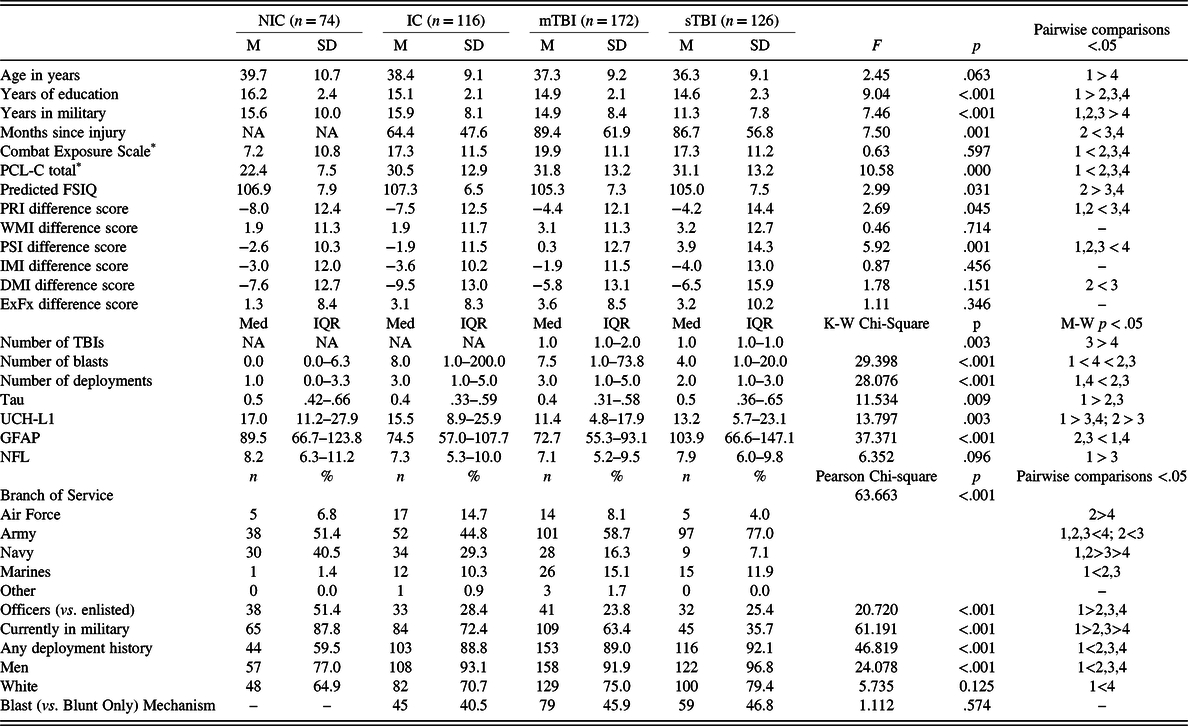
Descriptive statistics and group comparisons for demographic, military, and clinical characteristics by group are presented in Table 1. Descriptive statistics and group comparisons for predicted FSIQ and cognitive domain difference scores are also presented in Table 1. Predicted FSIQ based on ToPF and simple demographics was higher in the IC group than in the mTBI (p = .020, d = .29) and sTBI (ps = .014, d = .33). Perceptual reasoning performance was higher in the control groups than in the TBI groups (ps < .05, ds = .25–.29). Processing speed performance was worse in the sTBI group than in the NIC (p < .001, d = .51), IC (p < .001, d = .44), and mTBI (p = .016, d = .27) groups. Delayed memory performance was worse in the mTBI group than in the IC group (p = .027, = .28). There were no statistically significant differences in Working Memory, Immediate Memory, or Executive Functioning performance between the groups.
Demographics, military, injury, and clinical characteristics and group comparisons

Notes: The sTBI group was composed of complicated mild TBI (n = 43), moderate TBI (n = 24), severe TBI (n = 22), and penetrating TBI (n = 37). Criteria for TBI severity classification were as follows: [a] uncomplicated mTBI: (i) Glasgow Coma Scale (GCS) = 13–15, PTA <24 hr, LOC <30 min, and/or AOC present, and (ii) no trauma-related intracranial abnormality (ICA) on CT or structural MRI; [b] complicated mTBI: (i) GCS = 13–15, PTA <24 hr, LOC <30 min, and/or AOC present, and (ii) trauma-related intracranial abnormality on CT or MRI. [c] Moderate TBI: LOC 30 min–24 hr, PTA 1–7 days, and/or lowest reliable GCS (e.g., not intubated/sedated/intoxicated) >30 min post-injury of 9–12; [d] Severe TBI: Loss of consciousness (LOC) >24 hr, posttraumatic amnesia (PTA) >7 days, and/or lowest reliable Glasgow Coma Scale (GCS) >30 min post-injury of <9; [e] Penetrating TBI: a breach of the cranial vault and/or dura mater by an external object (e.g., bullet, shrapnel) and/or skull fragment (i.e., depressed skull fracture).
Difference scores were computed by subtracting the actual standard score from the ToPF-Simple Demographics predicted scores. In the case of executive functioning, predicted FSIQ was used.
* Participants were excluded if they evidenced potential over-reporting, under-reporting, or inconsistent/variable responding on the MMPI-2-RF, for a sample size of 361 for these analyses.
Abbreviations: DMI = Delayed Memory Index; ExFx = executive functioning; FSIQ = Full Scale Intelligence Quotient; GFAP = glial fibrillary acidic protein; IC = injured control; IMI = Immediate Memory Index; K-W = Kruskal–Wallis; mTBI = uncomplicated mild traumatic brain injury; M-W = Mann–Whitney; NFL = neurofilament light; NIC = non-injured control; PRI = Perceptual Reasoning Index; PSI = Processing Speed Index; sTBI = complicated mild, moderate, severe, and penetrating TBI; ToPF = test of premorbid functioning; UCH-L1 = ubiquitin carboxyl-terminal hydrolase L1; WMI = Working Memory Index
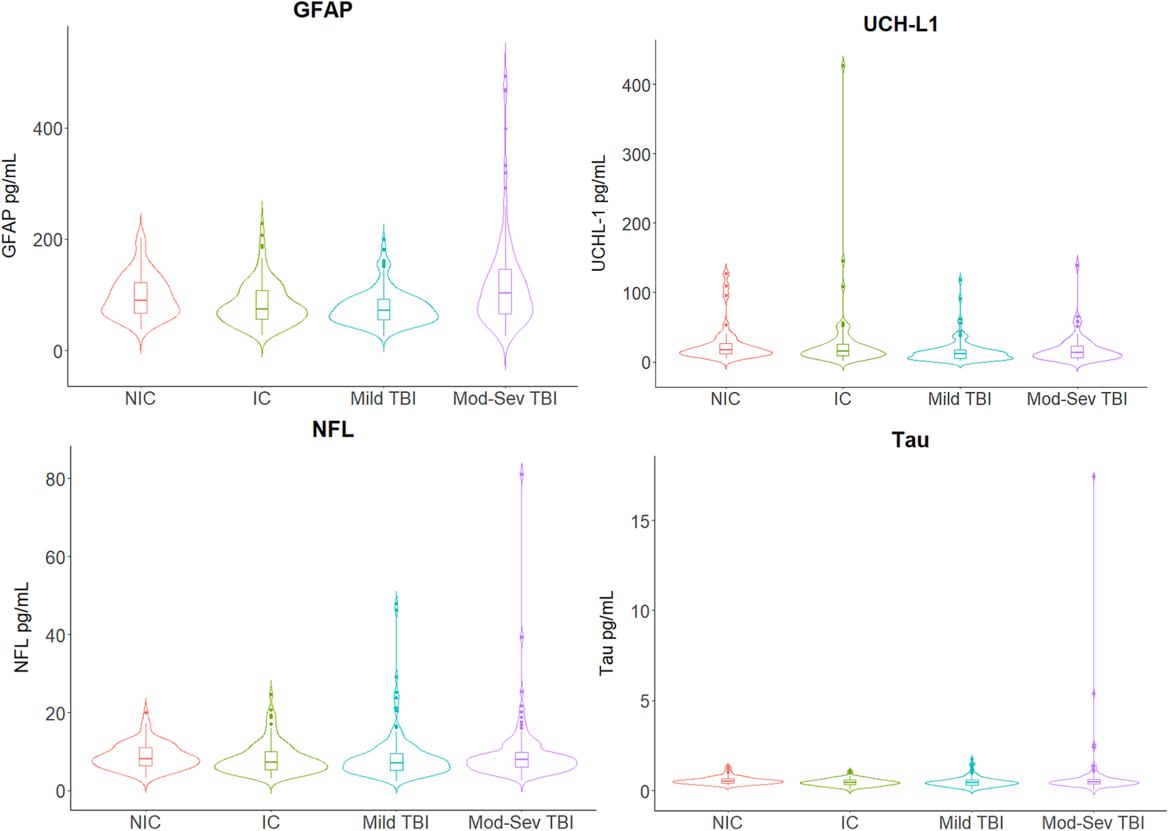
Descriptive statistics and group comparisons for the four blood biomarkers are also presented in Table 1. The distribution of biomarkers within each group is presented in Figure 1. Tau was higher in the NIC group than in the IC (p = .006, r = .21) and mTBI (ps = .007, r = .22) groups. UCH-L1 was higher in NICs than the mTBI group (p = .002, r = .28) and sTBI group (p = .045, r = .20); additionally, it was higher in the IC group than in the mTBI group (p = .005, r = .22). GFAP was higher in the NICs and sTBI group than in the IC and mTBI groups (ps < .006, rs = .21–.30). NFL was higher in NICs than in the mTBI group (p = .024, r = .15).
Plasma biomarker levels within each group. Abbreviations: GFAP = glial fibrillary acidic protein; IC = injured control; mild TBI = uncomplicated mild traumatic brain injury; Mod-Sev TBI = complicated mild, moderate, severe, and penetrating TBI; NFL = neurofilament light; NIC = non-injured control; UCH-L1 = ubiquitin carboxyl-terminal hydrolase L1.

In the IC group, as NFL increased, so did the likelihood of MNCD (Wald = 4.780, Exp(B) = 1.119, 95% CI = 1.012–1.238, p = .029). The final model resulted in a 77.2% correct classification rate (98.8% true positives; 13.8% true negatives). Otherwise, blood biomarkers were not significantly related to MNCD after controlling for covariates.
There were no significant relationships between biomarkers and performance on individual cognitive domains in the NIC or mTBI groups. Within the sTBI group, GFAP was significantly related to perceptual reasoning (R 2Δ = .030, β = .197, p = .036). Additionally, within the sTBI group, UCH-L1 was significantly related to immediate memory (R 2Δ = .084, β = .291, p = .015) and delayed memory (R 2Δ = .065, β = .262, p = .020). Within the IC group, GFAP was inversely related to working memory (R 2Δ = .052, β = −.235, p = .013), UCH-L1 was inversely related to working memory (R 2Δ = .071, β = −.267 p = .020), and NFL was related to executive functioning (R 2Δ = .039, β = .198, p = .021).
DISCUSSION
This study evaluated UCH-L1, GFAP, NFL, and t-tau in relation to cognitive performance in participants with and without TBI a year or more post-injury. After controlling for relevant covariates, UCH-L1 was significantly related to immediate memory and delayed memory in patients with a history of complicated mild, moderate, severe, and penetrating TBI. Additionally, GFAP was related to reduced perceptual reasoning in this group of participants. In contrast, t-tau and NFL were not significantly related to cognitive performance. This is the first study to show that GFAP and UCH-L1 are related to objective cognitive performance a year or more following TBI. It is important to note, however, that after accounting for covariates, UCH-L1 explained less than 10% of the variance in immediate memory, and delayed memory, while GFAP explained only 3% of the variance in perceptual reasoning. Therefore, although they are related to cognitive performance, the relationship is rather weak. Nevertheless, UCH-L1 and GFAP may be useful in understanding prognosis several years following complicated mild or more severe TBI.
UCH-L1 and GFAP have both been implicated in neurodegeneration (Guglielmotto et al., Reference Guglielmotto, Monteleone, Vasciaveo, Repetto, Manassero, Tabaton and Tamagno2017; Wang, Yang, Sarkis, Torres, & Raghavan, Reference Wang, Yang, Sarkis, Torres and Raghavan2017). GFAP has been shown to be inversely related to performance on the Mini-Mental State Examination in patients with and without dementia (Oeckl et al., Reference Oeckl, Halbgebauer, Anderl-Straub, Steinacker, Huss and Neugebauer2019). It is possible that when GFAP and/or UCH-L1 remain elevated following complicated mild or more severe TBI, this contributes to a neurodegenerative process. It has been suggested that increased autoantibodies to GFAP following TBI may hinder recovery and spur neurodegeneration (Wang et al., Reference Wang, Yang, Zhu, Shi, Rubenstein, Tyndall and Manley2018).
Although UCH-L1 and GFAP were related to cognitive performance in the sTBI group, there was no relationship between any of the biomarkers and cognitive performance in the mTBI group. This supports past research concluding that cognitive performance following mTBI is strongly related to non-neurological factors (Belanger et al., Reference Belanger, Tate, Vanderploeg, Morgan and Ricker2018). Additionally, none of the four biomarkers reliably distinguished between the sTBI group and both control groups. Therefore, this study does not provide evidence supporting GFAP, UCH-L1, t-tau, or NFL as diagnostic biomarkers of TBI a year or more post-injury.
Interestingly, within the IC group, increased NFL was related to increased likelihood of MNCD. Additionally, GFAP, UCH-L1, and NFL were each related to cognitive performance. Measurement of blood biomarkers is reliant on blood–brain barrier permeability, which can also be affected by bodily injury and stress (Dadas, Washington, Diaz-Arrastia, & Janigro, Reference Dadas, Washington, Diaz-Arrastia and Janigro2018). We have shown previously that our IC group performs somewhat below expectations based on demographically adjusted normative data (Lippa, French, Bell, Brickell, & Lange, Reference Lippa, French, Bell, Brickell and Lange2020). Our current findings suggest the possibility of increased risk of neurological processes that could lead to cognitive decline in ICs with these elevated blood biomarkers. Continued longitudinal research on this sample of controls is warranted. These findings also highlight the importance of including injured controls when investigating outcome following TBI, especially in military/veteran samples.
This study has a number of limitations. The absence of acute cognitive and biomarker data precluded a longitudinal investigation necessary for determining change over time. Additionally, the sTBI group was rather heterogeneous, including participants with complicated mild, moderate, severe, and penetrating TBI. This grouping was intentional to maximize power to detect relatively small effects commonly seen between biomarkers and symptoms. In order to mitigate this heterogeneity, injury severity was included as a covariate. Additionally, although the models controlled for several relevant covariates, they did not include psychological functioning. PTSD has been shown to influence both biomarker levels and cognition, and it will be important to investigate how psychological functioning and biomarkers may or may not interact to impact cognitive functioning over time.
Notwithstanding these limitations, the findings suggest that following complicated mild, moderate, severe, or penetrating TBI, UCH-L1 and GFAP are related to sustained cognitive impairment. After controlling for demographics and injury factors, the percent variance explained in neurocognitive performance by each of the biomarkers was less than 10%, suggesting that UCH-L1 and GFAP may play a small role in cognition several years following complicated mild or more severe TBI. UCH-L1 and GFAP should be investigated through other mechanisms that may have increased sensitivity, such as exosomes and auto-antibodies. Additionally, future longitudinal research, including injured controls, should investigate whether acute blood biomarkers levels predict cognitive performance several years following TBI.
AUTHOR NOTES
The views expressed in this manuscript are those of the authors and do not necessarily represent the official policy or position of the Department of Army, Navy, Air Force, Defense Health Agency, Department of Defense, or any other US government agency. The identification of specific products, scientific instrumentation, or organizations is considered an integral part of the scientific endeavor and does not constitute endorsement or implied endorsement on the part of the author, DoD, or any component agency. This work was prepared under Contract HT0014-19-C-0004 with DHA Contracting Office (CO-NCR) HT0014 and, therefore, is defined as US Government work under Title 17 U.S.C.§101. Per Title 17 U.S.C.§105, copyright protection is not available for any work of the US Government. For more information, please contact dha.DVBICinfo@mail.mil.
CONFLICT OF INTEREST
The authors have nothing to disclose.
ACKNOWLEDGMENTS
This study is part of the larger Defense and Veterans Brain Injury Center (DVBIC) 15-Year Longitudinal TBI Study designed to respond to a Congressional mandate (Sec721 NDAA FY2007). The authors would like to thank the service members and veterans for their time and commitment to participating in the research. The authors would also like to acknowledge the efforts of the larger team of research coordinators, research associates, research assistants, program managers, and senior management who contribute to the DVBIC 15-Year Longitudinal TBI Study.