1 Introduction
‘Sonorant transparency’ in Russian, or voicing assimilation through a sonorant, is one of the most unusual phenomena that have been reported in studies of voice assimilation in the world's languages. It received attention after Jakobson (Reference Jakobson1978) reported that in his speech an obstruent assimilated to a following obstruent at a proclitic boundary when a sonorant consonant intervened (e.g. iz Mcenska [smʦ] ‘from Mcensk’, ot mgly [dmg] ‘from the haze’). Later, Hayes (Reference Hayes, Aronoff and Oehrle1984) argued that this is a phonological rule of fast speech in Russian. However, the phenomenon has always been controversial. It violates one of the most common properties that have been attributed to obstruents: preservation of voicing specification before a sonorant (Trubetzkoy Reference Trubetzkoy and Baltaxe1969). Moreover, not every linguist agrees about the existence of sonorant transparency in Russian. Comprehensive phonetic and phonological descriptions of Standard Russian (e.g. Halle Reference Halle1959, Avanesov Reference Avanesov1968) and Russian dialects (e.g. Avanesov & Bromlej Reference Avanesov and Bromlej1986) have not reported cases of sonorant transparency. It has been argued to be a gradient phenomenon (Cho Reference Cho1990, Shapiro Reference Shapiro1993, Padgett Reference Padgett2002), limited to the environment before devoiced sonorants (Ševoroškin Reference Ševoroškin1971) or even unattested in Standard Russian (Es'kova Reference Es'kova1971, Kavitskaja Reference Kavitskaya, Dziwirek, Coats and Vakareliyska1999, Robblee & Burton Reference Robblee, Burton, Browne and Zec1997). In spite of these doubts, the claim that voice can assimilate through a sonorant has been used to support important theoretical generalisations (Kiparsky Reference Kiparsky1985, Steriade Reference Steriade1999), and is adopted in some phonological analyses of Russian (e.g. Petrova Reference Petrova, Browne, Kim, Partee and Rothstein2003, Rubach Reference Rubach2008).
Whether obstruents can or cannot assimilate in voicing before an intervening sonorant is an important question in phonological theory. It is related to the ‘action-at-a-distance’ principle (Poser Reference Poser, van der Hulst and Smith1982). Non-local agreement in certain distinctive features is not uncommon in languages, and is typically realised as harmony. Distant agreement in nasality or place of articulation can affect results of phonological alternations in derived environments (Rose & Walker Reference Rose and Walker2004). Intriguingly, laryngeal harmony in stops (e.g. in Chaha and Zulu) is usually restricted to roots and does not operate across morpheme boundaries to cause phonological alternations in affixes (Rose Reference Rose, van Oostendorp, Ewen, Hume and Rice2011). Therefore, even in cases of laryngeal harmony, obstruents in prevocalic/presonorant position do not change laryngeal specifications.
Obstruent assimilation in voicing through a sonorant has been claimed not to be unique to Russian. Rubach (Reference Rubach1996, Reference Rubach1997) argues that sonorant transparency to voice assimilation is a regular process that occurs both word-internally and across a word boundary in Polish. Unlike in Russian, voice assimilation through a sonorant in Polish can be regressive and progressive. However, the acoustic analysis in Strycharczuk (Reference Strycharczuk2012) raises questions about whether phonological sonorant transparency exists in Polish. She finds a complex pattern of results, but argues that Polish speakers show a strong tendency to preserve underlying voicing in presonorant obstruents. Therefore, a search for experimental evidence of presence or absence of sonorant transparency in Russian is crucial for our understanding of the nature of phonological assimilation.
Acoustic studies can be useful in testing the validity of phonetic data upon which phonological analyses are based. While acoustic studies of Russian obstruents suggest that little variation exists in initial and intervocalic voiced and voiceless obstruents (Halle Reference Halle1959, Barry Reference Barry, Holmes and Ainsworth1988, Reference Barry1995, Ringen & Kulikov Reference Kulikov2012), there has been no instrumental analysis addressing the important question of how voicing is implemented in Russian obstruents in voiced and voiceless clusters. To verify whether there is voice assimilation in a consonant cluster, it is crucial to establish whether the acoustic parameters of voicing in the leftmost obstruent change as a function of the voicing category of the rightmost obstruent. In this paper, I argue that there is no effect of the rightmost obstruent on the voicing of the leftmost obstruent in obstruent–sonorant–obstruent clusters in Russian, and hence no voice assimilation. In contrast, a strong effect of the rightmost obstruent in obstruent-only clusters is a direct result of voice assimilation.
This paper is organised as follows. In §2, data illustrating cases of voice assimilation in Russian are presented. §3 is a review of previous studies of the phonetics and phonology of voice assimilation in Russian. §4 and §5 describe an experiment in which cases of voice assimilation in obstruent clusters with and without intervening sonorants were examined. The results show no evidence of sonorant transparency in Russian. Obstruents do not assimilate in voicing through a sonorant. §6 discusses and summarises the results.
2 Voicing contrast and voice assimilation in Russian
Russian has a contrast between voiceless unaspirated stops /p t k/ and fully voiced stops /b d g/.Footnote 1 The contrast is preserved in a prevocalic/presonorant position (Avanesov Reference Avanesov1968), both word-initially (1a) and word-internally (1b).
-
(1)


Word-internal morpheme boundaries are usually invisible to voicing processes. For example, final obstruents in prefixes preserve underlying voicing when they occur in a prevocalic/presonorant position, as shown in (2).
-
(2)

The boundary between a preposition and a content word is also treated as a word-internal morpheme boundary. Prepositions in Russian behave as affixal proclitics, which do not constitute separate prosodic words and are prosodified with the following noun under a prosodic word (see Selkirk Reference Selkirk, Beckman, Dickey and Urbanczyk1995 for a detailed analysis of prosodic constituents).Footnote 2 Like the prevocalic obstruents in prefixes in (2), final obstruents in prepositions preserve their underlying voicing before words beginning with vowels or sonorants, as illustrated in (3).
-
(3)

Russian is usually described as having regressive voice assimilation in obstruent clusters. Two or more obstruents in a cluster are described as having the same specification for voice, which is determined by the rightmost obstruent in a cluster. Thus, both voicing of an underlying voiceless stop and devoicing of an underlying voiced stop are attested, as shown in (4).
-
(4)

Voice assimilation also occurs across a clitic boundary. Final obstruents in prepositions (proclitics) agree in voicing with the root-initial obstruent, as illustrated in (5).
-
(5)

To sum up, obstruents before sonorants are generally claimed to retain their underlying laryngeal specifications when a sonorant segment is a vowel or a consonant followed by a vowel. In some cases, however, obstruents in Russian have been reported to change their voicing specifications before sonorant consonants. Jakobson (Reference Jakobson1978) reports that in his speech, final obstruents in prepositions (e.g. iz ‘from, out of’ or ot ‘off, from’) agree in voicing with the obstruents following the sonorant, as shown in (6), instead of preserving their laryngeal specification in presonorant position.
-
(6)

No assimilation through a sonorant, however, has been reported within a word. For example, an initial voiceless obstruent in Russian names of Polish origin, e.g. Kržyžanovskij, Prževalskij, is never pronounced as voiced before a sonorant followed by a voiced obstruent. Voice assimilation through a sonorant has never been reported across a word boundary either, cf. (7).
-
(7)

Cases of sonorant transparency to voice assimilation in Russian have thus been claimed to be found in a single restricted environment: in clusters across a prepositional boundary.
3 Background
Following Jakobson, Hayes (Reference Hayes, Aronoff and Oehrle1984) claims that sonorant transparency in voice assimilation is a phonological process found in fast speech. He argues that the phonological feature [±voice] spreads through a sonorant to the leftmost obstruent, and connects this with another fact about voicing in Russian – the idiosyncratic behaviour of Russian /v/. The labiodental fricative in Russian undergoes voice assimilation, but never triggers assimilation of a preceding obstruent when occurring before a vowel. Obstruents generally retain an underlying voicing contrast in this position (e.g. tvorec [tv] ‘creator’, dvorec [dv] ‘palace’). Voice assimilation before /v/, however, is regular when /v/ precedes an obstruent and assimilates (ot vdovy [dvd] ‘from the widow’, bez vpuska [sfp] ‘without admission’).
However, this analysis is based predominantly on cases of incomplete voicing. In order to explain how devoicing might spread through sonorants that are still pronounced with vocal fold vibration, Hayes generalises over these cases and cases of partial devoicing of word-final sonorants. He argues that sonorants can be pronounced with vocal fold vibration, but be phonologically [−voice]. According to Hayes (Reference Hayes, Aronoff and Oehrle1984: 325), [−voice] sonorants are characterised by weaker and less regular vibration of the vocal folds than [+voice] sonorants. The other direction of assimilation, i.e. voicing in presonorant obstruents, is not discussed. Unfortunately, no results of acoustic measurements of voicing in obstruents or any demographic information about the language consultants and what variety of Russian they speak are given. Nor does Hayes provide any information about how regular this process is, except that this phenomenon becomes more noticeable in fast speech.
Not every linguist agrees on the existence of sonorant transparency in Russian. Some (Es'kova Reference Es'kova1971, Shapiro Reference Shapiro1993, Kavitskaya Reference Kavitskaya, Dziwirek, Coats and Vakareliyska1999) deny its existence. According to Es'kova (Reference Es'kova1971: 245), voicing of /t/ in cases like ot mgly ‘from the haze’ cannot occur, because clusters like [dmg] are not possible within a single syllable. Kavitskaya (Reference Kavitskaya, Dziwirek, Coats and Vakareliyska1999) claims that sonorant transparency is not found in the speech of several language consultants in her study (speakers of the Moscow dialect of Standard Russian), nor in her own speech. Others claim that transparency is possible under certain circumstances. Cho (Reference Cho1990) and Padgett (Reference Padgett2002) argue that sonorant transparency to voice assimilation in Russian is a gradient, phonetic phenomenon. Ševoroškin (Reference Ševoroškin1971) argues that it is optional. He departs from Hayes, however, in claiming that only phonetically devoiced sonorants can trigger devoicing in preceding obstruents. Thus /z/ in the phrase iz mxa ‘out of the moss’ is voiced if [m] is voiced, but it is voiceless if the sonorant is devoiced: [is  xa].
Some cases of voice assimilation before a sonorant followed by an obstruent were investigated by Robblee & Burton (Reference Robblee, Burton, Browne and Zec1997). They tested four speakers who pronounced sentences with embedded phrases containing prepositions with voiceless obstruents, s ‘with, from’ and ot, before liquid–vowel and liquid–voiced obstruent sequences (e.g. s lišnim ‘with extra’, s ldiny ‘from the ice’) and prepositions with voiced obstruents iz ‘from’, bez ‘without’, nad ‘over’ and pod ‘under’ before liquid–vowel and liquid–voiceless obstruent sequences (e.g. bez riska ‘without risk’, bez rtuti ‘without mercury’). Mean closure duration and the relative amplitude of low-frequency energy were taken as an indication of the voicing properties of the first obstruent in a cluster. The results show that the second obstruent (C2) did not affect the laryngeal state of the first obstruent (C1). Neither mean closure duration nor relative amplitude of /t/ and /d/ differed significantly if the liquid was followed by a vowel or by an obstruent. The two classes of obstruents – voiceless and voiced – remained distinct.
Due to limitations of the design, some important comparisons were not made in Robblee & Burton (Reference Robblee, Burton, Browne and Zec1997). First, they did not investigate changes in voicing in obstruents in fast speech. Second, they compared voiced and voiceless obstruents only in potentially assimilating cluster types (voiced–sonorant–voiceless and voiceless–sonorant–voiced). In order to establish the sources of voicing and devoicing in C1 in obstruent–sonorant–obstruent clusters, it is crucial to compare voicing in presonorant C1 obstruents before both voiced and voiceless C2 with voicing in C1 stops in obstruent clusters. As phonological assimilation in obstruent clusters means that voicing in C1 is a function of C2 voicing, the goal of this study is to examine the effects of a sonorant+C2 obstruent on the voicing properties of C1 obstruents in consonant clusters across a clitic boundary.
4 Method
4.1 Participants
Fourteen native speakers of Russian, seven males and seven females, participated. Their mean age was 19·0 years (SD=1·9; range 18–25 years). They were monolingual speakers who had grown up and resided in Tambov, Russia, and spoke educated Standard Russian.Footnote 3 The participants had no history of speech or hearing disorders. They were naive as to the purpose of the experiment, and were paid a standard hourly rate for their participation in the study.
After inspection of the recordings, one speaker's data (S6) were excluded, due to consistent deletion of voiceless C1 obstruents in obstruent–sonorant–obstruent clusters. His data were discarded from the statistical analysis; however, his results are reported in a general discussion of processes that were observed in obstruent–sonorant–obstruent clusters in prepositions.
4.2 Stimuli
The list of stimuli consisted of four phrases with a preposition ending in an underlying voiceless stop (ot), and four phrases with a preposition ending in an underlying voiced stop (nad). These prepositions preceded nouns beginning with a sonorant–obstruent cluster with a voiced or voiceless C2: e.g. nad rtutju ‘over mercury’, ot lgun'ji ‘from the liar’. Thus there were target phrases with four types of obstruent–sonorant–obstruent combinations: voiced–sonorant–voiced (/dlg, dmz/), voiced–sonorant–voiceless (/drt, dmx/), voiceless–sonorant–voiced (/tlg, tmz/) and voiceless–sonorant–voiceless (/trt, tmx/). Eight phrases with the same prepositions before a noun beginning with a single stop were used as a control category (assimilation condition): voiced–voiced (/dg, db/), voiced–voiceless (/dt, dk/), voiceless–voiced (/tg, tb/) and voiceless–voiceless (/tp, tk/): e.g. nad parom ‘over vapour’, ot gaza ‘from gas’. Heterorganic stops were used to reduce the number of unreleased C1 stops in clusters (Zsiga Reference Zsiga2000). The full list is given in (8). Finally, there were twelve fillers with assorted prepositional phrases unrelated to voice assimilation. The phrases were randomised and presented to the participants as a single set.
-
(8)

4.3 Procedure and measurements
The participants were asked to read phrases aloud in three speaking-rate conditions. In condition 1 (list rate), the target phrases were pronounced carefully as a word list. In condition 2 (slow rate), the phrases were placed in a carrier phrase Skaži—ješče raz ‘Say—once again’, and were pronounced at a comfortable tempo. In condition 3 (fast rate), the phrases were placed in the same carrier phrase, and pronounced quickly. The speakers were instructed to say the phrases as if they were trying to say something important to a person who was leaving the room.
For each condition, the speakers read the materials three times, but only the second and third readings were recorded. 96 test phrases (16 phrases×3 conditions×2 readings) for each speaker were recorded; thus the total number of target segments was 1248. 40 tokens were discarded, due to absence of release, nasalisation, deletion or metathesis. 1208 tokens thus remained for the statistical analysis.
The speakers were digitally recorded in a quiet room, using a one-point condenser Shure WH30XLR microphone connected to an M-Audio MobilePre USB soundcard through an XLR interface. The microphone was placed 20 mm from the right corner of the mouth. The recording was made at 44,100 Hz and then downsampled at 22,050 Hz for acoustic analysis. A digital high-pass filter with a 70 Hz cut-off frequency was applied to the speech waveform. The high-pass filter served to reduce oscillations resulting from room vibration, as well as to suppress the microphone air-blast artefact associated with plosive speech productions.
The obstruent boundaries were set manually in Praat (Boersma & Weenink Reference Boersma and Weenink2011). To investigate whether voice assimilation occurred in obstruent clusters, acoustic measurements of the first and second obstruents in the cluster (C1 and C2) were performed. Changes in various acoustic measurements are diagnostic of voice assimilation in C1: closure duration, voicing duration, voicing ratio, duration of a preceding vowel and F1 frequency. Both the waveform and the spectrogram were used to set the obstruent boundaries. Figure 1a illustrates an underlying voiced C1 stop before a sonorant and a voiceless C2 stop; Fig. 1b illustrates an underlying voiced C1 stop before a voiceless C2 stop in an assimilating obstruent–obstruent cluster. The beginning of the stop closure was marked at the end of the F2 structure, which typically coincides with a significant drop in amplitude of vocal fold vibration (Jessen Reference Jessen1998). The end of the closure was marked at the beginning of the release burst. Closure duration and duration of voicing of the target stops were measured. The voicing ratio was then calculated as a ratio of voicing duration to closure duration.
Examples of important acoustic measurements for voiced and voiceless stops. Tokens (a) nad rtutju ‘over mercury’, spoken by S10 (male) at fast rate (no assimilation; fully voiced C1 stop before a voiceless C2 stop), and (b) nad parom ‘over vapour’, spoken by S1 (female) at fast rate (assimilation; voiceless C1 stop before a voiceless C2 stop).

The onset and offset of the vowel were marked at the beginning and end of F2, which typically coincided with high amplitude of vocal fold vibration. When a nasal preceded a vowel, the boundary was set at the point where there was a noticeable change of the formant structure and amplitude of vocal fold vibration. F1 was measured at a point 10 ms before vowel offset.
5 Results
The objective of the analysis was to determine whether voice assimilation takes place in consonant clusters across a prepositional boundary at different speaking rates. If the first obstruent in the cluster (C1) assimilates in voicing, the voicing properties of this segment should be consistent with the voicing properties of the second obstruent in the cluster (C2). If, in contrast, the voicing properties of C1 are consistent with the underlying specification for voice, this can be taken as evidence for absence of voice assimilation.
Several acoustic measurements were used to investigate the voicing properties of stops: voicing duration, closure duration, voicing ratio, duration of a preceding vowel and F1 frequency. These measurements were tested for effects of C1 underlying voicing (voiced, voiceless), C2 voicing (voiced, voiceless), cluster type (with, without a sonorant) and speaking rate (slow, fast). An effect of C2 for all cues would indicate voice assimilation and sonorant transparency. If, however, sonorant transparency is not found in the data, cluster type is predicted to interact with C1 voicing and C2 voicing. For clusters with a sonorant, an effect of C1 voicing and no effect of C2 voicing are expected, indicating preservation of the underlying contrast and no assimilation. For clusters without a sonorant, a effect of C2 voicing is expected, but no effect of C2 voicing, indicating voice assimilation. The presence of sonorant transparency can be established if an effect of C2 voicing but no effect of C1 voicing is found in both types of clusters.
The analysis involved several stages. First, the effect of the speech tempo on production was investigated, to determine whether the manipulation of the speaking rate had the intended effect. Next, the voicing properties of C2 were analysed, to establish whether the segments that might determine the results of voice assimilation remained stable. Finally, the C1 was analysed, to assess the degree of assimilation in C1 in different speaking-rate conditions. The C1–sonorant–C2 clusters were compared to the C1–C2 clusters, to determine whether the intervening sonorant prevented voice assimilation. A preliminary test showed that duration of voicing was not significantly different in the list and slow speech conditions (T(12)=0·51, p=0·619); thus the data for the list condition were dropped in favour of analysis in more realistic speaking conditions.
5.1 Effect of speaking rate on phrase duration
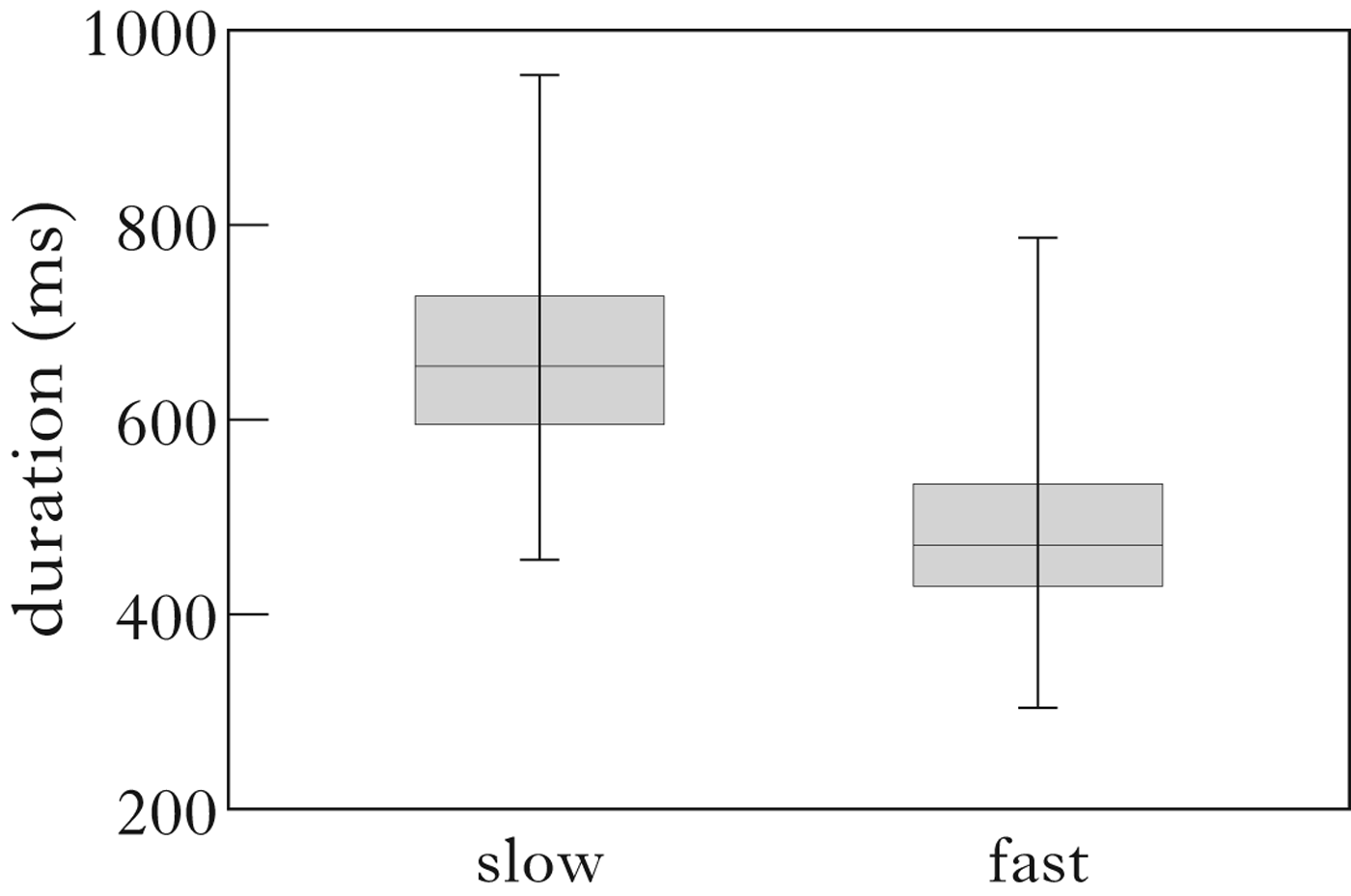
The first test examined whether the manipulation of speaking rate had the intended effect. The total phrase duration was used as a proxy for speaking rate; shorter duration was expected with faster reading.Footnote 4 A repeated measures ANOVA was used to evaluate a (within-subjects) effect of speaking rate conditions (slow, fast) on word duration. Figure 2 summarises the results.
Mean phrase duration in slow and fast speaking rate conditions.

A highly significant main effect of speaking rate was found (F(1,12)=146·4, p<0·001). As expected, all speakers' phrases had a shorter duration in the fast condition (M=489 ms, SD=48) than in the slow condition (M=646 ms, SD=53), a mean difference exceeding 150 ms.
5.2 Voicing in C2 obstruents
The next set of tests examined voicing in the second consonant in a cluster (C2). For the purposes of the study, it was important to establish whether voicing in C2 was a constant parameter or varied unpredictably. The latter situation would considerably complicate the analysis of voicing in C1 stops, as it would require testing changes of voicing in C1 in individual matched pairs with C2.
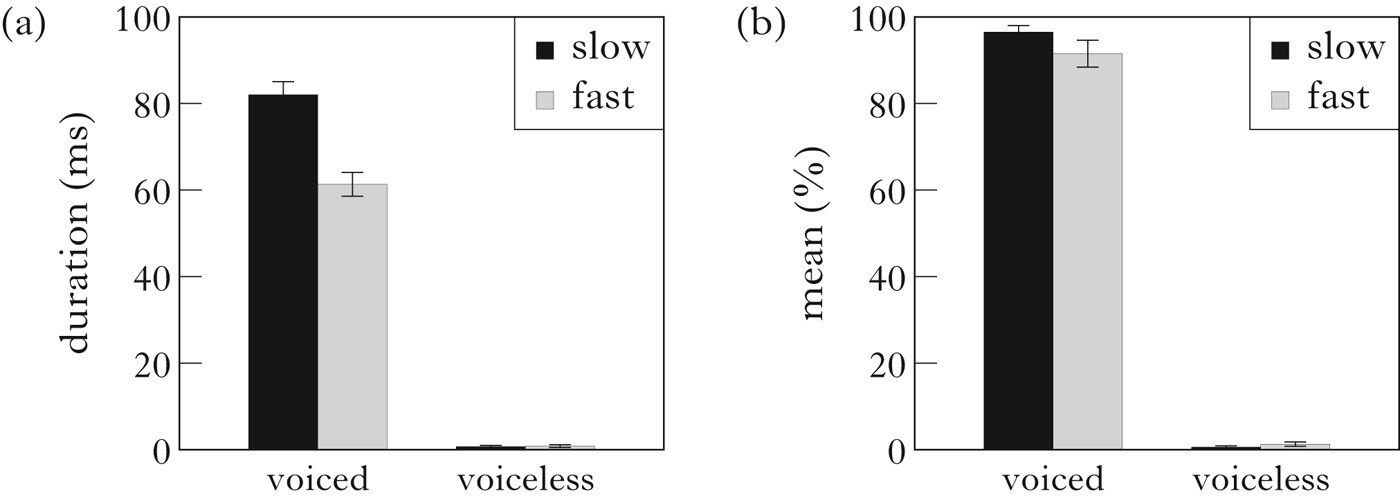
Because a variety of unmatched stops (e.g. [t] vs. [g]) and fricatives (e.g. [x] vs. [z]) were used in the stimuli, direct comparison of all temporal cues in these obstruents was not appropriate. Such comparison would find differences (e.g. in closure duration) which are due to manner (stop vs. fricative) or place of articulation (dental vs. velar) rather than to underlying voicing. Thus only duration of voicing and the proportion of voicing duration to closure duration (voicing ratio) of the two categories of obstruents was compared across two speaking-rate conditions. The results are summarised in Fig. 3.
(a) Mean voicing duration and (b) mean voicing ratio in underlying voiced and voiceless C2 obstruents in the slow and fast rate conditions.

A repeated measures ANOVA with underlying voicing (voiced, voiceless) and speaking rate (slow, fast), was performed on each measurement. Main effect of underlying voice was significant for both acoustic measurements: voicing duration (F(1,12)=723·9, p<0·0001) and voicing ratio (F(1,12)=1684, p<0·0001). As expected, C2 obstruents retained their underlying specification for voice. Underlying voiced obstruents were voiced during 94% of their closure/frication, averaging 72 ms (SD=27); underlying voiceless obstruents were voiced for 1% of their closure/frication, averaging 1 ms (SD=4).
An effect of rate (F(1,12)=89·2, p<0·0001) and an interaction with underlying voicing (F(1,12)=79·1, p<0·0001) were obtained for voicing duration, revealing that it was shorter in fast speech (M=61 ms, SD=24) than in slow speech (M=82 ms, SD=27) only in voiced C2 obstruents. Duration of voicing in voiceless C2 obstruents did not change as a function of speaking rate. The differences in duration between voiced and voiceless obstruents were nevertheless significant in both speaking-rate conditions (slow: T(1,12)=26·87, p<0·0001; fast: T(1,12)=22·14, p<0·0001).
No effect of rate (F(1,12)=2·42, p=0·146) was obtained for voicing ratio: voicing ratio in C2 obstruents did not change in different speaking-rate conditions. Thus the results suggest that voicing in C2 obstruents remains stable, which ensures a correct analysis of voicing in C1 obstruents.
5.3 Voicing in C1 stops
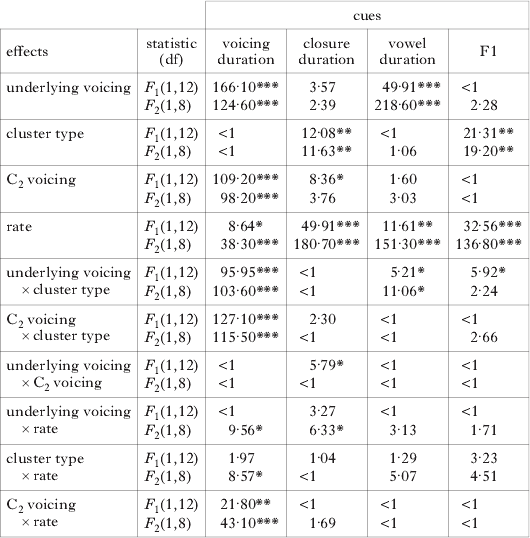
The next step of the analysis examined cues to voicing in C1 stops. In particular, the closure voicing was examined, along with three secondary cues: closure duration, duration of a preceding vowel and F1 frequency. In a by-subject analysis, each cue was examined using a repeated measures ANOVA with C1 underlying voicing (voiced, voiceless), cluster type (with a sonorant, without a sonorant), C2 voicing (voiced, voiceless) and speaking rate (slow, fast) as within-subject factors. In a by-item analysis, a repeated measures ANOVA with speaking rate (slow, fast) as a within-subject factor and cluster type (with a sonorant, without a sonorant), underlying voicing (voiced, voiceless) and C2 voicing (voiced, voiceless) as between-subject factors was performed on each cue. The summary for these ANOVAs is shown in Table I, and the most important findings are discussed below.
Summary of ANOVAs examining effects of underlying voicing (two levels), cluster type (two levels), C2 voicing (two levels) and speaking rate (two levels) on acoustic cues in C1 stops in prepositions. F 1 and F 2 values are shown. Significant values are indicated by * (p<0·05), ** (p<0·01) and *** (p<0·001).

5.3.1 Main cue: voicing during closure
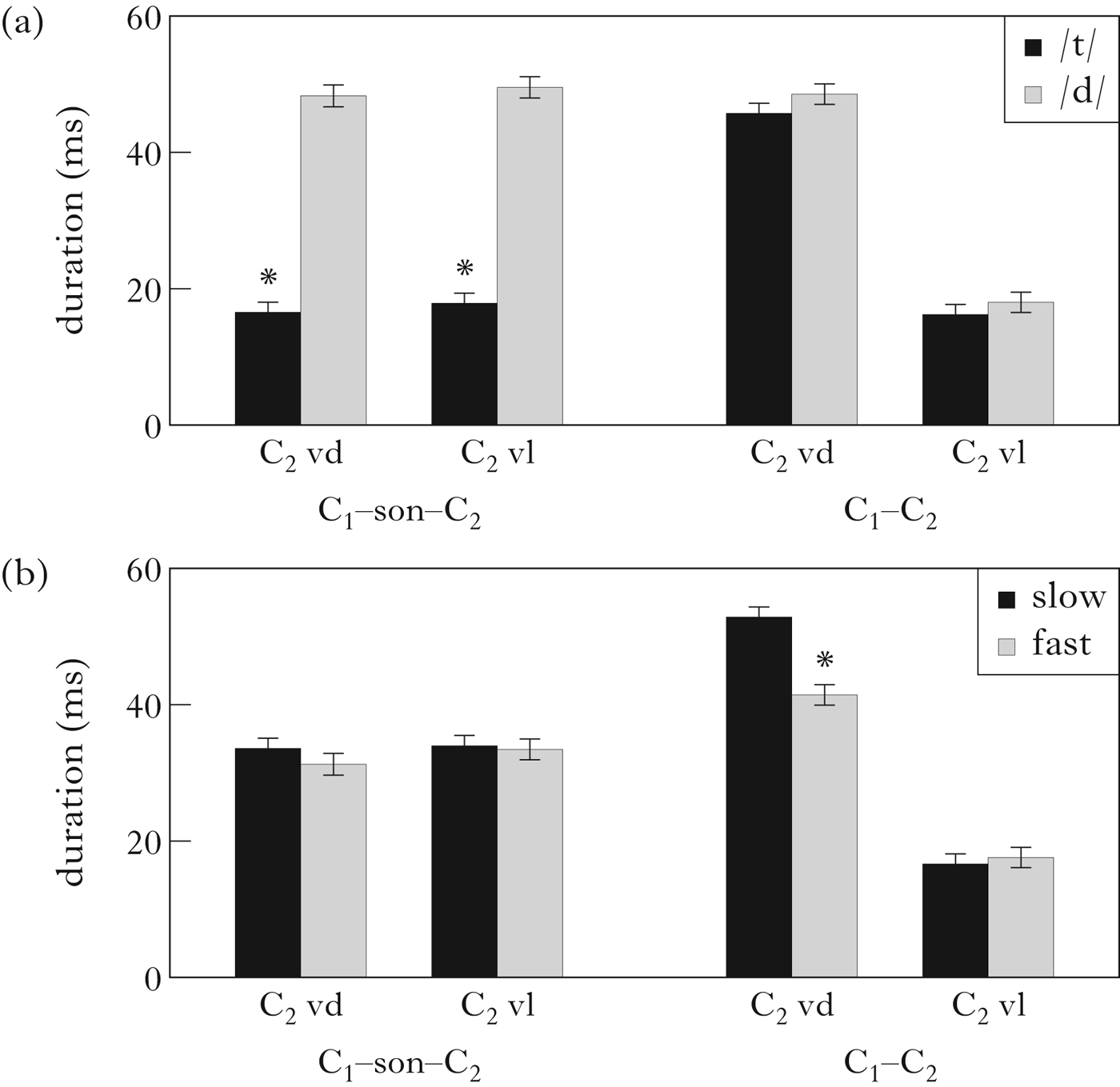
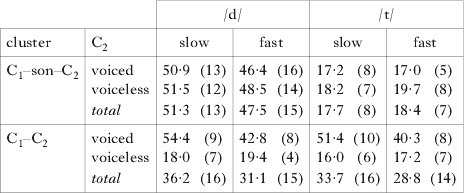
Acoustic measurements of voicing duration are summarised in Table V in the Appendix. Crucially, the statistical tests revealed significant interactions of cluster type with C1 and C2 in both by-subject and by-item analyses (see Fig. 4a). This means that C1 obstruents retained an underlying voicing contrast when they were in a presonorant position (voiced: M=49 ms, SD=14; voiceless: M=18 ms, SD=7; F 1(1,12)=144·4, p<0·001; F 2(1,4)=160·8, p<0·001), with no effect of C2 voicing (F 1<1; F 2<1). In obstruent–obstruent clusters, in contrast, no effect of underlying voicing in C1 obstruents was found (voiced: M=34 ms, SD=7; voiceless: M=31 ms, SD=8; F 1<1, F 2<1), but the effect of C2 was highly significant (voiced: M=47 ms, SD=9; voiceless: M=18 ms, SD=7; F 1(1,12)=220·5, p<0·001; F 2(1,4)=365·2, p<0·001).
Effects of (a) cluster type and (b) speaking rate on voicing duration in C1 stops, pooled across 13 speakers.

This strongly suggests that voice assimilation in Russian is found only in obstruent–obstruent clusters, whereas in obstruent–sonorant–obstruent clusters the rightmost obstruent does not affect voicing in C1 obstruents, and thus claims about voice assimilation and sonorant transparency in such clusters are not supported.
Speaking rate affected voicing in C1 (F 1(1,12)=8·64, p<0·05), but due to a significant rate×C2 voice×cluster type interaction (F 1(1,12)=15·14, p<0·01; F 2(1,8)=22·63, p<0·01), the effects of rate in clusters with and without a sonorant were investigated separately. Results are shown in Fig. 4b.
In obstruent–obstruent clusters, rate interacted with C2 voice (F 1(1,12)=40·69, p<0·001; F 2(1,4)=82·31, p<0·001) rather than with underlying voice (F 1<1; F 2<1), revealing that the duration of voicing changed as a function of speaking rate only in phonetically voiced obstruents before voiced C2 (slow: M=53 ms, SD=10; fast: M=42 ms, SD=8; T(1,12)=5·96, p<0·001). Voicing in voiceless obstruent clusters did not change as a function of speaking rate (T<1).
In clusters with presonorant C1 obstruents, a different pattern was observed. Rate did not interact with C2 (F 1<1; F 2<1), and mean difference (5 ms) between slow and fast rates observed in voiced presonorant obstruents (slow: M=51 ms, SD=13; fast: M=46 ms, SD=15) was significant in a by-item analysis (T(1,3)=4·45, p<0·05) but it did not reach significance level in a by-subject analysis (T(1,12)=1·08, p=0·300). No significant difference in voicing duration between the slow and fast conditions was observed in underlying voiceless presonorant obstruents (T 1(1,12)<1; T 2(1,3)=1·12, p=0·345).
Thus the results suggest that changes in duration of phonetic voicing were different in the two types of clusters. In the assimilating obstruent–obstruent clusters, the changes due to rate manipulation were found in voicing affected by C 2 obstruents, but in obstruent–sonorant–obstruent clusters, no significant change of voicing as a function of speaking rate was found.
5.3.2 Distribution of voicing duration
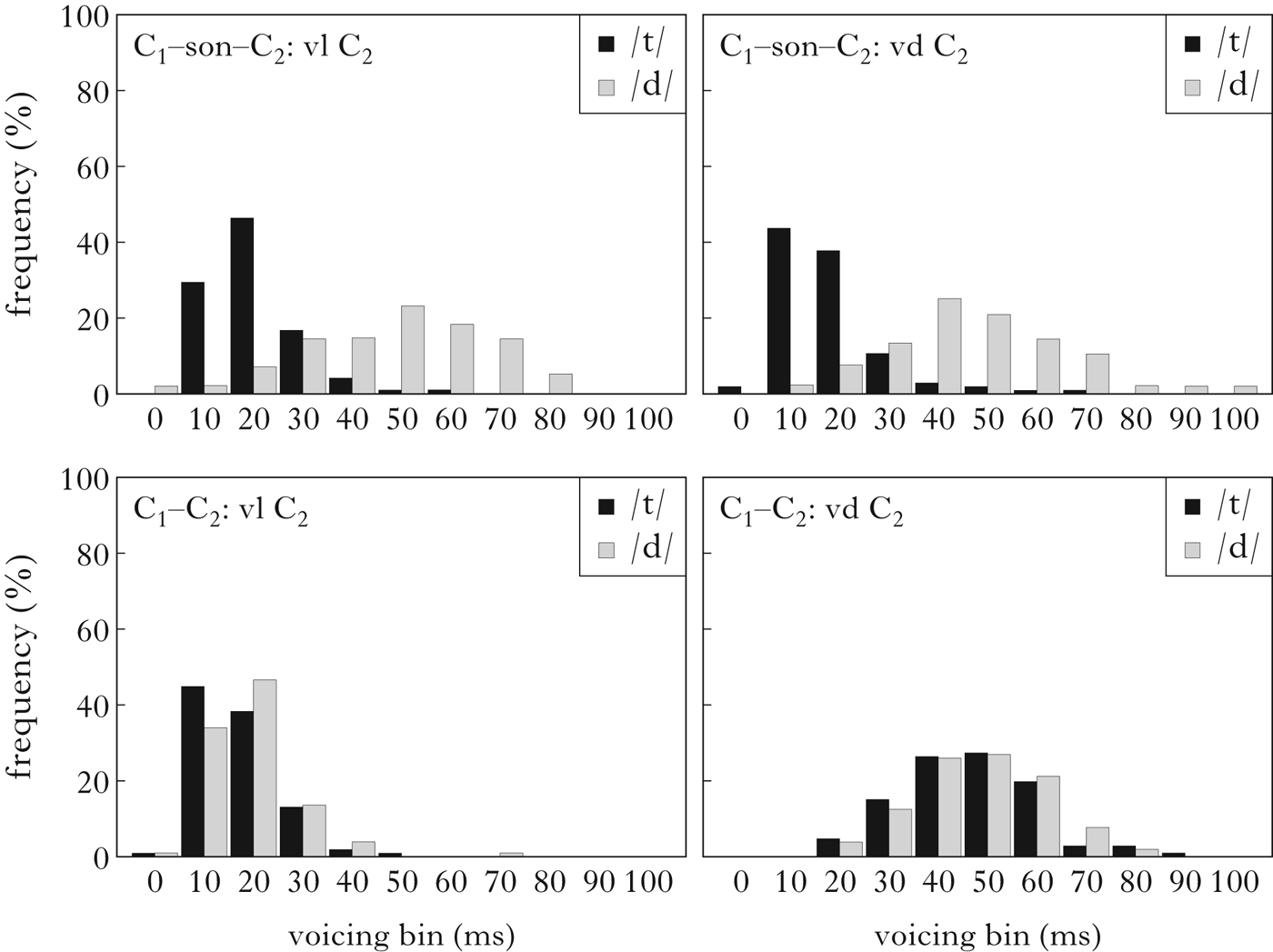
While the main effect of underlying voicing on closure voicing was highly significant for obstruent–sonorant–obstruent clusters, this result does not show whether there was any overlap in the distributions. It is important to evaluate whether this cue is an unambiguous marker of voicing. The distributions were thus computed for voicing during closure values in 10 ms bins, centred at 0, 10, 20, etc., as shown in Fig. 5.
Distributions of voicing duration in C1 stops in prepositions, broken down by cluster type (upper row: C1–son–C2; lower row: C1–C2) and C2 obstruent (left column: voiceless; right column: voiced).

The distributions revealed that overlap of voicing duration in underlying /d/ and /t/ was complete in obstruent–obstruent clusters, but for underlying /d/ and /t/ in obstruent–sonorant–obstruent clusters there were two distinct modes: one with a peak at 20 ms for /t/, and the other with a peak at 45 ms for /d/. This confirms the results of statistical tests, and suggests unambiguous voice assimilation in obstruent–obstruent clusters, but preservation of the underlying contrast in obstruent–sonorant–obstruent clusters.
The two types of clusters had very similar distributions in terms of phonetic voicing. The categorical boundary between phonetically voiced and voiceless obstruents was established at 35 ms, using the formula ‘mean+2 SD’ (Slis Reference Slis1986). For both cluster types, there was partial overlap: roughly 25% of [d]'s had voicing durations shorter than 35 ms, and overlapped with [t]'s. About 10% of [t]'s had voicing durations longer than 35 ms, and overlapped with [d]'s.
5.3.3 Voicing ratio
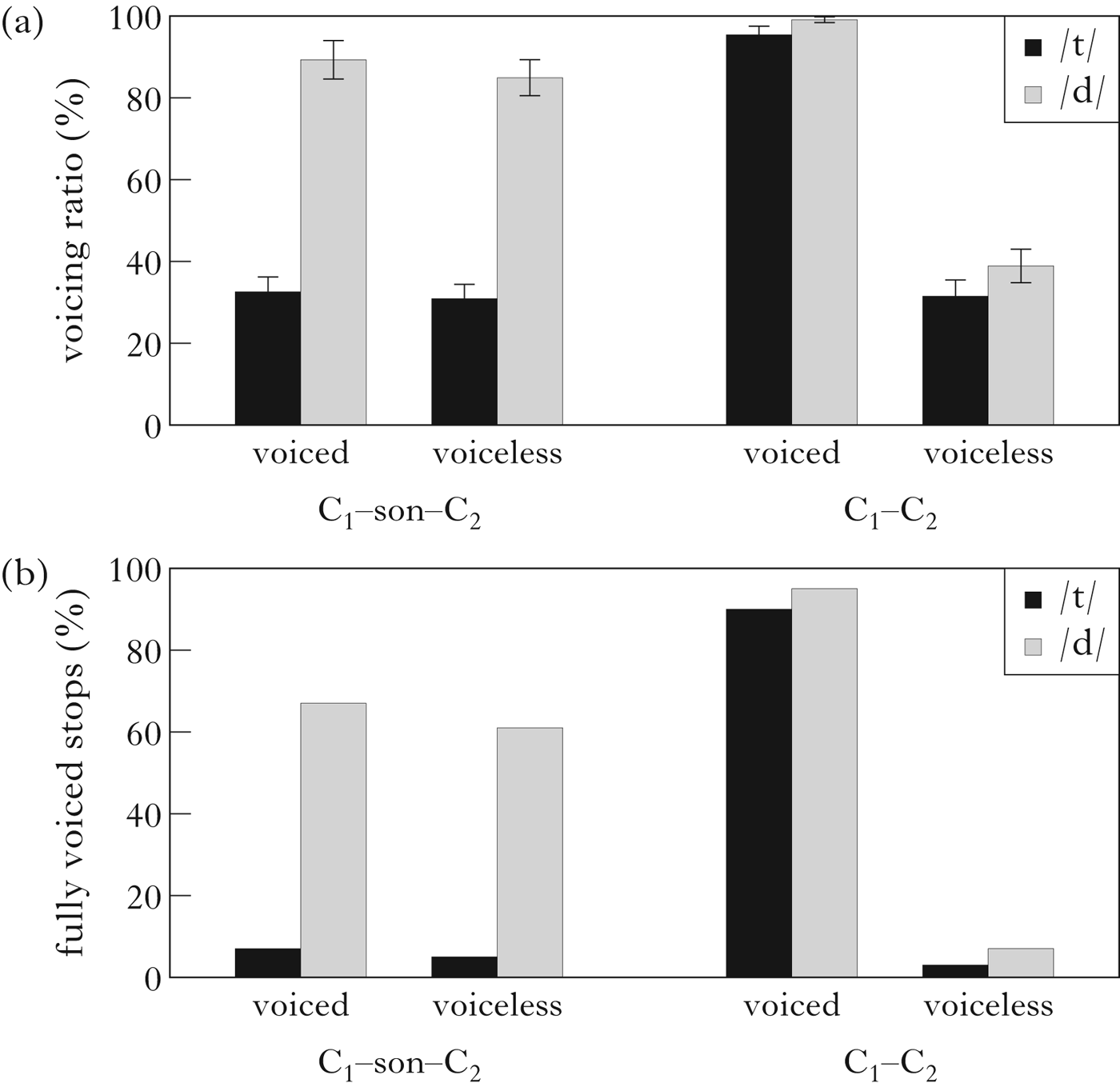
As distribution of voicing durations revealed partial overlap between phonetically voiced [d] and voiceless [t], it was important to examine the percentage of voicing during closure in these stops, and the number of partially voiced stops. Voicing ratios were calculated as a ratio of voicing duration to closure duration. A summary of voicing ratios is given in Fig. 6a, while Fig. 6b summarises the calculations for fully voiced C1 stops.
(a) Voicing ratios and (b) percentage of fully voiced C1 stops in clusters, broken down by C2 obstruent and cluster type, pooled across 13 speakers.

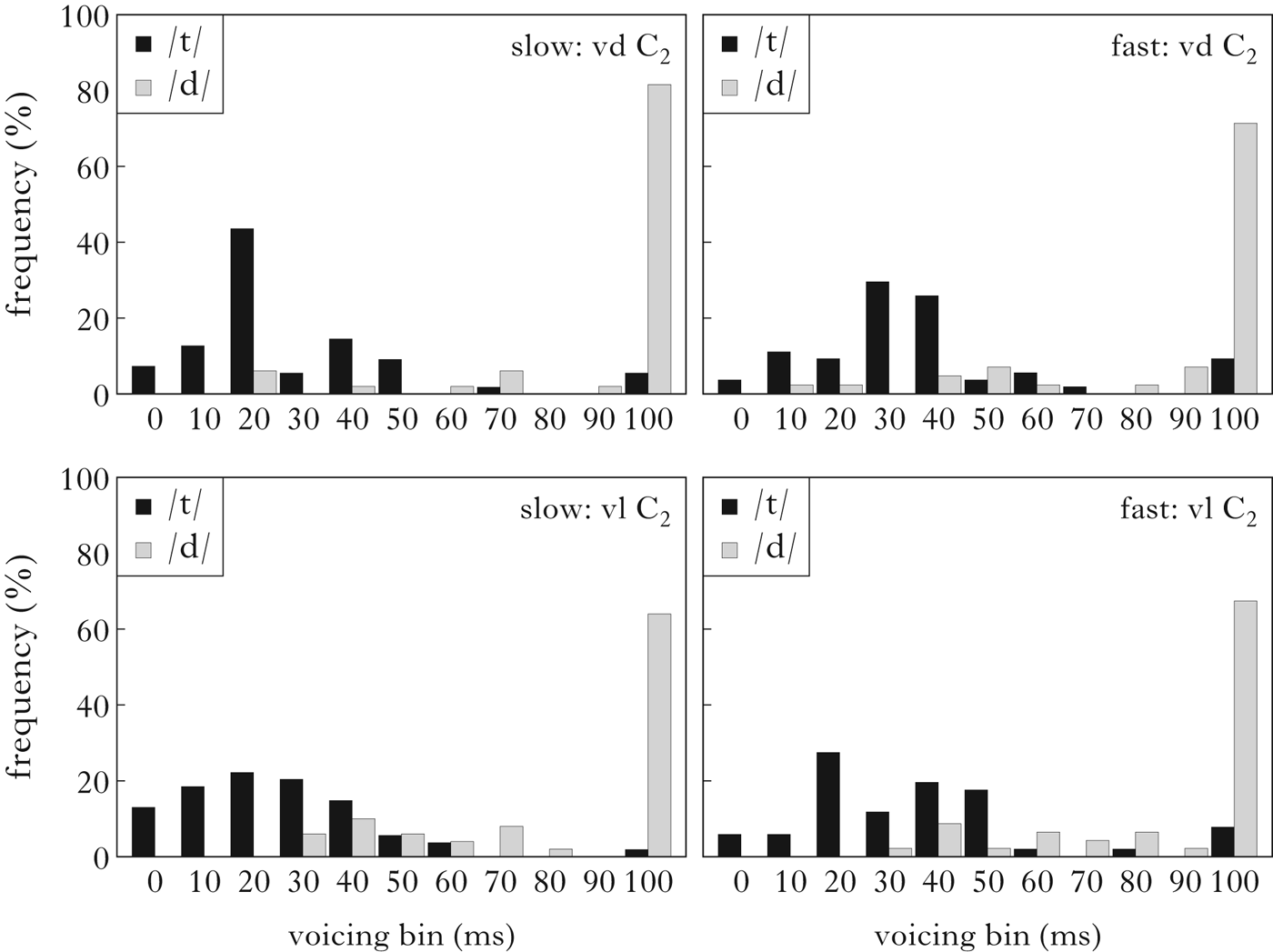
The distributions of voicing ratios in presonorant C1 obstruents (Fig. 7) show that the underlying voicing contrast was not neutralised in presonorant /t/ and /d/. The distributions are bimodal, but there was some overlapping between underlying voiceless and voiced obstruents in all presonorant clusters, suggesting that some C1 obstruents had gradient changes in phonetic voicing.
Distributions of voicing ratios in presonorant C1 stops in clusters, broken down by C2 obstruent (upper row: voiced; lower row: voiceless) and speaking rate (left column: slow; right column: fast), pooled across 13 speakers.

Crucially, however, these changes in voicing ratios in C1 obstruents were not caused exclusively by voicing of the following C2 obstruent, and thus cannot be interpreted as voice assimilation. No association was found between phonetic voicing, which was established as a voicing ratio lower than 50% for voiceless obstruents and higher than 50% for voiced obstruents, and the voicing category of C2 (ϰ2(1)=0·16, p=0·689).Footnote 5 Intriguingly, 2% of underlying presonorant /t/'s in slow speech and 8% of /t/'s in fast speech were produced with a fully voiced closure before voiceless C2, i.e. in the environment which excludes phonetic and phonological voicing. Similarly, underlying presonorant /d/ was not fully voiced in 18% of cases in slow speech and in 29% of cases in fast speech before voiced C2, suggesting that shorter voicing in such clusters is not a result of assimilatory devoicing.
5.3.4 Secondary cues: closure duration
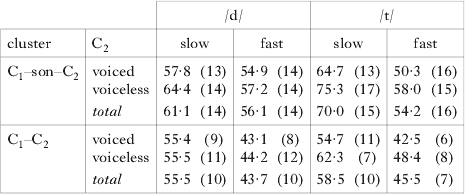
Table VI (see the Appendix) summarises the results of acoustic measurements of closure duration in C1 stops.
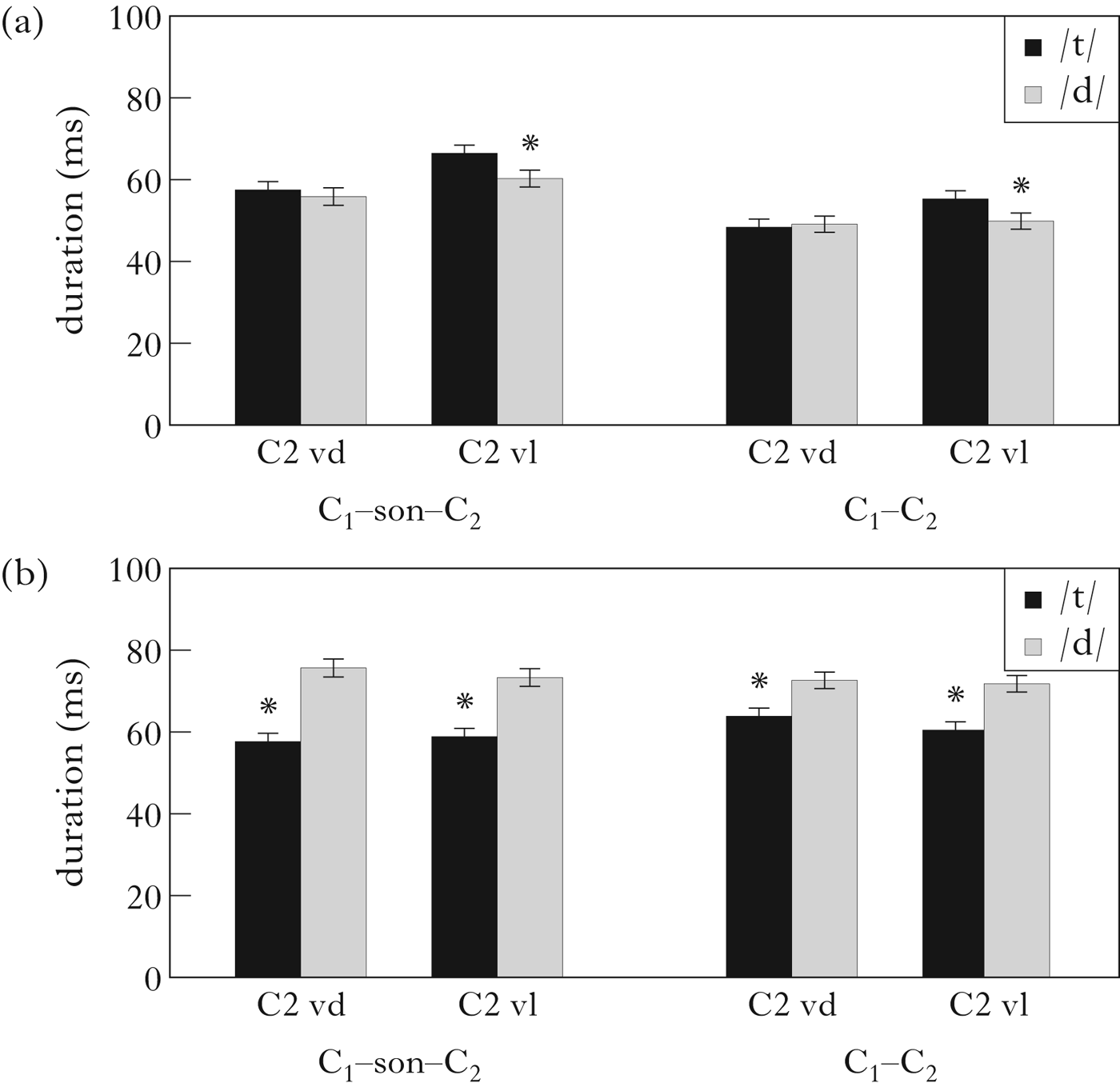
The statistical tests revealed (Fig. 8a) that an effect of cluster type was obtained, but no main effects of underlying and C2 voicing or interaction. Stops were longer when they preceded a sonorant (M=60 ms, SD=15) and shorter in obstruent clusters (M=51 ms, SD=9). This is consistent with the pattern observed in word-internal consonant clusters (Kulikov Reference Kulikov2012): speakers of Russian produce longer stops in presonorant position than in stop clusters. As expected, speaking rate affected closure duration (F(1,12)=49·91, p<0·001): stops were longer in slow speech (M=61 ms, SD=12) and shorter in fast speech (M=50 ms, SD=12).
Effects of cluster type on (a) closure duration in C1 stops and (b) preceding vowel duration.

5.3.5 Secondary cues: vowel duration and F1 frequency
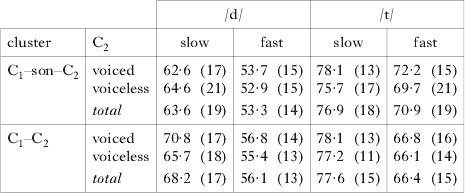
Results for the duration of vowels preceding C1 stops are shown in Table VII in the Appendix. Figure 8b summarises the results of the statistical tests. Due to a significant underlying voice×cluster type interaction, each cluster type was examined separately.
The effect of underlying voice was obtained for both clusters, but the difference was greater before presonorant C1 obstruents (voiced: M=73 ms, SD=15; voiceless: M=58 ms, SD=13; F 1(1,12)=42·27, p<0·001; F 2(1,4)=111·2, p<0·001) and smaller before obstruent–obstruent clusters (voiced: M=72 ms, SD=11; voiceless: M=62 ms, SD=14; F 1(1,12)=33·93, p<0·001; F 2(1,4)=124·8, p<0·001).Footnote 6
A marginal effect of C2 was observed only in obstruent–obstruent clusters (voiced: M=68 ms, SD=13; voiceless: M=66 ms, SD=12; F 1(1,12)=4·77, p=0·05; F 2(1,4)=5·36, p=0·082). No effect of C2 was found in vowels before a cluster with an intervening sonorant (M=66 ms, SD=15; F 1<1; F 2<1).
Speaking rate affected vowel duration, and did not interact with underlying voice or C2 voice: vowels were longer in slow speech (M=72 ms, SD=14) than in fast speech (M=61 ms, SD=13).
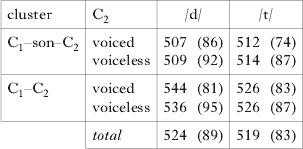
Results for F1 frequency are shown in Table VIII in the Appendix. The statistical test found that only the effect of speaking rate was significant for both cluster types. F1 frequencies were different in fast speech than in slow speech (slow: M=548 Hz, SD=95; fast: M=496 Hz, SD=76).
Thus the results suggest that the two types of clusters were different. No influence of C2 was found in secondary cues in clusters with an intervening sonorant.
5.4 Variation in voicing duration in presonorant tokens
Although no effect of C2 on voicing in C1 obstruents was found in obstruent–sonorant–obstruent clusters, the results show that speakers produced at least a few presonorant C1 tokens with greater variation in voicing duration. Some voiceless C1 obstruents had a higher voicing ratio (more than 50%) than typical presonorant voiceless tokens; some voiced C1 obstruents were produced with incomplete voicing during closure. Such tokens were evenly distributed within the whole range of voicing ratios, which suggests that this is a gradient phonetic phenomenon. Waveforms and spectrograms of two such tokens are shown in Fig. 9a (longer than average voicing in voiceless C1) and Fig. 9b (shorter than average voicing in voiced C1).
Examples of tokens with variation in duration of voicing: (a) ot lgun'ji ‘from the liar’, spoken by S11 (male) at fast rate (voicing of /t/ before a voiced C2) and (b) nad rtutju ‘over mercury’, spoken by S9 (male) at fast rate (devoicing of /d/ before a voiceless C2).

Apparently, in the past, such cases have been interpreted as involving ‘sonorant transparency’, and it was claimed that there is a phonological rule of assimilation through a sonorant in Russian. However, the results of this study clearly show that such interpretation is not viable. First, variation in voicing duration is not determined by the rightmost obstruent in the cluster. As shown in the previous section, devoicing in presonorant underlying /d/ was observed in clusters with voiced and voiceless C2. Second, these few examples do not represent a pervasive pattern of voice assimilation, as variation in voicing duration was observed in a small subset of clusters with a sonorant (14% of tokens) across all speaking rates.
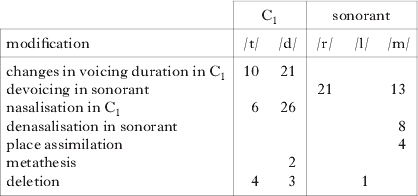
Variation in voicing duration in obstruent–sonorant–obstruent clusters occurs along two lines: (i) patterns of consonant modification, and (ii) individual variation in speakers. Inspection of the data shows that variation in voicing duration is not the only ‘noise’ found in obstruent–sonorant–obstruent clusters. Table II summarises types of modification of the consonants in such clusters.Footnote 7
Modification of C1 stops and sonorants in obstruent–sonorant–obstruent clusters, pooled across 14 speakers in slow and fast rate conditions. The total number of clusters examined was 435.

Although the experiment was not designed to account for these modifications, the typical cases are reported in this paper, as these results may provide insights into the nature of such variation. Changes in voicing duration and nasalisation were found in presonorant C1 obstruents, and sonorants, when modified, were usually devoiced.Footnote 8 The changes sometimes affected both C1 and the sonorant. In some clusters, nasalisation of [d] or [t] coincided with denasalisation and devoicing of [m], resulting in ‘nasal switch’ (e.g. /nad mxom/→[nanpxom]). Metathesis occurred in [dmx] and [dmz] clusters: /nad mxom/→[danmxom], /nad mzdoj/→[danmzdoj].Footnote 9 Apparently, these modifications are driven by the tendency to simplify long consonant clusters, resulting in a simpler and less marked syllable structure.
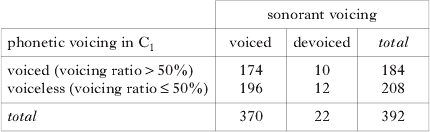
Crucially, however, the majority of C1 obstruents retained their laryngeal specifications before a sonorant. Even devoicing of a sonorant did not necessarily cause devoicing in a preceding C1 obstruent. As shown in Table III, surface voicing in C1 obstruents is not associated with surface voicing in an adjacent sonorant (ϰ2(1)=0·02, p=0·532). This pattern is consistent with presonorant faithfulness and absence of assimilation.
Phonetic voicing in C1 stops before voiced and devoiced sonorants in obstruent–sonorant–obstruent clusters.

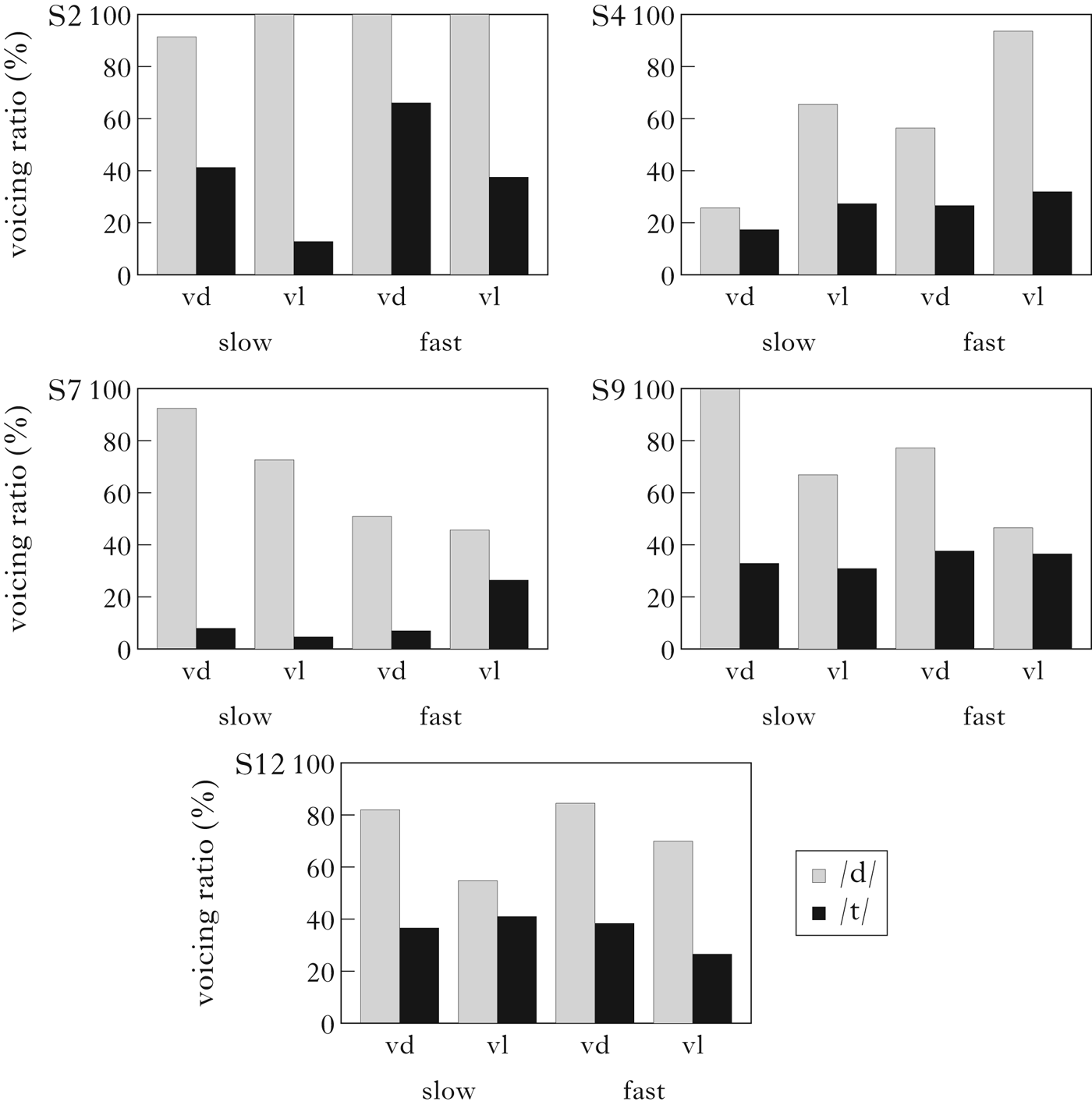
Variation was also observed among the speakers. They varied in their tendencies to devoice or voice C1 obstruents in clusters where variation in voicing duration was found. Observations of individual tokens revealed that three speakers – S3, S5 and S10 – did not show any evidence of variation in voicing duration. S4, S7, S8 and S9 never voiced, and S2, S11, S13 and S14 never devoiced. Only S1 and S12 produced some voicing and devoicing, although they were not consistent in different speaking-rate conditions.Footnote 10 Five speakers – S2, S4, S7, S9 and S12 – showed patterns that might resemble the ‘sonorant transparency’ pattern previously reported in literature. Their voicing ratios are presented in Fig. 10. However, the individual analyses of results for these speakers do not suggest that variation in production of voicing in presonorant stops is triggered by the C2 obstruent, as shown in Table IV.
Individual voicing ratios for presonorant C1 stops in slow and fast conditions for five speakers (S2, S4, S7, S9 and S12).

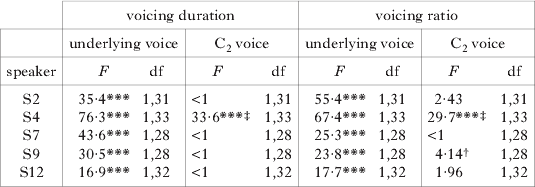
Effects of underlying voicing and C2 voicing on duration of voicing and voicing ratio in clusters with presonorant C1 stops for five speakers. † p=0·054; ‡ longer voicing in C1 stops before voiceless C2. Significant values are indicated by *** (p=0·001).

Separate univariate ANOVAs for each speaker with rate (slow, fast), underlying voice (voiced, voiceless) and C2 voice (voiced, voiceless) as factors were used to investigate the influence of the rightmost obstruent on voicing duration and voicing ratios in presonorant C1 obstruents. C2 voicing does not affect voicing duration in presonorant C1 obstruents, it only marginally (p=0·054) affects voicing ratio in S9's obstruents and is manifested as incomplete voicing during closure. Significant effects of C2 on voicing duration and voicing ratio obtained for speaker S4 in fact reveal an unusual inverse pattern, with longer duration of voicing before voiceless C2 (voiceless: M=41 ms, SD=21; voiced: M=23 ms, SD=13). Intriguingly, S4 produced all underlying /d/'s before a voiced C2 with a voiceless closure. Thus patterns of individual variation and modification of consonants in obstruent–sonorant–obstruent clusters also fail to reliably indicate phonological assimilation correlated with voicing in C2.
6 Discussion and conclusion
The results of the experiment do not support the claim that voice assimilation through a sonorant consonant is a phonological rule of Russian. Contrary to this claim, the results of the tests strongly suggest that no consistent phonological change of underlying voicing occurred in C1 obstruents in obstruent–sonorant–obstruent clusters in response to the voicing of C2. Such an effect would be a natural condition of phonological assimilation in voicing. Recall that a strong effect of C2 voicing was predictably found in obstruent–obstruent clusters, where voice assimilation is a regular process. The surface voicing of C1 stops in these clusters was contingent on the voicing category of the rightmost obstruents. Duration of voicing in underlying /t/ before voiced C2 was increased, to produce a voiced closure; duration of voicing in underlying /d/ before voiceless C2 was reduced to a short voice tail, to produce a voiceless closure. But presonorant C1 obstruents in obstruent–sonorant–obstruent clusters did not change duration of closure voicing, just as in other presonorant positions in Russian. In addition, no effect of C2 voicing was obtained for other cues (e.g. vowel duration). These findings do not fully support Ševoroškin (Reference Ševoroškin1971), who claims that C1 devoicing occurs only before voiceless sonorants. Although some devoiced C1 obstruents were indeed found before devoiced sonorants, this was not a regular pattern.
The findings of this study are in line with the acoustic study of sonorant transparency in Russian in Robblee & Burton (Reference Robblee, Burton, Browne and Zec1997) and the recent acoustic study of Polish presonorant stops in Strycharczuk (Reference Strycharczuk2012). Russian and Polish speakers show a strong tendency to preserve the underlying contrast in presonorant position. This pattern is not consistent with the model of phonological assimilation, which would predict neutralisation of the contrast and little or no difference in the realisation of voicing in assimilated (devoiced) and underlying voiceless obstruents.
These results cast doubt on the idea that propagation of voicing through a sonorant consonant is a viable phonological process. The observed pattern in obstruent–sonorant–obstruent clusters is consistent with presonorant faithfulness rather than with voice assimilation. Proponents of voice assimilation through a sonorant in Russian can still argue that this principle is needed to explain voice assimilation before /v/. Indeed, obstruents usually fully assimilate before /v/ followed by another obstruent (Avanesov Reference Avanesov1968, Hayes Reference Hayes, Aronoff and Oehrle1984; though see Panov Reference Panov1967), but they retain their underlying voicing before prevocalic /v/, which suggests that Russian /v/ is transparent to voice assimilation. But without evidence of voice assimilation before ‘true’ sonorant consonants, the claim of general sonorant transparency becomes weak. Hayes' theory that [v] is underlyingly /w/ explains why obstruents retain their underlying voicing before prevocalic [v]. However, it does not immediately follow that voice assimilation before [v] is a case of propagation of voicing through a sonorant. The crucial difference between /v/ and the other sonorants is the fact that /v/ always surfaces as a fricative in Standard Russian. To ensure this fact, Hayes proposes a rule of ‘W Strengthening’. The result of strengthening of /w/ is a fricative [v], which can trigger voice assimilation, like any other fricative in Russian.
Another striking result of this study is that presonorant stops in obstruent–sonorant–obstruent clusters are prone to variation in proportion of voicing to closure duration. This variation is greater than in single word-internal intervocalic stops. Ringen & Kulikov (Reference Kulikov2012) report that 97·5% of underlying voiced stops in this position in Russian are pronounced with voicing during the entire closure, and that all underlying voiceless stops in the sample have voiceless closure.Footnote 11 In contrast, some presonorant obstruents in this study show variation in voicing ratio, but I argue that such variation cannot be interpreted as voice assimilation through a sonorant.
The results indicate that this variation was not triggered by the rightmost obstruent in a cluster. It was found not only in voiceless C1 stops before voiced C2 obstruents and in voiced C1 stops before voiceless C2 obstruents (a scenario that might indicate voice assimilation), but also in voiceless C1 stops before voiceless C2 stops and in voiced C1 stops before voiced C2 obstruents. Crucially, 23% of all presonorant underlying /d/'s in clusters with a voiced C2 had incomplete voicing during closure; 6% of all presonorant underlying /t/'s in clusters with a voiceless C2 were fully voiced. Apparently, voice assimilation is an impossible scenario in these cases and gradient changes in voicing duration can best be described as random phonetic variation in production of voicing.
Variation in acoustic parameters of presonorant C1 stops differed across the speaker population. Speakers had different tendencies for devoicing and voicing before a sonorant. Some speakers never produced voicing or devoicing, even in fast speech, while others produced some underlying voiced tokens with incomplete voicing.
It is clear that more research is needed to uncover the sources of such variation. But any discussion of variable voicing should consider at least some of the following factors. One possible reason for variation in voicing duration is phonetic context. Note that such variation occurs in presonorant obstruents, and that previous studies have shown that this context can affect voicing duration. Shorter prevoicing is found in word-initial stops for Dutch (van Alphen & Smits Reference Alphen van and Smits2004) and Russian (Kulikov Reference Kulikov2012). Closure voicing in voiced stops is shorter, and incomplete closure voicing occurs more often in presonorant position in English (Docherty Reference Docherty1992) and in Russian (Kulikov Reference Kulikov2012). Therefore, shorter duration of closure voicing in obstruent–sonorant–obstruent clusters is consistent with this pattern, and may be a natural outcome of the presonorant phonetic context in which voiced obstruents are produced.
Speech tempo might also affect production of voicing. Variation in voicing duration in obstruents in prepositions was found more often in fast speech. The reasons for more variable production of voicing in fast speech can be found in the articulatory implementation of voicing. Production of voicing during closure crucially depends on the timing of two events: the end of stop closure and the onset/offset of vocal fold vibration. Controlling the timing of articulatory gestures is harder in fast speech than in slow speech; more ‘noise’ in production is therefore expected in fast speech.
It is possible that relationships between alternations found in obstruent–sonorant–obstruent clusters and speaking rate are a legitimate result of a trade-off between the speaking rate and the complexity of syllable structure (see Chitoran & Cohn Reference Chitoran, Cohn, Pellegrino, Marsico, Chitoran and Coupé2009 for discussion). Chitoran & Cohn suggest that syllable complexity correlates with speaking rate. Syllabic structure is preserved at slow rate and simplified at fast rate. The results of this study support this hypothesis. Speakers used different repair strategies (feature sharing, metathesis, deletion) to produce simpler syllable structures in 14% of obstruent–sonorant–obstruent clusters in the fast rate condition. Changes in voicing duration in such clusters, sometimes interpreted as a voice assimilation through a sonorant in Russian, are not even the most numerous cases of modification. Nasalisation and sonorant devoicing occurred as often as changes in voicing duration.
Another possible source of variation might be dialect. An anonymous reviewer has suggested that sonorant transparency may be present in some dialects of Russian, but absent in other dialects. This is plausible, as Russian dialect phonology does have variation in the application of phonological rules (see Crosswhite Reference Crosswhite2000 for a phonological analysis of vowel reduction in Russian). Variation in voicing in obstruent–sonorant–obstruent clusters, however, cannot be unequivocally attributed to dialect variation. Although Roman Jakobson always admitted that his idiolect deviated from Standard Russian in certain ways, we do not know whether those differences were dialectal, as we do not have the necessary recordings of his speech. In addition, comprehensive descriptions of Russian dialects (Avanesov & Bromlej Reference Avanesov and Bromlej1986) do not report cases of sonorant transparency in regional varieties of Russian. It is not clear at this point which Russian dialects might have it. Individual variation, however, can probably explain some aspects of claims about sonorant transparency. Recall that three speakers in this study had more tokens with variation in voicing than other speakers. Although these tokens do not represent a pattern of voice assimilation, this example demonstrates that some speakers of Russian may occasionally pronounce obstruent–sonorant–obstruent clusters with partially devoiced C1 obstruents in casual speech.
I conclude that the paper presents experimental acoustic evidence that obstruents in clusters in Russian do not assimilate in voicing when a sonorant consonant intervenes. The results are not consistent with the current claims about ‘sonorant transparency’ in Russian as a phonological fast speech rule. Further research, involving a wide variety of speakers and lexical items, will help us understand the source of greater variation in closure voicing observed in some tokens in long clusters, and pinpoint factors that might explain such variation.
Appendix Tables showing results of acoustic measurements
Means (ms) and standard deviations (in parentheses) of voicing duration in underlying voiced and voiceless C1 stops in clusters with and without an intervening sonorant.

Means (ms) and standard deviations (in parentheses) of closure duration of underlying voiced and voiceless C1 stops in clusters with and without an intervening sonorant.

Means (ms) and standard deviations (in parentheses) of duration of a vowel preceding underlying voiced and voiceless C1 stops in clusters with and without an intervening sonorant.

Means (Hz) and standard deviations (in parentheses) of F1 on vowels preceding underlying voiced and voiceless C1 stops.