Introduction
Rapid advances in word learning are among the most important developments of the first two years of life. Learning new words is a complex process that draws on many different cognitive capacities, including perception, attention, and memory (Carpenter, Nagell, Tomasello, Butterworth, & Moore, Reference Carpenter, Nagell, Tomasello, Butterworth and Moore1998). In their second year, children begin to be able to register words after only a few exposures, showing that they can process a novel word form in the input, link it to a referent, and begin the process of encoding it in long-term memory (McMurray, Horst, & Samuelson, Reference McMurray, Horst and Samuelson2012). The word-learning process increases rapidly from around 14 months (Bergelson & Swingley, Reference Bergelson and Swingley2012, Supporting Information; McCune & Vihman, Reference McCune and Vihman2001) and continues to improve throughout the lifespan, as the capacity for both memory and attention increases along with the lexicon itself (Vihman, Reference Vihman2017). Yet despite extensive research on lexical development, questions about the central mechanisms of word learning remain.
One line of research has examined perceptual characteristics of word forms, including both the word form itself and its relation to potential competitors (‘phonological neighbors’) (e.g., Fernald, Pinto, Swingley, Weinberg, & McRoberts, Reference Fernald, Pinto, Swingley, Weinberg and McRoberts1998). Fernald et al. (Reference Fernald, Pinto, Swingley, Weinberg and McRoberts1998) demonstrated that from 14 months on children look longer to familiar objects when they are named, with steady developmental advances in response speed. In subsequent studies, Swingley and colleagues (e.g., Dietrich, Swingley, & Werker, Reference Dietrich, Swingley and Werker2007; Swingley & Aslin, Reference Swingley and Aslin2000, Reference Swingley and Aslin2002) tested the effect of changing vowels or initial consonants on the recognition of familiar words or on novel word learning in one- to two-year-old children learning English or Dutch. Similarly, White and Morgan (Reference White and Morgan2008) showed that 19-month-olds are sensitive to the degree of phonological mismatch affecting a segment, in relation to both familiar and unfamiliar objects.
In a second approach, several studies have indicated that existing word knowledge strongly supports word recognition. For example, Fernald, Swingley, and Pinto (Reference Fernald, Swingley and Pinto2001) demonstrated that children's vocabulary size affects their speed and efficiency in processing spoken language, regardless of age. Specifically, children with larger expressive vocabularies recognize familiar words more reliably than children with smaller vocabularies. (See also Torkildsen et al., Reference Torkildsen, Svangstu, Hansen, Smith, Simonsen, Moen and Lindgren2008 and Law & Edwards, Reference Law and Edwards2015).
A third line of research has argued that early vocal production plays a vital role in word learning, especially at the outset. Through vocal practice, or babbling, in the last months of the first year infants establish sensory–motor couplings between their articulatory routines and the speech to which they are exposed. That is, babbling practice creates an ‘articulatory filter’ that highlights matching elements in input speech (Vihman, Reference Vihman1993). To investigate phonetic skills, McCune and Vihman (Reference McCune and Vihman2001) introduced Vocal Motor Schemes (VMS), a measure of consistency and stability of consonant use. Using this measure, the experimental studies of DePaolis, Vihman, and Keren-Portnoy (Reference DePaolis, Vihman and Keren-Portnoy2011), DePaolis, Vihman, and Nakai (Reference DePaolis, Vihman and Nakai2013), and Majorano, Vihman, and DePaolis (Reference Majorano, Vihman and DePaolis2014) demonstrated effects of well-practised sounds on infant responses to word forms. This provides an explanation for earlier findings regarding the relationship of babbling to first words: (i) the first words are surprisingly accurate, targeting adult words that are simple in structure and made up of early learned consonants (in three children learning English: Ferguson & Farwell, Reference Ferguson and Farwell1975; in 48 children learning one of 10 languages each: Menn & Vihman, Reference Menn, Vihman, Clements and Ridouane2011); and (ii) these words are similar to the vocal forms the infant has used in babbling (in three children acquiring English: Stoel-Gammon & Cooper, Reference Stoel-Gammon and Cooper1984; in nine children acquiring English: Vihman, Macken, Miller, Simmons, & Miller, Reference Vihman, Macken, Miller, Simmons and Miller1985). In short, the characteristics of babbling are associated with children's early word forms and accordingly are understood to facilitate lexical acquisition (Majorano & D'Odorico, Reference Majorano and D'Odorico2011; McAllister Byun & Tessier, Reference McAllister Byun and Tessier2016; McGillion et al., Reference McGillion, Matthews, Herbert, Pine, Vihman, Keren-Portnoy and DePaolis2017), although adult responses, which are themselves dependent on infants’ advances in vocal skills (Goldstein & Schwade, Reference Goldstein and Schwade2008; Lacerda & Sundberg, Reference Lacerda and Sundberg2006), are clearly also part of the story.
However, few studies have directly investigated the production–perception link in early word learning. One relevant study is DePaolis, Keren-Portnoy, and Vihman (Reference DePaolis, Keren-Portnoy and Vihman2016), which investigated the effect of production on untrained word-form recognition. Specifically, using the headturn preference paradigm, the study tested 10-month-old infants’ responses to (untrained) familiar words as compared to words the infants were unlikely to have heard. A correlation was found between vocal production and word-form recognition: infants with more advanced phonetic skills showed extreme (strong novelty or strong familiarity) responses, whereas less phonetically advanced infants responded at chance. The sample (59 infants) was too small, once divided by response type, to distinguish levels of phonetic advance between the infants showing the novelty effect, associated with more advanced and stable linguistic knowledge, and those showing the familiarity effect, expected to relate to less advanced representation in memory, but the former were more lexically advanced. Thus the results demonstrated a link between word-form representation at 10 months and individual advances in vocal production.
Renner (Reference Renner2017), a study that directly investigated the interaction of production and perception, used eye-tracking to test Swedish children with vocabularies of 100–200 words on familiar object names pronounced (i) correctly, (ii) incorrectly but in accord with the child's own production patterns, or (iii) incorrectly in ways that did not correspond to the child's forms. Renner obtained clear evidence of child attention to own-mispronunciation forms, although the study was limited by inclusion of only 10 children.
The aim of the present study is to investigate the relation of infants’ phonetic skills to word learning by assessing their ability to learn novel words. In order to obtain a measure of phonetic skill (VMS status), we made two recordings each of 30 children aged about 11 months. Between the two recordings we trained the children with specially prepared books that highlighted four nonwords made up of either early or late learned consonants (ELC, LLC). To control for an overall training effect we then tested the children on the trained nonword images vs. foils. We expected children with better phonetic production skills to display a better ability to remember words and their referents. The experiment was designed to answer the following research questions (RQs):
(i) Can prelinguistic infants be successfully trained to recognize new word-form associations? That is, would the trained word images, whether ELC or LLC, elicit more attention at test than the untrained foil images?
(ii) Would the child's production experience (VMS vs. noVMS children) affect their learning of the nonword form–image relationship? We expected the children with more advanced phonetic skills (VMS children) to display more attention to the match between trained word form and image than the noVMS children.
(iii) Would the overall accessibility of the word forms (ELC vs. LLC) have an effect on the children's ability to learn the form–image relationship? We expected to find stronger results for ELC words, at least for the children in the VMS group.
Method
Participants
Thirty-four monolingual Italian infants (15 males) recruited from eight municipal nurseries in Parma, in northern Italy, participated in the study; they were aged about 11 months (0;10.21–0;11.12) in the initial recording. All participants were full-term infants with no known sensorimotor delay. The families were middle-class (23 mothers had a university degree, seven a high-school diploma). Parents signed consent forms after the research aims and procedure had been explained. Four children failed to complete the study due to illness or problems during the experiment. The final sample included 30 children (12 males).
Study design
The study included three data-collection procedures: (1) two observational sessions, over two weeks, to assess vocal production; (2) one week of training on novel words (5 sessions); and (3) an experimental session to assess learning.
(1) Observational sessions: procedure and analysis
Each infant was first observed in the home for approximately 15 minutes at around 11 months. The infants were video-recorded during free play with a standard set of toys, using a Sony digital Handycam; a Sony ICD-P17 microphone was attached to a cloth vest worn by the infants. Each mother completed the Italian CDI (Caselli, Bello, Rinaldi, Stefanini, & Pasqualetti, Reference Caselli, Bello, Rinaldi, Stefanini and Pasqualetti2017), including a section on sensory–motor behaviour (e.g., imitation skills and motor control) and the characteristics of the child's environment (e.g., time spent at nursery, at home, or with grandparents).
After approximately two weeks each child was observed again in a silent room at the nursery, prior to the experimental procedure, for approximately 15 minutes of mother–child interaction, following the guidelines of the ALB (Assessing Linguistic Behaviour; Olswang, Stoel-Gammon, Coggins, & Carpenter, Reference Olswang, Stoel-Gammon, Coggins and Carpenter1987).
Two trained researchers independently made broad phonetic transcriptions of each child's vocal productions. Where necessary, a third transcriber was consulted; if there was no consensus after four listenings, the utterance was excluded. A total of 29 utterances (4%) were excluded. Following McCune and Vihman (Reference McCune and Vihman2001), another researcher transcribed approximately 5 minutes’ recording from each participant for consonant identification (/p,b/, /t,d/, /k,g/, /m/, /n/). Inter-coder agreement was .87, which corresponds to the level of reliability reported in other studies of vocal production in the first year (e.g., Davis & MacNeilage, Reference Davis and MacNeilage1995; DePaolis et al., Reference DePaolis, Vihman and Keren-Portnoy2011). Total utterances produced and numbers of uses of each consonant were tallied for each participant.
(2) Word-learning training
(a) Training the educators
In a preliminary meeting of the nursery staff (female native speakers of Italian) who were to participate in the study we explained the project and what was required of them. After obtaining their informed consent, we trained each educator individually, showing them how to read the book and talk with the children, including use of eye-gaze, facial expression, gesture, and tone of voice. After the training, we asked them to read the book prepared for the experiment, both with and without video-recording, to accustom them to the setting and to correct their performance as necessary. In this way we attempted to limit any possible influence of different teachers’ ways of reading to ensure that the children's experiences would be as similar as possible. Subsequently, each child was trained individually in a nursery room free of distractions.
(b) Training the infants
Beginning one week after the first observational session, each child participated in training at their nursery on a set of words illustrated in a specially prepared picture-book. The sessions were run in the same way in each nursery.
The purpose-made book consisted of pictures of four fantasy animals, with two different images of each (total of eight images). Each animal was named with a nonword. Two nonwords were made up of consonants expected to be learned early (E[arly]L[earned]C[onsonant]-words): /pab:e/ and /mom:i/; two nonwords were made up of consonants expected to be learned later (L[ater]LC-words): /gak:i/ and /vof:e/. The vowels were selected to be the same in the two pairs of stimuli, while avoiding any close resemblance to real Italian words. We included medial geminates in all of the nonwords, as they have been shown to have special salience for infants, playing a greater role in untrained word-form recognition than onsets, in words that include geminates (Vihman & Majorano, Reference Vihman and Majorano2017). Note that the average frequency, in Italian speech, of the consonants included in these nonwords ranges from .004 (for both the geminates /m:/ and /f:/) to .047 and .049 (for the singleton consonants /m/ and /p/, respectively), with a mean for the ELC of .006 and for the LLC of .009 (based on Goslin, Galluzzi, & Romani, Reference Goslin, Galluzzi and Romani2014, Table 3, but combining singletons and geminates, as both occur in the speech infants hear). For the geminates only the ELC mean is .005, the LLC mean, .006. Thus the infants’ exposure to the early learned consonants is unlikely to be greater than their exposure to the later learned consonants, based on frequencies for the adult language; the differences are in any case very small.
The educators presented the nonwords in isolation, repeating each word three times for each image. As each nonword was associated with two pictures of the same animal, the children heard each one six times per session. Two books were used (Books A and B), containing the same stimuli but with different associations of word forms to images (e.g., the image referred to as /pab:e/ in Book A was referred to as /vof:e/ in Book B). Half of the children were read Book A, the other half Book B. The interactions were video-recorded to ensure that each child heard the words the same number of times. The parents were not informed about the words so that no child would be exposed to the words more often than any other. The training took about 10 minutes a day.
(3) Preferential Looking Paradigm (PLP)
On the day of the last training session each child participated in an experiment using the PLP procedure in a silent room at their nursery. The stimuli were the four nonwords trained at the nursery.
Stimuli and procedure
Each word was produced by a female native Italian speaker and recorded in a sound-treated room using a RODE NT2A condenser microphone connected to a Metrichalo soundcard sampling at 48 KHz-24 bit. The stimuli had a speech peak within ± 1.5 dB as measured on a mechanical VU meter (Marantz PMD 222) and an ISI of 750 ms. The stimuli were digitally transferred onto a PC hard drive for eventual output. Acoustic analysis of the three nonwords showed that they had similar characteristics as regards peak intensities (M = 16.1 dB; range, 15.6 dB to 17dB), frequency (M = 948 Hz; range, 855 Hz to 1002 Hz), and duration (M = 782.7 ms; range, 726 ms to 820 ms). The images measured 16.9 × 12.7 cm on a 34.7 × 26.0 cm LCD 75 dpi screen. Their position (left and right) was counterbalanced.
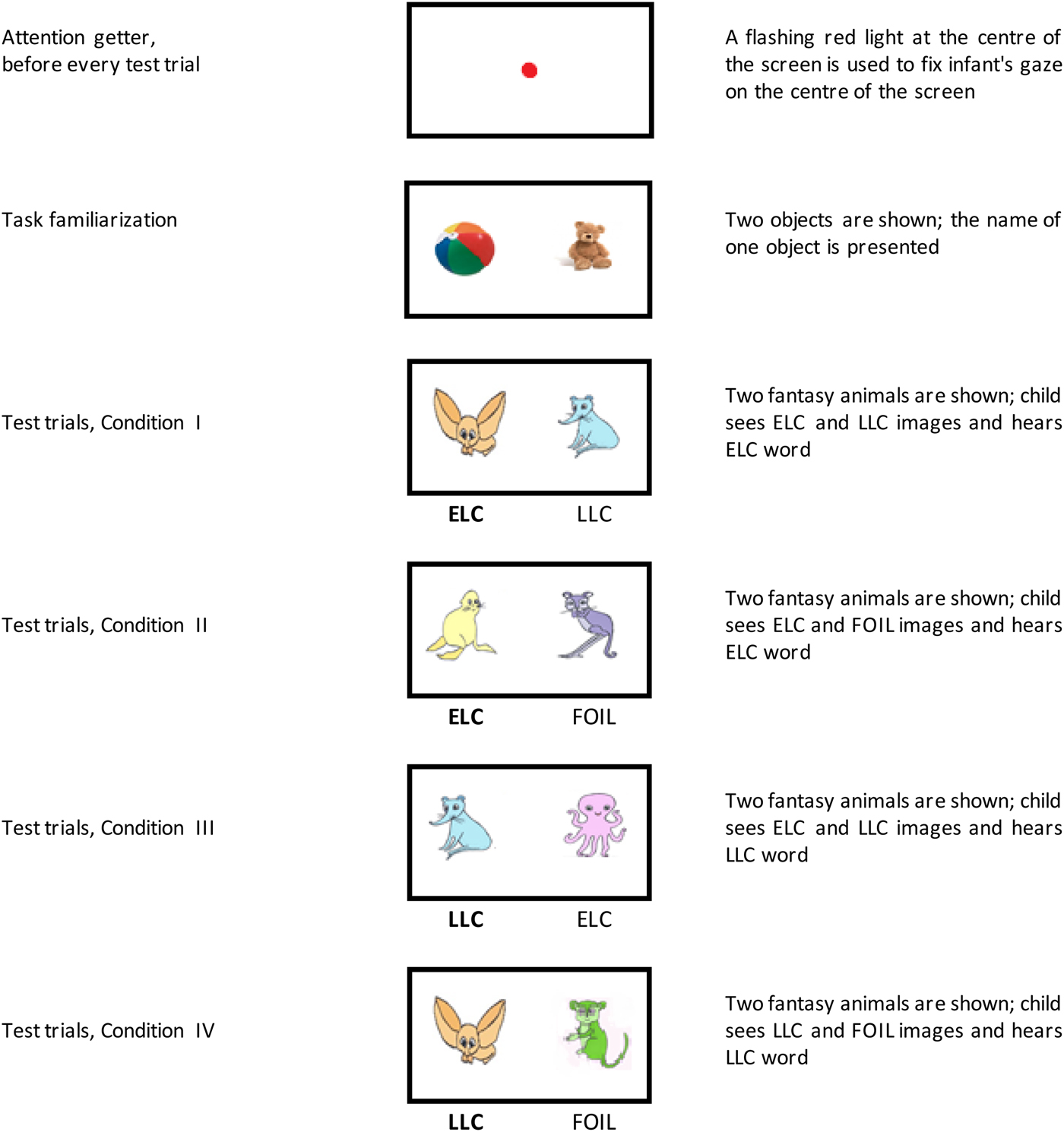
The experimental procedure was set up in accordance with Fernald et al. (Reference Fernald, Pinto, Swingley, Weinberg and McRoberts1998). Infants sat on their mother's lap in a three-sided test booth in front of a monitor, 45 cm from the screen, with a camera placed above it. The experimenter controlled stimulus presentation using a PC from a separate location outside the test booth. Each experiment was composed of a familiarization phase and a test phase. During the familiarization phase, the child heard two word forms and saw two images of toys. This phase was designed to acquaint the infants with the stimuli. During the test phase, the ELC and LLC words were presented in pairs (see Figure 1). Two foils (images the children had not seen in training) were also included. The child heard one word form in association with each pair of images, for a total of 16 trials (4 trials reproduced 4 times in different orders), as shown in Figure 1.
Experimental procedure.

A flashing red light at the centre of the screen was used to gain the infant's attention. The experimenter initiated each trial when the infant's gaze was directed towards the light. A first pair of images appeared simultaneously on the screen, followed, after a 0.5 s delay, by presentation of the nonword. The infant's looking time to the images was recorded by the video camera above the screen and coded offline. Each trial presentation lasted 4 seconds.
The first experimenter coded infant looks. The offline analysis window extended from 0.367 to 3.5 s after the onset of the target word form (following Fernald et al., Reference Fernald, Pinto, Swingley, Weinberg and McRoberts1998; Swingley, Reference Swingley2016). To assess the reliability of the coding, a second experimenter coded ten infants’ looking times; inter-coder agreement was .89 (Cohen's index).
Results
Infant production
To identify VMS we adapted the criteria used in DePaolis et al. (Reference DePaolis, Vihman and Nakai2013) and Majorano et al. (Reference Majorano, Vihman and DePaolis2014). To assure both frequency and stability of use, given that the assessment was based on just two sessions of 15 minutes each, we defined VMS use as child production of a given consonant at least 5 times in each session. In order to group the infants by VMS use we applied a model-based cluster analysis to each child's total consonant uses, using R (version 3.4.0); on this basis the infants were then separated into two groups (the optimal number of clusters): a noVMS group (i.e., children who produced few consonants consistently over the two sessions), which comprised 18 infants (M = 12.89 consonant tokens, SD = 9.25), and a VMS group (at least one consonant produced 5 times or more in both sessions), which comprised 12 infants (M = 40.83 consonant tokens, SD = 16.31). The noVMS children produced no one consonant as much as five times in each session; three of them actually produced no supraglottal consonants at all in either recording.
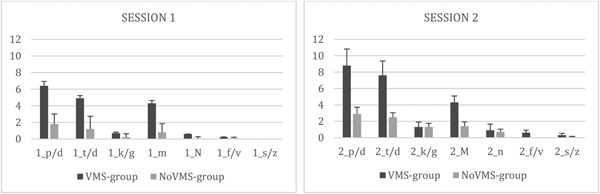
Here, as in earlier studies with Italian infants (Majorano et al., Reference Majorano, Vihman and DePaolis2014; Majorano & D'Odorico, Reference Majorano and D'Odorico2011), the consonants most often produced were bilabials and stops. This validates our choice of stimuli to serve as ELC (p/b, m) vs. LLC (g/k, f/v) (see Figure 2).
Consonants produced in each session (means and standard error)

Word learning
The comparison between trained-word images and foils (Conditions II and IV) was intended to test RQ (i); the division into two subgroups (VMS, noVMS) tested RQ (ii); and the use of two heard words (ELC for Conditions I and II, LLC for Conditions III and IV) tested RQ (iii). We expected to see a learning effect (RQi) in Condition II and a group effect (RQii) in Condition I; however, we did not expect to see a clear effect in Conditions III or IV, due to the anticipated difficulty of the LLC word for all the children.
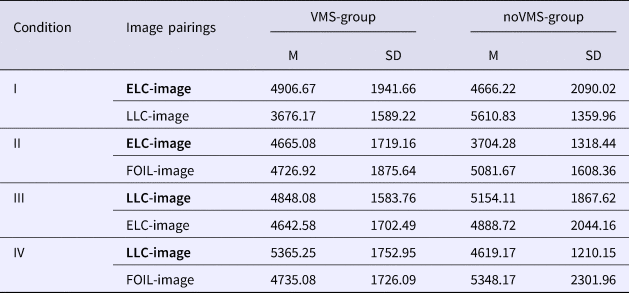
Table 1 and Figure 3 show the looking times in each condition for the two groups of infants. Four mixed 2 × 2 (Images [1 and 2] × Production [noVMS-group, VMS-group]) Analyses of Variance (ANOVA), one per condition, were performed on the test trials, with looking times as the dependent variable. For Condition I (ELC vs. LLC image; heard ELC), the analysis indicated no main effect for the single factors (Images: F(1,28) = 0.11; p = .74, η 2 = .01; Production: F(1,28) = 2.9; p = .09, η 2 = .38), but a significant interaction between Images and Production (F(1,48) = 6.31; p = .02, η 2 = .68). Post-hoc analysis indicated that the VMS group looked longer to the ELC than to the LLC image (VMS: MLLC = 3676.17 DSLLC = 1589.22; noVMS: MELC = 4906.67 DSELC = 1941.66; t(17) = 2.42; p < .05)). This indicates that the children with more production experience recognized the more accessible word form when it was heard and its image shown, in contrast with the less accessible trained word form.
Response times (in ms) for ELC and LLC images in each condition (means and standard error)

Looking times (in ms) for the two groups in the four conditions (the heard stimuli – ELC and LLC – are in bold face).

In Condition II (ELC vs. FOIL image; heard ELC), the analysis indicated a significant main effect for Images (F(1,28) = 4.24; p = .04, η 2 = .51): infants looked longer to FOIL; there was no main effect for Production (F(1,28) = 3.55; p = .07, η 2 = .44) and no significant interaction between Images and Production (F(1,48) = 0.39; p = .54, η 2 = .09). This result was not anticipated; it does not directly respond to any of our RQs.
In Condition III (ELC vs. LLC image; heard LLC), the analysis indicated no main effect for the single factors (Images: F(1,28) = 0.16; p = .69, η 2 = .01; Production: F(1,28) = 0.65; p = .42, η 2 = .02) and no significant interaction between Images and Production (F(1,28) = 0.01; p = .91, η 2 = .05). Similarly, in Condition IV (LLC vs. FOIL image; heard LLC), the analysis indicated no main effect for the single factors (Images: F(1,28) = 0.01; p = .91, η 2 = .05; Production: F(1,28) = 0.02; p = .89, η 2 = .05) and no significant interaction between Images and Production (F(1,28) = 2.51; p = .12, η 2 = .33). These results indicate that the LLC words were indeed difficult for all the children.
In summary, the children gave little evidence of having learned the trained words overall. The only significant overall difference in looking times was observed in Condition II, where the children attended more to the Foil than to the ELC words, an unanticipated outcome. However, a difference emerged in relation to production experience: the VMS group attended significantly more to the ELC image in Condition I, in which the ELC nonword was heard while both the ELC and the LLC trained images were presented.
Discussion
Although several studies have reported that infants with larger expressive vocabularies show more advanced lexical processing skills, little attention has been directed to the contribution of production to early word learning. The present study was designed to build on previous findings that establish a role for vocal practice in word recognition (DePaolis et al., Reference DePaolis, Vihman and Keren-Portnoy2011, Reference DePaolis, Vihman and Nakai2013; Majorano et al., Reference Majorano, Vihman and DePaolis2014). Specifically, by combining observation and experiment we aimed to assess: (i) prelinguistic infants’ ability to learn new words after a period of naturalistic training; (ii) the effect of production skills on such word learning; and (iii) an effect of word-form accessibility, based on comparing nonwords composed of developmentally early vs. late consonants. Our results are in line with earlier findings in that they show a relationship between more vs. less experienced vocal production skills and children's word learning, which requires retention of both form and meaning. We observed greater infant attention to the image corresponding to the heard nonword form only in children with more advanced vocal production and only for words made up of consonants likely to have been well practised. Following DePaolis et al. (Reference DePaolis, Keren-Portnoy and Vihman2016), we take this to be a ‘familiarity effect’ that reflects a recently established representation in memory. That is, we assume that the training led to the beginnings of lexical representations for the VMS group, with their greater production experience, and only for the ELC words, some of whose consonants could presumably be mapped onto infant experience with their own vocal production.
Interpretation of the finding involving attention to the foil image is more difficult. The previously unseen foil image attracted more infant attention than the trained early learned consonant images (Condition II), but not more than the later learned word images (Condition IV). This may mean that, when the ELC images were contrasted with foils, the infants experienced sufficient familiarity with them to produce a novelty effect, whereas the LLC images – paired in training with word forms that were less easily assimilated to the child's existing vocal patterns – failed to create a strong enough ‘feeling of familiarity’ to lend special salience to the contrasting foil image. Furthermore, in Condition III neither group of infants showed a significant preference for the LLC words: as anticipated, the training failed to produce even rudimentary signs of word recognition. In other words, we hypothesize that the greater attention to the foil that we see in Condition II reflects the greater interest aroused by a new image when compared with one already seen and retained to some extent, despite the auditory match to that image; in contrast, the juxtaposition of a new image with a still less strongly represented image and matching auditory stimulus failed to elicit any preferential response at all. Further research is needed to test this idea.
All in all, our findings suggest that the training led to a new lexical representation only in the children with more advanced production skills, and even that representation was not robust: it was strong enough to be accessed only when primed by hearing the ELC word forms and seeing the corresponding images. In contrast, for the children with less production experience, none of the trained words appears to have been learned even to that extent. Thus, we interpret our results as demonstrating an effect of production practice with the relevant sounds, which was apparently necessary to facilitate access to the word forms at test. These results are in accord with earlier work suggesting that phonological memory is built through production practice (Keren-Portnoy, Vihman, DePaolis, Whitaker, & Williams, Reference Keren-Portnoy, Vihman, DePaolis, Whitaker and Williams2010). These results are based on a relatively small sample, however (only 12 VMS children), and when contrasted with a previously unseen foil image, hearing the trained ELC word form failed to elicit more attention to the ELC image in either group. All in all, then, trained word learning was not robust at this age under the conditions we provided. Nevertheless, the findings are the first to suggest an experimental effect of production in the earliest stages of word learning; they stand in need of validation from further studies.
Author ORCIDs
Marinella Majorano, 0000-0002-5033-328X.