Implications
Genetic improvement initiatives targeting increased robustness of farmed cattle can benefit from genomic selection breeding strategies without shifting the breeding objective away from a farm's profitability focus. For dairy cattle, augmentation of training populations with genotyped cows will commonly be required to ensure that a genomic selection scheme results in a greater relative increase in selection emphasis on robustness traits relative to productivity traits. For beef cattle, genomic selection strategies are likely to benefit robustness traits substantially because of current inefficiencies of existing beef cattle breeding schemes for improvement of robustness traits. More robustness trait recording is required.
Introduction
More robust cattle have the potential to increase farm profitability, improve animal welfare, reduce the contribution of ruminant livestock to greenhouse gas emissions and decrease the risk of food shortages in the face of increased variability in the farm environment. Although many research disciplines are required to fully define, record, quantify and understand the concepts of animal robustness, practical solutions are likely to fall largely in the domain of industrial genetic improvement programmes. This is because robustness is an inherent characteristic of the animal, rather than a consequence of feeding or management. Exceptions might include better animal health and vaccination programmes, or the identification of management factors around time of conception and/or early in life that shape the robustness of the animal via maternal imprinting and/or permanent environmental effects. This paper addresses genetic approaches to the issue of robustness only. Robust animals are loosely and simply defined here as those that are able to be healthy and perform well under a wide range of environmental conditions.
Genetic improvement initiatives can include breed choice, cross breeding, more efficient breeding programmes and more appropriate selection of genestocks from the global gene pool. Cattle breeding programmes have a long history of successful contributions to farm profitability, but there are also failures and inefficiencies. In developing countries, importation of potentially high-performing dairy cattle has sometimes led to terrible failure and loss of food security for poor people, because of the imported cattle being unsuited to the environment (e.g. Orskov, Reference Orskov1993). In the western world, focus has historically been on a narrow range of relatively easily recorded and economically important traits, such as milk yield in dairy cattle and growth rate in beef cattle.
It is generally perceived that historical genetic selection for productivity has led to reduced robustness. Evidence includes the recent declining genetic trends for fertility in Holstein dairy cattle globally (e.g. VanRaden et al., Reference VanRaden, Sanders, Tooker, Miller, Norman, Kuhn and Wiggans2004). A number of studies have shown that the superiority of high genetic merit dairy cows over those of low genetic merit for milk yield traits declines when both types of cows are in herds with less intensive feeding regimes (Veerkamp et al., Reference Veerkamp, Simm and Oldham1994; Harris and Winkelman, Reference Harris and Winkelman2000; Berry et al., Reference Berry, Buckley, Dillon, Evans, Rath and Veerkamp2003; Fulkerson et al., Reference Fulkerson, Davison, Garcia, Hough, Goddard, Dobos and Blockey2008). Perhaps more importantly, there is evidence that fertility (Harris and Winkelman, Reference Harris and Winkelman2000; Fulkerson et al., Reference Fulkerson, Davison, Garcia, Hough, Goddard, Dobos and Blockey2008) and body condition score (Veerkamp et al., Reference Veerkamp, Simm and Oldham1994; Berry et al., Reference Berry, Buckley, Dillon, Evans, Rath and Veerkamp2003) show genotype by environment interactions such that differences in cows of different genetic merit for these traits tend to be lower under less intensive finishing regimes. For beef cattle, continental breed beef cows with high genetic merit for growth rate have been shown to have lower fertility rates than the British breed types with lower growth rates, but only in a less favourable environment (Morris et al., Reference Morris, Baker, Hickey, Johnson, Cullen and Wilson1993). There are many more examples of genetic improvement for productivity leading to unfavourable consequences for fitness (Rauw et al., Reference Rauw, Kanis, Noordhuizen-Stassen and Grommers1998), although many of these are in animals farmed more intensively than is common for cattle.
A major driver of the need for more robust cattle appears to be coming from consumer markets and society in developed countries. Farm profit is a key driver of farm decision making (Amer, Reference Amer1994), and this leads to conflict between farmers and non-farm stakeholders in the farm production to food value chain. For example, the use of antibiotics in farmed livestock is commonly used to increase profitability, but this practice is commonly of concern to consumers. This conflict has been discussed in detail by Nielsen et al. (Reference Nielsen, Olesen, Navrud, Kolstad and Amer2011) in the context of animal welfare. Importantly, non-market values (Olesen et al., Reference Olesen, Groen and Gjerde2000) in the context of robustness may be manifested through lack of awareness of future favourable impacts on farm profit from robust cattle. The views of consumers and society tend to also have non-market values at the farm and breeding programme level because of an absence of market price signals.
An additional complication arises through evidence emerging that future breeding goals for reduced greenhouse gas emissions per unit of product may favour improvement of productivity traits that intensify production systems to the detriment of animal welfare (Wall, Reference Wall2010). Further, if future rapid genetic selection for greater feed efficiency to minimize greenhouse gas emissions from livestock was to reduce the level of fat reserves in breeding cows, a reduction in robustness may be one of a number of possible unintended consequences.
At the same time, the potential for greater future instability in weather patterns and more intensive use of marginal grazing lands because of high animal protein prices is likely to lead to robustness increasing in direct economic importance to at least a significant subset of global cattle farmers. Thus, the need to farm profitably under greater environmental variability is likely to become an increasingly important driver for breeding for robustness in the future.
Over the past decade, dairy cattle breeders have taken an important step forward in breeding for robustness through the adoption of so called broader breeding goals, which contain a wider array of traits but with trait weightings based on their projected impact on farm profitability (e.g. Miglior et al., Reference Miglior, Muir and Van Doormaal2005; Lopez-Villalobos, Reference Lopez-Villalobos2010). Although beef breeding programmes have also developed more broad breeding goals, genetic progress in many non-output traits of economic importance is often limited because of low heritabilities and these traits being recorded relatively late in life (e.g. Roughsedge et al., Reference Roughsedge, Amer, Thompson and Simm2005). Dairy cattle progeny-testing systems are less limited by these factors because large numbers of progeny groups and already existing long generation intervals for evaluation of production traits have mitigated the problem.
This paper focusses on within-breed genetic improvement initiatives as a mechanism by which research into robust cattle can be put into practice. The process of broadening breeding goals is taken a step further by posing the artificial evolution concept forwarded by Gibson (Reference Gibson1989) as providing an opportunity for government and industry level stakeholders to further, and possibly more effectively, manipulate genetic improvement developments in favour of robustness. The theory is then used to consider how the design of new breeding programmes and breeding strategies that incorporate genomic selection (Meuwissen et al., Reference Meuwissen, Hayes and Goddard2001) might affect animal robustness in a practical context.
Gibson's theory of artificial evolution
Gibson (Reference Gibson1989) recognized the uncertainty associated with identifying economic weights for multi-trait selection indices, and suggested taking a broad view with respect to breeding programme design to account for the fact that different designs result in different responses of traits. Different responses are evident even when economic weights remain constant across designs. In the context of robust beef cattle, a progeny-testing scheme might result in higher rates of genetic progress in functionality traits relative to growth and carcase traits, than a breeding scheme focussing primarily on the selection of young males. This is because low heritability becomes less limiting to accuracy of selection as the amount of information from relatives increases. If the low heritability is because of high environmental variance rather than low genetic variance, then information from relatives increases accuracy of selection and the genetic variance present can be better exploited. In the spirit of Gibson's argument, a breeding scheme design that would result in greater response in robustness traits relative to production traits might be favoured because of uncertainty in the true economic values.
Because current short-term farmer preferences may result in an under weighting of selection emphasis on robustness traits, the logical next step in the application of the concept of artificial evolution is for outside stakeholders to manipulate the design of breeding programmes in their favour. In many situations, this might be a more desirable instrument than manipulation of the economic weights used in index selection. Indices that are out of touch with farmer perceptions can often be overlooked during the selection process, particularly when breeding programmes operate in a highly competitive genestock market. Altering the process of artificial evolution through breeding scheme design can be achieved as simply as subsidizing the recording of traits of interest to the stakeholder applying the subsidy. As long as the traits of interest have at least some modest economic value to farmers, and as long as the competitive breeding programme continues to select to maximize farm profit, its competitiveness should not be compromised, rather, it should be enhanced.
Both, choice of a genomic selection strategy over a conventional selection strategy and choice of alternative designs of genomic selection strategies, offer new and exciting opportunities for exploitation of the concept of artificial evolution. The remainder of this paper considers how genomic selection strategies can be manipulated by interested stakeholders, in order to achieve faster rates of genetic improvement in favour of robustness traits relative to production traits.
Accuracy of genomic predictions
The accuracy with which genomic predictions identify truly genetically superior animals is a key determinant of the efficiency of genomic selection schemes. Projecting the resulting accuracy can be undertaken using theoretical formulae. Alternatively, data are starting to become available, which show realized accuracy of genomic selection in real world applications. These real world comparisons are somewhat complicated by a widely observed tendency for both accuracy obtained directly from genetic evaluation systems incorporating genomics and also from genomic predictions to be inflated. Furthermore, efficacy of genomic selection for low heritability traits is likely to have been overpredicted in a number of early studies because of confounding between training and validation populations (Amer and Banos, Reference Amer and Banos2010).
For this study, formulae proposed by Daetwyler et al. (Reference Daetwyler, Pong-Wong, Villanueva and Woolliams2010) with a slight modification proposed by Woolliams et al. (Reference Woolliams, VanRaden and Daetwyler2010) to account for incomplete spread of markers across the genome were used to predict the accuracy (rGS) of direct genomic predictions that do not include additional accuracy provided by parent average information, as follows:

where Np is the number of individuals with genotypes and phenotypes in the training population, w is the proportion of the genome covered by markers as defined by Woolliams et al. (Reference Woolliams, VanRaden and Daetwyler2010) and assumed here to be 0.9,  is the effective heritability of the phenotype used as the dependent variable in training and Me is the number of independent chromosome segments, which is in turn predicted (Goddard, Reference Goddard2009) using

where Ne is the effective population size and L is the length of the genome in Morgans.
For the calculations used in this study, L was assumed to be 30 Morgans and Ne was assumed to be 200 individuals.
Actual heritabilities (h2) need to be translated to the effective heritability scale ( ). For proven bulls used to train genomic selection, progeny information was used to predict the effective reliability of de-regressed daughter average proofs using
 , where p is the number of daughters per bull used in training.
It is also of interest to quantify the additional information that could be provided by genotyping cows, the effective heritability ( ) can be translated from the actual trait heritability using selection index formulae. Paternal half-sib information should be ignored when deriving the effective heritability, as many training individuals are likely to have the same paternal half-sibs. The effective heritability used to compute rGS was
 , but the number of individuals with phenotypes in the training population was adjusted upwards to account for the extra training information provided by cows using

where NBulls and NBull equivs are the number of bulls and bull equivalents (provided by the cow information), respectively, with phenotype and genotypes used in training. The number of bull equivalents (NBull equivs) provided by NCows training cows was obtained by solving to find the number of bulls at a training effective heritability for bulls that would give the same predicted accuracy as NCows (the number of cows used for training) at the training effective heritability for cows.
Genomic selection and artificial evolution
Within the context of this paper, it is of interest to investigate how manipulating the numbers of training individuals might result in artificial evolution of a robustness trait assumed to have low heritability (0.02 to 0.1) relative to a productivity trait assumed to have a moderate-to-high heritability (0.1 to 0.3). It is also of interest to consider how a genomic selection strategy without progeny testing might compare with conventional progeny testing and/or young animal selection strategies in terms of the balance of responses in the robustness v. the productivity traits.
An efficiency ratio of genomic selection relative to a breeding programme without genomic selection (GSeff) for a specific trait i can be defined as

where rGS is the accuracy of genomic selection for the trait as presented above (Equation 1) and a is a constant that accounts for differences in relative efficiencies of different breeding programmes because of numbers of selection candidates and/or length of the generation interval. The accuracy of selection under a traditional selection strategy (rC) such as young animal selection or progeny testing can be derived for specified numbers and types of relatives using standard selection index theory. For example, under mass selection with no correlated trait information, rC takes the value of the square root of the heritability. Under the same assumption of no correlated trait information, rC for progeny-tested selection candidates with a single record per offspring is a simple function of trait heritability and the number (s) of half-sib offspring recorded (i.e.  ).
A breeding programme was modelled with two traits of interest: a productivity trait that has a higher effective heritability and a large number of recorded animals, and a robustness trait that has a lower effective heritability and less recorded animals. The degree of selection emphasis shifted away from the productivity trait and towards the robustness trait that might be expected with genomic selection can be measured using a ratio defined as follows:

A value of this emphasis ratio R greater than one indicates that genomic selection would lead to the robustness trait receiving greater selection emphasis, relative to a breeding programme without genomic selection. The constant a in Equation 2, which accounts for relative breeding programme efficiency, is present in both the numerator and denominator of R, and thus it does not affect the relative contribution to genetic progress made by the two types of traits.
Example calculations
To demonstrate the predictions generated by the formulae above, some example calculations of the emphasis ratio R were undertaken to show how different genomic selection strategies might influence the relative rate of genetic progress in traits linked to robustness. Both simple mass selection and simple progeny-testing schemes with 100 progeny per sire were compared with a genomic selection strategy. Genotyped bulls with 100 recorded progeny were assumed to be the primary source of training information for genomic selection; however, it was also assumed that only half as many bulls suitable for training were available for the robustness trait as for the productivity trait. For some situations, it was assumed that 5000 cows were genotyped and also used in training genomic predictions for both the productivity and robustness traits. Training cows had two repeated records (repeatability assumed to be 0.6) for both the productivity and the robustness trait.
Results
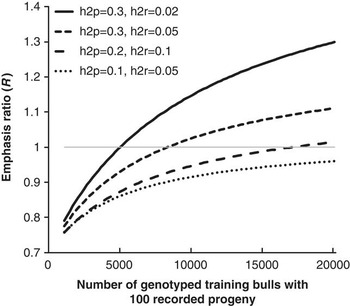
Figure 1 shows the ratio of efficiencies of genetic response for the robustness trait relative to the productivity trait with a switch from a progeny-testing programme to a genomic selection programme where half as many bulls are available for training for the robustness trait as for the productivity trait. At low numbers of bulls tested and with a small difference in the heritabilities for the two trait types, the ratio of efficiency value is predominantly less than one, indicating that the genomic selection scheme would result in a shift in selection emphasis towards the productivity and away from the robustness trait. Increasing the numbers of bulls tested favours genetic progress in the lower heritability robustness trait, but at a decreasing rate.
Ratio of emphasis on a robustness trait with heritability (h2r) relative to a productivity trait with heritability (h2p) when a genomic selection scheme is compared with a progeny-testing scheme with varying numbers of training bulls for the productivity trait and where the robustness trait has one half as many training bulls as the profit trait.

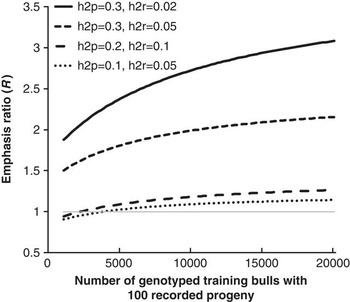
Figure 2 shows the ratio of efficiencies of genetic response for the robustness trait relative to the productivity trait, with a switch from a mass selection programme to a genomic selection programme. As for Figure 1, only one half as many bulls were available for training for the robustness trait as for the productivity trait. With the exception of situations with very low numbers of training bulls and a small difference between heritabilities, the robustness trait contributes relatively more to genetic progress than the productivity trait under the genomic selection strategy. The effect of increasing the number of training bulls is quite modest when there is only a small difference in heritability between the two traits, but very large otherwise.
Ratio of emphasis on a robustness trait with heritability (h2r) relative to a productivity trait with heritability (h2p) when a genomic selection scheme is compared with a mass selection scheme with varying numbers of training bulls for the productivity trait and where the robustness trait has one half as many training bulls as the profit trait.

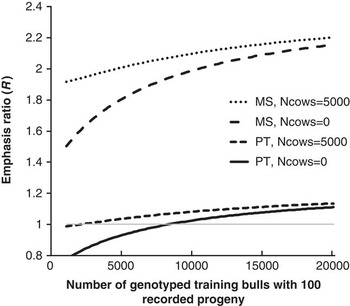
Figure 3 shows the impact of adding 5000 cows recorded for both the robustness and productivity trait to the training population of bulls for a situation where the difference in productivity and robustness trait heritabilities is quite large. The lower pair of lines considers the switch to a genomic selection scheme from a progeny-testing scheme, whereas the top pair of lines considers the switch from a mass selection scheme. In both situations, adding the cows to the training population results in a shift in relative response in favour of the robustness trait. As the number of bulls available for training increases, the effect gets diluted, and adding a relatively modest number of cows to a training population that is dominated by a large number of bulls has limited marginal effect on relative trait responses.
Ratio of emphasis on a robustness trait with heritability of 0.05 relative to a productivity trait with heritability of 0.3 when a genomic selection scheme is compared with progeny test (PT) and mass selection (MS) breeding schemes with varying numbers of training bulls for the productivity trait and where the robustness trait has one half as many training bulls as the profit trait.

Discussion
This paper elucidates the scope that exists for national, industrial, and potentially international stakeholders to influence the direction of genetic improvement without running the gauntlet of alienating farmers through artificial economic weights and risking putting co-operating or national breeding programmes out of business. Redirecting artificial evolution through investment and support for technologies can result in substantially improved selection emphasis towards traits desired by wider stakeholders, but also by farmers. Investment in genomic selection at a national level would appear to be an ideal mechanism for improving robustness, although different approaches to genomic selection might have different consequences.
There are opportunities for genetic improvement initiatives other than genomic selection to better achieve more robust cattle, but each faces potential conflicts. Heterosis through crossbreeding is well known to contribute to robustness, but crossbreeding can lead to loss of genetic diversity and pose a threat to traditional suppliers of improved breeding stocks. Breed substitution can contribute to loss of genetic diversity and result in unexpected incompatibility between the new breed and the environment to which it has been introduced.
The potential for a switch from a progeny-testing scheme to genomic selection, without progeny testing, to result in a selection response favouring productivity relative to functional traits is of major concern. Productivity traits are commonly unfavourably correlated with robustness traits, and thus genomic selection scheme designs that are biased towards productivity traits could easily result in deterioration in robustness at an accelerating rate. Because robustness traits have not been recorded for as long a period of time as production traits such as milk yield, this is likely to be a substantial issue in many dairy cattle breeding industries. Improved recording of the robustness trait to increase its heritability and increasing the number of training bulls for the robustness trait can ameliorate this problem. Alternatively, genomic selection could be used to preselect bulls for progeny testing, although such a strategy may give lower rates of genetic progress for total merit relative to a genomic selection strategy that identifies young bulls for more immediate widespread use in the commercial population.
Robustness traits are sometimes expressed later in life than productivity traits. This further exacerbates the problem of having less training bulls for the robustness trait, but to a decreasing degree over time as the latest crop of training animals becomes a decreasing fraction of the total historic pool. Progeny-testing schemes are also likely to be inefficient at improving traits expressed later in life; therefore, more detailed modelling would be required to elucidate the effect of breeding scheme design on robustness traits expressed later in life. In this case, the effective heritability of the later in life robustness trait may be high, relative to the accuracy of evaluation of the same trait for bulls selected after progeny testing. A substantial difference might easily offset a shortfall in training animals for the late in life robustness trait.
Where genomic selection strategies are driven by the interests of commercial breeding programmes competing for market share, there is a risk of either fragmentation of, or, underinvestment in training populations. The results of this theoretical analysis suggest that robustness traits will benefit more when training resources are pooled, so that all companies have sufficient access to recorded training populations. Beef cattle breeding programmes are most exposed to a lack of training animals for the many and diverse breeds of interest. However, when switching to a genomic selection strategy from breeding schemes based on selecting individuals before any progeny information, it is hard to make the progress achieved for robustness traits much worse. This is largely a reflection of the assumption of relatively low heritability of robustness traits, and the inefficiency with which progress can be achieved when selecting for low heritability traits in the absence of progeny information.
Industry and government investment initiatives linked to genetic improvement need to switch some of their investment effort into incentivizing new trait recording at breeding programme and farm level. This in conjunction with broader breeding goals already in place for many cattle populations will lead to artificial evolution towards more robust cattle and dovetail synergistically with new technological developments in genomic prediction. Some new recording could come through investment in a relatively small number of intensively recorded nucleus herds. However, care must be taken to ensure that training animals maintain reasonably close relationships with selection candidates (Habier et al., Reference Habier, Tetens, Seefried, Lichtner and Thaller2010), and that the numbers of animals with phenotypes are sufficiently high to facilitate accurate genomic predictions. The phenotypes recorded might also be sensitive to the environment. For example, when considering robustness, it may not be relevant to collect phenotypes in nucleus herds with state-of-the-art management, if the goal is to improve cattle such that they are able to perform robustly across a wide range of environmental conditions. It seems likely that there will be a continued need for improved recording and data capture from a wide pool of commercial farms.
Acknowledgements
The author is very grateful for financial assistance from the cattle commission of the European Federation of Animal Science and the American Society of Animal Science for providing financial support to present results of this study at the 61st Annual Meeting of the European Federation of Animal Science.