


To what extent can Chinese provinces influence national foreign policy? Analyses of China's foreign and security policies often treat China as a unitary actor, assuming a cohesive grand strategy articulated by central elites. Most research has focused on how subnational actors shape Beijing's domestic and economic policies.Footnote 1 I show that provincial actors often have leeway to interpret, modify, and otherwise influence foreign policy directives. Beijing's renewed emphasis on policies such as the “belt and road” initiative require the involvement of multiple actors and a greater reliance on provinces to provide information and carry out tasks.Footnote 2 Yet, local pursuit of parochial interests may diverge from or conflict with national interests.
Building on recent research on the pluralization of policymaking in China,Footnote 3 this article provides new evidence for the under-examined role of provinces in influencing the formulation and implementation of China's foreign security policy. It presents a more nuanced argument for the motivations behind evolving and increasingly activist Chinese foreign policy. This contributes to the broader literature on domestic sources of foreign policy, while bridging the gap with existing comparative studies on central–local relations in Chinese domestic and economic policies. My findings show that foreign policymaking can be haphazard and unpredictable even for important issues. This has important policy implications for responding to China's international actions.
Using Hainan and Yunnan as case studies, I demonstrate how provinces have influenced specific issues in China's foreign policy. Both are strategically located by South-East Asia, where the centre faces sensitive and important policy issues. Hainan has shaped aspects of South China Sea policy, and Yunnan's role in foreign economic and energy security policy has influenced bilateral relations with Myanmar. Both are unlikely cases as they are peripheral provinces in economic and political terms, in contrast to wealthy, politically connected coastal provinces covered in previous studies.Footnote 4
Differentiating between influence over policy formulation and policy implementation, I identify three main mechanisms of provincial influence – trailblazing, resisting, and carpetbagging – and illustrate each with examples of different provincial policies. This evidence comes from primary Chinese-language sources as well as field interviews with Chinese government-affiliated individuals and academics in Beijing, Yunnan, and Hainan. I have preserved the anonymity of all interviewees.
China's Foreign Policymaking and Centre–Local Relations
The foreign policymaking process in China has been described as “a system in which an increasingly professionalized, complex, and conflict-ridden bureaucracy has coexisted with a still very powerful, personalized senior-dominated elite.”Footnote 5 Key decision-making processes remain highly centralized and opaque. While the Politburo Standing Committee (PSC) gives formal approval, members do not have in-depth knowledge of foreign affairs. Moreover, the system's deliberative, incremental approach, lack of institutionalized coordination, and involvement of multiple interests as China expands its overseas activities, facilitate ways for other domestic actors to exercise voice in policymaking. Individual bureaucracies promote their narrow interests, while the military and business sector, including state-owned enterprises, maintain powerful sway in China.Footnote 6 New policy “entrepreneurs” such as the media, non-governmental organizations, and lobby groups are entering the political process.Footnote 7
Amidst this pluralization of foreign policymaking, provincial governments play important roles. As “political middlemen,” provinces transmit policy downwards from the centre but also transmit information and assessments back up.Footnote 8 Officially, foreign policy decisions follow “a straight line” (yitiaoxian 一条线) from centre to province.Footnote 9 But progressive decentralization has induced “de facto federalism,”Footnote 10 and incremental decision-making has provided opportunities for provinces to reinterpret policy,Footnote 11 aggravating persistent tensions between centralized control and decentralized governance.Footnote 12 For instance, the broad scope and diffuse implementation of the “open up the west” development campaign facilitated centre–local bargaining and inter-provincial competition for benefits.Footnote 13 Provinces negotiate between the needs of both central and local constituencies, acting as a patron to constituents below while also a client in the larger polity.Footnote 14 For instance, provincial Foreign Affairs Offices simultaneously serve as branches of the Foreign Ministry and as local institutions responding to local interests.Footnote 15
Existing literature on centre–local relations has largely focused on domestic policies, such as post-Mao decollectivization and the push for reform and opening up.Footnote 16 Regional decentralization and local experimentation played an important role in economic liberalization,Footnote 17 with similar dynamics in social policy, labour relations, and broader domestic reforms.Footnote 18 Provincial governments are also playing an increasing role in foreign economic relations,Footnote 19 including economic and sociocultural cooperation with South-East Asian countries.Footnote 20 Previous research has identified the complex bargaining dynamics between subnational actors,Footnote 21 but mostly attributed variation in provincial compliance to selective central government support.Footnote 22
Mechanisms of Provincial Influence on China's Foreign Policy
Building on previous research in centre–local relations, this article highlights the role and agency of provincial actors. It also makes new theoretical and empirical contributions on how provinces can influence China's foreign policy, a realm traditionally assumed to be the sole prerogative of Beijing. While provinces may not have formal authority in creating national-level foreign policy, this paper argues that their internal interactions with the central government and their actions on specific policy issues can have significant implications for national foreign policy and China's relations with other countries. This is even more salient in areas of disputed sovereignty, where ostensibly domestic provincial policies are viewed by other countries as part of foreign policy.
Provincial proposals are propagated via regular forums with visiting foreign ministry officials as well as Track 2 dialogues with neighbouring countries, and internal reports are submitted upwards to central agencies. Publishing media articles can bring issues to Beijing's attention, especially if picked up by the People's Daily.Footnote 23 Scholars in local universities and think tanks provide information and expertise for provincial governments in the policymaking process, as the latter often lack sufficient knowledge.Footnote 24 I distinguish between two points of provincial influence on policymaking. First, provinces could influence implementation – how the province chooses to execute delegated tasks can differ from the centre's original plans. Second, provincial actions could influence formulation, affecting either the choice of actual policy or the choice of tactics used.
Contrary to conventional wisdom, this study highlights how provinces can affect policy formulation by trailblazing policy. In pursuit of local interests, the province creates new policy ideas on specific issues that constitute broader foreign policy and proactively persuades Beijing to adopt them. Provincial proposals could empower the use of a certain policy tactic or create externalities for China's foreign relations with other countries. Trailblazing involves lobbying the centre, often in collaboration with other subnational actors such as state-owned enterprises or the military, and sometimes presenting a fait accompli by starting projects before formal approval.Footnote 25 While the need for some form of central government approval can circumscribe provincial freedom, provinces trailblaze by pushing specific foreign policy ideas that are adopted by the centre, upending the conventional top-down policymaking process.
In addition, a province can influence the policy implementation process by carpetbagging existing central directives. This occurs when the province publicly echoes central rhetoric but pursues different priorities, leading to divergence in implementation. It captures central policy by enacting new local policies under existing frameworks. This does not directly contradict Beijing's directives but introduces new ideas on how to implement specific tasks, thus causing the centre to lose some control of overall policy implementation. Carpetbagging often involves a fishing strategy to achieve incremental concessions from the centre and then expand policies in line with provincial interests.Footnote 26
Finally, when a province perceives that a foreign policy has adverse effects on its local interests, it can resist by refusing to adopt central directives. Apart from lobbying the centre to reformulate policy, it can influence policy implementation by choosing to shirk – refusing to carry out the centre's instructions, especially when the centre has limited monitoring capacity; or stall – thereby delaying implementation, especially when competing actors can be played off against one another.Footnote 27 Figure 1 summarizes these mechanisms.
Mechanisms of Provincial Influence
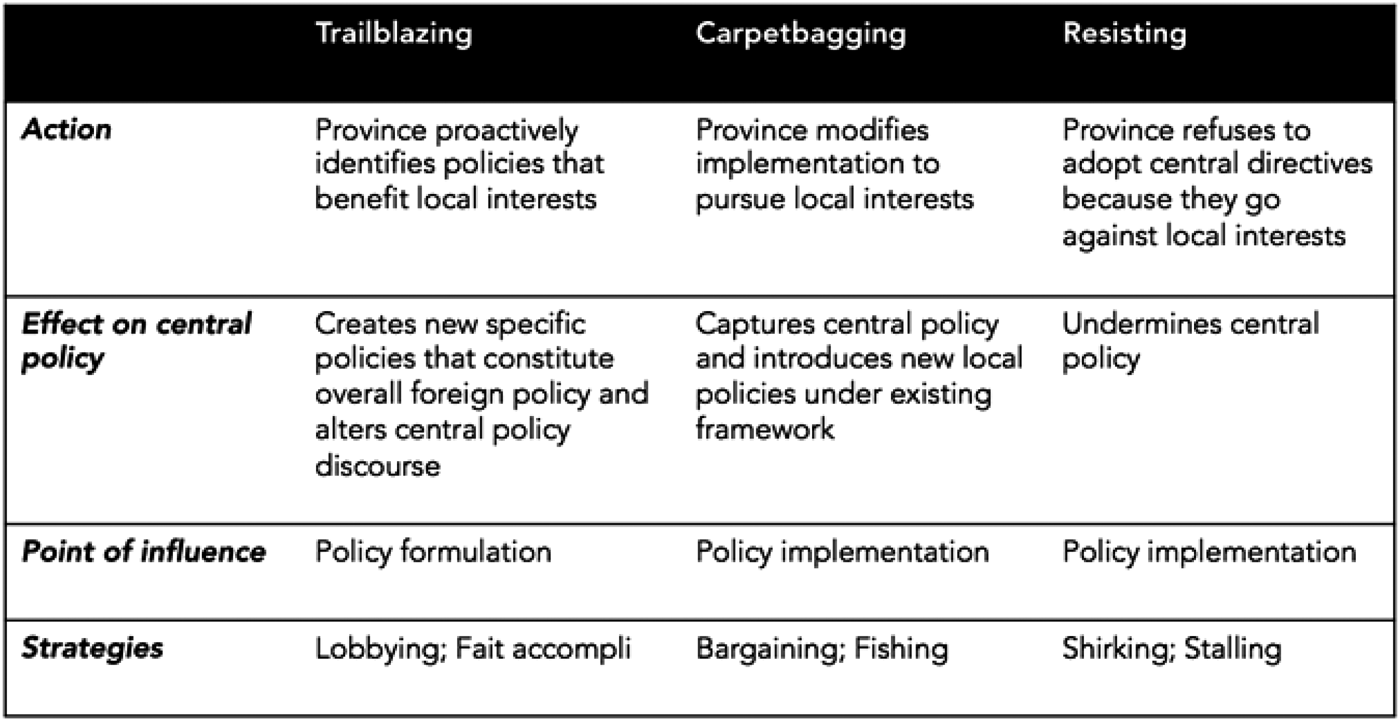
I elucidate these mechanisms with case studies of Hainan and Yunnan, including examples from both illustrating trailblazing, as influence over policy formulation is a relatively unexplored phenomenon. Domestically, both provinces exert weak political influence as they are less economically developed.Footnote 28 Moreover, Beijing is likely to exert tighter control over their policies owing to their sensitive geopolitical positions – Yunnan borders Myanmar and Hainan is adjacent to territorial disputes in the South China Sea.Footnote 29 For example, Beijing (not Hainan) handled the 2001 EP-3 incident and resource exploration in the South China Sea.Footnote 30 These two conditions suggest that Hainan and Yunnan should be less likely to exert an active influence on central foreign policy, especially when compared to traditionally wealthy and influential coastal provinces. Such least-likely case selection provides more convincing evidence for my argument.Footnote 31 That even these purportedly peripheral provinces shape policy formulation and implementation points to the importance of subnational actors in China's foreign relations.
Trailblazing Pipelines into Myanmar: Yunnan
Yunnan trailblazed a cross-border pipeline policy that formed part of China's nascent energy security policy. Provincial actors shaped Beijing's formulation of energy security concerns by promoting the “Malacca Dilemma” concept, and persuaded Beijing that pipelines into Myanmar were an appropriate policy solution. This foreign economic policy had implications for national energy security and China's foreign relations with Myanmar. Oil and gas pipelines were constructed from Kyaukpyu port in Myanmar to Kunming, Yunnan's provincial capital. The US$1.04 billion natural gas pipeline was completed in July 2013, jointly funded and constructed by the China National Petroleum Corporation (CNPC) and other, foreign firms. A second $1.5 billion pipeline for crude oil was completed in early 2015, connecting oil fields off Myanmar's western coast to refineries in Kunming. The CNPC holds a majority stake of 50.9 per cent and funded most of the construction.Footnote 32
Local economic interests drove Yunnan's trailblazing policy. Direct supply would alleviate high prices and shortages, diversify Yunnan's economy, secure greater investment and increase its strategic and political significance to Beijing. For provincial leaders, a successful pipeline project would boost chances for political promotion.Footnote 33 As will be discussed below, it also provided opportunities for local corruption. To pursue parochial interests, Yunnan actively raised concerns over national energy security and promoted the pipeline as a policy solution, despite its infeasibility. Yunnan trailblazed foreign policy in two ways: first, altering policy content by advocating the concept of the “Malacca Dilemma”; and second, influencing policy tactics by pushing the Sino-Myanmar pipeline over alternatives. Yunnan's actions distinguished it from other provinces that later followed central energy security policy.
In the early 2000s, a growing economy, alongside heavy reliance on imported energy supplies, prompted Beijing to consider energy security as a critical component of national security, as reflected in top leadership speeches.Footnote 34 National policy emphasized exploring overseas energy resources and diversifying import sources to avoid supply disruptions.Footnote 35 The phrase “Malacca Dilemma” is usually traced back to Hu Jintao's 胡锦涛 2003 speech, reportedly expressing concern over China's dependence on the Malacca Straits for energy imports and that “major powers” could potentially block the route.Footnote 36 At the same time, some Chinese observers have claimed that the Malacca Dilemma concept has been falsely attributed to Hu by self-interested subnational actors.Footnote 37
In fact, research suggests that the concept has links to lower-level discourse from Yunnan. In the early 1990s, the commander of the People's Liberation Army's (PLA) 14th Army, based in Kunming, General Wang Zuxun 王祖训, wrote a military graduation thesis entitled “Yunnan's strategic corridor” (Yunnan datongdao 云南大通道). He argued that China should establish alternate routes through Yunnan into Myanmar and Vietnam in order to ensure access to Indian Ocean or South-East Asian ports in the event of a US blockade of the Malacca Straits.Footnote 38 Wang's thesis received attention from senior military leadership and then-president Jiang Zemin 江泽民. Indicating Beijing's recognition of such thinking, Wang was later promoted to regional commander and then president of the PLA Academy of Military Science.Footnote 39 Another senior scholar and Yunnan government official whose successive promotions suggest high-level Party approval, Che Zhimin 车志敏, has also advocated similar policies. Che has described Yunnan as “China's only strategic corridor” to the two oceans (Indian and Pacific) and major neighbouring markets, providing a way to circumvent the Malacca Straits.Footnote 40 In 2001, he promoted Yunnan as an “international corridor” (guoji datongdao 国际大通道) to “guarantee the supply and sources of China's future vital strategic resources.”Footnote 41
The year after Hu's purported speech, Yunnan academics submitted a proposal – via the provincial government – to the State Council for the construction of an oil pipeline from Myanmar to Kunming.Footnote 42 The same scholars then wrote an op-ed in August 2004, advocating the advantages of the Myanmar–China pipeline. Pipeline energy imports would avoid the Malacca Straits, shorten shipping routes, increase Chinese leverage in Myanmar, and minimize costs by capitalizing on existing infrastructure.Footnote 43 Apart from “truly breaking” the Malacca Dilemma, the pipeline would “solidify and develop Sino-Myanmar neighbourly and friendly relations,” and turn Yunnan into an “important base” for China's “strategic oil reserves.”Footnote 44
The Yunnan government lobbied vigorously to bring the proposal to the central leadership's attention, working closely with local academics to push the pipeline forward. That same month, the provincial Party secretary (also a member of the Chinese Communist Party (CCP) Central Committee) and the deputy provincial governor held further discussions; the-then vice-premier subsequently expressed support for the proposal. A Yunnan University working group examined the details of implementing the pipeline project and establishing Yunnan as an important base for refining and storing oil reserves.Footnote 45 It reported findings to the provincial policy research council and the provincial development and reform committee. In late August, a joint report was submitted to the CCP Central Policy Research Office; this was followed by field studies in Myanmar and Thailand. In May 2005, a Yunnan delegation testified for the National Development and Research Council (NDRC) and even submitted a confidential report to the CCP Politburo leadership.Footnote 46 At the 2006 meetings of the National People's Congress and Chinese People's Political Consultative Conference, the Yunnan delegation called for the commencement of pipeline construction, incorporating the proposals into the 11th Five-Year Plan, and establishing Yunnan as China's new base for oil refining. The NDRC approved the pipeline the same month.Footnote 47
Even before the project's official launch in 2010, the Yunnan government started building related infrastructure. The pipeline and refinery constituted one of the province's key construction projects in 2007 and 2008, and a functional government office was established in 2007 to handle the project. The construction of an oil depot in Kunming had started in 2009,Footnote 48 presenting a fait accompli and strengthening the provincial government's case for completing the full pipeline project. Yunnan also persuaded the central government to adopt its project over alternatives through Thailand, Pakistan and Iran. All (including the Kunming–Myanmar pipeline) faced the challenges of cost-effectiveness, technology or political uncertainties.Footnote 49 Yunnan scholars and the media criticized competing proposals, downplaying the pipeline's costs while exaggerating rival proposals' shortcomings.Footnote 50 Yunnan scholars emphasized the necessity of diversification of China's energy sources, as well as the project's broader contribution to provincial economic development, via peripheral and downstream industries.Footnote 51
Importantly, Yunnan formed a powerful lobbying coalition with the CNPC. According to observers, CNPC interests played a major role behind the scenes.Footnote 52 Provincial interests mixed with oil money and personal corruption were key in pushing the project forward.Footnote 53 Chinese national oil companies were keen supporters of building a land pipeline, having already been actively involved in oil and gas development projects in Myanmar.Footnote 54 The CNPC saw the proposed pipeline as a means to gain additional market share in the south-west at the expense of its rival Sinopec. Then-provincial Party secretary Bai Enpei 白恩培 and then-CNPC chairman Jiang Jiemin 蒋洁敏 had close ties, having worked together in Qinghai province as Party secretary and deputy governor respectively. In December 2007, the Yunnan government and the CNPC signed an investment agreement of 80 billion yuan (US$11.7 billion), the largest single investment the province had ever received.Footnote 55 CNPC officials actively presented the project as a contribution to China's energy security and resource diversification.Footnote 56
As a major strategic state-owned enterprise (SOE), the CNPC holds considerable influence in Beijing. The Party appoints SOE leaders, who often hold ministerial rank or alternate membership in the Central Committee. A symbiotic relationship exists – SOEs need state support for major projects or investments, while political leaders need successful SOEs to maintain economic growth and domestic legitimacy. The executives of the national oil companies are often present when relevant foreign policy issues are being discussed.Footnote 57 Jiang was an alternate member of the 17th CCP Central Committee and a member of the 18th Central Committee. Moreover, he had close ties with Zhou Yongkang 周永康, then a powerful member of the Politburo Standing Committee and a former CNPC president.Footnote 58 This mix of bureaucratic and relational influence helped in pushing through the pipeline.
Ultimately, Yunnan's success has not been beneficial for China. The 22 million tons of oil promised by the pipeline is negligible compared to total Chinese oil imports.Footnote 59 By some projections, 89 per cent of China's oil imports in 2030 will still come through shipping lanes.Footnote 60 The pipeline has incurred high costs, traversing difficult terrain and requiring investment in additional facilities. Assuming the CNPC seeks a 10 per cent operational profit, oil delivered to Yunnan via the Myanmar pipeline is likely to cost more than twice as much as via the traditional route.Footnote 61 There is now considerable scepticism about the Malacca Dilemma and the necessity of the Myanmar–Yunnan pipelines. My interviews with Beijing experts describe the project as provincial interests “kidnapping” the centre's interests.Footnote 62 This supports the argument that the Malacca Dilemma reference was concocted by domestic interest groups and blown up into a “rhetorical Frankenstein,”Footnote 63 as any adversaries seeking to disrupt energy supplies could easily target other places.Footnote 64
Moreover, Sino-Myanmar relations have worsened. Project construction was often disrupted by local protests over environmental concerns, labour unrest, the forced relocation of farmers and inadequate compensation, and heavy fighting involving ethnic minority groups in Myanmar.Footnote 65 While Yunnan promoted the pipelines as a means to access the ocean via Myanmar, the latter interpreted this as representing Beijing's intentions of exploiting Myanmar for strategic purposes, increasing bilateral friction.Footnote 66 Yunnan's trailblazing pipeline policy thus undermined China's foreign relations.
Myanmar's recent political transition and engagement with other international actors was a shock for Chinese leaders. Beijing has been seeking to regain its political footing, preserve its economic investments, and repair its image by reaching out to the ruling National League for Democracy (NLD) and even civil society actors in Myanmar.Footnote 67 Given greater central attention to and control over major foreign policy decisions regarding Myanmar since the NLD took power, provincial “trailblazing” may be more difficult. Nonetheless, Yunnan's pipeline policy created sunk costs for China's foreign relations. It is politically and economically difficult for Beijing to cancel an ongoing project, given multiple vested interests; after long delays and complicated negotiations, the oil pipeline only started operating in April 2017.Footnote 68 Yunnan's trailblazing has created continuing sources of bilateral tensions.
Trailblazing Tourism in the Paracels: Hainan
Hainan has administrative authority over 2 million square kilometres of the South China Sea, including disputed features in the Spratlys (Nansha 南沙), Paracels (Xisha 西沙), and Macclesfield Bank (Zhongsha 中沙).Footnote 69 In managing disputed claims over territorial features and maritime jurisdiction, Beijing's South China Sea policy maintains a delicate balance between safeguarding national sovereignty and minimizing international tensions. While requiring some degree of central support, Hainan successfully trailblazed new forward-leaning policy tactics by using tourism development in the Paracels to assert sovereignty claims.
Hainan's provincial economic priorities diverged from Beijing's national security interests. Hainan identified tourism as a source of development that boosts growth, lends diversity to the economy, and attracts investment. Despite ecological concerns and resource constraints, local officials envision increasing the number of visitors and tourist routes,Footnote 70 creating a Hainanese Maldives.Footnote 71 From Beijing's perspective, tours to disputed features could provoke other claimants and raise tensions in the South China Sea.
Hainan began pushing for tourist routes to the Paracels from 1994, submitting several reports to the State Council. To persuade Beijing, Hainan created national security rationales, linking tourism with safeguarding Chinese sovereignty and pushing a strategy of “divide and rule, advance and entrench step-by-step” (fen er zhizhi bubu wei ying 分而治之步步为营).Footnote 72
Apart from lobbying agencies such as the NDRC, the National Tourism Administration (NTA) and the State Oceanic Administration, Hainan had to persuade key opposing actors. The Foreign Ministry sought to avoid provocation, and the PLA had security concerns over bases in the Paracels, including a major outpost on Woody Island. In negotiating with the military, Hainan “aimed high” by asking for more civilian-use areas to ensure a moderate compromise.Footnote 73 In response, the military agreed to open up two smaller islands for tourism. Hainan also formed an influential lobbying coalition with SOEs interested in resource development.Footnote 74
In 2002, the provincial government and the PLA navy jointly submitted a report on Paracels tourism, prompting the State Council to consult various national agencies. After onsite surveys involving the State Council, tourism, military, and local government bodies, the State Council subsequently approved development plans.Footnote 75 In February 2009, Beijing invested 8 billion yuan to expand a harbour for cruises to the Paracels. In December, central approval of Hainan's “international tourism island” project included a nod to “promote tourism development in the Paracels, and sequentially develop tourism on uninhabited islands.”Footnote 76 The NTA subsequently announced that it was working with Hainan to promote tourism to the Paracels.Footnote 77
Unexpectedly, news circulated in April 2012 that the Paracels were now opened for tourism. The NTA quickly refuted it, suggesting local authorities used the media to fan public support and pressure Beijing.Footnote 78 Nonetheless, in mid-April the State Oceanic Administration issued a national plan officially incorporating proposals to develop tourism in the Paracels.Footnote 79 This included ecological preservation, infrastructure development and facilities for renewable energy, seawater desalination and wastewater management.Footnote 80 A trial cruise went ahead that month,Footnote 81 followed by the official launch a year later.Footnote 82
Despite enormous logistical and resource challenges in making the Paracels a viable tourist destination, local authorities invested significant efforts in developing infrastructure on the islands and making them suitable for human habitation. These efforts included piers, solar panels, clean water facilities, and even a police station.Footnote 83 In addition, the Sansha City 三沙市 mayor lobbied the central government to expand cruises to more islets, build larger-scale tourist facilities and supporting infrastructure, and even open cruise routes into the Spratlys.Footnote 84 The mayor has promoted tourism to the Paracels as a policy of “low sensitivities, easy public declarations, low investment, and high returns,” helping to increase the Chinese economic and civilian presence in the South China Sea and hence preserving sovereignty rights (weiquan 维权) in line with national strategy.Footnote 85 In 2014, with tacit approval from Beijing, Hainan started plans for tourism routes to the Spratly Islands, which are even more contested.Footnote 86
As Beijing usually “does not oppose” local initiatives rather than give explicit approval, provinces have a grey area in which to manoeuvre and shape policy boundaries – according to interviewees, it has “continuously been the province pushing the centre along.”Footnote 87 Under Xi Jinping 习近平, Beijing's move away from restraint has given Hainan even more leeway to push its own policies. China's island-building activities echo the province's trailblazing approach of building infrastructure, promoting human habitation and establishing physical presence. Foreign observers see tourism and civilian development as part of China's insidious South China Sea strategy, even as such policies are mainly promoted by Hainan officials.Footnote 88 While central approval facilitated provincial actions, Hainan's trailblazing introduced new tactics for Beijing in the South China Sea.
Carpetbagging South China Sea Policies: Hainan
Apart from trailblazing tourism to the Paracels, Hainan has carpetbagged the centre's existing South China Sea policies, reshaping actual implementation to benefit its own priorities. This occurs when there are institutionally mandated resources permitting unilateral provincial action, or when Beijing has set a precedent of approving an initial policy step, and the province captures publicly stated national interests, making it hard for the central government to step back. Parochial interests are framed in the context of national interests. Capitalizing on central initiatives helps to secure financial resources as well as political attention from Beijing in order to boost Hainan's development. Examples include developing Sansha City on Woody Island, implementing local maritime legislation, and exploiting maritime militia policies.
Sansha City
In July 2012, Sansha City was elevated from a county-level to a prefectural-level city, with administrative jurisdiction over disputed features in the South China Sea. Beijing only approved Sansha's administrative upgrade after Vietnam passed a maritime law in June 2012 declaring jurisdiction over the Paracel and Spratly islands. But central policy quickly put in motion a series of accompanying provincial initiatives that became hard to stop. Although it is difficult to find concrete details of Beijing's plans, evidence suggests the degree of local enthusiasm was underestimated by Beijing, whose decision to give Sansha City the go-ahead was a reactive “urgent measure” and simply a proportional legal counterpoint to Vietnam.Footnote 89 Hainan seized this opportunity for carpetbagging, modifying the implementation process by introducing new development policies beyond Beijing's original plans. Enhancing Sansha's political status could secure more central funding and investment for economic development in the Paracels, including tourism, marine fishing, deep-water aquaculture and energy exploration. For instance, waters in that area could support an annual catch of up to 2 million tons of fish, compared to 80,000 tons around Hainan.Footnote 90
Capitalizing on Sansha City's “special governmental, defense, foreign affairs, economic, and cultural responsibilities,” Hainan has justified requests for enhanced political power, economic development and larger subsidies from the centre by linking these policies to safeguarding national sovereignty and maritime rights.Footnote 91 Without denying some degree of implicit central support, active local government pronouncements have created local civilian and legal governance institutions on multiple islands; developed transportation and energy infrastructure; built education and health facilities and public housing for civilian inhabitants; and constructed logistical bases for developing fishing and tourism industries.Footnote 92 Sansha has reportedly attracted over US$400million in business capital.Footnote 93 The local Party secretary even advocated extending the Maritime Silk Road south by over 2,000 kilometres to reach the disputed James Shoal, inside Malaysia's exclusive economic zone (EEZ).Footnote 94 To encourage fishermen to settle permanently in the Paracels, Sansha has allocated 10 billion yuan towards financial incentives for those who reside there half the year, and subsidizes 90 per cent of insurance costs.Footnote 95 In March 2017, Sansha's Party chief announced that structures would be built on several disputed features, including the Scarborough Shoal. This undermined Beijing's efforts to improve relations with Manila, including an apparent Chinese pledge to avoid construction on the disputed feature, and elicited a denial from the Foreign Ministry.Footnote 96
Local authorities have created an enlarged space to operate and lobby for their interests, developing the Paracels beyond Beijing's original intentions. Hainan's carpetbagging of Sansha's administrative upgrade has had international implications, including external perceptions of a more provocative Chinese foreign policy than Beijing may have intended. Foreign observers interpret local non-military policies, such as expanding tourism, promoting civilian inhabitation and establishing maritime law enforcement coordination centres, as part of China's concerted grand strategy to exercise effective control over the Paracels and subsequently the Spratlys.Footnote 97
Local legislation, international implications
Hainan subsequently enacted local maritime legislation affecting disputed areas in the South China Sea, creating further tensions with other claimants. In November 2012, the local government announced new “regulations” with two controversial articles prohibiting certain foreign vessel activitiesFootnote 98 and empowering Hainan to take action.Footnote 99 The announcement sparked international concern regarding potential Chinese actions to assert sovereignty or impede freedom of navigation in the South China Sea.Footnote 100 This move was made without Beijing's prior approval, and the Foreign Ministry subsequently pressured Hainan to delay or modify the regulations. Reportedly, provincial Party secretary Luo Baoming 罗保铭 and vice-foreign minister Fu Ying 傅莹 had a tense argument over this issue.Footnote 101 However, Hainan was able to stand its ground and the regulations went into force. A similar furore erupted when Hainan issued new “measures” in late 2013 inconsistent with UN Convention on the Law of the Sea principles on the freedom of navigation in EEZs. They stated that foreign vessels entering Hainan's administrative waters for fishing or survey activities would have to seek State Council approval. Violators would be compelled to leave or subject to disciplinary measures.Footnote 102
While Hainan was careful not to overstep its authority, it sought to use the “symbolic value” of these laws to increase Hainan's role in maritime administration, especially with the opportunity presented by the elevation of Sansha City.Footnote 103 In both instances, Hainan still followed national institutional frameworks, including China's fisheries law.Footnote 104 The laws were also geographically limited and mostly focused on regulating domestic fishing and illegal activities.Footnote 105 Nonetheless, the sensitive context of South China Sea disputes means that local policies interact with national security policy. Even if its actions required some implicit approval from the top leadership, Hainan has pushed Chinese foreign policy along, using national priorities to pursue local objectives. Given the political difficulties inherent in Beijing publicly retracting local initiatives, Hainan's carpetbagging has contributed to external perceptions of an aggressive Chinese policy. Hainan's actions generate more sensitive international repercussions than those of other provinces because of its domestic administrative authority over disputed areas in the South China Sea.
Maritime militia: blurring economics and security
Local implementation of China's “maritime militia” policy further illustrates Hainan's carpetbagging of central policies. Beijing seeks maritime rights protection, while the province prioritizes increasing fishing revenue, especially given depleting coastal fish stocks. Both objectives require improved capabilities to dispatch vessels to more distant waters. While the central government pours resources into the province, Hainan capitalizes on this to pursue economic interests.
Both Beijing and the PLA are involved in developing local maritime militia, actively supported by Hainan's leaders.Footnote 106 Fishermen have been organized into maritime militia units, receiving training from central military and law enforcement agencies on specialized maritime technical skills and live-fire sessions.Footnote 107 For Beijing, encouraging fishermen to participate in “non-economic responsibilities” blurs the line between military and civilian activities, avoiding overt militarization while complicating the responses of other countries.Footnote 108 Such grey zone activities include sending alerts about the presence of foreign vessels, assisting Chinese coastguard ship manoeuvres against foreign vessels by blocking pathways or throwing nets, and delivering supplies to island-building projects in the Spratlys.Footnote 109
Hainan has capitalized on the maritime militia policy to demand more financial resources from the centre. Hainan has increased the number of mechanized fishing vessels and encouraged private operators to upgrade fishing vessels.Footnote 110 Basic wooden vessels have been replaced by larger, modernized steel-hulled trawlers with greater cruising ranges and improved operation in rough sea conditions.Footnote 111 According to local interviews, this form of “sovereignty rights via fishing” (zhuquan yuye 主权渔业) would be economically unsustainable if not for central government support.Footnote 112 Delegating maritime rights protection to Hainan has incurred significant costs for Beijing. Even as militia expansion has accelerated in the last few years, provincial and county-level national defence spending has decreased, suggesting that Beijing's financial contributions to Hainan's maritime militia have increased substantially.Footnote 113 Beijing has substantially subsidized vessel construction – by some accounts, for a 500-ton trawler that costs 5 million yuan, the centre provides 1.5 million yuan and local authorities 300,000 yuan.Footnote 114 Fuel subsidies, given in proportion to horsepower, have spurred fishermen to build bigger fishing vessels.Footnote 115
Local authorities are responsible for militia operating expenses,Footnote 116 and those in Hainan have not always been enthusiastic about building up the maritime militia. Professional training and law enforcement activities use local resources and lead to lost income (as fishermen are not out at sea). For example, it has been difficult to activate militia units during the peak fishing season.Footnote 117 As a result, maritime militia policy has been carpetbagged to perform dual functions – not just military and law enforcement, but also as a response force for emergencies.Footnote 118 Hainan has lobbied Beijing to build emergency rescue facilities in the Paracels, which would support maritime patrols but also local fishermen operating in deeper waters, boosting the provincial economy at Beijing's expense.Footnote 119 Some exploit maritime militia policies to circumvent regulations and cover up illegal fishing activities.Footnote 120
Without downplaying the political benefits from participating in Beijing's militia expansion, Hainan and its local governments have shaped policy implementation to ensure that local fishing economies continue to benefit. While central support for militias is not unique to Hainan, the latter's salience for the South China Sea suggests that Beijing is concentrating its resources there. Beijing's public commitment to such foreign policies, not least under Xi Jinping, has enabled the province to carpetbag maritime militia policies and capture central interests for local interests.
Resisting Fishing Restrictions: Hainan
Hainan has also resisted implementing central policy that undermines provincial interests. To dampen international tensions, Beijing restricts fishing activities in sensitive areas, including an annual summer moratorium on fishing in parts of the South China Sea; however, it cannot always effectively enforce these directives.Footnote 121 Hainan has shirked its enforcement responsibilities, pushing ambitious growth targets for the fishery sector. Fishing is an important part of local economies, and fishermen in coastal provinces suffered significant income losses after China signed fishery agreements with neighbouring countries.Footnote 122 Domestic demand for rare products such as giant clams, red coral and sea turtles has promoted illegal poaching in disputed waters.Footnote 123
Although not all fishermen violate the bans, poor provincial enforcement has facilitated clashes between Hainan fishermen and foreign patrol boats, contributing to diplomatic tensions over perceived Chinese attempts to assert control over the South China Sea.Footnote 124 The 2012 standoff at Scarborough Shoal with the Philippines was sparked by the Philippines' attempted arrest of Tanmen 潭门 fishermen collecting giant clams.Footnote 125 Owing to the lack of provincial enforcement, fishermen often venture into other countries' EEZs.Footnote 126 In 2014, the Philippines arrested Chinese fishermen for poaching sea turtles by Half Moon Shoal, in the Spratlys and in the Philippine EEZ.Footnote 127 In their quest for rare clams, some of which fetch up to US$2,000 each, Chinese fishermen are destroying endangered coral on the South China Sea seabed.Footnote 128 This continues despite Beijing's recent efforts to crack down on such activities.Footnote 129 Divergent provincial and central priorities have promoted lax enforcement of fishing restrictions. Local economic interests are driving provocative fishing activities.Footnote 130 Hainan's resistance has contributed to China's worsening image in the South China Sea and has given other claimants more justification for action.
Resisting Border Security: Yunnan
Beyond the pipeline issue, Yunnan and Beijing face complicated border security issues with Myanmar. Because Myanmar is a major economic partner, Yunnan has strong interests in maximizing cross-border trade and investment which sometimes come into contention with Beijing's preference for border stability.Footnote 131 To protect local economic interests, Yunnan has tried to minimize Beijing's involvement. It has avoided providing timely updates on the security situation, impeding responses to Myanmar shelling of Chinese territory. During the 2009 Kokang conflict, Yunnan defied Beijing's order to close the border (although Beijing subsequently intervened directly).Footnote 132
It remains difficult for Beijing to clamp down on Yunnan's extensive economic and political relationships with the large, poorly governed border regions of Myanmar. Provincial and sub-provincial officials have encouraged the extraction of natural resources in Myanmar, including illegal trade in jade and timber, shirking Beijing's enforcement.Footnote 133 This has sparked widespread anti-Chinese sentiment in Myanmar over Beijing's perceived systematic exploitation. Myanmar officials and analysts also believe that local officials, military actors and businessmen are supplying arms to ethnic rebel groups, actively undermining Beijing's preference for restraint.Footnote 134 The Yunnan government maintains close relations with the Kokang and Wa people, providing public services, aid and investment.Footnote 135 This contributes to common perceptions in Myanmar that Beijing is encouraging ethnic conflict as political leverage against the NLD government.Footnote 136
Conclusion
Given the nature of China's political system, most insiders are reluctant to openly discuss provincial actions contrary to the central government's wishes. As many interviewees pointed out, it is difficult or impossible for the provincial government to undertake major policies without securing approval from the central government. Yet, case evidence and interviews in Beijing, Yunnan and Hainan point to considerable manoeuvring space for subnational actors to bargain, lobby and alter the centre's foreign policy, even within the institutional bounds of the top-down political system. In pursuit of parochial economic interests, provinces trailblaze new policies and carpetbag or resist central policies.
Although Chinese provinces are not generally able to independently enact foreign policy, they can influence formulation and implementation through the mechanisms described in this paper. Particularly in the case of border provinces, this has important and sensitive international implications, affecting China's relations with its neighbours. Without denying the role of the central government, key foreign policies on energy security and island development in the South China Sea have grown from provincial preferences, rather than being a top-down conception of national strategy from the outset. While the greater centralization of authority under the Xi government may make it harder for provinces to overtly act against the centre's preferences, monitoring and enforcement problems are likely to persist. Cumulative provincial policies also create sunk costs, are not easily reversed, and will continue to exert impacts on foreign policy down the line. Moreover, China's expanding foreign policy demands a greater role for provincial actors. As China attempts to concretize and implement its “belt and road” initiative, provincial and commercial actors are competing for a share of the pie, which will ultimately shape the directions, coherence and success of China's foreign policy. This highlights the importance of subnational sources of foreign policy, even in an authoritarian state with putatively centralized policymaking. This paper builds an important agenda for future research on other provinces and the factors affecting variation in influence between and within provinces.
Acknowledgements
I thank Meir Alkon, Tom Christensen, Terence Lee, Rory Truex, Lynn White, and seminar participants at Princeton University, the National Institute for South China Sea Studies in Hainan, the Tobin Project, and ISA 2017 for their comments. This material is based upon work supported by the National Science Foundation Graduate Research Fellowship Program under Grant No. DGE 1148900. Any opinions, findings, and conclusions or recommendations expressed in this material are those of the author and do not necessarily reflect the views of the National Science Foundation. The Bradley Foundation and Princeton University's Center for International Security Studies provided generous research funds.
Biographical Note
Audrye Wong is a PhD candidate in security studies at the Woodrow Wilson School of Public and International Affairs, Princeton University, and a National Science Foundation graduate research fellow.



