




No CrossRef data available.
Report of the Editor of Perspectives on Politics,2003–2004
Published online by Cambridge University Press: 06 April 2005
Extract
Perspectives on Politics opened for business on June 1, 2002, and haspublished two complete volumes of four issues each. My first full report as editor coveredsubmissions and, where possible, their disposition from June 1, 2002, through July 31, 2003. This report covers the succeeding year, ending on July 31, 2004.
Information
- Type
- Association News
- Information
- Copyright
- © 2005 by the American Political Science Association
Perspectives on Politics opened for business on June 1, 2002, and has published two complete volumes of four issues each. My first full report as editor covered submissions and, where possible, their disposition from June 1, 2002, through July 31, 2003.1
I submitted a preliminary report to the APSA Council on April 5, 2003, which covered June 1, 2002 through March 31, 2003. The first full report (Hochschild 2004), supercedes that one since it encompassed the first full year of operation and included more complete data and better analyses. Reports now cover the period August 1-July 31 of the following year.
Structure of Perspectives on Politics
Perspectives on Politics has a somewhat unusual editorial structure and review process compared with other political science journals, in keeping with the American Political Science Association's mandate to develop a journal with distinctive types of articles and extensive editorial involvement.2
This section summarizes information included at www.apsanet.org/perspectives, Hochschild 2003, and Hochschild 2004.
Most manuscripts submitted after an initial revision get reviewed, and from that point on, manuscripts go through the standard double-blind review process. We typically seek three reviewers across a range of expertise, and I invite authors to suggest referees. Mixed reviews sometimes lead to a “revise and resubmit,” depending on their content. The editors almost always make a decision after one round of “revise and resubmit,” sometimes after sending the revised paper out for additional reviews.
This introduction will help the reader make sense of the data below. Two final prefatory notes: we do not categorize papers by approach, as does the APSR,3
However, some papers are categorized as “Methods and Philosophy of Social Science.” That category is broad, including all submissions focused primarily on how best to study politics or how political scientists in fact do so.
Submissions
I start with the number of submissions, noted in Table 1:

Table 2 combines the subdivisions of Table 1, and reports the 329 submissions by subfield in political science (the first six columns) and by nonacademics (the final column).

We issued 272 solicitations for manuscripts this year (mostly requests for papers presented at conferences). We received 89 manuscripts in response, which are incorporated into Table 1. A third of those solicitations were in comparative politics, 20% in American politics, 15% each in international relations and political theory, and 5% or fewer in the remaining categories. Of these submissions, 7 were accepted and we had not made a decision on 39 as of August 1, 2003.
Of the 84 proposals received this year, we invited the authors of 71 (85%) to submit a full draft. Four-fifths proposed articles; the rest were evenly divided between “Perspectives” essays and review essays.
With only two years of data, we have little confidence in what appear to be trends. Nevertheless, last year's imbalance in submissions toward American politics has been reduced, through both solicitations and over-the-transom submissions.
Processing
Table 3 shows how manuscripts fit into the different stages of Perspectives' process for review and decision-making. It includes the 329 new manuscripts of this report year, and an additional 122 that were first submitted prior to August 1, 2003 (for a total of 451 ms. handled this year).

We have made decisions on over half of the submissions dealt with during this 12-month period; a large majority of those are rejections before review. (Remember that many pre-review rejections occur because the article is not appropriate for the distinctive mission of Perspectives, not because of any judgment about quality.) We have sent detailed suggestions for revision to two-fifths of authors. At any one time, only a small fraction of submissions to the journal are under review.
Table 4 shows the amount of time taken by these various stages. Note that the number of items in each row varies, and that the table includes only articles on which we have made decisions.

We take pride in the first row of Table 4. My letter proposing pre-review revisions follows an evaluation by at least two editors and two student assistants to the editor, as well as a discussion of each set of evaluations. So a great deal of careful work goes into that innocuous-sounding first stage.
This is an opportune moment to thank reviewers for responding to our requests for assistance; as the second row shows, with few exceptions their comments have been reasonably prompt, and reviews have almost always been clear, detailed, and extremely helpful.
Comparing the median and the mean days for turnaround in the final row in Table 4 suggests the considerable variance around the average total response time. This variance was caused by a few papers that we found very difficult to evaluate, as well as by papers that were part of a symposium. On the latter, we could not make a final decision on one until we knew the disposition of all; given that reviewers take different amounts of time to respond to individual papers, evaluating a proposed symposium slows the decision-making process down.
Overall, we work very hard to send a substantive response back to authors within a brief period of time.
Outcomes
Table 5 reports the overall outcomes for the report year:

Tables 6 provides more detail for interpreting Table 5. It shows acceptance rates for all submissions according to the subfields of political science (first six rows) or the non-academics (next row). The final row (Total) corresponds to the final column of Table 5.

Our rejection rate for articles is reasonably even across the four largest subfields, although somewhat higher for comparative politics. Our acceptance rate, however, is distinctly higher for American politics than for the other subfields, and very low for international relations. The result for American politics is partly an artifact of how we categorized articles that cut across two or more subfields, especially since these percentages are based on small numbers, and partly a result of the fact that one editor developed a symposium with five articles (on the 2000 presidential election). The result for international relations is more troubling, even if one takes into account the cutting-across-subfields phenomenon. Our impression is that IR scholars are more inclined to speak mainly to other members of the subfield than is the case in other subfields, at least among the submissions we have received. Therefore their manuscripts are often not appropriate for Perspectives despite their sometimes excellent quality. We hope IR scholars see this as an invitation to develop manuscripts for this journal.
Table 7 summarizes the results of decisions made during this report year by the editors of Perspectives.

Note that we did not decide to send only 23% of submissions to external reviewers; the 77% of manuscripts that did not go to reviewers reflects both manuscripts that we turned down before review, and manuscripts that authors chose not to send back after we sent suggestions for pre-review revisions.
Publication
Table 8 shows the published results of everything I have described up to this point. It covers Volume 1, Issue 4 (December 2003) of Perspectives, and Volume 2, Issues 1, 2, and 3 (March, June, and September 2004). It provides raw numbers, not percentages, since the totals are so low.

We see a reasonable distribution across the five subfields that one would expect of most of the contributions to Perspectives, except for the fact that American politics may be too predominant. But each article is excellent; we would have been sorry not to publish any of them.
Book Reviews
As Table 9 shows, from July 31, 2003 to August 1, 2004, the book review office at the University of North Carolina, Chapel Hill, received nearly 1,400 books and planned to review 319, for an overall acceptance rate of 23%. The number of books received is somewhat lower than in recent years, during which the book review office received 1,600 to 1,800 books. It is not clear whether this marks a trend in submissions or simply an unusual year.

The distribution of books sent to the review office is fairly typical, with the fields of American and comparative politics having a higher percentage than international relations and political theory. However, the number of books submitted in international relations is lower than in previous years.
The book review editors give first priority for review to singly- or coauthored works published by university presses. They also consider singly- or co-authored works by other presses, as well as edited volumes with a strong thematic focus. The overall acceptance rate of 23% is typical for the book review section. The proportion of books reviewed is generally higher in the subfields of political theory and international relations because the books received are primarily singly- or co-authored scholarly works. (By contrast, in the subfield of American politics and, to some extent, in comparative politics, many of the books received are textbooks, nonscholarly works, or books from other disciplines.) However, in comparing these figures to previous years, the proportion of books accepted in American politics is slightly higher and the number in international relations slightly lower.
Table 10 shows the number of book reviews per subfield published in Perspectives on Politics from Vol. 1, Issue 4 (December 2003) through Vol. 2, Issue 3 (March, June, and September 2004).

The number of books in the subfields of American and comparative politics is slightly higher than is typical, and the number in international relations and political theory is correspondingly lower. We aim to have the distribution of books relatively equal across the subfields, but are limited in any given year by the number and quality of books submitted in each subfield.
Conclusion
Like everything else in Perspectives on Politics, the annual report remains a work in progress. The editors and staff welcome queries that were not answered above and suggestions for topics to include in future reports. We welcome even more your suggestions, proposals, and manuscripts for future publication in Perspectives.
References
Hochschild Jennifer L.
2003 “Introduction and Observations.”
Perspectives on Politics
1
(1): 1– 4.Google Scholar
Hochschild Jennifer L.
2004 “Report of the Editor of Perspectives
on Politics, 2002–2003.” PS: Political Science and Politics
37
(1): 143– 49.Google Scholar
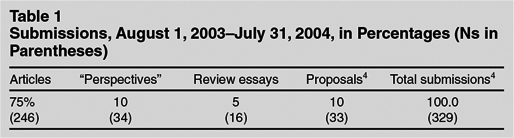
Submissions, August 1, 2003–July 31, 2004, in Percentages (Ns in Parentheses)This column includes only proposals for which we had not yet received full submissions by July 31, 2004.
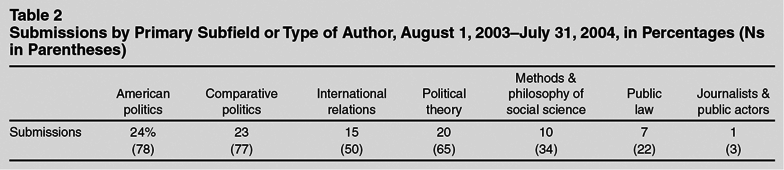
Submissions by Primary Subfield or Type of Author, August 1, 2003–July 31, 2004, in Percentages (Ns in Parentheses)
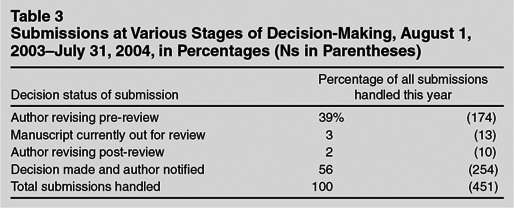
Submissions at Various Stages of Decision-Making, August 1, 2003–July 31, 2004, in Percentages (Ns in Parentheses)
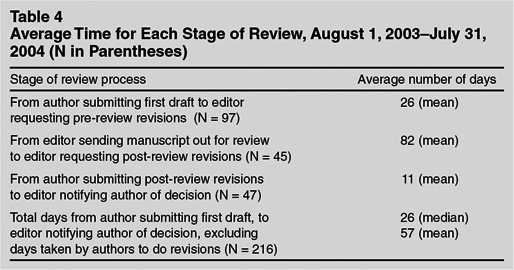
Average Time for Each Stage of Review, August 1, 2003–July 31, 2004 (N in Parentheses)
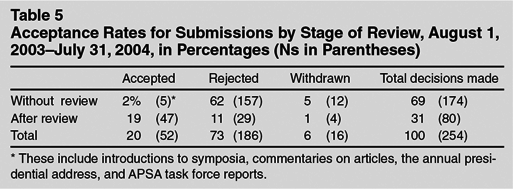
Acceptance Rates for Submissions by Stage of Review, August 1, 2003–July 31, 2004, in Percentages (Ns in Parentheses)
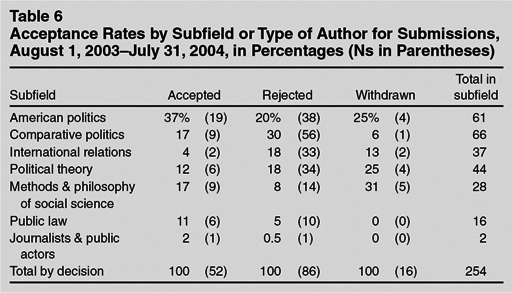
Acceptance Rates by Subfield or Type of Author for Submissions, August 1, 2003–July 31, 2004, in Percentages (Ns in Parentheses)
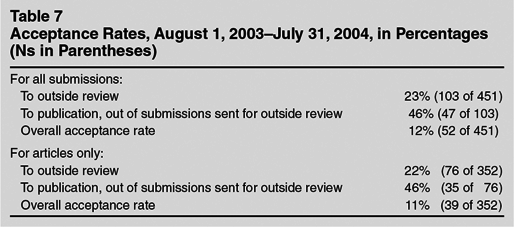
Acceptance Rates, August 1, 2003–July 31, 2004, in Percentages (Ns in Parentheses)
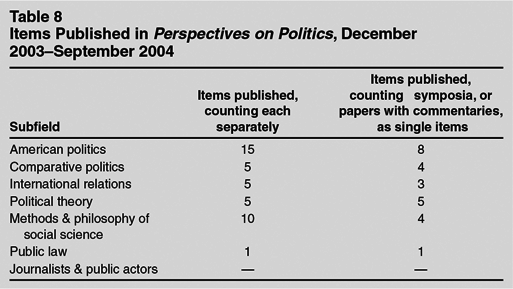
Items Published in Perspectives on Politics, December 2003–September 2004
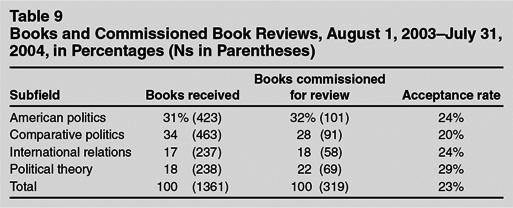
Books and Commissioned Book Reviews, August 1, 2003–July 31, 2004, in Percentages (Ns in Parentheses)
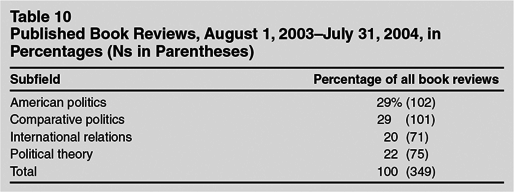
Published Book Reviews, August 1, 2003–July 31, 2004, in Percentages (Ns in Parentheses)
 You have Access