


1. Introduction
The left periphery of the clause (henceforth, LP) in Romance languages has been deeply investigated since the beginning of the program of the cartography of syntactic structures (Rizzi Reference Rizzi and Liliane Haegeman1997, Reference Rizzi, Guglielmo Cinque and Salvi2001, Reference Rizzi and Adriana Belletti2004; Poletto Reference Poletto2000; Benincà and Poletto Reference Benincà, Poletto and Luigi Rizzi2004; Frascarelli and Hinterhölzl Reference Frascarelli, Hinterhölzl, Kerstin Schwabe and Winkler2007; Rizzi and Bocci Reference Rizzi, Bocci, Martin Everaert and Van Riemsdijk2017; Larrivée Reference Larrivée2021; Wolfe Reference Wolfe2022).Footnote 1 With respect to the LP, Romance languages do not behave uniformly as a group. Indeed, several dimensions of variation exist – let us take, for example, French and Italian, which differ in the structure and productivity of cleft structures (Belletti Reference Belletti and Ur Shlonsky2015), as well as in the locus of spell-out of wh-elements (Bonan Reference Bonan2021).
In contemporary French, various elements can be located at the beginning of the clause and thus labelled as topics within the LP (see section 2 for a definition of topic). Candidates are subjects, such as lui ‘he’ in (1); objects, such as cette épreuve ‘this trial’ in (2); and non-arguments (cf. temporal/locative complements or adverbs), such as hier ‘yesterday’ in (3) (but see Rizzi Reference Rizzi and Adriana Belletti2004 on the discourse status of sentence-initial adverbials). Examples (1)–(3) are naturally occurring instances extracted from one of the treebanks that will be explored in our study (Paris Stories, Kahane et al. Reference Kahane, Caron, Strickland and Gerdes2021; see treebank details in section 4).


At least two possible cartographic models can map the syntactic derivations of these data, taking into account the nature of merge for the topicalized element (external merge/base-generated vs. internal merge/moved). In a recent proposal, Wolfe (Reference Wolfe2022) also suggests that the nature of merge underwent language change throughout the history of French. Following Wolfe (Reference Wolfe2022), it is possible to identify at least two stages of French with different settings concerning the merge nature of constituents in the LP (which are solely XPs, maximal projections; refer to section 2 for details).Footnote 2
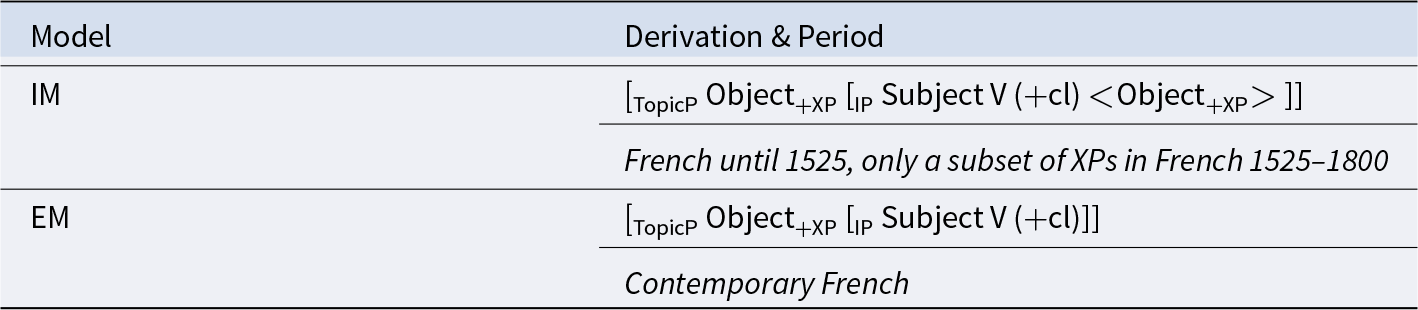
The proposed syntactic derivations for object topicalization (cf. example (2)) are outlined in Table 1. These two models imply different predictions in terms of locality effects which are triggered by movement (or absent by lack of movement; Rizzi Reference Rizzi1990).
Models and the relevant period of French for each strategy in Wolfe (Reference Wolfe2022)

Table 1 Long description
Intended content compares multiple theoretical models by linking each strategy to the historical period of French in which it is relevant. The provided input contains no rows or values, so model names, strategy labels, and time-period assignments cannot be reported or compared. Because the dataset is absent, no trends, contrasts among strategies, or distribution across time periods can be inferred. Any abbreviations referenced in notes cannot be applied to specific entries without the missing table content. Provide the table rows and columns to generate a descriptive summary of which models align with which strategies and periods.
+cl = presence of a resumptive clitic, EM = external merge/base-generation, IM = internal merge/movement
The aim of this work is then to evaluate whether such a proposal can be confirmed by quantitative data and simple computational methods. We explore the tools of the Quantitative Computational Syntax framework (henceforth QCS; Gulordava and Merlo Reference Gulordava and Merlo2015, Reference Gulordava and Merlo2020, Merlo Reference Merlo2015, Reference Merlo2016; and related works). In this approach, theory-driven (expected) frequencies of grammatical configurations serve as a dependent variable to test linguistic proposals.
In our study, we test the predictive power of Wolfe’s (Reference Wolfe2022) model in comparison to a series of baseline models (e.g., where only internal merge or only external merge are active). Our diagnostics rely on identifying hallmarks of movement and locality in grammatical clauses via the extraction of quantitative data from syntactically annotated large-scale databases. Specifically, we focus on the difference between observed, retrieved counts and expected, imputed counts (refer to Samo and Merlo Reference Samo and Merlo2019, Reference Samo and Merlo2021 for a detailed description of the methodology). This simulation-based metric is used to compare the generalization ability of formal approaches (Merlo and Samo Reference Merlo, Samo, Evelina Leivada and Grohmannto appear).
In a nutshell, Wolfe’s (Reference Wolfe2022) proposal centers on a clear dichotomy of merge nature between (at least) two stages of French. We rely on a quantitative dimension and operate on three sets of treebanks respectively representing Old French (henceforth, OFr), Middle French (MFr), and contemporary French (CFr). Details on the treebanks are given in section 4.
To reach our goal, we proceed as follows. Section 2 introduces the linguistic elements of the models under investigation, while we quantify the resulting hypotheses in section 3. The materials and methods used in our studies are detailed in section 4. Section 5 focuses on the discussion of our findings. Finally, section 6 provides conclusions.
2. Topics in French, merge, and locality
2.1. Topics in (the diachrony of) French (Wolfe Reference Wolfe2022)
We adopt a “basic” definition of topics in the spirit of Rizzi (Reference Rizzi and Liliane Haegeman1997). Specifically, we define topics as those constituents that appear in a position different from their canonical position, “normally expressing old information somehow available and salient in previous discourse” (Rizzi Reference Rizzi and Liliane Haegeman1997: 285). Syntactically speaking, topics in French involve the reordering of the canonical clause (in the sense of unmarked structure; Haspelmath Reference Haspelmath2006), and, in some cases, the presence of a resumptive clitic pronoun in the comment of the topic (clitic left dislocation structures; see Cinque Reference Cinque1990).Footnote 3
Topics in French have been extensively explored in numerous theoretical studies (e.g., Rizzi Reference Rizzi2005; De Cat Reference De Cat2007; Berthelot Reference Berthelot2017; Authier and Haegeman Reference Authier and Haegeman2019), experimental research in language acquisition and pathology (see Durrleman et al. Reference Durrleman, Hippolyte, Zufferey, Iglesias and Hadjikhani2015; Durrleman and Bentea Reference Durrleman and Bentea2021, and references therein), as well as investigations into diachronic aspects involving microvariation and language change (Troberg Reference Troberg2004; Mathieu Reference Mathieu2013; Salvensen Reference Salvensen2013; Bech and Salvesen Reference Bech and Salvesen2014; Zaring Reference Zaring2018; Larrivée Reference Larrivée2021; Wolfe Reference Wolfe2022).
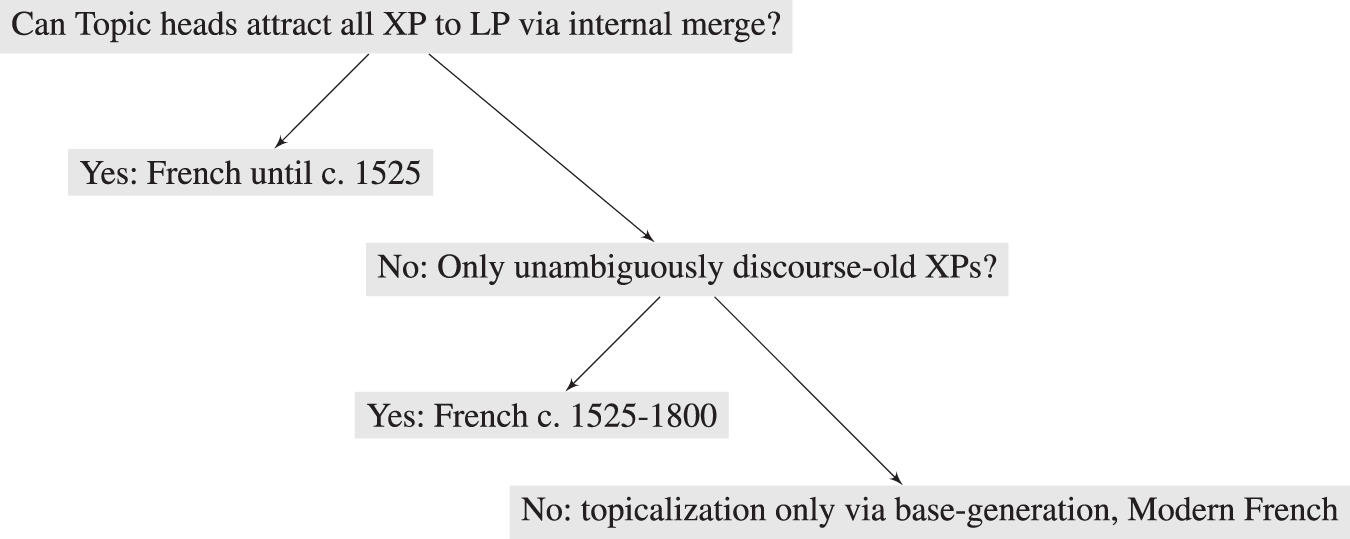
Recently, Wolfe (Reference Wolfe2022) explored the diachronic stages of French and postulated that the merge nature of the constituent within the LP has undergone language change throughout the history of the language. The flowchart in Figure 1 summarizes the proposal.
Parameter hierarchy for topicalization in French, adopted from Wolfe (Reference Wolfe2022: 261).

Wolfe’s (Reference Wolfe2022) proposal reads as follows. The internal merge of topics (movement from the IP) was the main strategy in older stages of French, until circa 1525. In a subsequent stage (c. 1525–1800), only a subset of constituents were able to undergo movement (those that are “unambiguously discourse-old”, as given in Figure 1). Finally, Modern French only allows externally merged (base-generated) topics. Importantly, a key element of Wolfe’s (Reference Wolfe2022) hypothesis is the idea that the topics undergoing language change in a first phase are maximal projections (XP).
2.2. Processing locality and a distributional model of similarity
Different loci of generation of the constituents, and the presence or lack of movement, can be explored as factors with respect to predictions in terms of locality (Rizzi Reference Rizzi1990, Reference Rizzi and Adriana Belletti2004). We adopt these factors as a diagnostic tool to compare syntactic proposals with simple computational methods (in line with previous works: Samo and Merlo Reference Samo and Merlo2019; Reference Samo and Merlo2021; Samo Reference Samo2022b).
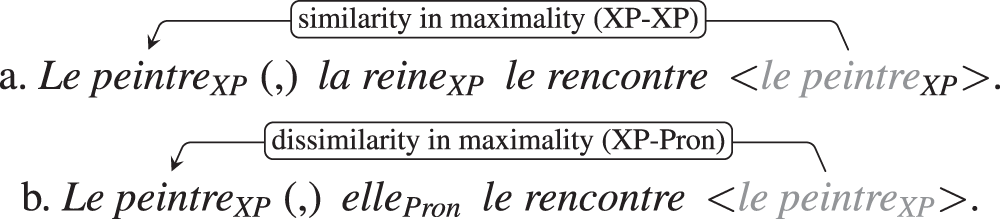
According to Wolfe’s (Reference Wolfe2022) model, we should expect forms of asymmetries emerging between at least two groups of languages, that is, OFr/MFr versus CFr. While the base-generation/EM approach postulated for CFr lacks predictions regarding locality effects, the movement/IM model discussed for OF predicts various intervention effects that can burden the parsing of specific structures in terms of (featural) Relativized Minimality (Rizzi Reference Rizzi1990, Reference Rizzi and Adriana Belletti2004; Starke Reference Starke2001; see Friedmann et al. Reference Friedmann, Belletti and Rizzi2009; Belletti et al. Reference Belletti, Friedmann, Brunato and Rizzi2012; Durrleman et al. Reference Durrleman, Marinis and Franck2016, a.o. for psycholinguistics applications). Specifically, fronting a maximal projection XP may pose challenges in parsing when it crosses a higher “similar” constituent (i.e., another XP). On the other hand, dissimilarity between a moved element and an intervener (e.g., a moved XP crossing an intervening pronominal form) is considered to facilitate parsing. Figure 2 provides a summary of this asymmetry.Footnote 4
Similarity and dissimilarity with respect to feature maximality of the sentences ‘The painter(,) the queen meets him’ and ‘The painter(,) she meets him’ in contemporary French.

The strongest hypothesis testing would rely on these (similarity) intervention effects creating clear-cut asymmetries between grammatical and ungrammatical clauses, for example, the well-known case of asymmetry in English between *When+Wh do you wonder who+Wh won? versus You−Wh wonder who+Wh won (cf. Rizzi Reference Rizzi1990, Reference Rizzi2013).
Studies in locality parsing have highlighted different kind of asymmetries. As for studies focusing on populations of French speakers, different dimensions of grammaticality and acceptability have been found in adult grammars across structures (Villata et al. Reference Villata, Rizzi and Franck2016; Shlonsky et al. Reference Shlonsky, Villata and Franck2020), and in language development (Durrleman et al. Reference Durrleman, Hippolyte, Zufferey, Iglesias and Hadjikhani2015; Reference Durrleman, Marinis and Franck2016; Durrleman and Bentea Reference Durrleman and Bentea2021).
However, our quantitative aspect, that is, the observed frequencies in a given dataset of naturally occurring data, only consists of instances of grammatical clauses. Indeed, from a broader perspective, the asymmetry discussed in Figure 2 is striking in specific grammars: impossibility, indicated by significantly low accuracy scores in the comprehension of A $'$-constructions in comparison to adult grammar, is particularly pronounced in certain populations, such as children (Friedmann et al. Reference Friedmann, Belletti and Rizzi2009), and in language pathology (Durrleman et al. Reference Durrleman, Marinis and Franck2016) (for the acquisition of topics in Romance, see Belletti Reference Belletti2022). In addition, as demonstrated by Zhao et al. (Reference Zhao, Samo, Utunen, Stucke and Gamhewage2021), (similarity) intervention effects in grammatical clauses are minimized crosslinguistically (in Chinese, English, French, Italian, Polish, Portuguese, Russian, and Spanish) in specific genres, such as emergency knowledge-transfer of health-related content.
We here adopt and test the proposal that sentences featuring a similar configuration between the moved element and the intervener are more complex – that is, harder to parse – than sentences with a dissimilar configuration.
The dis/similarity in intervention effects is accounted for by a distributional model, as discussed in previous studies (Samo and Merlo Reference Samo and Merlo2019, Reference Samo and Merlo2021) and in detail in Merlo and Samo (Reference Merlo, Samo, Evelina Leivada and Grohmannto appear). The notion of locality in sentences can be conceived as collections of relevant attributes and their values. In essence, sentences can be encoded as a vector ( $x_n$, [...],
 $x_{n+1}$,
 $y$) of attributes
 $x$ (dimensions, in our case matching configurations for relevant features for locality, e.g., maximality, number, etc.) with binary values (matching
 $= 1$, mismatching
 $= 0$), and a class
 $y$ representing observed/expected frequency – a dependent variable that depends on the “activated” similarity (matching). These representations are partially hand-defined model (see Merlo and Samo Reference Merlo, Samo, Evelina Leivada and Grohmannto appear for a typology of computational models), in which
 $x$ are determined by the theory and
 $y$ is imputed on the frequency in corpus counts.
For instance, if the features under investigation are maximality, number (singular vs. plural) and person (first vs. second vs. third), in this specific order, and a match is assigned a value of 1 while a mismatch is assigned 0, sentences can be represented as vectorial representations of matching features with three dimensions. Each dimension represents a specific morphosyntactic feature. Consider, for example, sentence (a) in Figure 2 – Le peintre(,) la reine le rencontre ‘the painter, the queen meets him’. In this sentence, the topic le peintre XP, third, singular matches in all features – maximality (XP), person (third), and number (singular) – with an intervening subject la reine XP, third, singular. Therefore, the representation of sentence (a) in Figure 2 would be  $ \lt $1,1,1
 $ \gt $. The same encoding can be implemented for sentence (b) in Figure 2 – Le peintre(,) elle le rencontre ‘the painter, she meets him’. In this case, the initial topic matches in person (third) and number (singular), but not in maximality (XP vs. pronoun). The representation would be expressed as
 $ \lt $0,1,1
 $ \gt $, different from the representation of (a) in Figure 2.
To confirm or reject the impact of movement on the frequency of grammatical clauses, it is essential to establish a benchmark based on expected counts. We generate expected counts for the distribution of these features in canonical clauses when no movement is involved. This distribution becomes our dependent variable, adopted as a metric to test linguistic proposals.
For instance, the canonical order counterparts of the sentences in Figure 2, that is, La reine rencontre le peintre ‘the queen meets the painter’ and Elle rencontre le peintre ‘she meets the painter’ would be respectively encoded, like their topicalized counterparts, as  $ \lt $1,1,1
 $ \gt $ and
 $ \lt $0,1,1
 $ \gt $.
The quality and quantity of features naturally vary based on the explored theoretical frameworks (see details on relevant features across languages, e.g., mismatch in the feature gender as an ameliorative effect in Hebrew but not in Italian, cf. Belletti et al. Reference Belletti, Friedmann, Brunato and Rizzi2012).
In this study, we focus on a one-dimensional vector, specifically on the feature maximality. There are four main reasons for this choice: (i) Wolfe (Reference Wolfe2022) highlights maximality as a salient feature (see Figure 1); (ii) as pointed out by Belletti and Rizzi (Reference Belletti and Rizzi2013), pronouns (in our case, subject pronouns, one of the values of maximality) represent interveners to a lesser extent, resulting in ameliorative effects across grammars (Friedmann et al. Reference Friedmann, Belletti and Rizzi2009, but also see Rizzi Reference Rizzi2018); (iii) we also explore the fronting of adverbs to detect and map asymmetries, and these elements do not encode forms of number or person, but do encode maximality; and (iv) the annotation scheme of the treebanks under investigation (de Marneffe et al. Reference de Marneffe, Marie-Catherine, Nivre and Zeman2021; details in section 2.3).
Finally, the dependent variable  $y$ is determined in relation to the frequency (and distribution) of sentences with specific configurations, compared to expected counts derived from canonical counts. As will be discussed in section 3, a model postulating movement (IM) of the initial XP makes explicit predictions: observed mismatching configurations in maximality should be more frequent than the expected counts. Wolfe (Reference Wolfe2022) discusses this model for older stages of French. In contrast, a base-generation model (EM) does not predict any directions, as no crossing is involved, and consequently, no effects of intervention locality arise. This is a fitting null hypothesis of no differences between groups, in our case, mismatching configuration/stages of French. This model is discussed for contemporary French in Wolfe (Reference Wolfe2022).
Treebanks annotated in cartographic terms do not currently exist, and creating them would demand a significant human workload. To gather linguistic data from large-scale datasets, it is necessary to translate cartographic configurations into already available, simpler syntactic annotation schemata. To facilitate crosslinguistic (considering different stages of French, but also to enable comparisons with other language in future research) and cross-genre analyses, we explore open-source treebanks annotated using the Universal Dependencies (henceforth, UD) guidelines (Nivre Reference Nivre2015; Zeman et al. Reference Zeman2023), as discussed in section 2.3.
2.3. Dependency structures, features, and locality
The rich and fine-grained typology of cartographic labels is not semi-automatically retrievable in existing large-scale datasets. In the spirit of Samo (Reference Samo2019a), we need to translate collectable data from available sources into cartographic representations (ultimately aiming to test cartographic proposals).
We work with a limited set of syntactic and morphosyntactic labels from UD (based on de Marneffe et al. Reference de Marneffe, Marie-Catherine, Silveira, Haverinen, Ginter, Nivre and Manning2014; see also de Marneffe et al. Reference de Marneffe, Marie-Catherine, Nivre and Zeman2021). Specifically, concerning pure syntactic dependencies, our focus is on dependencies that govern arguments, such as the labels for direct objects (obj) and indirect objects (iobj); non-arguments, such as oblique constituents (obl); and adverbial elements (advmod). Subjects (nsubj) mainly represent interveners in terms of locality: even when a subject is topicalized, neither model yields clear predictions concerning intervention effects; hence, they are not taken into consideration as topics in this work.
Morphosyntactic labels (e.g., part-of-speech tags, henceforth upos, as in UD) are adopted to automatically identify the levels of the dimensions of the vectorial representations. The feature maximality can be encoded in terms of maximal projections XP, proper noun (propn) and noun (noun), and pronominal entities, pronouns (pron).Footnote 5 Naturally occurring examples can be found in Table 6 and Table 7 in section 4. We present the predictions of Wolfe’s (Reference Wolfe2022) model and the control groups (IM only, EM only, and a “reverse” of Wolfe’s model) in section 3.
3. Quantifying the hypotheses
As mentioned in the previous sections, Wolfe’s (Reference Wolfe2022) model expects asymmetries between (at least) two sets of languages in terms of intervention locality effects. We quantify these predictions by exploring the tools within the framework of QCS (Merlo Reference Merlo2015, Reference Merlo2016; Gulordava and Merlo Reference Gulordava and Merlo2020).
Our metrics rely on comparing the observed and expected frequencies of grammatical clauses in given treebanks.Footnote 6 As introduced in section 2, the EM strategy lacks explicit predictions concerning intervention effects, whereas clear predictions are stipulated by an IM hypothesis.
Specifically, the IM hypothesis predicts that the observed counts of mismatching configurations of given features should be greater than the expected counts. Additionally, different sizes should emerge in the spirit of a hierarchy of features (Laenzlinger and Soare Reference Laenzlinger, Soare, Joanna Blochowiak, Grisot, Durrleman and Laenzlinger2017) and types of intervention effects (Durrleman et al. Reference Durrleman, Marinis and Franck2016; Durrleman and Bentea Reference Durrleman and Bentea2021): mismatching configurations with arguments should be higher (since subjects are stronger interveners in these configurations) than with non-arguments and adverbials, in that order (see also Costa et al. Reference Costa, Friedmann, Silva and Yachini2014).
Let us formalize the hypotheses and how they can be integrated in different models. Let Observed be the distribution of observed counts in mis/matching configurations, and let Expected be the distribution of counts of mis/matching configurations in canonical clauses. Our metric is equal to the difference of  $\textit{Observed} - \textit{Expected}$.
This difference can be close to 0 ( $\approx$ 0), indicating that the observed counts are as many as the expected ones (hence, no asymmetries between canonical and marked sentences, supporting base generation). Alternatively, the difference may be distant from 0, with the direction being informative: if the difference is positive for mismatching configurations, it suggests that the mismatch acts as an ameliorative effect, supporting a movement theory.
The IM model also predicts that the difference would be higher in arguments (Arg) than in non-arguments (Non-Arg), obliques (Obl) and adverbs (Adv) (with  $ \gt $ indicating greater):
 $\textit{Arg} \gt (\textit{Obl},\!\textit{Adv})$. We label these outcomes as intervention effects (henceforth, IntEff). Adverbs should show values close to 0 – meaning that we observe a similar distribution between observed and expected counts – since adverbs and intervening subjects share few elements in common (e.g., maximality, but not number and gender). On the other hand, the EM model does not provide clear predictions, so the values for every condition (Arg, Obl, Adv) should be
 $\approx$ 0.
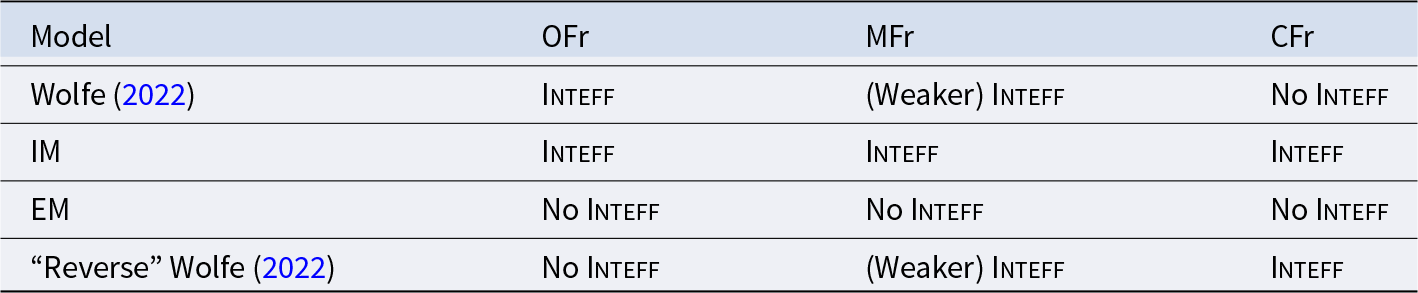
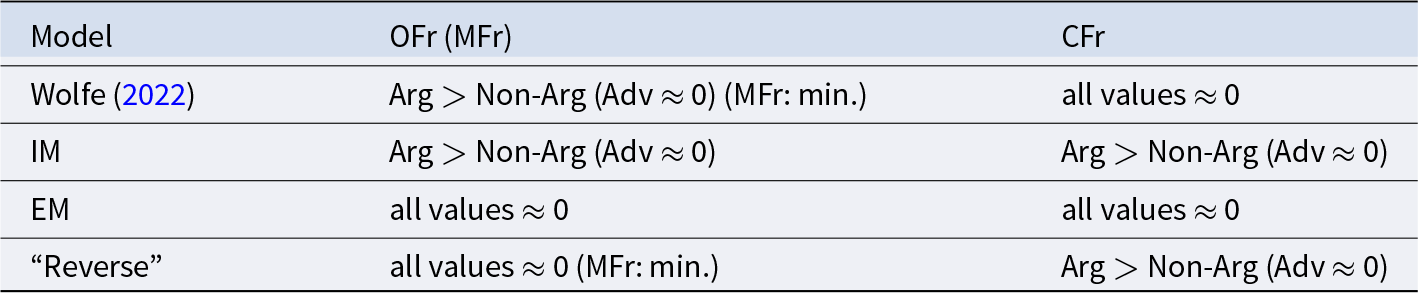
Following Wolfe (Reference Wolfe2022), we should expect asymmetries between (at least two) groups of languages. The predictions from IM should be valid for OFr, but not for CFr (with MFr possibly representing a middle value). Wolfe’s (Reference Wolfe2022) model is contrasted with two models, an IM-only and an EM-only, in which language change is not at play (no asymmetries arise between groups). A logical fourth model would be a “reverse” of Wolfe’s (Reference Wolfe2022) model, in which OFr follows an EM model and CFr shows signs of IM. The predictions of the various models are presented in Table 2.
Models and their predictions with respect to intervention effects (IntEff) across periods of French

Table 2 Long description
Model predictions of intervention effects across different periods of French are intended to be compared in this table, but no table entries were provided. Without the model names, period labels, and predicted intervention-effect values, it is not possible to report key results, rank models, or describe trends across periods. If the table includes uncertainty ranges or confidence information, those details are also required to interpret differences reliably. Provide the table rows and columns so the can summarize which models predict stronger or weaker intervention effects in each period and whether predictions are consistent over time.
Let us present the details of our quantification. Our study explores a modified version of a metric previously adopted for Romance adverbial fronting in Samo (Reference Samo2022b) and for fronting in Verb Second languages in Samo (Reference Samo2023), and it relies on the distribution of conditions. To illustrate, consider a straightforward example involving a one-dimensional representation with only the maximality feature. Let us hypothesize that, in a treebank, mismatching configurations between the subject and object in maximality (e.g., Je pron lis un livre XP ‘I read a book’) account for 35% (0.350) of the total occurrences of subjects and objects. This distribution represents the expected distribution. If the observed distribution of mismatches in topic configurations, such as Le billet d’avion XP, nous pron l’achetons ‘The airplane ticket, we buy it’, is higher than 0.350, for example, 0.600, we observe an ameliorative effect. This ameliorative effect can be quantified by subtracting the expected counts from the observed counts ( $0.600 - 0.350 = 0.250$). Results close to 0 indicate no variability between canonical clauses and clauses with topics, aligning with an EM approach. Negative results, on the other hand, indicate a pejorative effect that should be explored in alignment with research on locality parsing and disfavored matching configurations (Samo and Merlo Reference Samo and Merlo2019).
Our main study aims to detect our measure in two conditions: arguments, which should trigger ameliorative effects, and non-arguments, which do not (Costa et al. Reference Costa, Friedmann, Silva and Yachini2014; Friedmann et al. Reference Friedmann, Rizzi and Belletti2017). We also make an additional distinction for non-arguments between obliques and adverbs. According to standard cartographic representations, in all these cases, movement to the LP might involve crossing the subject in SpecIP: arguments are generated in the VP (Si Reference Si2019), obliques in a dedicated position for non-arguments (Schweikert Reference Schweikert2005), and adverbs within the IP (Cinque Reference Cinque1999). We retrieve our data from four treebanks of CFr, one of MFr, and one of OFr.
Following Table 2, we can expect distinct behaviours between stages of French and models. Particularly, the strongest hypothesis of IM is that the difference between observed and {expected mismatching configurations should be higher with arguments than with non-arguments ( $\textit{Arg} \gt \textit{Non-Arg}$). Specifically, all the values for arguments should be positive (higher than 0, indicating they are more frequent than expected). Mismatching configurations for non-arguments and adverbs, on the other hand, should be similar to the expected counts, thus
 $\approx$ 0; no prediction is made regarding the polarity, positive or negative, of the values.
Conversely, EM would not predict any specific direction of effects for either arguments or non-arguments, but rather that all values (Arg, Non-Arg)  $\approx$ 0 since the observed counts should be similar to the expected ones. Technically, by adopting a bi-clausal approach to topics generated higher than the LP, or dedicated positions for topics generated within the LP (cf. Benincà Reference Benincà, Adrian Battye and Roberts1995; Wolfe Reference Wolfe2015, and references therein), one can also expect additional random results. An additional random factor could be sentences in which other features trigger movement (e.g., focus in questions; Rizzi Reference Rizzi and Liliane Haegeman1997 and related works). We use this randomness to test our methodology by exploring a “special” treebank only consisting of questions; further details can be found in section 4.
Wolfe (Reference Wolfe2022) predicts asymmetries across languages. OFr should show effects of IM, while CFr should behave according to EM. MFr is expected to pattern with OFr, albeit in a “minimized” fashion, that is, exhibiting a lesser distance between the results of arguments and the results of non-arguments. The hypotheses are summarized in Table 3.
Models and predictions for stages of French

Table 3 Long description
Table entries are included, so the specific models, predicted stage labels, and any distance or feature measures cannot be described. The intended content appears to compare multiple models and their predictions across stages of French, likely separating different feature types such as arguments, non-arguments, and adverbials. Without the rows and columns, it is not possible to report key values, rank models, identify trends across stages, or note which predictions align best. Provide the table body (headers and all cells) to generate accurate, WCAG-compliant with comparisons and takeaways.
Adv = adverbials, Arg = arguments, min. = minimized distance, Non-Arg = non-arguments
Additional variables are associated with the genres/registers of the treebanks. For example, in the case of CFr, two treebanks represent spoken corpora, while the other two primarily represent written sources. Descriptions of the treebanks are provided in section 4.
4. Materials and methods
4.1. Materials
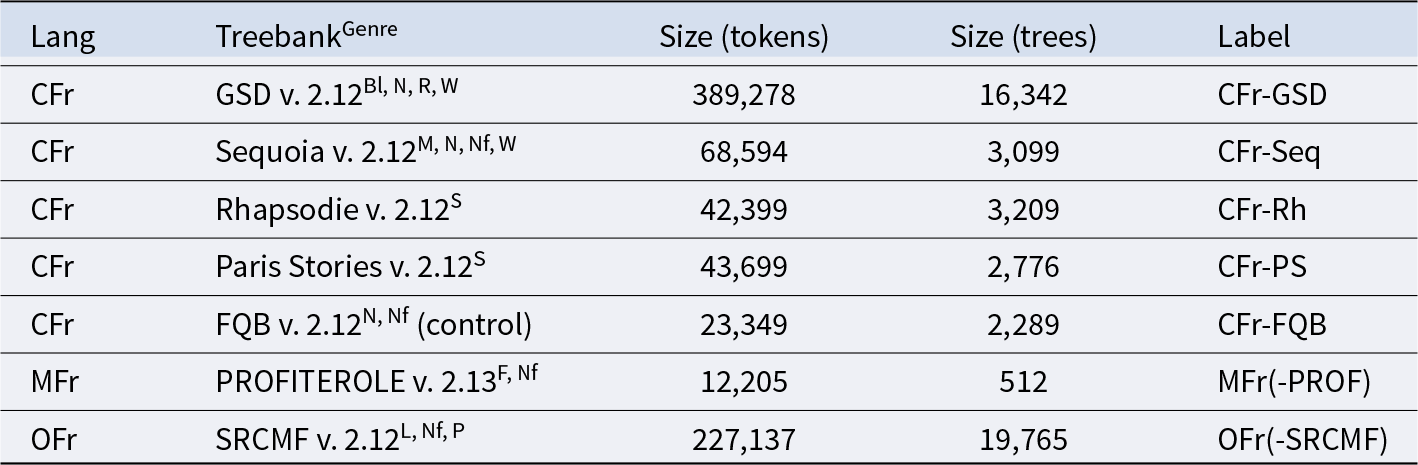
The data points discussed in this work are extracted from seven UD treebanks. Two treebanks represent written sources of contemporary French, namely GSD version 2.12 (Guillaume et al. Reference Guillaume, de Marneffe and Perrier2019) and Sequoia v. 2.12 (Candito and Seddah Reference Candito and Seddah2012; Bonfante et al. Reference Bonfante, Guillaume and Perrier2018). Two treebanks consist of spoken data: Paris Stories v. 2.12 (Kahane et al. Reference Kahane, Caron, Strickland and Gerdes2021) and Rhapsodie v. 2.12.Footnote 7 One treebank, SRCMF v. 2.12, contains Old French (ninth–13th century; Stein and Prévost Reference Stein and Prévost2013). We use one treebank of MFr, PROFITEROLE (early 14th–late 15th century; Prévost et al. Reference Prévost, Dehouck, Lavrentiev, Heiden and Grobol2024). We also have a control group made by FQB (Seddah and Candito Reference Seddah and Candito2016), a corpus entirely made up of questions. We did not query available parallel treebanks to avoid bias derived from translation effects. Details of genres and sizes of the investigated treebanks are given in Table 4.Footnote 8
Language, treebank, size in terms of tokens and sentences (trees), and label adopted for the rest of the work

Table 4 Long description
Dataset inventory intended to list each language and its treebank, along with corpus size measured by token count and sentence count, plus a short label used later in the document. No rows or numeric values were included in the provided table data, so key figures, largest or smallest corpora, and cross-language comparisons cannot be described. Genre abbreviations are referenced in the surrounding material, but without the actual entries it is not possible to state which genres apply to which treebanks. Provide the table rows to generate accurate that reports the main patterns and any notable outliers.
Genre abbreviations: Bl = blog, L = legal, M = medical, N = news, Nf = nonfiction, P = poetry, R = reviews, S = spoken, W = wiki
4.2. Methods
The decision to use two different versions of the treebanks (PROFITEROLE v. 2.13 vs. all other UD treebanks v. 2.12) resulted from the availability of the data via fully automatic means. On the day of retrieval, December 10th 2023, only version 2.12 could be automatically retrieved from a Python environment on count.grew.pl. The recently added treebank for MFr was queried manually with the web-based interface of universal.grew (https://universal.grew.fr, last access December 10th 2023).Footnote 9 The actual queries were identical in both methods (Python script, manual search).Footnote 10
As discussed in section 2.3, we retrieved sentences with a specific combination of syntactic and morphosyntactic annotations. When available, UD allows for sub-annotations; for instance, the distinction between oblique arguments (obl :arg) and oblique non-arguments (obl :mod) provided us with the opportunity to automatically discriminate obliques across two different categories (Arg vs. Obl). Given that Wolfe (Reference Wolfe2022) focuses on maximal projections, we retrieved XPs by restricting upos to common nouns (noun) and proper nouns (pnoun) for arguments and obliques. Following cartographic analyses that consider adverbs to be generated in specifier positions (Cinque Reference Cinque1999; Tescari Neto Reference Tescari2022), we also retrieved the relevant upos (adv). Moreover, beyond being topicalized or focused, adverbs (contrary to, e.g., arguments) can also be “highlighted” – adopting Rizzi’s (Reference Rizzi and Adriana Belletti2004) terminology – in neutral contexts, and they target a dedicated position in the left periphery (ModP; see Rizzi Reference Rizzi and Adriana Belletti2004; Rizzi and Bocci Reference Rizzi, Bocci, Martin Everaert and Van Riemsdijk2017; Samo Reference Samo2022a for details). Due to the annotation scheme of the retrieved data, we adopt a single, more general label (Topic; see below) without providing a case-by-case fine-grained distinction.
Syntactic dependencies are summarized in Table 5. The subject of the sentence is identified by the label nsubj and by the label expl for expletive subjects, and the subject’s maximality is indicated by its upos annotation (pnoun and noun mark maximal projections XP; pron marks pronominal forms).
Syntactic dependencies for each category to collect maximal projections

Table 5 Long description
Syntactic dependencies by category for collecting maximal projections cannot be described because the table data is missing. Without the rows, columns, and values, no key data points, comparisons, or trends can be identified. Provide the table contents, including category names and the listed dependency types, so the relationships and any differences across categories can be summarized accurately. If there are abbreviations or special labels, include their definitions to avoid misinterpretation.
We also considered mismatch conditions in those cases containing a null pronominal subject (Rizzi Reference Rizzi1982; Holmberg and Roberts Reference Holmberg and Roberts2013) in older stages of French (Vance Reference Vance2012; Ingham Reference Ingham2018, and references therein). The UD annotation scheme does not mark pro-drop sentences, but they can be retrieved by looking for the absence of dependency subjects in given (e.g., finite) contexts.Footnote 11
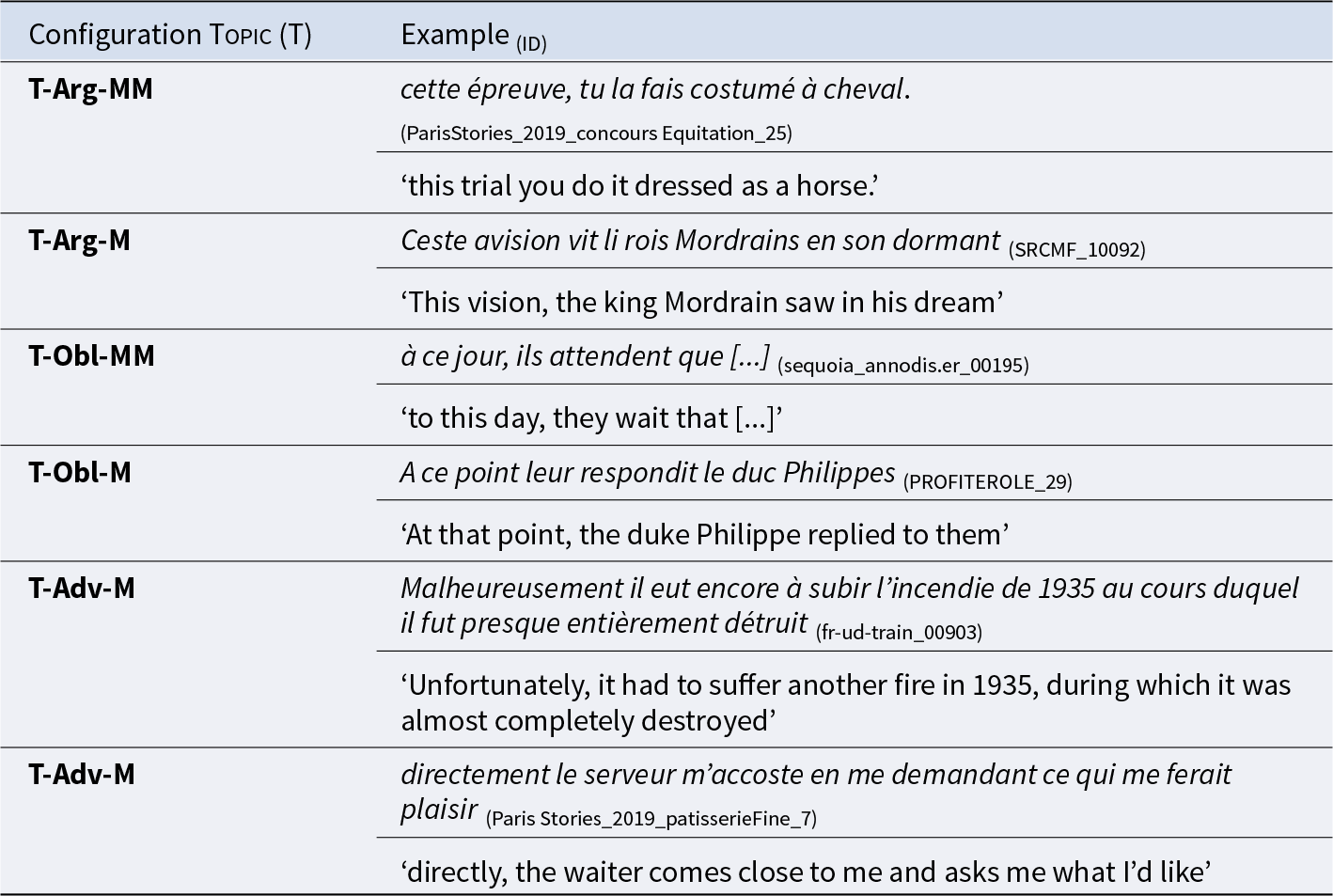
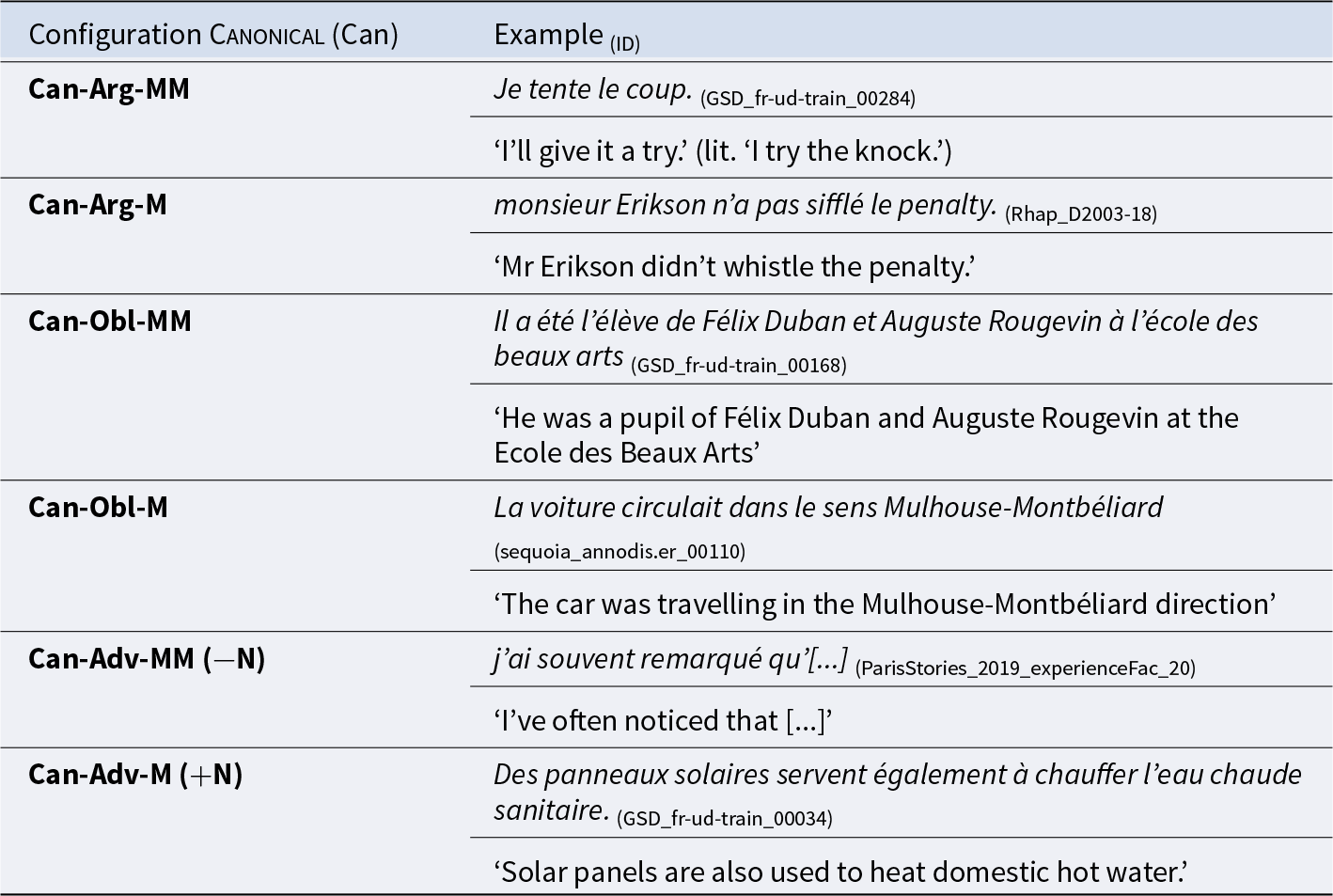
Naturally occurring examples for every category under investigation are given in Table 6 – we use a general label Topic (T) for left-peripheral/fronted/generated elements – and Table 7 for canonical clauses.
Conditions, naturally occurring examples, and sentence IDs for topic configurations

Table 6 Long description
Content for the data table is not provided, so specific conditions, naturally occurring examples, and sentence ID entries cannot be described. The intended structure appears to map each topic configuration to a condition, an example from real-world text, and one or more sentence identifiers. Without the rows and columns, no key values, comparisons, counts, or trends can be summarized. Interpretation is limited because the dataset, headings, and any grouping or ordering are missing. Provide the table cells or a text export to generate accurate WCAG-compliant that reflects the actual entries.
Conditions, naturally occurring examples, and sentence IDs for canonical configurations

Table 7 Long description
Table content was not provided, so specific conditions, naturally occurring examples, and sentence identifiers cannot be described. Without rows, columns, headers, or values, no key data points, comparisons, or trends can be identified. If you share the table data, the can summarize what each condition is, which real-world examples map to it, and how sentence IDs are organized. Any interpretation should note whether sentence IDs are unique, whether examples repeat across conditions, and whether any entries are missing or grouped.
We also retrieved canonical orders (e.g., arguments following subjects in non-argument questions, but also wh-in-situ; see Bonan Reference Bonan2021) from the treebank consisting only of questions, FQB. This retrieval tests the robustness of our methodology. If we observe results dissimilar to those in the other corpora, we can exclude a non-bias effect of our procedure, thereby reinforcing its reliability.
It is important to emphasize that we are not making any assumptions about the status of the syntactic constituent in initial position (e.g., frames or other kinds of left peripheral elements; Benincà and Poletto Reference Benincà, Poletto and Luigi Rizzi2004; Rizzi Reference Rizzi and Adriana Belletti2004). Instead, we are testing each linguistic datum under investigation across models using the same methodologies and diagnostics. Results are presented and discussed in section 5.
5. Results and discussion
5.1. Results
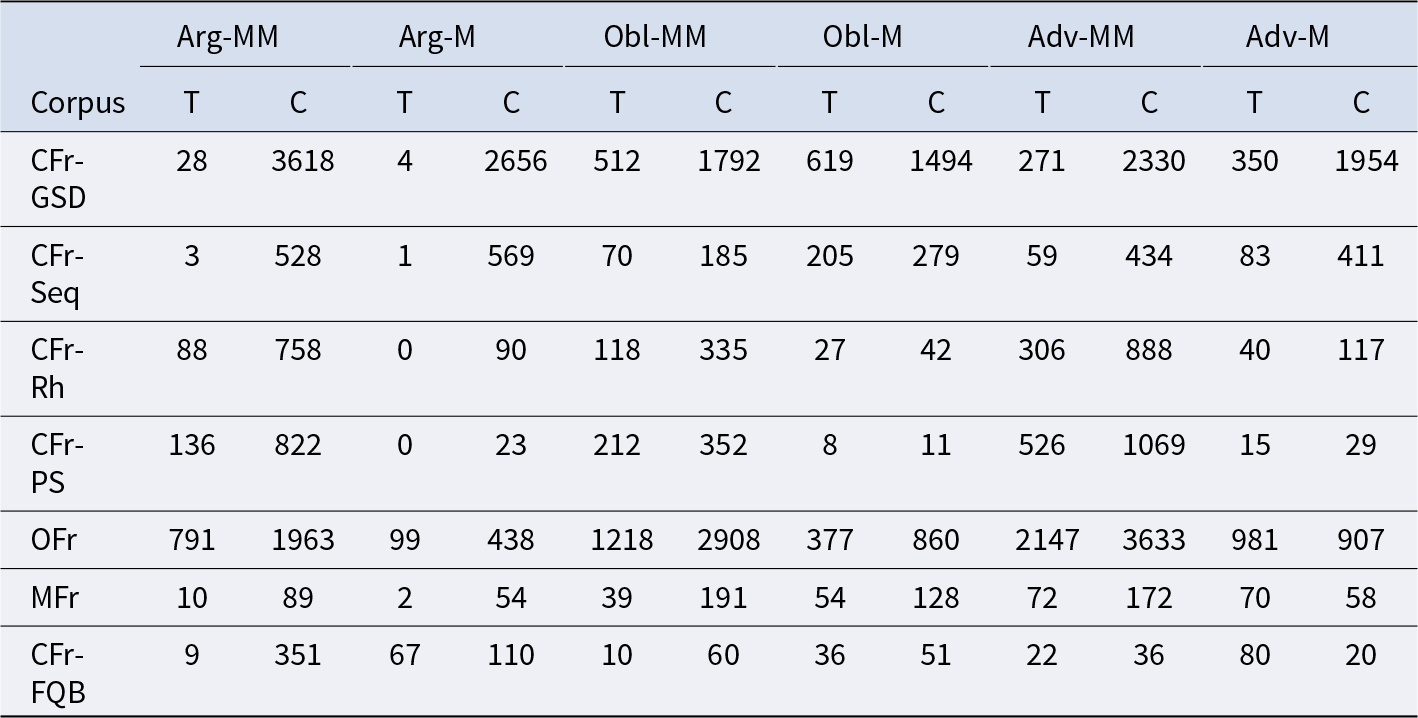
The raw results of the data extraction are first summarized in Table 8. A first non-trivial observation is that sentences with topics (marked orders) are less frequent than their canonical counterparts, except for adverb fronting with matching maximality in OFr, MFr, and in the control group of questions (FQB).
Raw frequencies of attested configurations for each treebank

Table 8 Long description
Raw frequency counts are intended to be listed for each treebank across multiple configuration categories. The provided input contains no rows, columns, or numeric entries, so no key values, rankings, or differences between treebanks can be reported. Trends such as which configurations are most common, or whether canonical versus non-canonical patterns dominate, cannot be determined. Any interpretation about matches versus mismatches, or about roles like adverbs, arguments, obliques, and topics, is not possible without the missing counts. Supplying the table’s actual data would allow a summary of the highest and lowest frequencies and the main cross-treebank contrasts.
Adv = adverbs, Arg = arguments, C = canonical, M = match, MM = mismatch, Obl = obliques, T = topic
Our metric is the difference between the observed and the expected distribution of mismatching configurations. Let us illustrate the methodology in a simple manner with an example from Table 8. In the GSD treebank, the total number of obliques in a canonical order is 3286 (1792  $+$ 1494). Thus, when no movement is at play, the mismatching condition accounts for 54.5% (0.545
 $=$ 1792
 $/$ 3286) of the occurrences of obliques. This distribution (0.545) represents our expected distribution. If movement does not play a role for topicalized obliques either, we should expect a very similar distribution of mismatching configurations (since this distribution in canonical structures depends on generative factors within the sentences), and therefore, the difference between the observed and the expected distribution should be approximately 0. If movement plays a role for topicalized obliques, we expect that the observed distribution of mismatching configurations should be higher than the expected one. In our case, the number of topicalized obliques in the GSD treebank is 1131 (512
 $+$ 619). The distribution of mismatching configurations is equal to 0.452. Therefore, the expected distribution (0.545) minus the observed distribution (0.452) equals
 $-$0.093, which we consider close to (
 $\approx$) 0 (see section 3, but also section 5.2).
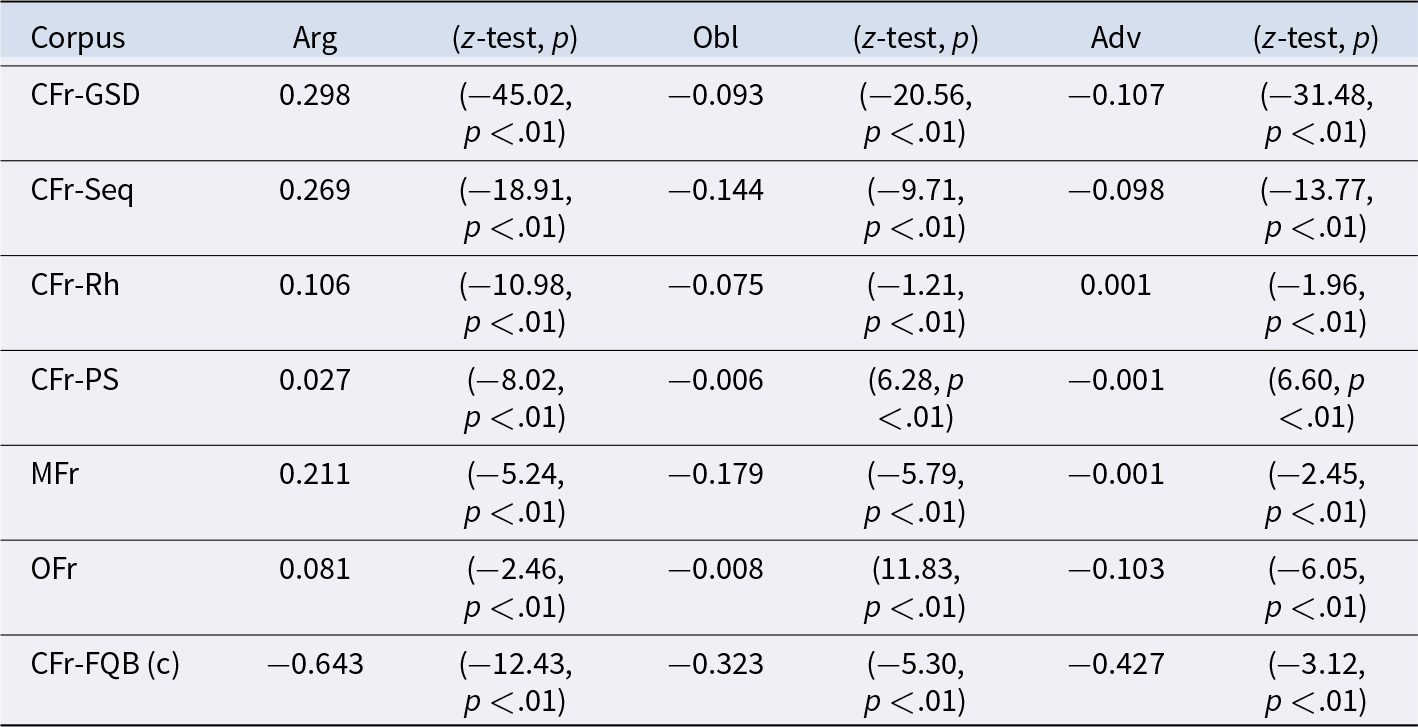
When comparing results for arguments in the same treebank (GSD), the expected distribution of mismatch is 0.577, while the observed distribution is 0.875. This indicates a higher occurrence of mismatching configurations than expected. The difference between observed and expected, 0.298 (0.875  $-$ 0.577), represents a predicted ameliorative effect according to a theory of locality. All results are provided in Table 9.
 $\textit{Observed} - \textit{Expected}$ counts of mismatches, z-tests, and p-values across treebanks

Table 9 Long description
Observed minus expected mismatch counts are intended to be listed for each treebank, alongside a z-test result and a p-value to indicate whether the mismatch difference is statistically notable. No rows or values were provided, so specific treebanks, mismatch magnitudes, and which results are statistically significant cannot be identified. With the data available, no comparisons, trends, or outliers across treebanks can be described. Provide the table entries to generate that highlights the largest positive and negative mismatch differences and notes which p-values indicate stronger evidence.
The raw frequencies in Table 8 show differences in size across treebanks and conditions. It is important to remark that resizing should only be taken into account across conditions, not across treebanks. Therefore, following previous works (Samo and Merlo Reference Samo and Merlo2019, Reference Samo and Merlo2021), we run a binomial test on the raw numbers to compare the results within conditions/between treebanks and to exclude results influenced by chance. We therefore calculated a z-test and a p-value for each condition, as given in Table 9.Footnote 12
Before turning to the model comparison and selection, we can detect whether our methodology is reliable by examining the results for FQB. The results for this control treebank, as predicted in section 4, vary extremely when compared to the other treebanks, with an extreme value for arguments ( $-$0.643, z
 $=$
 $-$12.43, p
 $ \lt $ .01).
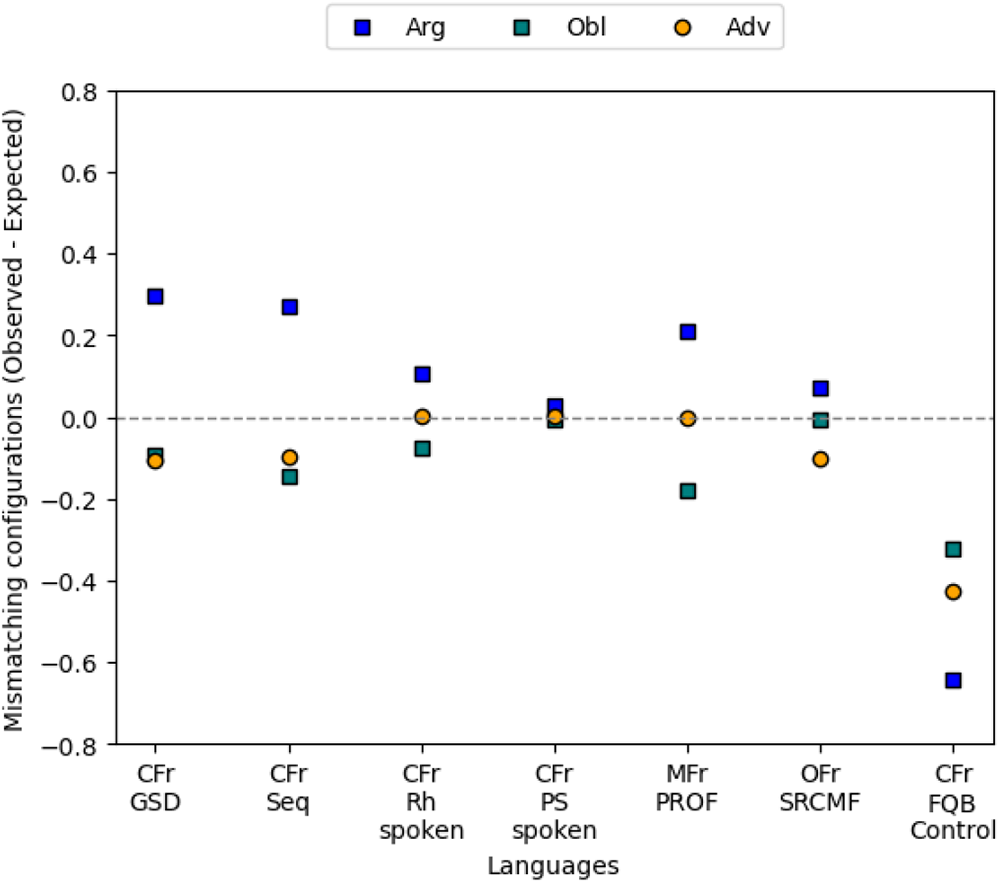
The main results are visualized in the dot chart in Figure 3. Let us reclarify the hypotheses according to the visualization. If Wolfe’s (Reference Wolfe2022) model is in the right direction we should expect a strong asymmetry between stages of French. In particular, the IM hypothesis for OFr predicts higher values for argument mismatching conditions, followed by obliques and adverbs with values close to 0. On the other hand, CFr should display either a random order (i.e., not the scale Arg-Obl-Adv) or all elements close to 0. Models postulating only IM or only EM predict no asymmetries between stages of French. Finally, FQB, as a control for the methodology, should show a different pattern compared to the other treebanks.
Observed - Expected mismatching configurations ( $y$-axis) and treebanks for arguments (Arg), obliques (Obl), and adverbs (Adv).

We do not observe a clear-cut asymmetry between CFr (all treebanks) on one side and OFr/MFr on the other. However, the findings in our study align with Wolfe’s (Reference Wolfe2022) predictions when considering spoken treebanks. Specifically, Paris Stories exhibits observed values similar to the expected ones (arguments 0.027, obliques 0.006, and adverbs  $-0.001$), supporting the idea of an IM model for contemporary spoken French. Spoken French is discussed as parametrically differing from contemporary “standard” French, particularly in the production and productivity of wh-in-situ questions (see details and references in Baunaz and Bonan Reference Baunaz and Bonan2023, a.o.).
We observe (weak) intervention effects for OFr – a positive value for the difference between expected and observed counts for arguments, alongside values close to 0 for non-arguments. These results are partially, but not fully, predicted by an IM model and by Wolfe’s (Reference Wolfe2022) hypothesis.
The weak intervention effects for OFr may be attributed to the type of movement to the LP found in Verb Second (V2) environments (Haegeman Reference Haegeman1996; Poletto Reference Poletto2002; Roberts Reference Roberts and Luigi Rizzi2004; Wolfe Reference Wolfe2015). This discussion, however, postulates that intervention in V2 environments follows standard locality effects and is not derived from a bottleneck effect (Roberts Reference Roberts and Luigi Rizzi2004), which makes different predictions in terms of locality (namely, that the fronted element bears some generalized features that block any other type of constituent). Recently, Samo (Reference Samo2023) compared these two models using Germanic treebanks, and the results support standard locality effects. These findings align with those of Reference Samo, Marco Coniglio, Müller and SteinbachSamo (to appear) on argument and adverbial fronting crosslinguistically and across language families (Romance, Germanic, Chinese, Hebrew). See details of a typology of intervention effects in section 5.2.1.
Finally, the results retrieved through this methodology from GSD and Sequoia show typology intervention effects in A $'$-configurations, confirming previously reported discussions for relative clauses (Samo and Merlo Reference Samo and Merlo2019) and cleft clauses (Samo and Merlo Reference Samo and Merlo2021).
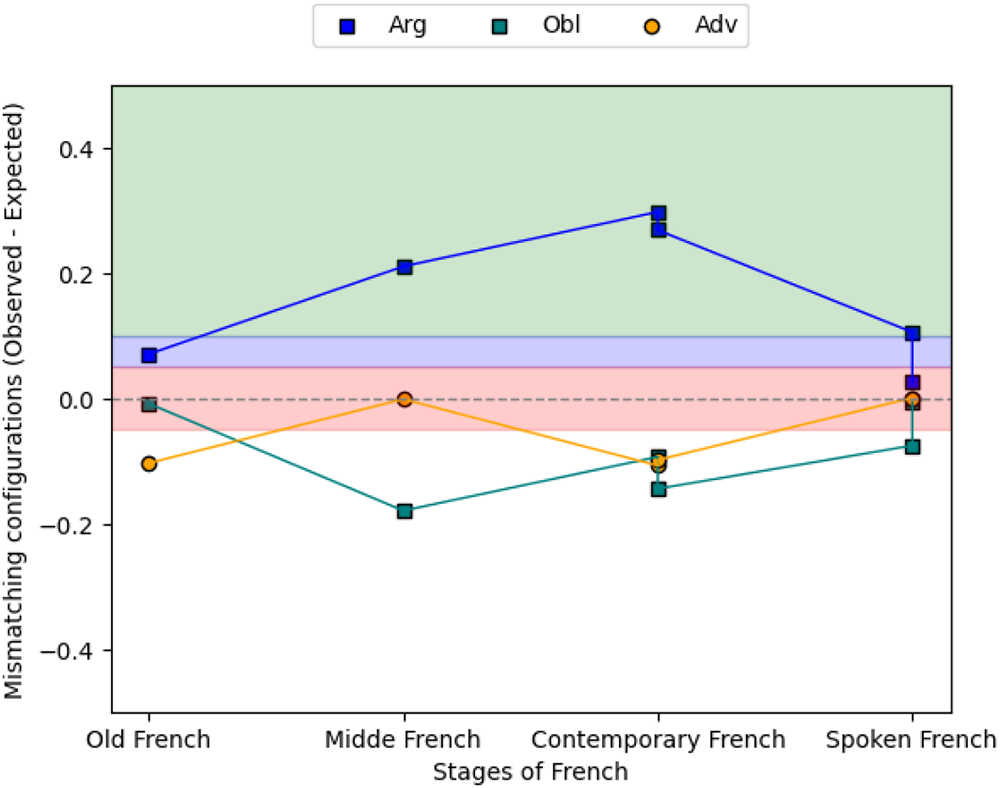
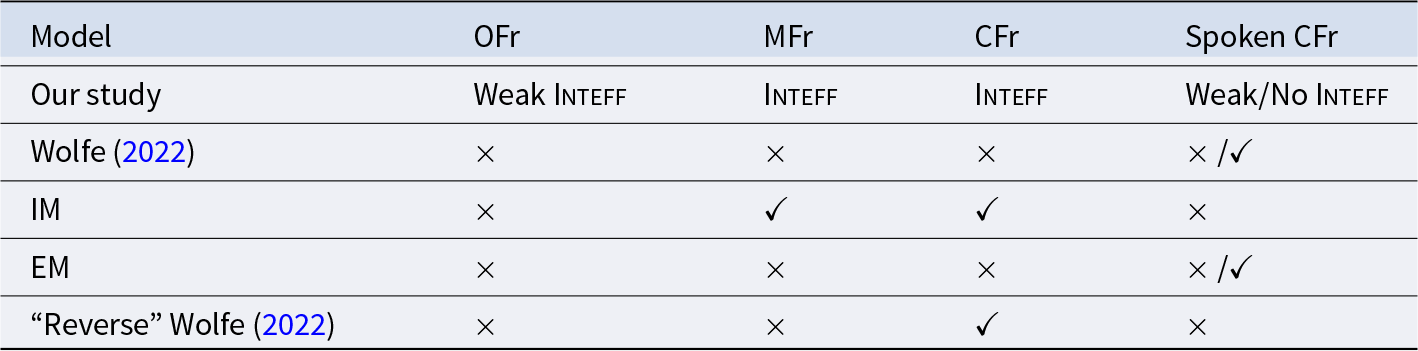
We can compare the predictions of the models in Table 2 and Table 3 with our results. Due to the asymmetry in registers (written vs. spoken) evident in Table 9 and Figure 3, we split CFr into CFr and spoken (C)Fr. We established three thresholds: values between  $-$0.05 and 0.05 indicate no intervention effects (i.e., values close to 0, but we statistically avoid false positives) – meaning that the observed values align with the expected ones; values higher than 0.1 are considered “strong” intervention effects; finally, values between 0.05 and 0.1 denote weaker intervention effects. This procedure is visualized in Figure 4.
Mismatching configurations across conditions and stages of French: intervention effects (green background), weaker intervention effects (blue background), and no intervention effects (red background).

Let us compare the predictions of the different models provided in Table 3 with the results emerging from Figure 4 in Table 10.
Agreement between models and results of our study with respect to intervention effects (IntEff) across periods of French

Table 10 Long description
Agreement between models and the study’s results regarding intervention effects across different periods of French is the intended focus. No rows, columns, labels, or numeric entries were provided, so specific agreement levels, differences by period, or overall trends cannot be described. Without the underlying values, it is not possible to identify which periods show stronger or weaker alignment, or whether agreement changes over time. Provide the table contents to generate WCAG-compliant that reports the key comparisons and any notable patterns.
Wolfe’s (Reference Wolfe2022) hypothesis regarding language change is possibly heading in the right direction, especially concerning spoken contemporary French. The data are not clearly predicted by any of the models discussed in section 3, suggesting the potential influence of additional factors. For instance, the V2 structure in OFr (Zaring Reference Zaring2018; Larrivée et al. Reference Larrivée, Feldhausen, Elsig, Kuchenbrandt and Neuhaus2019; Larrivée Reference Larrivée2021) could introduce various forms of intervention effects, as both the constituent and the verbal head move. Based on our findings, we propose integrating novel ideas for assigning parametric values to stages of languages. Specifically, in section 5.2, we would like to pone stress on (i) a typology of intervention effects (with or without verb movement in the LP), and on (ii) some notes towards a theory of registers in cartographic syntax. Importantly, we do not propose a specific new model in this work. Our goal is to suggest that certain elements, such as the type of movement and register, should be considered by theoretical linguists in future studies.
5.2. Discussion
Our contributions are manifold. Specifically, our results have three main highlights: (i) exploration of paths leading to different types of intervention effects based on the elements involved in the movement (section 5.2.1), (ii) some notes towards a theory of registers in syntactic cartography (5.2.2), and (iii) the exploration of a quantitative and computational methodology for comparing and selecting theoretical models (5.2.3).
5.2.1. Notes for a typology of intervention effects
One theoretical consideration is that the weak intervention effects in OFr may be attributed to the possibility that fronting also involves verb movement in V2 environments. Despite not being fully similar to the “smuggling” ameliorative effects in parsing (where the verb and internal argument cross the intervener, but they do not violate locality; see Belletti and Collins Reference Belletti and Collins2020 and references therein, also the recent discussion in Rizzi and Belletti Reference Rizzi and Belletti2022), we propose that the triggered locality effects might differ in quality or magnitude with respect to movement that does not require verb movement. In particular, Samo (Reference Samo2023) examined argument fronting in Germanic V2 languages, but the ameliorative effects (positive values between expected and observed distributions) were weaker than, for example, in Italian (: 22), and in line with the asymmetry discussed here between OFr and CFr.
From a theoretical standpoint, the two movements imply two different syntactic activations of the relevant LP head: FinP/ForceP (adopting Haegeman Reference Haegeman1996; Poletto Reference Poletto2002; Wolfe Reference Wolfe2015; see also the recent work by Catasso Reference Catasso2024) or TopP/FocP/ModP (adopting a criterial approach to V2; cf. Rizzi Reference Rizzi, Ken Ramshøj Christensen, Jørgensen and Wood2019; Samo Reference Samo2019b). Adopting a “cartographic” format of parameters in the spirit of Rizzi (Reference Rizzi2017), in which functional projections trigger syntactic operations, movement of the sole XP activates a search and a merge operation only in the specifier position, while XP  $+$ inflected verb movement also activates search and merge at the head level. This multiple, more specified activation might favour parsing. This can also be understood in terms of acquisition: a similar pattern observed in Hebrew, that is, adverbial fronting followed by verb movement, is acquired relatively easily (Friedmann et al. Reference Friedmann, Belletti and Rizzi2021).
Therefore, we can categorize intervention effects into three types: (i) weaker intervention effects when the verb is also involved, (ii) stronger intervention effects when only the XP moves, and (iii) avoided intervention leading to the creation of a bi-clausal structure in spoken language, aligning with the findings of Wolfe (Reference Wolfe2022). Table 11 illustrates the various types of intervention effects: we use Top $^{\circ}$ as an example, in the spirit of a criterial approach to V2 (see Rizzi Reference Rizzi, Ken Ramshøj Christensen, Jørgensen and Wood2019; Samo Reference Samo2019b, and references therein); no labels are given for the EM constituent in No IntEff, either in a dedicated functional projection (Benincà and Poletto Reference Benincà, Poletto and Luigi Rizzi2004) or in a higher sentence.Footnote 13
Types of intervention effects and associated structures

Table 11 Long description
Table values or headings were provided, so the specific intervention effect types and the structures linked to each type cannot be described. With the data missing, it is not possible to report counts, categories, comparisons, or patterns. If you share the row and column labels and the cell entries, I can write WCAG-compliant that summarizes the key relationships and any notable differences across effect types.
No experimental designs on stages of French can be performed, due to the fact that the data for older stages are only corpus data of specific genres/registers. Therefore, mapping the merge nature of the different periods is currently challenging, but trends can be observed, as we have demonstrated in this work.
5.2.2. Corpus data and a cartography of text genres/registers
Another point to consider is the syntax of text genres and the cartography of text genres/registers, in line with discussions present in corpus linguistics (Bybee and Thompson Reference Bybee and Thompson2021, a.o.). This path has been partially explored in cartographic studies on diary contexts in English (e.g., Haegeman Reference Haegeman2013), as well as in the pragmatic-related usage of syntactic elements (crosslinguistically) in comics (Endo Reference Endo2022).
As mentioned in footnote 8, we adopted our genre labels according to the descriptions of large-scale datasets, which cannot be as precise as dedicated domain-specific corpora.
Minimizing complexity in text genres, and especially locality, has begun to be explored crosslinguistically. Zhao et al. (Reference Zhao, Samo, Utunen, Stucke and Gamhewage2021) tested whether complex configurations arise in emergency knowledge transfer contexts. The authors examined complex A $'$-configurations, and their results show that complex configurations are minimized in a series of corpora extracted from OpenWHO (an emergency learning platform of WHO, containing medical guidelines for health responders in emergency situations; Rohloff et al. Reference Rohloff, Utunen, Renz, Zhao, Gamhewage and Meinel2018) when compared to other corpora (social media, news, legal).
We believe that pursuing this path might also lead to a better understanding of the claimed syntacticization of semantic and pragmatic properties (Cinque and Rizzi Reference Cinque, Rizzi, Bernd Heine and Narrog2010; Si Reference Si2011; Rizzi and Cinque Reference Rizzi and Cinque2016).
5.2.3. Towards computational cartography for model comparison and model selection
Finally, we make a few notes on the adoption of the methodology developed in this article. We believe that a significant contribution of this article is associated with the type of data collection and analysis employed. Model comparison and model selection are two fundamental aspects of simulation-based research that should be utilized to detect (diachronic, comparative) trends in syntactic research. There is a renewed interest in quantitative and computational research for theoretical considerations (see the recent introductions in van Craenenbroeck and van Koppen Reference van Craenenbroeck, Jeroen and van Koppen2022).
An important element involves encoding linguistic phenomena into machine-readable entities for the exploration of computational models (Merlo Reference Merlo2015; Merlo and Ouwayda Reference Merlo and Ouwayda2018). The encoding of data from linguistic phenomena in rich-resource languages, dialects, and idioms aids in mapping the micro- and macro-variation discussed in theoretical terms. Relevant examples include studies on word orders with multiple auxiliaries in Dutch varieties (van Craenenbroeck et al. Reference van Craenenbroeck, Jeroen and van den Bosch2019) and distributions of clitics and negation in Italo-Romance varieties (Pescarini Reference Pescarini2019, Reference Pescarini2022) (see also the large-scale typological works on the Parametric Comparison Model, PCM; Guardiano and Longobardi Reference Guardiano, Longobardi and Ian Roberts2016; Ceolin et al. Reference Ceolin, Guardiano, Irimia and Longobardi2020, a.o.).
Our work focused on a specific type of encoding, employing a one-vectorial dimension related to the feature maximality to detect asymmetries among various types of topicalized constituents and stages of French. This exploration is discussed within a specific model that adheres to cartographic guidelines. Theories developed under the Cartography of Syntactic Structures (Rizzi and Cinque Reference Rizzi and Cinque2016), along with their fine-grained maps, imply strong predictive power. The generalization ability of cartographic models thus represents an optimal testbed for the exploration of computational and quantitative methodologies, in the spirit of QCS (Merlo Reference Merlo2016).
The simple computational model discussed here, in terms of observed and expected counts, represents a potential metric that can be investigated, but it is not the only possible direction. However, among the limitations, it is important to note that the methodology applied here is restricted to grammatical clauses (retrievable in treebanks) and features that are overtly annotated in treebanks. Future studies might refine the methodology, and following the approach of Merlo and Ackermann ( Reference Merlo and Ackermann2018); Samo and Merlo (Reference Samo, Merlo, Caterina Bonan and Ledgeway2023) for French and Samo and Chen (Reference Samo and Chen2022) for Chinese, Artificial Neural Networks and Large Language Models can be explored. These simulation-based results can be harvested by theoretical syntacticians to rediscuss and refine models.
6. Conclusions
In this work, we have explored and improved a methodology discussed by Samo and Merlo (Reference Samo and Merlo2019, Reference Samo, Merlo, Caterina Bonan and Ledgeway2023) and Samo (Reference Samo2022b, Reference Samo2023) for predicting the frequencies of grammatical clauses based on formal syntactic proposals. We tested Wolfe’s (Reference Wolfe2022) model concerning parametric language change (merge nature) in stages of French with respect to XP fronting (topics).
Specifically, we explored a theory-driven frequencies approach through corpus analysis, with a particular focus on morphosyntactically annotated treebanks. In other words, linguistic proposals serve as independent variables, and agreement between predicted and attested counts represents the dependent variable used to assess the models’ ability to generalize. We tested the generalization ability of a series of models. Our data partially support Wolfe (Reference Wolfe2022) with respect to the IM nature of topics in contemporary spoken French. Finally, we proposed that future studies consider additional aspects, with a particular focus on (i) a typology of intervention effects and (ii) some notes towards a theory of registers in cartographic syntax.
Future research should include more languages, syntactic configurations, and features, while maintaining transparency in the automation process for replicability. We believe that quantitative and simple computational methods represent a tool that should be explored and exploited by theoretical syntacticians in order to compare, select, and, ultimately, refine models.
Acknowledgements
Giuseppe Samo acknowledges the support of the project “A comparative study of syntactic processing in Humans and LLMs” supported by the Ministry of Education Humanities and Social Sciences Post-Funding Project (24JHQ046).